Policing Palestine Solidarity

By Nicki Jameson 13 January 2025 (Reading time: 12 mins.)

(NB: An unconnected article with very similar title about the Irish organisation IPSC, rather than the English one as this is, was published on this blog in December 2023)

The below speech was delivered by Nicki Jameson at a Revolutionary Communist Group public meeting in London on 12 December 2024 titled ‘Defend the right to defend Palestine: fight back against state repression and media lies’. It is reprinted here from its publication in the RCG’s Fight Racism Fight Imperialism newspaper with permission and reformatted by RB for publication.

The genocidal Zionist onslaught which followed the 7 October 2023 Al Aqsa Flood operation caused a crisis for the imperialist ruling class.  In both the US and Britain this was reflected in election results, for example. 

Whatever now happens in the aftermath of this week’s events in Syria, and what splits in the solidarity movement this may lead to, it remains the case that international support for the resilient Palestinian struggle is widespread and not diminishing.

In this context, the British government, both under the previous Conservative administration and now under Labour, has sought to contain and limit the effectiveness of the protest movement. 

It does not want to be seen to ban protests entirely, but it has aimed to render them impotent and tokenistic.

While it would, of course deny this, the role of the national Palestine Solidarity Campaign (PSC) is to facilitate this limitation.

It does this by ensuring that anger against the Zionist genocide is channelled into ‘safe’ slogans such as the demand for a ceasefire, and formulaic A to B marches, organised on terms dictated by the police, culminating with a passive crowd listening to anodyne speeches from the usual suspects.

Contained as they are, that PSC marches nonetheless constitute a regular expression of solidarity with the Palestinian struggle by a significant section of the British public is way too much for some in the political establishment.

And also for the vocal cohort of Zionists whose angry social media presence is used to decry ‘hate marches’ and demand greater policing and more arrests.

The police themselves vacillate between different approaches, dependent on the whims of the Home Secretary of the moment and Zionist political pressure. 

Palestine protests

The very first protests in early October 2023 after the AAF operation were lightly policed.  On 9 October we stood directly outside the Israeli embassy with no conditions or attempt to prevent the demo. 

Within a very short period of time this had changed dramatically and the then weekly protests organised by PSC were subject to heavy policing. 

Zionist keyboard warriors on twitter began immediately to play a role in fingering people, posting video footage of alleged crimes, with the demand that people be arrested. The police duly obliged. 

While total overall arrest figures seem hard to track down, between October 2023 and March 2024 there were 305 arrests under the Metropolitan Police’s Operation Brocks – the policing operation related to Palestine protests in London.

This included 89 far-right counter protesters arrested on Remembrance Day, when – riled up by then Home Secretary Suella Braverman – they came to ‘defend the cenotaph’ from a non-existent attack.

During this period eight people were arrested on FRFI contingents in London. Their experience is fairly typical of those targeted at the time.

London police making an arrest on Palestine solidarity march 13 January 2024 (Photo cred: FRFI)

In the main they were profiled by Zionists on twitter, who flagged up to the compliant police that the comrades either had placards bearing the words ‘Victory to the Intifada’ or were using that slogan. 

A young person was also arrested on the spurious pretext that he was wearing a symbol of a proscribed organisation, although the PFLP is not in fact proscribed in this country.  He was subsequently de-arrested but not before those who came to his aid were also swept up. 

Of this eight, only one person was charged. This was subsequently thrown out of court.  Of the others, all but one have been definitively told they will not be charged.

A ninth comrade, arrested in a dawn-raid on their home remains on bail under the Terrorism Act in relation to a speech made 15 months ago.

It was clear from police interviews, that the cops in Operation Brocks had no idea what Intifada actually meant and had been given a script by their political masters. 

We take the exoneration of those arrested to mean that VICTORY TO THE INTIFADA, a call for solidarity with the uprisings of Palestinians against Zionist oppression, is entirely legitimate and in no way criminal.

Spurious arrests continue to take place, using the now tried and tested process of Zionist twitter posts highlighting the offensive words or item, prompting either immediate arrest or the publishing of a police ‘wanted’ notice.

Following the lack of any prosecution for slogans such as ‘From the river to the sea’ or ‘Victory to the Intifada’, the most common ‘crime’ is comparison of Israeli genocide to the Nazi holocaust.

Although no-one has been successfully prosecuted along these lines, Zionists continue to claim it is an anti-Semitic hate crime. 

Many of these arrests are farcical.

People will remember the arrest, charging, trial and not guilty verdict of Marieha Hussain, who had depicted Conservative politicians Rishi Sunak and Suella Braverman as coconuts on a homemade placard she took to a protest on 11 November 2023. 

In May 2024, four activists from Camden Friends of Palestine were arrested under the Terrorism Act for holding a banner depicting a dove flying through the Israeli apartheid wall.

Police claimed that as the banner depicted ‘a clear blue sky with no clouds’ and there had been similar weather on 7 October, this showed obvious support for Hamas. After 3 months on bail they were told that there would be no charges.

A tremendous amount of police time and money is being spent on this process with what would appear to be no tangible reward in terms of convictions or imprisonment.

However, what simply looking at the charge or conviction rates fails to show is the way these arrests are used as harassment and interference both in people’s ability to protest and their everyday lives.

Those described here have had bail conditions which specified variously that they could not enter the borough of Westminster, could not enter university premises other than for study and must surrender their passports and not leave the country.

Arrestees from the CPGB-ML were banned for the duration of their bail from attending protests and distributing literature. People flagged for arrest by Zionist twitter have also been reported to their employers, professional bodies and universities in an attempt to ruin their ability to work or study.

While most early arrests were under Public Order police powers, there is increasing use of the Terrorism Act (TA) 2003 to criminalise solidarity with Palestine, targeting both protesters on the streets and what people say on line.

Journalists and youtubers, such as Richard Medhurst, Sarah Wilkinson and Asa Winstanley have been subject to arrests and house raids.

The TA was brought in by the last Labour government at a time when Keir Starmer was Director of Public Prosecutions.

On 27 November, the Met Police used the TA to raid the premises of the Kurdish Community Centre in Haringey, north London, arresting six people and placing the centre under siege.

Anti-Zionist blogger/activist Tony Greenstein will be in court next week on a charge under section 12 of the TA, for responding over a year ago to a Zionist tweet accusing him of being a Hamas supporter with the words: ‘I support the Palestinians, that is enough and I support Hamas against the Israeli army.’  
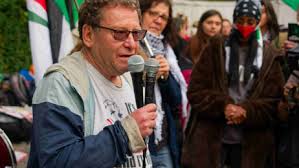
Anti-imperialist Jewish and Palestine Solidarity activist Tony Greenstein, who is being persecuted by the British police. (Photo sourced: Internet)

The aim is to create a climate of fear in which people become scared to attend even the most peaceful and routine of protests, where we censor our own slogans, placards and behaviour in order to evade the eyes of the on-line harassers and the police.

Palestine Action and Elbit

Alongside all this has run another process in which the brave participants show no fear in the way they exercise their solidarity with the Palestinian struggle.

Palestine Action was set up in 2020 by activists who were frustrated by the PSC’s lack of direct action to enforce BDS – Boycott, Divestment and Sanctions. 

Since then it has primarily targeted the British operation of Israeli arms company, Elbit Systems, as well as other companies collaborating with Elbit or are otherwise implicated in the arming of the Zionist war machine or sale of its ‘battle tested’ technology to other countries’ militaries.
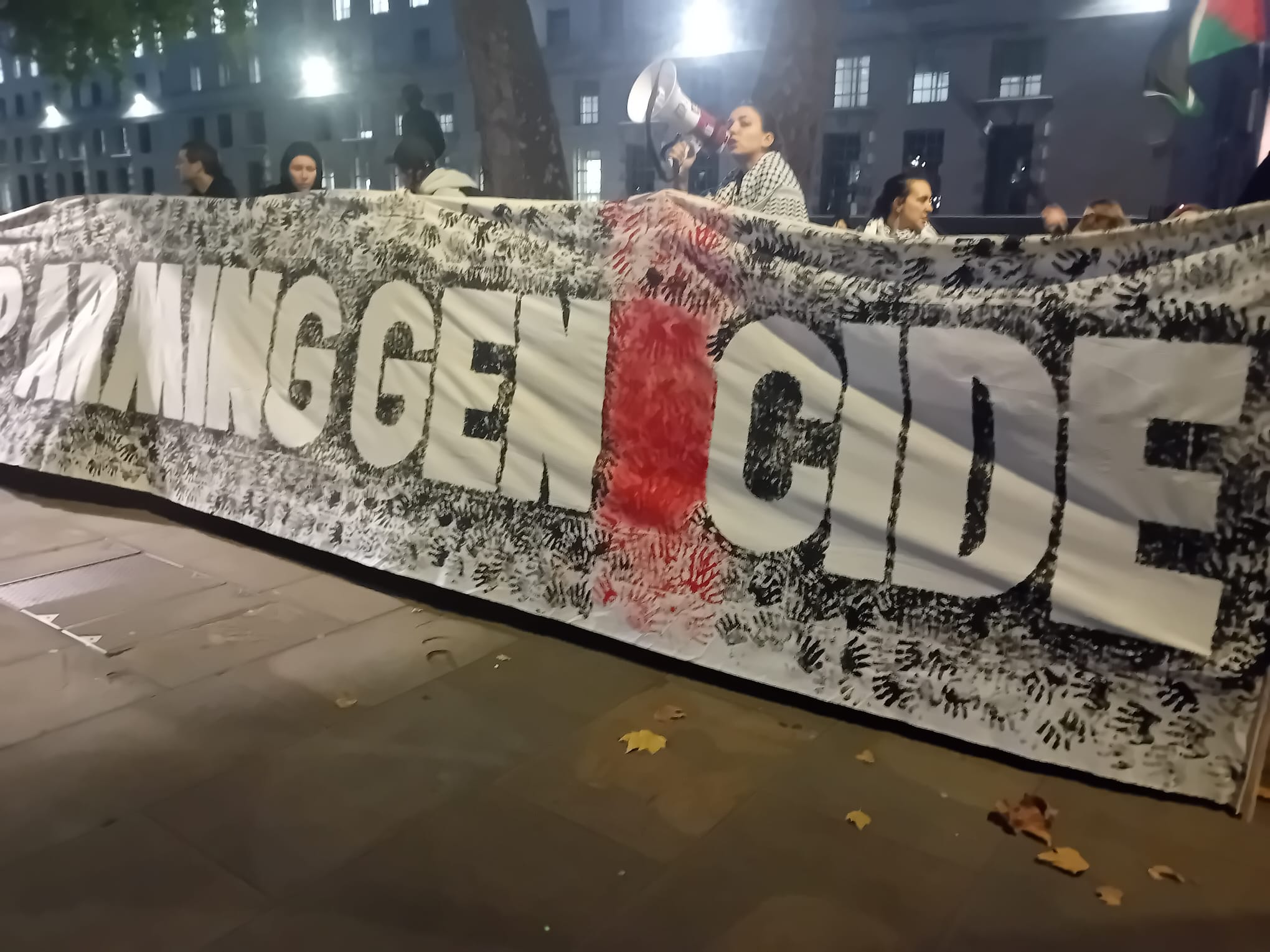
Daily Stop Arming Genocide banner outside Houses of Parliament, Westminster, London. (Source photo: Internet)

Palestine Action’s tactics mainly consist of occupations, blockades and drenching premises in red paint to symbolise the blood on the hands of these profiteering companies.

Until recently, although a lot of these actions led to arrests, very few Palestine Action activists ended up behind bars. This has changed since Keir Starmer’s Labour government came to power. There are currently 18 Palestine Action activists in prison in England, along with 2 in Scotland.

One of the Scottish prisoners is the last of the group known as the Thales 5, who were convicted of occupying the roof of the Glasgow premises of French company Thales in 2022. Thales was working with Elbit to produce Watchkeeper drones for the British military.

The prisoners in England have not been convicted and are all held on remand, having been refused bail by the courts.  The majority were arrested in relation to actions against the Filton arms factory in Bristol. Ten people were remanded in August and a further eight in November. 

Although none have been charged with terrorism offences, the TA was used to effect their arrests, allowing the police more powers to detain pre-charge, raid homes and generally act in a heavy-handed manner. 

In the latest arrests in November, flatmates and families were evicted from their homes, sometimes for several days while the police searched premises.  In one raid, the mother and younger brother of the person arrested were both handcuffed, despite not being accused of any offence.

In prison, those on remand for pro-Palestine direct action have come in for special scrutiny and additional intrusive measures on top of those which all prisoners are forced to deal with.

The six women detained in Bronzefield prison in August were all allocated to separate wings and deliberately prevented from associating with one another. Their mail has been heavily censored.

Four male prisoners in Wormwood Scrubs, although not subject to the same separation regime, have also had their correspondence held up, censored and returned to sender, with supporters being served with notices to the effect that no communication between them is permitted.

FRFI successfully appealed against such a notice in relation to our sending the paper to the prisoners, although the prison claims it still has a right to withhold the paper or other publications if the censors decide they are ‘inappropriate for a prison setting’.

The purpose of all this is clearly to scare those it is directly targeting it and to deter others from coming forward to join Palestine Action’s activities.

As Palestine Action carries out more actions against Elbit, including repeatedly blockading the UAV Engines site at Shenstone in the Midlands, which manufactures engines for Elbit, it is clear that the repression is not succeeding.

Palestine solidarity demonstration Downing Street 14 December 2024. (Source photo: Internet)

Kitson methodology

General Sir Frank Edward Kitson died on 2 January 2024, aged 97, after a long and illustrious career as a dedicated servant of British imperialism.

In addition to the litany of his war crimes, he will be remembered for authoring the text book Low Intensity Operations – Subversion, Insurgency and Peace-keeping (1971), a manual for dealing with subversive and recalcitrant populations, both at home and abroad.

Kitson’s work continues to form a central plank of British strategy for policing dissent and his disciples are clearly leading policing operations against pro-Palestine protesters.

In Kitson’s book, he details how ‘psychological operations’ should be used to isolate ‘subversives’ from the people while building links with and strengthening support for moderate elements who do not oppose the state but disagree on certain policies.

This technique was used both abroad in Britain’s colonies, and at home to police, for example, the Irish solidarity movement of the 1970s-80s.

Today’s ‘moderates’ take the form of the PSC, Stop the War and similar organisations. PSC marches are negotiated with the police, with strict conditions imposed on the protests.

The PSC has provided no support for people arrested on its demonstrations, citing the low arrest rates as proof of how respectable their protests are, while distancing itself from those who have been targeted.

While the PSC opposes Zionist massacres of the Palestinian people, it does not support the resistance of those under attack. 

Consequently it does not complain when the British police uses Terrorism Act powers to criminalise people for supporting the right of Palestinians to resist their oppressors through armed struggle.

This treachery puts the PSC on the wrong side of international law – oppressed nations successfully fought for the right to self-defence by means of armed struggle to be enshrined in UN resolutions in 1974 and 1982.

Fighting back, building solidarity

For some of us, the culture around supporting our arrested comrades was drilled into us many years ago.  A whole new generation has had to learn these lessons. 

It is positive to see that, although the PSC and such organisations continue not to want to get their hands dirty with supporting anyone targeted by the police, a different attitude is also widespread and ‘arrestee support’, prison solidarity letter-writing etc are common currency among activists. 

At the same time there is an element of this solidarity which is depoliticised. For example, the provision of a constant presence at a police station to monitor things and be there when arrestees are released is a good thing and the support organisations which provide this do an invaluable job.

However, when we have comrades under arrest, we want to do more than legal monitoring and instead turn the police station into a focus for protest.  The same with courts and prisons. 

It’s very positive to see Palestine Action, the SOAS encampment and others also doing this to great effect, thus ensuring that the focus is not just on the Israeli companies who are their principle targets, but also on the British criminal justice machinery which is being marshalled against those who take a stand.

Our task, as always, here in the belly of the imperialist beast, remains to protest against the British government and British corporations’ complicity in the Zionist genocide.

And to show unconditional solidarity with those who fight back against the Zionist war machine by whatever means are at their disposal.

Supporting the resistance and opposing the British state cannot fail to bring us into conflict with that same state and we must continue to stand alongside everyone who is criminalised for their solidarity.

End.

SOURCE

SHE SHOULD KNOW ALL ABOUT INVASIONS

Diarmuid Breatnach

(Reading time: 4 mins.)

In late November last year the UK’s Home Secretary1 referred to refugees and migrants entering Britain as “an invasion”, for which a Hollocaust survivor, 83-year-old Joan Salter, challenged her, likening her speech to that of the Nazis.

An NGO working with refugees, Freedom From Torture, posted some of the exchange on Twitter. In turn, the NGO came under pressure from the Home Office to retract the video.

This month, not only did the charity refuse but did so publicly, fully endorsing the content of the video.

Anyone would well understand the difference between invading a country and entering it as a refugee, asylum seeker or even economic migrant. Those come unarmed, fleeing to safety or trying to make a living for themselves and their family.

A minister of a British Government should be extremely well-placed to understand the distinction. After all, there is no continent and very few countries, including its near neighbours, which the British ruling class has not caused to be invaded at some time or other.2

Map of areas of the world ‘owned’ by Britain or the UK at one time (Source: Internet)

From the time the descendants of the Anglo-Saxon invaders of Celtic England merged with the descendants of the later Norman invaders, England has gone from being a major invading and colonising military and naval power to being a major imperialist one.

Imperialist action did not always end in invasion; pressure could be applied in other ways, through bribery — or open threat. The term “gunboat diplomacy” was coined to describe imperialist actions short of actual invasion and Britain was renowned for actions of that type.

The ruling class of Britain has waged war against people to take over trade routes, to colonise land and extract resources, in competition with other colonial powers, to quash resistance and even for the right to sell opium in China.

In the course of those colonial and imperialist activities, Britain has carried out many invasions. In fact, Suella’s parents themselves come from former colonies.

Braverman is a child of migrants

Suella Braverman is the daughter of parents of Indian origin who emigrated to Britain in the 1960s: Uma (née Mootien-Pillay) from Mauritius and Christie Fernandes, from Kenya. Both those countries have indeed been invaded by Britain.

Kenya in particular from 1952-1960 had one of the worst experiences of colonial treatment by the British military, including wide-scale murder, torture and rape. India and Pakistan had their infrastructure and manufacture undermined by Britain leading to regular country-wide famines.

Suella Braverman, MP, currently UK Home Secretary. (Sourced: Internet)

Suella should know about invasions, refugees and migrants but is on record as saying that the British Empire was on the whole a beneficial experience for its conquered. This is a prime example of the “slave mind” that apes the invader and wants to collaborate with it.3

Such “slave-minded” people can be even more vicious and callous in their attitudes than the conquerors themselves and Braverman certainly fills that bill. And it’s not just in occasional choice of words that Braverman nears Nazi appearance.

During Braverman’s unsuccessful campaign for selection as leader of the Conservative Party last July, she said her priorities would have included to “solve the problem of boats crossing the Channel” and “to withdraw the UK from the European Convention of Human Rights.”

In October 2022, Braverman said that she would love to see a front page of The Daily Telegraph sending asylum seekers to Rwanda4 and described it as her “dream” and “obsession.” No doubt she includes human rights and legality concerns as “all of this woke rubbish.5

A courageous NGO

Holocaust survivor Joan Salter, the woman who accused Braverman of Nazi-like speech, is the daughter of refugees from Nazi persecution who survived but endured imprisonment and hazardous journeys. She has an MBE for her work on Holocaust education.

Joan Salter, Holocaust survivor who challenged the Home Secretary. (Sourced: Internet)

In response to a Home Office accusation that the clip is only partial and therefore misleading, the NGO’s CEO Sonya Sceats pointed out the full exchange is available in video on its website and said the charity will not remove the Twitter clip.

“As an organisation providing therapy to torture survivors who feel targeted by her language and who know first-hand where such dehumanising language can lead, we will not do so. She has used language she should be ashamed of, and we won’t be pressured into helping her hide it.”

Non-Governmental Organisations nearly always rely on government funding, whether directly or indirectly and as a result tend not to rock the boat too much, in case they find their boat getting smaller or their team even being tossed overboard.

Sony Sceats, CEO of Freedom From Torture charity who stood up to the Home Secretary.

As a result, in public the CEOs of those organisations tend to vary from generally totally compliant6 to cautiously critical on certain occasions. In that context, the actions of Salter in the initial video and of the Freedom From Torture NGO in militantly backing her can only be admired.

End.

Footnotes

References

Charity refuses to delete clip of Holocaust survivor confronting UK politician (thejournal.ie)

Suella Braverman – Wikipedia

Britain Has Invaded All but 22 Countries (kottke.org)

https://www.holocaust.org.uk/joan-salter-profile

1This is the UK’s equivalent to Minister for Home Affairs, these days normally restricted to Britain (i.e excluding the colony in Ireland) and in particular England and Wales (i.e often excluding even Scotland).

2Britain Has Invaded All but 22 Countries (kottke.org)

3The concept of the ‘slave mind’ or ‘colonised mind’ has been addressed by a number of writers on national liberation, notably Patrick Pearse (1879-1916) from Ireland and Franz Fanon (1925-1961) from Martinique.

4That plan has been condemned by many human and civil rights organisations and also denounced as illegal.

5A quote dating from her attempt at Leader of the Conservative Party.

6Or actually collusive.

A FOOTBALLER AND RACISM WITHOUT COLOUR

Diarmuid Breatnach

(Reading time main text: 10 mins.)

Current media news reports quote James McClean, a player for the English Football League club Stoke City and for the soccer team of the Irish State1, protesting against being subjected to anti-Irish racism and his wife Erin also, not so much on her own behalf but in consideration of her three children. McClean points out that while other kinds of discrimination are rightly opposed, anti-Irish racism goes largely ignored by British society and by the football profession. Despite its existence for 800 years and its persistence today, anti-Irish racism has long been neglected in the study of racism and the struggle against it.

James MacClean, who comes from Derry, has been made a controversial figure by his refusal to comply with the expectation that he wear a Remembrance Poppy, which he correctly sees as a promotional emblem for the British Army. As a result he has been subjected to sectarian Loyalist abuse and anti-Irish abuse targeting him and his family.

Erin and husband and footballer James MacClean, enjoying a social occasion. They have been harassed by anti-Irish racism and threats to them and to their children. (Photo source: Internet)

The origins of anti-Irish racism can be traced back to the writings of Anglo-Norman Gerald of Wales (Giraldus Cambrensis) in the latter half of the 12th Century. Coming from a background of Norman feudal culture and a comparatively recent history of conquest of large parts of Celtic and Saxon Britain2, Gerald found little to admire in Gaelic culture3 or society and much to deride. The feudal Norman visitors were encountering a culture of clan ownership of land, of election of clan leaders and greater kings who might not be first-born, of a Christian clergy that was not celibate and in which women could own their own property before, during and after marriage with the right to divorce. A culture shock indeed.

The writings of Gerald helped justify the 1169 opportunistic invasion of Ireland at the invitation of a resentful overthrown Irish king. With that beachhead well-established and the Irish Vikings of Dublin evicted by Richard de Clare, “Strongbow” in 1170, anti-Irish racism served to justify the official invasion of Henry in 1171 backed up by the authorisation of Pope Adrian IV with the Papal Bull Laudabiliter, a 1155 letter of ecclesiastic authorisation, to bring the semi-independent Irish church to the Gregorian Reforms.4

Despite the early scorn and distaste of the Norman invaders for Irish culture, within less than two centuries they were becoming integrated with it to such an extent as to cause alarm among the English Normans. The latter drafted a number of laws forbidding elements of that integration, the most infamous being the Statutes of Kilkenny in 1366, forbidding the Irish Normans from adopting native Irish customs, forms of dress and use of the Irish language; they had become “more Irish than the Irish themselves”, their critics in England complained. Inside the “Pale”, the central enclosures of the occupiers’ power, the Statutes could be enforced but not outside and so Ireland remained essentially Gaelic in culture, with some cultural transference from the Normans.

Control of Irish territory breakdown 1450 (Image sourced: Internet)

For the conquest to be secure, Ireland needed to be conquered entirely and plantations of people seemed the way to achieve this: send in settlers, give them expropriated land which they they would have to defend. This was the approach of the Tudor monarchs of England and to a requirement that the settlers would be English-speaking they added the new religion, that of the Protestant Reformation. Settlements had to be capable of defence5 and no “mere Irish” should be employed.

Dispossession, plantation and oppression continued through the 17th Century under Cromwell and King William and through the Penal Laws thereafter up to the 19th.

Land distribution in ireland after the Cromwellian Resettlement Act 1652 (Image sourced: Internet)

The native Irish (Gael) and now also the Norman Irish (Gall-Ghael) were the enemy surrounding these settlements outside the Pale, they had been dispossessed and would no doubt recover their lands and their sovereignty if given the chance. And they were by far the majority. Justification for conquest and dispossession required an appropriate ideology and this was found in the assumed superiority of the occupiers’ religions, language, culture and polities. And the natural corollary to that was an ascribed inferiority to everything among the natives: language, religion, cultural habits and mores, dress … Naturally practical physical measures were required also: oppression, discrimination and repression of resistance.

The Irish were characterised as savage, child-like, emotional, untrustworthy (they agreed to treaties when beaten but broke them later6), superstitious, violent (they kept resisting the lawful authority or even uprising), drunkards, dirty ….

Following the scientific breakthrough of Darwinism came “Social Darwinism” and some Victorian pseudo-anthropologists placed the Irish as a Celtic Iberian race below the Teutonic (with which of course they identified the English) but above the “African Hottentot”. The Irish and Latin “races” were described as of “feminine” nature: emotional, weak, charming at times, unintelligent, needing to be controlled; while the “masculine” Anglo-Teutonic “races” were strong, measured, logical and obviously the right ones to be in control.

Éire struggling with Famine, which was in reality an imposed holocaust — while the irish starved, due to a blight on their staple food of potato, their other products were collected for rent and left Ireland in ships for Britain. (Image sourced: Internet)

Irish uprisings increased the sense of insecurity of the conquerors and occupiers and intensified their efforts to justify their oppression and repression of the Irish so that Victorian Britain during Fenian campaigns churned out jokes against the Irish, along with nasty tales and horrible caricatures in popular newspapers. But not just popular newspapers: as the Irish starved in the Great Hunger of the mid-19th Century while their produce fed the British industrial revolution, the London Times, newspaper of record for the British ruling class, exulted in an editorial that the the Irish (survivors) were leaving and that soon an Irishman would be as rare in Ireland as the American Indians on the North-East Coast of the USA.

“The Irish Frankenstein” (sic) 1882, popular Punch magazine (Image sourced: Wikipedia)
Anti-Eviction Rally in they Land War, 1850 (Image sourced: Internet)

EXPORTING ANTI-IRISH RACISM

Not surprisingly, a central ideology such as anti-Irish racism accompanied the British wherever they went, despite the number of Irish in their armies and administrative layers. Boston, Massachusetts was particularly known for ant-Irish prejudice and discrimination and that may explain why the Irish community there was reportedly so clannish and defending its hard-won turf against all comers, including unfortunately competition from those considered even lower than the Irish, African Americans7. The anti-Irish ideology made itself felt in the white-ruled colonies, later Dominions of Australia, New Zealand and Canada too.

A common enough sign in Britain and white settler British dominions during certain periods (Image sourced: Internet)

A strange case of the dissemination of this virus was its export to Scotland, a nation although of Celtic origin, heavily settled by Normans and Saxons, and incorporated into the United Kingdom in 1707. This was in particular of Ulster origin and took the form of anti-Catholicism. The English occupation had consciously stirred up religious sectarianism in the 1790s in order to break up the growing unity of Protestant Irish of various backgrounds with the Catholic vast majority which was framed in a republican project for greater independence. An important part of that subversion was the creation of the Orange Order in Loughgall in 1795, which became active in helping to suppress the United Irishmen uprising of 1798 and especially in repression afterwards, both against Republican Protestants and Catholics in general. As the Republican element among the Protestants decreased dramatically due to repression and emigration, the Order concentrated almost exclusively on oppression of Catholics and repression of resistance, a role it plays to this day.

But with the decline of the Ulster weaving industry in particular due to Ireland entering the UK in 1801 and British preferential treatment of their own production, many Ulster emigrants came to Scotland and were in competition for work, with the Orange Order being used to infect the already widely Protestant Scottish society against the Catholics which meant essentially, against the Irish. That has continued to this day (see References) and finds its expression in an often violent rivalry for example between soccer football teams of “Catholic” and “Protestant” background8, in Orange marches celebrating the victories of King William in Ireland and in discrimination in other areas such as policing too.

ANTI-IRISH RACISM IN THE 20th AND 21st CENTURIES

Anti-Irish racism was whipped up again during the 1916 Easter Rising and Irish war of Independence (1919-1921), and not just against the Irish in Ireland but against the Irish in Britain, in the USA9 and in Australia10. It raised its ugly head (and bared its teeth) again during WW2 (inflamed by the IRA campaign in Britain and Irish state neutrality) and again during the recent 30 years’ war.

An allegedly common lodging house sign in Britain, the existence of which is now disputed. What is beyond doubt is that those three exclusions (and of children) were advertised though not all necessarily all together. (Image sourced: Internet)

In the 1970s anti-Irish articles, jokes and cartoons abounded in the British press and to this ideological offensive was added the 1971 weekly program of The Comedians (“stand up comedians”), of which a huge proportion of their material was anti-Irish racism, depicting the Irish in particular as stupid. I was London myself during that period and remember that a “comedian” only had to say “There was this Paddy on a building site” and the audience would be already laughing. Bernard Manning was the most infamous of those but there were many, many others.

Bernard Manning, perhaps chief among a long line of British racist comedians. (Image sourced: Internet)
Perhaps a better aspect of Bernard Manning (Image sourced: Find a Grave)

Those jokes and others were repeated not only by comperes and club comedians but of course also at work, in school, at college and in universities. They represented a deeply degrading ideological offensive on a cultural level against the whole Irish community.

Apart from the Comedians TV program, a number of media personalities made racist jokes about or references to the Irish without any apology from the media or repercussions from their employers. Angus Deaton, for a long time presenter of Have I Got News For You, the popular British TV comedy news and current affairs commentary show, made a joke about the Irish (although participant Paul Merton, who said his mother was Irish, riposted brilliantly). Caroline Aherne, a comedienne who brilliantly played the biting chat-show character “Mrs. Merton”, was one of the few to speak out publicly against the racist “humour” but both her parents were Irish. Billy Connolly, Scottish comedian of Catholic Irish background, while discussing comedy, admitted to having told an anti-irish joke once when feeling lonely on stage, which he regretted. To the urbane Irish presenter Terry Wogan’s great credit while judging a popular British TV talent show, he declared anti-Irish jokes were not funny.

1974 saw the introduction of the Prevention of Terrorism (sic) Act and the framing and incarceration of two score innocent Irish people. Apart from raids on homes, spurious arrests without warrants, detention without charge and oppressive interrogations, thousands were questioned at ports and airports, often made to miss their flights at the latter. Though the charges falsely alleged involvement in “terrorist acts” the basis was Irishness, in a way very reminiscent to “Muslim” being considered sufficient justification today.

James MacClean playing for his club, Stoke City. (Photo credit: Northern Echo)

“INVISIBLE” RACISM

If a good working definition of racism is “discrimination against and disparaging of another ethnic group from a position of power”, then the Irish should have had no problems in gaining recognition as being racially oppressed and discriminated against. However, so many insisted that the Irish could not qualify because they were “white”. But in fact there already existed a “white” ethnic group which was widely acknowledge as having been discriminated against for centuries – the Jews. That however was explained by some as being a “religious discrimination” at root and not “racism”. The basic fact of the matter was and is that it did not suit the British ruling class or their intelligentsia to admit to anti-Irish racism – and not just because of guilt but for very practical reasons: they are still in conquest-occupation of nearly one-fifth of Irish territory. And the Irish diaspora is the oldest ethnic minority in Britain as well as, until recently perhaps, the largest11.

Cover of memoir by John Lydon, aka Johnny Rotten, lead singer of the punk band Sex Pistols. Lydon was of irish descent growing up in North London. (Image sourced: Internet)

The British Left, the leading parts of which have either gained access to management of the British State or aspire to do so, for the most part have denied or minimalised anti-Irish racism. It took Liz Curtis to put together a popular illustrated booklet on anti-Irish racism and the Irish in Britain Representation Group, founded in 1981 to campaign against it. The IBRG made official complaints to and about the media and picketed WH Smiths12 until they stopped selling “Irish mugs” with the handle inside. While supporting general equality, the IBRG made complaints to local authorities about racist measures that impacted upon the Irish and sought to have an Irish ethnicity identification choice in the British Census, which was eventually successful.13 An approach of theirs to the GLC convinced the Council, under the leadership of Ken Livingstone, to withdraw all their advertising from the London Evening Standard until the latter apologised for publishing an anti-Irish racist cartoon. The Editor refused to apologise and never again received any advertising from the GLC14, at a revenue loss to the newspaper estimated at £2 million.

Mostly the Irish community fought the racism on their own, without the support of most of the British Left or the liberal-social-democratic elements. Even after the 1965 Race Relations Act the widespread feeling was that whether one was for or against the Act, it did not apply to the Irish. The Act specifically excluded shops and boarding houses (i.e places where notices declaring “No Blacks, No Dogs, No Irish”) were widespread but they were included in the 1968 Act15. The 1976 Act was more comprehensive but the assumption of inapplicability to the Irish continued. It appears that it was not until the Killian case against the British pharmaceutical retail chain Boots in 1989 that an Irish person was successful in taking a case for discrimination16 under the 1976 Act.

James McClean for Ireland in International friendly match against Bulgaria at Aviva Stadium, Dublin, September 2019. (Photo credit: Seb Daly/Sportsfile via Getty Images)

The anti-Irish racist offensive mostly petered out at the end of the 1990s but flared up again in the British media during the whole Brexit saga. In 2015 Jeremy Clarkson flew into a rage with an Irish co-producer of the Top Gear show, abused him racially and punched him in the mouth. It is a virus or bacteria living deep in the British mainstream psyche; it recedes at times only to be reactivated whenever the British ruling class — or sections of the chattering class — perceive that the Irish are not acting in the best interests of Britain, whatever they perceive those to be.

End.

FOOTNOTES

1In the world of soccer football, there are two “national” teams competing for the championships: “Republic of Ireland” and “Northern Ireland”, a clear example of intrusion of politics into sport, for Ireland is one country and was recognised as such even by the English invaders (the inventors of soccer) from 1169 until they partitioned the country in 1921. Thus what is mostly recognised as the Irish national team has to compete against another team from a part of its own country in order to progress in championships!

2England suffered a Norman invasion in 1066 which gradually extended over the whole of Britain, the south-east of which had been already conquered by the Saxons.

3He admired Gaelic decorative art as expressed in illuminated manuscripts and harp-playing, describing them as “the work of angels”, almost expressing incredulity that they could have come from Gaelic culture. It is unlikely that he learned the Irish language, perhaps conversing with natives through the medium of Latin or an interpreter.

4The Gaels, who earlier had a pantheistic religion moderated by the druidic order, had been largely Christian by the 5th Century; furthermore the transition to Christianity in Ireland was not imposed by conquest and appears to have been largely voluntary; in addition the Christian monks recorded a great many of the pre-Christian myths and legends. During the Early Middle Ages the Irish Church sent out missionaries to many parts of Europe, establishing monasteries similar to universities as far away as Asia Minor.

5Hence the layout of triangle, square or diamond town centres of settler origin in Ireland, rather than native layout of lines of housing following road or river crossing and backing up behind, or congregating around harbour, fort or monastery. See also the design of even the small Protestant churches which look built to be used as forts, with strong doors and narrow windows, some even like arrow-slits.

6Compare this with the long history of conquerors, certainly including the English, repeatedly violating treaties they had made when victorious!

7Of course Boston was far from being the only US City where anti-black racism was the norm in Irish communities but it was perhaps the worst. Of course Irish anti-slavery, labour and civil rights workers also existed, some of them very prominent in their field.

8e.g supporters of Glasgow Celtic v. Rangers, of Hibernians v. Heart of Midlothian in Edinburgh.

9The British intelligence services were well aware that the Irish insurgency was receiving substantial concrete and moral assistance from the Irish diaspora in the USA.

10It had existed there before from in particular English settlers but reached hysterical proportions when two attempts to impose conscription in WW1 through referendum – because they feared to impose it otherwise – failed, a fact which was attributed by many to the Irish element in the (white) Australian electorate.

11Certainly the largest national diaspora

12 British equivalent of Easons in Ireland

132001; the opposition did not come from the British establishment alone but also from middle-class black activists keen to keep anti-racism as their preserve solely.

14The GLC was abolished by the Thatcher Government in 1985.

15Which was not applicable in the Six Counties, despite being a part of the UK

16 As in the early successful cases where the complainant was Irish, it was about discrimination in employment; later there were many about abuse at point of service as well of as employee.

REFERENCES AND FURTHER READING

General history of Anti-Irish Racism
Nothing But the Same Old Story: Roots of Anti-Irish Racism, Liz Curtis, (1984) GLC; 1996 Sásta reprint)

Apes and Angels: The Irishman in Victorian Caricature, L. Perry Curtis (1971, republished 1996 by Smithsonian DC

Ireland: The Propaganda War ; the British Media and the Battle for Hearts and Minds, Liz Curtis, (1984) Pluto Press; 1998 Sásta update and reprint)

The Irish Community – diversity, disadvantage and discrimination, Bronwen Walter, 1999 https://www.runnymedetrust.org/bgIrishCommunity.html

Anti-Irish Sentiment in Modern Britain: https://theyorkhistorian.com/2018/03/18/anti-irish-sentiment-in-modern-britain/

Snippets across the centuries: https://sheelanagigcomedienne.wordpress.com/anti-irish-racism/

Swift, Roger and Sheridan Gilley, The Irish in Britain, 1815-1939. London: Pinter, 1989.

Swift, Roger and Sheridan Gilley, The Irish in the Victorian City. London: Dover, 1985.

The use of the ‘cartoonist’s armoury’ in manipulating public opinion: anti-Irish imagery in 19th century British and American periodicals: https://www.jstor.org/stable/41932626?seq=1

A very rare occasion when a letter of mine was published by the Irish Times:
https://www.irishtimes.com/opinion/letters/anti-irish-racism-in-britain-1.4188132

MORE RECENT OCCURRENCES FROM PROMINENT BRITISH COMMENTATORS

2005 — comment on decades of anti-Irishness in the Daily Mail: https://www.independent.ie/irish-news/anti-irish-newspaper-plans-to-launch-edition-here-26213160.html

Jeremy Clarkson and anti-Irish racism: http://littleatoms.com/society/jeremy-clarkson-and-being-lazy-irish-britain

Daily Mail, 2017: https://www.irishtimes.com/culture/art-and-design/apes-psychos-alcos-how-british-cartoonists-depict-the-irish-1.3149409

Julie Burchill, 2018: https://london.eater.com/2018/1/26/16933806/julie-burchill-anti-irish-sentiment-nuala-es-mag-restaurant-review

John Cleese: https://www.irishtimes.com/culture/john-cleese-has-a-faulty-sense-of-humour-about-the-irish-1.4294487?mode=sample&auth-failed=1&pw-origin=https%3A%2F%2Fwww.irishtimes.com%2Fculture%2Fjohn-cleese-has-a-faulty-sense-of-humour-about-the-irish-1.4294487

Tony Abbot, leader of Australian Liberal Party at the time (2011): https://theconversation.com/the-problem-with-jokes-about-irishmen-2370

CAMPAIGNING AGAINST ANTI-IRISH RACISM

James McClean and wife Erin speak out against threats and anti-Irish comments received by them and against their children: https://www.forbes.com/sites/mikemeehallwood/2021/02/15/anti-irish-racism-condemned-as-james-mccleans-wife-shares-social-media-threats-against-their-children/

A year-by-year record of many activities of the IBRG, regular campaigner against anti-Irish racism: https://lipsticksocialist.wordpress.com

Battle to have an Irish category in the British census: https://link.springer.com/chapter/10.1007/978-3-319-20095-8_7, Chap 7.2, paragraph 2.

GLC banning adverts over anti-Irish cartoon in the London Evening Standard: https://books.google.ie/books?id=fVcGDAAAQBAJ&pg=PT94&lpg=PT94&dq=GLC+ban+on+advertising+evening+standard&source

Asian man who won first successful case against racial discrimination in Britain mentions anti-Irish racism: https://eachother.org.uk/racism-1960s-britain/

British media racist cartoonist JAK: https://en.wikipedia.org/wiki/Raymond_Jackson

1977 comment: https://www.irishtimes.com/news/irish-suffering-in-britain-is-more-than-just-racist-jokes-1.85448

Exclusion of the irish from the anti-racism mainstream paradigm: https://discoversociety.org/2019/03/06/is-anti-irish-racism-still-a-problem-you-can-bank-on-it/

Commenting on anti-Irish Racism in Scotland

James MacMillan: https://www.heraldscotland.com/news/12398473.composer-celtic-fans-should-feel-free-to-sing-republican-songs-james-macmillan-claims-sectarianism-rules-out-pride-in-irish-roots/

Neil Lennon: https://www.theguardian.com/football/2018/nov/02/neil-lennon-sectarianism-racism-hibernian-scotland

TFN: https://tfn.scot/news/anti-irish-racism-is-rife-in-scotland

Event against anti-Irish racism in Scotland cancelled after threats: https://www.thetimes.co.uk/article/anti-irish-racism-event-cancelled-as-venue-receives-threats-of-violence-k2wdjxl3z