Trump, Ramaphosa and White Power

Gearóid Ó Loingsigh (reprinted intact from his substack and reformatted for Rebel Breeze)

(Reading time: 5 mins.)

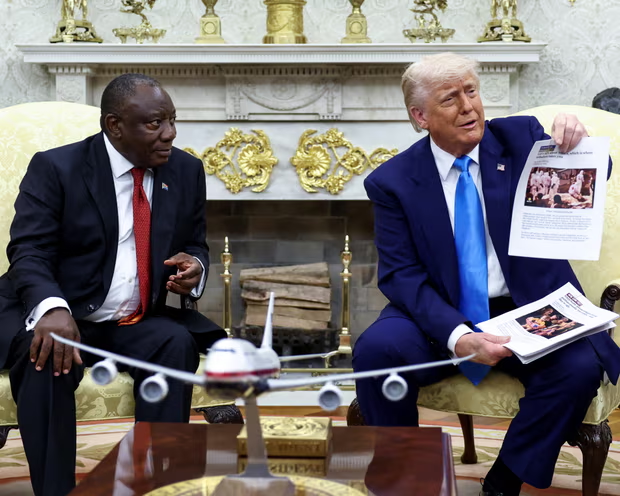
Once more Trump has acted like the lunatic he is and ambushed the president of South Africa, Cyril Ramaphosa, stating that the country was undergoing a real genocide of whites.

Many have commented on the effrontery of Trump to talk of a fictitious genocide of whites in South Africa, whilst his main ally Israel is carrying out one in real time every day on the news shows.

Trump used images from the Democratic Republic of Congo, a country more than 4,500 kilometres away, to show that they were killing whites in South Africa.

Trump also lied about the land question in the country, accusing the government of stealing the whites’ lands when the reality is that the whites continue to be the owners of the greatest part of the land in the country.

It is worth saying that Ramaphosa defended himself partially, and only partially as behind the new legislation on the matter there is the hidden failure of the peace process when it comes to resolving the land question.

When the Apartheid regime was ended, the country was one of the most unequal on the planet and the whites were the owners of the greatest part of the agricultural lands. Around 60,000 whites were the owners of 86% of all the agricultural lands, some 82 million hectares.[1] 

The agrarian reform proposed by the ANC in its White Paper of 1997 was a market-driven reform, i.e. the voluntary sale and purchase with some help from the government without the government being a buyer.[2] Blacks could also ask for the restitution of lands stolen by racist laws since 1913.

A whole land bureaucracy was set up, not unlike what Colombia has, Land Claims Courts where all those who registered could make their case with three possible outcomes, the restitution of the land, the handover of alternative land or a financial compensation.

In 1992, the ANC had put forward a document in which they argued for the expropriation of lands and other non-land market mechanisms. But by 1997 they had accepted neoliberal discourse and adopted the land market as the cornerstone of their policy.[3]

Initially the ANC government had proposed handing over 30% of the agricultural lands held by whites to blacks within five years. But they kept postponing it.

By March 2011, they had handed over 6.27 million hectares, and of that 45% was not agrarian reform, properly speaking, but rather land restitution.[4] The government didn’t just fail regarding land, but on everything. Inequality rose since the fall of Apartheid.

The Gini[5] rose following the end of Apartheid in 1994 and now is situated in 0,67 making it the most unequal country on the planet in terms of income, where just 3,500 people own 15% of all the wealth of the country.[6] 

SA President Ramaphosa looks on while US President ambushes him publicly with alleged ‘evidence’ of persecution of white people in S. Africa (Photo cred: Kevin Lamarque Reuters)

There is also a high concentration of land. “Currently 72% of farms and agricultural holdings are owned by white individuals, who make up 7.3% of the population, while black Africans, constituting 81.4% of the population, own only 4% of the land.”[7]

The whites continue to be the owners of the land, the black middle class through Black Economic Empowerment programmes reached agreements with those whites and the companies in the agricultural sector to integrate themselves into the neoliberal economy.

This is the so-called ‘white capitalism’ and South Africa became a leading country in the agribusiness sector of the continent. In 2015, of the 10 largest agribusiness companies on the continent, eight were South African.[8]

Ramaphosa himself is an excellent example of the new South African businessmen, the former fighters against capitalism who now profit from the blood and sweat of those who were once the grassroots militants of the organisations they led.

Between 1994 and 1998 he acquired a portfolio of more than 40 million Rand[9] (some 8 million dollars at the time) and ended up as an extremely wealthy man (some 700 million dollars) thanks to his controversial investments and acquisitions in the mining sector.

Ramaphosa is also the owner of the McDonalds franchise in the country. The former leader of the National Union of Mineworkers became a magnate in the sector.

In 2013 the Police murdered 34 miners in the midst of a strike at Lonmin, one of the companies where he was a director, being the owner of 9.1% of the company. [10] 
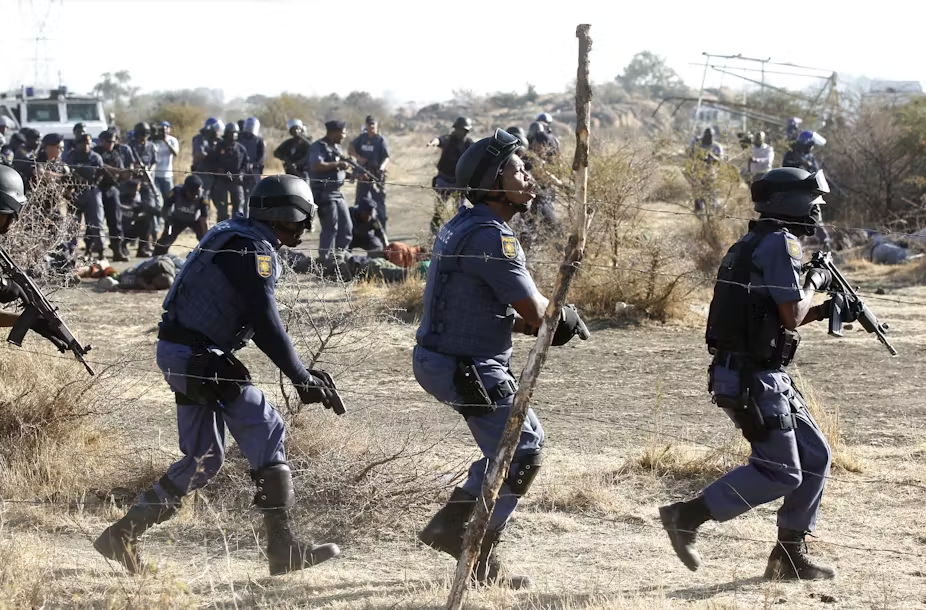
South African police move forward to kill more striking miners at Lonmin 2012 while in background other police stand over miners killed already(Photo cred: Sephiwe Lebeko/ Reuters)

And just like in the times of Apartheid, the Farlam Commission, those charged with investigating the Marikana Massacre found nobody guilty. Nobody! Blood is washed from the hands of a black capitalist just as easy from those of a white capitalist.

When he took over the presidency of the country, there hadn’t been any great advances made regarding agrarian reform there. The failure to meet the promises of the transition and the political programme of the ANC cost them electoral support.

So much so that they now govern the black masses with the support of a white party, the Democratic Alliance, a right-wing party that strongly opposes any expropriation of land without compensation and in practice is opposed to any great change in land policy.

It is in this context that Ramaphosa launched his new campaign and new land law. The ANC say they want to implement the Freedom Charter, but it is not so. Mandela himself had discounted that in his speech to Davos.[11] 

He didn’t explicitly refer to the document but he never again spoke of the nationalisation of resources such as mines and land.

Ramaphosa’s law proposes various measures that already exist in almost all capitalist countries, the expropriation of property with compensation for public purposes or where there is a public interest i.e. the compulsory purchase or as they say in the USA, the heart of capitalism, eminent domain.

These norms exist in almost the entire world. As is the case in many capitalist countries, it also includes elements to reduce the amount of compensation or not pay it.

It is another thing to believe that Ramaphosa aims to do what the ANC never wanted to since the first government. He does not want to fight with so-called white capitalism as he knows that so-called black capitalism is the same thing and one depends on the other.

What Ramaphosa is about is a public relations manoeuvre to strengthen a weakened and discredited ANC. There will almost certainly be more such initiatives. But the ghosts of Marikana tell us that this traitor has no intention of doing anything for the black masses.

Trump talks of a genocide that only exists in the sick mind of Elon Musk and of a land theft that Ramaphosa does not want. If he steals the whites’ lands, who will he sip cognac with then? White power is still in control of South Africa.

It dominates the economy in alliance with the not so new black bourgeoisie, the black apparatchiks that control the scaffolding of the state, and the growing presence of foreign capital.

We all recognise Trump as the enemy and idiot that he is. The problem is that sometimes we acknowledge those he attacks as friends when in reality they are the same enemies, except some are more intelligent, cultured and refined.

Ramaphosa when he was a trade union leader said “There is no such thing as the liberal bourgeois. They are all the same. They use fascist methods to destroy workers’ lives.”[12]

Workers’ blood is washed from the hands of all the capitalists, blacks, whites, Russians, Arabs or Yanks: Ramaphosa in Marikana or Trump everywhere. The whites in South Africa, the Elon Musks have no reason to fear their friend Ramaphosa, despite the stupidities from Trump.

End.

NB: For more articles by Gearóid see https://gearoidloingsigh.substack.com

NOTES

[1] Lahiff, E. & Li, G. (2012) Land Redistribution in South Africa: A Critical Review. WB.p.3 https://openknowledge.worldbank.org/server/api/core/bitstreams/28ccc35a-31cd-58ba8d0e-1b65b74b275c/content

[2] Ibíd., p.5

[3] Ibíd., p.8

[4] Ibíd., p.9

[5] The Gini is a measure of inequality where 0 = absolute equality and 1 = absolute inequality.

[6] Valodia, I (2023) South Africa can’t crack the inequality curse. Why and what can be done. https://actsa.org/the-facts-land-reform-in-south-africa/

[7] Actsa (19/02/2025) The Facts: Land Reform in South Africa. https://actsa.org/the-facts-land-reform-in-south-africa/

[8] See ACB (2015) Africa an El Dorado for South Africa’s Agribusiness Giants. https://safsc.org.za/wp-content/uploads/2015/09/SA-Agribusiness.pdf

[9] Bond, Patrick (2000) Elite Transition: From Apartheid to Neoliberalism in South Africa, London & South Africa, Pluto Press and UNP, End Note No. 7, Chapter 2 page 266.

[10] The documentary Miners Shot Down can be seen at https://www.youtube.com/watch

[11] See https://www.weforum.org/stories/2013/12/nelson-mandelas-address-to-davos-1992/

[12] Cited in Miners Shot Down.

LEGACY OF MANDELA AND THE ANC – A BROKEN SOCIETY

News & Views No. 14   Diarmuid Breatnach

(Reading time: 6 mins.)

We need to be careful when elevating people from our ranks to the status of heroes – especially if they are alive and can renounce or betray the principles they originally fought for.1

And we have the right to be suspicious when those heroes are also acclaimed by the capitalists and imperialists, those who are certainly not our friends. But most of all, it is by their fruits that we can best evaluate people, whatever their past actions.

The society bequeathed after years of heroic struggle to the South African masses is broken. Housing and homelessness crisis,2 unemployment, poverty,3 prostitution, lack of medical care, inadequate sanitation and soaring crime, including violent crime – is not what the people fought for.

And this is occurring in a country rich in natural resources4 which are being extracted daily by imperialism, while the few on top — the earlier white settler bosses now joined by the corrupt black bourgeoisie – live in luxury.

(Image sourced: Research Gate)

CRIME & POLICING

Anton Koen, a former police officer who now runs a private security firm that specialises in tracking and recovering hijacked and stolen vehicles believes that “It’s not getting better, it is getting worse”, with the murder rate the highest it’s been in 20 years.

(Photo cred: AP)

In crime-ridden societies, the poor suffer the most and are of course also recruited into crime.

There were 27,494 killings in South Africa in the year to February 2023, compared with 16,213 in 2012-2013. South Africa’s homicide rate in 2022-2023 was 45 per 100,000 people, compared with a rate of 6.3 in the US and around one in most European countries.

Those who can afford it, hire private security, which is a booming business with South Africa’s security industry — one of the largest in the world, with more than 2.7 million registered private security officers registered in the country, according to the regulating agency, the PSIRA.5

People with money make up a very small percentage of South Africa, said Chad Thomas, an organised crime expert who has worked more than 30 years in police work and now in private security.6

That means that the vast majority of South Africans don’t really benefit from this security industry … If you live in a traditional township environment, or if you live in an informal settlement …7 security patrols in those areas are few and far between because they don’t have paying customers.”

Thomas, like many, ties the high levels of violent crime in South Africa to anger over the country’s deep problems of poverty.8

Private security companies are paid a monthly fee to patrol neighbourhoods and for providing armed response to their clients’ alarm systems. Tracking and car recovery can be part of the service, often resulting in getting involved in high-speed chases of car thieves and hijackers.

According to the PSIRA, the number of security businesses in South Africa grew by 43 per cent in the past decade, while the number of registered security officers has increased by 44 per cent. Meanwhile there are 150,000 police officers for the country’s 62 million people.

It is hardly surprising that the SA police force has difficulty in recruiting numbers. It is a force used to violently repress people9 and culpable in the worst massacre of working people in South Africa’s modern history, killing 40 striking miners over a couple of days.

That slaughter occurred in 2012 at the British-owned Lonmin platinum mine in Marikana, when miners wished create a new union and to leave the National Union of Mineworkers which, they said, was more in favour of their employers than the workers.10

Cyril Ramaphosa, the millionaire ex-President of the NUM was widely suspected of having organised the massacre and he’s now President of the ANC and of the South African Government. At the time, Jacob Zuma was President, now in the process of being tried for financial corruption.

But Mandela was still alive and at liberty when the massacre occurred and did not condemn the atrocity nor those responsible. Long-time anti-apartheid campaigner (and Mandela’s friend) Bishop Tutu once famously commented that “The ANC stopped the gravy train – long enough to get on it.”11

IMPORTANT

Is it important whether this person or that were truly the heroes they are reputed to have been? I think it is, not only because we tend to erect them as models for our behaviour but also because their lives and their choices present us with historical lessons.

The South African regime during the struggle was a white European settler state and like all of those, undemocratic and racist too. The masses rose up several times against it but people did not risk beatings, torture, imprisonment and death merely for the right to vote.

The struggles were so strong and the minority settler regime so emphatically opposed to reforms that its imperialist partners felt it vulnerable to revolution. They eventually convinced the regime to enfranchise the majority black population.

But what if the black masses went on kick out the imperialists?

The change had to be managed and the leadership of the ANC, the NUM and the Communist Party of South Africa proved willing to control their supporters. However, something else was needed, as in similar circumstances: a known face, a hero, to be the figurehead before the masses.

Representative of USA, chief imperialist country and Nelson Mandela after latter’s release.

Mandela proved to be that man, not only for his long imprisonment for guerrilla action but because he had been tested among the political prisoners on Roben Island and was judged the most suitable, so he had been separated from the other political prisoners to a new jail for grooming.

Mandela, after a huge publicity buildup around the world, was released in 1990 and began a series of negotiations with the settler minority’s leadership. In 1994, with universal suffrage, Mandela was easily elected head of the ANC and of the new government of South Africa.

Of the wave of pacification processes that swept around the world starting in the very early 90s with Al Fatah in Palestine, the South African process turned out to be the only one that delivered any of the objectives of what was promised12 — and that was the vote for everyone.

But it had the potential beyond that gain: of national liberation, the possession of all its natural resources and of a progressive social order, a beacon for the rest of Africa. It was important for imperialism to prevent all that and, with the help of the leaders of the ANC, NUM and CPSA, they did so.

The immediate result was a drop even further in the standard of living of the masses and an increase in the rapacious grip of imperialism on the natural resources, while municipal services declined further and crime at the bottom took off, matching corruption at the top.

The broken society there now is the cumulative result and should serve as a lesson about pacification processes, negotiations during struggle and our choices of heroes – or those chosen for us.

End.

FOOTNOTES

1As we in Ireland can testify, with the lionisation of Michael Collins, for example, for his role in the War of Independence (1919-1921) but who, a little later, acted on behalf of the Irish colonial bourgeoisie and their British masters to launch the Civil War (1922-1923) to prevent the establishment of a 32-County Republic.

2https://www.monitor.co.ug/uganda/news/fire-engulfs-illegal-housing-block-killing-73-in-south-africa-4353926

3 As of 2023, around 18.2 million people in South Africa are living in extreme poverty, with the poverty threshold at1.90 U.S. dollars daily (see Statista in Sources & References).

4See Sources & References

5The Private Security Industry Regulatory Agency.

6https://www.breakingnews.ie/world/private-security-firms-fill-void-in-crime-riddled-south-africa-1572546.html

7Ibid.

8Ibid.

9For examples see series of articles in https://www.saferspaces.org.za/understand/entry/police-brutality-in-south-africa

10It was notable that those popular organisations deeply implicated in pacification processes either reported with great restraint on the massacre or failed, like the Left-Nationalist Basque trade union LAB, to comment on it at all (to say nothing of sending a solidarity message to the striking workers or denouncing the State).

11https://www.independent.co.uk/news/world/anc-boards-the-gravy-train-john-carlin-in-johannesburg-on-the-underdogs-who-have-become-fat-cats-in-a-few-months-1379001.html

12For example Palestine, Ireland, the Basque Country, Turkish Kurdistan, Colombia, Sri Lanka …

SOURCES & REFERENCES

Crime and private security firms: https://www.breakingnews.ie/world/private-security-firms-fill-void-in-crime-riddled-south-africa-1572546.html

SA police: https://www.saferspaces.org.za/understand/entry/police-brutality-in-south-africa

SA Housing: https://rebelbreeze.com/2023/09/30/pacification-kills-too/

https://www.monitor.co.ug/uganda/news/fire-engulfs-illegal-housing-block-killing-73-in-south-africa-4353926

SA Poverty: https://www.statista.com/statistics/1263290/number-of-people-living-in-extreme-poverty-in-south-africa

ANC corruption: https://www.independent.co.uk/news/world/anc-boards-the-gravy-train-john-carlin-in-johannesburg-on-the-underdogs-who-have-become-fat-cats-in-a-few-months-1379001.html

PACIFICATION KILLS TOO

Diarmuid Breatnachpreviously published in the Pensive Quill

(Reading time main text: 6 mins.)

At the end of last month, in Johannesburg, South Africa, over 76 residents perished in a fire sweeping through one of a number of “illegal” buildings, home to some of the city’s poor who are desperate for somewhere to live.

How is this possible we may ask. Didn’t the South African people win their struggle after many years of sacrifice? Didn’t Mandela and the ANC lead them to victory in 1994?

The huge South African majority people fought a long and hard struggle against the domination and exploitation of a European settler minority and institutional racism. But they also fought against capitalist exploitation and imperialist plunder of their rich natural resources.

Some of the results of the Sharpeville Massacre, 1960 after South African police opened fire without warning at unarmed black people protesting the pass (apartheid) laws. In total, 69 people were killed and more than 180 people were injured, mostly shot in the back as they fled the violence. A later report would state over 700 bullets had been fired, all by police. (Photo sourced: Internet)

Despite the riches of those natural resources in gems, precious metals and minerals,1 most non-white Africans2 in South Africa lived in abject poverty with poor health care, scarce or non-existent infrastructures and services, including education and training.

In the decades leading up to the fall of the formal apartheid system, that struggle was led by the ‘triple alliance’ of the (banned) African National Congress,3 the National Union of Mineworkers (of S.A.) and the (banned) Communist Party of South Africa.

Township in South African photographed in 2018, over 20 years after enfranchisement and ANC government (Photo credit: Andrea Lindner/ Getty Images)

Their struggles defeated the apartheid system and in April 1994 all residents of South Africa were enfranchised. National elections brought 1990, was elected President of the country.

Yet shortly after that great change, it was noted that the living standards of the mass of people were even lower than before, that the settler capitalists continued to reap their profits and that imperialism had actually intensified their penetration of the South African economy.5

Today approximately 55.5 percent (30.3 million people) of the S.A population is living in poverty at the national upper poverty line (~ZAR 992) while a total of 13.8 million people (25 percent) are experiencing food poverty. Municipal services to the huge ‘townships’ are unreliable at best.

Almost one in every three of work-available people is unemployed and only 95% of the population have basic literacy, which means that one in 20 doesn’t have it.

It is in that context that we can begin to understand hundreds of people living in an “illegal” building without even a fire escape, obliged to take the risk of such accommodation, in a land that continues to be rich in great wealth which however, never comes near the mass of people.

PACIFICATION PROCESSES

In the 1990s a number of people began to promote processes to resolve a number of long-ongoing conflicts around the world, mostly where imperialism or colonial settlers were oppressing the people of a country. The promoters called them “peace processes”.

Palestine was the first of those in which a “peace process” was introduced and South Africa was next in 1994, followed by Ireland in 1998. As it took root in one country, former resistance activists went from there to other conflicts to encourage people there to embrace the process too.

In fact the progress of this process seemed like the US imperialist ‘dominoes’ theory, only in reverse: rather than ‘communism’ in one country influencing people in another to go the same way, capitulation in one country was used to infect the next.

Palestinian and South African delegates attended Sinn Féin congresses to promote their ‘peace process’ to the party’s membership; subsequently SF delegates in turn joined South African ones in selling the process to the Basque national liberation movement.6

Arnaldo Otegi (centre photo) foremost of the Basque movement’s ‘official leadership’ and EH Bildu party in 2019 – the banner behind asks for “one further step” in Castilian (Spanish) and “yes” in Euskera (Basque). (Photo cred: EFE)

Some movements declined to imbibe the process wine but those that drank it found their movements split, their leaderships increasingly accommodated to their people’s exploiters and nowhere at all were any of the movement’s principal objectives achieved.

Except, that is, in South Africa, where at least the people were enfranchised. But the right to vote is intended to help shape the polity for improvement and that has not happened in South Africa. The ANC, NUM and CPSA of the ‘triple alliance’ have become part of the system instead.

THE OPPOSITION BECAME THE SYSTEM’S GUARDIANS

Western imperialism recognised the vulnerability and isolation of the minority settler regime, convincing its leadership to concede mass enfranchisement rather than suffer revolution. And in order to prevent the mass going ‘too far’, they brought the resistance leaders into the deal.

Bishop Tutu7 once remarked that “The ANC stopped the gravy train just long enough to get on it”, which angered his friend, Nelson Mandela. But when forty striking miners were murdered by police of the ANC Government with NUM collusion in 2012, Mandela did not condemn them.

The kopje or hillock at Marikana, near the Lonmin mine, South Africa, where the striking miners were massacred by police of the ANC government in 2012. Over a decade later, plans for a memorial park have still not borne fruit. (Photo sourced: Internet)

This corruption did not grow overnight. Jacob Zuma,8 while President of the ANC, has been formally accused of rape, indicted a number of times and eventually convicted of financial corruption. Winnie, Mandela’s ex-wife led a clique accused of political corruption and murder.

Cyril Ramaphosa, now President, was a millionaire even during the apartheid regime while General Secretary of the National Union of Mineworkers and, because the striking mineworkers in 2012 were rejecting the NUM as corrupt, is widely believed to have organised the massacre.

There should have been many signs of this corruption in the ANC prior to entering government – and there were.

The ANC ran concentration camps notably in Angola, Zambia, Tanzania and Uganda where they punished and even killed “dissidents”.9 And in South Africa perhaps they had their own ‘Steak Knife’10 to organise “Pirelli necklacing”11 for alleged informers.

Mandela knew about the camps and the “necklacing” but did not condemn them, possibly out of mistaken solidarity or ‘the greater good’ theory, as acted upon by some of the solidarity movement abroad.

Ronnie Kasrills, a senior member of the Communist Party of SA and formerly on the ANC’s National Executive Council, who now criticises the pacification process, claims they were concentrating on the political process and took their eye off the economic one.

And no doubt many at home and abroad thought all this could be sorted out once the domination of the white settler regime was broken and African majority had the vote. But political plants grown in contaminated soil do not grow healthy fruit.

And so we come to 76 or more poverty-stricken dead and well over a hundred injured by fire in a building owned by the City, which is run by a black South-African administration that doesn’t care, in a state run by a corrupt black South African government in partnership with the settler class.

Plastic-shrouded bodies of some of the 76 fatal victims of the fire in the housing block in Johannesburg, South Africa. (Photo cred: Jerome Delay/AP )

Armed resistance campaigns, uprisings and revolutions kill but they have in their favour that they are striving for a better world. Pacification processes kill without any chance of achieving a substantial improvement.

Pacification processes murder dreams but kill physically too: in massacres and avoidable disasters but also by overwork, ill-health, work injury, despair, substance abuse, suicide, and the many ways in which the capitalist-imperialist system causes misery wherever it lives.

End.

FOOTNOTES

1South Africa holds the world’s largest reported reserves of gold, platinum group metals, chrome ore and manganese ore, and the second-largest reserves of zirconium, vanadium and titanium. In 2021, South Africa’s diamond production amounted to 9.7 million carats, an increase on the previous year’s 8.5 million carats. The country ranked fifth among the world’s largest diamond producers by volume.

2The racialcategories introduced by the Apartheid regime remain ingrained in South African society with South Africans officially continuing to classify themselves, and each other, as belonging to one of the four defined race groups (Blacks, Whites, Coloureds and Indians).

3Banned by the South African settler government from 1960 until early 1990; now a mass party in government.

4The ANC is still in government at the time of writing, without a break since 1994.

5See The Shock Doctrine – the rise of disaster capitalism by Naomi Klein (2007).

6Palestine faded as a promoter of the pacification process since it had failed spectacularly there, its mass rejection resulting in the resistance upsurge of the Second Intifada followed by the fall of Al Fatah and the Palestinian Authority from their leadership position and the huge turn to the Islamist Hamas by a society generally voting along political rather than religious lines.

The Spanish ruling class was interested only in crushing the Basque resistance and made little attempt to sweeten the surrender of the leadership (Arnaldo Otegi and company) who nevertheless capitulated. Other areas where the process landed or attempted to do so were Colombia, Sri Lanka, Turkey (Kurdish national liberation movement), India, Phillipines (both latter agrarian movements). Only in Colombia was it adopted by both the rulers and the resistance and proved a disaster for the latter.

7A Christian bishop and campaigner for most of his life against the rule of the settler minority.

8South African politician who served as the fourth President of South Africa from 2009 to 2018. Zuma was a former anti-apartheid activist, member of the ANC’s military wing Umkhonto we Sizwe, and president of the ANC from 2007 to 2017.

9See Sources.

10MI5 codename for senior Provisional IRA member Freddie Scappaticci who led the guerrilla organisation’s internal security department, which tortured and executed alleged informers.

11A car tyre, doused in flammable fuel, was placed over the terrified victim while still alive and set alight, often in front of a crowd.

SOURCES

https://www.theguardian.com/world/2023/sep/01/grief-and-anger-in-wake-of-deadly-johannesburg-blaze

https://www.breakingnews.ie/world/factbox-what-are-johannesburgs-hijacked-buildings-and-why-do-people-live-there-2-1521491.html

ANC concentration camps: https://www.amnesty.org/es/wp-content/uploads/2021/06/afr530271992en.pdf

The Queen’s Service To ….

Gearóid Ó Loingsigh

(Reading time: one minute)


Queen Elizabeth II / Sinn Fein president Mary Lou McDonald

Mary Lou McDonald, the current president of Sinn Féin, surprised a few, just a few, with her recent comments thanking the English queen, Elizabeth, for her service.  She stated that “Can I also extend to the British Queen a word of congratulations because 70 years is quite some record.  That is what you call a lifetime of service.”(1)

Why someone who describes herself as a republican would want to heap praise on a monarch and refer to the reign of the monarch as service is bewildering.  However, it is not that strange in the context of the Irish peace process.  It is part of the long road of Sinn Féin’s accommodation to the British state that was laid out in the Good Friday Agreement.  Sinn Féin at that time abandoned any pretence of having a critique of imperialism and capitalism.

The agreement signed basically stated that the British had no selfish interest in Ireland and the conflict was a communal one.  Putting it in blunt terms, two savage tribes agreed to settle their differences, the British state was not one of those savage agents in the conflict.(2)

Exactly what service has the English queen given and to whom?  As a monarch she has blessed every British military adventure since her coronation in 1953, including the savagery of the British repression of the Mau Mau rebellion in Kenya, various other colonial wars, not to mention her awarding of an OBE to Lt. Colonel Derek Wilford the man responsible for Bloody Sunday in Derry in 1972.  In 2019 she stood over her behaviour when she stated that the British government would “bring forward proposals to tackle vexatious claims that undermine our armed forces, and will continue to seek better ways of dealing with legacy issues that provide better outcomes for victims and survivors”.(3)  The massacre of Bloody Sunday was placed in the category of vexatious claims.

Part of the service that McDonald now lauds includes this and many more such incidents.  Though it is not unexpected.  It can only surprise those who pay no attention to the outcomes of peace processes around the world.  Yasser Arafat spent more time repressing Palestinians than he did fighting the Israelis after the Oslo Accords.  In South Africa, the former mining trade union leader Cyril Ramphosa became a mining magnate, whose company was involved in the massacre of 34 striking miners at Marikana in 2012.(4)  He and the ANC made their peace with white capitalists and obtained a share of the wealth, in Ramphosa’s case a very substantial amount which some estimates place around $780 million dollars.  In El Salvador, the FMLN eventually gained power, but did not implement a single thing they had ever fought for and their former commander Joaquín Villalobos is now a consultant to right wing forces on how to defeat left wing movements and contributes to the right-wing think tank The Inter-American Dialogue, which includes such illustrious figures as Violetta Chamorro from Nicaragua and former head of the World Bank, Robert Zoellick, to name just two unsavoury characters.(5)  In Colombia, the ink hadn’t even dried on the agreement and the FARC commander Timochenko declared that the Colombian armed forces would be allies of the FARC in building a new country.  The murder of just over 300 members of the FARC since the signing of the peace agreement has not caused him to change his evaluation of the Colombian armed forces, in fact he has doubled down on his position.

It is in the nature of the beast.  In every peace process that has happened, the former enemies of the state reconciled themselves to the regime and the system, without exception.  McDonald’s declarations are just a confirmation of that and also a sign that it is a bottomless pit and there is no level of political depravity that Sinn Féin will not sink to.

Notes

(1)  Belfast Telegraph (10/02/2022) Sinn Féin leader congratulates Queen on ‘lifetime of service’ https://www.belfasttelegraph.co.uk/news/northern-ireland/sinn-fein-leader-congratulates-queen-on-lifetime-of-service-41334673.html

(2)  The agreement can be consulted at https://www.dfa.ie/media/dfa/alldfawebsitemedia/ourrolesandpolicies/northernireland/good-friday-agreement.pdf

(3)  The Irish Post (20/12/2019) Anger as Queen’s speech appears to dismiss fight for justice for Bloody Sunday victim’s as ‘vexatious claims’ https://www.irishpost.com/news/anger-queens-speech-appears-dismiss-fight-justice-bloody-sunday-victims-vexatious-claims-175999

(4)  The Guardian (19/05/2015) Marikana massacre: the untold story of the strike leader who died for workers’ rights https://www.theguardian.com/world/2015/may/19/marikana-massacre-untold-story-strike-leader-died-workers-rights
 
(5) See https://www.thedialogue.org