

Diarmuid Breatnach
(Reading time: 4 mins.)
The death is announced on mass media today at 81 year of age of Jamaican reggae singer, songwriter and author Jimmy Cliff,1 famous for songs such as The Harder They Come and for his role in a film of the same title.
As is usual in such cases, tributes have been posted on social media and quoted in the western mass media, including by Ali Campbell of the UB 40 band who was reported to be ‘so sad’2 (which to be honest, seems a little strange as Jimmy Cliff lived to a good 81 years of age before he died).
I first heard a few of Jimmy Cliff’s nearly 30 recordings among the Caribbean community of SE London.
Jimmy Cliff grew up James Chambers in a family of nine in St. James in Jamaica, often mistakenly thought of as the largest Caribbean island (which it is not – that is in fact Cuba). Jamaica, like Trinidad & Tobago, another larger island and Barbados, were among the British colonies in the Caribbean.
The Caribbean islands and coastline3 were first European-colonised by the Spanish, then by the French, Dutch and British Empires, often in armed conflict against its indigenous people but also among themselves, also against slave uprisings and later against local struggles for independence.4
Since WWII the dominant imperialist power in the Caribbean is undoubtedly the United States of America, though France retains some colonial possessions and a few remain part of the British Commonwealth.
Today the Caribbean is in the news through a large force of US Naval forces posted there, along with nearby posting of bombers, along with the murder of over 80 small boat sailors, allegedly drug smugglers (without evidence and as though drug smuggling gets the death sentence).5
According to threats of President of the USA Trump, he intends to target Venezuela and its President Nicolás Maduro, whom he claims – without a shred of evidence — to be the leader of a drug cartel.
Migrant communities and the spread of Reggae
During the decades I spent in London I had a fair amount of contact with parts of the Caribbean immigrant and diaspora community, partly through working alongside some of its members, partly through socialising in SE London and through activity in resistance to fascism and racism.
I first came across Reggae music while living as a migrant in the SE London areas of Lewisham, New Cross and Peckham. There were large Irish and Caribbean communities there with some but not a great deal of interaction between both communities but little hostility between them either.
Both communities were subject to institutional racism and politicised communal racism as organised by the fascist National Front and British Movement, both of which had connections to British Loyalist paramilitary organisations in Scotland and in the Six Counties in Ireland.
I recall reading in a British 1950s sociological study on ‘deviant behaviour’ that ‘Teddy Boy’ gangs would target the post-War newly-arrived Caribbean immigrants (but also the ‘Micks’, i.e the Irish) and a Jamaican workmate told me about the gangs waiting for them on Childeric Rise.6
How he went out armed with a home-made knuckle-duster and how the police would come to the fighting, arresting mostly the Caribbean victims. “Them turn me away when dem see me,” a Caribbean migrant discussing racism told me, “but dem turn you away when dem hear you.”
In Caribbean shebeens7 or illegal ‘clubs’ in that SE London area, one could buy for a modest sum a plate of goat curry and rice, or a can of pale ale or Guinness, while listening to vinyl records of Bluebeat, Ska, Rock Steady, Reggae and, to a lesser extent, Calypso.8 And dance, perhaps.9
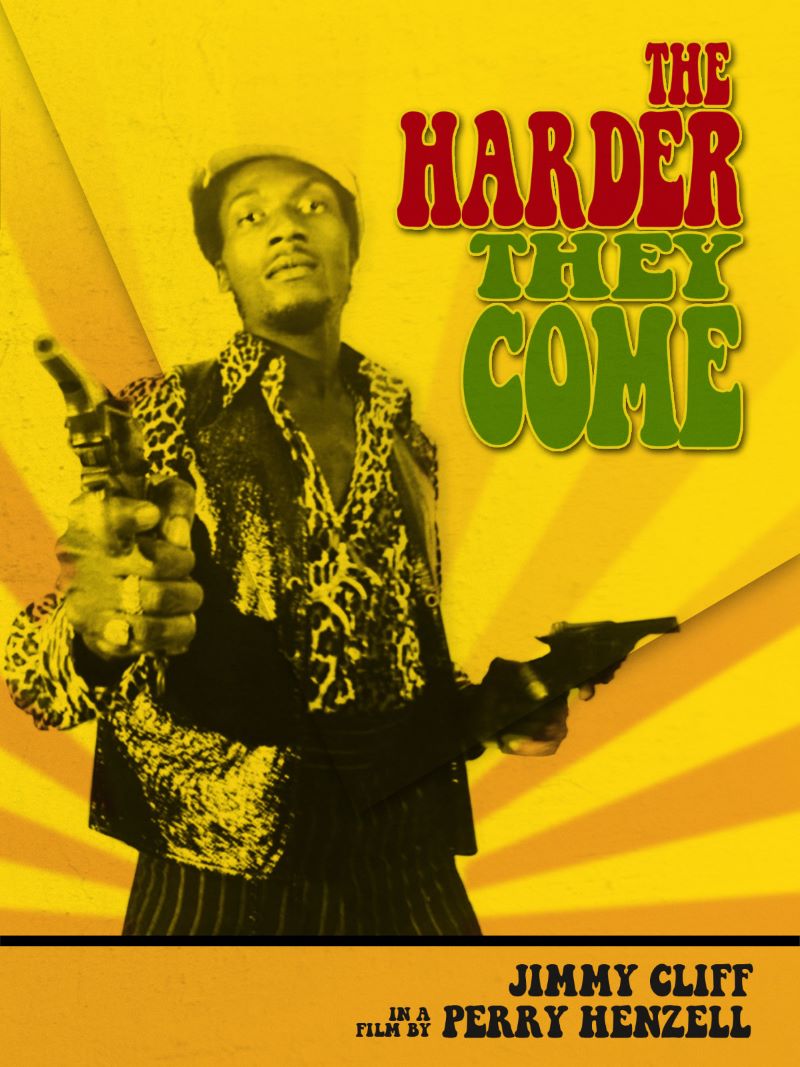
Jimmy Cliff composed songs and rode the rising Reggae tide, for a short while rivalling Bob Marley for most popular position. What launched him and the Reggae ship into wider seas was the film The Harder They Come based on the novel of the same name featuring Cliff’s own song.
The Harder They Come novel by Ekwueme Michael Thelwell charting the fictionalised career of a Jamaican who fails to succeed as a reggae singer and becomes a gangster is based on the real life of Jamaican folk hero and reggae star Rhygin.10

But the film’s hero was performed by Jimmy Cliff and his music played as soundtrack.
In Peckham I watched the film years later and enjoyed it but I also read the novel. The latter gives an interesting background of the hero growing up in his grandmother’s care in rural Jamaica, before he goes to Kingston, while the film opens only with the hero’s arrival in the city by bus.
Famous folk singer Bob Dylan is reported to have said that Jimmy Cliff’s 1969 song Vietnam was the best protest song he had ever heard. It is hard to credit that as a true statement; Pete Seeger, Dylan’s contemporary, many others and Dylan himself had composed many better.
Jimmy Cliff’s Vietnam song takes as its theme a US soldier in Vietnam writing about his impending return home at the end of his tour of military service in Vietnam and his desire for his girlfriend, followed by another missive to the soldier’s mother announcing her son’s death in Vietnam.
The tragic juxtaposition of youth, romantic love, violent death and parental bereavement is an inherent theme of war and of course works on our emotions. But the song says nothing about who sent the soldier there nor the reasons for the Vietnam War, though one line calls for its end.
The lyrics tell us nothing about the devastation of the US war upon the peoples of Vietnam, Laos and Cambodia, nor about the heroism of the people’s resistance.11 Not even about the huge protests of many people in the USA — particularly youth — and in much of the western world.

However, Jimmy Cliff’s performance of the song 20 years ago in Jamaica brings the point of the anti-war movement much more into context as in his introduction to the song on stage he castigates Tony Blair and George Bush and names a number of other imperialist wars.
It was a great performance of Cliff’s at the end of his sixth decade of life and I hope you enjoy it here on video.
https://www.youtube.com/watch?v=jCc5jSw0bSQ
End.
Note: If you found this article of interest, why not register with Rebel Breeze for free, so that you will be notified by email of subsequent articles. You can de-register any time you wish.
FOOTNOTES
1https://www.independent.co.uk/arts-entertainment/music/news/jimmy-cliff-dead-age-cause-songs-reggae-b2871220.html and https://en.wikipedia.org/wiki/Jimmy_Cliff
2Facebook · UB40 Featuring Ali Campbell So sad James chambers has left a void in reggae music, his voice and influence was exemplary. He was a reggae pioneer, RlP Jimmy cliff.
3https://en.wikipedia.org/wiki/Caribbean
4https://en.wikipedia.org/wiki/History_of_the_Caribbean
5https://www.nbcnews.com/politics/national-security/top-military-lawyer-raised-legal-concerns-boat-strikes-rcna243694
6This rise gave on to the New Cross Road from terraced housing down below where a number of Caribbean families lived, in one house of which I shared a double room with another Irish migrant. Almost at the top of Childeric Rise itself was the entrance to The Harp Club Irish dance hall with an Irish pub on an opposite corner and another across the road.
7From the acknowledged Irish language word ‘síbín’, etymology uncertain but adopted as far away as the Caribbean and South Africa.
8Music mostly of Trinidad and Tobago, often accompanied by steel band instruments, based on folk dance music from a part of West Africa. https://en.wikipedia.org/wiki/Calypso_music
9Not very well to those rhythms, in my case.
10https://groveatlantic.com/book/the-harder-they-come/
11Estimates of Vietnamese soldiers and civilians killed range from 970,000 to 3 million. Some 275,000–310,000 Cambodians, 20,000–62,000 Laotians, and 58,220 US service members died. https://en.wikipedia.org/wiki/Vietnam_War#:~:text=The%20war%20exacted%20an%20enormous
SOURCES
https://www.independent.co.uk/arts-entertainment/music/news/jimmy-cliff-dead-age-cause-songs-reggae-b2871220.html and https://en.wikipedia.org/wiki/Jimmy_Cliff


 rebelbreeze