ABOUT “GET THEM OUT”

Diarmuid Breatnach

(Reading time: 4 mins.)

Cycling along the Liffey quays some time back I saw a crowd waving Tricolour and other flags and heard a roar of “Get them out!” No mystery about the origin: the far-Right racists that crawled out into the light in recent years, targeting migrants.1

The same cry has been heard outside proposed IPAS centres and in other demonstrations that can mostly be characterised as anti-immigrant and anti-refugee.
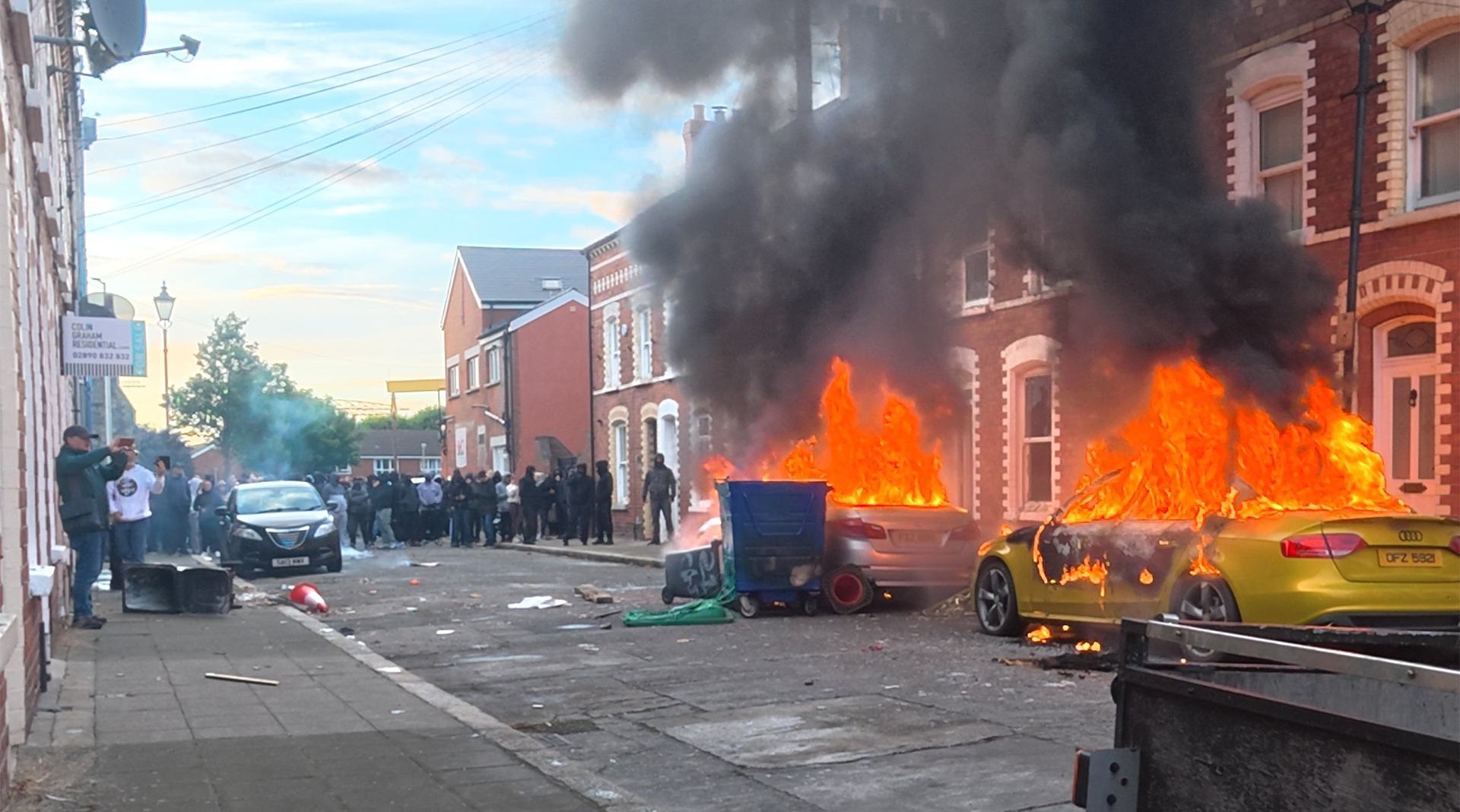
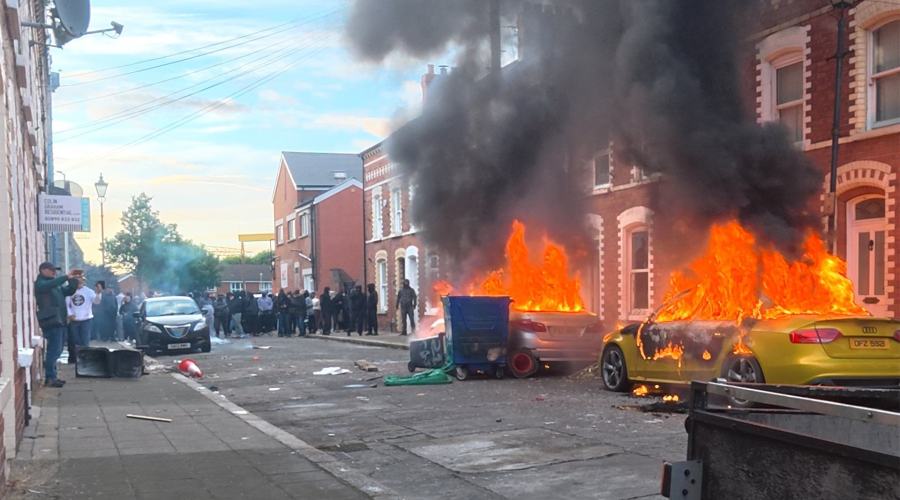
Scene with cars set alight by racist Loyalist mobs in Belfast on 6 June. At least three houses were also set ablaze. (Photo: Getty images)

But why should we be “getting them out”? In answer to that question all we get is lying propaganda. “They are getting housing instead of Irish people.” No, they are not. Some refugees are getting hostel accommodation and many are not, even though Ireland has signed up to accept some.

If refugees are getting such good treatment, why would so many be living in tents on streets, parks or along canal banks? And why are far-Right fascists threatening them and slashing their tents? Are they claiming that refugees are doing them out of living in tents themselves?

In fact we never had widespread affordable decent housing but high emigration made it less noticeable. All the same there were struggles in the 1960s and 70s led by the Dublin and Dun Laoghaire Housing Action Committees, involving occupations of houses and fighting evictions.

Another claim is that migrants are a threat to Irish women. Why would that be the case? Yet, every day in the mass media we read of cases of rape, sexual harassment and controlling behaviour of women — by Irish men!

The far-Right also claim that migrants are a threat to children (actually, they often claim that LGBT people are also, calling them ‘paedos’). Fact: the major threat to children in Ireland have been Irish institutions including the Catholic Church, which is strongly defended by the far-Right.

Sociological research shows that most sexual abuse of children happens in the family or friend circle and we regularly read in the media of those cases also – nearly always by Irish men.

Then there’s the “military-age single men” mantra – what does that even mean? Military age is usually understood to be between 17 and 45 years of age. It is in other words the age at which most men emigrate to work in other lands. The age at which most Irish emigrated!2

It’s also an age of most health and physical ability to travel, to work and to send money home, as hundreds of thousands of us Irish did, whether single or married, or the optimum age to risk the dangers of being a refugee trying to find somewhere safe for one’s family to follow.

Research shows that the “military-age single men” mantra is a recent addition to Irish far-Right discourse, some believing it an import from the far-Right in the USA, along with the racist “great white replacement” conspiracy theory, adapted here to “replacing the Irish” conspiracy theory).

Which reminds me that the arrival of migrants is often characterised as “an invasion.” Really? When we emigrated in the past or today for work or safety from persecution, were or are we invading England, Scotland, Wales, the USA, Canada, Australia, New Zealand? Or other countries?

We are not being invaded by refugees or migrant workers. But we have been invaded by British troops and colonial police, foreign multinationals, and US and NATO flights.

The far-Right in Ireland hate foreigners and their imagined ‘invasion’, but not it seems the reality of British troops occupying one-sixth of our country and patrolling it with their colonial and sectarian police force. Nor the reality of the RAF and the USAF violating our airspace.

Nor the foreign multinationals and vulture funds controlling our housing market, taking over Irish firms and public infrastructure and plundering our national resources.

Get them out? Well if migrants and their contribution to Irish society were to be ‘got out’, there would be a massive task facing the far-Right.

We should then get rid of the Tricolour, as it was presented to us by foreigners: revolutionary Republican women in Paris in 1948. We should also reject the Irish Republic flag, which was created on domestic material in the home of Constance Markievicz, who was born in London.

Yes, and she delivered it in 1916 to the GPO so that it was raised on the Princes Street corner of the GPO by a man who was born in Argentina. Of course, inside the GPO were Thomas Clarke and James Connolly, the first born in England and the second in Edinburgh (where he was raised too).

I do recall a racist recently denouncing the Save Moore Street From Demolition campaign for pointing out the foreign origins of those two signatories of the 1916 Proclamation and insisting that it was where their parents came from that mattered.

What then of Patrick and Willie Pearse, whose father was English or Tomás McDonagh, whose mother was English too? Or Thomas Davis, whose father was Welsh? Clearly there’s a massive job ahead with “getting them out”, all these foreign connections in our resistance history.

Many of our martyrs and heroes, writers, song composers, musicians, flags, songs, poems, literature, documents “contaminated” by migrants will need to dumped if the far-Right are honest in their slogans. But they are not, of course – they only use them to fool the masses.

But who is he writing this for? The organised fascists won’t care and their followers won’t read it.” A good question – to whom we speak and write is as important as what we speak and write. I don’t write it for the organised fascists of course, the debate with them will inevitably be a physical one.

Nor do I write it for their deluded followers, who would hardly be reading articles in the Rebel Breeze blog. I write it for you and you and you, to use in your discussions with the deluded followers, those who are willing to listen because you are neighbours, workmates or families.

And if you already knew all this or I have not written it well enough or you fail in using it and other arguments you use, I’m sorry, I and you did our best. In the end, the argument will be resolved in the street and on barricades. And we need to get ready for that too.

End.

Note: If you found this article of interest, why not register with Rebel Breeze for free, so that you will be notified by email of subsequent articles. You can de-register any time you wish.

FOOTNOTES

1I wrote this quite some time ago but it never got posted for some reason or other. After the racist riots in Belfast seems a good time to dig it out and post it.

2Including myself, to London.

JIMMY CLIFF, VIETNAM AND CARIBBEAN MIGRANTS

Diarmuid Breatnach

(Reading time: 4 mins.)

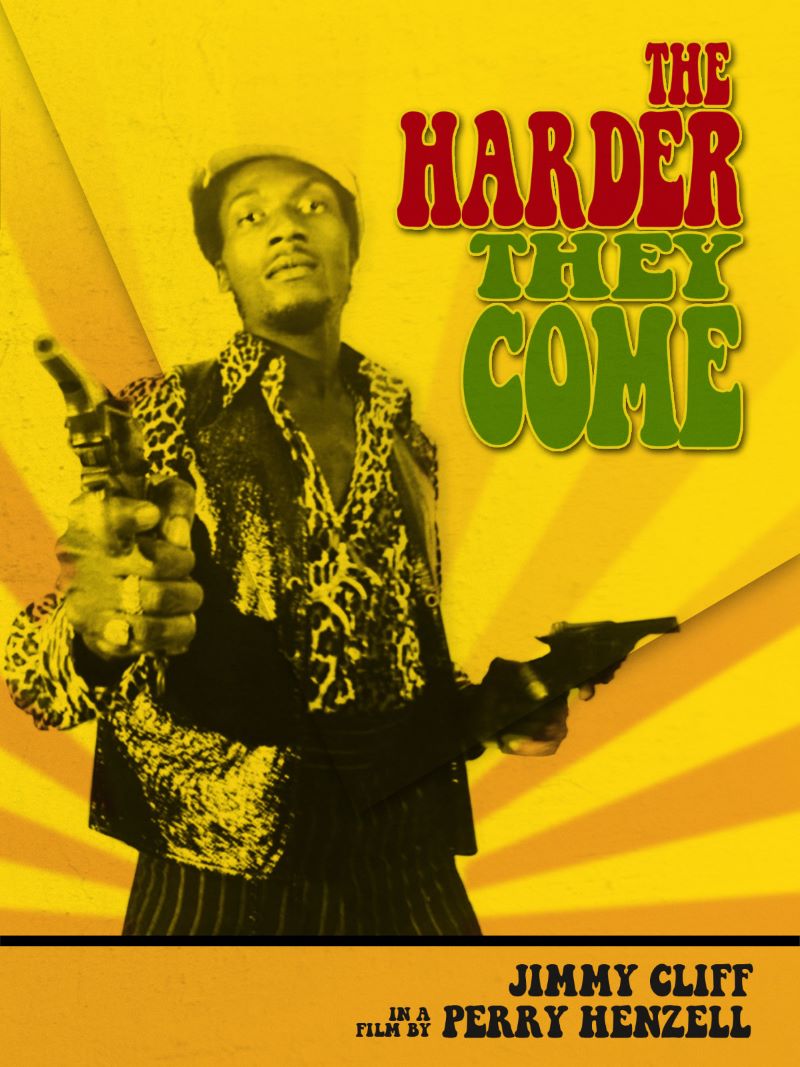
The death is announced on mass media today at 81 year of age of Jamaican reggae singer, songwriter and author Jimmy Cliff,1 famous for songs such as The Harder They Come and for his role in a film of the same title.

As is usual in such cases, tributes have been posted on social media and quoted in the western mass media, including by Ali Campbell of the UB 40 band who was reported to be ‘so sad’2 (which to be honest, seems a little strange as Jimmy Cliff lived to a good 81 years of age before he died).

I first heard a few of Jimmy Cliff’s nearly 30 recordings among the Caribbean community of SE London.

Jimmy Cliff grew up James Chambers in a family of nine in St. James in Jamaica, often mistakenly thought of as the largest Caribbean island (which it is not – that is in fact Cuba). Jamaica, like Trinidad & Tobago, another larger island and Barbados, were among the British colonies in the Caribbean.

The Caribbean islands and coastline3 were first European-colonised by the Spanish, then by the French, Dutch and British Empires, often in armed conflict against its indigenous people but also among themselves, also against slave uprisings and later against local struggles for independence.4

Since WWII the dominant imperialist power in the Caribbean is undoubtedly the United States of America, though France retains some colonial possessions and a few remain part of the British Commonwealth.

Today the Caribbean is in the news through a large force of US Naval forces posted there, along with nearby posting of bombers, along with the murder of over 80 small boat sailors, allegedly drug smugglers (without evidence and as though drug smuggling gets the death sentence).5

According to threats of President of the USA Trump, he intends to target Venezuela and its President Nicolás Maduro, whom he claims – without a shred of evidence — to be the leader of a drug cartel.

Migrant communities and the spread of Reggae

During the decades I spent in London I had a fair amount of contact with parts of the Caribbean immigrant and diaspora community, partly through working alongside some of its members, partly through socialising in SE London and through activity in resistance to fascism and racism.

I first came across Reggae music while living as a migrant in the SE London areas of Lewisham, New Cross and Peckham. There were large Irish and Caribbean communities there with some but not a great deal of interaction between both communities but little hostility between them either.

Both communities were subject to institutional racism and politicised communal racism as organised by the fascist National Front and British Movement, both of which had connections to British Loyalist paramilitary organisations in Scotland and in the Six Counties in Ireland.

I recall reading in a British 1950s sociological study on ‘deviant behaviour’ that ‘Teddy Boy’ gangs would target the post-War newly-arrived Caribbean immigrants (but also the ‘Micks’, i.e the Irish) and a Jamaican workmate told me about the gangs waiting for them on Childeric Rise.6

How he went out armed with a home-made knuckle-duster and how the police would come to the fighting, arresting mostly the Caribbean victims. “Them turn me away when dem see me,” a Caribbean migrant discussing racism told me, “but dem turn you away when dem hear you.”

In Caribbean shebeens7 or illegal ‘clubs’ in that SE London area, one could buy for a modest sum a plate of goat curry and rice, or a can of pale ale or Guinness, while listening to vinyl records of Bluebeat, Ska, Rock Steady, Reggae and, to a lesser extent, Calypso.8 And dance, perhaps.9

Jimmy Cliff composed songs and rode the rising Reggae tide, for a short while rivalling Bob Marley for most popular position. What launched him and the Reggae ship into wider seas was the film The Harder They Come based on the novel of the same name featuring Cliff’s own song.

The Harder They Come novel by Ekwueme Michael Thelwell charting the fictionalised career of a Jamaican who fails to succeed as a reggae singer and becomes a gangster is based on the real life of Jamaican folk hero and reggae star Rhygin.10

But the film’s hero was performed by Jimmy Cliff and his music played as soundtrack.

In Peckham I watched the film years later and enjoyed it but I also read the novel. The latter gives an interesting background of the hero growing up in his grandmother’s care in rural Jamaica, before he goes to Kingston, while the film opens only with the hero’s arrival in the city by bus.

Famous folk singer Bob Dylan is reported to have said that Jimmy Cliff’s 1969 song Vietnam was the best protest song he had ever heard. It is hard to credit that as a true statement; Pete Seeger, Dylan’s contemporary, many others and Dylan himself had composed many better.

Jimmy Cliff’s Vietnam song takes as its theme a US soldier in Vietnam writing about his impending return home at the end of his tour of military service in Vietnam and his desire for his girlfriend, followed by another missive to the soldier’s mother announcing her son’s death in Vietnam.

The tragic juxtaposition of youth, romantic love, violent death and parental bereavement is an inherent theme of war and of course works on our emotions. But the song says nothing about who sent the soldier there nor the reasons for the Vietnam War, though one line calls for its end.

The lyrics tell us nothing about the devastation of the US war upon the peoples of Vietnam, Laos and Cambodia, nor about the heroism of the people’s resistance.11 Not even about the huge protests of many people in the USA — particularly youth — and in much of the western world.

Jimmy Cliff in performance (Photo credit Alastair Wison/ PA)

However, Jimmy Cliff’s performance of the song 20 years ago in Jamaica brings the point of the anti-war movement much more into context as in his introduction to the song on stage he castigates Tony Blair and George Bush and names a number of other imperialist wars.

It was a great performance of Cliff’s at the end of his sixth decade of life and I hope you enjoy it here on video.

https://www.youtube.com/watch?v=jCc5jSw0bSQ

End.

Note: If you found this article of interest, why not register with Rebel Breeze for free, so that you will be notified by email of subsequent articles. You can de-register any time you wish.

FOOTNOTES

1https://www.independent.co.uk/arts-entertainment/music/news/jimmy-cliff-dead-age-cause-songs-reggae-b2871220.html and https://en.wikipedia.org/wiki/Jimmy_Cliff

2Facebook · UB40 Featuring Ali Campbell So sad James chambers has left a void in reggae music, his voice and influence was exemplary. He was a reggae pioneer, RlP Jimmy cliff.

3https://en.wikipedia.org/wiki/Caribbean

4https://en.wikipedia.org/wiki/History_of_the_Caribbean

5https://www.nbcnews.com/politics/national-security/top-military-lawyer-raised-legal-concerns-boat-strikes-rcna243694

6This rise gave on to the New Cross Road from terraced housing down below where a number of Caribbean families lived, in one house of which I shared a double room with another Irish migrant. Almost at the top of Childeric Rise itself was the entrance to The Harp Club Irish dance hall with an Irish pub on an opposite corner and another across the road.

7From the acknowledged Irish language word ‘síbín’, etymology uncertain but adopted as far away as the Caribbean and South Africa.

8Music mostly of Trinidad and Tobago, often accompanied by steel band instruments, based on folk dance music from a part of West Africa. https://en.wikipedia.org/wiki/Calypso_music

9Not very well to those rhythms, in my case.

10https://groveatlantic.com/book/the-harder-they-come/

11Estimates of Vietnamese soldiers and civilians killed range from 970,000 to 3 million. Some 275,000–310,000 Cambodians, 20,000–62,000 Laotians, and 58,220 US service members died. https://en.wikipedia.org/wiki/Vietnam_War#:~:text=The%20war%20exacted%20an%20enormous

SOURCES

https://www.independent.co.uk/arts-entertainment/music/news/jimmy-cliff-dead-age-cause-songs-reggae-b2871220.html and https://en.wikipedia.org/wiki/Jimmy_Cliff

https://en.wikipedia.org/wiki/Caribbean

SHE SHOULD KNOW ALL ABOUT INVASIONS

Diarmuid Breatnach

(Reading time: 4 mins.)

In late November last year the UK’s Home Secretary1 referred to refugees and migrants entering Britain as “an invasion”, for which a Hollocaust survivor, 83-year-old Joan Salter, challenged her, likening her speech to that of the Nazis.

An NGO working with refugees, Freedom From Torture, posted some of the exchange on Twitter. In turn, the NGO came under pressure from the Home Office to retract the video.

This month, not only did the charity refuse but did so publicly, fully endorsing the content of the video.

Anyone would well understand the difference between invading a country and entering it as a refugee, asylum seeker or even economic migrant. Those come unarmed, fleeing to safety or trying to make a living for themselves and their family.

A minister of a British Government should be extremely well-placed to understand the distinction. After all, there is no continent and very few countries, including its near neighbours, which the British ruling class has not caused to be invaded at some time or other.2

Map of areas of the world ‘owned’ by Britain or the UK at one time (Source: Internet)

From the time the descendants of the Anglo-Saxon invaders of Celtic England merged with the descendants of the later Norman invaders, England has gone from being a major invading and colonising military and naval power to being a major imperialist one.

Imperialist action did not always end in invasion; pressure could be applied in other ways, through bribery — or open threat. The term “gunboat diplomacy” was coined to describe imperialist actions short of actual invasion and Britain was renowned for actions of that type.

The ruling class of Britain has waged war against people to take over trade routes, to colonise land and extract resources, in competition with other colonial powers, to quash resistance and even for the right to sell opium in China.

In the course of those colonial and imperialist activities, Britain has carried out many invasions. In fact, Suella’s parents themselves come from former colonies.

Braverman is a child of migrants

Suella Braverman is the daughter of parents of Indian origin who emigrated to Britain in the 1960s: Uma (née Mootien-Pillay) from Mauritius and Christie Fernandes, from Kenya. Both those countries have indeed been invaded by Britain.

Kenya in particular from 1952-1960 had one of the worst experiences of colonial treatment by the British military, including wide-scale murder, torture and rape. India and Pakistan had their infrastructure and manufacture undermined by Britain leading to regular country-wide famines.

Suella Braverman, MP, currently UK Home Secretary. (Sourced: Internet)

Suella should know about invasions, refugees and migrants but is on record as saying that the British Empire was on the whole a beneficial experience for its conquered. This is a prime example of the “slave mind” that apes the invader and wants to collaborate with it.3

Such “slave-minded” people can be even more vicious and callous in their attitudes than the conquerors themselves and Braverman certainly fills that bill. And it’s not just in occasional choice of words that Braverman nears Nazi appearance.

During Braverman’s unsuccessful campaign for selection as leader of the Conservative Party last July, she said her priorities would have included to “solve the problem of boats crossing the Channel” and “to withdraw the UK from the European Convention of Human Rights.”

In October 2022, Braverman said that she would love to see a front page of The Daily Telegraph sending asylum seekers to Rwanda4 and described it as her “dream” and “obsession.” No doubt she includes human rights and legality concerns as “all of this woke rubbish.5

A courageous NGO

Holocaust survivor Joan Salter, the woman who accused Braverman of Nazi-like speech, is the daughter of refugees from Nazi persecution who survived but endured imprisonment and hazardous journeys. She has an MBE for her work on Holocaust education.

Joan Salter, Holocaust survivor who challenged the Home Secretary. (Sourced: Internet)

In response to a Home Office accusation that the clip is only partial and therefore misleading, the NGO’s CEO Sonya Sceats pointed out the full exchange is available in video on its website and said the charity will not remove the Twitter clip.

“As an organisation providing therapy to torture survivors who feel targeted by her language and who know first-hand where such dehumanising language can lead, we will not do so. She has used language she should be ashamed of, and we won’t be pressured into helping her hide it.”

Non-Governmental Organisations nearly always rely on government funding, whether directly or indirectly and as a result tend not to rock the boat too much, in case they find their boat getting smaller or their team even being tossed overboard.

Sony Sceats, CEO of Freedom From Torture charity who stood up to the Home Secretary.

As a result, in public the CEOs of those organisations tend to vary from generally totally compliant6 to cautiously critical on certain occasions. In that context, the actions of Salter in the initial video and of the Freedom From Torture NGO in militantly backing her can only be admired.

End.

Footnotes

References

Charity refuses to delete clip of Holocaust survivor confronting UK politician (thejournal.ie)

Suella Braverman – Wikipedia

Britain Has Invaded All but 22 Countries (kottke.org)

https://www.holocaust.org.uk/joan-salter-profile

1This is the UK’s equivalent to Minister for Home Affairs, these days normally restricted to Britain (i.e excluding the colony in Ireland) and in particular England and Wales (i.e often excluding even Scotland).

2Britain Has Invaded All but 22 Countries (kottke.org)

3The concept of the ‘slave mind’ or ‘colonised mind’ has been addressed by a number of writers on national liberation, notably Patrick Pearse (1879-1916) from Ireland and Franz Fanon (1925-1961) from Martinique.

4That plan has been condemned by many human and civil rights organisations and also denounced as illegal.

5A quote dating from her attempt at Leader of the Conservative Party.

6Or actually collusive.