Literature that must not be forgotten

Gearóid Ó Loingsigh

Reprinted from author’s substack 26 July 2026 and reformatted for Rebel Breeze

(Reading time: 9 mins.)

The history of societies is the history of their ruling classes. So it comes as no surprise that we are told that Lord X built a palace, Lady Y built a garden and so forth.

The history of society is the history of great men (and the occasional woman, when she’s allowed) with those who actually do anything written out of history.

Take a tour of any stately home and you will be told that the Earl built the west wing in a given year, an incredible chippie, brickie and plumber all in one with some artistic flair to boot.

The workers who actually carried out the work are not mentioned and if it was slave labour, well let’s not go there at all.

It is the type of situation that led the great German poet and dramatist Bertolt Brecht to ask the question

Who built Thebes of the 7 gates?
In the books you will read the names of kings.
Did the kings haul up the lumps of rock ?

And Babylon, many times demolished,
Who raised it up so many times ?

In what houses of gold glittering Lima did its builders live ?
Where, the evening that the Great Wall of China was finished, did the masons go?

Great Rome is full of triumphal arches.
Who erected them ?

Over whom did the Caesars triumph ?
Had Byzantium, much praised in song, only palaces for its inhabitants ?

Of course it is not just the obvious contribution of workers to the construction of buildings no fat cat could ever build, their contribution to the world of literature and art is also deliberately ignored.

The aforementioned poem of Brecht is titled Questions From a Worker Who Reads. Brecht was well aware that in order to overthrow capitalism you have to be able to question it and reading is part of the process.

His famous quote from his poem In Praise of Learning is “Hungry man reach for the book, it is a weapon”.

It is indeed and the weapon is mightier if you think that people like you wrote it. It is partly why the history of literature is a bit like the history of stately homes, the Lords and the Ladies did everything.

No workers, no peasants, no one putting down the hammer for a minute wrote a poem or pausing the plough either.

Literature belongs to the rich, so working class writers or even just opposition writers are routinely written out of history and their literature is reserved for small literary circles and revolutionaries who have retired to the café.

Under no circumstances should it ever be read by other workers, lest the reader get the idea that they too can produce it. Of course there are lots of writers from a working class background, but they are a minority in comparison to the middle and upper classes.

Or least they are in terms of contracts with commercial publishers and libraries tend not to organise catalogues of their works, as they are not worthy of merit in the eyes of the middle class pedants who populate literary studies.

The working class writer Kit de Vaal asked where were all the working class authors and published an anthology of such authors.[1] There is no anthology of middle class or rich authors, as they are the norm, they are everywhere, ubiquitous, ever present.

Pick a book at random on a library shelf or in a book shop and you will invariably pick one written by someone who is not working class, even with non-fiction.

One thing is writing about the working class, which can be financially rewarding and lead to career advancement especially if you are already not of the working class.

But there have been many writers, written out of literary history, or relegated to specialist circles in some academic institute where increasingly the working class can be studied, but not study.

There is one Japanese author, Tajiki Kobayashi who had been on my must-read list for a long time before I eventually got around to him. His most famous novel is The Crab Cannery Ship (also translated as The Factory Ship) which is based on a real incident.

In Japan in the 1920s workers revolted on the ships where they were kept in almost slave like conditions harvesting crabs and then canning them on the ships themselves (hence the title).

The novel is a searing indictment of Japanese capitalism, nationalism and the emperor, who was in Japanese law a divinity.
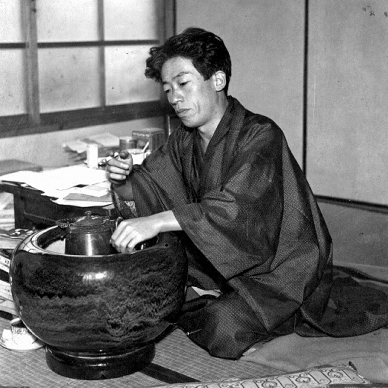
Takiji Kobayashi (Photo source: Wikipedia)

We often think, in fact we are told that Japan is a land of hard working obedient workers who never question authority and this is the key to its success. Nothing could be further from the truth.

Japan experienced waves of social unrest as it industrialised along with brutal repression from the state and following the end of WWII trade union membership boomed reaching 5 million by 1947.

This movement was repressed with the US military occupation playing a key role in the Red Purge with thousands of workers hounded out of their jobs, the Communist Party was effectively banned and freedom of speech was suppressed.

The Japanese consensus is the result of oppression, not of some quaint cultural quirk.[2] But if you are to buy into this consensus myth then not only has history to be ignored, but so too must the literature that talks of it.

Kobayashi didn’t just write about the working class, he wrote for them as part of his political militancy. He paid dearly for his commitment. In 1933, at the age of thirty, the Japanese police tortured him to death, leaving two of his novels incomplete.

The Crab Cannery Ship had been serialised in a magazine, Senki, and was not available as a novel in Japan until 1948, though its English translation was available in the year of his murder.

It is a strange consensus that requires torturing poets and writers to death, but not so strange that we would be asked to forget them.

Not that Takiji’s novel had ever been entirely forgotten.

It occupied a secure position in Japan’s modern history as the best-known literary product of the proletarian movement, a major cultural and political current of the 1920s and early 1930s—a time when labor activism, socialism, feminism, and antimilitarism were briefly in the ascendant, while paintings, posters, prose narratives, poetry, and plays depicting the lives and struggles of the dispossessed enjoyed a considerable degree of popular interest and critical esteem.

By the mid-thirties, however, as the country’s elites led the nation ever closer to an all-out war on the Asian continent, this progressive groundswell had been largely obliterated through a combination of internal dissension, government propaganda, and intensified repression: arrests, beatings, imprisonment, and censorship.[3]

He was part of a movement of proletarian literature and president of the Proletarian Writer’s Guild of Japan.

Proletarian literature was not just written by working class authors (and also middle class authors who had turned their backs on their own class), nor was it just stories about the working class for middle class audiences.

It was for the working class with no middle class filters applied to make it suitable for chats over coffee, and it talked of socialism. His novels are political, in an overtly Marxist sense, class struggle is a key part of the plot.

The clandestine nature of political work in Japan is dealt with in the unfinished novel Life of a Party Member, and would be familiar to anyone who has lived under repressive regimes. Kobayashi himself engaged in clandestine work and was arrested numerous times and tortured.

The use of the term Proletarian rather than working class tells you all you need to know.

He was a fighter, he may well have liked coffee but his life was not that of the quaint coffee shop, arcane academic discussions where the middle class engage in their favourite pastime, talking and writing about the working class, earning royalties and accolades in the process.

His most famous novel The Crab Cannery Ship went through a huge revival in 2008, following the financial crash, selling hundreds of thousands of copies.

In 2008—the year Takiji’s novel skyrocketed to fame—over thirty thousand Japanese people killed themselves, tens of thousands were homeless, some three million were unemployed, twenty million were living in poverty, and more than a third of the active labor force comprised irregular workers who were poorly paid and could easily be fired.[4]

Reading it, it is easy to see why. I am neither Japanese nor a fisherman, yet much of what happens on the ship speaks to me, it speaks to everyone, abusive bosses, people trapped in low income, insecure work with little security, poor safety.

What Kobayashi describes is something that never went away in the third world and has made a comeback now everywhere due to the defeat of the trade union movement and, let’s be honest, the constant sell outs by the bureaucracy.

But that novel and his other writings are not about the plight of the working class or the proletariat to use the more accurate term that the middle class so loathe and despise. It is about the fight of the working class against those conditions.

He argues through his characters for a struggle for socialism, against the Japanese ruling class, nationalism, empire and also for the liberation of women.

In his novel Yasuko, two of the main protagonists are women who as the plot develops become independent forceful characters, through their participation in the class struggle and their fight against the repression of the state.

One of them, Yasuko lends her name to the title. It is obvious why the Japanese literati would not have promoted him so much. There are equivalents all around the world of proletarian writers or other oppositionists who have been relegated to a dusty corner.

The proletarian wave did not just happen in Japan, but throughout the East, Russia and also the United States.

There of course exceptions who became worldwide phenomena within their own lifetime.

One such author is Bertold Brecht who coincides in time with various proletarian literature movements around the world and then there is also the Italian artist Dario Fo, the author of many works such as Accidental Death of an Anarchist and Can’t Pay! Won’t Pay! 

The title of this particular play became a catchphrase and slogan in the English speaking world.

Both were products of their time and achieved international fame, making them hard to relegate to dusty corners and though there are always attempts to relativise writers, soften the sharp edges of their plume it is not easy with either.

Brecht was unrepentant till his death and Dario Fo and his wife Franca Rame were lifelong activists and enemies of the Italian state, so much so that fascists under orders from the Italian police kidnapped tortured and raped her in an unsuccessful attempt to silence her.
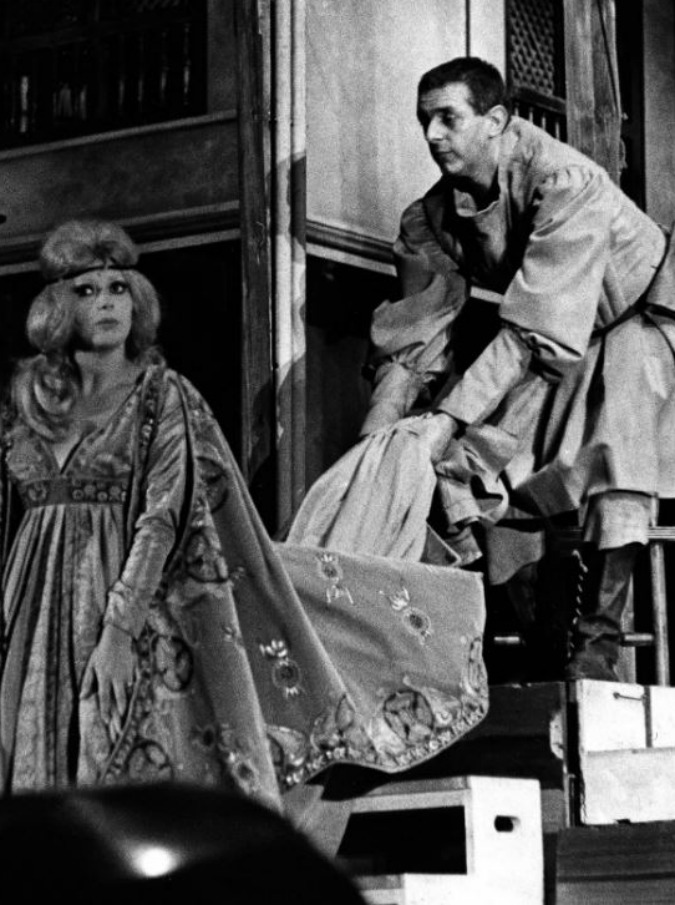
Franca Rama and Dario Fo in performance. (Photo sourced: Internet)

There was more at stake for her and her husband than artistic awards. Their work was political in all senses of the word and they were participants in the class struggle.[5]

In oppressed countries around the world various writers such as the El Salvadoran Roque Dalton, or the Palestinian Ghassem Kanafani are still remembered and celebrated amongst their people.

But they fought against foreign empires, Kobayashi was from the empire he fought against. It is harder to reinterpret him as anything other than what he was, a proletarian writer who gave his life not so much for a literature that was forgotten but for a revolution that never came.

What literature is remembered and celebrated is a question of power and politics. There is literature that must be remembered and there is that which must be forgotten or in rare exceptions begrudgingly acknowledged.

Kobayashi, however, is now acknowledged so much so that there are now Kobayashi tours, which is itself worrying, but there is no escaping who or what he was, though Sabu, the director of a remake of the film version did make an attempt at this depoliticising the novel.

There is also no escaping that the current Japanese inbred royal family murdered him. All of the post war institutions are the direct heirs of those who murdered him.

That his novel could speak to the Japanese working class 79 years after it was written, is testament to the lasting value of his writing.

Darkness never lasts and despite the best efforts of the media, the cultural gatekeepers in publishing, academia and galleries, it is as Brecht remarked in his poem Literature will be scrutinised.

But at that time will be praised

Those who sat on the bare ground to write

Those who sat among the lowly

Those who reported the deeds of the fighters

With art. In the noble words

Formerly reserved

For the adulation of kings…

Yes, a time will come when

These clever and friendly men

These angry and hopeful men

Who sat on the bare ground to write

Who were surrounded by the lowly and the fighters

Will be publicly praised.

And so literature once forgotten or relegated to a lowly category comes forth in all its glory and as Rosa Luxembourg put it, when talking about revolution, proclaims, I was, I am, I shall be.

End.

Note: You may wish to read other articles by Gearóid Ó Loingsigh on his substack https://gearoidloingsigh.substack.com/

Note: If you found this article of interest, why not register with Rebel Breeze for free, so that you will be notified by email of subsequent articles. You can de-register any time you wish.

NOTES:

[1] The Guardian (10/02/2018) Kit de Waal: ‘Make room for working class writers’. Kit de Waal. https://www.theguardian.com/books/2018/feb/10/kit-de-waal-where-are-all-the-working-class-writers-

[2] For an overview of class struggle in Japan in the post war period see Ichiyo, M (1987) Class Struggle and Technological Innovation in Japan since 1945. IIRE. Amsterdam. https://fileserver.iire.org/nsr/nsr5.pdf

[3] Translator’s Preface to Kobayashi, T. (2013) The Crab Cannery Ship and other novels of struggle. University of Hawai’i Press. Pp ix & x.

[4] Ibíd., p.x

[5] The Guardian (29/05/2013) Franca Rame obituary. John Francis Lane https://www.theguardian.com/stage/2013/may/29/franca-rame

The Influence of the Working Class on the 1916 Rising

Diarmuid Breatnach

(Reading time: 9 mins.)

The 1916 Rising is usually seen as a nationalist Rising of Irish Republicans with perhaps some socialist involvement. Even Connolly is often portrayed as a patriot only (see the song James Connolly the Irish Rebel) with socialist views.

Of the six organisations that participated actively in the 1916 Rising1 only one of them was specifically of the Irish working class. Perhaps that’s why the great influence of the working class on the Rising tends to be generally overlooked.

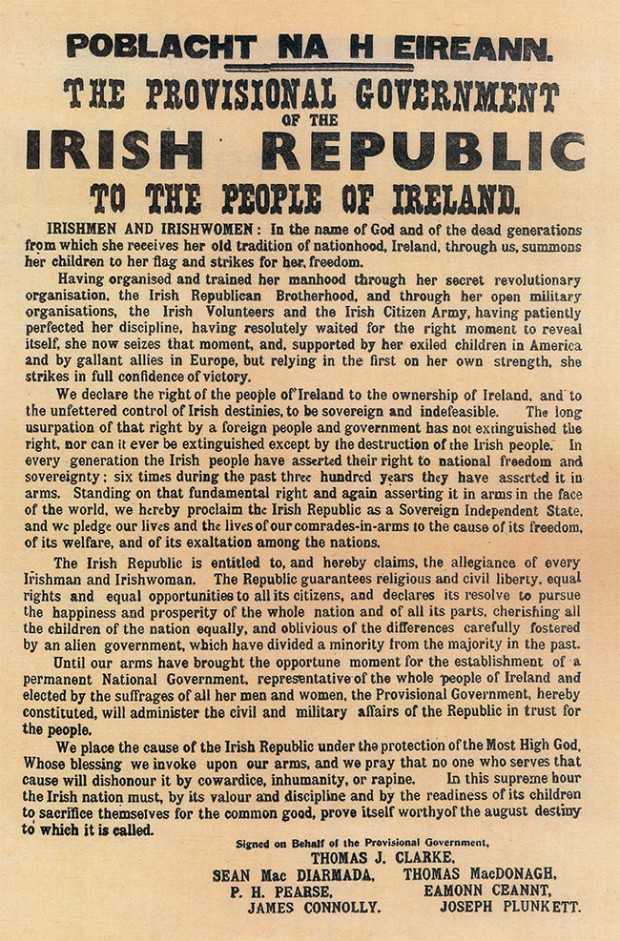
As is well-known, James Connolly is one of the Seven Signatories2 of that wonderful and progressive document, the 1916 Proclamation of Independence. However, Connolly only became part of the planning committee for the Rising a very short time before the scheduled date.3

That is true but we should ask ourselves why they included him at all. The Irish Volunteers had a nationwide organisation with the also nationwide Cumann na mBan as auxiliaries, whereas Connolly could perhaps mobilise a couple of hundred fighters.

(Photo sourced: Internet)

It is said he was brought on board because the IRB believed that his constant demand for a Rising during WWI and the military exercises of the Irish Citizen Army indicated that Connolly was likely to lead the ICA to rise on their own and would spoil their schedule.

How likely was he to do that? It’s true that as a socialist Connolly was horrified by the slaughter of war, where workers of one state are sent to kill and be killed by workers4 of another and perusal of his writings do show that he thought an uprising to sabotage war was desperately needed.

Would he have gone ahead alone with the roughly 250 men and women of the Irish Citizen Army, hoping perhaps to inspire a popular upsurge and to encourage the Irish Volunteers to join it, in spite of even their leaders?5 It’s hard to believe so but of course it’s possible.

However, from the moment the Republican planners of the Rising took Connolly on board, we can see a significant organisational shift towards the working class in Dublin and nowhere more so than around Liberty Hall, where the first flag for an uprising was hoisted and the Proclamation printed.

Liberty Hall was of course the headquarters of the Irish Transport & General Workers’ union,of which James Connolly was the leader at that time and also editor of its newspaper,The Irish Worker.

And for a person brought in to the planning so recently, how extraordinary that Connolly was given the rank of Commandant General! A responsibility he took seriously, sending couriers around the country and attempting to direct defence preparations around the various Dublin garrisons.

The first battle flag of the Rising

A week before the Rising Connolly and the Irish Citizen Army had an Irish Republican flag raised above Liberty Hall as a flag of war and the one chosen to do the raising was a girl of 16 years, Molly O’Reilly.6

The associated circumstances are worth retelling, if only to illustrate the difference between the Liberty Hall of then and today. Adults took classes in Irish language and cultural activities there while their children and those of union activists waited for their parents, took dancing classes or played.

In playing, Molly O’Reilly accidentally broke a window and in terror and shame, ran home.

When Connolly sent a message to her home that he wanted to see her, she went to Liberty Hall expecting a severe telling off. Instead he told her not to worry and what he was asking of her. She was proud to do it but so small she had to stand on a chair to pull the cord raising the flag.

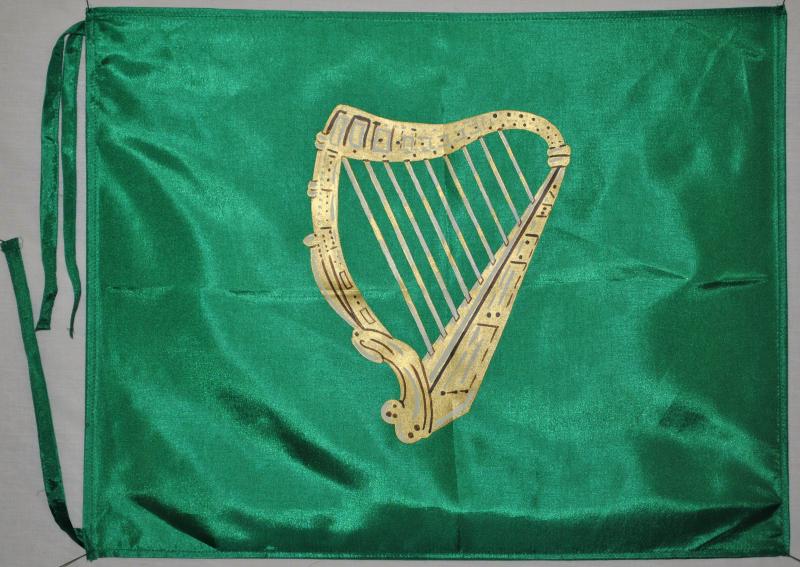
Remnant of the flag raised on Liberty Hall (Image sourced: National Museum)
Commemoration ceremony “Women of 1916” with relatives of Molly O’Reilly in place of honour (note the uniforms are of Irish Volunteers rather than Irish Citizen Army).(Photo: D.Breatnach)

Of course we know that flag was not of the revolutionary workers but instead the harp on green which was that of the early Fenians and was very similar to that of the United Irishmen, the first revolutionary Irish Republican organisation.7

Those early Fenians were mostly composed of working class members and their 1867 proclamation to the world was largely proletarian in outlook. In Britain, the Fenians formed part of the First International Workingmen’s Association which was led by Marx and Engels.

Their flag was flown over at least one of the 1916 Rising garrisons, I believe at theJameson Distillery in Marrowbone Lane.

Similar flag to that hoisted over Liberty Hall (Photo sourced: Internet)

The other flags of the Rising included the Tricolour, presented to the Irish Republicans of the ‘Young Irelanders’ by women in revolutionary Paris in 1848, which was one of two flown on the roof of the GPO, the headquarters of the Rising.

Sharing the GPO roof with the Tricolour was the flag made only days before from domestic material and painted with the words “Irish Republic” in the house of Constance Markievicz, an officer in the Irish Citizen Army, shortly before the Rising.

The Irish Citizen Army’s own flag, the Starry Plough, flew over the Clery’s building facing the GPO. Sadly today most Irish people do not know that flag, though awareness of it and its background is growing among the indigenous Irish and the migrant community.

The design of the Starry Plough, flag of the ICA as it was in 1916 (Image sourced: Internet)

The first workers’ army in the world8

The Irish Citizen Army was formed as a workers’ militia during the great Lockout and strike of 1913-1914, to defend against the attacks of the police, the physical repressive front line of the capitalist class; the ICA’s flag was placed above Murphy’s Imperial Hotel in Clery’s.9

The Irish Citizen Army on exercises at their grounds near what is Fairview today (Photo sourced: Internet)

Though its constitution was more nationalist than socialist, the ICA was in its membership and purpose the first workers’ army in the world and when reorganised a few years later, represented also working class feminism, recruiting women, some of whom were officers commanding men.

Once the preparations for the Rising were in tatters with MacNeil’s countermanding order, where did organisers gather to discuss what to do? In Liberty Hall, the building of the Irish Transport and General Workers Union and it was there that the decision to rise on Monday instead was taken.

It is hard to overstate the importance of the fact that the decision to go ahead with insurrection was taken in the building which had become de facto the HQ of the revolutionary working class in Dublin, with an illegal flag of rebellion flying and where the Proclamation was to be printed.

The writing and text of the Proclamation

The wording of the Proclamation is thought largely composed by Pearse but influenced by Connolly, including its address to “Irish men and Irish women” and perhapsWe declare the right of the people of Ireland to the ownership of Ireland, and to the unfettered control of Irish destinies”.

Another section which could bear Connolly’s fingerprint reads: The Republic guarantees religious and civil liberty, equal rights and equal opportunities to all its citizens, and declares its resolve to pursue the happiness and prosperity of the whole nation and of all its parts, cherishing all the children of the nation equally.

(Image sourced: Internet)

But, whoever composed or influenced the Proclamation text, it was printed in Liberty Hall. An Irish Citizen Army member went to Stafford Street (Wolfe Tone St. today) to borrow the print type from a printer there to bring back to Liberty Hall, which was under daily 24-hour armed guard.

Having printed the Proclamation in Liberty Hall under armed guard and having decided there to rise on Easter Monday, where did the assault groups for Stephens Green, Castle and the GPO, including the Headquarters Battalion, meet on the morning of the Rising? …. Again, at Liberty Hall.

An early non-combatant casualty of the Rising was Ernest Kavanagh,10 who drew cartoons for the newspaper of the ITGWU, The Irish Worker. For some reason he went to Liberty Hall on Tuesday and was shot dead on the steps of the union building, presumably by a British Army sniper.

The working class in armed resistance

Once the Rising was in motion, the Irish Citizen Army had primary responsibility for two areas, the Stephens Green/ College of Surgeons garrison and the Dublin Castle/ City Hall garrison but also fought in other areas, for example on Annesley Bridge and in the GPO/ Moore Street area.

All who fought alongside them commented on their courage and discipline. After the surrender, many, along with Irish Volunteers were sentenced to death, most being commuted to life imprisonment. But two leaders of the Irish Citizen Army were shot by firing squad.

One of the areas from which the British forces were sniped at for days after the Rising was the docks area, then predominantly surrounded by working class residential areas.

A question we should ask ourselves is why the forces coming from Britain to suppress the Rising landed at Dún Laoghaire, from where they had to march nearly 12 km (approaching eight miles) to Dublin city centre, instead of at the excellent Dublin docks on the Liffey.

Hugo McGuinness, who specialises in history of the North Wall area, believes that the British expected Dublin to be in the hands of the working class resistance and that it was simply too dangerous to land British troops there, though gunboats could fire from the Liffey.

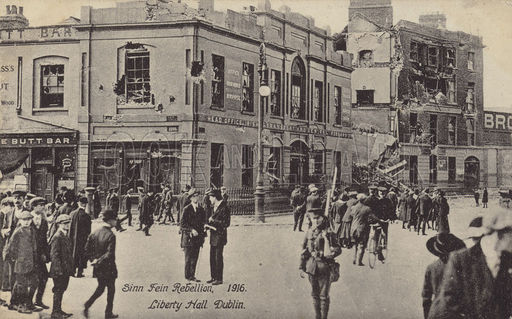
Certainly, the British believed Liberty Hall and buildings along Eden Quay were occupied as fighting posts by the Irish Citizen Army and they fired artillery at the union building from Tara Street, as photos of shell holes in that building and right through to the next testify.

Photo shell-damage Liberty Hall (first building with corner towards the camera, viewed northwards from Butt Bridge) as one of a set of commemorative postcards. (Photo sourced: Internet)
Another postcard with closeup of shelling damage to Liberty Hall and to the building next to it. Interestingly, in this one Liberty Hall is labeled “the Rebel Headquarters”. (Photo sourced: Internet)

Much is made in some historical accounts of the opposition to the Rising from sections of the Dublin population, during and immediately after the Rising. The city was the capital of a British colony, only just over a century earlier spoken of as “the second city of the British Empire”.

A substantial proportion of the wealthy and middle classes were Loyalist, including some Catholics; even ‘nationalist’ sections were committed to supporting the UK in WWI and John Redmond, leader of the ‘nationalist’ political party had openly recruited for the British Army.

Also, among the working class and the lumpen elements, many were depending on “Separation Allowances” with regard to males serving in the British Army. It is true that the insurgents in some places had to threaten, club or even shoot some civilians who tried to obstruct the Rising.11

These incidents during the Rising were not many but afterwards there were insults and other things thrown at prisoners being marched to imprisonment (or firing squad). The city was under martial law but even so a Canadian journalist reported the insurgents being cheered in working class areas.

There were also other individual witness accounts, such as a man on a tram saluting prisoners in Parnell Street until threatened by soldier escorts and a firefighter in the GPO doing likewise. A year later most of even the earlier hostility had changed to admiration and pride in the fighters.

Leadership of the working class

James Connolly wrote and said many things of importance but surely, with regard to the struggle for Irish national independence, the greatest of these was: “Only the Irish working class remains as the incorruptible inheritors of the fight for freedom in Ireland.”

By that he meant — and I agree — that all other social classes can gain something from selling out the interests and resources of Irish nationhood but that the working class can gain nothing from that.

The Irish working class staked their claim on the struggle for Irish independence in 1916 but have not succeeded in leading it and because of that, that struggle remains to be won.

Today and in other days, remembering that long struggle and the class whose leadership revolutionary socialists seek to represent and to uphold, we declare the need for that leadership over a broad front of all others who wish to struggle to advance.

In doing so, we declare that far from the working class having to wait for socialism, in the course of national struggle it must also shape its own demands around the economy, natural resources, infrastructure, social services, social questions, culture and, above all, to the fruits of its labour.

End.

FOOTNOTES

1Irish Republican Brotherhood, Irish Volunteers, Irish Citizen Army, Cumann na mBan, Na Fianna Éireann, Hibernian Rifles.

2All of which were executed by British firing squad, along with another seven in Dublin and yet another in Cork. The 16th execution was by hanging in London.

3(See Sources: Cooption of James Connolly etc) Connolly was a lifelong socialist and a revolutionary throughout his adult life, author, historian, journalist, song-writer, trade union organiser; active politically in Scotland, Ireland, New York and back in Ireland.

4The international socialist movement viewed the imperialists’ movement towards war with horror and in international conferences vowed to oppose it with all their might, including turning war resistance into revolution (“War against war”). However, once imperialist war was declared that resolve collapsed in most states, Russia, Germany and Ireland being notable exceptions and each saw a rising against war, in Ireland’s being the first.

5Joseph E.A. O’Connell (Jnr.) suggests a possible intention of goading of the State into attacking him and the ICA which might spark the general rising.

6(See Sources)

7The harp on the United Men’s flag was more ornate and was inscribed with the words “It is newly-strung and shall be heard”.

8https://www.connollybooks.org/product/irishcitizenarmy

9It was a good central location but more than that – the Hotel was one of the businesses of William Martin Murphy, chief organiser of the employers’ bloc to break the Irish Transport & General Workers’ Union.

10Kavanagh was a supporter of the workers, of votes for women and against participation in the imperialist war, contributing cartoons also to the Irish Citizen, Fianna and Irish Freedom publications, also to accompany poems of his sister, Maeve Cavanagh McDowell.

11I do not include in this the three members of the Dublin Metropolitan Police who were a force for the British occupation and also for the Dublin capitalists. The Irish Citizen Army in particular had good reason to settle accounts with them for attacks on them including inflicting mortal baton injuries on two workers during a charge on a union meeting on 30th September 1913 on Eden Quay and beating people and smashing up furniture in Corporation Street a little later.

SOURCES

Co-option of James Connolly to the Military Council planning the Rising: https://www.historyireland.com/connollys-kidnapping/

Raising the flag on Liberty Hall: https://microsites.museum.ie/1916objectstories/ObjectDetail/remains-of-irish-flag
Molly O’Reilly breaking a window incident: https://www.independent.ie/irish-news/ladies-day-for-1916-heroines/26528456.html

Printing of the Proclamation of Independence: https://libguides.ucc.ie/1916Proclamation
https://www.dublincity.ie/library/blog/printing-1916-proclamation-transcript

Decision taken to go ahead with the Rising on Easter Monday: https://www.irishtimes.com/culture/heritage/easter-rising-uneasy-calm-before-the-storm-1.2575638
https://www.nli.ie/1916/exhibition/en/content/risingsites/libertyhall/

“Only the Irish working class remains the incorruptible heirs …” (end second sentence from last): https://www.marxists.org/archive/connolly/1910/lih/foreword.htm