
Diarmuid Breatnach
(Reading time: 4 mins.)
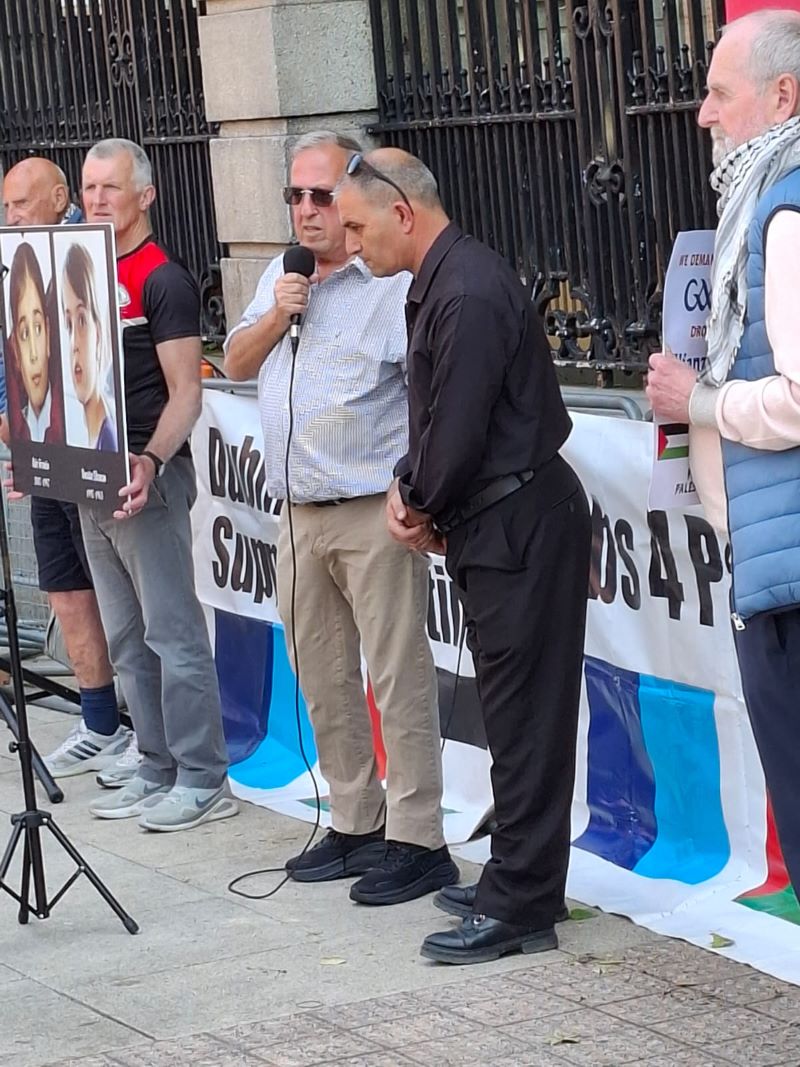
Two famous people addressed a crowd outside Leinster House, home of the Parliament of the Irish State on 25th May. Rami Elhanan, an Israeli graphic designer, and Bassam Aramin, a Palestinian scholar, had forged a remarkable friendship.
Bassam Aramin, now a Palestinian scholar, had been sentenced to a 7-year term of imprisonment for throwing a grenade at Israeli soldiers when he was 17 and had lost his daughter later to a plastic bullet fired at short distance by an IOF soldier.
Rami Elhanan, an Israeli graphic designer, had also lost his daughter Smada but to a suicide bomber in 1997. Both men became advocates of peace and dialogue and friends to one another.
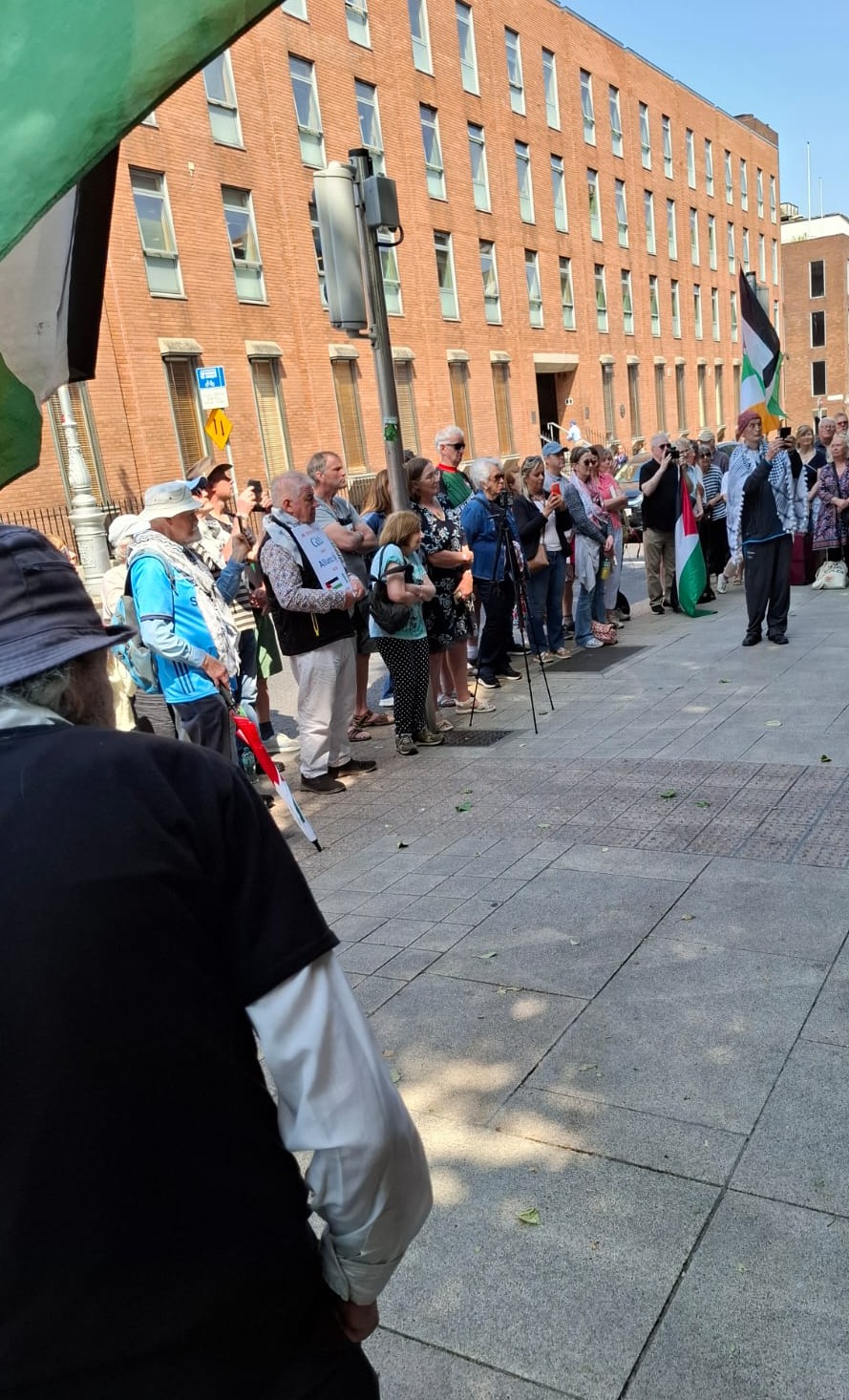
Their audience was the weekly Dubs for Palestine gathering outside Leinster House on Wednesdays 12 noon to about 1.00 pm, with speeches, songs and poetry and David Hickey as MC. This week’s was the 113th such weekly gathering and the duo had been invited to speak.
The broad group has of late been concentrating on parting the Gaelic Athletic Association1 from its sponsor and insurance underwriter, the former Nazi and since Zionist-friendly Allianz company, along with now campaigning for the Irish soccer team not to play the ‘Israeli’ team.
Rami Elhanan referenced his descent from Holocaust survivors and outlined the different living standards of the Palestinian and Israeli Jewish communities, commenting on the sickness in Israeli society, that they did not want to know what is being done in their name to the Palestinians.
Basam Aramin’s contribution was against the Occupation and claimed that without that, Palestinians and Israelis could live in peace (it was not clear whether he was referring to the ‘Two State’ proposal2). David Hickey, the MC of the group presented them with an Arum Lily each.3
After their speeches had been applauded, they were asked to comment on the recent Leinster House debate and the Government’s refusal to endorse a boycott of Israel. Rami Elhanan replied that boycotts entrenched opposing sides and that continuing to talk was the answer.
Singer and activist Emma Browne, invited next to the microphone, sang Keep the Little Flame Alive, among the lyrics of which Faye, Dolores, Bernadine, Table grapes and gasoline, Homemade rifles, kitchen knives, Kept the little flame alive riposted the previous speakers.
Soon afterwards, Paul Lynch read a poem of a Palestinian father mourning the killing of his child. Poet and activist Dorothy Collin declared that in order to have peace there must be justice first and that we must support the oppressed in whatever way they choose to resist.
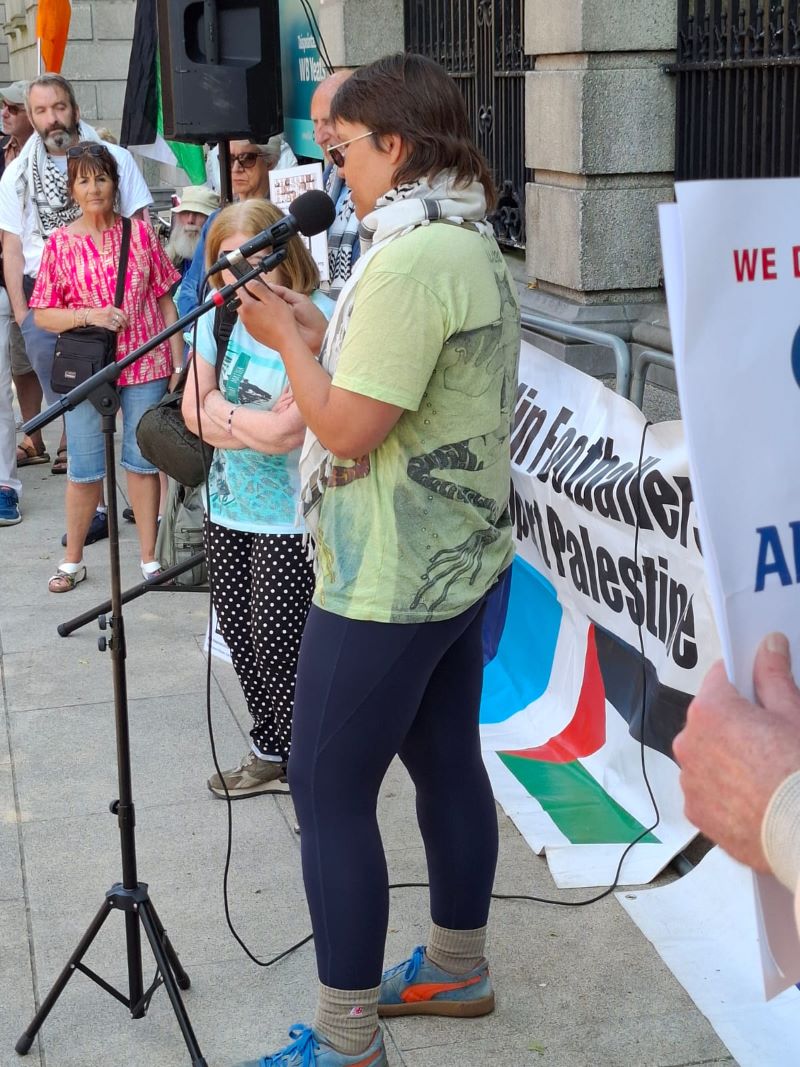
Áine Rutley also upheld our duty of solidarity and the right of the Resistance movement to choose its own methods, as did Jimi Cullen who then performed his own song composition The Freedom Fighter about a fighter from Gaza.
As I was called to the microphone, I commented that my views had already been well expressed in song and speech and that one of the forms of resistance is song, of which we had more than probably any other people in the world and sang An Dord Féinne,4 which is banned in Germany.
A little later the event came to an end with another song from Emma Browne, Never Again Is Now and with group chanting for Palestine, against Allianz and against playing the ‘Israeli’ team.
IN CONCLUSION
It is a popular proposition in certain circles that all social conflicts can be resolved by discussion, by understanding our opponents’ view. It is an attractive idea but flies in the face of history and of contemporary reality.
The interests of Occupied and Occupier are opposed and cannot be reconciled through understanding. The Occupier understands that the Occupied wish to be rid of them. The Occupied do understand that the Occupier wishes to continue appropriating their land and resources.
In this kind of situation one must win and the other lose. Far from understanding leading to peaceful resolution, the more the oppressed understand the nature of their oppressor, the more resolutely they are likely to resist and this is surely true of the Palestinians resisting the Zionist settlers.
The false proposition of resolving irreconcilable interests through discussion is usually of liberal or social-democratic origin when applied to anti-colonial, anti-imperialist and anti-racist struggles and though appearing even-handed, always ends up disempowering the victimised.
The journeys of both these men is extraordinary and interesting but it should not be presented as representative of the Palestinian struggle against Occupation, Theft and Genocide. Each father lost a child but the Palestinian is losing a lot more on top.
Furthermore, a just resolution can only come about through the total defeat of the Zionist forces and the dismantling of their State, so that if we really want that kind of resolution we are called to support the Palestinian side, unequivocally and resolutely.
Of course, in reality there is no question of real peace without justice, for ultimately the oppressed (unless wiped out) will rise in struggle again and again. The proposition of accommodation of opposites by discussion can only undermine or distract the struggle of the oppressed.
We cannot take the story of Bassam Aramin and Rami Elhanan, however remarkable, as even a metaphor for a just resolution nor allow ourselves to be seduced from resistance nor our struggle undermined by it.
End.
Note: If you found this article of interest, why not register with Rebel Breeze for free, so that you will be notified by email of subsequent articles. You can de-register any time you wish.
FOOTNOTES
1The management of the Gaelic games, including hurling and Gaelic football. The GAA has teams in every one of the 32 counties of Ireland, crossing the colonial border and is the biggest community sports association not only in Ireland but also in Europe and perhaps in the world.
2This proposal came out of the Oslo Accords, to give the Palestinians 20% of their land for peace with the Zionist settlers who would own the remaining 80%. Apart from its basic injustice the proposal was never realistic since Zionist settlers continued to construct settlements on additional land. Despite this, supporting that proposal is the formal position of most western imperialist states and the Irish State and of most parliamentary political parties.
3In Ireland these are often viewed as symbolic of the 1916 Easter Rising.
4Also known as Gráinne Mhaol and Óró Sé Do Bheatha ‘Bhaile, an Irish traditional song of some antiquity refashioned into an Irish resistance song by Patrick Pearse, a martyred leader of the 1916 Rising.
SOURCES

