
Diarmuid Breatnach
(Reading time main text: 4 mins.)
We’ve recently passed by the date of the start of a monumental prison resistance struggle when IRA prisoner Kiaran Nugent refused on 14 September 1976 to wear prison uniform.
The Hunger Strike of 1981 tends to be remembered as an isolated event in the history of the Irish Republican prisoners’ opposition to criminalisation. But it was five years of struggle through stages that ended eventually in the martyrdom of ten Republicans.
Irish Republicans had been in imprisoned in British jails since the late 18th Century.1 After the Irish national bourgeoisie accepted the British partition of Ireland, Republican prisoners were held in prisons in the Irish State and in the British colony of the Six Counties and at times in Britain too.
This situation continued on low but constant level with higher points during the Civil War (1922-1923), the pogroms in the Six Counties, the 1930s,2 the 1940s, the Border Campaign (1958-1962) and the Civil Rights campaign from the mid-1960s onwards.
The Wikipedia section on Special Category Status states that it was introduced for Republican prisoners serving sentences in the Six Counties in 19723 but neglects to mention that it was already widespread among nationalist prisoners due to internment without trial a year earlier.
The British introduced internment without trial in their Irish colony in 1971 and one of the effects of that measure was to put a huge number of mostly nationalists from the Six County colony into jail. These prisoners were all accorded Special Category Status and wore their own clothes.

Over the life of the measure, 1,981 people were interned without trial in the Six Counties (British Army’s Operation Demetrius). Of those detained 1,874 were from a Catholic/Republican background while, towards the end, 107 were from a Protestant/Loyalist background.
Special Category Status distinguished the internees from other political prisoners which were few in number at the time but its major impact was to distinguish them visibly from social prisoners or what are commonly called ‘criminals’ and was often called Political Prisoner Status.
In June 1972 other nationalists/ Irish Republicans4 charged and convicted were also accorded Special Category Status,5 which came to be seen as prisoner of war status for opponents of the British colonial occupation, despite Britain’s claims that the prisoners were just criminals.
Internment without trial in the Six Counties, generally recognised as a failure from both political and military points of view, was formally ended after four-and-a half years on 5 December 19756. As resistance continued, including now an armed aspect, more prisoners saw the inside of jails.
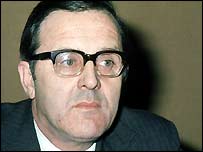
But they were still under Special Category regime and wearing their own clothes. The following year on 5 March 1976, Merlyn Rees as Secretary of State implemented the Labour Government’s7 decision to remove Special Category Status from any subsequently-convicted prisoners.
MERL
The first Irish Republican prisoner to be informed he would have to wear prison uniform under the new rules was Kiaran Nugent. His reply, though pithy has gone down in the records of Irish resistance statements: “You’ll have to nail it to my back.”
Stripped naked, Vol. Nugent was put in a cell, from which he found a blanket and wrapped it around himself. It was a natural act to cover his nakedness but he may also have known that Irish Republican prisoners of the Irish State in the 1940s had done the same.
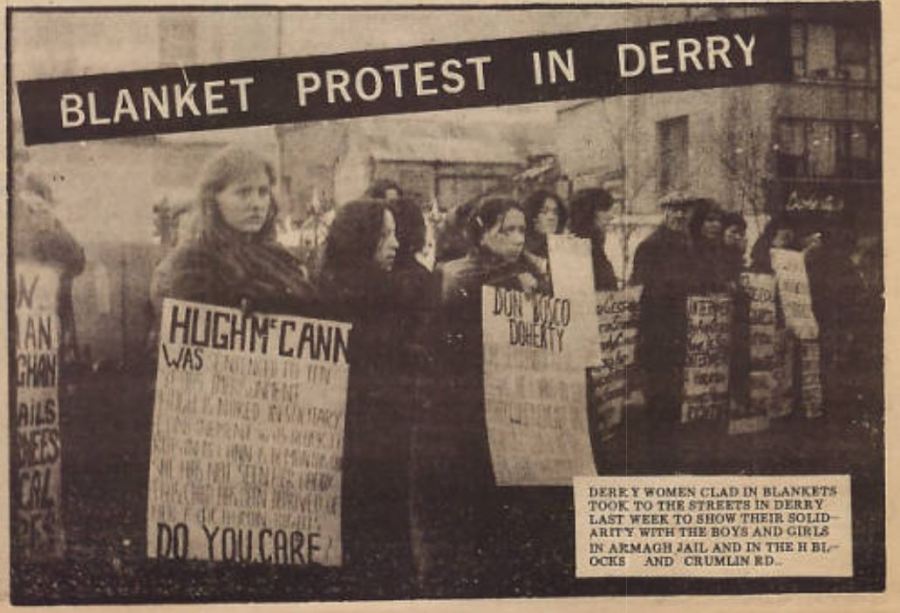
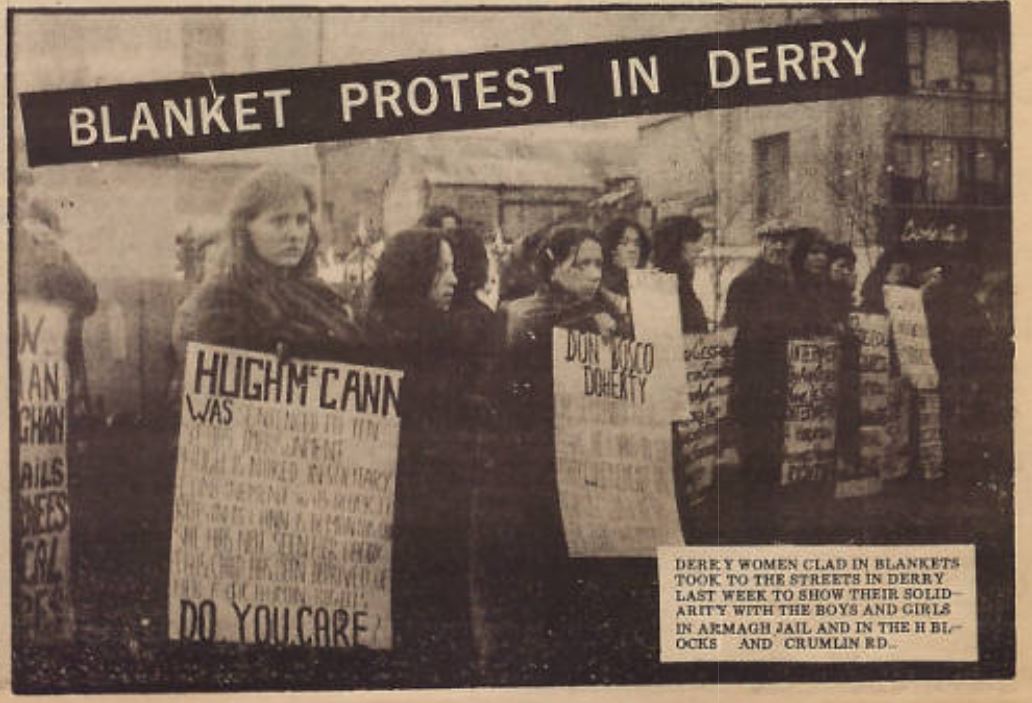
The Blanket Protest had begun and spread as more prisoners coming into the prison system took the same stand. There it might have stayed were it not for the violence and cruelty of HM Prison regime by its warders regularly assaulting prisoners on their way to and back from the showers and toilets.
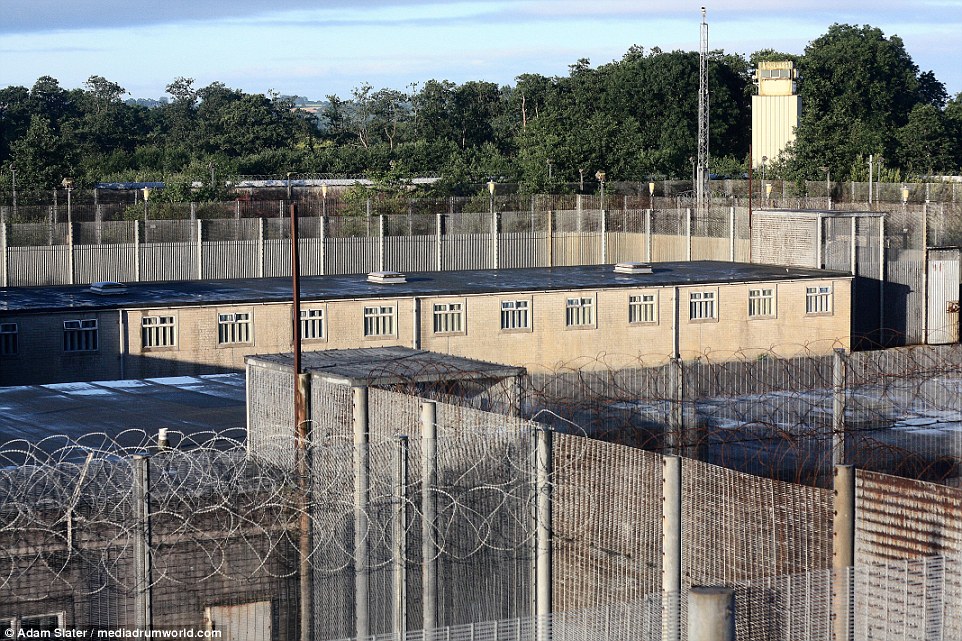
In 1978 the Irish Republican prisoners in the Maze H-Blocks8 resolved to remain in their cells, emptying their excreta out the window and their urine under their cell doors into the passageway. So the prison authorities blocked up their windows and warders pushed urine back under their doors.
The Irish prisoners then had nowhere to put their excreta so they smeared it on the walls. They built a dam of bread fragments around their door to prevent their urine being pushed back in. These conditions they endured until the prison riot squad beat them out of their cells for power-hosing.
Those who watched the film Hunger (2008) directed by Steve McQueen will have seen some of that and how they treated the naked prisoners too, beaten to the ground, anus probed for contraband messages or materials, the same gloved hand often opening their mouths to look inside also.
Their flesh was forcibly abraded with scrubbing brushes and they were often inserted into cells still wet from the hosing. Once back inside cells, they continued the protest.
On 27 October 1980 seven Republican prisoners, against the orders of IRA GHQ, embarked on a hunger strike included the Five Demands to break the system, which they terminated after 53 days on receiving promises from the authorities which were then reneged upon.
The 5 Demands:
- The right not to wear a prison uniform;
- The right not to do prison work;
- The right of free association with other Republican prisoners, and to organise educational and recreational pursuits;
- The right to one visit, one letter and one parcel per week;
- Full restoration of remission lost through the protests.9
Outraged at the reneging, Republicans renewed the hunger strike with their previous Provisionals’ jail Commanding Officer10 insisting he be first. So was Bobby Sands the first to die and another nine martyrs behind, seven Provisional IRA and 3 INLA as they came on to the strike in sequence.
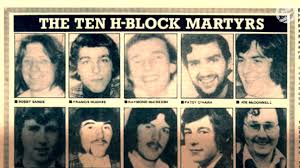
The effect of the hunger strikes of 1981 was huge in Ireland, Britain and further abroad. IRA Vol. Kieran Nugent had an important hand in pushing the process but so did Mervyn Rees, William Whitelaw, Brian Faulker and Edward Heath,11 in a long process of repression and resistance.
Today the struggle continues with approximately 20 Irish Republican prisoners, male and female in prisons between the neo-colonial Irish state and the British colony of the Six Counties. They have essentially won the five demands, though official harassment in the colony’s jails is endemic.
End.
NB: If you found this article interesting you may wish to subscribe to the blog free of charge, after which you would receive a notification in your email every time an article was published. You can unsubscribe any time you wish.
APPENDIX: Brief biography of Kieran Nugent (12th September 1958 – 3rd May 2000).
Volunteer Kieran Nugent began his short life presumably in the occupied Six Counties of Ireland but all the references I have found so far begin with him at the age of 15 years of age, standing at a corner with a friend on the corner of Merrion Street and Grosvenor Road, West Belfast.
It was 20th March 1973.12 A car pulled up beside them asking for directions but an occupant of the vehicle then opened fire with a submachine gun. Nugent was seriously wounded, shot eight times in the chest, arms and back. His friend, Bernard McErlean, aged 16, was killed.
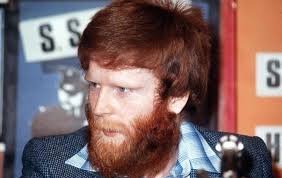
Another youth was seriously injured also.13 Local people reported that a British Army Saracen armoured car had crashed through a nearby barricade and that was what had allowed entry for the murder gang, later claimed by the UDA, a British proxy Loyalist militia.
“At some point afterwards, Nugent joined the IRA.”14 The youngest age for IRA membership was 17 and Nugent aged 16 was arrested by the British Army, automatically refused bail, and at trial, after five months on remand in Crumlin Road Prison, Belfast, case withdrawn, he was released.
Kieran became an active volunteer until his arrest and internment without trial, on 9 February 1975. He served nine months in Cage 4 of Long Kesh Detention Centre (later renamed The Maze) in the Six Counties, until 12 November 1975. But was arrested and imprisoned again on 12 May 1976.
Vol. Nugent was charged with hijacking of a bus, a frequent Republican resistance activity in Belfast where the vehicle would then be utilised as a barricade. His sentence was three years in jail which he was commencing when he began the blanket protest.
The cause of death for Kieran Nugent was given as heart attack. A number of his acquaintances remarked that he had sunk into alcoholism with some adding that the movement had given him no support. Whether true or not, many former Republican prisoners of the period had shortened lives.
FOOTNOTES
SOURCES
https://en.wikipedia.org/wiki/Special_Category_Status
SC status generalised for Republican prisoners: https://cain.ulster.ac.uk/events/bfriday/bac.htm
https://cain.ulster.ac.uk/events/intern/chron.htm
1Republican prisoners were held in British jails in Ireland, Britain and Australia – and for centuries before that Irish clan members had been incarcerated in Britain and Ireland.
2When the anti-fascist struggles also contributed to prisoner of the states.
3https://en.wikipedia.org/wiki/Special_Category_Status
4I am using the term “nationalists” as a broad and not strictly accurate term to describe the people of the Catholic ghettoes and areas of the British colony; of course many of them could have been also or instead mainly democrats, socialists. The term “Irish Republicans” I am using to describe those belonging to organisations nominally of Irish Republican kind but again how much each was truly Republican in ideology varied, for example in their opinion of the appropriate role of the Catholic Church in Irish society.
5Sentenced and remanded in custody Irish Republicans in jails went ona hunger strike for ‘political status’ in 1972 and the Provisional IRA during the Truce negotiations of June that year asked for political status for them which William Whitelaw conceded.
6https://cain.ulster.ac.uk/events/intern/chron.htm However internment without trial in fact continued by charged Republicans being refused bail and remaining in jail for two years or more awaiting trial. Bail decision and trial would be in the special no-jury Diplock Courts.
7It is difficult to understand any Irish person or indeed any anti-imperialist putting any faith in a British Labour government. Apart from its long imperialist history, it formed part of the national government that executed leaders of the 1916 Rising, sent troops to the Six Counties to quell the civil rights struggle in 1969, introduced the Prevention of Terrorism Act in Britain in 1974 and framed a score of Irish people for bombings, removed Special Category Status in 1976 …
8A special male political prison containing panopticon-designed blocks in Lisburn, Co. Antrim, built in 1971 and closed in 2000, the future of the empty buildings uncertain. Female Republican political prisoners were kept in Armagh Jail and fought with different tactics, including taking the Prison Governor hostage at one point.
9Prisoners disobeying prison rules are punished in a number of ways, one of which is loss of the remission off sentence normally expected.
10In a long tradition the prisoners of each political group in jail elect their leader and previous ranks are abandoned for the duration of the incarceration.
11In sequence: Labour Party Secretary of State; Conservative party Cabinet Minister; Unionist Prime Minister of the colony; Conservative Prime Minister of the UK.
12https://www.facebook.com/story.php?story_fbid=672093692010347&id=100076291652304&_rdr
13Ibid.
14Various sources
 rebelbreeze