CHRISTMAS IS PART OF WAR IN WEST ASIA

Diarmuid Breatnach

(Reading time: 5 mins.)

Writing about Christmas and war tends to focus on Christmas celebration as a counter to war,1 or alternatively on how hard it is to be celebrating Christmas in the midst of war. However, in much of West Asia, Christmas is now very much a part of the war.

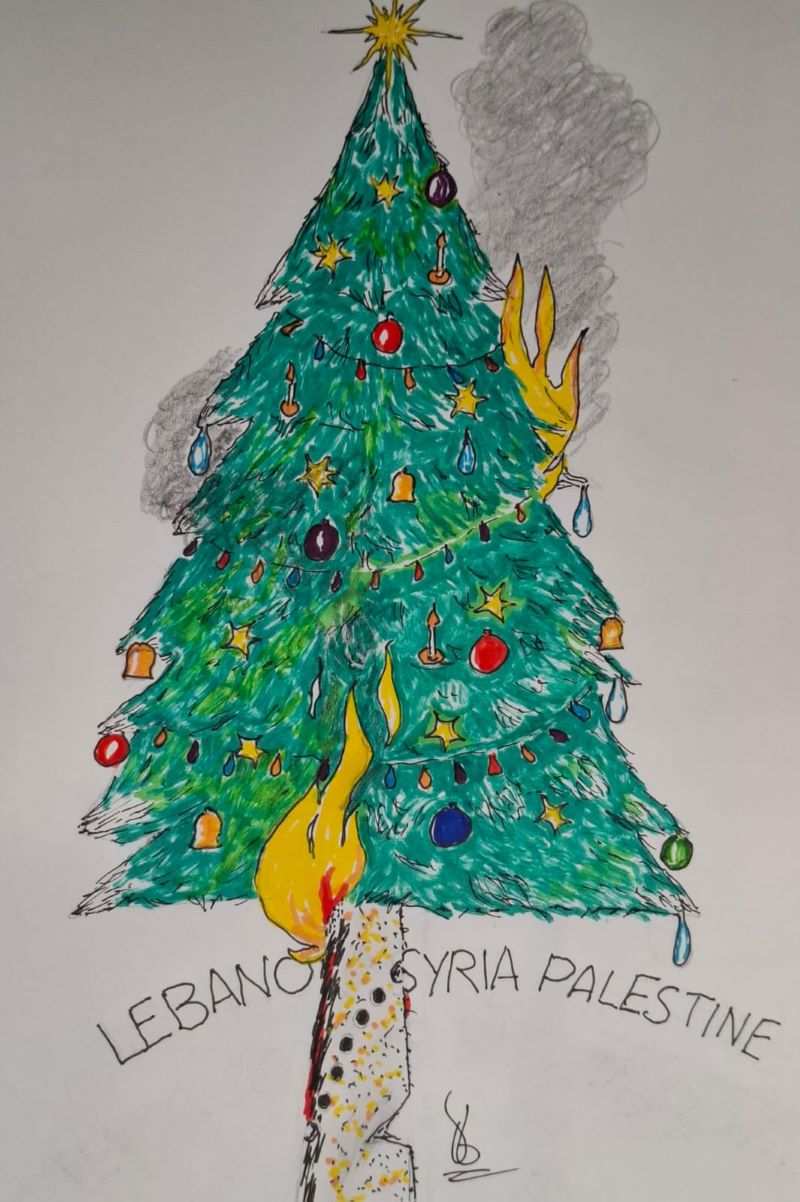
This is certainly the case in Lebanon, Syria, Gaza and the West Bank and even inside ‘Israel’.

Among the peoples of this majority Muslim region the festivities are primarily those of Christian communities. Yet the broad Muslim population has no issue with the religious aspect of the festival, nor even with the iconic symbolism of the Holy Family and the birth in a manger of Jesus Christ.

The latter, among Christians believed a human incarnation of God, is also revered among Muslims but as a prophet, though of course lower in ranking than their highest-ranking prophet, Mohammed (c. 570 – 8 June 632 CE), allegedly of the Banu Hashim clan of the Quaraysh Arab tribe.

Among the Judaic religion, Jesus Christ is also believed a prophet.

It is important – and not just for historical reasons – to note that the major perpetrator of religious persecution from the Middle Ages on has been Christianity, led by European Christian elites persecuting followers of Judaic and Islamic religions and employing the Inquisition2 against them.

Earlier of course Christianity had its internal divisions resulting in one part of Christianity persecuting another (the East-West schism) and then later the split of the Reformation, with religious and temporal powers in war and in persecution of one another and of subject populations.3

The chief object of Christian religious persecution overall was the Jews and the objects of that persecution found sanctuary in many Muslim countries and, in general, within the Austro-Hungarian Ottoman Empire.

Leaders of a number of Muslim states today are traditionally at pains to demonstrate their acceptance of Christian communities and this Christmas both Mohammed Shia al-Sudani, Prime Minister of Iraq and President Masoud Pezeshkian of Iran once more did so publicly.

Mohammed al-Sudani attended a Christian service and Masoud Pezeshkian visited a Christian family.4

Of course, Christmas as celebrated generally across the West is more – and one might say also much less – than a Christian or even a religious festival, with emphasis on feasting, alcoholic consumption and expenditure on presents.

Much of the symbolism too owes more to pagan religion than to Christianity.5

With a number of those aspects, including consumption of alcohol (traditionally forbidden by and to Muslims), pagan symbolism and more than a nod to western imperialist culture, many Muslims may take exception but even then not at all to celebration of the alleged birth of Jesus Christ.

However, for those wishing to cause divisions in predominantly Islamic societies, or in imposing their sectarian absolutist rule on society, the celebration of Christmas has become a hostile target in Lebanon, Syria, Gaza, the West Bank and even inside ‘Israel’.

LEBANON

Lebanon is the most ethnically-diverse of the West Asian states, approximately one-third Christian, one-third Shia Muslim and a third Sunni Muslim. For years, Christmas has been celebrated not only by the Christian community but also, to varying degrees, by the other ethnic groups also.

It is extremely worrying therefore when a primary schoolteacher taught her girl pupils and filmed them not only renouncing Christmas as ‘non-Muslim’ but calling its celebrants the equivalent of heretics. There was widespread shock when she uploaded the video she had made of the girls.

Not surprisingly, the teacher was sacked but this too was orchestrated into a controversy with extreme religious sectarians coming on to the streets to protest, including former sectarian terrorist and ex-convict for bombing a church Samir Geagea of the sectarian Lebanese Forces militia).6

SYRIA

Under the new regime in Syria, celebrating Christmas can get people killed.The celebration was not controversial in the majority Islamic but secular state of Syria under al-Assad but that changed following that regime’s overthrow by western-supported Islamic fundamentalist jihadists.

During Christmas 2024 units of the fundamentalist jihadist coalition under self-appointed al-Julani (formerly Ahmed al-Sharaa of the Syrian chapter of ISIS) led attacks on Christians, forbade the erection of Christmas trees and knocked down and burned some that had been erected.7

Earlier this year Sayara Ahl Al-Sunnah, a Syrian terrorist organization split from the ruling Hay’at Tahrir Al-Sham (HTS) of al-Julani in February carried out a suicide attack on the Mar Elias Greek Orthodox church in Damascus, killing 30 Christian worshippers.8

Not just Christian communities are targeted in this ‘new democratic Syria’ so beloved of the Western powers but primarily really the Shia Muslim offshoots of Alawites9 and Druze10 communities. Both these communities are now mobilising in self-defence against the new rulers.

PALESTINE

In Gaza, blockaded and besieged, starving, flooded, homeless, cold, bombarded, even thinking of a festive celebration seems a crazy idea yet some have attempted to celebrate Christmas this year11 although any gathering of Palestinians seems an invitation to an IOF raid or even bombing.

In the West Bank, the Christian pastor12 in Ramallah, Isaac Munther, faced with the accelerating genocide in Gaza in 2023 declared there would be religious observation only and no Christmas celebrations of lights etc … but his sermon and Christ-nativity-in-rubble scene went ‘viral.’

Munther did the same during Christmas 2024 but this year the West Bank faces its own escalation of Palestinian home demolitions, army invasions, settler attacks on homes, livestock, farmland. However the IOF attacked some Palestinians who did try to celebrate a western-style Christmas.

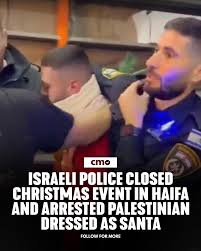
Palestinians of other Christian denominations also tried to celebrate Christmas but met with repression and in Bethlehem there were clashes with Palestinians in Santa costume assaulted and arrested by ‘Israeli’ Occupation Forces.13

Occupied Palestine (‘Israel’ sic) also saw a Palestinian ‘Santa Claus’ being arrested by the IOF and Palestinian celebrants assaulted in Haifa.

As the supposed Holy Land where Jesus Christ was allegedly born, Christian tourism makes a significant contribution to the income of the Zionist state.14 But even so, Palestinian Christians and even tourists have complained of being menaced and spat at by militant Zionist settler youths.15

The Israeli Zionist state likes to promote itself as culturally representing the West much more than the East – which it certainly does – but seeing this repression of Christians even celebrating Christmas, one has to wonder what kind of ‘western society’ is this?

Meanwhile, in Rome …

Discussion of Christmas entails a mention of the majority sect of western Christianity, the Catholic faith and of its leader, the Pope. And the relatively new Pontiff – and first USA-born one – did in fact refer to Gaza in the traditional Papacy Christmas message from the Vatican.

Leo XIV’s message has been lauded by some in apparent ignorance of the political position of the Vatican and of its Papacy, which has been always to support western imperialism, or in his advocacy of Zionist colonisation in the western support for a two-State solution (sic) in Palestine.16

But for democracy and anti-imperialist unity …

Republicans reject any religious role in the management of the state or of its institutions – including education17 – but should also protect the freedom to worship or celebration of festive period of any personal or organised religion — and indeed also the right to promote atheism or agnosticism.18

Anti-imperialist revolutionaries whether secular or not need to oppose religious sectarianism and promote unity in the face of imperialism. It is imperialism and colonialism that promotes inter-religious conflict and fosters fundamentalist sectarians in order to undermine anti-imperialist resistance.

End.

Note: If you found this article of interest, why not register with Rebel Breeze for free, so that you will be notified by email of subsequent articles. You can de-register any time you wish.

FOOTNOTES

1For example the famous Christmas Day informal truce of 1914, when WWI hostilities between German and Allied troops temporarily ceased on parts of the Western Front and enemy combatants exchanged greetings and gifts. https://www.irishtimes.com/culture/heritage/the-1914-christmas-truce-fraternisation-of-an-extraordinary-kind-1.2048442

2Although it later became an instrument of Rome to ensure orthodoxy in religion, literature and science, the Inquisition was originally instituted in Iberia as a controlling agent over the forced conversions of Jews and Muslims to Christianity and later also operated as an instrument in control of the Spanish colonies.

3Of which we in Ireland have centuries of experience.

4https://www.tehrantimes.com/news/522126/Top-officials-join-Iran-s-Christians-in-celebrating-Jesus-birth

5The ‘old man of the woods’ Santa Claus or God of thunder and lightning in a sky-chariot pulled by horned beasts (two of which are also allegedly named Thunder (Donner) and Lightning (Blitzen) and the Christmas Tree and/ or Yule Log, pagan symbols of a festival signalling the turn of the seasons.

6https://youtu.be/b1yltoo3q6Q?t=150 almost from the beginning for part of the podcast.

7https://www.jurist.org/news/2024/12/christmas-tree-burning-ignites-protests-in-damascus/

8This is the same group that carried out a suicide attack on the Imam Ali mosque in Homs this week, which left 8 people dead.

9Arabic-speaking ethno-religious minority group who primarily live in Syria and follow Alawism, a syncretic and esoteric offshoot of Shia Islam.

10Arabic-speaking ethno-religious minority in Syria, Lebanon, Israel and the Israeli-occupied Golan Heights.

11https://english.almayadeen.net/news/politics/silent-christmas-in-gaza–grief–cold–and-a-genocide-that-w

12Of the Evangelical Lutheran Church in Jordan and the Holy Land.

13https://www.aljazeera.com/news/2025/12/25/christmas-under-occupation-israeli-attacks-against-palestinian-christians

14“While there is no precise figure for how much Israel earns specifically from religious tourism, estimates suggest that Christian holy sites alone generate around $3 billion each year to the Israeli economy under normal circumstances — with over half of all tourist arrivals coming from Christians — and a quarter of those visitors going to Christian holy sites.” https://religionunplugged.com/news/war-in-gaza-and-the-disruption-of-pilgrimages-to-jerusalem

15https://www.middleeasteye.net/news/israeli-forces-arrest-santa-clause-raid-palestinian-christmas-celebration and https://www.instagram.com/reels/DSp2Cs6FDXW/

16https://www.reuters.com/world/middle-east/pope-leo-palestinian-state-only-solution-israeli-conflict-2025-11-30/

17This is an issue in many lands including Ireland where the Irish State and the colony’s both pay the salaries of teachers employed in religious-ethos schools. People have a right to religious education for their children should they wish it but in no way should the State facilitate such and, on the other hand, all children are required to attend formal education supplied by the State.

18The 1916 Rising Proclamation: “The Republic guarantees religious and civil iberty to all …

SOURCES

https://english.almayadeen.net/news/politics/silent-christmas-in-gaza–grief–cold–and-a-genocide-that-w

https://www.aljazeera.com/news/2025/12/25/christmas-under-occupation-israeli-attacks-against-palestinian-christians

https://www.instagram.com/reels/DSp2Cs6FDXW/

https://www.middleeasteye.net/news/israeli-forces-arrest-santa-clause-raid-palestinian-christmas-celebration

Alawite protests and new Syrian state repression: https://thecradle.co/articles/syrian-govt-forces-supporters-attack-alawite-protesters-calling-for-end-to-killings-kidnappings

Part of new Syrian forces repression of Christmas: https://www.jurist.org/news/2024/12/christmas-tree-burning-ignites-protests-in-damascus/

Islamist sectarians whipping up anti-Christian hatred in Lebanon: https://youtu.be/b1yltoo3q6Q?t=150 (early part of podcast)

Manufacturing Rebels: How the US and UK empowered HTS

by Kit Klarenberg (republished and somewhat reformatted with kind permission from his article in The Cradle) https://thecradle.co/articles/manufacturing-rebels-how-the-uk-and-us-empowered-hts
(Reading time: 7 mins.)

On 18 December, The Telegraph published an extraordinary investigation into how the UK and US trained and “prepared” fighters in the Revolutionary Commando Army (RCA).

This was a “rebel” force that collaborated with Hayat Tahrir al-Sham (HTS) in the mass offensive toppling of Syrian president Bashar al-Assad weeks earlier. 

In an unprecedented disclosure, the outlet revealed that Washington not only “knew about the offensive” well in advance, but also had “precise intelligence about its scale.”

Washington’s now-confirmed “effective alliance” with HTS was described as “one of many ironies” emerging from the decade-and-a-half-long proxy war.

The Telegraph suggested this collaboration was inadvertent – simply a symptom of how Syria’s grinding, protracted civil war gave birth to “a bewildering array of militias and alliances, most of them backed by foreign powers.” 

US support of HTS: A ‘necessary’ alliance 

Alliances were fluid, with groups often splintering, merging, and shifting allegiances. Fighters frequently found themselves switching sides, blurring lines between factions.

Yet, ample evidence indicates the UK and the US maintained deliberate, long-standing ties with the dominant rebels of HTS.

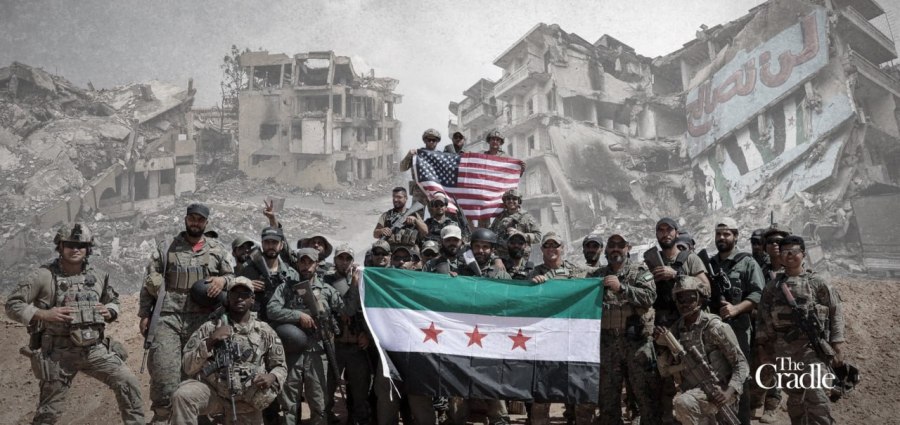
(Photo cred: The Cradle)

For instance, in March 2021, President-elect Donald Trump’s former lead Syria envoy, James Jeffrey, gave a revealing interview to PBS, during which he disclosed that Washington secured a specific “waiver” from then-secretary of state Mike Pompeo to assist HTS. 

While this did not permit direct funding or arming of the UN/US-designated terrorist organization, the waiver ensured that if US-supplied resources “somehow” ended up with HTS, western actors “[could not] be blamed.” 

The fungibility of weapons on the Syrian battlefield was something Washington counted on heavily.

In a 2015 interview, CENTCOM spokesman Lieutenant Commander Kyle Raines was quizzed about why Pentagon-vetted fighters’ weapons were showing up in the hands of the Nusra Front (precursor to HTS).

Raines responded: “We don’t ‘command and control’ these forces – we only ‘train and enable’ them. Who they say they’re allying with, that’s their business.”

This legal loophole enabled Washington to “indirectly” support HTS, ensuring the group did not collapse while maintaining its designation as a terrorist organization.

This status was complete with a now-rescinded $10 million bounty on leader Abu Mohammad al-Julani, who now goes by his real name Ahmad al-Sharaa. 

Jeffrey rationalized this strategy, calling HTS “the least bad option” for preserving “a US-managed security system in the region,” and thus worth “[leaving] alone.” HTS’s dominance, in turn, gave Turkiye a platform to operate in Idlib.

Meanwhile, HTS sent unmistakable messages to their US patrons, pleading:

We want to be your friend. We’re not terrorists. We’re just fighting Assad.”

Safe haven’

Since Assad’s fall, officials in London have markedly taken the lead in legitimizing the HTS-led interim administration as Syria’s new government.

The group was added to the UK’s list of proscribed terrorist organizations in 2017, its entry stating HTS should be considered among “alternative names” for the long-banned Al-Qaeda.

While UK Prime Minister Keir Starmer declared it “too early” to rescind the group’s designation, British officials met HTS representatives on 16 December – despite the illegality of such meetings.

This likely signals an impending, highly politicized western rehabilitation of HTS. Throughout Syria’s dirty war, UK intelligence waged extensive psychological operations to promote “moderate rebels,” crafting atrocity propaganda and human-interest stories. 

These efforts were ostensibly aimed at undermining groups like HTS, ISIS, and Al-Qaeda. Yet leaked documents from UK intelligence reveal how HTS remained intertwined with Al-Qaeda post-2016, directly contradicting media narratives.

In other words, throughout the decade-and-a-half-long crisis, HTS was officially considered on par with the most fundamentalist, genocidal elements in the country. 

British documents also make a total mockery of the common refrain that HTS severed all ties with Al-Qaeda in 2016. A 2020 file described how Al-Qaeda “co-exists” with HTS in occupied Syrian territory, using it as a launchpad for transnational attacks. 

The document warned that HTS’s domination created a “safe haven” for Al-Qaeda to train and expand, fueled by instability. British psyops against HTS spanned years but ultimately failed.

Instead, leaked files lament HTS’s growing influence, territorial gains, and re-branding as an alternative government.

[Al-Qaeda] remains an explicitly Salafi-Jihadist transnational group with objectives and targets which extend outside Syria’s borders. [Al-Qaeda’s] priority is to maintain an instability fuelled safe haven in Syria, from which they are able to train and prepare for future expansion. HTS domination of north west Syria provides space for [Al-Qaeda] aligned groups and individuals to exist.”

British-backed propaganda benefiting HTS

British intelligence psyops attempting to hinder HTS were in operation from the group’s founding until recently.

Yet, they appear to have achieved nothing. Numerous leaked files reviewed by The Cradle bemoan how HTS’s “influence and territorial control” had “dramatically grown” over the years. 

Its successes allowed the extremist group “to consolidate its position, neutralize opponents, and position itself as a key actor in northern Syria.” But HTS’s “domination” was secured in part by the group re-branding itself as an alternative government.

HTS-occupied territory was home to a variety of parallel service providers and institutions, including hospitals, law enforcement, schools, and courts.

The group’s domestic and international propaganda specifically promoted these resources as a demonstration of an “alternative” Syria awaiting roll-out across the entire country.

Ironically, many of these structures and organizations – such as the infamous White Helmets, who also operated in ISIS-run territories – were direct products of British intelligence, created for regime change propaganda purposes.

Moreover, they were aggressively promoted by London at enormous expense.

Repeated references are made in leaked UK intelligence documents to the importance of “[raising] awareness of moderate opposition service provision,” and providing domestic and international audiences with “compelling narratives and demonstrations of a credible alternative to the [Assad] regime.”

There is no consideration evident in the files that these efforts might be assisting HTS greatly in its own efforts to present itself as a “credible alternative” to Assad.

Nonetheless, it is acknowledged that Syrians in occupied territory would accommodate HTS “particularly if [they are] receiving services from it.”

Even more eerily, the documents note, “HTS and other extremist armed groups are significantly less likely to attack opposition entities that are receiving support” from the UK government’s Conflict, Stability, and Security Fund (CSSF). 

This was the mechanism through which Britain’s Syrian propaganda war and organizations like the White Helmets and extremist-linked Free Syrian Police were financed.

These UK-run governance structures and opposition elements, which were allegedly intended to “undermine” HTS, operated in areas controlled by the group safe from violent reprisals for their foreign-funded work, as they “demonstrably provide key services” to residents of occupied territory.

There is also the darker prospect that HTS was well aware these “opposition entities” were bankrolled by British intelligence, and they were unmolested on that very basis.

Coordinated offensive

As The Telegraph‘s report explains, “the first indication that Washington had prior knowledge” of HTS’s offensive was when its RCA proxies were given a rousing pep talk by their US handlers three weeks prior. 

At a secret meeting at the US-controlled Al-Tanf air base close to the borders of Jordan and Iraq, the militants were told to scale up their forces and “be ready” for an attack that “could lead to the end” of Assad. A quoted RCA captain told the outlet:

They did not tell us how it would happen. We were just told: ‘Everything is about to change. This is your moment. Either Assad will fall, or you will fall.’ But they did not say when or where, they just told us to be ready.”

This followed US officers at the base, swelling the RCA’s ranks by unifying the group with other UK/US-trained, funded, and directed Sunni desert units and rebel units operating out of Al-Tanf under joint command. 

According to The Telegraph, “RCA and the fighters of HTS … were cooperating, and communication between the two forces was being coordinated by the Americans.”

This collaboration proved to be of devastating effect in the “lightning offensive,” with RCA rapidly seizing key territory across the country upon explicit US orders.

RCA even joined forces with another rebel faction in the southern city of Deraa, which reached Damascus before HTS. RCA now occupies roughly one-fifth of the country, pockets of territory in Damascus, and the ancient city of Palmyra. 

Hitherto “heavily defended” by Russia and Hezbollah, Moscow’s local base has now been taken over by RCA. “All members of the force continued to be armed by the US,” receiving salaries of $400 monthly, nearly 12 times what Syrian Arab Army (SAA) soldiers were paid.

It is uncertain whether this direct financing of the RCA and other extremist militias that toppled the Assad government continues today. What is clear, though, is that the UK and US supported HTS from the group’s inception, even if “indirectly.”

In turn, this covert backing played a pivotal role in positioning HTS financially, geopolitically, materially, and militarily for its “lightning” swoop on Damascus and assumption of government today.

Reinforcing the interpretation that this was the objective of London and Washington all along, following Assad’s ouster, Starmer promptly declared that the UK would “play a more present and consistent role” in West Asia as a result. 

While western and certain regional capitals may celebrate the apparent success of their lavishly funded, blood-soaked campaign to dismantle decades of Baathism, British intelligence had long cautioned that the outcome would grant Al-Qaeda an even larger “instability-fueled safe haven” for “future expansion.”

Who Bombed the Syrian Soldiers’ Graduation Ceremony?

News & Views No.10 Diarmuid Breatnach (Reading time: 5 mins.)

A three-day period of national mourning began Friday in Syria over the drone bombing of a passing-out ceremony of Syrian soldiers completing their Army training, the death toll so far being 89 including women and children.

The news of events in Palestine over the weekend has overshadowed the Syrian news but nevertheless the events in Syria were very serious.

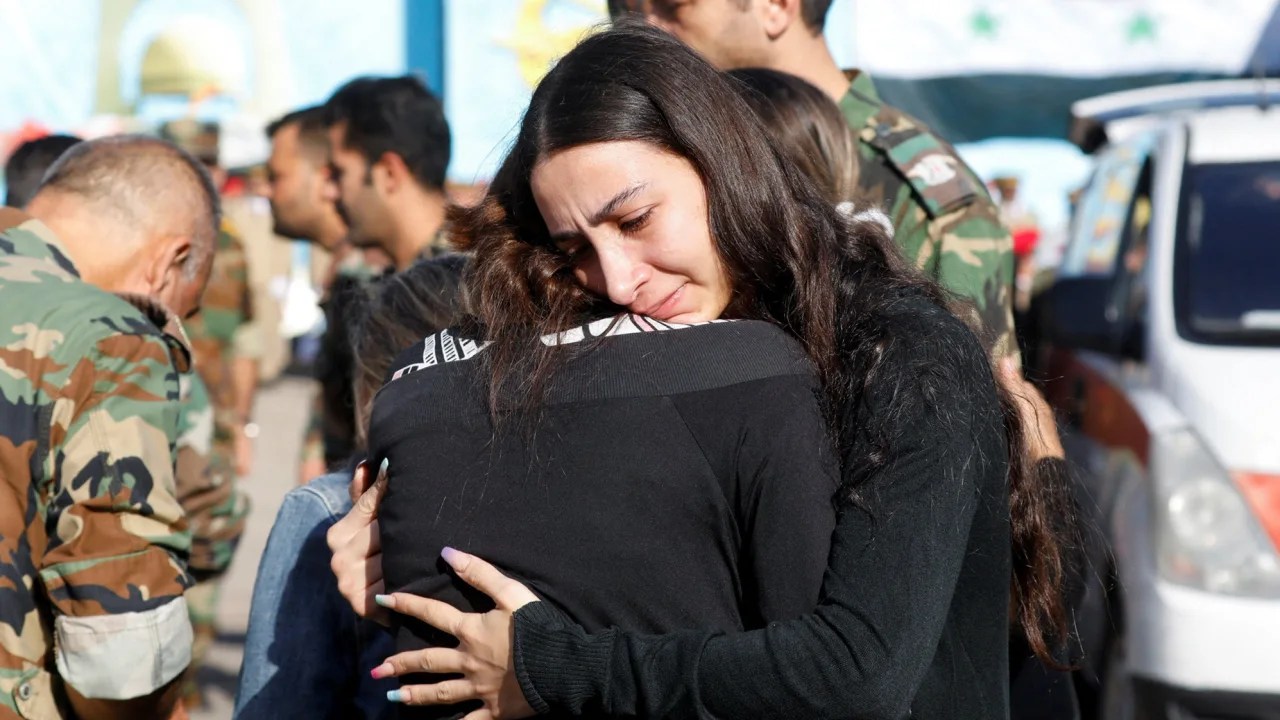
Thursday’s strike on the Homs Military Academy killed 89 people, among graduating soldiers and proud family members, also wounding as many as 277, according to the health ministry — and the death toll could rise as some of the wounded are in a critical condition.

Women relatives of soldiers in the passing-out parade comfort one another in their grief. (Photo sourced: Internet)

Who did it? and Why? are two questions that spring to mind. The mass media which is usually quick to speculate – or to find some ‘expert’ to speculate for them – are not doing so. In fact, they are not even asking the questions.

But that doesn’t stop the media from slagging off the Syrian state leadership and dropping in a kick at the Russians at the same time.

So Associated Press agency starts off “putting it all into context”, mar dhea, as we can see from a number of quotations scattered throughout the report:

No group immediately claimed responsibility for Thursday’s attack as Syria endures its 13th year of conflict that has killed half a million people.

Syria’s crisis started with peaceful protests against Mr Assad’s government in March 2011 but quickly morphed into a full-blown civil war after the government’s brutal crackdown on the protesters. You see, undemocratic regime!

In 2015, when Russia provided key military backing to Syria, as well as Iran and the Lebanese militant group Hezbollah. You see, Russia and Iran involved!

Russia and Turkey, who support rival sides in the country’s conflict, reached a ceasefire in March 2020, ending a three-month Russian-backed government offensive against insurgents. Russia again and … Turkey? The NATO state in the Middle East?

So how did the Syrian State respond to the bombing? Well, what you expect from a brutal regime that is supported by nasty Russia and Iran?

The Britain-based Syrian Observatory for Human Rights, an opposition war monitor, reported that Russian warplanes carried out several airstrikes on the town of Jisr al-Shughour and nearby villages on Friday.

Overnight, Syrian troops pounded the last major rebel-held region in parts of Idlib and Aleppo provinces, killing at least three people and wounding more than 15 in the town of Daret Azeh, according to the opposition’s Syrian Civil Defence, also known as White Helmets.

The area is a stronghold of the Turkistan Islamic Party, a Uyghur militant group, many of whose fighters are Chinese Muslims.

Hey, wait a minute! Quoting “Britain-based Syrian Observatory for Human Rights, an opposition war monitor” (i.e pro-NATO)? White Helmets, an anti-Syrian regime organisation? And wasn’t NATO involved in a war in Syria?

Yes, it was: US imperialism with its allies was deeply involved there.

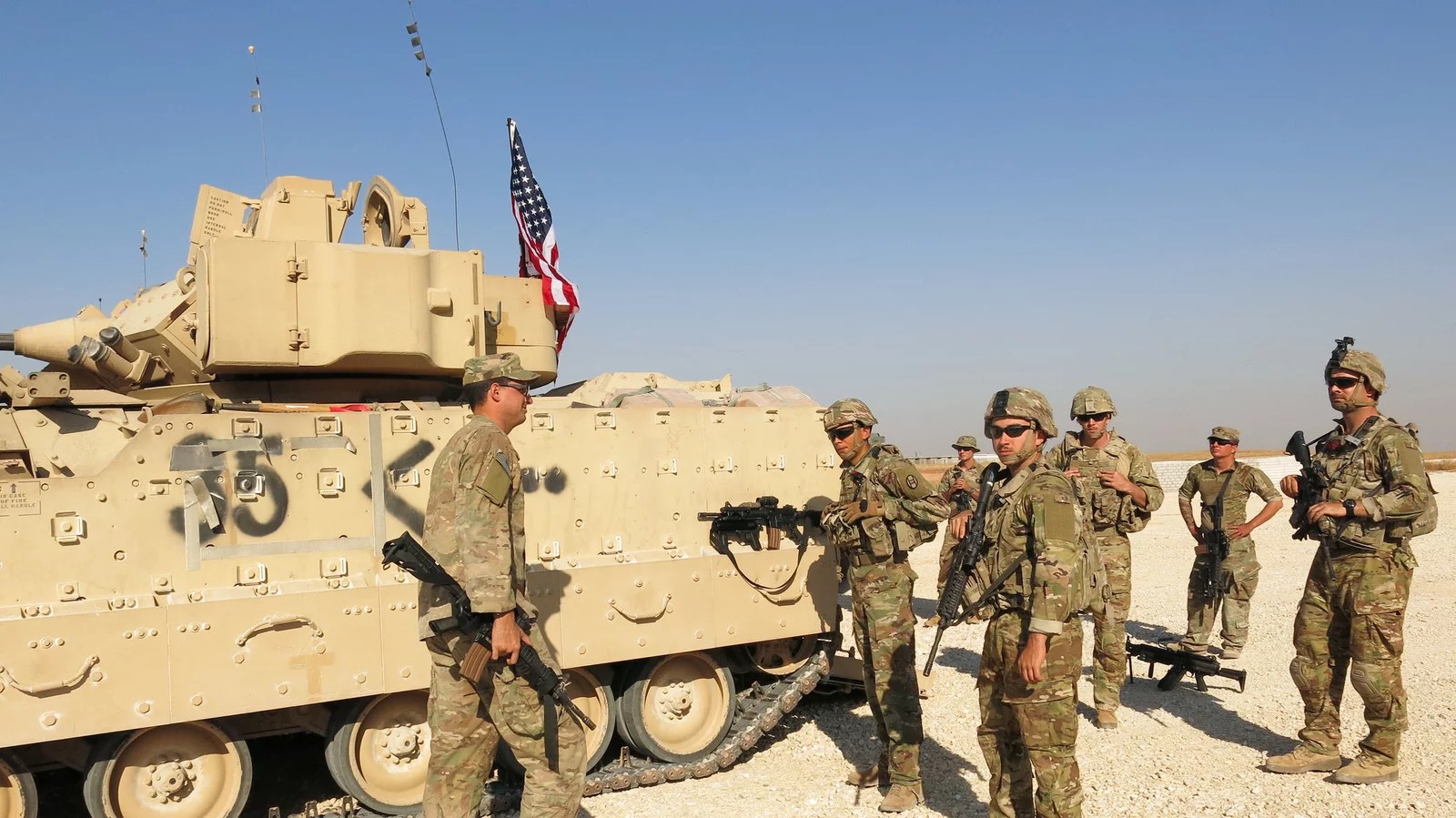
A new U.S. brigade combat team arrives in front of a Bradley Fighting Vehicle at a base in Syria’s Hasakah province in 2019. (Photo cred: Jane Arraf/NPR)

Also in fact there were “peaceful protests against Mr Assad’s government in March 2011and they were suppressed by the State but, without justifying that suppression, let’s look at the Middle East context of the time.

IRAQ, then LIBYA, then SYRIA – OOPS!

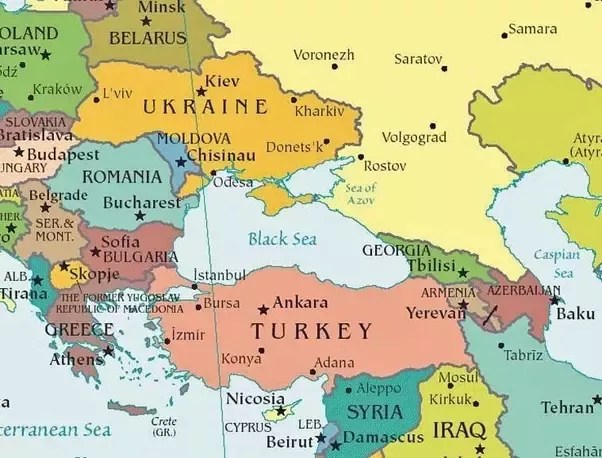
The USA’s plan to encircle Russia from the Middle East1 involved knocking out the regimes that were not allied to it. First step, invading Iraq in 2003 with lies about “weapons of mass destruction” and the hysteria following the Twin Towers bombing.2

Then supporting the coalition of forces to overthrow Muammar Gaddafi’s Libya in 2011 and at the same time, those against Assad in Syria. After their overthrow, Iran would have been next, to bring the USA nearly right up to Russia’s border and getting rid of the Iranian regime at the same time.

This is also why the West encouraged a rising against the status quo in Georgia (which Russia and Georgian allies suppressed) and supports the Armenian resistance in Azerbaijan.

Map showing some of the states in Eastern Europe and the Middle East bordering or on the approach to Russia; Libya would be further south on the map (Image sourced: Internet).

Having jihadist3 muslim fundamentalists in a western imperialist-supported coalition against Assad in Syria would have been fine for the USA,4 as it was in Iraq but inconveniently, ISIS was an important part of of the islamic fundamentalist spectrum and it had declared war on the USA.

So the USA had to go to war against ISIS but also to support the SDF,the Kurdish-led coalition in Rojava, who were fighting ISIS. Russia came to the support of Assad against the US-supported NATO proxies and muslim jihadists other than ISIS.

Turkey, although a NATO member, got involved mostly because of its hostility to the Kurdish left-nationalist movement in Turkey5 and that movement’s close connections to the Syrian Kurds which, though working with NATO, were dumped by Trump to considerable US internal disagreement.

The presence of Russia’s forces prevented the USA from invading Syria or enforcing a no-fly zone over it and prevented also Turkey from advancing beyond the section of Syria which it has taken over and where its proxies – particularly among jihadists — are in operation.

And also helped to hugely reduce the threat of ISIS.6

That is the backdrop to the western media’s reporting, pretending that the whole problem in Syria is entirely the regime’s own fault and that Russia and Hizbollah are making it all worse. And not mentioning the USA or NATO even once.

BUT WHO DID IT?

The western media, through emphasising the areas attacked by Syrian military, seems to be suggesting one of the jihadist groups were responsible. But would they have had the capacity for such an attack from 60 kms away? And if they did, were they supplied from outside?

The regime’s military statement accusing jihadists “backed by known international forces” of responsibility hints strongly at a western powers’ axis member and said “it will respond with full force and decisiveness to these terrorist organisations, wherever they exist”.

If the West did plan this attack or supply jihadists who carried it out, it is difficult to see what tactically or strategically they could hope to gain from it.

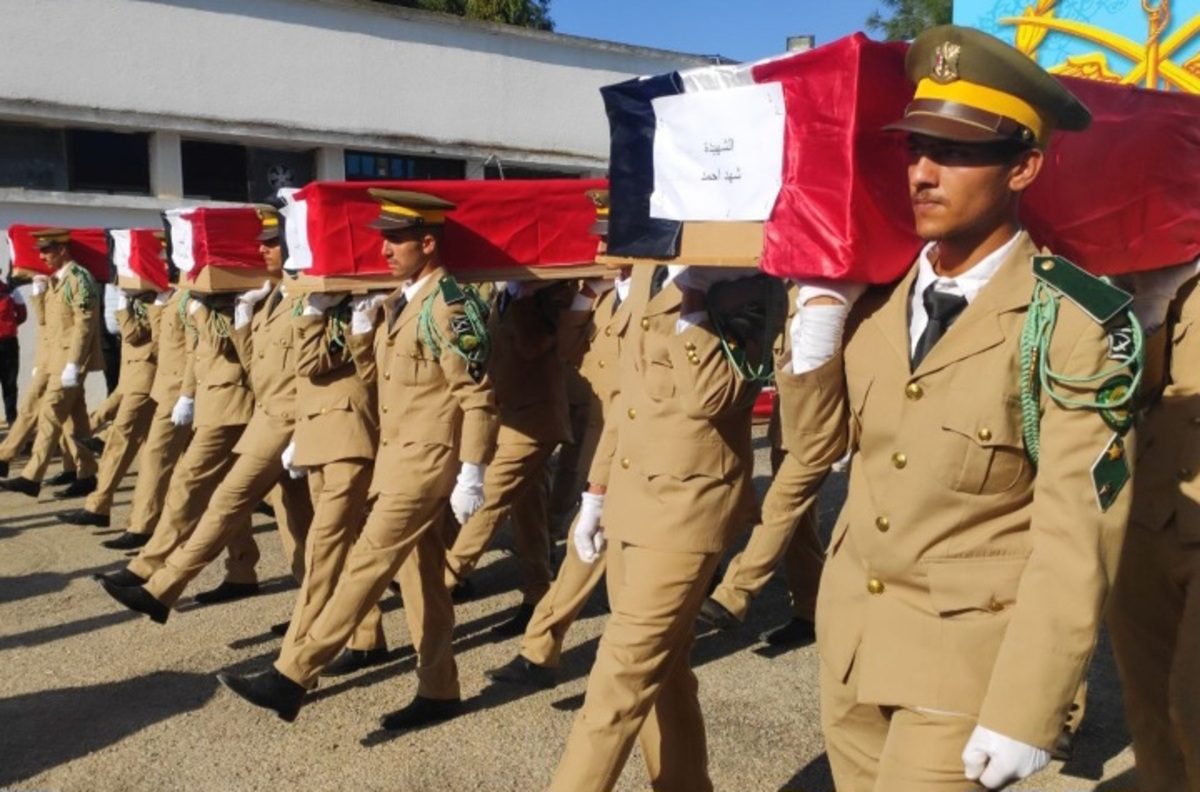
Funeral march of Syrian Army carrying coffins of victims of the drone attack. (Photo sourced: Internet)

JUSTIFIABLE IN WAR?

The western media, although it included coverage of the grief of relatives of the slain, for the most part did not discuss the question of whether the attack was justified in war, though it would and does do so continually with regard to the war in Ukraine.

Civilian woman injured in the drone attack. (Photo sourced: Internet)

In war it is of course justifiable to bomb the enemy’s soldiers, even those still in training or just successfully completing it. But efforts should be made to avoid causing civilian casualties and hitting a passing-out ceremony is bound to cause many, including women and children.

In that regard the bombing cannot be regarded as a legitimate act of war and therefore must be considered a war crime – but again, that seems a term reserved in the West with which to accuse the Russians in the Ukraine war alone.

End.

FOOTNOTES

SOURCES

https://www.breakingnews.ie/world/funerals-held-in-syria-for-dozens-of-victims-of-attack-on-military-ceremony-1535741.html

https://www.aljazeera.com/news/2023/10/5/syrian-military-college-hit-in-drone-attack

Very biased account but at least mentions US military involvement and that the war in Syria is in many ways a proxy war:
https://en.wikipedia.org/wiki/Foreign_involvement_in_the_Syrian_civil_war

https://en.wikipedia.org/wiki/Gulf_War

1As with NATO in Eastern Europe for years but although coups and insurrections were also encouraged there, seduction of regimes was more prevalent.

2It is well to remember that the Iraqi regime had been an ally of US imperialism and had waged a war against the new Iranian regime from 1980 to 1988 after the overthrow of Western ally the Shah of Iran (1979). At the time the West didn’t care about the Hussein regime’s gassing of Kurds in 1988 (I personally knew people who were trying without success to get it into the news then) but 23 years later it was suddenly “news” when the USA decided that the Hussein regime would have to go.

3Fundamentalist Muslims who claim they are engaged in a ‘Jihad’, i.e a ‘holy war’.

4The USA deliberately encouraged and helped build up jihadists in Afghanistan to overthrow the socialist regime 1978-1992) and its Soviet supporters, in the course of which it helped create Al Qaeda.

5In particular the PKK.

6‘On 22 November 2015, Syria′s president Bashar Assad said that within two months of its air strikes, Russia had achieved more than the US-led coalition had achieved in its fight against ISIL in a year. Two days later, the US said: “Russia right now is a coalition of two, Iran and Russia, supporting Assad. Given Russia’s military capabilities and given the influence they have on the Assad regime, them cooperating would be enormously helpful in bringing about a resolution of the civil war in Syria, and allow us all to refocus our attention on ISIL. But I think it’s important to remember that you’ve got a global coalition organized. Russia is the outlier.’”

At the end of December 2015, senior US officials privately admitted that Russia had achieved its central goal of stabilising the Assad government and, with the costs and casualties relatively low, was in a position to sustain the operation at this level for years to come. (Wikipedia)

TURKEY’S PAYOFF FROM NATO LOOKS BAD FOR ROJAVA

Diarmuid Breatnach

(Reading time: 8 mins.)

Against the bigger war going on in the Ukraine, a smaller one hotting up has been getting little attention. Turkey started shelling a region in Syria which the inhabitants call Rojava and killed some of those inhabitants, including military leaders, who have had mass funeral protests.

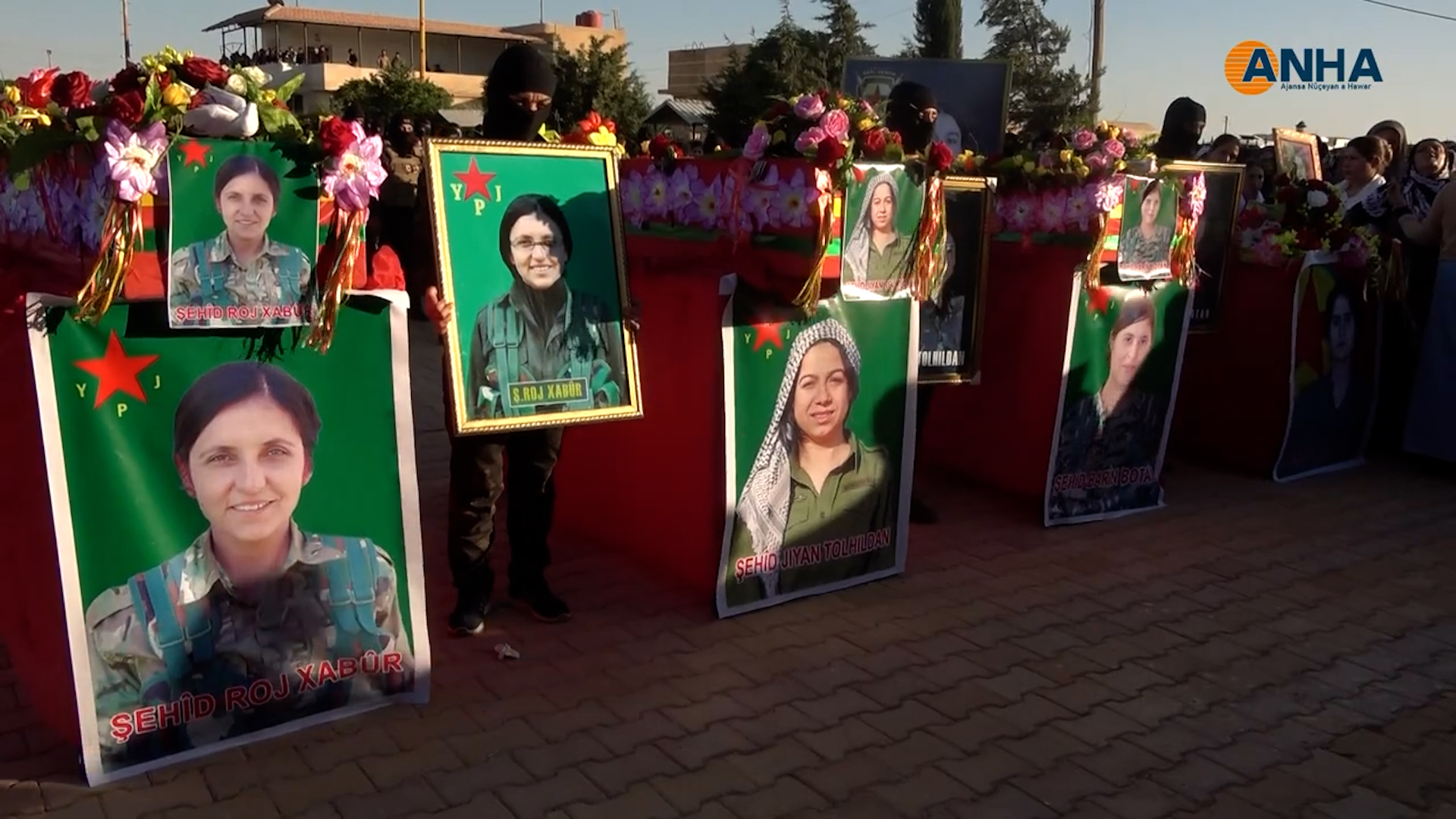
Salwa Yusuk, a deputy commander of the US-backed Syrian Democratic Forces, was killed in a Turkish drone attack in Syria on Friday. Also killed in the same vehicle were Joana Hisso, 30, also known as Roj Khabur, and Ruha Bashar, 19, also known as Barin Botan. (Image sourced: Internet)

The Kurds’ representatives were blaming the USA and Russia but most of all the former, saying it’s part of a deal for Turkey to lift its objections to Sweden and Finland for membership of Nato.

The official quid pro quo was for those countries to repress their Kurdish diaspora and to remain silent on repression in Turkey. But it seems an unofficial part of the deal was to let Turkey set its military loose on Rojava, the inhabitants of which are now living in fear of a full Turkish invasion.

Far indeed do the consequences of the war in the Ukraine reach around the world – Rojava is over 2,000 km from the Donbas region (and they will reach much further than this before it’s over)!

The Kurdish-led Rojava sector fought ISIS from 2014 to March 2019, at first without any external help and later assisted by NATO bombing runs.

The USA’s earlier policy had been to boost Islamic jihadism as a counter to left-wing nationalism and Russian influence (for example in Afghanistan) – until jihadism threatened western interests also. Then it waged war to eradicate it and, in the course of that, supported the Kurds in Rojava.

But US/NATO wants a solid block facing (not to say encircling) Russia – so now previous bets are off and the Rojava region can be thrown to the wolves – or to Turkey; first by Trump to screams of outrage from US Democrats but now by Biden, to probable silence.

BACKGROUND

But why does the Turkish military want to shell Syria? Why specifically shelling the Rojava region? If you know, you know but if you don’t, a little background might help.

The Kurds are the largest ethnic minority in Turkey, comprising around 18% of Turkey’s population; the largest concentration (2 million) of which lives in Istanbul. The majority of Kurds are Sunni Muslim, with Alevi Shi’a Muslim, Christian, Jewish, and Yezidi communities.

Together with Kurdish populations in Iraq, Syria, Iran and Armenia (all “Kurdistan”) the Kurds number between 25 and 35 million in the Middle East (with a very large diaspora in Europe, the USA and other areas).

The area occupied by Kurds in the Middle East is of huge strategic and resources importance and none of the major states in the area have agreed to their having a state.

After World War One and the defeat of the Ottoman Empire, the victorious Western allies made provision for a Kurdish state in the 1920 Treaty of Sevres.

However the new leader of Turkey, Kemal Attaturk, the “father of modern Turkey” rejected a reduction in the size of the state and the subsequent imperialist Treaty of Lausanne set the boundaries of modern Turkey without any reference to the Kurds (“mountain Turks”, according to Attaturk).

Also in 1920, the Royal Air Force of the UK bombed the Kurds with chemical weapons and machine-gunned them during the Iraqi (then Mesopotamia) uprising,

In 1946 the USSR supported a Kurdish state in a part of what is Iran today but in the face of the western powers’ opposition and support for the state of Persia’s (then a client state of the West) claim to the territory, the USSR withdrew its support and the Kurdish state was suppressed.

Every attempt to set up a Kurdish state since then has been violently suppressed and, in Turkey, even an autonomous Kurdish region was beyond contemplation by the authorities, who suppress even Kurdish language and music.

THE KURDS IN SYRIA

In 2013 an uprising began against the Assad regime which, though it had some popular elements quickly became dominated by Jihadists and NATO proxies. The Syrian part of the Kurdish liberation movement saw an advantage for itself here and set up its own liberated areas.

Also in 2013 the fundamentalist islamist group ISIS burst on to the scene and, taking advantage of the Assad regime’s beleaguered situation, attacked large areas of Syria, to overthrow the regime but also to subjugate all peoples in the region, including the Kurds and Arabs of any kind.

The Kurds of Rojava fought to protect their areas from ISIS but also carried out a heroic rescue action to save Yazidis, opening and defending a corridor for Yazidi refugees to reach safety in the Kurdish liberated area where they built a cross-community alliance with Yazidis, Turkmen and Arabs, in which they state that all its citizens have equal rights.

Whether this is as true as they (and as their supporters in parts of the European Left) say or not, certainly women have a formally equal status and women are elected – and also appointed — to positions of high administrative and military responsibility.

Demonstrators in Stockholm against the NATO deal with Turkey and in solidarity with the Kurds (whose flags are also visible (Image sourced: Internet)

The Turkish regime has been at war with the Kurds within the state’s territory led by the PKK since 1974 and viewed the setting up of an independent republic under Kurdish leadership across the border in Syria with great alarm.

In 2014 Turkey began attacking support and supply lines from Kurds in Turkey to Rojava, which caused outrage among the extended Kurdish diaspora and other opponents of ISIS in the West.

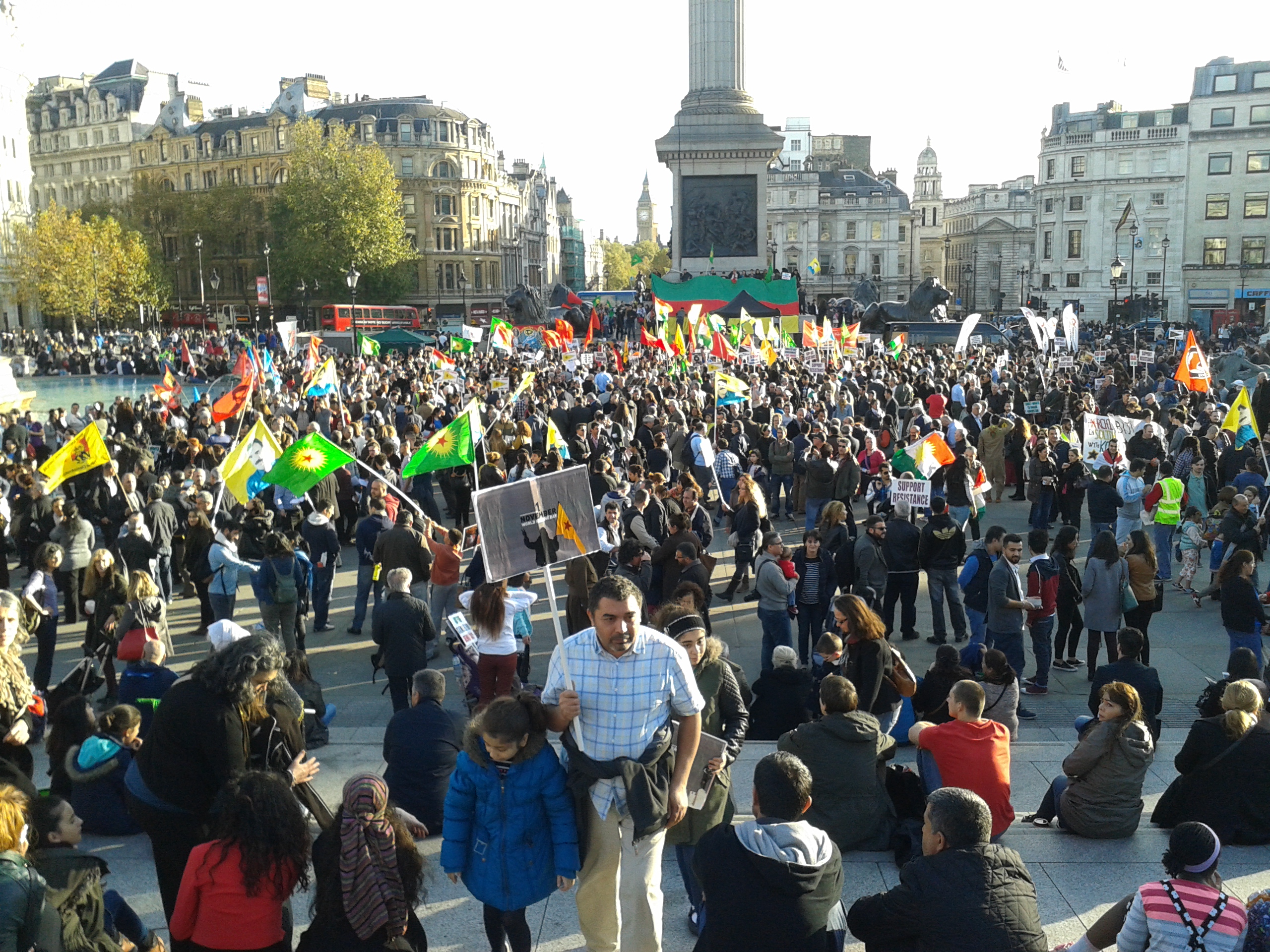
London rally November 2014 in solidarity with Kurds in Syria and condemning Turkish attacks. (Photo: D.Breatnach)

And in fact, although Turkey is an important member of NATO, Turkish military attacked the enclave a number of times, both directly and through the use of muslim fundamentalist jihadists.

Nevertheless, NATO’s concentration on wiping out the ISIS threat in the area had to have a restraining effect on Turkey. And then there was Russia too, also supplying air cover — but to the Syrian regime.

MY ENEMY’S ENEMY IS ….” — an understandable but dangerous philosophy

At first in 2013 it seemed that the Kurds around Rojava were merely taking advantage of the Syrian regime’s trouble to go for establishing their own republic, in addition to fighting the dire threat of ISIS.

In the latter struggle, they would of course gladly accept NATO bombing of ISIS and liaise with NATO commanders on where ISIS forces were gathering – for the Kurd’s own safety and for destruction of a dangerous enemy.

However some years ago an interview with the Kurdish commander of the Rojava military forces was published in which he said that the intentions of the Rojava military went further and involved overthrowing the Assad regime, an objective that they shared with NATO.

At a meeting organised by socialist Irish Republicans about five years ago, while expressing admiration for the Kurd’s struggle for self-determination in general and specifically against ISIS, I questioned from the audience a Kurdish speaker from London.

When I commented on what seemed a clear alliance with western imperialism and in particular the USA, the biggest imperialist power in the world, the speaker replied that they were merely accepting necessary aid for their defence against ISIS.

But when I pointed him towards the Kurdish military commander’s interview on the regime change objectives of his forces and of NATO, all he had to say was that I should visit Rojava.

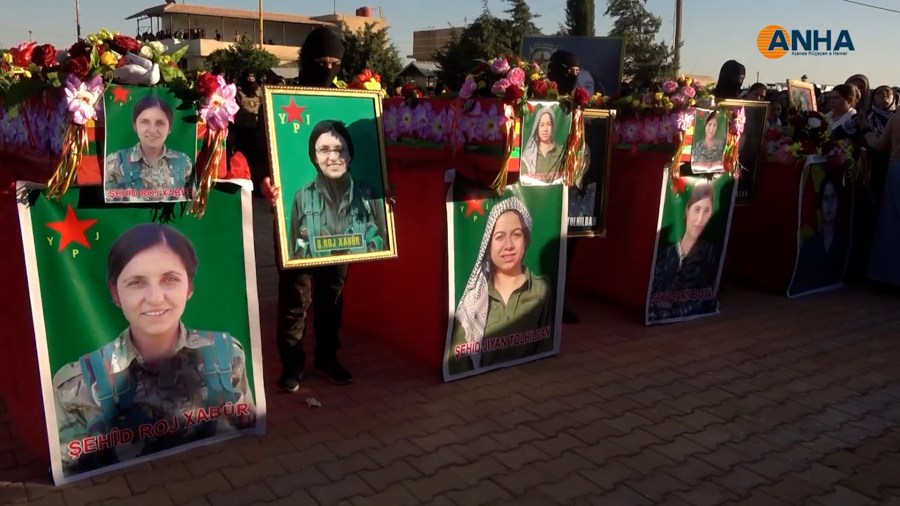
Mass funerals (despite fear of further Turkish drone strikes) of three fighters of the Women’s Protection Unit (YPJ) killed recently (Image sourced: ANHA)

CONCLUSION

This situation and its history once again highlights the dangers of revolutionaries doing any deal with imperialism, most of all one where the long-term survival of one’s people depends on the continued support of an imperialist power.

It also raises the question of whether it is justifiable or at least wise in the longer term to use a major world power’s assistance in order to remove a smaller power.

The main Kurdish liberation movement of the PKK fought a heroic struggle for decades, in particular against the ferocious Turkish regime, with many martyrs and political prisoners.

One of its weaknesses was the almost deification of their leader Oçalan and the way his attempted embracing of the proposed “peace process” undermined the movement, as similar processes have done wherever they have been introduced.

Of course, as with the Spanish state, another fascist but supposedly democratic regime, the Turkish regime is not interested in any “peace process”, a slow sapping of the resistance movement. For its ruling elite, crudely crushing the resistance with brute force is the only way .

The Kurdish movement in Syria was seen as a spinoff from the PKK which supported it in its struggle against the Syrian regime but in particular in its heroic struggle against the Islamic State/ ISIS/ Deish.

However the Turkish state would view any independent Kurdish area, let alone one in nearby Syria as encouragement to Kurds within its territory. The ISIS movement threatened some Western interests and so NATO went to war with it, the Syrian Kurds linked themselves with NATO not only to defeat ISIS but also to overthrow the Assad regime.

US-led NATO wanted to overthrow the Assad regime but as part of its Middle Eastern encirclement of Russia (which is why Russia came to the aid of Assad against ISIS). Iraq and Libya had fallen already and, after Syria, Iran would be next on the list.

Thousands of people joined a demonstration in Tel Rifaat town of the Shehba Canton on Sunday 10th Nov 2019 in protest at the Turkish state’s invasion and genocidal practices in northern Syria. 40% of the population of Efrin (Afrin) having to survive in a semi no-man’s land, defended by the multi-ethnic SDF of AANES, after expulsion by the Turkish invasion, plantation and Turkification of their homes and properties.

But as the ISIS threat and the likelihood of deposing Assad faded, NATO support for the Rojava fighters declined. In October 2019 the SDF had to conclude an agreement with the Syrian regime to have it move into their area to end five days of attacks by Turkey.

When their protection from Turkey could be dropped in exchange for a US/NATO advantage in Eastern Europe, nothing stood against a Turkish all-out attack on Rojava. Nothing, that is, except the Russian airforce.

If Turkey is to attack Rojava with ground troops it will need to use air cover both in manned and unmanned vehicles, which would require Russia not policing the no-fly zone in Syria near the Turkish border.

In February 2021, a Russia-brokered agreement between the SDF and the Syrian regime to lift the SDF’s siege of regime-held towns showed strains. But last month, at a summit in Tehran between leaders of Iran, Russia and Turkey, the other two warned the latter not to attack the Kurds in Syria.

However, despite Turkey’s NATO membership, Russia does get along with the state’s rulers from time to time and the recent discussions between the ruling elites of Russia and Ukraine on unblocking the flow of grain and fertiliser out of the war zone were held in Turkey.

The Syrian regime does not want an autonomous area within the territory of its state and Russia’s leaders will be anxious to keep on good terms with its ally – but it will also wish to wean Turkey away from NATO.

The Rojava enclave, though never as wonderful as it was proclaimed to be from a socialist point of view, is nevertheless an interesting experiment in federalism and multi-ethnic administration.

It will be sad if Rojava falls to Turkish aggression and a mean repayment for their heroic struggle to rescue the Yazidis and to hold off the advance of ISIS which cost them 10,000 dead fighters. It may also be yet another disastrous byproduct of the proxy war NATO is waging in the Ukraine.

End.

SOURCES & FURTHER READING:

Turkish military attacks on Rojava: https://thefreeonline.com/2022/07/12/mass-funerals-as-terrorist-turkey-shells-towns-and-refugees-before-new-rojava-invasion/
https://thefreeonline.com/2022/07/23/sdf-says-two-of-its-female-commanders-one-fighter-were-murdered-in-turkish-drone-strike-video/

NATO dumps the Kurds: https://www.lemonde.fr/en/international/article/2022/06/28/nato-says-turkey-has-agreed-to-support-finland-and-sweden-joining-alliance_5988282_4.html

Trump dumps the Syrian Kurds: https://progressive.org/latest/foreign-correspondent-trump-kurds-empire-crumbles-erlich-101918/

Russia blocks Turkey’s plans to attack Rojava: https://www.irishtimes.com/world/middle-east/2022/07/20/iran-and-russia-warn-turkey-against-military-offensive-against-syrian-kurdish-forces-in-syria/
https://thefreeonline.com/2022/07/26/turkish-invasion-cancelled-did-putin-just-save-rojava/

Syrian Democratic Forces, the Kurdish-led Rojava alliance: https://en.wikipedia.org/wiki/Syrian_Democratic_Forces

Long history Turkish State conflict with Kurds: https://www.cfr.org/global-conflict-tracker/conflict/conflict-between-turkey-and-armed-kurdish-groups

A modern history of the Kurds: https://www.bbc.com/news/world-middle-east-29702440