
Diarmuid Breatnach
(Reading time main text: 4 mins.)
Yahya Sinwar, head of the Palestinian resistance organisation Hamas, was killed in action by an Israeli Occupation Force in what was for them a routine operation in Gaza on 16th October, his last moments captured on video and broadcast widely.
From that event alone there is much for us to learn about Hamas and the Palestinian Resistance in general as well as about Sinwar himself — but also about the IOF, the way it fights and the extent of its self-discipline.
For the bare details as publicly shared, Sinwar was in military outfit, in tac vest, armed with a pistol and automatic rifle and accompanied by two local Hamas commanders in the Tal as-Sultan, Rafah area of Gaza patrolled by the IOF, very close to the semi-permanent IOF front lines.1
One may assume Sinwar was on a reconnaissance operation.

Something gave away their position to a passing patrol in an area where, as far as the IOF were concerned, nothing should be alive except themselves. Pursued, they split up, local commanders in one building and Sinwar into another so the patrol called a tank to fire into each.
The patrol attempted to enter the building into which the individual fighter had gone but two grenades beat them back, injuring one soldier,2 so they retreated and called for a tank to put another shell in the building.
Still wary in the aftermath, they sent a surveillance drone into the building and the image it captured was what was seen in the widely-circulated video: a Palestinian fighter, apparently unarmed, right hand mangled. As they watched, he threw a stick at the drone with his left hand but missed.
So the IOF patrol had another tank round fired into the building and they went on their way.3

But unusually,4 they came back. Perhaps someone thought they recognised Sinwar in the camera video? It was then they discovered that one of the three fighters they had killed was Yaha Sinwar, confirmed by test results matching his DNA records they had from his years in captivity.
According to ‘Israeli’ postmortem, although he’d been hit by shrapnel and his right hand was mangled, what killed Sinwar was a bullet to the brain – which raises other questions.5
Whatever he was doing at that time, it was clear that he was there as a commander and Resistance fighter, armed and dressed for combat in a highly dangerous area, regularly patrolled by the IOF and only a short distance from their secured front lines.
That alone spoke of courage but also his and his comrades’ resistance in the face of superior numbers declared their courage and determination. But Sinwar’s continuing to resist while badly wounded and his comrades dead, spoke of heroism.
Although only weeks from his 62nd birthday and after 22 years in a Zionist jail, Sinwar seems to have been quite fit. However, according to the results of a postmortem examination carried out by the IOF, Yahya Sinwar had not eaten in 72 hours prior to his death – a period of three days.6
The event was revealing in outlining how the IOF infantry is accustomed to fighting. They are fine with killing civilians but when confronted with armed resistance fighters, they hold for a short while if at all before retreating and calling up artillery or air strikes.
Their dead and wounded are picked up by helicopter and rushed to undamaged ‘Israeli’ hospitals, well equipped and staffed less than an hour away, a journey that is never fired upon by the Palestinian Resistance.
The contrast could not be starker, as the IOF fire on Palestinian paramedics and their vehicles, blockade Palestinian hospitals from receiving fuel and other essential supplies, even bombing and occupying them, kidnapping and killing medical personnel.
What people saw in the video of Sinwar’s last moments exposed Israeli lying propaganda about Sinwar, accusing him of living safe and well inside the tunnels and never emerging or, if he does, going about in a burka, disguised as a woman, also of intending to flee to Egypt with ‘hostages’.7

The quick circulation of the video by the IOF exposed also the renowned indiscipline of their military and their total lack of comprehension of the mental and emotional processes of the people they have been occupying and oppressing for seven decades.
Their indiscipline is attested to by the thousands of videos on social media posted by the IOF during their genocidal operations as, contrary to orders, they film themselves blowing up buildings including a university, humiliating and brutalising prisoners, even on occasion raping them.
The IOF are renowned too for leaving graffiti inside occupied houses and for prancing around houses they have destroyed, often wearing the intimate underclothing of Palestinian women, whom they have at least turned into refugees and may have killed.
In those circumstances their release of the video before discussing it with their intelligence and propaganda department is not surprising but doing so underlines their failure to understand their enemy. They thought that killing Sinwar would undermine Palestinian morale.
They, colonialists and other oppressors in general fail to take account of the human will to resist and the potency of the memory and example of martyrs. This is an aspect we understand well in Ireland.
The Zionist intelligence services would surely have preferred not to have Sinwar’s last moments shared publicly and possibly would have liked the opportunity to lie about them.

Sinwar was clearly a remarkable individual, Palestinian Resistance fighter, thinker and leader but the IOF made him a martyr and in their arrogance showed his heroism not just to the Palestinians — nor to Arabs alone — but to the world.
End.
APPENDIX: HIGHLY ABBREVIATED BIOGRAPHY (Reading time: 2 mins.)
Yahya Ibrahim Hassan Sinwar (Arabic: يحيى إبراهيم حسن السنوار, romanized: Yaḥyá Ibrāhīm Ḥasan al-Sinwār; 29 October 1962 – 16 October 2024) was a Palestinian resistance fighter, former political prisoner and subsequently politician who was killed in action.
Sinwar served as chairman of the Hamas Political Bureau from August 2024 and as the leader of Hamas in the Gaza Strip from February 2017, until his death in October 2024, succeeding Ismail Haniyeh (assassinated by Israeli strike while on a fraternal visit to Iran) in both roles.
He was born in the Khan Yunis refugee camp in Egypt-ruled Gaza in 1962 to a family who were refugees from Majdal (Hebrew: Ashkelon) during the 1948 Palestine War. He gained a bachelor’s degree in Arabic studies at the Islamic University of Gaza.8
Sinwar’s first arrest was in 1982 for ‘subversive activities’, serving several months in the Far’a prison where he met other Palestinian activists and dedicated himself to the Palestinian cause. Though arrested again in 1985, upon his release he continued his organising trajectory.
Israeli propaganda has claimed that during this period his work in internal security against Zionist agents and informers earned him the nickname “Butcher of Khan Younis” but no-one who knew him or seriously studied him even heard of that alleged nickname until after his death.9

Sentenced to four life sentences in 1989, Sinwar spent 22 years in prison until his release among 1,026 others in a 2011 prisoner exchange for Israeli soldier Gilad Shalit. According to John Elmer10 Sinwar wanted others released before him but the prisoners insisted he be one of those leaving.
The prisoners had elected Sinwar as their leader in the prison11 and he was known for encouraging prisoners to use their time productively and to study – in particular to study the enemy. He certainly practised what he preached, becoming fluent in Hebrew and studying IOF tactics.
And also, incredibly, in writing a political novel, The Thorn and the Carnation.12
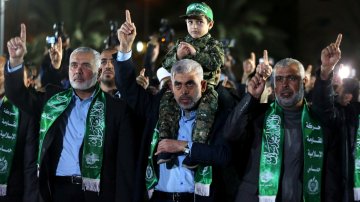
On 21 November 2011, a month after his release, Sinwar married Samar Muhammad Abu Zamar and the couple had three children. Sinwar’s wife received a master’s degree in theology from the Islamic University of Gaza. His brother Mohamed remains active in the resistance and is being sought by the IOF.
Re-elected as Hamas leader in 2021, Sinwar survived an ‘Israeli’ assassination attempt that same year.
FOOTNOTES
1At their ‘Philadelphi Corridor’
2According to Jon Elmer, admittedly only days after the event, this is not mentioned in most reports or discussion on line. https://www.youtube.com/watch?v=Dj43mbQ3AiE
3All of this is according to the Israeli Occupation Force.
4 According to Jon Elmer, blogger and weekly podcast military analyst for the Electronic Intifada, also in discussion with Justin Podur https://www.youtube.com/watch?v=Dj43mbQ3AiE (at 1.23.3), that was so unusual because the IOF don’t usually go back to carry out battle analyses for intelligence.
5https://www.firstpost.com/explainers/hamas-leader-yahya-sinwar-death-autopsy-report-idf-israel-13827027.html Not that carrying out field executions would be any stranger to the IOF
6https://www.firstpost.com/explainers/hamas-leader-yahya-sinwar-death-autopsy-report-idf-israel-13827027.html
7https://thecradle.co/articles/netanyahu-aide-arrested-over-intel-leak-used-to-sabotage-gaza-ceasefire
8 Often attacked by the IOF and once by Fatah, its campus was bombed and its buildings destroyed on the night of 10 October 2023.
9This is admitted even in the hostile Wikipedia page about Sinwar.
10Discussion Justin Podur and Jon Elmer on https://www.youtube.com/watch?v=Dj43mbQ3AiE
11This seems not unusual among political prisoners:Irish Republican prisoners also elected their OC in the British Occupation jails: Mairead Farrell had been O/C in Armagh Jail and, before he entered his fatal hunger strike, Bobby Sands had been O/Cof the H-Blocks.
12https://books.google.ie/books/about/The_Thorn_and_the_Carnation_Part_I.html
 rebelbreeze
saw another post comparing Yahya Sinwar to James Connolly as both fought for their countries and were murdered by the Forces of Occupation while they were sitting in a chair
Grma but I would not find comparison on that basis appropriate. Sinwar was not a socialist and Connolly was, Sinwar was wounded in action and collapsed into a chair to try to stop blood lost with a tourniquet so he could fight on, he was killed by enemy fire without apparently knowing who he was; Connolly was obliged to surrender and was court martialled and shot by firing squad, also wounded earlier so that they had to place him in a chair.
They were however both dedicated to national liberation of their respective nations, both largely self-educated historically/ politically, both good organisers and both faced death with courage, both revered as martyrs.