In the introduction to his most famous book on education, Ivan Illich says that for most of his life he never questioned that universal free education was an absolute good. This, I believe, would be the position of most people, even conservatives. But Illich went on to argue that institutionalising education (in fact as a service industry) has led to the institutionalising of society. In other words, education serves, not to emancipate the individual but to create a slavish attachment to the institutions. Illich’s solution is to abandon institutional education (the service industry) in favour of peer to peer education, what he calls a web of learners. Illich’s book preceded the creation of the internet as we now know it, and the development of peer to peer education as a service industry in its own right! Antonio Gramsci, mulling over the same problem in his prison cell in the 1930s came up with a similar analysis and a different solution. He wanted to subvert the institution, to create a school that would teach radicalism. The state controlled most forms of discourse, including that of educational institutions, he argued, therefore it was necessary for the radical left to create its own parallel institutions to defeat the hegemony of the state.
From the video accompanying Pink Floyd’s “The Wall” (copied and inserted by Rebel Breeze)
In Ireland (and throughout those countries where the doctrines of neo-liberalism have come to dominate public discourse) education has undergone a significant, but largely unremarked change, one that may well be founded on a gramscian understanding of the necessity for the state’s total control of public discourse (the gramscian concept of hegemony). Until the advent of neo-liberalism, the stated aim of modern education (whatever its real achievement) was founded on an etymological understanding, false or otherwise, of the verb to educate as deriving from the Latin educo ‘to lead out.’ The child was largely ignorant and needed to be led out of this ignorance. A child growing up in a wilderness and isolated from its peers would learn many useful things, but nothing of the wealth of human culture. The purpose of education was to enable a child to acquire modernity, enlightenment, civilisation.
Of course, all of these terms are themselves culturally laden and the concept itself was paternalistic in all its senses. Children are not ignorant – Joseph Jacottot proved that – otherwise they could not acquire such a sophisticated knowledge of language and culture. Nevertheless, the intelligent schoolteacher could attach herself/himself to the idea of enlightenment and enabling. One could, in fact, bring the best of intentions to teaching. Good teachers were expected to teach pupils, first and foremost, to be questioners, and here, at least, was some hope for change. Such teachers could argue that their purpose was to enable critical thinking, and that such thinking was for the betterment of the individual and society. It was a modest ambition, but a decent one, founded on a a belief that individual self-realisation and social change were important values.
But following the ascendancy of the ‘business model of politics’ in Irish political thinking, the curriculum has been crowded out with ‘business’ subjects. In Ireland what was once a single subject – Commerce – has tripled into Business Studies, Economics and Accountancy so that ‘business’ teachers are now the largest single homogenous group in any staffroom. History has suffered and all but disappeared in some schools. Geography, with its study of large-scale human interactions, has been drastically reduced. The classics, which at best encouraged a long view of human existence are now taught in a handful of schools. English has had a significant injection of ‘practical’ writing and reading and the texts used tend more towards the kind of books written specifically for teenagers (itself now a massive service industry). Chemistry, Biology and Physics are now sold as gateways to lucrative careers. Mathematics is moving towards the failed strategy of ‘problem-solving’ at the behest of industry. The Irish department of education’s website says:
‘This Government believes in education, both as a means of enabling all individuals to reach their full potential and as a major contributor to our current and future economic success. These two key priorities underpin the actions set out in this Statement of Strategy.’
Which translates as: education is a means of enabling individuals but it is also an element of capitalism. Significantly, the pupil/student is referred to as an ‘individual’, rather than a citizen, a pupil or a student all of which terms imply some form of community. The ‘individual’ is the base unit of neo-liberalism. Elsewhere in the site pupils/students are referred to as ‘clients’. She is to see herself as a cog in the machine, a contributor to current profit. In the section headed ‘Focusing on the needs of our clients’, the word ‘customer’ appears twelve times including in the following contexts: ‘The Department’s main customers are the Education Service Providers, i.e., teachers, management of schools and colleges and organisations providing education services’; ‘the Department is committed to delivering quality services that meet the needs of our customers and clients, particularly learners, at all levels. This commitment is reflected in the performance management process, where quality customer service is identified as a core competency for all our staff.’; ‘The Customer Charter describes the level of service that can be expected in accordance with the 12 Quality Customer Service (QCS) principles.’, etc.
This unsubtle use of language betrays two things: firstly, the department’s certainty that its use of terms like ‘customer’ for young people, parents and teachers is unremarkable; and secondly, the increasing brutalisation of the system as a whole. Neo-liberalism has turned us all into customers (‘a person or organization that buys goods or services from a store or business’) who must approach their own state wallet in hand to purchase ‘quality services’ and who can expect ‘core competencies’. Every department of government, every county council and city council and every state and semi-state company now has a ‘customer charter’, as do banks, insurance companies, oil companies, etc. In the neo-liberal state there are no citizens. In the ‘customer charter’ for the Department Of Justice, Equality and Law Reform, for example, the word ‘customer appears’ a total of forty times, while ‘citizen’ only appears in this sentence: ‘For complaints about service delivery in relation to Immigration, Citizenship, Visas or other services at INIS, please email INIScustomercomplaints@justice.ie’. Even here, the complaining citizen or non-citizen is directed to ‘customer complaints’.
Thus, the neo-liberal nirvana is so easily achieved.
In the course of two generations we went from citizens of a republic to customers of a state. Our government became a service industry with laudable aims like efficiency and value for money. Its old-fashioned Republican ideals (like liberty, equality and fraternity, perhaps?) now relate entirely to customer satisfaction. Not so long ago, in Easter 1916, the first provisnional government of the Irish Republic declared the following:
‘The Republic guarantees religious and civil liberty, equal rights and equal opportunities to all its citizens, and declares its resolve to pursue the happiness and prosperity of the whole nation and of all its parts, cherishing all the children of the nation equally’.
‘Citizens?’ Shouldn’t that be ‘customers?’ And surely we should substitute ‘Economy’ for ‘Republic’, after all, it is the economy that underpins our rights. In which case, we shouldn’t be a bit surprised if the word ‘equality’ is dropped in favour of ‘equal access to services’ and the word ‘happiness’ is dropped entirely or at least re-defined as ‘shopping’. And if we’re going to use the word ‘guarantee’, shouldn’t it be only used in the context of banks?
And why should we accept such changes? Well, we did it at school…
DID YOU KNOW IT WAS A ‘RED’ WHO WROTE “BROTHER CAN YOU SPARE ME A DIME?” WELL, NOT SO SUPRISING, MAYBE. BUT HOW ABOUT THE SONGS FOR “THE WIZARD OF OZ” and “FINIAN’S RAINBOW”?
Yip Harburg, author of lyrics of many songs, including those in The Wizard of Oz musical.
Yip Harburg, born in the poor Lower East Side Manhattan to Russian Ashkenazi Jew migrants, was a socialist and the writer of the lyrics of the songs in The Wizard of Oz and worked on the music too.
In fact, a lot of the production team and actors were “pinkos” of some kind, including Judy Garland. The “Brother Can You ..” melody was based on a Russian lullaby. In this Amy Goodman interview on Democracy Now TV (see link bottom of piece), Yip’s son Ernie Harburg talks about his father and included is quite a bit of footage of Yip himself, talking and singing, as well as footage of the first Wizard of Oz film.
When some people think it appropriate, while supporting the Palestinians, to synonymise the words “Jew” and “Israeli”, confusing the ethnic grouping of Jews with the fascist, racist and colonist ideology of Zionism, they are ignorant of or forget not only those Jews who combat Zionism today like Finkelstein and Chomsky but also the public criticisms of Zionism and the creation or actions of the state of Israel expressed by Albert Einstein, authors Erich Fromm, Howard Zinn, Isaac Asimov, Philip Roth, I.F. Stone; violinist Yehudi Menuhin; journalists Joe Klein (Time magazine), Roger Cohen (NY Times); Richard Falk (UN Special Rapporteur), historian Gabriel Kolko and many, many others. Those Jews are following a tradition: political and religious dissidence was endemic in Western Jewry and Jews have been to the forefront in socialist movements in Europe and in the USA, as well as in the struggles against racism and for civil rights in the latter.
“Music makes you feel; words make you think; songs make you feel the thoughts,” said Yip Warburg. At the time of the Depression in the USA (caused by the financiers, surprise, surprise), with massive unemployment and poverty, the authorities and some of the public wanted songs like “Happy Times Are Here Again” and no-one was writing songs about the suffering except for his father, says Yip’s son Ernie Harburg. Not on Broadway, maybe, but in some speakeasies, in some bars and on some radio shows, the blues and folk singers were composing and singing those songs, some writers like Steinbeck were writing their stories and photographers like Dorothea Lange, Jack Delano, Gordon Parks and others were recording their faces.
People were out on the streets and picket lines too, shouting, marching, holding placards, getting their heads busted by cops and sherrifs and goons and breaking some of their heads back too. Sometimes the protesters and campaigners were shot and sometimes even executed. As the financiers swing us around to those times again, we celebrate the victories and learn from the defeats, take pride in the courage of all those who fought and mourn those who fell, whether they fought against the police and municipal authorities, the witch-hunters like McCarthy and the ignorant red-haters, the National Guard, the FBI …
Scene from the Musical Theatre production of Americana, which featured Warburg’s song “Brother Can You Lend Me a Dime?”
And we singers, singing the lyrics and melodies of others and of our own, written in the past or in the present, give honour to the fighters in whole periods of struggle even as, in the book of history, the first lines in the next chapter are being written.
Palestinian supporters and other critics of Israel’s bombardment of Gaza have long complained about the western mass media’s reporting of the conflict in Palestine. The complaints have outlined reporting slanted in the Israeli state’s favour and/or specifically against the Palestinians and their representatives.
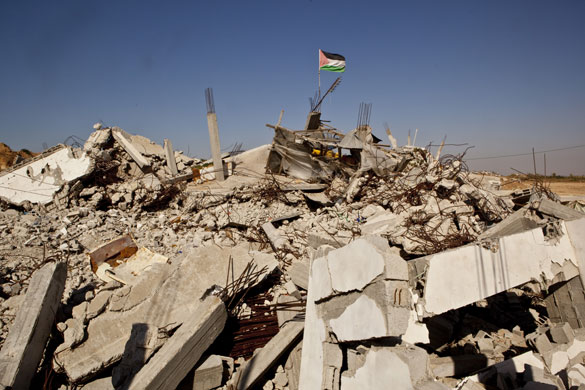
Palestinian flag flies over the rubble of a Gaza neighbourhood after Israeli bombardment 2014 (photo Antonio Olmos)
Umberto Ecco once defined language as a system of communication through which one could tell lies. There is no doubt but that our mass media uses language. Their editors and reporters herd us as sheep are herded by trained dogs, sometimes with barks and snaps of teeth but more usually through nudges and subtle changes of posture. They direct us to the pen where we are wanted or, at the very least, away from freedom.
In order to demonstrate the techniques used I have taken an example of reporting on the conflict and analysed it. The piece chosen is far from being one of the worst pro-Israeli or anti-Palestinian pieces of journalism – it is actually quite mild and even points out the statistical imbalance in the killing of civilians by Israel’s armed forces on the one hand and by Palestinian guerrillas on the other hand. The report is by the Irish on-line newspaper The Journal and was put up by them in the middle of August 2014.
The piece opens by saying that“Palestinian negotiators have been considering an Egyptian proposal to end the month-long Israel-Hamas war as the latest 72-hour ceasefire in the Gaza Strip is due to expire.”
This first of all says that the conflict is a war which also implies some kind of equal balance in fighting forces and also a share in blame. But it is not a war between any two sides; if it can be called a war at all, it is a war by Israel only. Israel is the fourth-largest military power in the world, with an army, navy and air force equipped with some of the latest armament and surveillance equipment. The Palestinians have a number of guerrilla groups, operating as infantry and no air or naval force at all. Their “artillery” are low-level rockets and mortars which cause very little damage to Israeli civilians and even less to the Israeli armed forces (except at close quarters, if Israeli soldiers invade territory held by the guerrillas). Israel’s armament causes huge damage to Palestinian infrastructure, huge loss of civilian life and does cause some damage to the guerilla groups.
The phrasing also suggests that Hamas is the only opponent of Israel on the Palestinian side. However, Israel has been in conflict with the Palestinians since the very day it came into existence and long before Hamas appeared on the scene. Even today, there are a number of Palestinian political and military organisations that are opposed to Israel and its actions and all together they represent the whole of Palestinian society inside the occupied territories, inside the 1948 borders of the state of Israel and in the refugee camps and settlements. In the sense that one could say that there is a war going on, it is Israel waging war against the Palestinian people.
The very next paragraph in the Journal’s piece says that “Since the truce, which will expire at midnight, went into effect on Sunday, Israel has halted military operations in the coastal territory and Gaza militants have stopped firing rockets.”
We see presented here that on the one side we have “Israel” and on the other, “Gaza militants”. As in bourgeois media reporting “militants” usually has a negative connotation, this is already tending to turn the reader against the Palestinians in Gaza. On the other hand, we have “Israel” which we can interpret either as “a legitimate state” or as the Biblical “promised land of the Jews”. And that is being opposed by “militants” in Gaza. The phrasing legitimises the status of one side while de-legitimising the other.
We are also told that Israel has halted “military operations”, two words that hardly convey the sustained bombardment of Gaza’s civilian houses, schools, mosques, civil administration facilities, power plant, water treatment plant, factories, hospitals and emergency vehicles in recent weeks. It does not bring to mind the slaughter of over 2,000 Palestinians, the vast majority of them civilians and including 430 children. Not to mention the 9,567 wounded, including 2,878 children and hundreds of injured jamming the remaining ill-equipped hospital treatment centres.
Shuja’iyya neighborhood of east Gaza City during a 12-hour ceasefire on July 26 2014.
The paragraphs states that in return for the cessation of “military operations” by the Israelis, the Palestinians have “stopped firing rockets”. Actually, if this report had just gone into a little detail, how pitiful by comparison with Israeli deadly ordnance would be the Palestinian rockets! Nevertheless, it is the rockets that are recently used as propaganda excuses by Israelis (before them it was something else) to justify the unjustifiable, the terrorising and collective punishment of a largely civilian population. So it is very rare indeed that western media reports omit any mention of the rockets.
“The ceasefire was meant to give the two sides time to negotiate a more sustainable truce and aroadmap for the coastal territory.”
Again, “two sides” gives the impression of some kind of equal antagonists in balance. The “roadmap” may be a vague reference to some future deal but may also be a reference to something that was much bandied about in Clinton’s time as President of the USA. This “roadmap” was supposed to lead to a two-state solution and, apart from the fact that it completely supported the supposed right of the European settlers who created the state of Israel to steal Palestinian land, has now been rendered completely inoperable. This is due to the continuing Israeli Zionist greed for land and building of illegal settlements throughout much of what was imagined as being part of the Palestinian state. And besides, the “roadmap” did not apply to the Palestinian refugees, who were given no right to return to their land. But it is useful for zionist-friendly propaganda purposes to pretend that this “roadmpap” ‘solution’ still exists and is viable.
“A member of the Palestinian delegation to Egyptian-brokered talks in Cairo said today that his team was considering an Egyptian proposal, which was tabled yesterday. Egyptian mediators have been ferrying between the Palestinians and their Israeli counterparts in an attempt overcome the differences between the sides.”
While it is true that Egypt has been “brokering talks”, that state is hardly an innocent bystander. Egypt has kept the Rafah Crossing, the only official exit point from Gaza not entirely controlled by Israel, closed or constricted. Egypt has also worked to destroy the tunnels which the people of Gaza used to smuggle in those items of daily life and, no doubt the arms they need, which Egypt is preventing from getting through the Rafah Crossing. The Egyptian state could nullify much of the Israeli blockade of Gaza, merely by opening their crossing into Gaza for normal traffic 24 hours a day.
The Egyptian armed forces, the real power in that country, are clients of the USA – another power which is hardly innocent but which on occasion tries to present itself as impartial in the conflict, despite its massive funding of the state of Israel. But those are not facts that the western media wish to disclose about the USA, Egypt or the conflict in Palestine.
Another thing, notice that while Egypt is “brokering”, it is “ferrying” between the Palestinian and Israeli negotiators. Clearly the antagonists are not face-to-face. If we think about that at all, as readers we are left with a feeling that maybe each side hates the other so much that they can’t bear to be in the same room. Or we might even think that Hamas, since it doesn’t recognise the right of Israel to exist, might not deign to speak to them directly. But actually, the reverse is true — as throughout most of its history, Israel is refusing to speak to the Palestinians directly. But no point telling the readers about that, is there? Who knows what they might come to think of such an attitude and behaviour of the Israeli state?
“The Egyptian proposal calls for easing parts of the Israeli blockade of Gaza, bringing some relief to the territory, according to Palestinian officials in the talks. But it leaves the key areas of disagreement, including Hamas’ demand for a full lifting of the blockade and Israeli calls for Hamas to disarm, to later negotiations.”
This is a bald enough statement which seems neutral but notice the unchallenged call for Hamas to disarm. From a state that is granted legitimacy to an insurgent force often painted as illegitimate, such a call seems reasonable. It has been and continues to be the basis for “peace (i.e. pacification) processes” throughout the world. But is there a call for Israel to disarm? Of course not. Yet it is the most heavily-armed power in the Middle East, the only one in possession of a nuclear arsenal and the one which has most often attacked its neighbours (not to mention the Palestinians). And the piece above leaves us to draw the conclusion that the lifting of the Israeli blockade may require Hamas disarming — a ‘fair exchange‘. And a reasonable reason, if Hamas does not comply, for Israel to continue its blockade on the whole population of Gaza.
“The Palestinian negotiator said he had some reservations about the proposal and would try to improve it. “We would like to see more cross-border freedom, and also to have the question of a Gaza seaport and airport discussed,” he said.
Note no reason is given for the Palestinian wishes – they seem trivial almost and no reason not to agree to a truce. “Cross-border freedom” might seem like being free to go on shopping trips or holidays abroad. “Gaza seaport and airport” likewise may facilitate daytrips and holidays, or tourist traffic or imports of luxuries. Maybe even exports of craftwork, or olives from remaining trees not destroyed by Israel. Such phrases and word do not give us a picture of over 1,816,300 people locked into a piece of land of 5,046 square kilometres (13,069 square miles), under permanent hostile control and sporadic bombardment and invasion, short of clean water and with other water polluted, destroyed infrastructure, destroyed hospitals, schools, mosques and churches, ruined industries and agriculture, infrequent power supply for lighting and heating, hardly any transport, a polluted coast and Israeli attacks on fishermen.
During the existence of the USSR and its satellite states, the western media regularly attacked them for their restrictions on most of their citizens’ travel beyond their borders. They never did then — nor do they now – inform their readers of the much stricter Israeli control on travel by Palestinians, not only beyond Israel’s 1948 borders but also beyond the borders of Palestine occupied by Israel in the years since. In fact, even travel within the occupied territories is extremely difficult for Palestinians.
The next four sentences of the Journal’s piece are unproblematic enough as far as reporting goes although it could have commented on why lifting the blockade on Gaza might have been of such concern to Hamas and to the people of Gaza:
An Israeli government spokesman had no comment on the negotiations.
In recorded remarks broadcast on Hamas radio, Ismail Haniyeh, the top Hamas leader in the region, said that “achieving a permanent truce can come only through lifting the blockade on Gaza”.
Amid the ceasefire, an Associated Press video journalist and a freelance Palestinian translator working with him were killed today when ordnance left over from the war exploded as they covered a story about the conflict’s aftermath.
Italian national Simone Camilli, 35, and Ali Shehda Abu Afash, 36, died when an unexploded missile believed to have been dropped in an Israeli airstrike blew up as Gazan police engineers worked to neutralise it in the northern Gaza town of Beit Lahiya.
However, the report could have gone on to tell us that the explosion also killed the four Gaza police engineers trying to neutralise the explosives and that another four people, including AP photographer Hatem Moussa, were badly injured. Unimportant details? News that might make us think worse of the Israeli armed forces? Or sympathise with courageous Palestinian police and at-risk civilians?
But it is not long before the more suspect reporting reemerges:
“The war began on July 8 with Israel’s air campaign against Gaza’s Hamas rulers, whom Israel blamed for the kidnapping and murder in June of three Israeli teenagers in the West Bank. Nine days later, Israel sent in ground troops to destroy Hamas’ underground cross-border tunnels constructed for attacks inside Israel.
Here Hamas are presented as “rulers”, as distinct and opposed to – once again – the state of Israel, conferring legitimacy on one party to the conflict, the aggressor, while subtly suggesting that the other antagonist is anything but legitimate and perhaps even despotic.
But the paragraph goes beyond that and suggests that Israel has a legitimate claim that Hamas kidnapped and murdered three Israeli teenagers. The three were in fact kidnapped and murdered and, although Israel wrongly accused Hamas of responsibility, its intelligence organisation Shin Bet later admitted that it no longer believed that. It may have been some other smaller Palestinian group or even individual members that carried it out but it was not the Hamas organisation nor its leadership. But this paragraph leaves us with the impression that Hamas’ culpability was a reasonable supposition by Israel and a reasonable cause of it going to war against Gaza.
The paragraph goes on to accept Israel’s public rationale for the bombardment and invasion, viz. “to destroy Hamas cross-border tunnels for attacks inside Israel”. Israel first quoted the deaths of the three teenagers as their reason for attack and now it is the “Hamas tunnels”. So if the stated reasons change, doesn’t that suggest that they are suspect, not to be relied on, with maybe the real reason unspoken? No comment from the media. Where are the tunnels? Which “border” are they crossing (putting aside for the moment the fact that Israel has never defined its borders)? Where are they attacking “inside Israel”? When was the most recent Hamas attack “inside Israel”? If this is a reference to the paltry rockets Hamas has fired, Israel has never claimed that these were fired at it from “inside Israel”. If it is not a reference to the rockets, then to what? We are not told but instead left with a feeling that Israel’s concerns could somehow be legitimate.
“The fighting has so far killed more than 1,900 Palestinians, the majority of them civilians, Palestinian and UN officials say. On the Israeli side, 67 people have died, all but three of them soldiers.
This is an unadorned statement of the shocking facts and we could not fault this paragraph.
But how about the very next sentence?
“The latest outbreak of fighting is the third between Israel and Palestinian militants in Gaza since Hamas took over control of the densely-populated territory in 2007.”
Here we have a repeat of that formulation which we saw earlier: the conflict, we are being asked to see, is between the ‘legitimate’ state of Israel on the one hand and “Palestinian militants” on the other. And it is “fighting” between the two sides, rather than the truth: the attack of Israel’s military force upon the population of Gaza and the Palestinian guerrilla forces’ attempts to reply with their meagre resources.
Also, we are told that “Hamas took over control” of Gaza in 2007. In an invasion, perhaps? A coup d’etat? The fact, uncomfortable for the western media, is that it was in a democratic general election while Israel and western agents poured out anti-Hamas propaganda. And Hamas won not just in Gaza, incidentally – but in the West Bank too, although others are currently in power there. Are we told that Israeli political parties in government “took over control” of Israel? Of course not.
Continuing, the report states that“Hamas has been consistently pushing for an end of an Israeli Gaza blockade, which Israel says is necessary to prevent the group from gaining access to weapons and munitions it deploys against Israelis.”
In this sentence, we learn that Hamas wants an end to Israel’s blockade but not why. We are not told that it is so that they can have sufficient fuel for heating and transport, food, medicine, clean water, industrial and building materials, teaching and learning materials, spare parts, etc, etc. Nor are we told that Gaza could then actually export products and gain some self-sufficiency. Nor are we told that Israel is illegally holding monies, such as tax revenues, that belong to Gaza. But we ARE told why Israel wants the blockade — “to prevent the group from gaining access to weapons and munitions it deploys against Israelis.” Well, there you are – that’s only reasonable, surely? !!
I no longer watch television at home. It was not a case of rejecting that form of mass media, as some assume, but the result of a tiresome tussle with the huge US-based UPC monopoly, out of which, not surprisingly, I came off worst – they control the aerial in my block of flats and I am not permitted to put up my own dish to receive through a competitor.
Anyway, I used to darn socks sometimes while watching TV, especially during advertisements. Radio would have been ideal but I have long ago lost the habit of listening to that medium. When I lost my struggle with UPC, I stopped watching TV; I could have watched it on my laptop but I find it unsatisfying to watch on a small screen. And when I stopped watching TV, I also ceased darning. The pile of socks with holes in them grew, to be mended “some day”, until eventually I had to buy new ones.
I am aware that for many in our society here today, darning would be considered a quaint or even archaic activity, associated with oil lamps and making your own butter, perhaps. Or cooking on a range and the absence of indoor plumbing. For others, darning might signify poverty or meaness. To me, it is about using and reusing what can be used, and about mending what can reasonably be mended to use again. Clothes, like all other items we use, are produced by human labour and it seems wrong to me to waste that labour unnecessarily – a kind of negation of the labour in the first place and, following that, a negation of the activity that might follow when the workers have produced enough of the items.
Of course, in our time and in this place, it is likely that the socks that I buy have been made in some sweat-shop in a more undeveloped country where, if they think about it at all, the sweated workers hope that we’ll go throwing away our socks as soon as the first hole appears, or even sooner if possible, so that they can continue to sweat producing replacements and being paid their meagre wages in order to pay for food, shelter and medicines. So that they can continue sweating and raise their children who, in turn, will become sweated wage slaves producing articles of clothing, undercutting the wages of those who might produce the same articles here, but who rightfully demand more humane working conditions, annual holidays, health insurance and the level of wages necessary to maintain an average standard of living. My darning my socks does not help, even in the tiniest way, the workers in those foreign sweated shops, nor the unemployed clothing workers in the country in which I live.
So why do it? I am not well-off by standards in this country but any amount I save by darning will make little difference. True, I was raised in a different time and I have imbibed some of the culture of that time (and also rejected much of it). But it is neither meaness, habit nor a perception of helping workers that causes me to think I should darn my socks, but a respect for labour. I am aware that practically all items we use were created by labour. I am aware that the power to create that material wealth has been, for centuries, appropriated by a parasitic class that many call capitalists. Before them, that labour power was expropriated by the feudal lords and their monarchs and before them, by the huge slave empires of Rome and Greece and of others outside Europe.
I aspire to a society where that labour power will no longer be expropriated and where the workers shall decide how that power is to be used, for the benefit of all. “The labourer is worthy of his hire” (Luke 10:7, King James Bible) but s/he is worthy of much more than that — s/he is worthy to control all of her/his labour power and of the distribution of the wealth it produces. And so labour must be valued – not just some day in the future, I believe, but now. The new society takes form within the old, although it must destroy the old from which it was born and will, for a time also, carry some of the taints of the old. But it begins now, in the present – in my case, with me.
So the other day, although I still have undamaged pairs, I began to darn old pairs of socks. It was surprisingly restful. But after darning a pair, I fretted at the time spent on this, time spent away from other work, piling up. I darned one of another pair and put its companion and darning away materials away. I will return to darning socks, a few at a time, on other days. Or, at least, I hope to.
The auditorium in Trinity College on Friday 20th June was nearly empty at the advertised starting time for the lecture on “The Legacy of Power, Conflict and Resistance”. The start was delayed and more people came in but, by the time the speaker and the theme was introduced, the hall was still not full. That was surprising, because the speaker was Bernadette Mc Alliskey (nee Devlin), who had been at 18 years of age one of the leaders of the Civil Rights movement in the Six Counties (“Northern Ireland”), at 21 years of age elected MP for Mid-Ulster in 1969 and still, 45 years later, holding the record for the youngest woman ever elected to the British Parliament.
Bernadette Devlin early 1969. She was elected MP on a People’s Democracy ticket in 1969 but later classified herself as an “independent socialist”.
The same year as her election, Bernadette went to the USA to gather support for the Civil Rights movement in a trip being used by others, rumouredly, to gather funds for arms. She shocked the conservative part of Irish USA, Ancient Order of Hibernians and Democratic Party political allies, by some of her statements and actions regarding blacks and chicanos and in visiting a Black Panthers project. Bernadette returned home to serve a short prison sentence after conviction for “incitement to riot” arising from her role in the defence of Derry against police (RUC and B-Specials) and Loyalist attack.
In 1972, during her five-year tenure as a Member of Parliament, enraged by his comments about the murder a few days previously of 13 unarmed protesters (a 14th died later of his wounds) by the Parachute Regiment in Derry, she stormed up to the then British Home Secretary and, in front of a full House of Commons, slapped him in the face. Bernadette had been there in Derry that terrible day – she was to have addressed the anti-internment march upon which the Paras opened fire.
The Tyrone woman was also a founder-member of the Irish Republican Socialist Party in 1974, which she left after failing to bring the armed organisation, the Irish National Liberation Army, under party control. She continued to be a Left-Republican political activist, in particular campaigning against the treatment of Republicans on arrest and subsequently as prisoners in jail, in the H-Blocks Campaign. She learned to speak Irish. In January 1981, she and her husband Michael McAlliskey were the victims of an assassination attempt by a squad of the “Ulster Freedom Fighters” (a cover name for the Ulster Defence Association, which was not banned until 1992). They both survived, though Bernadette had been shot seven times.
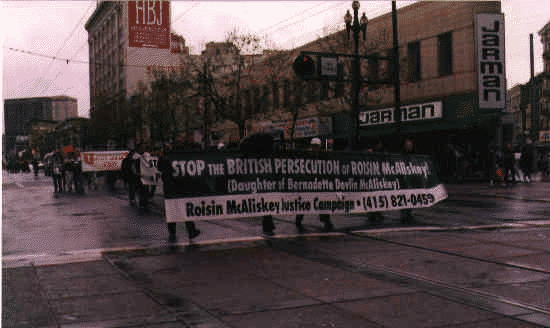
In 1996, while four months pregnant, Bernadette’s daughter was arrested on a German extradition warrant, charging her with being part of a Provisional IRA mortar attack on a British Army base in Osnabruck, Germany. Although taken to England, where a judge agreed to her extradition to Germany, a long and vigorous campaign fought by Roisín’s mother and her supporters eventually defeated the extradition and Roisín gave birth to a healthy daughter.
Recent portrait of Bernadette (Devlin) McAlliskey by Francis McKeeBernadette’s daughter was arrested twice on the same charge but vigorous campaigning impeded her extradition. Photo shows banner resisting the earlier attempt.
In 1998 and for some years after, Bernadette was an outspoken critic of Sinn Féin and of their direction in the “Peace Process”, which she saw as the party coming to accept British colonialism and Irish capitalism. In 2003 she was banned by the USA and deported, widely interpreted as being due to her speaking against the Good Friday Agreement, but continued her campaigning. However in 2007, another extradition warrant was issued for her daughter Roisín on the same charges as before and the young woman became emotionally ill. The whole trauma was seen by many as a warning to Bernadette to cease criticising the “new dispensation” and subsequently she was seen to fade from the ranks of public critics of the GFA, Sinn Féin and of the treatment of Republican prisoners.
Bernadette remained active through working with migrants in a not-for-profit organisation in Dungannon. In recent years she has returned, on occasion, to the issues upon which she was so outspoken previously, for example standing surety for Marian Price’s bail to attend her sister Dolores’ funeral and speaking at the ceremony herself. Bernadette also spoke at the Bloody Sunday Commemoration/ March for Justice in January this year in Derry.
With a c.v. of that sort, one would reasonably expect a packed auditorium.
Bernadette Mc Alliskey on the platform upon which she had earlier spoken in February 2014 at a rally following the annual Bloody Sunday Commemoration/ March for Justice.
Bernadette has walked the walk and thought the thought too but she can also talk the talk. With one A4 sheet in front of her, she spoke for over an hour, hardly ever glancing at her notes. Her talk was as part of Trinity College’s MPhil Alumni Conference on ‘Power, Conflict, Resistance’ organised by the Department of Sociology for its Mphil course in “Race, Ethnicity and Conflict”.
Bernadette McAlliskey began her talk with the theme of fear of conflict, developing the thesis that this fear is inculcated in us from childhood, as conflict arises out of challenging power and hierarchy. She traced this further back to religious indoctrination where dogma is to be accepted without question and finds its reflection in all aspects of life but particularly in the political.
Talking about Tom Paine, who expounded the theory that human beings, each independently, are responsible for themselves, she stated that this is fundamental to citizenship. Some aspects of this self-responsibility are delegated to institutions when we live in large groups but any decisions made for us without our consent are “an usurpation”. Tom Paine was an English Republican, author of, among other works Common Sense (1776) and The Rights of Man (1791). He had to flee England because of disseminating his ideas, which were considered revolutionary in his time.
Much of Bernadette’s talk was given over to this theme, to the lack of consideration of women even by such as Tom Paine, and also to the racism spread by colonialism, which the Christian hierarchies condoned and even encouraged.
When she finished to sustained applause and took questions, there were two from people identifying themselves as Travellers, another from a person from an NGO working with migrants, another regarding anti-Irish racism in English colonial ideology and the continuing power of the Catholic Church in the education system.
One question seemed to throw her and she admitted that she found it difficult to answer. Ronit Lentin, Jewish author, political sociologist and critic of Israeli Zionism asked Bernadette was it not true that racism in the Six Counties came mostly from within Loyalism, allied to anti-Catholic sectarianism. Bernadette struggled in replying, at one point denying it and pointing to anti-Traveller discrimination in the ‘nationalist’ areas but following this up by observing that Travellers would only camp in or near ‘nationalist areas’ (presumably because the hostility in a ‘unionist area’ would be worse).
Bernadette then went on to recall the recent anti-Muslim remarks made by a prominent Belfast evangelist preacher, James McConnell, and how the First Minister of Stormont, Peter Robinson, had defended the evangelist’s right to free speech. Asked for his own opinion of Muslims, the First Minister had replied that he also distrusted them “if they are fully devoted to Sharia law” but would trust them to go to the shop for his groceries and to bring him back the correct change. All the examples Bernadette drew on, apart from the generalised one about Travellers in ‘nationalist’ areas, were in fact from the Unionist sector.
The final question was from an SWP activist who pointed out that the State does not admit to its institutional racism and often takes no action on racist attacks or denies that the motive for the attack was racism. The activist asked Bernadette how she thought racism can be dealt with in this context. She replied that the legal structures are there and should be used and persisted with.
It seemed a strange response from one who would have described herself in the past as a revolutionary. Earlier in her talk she herself had quoted the black Caribbean lesbian, Audre Lorde, who said that the instruments of the State could not be used to dismantle it (actually I.V. Lenin had made the same point in The State and Revolution in 1917, nor was he the first to do so). A revolutionary’s answer to that question would presumably have been that while the structures should be used in order to expose them that ultimately the capitalist State’s power is the enemy of unity among the people; disunity rather than unity among the people is in the interest of the system. Mobilisation of the people against racism and directing them towards the source of their ills, the capitalist system, and building solidarity in action, is the only realistic way forward. Perhaps Bernadette felt constrained by the academic environment in which she was speaking but that is not the answer she gave.
(Grma to Irish Republican and Marxist History Project for the invitation to sing, the recording and the Youtube posting).
The song is Be Moderate (also known as”We Only the Want the Earth”) by James Connolly from the James Connolly Song Book, edited by Connolly and published in New York in 1907. No air or tune was indicated in that publication and it has been sung to a number of airs over the years. It’s a wonderful song in my opinion.
I sing it to the air of a “A Nation Once Again” composed by Thomas Davis in the 1840s, which I think suits it and supplies a chorus for others to join in. I first heard it sung to that air many years ago in London by a group of musicians and singers including Cornelius Cardew, of the CPE (m-l) (who was killed by a hit-and-run driver in an incident without any witnesses). He is here singing it with a ska back-beat(!): https://www.youtube.com/watch?v=pTxVBsg4u30
In my rendition here there is an adaptation and an error. The adaptation is my singing “workers” instead of “Labour” so as to distance the revolutionary content from the social democratic collaboration with capitalism, as illustrated by the unfortunate evolution of the party of that name founded by Connolly. My error is in the verse beginning “The Labour fakir …” in which I say “….. teaches” in two different lines.
I should have sung the lines thus: The Labour fakir full of guile false doctrine ever teaches
and whilst he bleeds the rank and file, tame moderation preaches;
Yet in his despite we’ll see the day, when with swords in their girths,
workers shall march in war array to claim their own, the Earth!
On April 20th 1914, Colorado National Guardsmen and mining company guards opened fire on a striking coal miners’ camp, with rifles and machine gun, killing up to 26 people, including women and children. They had set fire to the camp before opening fire and some of the casualties died of smoke inhalation.
The event and the response of the workers were the inspiration for the songThe Ludlow Massacre, composed by Woody Guthrie, the socialist troubadour from Oklahoma, around 30 years later. Here in Ireland it was recorded by Christy Moore in 1971 on the Prosperous album and it has long been a favourite of mine (I’ll be singing it as part of the selection for Songs of Struggle 1913-1923, part of the 1916 Festival at Liberty Hall on Saturday 26th April 2014).
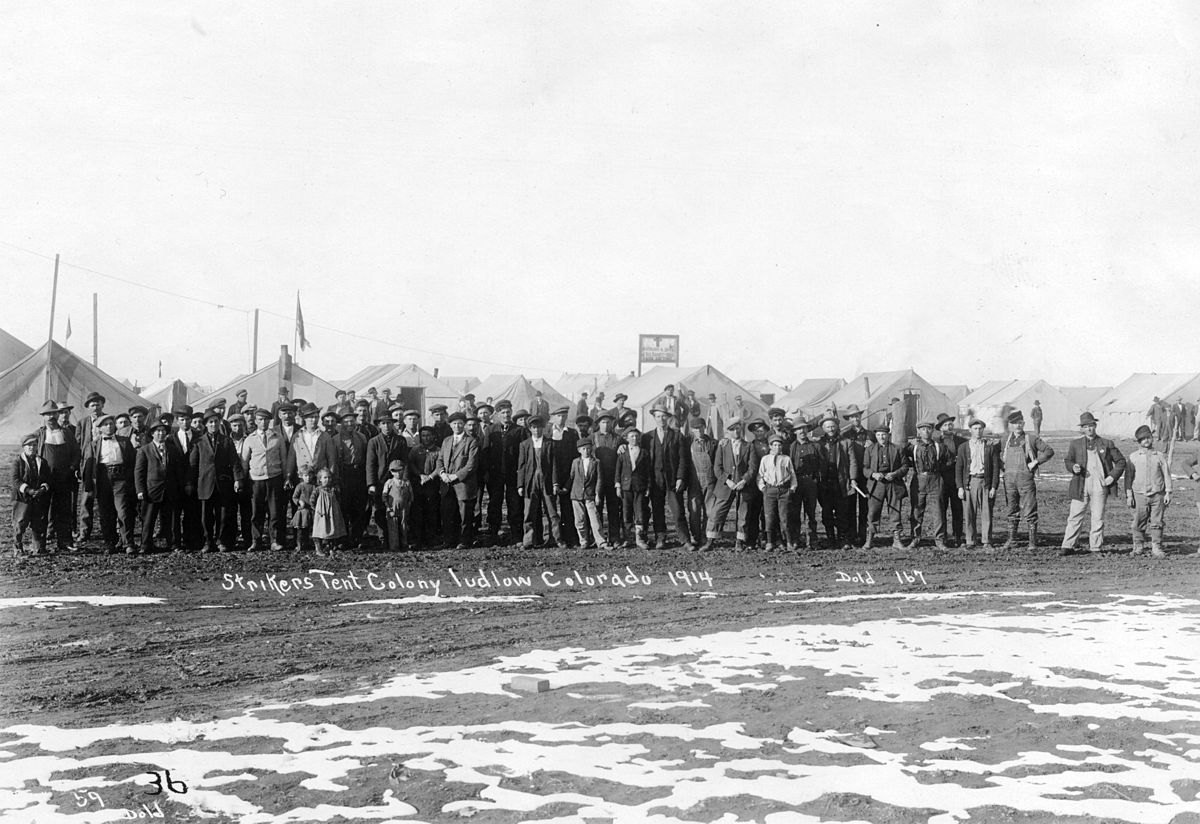
Colorado Strikers and families in front of tent town
The massacre took place during the great Southern Colorado Coal Strike which began in September 1913, a month after the strike of the IT&GWU tram workers began the eight month-long Dublin Lockout. But the Southern Colorado Strike lasted until December 1914 – sixteen months. And, in common with many industrial struggles in the USA, it was very violent.
The chief antagonists in this strike were the Colorado Fuel & Iron Co., of which John D. Rockefeller was the main owner; the Rocky Mountain Fuel Co. and the Victor-American Fuel Co. As events were to show, the mine-owners could also draw on the armed force of the state of Colorado, as well as on their own hired gunmen.
Opposing them was the United Mineworkers of America trade union. The UMA presented seven demands:
Recognition of the union as bargaining agent
An increase in tonnage rates (equivalent to a 10% wage increase)
Enforcement of the eight-hour work day law
Payment for “dead work” (laying track, timbering, handling impurities, etc.)
Weight-checkmen elected by the workers (to keep company weightmen honest)
The right to use any store, and choose their boarding houses and doctors
Strict enforcement of Colorado’s laws (such as mine safety rules, abolition of subs), and an end to the company guard system
The employers rejected the demands and prepared to bring in scab labour.
Living in company houses
As in a number of other countries, many mineworkers rented rooms or houses in company “towns” served by company shops, from which the miners also had to buy their equipment. Apart from that, they were also overcharged, so that often at the end of the week’s work the deductions left little pay to collect. This is the meaning behind the song Sixteen Tons (by either Merle Travis in 1946 or by George S. Davis in the 1930s — the origin is disputed):
You shift sixteen tons and what do you get?
Another day older and deeper in debt.
St. Peter don’t you call me ‘cos I can’t come —
I owe my soul to the company store.”
Living in company houses often meant eviction when workers struck work, as happened in Dublin in 1913 to a number of strikers, including those of the Merchant Co. in Merchant Street, near North Wall.
The evicted miners in Colorado set up a tent town of 1,200 people which was being harassed by company guards and then, when the workers resisted, by Colorado state’s National Guard. Pot-shots were taken at the camp and stragglers were beaten up; eventually strike leaders were assassinated.
On April 20th 1914, about eight months into the strike, the Colorado National Guard and company guards set fire to tents and as people scrambled around, opened fire on the camp. Some workers claimed a loss of life of 26 while others numbered it at 19; the lack of municipal or government recording meant that there were no “official” counts of the dead.
Officers of the Colorado National Guard
After the massacre — the workers’ response
In the aftermath of the massacre the workers armed themselves (union officials were seen openly handing out weapons) and fought back over a 40-mile front, from the town of Trinidad to Walsenburg (both of which are mentioned in the song). The death toll is recorded as between 69 and 199. The lack of municipal or government recording has already been mentioned; biased newspaper reporting was another problem and these two factors probably accounted for most of the discrepancies in accounting for the workers’ dead.
The UMA eventually lost the strike but the union survived that defeat and went on to fight and win other victories; in addition Congressional investigations into the events did result in improvement in miners’ conditions, the enforcement of the eight-hour day and legislation limiting employment of child labour. Today the Ludlow tent colony site is a USA National Historic Landmark and the area is owned by the UMA.
The lessons
The strike showed the ferocity of the US mine-owners in defence of their high profits as well as the readiness of municipal and government authorities in a prosperous democracy to collude with them — in the case of Colorado State, most actively and murderously. Also apparent was the heroism and solidarity of the workers in that long strike and the readiness of at least many of them to meet the capitalists’ violence with their own and to sacrifice their lives if necessary.
Like the Dublin Lockout, which was also a defeat for the ITG&WU, the Southern Colorado Coal Strike showed the necessity for workers and their organisations on occasion to fight losing battles. Apart from it not being possible at the outset to predict the outcome of all struggles, hard fights teach lessons and steel the class in its battles. If workers were to avoid all battles except those they were certain to win, they would fight very few, become weak and lose the ability to fight, to say nothing of carrying out a successful revolution.
A hundred years ago, the mineworkers in the Southern Colorado coalfields and their families wrote a great chapter in the history of workers’ struggles, even if a lot of the blood in which it was written was their own.
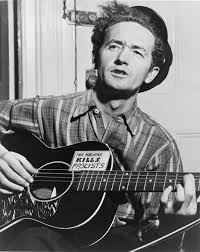
The Ludlow Massacre Monument, erected by the union 1916Woody Guthrie, socialist troubadour, composed the Ludlow Massacre song about 1944.
The Ludlow Massacre by Woody Guthrie
(The lyrics accuse “they” sometimes and “you” at others; I sing “they” or “their” all through, along with a few other minor changes)
It was early springtime that the strike was on
They moved us miners out of doors
Out from the houses that the company owned
We moved into tents at old Ludlow
I was worried bad about my children
Soldiers guarding the railroad bridge
Every once in a while a bullet would fly
Kick up gravel under my feet
We were so afraid they would kill our children
We dug us a cave that was seven foot deep
Carried our young ones and a pregnant woman
Down inside the cave to sleep
That very night the soldiers waited
Until us miners were asleep
They snuck around our little tent town
Soaked our tents with your kerosene
They struck a match and the blaze it started
They pulled the triggers of their Gatling guns
I made a run for the children but the fire wall stopped me
Thirteen children died from their guns
I carried my blanket to a wire fence corner
Watched the fire till the blaze died down
I helped some people grab their belongings
While their bullets killed us all around
I will never forget the looks on the faces
Of the men and women that awful day
When we stood around to preach their funerals
And lay the corpses of the dead away
We told the Colorado Governor to call the President
Tell him to call off his National Guard
But the National Guard belong to the Governor
So he didn’t try so very hard
Our women from Trinidad they hauled some potatoes
Up to Walsenburg in a little cart
They sold their potatoes and brought some guns back
And put a gun in every hand
The state soldiers jumped us in a wire fence corner
They did not know that we had these guns
And the red neck miners mowed down them troopers
You should have seen those poor boys run
We took some cement and walled that cave up
Where those thirteen children died
I said, “God bless the Mine Workers’ Union”
And then I hung my head and cried.
[Article by TOM, a contributor to Socialist Voice, newspaper of the Communist Party of Ireland and reprinted with their kind permission. In essence it agrees with the analysis of Mandela and South Africa given by Stephen Spencer and Diarmuid Breatnach in an article reviewing statements of the Irish Left and Republican movement following the death of Mandela — Rebel Breeze]
The presence of such friends of genuine democracy as the war criminals George W. Bush and Tony Blair, David Cameron, Bill Clinton and such right-wing media hangers-on as Sir Bob Geldof and Sir Paul Hewson (Bono) at Nelson Mandela’s funeral raises questions about the real content of the new South Africa that appeared in 1994, when the apartheid elite seemed to cede political power to the African National Congress.
Twenty years later, given the continuing racial inequality in present-day South Africa, the much lower life expectancy of blacks and their much higher rate of unemployment, the increased vulnerability of the country to world economic fluctuations and accelerated environmental decay during his presidency, did Mandela really change South Africa? And, if not, how much room had he to manoeuvre?
For many are still remembering the Mandela years as fundamentally different from today’s crony-capitalist, corruption-riddled, brutally securitised, eco-destructive and anti-egalitarian South Africa. But could it be that the seeds of the present were sown earlier, by Mandela and his associates in government?
Ending the apartheid regime was, undoubtedly, one of the greatest events of the past century. But, to achieve a peaceful transition, Mandela’s ANC allowed whites to keep the best land, the mines, manufacturing plants and financial institutions, and to export vast quantities of capital.
The ANC could have followed its own revolutionary programme, mobilising the people and all their enthusiasm, energy, and hard work, using a larger share of the economic surplus (through state-directed investments and higher taxes), and stopping the flow of capital abroad, including the repayment of illegitimate apartheid-era debt. The path chosen, however, was the neo-liberal one, with small reforms here and there to permit superficial claims to the sustaining of a “National Democratic Revolution.”
The critical decade was the 1990s, when Mandela was at the height of his power, having been released from jail in February 1990, taking the South African presidency in May 1994 and leaving office in June 1999. But it was in this period, according to the former minister for intelligence services Ronnie Kasrils, for twenty years a member of the Central Committee of the South African Communist Party, that “the battle for the soul of the African National Congress was lost to corporate power and influence . . . We readily accepted that devil’s pact and are damned in the process. It has bequeathed to our country an economy so tied in to the neo-liberal global formula and market fundamentalism that there is very little room to alleviate the dire plight of the masses of our people.”
Nelson Mandela’s South Africa fitted a pattern, that of former critics of old dictatorships—whether from right-wing or left-wing backgrounds—who transformed themselves into neo-liberal rulers in the 1980s and 90s: Alfonsín (Argentina), Aquino (Philippines), Arafat (Palestine), Aristide (Haïti), Bhutto (Pakistan), Chiluba (Zambia), Kim (South Korea), etc. The self-imposition of economic and development policies, because of the pressures of financial markets and the Washington-Geneva multilateral institutions, required insulation from genuine national aspirations—in short, an “elite transition.”
This policy insulation from mass opinion was achieved through the leadership of Mandela. It was justified by invoking “international competitiveness.” Obeisance to transnational corporations led to the Marikana Massacre in 2012 and the current disturbances on the platinum belt, for example. But the decision to reduce the room for manoeuvre was made as much by the local principals, such as Mandela, as it was by the Bretton Woods institutions, financiers, and investors.
Much of the blame, therefore, for the success of the South African counter-revolution must be laid at the door of the ANC leadership, with Nelson Mandela at its head. Hence the paeans of praise for the dead leader from the doyens of international reaction.
[TOM]
AN ACCOUNT OF PROPERTY “DEVELOPMENT” AND RESISTANCE WHICH MAY ILLUMINATE THE DISCUSSION AROUND MOORE STREET, DUBLIN
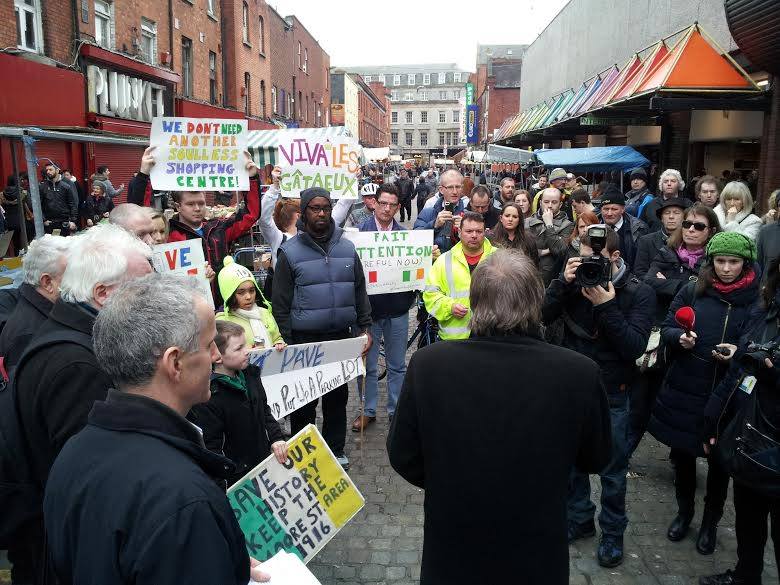
Second “Save Paris Bakery” demonstration, 3rd March 2014, as part of Save Moore Street campaign (photo John Ayres)
Currently, a property speculator, Chartered Land, wants to build a new shopping mall in Dublin’s city centre. The plan envisages construction from O’Connell Street (including site of the old Carlton Cinema) through to Moore St and the demolition of a number of houses in the parade in Moore Street. How Chartered Land saw off another developer with a much more modest plan, acquired a number of surrounding sites and came to a privileged arrangement with Dublin City Council has been the subject as far back as 2012 of a TV documentary by an investigative programme of TG4 Iniúchadh Oidhreacht na Cáscahttps://www.youtube.com/watch?v=Cx0Kah7dE80#t=469.
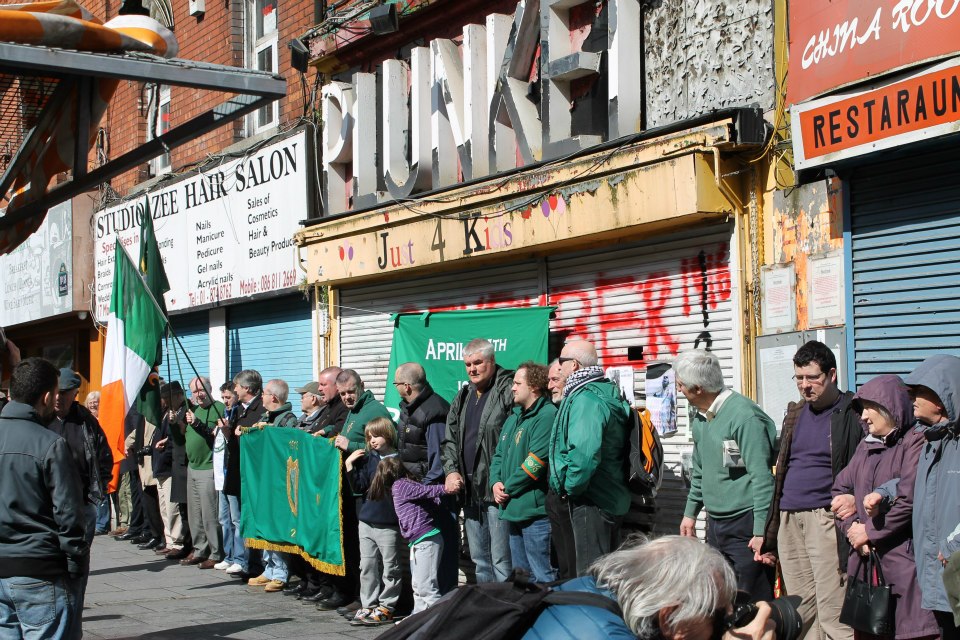
Hands Around Moore Street demonstration in 2013. The dilapidated shuttered shopfront (under a former owner’s name “Plunkett”) is No.16 Moore Street, last HQ of the 1916 Rising, occupied by Pearse, Connolly and others.
Campaigners have been resisting Chartered Land’s plan from a number of viewpoints: historical (conservation of a 1916 Rising battleground and last HQ of the Rising); architectural conservation; defending small businesses and traditional street market; opposition to yet another mall and thoughtless planning. The latest move was the expulsion by Chartered Land of the successful small business Paris Bakery, occupying two of the houses which the campaigners wish to save.
The first of two Save Paris Bakery demonstrations, February 2014, as part of the Save Moore Street campaign, being addressed by James Connolly Heron, grandson of James Connolly shot in 1916 by the British.
A campaign fought in a town on the eastern outskirts of London has, I believe, some lessons for people resisting Chartered Land and other property speculators. In 1968 in the outer London borough of Redbridge, the Ilford Town Council had a plan for a ring road and car parks which required the demolition of many houses. Whatever financial benefits were to be accrued from the plan and to whomsoever they would be going is not known to me but one would assume there were some from the events to be outlined. While they were applying for approval to the Dept. of the Environment AND BEFORE THEY RECEIVED APPROVAL, the Council served compulsory purchase orders on the houses in question and then forced the occupants to leave. The two-storey houses with gardens stood empty.
The Ilford Squatters’ Association, a broad group of different political parties and groups and independents, occupied some of the houses and moved homeless families into them (some of the families and some of the helpers, by the way, were Irish, including from Dublin). The campaign’s position was that they were against the “development” plan but that in any case, even if it went ahead, homeless families could and should be accommodated in houses in the meantime.
The council went to civil court and sought eviction orders which, at that time, had to name the individuals and the property in question. When the orders were granted, the squatters swapped the families at the address and moved the named one to another address.
Then the Council started vandalising the houses still empty, ripping out the stairs, smashing sinks and toilets and knocking holes through walls, ripping up floorboards. The Squatters had many volunteers and some of them had building experience; they repaired/ replaced toilets and sinks, rebuilt stairs and relaid floor boards.
The Council hired a firm of private detectives (i.e. thugs, some of them with National Front badges), and attacked two houses in what amounted to an illegal eviction. In one of them they smashed the jaw of a helper in two places and threw a child with scarlet fever out of her bed on to the floor in a bid to get the family to leave. The police stood by until a doctor arrived at a rush and said the child could not be moved; only then did the police ask the bailiffs to leave.
In another house, the bailiffs came through the street door with a battering ram to discover, as they fell through the joists, that in this house, the floorboards had not been replaced. A medieval-type battle then took place as they tried to climb up ladders on the outside and on the inside too (for the stairs had not been replaced either). Frustrated and battered, they then set fire to the ground floor. At this point, the police had to intervene, as the houses on each side were occupied (a Salvation Army officer on one side and a GP on the other). The bailiffs left and the Fire Brigade arrived to put out the fire.
Eventually the Council did some kind of a deal with the leadership of the Squatters’ Association and with a few remaining families and the campaign was over. By that time numerous helpers had been to civil and criminal courts and to jail on remand and some had accumulated “criminal” convictions. But the ring road was not approved for years afterwards (perhaps never) and nor was the car park.
There are two lessons from the account above, I think, for Moore St. campaigners:
1) Property speculators (“developers”) will do ANYTHING THEY CAN GET AWAY WITH to pursue their objectives
2) They will try and present the regulators with a fait accomplit, that is an accomplished fact. In the Moore St case, that means letting the named national monument buildings go to rack and ruin (as they did before) and getting rid of successful small businesses (as with Paris Bakery) and by making an ugly eyesore of Moore St. (derelict buildings, boarded up businesses, hoardings …) in the hope that opposition will crumble and people will be glad of any change to the area.
The resistance in Moore Street should continue to be holistic and every threatened part and interest should support the others.
Street cartooning, hoarding Moore Street, Dublin inner-city historic and market quarter under threat from property speculator/ developer Chartered Land. 1st March 2014.
Street cartooning Moore Street hoarding, Dublin inner-city historic and street market area under threat from property speculator/ developer Chartered Land. 1st March 2014









 rebelbreeze