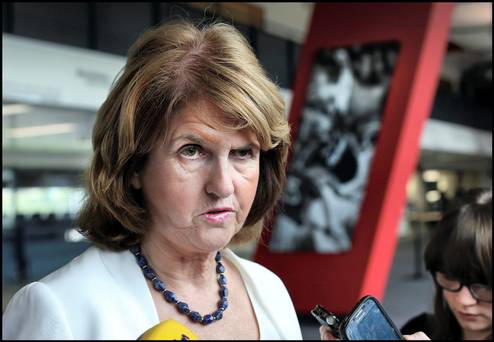
Joan Burton, Labour Party TD, Minister for Social Protection in Fine Gael/ Labour coalition Irish Government.Enda Kenny, Fine Gael, Taoiseach (Prime Minister) FG/ Labour coalition Irish Government.
“ ‘Parliamentary cretinism’ …. a lack of intellectual capacity, stupidity, in sections of the Left with regard to their attitude to the parliament in question ……also came to be associated with idealism, in the sense that Marxists understand that term, i.e. as wishful thinking ….of basing one’s actions on an ideal view rather than on the concrete reality and historical experience. ”
Increasingly, it seems, one hears calls for the resignation of the Government, or the leaders of the coalition in power, or a certain Government Minister. This kind of behaviour is honoured by practice over time, especially when weakness in the reigning party or parties is sensed or becomes obvious. The weakened government and its representatives are attacked on political, financial, economic and even personal grounds, hoping to make them lose confidence in themselves and the confidence of others, until they finally give in or their enemies become so many and united against them that they lose some apparently big battle and resign.
And then what? Well, in our political system, inevitably, a general election. Nearly every citizen in the state will get a vote and the chance to put into parliament an alternative government. This government will be composed of one of the main alternative parties or by a coalition of parties. So based on the disposition of forces around at the moment, that will mean a government of Fianna Fáil or a coalition of that party and of Sinn Féin. There is no other alternative, based on any predictable pattern.
And that can only mean that nothing will basically change. Fianna Fáil is a capitalist party marked by corruption and, like all Irish capitalist parties, by acting as a middleman in the sale of our country’s labour power and resources to foreign monopoly capitalists. It is the party which was in power at the start of the financial collapse and, in a move that even astounded capitalists of other states, bailed out the speculator banks Anglo Irish and Irish Nationwide and guaranteed the speculators against loss – decisions for which the Irish people are continuing to pay and without an end in sight.
Well, but Sinn Féin spoke against a number of the austerity measures imposed on the Irish people to make them pay for those decisions, didn’t they? Sure they did. There is a long tradition of parties in opposition attacking the government and then implementing, if not the exact same policies, at least very similar ones, as soon as they get into power themselves. In fact, Fine Gael and Labour politicians both did it with regard to the Fianna Fáil/ Green Party coalition which they replaced. To expect of that of Sinn Féin is a cynical view of the party, surely? Well, in the Six Counties they attacked the SDLP, their political rival party, for collaborating and colluding with the Unionist poltical elite and …. yes, now Sinn Féin are doing the exact same thing for which they criticised the SDLP, now that they have disposed of the other party as a viable rival.
Nor is there any reason to expect any different from Sinn Féin in the 26 Counties, particularly when they refused to condone, never mind encourage, significant acts of civil disobedience such as not registering and non-payment for the new Household and Property Taxes and the Water Charge. And their representative publicly condemns the actions of a few egg-throwers and car-thumpers against one of the Government Ministers most directly responsible for making the people pay for the finance crisis but can hardly find time to condemn the continuing violence of the state police, the Gardaí, against people resisting peacefully the instalation of water meters. This party wants one day to represent the Irish capitalist class in government and must, in the interim, present itself as “reasonable” — reasonable, that is, to the Irish capitalist class.
I said earlier that calling for the resignation of a government or Ministers is a long-standing practice with regard to parliamentary politics. But honoured by practice over time may mean nothing more than that this is, in fact, bourgeois democratic politics and standard parliamentary cretinism. “There he goes, using jargon again”, the reader may say. Well forgive me, but although jargon can be over-used and is too often used to exclude or to dominate, it has its uses too. If we were talking about motor engines, about which I know very little, I might object to such jargon as “internal combustion engine”, “camshafts”, “transmission” and the like. But it would take a lot longer to discuss if every one of those terms were broken down into sentences and if that collection of sentences had to be used every time we were referring to an object or to a collection of objects.
So, “bourgeois politics” means “the kind of politcs that the Bourgeoisie use among themselves or the kind of politics that the Bourgeoisie want the working class to follow”. “Bourgeois politics” is a much shorter term than that sentence, I feel you must agree. But “bourgeois”? “Bourgeoisie”? Well, Karl Marx and others saw society split into two main social classes, each with its own historical development, interests, ideology; they called these “the Bourgeoisie and the Proletariat”. We can, and often do, say instead “The capitalists and the workers” but in terms of ideology, I just feel “bourgeois” runs better. However, if every time I say “bourgeois” you prefer “capitalist”, say it under your breath by all means.
“Cretinism” is defined as the behaviour of a “cretin” which was usually defined in turn as a person of stunted mental and physical growth, a congenital condition and it later became a term of abuse, which is why the term is rarely used by health professional these days. It was used in its pejorative sense in political discourse around the end of the 19th Century and for many decades later and one of the political writers who tied it to the qualifying adjective “parliamentary” was the Russian revolutionary socialist V.I. Lenin. As his definitions and explanations came to dominance in the revolutionary socialist movement, the term “parliamentary cretinism” became a by-word among the Left up until the 1970s and one still hears it in some quarters today.
So, it was meant to convey a lack of intelectual capacity, stupidity, in sections of the Left with regard to their attitude to the parliament in question. Although it is a different thing, it also came to be associated with idealism, in the sense that Marxists understand that term, i.e. as wishful thinking, of basing one’s actions on an ideal view rather than on the concrete reality and historical experience. But although these things are different, lumping them together actually deepens the meaning of the term “parliamentary cretinism” and makes the term more complete.
Often, when one begins to speak in disparaging terms of parliament, listeners imagine the speaker is really saying something more, such as “I don’t believe in making any use of parliaments” or “having anything to do with parliaments is a waste of our time”. However, that is not necessarily the case. For most Anarchists, it is, probably. For most revolutionary Irish Republicans (as distinct from those that have capitulated and embraced parliamentarianism) it is too. However, many socialist revolutionaries are saying nothing of the kind and “parliamentary cretinism” does not refer to having some engagement with parliament or with parliamentary representatives. What it refers to is having the illusion that fundamental change — i.e. revolutionary change — can come about through parliament. The revolutionary socialist of the kind I have in mind is saying something like: “Have no illusions about parliament; put your main emphasis on building revolutionary organisation and dissemination of revolutionary ideology; use parliamentary avenues when it suits the needs of the movement.” Of course, there can be a big debate – and there often is – about just how one judges “when it suits the needs of the movement” and I will attempt later to answer this briefly because it is not the main thrust of this article, strange though that may seem at the moment.
So now, let us look again at calls for this government’s resignation. Should revolutionary socialists join in? I don’t think so. But surely it can’t hurt? And the confusion arising out of a change of government could be to our advantage? I think it can hurt and that any benefits arising out of change of government will be far outweighed by costs to the revolutionary and resistance movements. So, what — say nothing? Actually oppose resignations? Neither.
It is the task of revolutionary leadership to direct eyes to the ultimate goal and to point to the next steps to take at any moment – and also to take necessary steps themselves. We need to talk about all those things now with specific regard to the general issue under discussion – we need to talk about “revolutionary leadership”, “ultimate goal”, “the next steps” for the movement and the “necessary steps” we need to take ourselves.
“Revolutionary leadership” is the leadership that leads to revolution or the leadership given by revolutionaries. They are not always the same thing, since revolutionaries can and do make mistakes. Everyone and anyone who aspires to revolution and says “we should do this (or that) now” is potentially part of the revolutionary leadership. This includes individuals who are independent of any political party as well as those who are part of such parties. I say “potentially” because a number of other requirements need to be met to fulfill the promise of the title “revolutionary leadership”. Such leadership must tend towards revolution rather than reform, which is not to say standing aside from all reformist demands in every circumstance. As I hope we now agree, removing one set of representatives of the capitalist class to replace them with another, is not an objective worth the striving (we shall come later to how it can actually be harmful).
Such leadership also needs to have — or to build — the confidence of the movement in it as otherwise it cannot be effective, no matter how correct its analysis and calls may be. Confidence of that kind is built by working alongside the workers and other masses so that they see the mettle of those offering leadership in struggles and that they can also see that the analysis and the calls seem to correspond to the experience of the masses in those struggles. Therefore, such leadership needs to at least appear to be correct most of the time.
Unfortunately, as we know, leaderships claiming to be revolutionary have often turned out to be their opposite; also the concern of appearing to be correct most of the time has led to suppression of criticism and concealment of mistakes. Such a leadership may for the moment fulfill all the other requirements listed but it fails the test of “tending towards revolution”. I know of no formula that we can prepare that guarantees the movement protection against this kind of leadership but history and personal experience encourages me promote certain ingredients: permit criticism up until it threatens to paralyse necessary action; be open about admitting mistakes and learn from them; do not propagate ideas of infallibility (and make gods of no living persons); educate the participants in the movement and build their confidence in themselves.
What is this “ultimate goal” mentioned earlier? Nothing less than the complete overthrow of the capitalist class and the freeing of our people from imperialism, in order to build a totally different economy and society. I don’t propose to go much further here on this topic since the type of organisation of society we should aim for is a matter of hot debate among revolutionaries but we should focus for the moment on “complete overthrow”, “freeing our people” and “building a totally different society”. Each of those and all of them together imply certain kinds of organisation, certain ideology (or ideologies) and certain kinds of actions. And nailing my colours to the mass here, they imply empowering the working class to take control because it is the most numerous class, the most used to cooperative working and the only one which has no interest to be served by compromising with capitalism (some of its individual members may but that is not the class).
So what about “the next steps” for the movement? Nobody can prescribe these much in advance since the correct next steps depend upon the situation at the moment, the balance of forces, projections into future situations of the actions of the enemy and of our own forces, available alternatives, etc. Revolutionaries must analyse those elements in order to decide and there is no guarantee that they will not make a mistake. No book on theory and no leadership can provide us with a guarantee against that. So, mistakes will be made and they must be learned from. Let us hope that they are not major mistakes from which we will take generations to recover and let us take some precaustions against them and the cost to be paid for them but, at the same time, let us be bold and daring – the stakes are high but the prize is highest.
In any event, it does seem at the moment that the Irish government is in some disarrray. Demonstrations of dissatisfaction grow, as does civil disobedience, while the repressive measures of the State and declarations by some Ministers discredit them in the eyes of the broad masses of people. Then too, the Government has offered concessions on the Water Charge involving substantial reductions on the commencing charge it had projected. It seems clear that we should at least maintain the pressure and, if we can, increase it to the limits of which the movement is capable at this time. Again, analysis, judgement and call, guided by historical and recent experience – but no guarantees. However one thing a change of government will not do in this situation is maintain the pressure on the Irish capitalist class and may well have the opposite effect.
This is a time for revolutionary leadership to make it clear to the movement that a change of government will not do, will bring no fundamental change. We cannot make that clear if we jump on the “Enda Resign” or “Joan Burton Resign” or other similar bandwagons. We can however put forward some demands that people can pressure any new contenders for, such as abolition of the new taxes on working people and increased taxes on the capitalists, in order to make up the shortfall. And that funding for needed social and health services will be at least restored. But we should put forward those demands while, at the same time, making it clear we have no expectation that a new government will deliver or that, once having got past the current political crisis, will not reinstitute austerity measures once more. And we need to maintain the pressure on any new government and, if possible, increase it. We are not here to “give them a chance” but to overthow their masters and their system.
And now we come to the “necessary steps” we need to take ourselves. We do not put our trust in parliament, not even in putting more of our own in there. No, we put our trust in revolutionary organisation. This means building fighting organisations, not bureaucracies. And yet, we need some bureaucracy too – organisations need minutes of meetings to record who agreed to what, those minutes need to be distributed, events need to be organised, leaflets and posters put together, printing done, placards made, people have to be got to certain places, money collected, paid and accounted for, etc. etc. But the main requirement is that the organisations be fighting organisations – which means that they unite people on some demands, organise defensive or offensive actions, educate their members and supporters and build their numbers, neutralise their enemies or weaken their resistance, make allies, seek to achieve some victories.
Struggles take place in communities, work-places and institutions of mass education and the Irish Left has built extensive networks in none of them, nor is there any sign that it is trying to do so, save in isolated instances here and there.
The Irish Transport & General Workers’ Union as built and led by James Larkin and later by James Connolly and their associates, may not have been a revolutionary organisation. But it certainly was a genuine resistance organisation of the Irish working class, particularly in Dublin and it gave support to a revolutionary organisation, which the Irish Citizen Army proved to be. We have no such trade unions in Ireland now and SIPTU, that into which the ITGWU developed, has proved to be, whenever effective, more of a brake on the workers’ movement than an engine for it.
Well then, can we do without trade union organisation, especially since they are not usually revolutionary organisations? I don’t think so, since no other mass organisation of workers is conceivable in the near or middle-term future. Can we create a viable alternative trade union, then? A viable organisation that will win large numbers of other workers into a fighting trade union, large enough or at least concentrated enough in certain industries or work environments (e.g. local government, health services) to be able to take effective action there? Probably not, at the moment. But we could build a fighting and solidarity worker’s network inside and across trade unions and the Left has singularly failed to attempt that. Such a network would certainly enhance the fighting ability of the class and could, in time, provide the base to build a fighting alternative trade union.
The capitalist-owned mass media is a common cause of complaint among progressive people, in that it blacks out some news items and distorts others to the benefit of the ruling class. In the years leading up to the 1913 Lockout and even afterwards, leading up to 1916, “… the Irish Worker had ten to fifteen times the circulation of the Sinn Féin paper and of Irish Freedom, the revolutionary paper backed by the IRB”1. Circulation figures are often taken as being about one-third of actual readership as newpapers get handed around and, in a population with a low level of education, as in the working class at that time, the proportion of listeners may have been even higher, as those who could, read out to those who could not. The Irish Worker was a weekly newspaper but we don’t even have a monthly newspaper of revolutionary orientation that is widely read. If in the conditions of the early 1900s in Ireland such a periodical could exist and proliferate, how is that in Ireland in the early 2000s, with fast cheap printers, photocopiers and internet sites, we have not even come close to producing anything like that?
If we want to educate ourselves, as revolutionary activists, as well as others in the resistance movement, in revolutionary perspectives, then we need to create some institutions for facilitating the reflecting and learning process. Seminars and lectures once a year or on commemorative occasions are no substitute for this at all (apart from the fact that the mass of workers fail to attend such occasions). The Irish Left is not building this kind of process either.
The “necessary steps”, as I perceive them, are building fighting organisations and the resistance movement, building a mass resistance newspaper and building education institutions for revolutionaries and for the resistance movement. It is hard to escape the conclusion that the independent activists at the very least are not prioritising the building of these components or for some reason are failing to unite around the work and that on the other hand, the Left organisations and parties have no interest in doing so.
Coming back once again to the call for the resignation of the Government or of their Ministers, can it do any harm to join the call? Well yes, it most certainly can. This is because across society as a whole, including in the working class, there is an illusion that we live in a democracy, that in some way the people rule or, at least, could rule, if only we could get good representation. This often degenerates into trying to get slightly better representation than we had in the last government. Implicit in all this is the underlying assumption that we cannot substantially change things for the better and also that the changes we need can be effected by others representing us.
These notions fly in the face of historical experience but that is no bar to the wide acceptance of such ideas. Bourgeois democracy and in particular its ‘Left’ variant, social democracy (bourgeois democracy through a Labour party with trade union involvement), may be said to be the default position in western societies. It is the widely-accepted belief, the norm, the position most people start from. It is the position too from which, in the ordinary run of things, most people do not significantly depart — except into apathy. The job of revolutionaries is to give leadership away from that default position, to establish a new position and fight for it in the resistance movement, seeking to make it the main position, a new default position. That position is that revolution is made in the streets, workplaces, communities and education institutions and never in parliament. And that if we want real change, we have to build for revolution and nothing else will do. We need to use other struggles along the way, reformist ones for better wages, living conditions, less taxation of working people, changes in the law …. only in a revolutionary way, to strengthen the resistance movement and never the ruling class. And in those struggles, we should be putting forward revolutionary ideas and principles of organisation, getting our hands dirty with organising and participating in struggles and behaving as examples in line with the principles we put forward.
So, are parliamentary representatives of the Left of any use? Yes, they can get some statements into the media. They can expose certain acts of government and of agencies outside of parliament. They can also propose certain legislative changes. Their parliamentary allowances can be used to fund some revolutionary work. Parliamentary representatives can be useful — to the extent that they contribute in some manner to the work outlined in the preceding paragraphs. But no further.
In the lands under the direct dominion of England, i.e. the “United Kingdom”, and in some others that are part of the British Commonwealth, the dominant class has called the people to join in a cultural festival in November which they call “Remembrance”. In this year of 2014, the centenary of the beginning of World War I, there is a particular focus in the Festival on that war.
The organisation fronting this festival in the ‘UK’ is the Royal British Legion and their symbol for it (and registered trademark) is the Red Poppy, paper or fabric representations of which people are encouraged to buy and wear – and in some places, such as the BBC for personnel in front of the camera,forced to wear. In many schools and churches throughout the ‘UK’, Poppies are sold and wreaths are laid at monuments to the dead soldiers in many different places. Prominent individuals, politicians and the media take part in a campaign to encourage the wearing of the Poppy and the festival of remembrance generally and of late, to extend the Festival for a longer period.
High points in the ‘The Festival of Remembrance’ are the Royal Albert Hall concerts on the Saturday and the military and veteran’s parades to the Cenotaph memorial in Whitehall, London, on “Remembrance Sunday”. According to the British Legion’s website, “The concert culminates with Servicemen and Women, with representatives from youth uniformed organizations and uniformed public security services of the City of London, parading down the aisles and on to the floor of the hall. There is a release of poppy petals from the roof of the hall.
“The evening event on the Saturday is the more prestigious; tickets are only available to members of the Legion and their families, and senior members of the British Royal Family (the Queen, Prince Phillip, the Prince of Wales, the Duke of York and the Earl of Wessex) and starts and ends with the British national anthem, God Save the Queen. The event is televised.
“Musical accompaniment for the event is provided by a military band from the Household Division together with The Countess of Wessex’s String Orchestra.”
The money raised from the sale of the “Poppies” and associated merchandise is to be used to support former military service people in need and the families of those killed in conflict. On the face of it, military and royal pomp apart, the Festival may seem a worthy charitable endeavour and also one which commemorates very significant historical events — therefore a festival which at the very least should not be opposed by right-thinking and charitable people.
Yet the main purpose of this festival and the symbol is neither remembrance nor charity but rather the exact opposite: to gloss over the realities of organised violence on a massive scale, to make us forget the experience of the world’s people of war and to prepare the ground for recruitment of more people for the next war or armed imperialist venture – and of course more premature deaths and injuries, including those of soldiers taking part.
Video and song On Remembrance Day from Veterans for Peace lists British conflicts (including Ireland) and condemns the Church of England for supporting the wars, calling also on people to wear the White Poppy
Partial Remembrance – obscuring the perpetrators and the realities of war
The Royal British Legion is the overall organiser of the Festival of Remembrance and has the sole legal ‘UK’ rights to use the Poppy trademark and to distribute the fabric or paper poppies in the ‘UK’. According to the organisation’s website, “As Custodian of Remembrance” one of the Legion’s two main purposes is to “ensure the memories of those who have fought and sacrificed in the British Armed Forces live on through the generations.”
By their own admission, the Legion’s “remembrance”is only to perpetuate the memories of those who fought and sacrificed in the British Armed Forces – it is therefore only a very partial (in both senses of the word) remembrance. It is left to others to commemorate the dead in the armies of the British Empire and colonies which Britain called to its support; in WWI, over 230,500 non-‘UK’ dead soldiers from the Empire and, of course, the ‘UK’ figure of 888,246 includes the 27,400 Irish dead.
Cossack soldier volunteers WWI. Imperial Russia was an ally of Britain and France; the war was one of the causes of the Russian Socialist Revolution 1917. The following year, the war ended.
The Festival of Remembrance excludes not only the dead soldiers of the British Empire and of its colonies (not to mention thousands of Chinese, African, Arab and Indian labourers employed by the army) but also those of Britain’s allies: France, Belgium, Imperial Russia, Japan, USA and their colonies.
German soldiers playing cards during WWI. Photos of Germans in WWI more readily available show them wearing masks and looking like monsters.
No question seems to arise of the Festival of Remembrance commemorating the fallen of the “enemy” but if the festival were really about full “remembrance”, it would commemorate the dead on each side of conflicts. That would particularly be appropriate in WWI, an imperialist war in every aspect. But of course they don’t do that; if we feel equally sorry for the people of other nations, it will be difficult to get us to kill them in some future conflict.
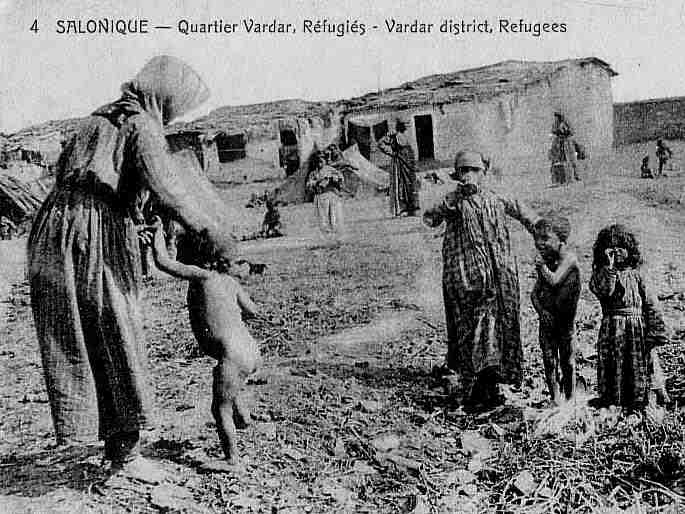
A real festival of remembrance would commemorate too those civilians killed in war (seven million in WWI), the percentage of which in overall war casualty statistics has been steadily rising through the century with increasingly long-range means of warfare.
Civilian war refugees in Salonika, NW Greece, WWI
Civilians in the First World War died prematurely in epidemics and munitions factory explosions as well as in artillery and air bombardments, also in sunk shipping and killed in auxiliary logistical labour complements in battle areas and through hunger as feeding the military became the priority and farmhands became soldiers.
In WWII 85,000,000 civilians died in extermination camps or forced labour units, targeting of ethnic and social groups, air bombardments, as well as in hunger and disease arising from the destruction of harvests and infrastructure. Air bombardments, landmines, ethnic targeting and destruction of infrastructures continue to exact a high casualty rate among civilians in war areas: one admittedly low estimate up to 2009 gave figures of 3,500 dead in Iraq during the war and aftermath and another 100,000 dead from western trade sanctions, along with 32,000 dead civilians in Afghanistan. Another review up to 2011 gave a figure of 133,000 civilians killed directly as a result of violence in Iraq and “probably double that figure due to sanctions”. (1)
The number of civilians injured, many of them permanently disabled, is of course higher than the numbers killed. Most of those will bring an additional cost to health and social services where these are provided by the state and of course to families, whether state provision exists or not.
Real and impartial “remembrance” would include civilians but not even British civilians killed and injured are included in the Festival of Remembrance, revealing that the real purpose of the Festival is to support the existence of the armed forces and their activities (“shoulder to shoulder with our armed forces”) (2) contributing at the same time to a certain militarisation of society and of the dominant culture.
If the Festival were really about “remembrance”, they would commemorate the numbers of injuries and detail the various types of weapons that caused them. But that might reflect unfavourably on the armaments manufacturers, who run a multi-billion industry in whatever currency one cares to name, so of course they don’t.
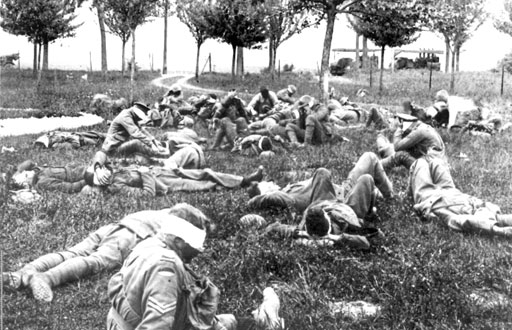
Australian soldiers who survived gas attack but injured by it awaiting hospitalisation, Northern France, WWI 1916.
And if really concerned about death and injury in war, they would campaign to end such conflict – for an end to imperial war. But then how else would the various imperial states sort out among themselves which one could extract which resources from which countries in the world and upon the markets of which country each imperial state could dump its produce? So of course the Royal British Legion doesn’t campaign against war.
Partial remembrance is indeed embodied in the song chosen by the British Legion to promote its Festival. No Man’s Land, sung by Joss Stone, is actually a truncated version of the song of the same title (better known in Ireland as the Furey’s The Green Fields of France), composed by Scottish-raised and Australian-based singer-songwriter Eric Bogle. The Joss Stone version contains the lyrics of the chorus as well as of one verse and one-half of another, omitting two and-a-half verses of Bogle’s song.
Some of the British media created a kind of controversy, at the behest of who knows whom, to have the British Legion’s song included top of BBC’s Radio One playlist. The song is reproduced in entirety below, with the lines sung by Joss Stone in italics and those she omitted in normal type.
Well, how do you do, young Willie McBride?
Do you mind if I sit here down by your graveside?
And rest for a while in the warm summer sun,
I’ve been walking all day, and I’m nearly done.
I see by your gravestone you were only 19
When you joined the great fallen in 1916,
I hope you died well and I hope you died clean
Or, Willie McBride, was it slow and obscene?
(Chorus)
Did they beat the drum slowly, did they play the fife lowly?
Did they sound the death march as they lowered you down?
Did the band play The Last Post in chorus?
And did the pipes play the Flowers of the Forest?
Did you leave a wife or a sweetheart behind
In some faithful heart is your memory enshrined?
Although, you died back in 1916,
In that faithful heart are you forever 19?
Or are you a stranger without even a name,
Enclosed forever behind the glass frame,
In an old photograph, torn, battered and stained,
And faded to yellow in a brown leather frame?
(Chorus)
The sun now it shines on the green fields of France;
There’s a warm summer breeze that makes the red poppies dance.
And look how the sun shines from under the clouds
There’s no gas, no barbed wire, there’s no guns firing now.
But here in this graveyard it’s still No Man’s Land
The countless white crosses stand mute in the sand
To man’s blind indifference to his fellow man.
To a whole generation that were butchered and damned.
(Chorus)
Ah young Willie McBride, I can’t help wonder why,
Do those that lie here know why did they die?
And did they believe when they answered the cause,
Did they really believe that this war would end wars?
Well the sorrow, the suffering, the glory, the pain,
The killing and dying, were all done in vain.
For Willie McBride, it all happened again,
And again, and again, and again, and again.
(Chorus)
It’s easy to see why the Royal British Legion might shy away from the omitted lyrics, which would hardly encourage recruitment or support for war. Interviewed on video, Joss Stone herself said how important it was to be “true to the lyrics” and that “the last thing one would want to do would be to disrespect the lyric”; incredibly, she and John Cohen, the record producer, both separately claimed that they had captured the essence of the song lyrics in the British Legion’s version.(3)
Although Bogle stated that he did not think the Joss Stone version glorifies war, he also said that it did not condemn it and was ultimately a sentimentalised version.
“Believe it or not I wrote the song intending for the four verses of the original song to gradually build up to what I hoped would be a climactic and strong anti-war statement,” Bogle said. “Missing out two and a half verses from the original four verses very much negates that intention.” (apparently in a reply from Bogle to a blogger’s email and quoted in a number of newspaper reports).
The truncation of the song and the removal in particular of the anti-war lyrics epitomises partial “remembrance” and stands as a metaphor for it, the production of a lie by omission and obscuration.
If the main objective were really to care for soldiers and veterans and their families ….…
If the festival were really about caring for veterans and their families, would it not seek to allocate that responsibility completely to the State? It is the capitalist state (and prior to that, the feudal state) which sent people to fight for it, so it should be that state which cares for the military personnel and for their families. According to histories of the British Legion, one reason for its formation was the callous disregard of the British state and low level of provision for its military injured in the First World War and for the dependents of the dead. Taking that principle further, the State could impose a War Tax or Veterans’ Dependent’ Tax, say, on the big capitalists, on whose behalf the State has sent its armed forces off to fight. After all, it is those capitalists who will benefit from the plunder of resources and opening of markets for their produce, the very reasons the wars are being fought.
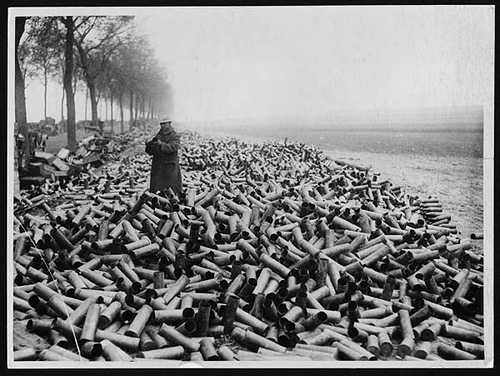
Millions of artillery shell casings, each designed to kill and mutilate, each produced at a profit to Capitalists.
Not only that, the capitalists directly profit from war itself; war is not merely a means of settling territorial disputes among capitalist nations – war itself is very big business. Every bullet, shell, bomb, rocket, mine was produced at a profit and when exploded, will be replaced by another, again at profit and so on, in huge production batches. Every gun, tank, armoured car, lorry, jeep, ship, plane, helicopter built … huge production, huge profits. Then uniforms, equipment, food production and packaging, deliveries …. it will be indeed a rare capitalist who does not profit from war while it is being fought.
The Royal British Legion does in fact do some campaigning around State support for armed forces personnel and their dependents. On the Legion’s website, under the section on “Campaigning”, the following appears:
“In no particular order, our top five recommendations for the next Government are to:
Enable all Armed Forces widows to retain their pension should they decide to later cohabit or remarry
Ensure that all veterans with Service-induced hearing problems can have their MOD-issued hearing aids serviced and replaced at no cost, and that working-age veterans can access higher grade hearing aids, including ‘in-the-ear’ aids
Protect the lifetime income of injured veterans by uprating their military compensation by the higher of earnings, inflation or 2.5% (the ‘triple lock’)
Offer veterans evidence-based treatment for mental health problems within a maximum of 18 weeks from referral, provided by practitioners with an understanding of veterans’ needs, in line with the Government’s commitment to parity of esteem between physical and mental health
Include spouses and Early Service Leavers in the resettlement support provided by the Career Transition Partnership”
As one can see, these are pretty minimal demands of the State and in no way impede its engagement in war and may actually assist in recruitment.
Shhhh! Suicide and PTSD among military personnell
While campaigning for mental health provision for referrals of veterans and serving personnel may help reduce suicides among this group, nowhere in the official Festival of Remembrance is the existence of this component of mortality even alluded to. It is known in the USA that statistics of suicides in their armed forces since 2003 actually exceed their numbers killed in combat.
Evidence is now emerging of suicide statistics among veterans of recent British armed conflicts too — and the statistics are rising. According to aBBC Panorama documentary last year, more British soldiers committed suicide in 2012 than were killed in action in Afghanistan (the British Army does not publish records of suicide death but Panorama’s researchers dug up the statistics from various sources).
The Ministry of Defence does keep some records of diagnoses of post-traumatic stress disorder (PTSD) among its serving personnell and says the incidence is lower than in the general population but many suspect that the figures do not reflect the full reality. Also, the same statistics show that male military under 20 years of age “had a 46% statistically significant increased risk of suicide than the rest of the general population”.(4)
PTSD was not recognised by the beligerents in World War One and many of those who were shot by firing squad for “cowardice”, “desertion” or “refusing an order” “in the face of the enemy”, were sufferers of that syndrome. Their dependents were left without a war pension too.
Talking about PTSD and suicide among soldiers is hardly likely to encourage recruitment to the armed forces and so, despite its pledge to “support all members of the British Armed Forces past and present, and their families”(5), the British Legion draws a veil of silence over those aspects, particularly during the Festival.
Getting the public behind the armed services and war
Far from campaigning against war or even assigning financial and moral responsibility to the capitalists who cause war and also profit from it, the British Legion, through the promotion of the Poppy and “Remembrance”, strives to keep the public in support of militarism (6) and in readiness to support future wars.
It does this in a number of ways: it maintains a separation from the reality of war for the public, as well as a separation between the victims of the State-sponsored wars and the cause of their victimhood. It avoids mention of the causes of war and of those who profit by it. And it promotes the armed services and the conflicts in which they have participated uncritically, a promotion embodied in the Legion’s slogan in use until this year, “Shoulder to shoulder with all who Serve” (which it intends to replace with “Live On – To the memory of the fallen and the future of the living”).
War is presented in the mass media during the Festival and at other times as unfortunate but also as giving rise to uplifting heroic action and to comradeship. Feeling of comradeship is a real phenomenon among people suffering equal or similar conditions and, in the military, is most commonly seen among the lower ranks. When the British Legion was an organisation limited to veteran membership, presenting it as providing comradeship was understandable. However, the British Legion has now extended its membership not only to families but to all kinds of supporters, whether active as volunteers (for example, selling “Poppies”) or completely passive (just paying an annual membership subscription). It now promotes a different kind of “comradeship” and, under that very heading, invites members of the public to “Become part of a network of people who care about the Armed Forces family”.(7)
The British Legion is actively seeking a different kind of ‘comradeship’ or solidarity to that existing among the military or veterans. But this is not an alternative such as the comradeship of humanity nor of the working class, which would lead the workers of the opposing armies to rise up against their masters, but of “the nation”.
This of course would be a misnomer anyway since there are a number of nations in the ‘UK’, for example. But even if the comradeship were for “England”, or “Australia”, these territorial-political units are by no means homogenous. All of them are divided into classes and in each, one class rules – the monopoly capitalist class. It is that class that decides on war and it is that class that profits from it, along with smaller profits for smaller capitalists. But it is not they who will be blowing up, shooting and stabbing one another in the wars they instigate – it is the working and lower middle classes.
The military casualties in war are presented as heroic sacrifices for “the nation”, a mythical concept often represented by neighbourhood and family. Family and neighbourhoods in all the countries in the conflict will suffer but it is neither the families nor the neighbourhoods which instigated the war, nor will they profit from it. In fact, their representatives will be sent to kill one another on the battlefields, leaving desolation and loss among their families and neighbourhoods.
However, as was pointed out by speakers at the recent launch of a book against militarism in a London bookshop recently(8) the fact that the British monopoly capitalist class is having, through the British Legion and its Festival, to exert itself to seek identification with its armed forces and support for war, is a sign that public opinion is not all going the way it would like.
Left and liberal support for the Red Poppy
People enlist in imperial and colonial armed forces for a variety of reasons. Excitement and adventure of course appeal to many but there is also the push of unemployment, the pull of education and training (however doubtful the usefulness of that training may be in later life although in the USA, serving and ex-armed forces people qualify for educational funding http://www.collegescholarships.org/grants/military.htm).
Then of course there is the propaganda about the atrocities committed by enemy forces (whether real or not) and the alleged threat they pose to the population of the state doing the recruiting. The alleged threat is the propaganda reason most aggressive imperialist powers name their war ministries the Department or Ministry of Defence and that some even incorporate the concept into the title of their armed forces, viz. the “Israel Defence Force”).
British soldiers move up through a trench to begin attack at the Somme battle, Northern France, WWI
And, quite often, people are conscripted by force, as they were in Britain during both World Wars as well as for “National Service” up to 1960, as well as in other European countries (and in the USA in the draft for WWII, Korea, Vietnam). The standard punishment for refusing to join up when conscripted was a jail sentence but some conscientious objectors in WWI were shipped by the British Army to France, so that they could be shot for “desertion in the face of the enemy”. The penalty for certain acts in a war area, such as desertion, refusal to obey orders or striking an officer, could be death – during WWI, 306 British and Commonwealth soldiers were shot by firing squad, while others were executed in the armies of Britain’s allies, as well as in those of Germany, Austria and Turkey.
As an aside from the purpose of this article, it is noteworthy that the only area of the ‘UK’ where conscription was not introduced was Ireland, where opposition to it ran right across a spectrum from the IT&GWU and some other trade unions, through the Irish nationalist and republican movements to the Catholic Church hierarchy. The only area of the European-settler Commonwealth where it was not introduced, being defeated in two consecutive referenda, was Australia – where 40% of the population is said to be of Irish descent and where the Irish diaspora, with some justification, was blamed by supporters of conscription for the failure to introduce it. However, thousands of Irish and Australians did volunteer, especially in the earlier days of the war.
The issue of why and how people join the imperialist armed forces is often raised by Left and liberal advocates of wearing the Poppy or of similar commemoration festivals (e.g. Armed Forces Week in the USA, second Saturday to third Sunday of May). Another group contend that the real or original purpose of these commemorations and festivals is to commemorate the great human loss of their country or to support veterans and their families.
These commemorative events, these Left or liberal advocates often contend, have been hijacked by militarists and, in the case of the ‘UK’, by the Royals and they should not be allowed to get away with it. Accordingly, one may find socialists and anti-war people and even activists wearing the Poppy, as is the case for example with a few of the activists of the British-based group Veterans for Peace, although most of them do not wear the Red Poppy and many promote the White Poppy.
Personally, I do not believe that Left and liberal advocates of wearing the Red Poppy have correctly analysed the original purpose of those who created it. But even if they should be correct, clearly serious cognizance should be taken of how the Red Poppy symbol is being used today and what its main thrust is. It is pretty clear that this symbol and the commemorations in imperialist countries in general are being used to recruit personnel for the armed forces of those states and, above all, to swing public opinion behind not only those armed forces but also in support of their state’s armed actions against other states and in wars of conquest in other lands.
The White Poppy – in Britain, Australia, Canada and in Ireland
To counter the propaganda offensive surrounding the Red Poppy, some in the ‘UK’ and in some Commonwealth countries advocate the wearing of a white poppy symbol. The idea of an alternative and anti-war symbol was apparently first proposed in 1926 and the White Poppy was first sold by the Women’s Cooperative Movement in Britain in 1933. The following year, the major anti-war organisation in Britain, the Peace Pledge Union, began its annual sale of the White Poppy symbol. Although tolerance of the White Poppy has been pronounced by the Royal British Legion, the wearing of it has been attacked by a number of public figures in Australia and in Britain, including Margaret Thatcher during Question Time in the House of Commons.
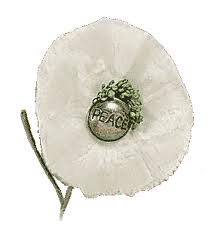
The White Poppy Emblem, worn as an alternative to the Red Poppy but also sometimes alongside it
In 2006 the Royal Canadian Legion initiated legal action against the main Canadian distributor of the White Poppy symbol and against the Peace Pledge Union. This action gained considerable publicity in the Canadian media and, according to the PPU, “resulted in widespread support and a substantial increased sale of white poppies in Canada”(9). The PPU site also carries accounts of orchestrated hostility by the media, in church groups and schools, although some schools also provide the White alongside the Red Poppy symbol.
Reviewing the principle behind it and the history of its existence as a symbol, also not ignoring its pacifist associations (which are unwelcome to me), it does seem a progressive act for people in Britain and Australia, New Zealand and Canada to wear the White Poppy. The act of wearing that symbol is statement that the wearer dissents from the wearing of the Red Poppy and is opposed to imperialist and colonialist war.
I have no strong feeling about whether people should wear it in Ireland or not but nor do I see any reason to promote it (with the exception of within the “Unionist community”, where discussion around it could be useful, although the practice would almost certainly be dangerous). Although our whole nation was a part of the ‘UK’ during World War I, twenty-six of its 32 counties have since ceased to be so. The thrust that led to that current status was embodied in the 1916 Rising (itself an action against WWI)and the War of Independence 1919-1921, events of much greater historic national significance for us, despite their much smaller loss of Irish lives, than is the First World War. The symbol covering that period and in particular the 1916 Rising is the “Easter Lilly” (the Arum Lilly or Calla. Z. aethiopica), paper and metal badge representations of which are worn around that time, both in Ireland and in some cases abroad.
There has been a growing attempt in Ireland in recent years to have a national honouring of the Irish who died serving in the British Army and at the moment this is concentrating on the First World War period. This is far from unproblematic: they were soldiers in the armed forces of a state that was occupying our country, then a colony, and actively engaged in repression of our people – a repression which at that time had been going on for 700 years. The 1916 Rising had taken place right in the middle of WWI and had been suppressed by British troops – including units recruited in Ireland. Almost immediately after the end of World War One, the IRA had begun the War of Independence, during which its principal opponents in armed action were the British Army, the Royal Irish Constabulary and the special auxilliary forces of the latter (“’Tans” and “Auxies”).
As if that were not problematic enough, that same colonial power remains to this day in occupation of a part of our national territory. And that colonial occupation and its colonial police force is backed up by that same British Army, an army which only recently fought a 30-year war against Irish guerrilla forces in the colony. During that war, the British Army daily harassed civilians in ‘nationalist’ areas and at times gassed, arrested and beat them up or shot them dead. That same Army also colluded with sectarian assassination squads and carried out unofficial executions, i.e. murders, of guerrilla fighters and of political activists.
Given this history and current situation, it is curious that some determined efforts to commemorate Irish dead in the British Army during WWI continue. Some of its advocates may be motivated by nothing more than a genuine historical commemorative interest and some by some kind of sense of justice. But undoubtedly there exists in Ireland, as well as the unionist mentality in parts of the Six Counties, a nostalgia for the British among some in the Irish state. This is the “West Britain” mentality that never ceased to wish Ireland to be a part of the British Empire, reinforced by the desire of some other elements to see Ireland part of the British Commonwealth. For these elements, celebration of the Irish who fought in the British Army is a way of stating their claim to the past they like and the future to which they aspire. These tiny sections of the Irish population have some representation in Irish academic and public life and, one suspects, among the Irish capitalist class, a class with no sense of history but a strong sense of the quick Sterling, Punt, or Euro – whichever seems best at the time.
Uncritical commemoration of Irish soldiers who died in the British Army and particularly in WWI is not only problematic but plays into the agenda of “West British” and Commonwealth enthusiasts and for those reasons the broad Irish Republican movement is right to oppose such commemorations. But the issue goes far beyond that of “Brits Out!” — for socialists, these commemorations screen the real purpose of imperialist wars and the ways in which working people are pulled into them, to fight their corresponding working people in other countries, for the profits and strategic interests of a tiny, parasitic minority.
Certainly the Irish who fell in WWI in British military units should be remembered, as should all those working class and lower-middle class people of all countries who were sent to butcher their class brothers and be butchered in turn, along with the civilian casualties, in a dispute over territories, resources and markets between a small number of capitalists who would never fight one another in person and indeed who often wined and dined together and, not infrequently, intermarried. Those dead should be remembered as casualties of capitalism, imperialism and colonialism and their remembrance serve as part of a drive to overthrow those evils and to eliminate imperialist war forever.
End main article
Video Veterans for Peace at the Cenotaph, Remembrance Sunday 2014
1) See “Civilian war dead” links at end of article
2) Quotation from the Royal British Legion’s website (see link at end of article)
3) She may be seen and heard saying those things and a number of other inane (or dishonest) things in a number of videos entitled Behind the Scenes of the Official Poppy single with Joss Stone and John Cohen can be seen and heard saying his piece on one of those too (see video links at end of article).
4) From the British Legion’s website (see link at end of article)
5) From The Female Front Line blog (see link at end of article)
6) Members of the armed forces are recruited and maintained by successive Armed Forces Acts every five years as a specific, albeit continuing, derogation from the Bill of Rights 1689, which otherwise prohibits the Crown from maintaining a standing army. http://en.wikipedia.org/wiki/Bill_of_Rights_1689
7) Quotation from the Royal British Legion’s website (see link at end of article)
8) Confronting a Culture of Militarism by David Gee, in Housmans Radical Bookshop
9) Referred to, without detail, on Peace Pledge Union site, about The White Poppy (see link at end of article)
Appendices: Historical Background, Natural History, Cultural Usage, Uses.
Historical background of the Poppy symbol
(Most of this section is taken from The Story Behind the Remembrance Poppy
The symbol of the Poppy was chosen, it is widely believed, because of the prevalence of this flower on battlefields in WWI. Although it grows reasonably well in meadows, the plant grows best of all on recently disturbed ground, so that rural battlefields, where bombs and shells have cratered the land and heavy vehicles and the tramp of human feet have flattened other vegetation and churned up the earth, suit it well. It has been seen as symbolic of some kind of rebirth and of course, the colour is that of blood.
In 1855, British historian Lord Macaulay, writing about the site of the Battle of Landen (in modern Belgium, not far from Ypres) in 1693, wrote “The next summer the soil, fertilised by twenty thousand corpses (apparently more like 28,000 human and many horse corpses – DB), broke forth into millions of poppies. The traveller who, on the road from Saint Tron to Tirlemont, saw that vast sheet of rich scarlet spreading from Landen to Neerwinden, could hardly help fancying that the figurative prediction of the Hebrew prophet (Isaiah – DB) was literally accomplished, that the earth was disclosing her blood and refusing to cover the slain.”
Moina Michael: “The Poppy Lady”
The origin of the red Flanders poppy as a modern-day symbol of Remembrance was the inspiration of an United States woman, Miss Moina Michael. According to her memoirs, while working in Overseas War HQ of the religious charitable organisation the YMCA, she was inspired by the poem “We Shall Not Sleep” (also known as In Flanders Fields) by Canadian Liutenant-Colonel John McCrae, which she read in The Ladies Home Journal, where it was illustrated by a vivid field of red poppies. Lieutenant-Colonel John McCrae had died of pneumonia several months earlier on 28th January 1918. Part of his poem reads:
Take up our quarrel with the foe:
To you from failing hands we throw
The torch; be yours to hold it high.
If ye break faith with us who die
We shall not sleep, though poppies grow
In Flanders fields.
In her autobiography, entitled “The Miracle Flower”, Moina describes this experience as deeply spiritual. She felt as though she was actually being called in person by the voices which had been silenced by death and vowed always to wear a red poppy of Flanders Fields as a sign of remembrance. She jotted down a poem in response, which she entitled “We Shall Keep the Faith”, of which the first verse read:
Oh! you who sleep in Flanders Fields,
Sleep sweet — to rise anew! We caught the torch you threw
And holding high, we keep the Faith
With All who died.
The First Poppies Worn in Remembrance
Later that day Moina found one large and 24 small artificial red silk poppies in Wanamaker’s department store. When she returned to duty at the YMCA HQ later that evening, the delegates from the conference being held there enthused about the symbols and she handed out all but one of them, which she kept for herself. The inspirations for the Poppy as a symbol then, by its creator, can be said to be religious but also nationalistic and warlike: “Take up our struggle with the foe.”
Campaign for the Poppy as a National Memorial Symbol
Thereafter Moina Michael campaigned to get the Poppy emblem adopted in the United States as a national memorial symbol, in which she was encouraged by the press.
Originally she intended to use the simple red, four petalled field poppy of Flanders as the Memorial Poppy emblem. Mr. Lee Keedick was contracted to design a national emblem and in December 1918 he produced a final design, which was accepted. This emblem consisted of a border of blue on a white background with the Torch of Liberty and a Poppy entwined in the centre, containing the colours of the Allied flags: red, white, blue, black, green and yellow.
The Torch and the Poppy Emblem
The “Torch and Poppy” emblem was first used officially on 14th February, 1919 in Carnegie Hall, New York City. The event was a lecture given by the Canadian ace pilot, Colonel William Avery “Billy” Bishop, VC, CB, DSO & Bar, MC DFC, ED. His lecture was titled “Air Fighting in Flanders Fields”. As the lecture ended a large flag with the new torch and poppy emblem on it was unfurled at the back of the stage.
However, in spite of the interest raised by the appearance of the new emblem at the time, and Moina’s continued efforts to publicize the campaign, this emblem was not taken up by any group or individual to help establish it as a national symbol.
There was so little public interest in the enterprise that eventually the emblem’s designer, Mr Keedick, abandoned his interest in pursuing Moina’s campaign.
The Poppy and Help for Wounded Ex-Servicemen
During the winter of 1918/1919 Moina Michael continued working for the Staff of the Overseas YMCA Secretaries, including doing charitable work such as visiting wounded and sick men from her home state of Georgia in nine of the debarkation hospitals in and around New York City.
During the summer months of 1919 Moina taught a class of disabled servicemen. There were several hundred ex-servicemen in rehabilitation at the University of Georgia. Learning about their needs at first hand gave her the impetus to widen the scope of the Memorial Poppy idea so that it could be used to help all servicemen and their dependants.
Official Recognition of the Memorial Poppy
In the early 1920s a number of organizations did adopt the red poppy as a result of Moina’s dedicated campaign.
1920: The American Legion Adopts the Memorial Poppy
In 1919 the American Legion was founded as an organization by veterans of the United States armed forces to support those who had served in wartime in Europe during the First World War.
In August 1920 the Navy representative promised to present her case for the Memorial Poppy to the convention. The Georgia Convention subsequently adopted the Memorial Poppy but omitted the Torch symbol. The Convention also agreed to endorse the movement to have the Poppy adopted by the National American Legion and resolved to urge each member of the American Legion in Georgia to wear a red poppy annually on 11th November.
One month later, on 29th September 1920, the National American Legion convened in Cleveland. The Convention agreed on the use of the Flanders Fields Memorial Poppy as the United States’ national emblem of Remembrance.
Anna Guérin: “The French Poppy Lady”
Fund Raising for France with Poppies
A French woman by the name of Madame Anna E Guérin was present at the same American Legion convention as a representative of the French YMCA Secretariat. She considered that artificial poppies could be made and sold as a way of raising money for the benefit of the French people, especially the orphaned children, who were suffering as a result of the war.
Anna Guérin returned to France after the convention. She was the founder of the “American and French Children’s League” through which she organized French women, children and war veterans to make artificial poppies out of cloth. Her intention was that these poppies would be sold and the proceeds could be used to help fund the restoration of the war-torn regions of France.
Anna was determined to introduce the idea of the memorial poppy to the nations which had been Allied with France during the First World War. During 1921 she made visits or sent representatives to America, Australia, Britain, Canada and New Zealand.
Spreading the Message of the Memorial Poppy
1921: French Poppies Sold in America
In 1921 Madame Guérin made arrangements for the first nationwide distribution across America of poppies made in France by the American and French Childrens’ League. The funds raised from this venture went directly to the League to help with rehabilitation and resettlement of the areas of France devastated by the First World War. Millions of these French-made artificial poppies were sold in America between 1920 and 1924.
5th July 1921: Canada adopts the Flower of Remembrance
Madame Anna Guérin travelled to Canada, where she met with representatives of the Great War Veterans Association of Canada. This organization later became the Royal Canadian Legion. The Great War Veterans Association adopted the poppy as its national flower of Remembrance on 5th July 1921.
11th November 1921: The First British Legion Poppy Day Appeal
In 1921 Anna Guérin sent some French women to London to sell their artificial red poppies. This was the first introduction to the British people of Moina Michael’s idea of the Memorial Poppy. Madame Guérin went in person to visit Field Marshal Earl Douglas Haig, founder and President of The British Legion. She persuaded him to adopt the Flanders Poppy as an emblem for The Legion. This was formalized in the autumn of 1921.
The first British Poppy Day Appeal was launched that year, in the run up to 11th November 1921. It was the third anniversary of the Armistice to end the Great War. Proceeds from the sale of artificial French-made poppies were given to ex-servicemen in need of welfare and financial support.
Since that time the red poppy has been sold each year by The British Legion.
11th November 1921: Armistice Day Remembrance in Australia
A resolution was passed in Australia that from 11th November 1921 the red Memorial Poppy was to be worn on Armistice Day in Australia.
The American and French Childrens’ League sent a million artificial poppies to Australia for the 1921 Armistice Day commemoration. The Returned Soldiers and Sailors Imperial League sold poppies before 11th November. A poppy was sold for one shilling each. Of this, five pennies were donated to a French childrens’ charity, six pennies were donated to the Returned Soldiers and Sailors Imperial League and one penny was received by the government.
Since that time red poppies have been worn on the anniversary of Armistice in Australia, officially named Remembrance Day since 1977. Poppy wreaths are also laid in Australia on the day of national commemoration called ANZAC DAY on 25th April. This is the day when the ANZAC Force landed on the beaches of the Gallipoli penninsular at the start of that campaign on 25th April 1915.
24th April 1922: The First Poppy Day in New Zealand
In September 1921 a representative from Madame Guérin visited the New Zealand veterans’ association, called the New Zealand Returned Soldiers’ Association (NZRSA) at that time. This organization had been established in 1916 by returning wounded veterans.
With the aim of distributing poppies in advance of the anniversary of Armistice Day on 11th November that year, the NZRSA placed an order for 350,000 small and 16,000 large French-made poppies from the French and American Childrens’ League. Unfortunately the delivery of the poppies did not arrive in time to organize and publicize the first nationwide poppy campaign, the Association decided to hold the first Poppy Day on 24th April, the day before ANZAC Day, in the following year.
The first Poppy Day in New Zealand in 1922 raised funds of over £13,000. A proportion of this was sent to the French and American Childrens’ League and the remainder was used by the Association for support and welfare of returned soldiers in New Zealand.
May 1922: French-made Poppies Sold in the United States
In 1922 the organization of the American and French Childrens’ League was disbanded. Madam Guérin was still keen to raise funds for the French people who had suffered the destruction of their communities. She asked the American organization called Veterans of Foreign Wars (VFW) to help her with the distribution of her French-made poppies throughout the United States.
That year the VFW assisted with the sale of the poppies in America to help keep up the much needed funds for the battle-scarred areas of France. The poppies were sold before Memorial Day which was observed at that time on 30th May. This was the first time that a United States war veterans’ organization took on the task of selling the red poppy as a symbol of Remembrance and as a means of fund raising. The VFW decided to adopt the poppy as its own official memorial flower.
1923: The American Legion Sells Poppies in the United States
In 1923 the American Legion sold poppies in the United States which were made by a French company.
Remembrance Poppies Made by War Veterans
American Legion Auxiliary Pays for Poppies
The Auxiliary to the American Legion was an organization founded in 1919 to support The American Legion. It was for women who wanted to devote their voluntary services to veterans and young people. The first convention of the Auxiliary took place in September 1921 and delegates agreed to adopt the red poppy as the memorial flower for the organization.
The delegates at the convention also agreed that disabled American war veterans could make their own poppies to be sold within the United States. The Auxiliary believed that US veterans making their own poppies could generate much needed income for disabled and unemployed veterans who had no other means of earning money. The Auxiliary provided all the material for the artificial poppies and had it pre-cut to form easily into individual flowers. The Auxiliary paid a penny for each poppy that was made.
The American Legion Auxiliary continues its work to support veterans and promotes the wearing of a red poppy on the annual Memorial Day observed in May in the United States. Paper poppies are handmade by veterans who are paid for them.
The Buddy Poppy Factory, U.S.A.
Following the distribution of the red French-made poppies for Madame Guérin in 1922, the Veterans of Foreign Wars (VFW) organization formally agreed in 1923 that American veterans of the Great War could also benefit from making and selling the red Memorial Poppy.
From 1924 disabled ex-servicemen started making poppies at the “Buddy Poppy” factory in Pittsburgh. The name “Buddy Poppy” was registered as a U.S. Patent in February 1924. In the following May a certificate was issued to grant trademark rights to the VWF for the manufacture of genuine “Buddy Poppies”.
Since the 1920s there are now 11 locations where the “Buddy Poppies” are made by disabled and needy veterans. Some 14 million “Buddy Poppies” are distributed each year in the United States.
Natural history and biologyof the Red Poppy
(Taken in entirety from Wikipedia)
Papaver rhoeas (common names include common poppy, corn poppy, corn rose, field poppy, Flanders poppy, red poppy, red weed, coquelicot, and, due to its odour, which is said to cause them, as headache and headwark) is a herbaceous species of flowering plant in the poppy family, Papaveraceae. This poppy is notable as an agricultural weed (hence the “corn” and “field”).
Before the advent of herbicides, P. rhoeas sometimes was so abundant in agricultural fields that it could be mistaken for a crop. However the only species of Papaveraceae grown as a field crop on a large scale is Papaver somniferum, the opium poppy.
The origin of the Red Poppy plant is not known for certain. As with many such plants, the area of origin is often ascribed by Americans to Europe, and by northern Europeans to southern Europe. Its native range includes West Asia, North Africa and Europe. It is known to have been associated with agriculture in the Old World since early times and has had an old symbolism and association with agricultural fertility. It has most of the characteristics of a successful weed of agriculture. These include an annual lifecycle that fits into that of most cereals, a tolerance of simple weed control methods, the ability to flower and seed itself before the crop is harvested, and the ability to form a long-lived seed bank. The leaves and latex have an acrid taste and are mildly poisonous to grazing animals.
A sterile hybrid with Papaver dubium is known, P. x hungaricum, that is intermediate in all characters with P. rhoeas.
Cultural usage of the Red Poppy
(Taken in entirety from Wikipedia with addition of two asterisked sentences)
United States commemorative stamp depicting Moina Michael and corn poppies
Due to the extent of ground disturbance in warfare during World War I, corn poppies bloomed in between the trench lines and in no man’s lands on the Western Front. Poppies are a prominent feature of “In Flanders Fields” by Canadian Lieutenant Colonel John McCrae, one of the most frequently quoted English-language poems composed during the First World War. It is also mentioned in one of Eric Bogle’s excellent anti-war songs, In No-Man’s Land (also known as The Green Fields of France), which has become a standard in the Irish folk-singing repertoire and part of which is being employed to opposite effect by the Royal Legion through the singing of Joss Stone.* 1
During the 20th century, the wearing of a poppy at and before Remembrance Day each year became an established custom in most western countries. It is also used at some other dates in some countries, such as at appeals for Anzac Day in Australia and New Zealand.
This poppy appears on a number of postage stamps, coins, banknotes, and national flags, including:
The common or corn poppy was voted the county flower of Essex and Norfolk in 2002 following a poll by the wild plant conservation charity Plantlife.
By what seems a strange coincidence, the red poppy has been a symbol of martyrdom and/or love in a number of older cultures.*
In Persian literature, red poppies, especially red corn poppy flowers, are considered the flower of love. They are often called the eternal lover flower. In classic and modern Persian poems, the poppy is a symbol of people who died for love (Persian: راه عشق).
Many poems interchange ‘poppy’ and ‘tulip’ (Persian: لاله).
[I] was asking the wind in the field of tulips during the sunrise: whose martyrs are these bloody shrouded?
[The wind] replied: Hafez, you and I are not capable of this secret, sing about red wine and sweet lips.
In Urdu literature, red poppies, or “Gul-e-Lalah”, are often a symbol of martyrdom, and sometimes of love.
Uses:
Red Poppy: The commonly-grown decorative Shirley Poppy is a cultivar of this plant.
P. rhoeas contains the alkaloid rhoeadine which is a mild sedative.
Videos containing quotations from Joss Stone and John Cohen about how they have stayed “true to the song” or “lyric” of No Man’s Land by Eric Bogle https://www.youtube.com/watch?v=ez1WBJaZZ7U#t=10and
In the introduction to his most famous book on education, Ivan Illich says that for most of his life he never questioned that universal free education was an absolute good. This, I believe, would be the position of most people, even conservatives. But Illich went on to argue that institutionalising education (in fact as a service industry) has led to the institutionalising of society. In other words, education serves, not to emancipate the individual but to create a slavish attachment to the institutions. Illich’s solution is to abandon institutional education (the service industry) in favour of peer to peer education, what he calls a web of learners. Illich’s book preceded the creation of the internet as we now know it, and the development of peer to peer education as a service industry in its own right! Antonio Gramsci, mulling over the same problem in his prison cell in the 1930s came up with a similar analysis and a different solution. He wanted to subvert the institution, to create a school that would teach radicalism. The state controlled most forms of discourse, including that of educational institutions, he argued, therefore it was necessary for the radical left to create its own parallel institutions to defeat the hegemony of the state.
From the video accompanying Pink Floyd’s “The Wall” (copied and inserted by Rebel Breeze)
In Ireland (and throughout those countries where the doctrines of neo-liberalism have come to dominate public discourse) education has undergone a significant, but largely unremarked change, one that may well be founded on a gramscian understanding of the necessity for the state’s total control of public discourse (the gramscian concept of hegemony). Until the advent of neo-liberalism, the stated aim of modern education (whatever its real achievement) was founded on an etymological understanding, false or otherwise, of the verb to educate as deriving from the Latin educo ‘to lead out.’ The child was largely ignorant and needed to be led out of this ignorance. A child growing up in a wilderness and isolated from its peers would learn many useful things, but nothing of the wealth of human culture. The purpose of education was to enable a child to acquire modernity, enlightenment, civilisation.
Of course, all of these terms are themselves culturally laden and the concept itself was paternalistic in all its senses. Children are not ignorant – Joseph Jacottot proved that – otherwise they could not acquire such a sophisticated knowledge of language and culture. Nevertheless, the intelligent schoolteacher could attach herself/himself to the idea of enlightenment and enabling. One could, in fact, bring the best of intentions to teaching. Good teachers were expected to teach pupils, first and foremost, to be questioners, and here, at least, was some hope for change. Such teachers could argue that their purpose was to enable critical thinking, and that such thinking was for the betterment of the individual and society. It was a modest ambition, but a decent one, founded on a a belief that individual self-realisation and social change were important values.
But following the ascendancy of the ‘business model of politics’ in Irish political thinking, the curriculum has been crowded out with ‘business’ subjects. In Ireland what was once a single subject – Commerce – has tripled into Business Studies, Economics and Accountancy so that ‘business’ teachers are now the largest single homogenous group in any staffroom. History has suffered and all but disappeared in some schools. Geography, with its study of large-scale human interactions, has been drastically reduced. The classics, which at best encouraged a long view of human existence are now taught in a handful of schools. English has had a significant injection of ‘practical’ writing and reading and the texts used tend more towards the kind of books written specifically for teenagers (itself now a massive service industry). Chemistry, Biology and Physics are now sold as gateways to lucrative careers. Mathematics is moving towards the failed strategy of ‘problem-solving’ at the behest of industry. The Irish department of education’s website says:
‘This Government believes in education, both as a means of enabling all individuals to reach their full potential and as a major contributor to our current and future economic success. These two key priorities underpin the actions set out in this Statement of Strategy.’
Which translates as: education is a means of enabling individuals but it is also an element of capitalism. Significantly, the pupil/student is referred to as an ‘individual’, rather than a citizen, a pupil or a student all of which terms imply some form of community. The ‘individual’ is the base unit of neo-liberalism. Elsewhere in the site pupils/students are referred to as ‘clients’. She is to see herself as a cog in the machine, a contributor to current profit. In the section headed ‘Focusing on the needs of our clients’, the word ‘customer’ appears twelve times including in the following contexts: ‘The Department’s main customers are the Education Service Providers, i.e., teachers, management of schools and colleges and organisations providing education services’; ‘the Department is committed to delivering quality services that meet the needs of our customers and clients, particularly learners, at all levels. This commitment is reflected in the performance management process, where quality customer service is identified as a core competency for all our staff.’; ‘The Customer Charter describes the level of service that can be expected in accordance with the 12 Quality Customer Service (QCS) principles.’, etc.
This unsubtle use of language betrays two things: firstly, the department’s certainty that its use of terms like ‘customer’ for young people, parents and teachers is unremarkable; and secondly, the increasing brutalisation of the system as a whole. Neo-liberalism has turned us all into customers (‘a person or organization that buys goods or services from a store or business’) who must approach their own state wallet in hand to purchase ‘quality services’ and who can expect ‘core competencies’. Every department of government, every county council and city council and every state and semi-state company now has a ‘customer charter’, as do banks, insurance companies, oil companies, etc. In the neo-liberal state there are no citizens. In the ‘customer charter’ for the Department Of Justice, Equality and Law Reform, for example, the word ‘customer appears’ a total of forty times, while ‘citizen’ only appears in this sentence: ‘For complaints about service delivery in relation to Immigration, Citizenship, Visas or other services at INIS, please email INIScustomercomplaints@justice.ie’. Even here, the complaining citizen or non-citizen is directed to ‘customer complaints’.
Thus, the neo-liberal nirvana is so easily achieved.
In the course of two generations we went from citizens of a republic to customers of a state. Our government became a service industry with laudable aims like efficiency and value for money. Its old-fashioned Republican ideals (like liberty, equality and fraternity, perhaps?) now relate entirely to customer satisfaction. Not so long ago, in Easter 1916, the first provisnional government of the Irish Republic declared the following:
‘The Republic guarantees religious and civil liberty, equal rights and equal opportunities to all its citizens, and declares its resolve to pursue the happiness and prosperity of the whole nation and of all its parts, cherishing all the children of the nation equally’.
‘Citizens?’ Shouldn’t that be ‘customers?’ And surely we should substitute ‘Economy’ for ‘Republic’, after all, it is the economy that underpins our rights. In which case, we shouldn’t be a bit surprised if the word ‘equality’ is dropped in favour of ‘equal access to services’ and the word ‘happiness’ is dropped entirely or at least re-defined as ‘shopping’. And if we’re going to use the word ‘guarantee’, shouldn’t it be only used in the context of banks?
And why should we accept such changes? Well, we did it at school…
DID YOU KNOW IT WAS A ‘RED’ WHO WROTE “BROTHER CAN YOU SPARE ME A DIME?” WELL, NOT SO SUPRISING, MAYBE. BUT HOW ABOUT THE SONGS FOR “THE WIZARD OF OZ” and “FINIAN’S RAINBOW”?
Yip Harburg, author of lyrics of many songs, including those in The Wizard of Oz musical.
Yip Harburg, born in the poor Lower East Side Manhattan to Russian Ashkenazi Jew migrants, was a socialist and the writer of the lyrics of the songs in The Wizard of Oz and worked on the music too.
In fact, a lot of the production team and actors were “pinkos” of some kind, including Judy Garland. The “Brother Can You ..” melody was based on a Russian lullaby. In this Amy Goodman interview on Democracy Now TV (see link bottom of piece), Yip’s son Ernie Harburg talks about his father and included is quite a bit of footage of Yip himself, talking and singing, as well as footage of the first Wizard of Oz film.
When some people think it appropriate, while supporting the Palestinians, to synonymise the words “Jew” and “Israeli”, confusing the ethnic grouping of Jews with the fascist, racist and colonist ideology of Zionism, they are ignorant of or forget not only those Jews who combat Zionism today like Finkelstein and Chomsky but also the public criticisms of Zionism and the creation or actions of the state of Israel expressed by Albert Einstein, authors Erich Fromm, Howard Zinn, Isaac Asimov, Philip Roth, I.F. Stone; violinist Yehudi Menuhin; journalists Joe Klein (Time magazine), Roger Cohen (NY Times); Richard Falk (UN Special Rapporteur), historian Gabriel Kolko and many, many others. Those Jews are following a tradition: political and religious dissidence was endemic in Western Jewry and Jews have been to the forefront in socialist movements in Europe and in the USA, as well as in the struggles against racism and for civil rights in the latter.
“Music makes you feel; words make you think; songs make you feel the thoughts,” said Yip Warburg. At the time of the Depression in the USA (caused by the financiers, surprise, surprise), with massive unemployment and poverty, the authorities and some of the public wanted songs like “Happy Times Are Here Again” and no-one was writing songs about the suffering except for his father, says Yip’s son Ernie Harburg. Not on Broadway, maybe, but in some speakeasies, in some bars and on some radio shows, the blues and folk singers were composing and singing those songs, some writers like Steinbeck were writing their stories and photographers like Dorothea Lange, Jack Delano, Gordon Parks and others were recording their faces.
People were out on the streets and picket lines too, shouting, marching, holding placards, getting their heads busted by cops and sherrifs and goons and breaking some of their heads back too. Sometimes the protesters and campaigners were shot and sometimes even executed. As the financiers swing us around to those times again, we celebrate the victories and learn from the defeats, take pride in the courage of all those who fought and mourn those who fell, whether they fought against the police and municipal authorities, the witch-hunters like McCarthy and the ignorant red-haters, the National Guard, the FBI …
Scene from the Musical Theatre production of Americana, which featured Warburg’s song “Brother Can You Lend Me a Dime?”
And we singers, singing the lyrics and melodies of others and of our own, written in the past or in the present, give honour to the fighters in whole periods of struggle even as, in the book of history, the first lines in the next chapter are being written.
Palestinian supporters and other critics of Israel’s bombardment of Gaza have long complained about the western mass media’s reporting of the conflict in Palestine. The complaints have outlined reporting slanted in the Israeli state’s favour and/or specifically against the Palestinians and their representatives.
Palestinian flag flies over the rubble of a Gaza neighbourhood after Israeli bombardment 2014 (photo Antonio Olmos)
Umberto Ecco once defined language as a system of communication through which one could tell lies. There is no doubt but that our mass media uses language. Their editors and reporters herd us as sheep are herded by trained dogs, sometimes with barks and snaps of teeth but more usually through nudges and subtle changes of posture. They direct us to the pen where we are wanted or, at the very least, away from freedom.
In order to demonstrate the techniques used I have taken an example of reporting on the conflict and analysed it. The piece chosen is far from being one of the worst pro-Israeli or anti-Palestinian pieces of journalism – it is actually quite mild and even points out the statistical imbalance in the killing of civilians by Israel’s armed forces on the one hand and by Palestinian guerrillas on the other hand. The report is by the Irish on-line newspaper The Journal and was put up by them in the middle of August 2014.
The piece opens by saying that“Palestinian negotiators have been considering an Egyptian proposal to end the month-long Israel-Hamas war as the latest 72-hour ceasefire in the Gaza Strip is due to expire.”
This first of all says that the conflict is a war which also implies some kind of equal balance in fighting forces and also a share in blame. But it is not a war between any two sides; if it can be called a war at all, it is a war by Israel only. Israel is the fourth-largest military power in the world, with an army, navy and air force equipped with some of the latest armament and surveillance equipment. The Palestinians have a number of guerrilla groups, operating as infantry and no air or naval force at all. Their “artillery” are low-level rockets and mortars which cause very little damage to Israeli civilians and even less to the Israeli armed forces (except at close quarters, if Israeli soldiers invade territory held by the guerrillas). Israel’s armament causes huge damage to Palestinian infrastructure, huge loss of civilian life and does cause some damage to the guerilla groups.
The phrasing also suggests that Hamas is the only opponent of Israel on the Palestinian side. However, Israel has been in conflict with the Palestinians since the very day it came into existence and long before Hamas appeared on the scene. Even today, there are a number of Palestinian political and military organisations that are opposed to Israel and its actions and all together they represent the whole of Palestinian society inside the occupied territories, inside the 1948 borders of the state of Israel and in the refugee camps and settlements. In the sense that one could say that there is a war going on, it is Israel waging war against the Palestinian people.
The very next paragraph in the Journal’s piece says that “Since the truce, which will expire at midnight, went into effect on Sunday, Israel has halted military operations in the coastal territory and Gaza militants have stopped firing rockets.”
We see presented here that on the one side we have “Israel” and on the other, “Gaza militants”. As in bourgeois media reporting “militants” usually has a negative connotation, this is already tending to turn the reader against the Palestinians in Gaza. On the other hand, we have “Israel” which we can interpret either as “a legitimate state” or as the Biblical “promised land of the Jews”. And that is being opposed by “militants” in Gaza. The phrasing legitimises the status of one side while de-legitimising the other.
We are also told that Israel has halted “military operations”, two words that hardly convey the sustained bombardment of Gaza’s civilian houses, schools, mosques, civil administration facilities, power plant, water treatment plant, factories, hospitals and emergency vehicles in recent weeks. It does not bring to mind the slaughter of over 2,000 Palestinians, the vast majority of them civilians and including 430 children. Not to mention the 9,567 wounded, including 2,878 children and hundreds of injured jamming the remaining ill-equipped hospital treatment centres.
Shuja’iyya neighborhood of east Gaza City during a 12-hour ceasefire on July 26 2014.
The paragraphs states that in return for the cessation of “military operations” by the Israelis, the Palestinians have “stopped firing rockets”. Actually, if this report had just gone into a little detail, how pitiful by comparison with Israeli deadly ordnance would be the Palestinian rockets! Nevertheless, it is the rockets that are recently used as propaganda excuses by Israelis (before them it was something else) to justify the unjustifiable, the terrorising and collective punishment of a largely civilian population. So it is very rare indeed that western media reports omit any mention of the rockets.
“The ceasefire was meant to give the two sides time to negotiate a more sustainable truce and aroadmap for the coastal territory.”
Again, “two sides” gives the impression of some kind of equal antagonists in balance. The “roadmap” may be a vague reference to some future deal but may also be a reference to something that was much bandied about in Clinton’s time as President of the USA. This “roadmap” was supposed to lead to a two-state solution and, apart from the fact that it completely supported the supposed right of the European settlers who created the state of Israel to steal Palestinian land, has now been rendered completely inoperable. This is due to the continuing Israeli Zionist greed for land and building of illegal settlements throughout much of what was imagined as being part of the Palestinian state. And besides, the “roadmap” did not apply to the Palestinian refugees, who were given no right to return to their land. But it is useful for zionist-friendly propaganda purposes to pretend that this “roadmpap” ‘solution’ still exists and is viable.
“A member of the Palestinian delegation to Egyptian-brokered talks in Cairo said today that his team was considering an Egyptian proposal, which was tabled yesterday. Egyptian mediators have been ferrying between the Palestinians and their Israeli counterparts in an attempt overcome the differences between the sides.”
While it is true that Egypt has been “brokering talks”, that state is hardly an innocent bystander. Egypt has kept the Rafah Crossing, the only official exit point from Gaza not entirely controlled by Israel, closed or constricted. Egypt has also worked to destroy the tunnels which the people of Gaza used to smuggle in those items of daily life and, no doubt the arms they need, which Egypt is preventing from getting through the Rafah Crossing. The Egyptian state could nullify much of the Israeli blockade of Gaza, merely by opening their crossing into Gaza for normal traffic 24 hours a day.
The Egyptian armed forces, the real power in that country, are clients of the USA – another power which is hardly innocent but which on occasion tries to present itself as impartial in the conflict, despite its massive funding of the state of Israel. But those are not facts that the western media wish to disclose about the USA, Egypt or the conflict in Palestine.
Another thing, notice that while Egypt is “brokering”, it is “ferrying” between the Palestinian and Israeli negotiators. Clearly the antagonists are not face-to-face. If we think about that at all, as readers we are left with a feeling that maybe each side hates the other so much that they can’t bear to be in the same room. Or we might even think that Hamas, since it doesn’t recognise the right of Israel to exist, might not deign to speak to them directly. But actually, the reverse is true — as throughout most of its history, Israel is refusing to speak to the Palestinians directly. But no point telling the readers about that, is there? Who knows what they might come to think of such an attitude and behaviour of the Israeli state?
“The Egyptian proposal calls for easing parts of the Israeli blockade of Gaza, bringing some relief to the territory, according to Palestinian officials in the talks. But it leaves the key areas of disagreement, including Hamas’ demand for a full lifting of the blockade and Israeli calls for Hamas to disarm, to later negotiations.”
This is a bald enough statement which seems neutral but notice the unchallenged call for Hamas to disarm. From a state that is granted legitimacy to an insurgent force often painted as illegitimate, such a call seems reasonable. It has been and continues to be the basis for “peace (i.e. pacification) processes” throughout the world. But is there a call for Israel to disarm? Of course not. Yet it is the most heavily-armed power in the Middle East, the only one in possession of a nuclear arsenal and the one which has most often attacked its neighbours (not to mention the Palestinians). And the piece above leaves us to draw the conclusion that the lifting of the Israeli blockade may require Hamas disarming — a ‘fair exchange‘. And a reasonable reason, if Hamas does not comply, for Israel to continue its blockade on the whole population of Gaza.
“The Palestinian negotiator said he had some reservations about the proposal and would try to improve it. “We would like to see more cross-border freedom, and also to have the question of a Gaza seaport and airport discussed,” he said.
Note no reason is given for the Palestinian wishes – they seem trivial almost and no reason not to agree to a truce. “Cross-border freedom” might seem like being free to go on shopping trips or holidays abroad. “Gaza seaport and airport” likewise may facilitate daytrips and holidays, or tourist traffic or imports of luxuries. Maybe even exports of craftwork, or olives from remaining trees not destroyed by Israel. Such phrases and word do not give us a picture of over 1,816,300 people locked into a piece of land of 5,046 square kilometres (13,069 square miles), under permanent hostile control and sporadic bombardment and invasion, short of clean water and with other water polluted, destroyed infrastructure, destroyed hospitals, schools, mosques and churches, ruined industries and agriculture, infrequent power supply for lighting and heating, hardly any transport, a polluted coast and Israeli attacks on fishermen.
During the existence of the USSR and its satellite states, the western media regularly attacked them for their restrictions on most of their citizens’ travel beyond their borders. They never did then — nor do they now – inform their readers of the much stricter Israeli control on travel by Palestinians, not only beyond Israel’s 1948 borders but also beyond the borders of Palestine occupied by Israel in the years since. In fact, even travel within the occupied territories is extremely difficult for Palestinians.
The next four sentences of the Journal’s piece are unproblematic enough as far as reporting goes although it could have commented on why lifting the blockade on Gaza might have been of such concern to Hamas and to the people of Gaza:
An Israeli government spokesman had no comment on the negotiations.
In recorded remarks broadcast on Hamas radio, Ismail Haniyeh, the top Hamas leader in the region, said that “achieving a permanent truce can come only through lifting the blockade on Gaza”.
Amid the ceasefire, an Associated Press video journalist and a freelance Palestinian translator working with him were killed today when ordnance left over from the war exploded as they covered a story about the conflict’s aftermath.
Italian national Simone Camilli, 35, and Ali Shehda Abu Afash, 36, died when an unexploded missile believed to have been dropped in an Israeli airstrike blew up as Gazan police engineers worked to neutralise it in the northern Gaza town of Beit Lahiya.
However, the report could have gone on to tell us that the explosion also killed the four Gaza police engineers trying to neutralise the explosives and that another four people, including AP photographer Hatem Moussa, were badly injured. Unimportant details? News that might make us think worse of the Israeli armed forces? Or sympathise with courageous Palestinian police and at-risk civilians?
But it is not long before the more suspect reporting reemerges:
“The war began on July 8 with Israel’s air campaign against Gaza’s Hamas rulers, whom Israel blamed for the kidnapping and murder in June of three Israeli teenagers in the West Bank. Nine days later, Israel sent in ground troops to destroy Hamas’ underground cross-border tunnels constructed for attacks inside Israel.
Here Hamas are presented as “rulers”, as distinct and opposed to – once again – the state of Israel, conferring legitimacy on one party to the conflict, the aggressor, while subtly suggesting that the other antagonist is anything but legitimate and perhaps even despotic.
But the paragraph goes beyond that and suggests that Israel has a legitimate claim that Hamas kidnapped and murdered three Israeli teenagers. The three were in fact kidnapped and murdered and, although Israel wrongly accused Hamas of responsibility, its intelligence organisation Shin Bet later admitted that it no longer believed that. It may have been some other smaller Palestinian group or even individual members that carried it out but it was not the Hamas organisation nor its leadership. But this paragraph leaves us with the impression that Hamas’ culpability was a reasonable supposition by Israel and a reasonable cause of it going to war against Gaza.
The paragraph goes on to accept Israel’s public rationale for the bombardment and invasion, viz. “to destroy Hamas cross-border tunnels for attacks inside Israel”. Israel first quoted the deaths of the three teenagers as their reason for attack and now it is the “Hamas tunnels”. So if the stated reasons change, doesn’t that suggest that they are suspect, not to be relied on, with maybe the real reason unspoken? No comment from the media. Where are the tunnels? Which “border” are they crossing (putting aside for the moment the fact that Israel has never defined its borders)? Where are they attacking “inside Israel”? When was the most recent Hamas attack “inside Israel”? If this is a reference to the paltry rockets Hamas has fired, Israel has never claimed that these were fired at it from “inside Israel”. If it is not a reference to the rockets, then to what? We are not told but instead left with a feeling that Israel’s concerns could somehow be legitimate.
“The fighting has so far killed more than 1,900 Palestinians, the majority of them civilians, Palestinian and UN officials say. On the Israeli side, 67 people have died, all but three of them soldiers.
This is an unadorned statement of the shocking facts and we could not fault this paragraph.
But how about the very next sentence?
“The latest outbreak of fighting is the third between Israel and Palestinian militants in Gaza since Hamas took over control of the densely-populated territory in 2007.”
Here we have a repeat of that formulation which we saw earlier: the conflict, we are being asked to see, is between the ‘legitimate’ state of Israel on the one hand and “Palestinian militants” on the other. And it is “fighting” between the two sides, rather than the truth: the attack of Israel’s military force upon the population of Gaza and the Palestinian guerrilla forces’ attempts to reply with their meagre resources.
Also, we are told that “Hamas took over control” of Gaza in 2007. In an invasion, perhaps? A coup d’etat? The fact, uncomfortable for the western media, is that it was in a democratic general election while Israel and western agents poured out anti-Hamas propaganda. And Hamas won not just in Gaza, incidentally – but in the West Bank too, although others are currently in power there. Are we told that Israeli political parties in government “took over control” of Israel? Of course not.
Continuing, the report states that“Hamas has been consistently pushing for an end of an Israeli Gaza blockade, which Israel says is necessary to prevent the group from gaining access to weapons and munitions it deploys against Israelis.”
In this sentence, we learn that Hamas wants an end to Israel’s blockade but not why. We are not told that it is so that they can have sufficient fuel for heating and transport, food, medicine, clean water, industrial and building materials, teaching and learning materials, spare parts, etc, etc. Nor are we told that Gaza could then actually export products and gain some self-sufficiency. Nor are we told that Israel is illegally holding monies, such as tax revenues, that belong to Gaza. But we ARE told why Israel wants the blockade — “to prevent the group from gaining access to weapons and munitions it deploys against Israelis.” Well, there you are – that’s only reasonable, surely? !!
I no longer watch television at home. It was not a case of rejecting that form of mass media, as some assume, but the result of a tiresome tussle with the huge US-based UPC monopoly, out of which, not surprisingly, I came off worst – they control the aerial in my block of flats and I am not permitted to put up my own dish to receive through a competitor.
Anyway, I used to darn socks sometimes while watching TV, especially during advertisements. Radio would have been ideal but I have long ago lost the habit of listening to that medium. When I lost my struggle with UPC, I stopped watching TV; I could have watched it on my laptop but I find it unsatisfying to watch on a small screen. And when I stopped watching TV, I also ceased darning. The pile of socks with holes in them grew, to be mended “some day”, until eventually I had to buy new ones.
I am aware that for many in our society here today, darning would be considered a quaint or even archaic activity, associated with oil lamps and making your own butter, perhaps. Or cooking on a range and the absence of indoor plumbing. For others, darning might signify poverty or meaness. To me, it is about using and reusing what can be used, and about mending what can reasonably be mended to use again. Clothes, like all other items we use, are produced by human labour and it seems wrong to me to waste that labour unnecessarily – a kind of negation of the labour in the first place and, following that, a negation of the activity that might follow when the workers have produced enough of the items.
Of course, in our time and in this place, it is likely that the socks that I buy have been made in some sweat-shop in a more undeveloped country where, if they think about it at all, the sweated workers hope that we’ll go throwing away our socks as soon as the first hole appears, or even sooner if possible, so that they can continue to sweat producing replacements and being paid their meagre wages in order to pay for food, shelter and medicines. So that they can continue sweating and raise their children who, in turn, will become sweated wage slaves producing articles of clothing, undercutting the wages of those who might produce the same articles here, but who rightfully demand more humane working conditions, annual holidays, health insurance and the level of wages necessary to maintain an average standard of living. My darning my socks does not help, even in the tiniest way, the workers in those foreign sweated shops, nor the unemployed clothing workers in the country in which I live.
So why do it? I am not well-off by standards in this country but any amount I save by darning will make little difference. True, I was raised in a different time and I have imbibed some of the culture of that time (and also rejected much of it). But it is neither meaness, habit nor a perception of helping workers that causes me to think I should darn my socks, but a respect for labour. I am aware that practically all items we use were created by labour. I am aware that the power to create that material wealth has been, for centuries, appropriated by a parasitic class that many call capitalists. Before them, that labour power was expropriated by the feudal lords and their monarchs and before them, by the huge slave empires of Rome and Greece and of others outside Europe.
I aspire to a society where that labour power will no longer be expropriated and where the workers shall decide how that power is to be used, for the benefit of all. “The labourer is worthy of his hire” (Luke 10:7, King James Bible) but s/he is worthy of much more than that — s/he is worthy to control all of her/his labour power and of the distribution of the wealth it produces. And so labour must be valued – not just some day in the future, I believe, but now. The new society takes form within the old, although it must destroy the old from which it was born and will, for a time also, carry some of the taints of the old. But it begins now, in the present – in my case, with me.
So the other day, although I still have undamaged pairs, I began to darn old pairs of socks. It was surprisingly restful. But after darning a pair, I fretted at the time spent on this, time spent away from other work, piling up. I darned one of another pair and put its companion and darning away materials away. I will return to darning socks, a few at a time, on other days. Or, at least, I hope to.
The auditorium in Trinity College on Friday 20th June was nearly empty at the advertised starting time for the lecture on “The Legacy of Power, Conflict and Resistance”. The start was delayed and more people came in but, by the time the speaker and the theme was introduced, the hall was still not full. That was surprising, because the speaker was Bernadette Mc Alliskey (nee Devlin), who had been at 18 years of age one of the leaders of the Civil Rights movement in the Six Counties (“Northern Ireland”), at 21 years of age elected MP for Mid-Ulster in 1969 and still, 45 years later, holding the record for the youngest woman ever elected to the British Parliament.
Bernadette Devlin early 1969. She was elected MP on a People’s Democracy ticket in 1969 but later classified herself as an “independent socialist”.
The same year as her election, Bernadette went to the USA to gather support for the Civil Rights movement in a trip being used by others, rumouredly, to gather funds for arms. She shocked the conservative part of Irish USA, Ancient Order of Hibernians and Democratic Party political allies, by some of her statements and actions regarding blacks and chicanos and in visiting a Black Panthers project. Bernadette returned home to serve a short prison sentence after conviction for “incitement to riot” arising from her role in the defence of Derry against police (RUC and B-Specials) and Loyalist attack.
In 1972, during her five-year tenure as a Member of Parliament, enraged by his comments about the murder a few days previously of 13 unarmed protesters (a 14th died later of his wounds) by the Parachute Regiment in Derry, she stormed up to the then British Home Secretary and, in front of a full House of Commons, slapped him in the face. Bernadette had been there in Derry that terrible day – she was to have addressed the anti-internment march upon which the Paras opened fire.
The Tyrone woman was also a founder-member of the Irish Republican Socialist Party in 1974, which she left after failing to bring the armed organisation, the Irish National Liberation Army, under party control. She continued to be a Left-Republican political activist, in particular campaigning against the treatment of Republicans on arrest and subsequently as prisoners in jail, in the H-Blocks Campaign. She learned to speak Irish. In January 1981, she and her husband Michael McAlliskey were the victims of an assassination attempt by a squad of the “Ulster Freedom Fighters” (a cover name for the Ulster Defence Association, which was not banned until 1992). They both survived, though Bernadette had been shot seven times.
In 1996, while four months pregnant, Bernadette’s daughter was arrested on a German extradition warrant, charging her with being part of a Provisional IRA mortar attack on a British Army base in Osnabruck, Germany. Although taken to England, where a judge agreed to her extradition to Germany, a long and vigorous campaign fought by Roisín’s mother and her supporters eventually defeated the extradition and Roisín gave birth to a healthy daughter.
Recent portrait of Bernadette (Devlin) McAlliskey by Francis McKeeBernadette’s daughter was arrested twice on the same charge but vigorous campaigning impeded her extradition. Photo shows banner resisting the earlier attempt.
In 1998 and for some years after, Bernadette was an outspoken critic of Sinn Féin and of their direction in the “Peace Process”, which she saw as the party coming to accept British colonialism and Irish capitalism. In 2003 she was banned by the USA and deported, widely interpreted as being due to her speaking against the Good Friday Agreement, but continued her campaigning. However in 2007, another extradition warrant was issued for her daughter Roisín on the same charges as before and the young woman became emotionally ill. The whole trauma was seen by many as a warning to Bernadette to cease criticising the “new dispensation” and subsequently she was seen to fade from the ranks of public critics of the GFA, Sinn Féin and of the treatment of Republican prisoners.
Bernadette remained active through working with migrants in a not-for-profit organisation in Dungannon. In recent years she has returned, on occasion, to the issues upon which she was so outspoken previously, for example standing surety for Marian Price’s bail to attend her sister Dolores’ funeral and speaking at the ceremony herself. Bernadette also spoke at the Bloody Sunday Commemoration/ March for Justice in January this year in Derry.
With a c.v. of that sort, one would reasonably expect a packed auditorium.
Bernadette Mc Alliskey on the platform upon which she had earlier spoken in February 2014 at a rally following the annual Bloody Sunday Commemoration/ March for Justice.
Bernadette has walked the walk and thought the thought too but she can also talk the talk. With one A4 sheet in front of her, she spoke for over an hour, hardly ever glancing at her notes. Her talk was as part of Trinity College’s MPhil Alumni Conference on ‘Power, Conflict, Resistance’ organised by the Department of Sociology for its Mphil course in “Race, Ethnicity and Conflict”.
Bernadette McAlliskey began her talk with the theme of fear of conflict, developing the thesis that this fear is inculcated in us from childhood, as conflict arises out of challenging power and hierarchy. She traced this further back to religious indoctrination where dogma is to be accepted without question and finds its reflection in all aspects of life but particularly in the political.
Talking about Tom Paine, who expounded the theory that human beings, each independently, are responsible for themselves, she stated that this is fundamental to citizenship. Some aspects of this self-responsibility are delegated to institutions when we live in large groups but any decisions made for us without our consent are “an usurpation”. Tom Paine was an English Republican, author of, among other works Common Sense (1776) and The Rights of Man (1791). He had to flee England because of disseminating his ideas, which were considered revolutionary in his time.
Much of Bernadette’s talk was given over to this theme, to the lack of consideration of women even by such as Tom Paine, and also to the racism spread by colonialism, which the Christian hierarchies condoned and even encouraged.
When she finished to sustained applause and took questions, there were two from people identifying themselves as Travellers, another from a person from an NGO working with migrants, another regarding anti-Irish racism in English colonial ideology and the continuing power of the Catholic Church in the education system.
One question seemed to throw her and she admitted that she found it difficult to answer. Ronit Lentin, Jewish author, political sociologist and critic of Israeli Zionism asked Bernadette was it not true that racism in the Six Counties came mostly from within Loyalism, allied to anti-Catholic sectarianism. Bernadette struggled in replying, at one point denying it and pointing to anti-Traveller discrimination in the ‘nationalist’ areas but following this up by observing that Travellers would only camp in or near ‘nationalist areas’ (presumably because the hostility in a ‘unionist area’ would be worse).
Bernadette then went on to recall the recent anti-Muslim remarks made by a prominent Belfast evangelist preacher, James McConnell, and how the First Minister of Stormont, Peter Robinson, had defended the evangelist’s right to free speech. Asked for his own opinion of Muslims, the First Minister had replied that he also distrusted them “if they are fully devoted to Sharia law” but would trust them to go to the shop for his groceries and to bring him back the correct change. All the examples Bernadette drew on, apart from the generalised one about Travellers in ‘nationalist’ areas, were in fact from the Unionist sector.
The final question was from an SWP activist who pointed out that the State does not admit to its institutional racism and often takes no action on racist attacks or denies that the motive for the attack was racism. The activist asked Bernadette how she thought racism can be dealt with in this context. She replied that the legal structures are there and should be used and persisted with.
It seemed a strange response from one who would have described herself in the past as a revolutionary. Earlier in her talk she herself had quoted the black Caribbean lesbian, Audre Lorde, who said that the instruments of the State could not be used to dismantle it (actually I.V. Lenin had made the same point in The State and Revolution in 1917, nor was he the first to do so). A revolutionary’s answer to that question would presumably have been that while the structures should be used in order to expose them that ultimately the capitalist State’s power is the enemy of unity among the people; disunity rather than unity among the people is in the interest of the system. Mobilisation of the people against racism and directing them towards the source of their ills, the capitalist system, and building solidarity in action, is the only realistic way forward. Perhaps Bernadette felt constrained by the academic environment in which she was speaking but that is not the answer she gave.
(Grma to Irish Republican and Marxist History Project for the invitation to sing, the recording and the Youtube posting).
The song is Be Moderate (also known as”We Only the Want the Earth”) by James Connolly from the James Connolly Song Book, edited by Connolly and published in New York in 1907. No air or tune was indicated in that publication and it has been sung to a number of airs over the years. It’s a wonderful song in my opinion.
I sing it to the air of a “A Nation Once Again” composed by Thomas Davis in the 1840s, which I think suits it and supplies a chorus for others to join in. I first heard it sung to that air many years ago in London by a group of musicians and singers including Cornelius Cardew, of the CPE (m-l) (who was killed by a hit-and-run driver in an incident without any witnesses). He is here singing it with a ska back-beat(!): https://www.youtube.com/watch?v=pTxVBsg4u30
In my rendition here there is an adaptation and an error. The adaptation is my singing “workers” instead of “Labour” so as to distance the revolutionary content from the social democratic collaboration with capitalism, as illustrated by the unfortunate evolution of the party of that name founded by Connolly. My error is in the verse beginning “The Labour fakir …” in which I say “….. teaches” in two different lines.
I should have sung the lines thus: The Labour fakir full of guile false doctrine ever teaches
and whilst he bleeds the rank and file, tame moderation preaches;
Yet in his despite we’ll see the day, when with swords in their girths,
workers shall march in war array to claim their own, the Earth!
On April 20th 1914, Colorado National Guardsmen and mining company guards opened fire on a striking coal miners’ camp, with rifles and machine gun, killing up to 26 people, including women and children. They had set fire to the camp before opening fire and some of the casualties died of smoke inhalation.
The event and the response of the workers were the inspiration for the songThe Ludlow Massacre, composed by Woody Guthrie, the socialist troubadour from Oklahoma, around 30 years later. Here in Ireland it was recorded by Christy Moore in 1971 on the Prosperous album and it has long been a favourite of mine (I’ll be singing it as part of the selection for Songs of Struggle 1913-1923, part of the 1916 Festival at Liberty Hall on Saturday 26th April 2014).
Colorado Strikers and families in front of tent town
The massacre took place during the great Southern Colorado Coal Strike which began in September 1913, a month after the strike of the IT&GWU tram workers began the eight month-long Dublin Lockout. But the Southern Colorado Strike lasted until December 1914 – sixteen months. And, in common with many industrial struggles in the USA, it was very violent.
The chief antagonists in this strike were the Colorado Fuel & Iron Co., of which John D. Rockefeller was the main owner; the Rocky Mountain Fuel Co. and the Victor-American Fuel Co. As events were to show, the mine-owners could also draw on the armed force of the state of Colorado, as well as on their own hired gunmen.
Opposing them was the United Mineworkers of America trade union. The UMA presented seven demands:
Recognition of the union as bargaining agent
An increase in tonnage rates (equivalent to a 10% wage increase)
Enforcement of the eight-hour work day law
Payment for “dead work” (laying track, timbering, handling impurities, etc.)
Weight-checkmen elected by the workers (to keep company weightmen honest)
The right to use any store, and choose their boarding houses and doctors
Strict enforcement of Colorado’s laws (such as mine safety rules, abolition of subs), and an end to the company guard system
The employers rejected the demands and prepared to bring in scab labour.
Living in company houses
As in a number of other countries, many mineworkers rented rooms or houses in company “towns” served by company shops, from which the miners also had to buy their equipment. Apart from that, they were also overcharged, so that often at the end of the week’s work the deductions left little pay to collect. This is the meaning behind the song Sixteen Tons (by either Merle Travis in 1946 or by George S. Davis in the 1930s — the origin is disputed):
You shift sixteen tons and what do you get?
Another day older and deeper in debt.
St. Peter don’t you call me ‘cos I can’t come —
I owe my soul to the company store.”
Living in company houses often meant eviction when workers struck work, as happened in Dublin in 1913 to a number of strikers, including those of the Merchant Co. in Merchant Street, near North Wall.
The evicted miners in Colorado set up a tent town of 1,200 people which was being harassed by company guards and then, when the workers resisted, by Colorado state’s National Guard. Pot-shots were taken at the camp and stragglers were beaten up; eventually strike leaders were assassinated.
On April 20th 1914, about eight months into the strike, the Colorado National Guard and company guards set fire to tents and as people scrambled around, opened fire on the camp. Some workers claimed a loss of life of 26 while others numbered it at 19; the lack of municipal or government recording meant that there were no “official” counts of the dead.
Officers of the Colorado National Guard
After the massacre — the workers’ response
In the aftermath of the massacre the workers armed themselves (union officials were seen openly handing out weapons) and fought back over a 40-mile front, from the town of Trinidad to Walsenburg (both of which are mentioned in the song). The death toll is recorded as between 69 and 199. The lack of municipal or government recording has already been mentioned; biased newspaper reporting was another problem and these two factors probably accounted for most of the discrepancies in accounting for the workers’ dead.
The UMA eventually lost the strike but the union survived that defeat and went on to fight and win other victories; in addition Congressional investigations into the events did result in improvement in miners’ conditions, the enforcement of the eight-hour day and legislation limiting employment of child labour. Today the Ludlow tent colony site is a USA National Historic Landmark and the area is owned by the UMA.
The lessons
The strike showed the ferocity of the US mine-owners in defence of their high profits as well as the readiness of municipal and government authorities in a prosperous democracy to collude with them — in the case of Colorado State, most actively and murderously. Also apparent was the heroism and solidarity of the workers in that long strike and the readiness of at least many of them to meet the capitalists’ violence with their own and to sacrifice their lives if necessary.
Like the Dublin Lockout, which was also a defeat for the ITG&WU, the Southern Colorado Coal Strike showed the necessity for workers and their organisations on occasion to fight losing battles. Apart from it not being possible at the outset to predict the outcome of all struggles, hard fights teach lessons and steel the class in its battles. If workers were to avoid all battles except those they were certain to win, they would fight very few, become weak and lose the ability to fight, to say nothing of carrying out a successful revolution.
A hundred years ago, the mineworkers in the Southern Colorado coalfields and their families wrote a great chapter in the history of workers’ struggles, even if a lot of the blood in which it was written was their own.
The Ludlow Massacre Monument, erected by the union 1916Woody Guthrie, socialist troubadour, composed the Ludlow Massacre song about 1944.
The Ludlow Massacre by Woody Guthrie
(The lyrics accuse “they” sometimes and “you” at others; I sing “they” or “their” all through, along with a few other minor changes)
It was early springtime that the strike was on
They moved us miners out of doors
Out from the houses that the company owned
We moved into tents at old Ludlow
I was worried bad about my children
Soldiers guarding the railroad bridge
Every once in a while a bullet would fly
Kick up gravel under my feet
We were so afraid they would kill our children
We dug us a cave that was seven foot deep
Carried our young ones and a pregnant woman
Down inside the cave to sleep
That very night the soldiers waited
Until us miners were asleep
They snuck around our little tent town
Soaked our tents with your kerosene
They struck a match and the blaze it started
They pulled the triggers of their Gatling guns
I made a run for the children but the fire wall stopped me
Thirteen children died from their guns
I carried my blanket to a wire fence corner
Watched the fire till the blaze died down
I helped some people grab their belongings
While their bullets killed us all around
I will never forget the looks on the faces
Of the men and women that awful day
When we stood around to preach their funerals
And lay the corpses of the dead away
We told the Colorado Governor to call the President
Tell him to call off his National Guard
But the National Guard belong to the Governor
So he didn’t try so very hard
Our women from Trinidad they hauled some potatoes
Up to Walsenburg in a little cart
They sold their potatoes and brought some guns back
And put a gun in every hand
The state soldiers jumped us in a wire fence corner
They did not know that we had these guns
And the red neck miners mowed down them troopers
You should have seen those poor boys run
We took some cement and walled that cave up
Where those thirteen children died
I said, “God bless the Mine Workers’ Union”
And then I hung my head and cried.
[Article by TOM, a contributor to Socialist Voice, newspaper of the Communist Party of Ireland and reprinted with their kind permission. In essence it agrees with the analysis of Mandela and South Africa given by Stephen Spencer and Diarmuid Breatnach in an article reviewing statements of the Irish Left and Republican movement following the death of Mandela — Rebel Breeze]
The presence of such friends of genuine democracy as the war criminals George W. Bush and Tony Blair, David Cameron, Bill Clinton and such right-wing media hangers-on as Sir Bob Geldof and Sir Paul Hewson (Bono) at Nelson Mandela’s funeral raises questions about the real content of the new South Africa that appeared in 1994, when the apartheid elite seemed to cede political power to the African National Congress.
Twenty years later, given the continuing racial inequality in present-day South Africa, the much lower life expectancy of blacks and their much higher rate of unemployment, the increased vulnerability of the country to world economic fluctuations and accelerated environmental decay during his presidency, did Mandela really change South Africa? And, if not, how much room had he to manoeuvre?
For many are still remembering the Mandela years as fundamentally different from today’s crony-capitalist, corruption-riddled, brutally securitised, eco-destructive and anti-egalitarian South Africa. But could it be that the seeds of the present were sown earlier, by Mandela and his associates in government?
Ending the apartheid regime was, undoubtedly, one of the greatest events of the past century. But, to achieve a peaceful transition, Mandela’s ANC allowed whites to keep the best land, the mines, manufacturing plants and financial institutions, and to export vast quantities of capital.
The ANC could have followed its own revolutionary programme, mobilising the people and all their enthusiasm, energy, and hard work, using a larger share of the economic surplus (through state-directed investments and higher taxes), and stopping the flow of capital abroad, including the repayment of illegitimate apartheid-era debt. The path chosen, however, was the neo-liberal one, with small reforms here and there to permit superficial claims to the sustaining of a “National Democratic Revolution.”
The critical decade was the 1990s, when Mandela was at the height of his power, having been released from jail in February 1990, taking the South African presidency in May 1994 and leaving office in June 1999. But it was in this period, according to the former minister for intelligence services Ronnie Kasrils, for twenty years a member of the Central Committee of the South African Communist Party, that “the battle for the soul of the African National Congress was lost to corporate power and influence . . . We readily accepted that devil’s pact and are damned in the process. It has bequeathed to our country an economy so tied in to the neo-liberal global formula and market fundamentalism that there is very little room to alleviate the dire plight of the masses of our people.”
Nelson Mandela’s South Africa fitted a pattern, that of former critics of old dictatorships—whether from right-wing or left-wing backgrounds—who transformed themselves into neo-liberal rulers in the 1980s and 90s: Alfonsín (Argentina), Aquino (Philippines), Arafat (Palestine), Aristide (Haïti), Bhutto (Pakistan), Chiluba (Zambia), Kim (South Korea), etc. The self-imposition of economic and development policies, because of the pressures of financial markets and the Washington-Geneva multilateral institutions, required insulation from genuine national aspirations—in short, an “elite transition.”
This policy insulation from mass opinion was achieved through the leadership of Mandela. It was justified by invoking “international competitiveness.” Obeisance to transnational corporations led to the Marikana Massacre in 2012 and the current disturbances on the platinum belt, for example. But the decision to reduce the room for manoeuvre was made as much by the local principals, such as Mandela, as it was by the Bretton Woods institutions, financiers, and investors.
Much of the blame, therefore, for the success of the South African counter-revolution must be laid at the door of the ANC leadership, with Nelson Mandela at its head. Hence the paeans of praise for the dead leader from the doyens of international reaction.
[TOM]