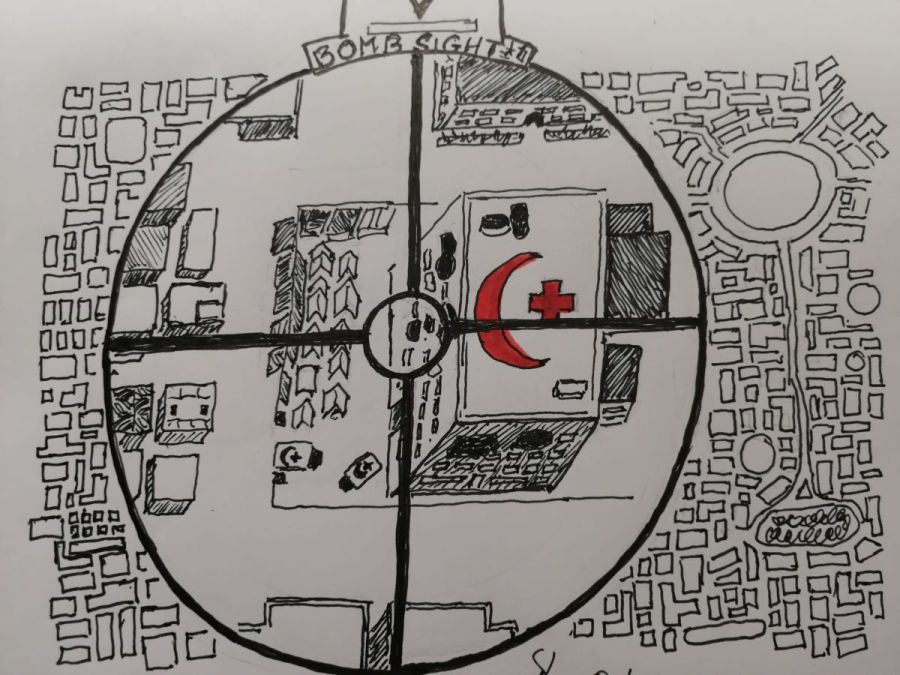
Written some time ago but never posted: Now, while the IOF once again threatens to bomb a hospital seems like an appropriate time for publication.
(Come for a quick peek into an ‘Israeli’ intelligence agents’ meeting as they get to the agenda item “Bombing Hospitals”. Names have been eliminated for the protection of the guilty)
Chairman: We all agree, whatever international law on conflicts says, that destroying the healthcare system of the enemy is important. However, X has requested a discussion on the current bombing of hospitals in Lebanon. X, over to you.
X: Thank you, Chairman. That was not clever, in my opinion, claiming the Lebanese hospitals have Hezbollah bunkers containing gold and weapons. Now the hospital administrators have brought the media on a tour around them so they can see for themselves that what we said was a lie.
Y: But your people agreed to bombing them – we had to have some reason for that. And anyway, that’s what we did in Gaza – bombed, sniped, invaded every one.
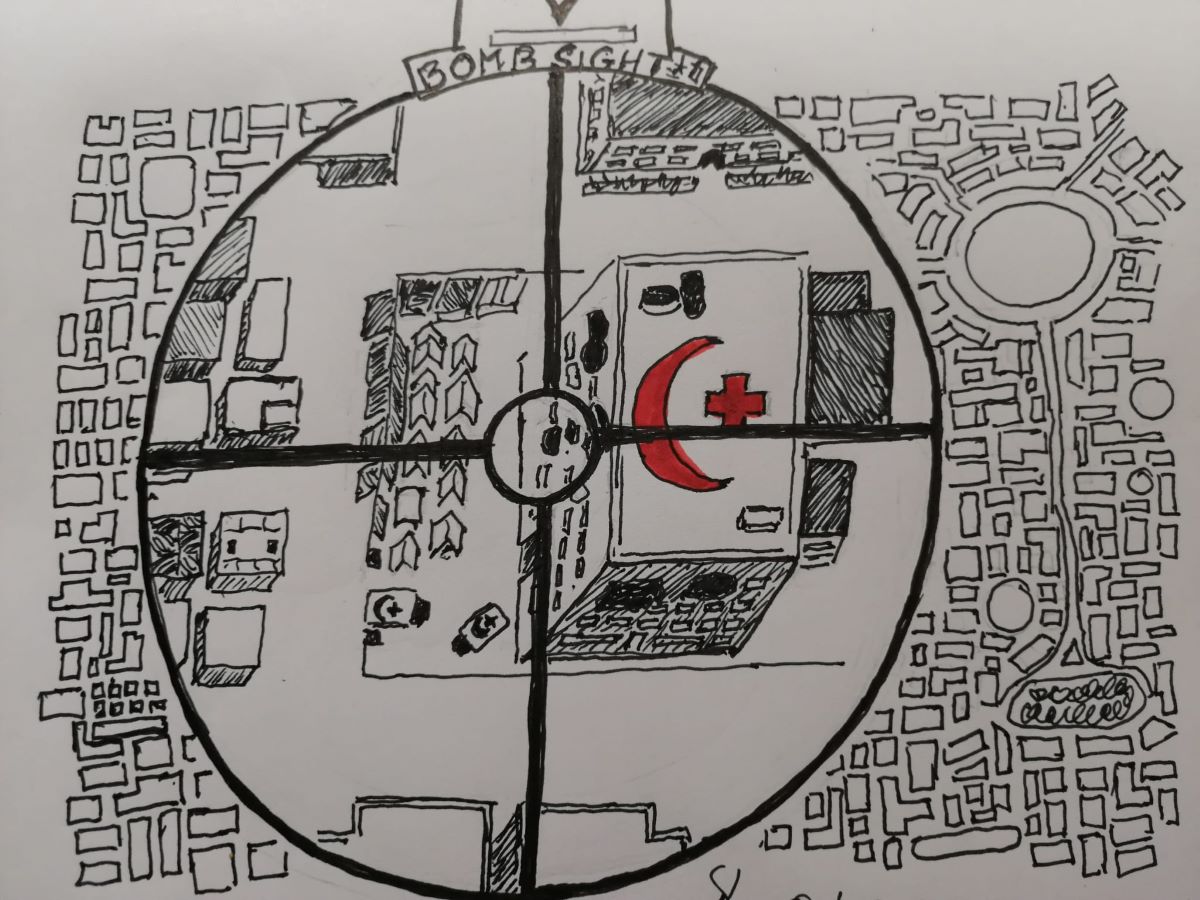
Hospital Bombsight (Cartoon by D.Breatnach)
X: Yes, but in Gaza WE controlled press foreign media access. And WE could make OUR videos, plant weapons etc.
Y: Wait a minute! Your videos showed maintenance shafts that didn’t look anything like Hamas tunnels. And planting weapons for media video? AFTER some media had ALREADY photographed the area WITHOUT weapons?
X: Did it matter? Did any international agency step in to stop what we were doing? Do you see the UN Security Council even bringing us to court in Brussels?
Y: Well then, why are you getting all steamed up about it?
X: Are you really that thick? Don’t put out lies that can and will be checked immediately! Either get some of our agents in Lebanon to plant stuff or … or just bomb the hospitals anyway. Nobody who matters will do anything. But don’t have us caught out lying, again and again!
Y: You’re not making sense. One minute it doesn’t matter what we do, then the next it matters what we say.
X: (Clap, clap). Congratulations. You finally get it!
Y: Don’t you patronise me! Your agency fucked up big time over October 7. Don’t think we’ve forgotten!
Chairman: Gentlemen! Decorum, please! We are all colleagues here …
(We leave the discussion at this point, the sound of raised voices fading behind us …)
end.
Note: If you found this article of interest, why not register with Rebel Breeze for free, so that you will be notified by email of subsequent articles. You can de-register any time you wish.
(From Rebel Breeze August 2023, after a similar period of days of practically incessant rain)
I slowed the car as we went to pass the Lotts but kept the engine running – the water was a foot high in the street and I didn’t want to have trouble starting it again.
What the jayzus are they building? asked Noah Parker (you can guess his nickname, though to be fair, his nose was hardly noticeable).
He was only voicing what was a general question in the neighbourhood. The Lotts, and I say the Lotts, because this was the acknowledged main branch of the clan here in Dublin, the other two being known respectively as the South Lotts and the North Lotts, were always a bit strange and secretive. And it’s not easy to combine those two qualities.
Strange but hard workers, all of them in one of the trades: carpenters, welders, electricians … Mrs. Lotts being the exception, into animal management. She had a nickname in the area from an idiosyncrasy of hers, of regularly glancing over her shoulder. ‘Backlook’ it was, though never mentioned in front of any of her brood, for self-preservation reasons.
Around their yard and their house there were cages, pens and runs for rabbits, chickens, geese and ducks but there was also an owl box on a tree, a pair of gaudy parrots flew around the house when it wasn’t raining, two llamas stared disconsolately from their pen at the rain and from somewhere a donkey brayed.
Holy Mother of God said, said Parker, will ya look at that giant rat?
It’s a coypu, replied Mary, who never took exception to the invocation of her namesake. They’re from South America.
Another one appeared and they began to run around one another playfully in the rain. Until one caught the other, climbed on top of it and began to … I blushed and looked in the rearview mirror, caught Mary’s stony glance and looked away hurriedly.
As well as all the animals, the yard was full of materials, sheets of metal and wood, planks, plastic sheeting and tarpaulin covering whatever the Lotts were building. I thought the shape was familiar in some way but couldn’t quite grasp what it was.
Stop the car a minute, will ya? said Parker, bringing down the window on his side. I tapped the brakes but kept the engine running.
You’re letting the rain in, complained Mary. He was too, but then he leaned the top half of his body out the window and, heedless of the rain on his head and shoulders, hailed the Lotts – or at least one of them.
Hey, Job, a fine soft day, wha’? called Parker.
Job Lott, trudging across their yard with some kind of machinery or tool clutched to his chest, his broad shoulder hunched, turned.
Ah, Noahsey, how’s it goin’? Then, peering into the car and nodding: Mary, Racker.
We nodded back.
What’re ya buildin’? Looks like a bloody big boat, Parker again, with a laugh and … something fell into place in my brain.
Job stopped dead, as if he’d been struck or walked into an invisible wall.
A moment stretched. The rain fell, a donkey brayed, parrots squawked.
Mister Lott – nobody called him anything but ‘Mister’ since he’d been a magistrate – hurried out with his wife from underneath a huge tarpaulin, put his big hand on his son’s shoulders and pushed him forward.
Sorry lads, we’re really busy right now, he called back over his shoulder. Job was glancing back at us as the three of them disappeared under the tarpaulin.
Parker pulled his wet torso back into the car and sent the window closed. We were silent in the car for a moment, the rain drumming on the roof and running down the windows, the engine idling.
Weird, commented Parker, unusually at a loss for words.
(Another one from the Rebel Breeze archives, this one from 2015)
I write to express my admiration for your work and my sympathies with regard to the criticisms with which you are currently being bombarded.
I hope you will forgive my ignorance of much of the work you have been doing in the area of Heritage, which is not really where my strengths lie. But I love the way you talk, the way you shoot down those critics, especially those TDs who ask those nasty questions.
And I’m sure you had something to do with removing Westport House from the NAMA sell-off, even if it is in Enda’s constituency. Such a fine example of our colonial architectural heritage!
Heather Humhpreys, Minister for Arts, Heritage and the Gaeltacht
But as we know, Minister, that wouldn’t be the kind of thing that would be appreciated by your critics. They’d rather you devoted your talents to a shabby row of Dublin houses of dubious architectural importance in a grubby street market.
A street which they say is “pre-Famine” — as if that were something to boast about! Laid down earlier than Sackville Street (now O’Connell Street) they say ….
Sure why would we want to keep a street that old …. or remember that embarrassing episode in our history either, when we lost a third of our population to over-reliance on one crop! We learned from that, though, didn’t we? Sure we grow hardly any crops at all now and get them all in from abroad.
And we live in cities now — who wants to be getting up at 6 a.m. in all kinds of weather and plodding through muck? If people like growing things that much, get a house with a garden, I say. And a gardener to do the donkey work.
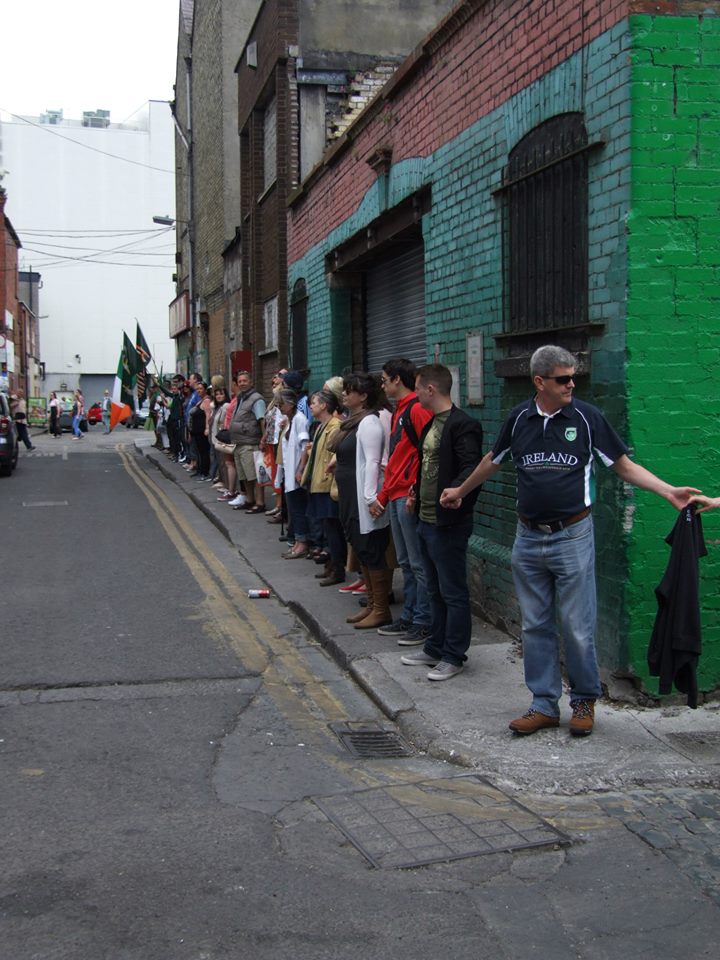
Supporters at the symbolic Arms Around Moore Street event organised by the Save Moore Street From Demolition campaign in June 2016. This is the corner of Moore Lane and Henry Place, across which Volunteers had to run under machine-gun and rifle fire from Parnell Street (at the end of Moore Lane, to the right of the photo) and at least one Volunteer died here.
But I’m digressing, Minister, my apologies. Apparently the reason they want to save that shabby terrace, that “pre-Famine street” — and the backyards and surrounding lane-ways, if you please! — is for HISTORICAL reasons. Historical!
Sure have we not had enough of history – Brehon Laws, Golden Age, Clontarf, Normans, 800 years of British occupation, blah, blah, blah! Weren’t we sick of it at school?
I’ve never liked Labour too much (somehow even the word sounds sweaty) but I have to admire their Education Ministry’s efforts to remove history as a subject from the compulsory school curriculum.
I’m sure they’re doing it for their own reasons – after all, wasn’t their party founded by that communist James Connolly? Sorry, revealing my own knowledge of history there, ha, ha! But whatever their reasons, they are on the right track.
Who wants to know where we are coming from? It’s where we ARE and where we are GOING TO, that matters!
But some people just can’t let it go, can they? They trail history around like something unpleasant stuck to a shoe. So what if 300 of the GPO garrison occupied that terrace in 1916?
The Rising, if you ask me, was a big mistake and I know plenty of people agree with me, even if most don’t have the courage to say so. Wouldn’t we be much better off if we’d stayed in the UK? And kept the Sterling currency? And as for the War of Independence …. don’t get me started!
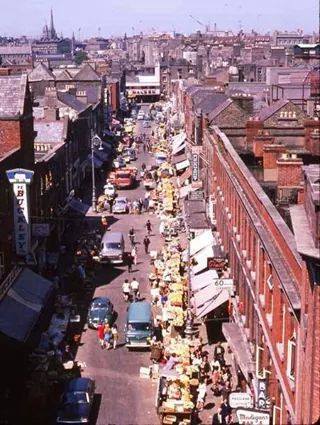
Aerial view Moore Street, looking northwards, 1960s, before the building of the ILAC and the running down of the street market.
And then there’s all that communist-sounding stuff about treating “all the children of the nation equally” — what kind of rubbish is that? Some are born to big houses with swimming pools and some are born to flats, or even rooms. That’s just the way of life.
And some will claw their way up to get to own big houses and if they are a bit uncouth, well that can’t be helped, they still deserve where they get to. And their children at least will be taught how to fit into their new station. That’s democracy! But everyone equal? Please!
Sorry, back to the Moore Street controversy. OK, after the mob pressured the Government, four houses in the street were made a national monument. But was that enough for the mob? Oh, no, not at all — eight years later the State had to buy the four houses to satisfy them.
Thankfully the specul ….. sorry, the developer, got back a good return on his investment – four million, wasn’t it? That’s the kind of thing that makes one proud to be Irish – buying run-down buildings and letting them run down more, then selling them for a million each.
That’s your entrepreneur! If only we had more like that, to lift this country up!
I must say I really liked that developer’s plan to build a big shopping centre from O’Connell Street into the ILAC, knocking those old houses in Moore Street down (although I know he had to leave those “national monument” four houses still standing in the plans).
I do hope whoever has bought the debt off NAMA and now owns those houses will carry on with that plan. Actually, I’d like the whole of O’Connell Street under glass if it were possible.
Wouldn’t it be great to do your shopping from the north end of the street to the south and from left to right, without ever having to come out into the weather? Of course, not much shopping there now, with Clery’s closed …. still ….
And then they’re going on about the market ….. traditional street market …. blah, blah. What’s wrong with getting your veg and fruit from the supermarket? Or getting them to deliver it your house, come to that? “Traditional street market” my ar….. excuse me, I got carried away there.
Those street markets are all very well for your Continentals, your Africans, Asians, Latin Americans and so on. Or for us to go wandering around in when we’re abroad on holiday, maybe. But back home? It’s the nice clean supermarkets for me any day.
Well now, if the mob insists on saving the street market, here’s an idea: why not provide a showcase stall or barrow, stacked with clean vegetables and polished fruit, right in the middle of the new shopping centre. After all, that’s heritage, isn’t it? And aren’t yourself the Minister for Heritage?
Most sincerely,
Phillis Tine-Fumblytil
Note: If you found this article of interest, why not register with Rebel Breeze for free, so that you will be notified by email of subsequent articles. You can de-register any time you wish.
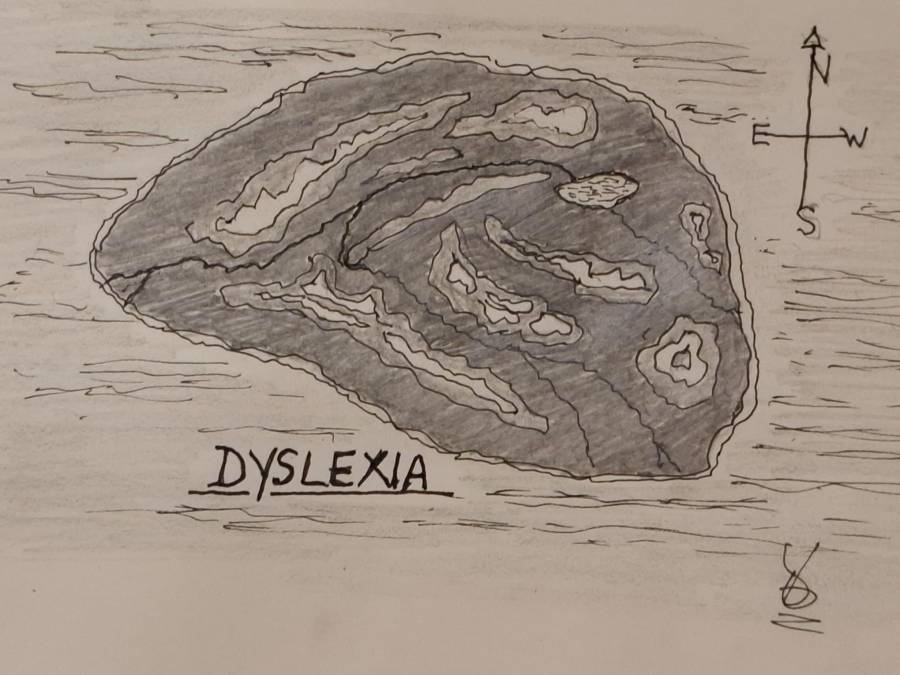
(The author is known as a traveller to many exotic places, including expeditions in search of mythical lands, most famously “The United Kingdom”, the “Republic”, “Norn Ireland” and “The Mainland.” Here he writes about the land of Dyslexia).
Dyslexia is, as the suffix “-ia” suggests, a country …. think of India, Mongolia, Russia, California [now relegated to a vassal state], Hibernia [also something of a vassal state], Narnia [er .. no, that is an imaginary land in a series of children’s tales].
Strangely the existence of Dyslexia was not even suspected until 1881, when Oslawd Khanber1 claimed to have visited the land. His discovery was widely doubted until confirmed by Ludorf Linber2 in 1887.
The people of this newly-discovered land were distinguished by all having a difficulty to varying degrees in spelling and/or in remembering sequences of numbers.
Khanber and Linber both named this land (and the rest of the world agreed) “Dyslexia”, from the Greek root “dys” meaning “bad/ abnormal/ difficult” and “lex” meaning “word” (although in Latin it means “law”, understood as “written word”).
Dyslexia was, like many other lands and people, not named by the natives themselves, but by people from elsewhere. Such examples abound, for example “Australia”, “America”, “Scotland”, “Eskimo”, “Teddy Boys”, “Pagans”, “Celts”, “Saxons”, “Teagues”, “Gypsies”, “E.T.s” etc.
Attempts to identify what the Dyslexics themselves called their land have so far collapsed in confusion, with different spellings and even pronunciations hotly argued for against others.
In fact, there have been accusations of racism aimed at those who named the land “Dyslexia” and the people “Dyslexics” — it seems particularly cruel to create a word itself so difficult to spell to name a people with a known disability in spelling.
Previously, Dyslexics just called themselves “people” and the land “the land”, while those who came across migrants from there before Dyslexia was actually discovered called them other names: such as “stupid”, “slow”, “thick” or “people with ADD or ADHD”.3
However, most “Dyslexics” today have not only adopted the name and learned to spell it but are wont to proudly declare “I’m Dyslexic” (but rarely “I am a Dyslexic”).
When Dyslexia came to the attention of the rest of the World no-one seemed astonished that it should be discovered long after the North and South Poles, the Mariana Trench, the Matto Grosso Plateau and indeed a great number of planets.
What did astonish the World was that Dyslexia had apparently independently within its borders invented television, radio, Ipads, microwave ovens, central heating and hot showers and of course the internal combustion engine and nuclear power.
This proliferation of technology would have been normally amazing (if anything normal can be said to be amazing, or vice versa) in a previously undiscovered country.
But what was really, really amazing was that everyone in Dyslexia had overcome a disability to climb to such industrial heights. The obstacles must have been tremendous.
Imagine confusing, for example, sodium chloride, a common table salt, with sodium chlorate, which is used as a weedkiller.
Also by the way, as an ingredient in making home-made bombs, a curious fact since nitrogenous fertiliser, with a directly opposite effect to sodium chlorate when spread on weeds, is also sometimes used in making home-made bombs).
Anyway, shake sodium chloride in small quantities on your weeds and they probably won’t like it but most will survive – especially those that actually like a little of it, like relatives of the cabbages and such. Shake a little sodium chlorate on your food, however and ….
well …. no, don’t try it – without urgent and skilled medical attention you will die quickly and painfully.
For another example, imagine confusing “defuse” with “diffuse”: one goes to de-escalate a conflict and ends up spreading it around. Other confusions are possible between the noun or verb “ware”, the (usually) adverb “where” and the past tense verb “were”. And so on.
For physics, knowledge of and accuracy in mathematics is essential – algebra, logarithms, binary codes, sines and co-sines, square roots (these last are mathematical constructs, not mythical regulated-shape carrots as propagated by anti-EU campaigners).
In calculating distances, heights and depths, spaces and circumferences, ability in geometry, trigonometry and ordinary mathematics is required. Somehow, the Dyslexics, the inhabitants of Dyslexia, had overcome their disability or compensated for it in some way.
They had developed as flourishing and environment-poisoning an industrial society as the most developed parts of the world, such as the United States of America (most developed industrially, that is).
Dyslexics are said, despite this disability with letters and numbers, to be of above-average intelligence. They had to be, to develop all those complicated benefits of industrial society despite their handicap.
Strangely, one may think, many Dyslexics have become literary figures famous throughout the world, Hans Christian Andersen, Agatha Christie, F. Scott Fitzgerald and WB Yeats among them. Contrary to popular belief among non-natives, James Joyce was not from Dyslexia.
This prevalence of Dyslexics among so many giants of literature and indeed of virtually every other field of human endeavour has given rise to a group of Dyslexians who call their disability “the gift of Dyslexia”.
The Dyslexics are often garrulous and sociable and this is especially true when in Dyslexia itself. The difficulty in remembering telephone numbers for example makes every telephone call an adventure.
Say a native wished to phone another native called Cathy (also known as Cthy, or Ktay, Thyca etc), and the phone number was 731 1062 (pleasenote, this is an imaginary telephone number by which neither Cathy nor anyone else can be reached).
The Dyslexic might phone 371 1026 – all the correct digits but in a different order (note, this also is an imaginary telephone number by which no-one may be reached).
The conversation, somewhat simplified, might go like this:
“Yes, hello?” (female voice, breathless with anticipation of another adventure).
Our caller: “Hi, is that Cathy?”
Recipient (giggling): “No, it’s not. There isn’t any Cathy here. I’m Wanda.”
Our caller: “Oh, hi Wanda, you sound very nice. How about going on a wanda with me?”
Wanda (with a little giggle but playing cautious): “Maybe …. What’s your name?”
Our caller: “Terry.”
Wanda: “Where were you thinking of wandering with me?” (A moment’s pause while both mentally translate the last part of that into “wandering on me”).
Terry (clearing his throat which has suddenly gone dry): “Well, there’s a nice new Indian restaurant opened up in town. Do you like Indian food, Wanda?”
“Ohhh, Terry, I love it. So spicy!” (Very slight pause as both translate “spicy” as a description for food flavouring into a metaphor instead). “When were you thinking of?”
“Er … tonight too soon?”
“No, I happen to be free tonight.”
“Shall I come and pick you up? Say …. seven pm?”
“That would be lovely, Terry. I live off the Trans City Road, tenth left, first right, eighth left, in Hopeful Street, the seventh house on the left-hand side if you’re coming from town, with a brown and white door and a hydrangea bush in the garden.”
“Got it – off the Trans City Road, tenth left, first right, eighth left, Hopeful Street, seventh house on the left-hand side, brown and white door and a hydrangea bush in the garden. At seven pm. I’m looking forward to meeting you.”
Most Dyslexics are always open to adventure, ‘going with the flow’. One never knows what a simple telephone call may bring or to what an appointment or written address may lead.
But as a result, Dyslexics are also philosophic about missed appointments, forgotten birthdays and so on; they waste little time mourning something lost and instead look forward to something gained.
Terry might or might not make it to Wanda’s but they both know the world is full of other possibilities.
Cathy, for example, who failed to receive a call from Terry to congratulate her on her gaining a dystinction in her dyploma, received later that evening what non-natives would term “a wrong number” call from a Sofia who had meant to call a Geraldine.
Sofia had intended trying to patch up a long-running difficult relationship with Geraldine and instead found herself making the acquaintance of Cathy, who seemed much nicer and more understanding than was Geraldine.
Putting her problems with Geraldine aside, Sofia agreed to Cathy’s suggestion to meet for a late coffee (which they both knew could lead to an early drink and who-knows-what from there). Cathy had by now forgotten that she was hoping Terry would call.
Dyslexia is not just another land, nor even just a strange one – it’s an entirely different way to live.
End.
Note: If you found this article of interest, why not register with Rebel Breeze for free, so that you will be notified by email of subsequent articles. You can de-register any time you wish.
3A supposed disability the existence of which is hotly debated but has exonerated many teachers accused of bad teaching methods and states accused of having too large classes in their schools and which has been profitable for some educational psychologists and extremely so for some chemical companies.
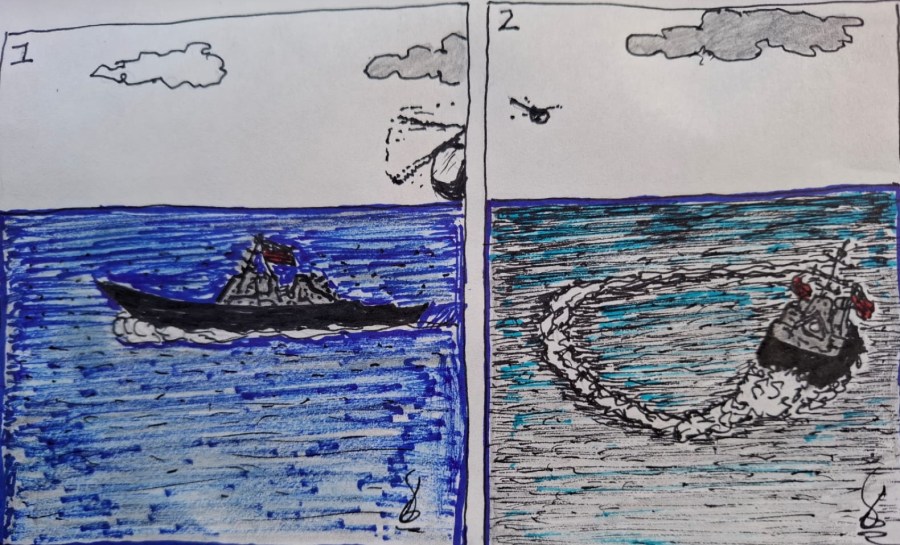
(23/ 07/ 2025: Continuing conversation on the control deck of the USS Fitzgerald, a destroyer of the US Navy in the Sea of Oman, off the coast of Iran.)
…. Sir, that course takes us into Iranian waters.
That’s right son. We’re the US Navy. We go where we like. Stay on course.
Yes sir, steady on course.
Sir, an Iranian helicopter is buzzing us, wanting us to turn back.
Signal the pilot to move off or we’ll shoot him down.
Yes, sir. Signalling.
Sir, he continues buzzing us.
Signal the pilot we’re a destroyer of the US Navy. He should move off or we’ll shoot him down.
Yes, sir. Signalling.
Sir, he continues buzzing us, says we’re heading for Iranian national waters and ordering us to turn away.
Warn the god-damn pilot again. We’ll shoot the fucker down.
Yes s … Sir, message received from the Iranian shore.
What does it say?
Sir, message reads “Your ship is in the cross hairs of our missile battery. Stop threatening our airforce pilot. Turn around and leave Iranian territorial waters. Repeat. You are in the cross hairs of our missile battery. Desist and turn away from our territorial waters forthwith.”
Sir? …
Sir?
Change course away towards international waters. Full speed.
Sir? Away from …
Yes! NOW, goddamn you! Back to international waters!
Yessir. Changing course now, sir.
End.
The idea for the cartoon was a good one, showing the confident sailing towards Iran and then the sharp turn away after warnings. The panels would have probably worked best in black and white: The blue in No.1 overwhelmed the overall image and in No.2, trying for a lighter touch, still did not work all that well. (Cartoon: D.Breatnach)
Entering the bedroom, I noticed the window still open and closed it. As I turned from doing that I was startled to see her curled up cosily on my bed. How did she get in?
I stared at her, dumbfounded. She just looked back calmly, not a trace of guilt or worry in her eyes.
How did you get in? I enquired but she just continued to regard me calmly. Of course, the window, I realised. Bloody hell!
You can’t be doing that, sneaking in through people’s windows, I said. You’ll have to leave.
No response, just that calm look.
She wasn’t moving so I went to lift her up and though clearly not pleased, she didn’t fight me.
Opening the door to the common corridor, I put her down gently on her feet there. She looked at me reproachfully but I hardened my heart.
The fire retarding door was closed so I opened it but she made no move to go out. I tapped her on her bottom and she gave a little jump and started to move.
Closing the fire door behind her I went back inside my home and locked the door. Then checked all the windows.
Bloody opportunist! I muttered. Bloody opportunist neighbourhood cat!
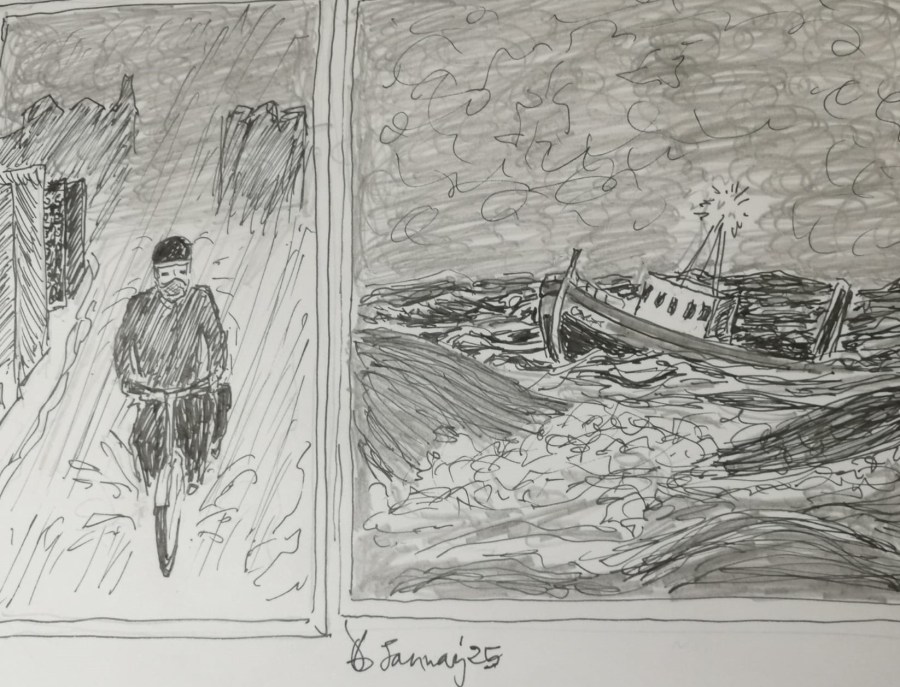
I slowed the car as we went past the Lotts but kept the engine running – the water was a foot high in the street and I didn’t want to have trouble starting it again.
What the jayzus are they building? asked Noah Parker (you can guess his nickname, though to be fair, his nose was hardly noticeable).
He was only voicing what was a general question in the neighbourhood. The Lotts, and I say the Lotts, because this was the acknowledged main branch of the clan here in Dublin, the other two being known respectively as the South Lotts and the North Lotts, were always a bit strange and secretive. And it’s not easy to combine those two qualities.
Strange but hard workers, all of them in one of the trades: carpenters, welders, electricians … Mrs. Lotts being the exception, into animal management. She had a nickname in the area from an idiosyncrasy of hers, of regularly glancing over her shoulder. ‘Backlook’ it was, though never mentioned in front of any of her brood, for self-preservation reasons.
Around their yard and their house there were cages, pens and runs for rabbits, chickens, geese and ducks but there was also an owl box on a tree, a pair of gaudy parrots flew around the house when it wasn’t raining, two llamas stared disconsolately from their pen at the rain and from somewhere a donkey brayed.
Holy Mother of God said, said Parker, will ya look at that giant rat?
It’s a coypu, replied Mary, who never took exception to the invocation of her namesake. They’re from South America.
Another one appeared and they began to run around one another playfully in the rain. Until one caught the other, climbed on top of it and began to … I blushed and looked in the rearview mirror, caught Mary’s stony glance and looked away hurriedly.
As well as all the animals, the yard was full of materials, sheets of metal and wood, planks, plastic sheeting and tarpaulin covering whatever the Lotts were building. I thought the shape was familiar in some way but couldn’t quite grasp what it was.
Stop the car a minute, will ya? said Parker, bringing down the window on his side. I tapped the brakes but kept the engine running.
You’re letting the rain in, complained Mary. He was too, but then he leaned the top half of his body out the window and, heedless of the rain on his head and shoulders, hailed the Lotts – or at least one of them.
Hey, Job, a fine soft day, wha’? called Parker.
Job Lott, trudging across their yard with some kind of machinery or tool clutched to his chest, his broad shoulder hunched, turned.
Ah, Noahsey, how’s it goin’? Then, peering into the car and nodding: Mary, Racker.
We nodded back.
What’re ya buildin’? Looks like a bloody big boat, Parker again, with a laugh and … something fell into place in my brain.
Job stopped dead, as if he’d been struck or walked into an invisible wall.
A moment stretched. The rain fell, a donkey brayed, parrots squawked.
Mister Lott – nobody called him anything but ‘Mister’ since he’d been a magistrate – hurried out with his wife from underneath a huge tarpaulin, put his big hand on his son’s shoulders and pushed him forward.
Sorry lads, we’re really busy right now, he called back over his shoulder. Job was glancing back at us as the three of them disappeared under the tarpaulin.
Parker pulled his wet torso back into the car and sent the window closed. We were silent in the car for a moment, the rain drumming on the roof and running down the windows, the engine idling.
Weird, commented Parker, unusually at a loss for words.
Car alarms are mostly of a kind, emitting shrill noise. But why not have them use voice? And why not allow the car-owner to choose from a variety of voice alarms, find one perhaps more suited to their own personality?
Don’t forget, you saw this idea and this selection here first!
SIX CATEGORIES, VARIOUS MODELS
Insistent (2 models)
(in English public school accent – not recommended for certain areas of Ireland, Scotland, Wales or inner-city England) You are crowding me. Please desist. In other words, stop!
B. (gradually increasing in volume)
This is not your car. You are not an authorised driver. You are performing an illegal act. There are serious consequences. You must stop now.
This is not your car. You are not an authorised driver. You are performing an illegal act. There are serious consequences. You must stop now.
This is not your car. You are not an authorised driver. You are performing an illegal act. There are serious consequences. You must stop now. (etc.)
Threateningselection (6 models)
A. (in northern USA accent) Step away from the car. STEP AWAY FROM THE CAR. DO IT NOW!
B. SMILE. THANK YOU. YOUR PHOTO IS ON ITS WAY TO THE POLICE.
C. God does not like you standing too near me or trying my door handle. He sees everything you do.
D. Stand back. You are about to receive a mega electric shock. Charging …
E. SCRATCH MY CAR AND PREPARE TO DIE. (available in a selection of accents, from Russian mafia to LA Gangsta).
F. That spike you have just received from my door handle has taken a sample of your DNA and carries a powerful sleep drug. You have seconds before you collapse. Find somewhere safe to lie down.
Sinister (1 model)
Yes, come in, come in! Welcome! Welcome! I’ve been waiting for someone like you. Just like you. Never mind the bloodstains. Just an accident. Or two. Come in, come in! (Available in a variety of voices, creaky, sibilant, etc.)
Persuasiveselection (2 models)
A. You’d steal a Metro? Seriously?
B. Yes, yes, listen to my voice. Breathe deeply. Lisssten to my voice. You feel com-fort-ably warrrrm and relaxed. Tot-all-y rel-axed. You don’t want to steal a car any more. Certainly not this one. You want to find a cafe and sit in it. Tot-all-y rel-axed. You will leave now.
Attention-attracting with Embarrassment Deterrence selection (5 models)
A. HELP! I AM BEING BROKEN INTO! HELP!
B. BARRRP! (Yes, a loud fart-noise. With sewer smell). BRAAPP! BARRRP!
C. I HAVE DISCHARGED A BAG OF URINE ON YOUR LEG. IT CARRIES A PERMANENT PURPLE DYE TOO.
D. EVERYBODY! THE PERSON STANDING BY THIS CAR IS A CHILD MOLESTER AND TORTURES PUPPIES AND KITTENS!
E. Ooh! Ah, stop. That tickles. No. Ahahahaha! No, please! No! AHAHAHAHAHA! Oh gosh, stop, please stop. Ahahahahaha!
Other
Think about what you’re doing. Do you really want to steal this car? Think about the conseq …






 rebelbreeze