ANOTHER SHOCKING STATE ATTACK ON THE RIGHTS OF A WOMAN BRINGS DEMONSTRATORS ON TO THE STREETS

A suicidal woman refused an abortion, is then force-fed to preserve her embryo which is later delivered at 25 weeks by caesarian section.

Diarmuid Breatnach

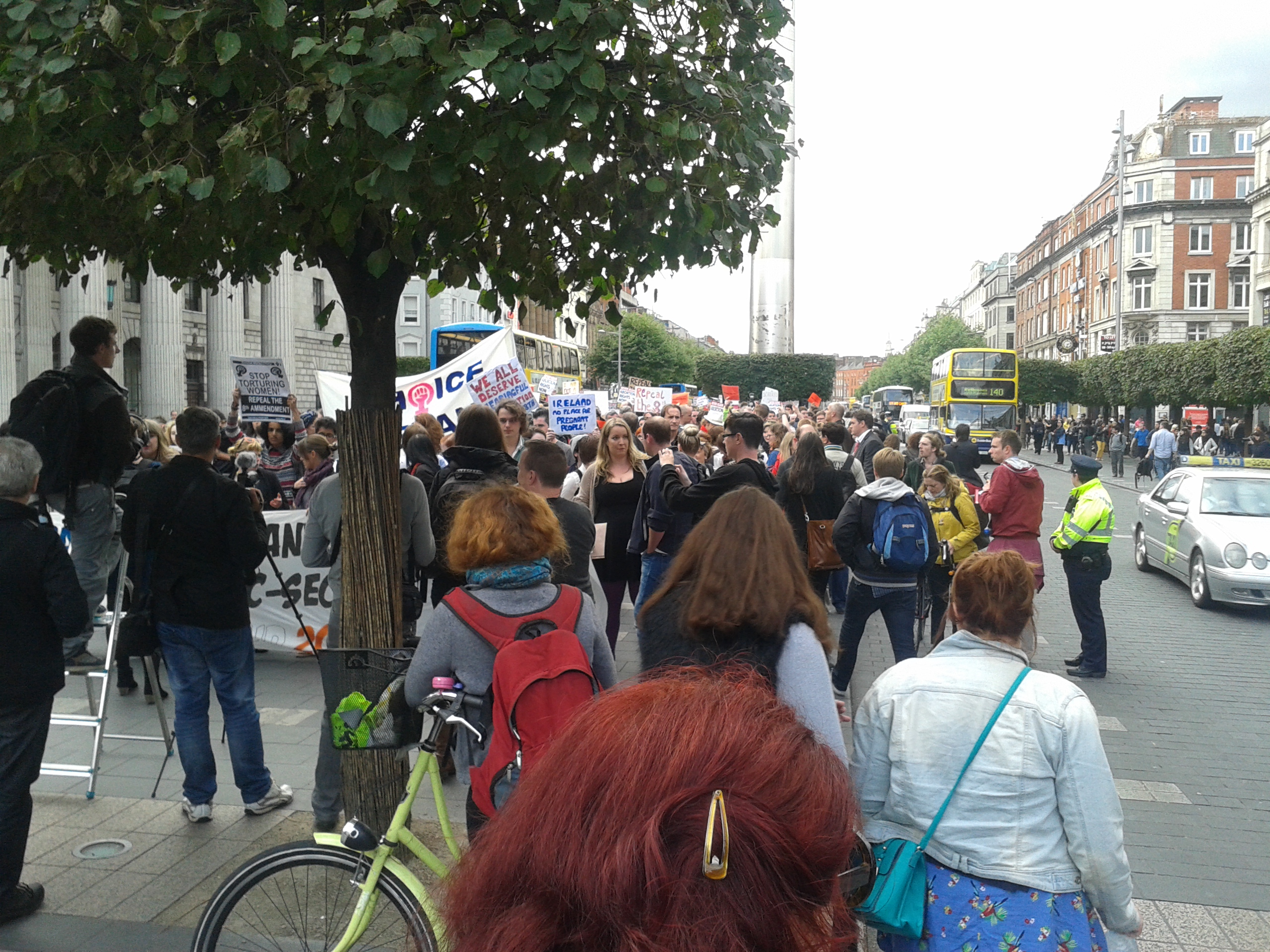
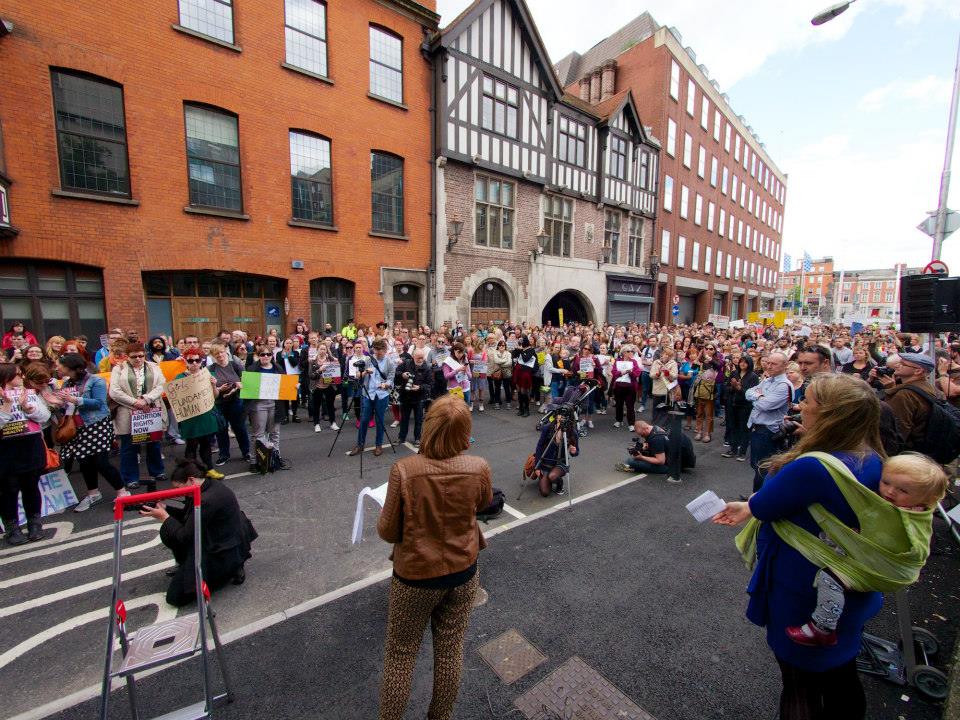
A woman considered suicidal by a medical panel was recently refused an abortion in Ireland and was subsequently force-fed. Within days a call was made for a protest demonstration and was answered by a substantial number in Dublin on Wednesday night last. The protestors filled the central section of O’Connell Street from the Spire to the Larkin monument and also spilled out into the road. Numbers of protestors took up station on the pavement fronting the GPO. A weekend demonstration was also convened in Dublin and another in Cork.0

Protest Caesarian etc rally 20Aug2014
Protesters in Dublin on Wednesday evening denouncing the treatment of the woman refused an abortion and force-fed. They called for the repeal of the Eight Amendment to the Irish Constitution.  (photo D. Breatnach)

The pregnant young woman, apparently under 18 years of age, was a migrant, who sought an abortion in Ireland. Some media reports say that her pregnancy arose as a result of a rape in her native country prior to her travelling to Ireland. Not all the details are clear but it seems that an Irish advice centre gave her the necessary information to travel to Britain to receive an abortion but that she was unable to afford it (there is also some question about her immigration or asylum status should she wish to reenter Ireland). It seems she then became depressed, not surprisingly, and expressed suicidal ideation. Under the Right to Life During Pregnancy Act 2013, introduced following the “X” case, a woman is entitled to receive an abortion if carrying the foetus should result in a substantial risk to her life – suicidal ideation being one of of those risks.

In accordance with the 2013 Act the young woman’s case was reviewed by a panel, consisting of two psychologists and an obstetrician. According to reporting in the mass media, the psychologists agreed that she was suicidal and that she she should therefore have the termination. The obstetrician apparently agreed that she was suicidal but argued that in a short while (two weeks has been mentioned), a caesarian could be carried out and a baby delivered alive and viable. Since the Act requires the unanimous concurrence of all three members of the panel, the young woman was refused an abortion.

It seems the woman became further depressed and stopped eating, whereupon lawyers for the hospital went to the High Court to obtain a court order permitting the woman to be force-fed, which procedure was carried out (probably intravenously). The woman is said to have subsequently agreed to a caesarian section by which method a baby was delivered. The fate of the woman is not in the public domain at this time but the baby was reportedly delivered alive and well after 25 weeks in the womb.

A number of speakers at the rally made the point that “here we are again”, i.e. that the lack of the necessary legislation has led to another case of terrible mistreatment of a young woman, a reference to other cases of refusal of abortion that have become scandals and lead to demonstrations such as about the death of Sadita Halappanavar in 2012 and the “X” case in 1992.

At the rally, all the speakers, campaigners and providers of services and a male doctor from Doctors for Choice, called for a referendum to repeal Amendment Eight of the Bunreacht (Irish Constitution). This is the amendment passed in 1983 in order to prevent abortion becoming legal. Some very telling points were made, one speaker saying that no-one in Ireland but a pregnant woman would be force-fed or bullied into submitting to an invasive surgical operation. Perhaps we cannot say that none of those things would ever happen to anyone else but it is certainly true that only in the case of a pregnant woman would that combination of coercive and intrusive procedures, clearly in violation of the Hippocratic Oath, have been considered so readily and applied in conjunction. That the woman was a migrant probably made it easier for the authorities but it is the legal position on abortion in Ireland and its moral underpinning which reduces the pregnant woman to the status of some kind of living vessel, the status of the unborn foetus being higher than that of the mother.

Men’s place in the movement

Breaking from the general trend at the rally, one of the speakers addressed many of her remarks specifically at the males present there in support. She told them “they should know their place” and that they had no right to express any opinion on the issue except to support the women. Some women applauded her and some did not.

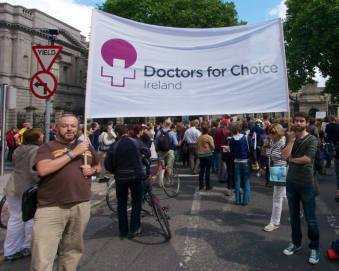
Drs for Choice 23Aug2014 AF
On the Dublin march for the repeal of the 8th Amendment on Saturday. This banner was also present at the Wednesday protest rally where one of their representatives spoke. (photo Andrew Flood)

Since variations of this view have emerged quite frequently, including the view that it’s a women’s issue or that men should just follow the opinion of women in the movement, it is worth examining this a little further. The current situation on abortion in Ireland of course impacts in the first place on women but it does not affect them only. An unwanted pregnancy, especially at an early age or stage in a relationship can force decisions that may later be regretted, including marriage or abandonment. Raising a child from what was an unwanted pregnancy has long-term social and economic implications, not just for the mother but for a much wider circle – as well as for the child growing up in society. The existence of legislation on abortion and its repeal is in the realm of criminal law — but above all it is a social issue, one affecting society. The provision of abortion is also a medical and social question: medical and social structures and services will need to be put in place, funded, monitored and its practitioners trained. Therefore all of adult society has a right to a voice on it. To call on a section of society to be mute supporters is to treat them as voting fodder and should not be supported by any genuinely democratic person.

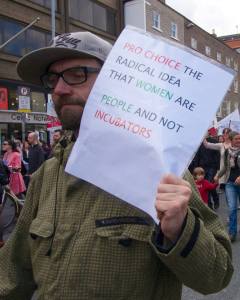
Pro-Choice that W not incubators
Man on the Dublin march for repeal of the 8th Amendment (photo Andrew Flood)

Also, if men, because they are not after all going to be the ones being impregnated and bearing children, should not have a voice but should only support women, which women’s opinions should they support? Why not support the many women who are totally against abortion? And even if supporting women who are for greater access to abortion, which section of opinion about which degree of access should men support?

Clearly men have to think about these issues to come to decisions. Are they to think silently, expressing no opinion and discussing with no-one, and then be expected to develop rational opinions to inform their actions and, in the case of a referendum, their voting too? Clearly the expectations expressed in such calls or statements are not only undemocratic but unrealistic too. Men not only have the right to express opinions on these issues but need to be able to do so in order to have the discussions that make it possible for them to make rational choices.

The attitude of the state and a referendum

The Dublin pro-choice demonstration on Saturday, according to observers, matched the numbers at the anti-abortion demonstration in the city on the same day – about seven hundred. The pro-choice demonstration took an unusual route from O’Connell Street and became the third demonstration to cross the Rosie Hackett Bridge (opened in May this year). The Bridge is the only one in Dublin named after a woman and Rosie was a trade union militant active in the Dublin Lockout of 1913, as well as taking part in the 1916 Rising as a member of the Irish Citizen Army. The demonstration rallied just across the river at the Department of Health in Hawkins Street (the Department under which the young woman had been refused an abortion and force-fed) and then went on to demonstrate at the Dáil (the Irish parliament).

ProChoice DeptHealth 23Aug2014 AF
Speaker addresses the crowd in Hawkins Street, outside the Department of Justice — Rosie Hackett Bridge is to the far right of the photo. (photo Andrew Flood)

Some supporters of a change in the law have presented the issue as though it is essential to the State and to the Catholic Church, two institutions closely linked, to control women’s bodies through refusing access to abortion, free and on demand. I do not think it is so. Certainly those forces may want to control women’s bodies (and indeed, men and women’s minds) but such control is not essential for the continued existence of the State. Many capitalist countries have either easy access to abortion or much more liberal laws than has the 26-County state. This state can afford to give that right but that does not mean that it will. When a state is able to give something but does not want to, sufficient force must be mobilised in order to convince it that yielding will cost it less than denying. Substantial pressure will need to be brought to bear on the State so that it agrees to holding a referendum.

But having a referendum does not mean that the correct and necessary outcome will be the result. We have had referenda in which the side of progress and justice was successful but also those in which it was not. The present Amendment Eight to the Bunreacht (Constitution), which the movement seeks to repeal, was the result of a referendum.

Yes, true, that was 30 years ago and opinions have changed since. In recent years, opinion surveys have shown a majority in favour of some relaxation of the law. Also, two legislative attempts to tighten restrictions on access to abortion, in 1992 and 2002, failed. On the other hand, the Thirteenth and Fourteenth amendments, both in 1992, were successful in loosening the ban, establishing the right of a pregnant woman to travel, even if to obtain an abortion, and to be given information about abortions services abroad. However, although the numbers in favour of unfettered access to abortion have grown substantially they do not yet constitute a majority.

According to analysts of the socio-economic background of respondents to the questionnaire, the indication is that the areas of greatest resistance are among a section of the middle class and a section of the working class. That particular section of the middle class is one of generally right-wing views and not amenable to change. Besides, they have the economic resources to lessen the chances of unwanted pregnancies including, despite their ideological position against it, to send their pregnant daughters quietly to Britain, having them return after a brief holiday without the neighbours being any the wiser. Or for a wife to go on a weekend visit to a friend in Britain even without her husband knowing the real reason for the trip.

The working class is in a different situation. High social and economic deprivation in Western countries tends to be accompanied by a higher degree of unplanned pregnancies and single parenthood than is the case with other socio-economic groups. Most working class families would also struggle to find the funds to send a family member to Britain (or to the Netherlands, apparently a new trend) to have an abortion, usually accompanied by at least one friend or family member, paying for travel, accommodation and the procedure itself. And the level of care is likely to be at the lower end of the scale. Of course many, many families and friend groups do manage it somehow.

The working class has a vested interest in this reform and this is recognised among some sections of the class but not in others. Traditional obedience to the Church has broken down in many areas, for example in ideas about sex before marriage and in using barriers to impregnation. However, the opposition to abortion remains, for many, a line not to be crossed. If a referendum is to be forced from the State and, in particular if the outcome is to be such as needed, a change in the outlook of at least a substantial section of this class needs to be achieved. Most working class people outside the immediate circles of the pro-choice movement tend not to see any campaigning on the issue except after such scandals hit the headlines – then a flare-up is briefly visible until things die down again.

The pro-choice movement will need to get out on to the streets and into communities on a regular basis if it is to win. I think it also needs to counter the work of the anti-choice propagandists, particularly those who put up their stalls in public areas or picket information centres. In discussion with some activists in the pro-choice movement, they say they do these things to some degree but don’t have the numbers of activists needed to do it more regularly. I confess that I find it hard to believe that in Dublin, for example, the movement is incapable through lack of activists to put a stall – indeed a number of stalls in different areas – on the street at least once a month. Some of those in the movement have been campaigning for decades and others for many years – and yet, as so many of their speakers said on Wednesday night in O’Connell Street, “here we are again”, responding to another fatal tragedy or shocking violation of human and civil rights.

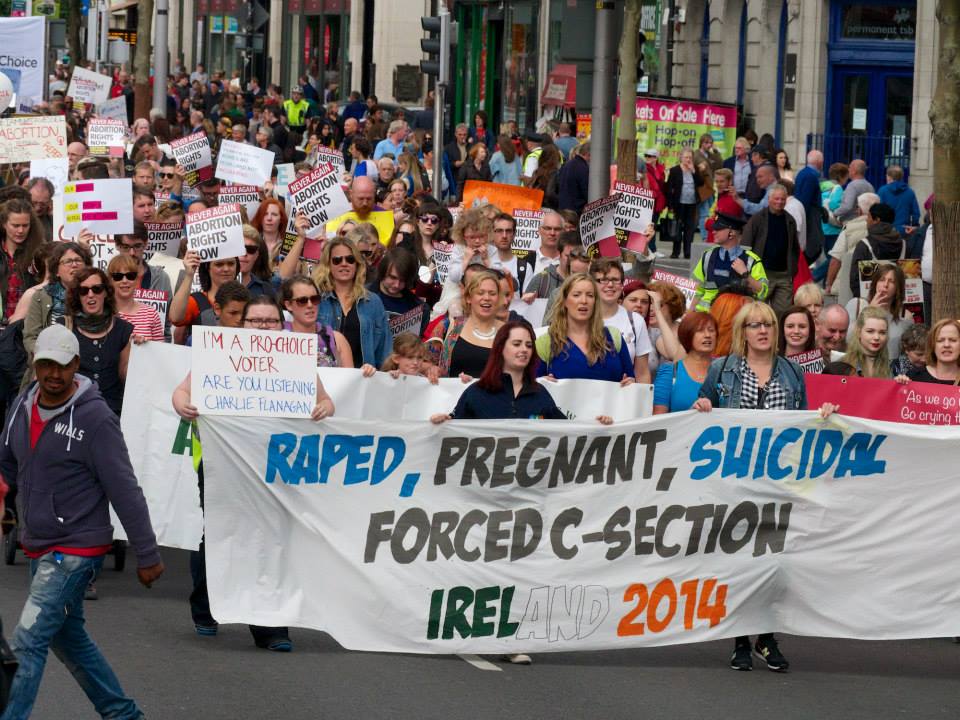
Front Rally Repeal 8th 23Aug2014
Front of the march on Saturday in Dublin (photo Andrew Flood)

Facebook organising and networking by pro-choice campaigning groups can produce quick mobilisation of substantial numbers of people. These people are already convinced. Most of the working class remains untouched by these mobilisations and certainly their overall outlook remains unchanged. If the pro-choice movement is to have its desires become reality, it needs to get out into the working class communities and promote its cause, hopefully recruiting from among those communities to better carry the message among their own. The movement needs to engage in dialogue with movements with a high percentage of people of working class background, such as – dare one say it? — the Irish Republican movement. The latter is, despite one very deep idealogical divide and the existence of a number of factions, the political opposition movement with the largest active participation of people of working class background. At the moment, the overall position of the movement is anti-choice but that is nowhere near as monolithic or as unassailable as it was even a decade ago.

The hope is that the necessary mobilisation will be done and that very soon the State will be forced to concede a referendum on the abolition of Amendment Eight. The hope is also that the necessary educational work will be done to achieve an overwhelming victory in that referendum. The activists in the movement need our support, men as well as women, in all of that.

End.

BERNADETTE McALLISKEY SPEAKING AT TRINITY COLLEGE

Diarmuid Breatnach

The auditorium in Trinity College on Friday 20th June was nearly empty at the advertised starting time for the lecture on “The Legacy of Power, Conflict and Resistance”. The start was delayed and more people came in but, by the time the speaker and the theme was introduced, the hall was still not full. That was surprising, because the speaker was Bernadette Mc Alliskey (nee Devlin), who had been at 18 years of age one of the leaders of the Civil Rights movement in the Six Counties (“Northern Ireland”), at 21 years of age elected MP for Mid-Ulster in 1969 and still, 45 years later, holding the record for the youngest woman ever elected to the British Parliament.

Bernadette Devlin circa 1968 or 1969.  She was elected MP on a People's Democracy ticket in 1969 but later classified herself as an "independent socialist".
Bernadette Devlin early 1969. She was elected MP on a People’s Democracy ticket in 1969 but later classified herself as an “independent socialist”.

The same year as her election, Bernadette went to the USA to gather support for the Civil Rights movement in a trip being used by others, rumouredly, to gather funds for arms. She shocked the conservative part of Irish USA, Ancient Order of Hibernians and Democratic Party political allies, by some of her statements and actions regarding blacks and chicanos and in visiting a Black Panthers project. Bernadette returned home to serve a short prison sentence after conviction for “incitement to riot” arising from her role in the defence of Derry against police (RUC and B-Specials) and Loyalist attack.

In 1972, during her five-year tenure as a Member of Parliament, enraged by his comments about the murder a few days previously of 13 unarmed protesters (a 14th died later of his wounds) by the Parachute Regiment in Derry, she stormed up to the then British Home Secretary and, in front of a full House of Commons, slapped him in the face. Bernadette had been there in Derry that terrible day – she was to have addressed the anti-internment march upon which the Paras opened fire.


The Tyrone woman was also a founder-member of the Irish Republican Socialist Party in 1974, which she left after failing to bring the armed organisation, the Irish National Liberation Army, under party control.  She continued to be a Left-Republican political activist, in particular campaigning against the treatment of Republicans on arrest and subsequently as prisoners in jail, in the H-Blocks Campaign.  She learned to speak Irish.  In January 1981, she and her husband Michael McAlliskey were the victims of an assassination attempt by a squad of the “Ulster Freedom Fighters” (a cover name for the Ulster Defence Association, which was not banned until 1992).  They both survived, though Bernadette had been shot seven times.


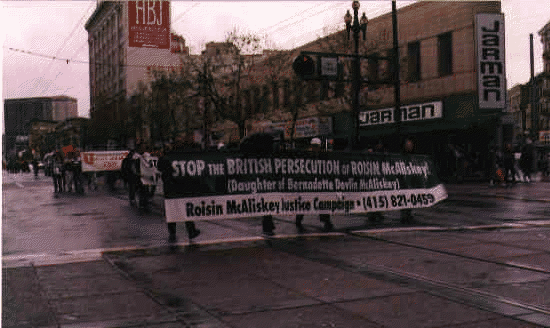
In 1996, while four months pregnant, Bernadette’s daughter was arrested on a German extradition warrant, charging her with being part of a Provisional IRA mortar attack on a British Army base in Osnabruck, Germany. Although taken to England, where a judge agreed to her extradition to Germany, a long and vigorous campaign fought by Roisín’s mother and her supporters eventually defeated the extradition and Roisín gave birth to a healthy daughter.

Recent portrait of Bernadette (Devlin) McAlliskey by Francis McKee
Bernadette's daughter was arrested twice on the same charge but vigorous campaigning impeded her extradition.  Photo shows banner resisting the earlier attempt.
Bernadette’s daughter was arrested twice on the same charge but vigorous campaigning impeded her extradition. Photo shows banner resisting the earlier attempt.


In 1998 and for some years after, Bernadette was an outspoken critic of Sinn Féin and of their direction in the “Peace Process”, which she saw as the party coming to accept British colonialism and Irish capitalism. In 2003 she was banned by the USA and deported, widely interpreted as being due to her speaking against the Good Friday Agreement, but continued her campaigning. However in 2007, another extradition warrant was issued for her daughter Roisín on the same charges as before and the young
woman became emotionally ill. The whole trauma was seen by many as a warning to Bernadette to cease criticising the “new dispensation” and subsequently she was seen to fade from the ranks of public critics of the GFA, Sinn Féin and of the treatment of Republican prisoners.

Bernadette remained active through working with migrants in a not-for-profit organisation in Dungannon. In recent years she has returned, on occasion, to the issues upon which she was so outspoken previously, for example standing surety for Marian Price’s bail to attend her sister Dolores’ funeral and speaking at the ceremony herself. Bernadette also spoke at the Bloody Sunday Commemoration/ March for Justice in January this year in Derry.

With a c.v. of that sort, one would reasonably expect a packed auditorium.

Bernadette Mc Alliskey on the platform upon which she had earlier spoken in February 2014 at a rally following the annual Bloody Sunday Commemoration/ March for Justice.

Bernadette has walked the walk and thought the thought too but she can also talk the talk. With one A4 sheet in front of her, she spoke for over an hour, hardly ever glancing at her notes. Her talk was as part of Trinity College’s MPhil Alumni Conference on ‘Power, Conflict, Resistance’ organised by the Department of Sociology for its Mphil course in “Race, Ethnicity and Conflict”.

Bernadette McAlliskey began her talk with the theme of fear of conflict, developing the thesis that this fear is inculcated in us from childhood, as conflict arises out of challenging power and hierarchy. She traced this further back to religious indoctrination where dogma is to be accepted without question and finds its reflection in all aspects of life but particularly in the political.

Talking about Tom Paine, who expounded the theory that human beings, each independently, are responsible for themselves, she stated that this is fundamental to citizenship. Some aspects of this self-responsibility are delegated to institutions when we live in large groups but any decisions made for us without our consent are “an usurpation”. Tom Paine was an English Republican, author of, among other works Common Sense (1776) and The Rights of Man (1791). He had to flee England because of disseminating his ideas, which were considered revolutionary in his time.


Much of Bernadette’s talk was given over to this theme, to the lack of consideration of women even by such as Tom Paine, and also to the racism spread by colonialism, which the Christian hierarchies condoned and even encouraged.

When she finished to sustained applause and took questions, there were two from people identifying themselves as Travellers, another from a person from an NGO working with migrants, another regarding anti-Irish racism in English colonial ideology and the continuing power of the Catholic Church in the education system.

One question seemed to throw her and she admitted that she found it difficult to answer. Ronit Lentin, Jewish author, political sociologist and critic of Israeli Zionism asked Bernadette was it not true that racism in the Six Counties came mostly from within Loyalism, allied to anti-Catholic sectarianism. Bernadette struggled in replying, at one point denying it and pointing to anti-Traveller discrimination in the ‘nationalist’ areas but following this up by observing that Travellers would only camp in or near ‘nationalist areas’ (presumably because the hostility in a ‘unionist area’ would be worse).

Bernadette then went on to recall the recent anti-Muslim remarks made by a prominent Belfast evangelist preacher, James McConnell, and how the First Minister of Stormont, Peter Robinson, had defended the evangelist’s right to free speech. Asked for his own opinion of Muslims, the First Minister had replied that he also distrusted them “if they are fully devoted to Sharia law” but would trust them to go to the shop for his groceries and to bring him back the correct change. All the examples Bernadette drew on, apart from the generalised one about Travellers in ‘nationalist’ areas, were in fact from the Unionist sector.

The final question was from an SWP activist who pointed out that the State does not admit to its institutional racism and often takes no action on racist attacks or denies that the motive for the attack was racism. The activist asked Bernadette how she thought racism can be dealt with in this context. She replied that the legal structures are there and should be used and persisted with.

It seemed a strange response from one who would have described herself in the past as a revolutionary. Earlier in her talk she herself had quoted the black Caribbean lesbian, Audre Lorde, who said that the instruments of the State could not be used to dismantle it (actually I.V. Lenin had made the same point in The State and Revolution in 1917, nor was he the first to do so). A revolutionary’s answer to that question would presumably have been that while the structures should be used in order to expose them that ultimately the capitalist State’s power is the enemy of unity among the people; disunity rather than unity among the people is in the interest of the system. Mobilisation of the people against racism and directing them towards the source of their ills, the capitalist system, and building solidarity in action, is the only realistic way forward. Perhaps Bernadette felt constrained by the academic environment in which she was speaking but that is not the answer she gave.

End.

Interesting retrospective piece on McAlliskey’s visit to the USA in 1969: http://www.historyireland.com/20th-century-contemporary-history/fidel-castro-in-a-miniskirt-bernadette-devlins-first-us-tour/

Interview with McAlliskey at a Scottish conference on radical independence https://www.youtube.com/watch?v=H4LdcnxMb9Q

SONGS FROM THE DOCKS

A well-prepared Paul O’Brien and a much-less prepared Diarmuid Breatnach singing at the Seán O’Casey Centre as part of the Songs From the Docks events. 

Paul sings mostly his own compositions.

Diarmuid singing the Ballad of Pat O’Donnell and (most of) the Jim Larkin Ballad. I believe this is the first posting of “Pat O’Donnell” on Youtube.


Thanks to Bas Ó Curraoin for the videoing.

Pat O’Donnell was a man with an interesting life — the little we know of it — which was sadly cut short.  Born in Gaoth Dobhair (Gweedore) in Donegal, even still an Irish-speaking area, he had spent time mining in the USA and had also spent time with cousins who were in the Molly Maguires in the coal-mining area of Pensylvania there.  A further article on him and on the killing of Carey, along with other links and a clip of another version of the song is here: https://rebelbreeze.wordpress.com/2014/12/17/pat-odonnell-patriot-or-murderer/


POLITICAL PRISONERS – are they really “part of the solution”?

Political prisoners
Political prisoners
Diarmuid Breatnach

Campaigners fighting for the release of individuals or of small groups of prisoners do not usually make the case that the release of those specific prisoners will affect the macro issues which led to their activism and encarceration. This has occurred on a number of occasions, however, those of Nelson Mandela in South Africa, the Kurdish PKK leader Ocalan and Basque movement leader Arnaldo Otegi being cases in point.

However, when the numbers of prisoners is large, their release is often connected by the campaigners to the objective of resolution of the conflict.

 The line often taken is that “the prisoners are (or should be) a part of the resolution of the conflict” or that “release of prisoners is necessary to create goodwill” or “to win support for the resolution process”. These lines emerged here in Ireland, in Palestine, South Africa and in the Basque Country; they form part of a popular misconception, all the more dangerous because of its widespread acceptance and seductiveness.

At first glance this kind of line seems reasonable. Of course the political activists and the prisoners’ relatives, not to mention the prisoners themselves, want to see the prisoners home and out of the clutches of the enemy. The prisoners should never have been put in jail in the first place. And all the time they have been in the jail has been hard on them and especially on their relatives and friends. An end to the conflict is desirable and so is the release of the prisoners.

But let us examine the proposition more carefully. What is it that the conflict was about? In the case of the recent 30 years’ war with Britain, it was about Britain’s occupation of a part of Ireland, the partition of the country and the whole range of repressive measures the colonial power took to continue that occupation. In the case of the Basque pro-Independence movement, it was also about the partition of their country, occupation and repressive measures (particularly by the Spanish state). But what was the fundamental cause? In each case, occupation by a foreign state.

OK, so if Britain and the Spanish state ended their occupations, that would end the conflicts, would it not? It would end the anti-colonial conflicts – there would be no British or Spanish state forces for Irish or Basque national liberation forces to be fighting; no British or Spanish colonial administration to be issuing instructions and implementing repressive measures. Other struggles may arise but that is a different issue.

So, if Britain and the Spanish state pull out, leave, those struggles are over. What do prisoners have to do with it? They are obviously in that case not part of the solution, which is British or Spanish state withdrawal – though their release should be one of the many results of that withdrawal. Prisoners may well be part of rebuilding a post-conflict nation but that is a different issue. They are not part of “the solution”.


PART OF THE PACIFICATION

As pointed out earlier, here in Ireland it was said that “the prisoners are part of the solution” – and most of the Republican movement, some revolutionary socialists and some social democrats agreed with that. And British imperialism and most of Irish capitalism agreed too. But what happened? Only those Republican prisoners who agreed with the abandoning of armed struggle and signed to that effect were released. And they were released ‘under licence’, i.e. an undertaking to “behave” in future. And as the years went by, a number of those ex-prisoners who continued to be active mostly politically — against the occupation, or against aspects of it like colonial policing, had their licences withdrawn and were locked up. Some who had avoided being prisoners because they were “on the run”, or had escaped – many of those, as part of the Good Friday Agreement, had been given guarantees of safety from future arrest but this too, it soon became apparent, could be revoked.

 In other words, the prisoners’ issue became part of imperialism’s ‘peace’ or, to put it more bluntly but accurately, part of imperialism’s pacification. The issue also became part of the selling of the deal within the movement, on one occasion prisoners being released early, just in time to make a grand entrance at a Republican party’s annual congress.

The release of prisoners can be presented by those in the movement supporting pacification as evidence of the “gains” of the process. Those who argue for the continuation of the struggle then find themselves arguing not only against those who pushed the pacification process within the movement but also against some released prisoners and their relatives and friends.

THEY ARE NOT LEAVING

 And prisoners continued to be hostages for the “good behaviour” of the movement. If British imperialism had left, there would have been no cause for the anti-colonial struggle to continue – so why would there be any need for any kind of release ‘under licence’ or any other kind of conditional release? Besides, the British would not be running the prisons in the Six Counties any longer. But the British are not leaving, which is why they need the guarantees of good behaviour.

Suppose the British were serious about leaving, sat down with the resistance movement’s negotiators and most details had been sorted out, including their leaving date in a few weeks’ time say, what would be the point for the British in trying to hang on to the prisoners? Can anyone seriously believe that they would take them with them as they left? If perhaps they had some in jails in Britain and were trying to be bloody-minded and hanging on to them there, well of course we’d want our negotiators to put as much pressure on the British as they could to release those as well.  It would be in the interests of British imperialism to release them but the reality is that the anti-colonial war would be over, whatever ultimately happened to those prisoners.

In South Africa and Palestine, the prisoners’ issue became part of the imperialist pacification process too. It did not suit the imperialists to have numbers of fighters released who would be free to take up arms against them again. So in South Africa, they were incorporated into the “security forces” of the corrupt new ANC state, forces the corruption and brutality of which were soon experienced by any who argued with them or opposed the policies or corruption of the ANC, NUM and COSATU leadership – including the two-score striking miners the “security forces” murdered over a couple of days at Marikana in 2012.

 In Palestine, the prisoners also became part of the “security forces” of Al Fatah after the shameful agreements at Madrid (1991) and Oslo (1993). The level of corruption of the Al Fatah regime and their “security forces” became so high that in order to oust them, in 2006 the largely secular Palestinian society voted for a religious party, the opposition Hamas. And then the “Palestinian security forces” took up arms against Hamas in order to deny them the fruits of their electoral victory. Unfortunately for them, Hamas had arms too and used them.

In both those countries, the occupiers had no intention of leaving and so it was necessary for them, as well as using the prisoners as bargaining chips, to tie them in to a “solution”. In fact, many of the prisoners became “enforcers” of the “solution” on to the people in their areas, i.e pacifiers in imperialism’s pacification process.

Teased out and examined in this way, we can see not only that the prisoners are NOT “part of the solution” but that accepting that they are plays right into the hands of the imperialists as well as facilitating their agents and followers within our movement, within our country.

Political prisoners, as a rule, are an important part of the struggle and need our solidarity. But for anti-imperialists, prisoners are not “part of the solution”, to be used as hostages for a deal with imperialism, even less as enforcers of a deal, forcing it upon the colonised people.

Our call, as anti-imperialists, without conditions or deals, is for the prisoners to be released and, while they remain in prison, to be treated humanely. We also call for them to be recognised as political prisoners. With regard to the solution to the conflict, there is only one: Get out of our country!

POSTSCRIPT:

The organisation representing relatives and friends of Basque political prisoners is Etxerat http://www.etxerat.info/. A separate organisation concentrating on campaigning, Herrira, has suffered a number of arrests and closure of offices by the Spanish state in 2013 and is under threat of outright banning.

Regrettably, I cannot give a similar link for Irish Republican prisoners, because of the existence of a number of organisations catering for different groups of prisoners and often with tensions between them. One day perhaps a united non-aligned campaign will emerge, along the lines of the H-Block campaign of the past, or the Irish Political Status Campaign that arose in London after the Good Friday Agreement. There is also a non-aligned Irish Anti-Internment Committee (of which I am a part), campaiging for an end to long periods of incarceration imposed on political “dissidents” through removal of licence, refusal of bail or imposition of oppressive bail conditions.

end

“WE ONLY WANT THE EARTH”

(Grma to Irish Republican and Marxist History Project for the invitation to sing, the recording and the Youtube posting).


The song is Be Moderate (also known as”We Only the Want the Earth”) by James Connolly from the James Connolly Song Book, edited by Connolly and published in New York in 1907. No air or tune was indicated in that publication and it has been sung to a number of airs over the years. It’s a wonderful song in my opinion.

I sing it to the air of a “A Nation Once Again” composed by Thomas Davis in the 1840s, which I think suits it and supplies a chorus for others to join in. I first heard it sung to that air many years ago in London by a group of musicians and singers including Cornelius Cardew, of the CPE (m-l) (who was killed by a hit-and-run driver in an incident without any witnesses).  He is here singing it with a ska back-beat(!): https://www.youtube.com/watch?v=pTxVBsg4u30


In my rendition here there is an adaptation and an error. The adaptation is my singing “workers” instead of “Labour” so as to distance the revolutionary content from the social democratic collaboration with capitalism, as illustrated by the unfortunate evolution of the party of that name founded by Connolly. My error is in the verse beginning “The Labour fakir …” in which I say “….. teaches” in two different lines.


I should have sung the lines thus:
The Labour fakir full of guile false doctrine ever teaches
and whilst he bleeds the rank and file,
tame moderation preaches;
Yet in his despite we’ll see the day, when with swords in their girths,
workers shall march in war array to claim their own, the Earth!

End


LETTER TO MEMBER NY ST. PATRICK’S DAY PARADE COMMITTEE

To: Patrick Brian Boru Murphy                                             From: Cornelius McSclawvey,
NY St. Patrick’s Day Parade Committee                                            Teernagoogh.
New York.                                                                                                  Republic of Ireland.

20th March 2014.

Re. invitation to PSNI to march in NY Parade


Dear Patrick Brian Boru Murphy,

I’m so sorry to hear of all the abuse you had to endure over your Committee’s decision to invite the Police Service of Northern Ireland to participate in the NY City’s Parade this year. To be honest, it was an overdue decision – even Sinn Fein accepted the PSNI years ago!  And of course urged your Committee to stand by the invitation — fair play to them although I’ve never liked them, I have to say.

But just who do these yobbos think they are? Those Irish-Americans who objected are living behind the times. And the gall of them to remind you of Peter King, selected Grand Marshall for the 1985 NY Parade, visiting IRA man Joe Doherty when he was in NY jail fighting extradition back to the UK! And the Philadelphia Parade committee making the same Joe Doherty Grand Marshall of their Parade back in 1989. Sure are we not all permitted a mistake or two in our lives?

Of course it was from the Irish Consulate that the suggestion first came to invite the PSNI. Some people, like that Larry Kirwan (of “Black ’47” musical notoriety), accused the Consulate of catering only for the rich Irish-Americans, the lace-curtain crowd. Yes, he did – he even put it in one of his books! Or so I’ve been told – I wouldn’t waste my time reading any of his rubbish. What’s wrong with lace curtains anyway? They let in light and keep your nosy neighbours’ eyes out – not that any neighbours live on our couple of acres of garden anyway, but still …

The cheek of that Wexford blow-in! And even if it were true, aren’t the successful Irish-Americans the ones who really matter? The likes of the Kennedys, O’Neill and even Republicans like Reagan (I mean the US political party), the ones who made — and keep on making – the USA great! Sure you couldn’t expect a country’s consulate to be looking out for the likes of building workers, bar and hotel staff, nurses and nannies! And even computer programming is pretty run of the mill these days.

Anyway, the Consulate lobbies for more green cards for Irish migrants, allowing them to emigrate to the USA legally, helping to sustain the economy back home through relieving us of paying them social welfare benefits and allowing them to earn money to send back home instead. Of course we know there are not enough green cards and a lot will still be illegal migrants but what can one do? And no doubt that helps keep the wages down … and stops them going on demonstrations and the like ….

Sorry, I’ve been drifting off topic. Your critics have been saying that the PSNI are just the RUC under a different name – that they are the same repressive and sectarian force as always. Well, maybe, but some things we have to just grin and bear, don’t we? And as for repression, sure they’re only persecuting dissidents, people who don’t agree with the Good Friday Agreement. The dissidents say that they’re being persecuted because of their legal political activities and not for breaking any laws. But if you stand against the tide, you must expect a good soaking, I always say.

Anyway, I just wanted to say “well done!” to you and to the rest of the Parade Committee. Hopefully next year you can not only invite the PSNI again but the Ulster Defence Regiment as well! As you know, they were formed from the B-Specials, much as the PSNI were from the RUC. It’s healthy to change the name of organisations every once in a while ….  And maybe the year after that, you can invite the British Parachute Regiment! They will probably never change their name but they are so colourful, with their red berets and wing badges … Fág an Balaugh!

Yours most sincerely,


Cornelius Mc Sclawvey


Did Mandela really change South Africa?

[Article by TOM, a contributor to Socialist Voice, newspaper of the Communist Party of Ireland and reprinted with their kind permission.  In essence it agrees with the analysis of Mandela and South Africa given by Stephen Spencer and Diarmuid Breatnach in an article reviewing statements of the Irish Left and Republican movement following the death of Mandela — Rebel Breeze]

The presence of such friends of genuine democracy as the war criminals George W. Bush and Tony Blair, David Cameron, Bill Clinton and such right-wing media hangers-on as Sir Bob Geldof and Sir Paul Hewson (Bono) at Nelson Mandela’s funeral raises questions about the real content of the new South Africa that appeared in 1994, when the apartheid elite seemed to cede political power to the African National Congress.

Twenty years later, given the continuing racial inequality in present-day South Africa, the much lower life expectancy of blacks and their much higher rate of unemployment, the increased vulnerability of the country to world economic fluctuations and accelerated environmental decay during his presidency, did Mandela really change South Africa? And, if not, how much room had he to manoeuvre?

For many are still remembering the Mandela years as fundamentally different from today’s crony-capitalist, corruption-riddled, brutally securitised, eco-destructive and anti-egalitarian South Africa. But could it be that the seeds of the present were sown earlier, by Mandela and his associates in government?

Ending the apartheid regime was, undoubtedly, one of the greatest events of the past century. But, to achieve a peaceful transition, Mandela’s ANC allowed whites to keep the best land, the mines, manufacturing plants and financial institutions, and to export vast quantities of capital.
The ANC could have followed its own revolutionary programme, mobilising the people and all their enthusiasm, energy, and hard work, using a larger share of the economic surplus (through state-directed investments and higher taxes), and stopping the flow of capital abroad, including the repayment of illegitimate apartheid-era debt. The path chosen, however, was the neo-liberal one, with small reforms here and there to permit superficial claims to the sustaining of a “National Democratic Revolution.”

The critical decade was the 1990s, when Mandela was at the height of his power, having been released from jail in February 1990, taking the South African presidency in May 1994 and leaving office in June 1999. But it was in this period, according to the former minister for intelligence services Ronnie Kasrils, for twenty years a member of the Central Committee of the South African Communist Party, that “the battle for the soul of the African National Congress was lost to corporate power and influence . . . We readily accepted that devil’s pact and are damned in the process. It has bequeathed to our country an economy so tied in to the neo-liberal global formula and market fundamentalism that there is very little room to alleviate the dire plight of the masses of our people.”

Nelson Mandela’s South Africa fitted a pattern, that of former critics of old dictatorships—whether from right-wing or left-wing backgrounds—who transformed themselves into neo-liberal rulers in the 1980s and 90s: Alfonsín (Argentina), Aquino (Philippines), Arafat (Palestine), Aristide (Haïti), Bhutto (Pakistan), Chiluba (Zambia), Kim (South Korea), etc. The self-imposition of economic and development policies, because of the pressures of financial markets and the Washington-Geneva multilateral institutions, required insulation from genuine national aspirations—in short, an “elite transition.”

This policy insulation from mass opinion was achieved through the leadership of Mandela. It was justified by invoking “international competitiveness.” Obeisance to transnational corporations led to the Marikana Massacre in 2012 and the current disturbances on the platinum belt, for example. But the decision to reduce the room for manoeuvre was made as much by the local principals, such as Mandela, as it was by the Bretton Woods institutions, financiers, and investors.

Much of the blame, therefore, for the success of the South African counter-revolution must be laid at the door of the ANC leadership, with Nelson Mandela at its head. Hence the paeans of praise for the dead leader from the doyens of international reaction.
[TOM]

TONY BENN (1925-2014)

Tony Benn
Tony Benn

He was a friend of Ireland, it is true — I often heard him speak on Irish solidarity platforms in England. I don’t remember him supporting the hunger strikers in 1981, however. You may recall that Concannon, representing the Labour Party, visited the dying Bobby Sands to tell him that Labour would not support him or his comrades. In London, we marched to Benn’s house (VERY long, hot  march) to get him to break with Labour on this but I don’t remember whether we were successful.

In the balance must also be put that when Secretary of State for Energy in a Labour Government, along with the rest of the Gvt, he conspired to break the embargo on apartheid South Africa by covertly selling them oil routed through Portuguese African colonies.

Someone referred to him as an “Ant-fascist fighter” — I don’t know about that.  He served as a pilot in Rhodesia (now Zimbabwe) and South Africa during the war.  Hundreds of thousands joined up during those years and many others were conscripted.  His reasons for joining could have been any, whatever  he may have said afterwards.  He certainly didn’t fight fascists on the streets of Britain as some did, both before and after the War.

PROPERTY SPECULATORS ARE CAPABLE OF ANYTHING

AN ACCOUNT OF PROPERTY “DEVELOPMENT” AND RESISTANCE WHICH MAY ILLUMINATE THE DISCUSSION AROUND MOORE STREET, DUBLIN

DB distance Moore St Paris Bakery
Second “Save Paris Bakery” demonstration, 3rd March 2014, as part of Save Moore Street campaign (photo John Ayres)

Currently, a property speculator, Chartered Land, wants to build a new shopping mall in Dublin’s city centre.  The plan envisages construction from O’Connell Street (including site of the old Carlton Cinema) through to Moore St and the demolition of a number of houses in the parade in Moore Street.  How Chartered Land saw off another developer with a much more modest plan, acquired a number of surrounding sites and came to a privileged arrangement with Dublin City Council has been the subject as far back as 2012 of a TV documentary by an investigative programme of  TG4 Iniúchadh Oidhreacht na Cásca https://www.youtube.com/watch?v=Cx0Kah7dE80#t=469.

Hands Around Moore St. No.16
Hands Around Moore Street demonstration in 2013. The dilapidated shuttered shopfront (under a former owner’s name “Plunkett”) is No.16 Moore Street, last HQ of the 1916 Rising, occupied by Pearse, Connolly and others.

Campaigners have been resisting Chartered Land’s plan from a number of viewpoints: historical (conservation of a 1916 Rising battleground and last HQ of the Rising); architectural conservation; defending small businesses and traditional street market; opposition to yet another mall and thoughtless planning.  The latest move was the expulsion by Chartered Land of the successful small business Paris Bakery, occupying two of the houses which the campaigners wish to save.

Moore St Paris Bakery closure protest Feb2014
The first of two Save Paris Bakery demonstrations, February 2014, as part of the Save Moore Street campaign, being addressed by James Connolly Heron, grandson of James Connolly shot in 1916 by the British.

A campaign fought in a town on the eastern outskirts of London has, I believe, some lessons for people resisting Chartered Land and other property speculators.  In 1968 in the outer London borough of Redbridge, the Ilford Town Council had a plan for a ring road and car parks which required the demolition of many houses.  Whatever financial benefits were to be accrued from the plan and to whomsoever they would be going is not known to me  but one would assume there were some from the events to be outlined.  While they were applying for approval to the Dept. of the Environment AND BEFORE THEY RECEIVED APPROVAL, the Council served compulsory purchase orders on the houses in question and then forced the occupants to leave. The two-storey houses with gardens stood empty.

The Ilford Squatters’ Association, a broad group of different political parties and groups and independents, occupied some of the houses and moved homeless families into them (some of the families and some of the helpers, by the way, were Irish, including from Dublin). The campaign’s position was that they were against the “development” plan but that in any case, even if it went ahead, homeless families could and should be accommodated in houses in the meantime.

The council went to civil court and sought eviction orders which, at that time, had to name the individuals and the property in question. When the orders were granted, the squatters swapped the families at the address and moved the named one to another address.

Then the Council started vandalising the houses still empty, ripping out the stairs, smashing sinks and toilets and knocking holes through walls, ripping up floorboards. The Squatters had many volunteers and some of them had building experience; they repaired/ replaced toilets and sinks, rebuilt stairs and relaid floor boards.

The Council hired a firm of private detectives (i.e. thugs, some of them with National Front badges), and attacked two houses in what amounted to an illegal eviction. In one of them they smashed the jaw of a helper in two places and threw a child with scarlet fever out of her bed on to the floor in a bid to get the family to leave. The police stood by until a doctor arrived at a rush and said the child could not be moved; only then did the police ask the bailiffs to leave.

In another house, the bailiffs came through the street door with a battering ram to discover, as they fell through the joists, that in this house, the floorboards had not been replaced.  A medieval-type battle then took place as they tried to climb up ladders on the outside and on the inside too (for the stairs had not been replaced either). Frustrated and battered, they then set fire to the ground floor. At this point, the police had to intervene, as the houses on each side were occupied (a Salvation Army officer on one side and a GP on the other).  The bailiffs left and the Fire Brigade arrived to put out the fire.

Eventually the Council did some kind of a deal with the leadership of the Squatters’ Association and with a few remaining families and the campaign was over. By that time numerous helpers had been to civil and criminal courts and to jail on remand and some had accumulated “criminal” convictions. But the ring road was not approved for years afterwards (perhaps never) and nor was the car park.

There are two lessons from the account above, I think, for Moore St. campaigners:
1) Property speculators (“developers”) will do ANYTHING THEY CAN GET AWAY WITH to pursue their objectives
2) They will try and present the regulators with a fait accomplit, that is an accomplished fact. In the Moore St case, that means letting the named national monument buildings go to rack and ruin (as they did before) and getting rid of successful small businesses (as with Paris Bakery) and by making an ugly eyesore of Moore St. (derelict buildings, boarded up businesses, hoardings …) in the hope that opposition will crumble and people will be glad of any change to the area.

The resistance in Moore Street should continue to be holistic and every threatened part and interest should support the others.

The Defendant — a short play

Diarmuid Breatnach

“We have had ‘stepping stones’ presented to us before in our history – they turned out to be stone walls.”

 (A revolutionary is on trial).

judge in full wig etc

Act 1.

Scene: A courtroom – Judge’s bench high, clerk at lower bench nearby, faced by dock, containing defendant and two guards, one at each side.  Long bench in front of dock containing Prosecution and Defence barristers or lawyers.

Judge:  Read the charges, clerk.

Clerk: The defendant is charged with treason, sedition, incitement to rebellion against the lawful government, conspiracy with persons unknown to incite discontent, unlawful assembly, obstruction of the highway and membership of an illegal organisation.

Judge:  Defendant, you have heard the charges?

Defendant:        I have.

Judge:  Address the Court properly.

Defendant:        I have heard the charges, Judge.

Judge:  The proper manner to address me is Your Honour.

Defendant:        I have heard the charges, Judge.

Judge:  I see.  Very well, let us proceed.  How do you plead to the charges?

Defendant:        Not guilty of any crime against the people.

Judge:  Clerk, enter a plea of “Not Guilty.”

Prosecuting Counsel stands up, approaches defendant in the dock.

Prosecuting Counsel:    You are against the Agreement?

Defendant:        I am.  It clearly does not deliver what we fought for, an independent united Republic.  In addition, I and some others fought for a socialist republic and it has not delivered that either.

Prosecuting Counsel:     You are aware that the electorate voted to accept the Agreement?

Defendant: Yes, but…

Prosecuting Counsel:    Just answer ‘yes’ or ‘no’.

Defendant:        Yes.

Prosecuting Counsel:     And do you believe in democracy?

Defendant:        Define ‘democracy’.

Prosecuting Counsel:     The will of the majority.

Defendant:        With suitable safeguards for certain minorities, certainly.

Prosecuting Counsel:     Yet you have admitted to undertaking actions against the Agreement, have you not?

Defendant:        I have.

Prosecuting Counsel:     You consider yourself above the will of the people, the majority, then?

Defendant:        No.  But I consider that I have a duty to act according to what is right and I can see clearly that the Agreement delivers nothing of what we fought for.

Prosecuting Counsel:     Yet the people voted for it.

Defendant:        The people were tired of war and repression and were lied to.  Many of our leaders betrayed us and brought many of our movement with them.

Prosecuting Counsel:     That is your interpretation.  Might it not be that your leaders and those of your movement who followed them were wiser than you?

Defendant:        No.

Prosecuting Counsel:     No?  You could not possibly be wrong?

Defendant:        I am not wrong on this.  The movement fought for a an independent, united republic.  We did not get it.

Prosecuting Counsel:     Your leaders and your movement – I beg your pardon, many in your movement – consider it a stepping stone.

Defendant:        We have had ‘stepping stones’ presented to us before in our history – they turned out to be stone walls.

Prosecuting Counsel:     So you would pursue a strategy of violence in the face of the clear will of the majority!

Defendant:        I do not choose violence.

Prosecuting Counsel:     You do not?  Have you not admitted earlier a statement attributed to you, that violence would be necessary to achieve a successful revolution?

Defendant:        Yes.

Prosecuting Counsel:     So you do choose violence.

Defendant:        I do not.

Prosecuting Counsel:     Pray explain.

Defendant:        I said that the history of classes and of imperialism shows us that no class has ever been permitted to overthrow the one above it by peaceful means; similarly that no nation has won independence from the state oppressing it without having to face violence.  It is the oppressors of the people who choose violence, not us.

But naturally, we should defend ourselves.  Anyway, it is hypocrisy for a state to accuse us of violence, when they have a long history of violence and are at this moment collaborating with others who are waging war and armed invasion of countries.

Prosecuting Counsel:     That is a different matter and not the concern of this court.

( Defendant mutters something)

Prosecuting Counsel:  What did you say?

Defendant:        I said ‘You would say that and anyway it should be the concern of any court of justice.’

Prosecuting Counsel:     This is a court of law and it is trying a case to decide whether you are guilty or innocent.  Let us proceed along another track.  Do you believe in dialogue?

Defendant:        Certainly.

Prosecuting Counsel:     Why then do you not use the Agreement as a basis for dialogue to achieve your aims?  Surely that is the democratic way?

Defendant:        I’d be happy to engage in dialogue as to the details of Britain’s withdrawal from Ireland.  I’d be happy to engage in dialogue as to the details of the capitalists handing over the wealth they have plundered from the people.

Prosecuting Counsel:  You would confiscate the property of businessmen?

Defendant:           That wealth was created by working people.  I would consider it one of the first tasks of a socialist government to confiscate the wealth of the rich, yes.

Prosecuting Counsel:     And ruin the country!

Defendant:        I consider that it is the imperialists and the capitalists that are ruining the country.  Our native industries are undeveloped or taken over by foreign monopolies.  There is wide-scale poverty, homelessness, ill-health, unemployment and emigration.

Prosecuting Counsel:     These are hard times internationally, yes.

Defendant:        Exactly.

Prosecuting Counsel:     What do you mean ‘exactly’?

Defendant:        The capitalists and imperialists internationally have caused these ‘hard times’ as you call them.  They grow richer while the people grow poorer.  The second is the direct result of the first or, if you like, the first is the cause of the second.

Prosecuting Counsel:     Let us take another track.  Do you admit that this present government was elected by a majority?

Defendant:        No.

Prosecuting Counsel:     No?  You do not?

Defendant:        No.  It gained an overall majority of parliamentary representatives.

Prosecuting Counsel:     Is that not the same thing?

Defendant:        No.  There are those who were eligible to vote but did not and those who voted for other parties but did not elect enough representatives.

Prosecuting Counsel:     You quibble.

Defendant:        I do not, those are facts and the figures will clearly demonstrate that this present government was elected by a minority of the electorate.  But even if it had been elected by the majority ….

Prosecuting Counsel:     Yes, please do continue.

Defendant:        Even then, it broke many important promises it had made prior to coming to power.  It has de-legitimised itself.

Prosecuting Counsel:     No party can carry out everything it promises ….. situations arise, measures have to be taken to respond ….

Defendant:        I agree that capitalist parties do not carry out their promises.  They need the votes of the people but represent the interests of a tiny minority.

Prosecuting Counsel:     Oh, please, spare us your socialist rhetoric!

Defendant:        I am attempting to respond to your questions.

Prosecuting Counsel:     You have encouraged sedition against the lawful government.

Defendant:        Sedition according to the laws of this state – capitalist laws.

Prosecuting Counsel:     Would you not agree that you are in a minority opinion?

Defendant:        On what?

Prosecuting Counsel:     In your political views.

Defendant:        I am in majority opinion that imperialist war is a bad thing.  I am in a majority opinion that poverty, homelessness, unemployment and emigration are bad things.  I am not in a minority opinion that the rich get richer while the poor get poorer.

But I do admit that I am in minority opinion as to the feasibility of the solutions I propose.  I admit that I am in a minority as to the confidence that revolutionary change is within our power.  In that I am in a minority – for the moment.

Prosecuting Counsel:     Ah, you believe that the people will see sense and support your ideas.

Defendant:        I wouldn’t put it quite like that but … yes.

Prosecuting Counsel:     A bit arrogant, would you not say?

Defendant:        Not at all.  In the history of this and many other lands, many thinkers and activists have been in a minority before their opinions became accepted by the majority.  Most accepted scientific opinion now was once that of a minority – indeed, often of a persecuted minority.

Prosecuting Counsel:     You consider yourself a persecuted minority?

Defendant:        My presence here and the charges are proof enough of that.  But one day we shall be a majority.

Prosecuting Counsel:     May the Court please, I have no more questions of this defendant.

(Prosecuting Counsel sits)

(All freeze)

Act 2.

 (All unfreeze)

  State Prosecution Counsel standing, summing up, addressing the Judge …………….

Prosecuting Counsel:        The Defendant has pleaded ‘not guilty’ but his own answers under cross-examination have belied that plea.  He has in effect admitted to treason, sedition, incitement to rebellion against the lawful government, conspiracy with persons unknown to incite discontent, unlawful assembly and obstruction of the highway.

The only charge to which he has not admitted is membership of an illegal organisation.  However, we have clearly shown from the evidence of the police and army witnesses that he is indeed a member of an illegal organisation.

The State submits that the case has been proven in all respects and asks for a verdict of  “Guilty as charged.”  In addition the State asks for the maximum sentence — the prisoner is a danger to society and totally without remorse.

 (Prosecution Counsel sits.)

(All freeze)

Act 3.

 (All unfreeze) ….

Judge addressing the Defendant ….

Judge:  Defendant, you have been found guilty as charged on all counts.  Do you wish to say anything before sentence is passed?

Defendant:        Yes.  I once again contend that I am not guilty of any crime against the people.  The actions I undertook were for the victory of my class, the working class, which entails the defeat of the local ruling class and foreign imperialism.  If I am guilty of anything, it is that I did not always work hard or competently enough for the cause.

Time and again, others like me have stood before your courts and of the British before yours and been sentenced to imprisonment or even death.  They faced it with courage and I will try to do the same.  I do not expect mercy and I will not ask for it.  I do not apologise for doing what I know was right.

But I tell you this: one day, it will be representatives of my class that will sit up there and it will be you down here to answer for your crimes.  I bid my farewell to comrades, family and friends and I ask them to forgive me for any way in which I have failed them.  And may my place in the ranks be filled by many more.

Judge:  Have you quite finished?

Defendant:        I have.

Judge:  You will be kept in custody while the court considers your sentence.  Guards, take the Defendant down.

Defendant is escorted out by guards.

Clerk (in muttered but audible aside to the Judge):  “Surely your honour is going to sentence him to death?”

Judge (whispering but audible):  “Possibly …. however, I need to consider what harm may be done by making a martyr of him.  Possibly some years in jail will have him forgotten more quickly …. and possibly break that arrogance of his too.”

(Loudly):  “Clerk, record the verdict and decision made here this day … 12th of January …. 1923, Irish Free State”.

(All freeze momentarily)

End.