POLITICAL PRISONERS – are they really “part of the solution”?

Political prisoners
Political prisoners
Diarmuid Breatnach

Campaigners fighting for the release of individuals or of small groups of prisoners do not usually make the case that the release of those specific prisoners will affect the macro issues which led to their activism and encarceration. This has occurred on a number of occasions, however, those of Nelson Mandela in South Africa, the Kurdish PKK leader Ocalan and Basque movement leader Arnaldo Otegi being cases in point.

However, when the numbers of prisoners is large, their release is often connected by the campaigners to the objective of resolution of the conflict.

 The line often taken is that “the prisoners are (or should be) a part of the resolution of the conflict” or that “release of prisoners is necessary to create goodwill” or “to win support for the resolution process”. These lines emerged here in Ireland, in Palestine, South Africa and in the Basque Country; they form part of a popular misconception, all the more dangerous because of its widespread acceptance and seductiveness.

At first glance this kind of line seems reasonable. Of course the political activists and the prisoners’ relatives, not to mention the prisoners themselves, want to see the prisoners home and out of the clutches of the enemy. The prisoners should never have been put in jail in the first place. And all the time they have been in the jail has been hard on them and especially on their relatives and friends. An end to the conflict is desirable and so is the release of the prisoners.

But let us examine the proposition more carefully. What is it that the conflict was about? In the case of the recent 30 years’ war with Britain, it was about Britain’s occupation of a part of Ireland, the partition of the country and the whole range of repressive measures the colonial power took to continue that occupation. In the case of the Basque pro-Independence movement, it was also about the partition of their country, occupation and repressive measures (particularly by the Spanish state). But what was the fundamental cause? In each case, occupation by a foreign state.

OK, so if Britain and the Spanish state ended their occupations, that would end the conflicts, would it not? It would end the anti-colonial conflicts – there would be no British or Spanish state forces for Irish or Basque national liberation forces to be fighting; no British or Spanish colonial administration to be issuing instructions and implementing repressive measures. Other struggles may arise but that is a different issue.

So, if Britain and the Spanish state pull out, leave, those struggles are over. What do prisoners have to do with it? They are obviously in that case not part of the solution, which is British or Spanish state withdrawal – though their release should be one of the many results of that withdrawal. Prisoners may well be part of rebuilding a post-conflict nation but that is a different issue. They are not part of “the solution”.


PART OF THE PACIFICATION

As pointed out earlier, here in Ireland it was said that “the prisoners are part of the solution” – and most of the Republican movement, some revolutionary socialists and some social democrats agreed with that. And British imperialism and most of Irish capitalism agreed too. But what happened? Only those Republican prisoners who agreed with the abandoning of armed struggle and signed to that effect were released. And they were released ‘under licence’, i.e. an undertaking to “behave” in future. And as the years went by, a number of those ex-prisoners who continued to be active mostly politically — against the occupation, or against aspects of it like colonial policing, had their licences withdrawn and were locked up. Some who had avoided being prisoners because they were “on the run”, or had escaped – many of those, as part of the Good Friday Agreement, had been given guarantees of safety from future arrest but this too, it soon became apparent, could be revoked.

 In other words, the prisoners’ issue became part of imperialism’s ‘peace’ or, to put it more bluntly but accurately, part of imperialism’s pacification. The issue also became part of the selling of the deal within the movement, on one occasion prisoners being released early, just in time to make a grand entrance at a Republican party’s annual congress.

The release of prisoners can be presented by those in the movement supporting pacification as evidence of the “gains” of the process. Those who argue for the continuation of the struggle then find themselves arguing not only against those who pushed the pacification process within the movement but also against some released prisoners and their relatives and friends.

THEY ARE NOT LEAVING

 And prisoners continued to be hostages for the “good behaviour” of the movement. If British imperialism had left, there would have been no cause for the anti-colonial struggle to continue – so why would there be any need for any kind of release ‘under licence’ or any other kind of conditional release? Besides, the British would not be running the prisons in the Six Counties any longer. But the British are not leaving, which is why they need the guarantees of good behaviour.

Suppose the British were serious about leaving, sat down with the resistance movement’s negotiators and most details had been sorted out, including their leaving date in a few weeks’ time say, what would be the point for the British in trying to hang on to the prisoners? Can anyone seriously believe that they would take them with them as they left? If perhaps they had some in jails in Britain and were trying to be bloody-minded and hanging on to them there, well of course we’d want our negotiators to put as much pressure on the British as they could to release those as well.  It would be in the interests of British imperialism to release them but the reality is that the anti-colonial war would be over, whatever ultimately happened to those prisoners.

In South Africa and Palestine, the prisoners’ issue became part of the imperialist pacification process too. It did not suit the imperialists to have numbers of fighters released who would be free to take up arms against them again. So in South Africa, they were incorporated into the “security forces” of the corrupt new ANC state, forces the corruption and brutality of which were soon experienced by any who argued with them or opposed the policies or corruption of the ANC, NUM and COSATU leadership – including the two-score striking miners the “security forces” murdered over a couple of days at Marikana in 2012.

 In Palestine, the prisoners also became part of the “security forces” of Al Fatah after the shameful agreements at Madrid (1991) and Oslo (1993). The level of corruption of the Al Fatah regime and their “security forces” became so high that in order to oust them, in 2006 the largely secular Palestinian society voted for a religious party, the opposition Hamas. And then the “Palestinian security forces” took up arms against Hamas in order to deny them the fruits of their electoral victory. Unfortunately for them, Hamas had arms too and used them.

In both those countries, the occupiers had no intention of leaving and so it was necessary for them, as well as using the prisoners as bargaining chips, to tie them in to a “solution”. In fact, many of the prisoners became “enforcers” of the “solution” on to the people in their areas, i.e pacifiers in imperialism’s pacification process.

Teased out and examined in this way, we can see not only that the prisoners are NOT “part of the solution” but that accepting that they are plays right into the hands of the imperialists as well as facilitating their agents and followers within our movement, within our country.

Political prisoners, as a rule, are an important part of the struggle and need our solidarity. But for anti-imperialists, prisoners are not “part of the solution”, to be used as hostages for a deal with imperialism, even less as enforcers of a deal, forcing it upon the colonised people.

Our call, as anti-imperialists, without conditions or deals, is for the prisoners to be released and, while they remain in prison, to be treated humanely. We also call for them to be recognised as political prisoners. With regard to the solution to the conflict, there is only one: Get out of our country!

POSTSCRIPT:

The organisation representing relatives and friends of Basque political prisoners is Etxerat http://www.etxerat.info/. A separate organisation concentrating on campaigning, Herrira, has suffered a number of arrests and closure of offices by the Spanish state in 2013 and is under threat of outright banning.

Regrettably, I cannot give a similar link for Irish Republican prisoners, because of the existence of a number of organisations catering for different groups of prisoners and often with tensions between them. One day perhaps a united non-aligned campaign will emerge, along the lines of the H-Block campaign of the past, or the Irish Political Status Campaign that arose in London after the Good Friday Agreement. There is also a non-aligned Irish Anti-Internment Committee (of which I am a part), campaiging for an end to long periods of incarceration imposed on political “dissidents” through removal of licence, refusal of bail or imposition of oppressive bail conditions.

end

Sorry, Your Majesty

Queen Elizabeth II Delivers Annual SpeechYour Most Exalted Majesty, Queen of the United Kingdom of Britain and Northern Ireland, Commander-in-Chief of the UK Armed Forces, Head of the Church of England, Queen of the Commonwealth.

We trust this letter finds your Highness well, as we do also with regard to Your Highness’ large family and of course your trusted corgis.


I am tasked with writing to yourselves in order to make some embarrassing admissions and to ask your Royal forgiveness.


No doubt your family carries the memory of an uprising in Dublin in 1916? Yes, of course one’s family does, as your Highness says. Well …. the embarrassing thing is this ……. it’s so difficult to say but no amount of dressing up is going to make it better so I’d best just come out with it: that was us. Yes, it’s true.


Not just us, of course. There were a load of Reds in green uniforms too, Connolly and Markievicz’s lot. And of course our female auxiliaries, and the youth group. But most of that rebellious band was us, the Irish Volunteers. I can’t adequately express to your Highness how ashamed we are of it all now. Your government of the time was quite right to authorise the courts-martial of hundreds of us and to sentence so many to death. Your magnanimity is truly astounding that only fifteen were shot by firing squads and that Casement fellow hanged.


But were we grateful? Not a bit of it! Does your Highness know that some people still go on about that Red and trade union agitator, James Connolly, being shot in a chair? What would they have your Army do? Shoot him standing up? Sure he had a shattered ankle and gangrene in his leg! One can’t please some people – damned if one does something and damned if one doesn’t. If the Army hadn’t kindly lent him a chair, those same people would be saying that the British wouldn’t even give him a chair to sit on while they shot him.

And how did we repay your Highness’ kindness and magnanimity in only executing sixteen? And in releasing about a thousand after only a year on dieting rations? By campaigning for independence almost immediately afterwards and starting a guerrilla war just three years after that Rising! A guerrilla war that went on for no less than three years. Your Majesty, we burn with shame just thinking of it now!

Our boys chased your loyal police force out of the countryside, shot down your intelligence officers in the streets of Dublin, ambushed your soldiers from behind stone walls and bushes ….. but still your Highness did not give up on us. Some people still go on and on about the two groups of RIC Auxiliaries and the things they did, referring to them by the disrespectful nicknames of “Black and Tans” (after a pack of hunting dogs) and “Auxies”. They exaggerate the number of murders, tortures, arson and theft carried out by them. Of course, your Highness, we realise now, though it’s taken a century for us to come to that realisation, that sending us that group of police auxiliaries was a most moderate response by yourself. But we were too blind to see that then and shot at them as well!

And that fellow Barry and his Flying Column of West Cork hooligans, wiped out a whole column of them. Your Highness will no doubt find it hard to believe this, but some troublemaker even went so far as to compose a song in praise of that cowardly ambush! Oh yes, indeed! And some people still sing it today – in fact they sing songs about a lot of regrettable things we did, even going back as far as when we fought against your Royal ancestors Henry and Elizabeth 1st! Truly I don’t know how your Highness keeps her patience.

Then we went on and declared a kind of independence for most of the country but …. some of us weren’t even satisfied with that! It was good of you to have your Army lend Collins a few cannon and armoured cars to deal with those troublemakers.

And then some time later, even after those generous loans, some of us declared a Republic and pulled the country (four fifths of it, at any rate), out of the Commonwealth. Left the great family of nations that your Highness leads! Words fail me ….well almost, but I must carry on, painful though it is to do so. A full confession must be made – nothing less will do. And then, perhaps …. forgiveness.

Of course your government held on to six counties …. You were still caring for us, even after all our ingratitude! It was like hanging on to something left behind by someone who stormed off in an argument – giving them an excuse to come back for it, so there can be a reconciliation. How incredibly generous and far-sighted of your Majesty to leave that door open all that time!

Fifty years after that shameful Rising, it was celebrated here with great pomp and cheering, even going so far as to rename railway stations that had perfectly good British names, giving them the names of rebel leaders instead. Then just a few years later, some of our people up North started making a fuss about civil rights and rose up against your loyal police force, forcing your government to send in your own Army. And was that enough for the trouble-makers? Of course not – didn’t they start a war with your soldiers and police that lasted three decades!


No doubt your Majesty will have noted that some of those troublemakers have changed their ways completely and are in your Northern Ireland government now. They’ve been helping to pass on the necessary austerity measures in your government’s budgets, campaigning for the acceptance of the police force and for no protests against yourself. Indeed, their Martin McGuinness has shaken your hand and rest assured were it not considered highly inappropriate and lacking in decorum, he would have been glad to kiss your cheek, as he did with Hillary Clinton when she visited. Or both cheeks, in your Majesty’s case! Your Majesty can see, I hope, that we can be reformed.


Our crimes are so many, your Highness; and we have been so, so ungrateful. But we were hoping, after you’d heard our confession, our humble apologies, after your Highness had seen how desperately sorry we are, that you’d forgive us. And if it’s not too much to hope for, that you’d take us back into the United Kingdom. Reunite us with those six counties, and so into the Commonwealth. Is there even a tiniest chance? Please tell us what we have to do and we’ll do it, no matter how demeaning. Please?


Your most humble servant,

P. O’Neill Jnr.

LETTER TO MEMBER NY ST. PATRICK’S DAY PARADE COMMITTEE

To: Patrick Brian Boru Murphy                                             From: Cornelius McSclawvey,
NY St. Patrick’s Day Parade Committee                                            Teernagoogh.
New York.                                                                                                  Republic of Ireland.

20th March 2014.

Re. invitation to PSNI to march in NY Parade


Dear Patrick Brian Boru Murphy,

I’m so sorry to hear of all the abuse you had to endure over your Committee’s decision to invite the Police Service of Northern Ireland to participate in the NY City’s Parade this year. To be honest, it was an overdue decision – even Sinn Fein accepted the PSNI years ago!  And of course urged your Committee to stand by the invitation — fair play to them although I’ve never liked them, I have to say.

But just who do these yobbos think they are? Those Irish-Americans who objected are living behind the times. And the gall of them to remind you of Peter King, selected Grand Marshall for the 1985 NY Parade, visiting IRA man Joe Doherty when he was in NY jail fighting extradition back to the UK! And the Philadelphia Parade committee making the same Joe Doherty Grand Marshall of their Parade back in 1989. Sure are we not all permitted a mistake or two in our lives?

Of course it was from the Irish Consulate that the suggestion first came to invite the PSNI. Some people, like that Larry Kirwan (of “Black ’47” musical notoriety), accused the Consulate of catering only for the rich Irish-Americans, the lace-curtain crowd. Yes, he did – he even put it in one of his books! Or so I’ve been told – I wouldn’t waste my time reading any of his rubbish. What’s wrong with lace curtains anyway? They let in light and keep your nosy neighbours’ eyes out – not that any neighbours live on our couple of acres of garden anyway, but still …

The cheek of that Wexford blow-in! And even if it were true, aren’t the successful Irish-Americans the ones who really matter? The likes of the Kennedys, O’Neill and even Republicans like Reagan (I mean the US political party), the ones who made — and keep on making – the USA great! Sure you couldn’t expect a country’s consulate to be looking out for the likes of building workers, bar and hotel staff, nurses and nannies! And even computer programming is pretty run of the mill these days.

Anyway, the Consulate lobbies for more green cards for Irish migrants, allowing them to emigrate to the USA legally, helping to sustain the economy back home through relieving us of paying them social welfare benefits and allowing them to earn money to send back home instead. Of course we know there are not enough green cards and a lot will still be illegal migrants but what can one do? And no doubt that helps keep the wages down … and stops them going on demonstrations and the like ….

Sorry, I’ve been drifting off topic. Your critics have been saying that the PSNI are just the RUC under a different name – that they are the same repressive and sectarian force as always. Well, maybe, but some things we have to just grin and bear, don’t we? And as for repression, sure they’re only persecuting dissidents, people who don’t agree with the Good Friday Agreement. The dissidents say that they’re being persecuted because of their legal political activities and not for breaking any laws. But if you stand against the tide, you must expect a good soaking, I always say.

Anyway, I just wanted to say “well done!” to you and to the rest of the Parade Committee. Hopefully next year you can not only invite the PSNI again but the Ulster Defence Regiment as well! As you know, they were formed from the B-Specials, much as the PSNI were from the RUC. It’s healthy to change the name of organisations every once in a while ….  And maybe the year after that, you can invite the British Parachute Regiment! They will probably never change their name but they are so colourful, with their red berets and wing badges … Fág an Balaugh!

Yours most sincerely,


Cornelius Mc Sclawvey


CAPTAIN BARTHOLOMEW TEELING, UNITED IRISHMEN HERO (buried in Croppies’ Acre, Dublin ).

This is a somewhat edited version of an article which first appeared on the Croppies Acre Rejuvenation FB page on 10th March 2014 https://www.facebook.com/pages/Croppies-Acre-Rejuvenation/691560670864090?fref=ts

French landing Kilalla
Republican French soldiers landing near Killalla 1798 (artist unknown).

CAPTAIN BARTHOLOMEW TEELING (1774-1798)

Teeling is mostly remembered for being an envoy of the United Irishmen to revolutionary France, later landing with Humbert’s expeditionary force in Mayo and for an amazing act during the battle of Collooney.  He was captured after the defeat of the revolutionary forces at Ballinamuck, after which most of the French were treated as prisoners of war but the Irish were either slaughtered or taken prisoner for trial on charges of treason.  Teeling was tried and sentenced to death; he was hanged at Arbour Hill on 24th September 1798 and faced death, as he had lived, like a hero.

Teeling monument
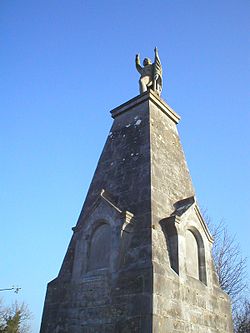
Teeling monument at Carrignagat, Co. Sligo

In 1898, the centenary year of the uprising and a year of many commemorations, statues, plaques and the writing of songs, a statue of Teeling was erected in Carricknagat. One of Sligo Town’s main streets, in which stand perhaps ironically the Sligo Courthouse and main police station, was also later named Teeling Street in his honour.

Bartholomew Teeling, a son of Luke Teeling, a Catholic linen merchant who lived in Chapel Hill, Lisburn, was educated at the Dubordieu School in Lisburn and at Trinity College Dublin. His younger brother Charles Teeling (1778–1850) went on to be a writer.

In 1796 Bartholomew enlisted in the United Irishmen and travelled to France to encourage support for a French invasion of Ireland.

The United Irishmen Directorate had intended to lead an armed insurrection with the support of a French landing.  France had a republican government, having had its own republican rising in 1789, during which the French King and Queen and many aristocrats had been executed.  A French fleet consisting of 43 ships carrying 15,000 troops including Theobald Wolfe Tone had set sail for Ireland in December 1796. The fleet had divided into smaller groups to avoid interception by the Royal Navy and were to reform at Bantry Bay.  Most did so but several ships, including the flagship Fraternité carrying General Hoche, leader of the expedition, were delayed; bad weather then set in and, combined with a lack of leadership, to the frustration and fury of Wolfe Tone, who commented that they were so close they “could have tossed a biscuit” ashore, the decision was made to return to France.

BLIAIN NA BHFRANCACH/ THE YEAR OF THE FRENCH

In August, when the other uprisings in Ireland had been suppressed or were stalling, another  French landing to assist the Irish rebellion finally took place in Mayo but it was a much smaller one.  On the 22nd August 1798, almost 1,100 troops under the command of General Humbert landed at Cill Chuimín Strand, Bádh Cill Ala (Killala Bay), Co. Mayo.  The numbers were too few to counter those being massed by the British and some of the other centres of the uprising had already been defeated or were hard-pressed and blocked; still, Humbert hoped for enough Irish to join and to raise other areas in insurrection.

French musketry Mayo reenactment
French soldiers fire muskets at British troops (re-enactment in Mayo).

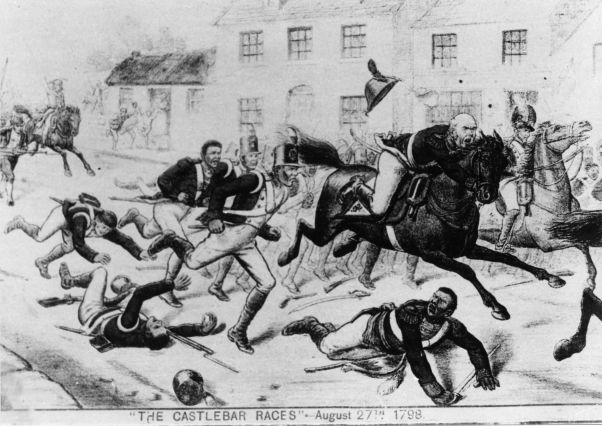
The remote location allowed a landing away from the tens of thousands of British soldiers concentrated in the east in Leinster, engaged in mopping-up operations against remaining pockets of rebels in the province. The nearby Mayo town of Cill Ala was quickly captured after a brief resistance by local yeomen and two days later, Béal an Átha (Ballina) was taken too, following the defeat of a force of cavalry sent from the town against the French.  Irish volunteers began to come into the French camp  from all over Mayo following the news of the French landing.  A victory over General Lake’s 6,000 at Castlebar followed, by which time General Humbert had gained 5,000 Irish recruits.

Battle of Killala1798
Print depicting battle of Killalla

“Killala was ours at midnight and high over Ballina town
Our banners in triumph were waving before the next sun had gone down.
We gathered to speed the good news boys, we gathered from near and afar
And history can tell how we routed the redcoats from old Castlebar.”
(Men of the West, by William Rooney).

“Seo sláinte muintir an Iarthair daoibh, a chruinnigh le cúnamh san áir;

mar sheas siad in aimsir an ghéar-chaill — seo sláinte fear Chonnacht’ go brách!”

                                           
(Chorus Fir an Iarthair, Gaeilge translation of the same song by [researching at present]……..)

Castlebar Races
Mocking print depicting short battle at Castlebar, dubbed “the Castlebar Races” due to the speed of the British forces’ retreat.

But meanwhile a British army of some 26,000 men was assembled under Field Marshall Lord Cornwallis, who had just been appointed Lord Lieutenant of Ireland (i.e. the British Queen’s representative) and was steadily moving towards the insurrectionist forces.

Abandoning Castlebar (where the victorious French held a ball to draw in the locals “of substance”), Humbert moved towards Ulster via Sligo hoping to link up with United Irishmen there, although the United Irishmen in Antrim had been beaten in a number of battles, the last one being at Ballynahinch on June 12th.

Plaque Castlebar Ball
Plaque recording General Humbert holding a ball after the Castlebar victory

ONE MAN AGAINST MUSKETS AND CANNON

The combined Franco-Irish forces marched north-eastwards towards Sligo on their way to County Donegal in Ulster.  On 5th September 1798 their progress was blocked by a unit of British troops from the garrison in Sligo, from approximately five miles to the north of Collooney. The British had installed a cannon above Union Rock at Carricknagat, a small townland to the immediate north of Collooney (hence the alternate name for the battle: the Battle of Carricknagat).  The cannon was protected by a screen of infantry including a sharpshooter by the cannon itself.  Charging the cannon would mean the death of many by cannon shot and by musket fire.   On the other hand, a detour would cost valuable time with large British forces following behind.

Suddenly Bartholomew Teeling broke from the Franco-Irish forces and charged forward on his horse.  One may imagine the scene: the British at first watch incredulously, then a scattered fire of muskets.  Teeling is unharmed, galloping onwards.  The British sharpshooter by the cannon coolly takes aim.  Teeling eyes him and suddenly swerves his horse; the shot goes past him.  The sharpshooter curses and reloads.  Another ragged volley from the infantry and again they miss.

The French and the Irish are cheering but they can’t believe he will make it.  Teeling’s horse leaps a ditch and gallops on past the infantry, foam flying from the animal’s body  – the sharpshooter looks up at him, loses his nerve and fumbles the charging of his musket …. Teeling is up at the gun, he has drawn his pistol and shoots the sharpshooter dead.  He draws another pistol and shoots the gunner.    The Irish and French are ecstatic and charge forward.  The British are stunned; some stand but most of the British infantry flee from the superior numbers and leave the cannon in the hands of the insurrectionist forces, as well as 60 dead and 100 taken prisoner.

Strangely, Colonel Charles Vereker, who commanded the Limerick militia in the stand-off, was awarded a peerage for his role in the battle.

NEW HOPE – AND DEFEAT

Hearing of a renewed United Irish offensive with risings in Westmeath and Longford, and perhaps with hopes of gathering support for a march on Dublin, Humbert turned and crossed the Shannon at Baile an Trá (Ballintra) on 7th September, stopping at Cloone that evening.  He was halfway between where he had originally landed and Dublin.  But that evening some survivors reached his camp to tell of the defeats of the insurgents at Wilson’s Hospital and at Granard.

Cornwallis was blocking the road to Dublin with a huge army and General Lake, smarting from his defeat at Castlebar, was expected with his forces soon.  In addition, Humbert’s rearguard was being constantly harassed and due to sabotage they had lost two cannon.

Humbert knew he was finished but felt military honour obliged him to make some kind of a stand, which he did at Ballinamuck, on the borders of the counties Longford and Leitrim.  About half an hour into the battle, Humbert signalled his surrender.  The British gave the French prisoner-of-war status but there was no such thing for “rebels”.  The 1,000 or so Irish forces and Teeling, perhaps knowing their fate, held on to their weapons but they were charged by British infantry and then dragoons; as they broke, they were hunted down.

Soon the bodies of about 500 Irish lay dead on the field and 200 prisoners were taken in mopping-up operations; almost all were later hanged, including Matthew Tone, brother of Wolfe Tone.  Most of the prisoners were marched to Carrick-on-Shannon, St. Johnstown (Ballinalee today), where they were executed in what is known locally as Bully’s Acre (there is also a Bully’s Acre in Dublin, part of the Royal Hospital of Kilmainham grounds, across the Liffey and a little to the west from Croppies’ Acre and Arbour Hill).  For some reason, Teeling and Matthew Tone were taken to Dublin.

SAMSUNG DIGITAL CAMERA
The Monument in Ballina, Mayo

Humbert and his men were also taken to Dublin, by canal, to be sent back to France. The British army then slowly spread out into the “Republic of Connacht” in a campaign of atrocities and destruction.  Many more were hunted down and hanged.

The catastrophe at Ballinamuck made a strong impression on social memory and was strongly represented in local folklore. Numerous statements in the oral tradition were later collected about this event, most of them in the 1930s by the historian Richard Hayes and by the Irish Folklore Commission.

“PERSEVERE, MY BELOVED COUNTRYMEN. YOUR CAUSE IS THE CAUSE OF TRUTH. IT MUST AND WILL ULTIMATELY TRIUMPH.”

As Ireland was under martial law after the uprising, Bartholomew Teeling was tried by court-martial as an Irish rebel, the charge being treason for which the sentence was death.   He was identified to the British by William Coulson, a damask manufacturer from Teeling’s home town of Lisburn.  Although Teeling had the rank of Captain in the French Army, to the British he was a British subject engaged in treason and Humbert was unsuccessful in his attempt to have Teeling treated as a French officer.  The condemned man was hanged at Arbour Hill Prison in Dublin (no longer in existence but the graveyard/ and 1916 memorial is still there), in his French uniform adorned with an Irish tricolour in his hat.

“Neither the intimation of his fate, nor the near approach of it, produced on him any diminution of courage. With firm step and unchanged countenance he walked from the Prevot to the place of execution, and conversed with an unaffected ease while the dreadful apparatus was preparing.”  (330. United Irishmen, their Lives and Times: Third Series: Robert R. Madden, M.D. 3 vols. Dublin, 1846).

Painting Bart Teeling
Portrait of Bartholomew Teeling

Teeling attempted to read the following statement from the scaffold, but was not permitted to:
“Fellow-citizens, I have been condemned by a military tribunal to suffer what they call an ignominious death, but what appears, from the number of its illustrious victims, to be glorious in the highest degree. It is not in the power of men to abase virtue nor the man who dies for it. His death must be glorious in the field of battle or on the scaffold.

“The same Tribunal which has condemned me — Citizens, I do not speak to you here of the constitutional right of such a Tribunal — has stamped me a traitor. If to have been active in endeavouring to put a stop to the blood-thirsty policy of an oppressive Government has been treason, I am guilty. If to have endeavoured to give my native country a place among the nations of the earth was treason, then I am guilty indeed. If to have been active in endeavouring to remove the fangs of oppression from the head of the devoted Irish peasant was treason, I am guilty.

“Finally, if to have striven to make my fellow-men love each other was guilt, then I am guilty. You, my countrymen, may perhaps one day be able to tell whether these were the acts of a traitor or deserved death. My own heart tells me they were not and, conscious of my innocence, I would not change my present situation for that of the highest of my enemies.

“Fellow-citizens, I leave you with the heartfelt satisfaction of having kept my oath as a United Irishman, and also with the glorious prospect of the success of the cause in which we have been engaged. Persevere, my beloved countrymen. Your cause is the cause of Truth. It must and will ultimately triumph.”

It is the very least we can do to honour the memory of this great man, cut down by oppression at 24 years of age in what would surely have been a life full of achievements, to ensure that where he and many comrades are buried, Croppies’ Acre, is maintained in an appropriate manner and open to visitors, from Ireland and from abroad.

POSTSCRIPT:

In 1800 the Irish Parliament, which was open to Anglican Protestants (Church of Ireland) only, had met in the current Bank of Ireland building at College Green) agreed to the Act of Union of Great Britain and Ireland and voted itself out of existence through Crown bribery and fear.

General Charles Cornwallis
Painted portrait of Field Marshall Lord Cornwallis, leader of the forces suppressing the uprising, also Lord Lieutenant of Ireland during the period

Cornwallis was later to surrender to a combined American and French force in 1781 at the Battle of Yorktown, which ended the American War of Independence in defeat for Britain.

After many adventures, Humbert  settled in New Orleans, where he was once again to fight the British at the Battle of New Orleans in the 1812 War.

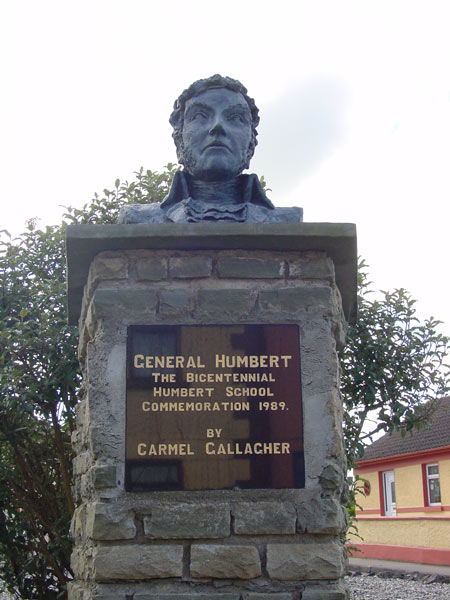
humbert head memorial
“Agus gairim na Franncaigh breá láidre, do tháinig le Humbert anall,
Mar thug siad dúinn croí agus misneach nuair a bhíomar go brónach sa ngabháil.”

General Lake was to have a successful imperial military career with Britain; he was also made an Irish MP (as well as being an MP in England) in the run-up to the vote for the Act of Union 1800 which abolished the Irish Parliament and made Ireland part of the United Kingdom.

Did Mandela really change South Africa?

[Article by TOM, a contributor to Socialist Voice, newspaper of the Communist Party of Ireland and reprinted with their kind permission.  In essence it agrees with the analysis of Mandela and South Africa given by Stephen Spencer and Diarmuid Breatnach in an article reviewing statements of the Irish Left and Republican movement following the death of Mandela — Rebel Breeze]

The presence of such friends of genuine democracy as the war criminals George W. Bush and Tony Blair, David Cameron, Bill Clinton and such right-wing media hangers-on as Sir Bob Geldof and Sir Paul Hewson (Bono) at Nelson Mandela’s funeral raises questions about the real content of the new South Africa that appeared in 1994, when the apartheid elite seemed to cede political power to the African National Congress.

Twenty years later, given the continuing racial inequality in present-day South Africa, the much lower life expectancy of blacks and their much higher rate of unemployment, the increased vulnerability of the country to world economic fluctuations and accelerated environmental decay during his presidency, did Mandela really change South Africa? And, if not, how much room had he to manoeuvre?

For many are still remembering the Mandela years as fundamentally different from today’s crony-capitalist, corruption-riddled, brutally securitised, eco-destructive and anti-egalitarian South Africa. But could it be that the seeds of the present were sown earlier, by Mandela and his associates in government?

Ending the apartheid regime was, undoubtedly, one of the greatest events of the past century. But, to achieve a peaceful transition, Mandela’s ANC allowed whites to keep the best land, the mines, manufacturing plants and financial institutions, and to export vast quantities of capital.
The ANC could have followed its own revolutionary programme, mobilising the people and all their enthusiasm, energy, and hard work, using a larger share of the economic surplus (through state-directed investments and higher taxes), and stopping the flow of capital abroad, including the repayment of illegitimate apartheid-era debt. The path chosen, however, was the neo-liberal one, with small reforms here and there to permit superficial claims to the sustaining of a “National Democratic Revolution.”

The critical decade was the 1990s, when Mandela was at the height of his power, having been released from jail in February 1990, taking the South African presidency in May 1994 and leaving office in June 1999. But it was in this period, according to the former minister for intelligence services Ronnie Kasrils, for twenty years a member of the Central Committee of the South African Communist Party, that “the battle for the soul of the African National Congress was lost to corporate power and influence . . . We readily accepted that devil’s pact and are damned in the process. It has bequeathed to our country an economy so tied in to the neo-liberal global formula and market fundamentalism that there is very little room to alleviate the dire plight of the masses of our people.”

Nelson Mandela’s South Africa fitted a pattern, that of former critics of old dictatorships—whether from right-wing or left-wing backgrounds—who transformed themselves into neo-liberal rulers in the 1980s and 90s: Alfonsín (Argentina), Aquino (Philippines), Arafat (Palestine), Aristide (Haïti), Bhutto (Pakistan), Chiluba (Zambia), Kim (South Korea), etc. The self-imposition of economic and development policies, because of the pressures of financial markets and the Washington-Geneva multilateral institutions, required insulation from genuine national aspirations—in short, an “elite transition.”

This policy insulation from mass opinion was achieved through the leadership of Mandela. It was justified by invoking “international competitiveness.” Obeisance to transnational corporations led to the Marikana Massacre in 2012 and the current disturbances on the platinum belt, for example. But the decision to reduce the room for manoeuvre was made as much by the local principals, such as Mandela, as it was by the Bretton Woods institutions, financiers, and investors.

Much of the blame, therefore, for the success of the South African counter-revolution must be laid at the door of the ANC leadership, with Nelson Mandela at its head. Hence the paeans of praise for the dead leader from the doyens of international reaction.
[TOM]

TONY BENN (1925-2014)

Tony Benn
Tony Benn

He was a friend of Ireland, it is true — I often heard him speak on Irish solidarity platforms in England. I don’t remember him supporting the hunger strikers in 1981, however. You may recall that Concannon, representing the Labour Party, visited the dying Bobby Sands to tell him that Labour would not support him or his comrades. In London, we marched to Benn’s house (VERY long, hot  march) to get him to break with Labour on this but I don’t remember whether we were successful.

In the balance must also be put that when Secretary of State for Energy in a Labour Government, along with the rest of the Gvt, he conspired to break the embargo on apartheid South Africa by covertly selling them oil routed through Portuguese African colonies.

Someone referred to him as an “Ant-fascist fighter” — I don’t know about that.  He served as a pilot in Rhodesia (now Zimbabwe) and South Africa during the war.  Hundreds of thousands joined up during those years and many others were conscripted.  His reasons for joining could have been any, whatever  he may have said afterwards.  He certainly didn’t fight fascists on the streets of Britain as some did, both before and after the War.

STATE MURDER; GOVERNMENT LIES, BLACKMAIL AND CENSORSHIP; MEDIA SMEARS

Anniversary

Sunday 6 March 1988

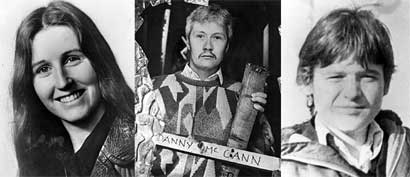
Three unarmed Irish Republican Army (IRA) Volunteers were shot dead by undercover members of the Special Air Service (SAS) in Gibraltar.  The three were Mairéad Farrell, Sean Savage and Daniel Mc Cann.

GIBRALTAR 3
The episode sparked intense controversy and began a chain of events that lead to a series of deaths in the Six Counties.
The British government claimed that the SAS shot the IRA members because they thought a bomb was about to be detonated. Eyewitnesses said that those shot were given no warning.Magill Carmen ProetaBritish Intelligence and some media tried to discredit one of the witnesses, Carmen Proeta, whose flat overlooked the murder scene and who came forward to say what she had seen. A British newspaper claimed that she was a prostitute running an escort agency and later had to pay her damages in a libel case.
An undercover unit of the Spanish Guardia Civil in the Spanish state had been shadowing the three Volunteers in cooperation with British Intelligence but had lost them just before the border. They were reported unhappy with the unexpected executions carried out by the British death squad. However, it is also true that the Gibraltar killings were carried out less than a year after the last operation of the GAL death-squads (1983-1987), run by the Spanish state with senior Guardia Civil officers and the Minister of the Interior against Basque pro-independence activists.
Tuesday 8 March 1988A car believed to belong to those killed in Gibraltar was found in Marbella and was discovered to contain 140 pounds of high explosives.Wednesday 16 March 1988During the funerals of the three Volunteers at Milltown Cemetery in Belfast a Loyalist gunman, Michael Stone, launched a grenade and gun attack on mourners. Three people were killed and 50 injured. The whole episode was recorded by television news cameras. The police and the army had withdrawn to avoid any confrontation with the mourners. Stone was chased to a nearby motorway were he was attacked by a number of mourners. The police arrived in time to save his life. The main Loyalist paramilitary groups denied any involvement with Stone. One of those killed, Kevin Brady, was a member of the IRA; though unarmed, he had been filmed, along with some others, moving TOWARDS Stone as the Loyalist attacked.


Saturday 19 March 1988

During the funeral of Kevin Brady, killed at Milltown Cemetery (16 March 1988), a car approached the funeral procession at high speed. It was claimed by some present that they feared another attack by Loyalist gunmen. The car’s passage was blocked and a group of the mourners attacked the two passengers, killing them. They were two soldiers in plain clothes and their purpose was never adequately explained.


28 April 1988

Thames Television, as part of the ITV television current affairs series “This Week”, screened a documentary about the killings called “Death on the Rock”. The documentary examined the deaths of three Provisional Irish Republican Army (IRA) members in Gibraltar on 6 March 1988 at the hands of British special forces (codenamed “Operation Flavius”).

The documentary presented evidence that the British government’s version of events was inaccurate and that the three IRA members had been shot without warning or while attempting to surrender, for which it was extensively criticised. The programme was condemned by the Government—who had attempted to have the Independent Broadcasting Authority (IBA) postpone its broadcast—while tabloid newspapers accused it of sensationalism and “trial by television”.

Over the following weeks, several newspapers attempted to undermine the documentary by attacking its witnesses or presenting its findings as distorted or inaccurate. After one of the documentary’s witnesses retracted his evidence at the inquest into the shootings, Thames Television commissioned an independent inquiry into the making of “Death on the Rock”—the first such inquiry into a single television programme—headed by Lord Windlesham and Richard Rampton, QC. The Windlesham-Rampton report largely vindicated “Death on the Rock”, and found, with two exceptions, that it had accurately portrayed the evidence of its witnesses.

Thames lost its franchise and the IBA was abolished as a result of the Broadcasting Act 1990, decisions which many people believed were influenced by the Government’s anger at “Death on the Rock”. http://en.wikipedia.org/wiki/Death_on_the_Rock


September 1995

The European Court of Human Rights found the British government guilty of violating Article Two of the European Convention, which protects a person’s right to life. In the first decision of its kind against a government, the court stated that the British had failed to uphold “the standard expected of a democratic government” when they shot dead three IRA Volunteers in Gibraltar in 1988.


GIBRALTAR THREE SONG
(Air: Glencoe Massacre)

Chorus:
Sad are three homes in Belfast now —
All Ireland shares their sorrow;
Mairéad Farrell, Sean Savage, and Daniel McCann …
They died on the streets of Gibraltar

I
They flew out of Belfast with an ambitious plan
To continue the struggle to free Ireland;
Mairéad Farrell, Sean Savage, and Daniel McCann:
They died on the streets of Gibraltar

Chorus:
Sad are three homes in Belfast now —
Old Ireland shares their sorrow;
As they walked in the sun, the Brits drew their guns
And blood stained the streets of Gibraltar

II
The SAS stood there so proud of their deed
Three more freedom fighters lay dead in the street
They’ve been given no warning no chance to retreat
For three had to die in Gibraltar

(Chorus)

III
Each of them unarmed, without mercy gunned down,
Shot again in the head as they lay on the ground,
By the Special Air Service, assassins of the Crown,
They were murdered on the streets of Gibraltar.

(Chorus)

This song, slightly different version to the one I have, was written I think by the Irish Brigade. The 3rd verse above is mine entirely, written over a decade ago while I was still living in London.

There are also a couple of other songs about the events and Roger Bolton, the TV documentary maker, wrote a book “Death on the Rock and other stories”.  The track of one of the other songs, Do Not Stand at my Grave and Weep, written by I think Catherine Jenkins, is on this video which has extracts from an interview with Mairéad Farrell http://youtu.be/xZUeCemzkt4

end


SEAN SAVAGE

 28 JANUARY 1985 – 6 MARCH 1988
Was studying for his ‘A’-levels when imprisoned on remand in 1982 on the word of an informer who subsequently retracted. He joined the IRA when he was seventeen years old.

MAIRÉAD FARRELL

3 MARCH 1957 – 6 MARCH 1988
Imprisoned in 1976. She took part in the 1980 hunger strike. She was Officer Commanding of Republican prisoners in Armagh prison throughout the 1981 hunger strike and was very well liked and highly respected by the female POWs. Released in 1986, she campaigned actively against strip-searching and returned to IRA duty.

DAN McCANN

30 NOVEMBER 1957 – 6 MARCH 1988
First imprisoned in 1973 and on three subsequent occasions. From 1979-1981 he was in prison ‘on the blanket’ during the campaign for political status. He had been the target of British Army death threats and survived a loyalist assassination attempt.

The Defendant — a short play

Diarmuid Breatnach

“We have had ‘stepping stones’ presented to us before in our history – they turned out to be stone walls.”

 (A revolutionary is on trial).

judge in full wig etc

Act 1.

Scene: A courtroom – Judge’s bench high, clerk at lower bench nearby, faced by dock, containing defendant and two guards, one at each side.  Long bench in front of dock containing Prosecution and Defence barristers or lawyers.

Judge:  Read the charges, clerk.

Clerk: The defendant is charged with treason, sedition, incitement to rebellion against the lawful government, conspiracy with persons unknown to incite discontent, unlawful assembly, obstruction of the highway and membership of an illegal organisation.

Judge:  Defendant, you have heard the charges?

Defendant:        I have.

Judge:  Address the Court properly.

Defendant:        I have heard the charges, Judge.

Judge:  The proper manner to address me is Your Honour.

Defendant:        I have heard the charges, Judge.

Judge:  I see.  Very well, let us proceed.  How do you plead to the charges?

Defendant:        Not guilty of any crime against the people.

Judge:  Clerk, enter a plea of “Not Guilty.”

Prosecuting Counsel stands up, approaches defendant in the dock.

Prosecuting Counsel:    You are against the Agreement?

Defendant:        I am.  It clearly does not deliver what we fought for, an independent united Republic.  In addition, I and some others fought for a socialist republic and it has not delivered that either.

Prosecuting Counsel:     You are aware that the electorate voted to accept the Agreement?

Defendant: Yes, but…

Prosecuting Counsel:    Just answer ‘yes’ or ‘no’.

Defendant:        Yes.

Prosecuting Counsel:     And do you believe in democracy?

Defendant:        Define ‘democracy’.

Prosecuting Counsel:     The will of the majority.

Defendant:        With suitable safeguards for certain minorities, certainly.

Prosecuting Counsel:     Yet you have admitted to undertaking actions against the Agreement, have you not?

Defendant:        I have.

Prosecuting Counsel:     You consider yourself above the will of the people, the majority, then?

Defendant:        No.  But I consider that I have a duty to act according to what is right and I can see clearly that the Agreement delivers nothing of what we fought for.

Prosecuting Counsel:     Yet the people voted for it.

Defendant:        The people were tired of war and repression and were lied to.  Many of our leaders betrayed us and brought many of our movement with them.

Prosecuting Counsel:     That is your interpretation.  Might it not be that your leaders and those of your movement who followed them were wiser than you?

Defendant:        No.

Prosecuting Counsel:     No?  You could not possibly be wrong?

Defendant:        I am not wrong on this.  The movement fought for a an independent, united republic.  We did not get it.

Prosecuting Counsel:     Your leaders and your movement – I beg your pardon, many in your movement – consider it a stepping stone.

Defendant:        We have had ‘stepping stones’ presented to us before in our history – they turned out to be stone walls.

Prosecuting Counsel:     So you would pursue a strategy of violence in the face of the clear will of the majority!

Defendant:        I do not choose violence.

Prosecuting Counsel:     You do not?  Have you not admitted earlier a statement attributed to you, that violence would be necessary to achieve a successful revolution?

Defendant:        Yes.

Prosecuting Counsel:     So you do choose violence.

Defendant:        I do not.

Prosecuting Counsel:     Pray explain.

Defendant:        I said that the history of classes and of imperialism shows us that no class has ever been permitted to overthrow the one above it by peaceful means; similarly that no nation has won independence from the state oppressing it without having to face violence.  It is the oppressors of the people who choose violence, not us.

But naturally, we should defend ourselves.  Anyway, it is hypocrisy for a state to accuse us of violence, when they have a long history of violence and are at this moment collaborating with others who are waging war and armed invasion of countries.

Prosecuting Counsel:     That is a different matter and not the concern of this court.

( Defendant mutters something)

Prosecuting Counsel:  What did you say?

Defendant:        I said ‘You would say that and anyway it should be the concern of any court of justice.’

Prosecuting Counsel:     This is a court of law and it is trying a case to decide whether you are guilty or innocent.  Let us proceed along another track.  Do you believe in dialogue?

Defendant:        Certainly.

Prosecuting Counsel:     Why then do you not use the Agreement as a basis for dialogue to achieve your aims?  Surely that is the democratic way?

Defendant:        I’d be happy to engage in dialogue as to the details of Britain’s withdrawal from Ireland.  I’d be happy to engage in dialogue as to the details of the capitalists handing over the wealth they have plundered from the people.

Prosecuting Counsel:  You would confiscate the property of businessmen?

Defendant:           That wealth was created by working people.  I would consider it one of the first tasks of a socialist government to confiscate the wealth of the rich, yes.

Prosecuting Counsel:     And ruin the country!

Defendant:        I consider that it is the imperialists and the capitalists that are ruining the country.  Our native industries are undeveloped or taken over by foreign monopolies.  There is wide-scale poverty, homelessness, ill-health, unemployment and emigration.

Prosecuting Counsel:     These are hard times internationally, yes.

Defendant:        Exactly.

Prosecuting Counsel:     What do you mean ‘exactly’?

Defendant:        The capitalists and imperialists internationally have caused these ‘hard times’ as you call them.  They grow richer while the people grow poorer.  The second is the direct result of the first or, if you like, the first is the cause of the second.

Prosecuting Counsel:     Let us take another track.  Do you admit that this present government was elected by a majority?

Defendant:        No.

Prosecuting Counsel:     No?  You do not?

Defendant:        No.  It gained an overall majority of parliamentary representatives.

Prosecuting Counsel:     Is that not the same thing?

Defendant:        No.  There are those who were eligible to vote but did not and those who voted for other parties but did not elect enough representatives.

Prosecuting Counsel:     You quibble.

Defendant:        I do not, those are facts and the figures will clearly demonstrate that this present government was elected by a minority of the electorate.  But even if it had been elected by the majority ….

Prosecuting Counsel:     Yes, please do continue.

Defendant:        Even then, it broke many important promises it had made prior to coming to power.  It has de-legitimised itself.

Prosecuting Counsel:     No party can carry out everything it promises ….. situations arise, measures have to be taken to respond ….

Defendant:        I agree that capitalist parties do not carry out their promises.  They need the votes of the people but represent the interests of a tiny minority.

Prosecuting Counsel:     Oh, please, spare us your socialist rhetoric!

Defendant:        I am attempting to respond to your questions.

Prosecuting Counsel:     You have encouraged sedition against the lawful government.

Defendant:        Sedition according to the laws of this state – capitalist laws.

Prosecuting Counsel:     Would you not agree that you are in a minority opinion?

Defendant:        On what?

Prosecuting Counsel:     In your political views.

Defendant:        I am in majority opinion that imperialist war is a bad thing.  I am in a majority opinion that poverty, homelessness, unemployment and emigration are bad things.  I am not in a minority opinion that the rich get richer while the poor get poorer.

But I do admit that I am in minority opinion as to the feasibility of the solutions I propose.  I admit that I am in a minority as to the confidence that revolutionary change is within our power.  In that I am in a minority – for the moment.

Prosecuting Counsel:     Ah, you believe that the people will see sense and support your ideas.

Defendant:        I wouldn’t put it quite like that but … yes.

Prosecuting Counsel:     A bit arrogant, would you not say?

Defendant:        Not at all.  In the history of this and many other lands, many thinkers and activists have been in a minority before their opinions became accepted by the majority.  Most accepted scientific opinion now was once that of a minority – indeed, often of a persecuted minority.

Prosecuting Counsel:     You consider yourself a persecuted minority?

Defendant:        My presence here and the charges are proof enough of that.  But one day we shall be a majority.

Prosecuting Counsel:     May the Court please, I have no more questions of this defendant.

(Prosecuting Counsel sits)

(All freeze)

Act 2.

 (All unfreeze)

  State Prosecution Counsel standing, summing up, addressing the Judge …………….

Prosecuting Counsel:        The Defendant has pleaded ‘not guilty’ but his own answers under cross-examination have belied that plea.  He has in effect admitted to treason, sedition, incitement to rebellion against the lawful government, conspiracy with persons unknown to incite discontent, unlawful assembly and obstruction of the highway.

The only charge to which he has not admitted is membership of an illegal organisation.  However, we have clearly shown from the evidence of the police and army witnesses that he is indeed a member of an illegal organisation.

The State submits that the case has been proven in all respects and asks for a verdict of  “Guilty as charged.”  In addition the State asks for the maximum sentence — the prisoner is a danger to society and totally without remorse.

 (Prosecution Counsel sits.)

(All freeze)

Act 3.

 (All unfreeze) ….

Judge addressing the Defendant ….

Judge:  Defendant, you have been found guilty as charged on all counts.  Do you wish to say anything before sentence is passed?

Defendant:        Yes.  I once again contend that I am not guilty of any crime against the people.  The actions I undertook were for the victory of my class, the working class, which entails the defeat of the local ruling class and foreign imperialism.  If I am guilty of anything, it is that I did not always work hard or competently enough for the cause.

Time and again, others like me have stood before your courts and of the British before yours and been sentenced to imprisonment or even death.  They faced it with courage and I will try to do the same.  I do not expect mercy and I will not ask for it.  I do not apologise for doing what I know was right.

But I tell you this: one day, it will be representatives of my class that will sit up there and it will be you down here to answer for your crimes.  I bid my farewell to comrades, family and friends and I ask them to forgive me for any way in which I have failed them.  And may my place in the ranks be filled by many more.

Judge:  Have you quite finished?

Defendant:        I have.

Judge:  You will be kept in custody while the court considers your sentence.  Guards, take the Defendant down.

Defendant is escorted out by guards.

Clerk (in muttered but audible aside to the Judge):  “Surely your honour is going to sentence him to death?”

Judge (whispering but audible):  “Possibly …. however, I need to consider what harm may be done by making a martyr of him.  Possibly some years in jail will have him forgotten more quickly …. and possibly break that arrogance of his too.”

(Loudly):  “Clerk, record the verdict and decision made here this day … 12th of January …. 1923, Irish Free State”.

(All freeze momentarily)

End.

DUBLIN VULTURE

DUBLIN VULTURE
Street cartooning, hoarding Moore Street, Dublin inner-city historic and market quarter under threat from property speculator/ developer Chartered Land. 1st March 2014.

Street cartooning Moore Street hoarding, Dublin inner-city historic and street market area under threat from property speculator/ developer Chartered Land. 1st March 2014