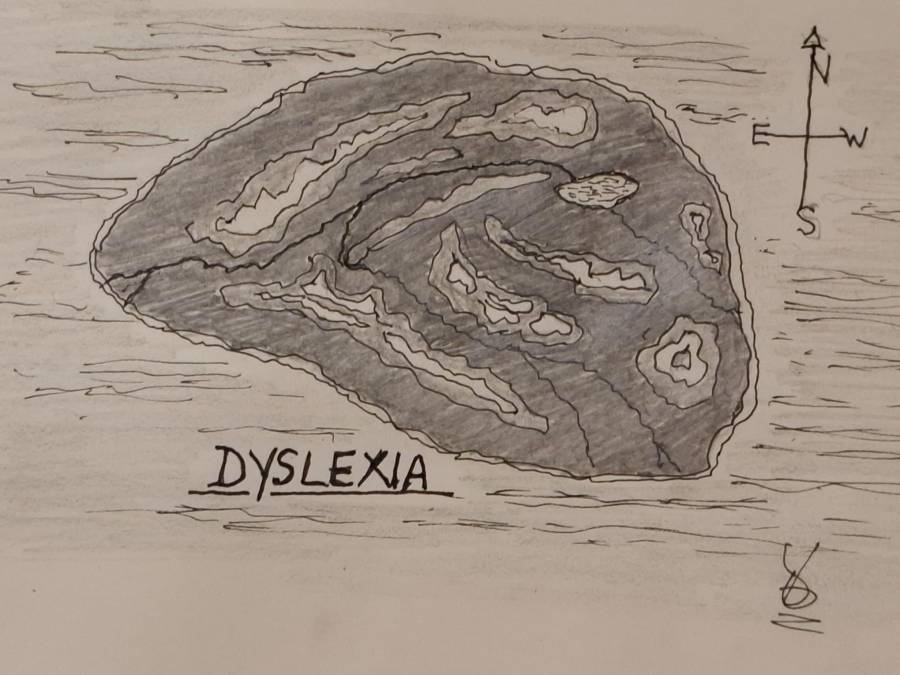
DYSLEXIA – A COUNTRY WHERE SURPRISE IS EXPECTED

Diarmuid Breatnach

(Reading time: 6 mins.)

(The author is known as a traveller to many exotic places, including expeditions in search of mythical lands, most famously “The United Kingdom”, the “Republic”, “Norn Ireland” and “The Mainland.” Here he writes about the land of Dyslexia).

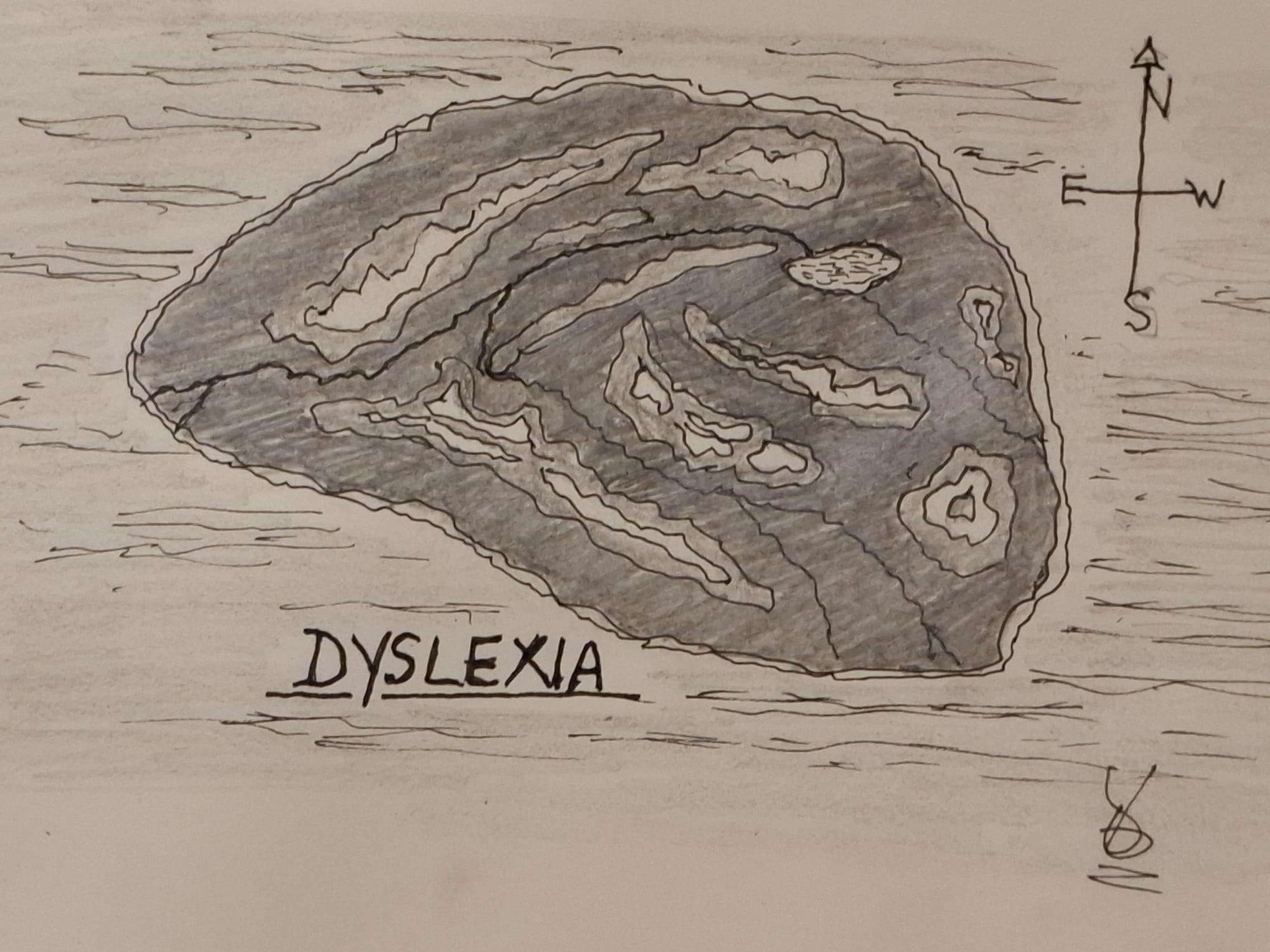
Dyslexia is, as the suffix “-ia” suggests, a country …. think of India, Mongolia, Russia, California [now relegated to a vassal state], Hibernia [also something of a vassal state], Narnia [er .. no, that is an imaginary land in a series of children’s tales].

Strangely the existence of Dyslexia was not even suspected until 1881, when Oslawd Khanber1 claimed to have visited the land. His discovery was widely doubted until confirmed by Ludorf Linber2 in 1887.

The people of this newly-discovered land were distinguished by all having a difficulty to varying degrees in spelling and/or in remembering sequences of numbers.

Khanber and Linber both named this land (and the rest of the world agreed) “Dyslexia”, from the Greek root “dys” meaning “bad/ abnormal/ difficult” and “lex” meaning “word” (although in Latin it means “law”, understood as “written word”).

Dyslexia was, like many other lands and people, not named by the natives themselves, but by people from elsewhere. Such examples abound, for example “Australia”, “America”, “Scotland”, “Eskimo”, “Teddy Boys”, “Pagans”, “Celts”, “Saxons”, “Teagues”, “Gypsies”, “E.T.s” etc.

Attempts to identify what the Dyslexics themselves called their land have so far collapsed in confusion, with different spellings and even pronunciations hotly argued for against others.

In fact, there have been accusations of racism aimed at those who named the land “Dyslexia” and the people “Dyslexics” — it seems particularly cruel to create a word itself so difficult to spell to name a people with a known disability in spelling.

Previously, Dyslexics just called themselves “people” and the land “the land”, while those who came across migrants from there before Dyslexia was actually discovered called them other names: such as “stupid”, “slow”, “thick” or “people with ADD or ADHD”.3

However, most “Dyslexics” today have not only adopted the name and learned to spell it but are wont to proudly declare “I’m Dyslexic” (but rarely “I am a Dyslexic”).

When Dyslexia came to the attention of the rest of the World no-one seemed astonished that it should be discovered long after the North and South Poles, the Mariana Trench, the Matto Grosso Plateau and indeed a great number of planets.

What did astonish the World was that Dyslexia had apparently independently within its borders invented television, radio, Ipads, microwave ovens, central heating and hot showers and of course the internal combustion engine and nuclear power.

This proliferation of technology would have been normally amazing (if anything normal can be said to be amazing, or vice versa) in a previously undiscovered country.

But what was really, really amazing was that everyone in Dyslexia had overcome a disability to climb to such industrial heights. The obstacles must have been tremendous.

Imagine confusing, for example, sodium chloride, a common table salt, with sodium chlorate, which is used as a weedkiller.

Also by the way, as an ingredient in making home-made bombs, a curious fact since nitrogenous fertiliser, with a directly opposite effect to sodium chlorate when spread on weeds, is also sometimes used in making home-made bombs).

Anyway, shake sodium chloride in small quantities on your weeds and they probably won’t like it but most will survive – especially those that actually like a little of it, like relatives of the cabbages and such. Shake a little sodium chlorate on your food, however and ….

well …. no, don’t try it – without urgent and skilled medical attention you will die quickly and painfully.

For another example, imagine confusing “defuse” with “diffuse”: one goes to de-escalate a conflict and ends up spreading it around. Other confusions are possible between the noun or verb “ware”, the (usually) adverb “where” and the past tense verb “were”. And so on.

For physics, knowledge of and accuracy in mathematics is essential – algebra, logarithms, binary codes, sines and co-sines, square roots (these last are mathematical constructs, not mythical regulated-shape carrots as propagated by anti-EU campaigners).

In calculating distances, heights and depths, spaces and circumferences, ability in geometry, trigonometry and ordinary mathematics is required. Somehow, the Dyslexics, the inhabitants of Dyslexia, had overcome their disability or compensated for it in some way.

They had developed as flourishing and environment-poisoning an industrial society as the most developed parts of the world, such as the United States of America (most developed industrially, that is).

Dyslexics are said, despite this disability with letters and numbers, to be of above-average intelligence. They had to be, to develop all those complicated benefits of industrial society despite their handicap.

Strangely, one may think, many Dyslexics have become literary figures famous throughout the world, Hans Christian Andersen, Agatha Christie, F. Scott Fitzgerald and WB Yeats among them. Contrary to popular belief among non-natives, James Joyce was not from Dyslexia.

This prevalence of Dyslexics among so many giants of literature and indeed of virtually every other field of human endeavour has given rise to a group of Dyslexians who call their disability “the gift of Dyslexia”.
The Dyslexics are often garrulous and sociable and this is especially true when in Dyslexia itself. The difficulty in remembering telephone numbers for example makes every telephone call an adventure.

Say a native wished to phone another native called Cathy (also known as Cthy, or Ktay, Thyca etc), and the phone number was 731 1062 (please note, this is an imaginary telephone number by which neither Cathy nor anyone else can be reached).

The Dyslexic might phone 371 1026 – all the correct digits but in a different order (note, this also is an imaginary telephone number by which no-one may be reached).

The conversation, somewhat simplified, might go like this:

“Yes, hello?” (female voice, breathless with anticipation of another adventure).

Our caller: “Hi, is that Cathy?”

Recipient (giggling): “No, it’s not. There isn’t any Cathy here. I’m Wanda.”

Our caller: “Oh, hi Wanda, you sound very nice. How about going on a wanda with me?”

Wanda (with a little giggle but playing cautious): “Maybe …. What’s your name?”

Our caller: “Terry.”

Wanda: “Where were you thinking of wandering with me?” (A moment’s pause while both mentally translate the last part of that into “wandering on me”).

Terry (clearing his throat which has suddenly gone dry): “Well, there’s a nice new Indian restaurant opened up in town. Do you like Indian food, Wanda?”

“Ohhh, Terry, I love it. So spicy!” (Very slight pause as both translate “spicy” as a description for food flavouring into a metaphor instead). “When were you thinking of?”

“Er … tonight too soon?”

“No, I happen to be free tonight.”

“Shall I come and pick you up? Say …. seven pm?”

“That would be lovely, Terry. I live off the Trans City Road, tenth left, first right, eighth left, in Hopeful Street, the seventh house on the left-hand side if you’re coming from town, with a brown and white door and a hydrangea bush in the garden.”

“Got it – off the Trans City Road, tenth left, first right, eighth left, Hopeful Street, seventh house on the left-hand side, brown and white door and a hydrangea bush in the garden. At seven pm. I’m looking forward to meeting you.”

Most Dyslexics are always open to adventure, ‘going with the flow’. One never knows what a simple telephone call may bring or to what an appointment or written address may lead.

But as a result, Dyslexics are also philosophic about missed appointments, forgotten birthdays and so on; they waste little time mourning something lost and instead look forward to something gained.

Terry might or might not make it to Wanda’s but they both know the world is full of other possibilities.

Cathy, for example, who failed to receive a call from Terry to congratulate her on her gaining a dystinction in her dyploma, received later that evening what non-natives would term “a wrong number” call from a Sofia who had meant to call a Geraldine.

Sofia had intended trying to patch up a long-running difficult relationship with Geraldine and instead found herself making the acquaintance of Cathy, who seemed much nicer and more understanding than was Geraldine.

Putting her problems with Geraldine aside, Sofia agreed to Cathy’s suggestion to meet for a late coffee (which they both knew could lead to an early drink and who-knows-what from there). Cathy had by now forgotten that she was hoping Terry would call.

Dyslexia is not just another land, nor even just a strange one – it’s an entirely different way to live.

End.

Note: If you found this article of interest, why not register with Rebel Breeze for free, so that you will be notified by email of subsequent articles. You can de-register any time you wish.

Footnotes:

1Adolph Kussmaul, to non-dyslexics.

2Rudolf Berlin, to non-dyslexics.

3A supposed disability the existence of which is hotly debated but has exonerated many teachers accused of bad teaching methods and states accused of having too large classes in their schools and which has been profitable for some educational psychologists and extremely so for some chemical companies.


SNAIL SEX IS AGAINST GOD’S PLAN

Diarmuid Breatnach

(Reading time: One minute)

Dear Editor,

Your Breaking News edition of 4 September 2025 featured a news item about a freak snail, with a left-spiralling shell, for which a freak mate was being sought.

This was disgusting use of public media light-heartedly flaunting disregard for Christian morality.

Ireland is a Christian country and public reference to the sexual act in general is bad enough but writing about snails and their sexual acts is much, much worse.

Quite apart from left-spiralling shells, snails are already freaks. It is well known that snails are hermaphrodite, that is they carry both male and female sexual organs and when one wishes to mate with another, apparently one decides whether to act the male while the other decides to act the female.

This is clearly unnatural and against God’s Plan, who created every animal as functioning male or female and the same with human beings. Snails in fact, apart from being a pest in the garden are clearly one part of Satan’s spawn. They are an abomination.

That any snail, whether with a right or a left-spiralling shell should fail to find a mate is a good thing and your publication should not be encouraging people to find it a partner. Your newspaper could be considered to be in effect pimping for it.

Publications of stories about snails and their sexual habits can only encourage the latest trend in human deviation known as ‘trans’ where some people choose to consider themselves and to be considered as a gender other than that with which they were born. This too is an abomination.

Please return to God’s plan and cease printing such dangerous and disgusting reports.

Sincerely,

A Sinestra variant (left-spiralling) snail, Cepaea Nemoralis photographed in Galicia, Spanish state. (Photo cred: Raymond JC Cannon)

SOURCE REFERENCE

https://www.breakingnews.ie/world/hunt-is-on-to-find-a-mate-for-ned-the-snail-with-a-rare-left-coiled-shell-1799818.html

The Public Health of a Nation and a Private Vengeance

Gearóid Ó Loingsigh 10 December 2024

(Reading time: 6 mins.)
NB: Edited by RB from original article for formatting purposes

The murder of Brian Thompson the CEO of United Healthcare has sent shock waves throughout the US, if the media are to be believed.

There is consternation in some quarters that the motive for the murder may be that he was the CEO of a health insurance company.

United Healthcare logo and late CEO Brian Thompson (Photo sourced: Internet)

This was evidenced by the message left behind of Delay, Defend, Depose on the shell casings, a reference to the tactics employed by insurance companies so as not to pay out on medical claims.

The right-wing media are understandably concerned that it is not a one-off and that others may take similar action against high-ranking insurance employees.

Some have even used the occasion to question, to a degree, the US private health care system, a system the Irish one is a pale copy of but intent on emulating as much as possible.

The company Thompson headed up is worth around US $550 billion, which is no small change. In the first nine months of 2024 it paid out US $9.6 billion to shareholders on total revenues of US $100.8 billion.[1] 

Despite the company’s name alluding to health care, that is not how it makes its money. Its money is the result of people paying for a private health care plan and then either not claiming or being denied coverage for medical procedures from the routine to vital lifesaving procedures.

Health insurance companies are not in the business of curing, they don’t even provide health care, they are merely intermediaries between the surgeon’s scalpel and the patient, capable of inflicting a deeper cut than the sharpest instrument in the hands of the most skilled medical professional.

With all the finesse of a drunken mugger with a blunt pen knife. It is in the sickness and death business through non-payment.

Every year almost 650,000 people in the US are forced into bankruptcy by medical bills, representing over 60% of all personal bankruptcies. Nearly 80% of those who go bankrupt had medical insurance![2] 

A recent report found that over 20 million people in the US owe at least US $220 billion in medical debt with the majority of that comprising of debts in excess of US $ 10,000 amongst just 2.9 million people.[3] 

Some of the debt arises from the so-called deductibles, the point at which insurance kicks in, which has been on the rise for years, with in some cases people having to pay US $3,700 before the insurance company pays a penny.[4] 

And then 20% of claims are denied, though depending on the company that may range from as low as 2% to 49%.[5]

United Healthcare logo (Photo sourced: Internet)

There is no way of looking at this, other than to conclude that health insurance companies are leeches, sucking the blood of the aged, the infirm and those who fall ill, for whatever reason.

In order to force people to pay health insurance the human cost of not doing so must be dramatic, traumatic, life threatening and unbearable. The threat of death or ill health is the whip with which they force people into line.

Thompson’s murder has touched a number of nerves. His company, the media and politicians expressed their sorrow and even rage at the killing. But as the BBC reported unofficial USA had a different reaction.

But online many people, including United Healthcare customers and users of other insurance services, reacted differently.

Those reactions ranged from acerbic jokes (one common quip was “thoughts and prior authorisations”, a play on the phrase “thoughts and prayers”) to commentary on the number of insurance claims rejected by UnitedHealthcare and other firms.

At the extreme end, critics of the industry pointedly said they had no pity for Thompson. Some even celebrated his death.

The online anger seemed to bridge the political divide.

Animosity was expressed from avowed socialists to right-wing activists suspicious of the so-called “deep state” and corporate power. It also came from ordinary people sharing stories about insurance firms denying their claims for medical treatments.[6]

Facebook is full of memes, celebrating, joking or otherwise supporting the killing. More than a reflection of some well thought out support for the murder, this is people lashing out at a system that condemns them to misery. It is a weapon of mass destruction.

Whilst many people with health insurance are frequently denied coverage for medically necessary interventions, there are others who have no health insurance at all. They simply can’t afford it or are not eligible.

Another report finds that as “many as 44,789 Americans of working age die each year because they lack health insurance, more than the number who die annually from kidney disease.”[7] That is nearly the same amount as soldiers who died throughout the entire Vietnam war.

So, given the nature of the system and the US $10 million that Thompson, vampire like, earned per year, it is very easy to have no sympathy for him. He was one of those grey men, that moved pieces of paper. He was like Eichmann, the banality of evil.

A man who never deliberately shot anyone or even gave an order to kill anyone, but nevertheless was responsible for a system that saw thousands die every year. The insurance companies are not idle bystanders simply taking advantage of a broken system.

The system is not broken, it works the way they intend it to work. Every year insurance companies spend millions on lobbying. In 2023, US $ 159 million was spent and in the first three quarters of 2024, US $117 million was spent on lobbying. [8]

US $10.7 million of that came from United Healthcare in 2023[9] and a further US $5.8 million reported in the first three quarters of 2024.[10] In the 2019-2020 election cycle, Thompson’s company donated US $ 4,285,464 to the Democrats and the Republicans. [11]

So, neither Thompson nor his fellow CEOs are innocent bystanders just doing a job, or making a buck as they like to say in the US. They are active participants in a system that relies on people falling ill and not being covered by their companies.

Death and disease are the lifeblood of the insurance industry, but only when people like Thompson do not pay out. Were they to payout for everyone and everything that US $9.8 billion dividend would be quickly whittled down.

It is easy not to feel any sympathy for Thompson, it is even easier perhaps to feel some sympathy and even empathy with the killer, if indeed his motive was related to a denial of coverage.

But knocking off CEOs of insurance companies won’t solve the problem; $9.8 billion dividends can take a hit and pay for increased security. The CEO will be replaced and at 10 million per year, there will be no shortage of candidates.

All it does is give some personal satisfaction to the killer and perhaps a sense of schadenfreude to the rest of us, as desperate times produce desperate reactions in many, reactions that in other times we might not have had.

Voting for the Democrats won’t solve it either. The insurance industry remained profitable and continued to not pay out under Obamacare as it did not challenge the private health industry or the insurance industry.

Turning your back on such politicians would be a first step and that includes Bernie Sanders who despite all his bluster would also fudge the issue.

Desperate times, desperate situations, desperate individual solutions that ultimately do not solve the problem, but give some people a sense that at least one of them got a taste of their own medicine. As The Guardian reported:

Though his survivors include a widow and two sons aged 16 and 19, Thompson’s death elicited a grim schadenfreude from many in the US who had been mistreated by the country’s rapacious health insurance industry. A private funeral for Thompson was planned for Monday.[12]

A private funeral, as there is unlikely to be some mass outpouring of public grief, but rather the unsightly spectacle of public anger was always a possibility at what in the end will be a moment of deep despair and grief for the family.

Though it should never be forgotten that deep despair and grief was the cut and thrust of how he made his money, his bread and butter. He and his family became rich through the deliberate inflicted anguish and misery on others.

But the only thing that will really give insurance companies a taste of their own medicine is the abolition of private health care and private insurance in all its forms, not just in medicine. And then putting the CEOs on trial for crimes against humanity.

Those thousands who die every year without insurance, those who suffer or die due to denial of coverage are not simple administrative situations. They are like the acts of Eichmann, the bureaucratic acts of grey men, who though never pulling a trigger, cause the deaths of millions.

Thompson’s epithet on his tombstone should read, Here Lies a Depraved Criminal. Loved by the Shareholders, Not Missed or Mourned by Many Others.

Thanks for reading Gearóid’s Substack! This post is public so feel free to share it. NB: For more articles by Gearóid see https://gearoidloingsigh.substack.com

Share


[1] See United Health Group Third Quarter Reports 2024 https://www.unitedhealthgroup.com/content/dam/UHG/PDF/investors/2024/UNH-Q3-2024-Release.pdf

[2] Public Citizen (n/d) Medicare-for-All Prevents Medical Bankruptcies. https://www.citizen.org/article/medicare-for-all-prevents-medical-bankruptcies/

[3] Rakshit, S. et al. (2024) The burden of medical debt in the United States. https://www.healthsystemtracker.org/brief/the-burden-of-medical-debt-in-the-united-states/#Share%20of%20adults%20who%20have%20medical%20debt,%20by%20health%20status%20and%20disability%20status,%202021

[4] CBS News (09/12/2024) Americans are paying more than ever for health insurance. Denials add to their pain. Aimee Pichi. https://www.cbsnews.com/news/health-insurance-costs-inflation-denials-luigi-mangione-united-healthcare/

[5] Ibíd.,

[6] BBC (07/12/2024) Killing of insurance CEO reveals simmering anger at US health system. Mike Wendling & Madeline Halpert. https://www.bbc.com/news/articles/cm2eeeep0npo

[7] PNHP (17/09/2024) Lack of Insurance to Blame for Almost 45,000 Deaths: Study. https://pnhp.org/news/lack-of-insurance-to-blame-for-almost-45000-deaths-study/#:~:text=As%20many%20as%2044%2C789%20Americans,to%20expand%20health%20insurance%20coverage.

[8] See https://www.opensecrets.org/industries/lobbying?cycle=2024&ind=F09

[9] See https://www.opensecrets.org/federal-lobbying/clients/summary?cycle=2023&id=D000000348

[10] See https://www.opensecrets.org/federal-lobbying/clients/summary?cycle=2024&id=D000000348

[11] See https://www.opensecrets.org/industries//indus?ind=H&cycle=2020

[12] The Guardian (10/12/2024) Suspect in UnitedHealthcare CEO shooting charged with murder by New York prosecutors. Edward Helmore. https://www.theguardian.com/us-news/2024/dec/09/brian-thompson-shooting-suspect-mayor

Ho, Ho, Ho – Father Christmas

(Reading time: 6 mins.)

Republishing this now as we approach again the festival called Christmas. A Christian festival, apparently, celebrating the birth of Christ, the baby Jesus. But are there darker aspects in its references?

Away in a manger
No crib for His bed
The little Lord Jesus
Lay down His sweet head

The stars in the sky
Look down where He lay
The little Lord Jesus
Asleep on the hay

Such a sweet, holy image.

But actually, when we look around us, it seems more like a festival of the pagan gods: of Bacchus, the god of alcohol and of Mammon, the god of wealth. Bacchus, because in non-Moslem countries, drinking of alcohol will be for most a big component of the festival.

Whiskey, brandy, wine and beer will be bought to stock up the house. Alcohol will be drunk at Christmas parties (including office parties, where for months afterwards some people will regret what they did or said – or even what they didn’t do or say).

Alcohol will be not just drunk but also put into some of the traditional food and even poured over it.

Then Mammon. Well, you can see the retail businesses stocking up for weeks or even months ahead of the festival which, after all, was only supposed to be a one or at most a two-day event.

Giving and receiving gifts has now become part of the festival and in most cases, gifts have to be bought. Which is a really big gift to the retail businesses and thence, really a sacrifice to Mammon.

In the Christian gospels of both Matthew and Luke, it is written that one “cannot serve both Mammon and God” — which goes to show how little they understood capitalism, where Mammon IS God.

A theologian of the Fourth Century saw Mammon as a personification of Beelzebub, which in his time was another name for Satan or the Devil.

Interestingly, Protestant Christianity, which some credit as having invented capitalism, at the same time regarded Mammon, or said they did, as “one of the Seven Princes of Hell”.

Cartoon depiction of Mammon, God of Wealth (Image sourced: Internet)
Sculpture representation of Bacchus, God of Alcohol, in California winery, USA (Image sourced: Internet)

SANTA

          Now, Santa Claus is also a big part of the Christmas festival, especially in western countries, a much more acceptable face than that of greedy Mammon and alcoholic Bacchus, right?

But originally, the Christians saw him as a representation of St. Nicholas, 4th Century Bishop of the Greek city of Myra, a location now in Turkey. He was the patron saint of archers, repentant thieves, sailors and prostitutes. The prostitutes probably had to be repentant ones too, of course!

The sailors, who probably had at least as much recourse to prostitutes as had any other calling, were apparently not required to be repentant – to be in danger on the sea was deemed enough.

But St. Nicholas was also the patron saint of children, pawnbrokers and brewers, so we can see how close he was getting there to the modern spirit of Christmas.

GERMAN TRAPPINGS

          Now, the Christmas Tree, der tannenbaum, so much a part of the symbolism of modern western Christmas, came to us from Germany, as did the sled and the reindeer.

The reindeer are not autochthonous or endemic in historic times to Germany, so they must have been brought in their myths from Scandinavia from where originally, the Germanic tribes came.

In turn, the Christmas Tree, Yule Log, reindeer and sled were exported from Germany to England in the reign of Queen Victoria, by her consort Prince Albert, who was German.

And since the English ruled all of us in Victoria and Albert’s time, the Christmas Tree came to us too, to the cities first and then slowly spreading through the rural areas.

A representation of St. Nicholas (before he got the red suit makeover) looking more like a pagan god of the woods. (Image sourced: Internet)

***

When you think about it, this German-English worship of the tree was a bit ironic, since the English had wiped out most of our forests already and were still cutting down our remaining trees in Queen Victoria’s time.

***

And Victoria, through Albert, gave us the Santa Clause we know and love today. A jolly man, well fed, white beard, twinkly eyes, dressed all in red with white trim ….

IN RED?

          Now, wait a minute! It turns out he wasn’t always dressed in red. Originally, he was dressed in a brown, or green cloak. He was, originally among the Germanic people, a god of the forests – hence the evergreen Christmas tree.

And like any sensible woodsman, he dressed in appropriate colours, brown or green. Neither Albert nor Victoria ever represented him as dressed in red. So how did it become so that we are incapable of seeing him today in any other colour than red?

Well, it turns out that Coca Cola is the responsible party.

Yes, although it was the cartoonist Thomas Nast in 1870s United States who first portrayed Santa in a red suit with a belt but it was Coca Cola, in their advertising campaign of 1931 and onwards who made his clothes red world-wide.

Coca Cola is a drink served cold and almost undrinkable when warm but who needs a cold drink in cold weather? I guess Coca Cola needed a warm image to make it still attractive in winter. So therefore the warm, jolly man dressed in red, with a bottle of Coca Cola in his hand.

1931, Santa Clause first appears in red, in Coca Cola advertisement, USA. (Image source: Internet)

Coca Cola brand is worth about $106.1 billion dollars today,1 far ahead of any other cold drinks product. Which I guess brings us back to …. yes, Mammon.

You can mix the drink with a number of alcoholic beverages too, so tipping a nod – and a glass – to Bacchus.

Now, the German Santa Claus, this originally woodland god, is also thought to have been something like Thor, a god of fire and lightning. So can it be any coincidence that two of his reindeer are called Donner und Blitzen, i.e “Thunder” and “Lightning”? Nein – of course not!

A starry night over desert hills, like the Nativity scene but without the Guiding Star. (Photo source: Internet)

INVISIBLE

          Although we see the image of Santa Claus everywhere and even pretend Santa Clauses all over our city streets, everyone knows that nobody sees the real Santa Claus. Children have to be asleep when he arrives to distribute his presents and somehow adults don’t see him either.

Which I suppose is a good thing ….

I mean if you found an adult intruder in your house at night, not to mention near your children, you’d be liable to whack him with a hurley (that’s an Irish cultural reference) …. or a baseball bat (that’s a U S cultural reference) …. or stab him with a sharp kitchen knife (that’s an international cultural reference).

It was bad enough when somehow that portly – not to say fat – man could somehow come down your chimney and go up again, without waking anyone … but now he can get in your house or flat even when you don’t have a chimney.

Which is at least creepy, if not downright scary …

Oh, let’s lighten the mood and sing together:

You better watch out
You better not cry
You better not pout
I’m telling you why

Santa Claus is comin’ to town

He’s making a list
He’s checking it twice
He’s gonna find out
Who’s naughty or nice

Santa Claus is comin’ to town

He sees you when you’re sleeping
He knows when you’re awake
He knows if you’ve been bad or good
So be good for goodness sake

Yes, lovely but wait …

“You better watch out, you better not cry …” — Is it just me, or is that not downright threatening? And he knows when we’re sleeping or awake? He has our children under surveillance? In some kind of list?

HO! HO! HO! IN MORALITY PLAYS

          Morality Plays were a genre of theatrical performances of the medieval and Tudor eras in which a character was tempted by a personification of Vice.

Now Vice (not unlike a lot of police Vice Squads), was often seen as the epitome of evil, corruption and greed – in other words, the Devil. The playwrights tended to portray the Devil as somewhat of a comical character, perhaps to keep their audiences entertained (or to disarm them).

So the character who played the Devil would announce his arrival with a stage laugh: “Ho, Ho, Ho!”

You can probably see where I’m going with this.

Nowadays, we tend to see the Devil portrayed in black but in earlier times, he was more often seen as coloured in red. The colour in which Coca Cola just happens to have dressed Santa too.

The German or Nordic Santa was originally a god of fire also, while even the modern Santa drives a magical chariot pulled by horned beasts and he is portrayed all in red. Traditionally, the Devil is seen as horned and residing in Hell, a supposed place of eternal flames below ground.

What does Santa Claus give to children who have not been good? A lump of coal! In other words, a mineral from underground that can burn to make fire.

A Victorian England representation of St. Nicholas (Image sourced: Internet)

NICHOLAS

          Santa Claus is supposed to be modelled on St. Nicholas …. and what is the popular abbreviated version of Nicholas, i.e the nickname? Yes, Nick.

And the common name for the Devil, Mammon, Beelzebub, Satan is ….. Old Nick!

We need to wake up! Guard our children!

HO, HO, HO!

End.

Footnotes

1https://www.statista.com/statistics/326065/coca-cola-brand-value/

IRELAND IN RUGBY – AND PALESTINE!

Clive Sulish

(Reading time: 3 mins.)

Thousands on Saturday (24th) witnessed Palestine supporters demonstrating outside the Israeli Embassy in Dublin’s Ballsbridge, their reactions for the most part ranging from neutral to applause, some having their photos taken alongside the picketers.

On this Saturday there was no Palestine solidarity march in Dublin and some instead attended a picket of the Zionist Embassy.

There were also a handful of hostile provocative reactions, ranging from mention of “the hostages” to cheering “Israel” and one who tried to make an issue of Jewishness but was firmly told that opposition to Zionism has nothing to do with anti-semitism.

Palestinian solidarity flag displaying designed by Brazilian political cartoonist Carlos Latuf during an earlier attack by the Zionist State on Palestinians. The building housing the Israeli Embassy is in the background. (Photo: Rebel Breeze)

Those who mention “the hostages” refer only to the 130 or so prisoners taken by the Palestinian resistance in their operation of October 7th, never to the thousands of civilians, including children, taken prisoner by the Zionist state and, if judicially processed, tried in Israeli military courts.

Initially the crowds leaving the Rugby game between the Irish and Welsh teams, seemed neutral as they passed the picketers but gradually grew warmer.

The handful of passersby who expressed support for the Zionist state were militantly denounced by the picketers as “Genocide supporters” but much more common from the crowds were signs of approval such as applause, thumbs-up and occasional cheers and clenched-fist gestures.

A few in the crowd also shook hands with or gave a fist-bump to a demonstrator and some also thanked the picketers.

Some asked to have their photos taken alongside a picketer, one also waving a borrowed Palestinian flag. A woman approached one of the demonstrators, removed her Ireland rugby colours scarf and wrapped it around the picketer’s neck, saying “We support you” before walking away.

One of the Palestine solidarity picketers wearing the Irish rugby colours scarf with which he was presented by one of the Irish team’s fans returning from the game. (Photo: Rebel Breeze)

The nearly non-stop chants of the picketers, led by a young man of Middle Eastern appearance in a keffiyeh were directed at solidarity with the Palestinians and denunciation of the Israeli State, including calls for boycott and sanctions and the expulsion of the Israeli Ambassador.

One of the female demonstrators, a regular at the site, is garbed in white “blood-stained shroud.” At least half the picketers appeared Irish by appearance and accent. A majority were female, which seems to be the pattern in pickets, rallies and marches in solidarity with Palestine.

The thousands who passed the picketers were in contrast to the earlier near-deserted Shelbourne Road, as the Gardaí had closed the road to vehicular traffic in the vicinity of the Aviva Stadium where the Ireland rugby team was playing the Welsh one.

A fragment of the rugby fans leaving the Aviva Stadium after the game and passing the picketers. (Photo: Rebel Breeze)

The Israeli Embassy moved in 2019 to its current location on the fifth floor of a multiple-business-occupied building at 23 Shelbourne Road. Formerly the zionist embassy occupied an upper floor at Carrisbrook House, Northumberland Road, with every other floor unoccupied.

Some of the occupants of the current building, which is protected by a Garda presence, have reportedly asked their landlord to remove the Embassy but the request was denied.

When Gardaí reopened the road a senior Garda officer directed the demonstrators, ‘for their safety’, to remove from the road in front of the Embassy building to the side. However, it is the Gardaí who have barricaded off the entire section of pedestrian pavement in front of the building.

It seems likely that this will become an issue at some point in the future.

The scene outside the Israeli Embassy in Dublin shortly before the commencement of the protest, showing the pedestrian footpath completely fenced off by Garda barricades. (Photo: Rebel Breeze)

THE RUGBY

The Irish team beat the Welsh one 31-7 on Saturday. The Irish rugby team is a 32-County team, unlike soccer, where the Irish state and the colony each has their own ‘national’ team and are obliged to compete against one another internationally.

However, the song played for the Irish rugby team is the anodyne Ireland’s Call and not Amhrán na bhFiann/ The Soldiers Song, which is played for the Irish soccer team and in Gaelic Athletic games.

Rugby has gained in wider popularity in Ireland in recent decades but formerly in most parts of Ireland was considered a game for Anglophiles or “West Brits”.

Also, with the exception of Limerick, socially a game of the upper middle class, being played in Anglican colleges and in Catholic colleges of the English public school model.

Until the advent of the now-defunct Irish Press(1931-1995), neither of the main national newspapers, The Irish Times nor The Irish Independent reported on Gaelic Athletic Association games, reporting instead on the minority rugby, hockey and cricket matches.

End.

(Photo: Rebel Breeze)

TWO WORLDS … AND A THIRD

Diarmuid Breatnach

(Reading time: 1 min.)

As I locked my bike up in Dublin City centre today, about to take a longish bus journey, two worlds connected around me.

Seeing a young woman collecting rubbish from the pavement to put in a litter bin, I became aware that she was the user of a nearby tent. I have to admit I was impressed with the focus on clearing of rubbish and noted an older van driver looking too.

Taking out my wallet I gave her some money with a brief word of encouragement and thought I heard the van driver giving out to me for doing so. Ignoring him, I got ready to cross the street to the bus stop. “Hey!” he shouted at me.

I turned back to him, ready for an argument.

“Did you just give that girl some money?” he asked.

“Yes,” I replied, (restraining myself from adding “and what of it?”). I was ready to meet aggression if it was coming but didn’t feel the need to start it.

He stretched out his hand to me, holding out a ten-euro note: “You dropped this.”

“Oh, thanks,” sez I, accepting the note, “I thought you were going to tell me off.”

He looked taken aback. “Not at all, sure I sometimes give her some money too.”

We shook hands and I crossed the road, reflecting that mine and the van driver’s world had briefly and in a small way intersected with the young woman’s world.

Outside, in yet another world, a state is carrying out genocide against a people in full view of the World, not just with western states’ compliance, as occurred with the genocide against the Jews in the 1930s and ‘40s, but this time with the actual encouragement and active collusion of the western states.

End.

Afternoon Coffee in Dublin

Diarmuid Breatnach

(Reading time: 1 min.)

It has been noticeably difficult in Dublin to find a place serving hot food between about 4pm and 7pm on a Sunday but that was once a week only (though awkward enough if you were entertaining visitors from abroad). But now it’s difficult to find a decent café in Dublin after 3.30pm all week — and more so if you’d like to sit outside or next to a window, watching life’s “rank and rich array” passing by.

Yesterday I was looking for a cup of coffee before I set off to visit someone in hospital. I found Anne’s Bakery in Moore Street closed at 3.30pm and, after a brief conversation with some people working nearby, headed off for its sister café in Henry Street but realised that if open, it would be closing very soon anyway (I think it closes at 4pm). So I set off for the hospital.

Coming back into the city centre around 5.15pm and still hankering for a coffee and thought-flow, I realised my chances were even worse now because Simon’s Corner in South Great George’s Street would be closed or closing. What about Cornucopia, in Wicklow Street? I cycled there, spotted empty tables outside, locked up my bike across the road just by Dingle company Murphy’s Ice-Cream (where you get 10% discount through ordering in Irish) and entered Cornucopia by left-hand door for the coffee-station. But …. no-one serving there. No sign saying “closed” so … maybe … might just have gone to the toilet?

After waiting awhile without any staff appearing, I made enquiries in the other part, the food-serving section and was told the coffee-station was closed. I looked at the lonnnnng queue, muttered “Fuck it”, went back outside, unlocked the bike and, careful of the big cars coming down that narrow street, pulled out to ride towards Grafton Street and from there northwards and home.

And …. Glory Alleluia! Empty tables outside Mary’s Bar & Hardware Shop! And illuminated by the sunlight slanting from the westering sun. Did they serve coffee, I wondered (I know they don’t sell hardware). Most Irish bars serve tea and coffee but the coffee quality can be questionable … or even instant and …. relief! Spotted the machine at the bar’s end with the roasted beans in the cylinder on top, ordered a cup and went back out to lock the bike.

Outside Mary’s Bar & Hardware Shop, Wicklow Street, yesterday late afternoon with part of my bike in view (Photo: D.Breatnach)

A little later, sitting outside in the sun, sipping reasonable coffee, watching passers-by …. people finishing work, shoppers, tourists, beggars, cops …. and then an interesting chat with one of “Mary’s” customers out for a smoke.

Then home, caffeinated and happy.

End.

PS: If you ever pop in to Mary’s for a drink, do make sure you visit the toilet. You will pass through what looks like an older section of the bar with surprising partitioned parts, past some hardware (but not for sale), then through a door, up some stairs …. On the way back, like as not, you’ll take a wrong turn (as I did) and enter …. a brightly-lit US-style diner with customers seated at red formica-top tables! A dislocating experience like something out of a sci-fi novel.

As you find the correct way back, depending on how much alcohol you’ve imbibed, you might wonder if that other place really exists. In this dimension, anyway.

“DEADLY CUTS” FILM IS … DEADLY

Clive Sulish

(Reading time: 4 mins.)

“DEADLY CUTS” FILM IS … DEADLY1

Michelle (Angeline Ball) runs a hairdressing salon in Piglinstown, a fictional Dublin city suburb that looks like Finglas3 and the area is suffering the attention of a local gang of thugs led by Deano (Ian Lloyd Anderson). The Gardaí4, represented by one individual played by Dermot Ward, are ineffectual in dealing with local crime and seem also well-disposed to a local politician, a Dublin City councillor, whose solution to the area is demolition of a parade of shops, including the hairdressing salon, followed by redevelopment. Michelle’s staff are Stacey (Ericka Roe), Chantelle (Shauna Higgins) and Gemma (Lauren Larkin).

Playing smaller roles are the local butcher Jonner (Aaron Edo), along with owners of the fish and chip shop, the local pub, pub entertainment organiser and three elderly ladies in particular.

Darren Flynn (Aidan McArdle) is the local politician, a Dublin City Councillor, who lets slip later in the film that he has a lot of property speculators waiting to get their hands on the area. Of course, in real life, nothing like that would happen in Dublin City Council, among the Councillors or the City Managers, would it? Quite apart from that, one must feel some sympathy for a certain Dublin City councillor who must surely wince every time he hears “Councillor Flynn” mentioned in the film’s dialogue.

(Image sourced: Internet)

If you know Dublin working and lower-middle class suburbs then some of the visual scenes will be familiar, the streets of housing, the green area, short strips of shops, including the chipper, the cheeky kids on bikes, the pub as a social centre. But for women the hairdressing salon plays a social role too as one can see from the varied ages and requirements of the customers. There was a time in some areas when the local barber shop played the same role for men, the waiting customers, the customer in the chair and the barber all taking part in the same conversation.

You’ll know too that unemployment tends to be higher in such areas and that there are social problems in particular with bored and disengaged youth, drug-taking and selling …. but not necessarily more of the taking than occurs in middle-class areas, particularly when the young people start clubbing.

Areas that could do with regeneration around the local community are not unusual in and around Irish cities but when that regeneration takes place it’s usually for another class – the gentrification project. That’s what’s in store for Piglinstown, if Mr. Flynn and his invisible property speculators have their way. This film is making its debut at a time when property speculators are visibly running wild over Dublin, building hotels, residential apartment and student accommodation blocks (of which most students can’t afford the rents), meanwhile destroying communities, cultural amenities and historical sites. And Dublin City Managers are giving the go-ahead for these planning applications while An Bord Pleanála regularly turns down appeals or moderates the application somewhat but rarely in essence.

The highpoint of the film both in tension and in flash and showbiz buzz is the Ahh Hair competition, which the Piglinstown hair dressing salon wants to win in order to boost their profile and avoid demolition by the speculators. Here Pippa (Victoria Smurfit) plays the vicious upper-class nasty with abandon, aided by her three familiars, the snooty Eimear (Sorcha Fahey) chief among them, many hands in the film’s audience surely itching to slap. Nor is the nastiness only verbal.

Snooty upper-class hair stylist Pippa, played by Victoria Smurfit, at the Ahh Hair competition. (Image sourced: Internet)

But it is also high satire, from Thommas Kane-Byrne as Kevin, the camp announcer and poseur judges with ridiculous hyperbole, including the star hairdresser D’Logan Doyle (Louis Lovett), to the cheering hooray henry and henrietta types in the audience. Even the finalist hairdressing creations would be to most people ridiculous, as are some of the creations and installations that win the annual Turner prize. Are the real hairdressing competitions anything like this?

Among the actors, it’s good to see Angeline Ball who charmed us in The Commitments (1991), 30 years ago and still looking good as the salon owner Michelle and Pauline McLynn who insisted in the eponymous series that Father Ted would have a cup of tea, “Ah, you will, you will, you will”. Comedienne Enya Martin, from Giz a Laugh sketches plays the staff’s somewhat sluttish friend.

The Deadly Cuts salon team in film promotion poster (Image sourced: Internet)

As I noted earlier, most reviewers have given the film high marks for entertainment value – not so Peter Bradshaw, who dealt it savage cuts in the Guardian and gave it only two stars out of five. “With violent gangsters, a gentrification storyline and a hairdressing competition, this movie can’t figure out what it wants to be.” Really, Peter? It seems to me that the film is all those things and manages them well within an overall comedic form, something like Dario Fo and the problem is that you just don’t get it.

The incidental music is a series of lively hip hop by clips from different artists, including the mixed English-Irish language group Kneecap. These should have your foot tapping and body swaying as you follow the plot and the dialogue, smoothly edited from scene to scene, laughing and occasionally shocked.

The resolution of the Piglinstown community’s problems in the film is as drastic as unlikely, (however much some viewers may agree with it). But the film is a very enjoyable and if you haven’t seen it already, I strongly recommend you do so.

End.

FOOTNOTES

1“Deadly” was a common Dublin slang expression which has fallen out of use but would still be recognised by many; in the way that much counter-culture slang uses the opposite from an accepted term, “deadly” meant “excellent” and is being employed here in that sense.

2Notably at the moment threats of demolition to the street market and historical site of Moore Street, part of the traditional music pub the Cobblestone and to the laneway at the Merchant’s Arch.

3In fact, Finglas’ in one of the communities acknowledged in the credits, the other being Loughlinstown.

4Police force of the Irish state.

SOURCES

https://www.imdb.com/title/tt11366736/

https://www.rte.ie/entertainment/movie-reviews/2021/1008/1251092-irish-comedy-deadly-cuts-is-a-cut-above-the-competition/

https://www.rottentomatoes.com/m/deadly_cuts

https://www.dublinlive.ie/news/celebs/giz-laugh-comedian-enya-martin-21694809

https://www.theguardian.com/film/2021/oct/06/deadly-cuts-review-ortonesque-dublin-comedy-thats-more-silly-than-funny

Dublin City Council Threatens Charity Food Tables

Diarmuid Mac Dubhghlais

(Reading time: 5 mins.)

DRHE threaten to clamp down on food tables feeding the homeless

Diarmuid Mac Dubhghlais

(Reading time: mins.)

Rebel Breeze editorial introduction: Through its agency Dublin Regional Homeless Executive, Dublin City Council recently threatened to close down the charity services delivering food and bottled water to homeless and hungry people. On the back of scandal about the alleged sexual predation of the deceased founder of the Inner City Homeless organisation, the Council issued a press statement which implied the threat, supported also by indications of Garda cooperation. Diarmuid Mac Dubhghlais, founder and organiser of the Éire Nua Food Initiative, one of the many charity services engaged in the work, has responded in a detailed article, reprinted here with the author’s permission.

THE 26-County State released figures on September 24 showing that there are currently 8,212 people accessing emergency accommodation in the State, a total of 6,023 adults and 2,189 children who are homeless.

A homeless person’s bed outdoors, cardboard as insulation underneath sleeping bag, this one located under the arch of the GPO (the building that was the HQ of the 1916 Rising). (Photo: Éire Nua Initiative)

These figures of homelessness have long been disputed by many others who work within the homeless sector as the State refuses to count those who are couch-surfing, or otherwise sharing accommodation with friends/family. The vast majority of the nation’s homeless are in the capital with 4,220 people accessing accommodation. 953 families are homeless in Ireland, according to the report.

Homelessness charities have warned that more families face losing their homes in the coming months due to private rental market constricts and evictions rise. This has already been borne out with reports of new faces showing up at the many soup runs/food tables that are in the city centre.
Pat Doyle, CEO of Peter McVerry Trust, said “Any increase is disappointing because it means more people impacted by homelessness. However, we are now at the busiest time of year for social housing delivery and we would hope that the number of people getting access to housing will significantly increase in the coming months.”

Dublin Simon CEO Sam McGuiness cited the toll on the physical and mental health of people trapped in long-term homelessness. He said: “This population is desperate to exit homelessness and yet they are spending longer than ever before in emergency accommodation. This group deserves far better lives than the ones they are currently living. We see first-hand the toll this is taking in the increased demands for our treatment services, counselling services and the increase in crisis counselling interventions. Outcomes for people in emergency accommodation will not improve until they have a secure home of their own. Until this happens there is scant hope of a better future for this vulnerable group.”

MANY CHILDREN NOW SPEND THEIR FORMATIVE YEARS IN HOMELESSNESS”

Éire Nua food initiative founder Diarmuid Mac Dubhghlais pointed out at a homelessness protest that many children now spend their formative years in homelessness and have no real idea of what it is like to have a traditional “Sunday dinner” or their own bedroom/play area. This will severely impact their personalities far into the future.

A report published on September 14 by the Irish Human Rights and Equality Commission and the Economic and Social Research Institute (ESRI) found that lone parents and their children account for 53% of all homeless families. The report said that lone parents and their children are much more likely to experience poor housing than other household types. The report also highlights the disadvantages experienced by young people, migrants, people with disabilities and Travellers in the Irish housing system. Researchers looked at six dimensions of housing adequacy – accessibility, affordability, security of tenure, cultural adequacy, quality, and location. They found that less than 25% of lone parents reported home-ownership, compared with 70% of the total population.
Lone parents had higher rates of affordability issues (19%) when compared to the general population (5%) and were particularly vulnerable to housing quality problems such as damp and lack of central heating (32% compared to 22%).

Ethnic minority groups had a significantly higher risk of over-crowding, the research found. Over 35% of Asian/Asian Irish people, 39% of Travellers and over 40% of Black/Black Irish people live in over-crowded accommodation, compared to 6% of the total population. Almost half of all migrants in Ireland live in the private rental sector, compared to 9% of those born in Ireland. Migrants, specifically those from Eastern Europe (28%) and non-EU countries (27%), are more likely to live in over-crowded conditions.

One of the queues for free food and water at a charity food table outside the GPO building. (Photo: Éire Nua Initiative)

The research found that almost one third of persons living with a disability experience housing quality issues, compared to 21% of those without a disability. Researchers said there remains a real risk that levels of homelessness will worsen after the pandemic restrictions are lifted and they raised concern about rents increasing faster than mean earnings in Dublin and elsewhere. In 2020, mean monthly rent in Ireland was estimated to be 31% of mean monthly earnings. “Adequate housing allows people to not only survive but thrive and achieve their full potential, whilst leading to a more just, inclusive and sustainable society.”

Meanwhile, the Dublin Regional Homeless Executive (DRHE) said on September 28 that it is to seek greater regulation of organisations providing services for homeless people in the capital as soon as possible in the wake of the Inner City Helping Homeless (ICHH) controversy. Dublin City Council’s deputy chief executive Brendan Kenny, who has responsibility for the Dublin Regional Homeless Executive (DRHE) in his role, said that due to the high number of informal homeless organisations set up in recent years there is “currently no vetting, no controls, on many people who are actually interacting directly with homeless people”. Kenny said he doesn’t want “over-regulation” to lead to certain groups disbanding but added: “At the moment there’s nothing and that’s not good enough.”

In a statement, the DRHE said it is “strongly of the view that greater regulation, vetting, and scrutiny is required for organisations/charities that set themselves up as service providers for homeless persons, including the provision of on-street food services”. “Several such organisations not funded by the DRHE have come into existence in recent years and the DRHE and our partner agencies will be endeavouring in the coming months to bring the necessary expanded scrutiny and regulation to all such organisations.”

Garda Commissioner Drew Harris said there will be a review of Garda vetting procedures for the homelessness sector. Kenny said a report commissioned by Dublin City Council into the impact of unvetted charities is near completion and will provide further insight on the matter.
It has been pointed out several times over the past four months that the DRHE, DCC and others have long tried to close the soup runs/food tables in the city centre and many now fear that what has been revealed through the ICHH debacle will be used to close many of these down. The DRHE are ignoring the fact that it is their rules and the oversight bodies recognised by them that has let the homeless down, not the food tables. Much of the work done by the food tables is done in the open and in full public view.

The issues highlighted through the ongoing ICHH investigation show it is what went on behind closed doors that is the problem. Those in oversight positions didn’t do their jobs; people were put in positions of authority without relevant qualifications. The DRHE, DCC and the police should look to how they can improve safety within their “regulated” organisations before seeking to regulate the volunteers who serve a need without any remuneration.

Many of the volunteers at food tables would have difficulty meeting the requirements of police vetting as some would be former addicts, and many others have no desire to become registered charities.

Again, it was pointed out by Diarmuid that many of these “regulated” charities will have high overheads such as transport insurance, maintenance and fuel costs. Some will have CEO wages and petty cash expenses to cover before any donations can be spent on the service user, whereas the Éire Nua food initiative and some others do not seek cash donations. All is done voluntarily and any costs are borne by the volunteers themselves. He cited that many registered charities are little more than businesses operating within the homelessness sector.

Diarmuid has been quoted in the past citing that “there are now many businesses making huge money out of those who are in homelessness” and “that the volunteer ethos that surround many food tables is not to be found within some charities”.

IMPROVE THE STANDARD OF REGISTERED ACCOMMODATION, NOT SHUT DOWN THE VOLUNTARY ORGANISATIONS”

Kenny said the large number of pop-up soup runs mean some people are less likely to engage with the larger charities funded by the DRHE and in turn, less likely to engage with their support services. The DRHE views sleeping in a homeless hostel, rather than on the street, as a “much safer” option. However, he acknowledged that some homeless people don’t want to stay in a hostel, for a variety of reasons.

“We fully understand that but we’re strongly of the view that a hostel bed is absolutely safer and more hygienic than sleeping in a sleeping bag on the side or a street or in a tent. We know there are some people that just won’t go to a hostel – it may be that they have mental health issues.
“We are also aware that some people would prefer to stay in a tent in order to stay involved in drugs and be taking drugs because they may not be able to do it in the hostel.” Kenny added that while hostels provide shelter and food, they “wouldn’t be the nicest place to sleep” but are still “far safer” than being on the street.

He totally ignores the many testimonies from residents, former residents and former workers within these hostels of the theft of personal property, the numerous assaults on residents by other residents, the bullying of residents by some staff members, low hygiene standards, open drug and alcohol abuse and the arbitrary nature operating within some hostels where a resident can be denied access on the whim of staff.

It is incumbent of the State, DRHE and the various councils to bring the standard of these types of accommodation up to a better standard and NOT try to shut those organisations who look after the many who fear staying within State accommodation.

Kenny also noted that sometimes tourists or those who are not homeless queue up to get food from the soup runs. He said fights also break out sometimes. “We’ve come across situations of tourists maybe going up to a food van and getting food, and maybe other people that are not in need of services. And the reality is that anybody that’s sleeping in a hostel, food is provided for them so there is not a shortage of food in the hostel services.

“[Soup runs] do attract a lot of people. I know there are times when large numbers of vulnerable people congregate and you end up with disputes and fights as well.”

Éire Nua free food service workers with table, outside the GPO. (Photo: Éire Nua Initiative)

On the issue of tourists queuing for food, he may well be right, but as the Éire Nua group has pointed out, “we feed the homeless AND hungry, we will not discriminate or question anyone who stands waiting for some food”.

Also pointed out by many residents of various hostels is the small proportions of meals given; while enough to sustain it is often not enough to keep that empty stomach feeling at bay.
And for the five to six years that Diarmuid has volunteered alone, with the Éire Nua group or on another soup run, he or other volunteers have never had to call the police. On the few occasions where trouble has occurred, it is often rectified within seconds as the majority of people awaiting food know that: (1) the volunteers are their friends and out there to help them and (2) causing disruption to the smooth running of the tables can result in being denied food.
The final word to Kenny from the Éire Nua food initiative: “Let the DRHE look to itself and those under its umbrella before looking to those outside their group; let them ensure the regulations in force within are enforced. Do not blame those who volunteer out of the goodness of their hearts for the sins of those who worked for them.”

End.

EDITORIAL COMMENT:

It may be that the primary concerns of the Dublin municipal authorities and the Gardaí are to remove the visible signs of poverty and homelessness, rather than protection of the vulnerable among these. DCC Brendan Kenny’s comments in mid-August against the proliferation of homeless people living in tents may be seen as a concern that the charity food services constitute an unwelcome reflection on the performance of the Irish State and the municipal authorities of its capital city, visible not only to the city’s inhabitants — at all levels of society — but also to its visitors.

USEFUL LINKS

https://www.thejournal.ie/drhe-call-for-more-regulation-of-homeless-organisations-5560886-Sep2021/

Kenny previous comments against homeless in tents: https://www.joe.ie/news/dublin-city-council-ceo-criticised-following-comments-homeless-tents-dublin-728819

The Inner City Homeless scandal: https://www.irishtimes.com/news/ireland/irish-news/homeless-charity-faces-uncertain-future-following-death-of-co-founder-1.4688838

EP REVIEW: SEAN TOBIN AND THE BOARDWALK FIRE- ‘St. Patrick’s Day Forever’ (2021)

Great upbeat number about a difficult time.

The following review is reprinted from https://londoncelticpunks.wordpress.com

Born and raised on the New Jersey shore, Sean Tobin was influenced by Folk-song troubadours like Guy Clark, Merle Haggard and Willie Nelson, as well as high-energy rockers like Bruce Springsteen, Bob Seger and Tom Petty. Self-taught and trained by the New Jersey bar scene, Tobin owes much to his time spent busking on the streets of Galway, Ireland throughout 2015 and 2017. After graduating college in 2017 and uncertain of which direction to take he undertook the El Camino de Santiago, a 500-mile trail through Spain, with his guitar tied to his pack. Upon completion, the future became obvious and on returning to New Jersey he worked hard to fund his music. He released his first album, This Midnight, in the summer of 2018, and in 2019 he played Frank Turner’s Lost Evenings III Festival at the House of Blues in Boston and soon after quit his day job.

In July 2019, Sean released ‘Dreams & Black Caffeine,’ a four-song EP recorded in Ocean, NJ with his band, The Boardwalk Fire. The group played several shows promoting the work, and had planned a tour for the summer of 2020, but were forced to cancel due to the Covid lockdown. The last year has seen the release of ‘East Coast Artifacts’, a compilation of his first EP, various tracks recorded through lockdown and three new songs.

“We’ve all played together as duos or trios in the past, but St. Patrick’s Day Forever really fortified us as a band,” said Tobin. “I just wish we could play live. That’s what we’re best at.”

Well he has a lot of catching up to do and on his new 4-track EP, accompanied by his band The Boardwalk Fire, he has made a pretty good start.

Released at the end of February, 2021 the EP features two originals and two covers and kicks off with the title track, a fast paced Irish trad influenced Celtic-Punk song about the lockdown and it’s first anniversary in New Jersey. It was after all the cancellations of St. Patrick’s Day events around the world that set the scene for what was going to follow. Lively, upbeat and catchy as hell Sean Tobin tells a great story with a brilliant accompanying video too!

It was winter 2020, we were playing on the roof, Jack was slapping stand-up to another song by Bruce. A mere twenty hours later, we heard it on the news: the Jersey Shore’s in lockdown, so stock up on your booze!*

Now it’s one, two, three fuckin’ months inside this house. There’s not too much I need, but I need fuckin’ out. So I make my way down Main Street, the flag’s on every door–it’s St. Patrick’s Day forever on the Jersey Shore, St. Patrick’s Day forever on the Jersey Shore.*

Not long later it was Easter, I was sippin’ on some stout. I’d horded fifty cases out of fear that they’d run out, but I couldn’t taste a drop ’cause I gave it up for Lent. So come Easter, fifty cases, up the field they went!*

Now it’s one, two, three fuckin’ months inside this house. There’s not too much I need, but I need fuckin’ out. So I make my way down Main Street, the flag’s on every door–it’s St. Patrick’s Day forever on the Jersey Shore, St. Patrick’s Day forever on the Jersey Shore.*

Murphy! Your laws are screwin’ me! But frankly, I don’t blame you. If it’s what we gotta do, to keep people from dyin’, then I’ll stay home for you. I just miss my friends…and the bar…*

So now it’s comin’ up on summer, and I’m still drinkin’ stout. I would be switchin’ to Corona, but I don’t think that’s allowed…So instead I’ve got a toucan on one can, three cans, five. If Guinness makes you stronger, I’m the strongest man alive!*

Now it’s one, two, three fuckin’ months inside this house.There’s not too much I need, but I need fuckin’ out. So I make my way down Main Street, the flag’s on every door–it’s St. Patrick’s Day forever on the Jersey Shore, St. Patrick’s Day forever on the Jersey Shore.

Now it’s one, two, three fuckin’ months inside this house.There’s not too much I need, but I need fuckin’ out. So I make my way down Main Street, the flag’s on every door–it’s St. Patrick’s Day forever on the Jersey Shore, St. Patrick’s Day forever on the Jersey Shore.*

The EP’s other original song is titled ‘Ode to Anna Liffey’s’ a bittersweet love song to the now closed Irish bar Anna Liffey’s in New Haven, Connecticut. As with all of Sean’s songs and in common with Irish music in general the songs tell intricate stories and at over six minutes the song gives him plenty of scope in telling his story of days spent propping up the bar there. A swirling gentle song with Sean’s strong voice backed by accordion and percussion that soon enough gets faster and faster with Sean’s guitar and Sean-David’s fiddle smoking! A real Irish tinged bluegrass/country floor filler that ends on a sad note (especially for us Irish!) with the last chorus going out to all the bars that are forced to close but “go down swinging”.