THE 1994 CHINOOK CRASH — AIRCRAFT MALFUNCTION, PILOT ERROR OR INTER-INTELLIGENCE ASSASSINATION?

Diarmuid Breatnach

(Reading time: 4 mins.)

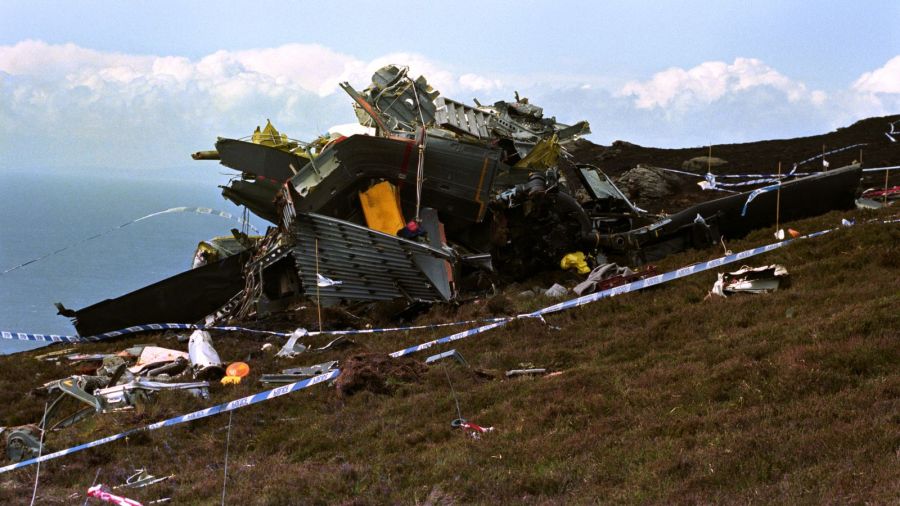
A group mainly of relatives of the deceased are seeking an official inquiry into the Chinook helicopter crash at the Mull of Kintyre, Scotland in 1994 killing 25 intelligence experts and four special forces crew on their way to a conference.

The crash wiped out almost all the top officers in command of intelligence gathering and operations in the occupied Six counties of Ireland from MI5, Army, RUC Special Branch and state Security Service.
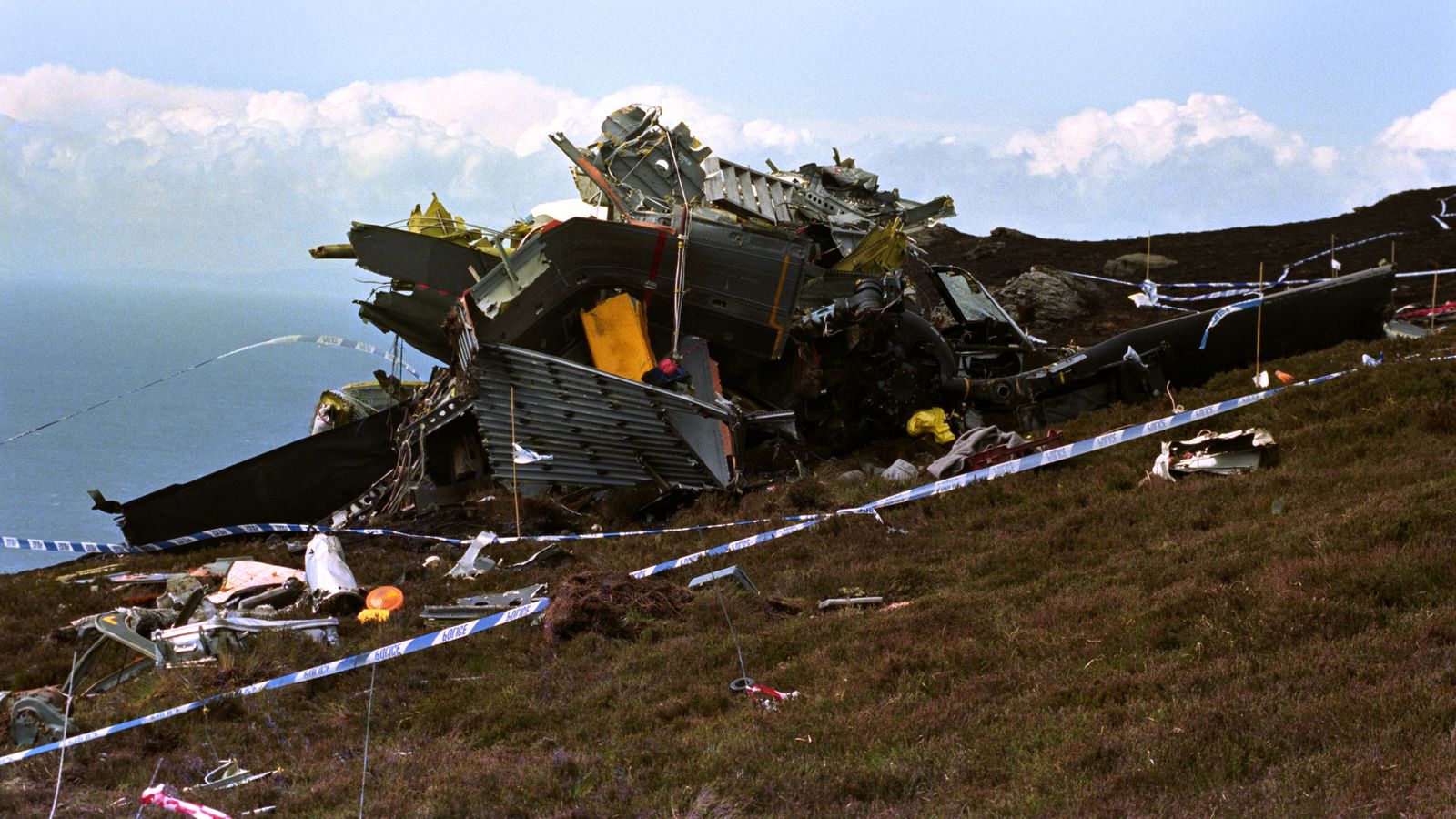
Photo of the crashed Chinook helicopter on the Mull of Kintyre 1994. (Photo: Sky News)

The first crash inquiry failed to confirm pilot error which was then overruled by State reviewers who blamed the pilots on the basis of supposition without any evidence. After campaigning by a number of people including families of the deceased pilots, a 2011 inquiry exonerated the pilots.

The current campaign wants to focus on questions as to the reliability of the aircraft but an alternative and darker interpretation developed at the time, alleging that the different departments of British spooks, MI5 and MI6 had a fatal falling out over territory and policy.1

The remit of MI5 is of domestic ‘UK’ matters while that of MI6 is external. However, the Six Counties, though being under the rule of the UK, was also geographically part of a foreign country, Ireland — and the Irish State, just across the border, a government foreign to the UK.

In addition, the Republican armed resistance groups frequently had contacts abroad and many people with connections to other resistance organisations in the world; both parts of Ireland were visited by representatives along with many media agencies in the pursuit of their reporting work.

Whereas a resort to assassination as a result of rivalry or difference in objectives between different arms of a state’s security service is no doubt extreme, the existence of the rivalry itself is quite likely and the stakes in terms of funding, staffing and operational management can be high.

If the rivals are working towards opposing ends, that will raise the stakes much higher. The secrecy of the State’s reaction to the event did nothing to dispel such theories and the mismanaged attempt to blame the pilots only lent added credence to such suspicions and belief.

The fact of the collusion of British secret service with Loyalist murder squads in the 6-Counties colony is well known and has been documented by a number of investigations. Such collusion from the Royal Ulster Constabulary, especially its Special Branch, is well known too.2

Quite a few familiar with the British colonial security forces in the Six Counties believe that there was an ‘inner force’ inside the RUC with the support of MI5 and British Army Intelligence, all colluding with or even managing assassinations and Loyalist sectarian murder gangs.

The British ruling class had set their sights on achieving the cooperation of the Provisionals in a pacification process and MI6 was in favour of this initiative. It is posited that MI5, the Inner Force inside RUC and Army Intelligence opposed this, believing that they could defeat the IRA.

It was the clash of these radically different approaches (albeit with the same ultimate objective of ending Republican armed resistance) that is believed by some to have culminated in the assassination of the anti-pacification section in the Mull of Kintyre crash.

We may never know for certain and the Ministry of Defence (MoD) sealed key files relating to the 1994 Mull of Kintyre Chinook crash for 100 years, locking them away until 2094

‘HEROES’?

Sorcha Eastwood calls those who died ‘heroes’,3 confirming herself and the Alliance political party she represents as on the side of British colonialism and its violent repression of Irish resistance, repression in the forms of internment, no-jury trials, assassinations and sectarian murders.

Those features are the reality of colonial repression and were very much in evidence in the colonial war of three decades which was approaching an end at the time of the crash.

The leadership of the Provisionals had accepted that although they could not be beaten, nor could they win the war4 and so were ready to participate in a pacification process.

British Intelligence had compromised or recruited elements of that leadership at highest and medium levels and had targeted assassinations of the less malleable individuals.5 The leadership was heading for the process culminating in the Good Friday Agreement of 1998.

Up to 3,500 people had died violent deaths 1969-1994 as the hands of of British military, colonial police, colonial proxies and Irish Republican resistance.

There were no tears shed for the dead at Mull of Kintyre among the subjected population of the colonial entity nor in many quarters of the Irish community at home or abroad and resistance culture soon produced a dark mocking parody to the air of Paul McCartney’s ‘Mull of Kintyre’ song.6

Confirmed assassination and suspicious deaths by aircraft crash are not unknown, among UN Secretary-General Dag Hammarskjöld’s 1961 plane crash on his way to negotiate peace in the Congo,7 General Zia-ul-Haq8 and commander of Russian mercenary force Yevgeni Prigozhin.9

end.

Note: If you found this article of interest, why not register with Rebel Breeze for free, so that you will be notified by email of subsequent articles. You can de-register any time you wish.

FOOTNOTES

SOURCES

https://www.breakingnews.ie/ireland/truth-being-withheld-over-raf-chinook-disaster-families-say-1907193.html
https://www.theguardian.com/uk/2000/jun/14/northernireland.comment

1What is more often but inaccurately called ‘the Irish peace process’; inaccurate because it was not designed to address the underlying reasons for the conflict and approaching three decades later has not done so. It resulted in The Good Friday Agreement, signed in 1998.

2See for example the Stevens Inquiries, Barron Tribunal, Dirty War by Martin Dillona (1990), also Lethal Allies (2013) by Anne Cadwallader.

3https://www.breakingnews.ie/ireland/truth-being-withheld-over-raf-chinook-disaster-families-say-1907193.html

4The war against a major imperialist power was concentrated in a territory one-sixth of Ireland and with a population divided along sectarian lines.

5See the cases of Denis Donaldson and Scappaticci (British Intelligence code name Stakeknife) for example and there are well-founded suspicions of a number of others that were never publicly exposed. See also the elimination of Volunteers Jim Lynagh and Padraig McKearney and their unit in the Loughgall Ambush/ Massacre.

6‘Mull of Kintyre, oh Brits falling into the sea’ etc

7https://www.un.org/en/delegate/63-years-later-mystery-still-surrounds-death-dag-hammarskj%C3%B6ld

8https://www.latimes.com/archives/la-xpm-1988-08-25-mn-1417-story.html

9https://www.theguardian.com/world/2023/oct/05/hand-grenade-explosion-caused-plane-crash-that-killed-wagner-boss-says-putin

LEARNING FROM AND CORRECTING OUR MISTAKES

Diarmuid Breatnach

(Reading time: 6 mins.)

In all areas of endeavour and no less in revolutionary work it is essential to review our actions (and those of others) periodically in order that we may draw lessons to improve the success of future activity.

Irish history provides an abundance of material to revise.

The most recent period worthy of intensive review in my opinion is the three-decade war, mostly in the Six Counties but also having repercussions within the territory of the Irish State, in Britain and even further abroad.

An article in the July issue of An Phoblacht Abú1, monthly hard-copy newspaper of the Anti-Imperialist Action organisation, discusses the psychological and organisational problems arising from the way that three-decade struggle came to an end and its effects on the resistance movement.

That period in Ireland commenced with a struggle for democratic civil rights, not one of the demands of which were for more than was already well established in the rest of the ‘UK’. But it soon changed into a guerrilla war with huge numbers of political prisoners and jail struggles.

The movement experienced a number of splits and changes of leadership but for most of of the time it was led by the Provisional organisation’s leadership although changes took place inside its own leadership too.

Ruairí Ó Brádaigh, President Provisional Sinn Féin 1970-1983, speaking at GPO rally 1976. He led an unwinnable war. (Photo cred: Pat Langan/ Irish Times)
Some of the Provisional IRA leadership following the 1970s split: Martin McGuinness, Dáithí Ó Conaill, Sean Mac Stiofáin, IRA press conference 1972, Derry. (Photo cred: Larry Doherty)

The period ended with that leadership not only abandoning armed struggle but being coopted with its structures into joint management of the colonial occupation and preparing for joint management of the neo-colonial Irish state, a number of smaller splits in the movement a much disillusion.

The An Phoblacht Abú article concentrates on building or rebuilding trust in leadership through measures such as clear communication, discussion, organisational restructuring, collective solidarity, open discussion, transparent communication and education.

The article does not say this but in my opinion one of the basic educational needs is to acknowledge that in the circumstances, what happened was inevitable (and to consider how different circumstances might be constructed in future).

UNWINNABLE

It is essential in my view to acknowledge that the struggle, as it was waged, was bound to lose. Yes, unwinnable: an unassisted armed struggle against a world imperialist power fought primarily in one-fifth of our territory where the population is deeply divided – how could we think otherwise?

Clearly, the Provisional leadership did think otherwise. Assuming they were not insane or very stupid, on what could their belief have been based?

I can see only two rational possibilities:

1) They believed the British had no essential need to retain the 6-Co. Colony and would abandon it if put under enough pressure, or

2) that the Irish ruling class, through its government, would step in and join the struggle.

If they believed the first, their analysis was not historically-based. Since its invasion and occupation of Ireland in the mid-12th Century, the British ruling class has repeatedly gone to enormous efforts to suppress Irish self-determination.

When they had the opportunity to leave in 1921 they had cultivated a client bourgeoisie, then instigated a civil war and partitioned the land, leaving themselves a firm foothold in the country.

Their initial response to a call for simple civil rights in the late 1960s was violent suppression on the streets, abolition of habeas corpus and introduction of internment without trial – and army massacres.

If the previous lessons of history were not clear to the movement’s leadership, then those events up to 1972 should have made them crystal clear.

If the Republican leadership believed the Irish ruling class would step up, they failed to draw the lessons of history since at least 1921 and to understand the neo-colonial nature of the Gombeen class, amply illustrated in the preceding 50 years of the Irish State.

As embarked upon and fought, the war could not be won but a struggle was potentially winnable.

However, to have a chance of winning, the struggle would have to be over the whole 32 Counties. And to engage the maximum number of people, it would have to take up the social, cultural, economic and political deficits across the Irish state and across the colony.

The social rights of women and LBG2 people were widely-acknowledged deficit areas, yet the Republican movement did not seriously address them. Of course, doing so would have put the Movement in direct opposition to the Catholic Church hierarchy and its followers.

Why should that be a problem? Hadn’t the Hierarchy been pro-British occupation since the late 1800s3 and anti-Republican since the 1790s? Wasn’t it one of the cornerstones of the neo-colonial Irish State, its social prop and social control mechanism?

Yes but the problem was that some of the leadership themselves were in that ideological ambit and were in any case afraid to disaffect many of their followers. A natural fear, of course. Yet only in that way could the struggle go forward across the Irish state’s territory.

It was left to campaigners mostly outside the Republican Movement, including social democrats and liberals, to fight for the rights to contraception, divorce, equality for women, LGB rights. And later, to take on the huge institutional abuses of the Catholic Church in Ireland.

Those issues affected directly well over half the population of the Irish state and the the leadership lacked the interest or the courage4 to take part in their struggles, never mind lead them, which it left to mostly non-revolutionary leaderships.

There were many other issues that affected people in the 32 Counties which a revolutionary leadership could take up and, I would argue, should have taken up.

The latter includes emigration, rights of the Irish diaspora (particularly in Britain), foreign penetration of the Irish economy, foreign land ownership, housing shortage, industrial struggles, academic freedom, Irish language rights, Church control of education and the health service …

Some of those issues were taken up for a while by the movement in parts of the 26 Cos. prior to the split in the Republican Movement but were progressively dropped as the armed struggle in the 6 Cos. took off.

When years later the Provisional leadership got interested in social democratic reformism, they found they could hardly make any headway in the unions against the Labour Party and the remains of the Workers’ Party – because of the Provos’ earlier overwhelming neglect of that area of struggle.

SUMMARY

The struggle in the Six Counties could not be won precisely because it was primarily confined to that area and also one in which a powerful enemy had seduced a huge section of the population.

When the leadership acknowledged the unwinnability of the struggle as being waged, instead of changing their methods and aims of struggle to take in the whole 32 Cos, they decided on capitulation and getting the most possible out of it for themselves.

A change in the top leadership of Sinn Féin and the IRA: Gerry Adams and Martin McGuinness photographed in 1987. They recognised they could not win and set about managing abandoning it while getting something out of the system for the leadership. (Photo: PA)

The leadership of the Republican movement was unwilling to widen the struggle because they believed that it was unnecessary to do so and/ or they were unwilling to overcome their own ideological indoctrination and/or lacked the courage to confront prejudices among their following.

Some of the social struggles have now been won or hugely progressed but without the leadership of the Republican Movement, in fact by leaderships of mostly reformist trends.

Due to leaving the industrial struggle to social democrats, the trade union movement has degenerated hugely and is in a poor state to take on any substantial economic or rights struggle, to say nothing of a revolutionary one.

The surviving Republican movement seems unwilling to acknowledge those historical facts and its failure thus far in leadership. Admission of the facts is necessary in order to commence to repair the movement and to prepare for a struggle with a prospect of success.

End.

FOOTNOTES

1Page 9, entitled COMRADESHIP – GUARD AGAINST BETRAYAL; I intend to review the July issue of the newspaper separately some time soon.

2I have omitted the T from LGB because it is only comparatively recently that the transexual issue has gained wide acknowledgement, whereas the Gay, Lesbian and even Bi-Sexual issue were widely known about at the time under discussion.

3The Irish (settler) Parliament passed an act giving middle-class and higher Catholics the right to vote in 1793.

4Though no-one could fault their physical courage