BASQUE POLICE INJURE 94-YEAR-OLD WOMAN ON RAID TO CAPTURE BASQUE POLITICAL ACTIVIST IN GERNIKA

Diarmuid Breatnach (translation of material from Naiz and writing of article)

Julia Lanas Zamakola, 94 years of age, went shopping as usual in Gernika on Monday 15th December 2014 but ended up in hospital after the Ertzaintza, the Basque Police, raided the market to arrest a Basque political activist.
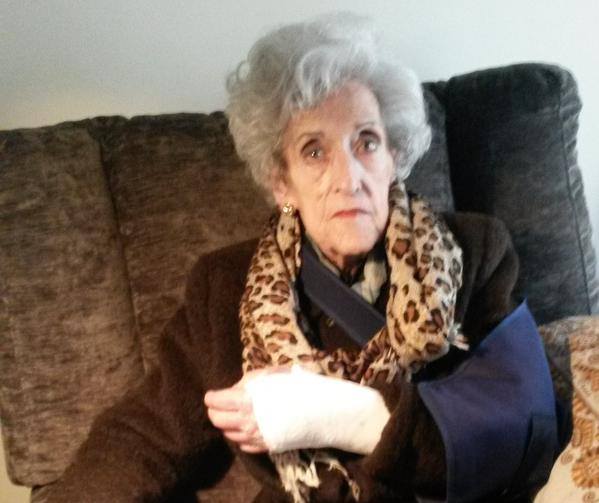
Julia Lanas, 94 years of age, struck and knocked to the ground by Basque police in raid to arrest a Basque activist in Gernika

Jone Amezaga, a young female activist of the Basque pro-Independence Left movement, had been sentenced to 18 months’ jail for allegedly hanging a banner which the State Prosecutor said “glorified terrorism”. Jone denied doing it and said the Ertzaintza, the Basque police, had framed her and declined to present herself to the authorities.

Many things are considered by the Spanish state to be “glorifying terrorism”, including putting up photographs of Basque political prisoners in a public place, bar, café or social centre.

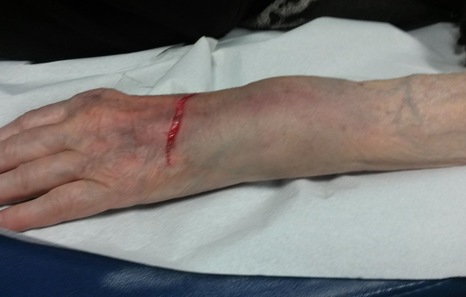
Elderly pensioner Julia Lanas said she had been pushed to the ground by the police during the raid. “My wrist was broken. It was an invasion, of terror. …. The Ertzaintza does not belong to the Basque (Autonomous) Government, they are nothing less than managers for imperial Spain.” “It reminded me of the Civil War,” she said and went on to say that she had survived the dictatorship (Franco’s) and the war and had relatives imprisoned and tortured.

Julia Lanas was given first aid by people in the crowd and then taken by ambulance to the Gernika hospital but they had to leave there because it was full. “There was a lot of solidarity” said Julia Lanas, referring to the crowd in support of Jone Amezaga and to the help she herself received. The 94 year-old woman was treated by the paramedics who then took her home and her son took her to hospital in Bilbao the following day. “The injury was from a telescopic baton,” she said.


94-year-old Basque woman Julia Lanas’ broken wrist and arm injury after police raid in Gernika
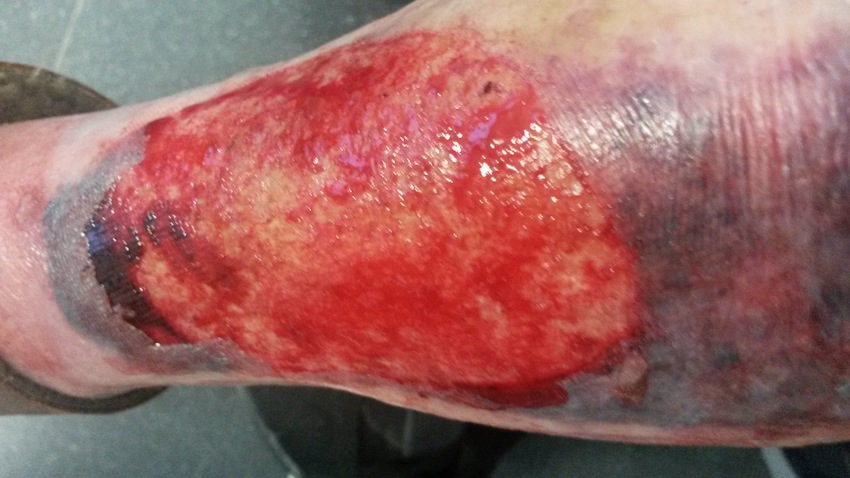
Julia Lanas’ injured leg after Basque police raid in Gernika


After a sustained tussle between uniformed and plain-clothes police and Jone Amezgaga, the Basque activist was taken prisoner by the Ertzaintza, some of whom used their batons on the crowd. Having secured their prisoner, the uniformed Ertzaintza then retreated backwards through the market, followed by the hostile crowd, until they gained the entrance, near to their vehicles and there stopped and faced their opposition.

Jone and her supporters had been expecting the police raid. In 2008 the Abertzale Left, the mass collective of organisations of the Basque pro-Independence Left, announced that they would henceforth use only peaceful methods in pursuit of their goal of self-determination, and the armed organization ETA subsequently declared their “permanent ceasefire”. The Spanish state’s response was to continue its repression of the movement.

The youth section of the Abertzale Left sought to find an appropriate method of resistance and developed the “human wall”. Some of the youth movement activists who had been sentenced by the State, instead of surrendering to the authorities or going “on the run”, presented themselves in public places, surrounded by supporters. The police – always the Basque police except in Nafarroa but sometimes backed by the Guardia Civil – then were obliged to spend a long time pulling people out of the “human wall” before reaching their quarry.

The first of these “human wall” resistance acts was at Donostia/ San Sebastian in April in 2013 when 500 mostly youth surrounded the six youths convicted of membership of SEGI, the Abertzale Left youth organization. SEGI is classed as a “terrorist organization” by the Spanish state and by the EU despite not a single conviction, even in Spanish courts, of an act of violence by the youth organization. The Donosti human wall was followed by another a month later on the bridge at the port of Ondarroa, when hundreds sat, arms linked, between Urtza Alkorta and the Ertzaintza. In October 2013 in Iruňa/ Pamplona, the Policía Nacional of the Spanish state had to dismantle another human wall of resistance to get at Luis Goňi, another youth convicted of SEGI membership. Last year there were two, one in Loiola (Azpeitia) for five youths and the one in Gernika. These “human walls” have now been constructed in three of the four southern Basque provinces (see video links below): Bizkaia, Gipuzkoa, Nafarroa – only Álava has yet to have one. Jone Amezaga’s arrest was the fifth occasion of the use of the “human wall” in the Basque Country and the second in the province of Bizkaia.

Amezaga, who refutes the charge and the police “evidence’ of “glorification of terrorism”, has been refused permission to remain at liberty while her appeal is being considered. Also it has been the custom of the Spanish state, in cases where the sentence is less than two years, for the convicted not to be taken to jail. The state declined to apply this custom in Amezaga’s case.
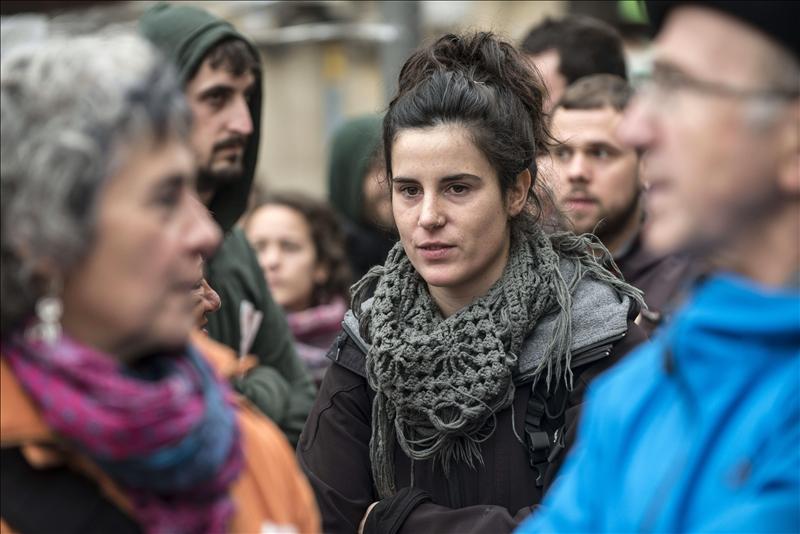
Jone Amezaga surrounded by supporters in Gernika prior to police raid


That Monday morning of the 15
th December in Gernika, the town containing the ancient meeting place of the Basque chiefs and victim of the infamous bombing by Franco’s German bombers during the Civil War, the stalls were set out for the weekly market as usual. However, a number of events of a political nature also took place and the town was draped in the orange colours of LIBRE (“free” in Spanish), an organization created in 2013 to expose and resist Spanish state repression. Around noon, Jone made her appearance, no doubt marked by undercover police and soon afterwards the police raid took place.
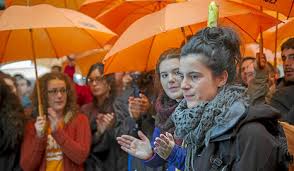
Jone Amezaga surrounded by supporters with orange (LIBRE's colour) umbrellas prior to police raid in Gernika
Jone Amezaga surrounded by supporters with orange (LIBRE’s colour) umbrellas prior to police raid in Gernika


It was plain-clothed police who led the assault, a number of individuals, some seen in the video dressed in black-and-white tops and one in a green top. There is no evidence of their identifying themselves by display of their police cards, for example, but it is clear that Jone’s supporters are in no doubt as to who they are. The Ertzaintza, masked and helmeted, in their red-and-black uniforms soon join the fray and eventually Jone is taken into custody. The crowd chants partly in Castillian and partly in Basque: “Jone libre!” (Free Jone!); “Guard dogs of the System!” “Hired killers!” “Abuse of power!”
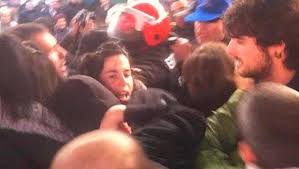
Jone Amezaga's face in the midst of the battle as supporters try to block the police arrest, 15 Dec 2014
Jone Amezaga’s face in the midst of the battle as supporters try to block the police arrest, 15 Dec 2014

While awaiting her appeal hearing, a wait which can take many months, Jone may be kept in any of the many prisons across the Spanish state (or across the French state, for those arrested there) throughout which political prisoners, most of which are Basque, are dispersed. She may also be transferred without warning to yet another jail. All this places an enormous strain on the visiting relatives and friends of such individuals — a financial, organizational, emotional and physical strain. And of course there are those who through infirmity are unable for journeys of thousands of kilometres. A number of serious traffic accidents occur on those journeys every year and to date twelve Basque prisoners’ relatives and friends thave lost their lives in those accidents..

End.

Links:

Photo Basque police injury to 94-year-old woman arm Gernika raid: http://www.naiz.eus/media/asset_publics/resources/000/134/771/news_landscape/emakumea_zauria.jpg?1418662774

Photo Basque police injury to 94-year-old woman leg Gernika raid: http://www.naiz.eus/media/asset_publics/resources/000/134/772/original/zauritua.jpg

Video police battle with crowd to capture Jone Amezaga – plainclothes police first Dec2014: https://www.youtube.com/watch?v=YXK9RqGry9Y#t=325

Video police battle with crowd to capture five youth Loiola Sep2014: https://www.youtube.com/watch?v=ulFkBGNE2_A

Video police battle with crowd to capture five Luis Goňi Oct2013: https://www.youtube.com/watch?v=TmRb0Nd3jxQ

Video police battle with crowd to capture Urtza Alkorta on Bridge Ondarroa May2013: https://www.youtube.com/watch?v=ar5FaKwr8L8

Video police battle with crowd to capture five youth Donosti April 2013: https://www.youtube.com/watch?v=dRd4JlbaD08

POLITICAL PRISONERS – are they really “part of the solution”?

Political prisoners
Political prisoners
Diarmuid Breatnach

Campaigners fighting for the release of individuals or of small groups of prisoners do not usually make the case that the release of those specific prisoners will affect the macro issues which led to their activism and encarceration. This has occurred on a number of occasions, however, those of Nelson Mandela in South Africa, the Kurdish PKK leader Ocalan and Basque movement leader Arnaldo Otegi being cases in point.

However, when the numbers of prisoners is large, their release is often connected by the campaigners to the objective of resolution of the conflict.

 The line often taken is that “the prisoners are (or should be) a part of the resolution of the conflict” or that “release of prisoners is necessary to create goodwill” or “to win support for the resolution process”. These lines emerged here in Ireland, in Palestine, South Africa and in the Basque Country; they form part of a popular misconception, all the more dangerous because of its widespread acceptance and seductiveness.

At first glance this kind of line seems reasonable. Of course the political activists and the prisoners’ relatives, not to mention the prisoners themselves, want to see the prisoners home and out of the clutches of the enemy. The prisoners should never have been put in jail in the first place. And all the time they have been in the jail has been hard on them and especially on their relatives and friends. An end to the conflict is desirable and so is the release of the prisoners.

But let us examine the proposition more carefully. What is it that the conflict was about? In the case of the recent 30 years’ war with Britain, it was about Britain’s occupation of a part of Ireland, the partition of the country and the whole range of repressive measures the colonial power took to continue that occupation. In the case of the Basque pro-Independence movement, it was also about the partition of their country, occupation and repressive measures (particularly by the Spanish state). But what was the fundamental cause? In each case, occupation by a foreign state.

OK, so if Britain and the Spanish state ended their occupations, that would end the conflicts, would it not? It would end the anti-colonial conflicts – there would be no British or Spanish state forces for Irish or Basque national liberation forces to be fighting; no British or Spanish colonial administration to be issuing instructions and implementing repressive measures. Other struggles may arise but that is a different issue.

So, if Britain and the Spanish state pull out, leave, those struggles are over. What do prisoners have to do with it? They are obviously in that case not part of the solution, which is British or Spanish state withdrawal – though their release should be one of the many results of that withdrawal. Prisoners may well be part of rebuilding a post-conflict nation but that is a different issue. They are not part of “the solution”.


PART OF THE PACIFICATION

As pointed out earlier, here in Ireland it was said that “the prisoners are part of the solution” – and most of the Republican movement, some revolutionary socialists and some social democrats agreed with that. And British imperialism and most of Irish capitalism agreed too. But what happened? Only those Republican prisoners who agreed with the abandoning of armed struggle and signed to that effect were released. And they were released ‘under licence’, i.e. an undertaking to “behave” in future. And as the years went by, a number of those ex-prisoners who continued to be active mostly politically — against the occupation, or against aspects of it like colonial policing, had their licences withdrawn and were locked up. Some who had avoided being prisoners because they were “on the run”, or had escaped – many of those, as part of the Good Friday Agreement, had been given guarantees of safety from future arrest but this too, it soon became apparent, could be revoked.

 In other words, the prisoners’ issue became part of imperialism’s ‘peace’ or, to put it more bluntly but accurately, part of imperialism’s pacification. The issue also became part of the selling of the deal within the movement, on one occasion prisoners being released early, just in time to make a grand entrance at a Republican party’s annual congress.

The release of prisoners can be presented by those in the movement supporting pacification as evidence of the “gains” of the process. Those who argue for the continuation of the struggle then find themselves arguing not only against those who pushed the pacification process within the movement but also against some released prisoners and their relatives and friends.

THEY ARE NOT LEAVING

 And prisoners continued to be hostages for the “good behaviour” of the movement. If British imperialism had left, there would have been no cause for the anti-colonial struggle to continue – so why would there be any need for any kind of release ‘under licence’ or any other kind of conditional release? Besides, the British would not be running the prisons in the Six Counties any longer. But the British are not leaving, which is why they need the guarantees of good behaviour.

Suppose the British were serious about leaving, sat down with the resistance movement’s negotiators and most details had been sorted out, including their leaving date in a few weeks’ time say, what would be the point for the British in trying to hang on to the prisoners? Can anyone seriously believe that they would take them with them as they left? If perhaps they had some in jails in Britain and were trying to be bloody-minded and hanging on to them there, well of course we’d want our negotiators to put as much pressure on the British as they could to release those as well.  It would be in the interests of British imperialism to release them but the reality is that the anti-colonial war would be over, whatever ultimately happened to those prisoners.

In South Africa and Palestine, the prisoners’ issue became part of the imperialist pacification process too. It did not suit the imperialists to have numbers of fighters released who would be free to take up arms against them again. So in South Africa, they were incorporated into the “security forces” of the corrupt new ANC state, forces the corruption and brutality of which were soon experienced by any who argued with them or opposed the policies or corruption of the ANC, NUM and COSATU leadership – including the two-score striking miners the “security forces” murdered over a couple of days at Marikana in 2012.

 In Palestine, the prisoners also became part of the “security forces” of Al Fatah after the shameful agreements at Madrid (1991) and Oslo (1993). The level of corruption of the Al Fatah regime and their “security forces” became so high that in order to oust them, in 2006 the largely secular Palestinian society voted for a religious party, the opposition Hamas. And then the “Palestinian security forces” took up arms against Hamas in order to deny them the fruits of their electoral victory. Unfortunately for them, Hamas had arms too and used them.

In both those countries, the occupiers had no intention of leaving and so it was necessary for them, as well as using the prisoners as bargaining chips, to tie them in to a “solution”. In fact, many of the prisoners became “enforcers” of the “solution” on to the people in their areas, i.e pacifiers in imperialism’s pacification process.

Teased out and examined in this way, we can see not only that the prisoners are NOT “part of the solution” but that accepting that they are plays right into the hands of the imperialists as well as facilitating their agents and followers within our movement, within our country.

Political prisoners, as a rule, are an important part of the struggle and need our solidarity. But for anti-imperialists, prisoners are not “part of the solution”, to be used as hostages for a deal with imperialism, even less as enforcers of a deal, forcing it upon the colonised people.

Our call, as anti-imperialists, without conditions or deals, is for the prisoners to be released and, while they remain in prison, to be treated humanely. We also call for them to be recognised as political prisoners. With regard to the solution to the conflict, there is only one: Get out of our country!

POSTSCRIPT:

The organisation representing relatives and friends of Basque political prisoners is Etxerat http://www.etxerat.info/. A separate organisation concentrating on campaigning, Herrira, has suffered a number of arrests and closure of offices by the Spanish state in 2013 and is under threat of outright banning.

Regrettably, I cannot give a similar link for Irish Republican prisoners, because of the existence of a number of organisations catering for different groups of prisoners and often with tensions between them. One day perhaps a united non-aligned campaign will emerge, along the lines of the H-Block campaign of the past, or the Irish Political Status Campaign that arose in London after the Good Friday Agreement. There is also a non-aligned Irish Anti-Internment Committee (of which I am a part), campaiging for an end to long periods of incarceration imposed on political “dissidents” through removal of licence, refusal of bail or imposition of oppressive bail conditions.

end