COLONIAL PROXY MILITIAS, FROM IRELAND TO PALESTINE

Diarmuid Breatnach

Reading time main text: 5 mins.)

Currently the Palestinian Resistance is engaged in an important struggle to eliminate four Israeli-proxy militias. This type of militias of colonial and imperial powers have a long history, not least in Ireland from the 1800s to the present.

SETTLER AND NATIVE MILITIAS IN IRELAND

The British colonial occupation of Ireland had an army to quell native resistance but many settlers also organised themselves into armed bands (as in Palestine), such as the Hearts of Steel or Hearts of Oak in the late 18th Century in order to resist the big landlords.

The United Irishmen were successful in uniting a number of these, both native and settler bands such as the Whiteboys and Hearts of Oak, particularly in Antrim but the Peep O’Day Boys went mostly with the sectarian and royalist Orange Order.

The settlers also organised yeomanry militias which they labelled ‘Volunteers’, initially to defend against a feared invasion from Napoleonic France. Some of those contained Republican sympathisers and some quite the opposite.1

In response to the successful uniting efforts of the mostly Protestant-led United Irishmen, the Orange Order was founded by British loyalists and soon received official support in organising anti-Catholic pogroms and in exposing United supporters, especially among the Protestant communities.

LOW INTENSITY OPERATIONS AND “PSEUDO-GANGS”

During the three-decades war towards the end of the 20th Century mostly in the 6 Counties, the British Occupation also organised proxies such as the Ulster Volunteer Force and the Ulster Defence Association. These were recruited among the Protestant/unionist community.

But not only among civilians.

As has been a pattern among colonial possessions, the occupying power organised a gendarmerie, i.e an armed police force under central command of the occupying power. In Ireland that was the Royal Irish Constabulary which came to prominence in the suppression of the 1867 Fenian rising.

After the partition of Ireland by the British in May 1921, the RIC within the remaining direct colony of the Six Counties was renamed the Royal Ulster Constabulary2. British Intelligence used this force to channel intelligence, arms and recruits into the Loyalist gangs.

In addition, many members of the disbanded RUC’s semi-militia, the part-time B-Specials, were reorganised into the RUC Reserve of the colonial police or recruited into the British Army as the newly-formed Royal Ulster Regiment, from which the Loyalist militias could be supplied as before.

Brigadier Frank Kitson was a leading colonial counter-insurgency strategist who had served in Kenya and Malaya before he was sent to the Six County colony to coordinate the Loyalist militias and the official armed forces and gendarmerie, no doubt in coordination with MI5.

Kitson published Gangs and Pseudo-Gangs (1960) and Low Intensity Operations (19713) based on the experience of colonial resistance repression in Malaya and Kenya, going on to introduce these ideas organisationally in the occupation of the Six Counties.

Pseudo gangs give the occupying power deniability and, being generally from the occupied country,4 have local knowledge. They can carry on terrorism and assassinations at ‘a remove’ from the occupying power.5 In the case of criminal gangs, they have an existing organisation.

Such gangs may have family or other social relationships with some in the targeted community, introducing allegiances and communal fragmentation as has been occurring to some extent in Gaza. However, in Ireland, the gangs were all originating from the unionist community.

Frank Kitson (now Brigadier) in 1971 (Photo source: Internet)

Jeffrey Sluka summarises6 “… beginning in 1972, there has been a vicious, continuous campaign of sectarian assassination against Catholics in Northern Ireland waged by Loyalist paramilitary groups (the Ulster Defence Association [UDA] and Ulster Volunteer Force [UVF]) …

“… and their associated death squads (the Ulster Freedom Fighters [UFF], Red Hand Commandos, Protestant Action Force, etc.), who have killed nearly 700 innocent Catholic civilians – the largest category of casualties in the war.

“Thousands of other Catholics have survived Loyalist attempts to murder them.

“The existence of this campaign has never been publicly acknowledged by the British authorities, who have ignored it, downplayed it, and actively misrepresented it …

“… to influence the media and public in this regard, both at home and abroad, as an integral part of their counterinsurgency strategy.

“The official position of the British authorities is that there is no state terror in Northern Ireland, and certainly no death squads. When pressed, they admit that there is Loyalist terror against Catholics, but insist that they have nothing to do with it.

“When pressed with evidence such as the fact that hundreds of members of the Security Forces have been convicted of involvement with Loyalist paramilitaries, they claim that this collusion is informal – individual acts by rogue soldiers and policemen

“- and not a reflection of government policy or military strategy. All of these are political lies.”7

SEPOYS

The use of military forces recruited among the occupied people dates back further even than the Roman Empire and the British Empire used them extensively in India, where they called them ‘Sepoys’,8 which is what the Basque pro-independence people call the Basque Autonomous Police.9

In India, one of the most serious uprisings against British rule was sparked by a mutiny of its Sepoys.10

In Palestine, the ‘Zipaios’ equivalent are the police of the Fatah-controlled Palestine Authority. They are bad enough, brutally suppressing dissent, spying on and even attacking Palestine organisations in the West Bank, arresting and even killing critics.

The Royal Irish Constabulary in Ireland were a gendarmerie mostly composed of sepoys and of course there were many Irish regiments in the British Army and Irishmen also served in other British Army units, the Royal Navy and the Royal Air Force.

WORSE THAN SEPOYS

The militias in Gaza are however even worse. Based on criminal gangs and social groups, they have consistently looted aid trucks coming into Gaza before Israel closed all the gates, then selling the goods at high prices to the hungry population as Gaza starved and medicine became scarce.

According to reports there are currently four Zionist-linked militias in Gaza: Abu Shabab around Rafah in southern Gaza; Husam al-Astal in Khan Younis, Ashraf al-Mansi in Beit Lahia in the North, and Rami Heles in eastern Gaza.

Sourced from The Cradle based on Sky News investigation.

Their looting, supported by the Zionist state, was even used to try to blame on the Resistance, with Israeli spokespersons claiming that Hamas was stealing the aid. Conversely, as the Resistance strove to counter the proxy militias, the fighters were targeted by the Israeli Occupation Force.

Consequently it was almost impossible for the Resistance to suppress the proxy militias – until the current ‘ceasefire’. Now, able to operate to some extent more openly, the Resistance is settling accounts with the proxy militias. And it is very important that they do so.

Not only for what they have done, the plundering of emergency aid, attacks on displaced persons, torture and murder of famed journalist Salah al-Jafarawi.11 But because they are a serious infection, injected into Gazan society by the Zionazi occupation in order to cause serious harm to the society.

According to reports, undercover operatives of the Resistance have infiltrated the gangs and managed to appropriate a large number of weapons and vehicles of the gangs donated by the IOF or by the United Arab Emirates.12

Hamas advertised a truce for gang members to hand over their weapons and surrender themselves to the authorities, which some have done but many have not. The Resistance has operational clashes with the militias and has captured many. Some were publicly executed by gunshot.

Whether full-scale war returns to Gaza after this ‘ceasefire’ (full of IOF bombings, shelling and shooting) or not, their presence in Palestinian society cannot be tolerated, not by the civil government, nor by the broad community, nor by the armed resistance.

End.

Note: If you found this article of interest, why not register with Rebel Breeze for free, so that you will be notified by email of subsequent articles. You can de-register any time you wish.

APPENDIX:

A Sky News investigation has revealed that Israel is backing four Palestinian militias inside Gaza to weaken Hamas as part of what militia leaders call “Project New Gaza.” Hossam al-Astal, head of one of the groups, said the militias are coordinating their efforts to remove Hamas from power.

He claimed that Yasser Abu Shabab and Ashraf al-Mansi, leaders of other groups, have also joined the project. All four militias are reportedly positioned along the yellow line in areas under Israeli control.

Astal told Sky News his headquarters is only 700 meters from an Israeli military outpost and that an Israeli coordinator had agreed to establish a “Green Zone” free of shelling or gunfire. Footage reviewed by the outlet showed militia vehicles with Hebrew markings scratched off.

Astal admitted the group receives logistical support and ammunition from outside Gaza and has bought Hamas weapons on the black market. A senior fighter in the Abu Shabab militia also said Israel had enabled the smuggling of guns, cash, and vehicles.

The militias reportedly coordinate their movements with Israeli forces at Kerem Shalom to bring in supplies, while western powers are said to provide indirect material support. Two of the militia leaders are former Palestinian Authority security officers.

While the Mansi militia denied direct contact with the Israeli military, it acknowledged coordination with Israel’s District Coordination Office. Abu Shabab previously told Army Radio he was open to working with Israel, calling Trump’s ceasefire plan “a way to end the war.”

“Soon we will achieve full control of the Gaza Strip,” he told Sky News.

(Summarised by The Cradle online news updates on Telegram 26 October 2025).

FOOTNOTES

1The yeomanry militias deployed in Wexford, such as the North Cork, proved to be the most vicious and indisciplined of the Occupation’s forces and are noted in a number of songs in English and Irish:
“… He led us on against the coming soldiers,And the cowardly yeomen we put to flight…” (Boolavogue, Patrick McCall, 1898);

“… Is go gcuirfeam yeomen ag crith in a mbrógaibh
Ag díol a gcomhair ar Shliabh na mBan.”
(Sliabh na mBan, believed by Mícheál Óg Ó Longáin, 1798).

2Since then renamed the Police Service of Northern Ireland (sic).

3The same year that mass internment without trial was introduced by the British Occupation and that the Ballymurphy Massacre of protesting nationalist civilians was carried out by the Parachute Regiment.

4Sometimes even from the oppressed native community.

5They are more easily dispensed with too, should they be no longer needed or their relationship become too public.

6In his own chapter For God and Ulster: The culture of terror and Loyalist Death Squads in Northern Ireland in Death Squad: The Anthropology of State Terror, Ed. Jeffrey Sluka (200), USA.

7Excerpt from ibid, sourced in https://cain.ulster.ac.uk/issues/violence/docs/sluka00.htm

8The term in Persian originally denoted ‘soldier’ but borrowed into Urdu and Hindi and under British rule, denoted native soldiers and their units in the British armed forces.

9The Ertzaintza. The Navarran police (‘Forales’) could also be called ‘Sepoys’ but are more usually called by other uncomplimentary names.

10https://www.bbc.com/news/world-asia-india-40528129

11https://www.aljazeera.com/news/2025/10/12/palestinian-journalist-saleh-aljafarawi-shot-dead-in-gaza-city-clashes

12Weapons, warlords, and wasteland: Israel’s new strategy for Gaza

SOURCES

Weapons, warlords, and wasteland: Israel’s new strategy for Gaza
https://news.sky.com/story/revealed-the-plan-for-a-new-gaza-and-the-four-militias-israel-is-backing-to-defeat-hamas-13456416

IRISH STATE COLLUDED IN COVER-UP OF BRITISH INTELLIGENCE-ASSISTED DUBLIN BOMBING

Diarmuid Breatnach

(Reading time: 8 mins.)

On the 49th anniversary of the Dublin and Monaghan Bombings a number of speakers criticised the Garda closure of its investigation a mere four months after the bombing with the highest number killed in any one day of the 30 years war.

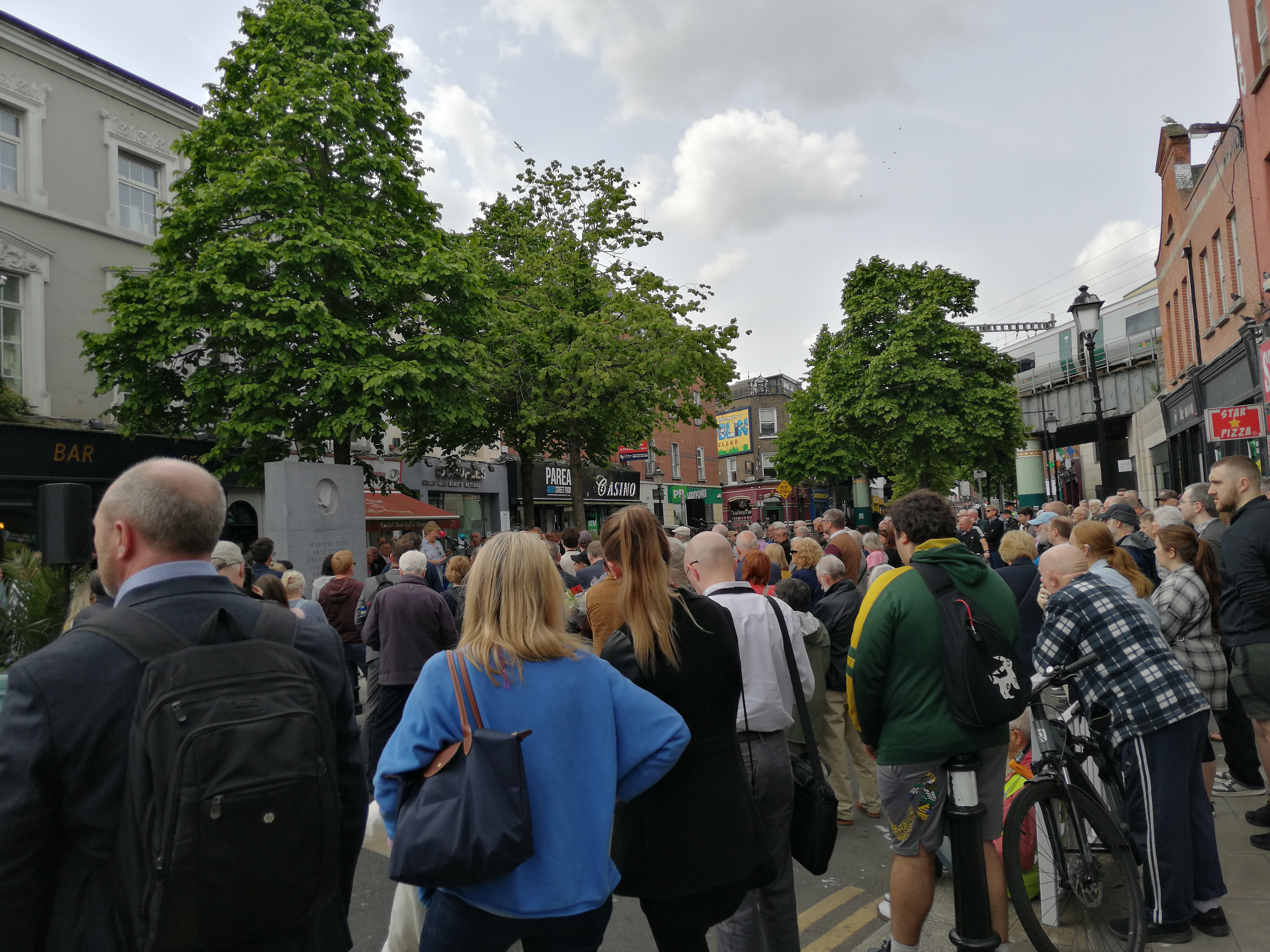
The criticisms were made on 17th May at the annual commemoration of the atrocity in Talbot Street, Dublin, organised by the Justice For the Forgotten campaign, held at the location of the memorial on the site of one of the bombings of that day.

The annual commemoration has been organised for many years by the Justice For the Forgotten campaigning group at the Talbot Street monument to the bombing1. It usually comprises reminiscences, poetry and music and a call for the British State to release its secret papers.

As of rote, an Irish Government Minister is invited to speak who routinely says how hard the Irish Government has been trying to get the British State to release the secret papers revealing the latter’s connection to those who carried out the bombing.

Years after the bombings, a British TV company (!) pointed the finger at the Ulster Volunteer Force, a British Loyalist paramilitary group but believed acting under British Intelligence agency direction, named some of those involved and a week later the UVF claimed responsibility.

In addition to British Intelligence, the British colonial police2 and British Army3 had been widely known to be working in collusion with Loyalists.

But few would have suspected Irish State collusion.

THE BOMBINGS AND AFTERMATH

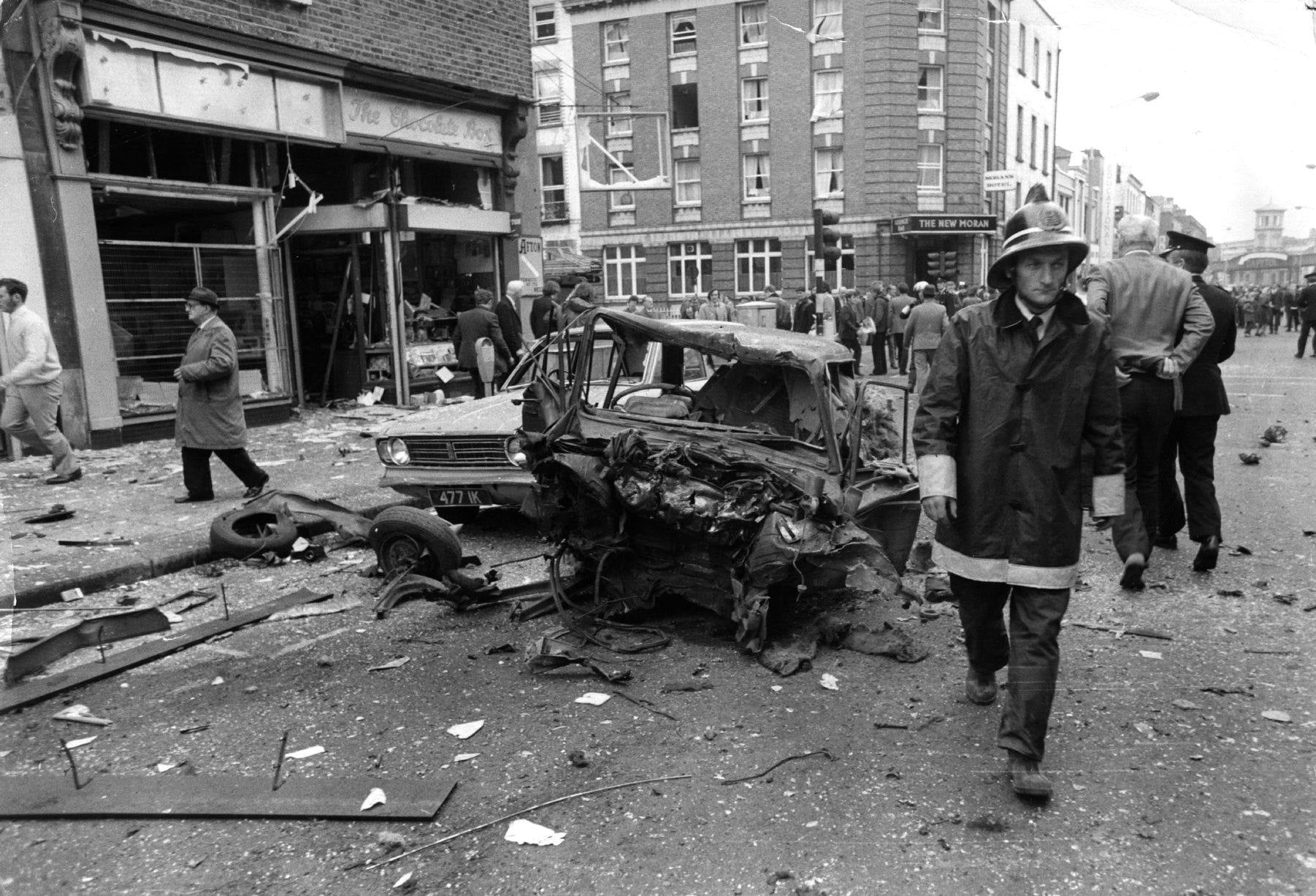
On 17th May 1974 three car bombs exploded without warning in crowded Dublin city centre streets and another in Monaghan town centre. Thirty-three people were killed along with a full-term baby and a miscarriage with around 300injured. No-one was ever even charged in relation to the atrocity.

Scene post-bombing in Talbot Street, the site where the Monument was erected later is out of shot to the right. (Photo sourced: Internet)

The intention, unlike that of many other city car-bombings in the Six Counties and in England, was clearly to cause maximum death and injury to civilians. The areas chosen in Dublin were full of shops with bus stops and 5.30pm was going home time from shopping and work.

And no warning was given.

In the course of the short Garda4 investigation, in macabre irony the remains of the exploded cars were sent for forensic examination to their very source: the Six Counties, i.e to the colonial police force (at the time, the RUC5). Unsurprisingly, nothing useful came back.

In a war that was already five years old (six years, if the civil rights marches are included) the collusion between the British colonial police and Loyalist paramilitary murder gangs was well known and collusion with the British Army widely suspected.

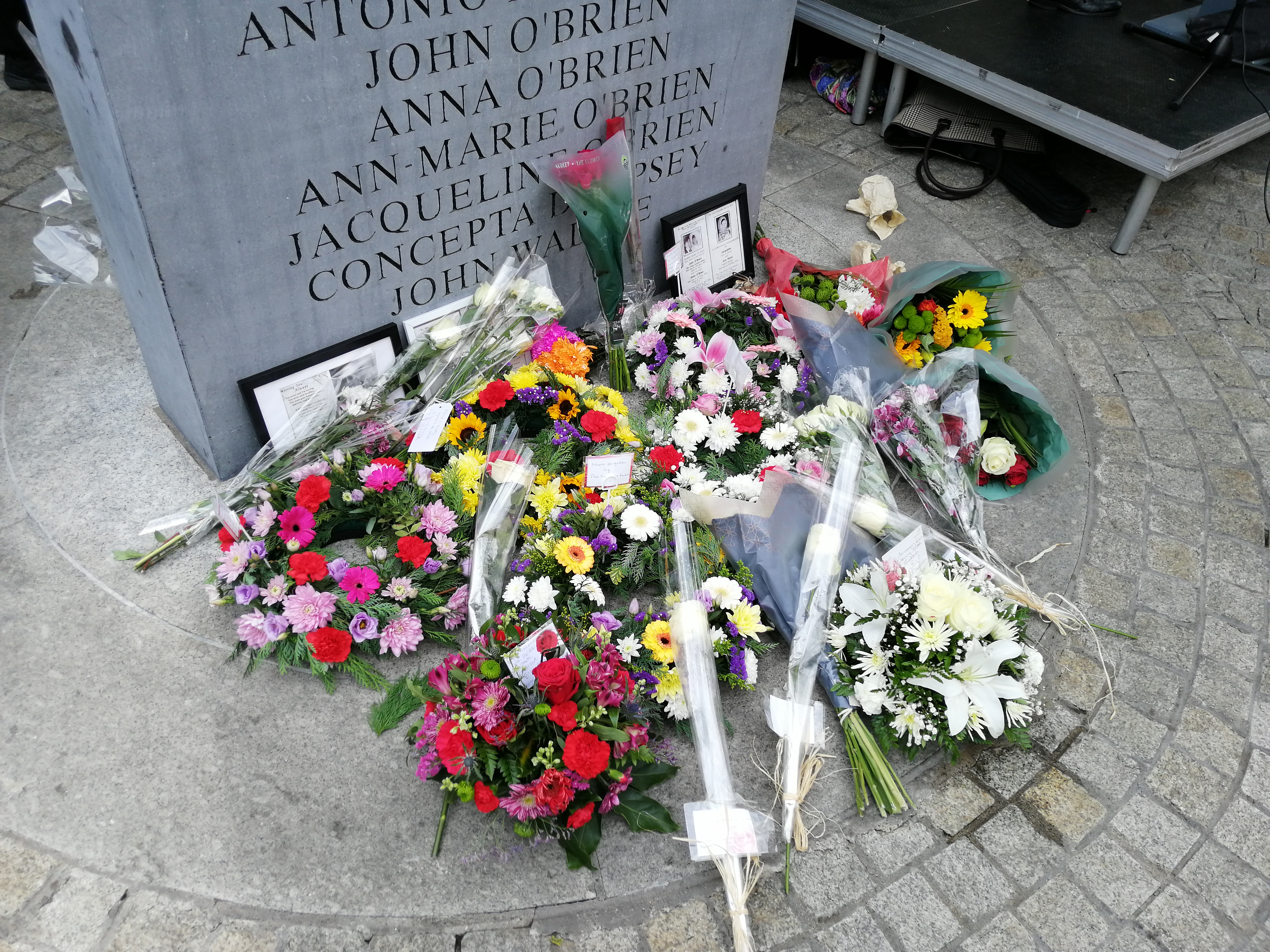
Floral tributes on the north face of the monument in Talbot Street. (Photo: D.Breatnach)
Floral tributes on the south face of the monument in Talbot Street. (Photo: D.Breatnach)

CAMPAIGN OF BOMBING DUBLIN

The Loyalist bombing of two cities in the Irish state in 1974, although by far the worst of the whole period, were not the first in Ireland, not even the first fatal ones.

In 1973 a Loyalist bomb in Dublin city killed Tommy Douglas and the year before that another killed George Bradshaw and Tommy Duffy – all were employees of Irish public transport state company CIE.

Even after the horror of 1974, on 29th November 1975, another a bomb at Dublin Airport killed John Hayes, a worker there.

And there were other earlier ones where no-one was injured, such as the blowing up of the Wolfe Tone monument just outside Stephens Green on 8th February 19716 and the Daniel O’Connell Monument in Glasnevin Cemetery (the round tower) in December 1971.

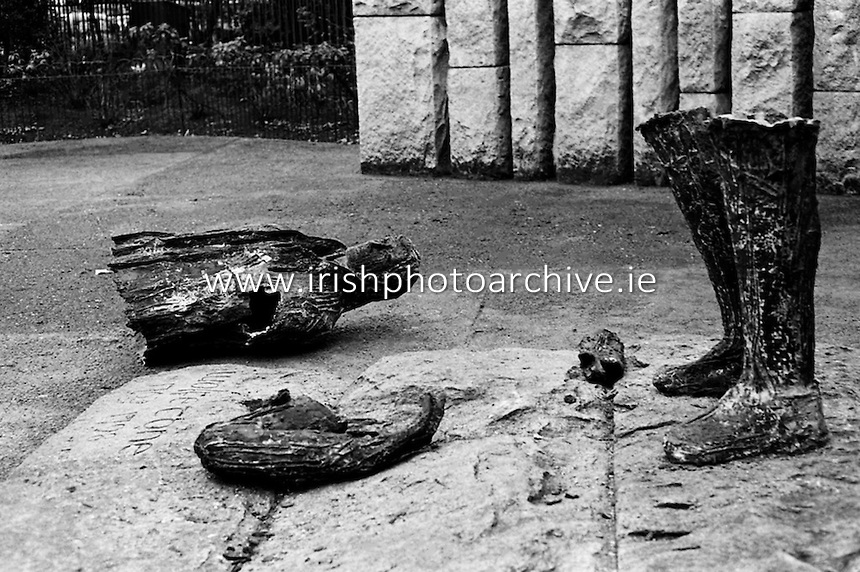
Pieces of the statue of Theobald Wolfe Tone on St Stephen’s Green. The statue was blown up by a loyalist bomb. A report at the time noted that ‘Huge slabs of the bronze sculpture were hurled 20 feet in the air’. 08/02/1971 (Photo sourced: Internet)
The O’Connell Monument in Glasnevin (round tower) seen here at sunset from the Botanic Gardens was a target of Loyalist bombing in 1971. (Photo: D.Breatnach)

If the Irish State had pursued investigations and cross-Border links after the earliest of those bombings, they might have headed off the carnage that followed later.

Not only did they not do so but in fact used the 1972 bombing to blame Irish Republicans so as to get an unpopular piece of repressive legislation through parliament, the Amendment to the Offences Against the State Act, along with the establishment of the no-jury Special Criminal Court7.

The Garda Commissioner at the time of the 1974 bombings was Patrick Malone and Ed Garvey, his Assistant Commissioner, was later exposed as a British Secret Service asset run by Fred Holroyd, a disenchanted British agent who revealed he had visited the policeman in his Dublin HQ.

Garvey, by then Commissioner, denied being a British agent and claimed no memory of the visit.

The Barron Report (2003) concluded that visit had undoubtedly occurred and that he had not informed his superiors, contrary to all rules regarding contact with agents working for a foreign government.8 When Fianna Fáil came into Government again, they sacked Garvey.

Since FF had not subjected him to a regular disciplinary process, probably in order to avoid the sordid story going public, Garvey was able to sue the Irish Government, win damages and ensure he received his former pension entitlements.

THE COMMEMORATION EVENT

Aidan Shields, who lost his sister Maureen in the bombing, chaired the event for Justice for the Forgotten and introduced its Secretary Margaret Unwin who, as all speaking or performing at the event seemed conscious that next year would be the 50th anniversary of the atrocity.

(Photo: D.Breatnach)

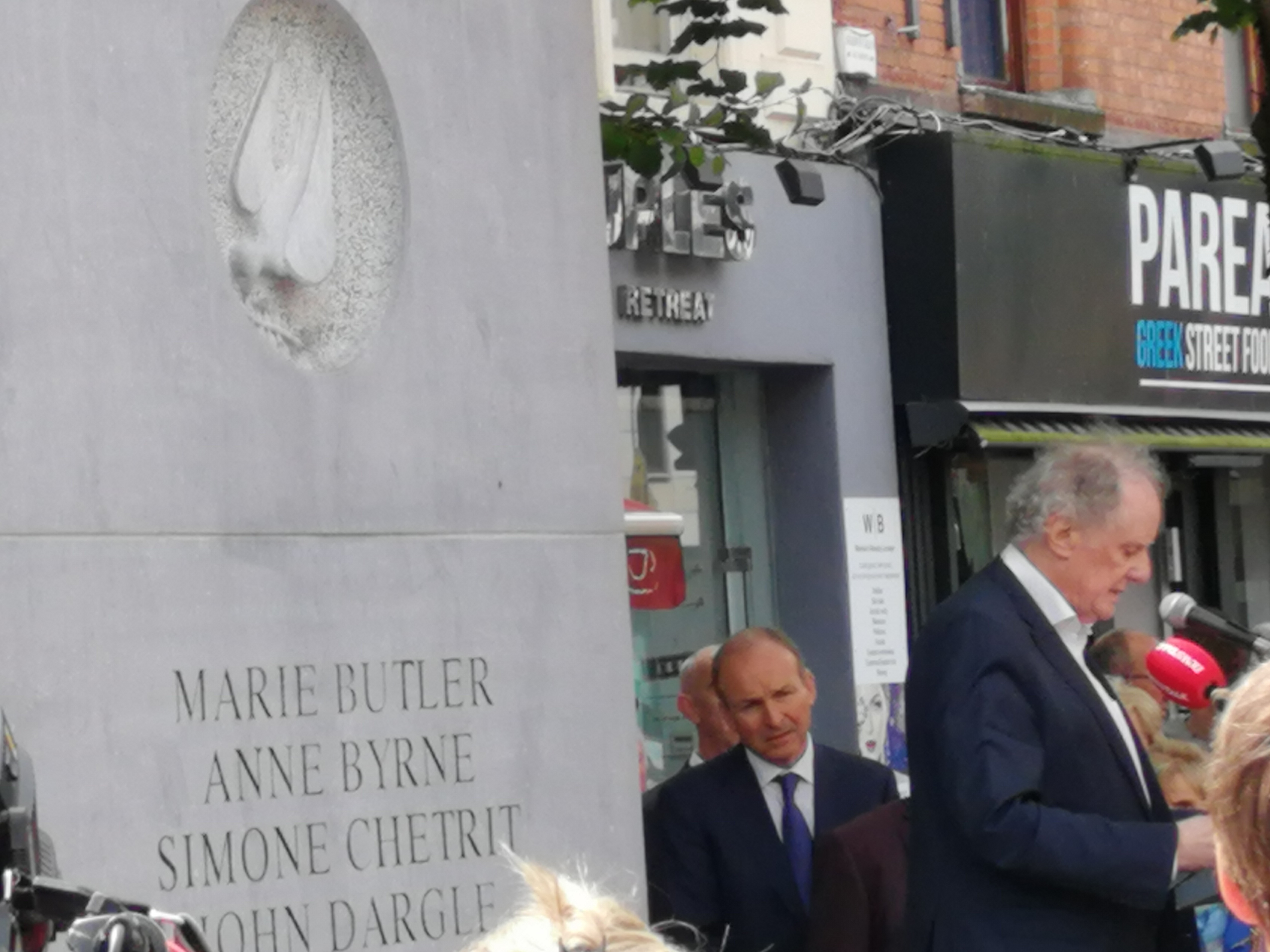
The regular Government slot was occupied by the current Tánaiste (Dep. Prime Minister) Mícheál Martin who, as has every Government representative since the JFTF commemorations began, claimed energetic diplomatic discussions for release of the papers with their British counterparts.

Martin also criticised the British Government’s widely-criticised intended legislation to prevent official investigations and trials regarding past crimes committed by British forces, while he simultaneously praised the British pacification process.

A young Italian woman played the theme from the Schindler’s List film and another air on violin. A visiting Italian couple had been killed in the bombing also but that was not mentioned when she was introduced.

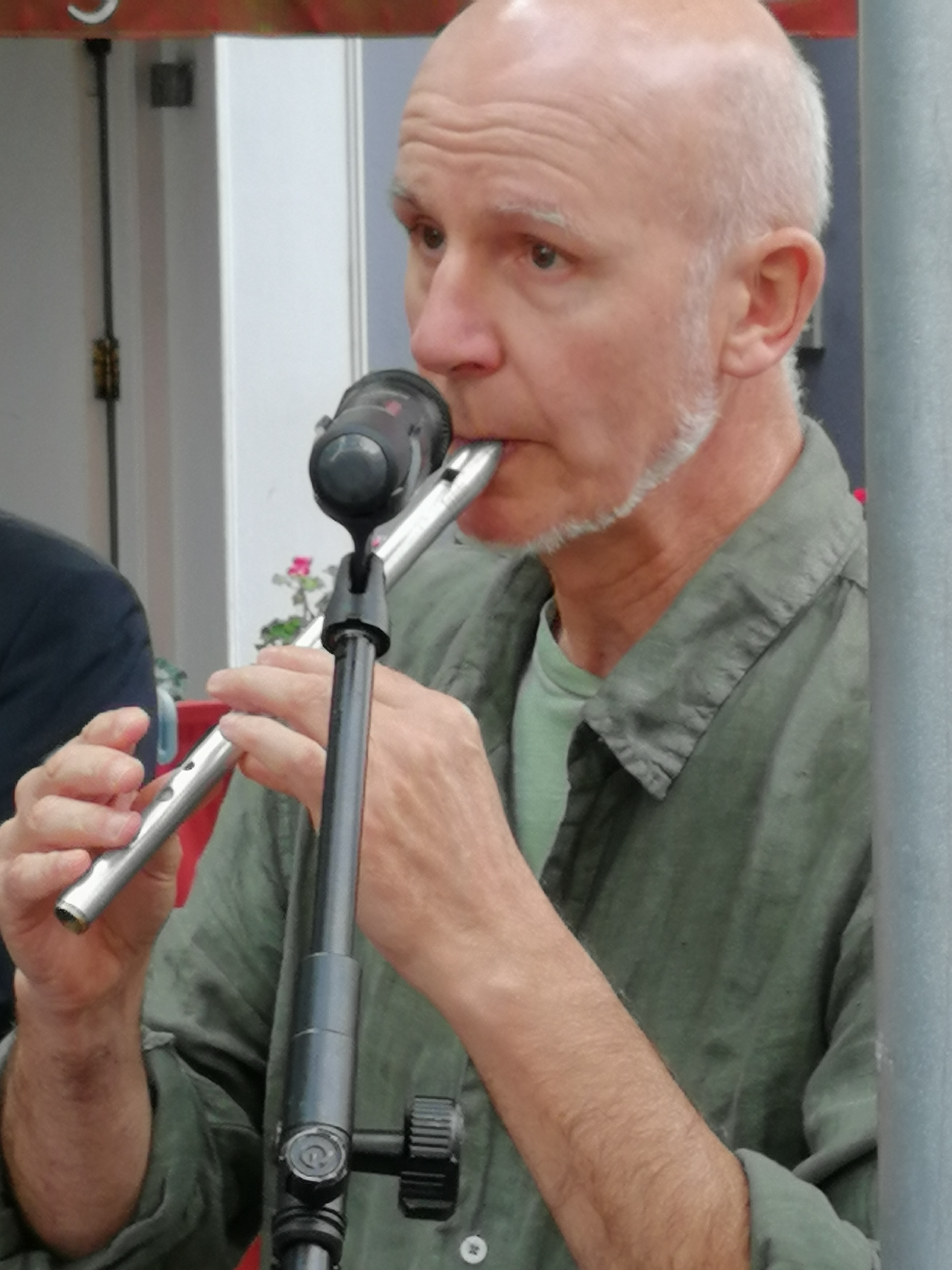
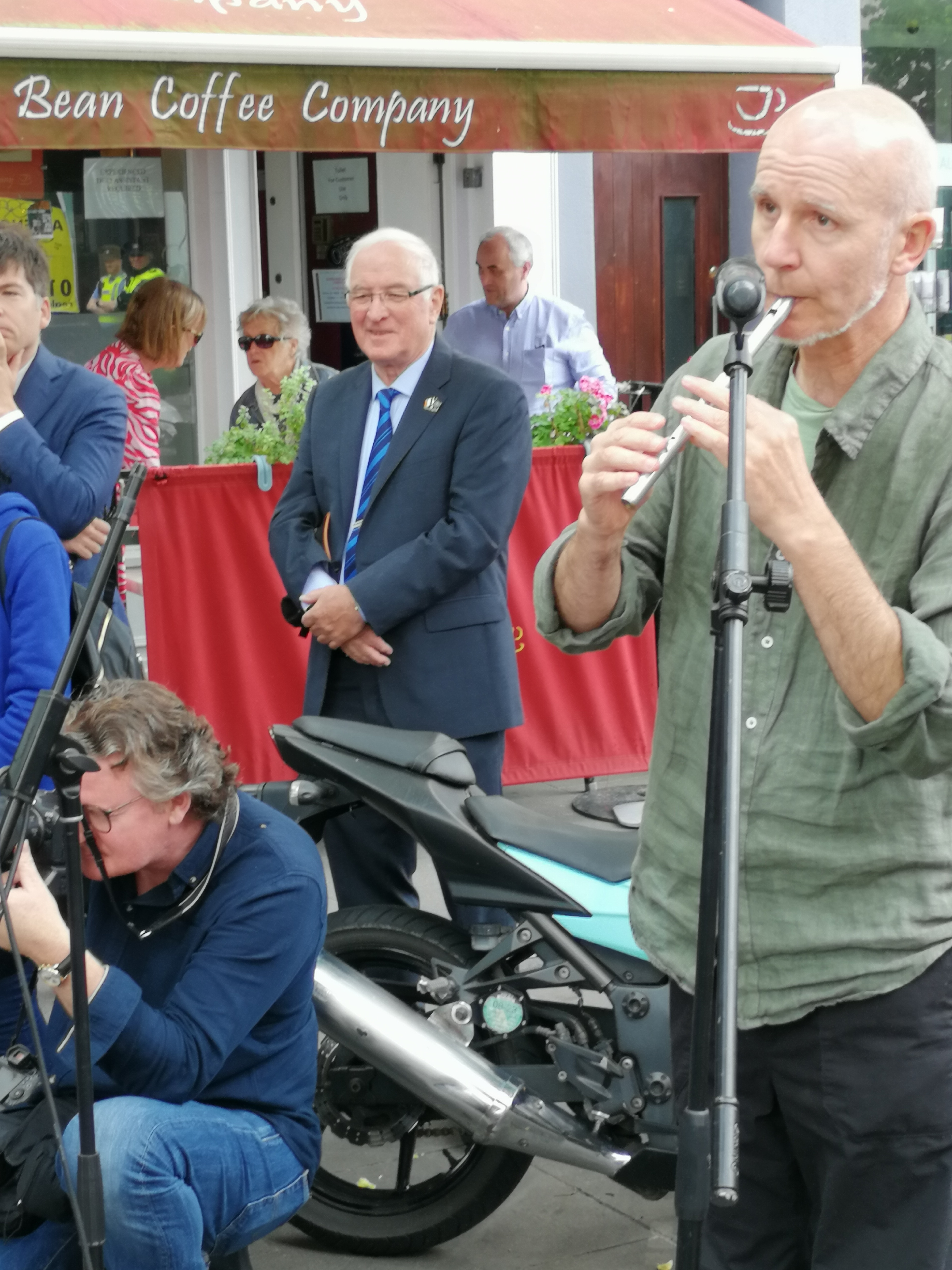
Rachel Hegarty read from her poetry compilation about the victims, based on testimonies by surviving relatives and friends. Cormac Breatnach on high D whistle and Eoin Dillon on uileann pipes played the Irish air Tabhair Dom Do Lámh (“Give Me Your Hand”).

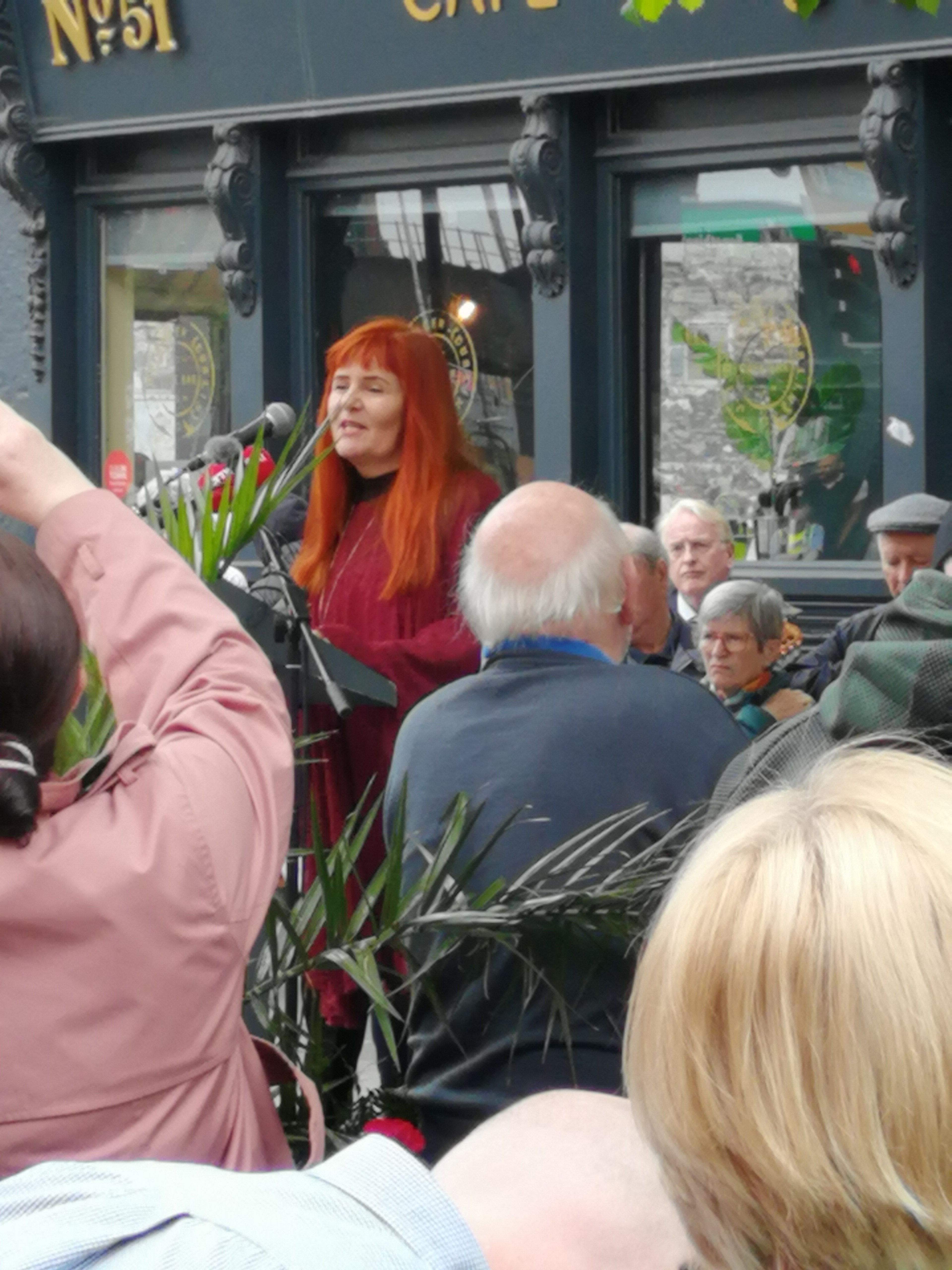
Poet Rachel Hegarty reciting from her work on the bombing. (Photo: D.Breatnach)
Closeup of Cormac Breatnach on high whistle playing at event. (Photo: D.Breatnach)
Eoin Dillon playing uileann pipes at event. (Photo: D.Breatnach)
Fuller shot of Cormac Breatnach playing at event with Eoin Dillon out of shot to the left. (Photo: D.Breatnach)

The Shillelagh North Ukulele Group played and sang The Sound of Silence and Things (we used to do), both appropriate in metaphorical context, the first for the official silence about the perpetrators and their British intelligence organisation, the second about the loss of the victims and to their loved ones.

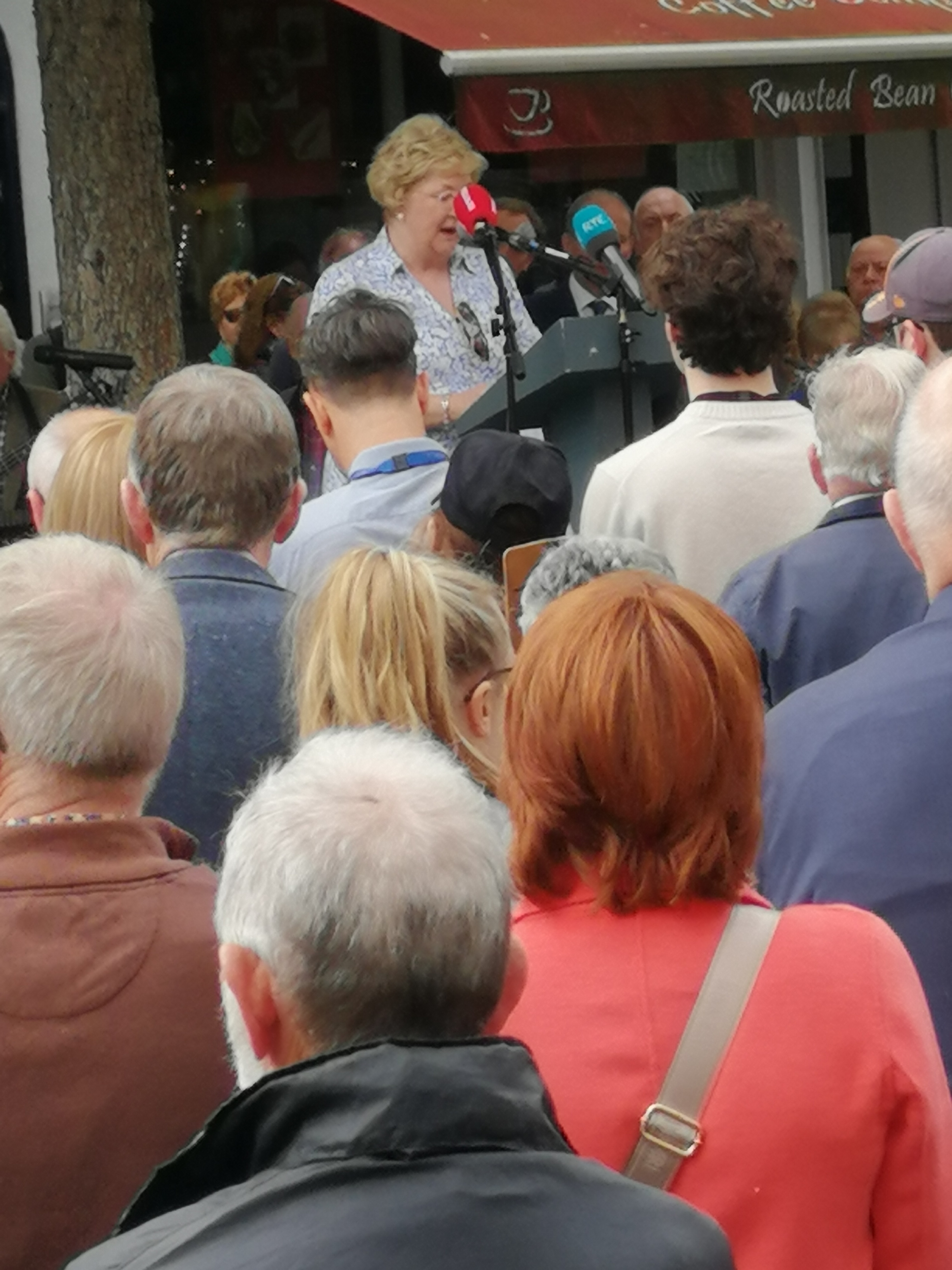
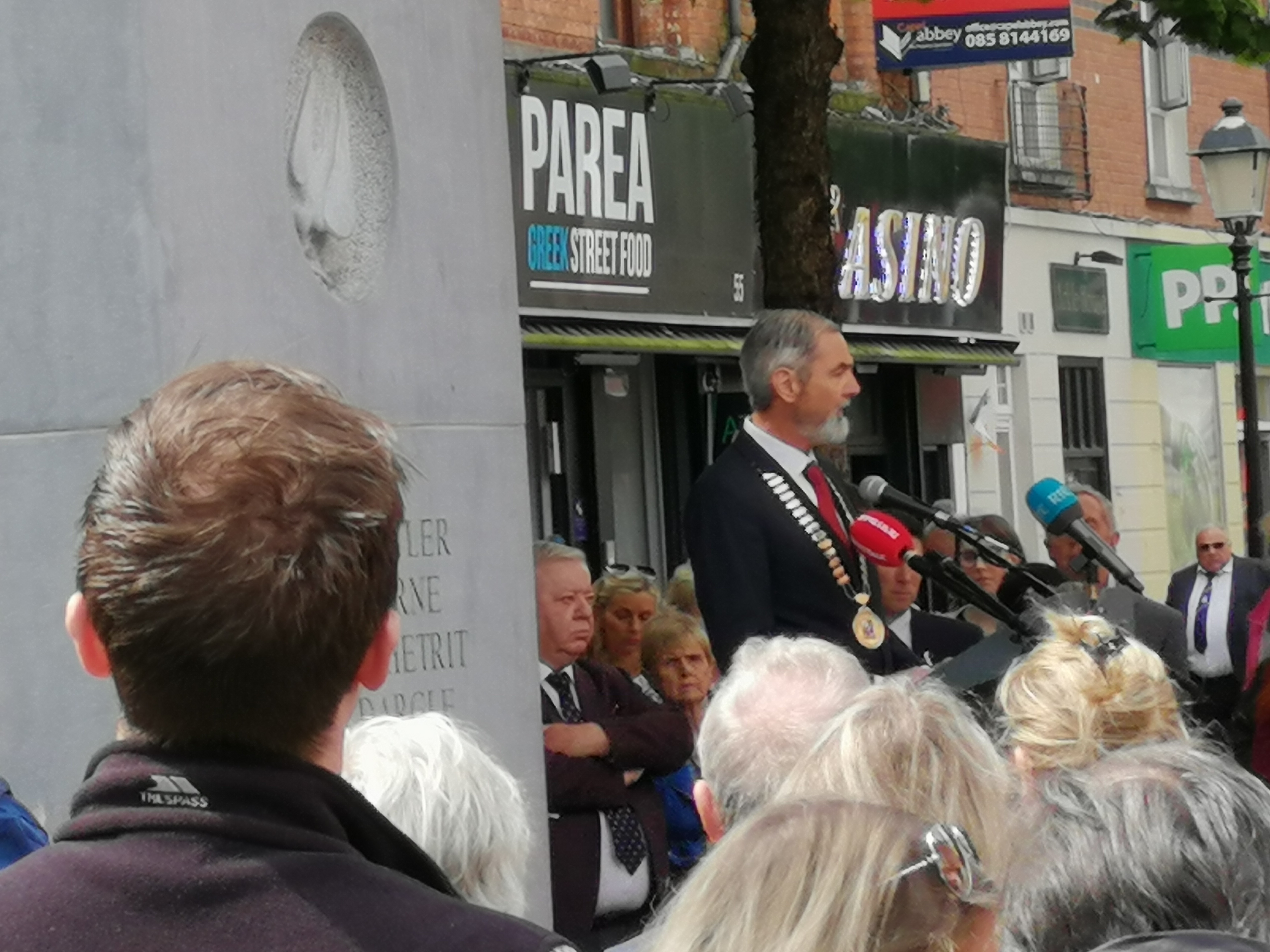
Dublin City Lord Mayor Caroline Conroy, of the Green Party, spoke about the atrocity and criticised the closing of the Garda investigation a mere four months after the bombing.9

Vincent Browne giving his oration. (Photo: D.Breatnach)

Well-known journalist and former TV presenter Vincent Browne gave the oration at the event and went into horrific detail on some of the injuries he had witnessed as a journalist at the scene with his doctor brother as they struggled to help the victims still alive.

Browne departed from the subject of the bombing, as a few had done to speak of the long war and the Good Friday Agreement but in his case also to accuse the Provisional IRA of having killed most of the people during the 30 Years War which seemed not appropriate on this occasion.

Seán Conlon, Cathaoirleach (Chair) of Monaghan Council10 spoke of the bombing and focused on the effect on his town. He also condemned the early closing of the Garda investigation and the failure to pressurise the British State into releasing security papers relevant to the bombing.11

Seán Conlon, Cathaoirleach of Monaghan Council, speaking with part of monument visible to his left. Aidan Shields is standing right next to the Monument. (Photo: D.Breatnach)

A number of speakers referred optimistically to the investigation into the Glenanne Gang by former English police chief Jon Boucher, who was present in the crowd at the commemoration. Boucher is heading a number of other historical investigations, including that of Stakeknife.12

The older age profile of the attendance was noticeable with only two teenagers visible and this in itself must be of concern.

FATAL CONSEQUENCES OF STATE COLLUSION AND COVER-UP

The failure to investigate the earlier Loyalist bombings and apprehend the perpetrators made the planning and execution of the Dublin and Monaghan bombings much easier. The early closing of the Garda investigation of the 1974 bombings ensured the perpetrators would run free.

As well as failing relatives and friends of those murdered and injured in Dublin on the 17th May 1974, the lack of pursuit had repercussions for many other victims of Loyalist murder squads, in particular the over 120 victims of the Glenanne Gang, including the Miami Band Massacre in 1975.

An aspect not normally commented upon was the choice of predominantly working class areas for Dublin massacre victims. It was not the high-end Henry or Grafton Streets that were chosen but the more working-class shopping areas of Talbot Street and Parnell Street.

The fatal Dublin bombings of 1972 and 1973 had also been directed at workers by location: three public transport workers and an airport worker.

Section of the Shillelagh North Ukulele Group playing and singing at the event (Photo: D.Breatnach)

THE GOMBEENS: A CRAVEN CLIENT RULING CLASS

The whole chain of events from the first Loyalist bombing of Dublin points quite clearly to the client nature of the Irish national bourgeoisie, the ruling class of the Irish State. Even if it wanted to, it is too weak to make strong demands of the British State.

What self-respecting national ruling class would allow a foreign power to send terrorists to bomb its capital city? And then collude with that power in drawing silence and secrecy over the atrocity?

None, of course. But the Irish bourgeoisie came into being in a truncated client state and, armed and equipped by its master, went to war for two years (1922-1923) against the very national liberation forces that had brought the British State with offered concessions to the negotiation table.13

To talk of uniting Ireland under such a class, apart from being impractical nonsense, is a travesty. To expect any real change by electing a party or combination of parties to government in such a situation is a pipe-dream.

The 1974 bombing, the subsequent investigation and the record of Irish governments since in relation to the bombing are together a stark illustration of the spineless nature of the Irish bourgeoisie when dealing with their masters.

A client ruling class yes but more accurately, a servant.14

End.

Section of the crowd in attendance viewed from the north-east of the location. (Photo: D.Breatnach)
Section of the crowd with the tower of Connolly (formerly Amiens Street) Station in the background. During the British suppression of the 1916 Rising, British Army machine-gun fire was directed from there along Talbot Street towards the General Post Office garrison and North Earl and Henry Streets. (Photo: D.Breatnach)

FOOTNOTES

1There was originally a plaque at the Garden of Remembrance and the Talbot Street monument was erected in 1977 after campaigning by relatives and victims. There is also a monument in Monaghan Town. In Dublin there is also a plaque at the site of another explosion that killed people that day in Parnell Street.

2Now the Police Service of Northern Ireland, formerly the Royal Ulster Constabulary (and before that, up until 1921, the Royal Irish Constabulary, when the whole of Ireland was under direct British rule).

3In particular the Ulster Defence Regiment, which had recruited from the part-time RUC B-Specials when the latter were disbanded but also special units such as the MRF in special operations and more generally across the whole of the occupation forces.

4Irish State police force.

5When the Irish State and colony statelet were created in 1921, the colonial gendarmerie of the Royal Irish Constabulary in the colony became the Royal Ulster Constabulary. In more recent years the force has change its name to the Police Force of Northern Ireland.

6The body of the monument to the Anglican leader of the United Irishmen was destroyed but the head was salvageable and rests on the re-cast body of the monument today.

7The Irish Council for Civil Liberties has dubbed that Court “a sentencing tribunal” but every party in government since has upheld those repressive provisions and Sinn Féin has abandoned its decades of opposition to them as it prepares to enter government in coalition with one party or another.

8Having a Garda Commissioner who was or became a British Intelligence agent might be shocking until we remind ourselves that the current Garda Commissioner, Drew Harris, coming from being Assistant Commissioner of the PSNI, was at least formerly part of MI5 operations in the colony and that must have been known to those who appointed him!

9Mayors of Dublin City are selected for one year from among the elected councillors. It is more of a ceremonial role than an executive one and the choice is usually negotiated in turn from among the represented political parties.

10As above with Cathaoirligh of Monaghan Council.

11A number commented that his contribution was so much better in every way than that of last year’s Monaghan Cathaoirleach. Conlon is a member of the Sinn Féin party and some may say his posture would therefore be expected. However, given changes in the party’s public position on many questions in recent years, a hard stand against the British administration no longer seems natural for this party’s public representatives.

12Operation Kenova.

13Irish Civil War (or as some see it, the Irish Counterrevolution) 1922-1923.

14It should be noted that the Gombeen class has also been a client in turn of US Imperialism and of EU Imperialism, with all of which it aligns itself on most questions of international policy and to which it opens up its markets, natural resources and infrastructure networks.

REFERENCES

Justice For the Forgotten: https://www.facebook.com/Justice4theForgotten1974
https://www.patfinucanecentre.org/projects/justice-forgotten#:~:text=Justice%20for%20the%20Forgotten%20was,single%20day%20of%20the%20Troubles.

The anniversary event: https://www.thejournal.ie/dublin-monaghan-bombings-anniversary-2-6069847-May2023
https://www.98fm.com/news/commemoration-dublin-monaghan-bombings-1466373
https://www.dfa.ie/news-and-media/press-releases/press-release-archive/2023/may/remarks-on-the-commemoration-of-the-49th-anniversary-of-the-dublin-monaghan-bombings.php

https://en.wikipedia.org/wiki/Dublin_and_Monaghan_bombings

https://www.garda.ie/en/about-us/our-history/garda-commissioners-since-1922/
Ed Garvey, former Chief Commissioner of the Garda and British Intelligence asset (interestingly there is no Wikipedia page on this man, nor is his creation of the infamous Garda ‘Heavy Gang’ or his British Intelligence work mentioned by Ferriter): https://www.dib.ie/biography/garvey-edmund-a342

Earlier Loyalist bombings in the Irish State: https://en.wikipedia.org/wiki/1972_and_1973_Dublin_bombings

Lethal AlliesBritish collusion in Ireland (2015), Ann Cadwaller: https://www.irishtimes.com/culture/books/lethal-allies-british-collusion-in-ireland-a-shameful-part-of-our-troubled-history-1.1578119

The Glenanne Gang: https://en.wikipedia.org/wiki/Glenanne_gang

Barron Report: https://www.irishtimes.com/news/barron-report-conclusions-1.398978

Jon Boucher investigation: https://www.irishnews.com/news/northernirelandnews/2019/11/30/news/jon-boucher-to-take-on-investigation-of-glenanne-gang-1778903/

https://www.opkenova.co.uk/