The Zionist state announced the closure of its embassy in Dublin, accusing the Irish Government of being anti-Israel.1 The broad Palestine solidarity movement celebrated the announcement while Harris for the Irish Government expressed regret.
The Zionist Embassy at 28 Shelbourne Road, Ballsbridge, Dublin has been without an Ambassador since she left Ireland last May in protest after the Irish Government, along with the Spanish and Norwegian governments, officially recognised the state of Palestine.2
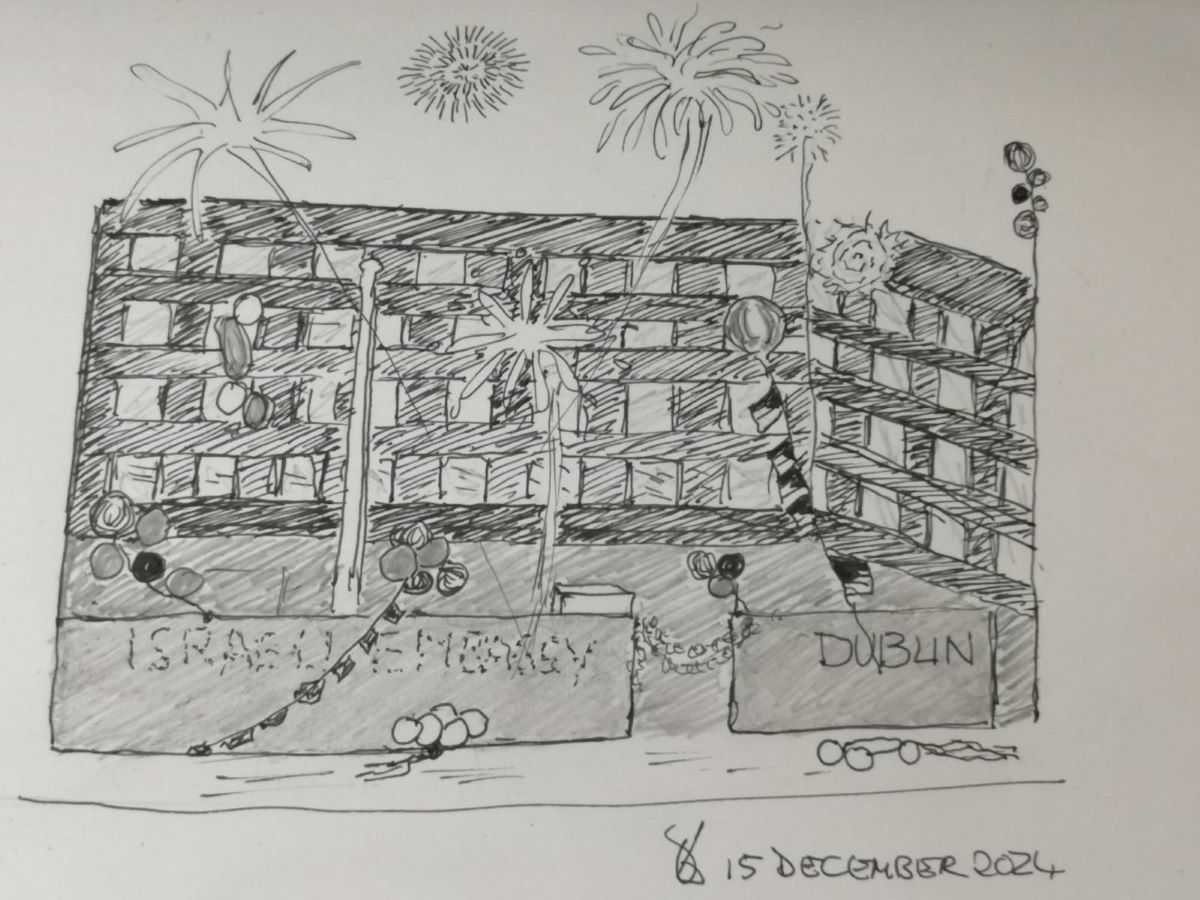
D.B cartoon drawing of celebrations outside the block in which the Zionist Embassy was located (and under 24-hour Garda protection). Many of the other users of the building will be relieved at the departure also.
However the Irish State’s recent decision to join South Africa’s case against Israel at the International Court of Justice3 seems to have prompted the closure of the Embassy and led once again to allegations of “anti-semitism” in Ireland which the President called a “gross slander”.4
Simon Harris, Taoiseach (prime minister equivalent) of the outgoing Irish Government5 expressed his regret at the ‘Israeli’ decision while at the same time rejecting vigorously the allegation that the Government is anti-Israel. He is absolutely correct in doing so.
Irish Governments have consistently been pro-Israel and colluding with Zionism, in contradiction to Irish popular opinion. The outgoing government6 has allowed military supplies for ‘Israel’ to fly through Irish airspace and the US military to land and depart from Shannon Airport.
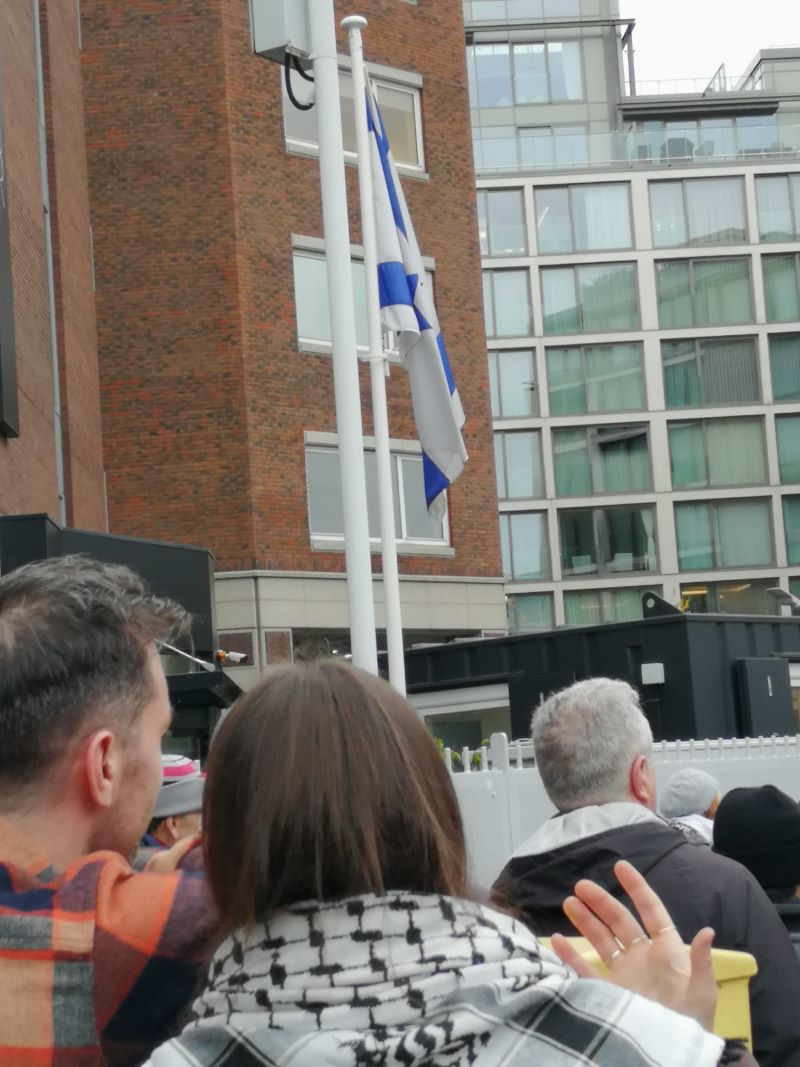
One of the participants outside the Israeli Embassy yesterday celebrating its imminent departure. (Photo: D.Breatnach)
The Irish Government has also held up for years the relatively mild UN-compliant Occupied Territories Bill. These points were well made in an Al Jazeera Inside Story7 program by Mícheál Mac Donncha, Sinn Féin Dublin City Councillor and by Zoe Lawlor, IPSC8 Chairperson.
Both did well outlining the general attitude of the Irish people to which the government was – to an extent – responding and in refuting the slur of anti-semitism on the Irish people. Lawlor pointed to the Irish history of resistance as a motivator but appears unaware that we once supported Israel.
This is important (and I have written about it9) because it shows that we are capable of changing our position to a better one when presented with the evidence of the need to do so, which task the Zionist themselves carried out for us.
However both speakers failed to answer the interviewer’s question of why the Irish government did not go further.
This is an essential question for us and the answer makes sense of the current political landscape with crucial import beyond the issues of Palestine and Zionism. Mac Donncha seemed to avoid the question entirely and chose instead to talk about actions that the Government should take.
The interviewer however put it bluntly to Lawlor that the reason was a reluctance to offend the USA, though presenting it as a fear of putting off US corporations’ investments. Lawlor correctly replied that corporations make decisions based on profit but avoided giving the political answer.
The Irish ruling class is a neo-colonial one and responds to requirements of its masters. These have been firstly the UK, followed by the US and more recently the EU. All of these are imperialist states and bound up with the interests of the colonial fort in the Middle East which is the Zionist State.
(Photo: D.Breatnach)
I am sure that Mac Donncha is aware of those facts and pretty sure that Lawlor is too but both declined to provide the explanation being asked for. One must suspect in Mac Donncha’s case the reason is that his party, Sinn Féin, is busily making itself acceptable to that very ruling class.
And Lawlor probably wants to keep the clean image for the ruling class which the IPSC leadership has been at pains to develop, particularly during this current genocidal offensive.
While the IPSC leadership has played an important role in mobilising national demonstrations much of the activism has been and continues to be by organisations on the ground. The Embassy itself was invaded some time back by such groups and has seen militant blockades.
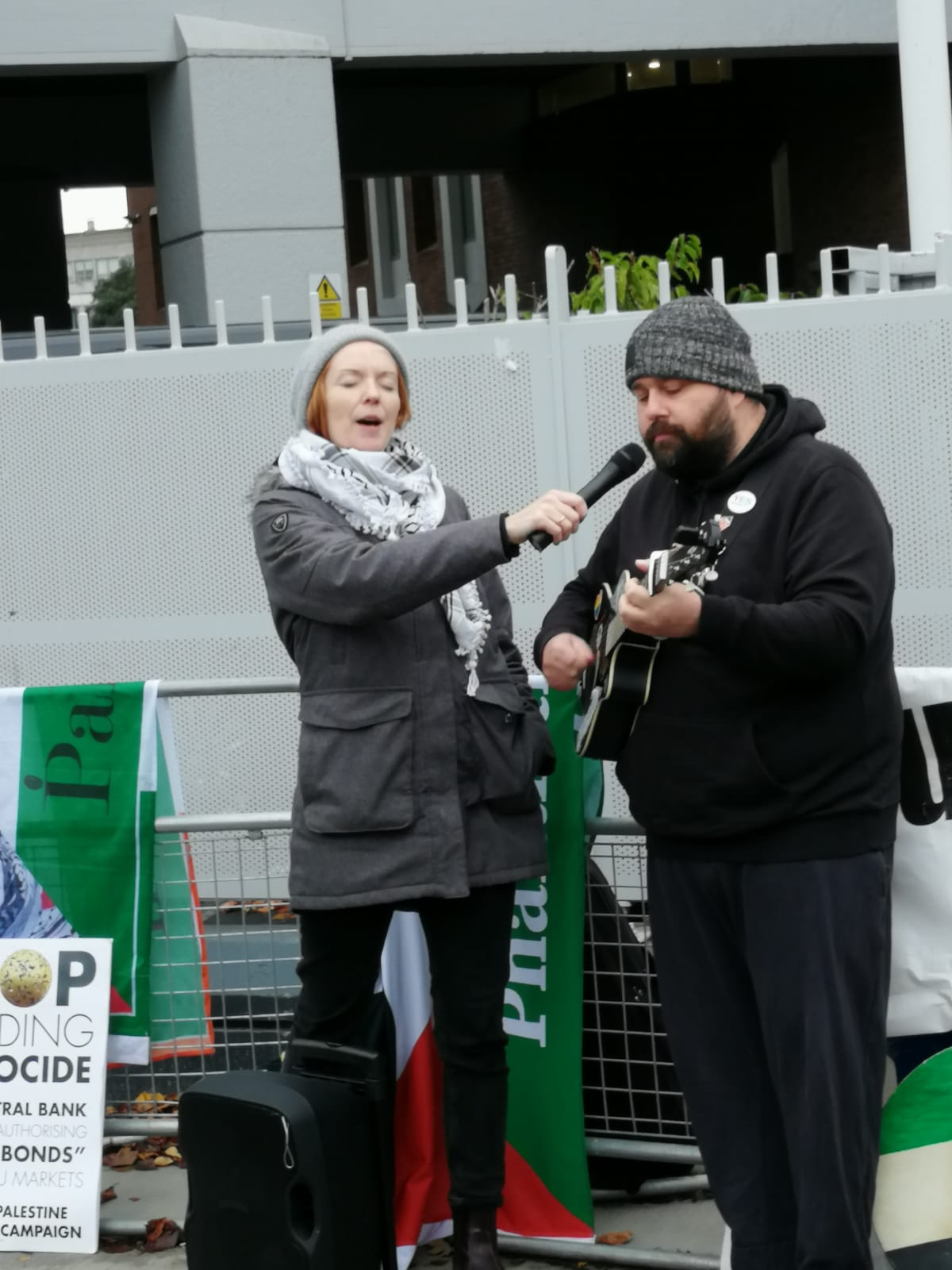
Jimi Cullen yesterday performing his composition “We Are All Palestinians” during a modest celebration outside the Zionist Embassy. Cullen has been performing outside there for an hour every Wednesday afternoon for 41 weeks. (Photo D.Breatnach)
Axa Insurance has been picketed frequently and occupied at least once and the Foreign Affairs Department was splattered with red paint while the Department of Transport was occupied. The US Embassy was picketed for three days in a row by organisations from Galway without IPSC support.
Only one IPSC march since October last year had the US Embassy as destination and on that occasion the march was led up quiet suburban streets to the stage set up next to police barricades blocking access to the Embassy gates and the main road into Dublin.
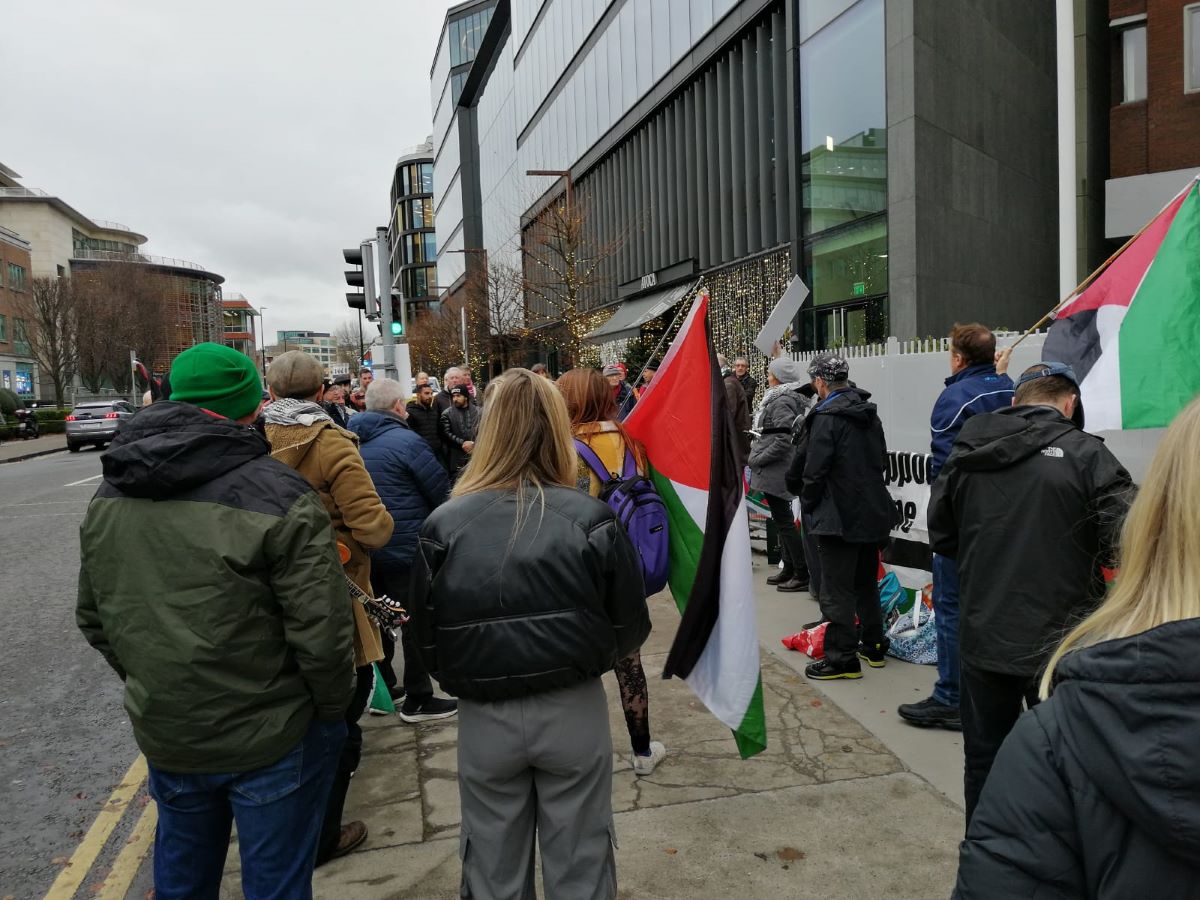
Section of the crowd yesterday afternoon celebrating its imminent departure outside the Zionist Embassy. (Photo D.Breatnach)
The general Irish public and in particular of course the activists in solidarity with Palestine can justly celebrate the departure of the Zionist Embassy. It is their symbolic victory.
However, there is no doubt that the Irish ruling class needs to be put under much heavier pressure than has heretofore been the case, if we are to shut down the collusion of the Irish Gombeen state with the Zionist genocide of Palestinians.
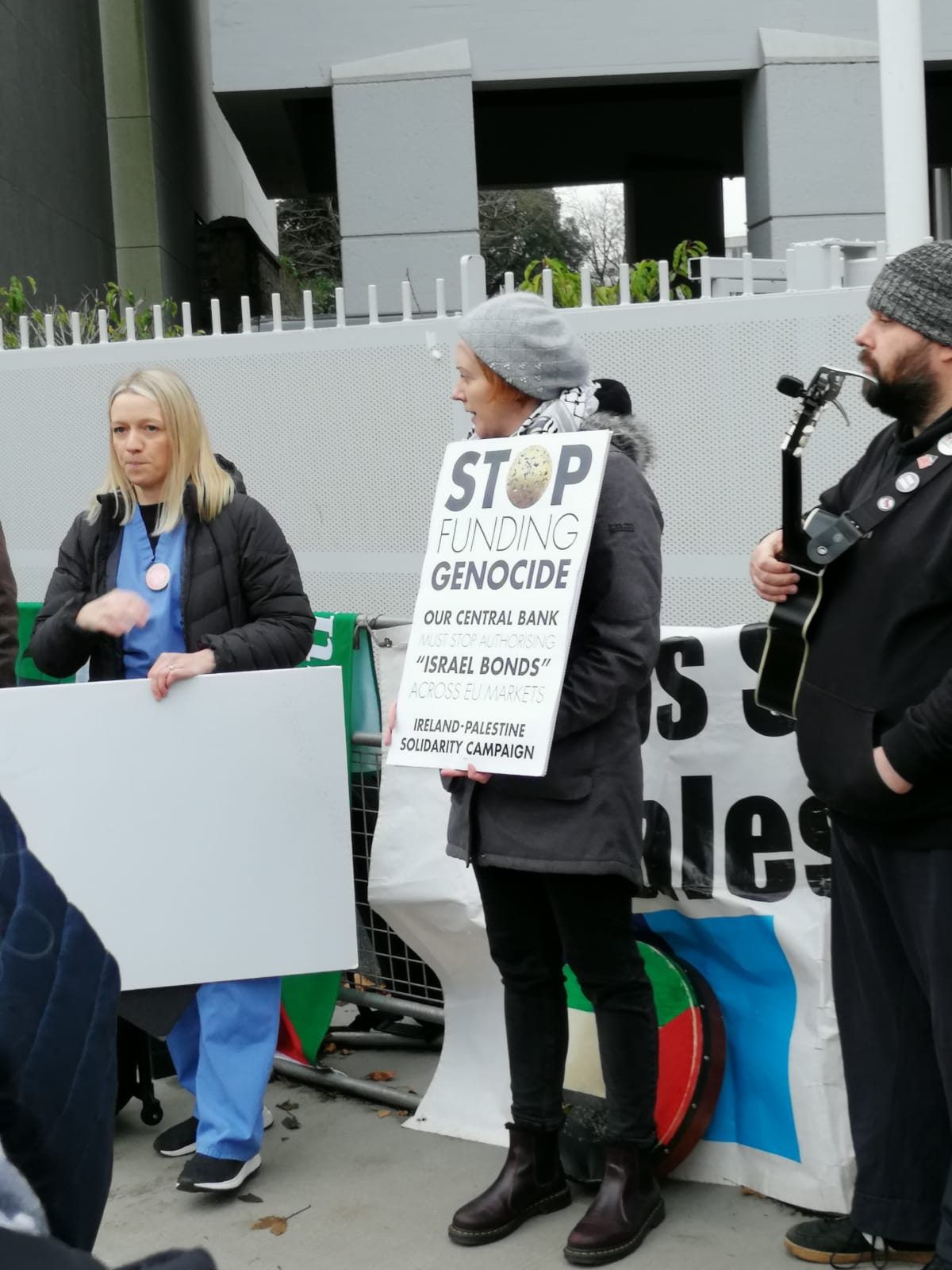
Outside the Zionist Embassy yesterday, an Irish healthworker calls for more effective solidarity with the Palestinians, in particular with the healthworkers being targeted by the IOF in Gaza. (Photo: D.Breatnach)
2https://www.gov.ie/en/press-release/71936-ireland-recognises-the-state-of-palestine. While the decision of those states has enraged the Zionist state, it is not as progressive as may seem at first glance. The ‘state’ that is being recognised is a) in addition to the state of Israel, i.e “the two-state solution” (sic); b) grants the Palestinians around 20% of Palestine which would be under the constant eyes and guns of the Zionists and c) is widely considered not realisable due to the proliferation of Zionist settlements and their special roads connecting them. Currently the only ‘government’ of such a state is the undemocratic, repressive and corrupt Fatah-controlled Palestinian Authority.
3Again this decision too has its deeply negative side since the Attorney General of the Irish State in his submission to the Preliminary Hearings on Genocide at the ICJ repeated the many times debunked Zionist propaganda of “mass rape by Hamas” during its breakout attack on October 7th.
5The elections of 29 November did not return any party with an absolute majority and discussions on forming a coalition government have been ongoing since the election results were confirmed.
(Reading time:3 mins. Note: Apologies for delay in publishing this report)
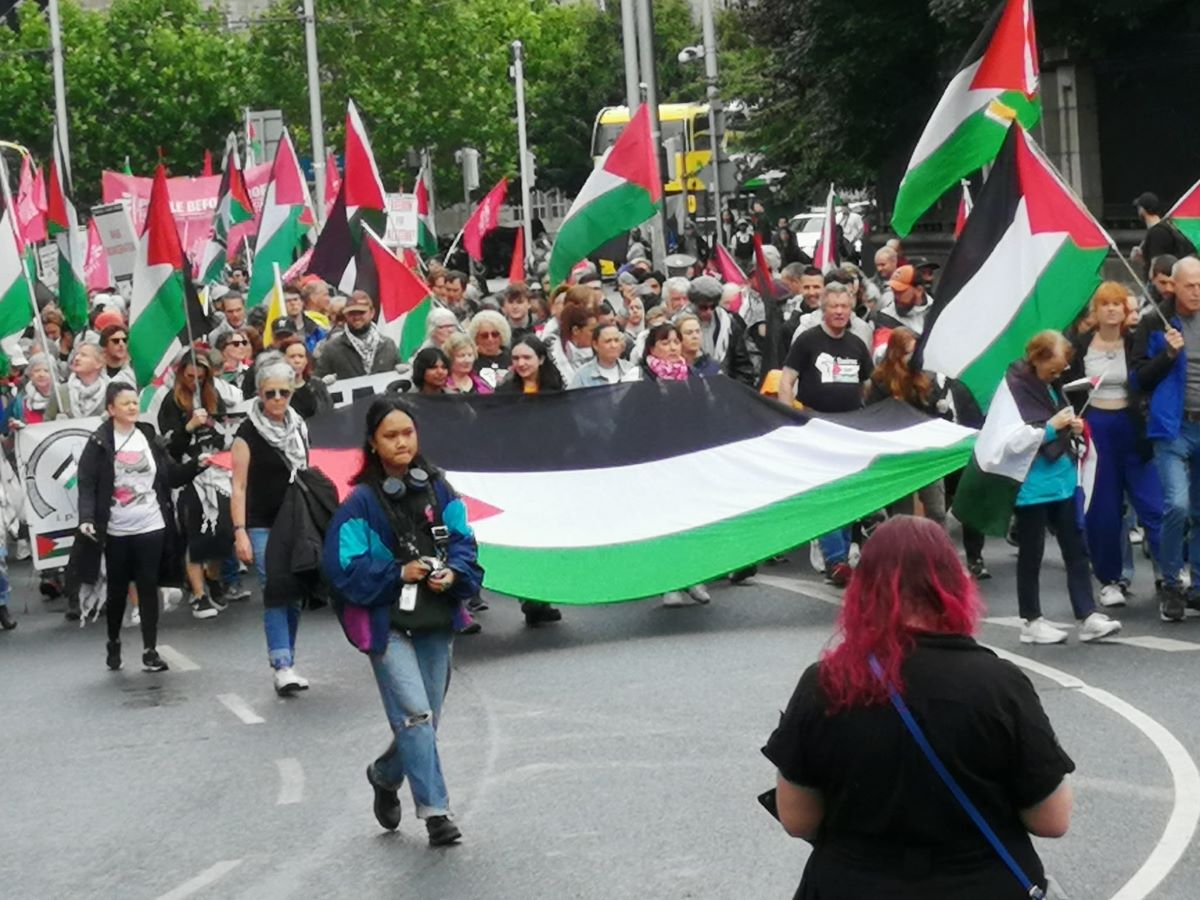
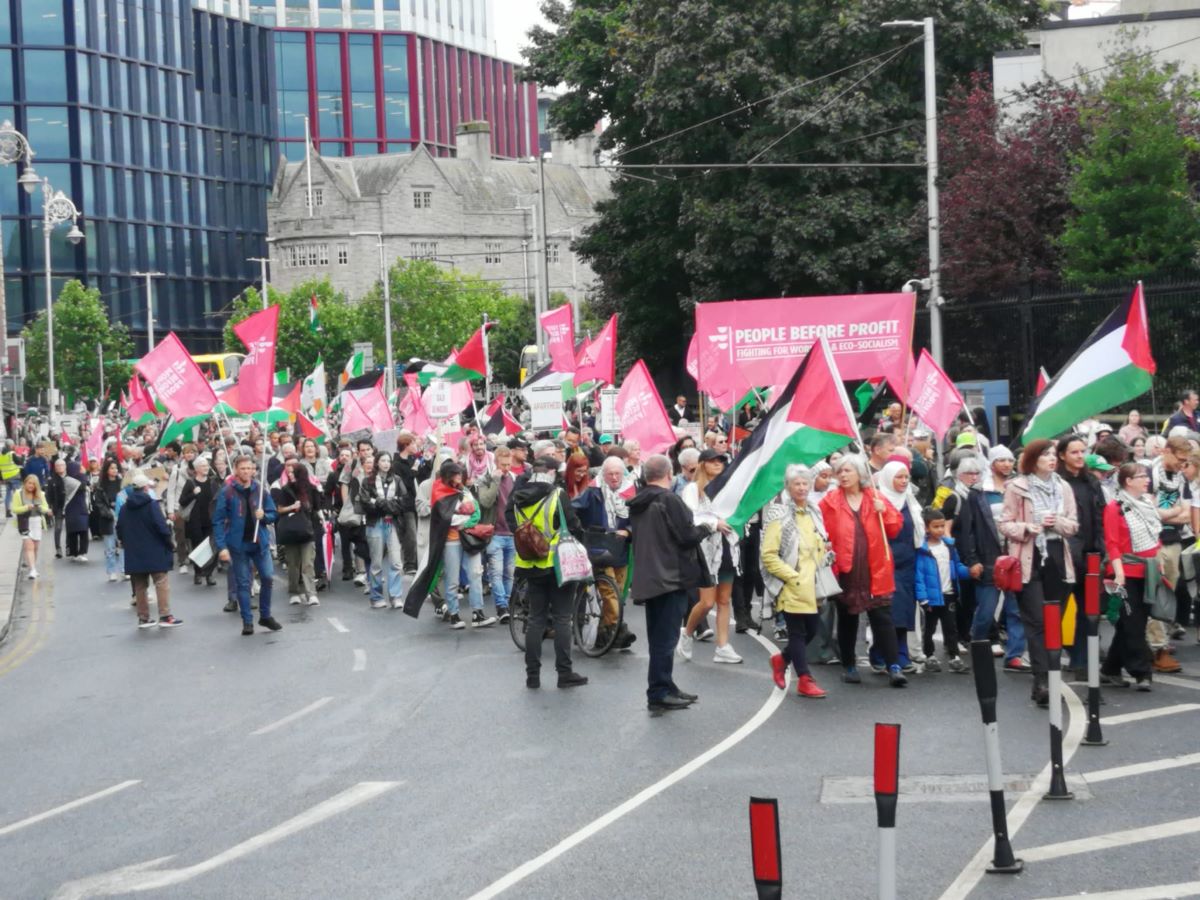
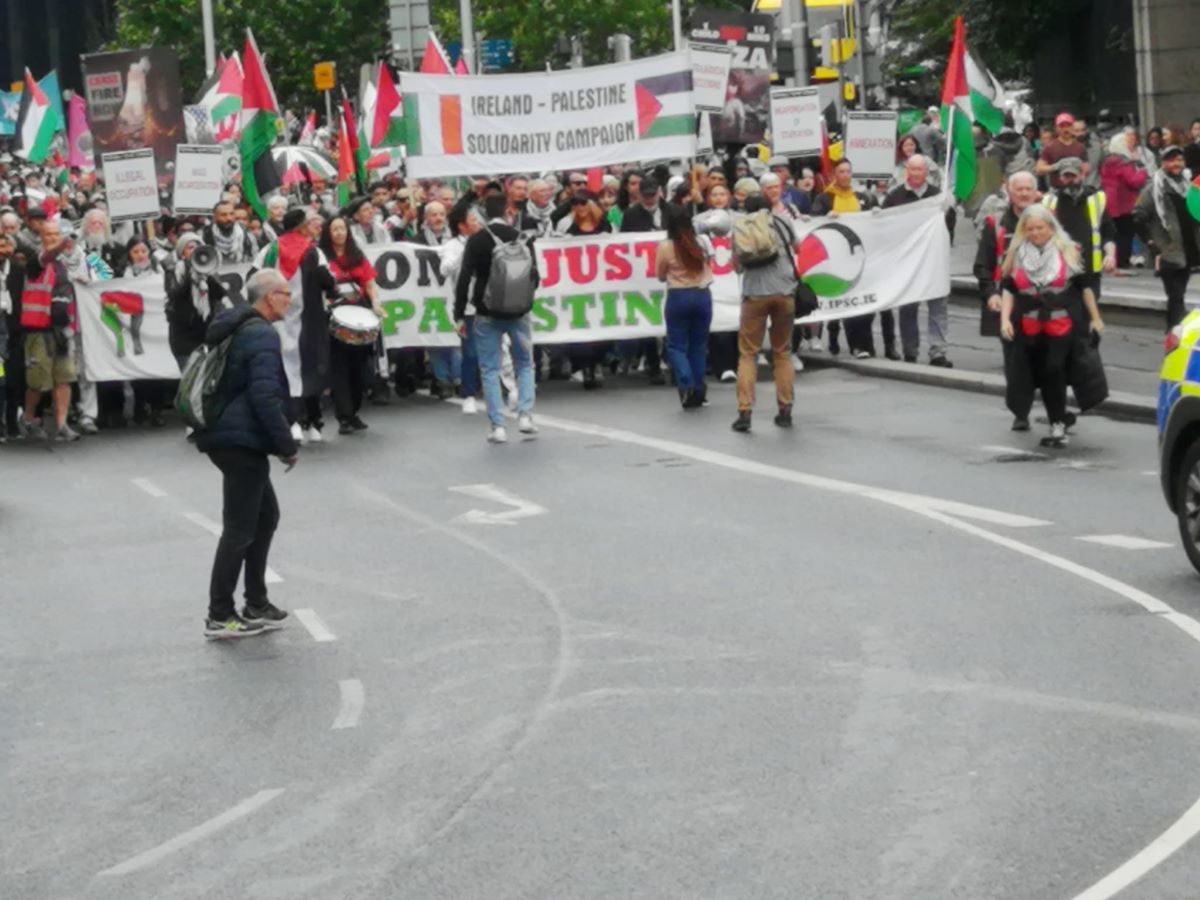
On Saturday 20th June the Irish people, despite their Governments once again marched in a national demonstration to show the Irish majority solidarity with Palestine and horror at their continuing genocide by the ‘Israeli’ armed forces.
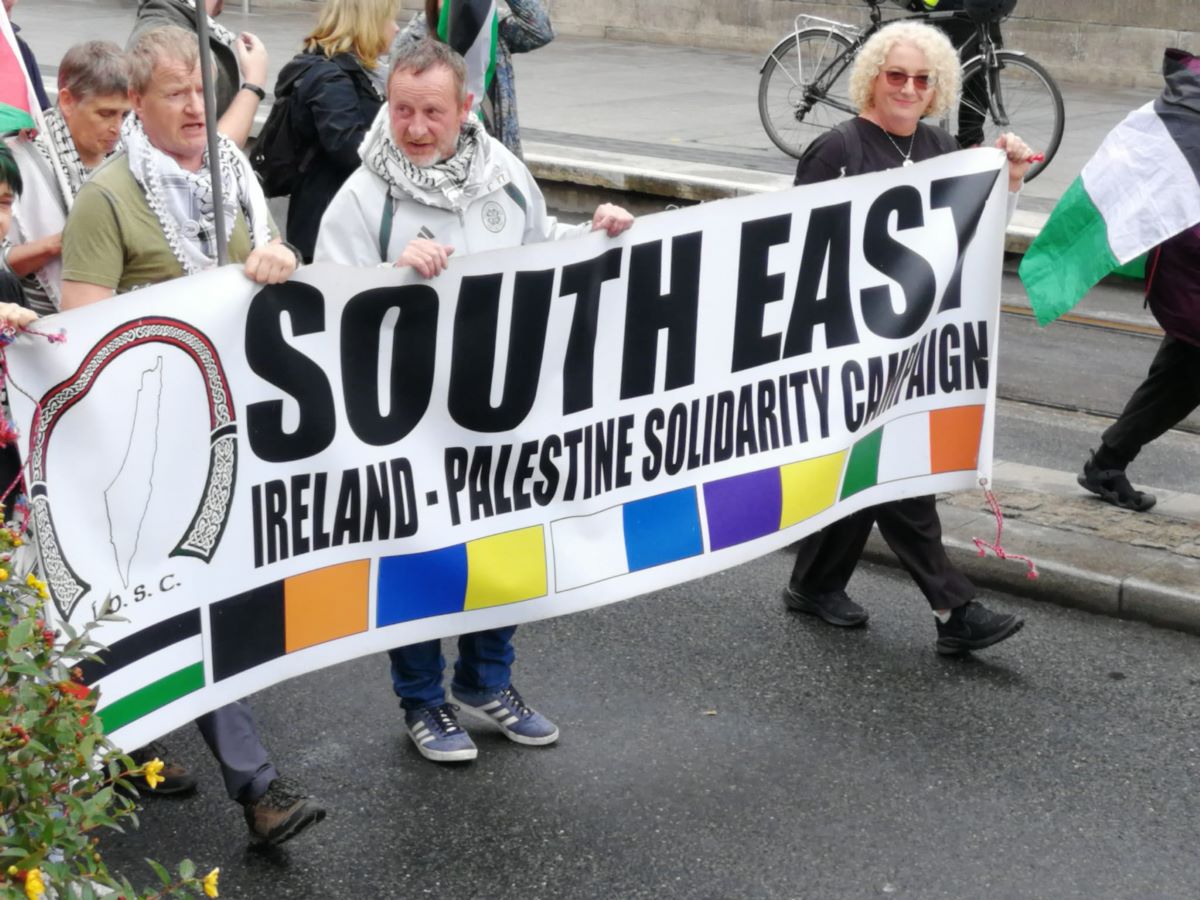
The march had been convened by the long-standing Ireland Palestine Solidarity Campaign which has branches across Ireland from Cork to Donegal, including in some parts of the British colony (where however the Loyalists are anti-Palestinian).1
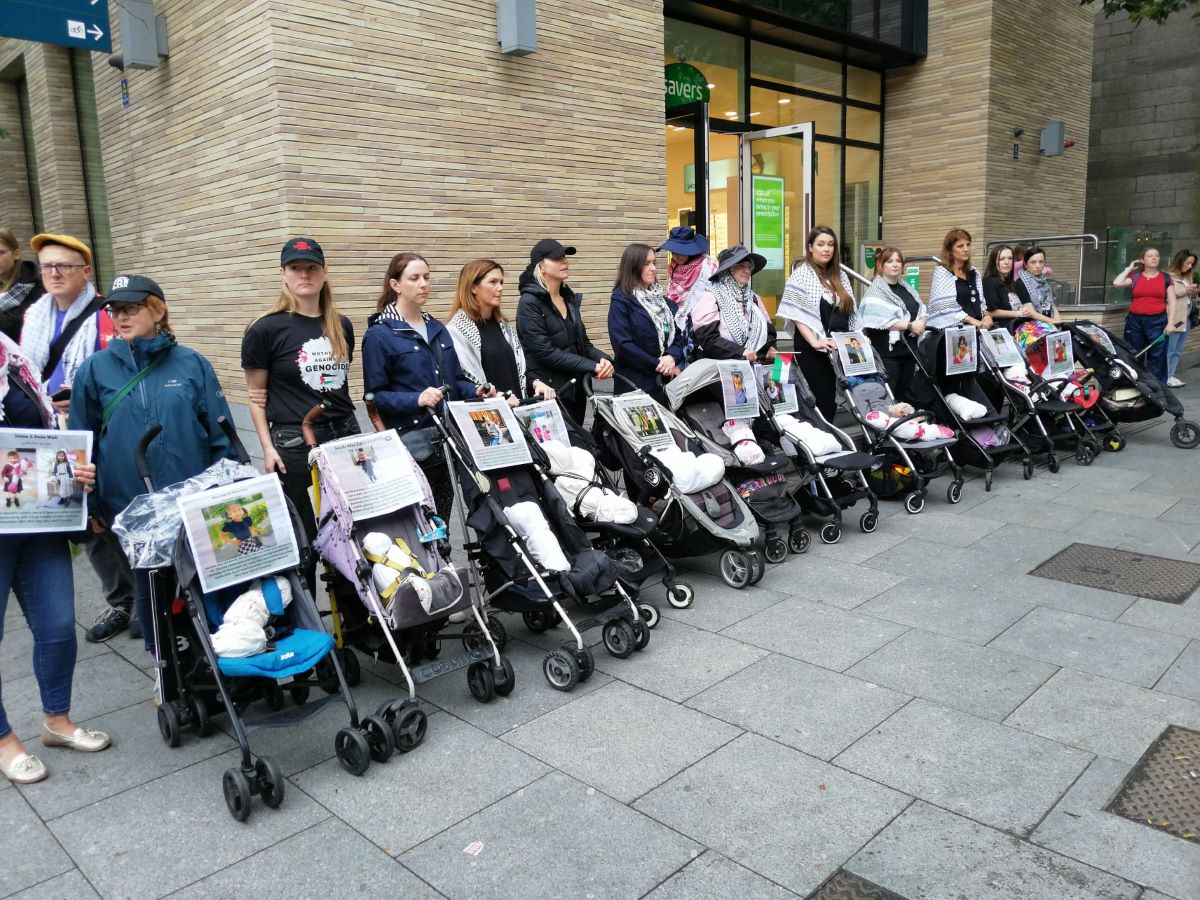
Mothers Against Genocide group in Dawson St. (around corner from Molesworth St.) evoking individual children murdered by ‘Israel’. (Photo: D.Breatnach)Dublin community group that holds Thursday evening vigils in four areas of North Dublin. (Photo: D.Breatnach)(Photo: D.Breatnach)
The assassinations of resistance leaders were still to come2 but it had been business as usual in Palestine with daily massacres of civilians by the ‘Israeli’ Occupation forces, ongoing starvation, destroyed health service, impending epidemics, prisoners released as ghosts of their former selves.
Also IOF raids and kidnappings3 in the West Bank, at times with Palestinian Authority4 collusion in arrests of activists, confiscation or destruction of Resistance weapons …
To all this the Palestinians in general have responded by helping one another trying to survive, digging people out of bombed rubble, documenting atrocities, burying their dead, trying to feed their children and elderly …
And their Resistance in all factions (and none) threw stones, fired bullets, launched anti-tank rockets, mortars, missiles and blew up bombs against Occupation armour and soldiers. And of course, contributed new names to the long list of martyred resistance fighters and commanders.
The ECJ,5 to howls of protest from the regime had pronounced its verdict that Israel was indeed, as has long been evident, guilty of practising apartheid against the Palestinians. However not one state ceased giving political or financial cover to the Occupation or supplying it with arms as a result.
Irish Healthcare Workers for Palestine. (Photo: D.Breatnach) (Photo: D.Breatnach)(Photo: D.Breatnach)
IPSC Police?
Only a few Irish Tricolours were displayed on the march which is visually a political mistake, as I’ve observed earlier and the organisers should state that such are welcome. Not one Starry Plough flag, that of socialist Republicans, could be seen either, despite no doubt there being many such participating.
Irish language placards and banners have been getting rarer, despite a previous welcome upsurge upon which I’ve commented in the past. However there were some to be seen, including a number of Saoirse Don Phalaistín flags and the banner of a Newry group, from Co. Down, under British occupation.
As they filled Molesworth Street towards the IPSC stage and police barriers at the end, facing the Leinster House Irish Parliament building, some marchers already began to leave, having heard speeches before and perhaps heading for their transport back to their earlier points of departure.
The company that erects crowd barriers were ready to install them to cut off a section of Molesworth Street at the intersection of narrow lanes and the Gardaí wanted to cram the crowd in beyond the barriers. IPSC stewards began to usher marchers further into Molesworth street.
One approached a group of marchers telling them what the police wanted to which one of the group replied: “I don’t give a f..k what the police want!” and after the steward’s persistence, accused him of doing the job of the police.
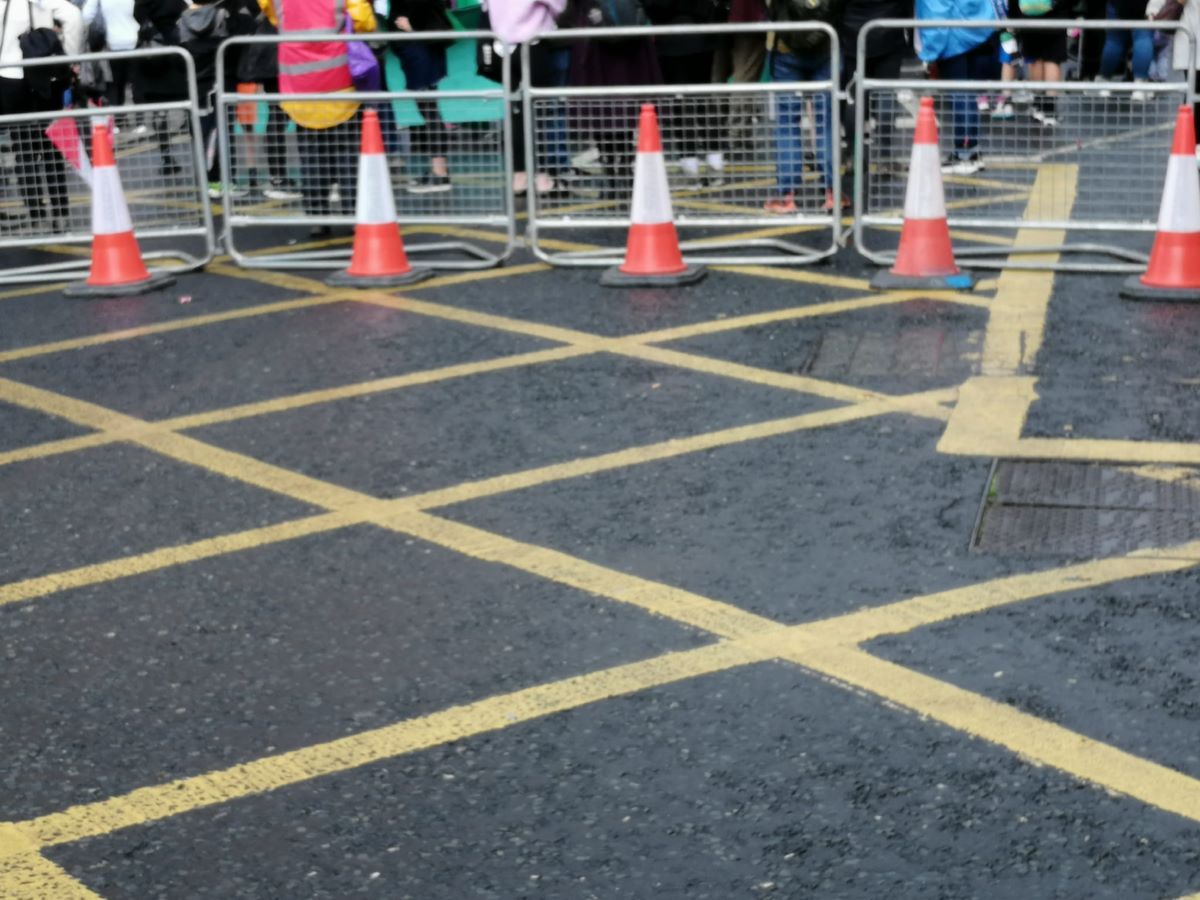
The IPSC stewards have helped the police pack marchers into the stretch of Molesworth Street beyond the intersection (and incidentally leaving any demonstrating in Dawson Street cut off from the main group). (Photo: D.Breatnach)
Aside from the rough language, what were the IPSC stewards doing passing on police orders?
People in the group said that the IPSC stewards have done this before and that furthermore there was no important-through way being cleared,6 the exercise serving no real purpose other than getting the public used to being corralled and that at the least the police should do their own job.
(Photo: D.Breatnach)(Photo: D.Breatnach)
The main purpose of stewards is to keep the march moving and safely from traffic. The route has been agreed beforehand by the IPSC with the Gardaí which is not a legal requirement in Ireland. Even in that case the stewards should keep a strict separation in functions from the police.
The IPSC does an important job, publishing information and organising events, especially nationally but back in October delayed in even calling for the Zionist Ambassador’s expulsion. Some other groups also organise events and it appears that the IPSC supports some and not others.
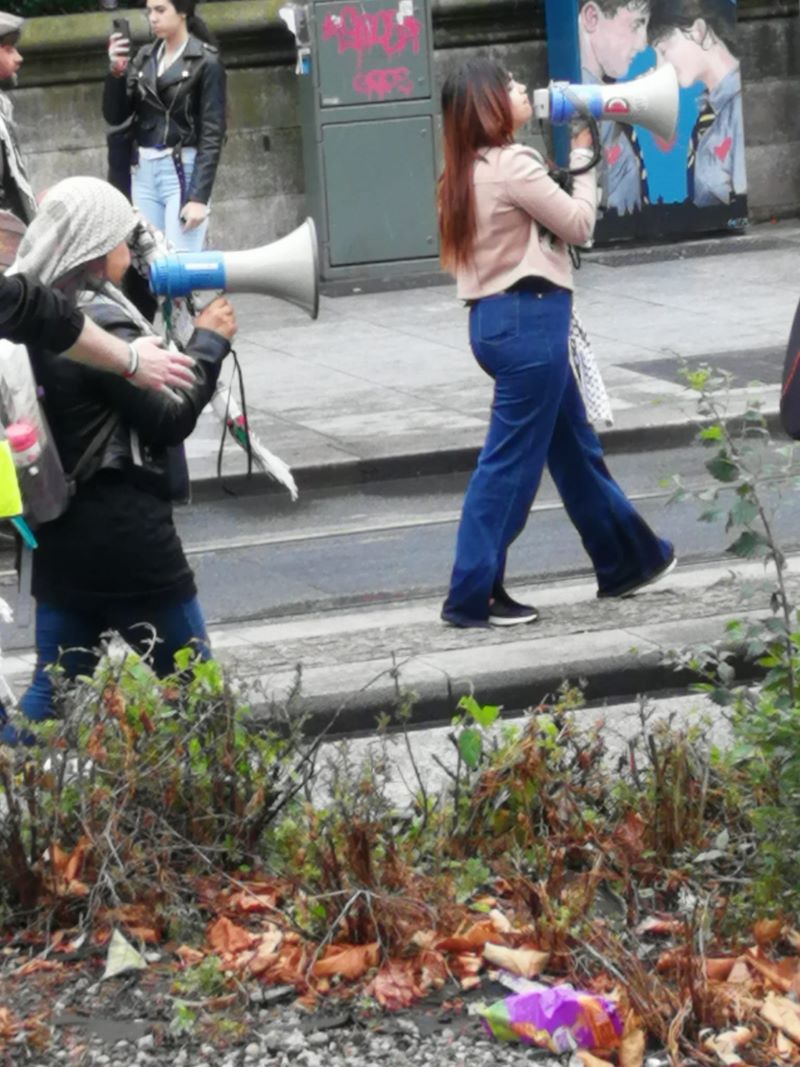
Young Palestinian women leading the slogans call-out. (Photo: D.Breatnach)(Photo: D.Breatnach)
Going forward it seems that the solidarity movement, including of course the IPSC, will need to take into account their meagre effect on the Irish Government, not to speak of upon the genocidal state itself and on its supporting states in the West, in particular the USA, Germany, UK …
Such recognition will call for escalation, for direct action, for different kinds of solidarity action … whether some organisations want to participate or not.
(Photo: D.Breatnach)(Photo: D.Breatnach)Some trade union banners on the march (though the unions do little to mobilise support, much less take action against ‘Israeli’ products etc.). (Photo: D.Breatnach)Front of the march turning into College Street. (Photo: D.Breatnach)
FOOTNOTES
1This could be because they see themselves as ‘British’ settlers, while the ‘Israelis’ are European settlers too but is more likely a knee-jerk reaction to the Palestine solidarity exhibited by Irish nationalists (something like “If they’re for them, we must be against them”.
2Assassinations of leaders of Hamas, Hezbolah and senior officers of Islamic Resistance Iraq.
3The IOF and the Zionist State may call them “arrests” or “detentions” but typically they are random or working off a list without warrants or due process. Former prisoners are re-arrested constantly; family of ‘wanted’ individuals are detained in order to pressure the ‘wanted’ to give themselves up. Typically the detained are served ‘administrative detention’ orders, jailing them for months without trial or evidence. Prisoners are underfed, overcrowded, beaten by guards, have dogs set upon them and medically neglected.
4Unelected, undemocratic, corrupt and zionist-colluding body financed by some Western powers and some colluding Arab states.
6Furthermore, with no side-streets available in that section beyond the intersection, the police could close that west end of the street should they wish to, ‘kettling’ all the demonstrators between two Garda barriers.
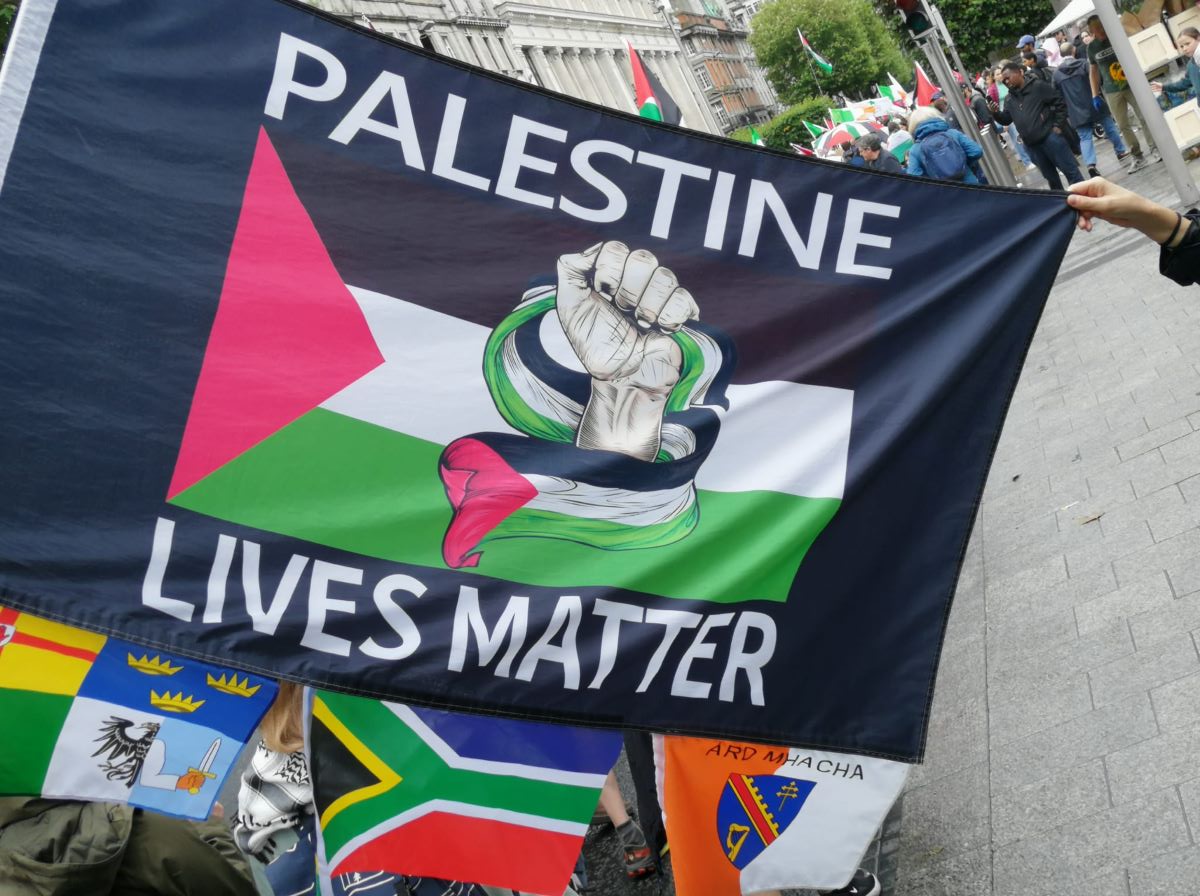
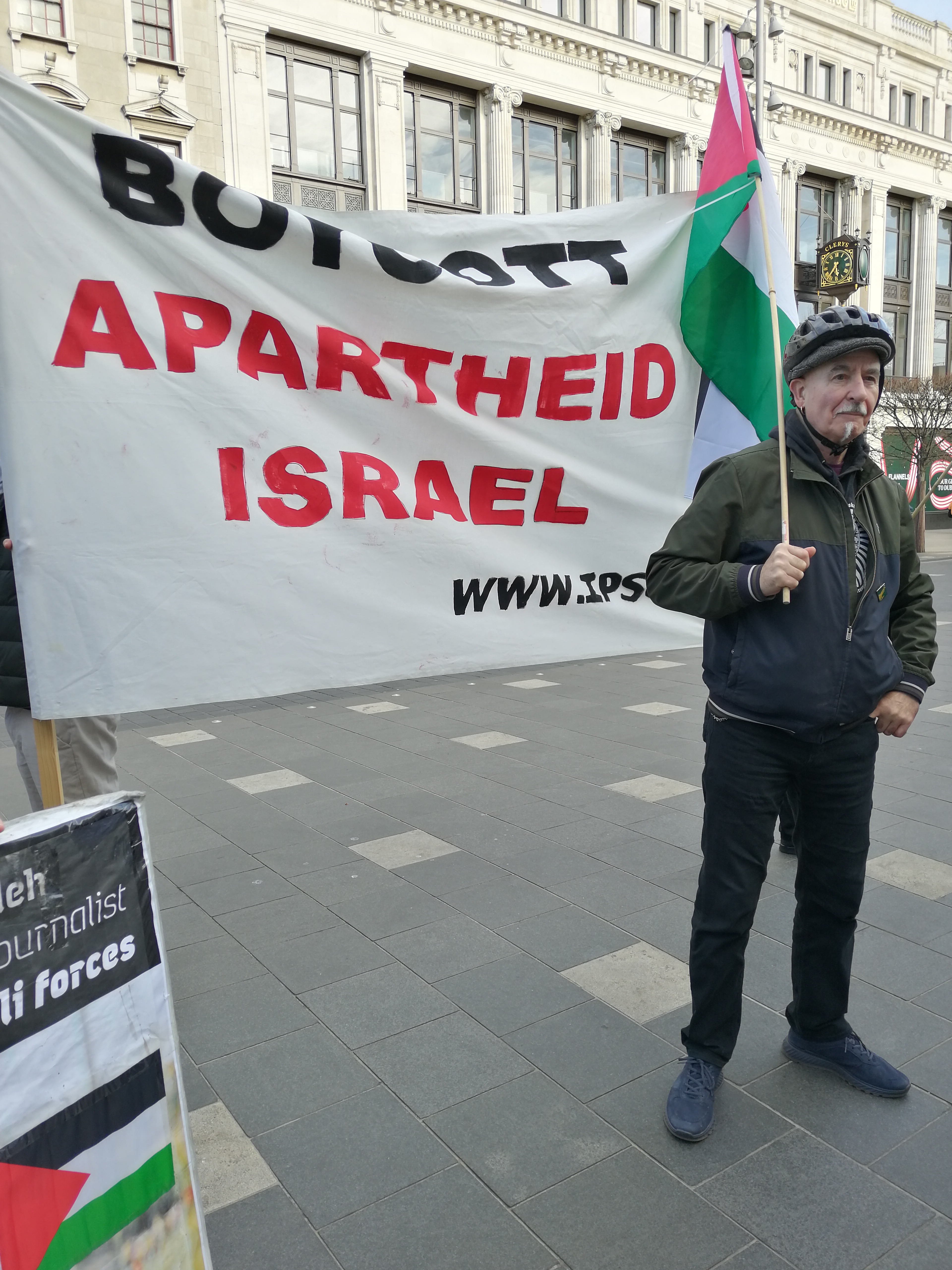
Palestinian flags waved as people gathered on the pedestrian reservation in Dublin’s main thoroughfare, O’Connell Street, to mark Palestinian Land Day March 30th, anniversary of the 1976 confiscation of Palestinian land by the Israeli Zionist State.
Naturally, the event also addresses the continual threat to additional Palestinian land by Zionist settler occupation, Israeli judicial and army demolition of Palestinian housing and intimidation, harassment and terrorism against Palestinians in Jerusalem.
Palestine supporters gathering for Land Day (Photo: D.Breatnach)
The Dublin event was organised by the Ireland Palestine Solidarity Campaign, a broad organisation that receives broad support not only across the Irish Left and Republican spectrum but also from a great many non-aligned Irish people and even many among voters for mainstream political parties.
This support was emphasised by frequent drivers in passing traffic, both public, taxis and entirely private, blowing their horns in approval of the rally. The population of the Irish state has gone from being in general support of the Israeli State to being generally hostile to its behaviour.1
Zionists tend to depict anti-Israeli Zionism as being anti-Jewish and therefore, according to them, “anti-semitic”2. Quite apart from the wide inapplicability of the term and some isolated historical examples dredged up3, it fails to account for the change in public attitudes over recent decades.
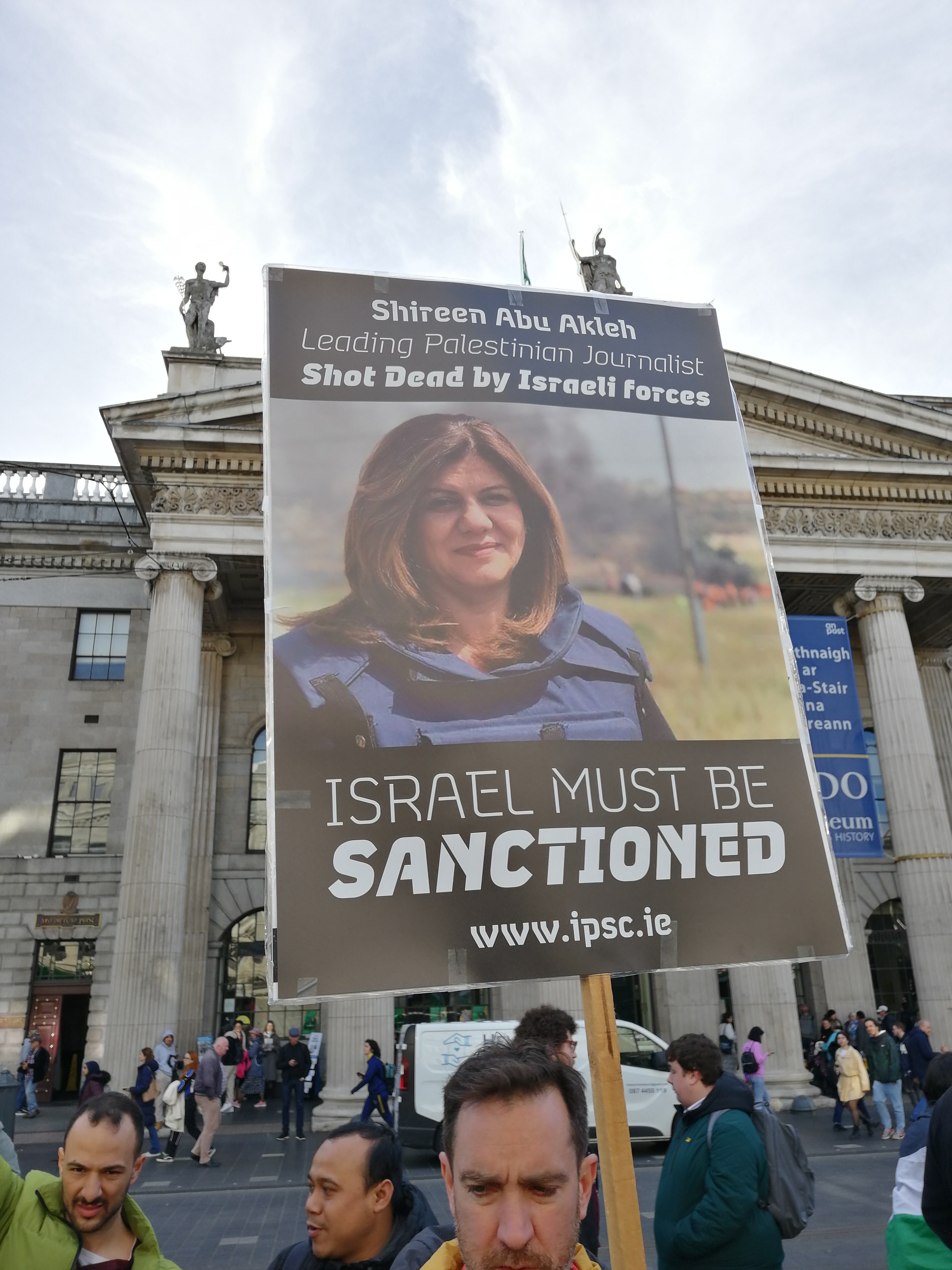
The iconic GPO in the background (Photo: D.Breatnach)
It has been years of viewing even media-sanitised coverage of massacres of Palestinians by the Israeli armed forces with international impunity that has radically altered the opinion of the public in Ireland, in all probability drawing on their own historical experience of foreign occupation.
An elderly Irishman voicing anti-Jewish views did in fact approach the rally but was confronted by other Irish people who emphasised that they were against the Zionist state and not against Jews, soon causing the first man to depart unhappily.
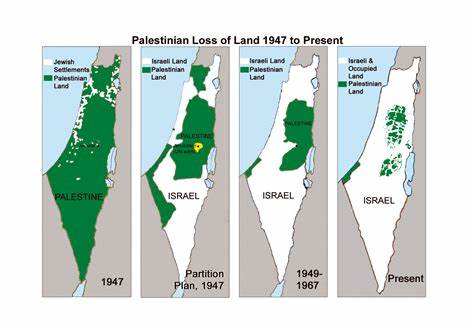
The continual occupation of Palestinian land by Zionist settlers has invalidated even the “two-state solution” (sic) beloved of liberals, making it a practical impossibility, undermining the main ‘concession’ of the supposed solution of the USA-mediated “Palestinian peace process” of 1991.
(Photo: D.Breatnach)
The refusal of the Israeli authorities to permit the return of Palestinian exiles while welcoming Jewish settlers, most of whom had no even ancestral connection to Palestine, means that the future for Palestinians in the Israeli state can be at best as an oppressed minority.4
(Photo: D.Breatnach)
Other Palestine news
Even as preparations for the Dublin rally took place, Israeli police shot dead a Palestinian they claimed had tried to wrest a gun from them at the Al Haq Mosque but whom Palestinian eye-witnesses said had merely been protesting the police harassment of a woman.
Since the rally, another two Palestinians have been killed in an by Israeli armed forces raid on Nablus. This brings the total number of Palestinians killed by Israeli forces this year alone to over 90, with a high proportion of them children.
Mass protests and even mini-riots by Israeli Jews are currently expressing opposition to the current government’s plans to ‘reform’ the judiciary, to bring it under the greater control of the Executive.
While Israeli Jews are deeply divided on this question the vast majority are agreed on the need to suppress Palestinians, to enforce apartheid and to keep the State as ‘Jewish’ one.
Meanwhile an April 1st Fool’s Day hoax depicting an executive of the sports shoe manufacturer company Puma declaring a boycott of the Zionist state was widely shared on the Twitter social media to overwhelmingly welcoming comment.
Exposure of the hoax received mixed responses, with wide condemnation from pro-Israeli and even some pro-Palestinian sources but others claiming it helped to widely publicise the manufacturer Puma’s close links to the Zionist State and that would enhance its boycott by many.
End.
(Image accessed: Internet)
Footnotes
1Dublin City has had Jewish municipal Councillors and the sixth President of Israel, Chaim Herzog (Hebrew: חיים הרצוג; 17 September 1918 – 17 April 1997) was an Irish-born Israeli politician, general, lawyer and author who served as the 6th President of Israel between 1983 and 1993. He was born in Belfast and raised primarily in Dublin; his father was Ireland’s Chief rabbi Yitzhak HaLevi Herzog, who immigrated to the British protectorate of Palestine in 1935 and served in the Haganah Zionist paramilitary group, later the Israeli Army where he reached the rank of Major-General. As recently as 1967 the prevailing Irish public opinion seemed sympathetic to the Israeli State and the fictional propaganda and wildly inaccurate historical Hollywood films Exodus (1960) and Cast a Giant Shadow (1966) were widely viewed sympathetically in Ireland.
2The term originally included hatred or fear of all Semitic people, including Arabs and Jews but has come to be understood as exclusively meaning a racist attitudes towards Jews. By no means all Jews are Zionist though Zionists have worked long and hard to make both descriptions interchangeable with a great deal of success among the world Jewish population with possible unfortunate consequences for Jewish populations outside Israel. However many Jews have criticised the behaviour of the Zionist State towards Palestinians, earning the hatred of the Zionists, who cannot label them as anti-semitic and therefore call them “self-hating Jews”.
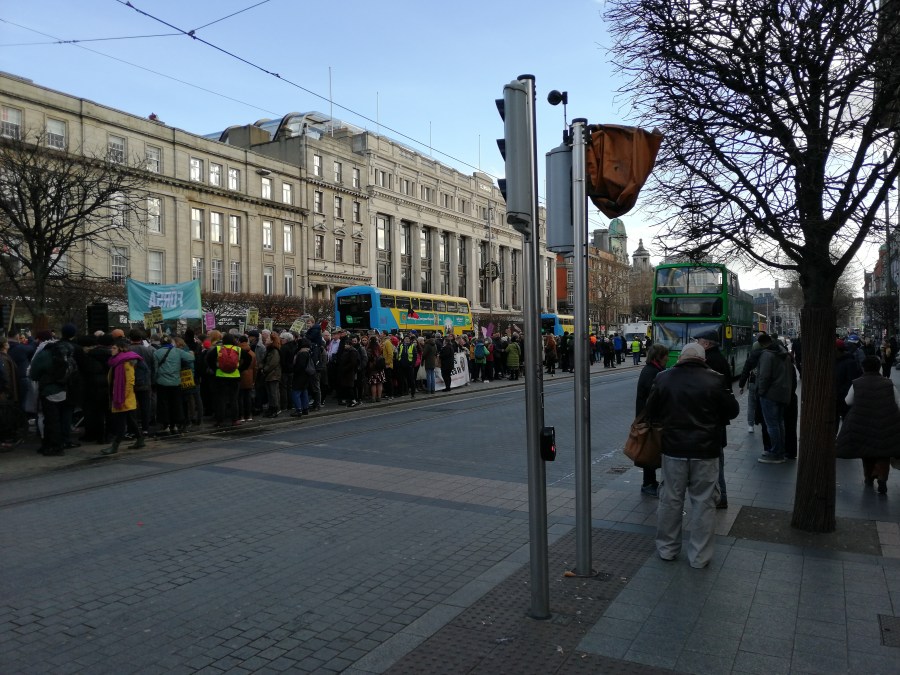
Monday was a new bank holiday in Ireland and two demonstrations of about equal size took place at the same time in Dublin that afternoon, one anti-racist and welcoming refugees, the other anti-refugee and with substantial racist and even fascist elements.
The pro-refugee event gathered on the central pedestrian strip on Dublin City centre’s main street, O’Connell Street, across the road from the iconic General Post Office, the building which served as the HQ of the 1916 Rising. Numerous placards and banners could be seen there.
Section of the Le Chéile pro-refugee demonstration in O’Connell Street (Photo: D.Breatnach)
The tightly-packed crowd stretched from the Spire southward almost to the Jim Larkin monument and were addressed by speakers. I knew the event had been organised by Le Chéile, a broad anti-fascist coalition of essentially pacifist nature with regard to fascism.
Closer view of section of the Le Chéile pro-refugee demonstration in O’Connell Street (Photo: D.Breatnach)
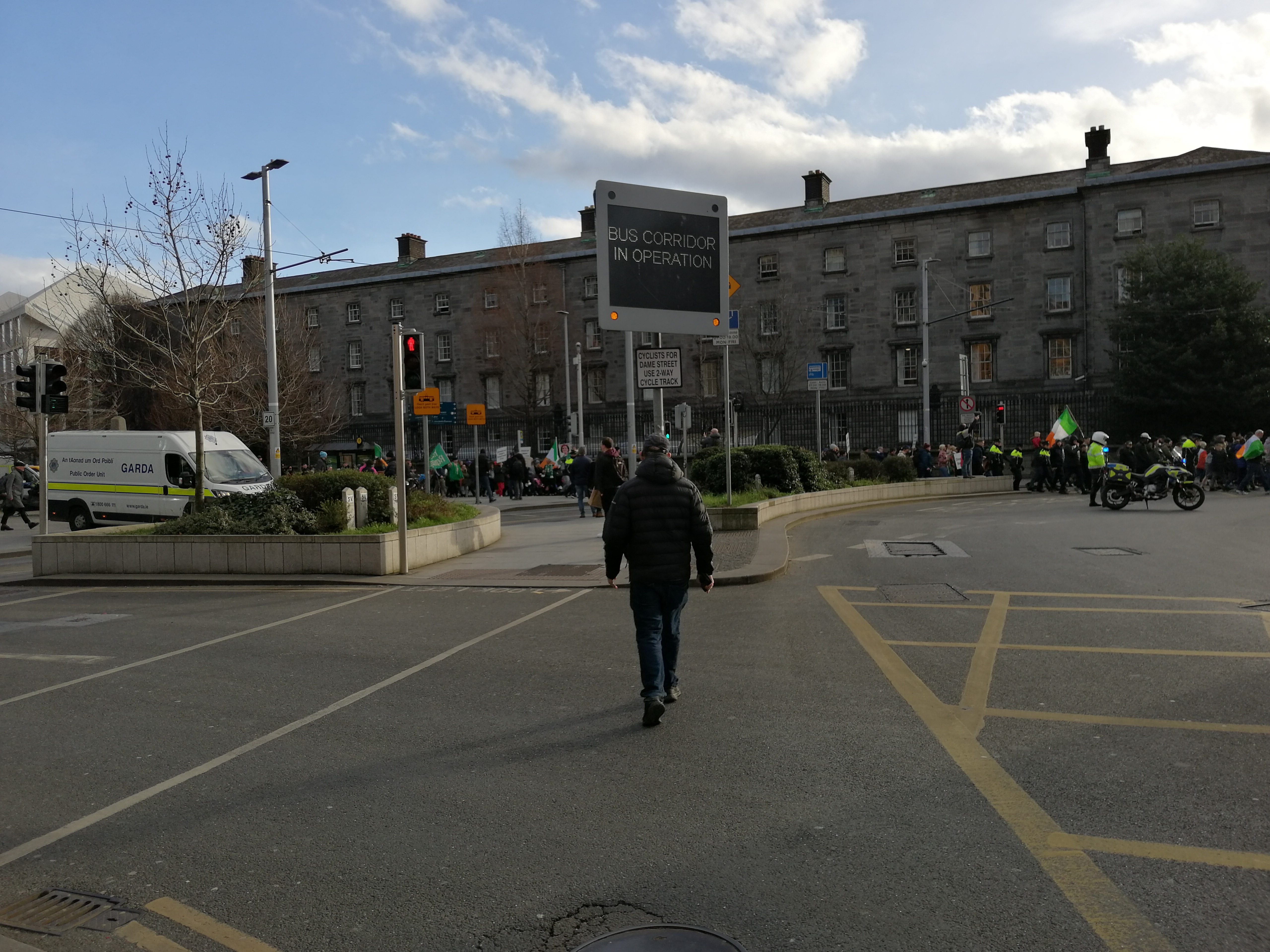
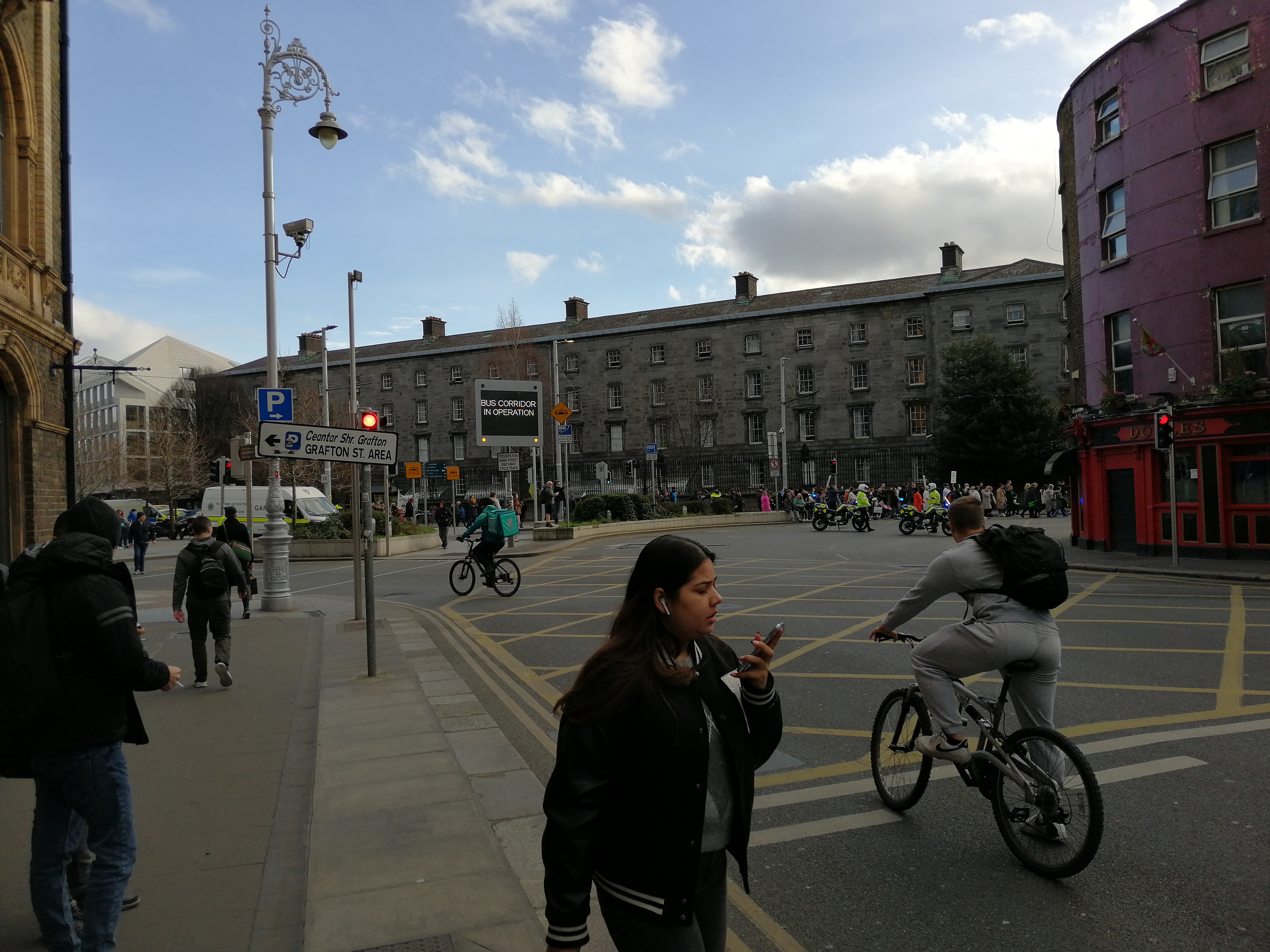
I passed them by in a hurry on my way to attend to a family commitment. While waiting to catch a bus in D’Olier Street, a number of Garda vans and motorcycles drawing up attracted my attention and soon afterwards the anti-refugee demonstration came from Pearse Street.
Cops arriving at Pearse Street/ D’Olier Street intersection just prior to arrival of the anti-refugee march. (Photo: D.Breatnach)
They passed along by Trinity College’s wall and soon after they had gone from my view, my bus arrived. I surmised the anti-refugee march had gone to demonstrate in front of Leinster House, the building that holds the parliament of the Irish State.
Front of the anti-refugee demonstration marching through the intersection (Photo: D.Breatnach)
As I was in a hurry and one group was tightly-packed and the other in extended line walking, it was difficult to compare the numbers but I made them both to be somewhat the same — between 500 and 700 each.
end.
Middle of the anti-refugee demonstration marching through the intersection (Photo: D.Breatnach)End of the anti-refugee demonstration marching through the intersection (Photo: D.Breatnach)Longer view of the Le Chéile-organised pro-refugee demonstration on O’Connell Street (Photo: D.Breatnach)
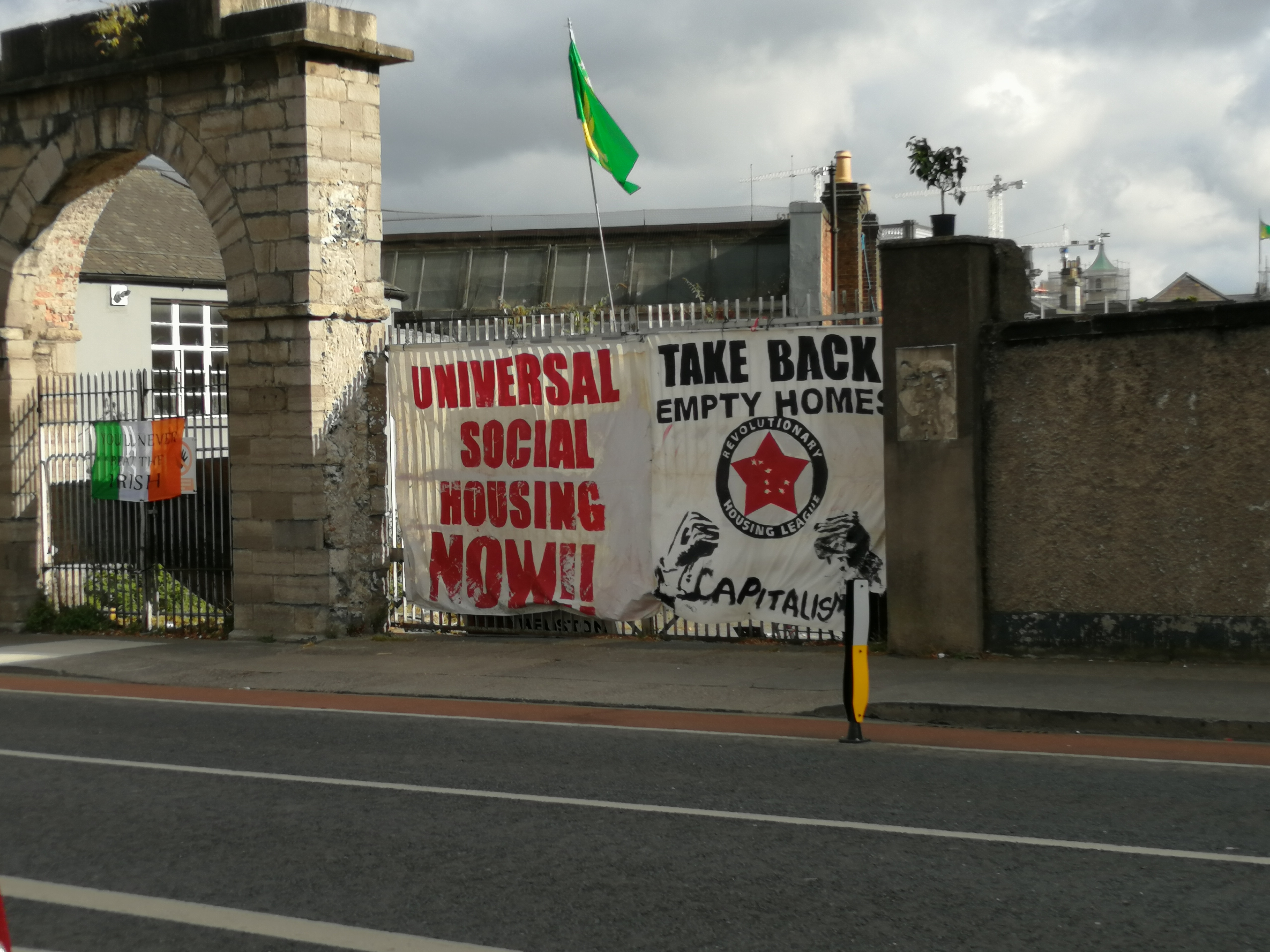
For a group that first came into public view on May 1st with an occupation of a building empty for two years, the Revolutionary Housing League has certainly been busy. At least two further acquisitions1 have followed since.
In addition, a hundred police with vehicles and helicopter have been videoed in one eviction of two activists; four activists have appeared defiantly in court in different cases and the High Court has granted injunction to companies against activists.
As I write this another eviction is being planned, resistance is being organised and further repression through courts and jail seem certain. The RHL are fighting the system, fighting a fundamental social wrong acknowledged by almost everyone.
SHORT HISTORY OF THE REVOLUTIONARY HOUSING LEAGUE
In 1st May 2022 activists acquired Lefroy House on Dublin’s Eden Quay, formerly used by the religious-based NGO, the Salvation Army to provide night-beds for young homeless people but empty for two years. The activists renamed the building Connolly2 House.
A decorated tile at the door of Connolly House in May/June 2022 (Photo: D.Breatnach)
At that time the occupiers were calling themselves the Revolutionary Workers’ Union though their council subsequently formed the Revolutionary Housing League.
The Salvation Army took the occupants to court, claiming the SA had been renovating the house in order to accommodate Ukrainian refugees. Despite the absence of evidence of any renovation work and the presence of a leaky roof (fixed by the activists!), the court granted the injunction.
The occupiers called for a rally against eviction on 2nd June and a large crowd of people of various political backgrounds, organisations and independents, arrived to support but of course, the eviction forces could wait and choose their time.
Musician performing and section of crowd at rally against eviction outside Connolly House (Photo: D.Breatnach)
On June 9th at 5.45 a.m early passers-by were amazed to see 100 Gardaí3 with a number of vehicles, supported by a helicopter, including armed police4, assault the building to take possession of it for the SA and to arrest two activist occupants. A video of the event taken by a passer-by went viral.
Both activists were later released on their own surety bail to await court process and the building was fortified against being retaken. To this date it remains empty.
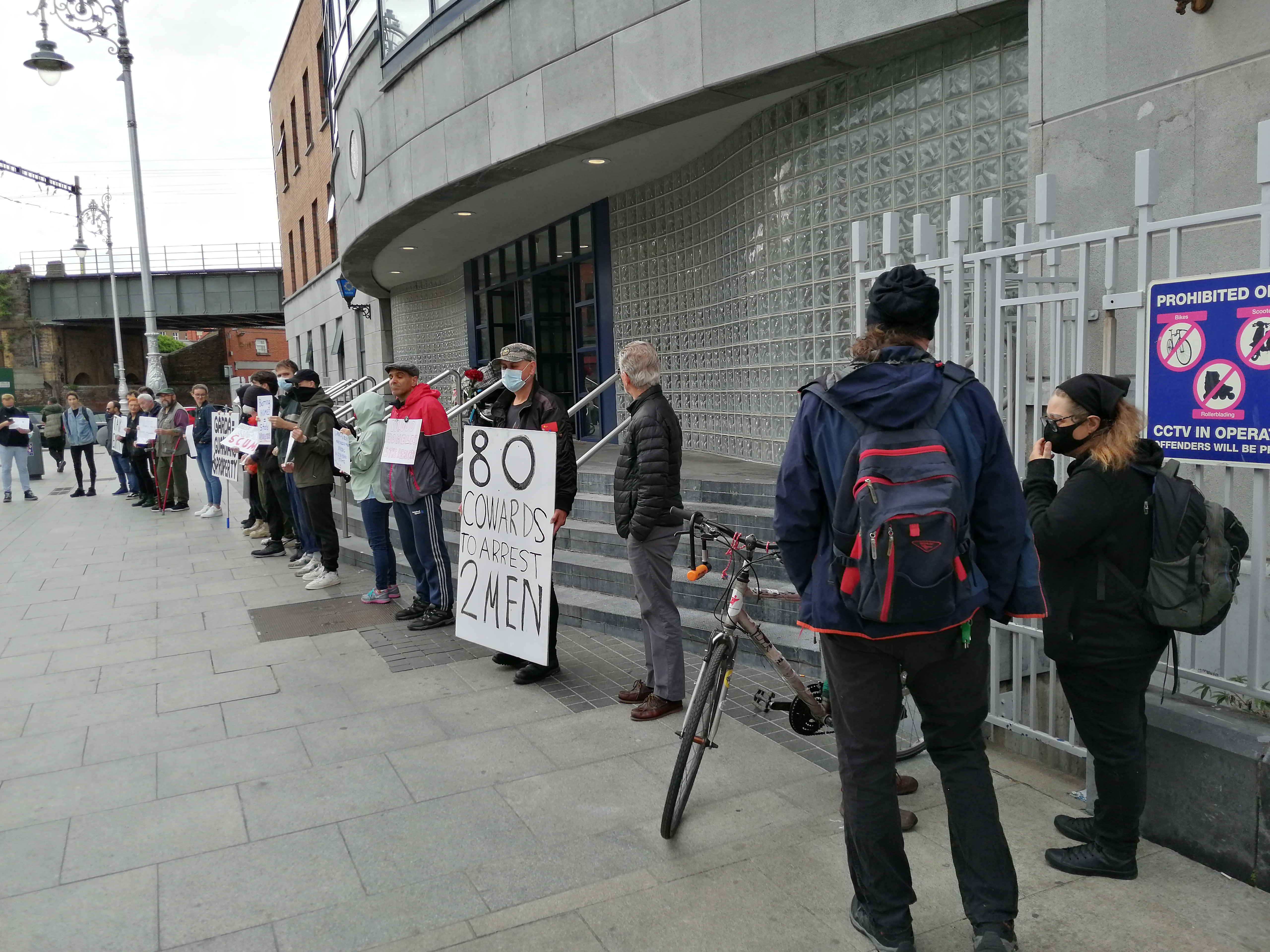
On 13th June, the housing activists convened a protest picket outside Store Street Garda station.
Picket on Store Street Garda Station following eviction of James Connolly House (Photo: D.Breatnach)
The RHL had acquired another site5, this one having been a building for homeless people of the municipality, Dublin City Council, but also empty for a long period. On June 10th Gardaí arrested two activists near the building and they too are being processed by the courts.
After that, the RHL occupied a large warehouse-type building on the very north bank of the Liffey by Sean Heuston Bridge which they named, naturally enough, Ionad6 Seán Heuston. They opened it as emergency accommodation and held talks and discussions within it.
Parkgate Street front of Ionad Seán Heuston in early September 2022 (Photo: D.Breatnach)
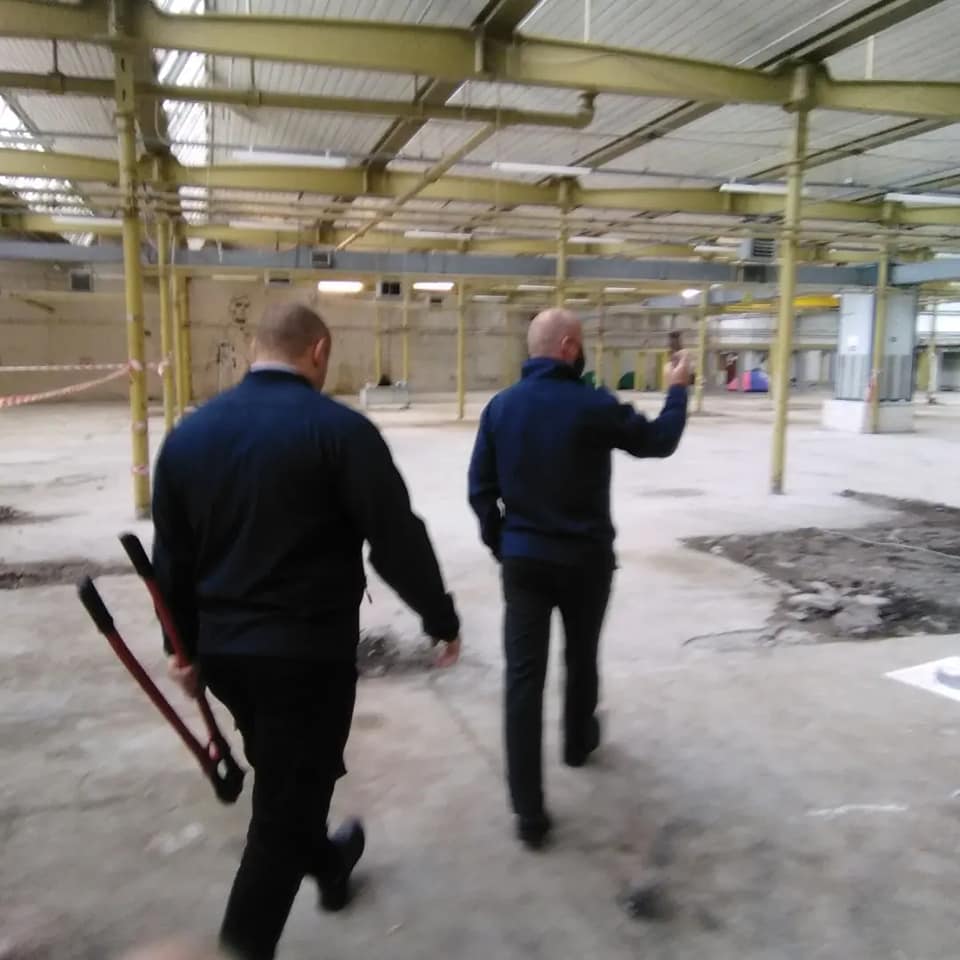
Employees of Pinnacle Security company with bolt-cutters entered the site on 3rd September but failed to evict residents and on the 5th September RHL activists picketed the company which, as a consequence, withdrew from acting as security for Chartered Land, owners of the site.
Pinnacle Security staff, one armed with bolt-cutters, entered Ionad Seán Heuston on 3rd September but failed to intimidate the residents into leaving. Two days later, RHL picketed their HQ and were given a written undertaking that the company would no longer carry out security for Chartered Land on the site. (Photo: Revolutionary Housing League)
The building owner’s interests are managed by Davy Platform ICAV, acting on behalf of its sub-fund the Phoenix Sub-fund but ultimately, the owner is Chartered Land which intends to build high-rental apartments on the site.
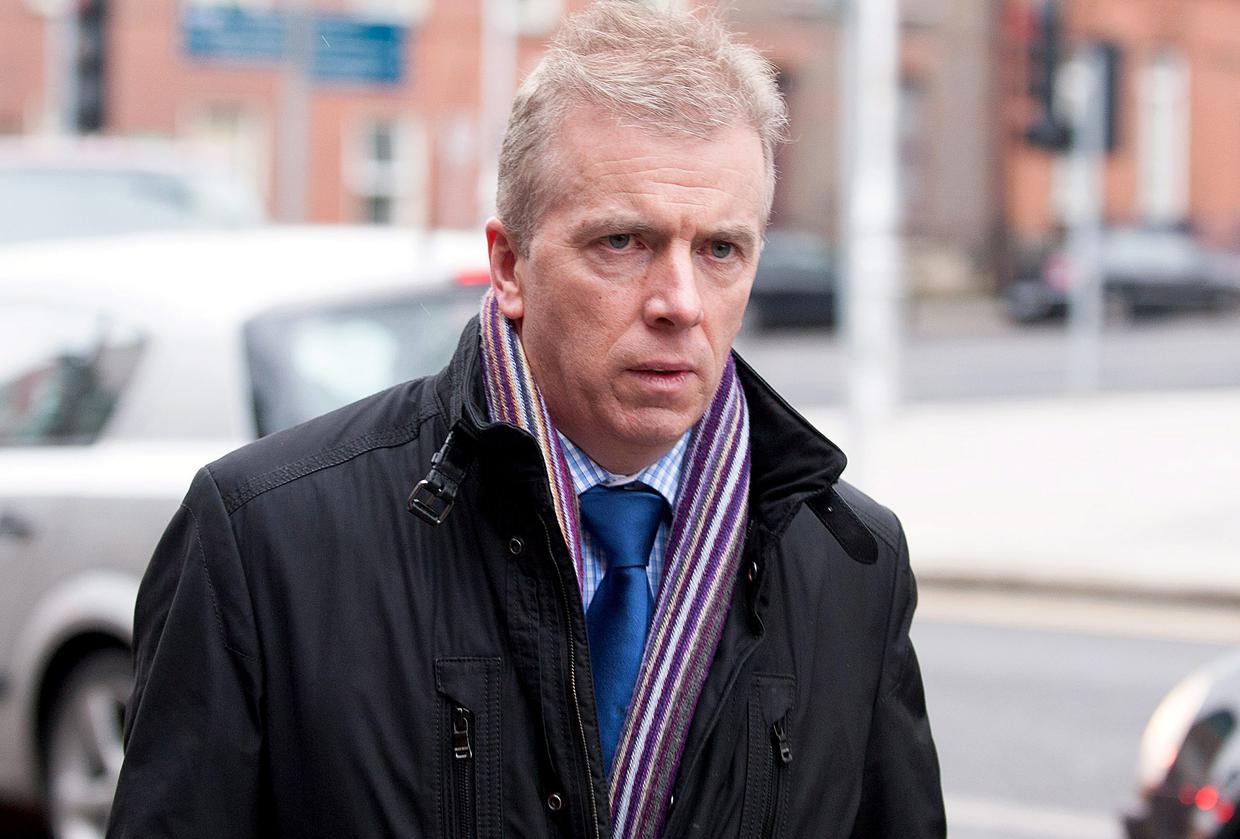
Joe O’Reilly is the property speculator tycoon behind Chartered Land, once the biggest debtor to NAMA whose responsible officer Conor Owens permitted O’Reilly to transfer his Moore Street, ILAC and Dundrum Shopping Centre holdings to Hammerson, a British-based property company.
Joe O’Reilly after appearing as a witness in criminal court in 2015 (Photo: Irish Independent)
That transfer gave Hammerson control of properties O’Reilly’s planning permission from Dublin City Council for a giant “shopping mall” there which they have now changed but again approved by DCC’s Planning Officer and which is under appeal to An Bord Pleanála.
Conor Owens is now Ireland Director for Hammerson.
Lawyers for O’Reilly named a number of individuals as being in occupation of the property, at least two of them apparently on the basis of photographs of the interior shared by the them on social media. Last Thursday a number appeared in court on applications for injunctions against them.
One who had not been named, a homeless individual, made an emotional appeal for he and his partner to be allowed to stay and the occupants to provide services to more homeless people. Another denied he had been an occupant but had merely shared photos on social media.
That latter individual had the injunction against him removed but was asked to sign an undertaking he would not enter the building, which he declined to do, remarking that he should not even have had to attend the High Court in the first place.
Sean Doyle of the RHL declared that the action they were taking was necessary and quoted James Connolly: We believe in constitutional action in normal times; we believe in revolutionary action in exceptional times. “These are certainly exceptional times”, Doyle remarked.
The judge went ahead and granted the injunction and required all occupants to evacuate building by Wednesday 21st (i.e as this piece was being concluded).
The RHL organised a picket and temporary protest occupation of Davy stockbrokers, who were handling procedures for Joe O’Reilly, the property tycoon owner of the site of Ionad Seán Heuston.
RHL picket and temporary occupation of Davy stockbrokers (Photo: Revolutionary Housing League)
Last weekend the RHL organised a solidarity concert at Ionad Seán Heuston with somewhere between 150 to 200 in attendance and with at least two bands posting on social media their delight at having performed there.
O’Reilly’s legal team claimed “a flagrant breach of the court order”.
The RHL have called a solidarity rally against the eviction at the site for tomorrow at 10am.
Band performing to crowd at Ionad Seán Heuston — “a flagrant breach of court order” according to property tycoon’s lawyers. (Photo: Revolutionary Housing League)
THE FUTURE
Whatever the outcome of the eviction intended for this particular building or the eventual result of court cases, it seems clear that the RHL are on a collision course with the State and its protection of landlords and property speculators.
While some may look askance at such a contest, one may ask legitimately what other course of action is effective and viable?
Marches and short-term symbolic occupations of individual buildings, including the high-profile Apollo House one supported by prominent individuals in December 2016, though possibly raising awareness, have not made a single dent in the homeless crisis.
Section of the crowd at rally outside Apollo House 11 January 2016. Events such as these mobilised opinion but did not change the situation as indeed it worsened (Photo: D.Breatnach)
Indeed, the situation seems to have got steadily worse – at least for those seeking accommodation; while on the other hand clearly landlords, letting agencies, property speculators, vulture funds and the very banks are raking in their profits.
OVER 10,000 HOMELESS INCLUDING 2,503 CHILDREN
Earlier this year the State admitted that homeless figures had passed ten thousand, for the first time since the covid pandemic7, a statistic that includes the shocking figure of 2,503 children.8
And a recent report states that the levels of homelessness are under-estimated because of the accounting system used by the State, which focuses on rough sleepers and those accessing emergency accommodation9.
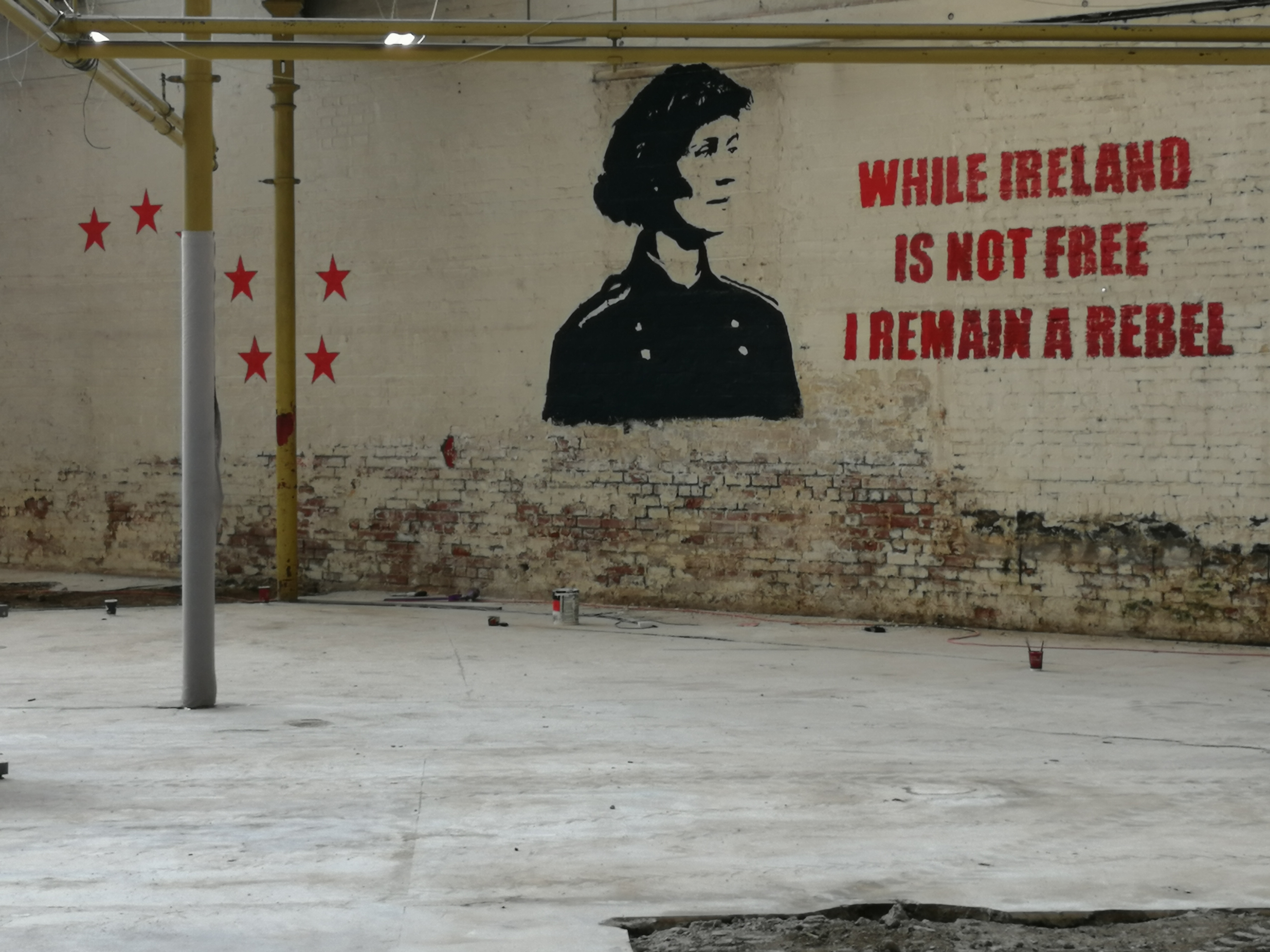
Mural representing revolutionary Irish socialist Republican Constance Markievicz and the outline in red stars of “the Starry Plough” (Ursa mayor), one of the impressive murals inside Ionad Seán Heuston (Photo: Rebel Breeze).
Sofa-surfing, rotating between friends and family, precarious rental arrangements all figure in homelessness but are not measured or accounted for by the State. Indeed these features of homelessness have been known for decades.
Clearly too, the obvious solution, the release of substantial funds by the State to local authorities to build public housing for affordable rent, is not favoured by any of the Government political parties.10
Apart from the general inclination of the ‘political class’ to serve big business many have direct interests in the housing situation, as an audit of TDs (member of the Irish Parliament) found over 80, i.e more than half, are landlords or own property – or both.11
Faced with such a situation it is clear that only a very substantial shock to the political system has any hope of having a serious impact on the housing crisis. Though the solution need not be revolutionary, all the evidence is that the methods do indeed have to be so12.
An interesting side-aspect of the RHL’s occupation has been the use of innovative and highly-effective art in banners and murals. Also the holding of a concert and some trad music sessions in acquired buildings, along with educational talks, discussions and Irish language classes.
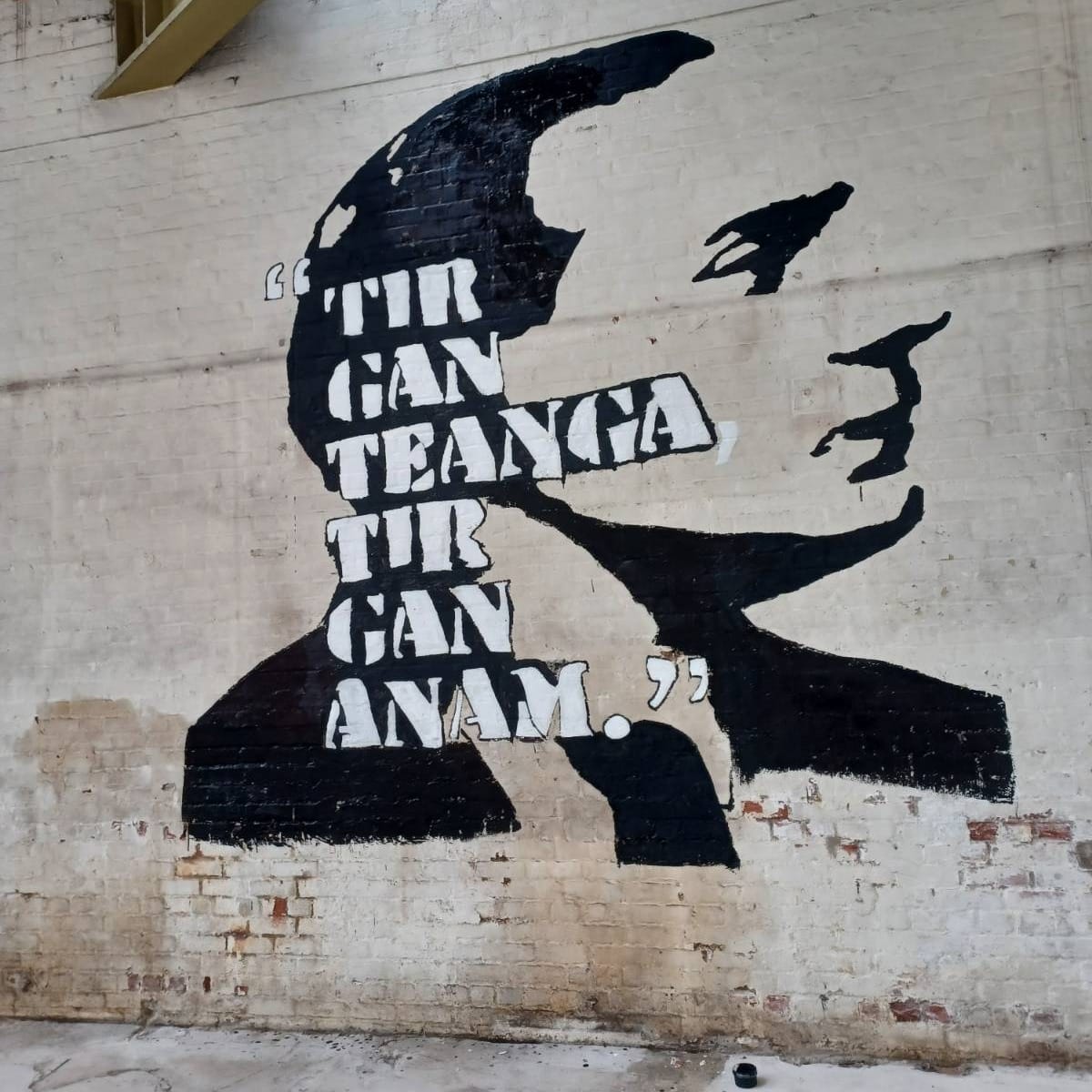
Another of the murals in Ionad Seán Heuston, a representation of the profile of Pádraig Mac Piarais/ Patrick Pearse, revolutionary Irish Republican, writer, educator, executed by British firing squad in 1916. His slogan translates as: “A country with out its language (is) a country without a soul”. (Photo: Revolutionary Housing League)
The RHL is a small organisation fighting the State Goliath which is representing the Philistines of property speculators, vulture funds and banks. They deserve our support in whatever measure we are able to give, in attending events and spreading the word.
Indeed, they have called for wider action – the RHL has on a number of occasions called on people to do what they are doing, to occupy the thousands of empty buildings which, if people did, would transform this struggle into a mass movement.
With no other viable solution in sight, surely we should support the RHL? Do we not owe it to those on the street or struggling to pay mortgages or high rents? Do we not owe to the children now, the future generation that will be blighted unless we act?
End.
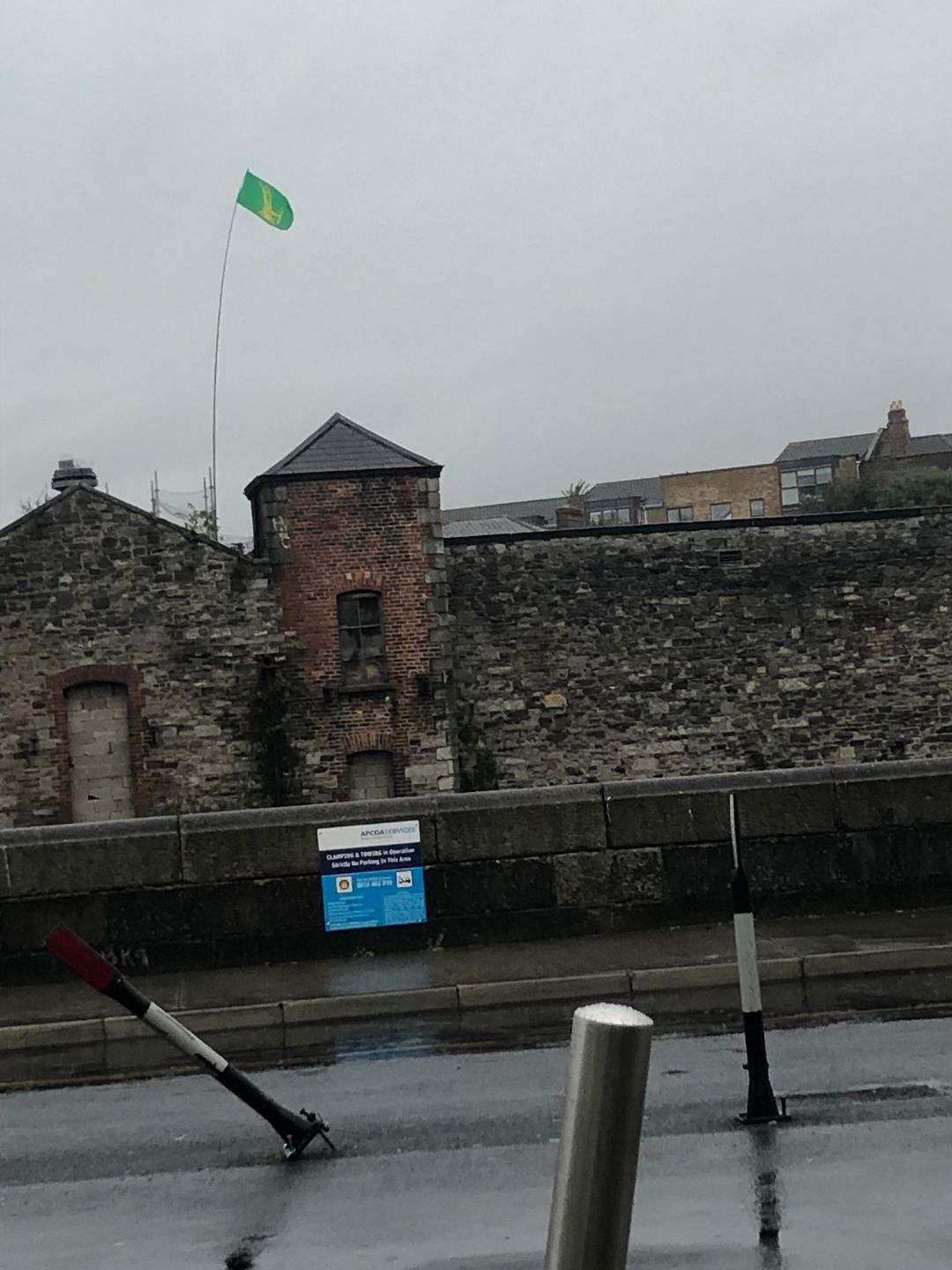
The Starry Plough flag of the Irish Citizen Army in the early decades of the 20th Century flies above Ionad Seán Heuston (Photo credit Revolutionary Housing League, taken from Seán Heuston Bridge)
FOOTNOTES
1The RHL call their taking of empty properties “acquisitions” in the name of the people.
2After notable socialist revolutionary, trade union organiser, journalist, historian and writer James Connolly, executed by British firing squad in 1916.
3The police force of the Irish State is called An Garda Síochána and the plural of its members, “Gardaí”, singular “Garda”.
4The Garda Síochána is essentially an unarmed police force with an armed response section, the latter which however seems to be growing and more in evidence in different situations.
5They named that one Liam Mellows House in honour of socialist Irish Republican and former member of the Irish parliament, the Dáil, executed during the Civil War by the Irish State in retaliation on 8th December 1922.
6Ionad in Irish means “place/ location/situation”.
10Sinn Féin’s latest housing policy indicates a crash building program for “affordable homes” but unclear whether to rent or own. Election promises tend to be taken with a pinch of salt by commentators; SF Councillors on Dublin City Council voted public land sold to developers. In addition, a future government including SF would almost certainly include a former government party in the coalition.
12The State has the power to put empty properties to use to eliminate all homelessness immediately and the Government can divert funds towards starting a big housing construction program which would give everyone good quality affordable homes in a couple of years. It does not do so because that would upset the profits of the property speculators, property management companies and the banks, their lenders.
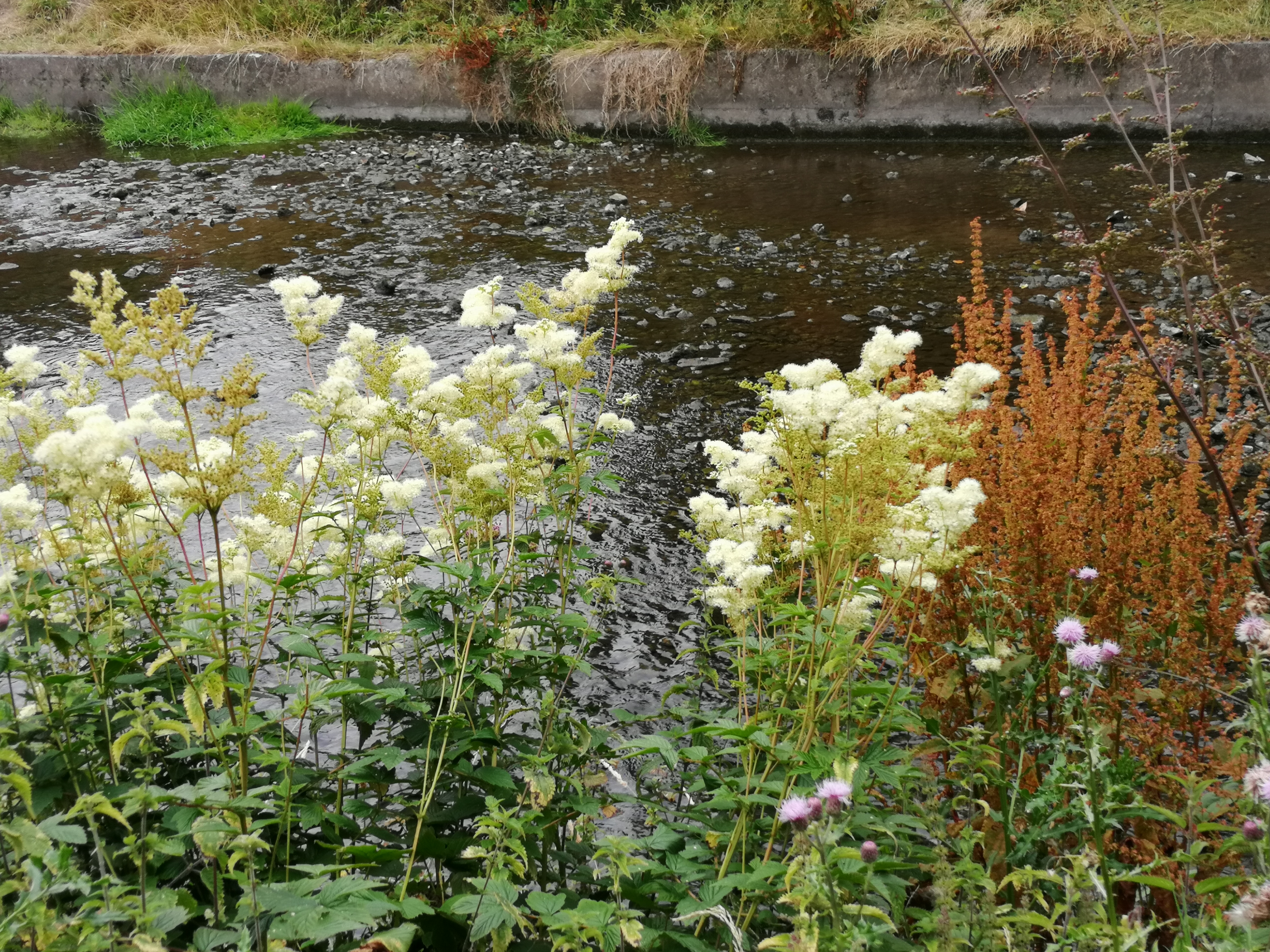
WALKING ALONG THE TOLKA AS IT RUNS THROUGH GRIFFITH PARK RECENTLY, I WAS PLEASED TO SEE A GREAT VARIETY OF WILDFLOWERS GROWING ON THE BANKS.
All were within a stretch of a few hundred yards.
Mint perhaps? (Photo: D.Breatnach)
Water mint maybe (Mentha aquaticaMismín mionsach) growing midstream so not able to pluck a leaf and smell it. Also brown seed-heads of Broad-leaved Dock (Rumex obtusifoliusCopóg shráide) for contrast (Photo: D.Breatnach).
Not sure what this one is but breaks out into tiny white flowers. Almost centre is a stalk of stinging nettle (Neantóg/ Cál faiche). (Photo: D.Breatnach
Member of the thistle family (Feochadán) — but which one? — in flower and down (Photo: D.Breatnach)
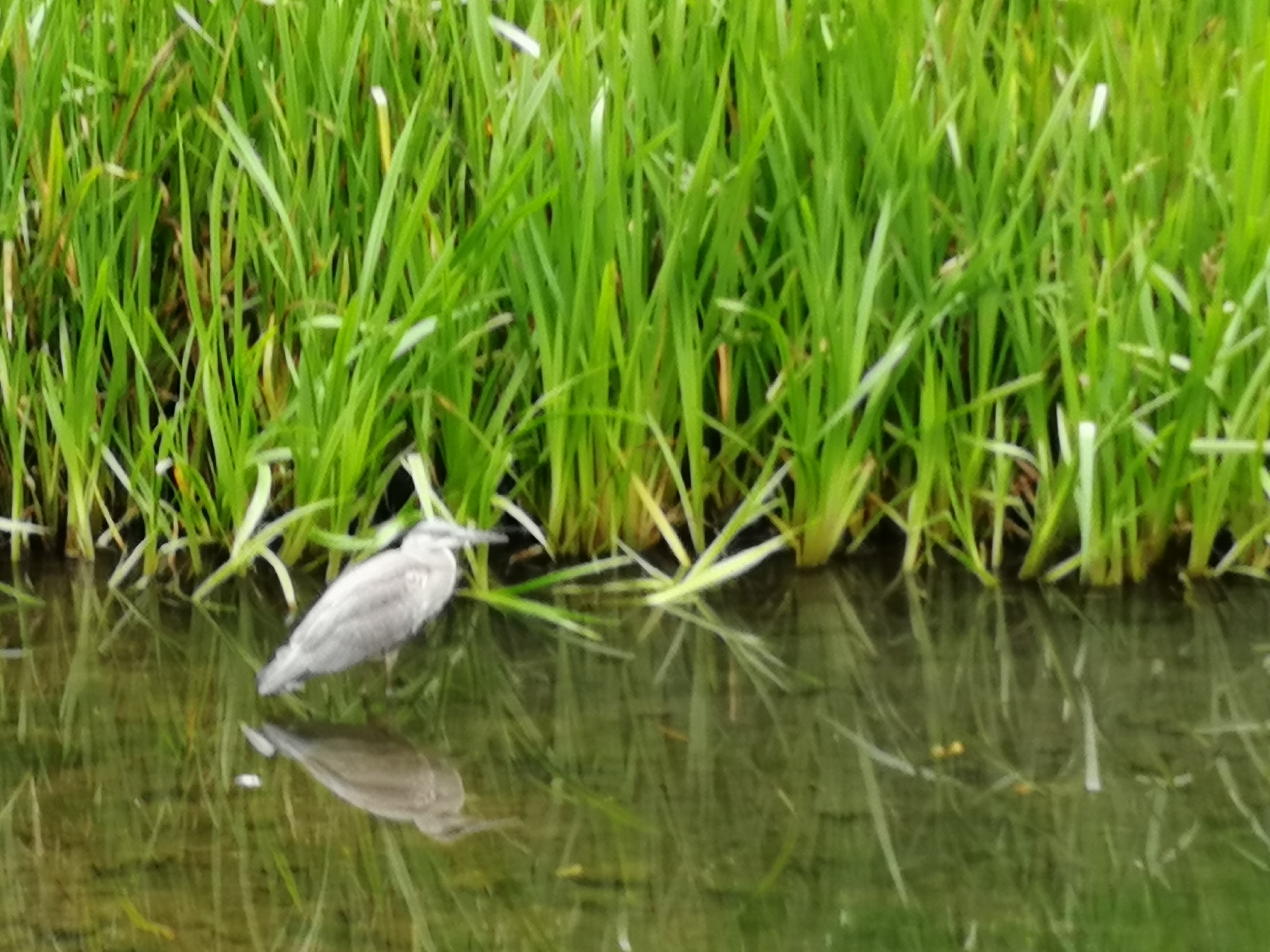
Little Grey Heron (Corr Éisc) waiting by the reeds for lunch to swim by (Photo: D.Breatnach)
Hollyhock in foreground and looks like another behind it — NOT a native plant. There were some growing each end of the bridge, as though planted or sown there. (Photo: D.Breatnach)
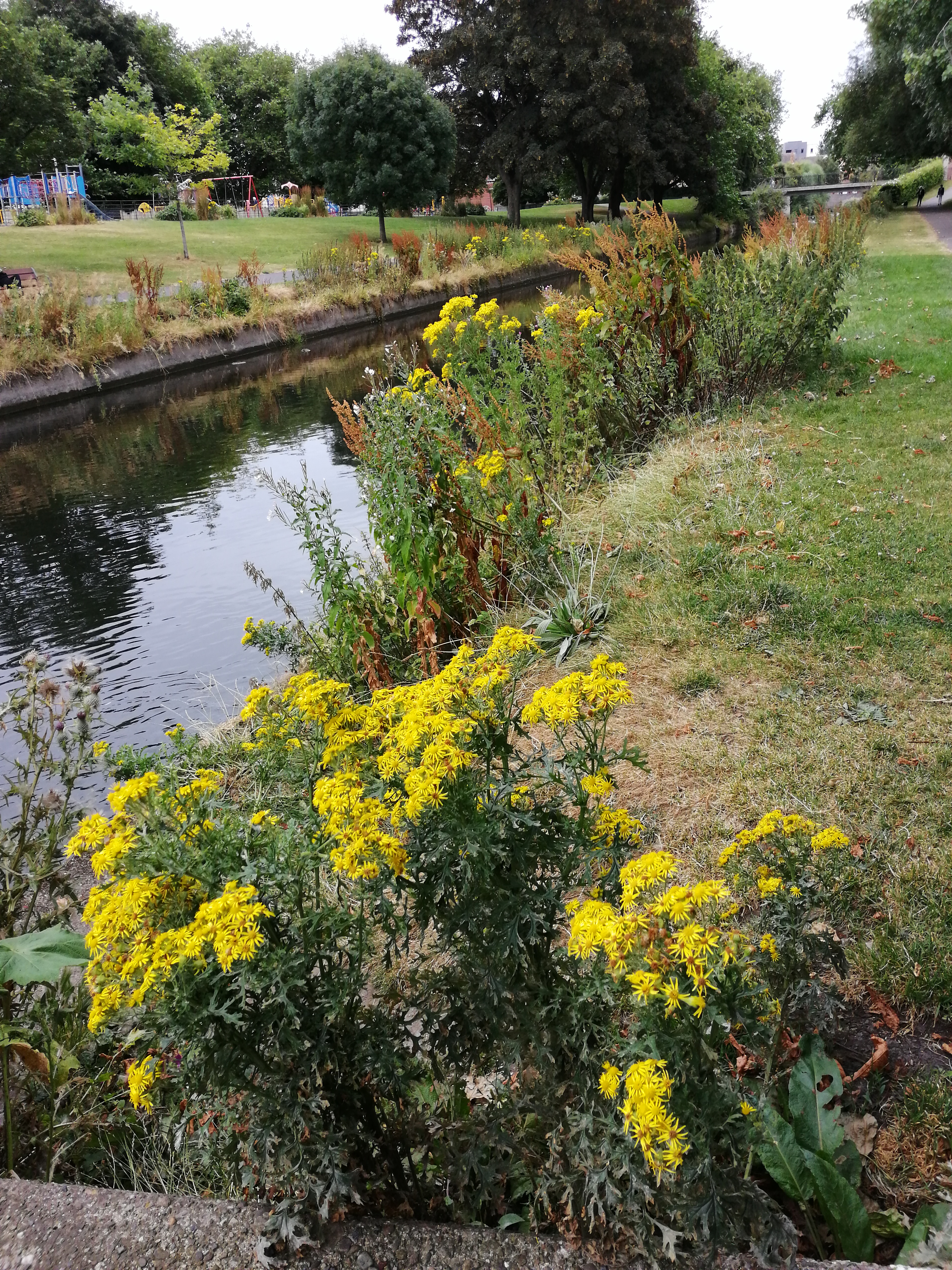
Groundsel/ Ragwort like constellations of stars before they go to down and seed. But which one? Common Ragwort (Senecio jacobaea / Jacobaea vulgarisBuachalán buí) I think. (Photo: D.Breatnach)
This one I do know — Meadowsweet (Filipendula ulmariaAirgead luachra) and dock seed heads again. (Photo: D.Breatnach)
Casadh sa tsruth — a bend in the flow — and view up from the weir. Willow trees on the right and a shrub I know to see but have not identified (a Skimmias?) on the right. (Photo: D.Breatnach)
Lesser Knotweed (Persicaria campanulataGlúineach an chlúimh), I’m pretty sure — an introduced plant. (Photo: D.Breatnach)
There were other flowering plants too but either had already flowered or were yet to do so.
(Photo: D.Breatnach) Red Campion (Silene Vulgaris Coireán na gcuach) at centre-right here? (Photo: D.Breatnach)
They had been preparing for this for some time. The infants were selected, received special care and food and were raised carefully in the Palace chambers inside the Citadel. They were now adolescents, maturing sexually.
As the time approached for their great expedition, the tunnels leading to the departure terminal were widened and cleared of all obstructions. Experts tested the weather conditions daily and, when the majority of these were in agreement, the Queen gave the order to launch.
The adolescents took off then, a great host of them, amidst great excitement. Their pheromones, male and female, filled the air around them and those who could, which was most of them, quickly found a partner and coupled.
It was a maiden flight from which the adolescent females would land no longer maidens. Those who would land, that is. For suddenly the air was filled with giant flying monsters with huge eyes and giant whirring wings.
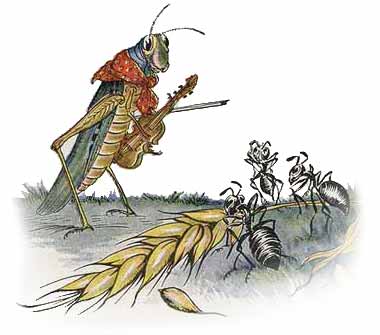
Black Ants busy while the good-times grasshopper looks on (Source image: Aesop’s Fables, Library of Congress, USA)
Much more accustomed to flight, these monsters flew among them, gobbling them up. Some even held rows of their hapless victims in their huge beaks as they flew off to feed them to their young. Hundreds, perhaps thousands of the little flyers perished in minutes.
Those who managed to land safely and didn’t end up drowning in a lake or a river, or snapped by denizens of the deep who sprang up at them as they passed overhead, or caught in sticky webs, or who were not stamped carelessly to death by huge walking giants or flattened by roaring, stinking monsters, still had to contend with smaller predators on the ground. The casualty rate was huge but some made it alive – some always did.
The males who made it down to ground safely would all die within a couple of days. Their wings were only intended for their nuptial flight; on the ground, they were nothing more than a nuisance, impeding their progress over and underground.
The females, sexually sated and no longer interested, had left their male partners behind. They bit off their own wings, ate them and, quickly finding some reasonably soft ground, began to dig.
Each one dug down as though her life depended on it, which of course it did; and not only her own life – each one was pregnant. Then she blocked the entrance to her tunnel, went back down it, excavated a chamber and began to lay eggs.
It was completely dark down there but she had been reared in darkness – she had one day of daylight only, the day she flew.
The young grubs who hatched were all females. She supplied them with some sparse nutrition from herself and cared for them as they grew, shed skin, grew … until they spun a cocoon from which they emerged as very small worker ants.
Magnified: Queen Black Ant Queen, grubs hatched from her eggs and metamorphosed adult worker ants. (Source Photo: Internet)
They were infertile workers and tended to their large mother, their Queen; even when they were fully-grown she was still one-and-a-half times their size, although about half the size she had been when she left her old nest.
Her most recent meal had been her own wings the day she had flown and mated. If she got past this crucial stage, she would recover her size and weight and lay more and more eggs.
The workers soon went up the tunnel, unblocked it and spilled out into daylight for the first time in their lives, beginning to forage for food. They found small seeds and, if they were lucky, sweet material such as soft-skinned ripe or rotting fruit.
They soon had their surroundings covered with their hive-scent, carried by each and every worker. Sometimes they found insects they could kill but these had to be very small indeed – these workers had been fed on insufficient nutrition and were, compared to the majority of their kind, puny.
If they found a food-source worth another visit, they left a specially-scented trail on their way back to their home, to guide theirs sisters back to the prize later.
A rich source of food typically would show two streams of traffic between their nest and the food – one empty-jawed heading for the food and the other, with pieces in their jaws, heading away from it and towards the nest.
The food gathered by the workers fed them and their Queen, while she continued laying eggs. As time went by, more and more workers were born, who would care for the hundreds of eggs their matriarch laid and raise more and more workers. Extensive tunnel networks were dug.
At some point the workers found aphids and began harvesting their sugary secretions; tending them on the stems of the plants the aphids infested and carrying them down to their citadel but bringing them back up later. The workers would fight to protect the aphids from those who preyed on their ‘herds’.
Successive generations of ant workers grew bigger, until they reached the optimum size of five millimetres (still four millimetres short of the Queen in her prime). A well-established citadel could in time house as many as 40,000 individuals (although between four and seven thousand would be more common).
They, and previous generations, are all daughters of the same mother and the product of one mating only. Their Queen, barring unusual disasters, might live to 15 years of age.
Black Ants (magnified many times) tending to pupae (grubs metamorphosing into adult ant forms) in the nest (Source Photo: Internet)
Once the citadel is built, it is vulnerable in the ordinary course of things only to parasites, flood, fire and severe surface disturbance. In Ireland, without bears, wild boar and largely without foraging pigs, severe surface disturbance is unlikely away from human construction or ploughing and digging.
Fire might not reach underground but the heat generated or the lack of oxygen might kill anyway; flood, of course, would be the biggest threat.
If a citadel should be uncovered or invaded by flood waters, some workers will rush to deal with the problem while others rush to save the young, trying to carry eggs, pupae or cocoons away in their jaws to a safe place. Some others will rush to do whatever they can for their Queen.
A black ant defends itself by running away if possible and if not, by biting. But intruders to the citadel are swarmed by biting ants. However most human skin is impervious to the bite and this species does not sting.
One day, perhaps three years from the Queen’s maiden flight, she will decide it is time to send her own children into the wider world. She will lay eggs and have these emerging grubs fed special food, which will produce males for the first time in her citadel, as well as other fertile females besides herself.
Flying ants seen against a sky (Source Photo: Donegal News)
Then, one day in July or in August, she will send them out too, to start new colonies.
Lasius niger, the Black or Garden Ant, is the most common of the 21 species of ant in Ireland. It is the most common also across Europe and a sub-species, L. neoniger, is known in the USA where however, it is not one of the most numerous ant species.
Lasius niger is a very active, hardy and adaptable species, living mostly outdoors under rocks and but rarely inside houses (although it may well enter houses repeatedly if it learns of food within, especially sweet food).
Flying ants emerging from their underground nest through gaps in paving stones. (Source Photo: Internet)
In cities, its nests are to be found in parks and gardens but also under street paving stones, the workers emerging to forage from tunnels leading to the joints between the stone. When those joints are surrounded by thin lines or small heaps of bright sand in summer, one knows that the workers are clearing the tunnels for the adolescents’ flights.
Another indication is an unusual amount of seemingly erratic ant activity around a nest, though one would need to be aware of what normal activity looked like, for comparison.
The ants may delay, awaiting what they judge to be optimum conditions but someday soon, mid to late afternoon, they will take to the air, to fly, to mate, to die or to live, to start a new population.
To an arachnophobe, the very idea of flying spiders must be a terrifying thought but they would reassure themselves that such a thing is only possible in horror movies. I am sorry to disabuse them but in fact many spiders do fly … and in fact, they’re flying in Ireland right now.
“Flying” might be a slight misnomer – “ballooning” might be more accurate, though they don’t use balloons. What they do is let out a line of silk – standard spider equipment – into rising warm air, or perhaps a breeze and …. up and away they go.
If it’s any consolation to the arachnophobes, the spider aeronauts are tiny – and probably need to be so for the airlift to work. On Wednesday in Dublin, at least three landed on me – one on my hand, one on my neck where I could feel the tickling (sorry, ararachnophobes!) and one on my bike, where it began to spin a web before I flicked it away to spin it somewhere else.
Traditionally, these have been called “money spiders” – apparently the folk belief or fancy was that if they landed on you, they meant good luck: as they symbolised a new suit being woven for you they were a prediction of an increase of wealth coming your way. They were landing on people all around Dublin on Thursday1 but wealth is coming sadly only to the same people as before: i.e native and foreign capitalists, property and finance speculators and landlords.
Looking up “money spiders” on the Internet, I find reference to Linyphidae which reminds me of Linyphia, that I recall2 spins those “hammock” webs in the hedges or bushes that you only really notice when they’re covered in dew.
Hammock or “sheet webs” of Linyphidae visible on foliage because of dew beading (Photo cred: James McNish)
But I had no ideal that “Linyphidae is a family of very small spiders comprising 4,706 described species in 620 genera3 worldwide.This makes Linyphiidae the second largest family of spiders after the Salticidae. The family is poorly understood due to their small body size and wide distribution, they are actually the most 3rd venomous spider worldwide4 after the black widow and Brazilian wandering spider;[citation needed] new genera and species are still being discovered throughout the world. The newest such genus is one from from Nepal …… Since it is so difficult to identify such tiny spiders, there are regular changes in taxonomy5 as species are combined or divided.”6
But wait a minute! No mention of our common wolf spider, which is small but not tiny except for its young, which I remember also take to the air. Was mine a false memory? Or was Crompton mistaken in Life of the Spider? So, I do a quick on-line check on the Wolf Spider into Wikipedia and yes, it mentions how the mother carries the tiny young on her back but …. no mention of them flying! However, a little more digging into the Internet (because it’s hard to believe I have been so mistaken about this for so long) and …. I find the reference! Yes, the young of Pardosa amentata, a species in the big family of wolf spiders, do also take to the air.
This is a small dark brown spider which you are most likely to see running over dry parched earth, especially when it cracks a bit, or over a stone or concrete path. It does not construct webs but runs its prey down, hence the “wolf” part of its name but unlike the wolf, Pardosa amentata hunts alone.
When she has been fertilised (whether her mate got away alive or not), she will weave a silk sheet into which she will lay her eggs and which she will then bind up into a round pill-shape, before strapping it on to her body underneath her abdomen. Since the egg-case is usually off-white, to a quick look it will appear that this is a brown spider with a white abdomen and most people who spend any time in a garden will have seen these7.
About real size (on standard laptop screen), Lycosa female carrying her egg-sac under her abdomen (Photo cred: Wikipedia Commons)
She carries this at all times, even when hunting or escaping from prey. She is very protective of that egg-case and if it is removed, Compton wrote, will try hard to retrieve it, even daring an ant-lion8 funnel to save it.
When she senses her young are are ready, she bites the egg-case open and tiny spiderlets come tumbling out, crawl up her legs and sit on her back, all linked legs, sometimes three layers deep.
Now when you see her, it looks like she is furry on the back or maybe has some kind of infestation. If the young are brushed off, she will try to wait for them to find her and climb back on. With egg-case or young, she can stil hunt and does but I don’t think anything is known of how the young receive alimentation – if indeed they do at all. Anyway, one day soon it’s goodbye Mam, goodbye back-travel mates and up they climb along stems and branches, let out the silk line …. wait …. wait …. wait …. YES! Up and up, soaring into the sky, to come down in …. somewhere. If they live that long.
Female wolf spider (family Lycosidae, magnified many times) carrying her young spiderlings on her abdomen (Photo cred: Science Photo Library)
Then they have to find prey that they can handle at their tiny size, avoid other predators, grow, moult, grow, moult until one day they will be a hopeful mature female or a hopeful and very cautious male. If the former, the cycle will begin again, all taking place in the space of only a couple of years.
But right now, all over Ireland, the little spider-nauts are flying …. and landing, somewhere near you.
End.
Ballooning spiderlet on a human finger (enlarged around x400 — images sourced internet)
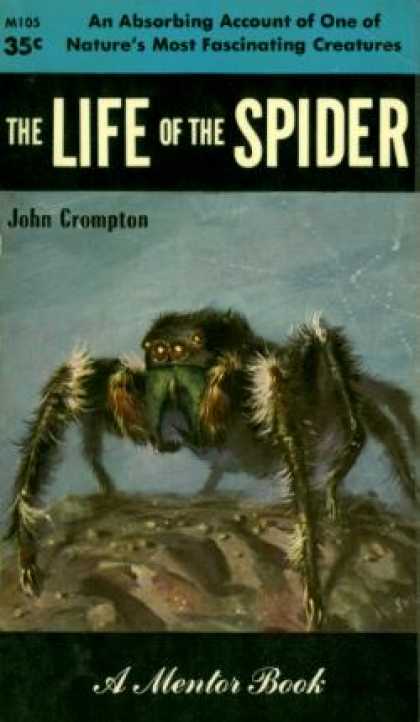
Especially for arachnophobes — cover of Crompton’s book (Image sourced: Internet)
2I read John Crompton’s Life of the Spider (Mentor, UK, 1954) as a child and remember a lot of what I read there.
3Genera is the plural of genus and means the overall group after the family which is then divided into species. For example the wolves, coyotes, hyenas, foxes and the domestic dog are all members of the overall family Canidae, but that itself is divided into 12 genera, of which Canis is the one to which the wolves Canis lupus and their descendants the domestic dog Canis (lupus) familiaris belong, while the foxes belong to the genus Vulpes. https://en.wikipedia.org/wiki/List_of_canids
4Even should this be true, their tiny jaws are unable to pierce human skin; the spiderlet itself is no bigger than the head of an ordinary sewing pin.
5The branch of science concerned with classification, in particular of life-forms.
7I’ve also seen a yellowish spider in water margins carrying a similar egg-case.
8The ant-lion is something like the “sand-worms” in the fictional Dune series, except that they remain in their funnel in a tip in the sand, waiting for the unwary traveler when their head emerges with fearsome jaws and …. well, you can imagine the rest.
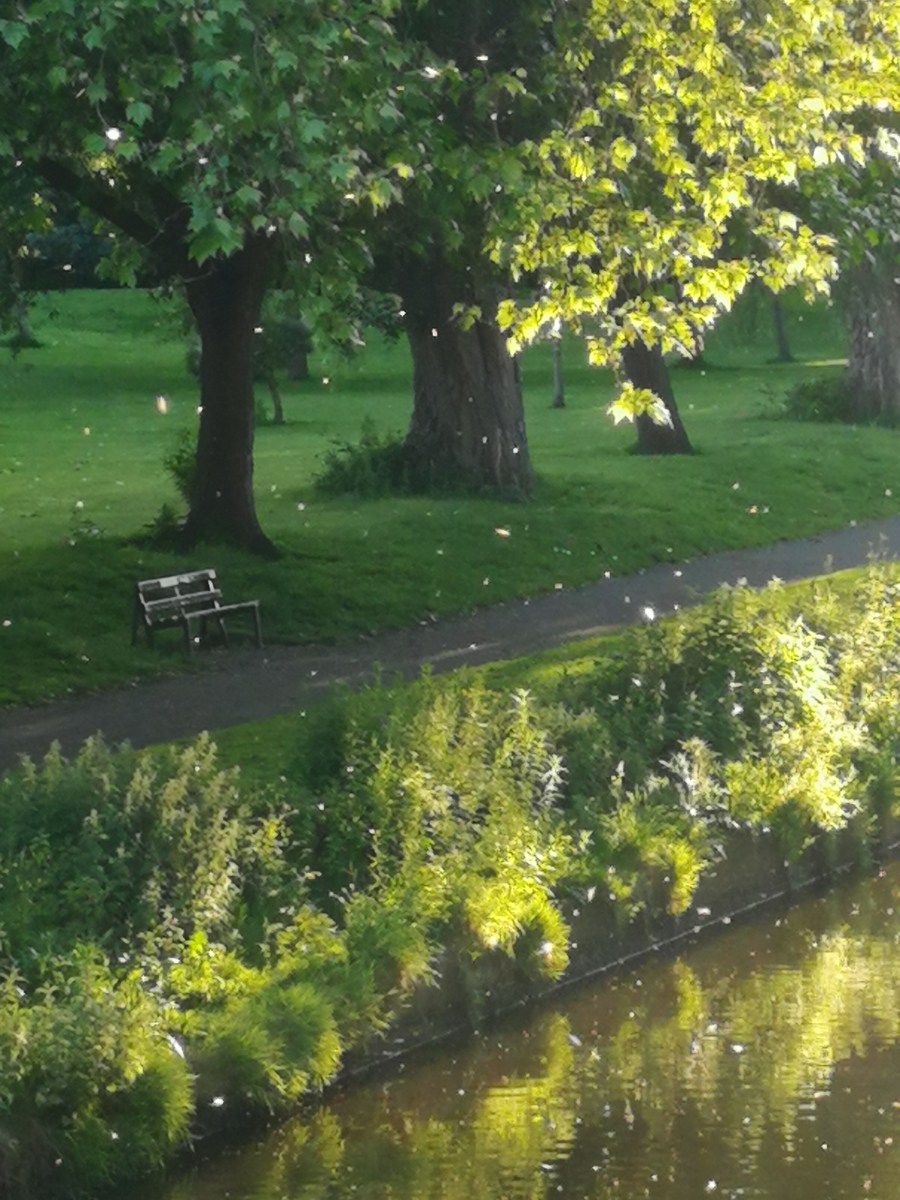
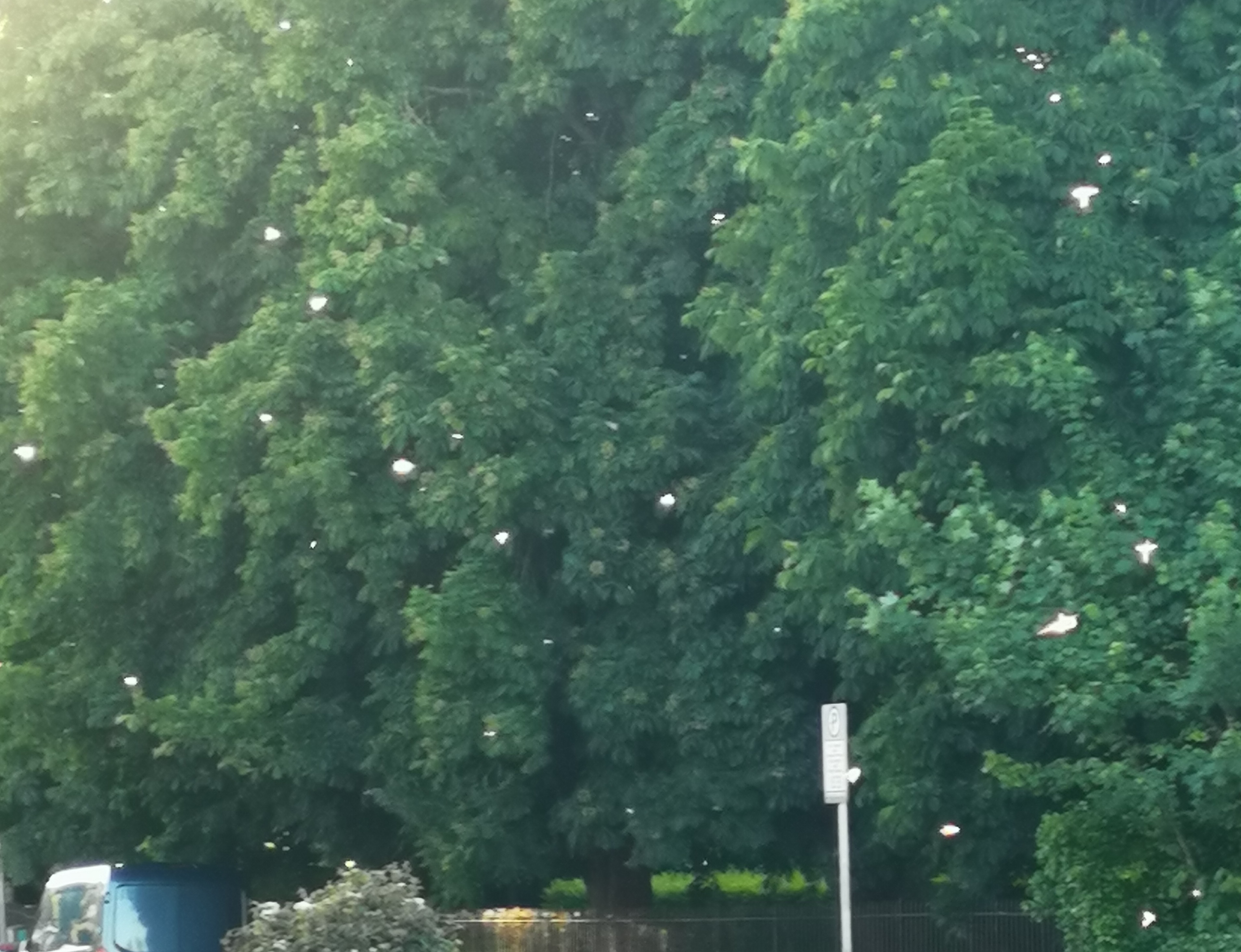
On my way to Griffiths Park in the Glasnevin-Drumcondra area on Monday I stopped to gape at a glitter-storm above the street. They were flies, dancing in the sunlight, the slanting light reflected off them. In the Park itself through which the Tolka flows, I saw many more clouds of them, always in patches of the early evening sunlight. These were the Mayfly or Cuil Bhealtaine. I took photos but my phone was unable to capture their true beauty, coming out in the photos more like snowflakes.
What seems to be snowflakes is my phone camera catching the sun flashing off mayflies dancing over the road in Drumcondra/ Glasnevin (Photo: D.Breatnach)
At one point I was able to observe a cloud of them at closer distance. They didn’t all just fly around haphazardly – every now and again individuals would dive down like a meteor – the sun making them seem as though they had a burning trail — and then zoom up again. On and on they went and it amazed me that no birds or bats seemed to be preying on them.
A poem or a piece of music might have done the sight justice.
Mayflies dancing over the Tolka in Griffiths Park (Photo: D.Breatnach)
UNDERWATER LIFE
The mayflies rise from their larval stages underwater only to procreate, to open their wings and fly, then to mate and to lay eggs into the water. They cannot eat as they no longer have mouthparts and individuals that are not seized and eaten by other life-forms have at most a couple of days to live.
A great many life-forms, especially invertebrates, spend their youth in the water and rise to mate. Dragonflies and damsel flies do so – a return to ancient mother water for some, perhaps. Long ago the cetaceans – whales and dolphins – ‘returned’ to sea and evolved to adopt to it, limbs converted to fins and tail. Penguins did the same, wings becoming flippers. And mayflies are quite an ancient life form too.
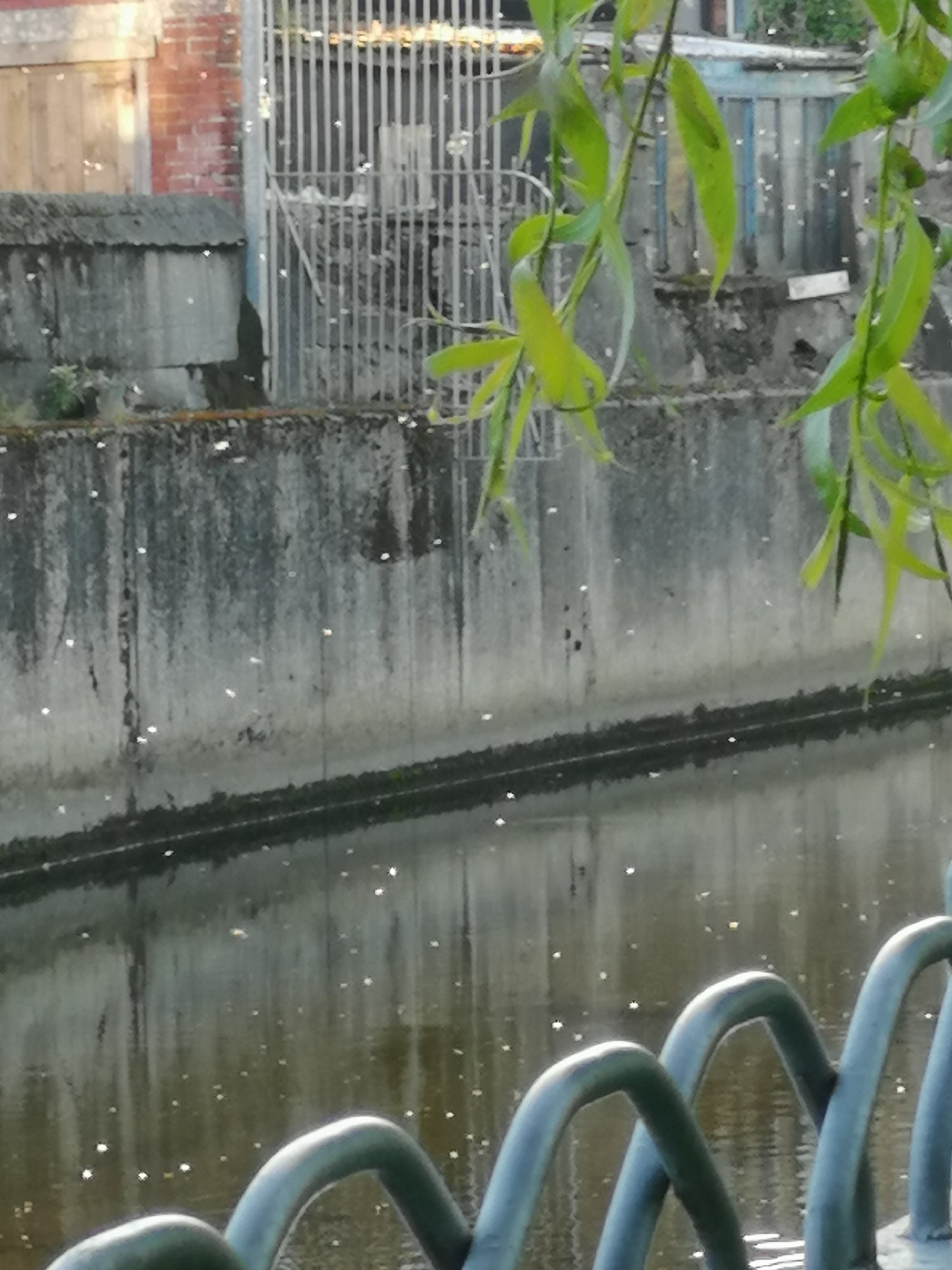
In the higher reaches, mayflies coming out in the photo like snowflakes (Photo: D.Breatnach)
As a child and into my early teens I would spend hours by a pond or other stretches of water, looking at what I could see of the animal life there, also sweeping a long-handled net through the water and bringing my assorted catch home to examine in jars or basins of water.
The larvae or nymph stages of water-laying flies comprised a large part of the collection: midges, gnats, mosquitos, rat-tailed maggots, stoneflies, bloodworms and also the larvae of the dysticus beetle (handle with care!). These and more shared the murky waters with daphnia and rotifers, leeches and planarian worms, water-mites, frog and newt tadpoles while water-scorpions, water-measurers, pond-skaters and water-margin spiders prowled the surface above like pirates.
Not snow on the Tolka — mayflies flickering in the sun (Photo: D.Breatnach)
In clearer water such as streams and rivers, I caught sticklebacks while caddis fly larvae inside their home-made tubes imitated drowned twigs.
But I don’t recall ever seeing mayflies and certainly never saw a hatch like this. No doubt trout anglers have seen the like often for such mass ‘hatchings’ are a bonanza for them. From boat or land they cast out their lines with articifial flies attached, hoping the trout rising to snatch at the mayfly harvest will grab the false fly instead. These hooks with bits of feather or fibre tied around them don’t look like a fly to you or me but sitting on top of the water and seen from below, they must look good enough to eat.
ON THE WAY BACK
There was more to see, like the mallard duck with her clutch of chicks or ducklings but the intervening branches made a photograph impossible. In shape and colour the new ducklings remind one of bumblebees and they zip around on the water without difficulty and fearless. Alas, they have a high attrition rate as seagulls and herons will each take them as a snack.
Botanic Gardens front entrance in gold, green and grey (Photo: D.Breatnach)
Looping around on my walk I passed by the closed Botanic Gardens looking great in the sunset but I had to stalk the view from the side to get a shot clear of the scaffolding inside and signpost outside in front.
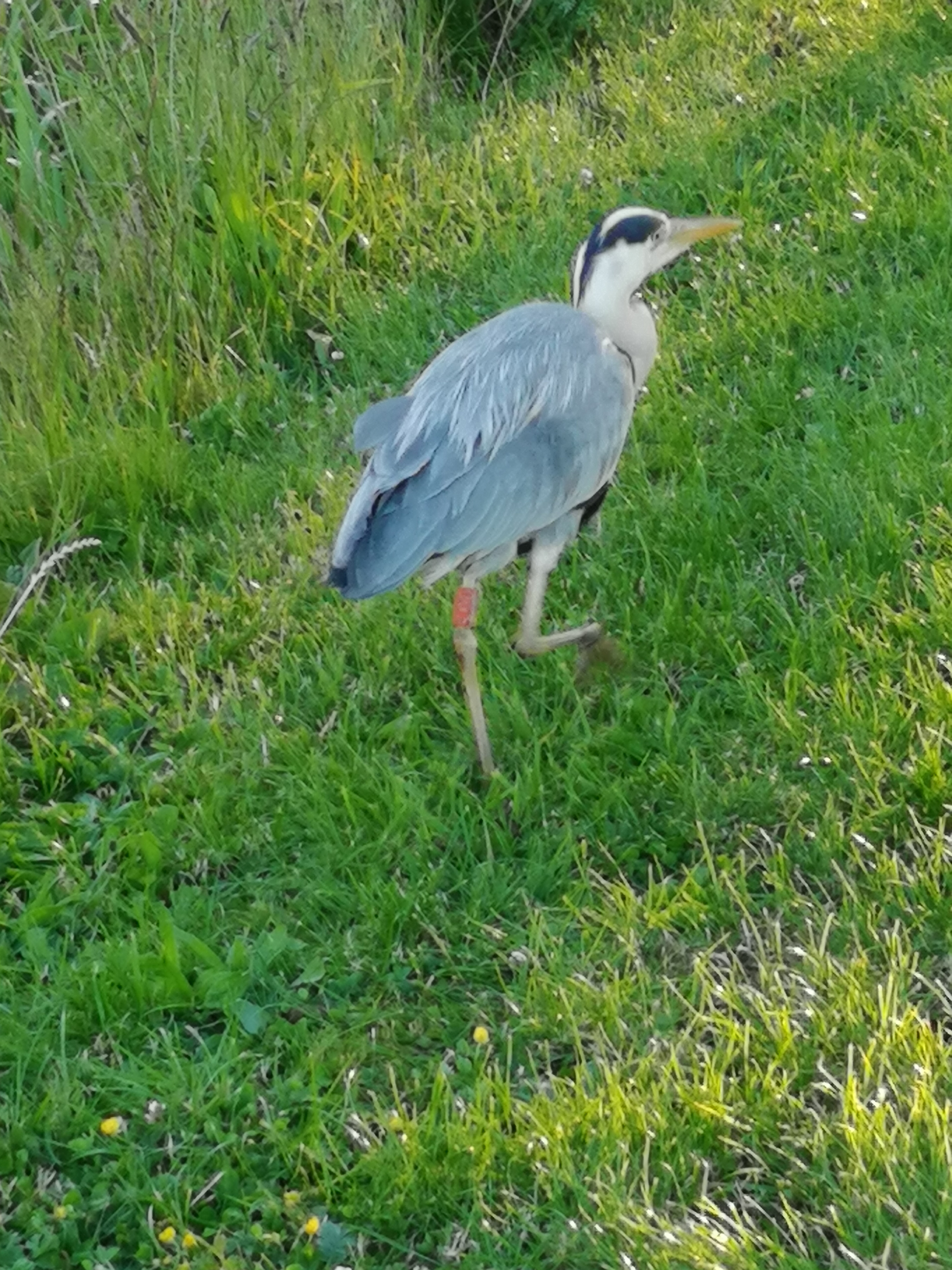
On the bank of the Royal Canal on the home stretch a heron was standing close to the path but I delayed too long getting my camera ready so it became uneasy and began to move off. Further along, a swan couple kept their cygnets close, just a couple of days old at most, balls of grey fluff – Anderson’s “ugly ducklings”.
“You’re taking too long to take the photo so I’m off!” (Photo: D.Breatnach)(Photo: D.Breatnach)
But the day’s prize for me was undoubtedly the clouds of mayflies in their glittering dance in the sun.
When I asked the guy filling shelves in the supermarket where the milk powder was I had no idea what was to come.
Picking up on his accent as he showed me, I asked him where he was from.
“Poland,” he replied, so naturally I thanked him in one of the few words or phrases I know in Polish. He responded in Polish too, then asked me where I was from.
“Here”, I replied.
“Dublin’”, he replied, “wha? ah Jayzus. How’re ya doin’, Bud? Allrih?” And there followed a stream of Dublinese: words, accent and even gestures.
This of course, is our third language here in the capital city – not the native one relinquished by so many, not the colonisers’ appropriated by so many, though a version of it, moulded, turned, somewhat UStaterised, slanged, missing endings ….
He had me laughing, of course and as I paid for my purchases I mentioned it to the cashier, who told me the guy works part-time on nightclub security, so he picks up plenty of it on the door. We both agreed he does it very well.
I went off smiling — another small but interesting experience in our capital city.






























 rebelbreeze