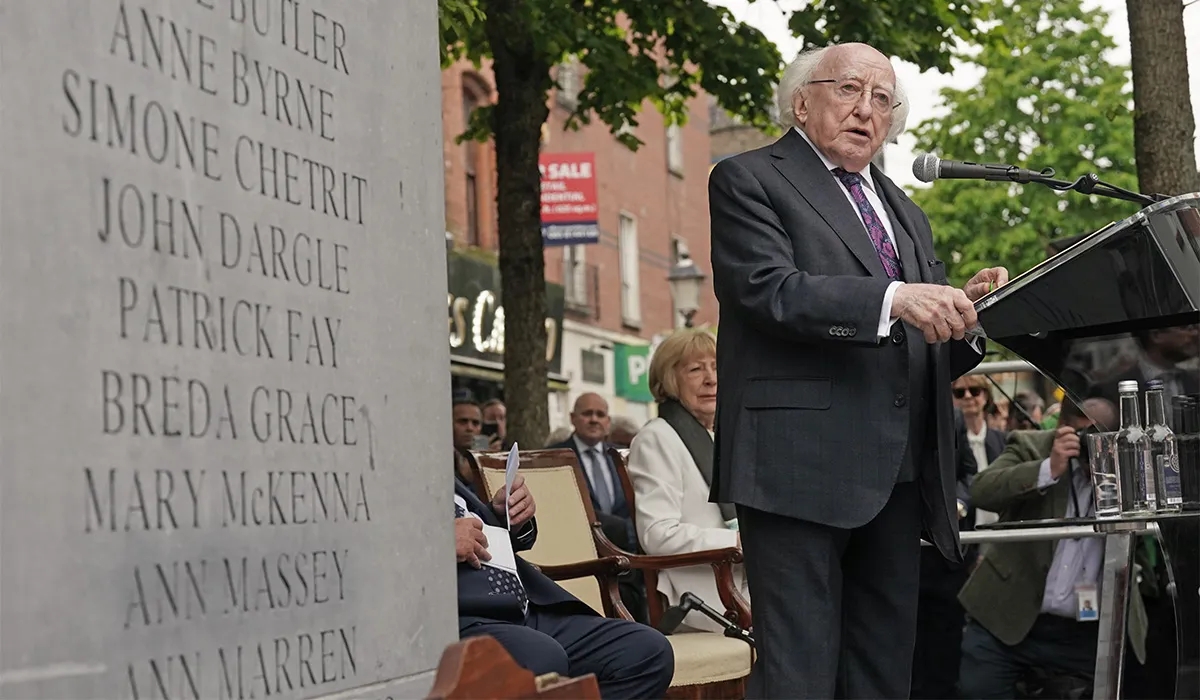
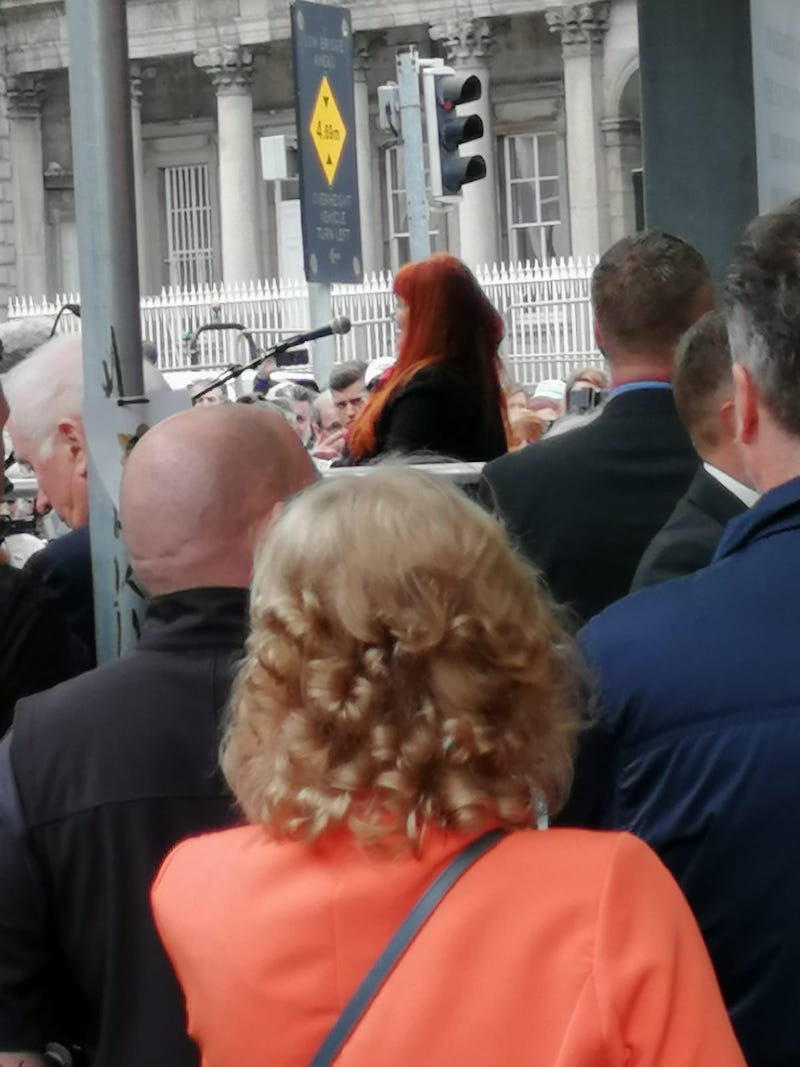
President Michael D Higgins speaks during a wreath-laying ceremony at the Memorial to the victims of the Dublin and Monaghan bombings on Talbot Street in Dublin, to mark the 50th anniversary of the Dublin and Monaghan bombings. (Photo cred: Brian Lawless/PA Wire)
Fifty years ago, on May 17th bombs exploded in Dublin and Monaghan killing 34 people. The anniversary was marked in Talbot St. Dublin beside the monument erected in memory of those murdered on that day.
The attendance at the anniversary was addressed by Michael D. Higgins, the southern president.(1)
He made a number of points in his speech, mixing his praise for the Good Friday Agreement and Elizabeth Windsor’s visit to Ireland with calls for the rights of the victims to know the full truth, oblivious to the inherent contradictions in his statement.
He did acknowledge that there were huge problems with the subsequent investigations and cited the Barron Report.
The report compiled by the late Judge Henry Barron, published 10th December 2003, provided some of the answers, pointing as it did to systemic failures at State level, one that included possible collusion between the security forces and loyalist paramilitaries.
Also featured was the disappearance of important forensic evidence and files, the slow-motion conduct of the investigation, a reluctance to make original documents available, and the refusal to supply other information on security grounds.(2)
There is nothing surprising about this. The dust had barely settled in Dublin and Monaghan and the Irish Government and the Opposition rushed out to deflect and suppress any debate.
Both the Taoiseach at the time, Cosgrave (Fine Gael) and the Opposition leader Jack Lynch (Fianna Fáil) both issued statements that were remarkably similar.
In them they broadened out responsibility for the attacks to anyone who had been involved in any violent act; i.e. they blamed the IRA by implication and failed to mention loyalists at all. This was not accidental. It was deliberate.
The nature of the bombings, the coordination, technology used all indicated the involvement of the British secret services, coupled with the fact that the loyalists never again showed the same capability ever.
Under no circumstances was the southern establishment going to accuse the British of anything.
Just over two years earlier, following the murder of 14 people on the streets of Derry by the Parachute Regiment in full view of TV cameras, an angry nation protested and burned the British Embassy in Dublin to the ground. Cosgrave and Lynch sought to avoid a repetition of that.
As the Barron Report pointed out the Garda investigation was poor, forensic evidence was destroyed, the team set up to investigate it was wound down after just two months and the murder inquiry itself was closed after seven months.
All of this shows clearly that they had no interest in getting to the bottom of it. So much so, when the RUC informed them that they had arrested some suspects in relation to the bombing, the Gardaí did not follow it up.
Years later when Judge Barron carried out his investigation, it was not just the British who were uncooperative. The Gardaí and the Department of Justice didn’t provide him with any information, their files were “missing”.
So, any call for truth means demanding the southern government reveal what it knows and also who shut down the inquiry, why, what happened to the files etc.
It was ironic that the Taoiseach, Simon Harris, the former Taoisigh, Micheál Martin (Fianna Fáil) and Leo Varadkar (Fine Gael) who were present and laid wreaths represent those who covered up the bombings.
If we are going to talk about truth, then a starting point should be that Fine Gael and Fianna Fáil covered it up and bear part of the blame for the failure to prosecute anyone.
But when Higgins and others demand the British hand over files and information, including the information offered at the time but not sought by the Gardaí, a question arises. Why would you ask the British government for information and files on a bombing that took place in Dublin?
There is only one possible answer: the British were involved in the bombing.
So, a good starting point would be not so much to talk euphemistically of full disclosure, but rather for them to admit their guilt and tell us all what they did and how and provide all the documentation relevant to their admission of guilt.
No Irish politician has ever demanded that the British own up for it. The demand is they give over information on those who carried it out, as if they were not serving members, at the time, of the British security forces.
The Irish state deliberately failed the victims of the bombings and continues to do so, to this day.
It is telling that the Barron Report on the bombings in not available on Irish government sites but rather on a site set up by victims of the bombings, Justice for the Forgotten (http://www.dublinmonaghanbombings.org/home/).
The Irish state has little interest in talking about the issue or of informing the Irish public, most of whom were born after the bombings.
Though Higgins criticised the Legacy Act, which puts a time limit on prosecutions, the Good Friday Agreement was always about drawing a line under what had happened. The GFA rewrote history to portray the British as honest brokers in a tribal sectarian conflict and not as an imperial power.
Acknowledging their role in the Dublin and Monaghan bombings would undermine that carefully crafted and now universally accepted lie about the British role in Ireland. The British will not release the files as to do so would be an admission of what their role in Ireland is.
The southern establishment despite its occasional calls for clarity and truth, dreads the British even considering such a move, as again it would undermine their role in the conflict as well and their responsibility for the ensuing cover up.
Thirty-five people were killed by bombings on 17th May 1974, the most in one day during the recent 30 Years War but outside of Ireland and even within it, most people are unaware of that fact. That’s because the perpetrators were not the IRA.
And probably also because the victims were killed not just in Ireland but within the Irish state. Also no doubt because the perpetrators were Loyalists led by British Intelligence.
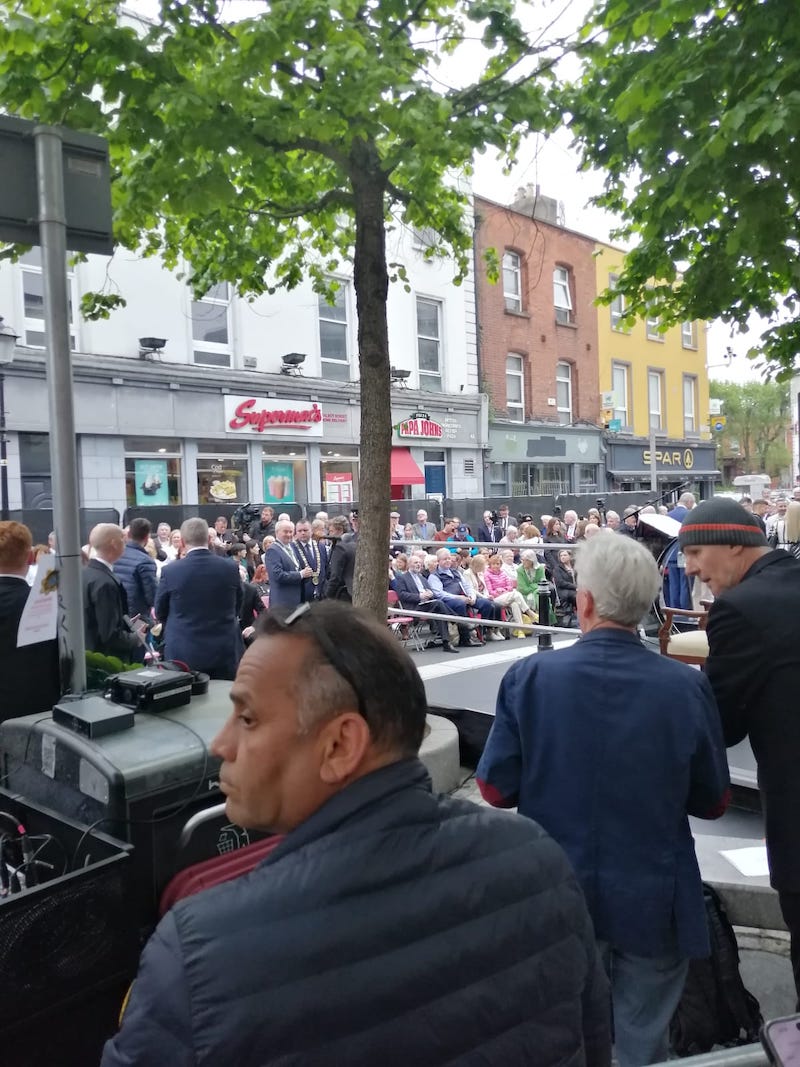
Section of westward end of attendance at event as President Michael D Higgins approaches (just out of view)(Photo: D.Breatnach)
Three bombs exploded on that day in the middle of a rush hour in Dublin City Centre: Talbot Street, Parnell Street and South Leinster Street. Somewhat later, a bomb exploded also in Monaghan Town. Altogether 35 were killed1 and “about 300”2 injured, some permanently.
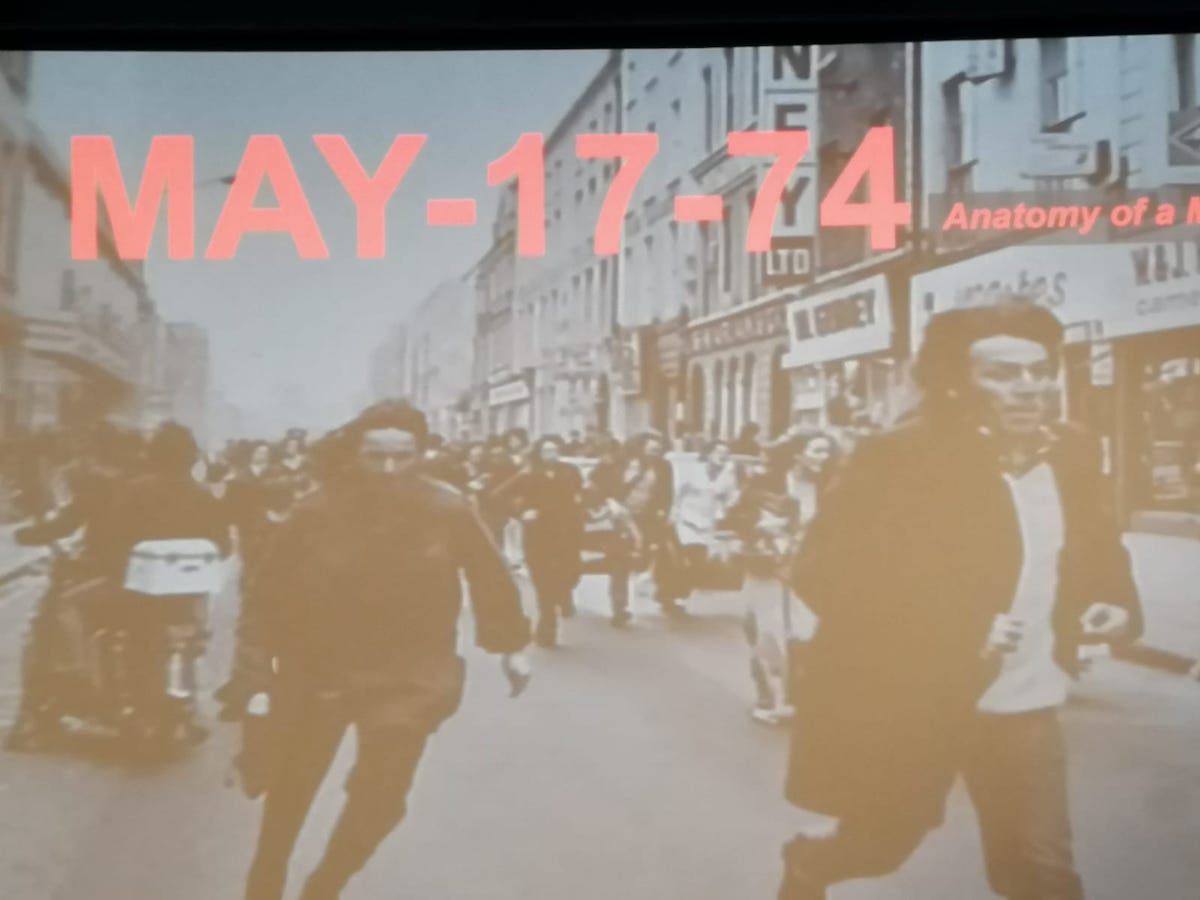
The names of some of the victims being displayed at the premiere of the Anatomy of a Massacre documentary. (Photo: D.Breatnach)
Within days and perhaps hours a number of suspects among Loyalist murder gangs had been identified but they were not arrested or even questioned about the atrocity – no-one ever was. Despite that, the Gardaí closed the case investigation seven months afterwards that same year.
A new documentary on the atrocities by Fergus Dowd was premiered in Dublin on Friday to two full screen auditoria in the Lighthouse Cinema, Smithfield, featuring interviews with witnesses, victims and relatives of victims, a former Taoiseach and a former State forensic scientist.
May-17-74 Anatomy of a Massacre is directed by Joe Lee and produced by Fergus Dowd.
The forensic expert had been given very little of the remains of cars containing the bombs since most had been sent to the RUC (colonial police) for their analysis (!) from which nothing useful emerged but he was able to determine that a high amount of amatol had been used.
At that time only the IRA among “paramilitary organisations” had the expertise to develop that explosive material which leads commentators to believe that the Loyalists received the necessary quantities from those seized from the IRA and held by the British armed forces.3
Given that many of the Loyalists involved were members of the Ulster Defence Regiment, a British Army unit, on the face of it the explosives could have been directly supplied by the British Army or indirectly obtained through the UDR as members of the British Army.
Nothing adverse is known about the Garda Commissioner who sent the exploded car remains to the colonial police but his Deputy and successor was Ned Garvey and whistle-blowing British spook Fred Holroyd claimed Garvey was a British Intelligence “asset” and to have met him in Dublin.
Confronted with this exposé years later Garvey admitted having met Holroyd but not to being a British spy – though he had not informed his superiors of his meeting with a foreign secret service agent. 4 Sadly this is not alluded to in the documentary.
As documented in Anatomy there had been a Loyalist bombing campaign of Dublin since 1969,5 with those in 1972 and 1973 killing between them three transport workers and no-one had been arrested by Gardaí or extradition sought in connection with even those fatal explosions.
No documentary about the bombing was made by RTÉ, the Irish broadcaster until 2004, thirty years after the atrocity.
However a much earlier documentary was by British company Yorkshire Television on ITV in 19936. RTÉ had declined the offer of joint screening and many people in Ireland who did not have access to ITV at the time missed it or had to go to a friend or relative to view it.
The British documentary was mentioned only in passing by one of the interviewees in Anatomy but without reference to RTÉ’s declining of the offer of joint screening.
British spook whistleblower Colin Wallace states that he was obliged to report on every meeting he had with Loyalists or others and his erstwhile bosses would have kept those papers, as they would have for the MI5 operatives who steered the bombing gang for Dublin and Monaghan.
The existence of MI5 documents that would throw much light on the bombings was referred to a number of times in Anatomy and the Justice for the Forgotten campaign keeps seeking them. Irish Government ministers regularly state that they have requested them but are always refused.
Missing from the documentary was what is now known of the secret contemporary memos of Arthur Galsworthy, British Ambassador to the Irish state: It is only now that the South has experienced violence that they are reacting in the way that the North has sought for so long …
… I think the Irish have taken the point.
Galsworthy also noted that the Irish Foreign Affairs Minister Garret FitzGerald told him that “the government’s view was that popular hostility appeared to be directed more against the IRA“.
In the immediate aftermath of the bombing, both Liam Cosgrave for the Government and Jack Lynch for the Opposition sought to widen the blame to include Irish Republicans.7
VIEWING THE DOCUMENTARY
Two screens at the Lighthouse cinema were fully booked to view the premiere.
The documentary is fascinating and some of the witnesses and relatives really excellent in their descriptions and commentary. Others interviewed pulled no punches in castigating successive Irish governments for closing the investigation and allowing it to remain closed.
Some, too, alleged a conjunction of interests between the Irish and UK states in ensuring the truth about the perpetrators and the Irish State’s reaction never surfaced.
Many people prominent in Irish political circles at different ends were present to see the premiere and after a few words from Margaret Unwin, Coordinator of the Justice for the Forgotten campaign, along with filmaker Dowd, the Resistance Choir sang their song composed about the bombing.
The Resistance Choir performing their song about the bombing massacre (Photo: D.Breatnach)Section of crowd from the Monument eastward (Photo: D.Breatnach)
Justice for the Forgotten organise a commemoration of the atrocity every year at which some music and poetry is performed, along with speeches by politicians representing the Irish State, and the local authority Councils of Dublin City and Monaghan and another individual or two.
Some of what is said there I have welcomed and some disliked but most of all I detest Ministers in the Irish Government coming there to tell us how they want the British State to release their secret documents regarding the event but never have any action to pressurise its Ministers in mind.
Cormac Breatnach playing low whistle at event (Photo: D.Breatnach)
This year, the 50th anniversary, the event took place after noon on Friday 17th May with a large crowd but only one speaker listed, President of the Irish State Michael D. Higgins, with traditional Irish music from Cormac Breatnach and Eoin Ó Dillon, a duo performing at the event for years.
Eoin Ó Ceannabháin sang The Parting Glass and poet Rachel Hegarty performed her poem about the bombing. But there was a surprise speaker also, an Italian from Breschia who also referred to state collusion in a bombing against an anti-fascist rally in his home town the same year, a few weeks later.
Poet Rachel Hegarty performing her poem about the event (Photo: D.Breatnach)
The MC of the event, Aidan Shields, son of fatal victim Maureen, told the audience to applause that Justice for the Forgotten would be sending a delegation to Breschia for the 50th commemoration of the atrocity in their town.
At left, Aidan Shields, son of fatal victim and MC at event, with Monument to the victims centre (Photo: D.Breatnach)
WHY THE BOMBING?
Trainee journalists are told to answer the ‘Five Ws’ in their reports: who, what, where, when and why.
The answers to four of those questions have been known for decades: Dublin and Monaghan is where; 17 May 1974 was the when; the bombing atrocity was the what. The who were the Loyalists and British Intelligence. But nobody seems to attempt to answer the why – or even to ask that question.
For the earlier 1972 bombing, the “why” is clear: to get the Irish parliament to vote for the Amendment to the Offences Against the State Act.
And they were successful in that since, all logic to the contrary, some of the Opposition decided to believe that the bombing was the work of Irish Republicans. So we now have that no-jury political court and senior Gardaí can give ‘evidence’ unseen by the accused from Garda “secret files”.
Apart from the guidelines of journalism, there are also those with regard to criminal investigations, which outline the importance of motive and opportunity. The British secret service certainly had opportunity – but what was their motive?
A bombing such as that in Dublin on 1974, in the Irish State’s capital city, is a message to the Irish ruling class (though the victims be different) were the. And from the British state through their intelligence service, which would hardly dare to carry out such an attack without at least the endorsement of their masters.
So the message was … what? “We will bomb your capital city if you don’t do what we want or if you do what we don’t want”? But the Irish ruling class was already cooperating about as fully as possible with the occupation in the Six Counties and repressing resistance in the Twenty-Six.
A similar campaign occurred in the 1980s, in the Basque Country within the French state (mostly). The Spanish Government waged a terrorist campaign8 of bombings, kidnappings and assassinations against suspected activists of the armed Basque liberation group ETA.
It seemed that what the Spanish authorities wanted was for the French to turn over Basque activists who were on the “French” side of the Border to the Spanish authorities, something the French had been unhappy to do, the Guardia Civil believed to be torturers even after Franco’s death.
After some of those bombings, the social-democratic French Government led by Mitterand began to hand over Basque activists to the authorities across the border, sometimes without even going through the official extradition procedures.
The Irish State did also permit extradition of Irish Republicans to the Six Counties (and later to Britain too) after the Dublin and Monaghan bombings, but not until ten years later, with Dominic McGlinchy, which hardly looks like the effect following its cause.
The Sunningdale Agreement had been signed in December 1973 which proposed some kind of power-sharing between nationalists and unionists with a role for the Government of the Irish state against which the Loyalists of the Ulster Workers’ Council had organised a general strike.
A British whistleblower, Colin Wallace claims that the bombing was a warning to the Irish ruling class to keep their fingers out of the colony.
VICTIMS AND RULING CLASS
Apart from not answering or even seeking the motivation for MI5 to arrange and oversee the bombing, I have not seen any discussion of the class nature of the locations. The bombings of 1972 and 1973 targeted transport workers.
But the bombings on the north side of the river in areas to the east of O’Connell Street also took place in areas where working and lower middle-class people worked, shopped and got on to the public transport buses. This hardly seems accidental.
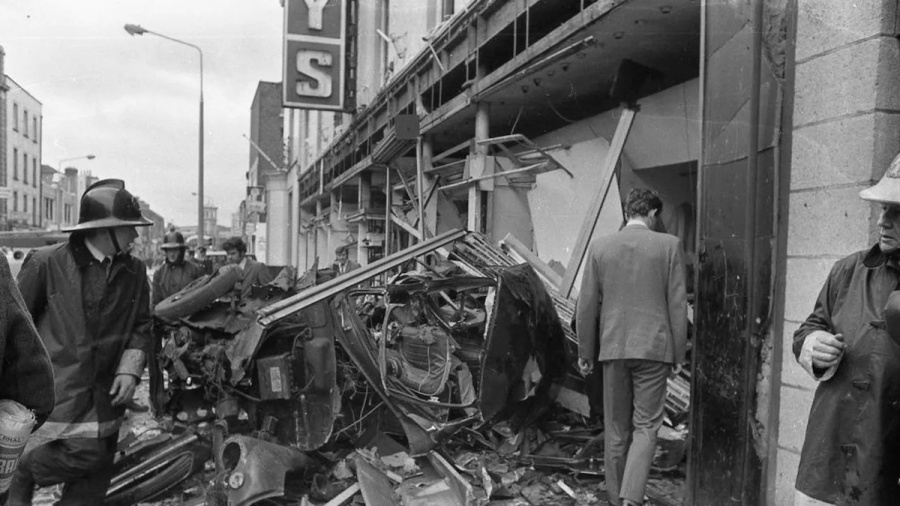
Aftermath in Talbot Street facing westward with Connolly Station tower in far background (Photo: PA)
A part of MI5’s message could have been: “This time it was mostly the kind of people nobody (who are in power) cares about, so be thankful. Next time we might hit the north-east centre around Henry Street, or areas around Trinity College, Dame Street and Grafton Street on the south side.”
One other point that is rarely made is that the bombing and the State’s reaction to it showed the totally craven and foreign-dependent nature of the Irish ruling class, to allow their capital city to be bombed by another state without seeking revenge or even restitution.
The French state made a deal with the Spanish after some bombs exploded in territory to which it laid claim but does anyone believe the result would have been the same if the Spanish terrorist groups had bombed Paris?
End.
FOOTNOTES
1 Some accounts give a total of 34 or 35 dead from the four bombings: 34 by including the full-term unborn child of victim Colette Doherty, who was nine months pregnant; and 35 by including the later still-born child of Edward and Martha O’Neill. Edward was killed outright in Parnell Street.
4 When Fianna Fáil came into government, they sacked Garvey but presumably not wanting to expose British Intelligence penetration of the Irish State’s management upper echelons, gave as a reason only that they had no confidence in him. This opened the way for Garvey to claim wrongful dismissal and win, giving him a payout and retaining his pension. Garvey was also important in running the notorious “Heavy Gang” within the Special Branch.
5 The Wolfe Tone Monument in Stephens Green had been blown up and the O’Connell monument, the Glasnevin ‘Round Tower’ had also been bombed.
6 “Yorkshire Television broadcast a documentary entitled ‘Hidden Hand – the Forgotten Massacre‘ made as part of its ‘First Tuesday‘ series. The programme dealt with the Dublin and Monaghan bombings of 17 May 1974. [The programme came to the conclusion that the Ulster Volunteer Force (UVF) would have required assistance to carry out the bomb attacks. There was speculation as to where such assistance might have come from. While no firm conclusions were reached, it was suggested that the security forces in Northern Ireland were the most likely source of help. Allegations concerning the existence of a covert British Army unit based at Castledillon were considered; as well as alleged links between that unit and Loyalist paramilitaries. It was shown that Merlyn Rees, the former Secretary of Sate, had known of the unit’s existence. On 15 July 1993 the UVF issued a statement in which it claimed sole responsibility for the Dublin and Monaghan Bombings.]” https://cain.ulster.ac.uk/events/dublin/chron.htm







 rebelbreeze