ABOUT THE 1981 IRISH HUNGER STRIKES

Diarmuid Breatnach

(Reading time: mins.)

The last person of the 10 Republican prisoners to die in the 1981 Hunger strikes died on August 20th but hunger strikes continued for a while until relatives began instructing the doctors to give the strikers alimentation.

What can be said about those strikes? Clearly, a tremendous sacrifice requiring immense courage and determination in a non-violent protest by national liberation fighters in jail in a struggle against British colonialism.

Certainly we lost individuals of great worth in that struggle. It may be asked whether the gain was worth the sacrifice or whether the prison struggle might have been fought in some other way.

The medieval Irish society practice of fasting as a means of protest may or may not have been original but it was an important part of the people of India’s struggle against English colonial rule. Palestinian prisoners have used mass and individual hunger strikes on a number of occasions.

The effects of the Irish 1981 hunger strikes were many and wide, most probably far beyond the intentions or expectations of the prisoners. The news went around the world, bringing expressions of solidarity from many regions, including actions by parliaments of various states.

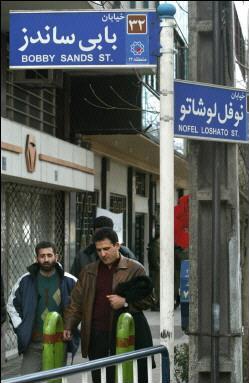
The Islamic Republic of Iran sent delegates to Bobby Sands’ funeral and renamed the street in which stood the British Embassy in Teheran ‘Bobby Sands Street’. The British Embassy to Iran had to give that as their address until they moved their main entrance around the corner.
Bobby Sands Street in Teheran, Islamic Republic of Iran (Photo sourced: Internet)

Hunger strikers stood in parliamentary elections in Ireland on both sides of the British Border, winning some seats and coming very close to winning some others. One result was that the British changed their electoral laws so that convicted prisoners could no longer stand in elections.

In the Irish state there has not been an outright majority government since that year – every single Irish government since then has been a coalition of one kind or another.

In Britain, the hunger strikes made a huge difference amongst the Irish community there. The 1974 Birmingham Pub Bombings massacre had been jumped on by the British Labour Government to pass the Prevention of Terrorism Act 1974 (now the Terrorism Act 2000).

Probably already drafted, it was brought before Parliament and passed within days, giving the police power to hold suspects for seven days without charge, wide-scale powers of stop and search and interrogation, usually without legal representation for the victim.

Within the year a score of people from the community had been framed on serious charges, convicted and jailed: Birmingham Six, Guildford Four, Maguire Seven, Judith Ward. Subsequently many Irish people stayed away from Irish solidarity marches and meetings – just in case.

The hunger strikes of 1981 blew away much of that fear and the Irish community came out in their thousands in an attempt to save the lives of the hunger-strikers — and have never been cowed down to the previous degree since.

The Irish in Britain Representation Group was formed in 1981 after the refusal of the Federation of Irish Societies to even pass a motion of sympathy for the family of Bobby Sands, who had died only days earlier; the IBRG provided radical and resolute leadership for the next 20 years.

One of a number of songs arising from the 1981 hunger strikes was the Ballad of Joe McDonnell, by Derek Warfield. It is a good song in general but what is most excellent is its chorus, where it turns the accusation of terrorism away from the Resistance and back to British Imperialism.

And you dare to call me a terrorist,
While you look down your guns!
When I think of all the things that you have done:
You have plundered many nations,
Divided many lands,
You terrorised their people,
Ruled with an iron hand …
And you brought the stain of terror to my land.

And it could just as well apply to US Imperialism, EU imperialism and their NATO military alliance.

I have sung the song many times over the years and did so again recently at the weekly Dubs For Palestine gathering outside Leinster House. And more recently still outside the British Embassy. I changed only a couple of words to provide a more optimistic line at the end.

End.

Note: If you found this article of interest, why not register with Rebel Breeze for free, so that you will be notified by email of subsequent articles. You can de-register any time you wish.
PEACE WITHOUT JUSTICE IN PALESTINE

Diarmuid Breatnach

(Reading time: 4 mins.)

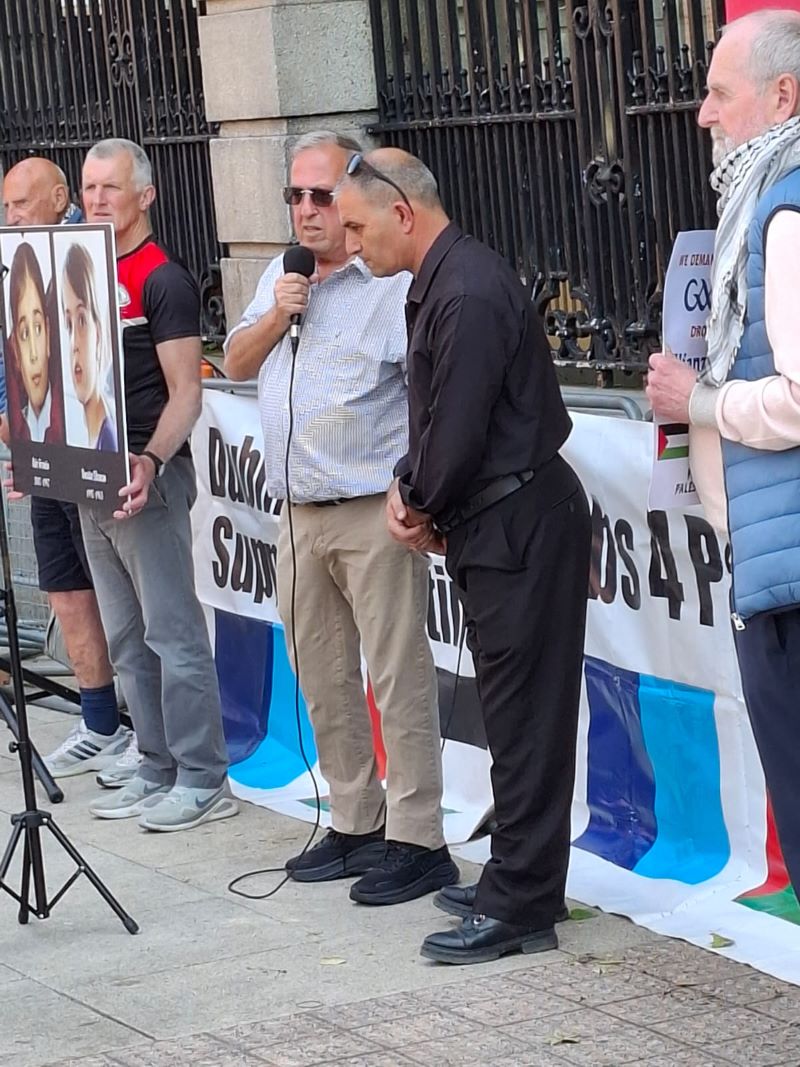
Two famous people addressed a crowd outside Leinster House, home of the Parliament of the Irish State on 25th May. Rami Elhanan, an Israeli graphic designer, and Bassam Aramin, a Palestinian scholar, had forged a remarkable friendship.

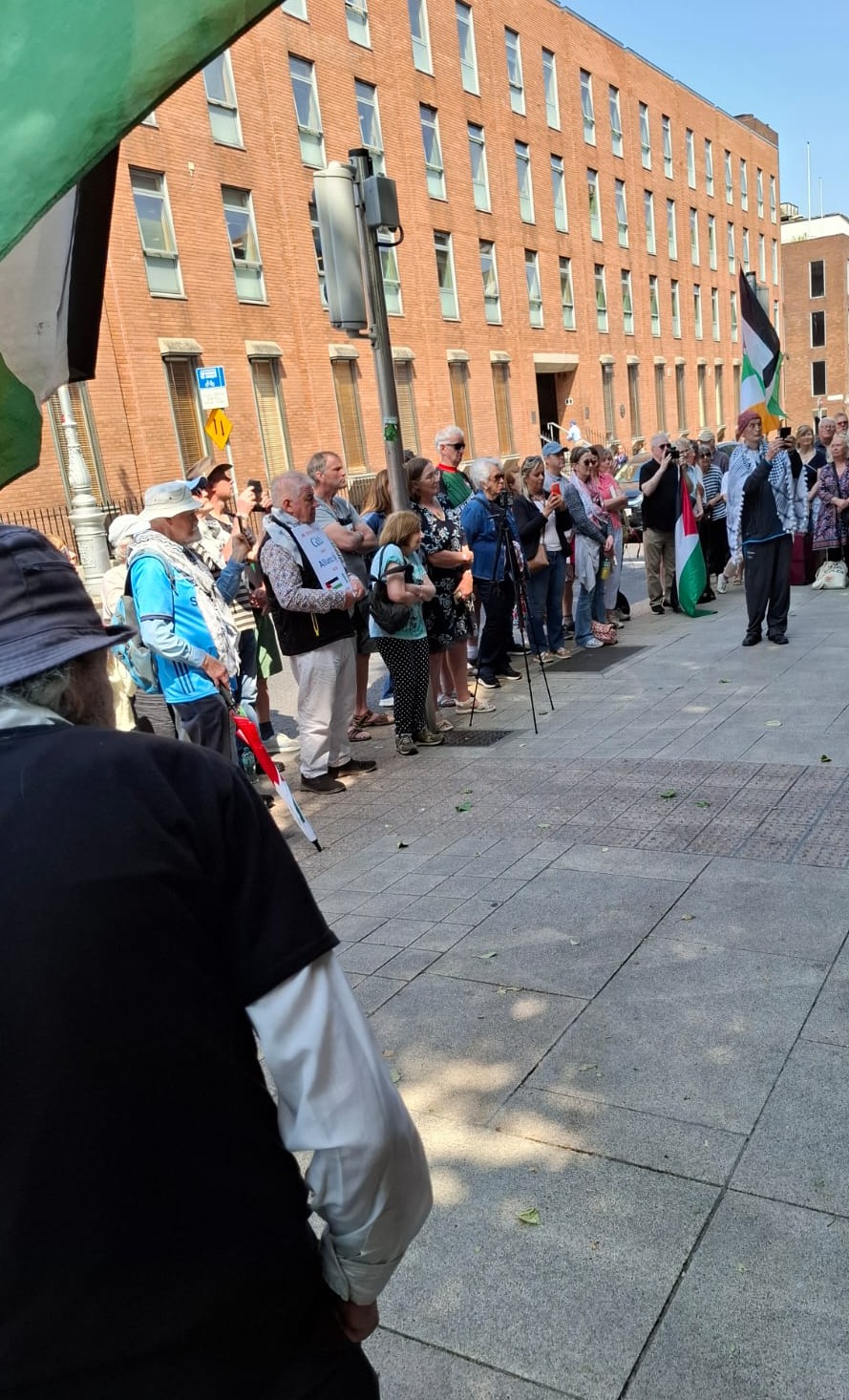
Section of participants in the Dubs for Palestine noontime event outside Leinster House 27 May 2026. (Photo: D.Breatnach)

Bassam Aramin, now a Palestinian scholar, had been sentenced to a 7-year term of imprisonment for throwing a grenade at Israeli soldiers when he was 17 and had lost his daughter later to a plastic bullet fired at short distance by an IOF soldier.

Rami Elhanan, an Israeli graphic designer, had also lost his daughter Smada but to a suicide bomber in 1997. Both men became advocates of peace and dialogue and friends to one another.

Their audience was the weekly Dubs for Palestine gathering outside Leinster House on Wednesdays 12 noon to about 1.00 pm, with speeches, songs and poetry and David Hickey as MC. This week’s was the 113th such weekly gathering and the duo had been invited to speak.

The broad group has of late been concentrating on parting the Gaelic Athletic Association1 from its sponsor and insurance underwriter, the former Nazi and since Zionist-friendly Allianz company, along with now campaigning for the Irish soccer team not to play the ‘Israeli’ team.

Rami Elhanan (L-R) and Basam Aramin addressing the Dubs for Palestine noontime event outside Leinster House 27 May 2026. (Photo: D.Breatnach)

Rami Elhanan referenced his descent from Holocaust survivors and outlined the different living standards of the Palestinian and Israeli Jewish communities, commenting on the sickness in Israeli society, that they did not want to know what is being done in their name to the Palestinians.

Basam Aramin’s contribution was against the Occupation and claimed that without that, Palestinians and Israelis could live in peace (it was not clear whether he was referring to the ‘Two State’ proposal2). David Hickey, the MC of the group presented them with an Arum Lily each.3

After their speeches had been applauded, they were asked to comment on the recent Leinster House debate and the Government’s refusal to endorse a boycott of Israel. Rami Elhanan replied that boycotts entrenched opposing sides and that continuing to talk was the answer.

Singer and activist Emma Browne, invited next to the microphone, sang Keep the Little Flame Alive, among the lyrics of which Faye, Dolores, Bernadine, Table grapes and gasoline, Homemade rifles, kitchen knives, Kept the little flame alive riposted the previous speakers.

Soon afterwards, Paul Lynch read a poem of a Palestinian father mourning the killing of his child. Poet and activist Dorothy Collin declared that in order to have peace there must be justice first and that we must support the oppressed in whatever way they choose to resist.

Áine Ruttley reading her poem while addressing the Dubs for Palestine noontime event outside Leinster House 27 May 2026. (Photo: D.Breatnach)

Áine Rutley also upheld our duty of solidarity and the right of the Resistance movement to choose its own methods, as did Jimi Cullen who then performed his own song composition The Freedom Fighter about a fighter from Gaza.

As I was called to the microphone, I commented that my views had already been well expressed in song and speech and that one of the forms of resistance is song, of which we had more than probably any other people in the world and sang An Dord Féinne,4 which is banned in Germany.

A little later the event came to an end with another song from Emma Browne, Never Again Is Now and with group chanting for Palestine, against Allianz and against playing the ‘Israeli’ team.

IN CONCLUSION

It is a popular proposition in certain circles that all social conflicts can be resolved by discussion, by understanding our opponents’ view. It is an attractive idea but flies in the face of history and of contemporary reality.

The interests of Occupied and Occupier are opposed and cannot be reconciled through understanding. The Occupier understands that the Occupied wish to be rid of them. The Occupied do understand that the Occupier wishes to continue appropriating their land and resources.

In this kind of situation one must win and the other lose. Far from understanding leading to peaceful resolution, the more the oppressed understand the nature of their oppressor, the more resolutely they are likely to resist and this is surely true of the Palestinians resisting the Zionist settlers.

The false proposition of resolving irreconcilable interests through discussion is usually of liberal or social-democratic origin when applied to anti-colonial, anti-imperialist and anti-racist struggles and though appearing even-handed, always ends up disempowering the victimised.

The journeys of both these men is extraordinary and interesting but it should not be presented as representative of the Palestinian struggle against Occupation, Theft and Genocide. Each father lost a child but the Palestinian is losing a lot more on top.

Furthermore, a just resolution can only come about through the total defeat of the Zionist forces and the dismantling of their State, so that if we really want that kind of resolution we are called to support the Palestinian side, unequivocally and resolutely.

Of course, in reality there is no question of real peace without justice, for ultimately the oppressed (unless wiped out) will rise in struggle again and again. The proposition of accommodation of opposites by discussion can only undermine or distract the struggle of the oppressed.

We cannot take the story of Bassam Aramin and Rami Elhanan, however remarkable, as even a metaphor for a just resolution nor allow ourselves to be seduced from resistance nor our struggle undermined by it.

End.

Note: If you found this article of interest, why not register with Rebel Breeze for free, so that you will be notified by email of subsequent articles. You can de-register any time you wish.
FOOTNOTES

1The management of the Gaelic games, including hurling and Gaelic football. The GAA has teams in every one of the 32 counties of Ireland, crossing the colonial border and is the biggest community sports association not only in Ireland but also in Europe and perhaps in the world.

2This proposal came out of the Oslo Accords, to give the Palestinians 20% of their land for peace with the Zionist settlers who would own the remaining 80%. Apart from its basic injustice the proposal was never realistic since Zionist settlers continued to construct settlements on additional land. Despite this, supporting that proposal is the formal position of most western imperialist states and the Irish State and of most parliamentary political parties.

3In Ireland these are often viewed as symbolic of the 1916 Easter Rising.

4Also known as Gráinne Mhaol and Óró Sé Do Bheatha ‘Bhaile, an Irish traditional song of some antiquity refashioned into an Irish resistance song by Patrick Pearse, a martyred leader of the 1916 Rising.

SOURCES

https://en.wikipedia.org/wiki/Apeirogon_(novel)

DUBLIN GERMAN EMBASSY PICKETED IN SOLIDARITY WITH ULM FIVE

Clive Sulish

(Reading time: 3 mins.)

Outside the German Embassy in Dublin speakers denounced the German State’s repression of Palestine solidarity activists and their treatment as terrorists in solitary confinement in dispersed locations, increasing the visiting difficulties for relatives.

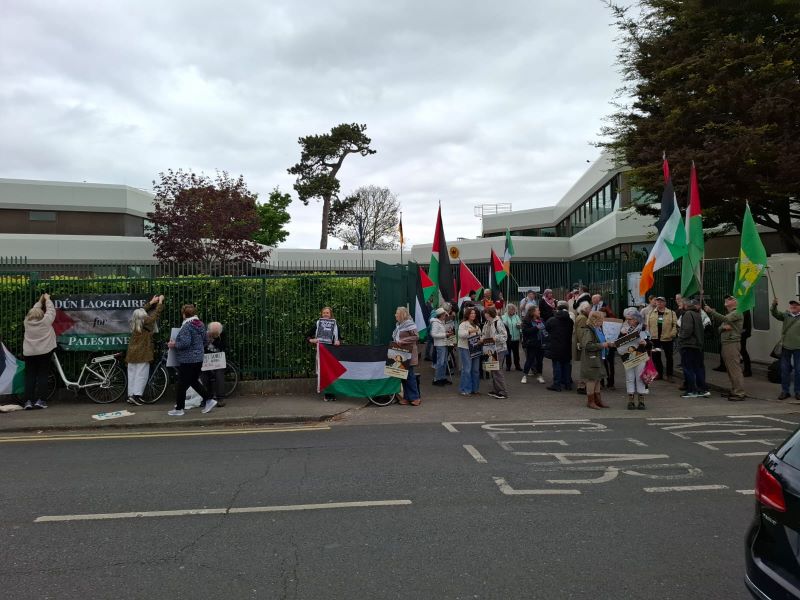
Organised by the broad group Dubs for Palestine, scores of people attended a lunchtime picket of the Embassy on Monday 27th April.1 In addition to the speeches and chants, songs were sung with particular relevance to the occasion and location.

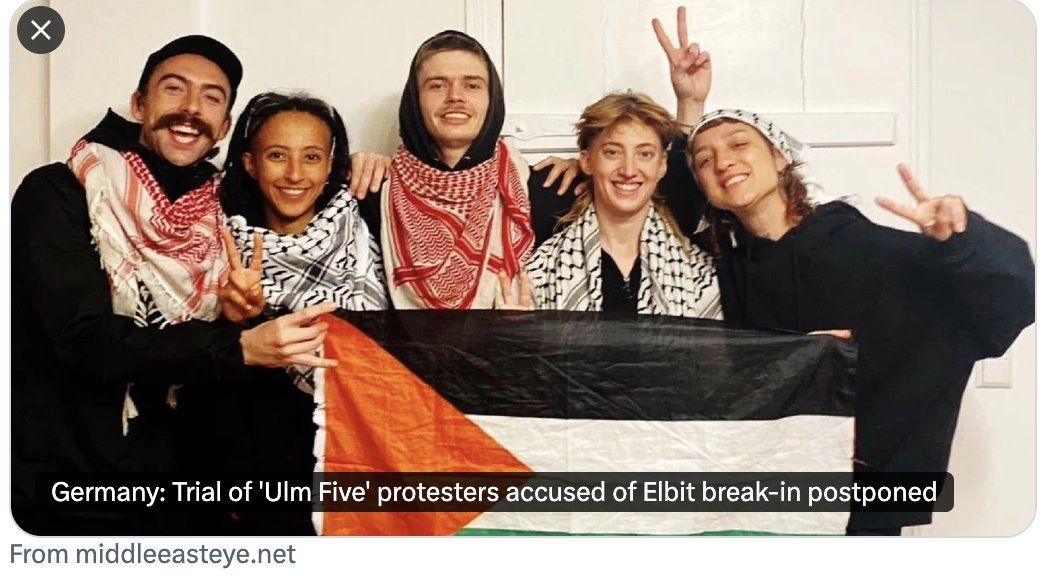
The focus of this rally was in support of a group of five activists that includes a young man formerly of Dún Laoire, Daniel Tatler-Devally and have become known as the Ulm Five. They were alleged to have broken into an Elbit Systems facility in Ulm, Germany and caused damage inside.


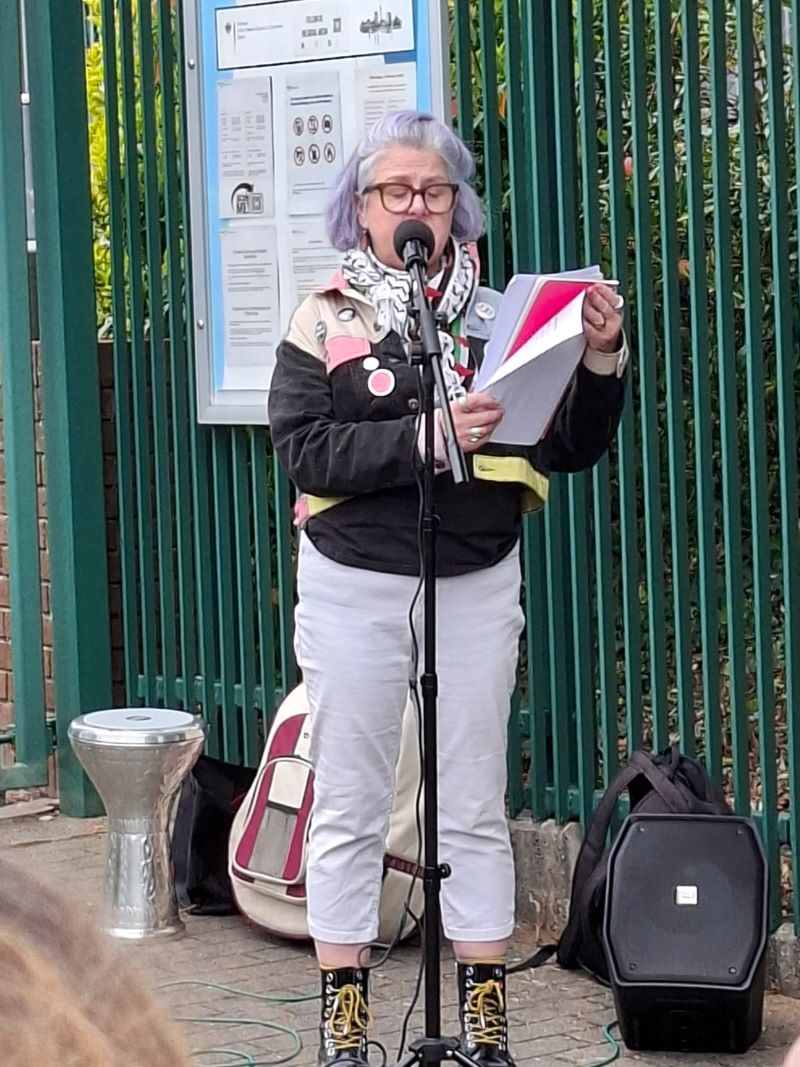
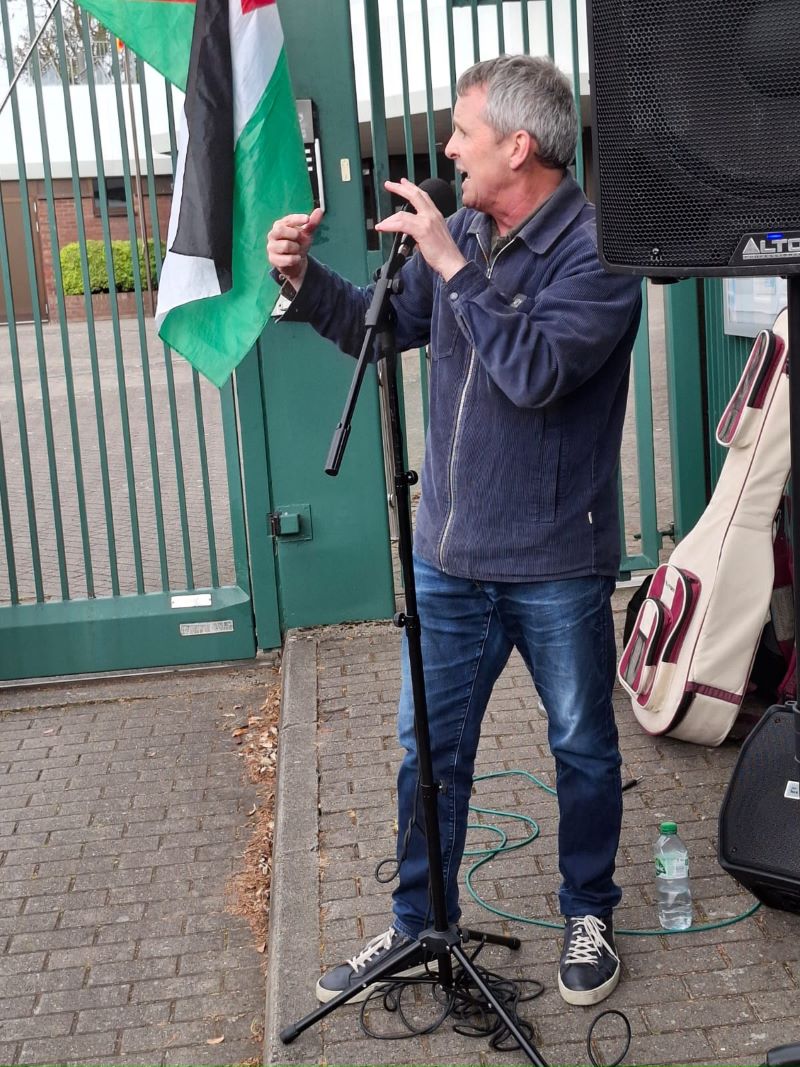
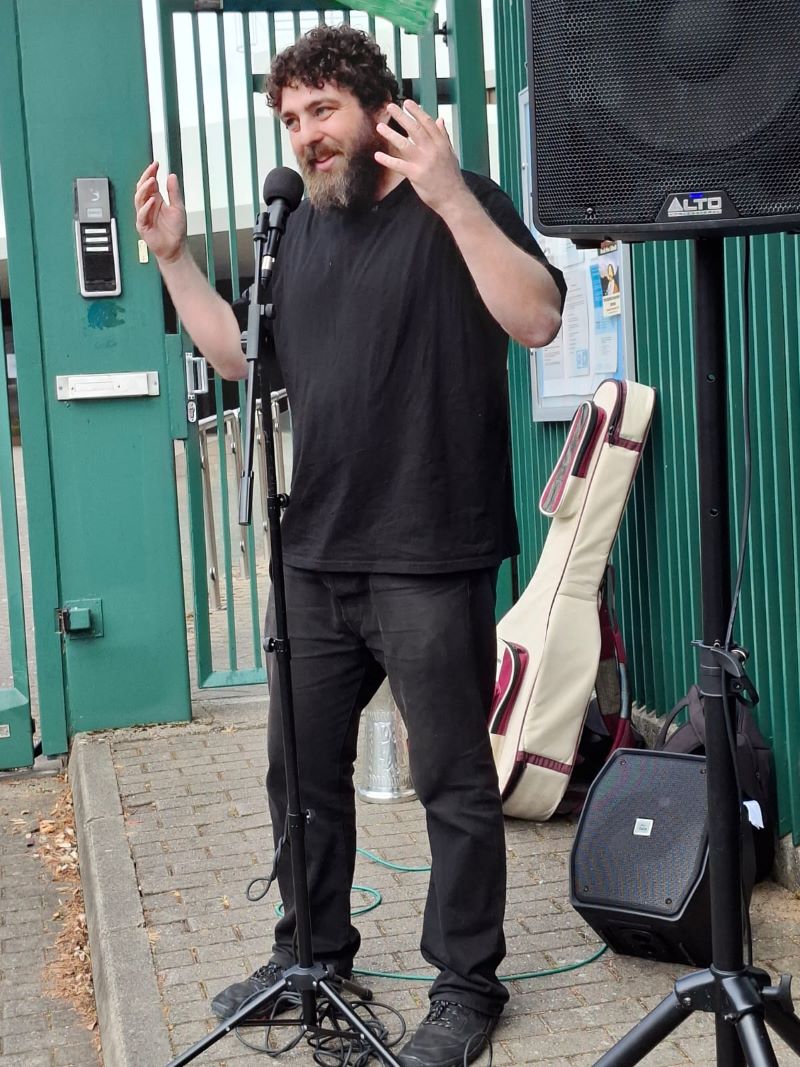
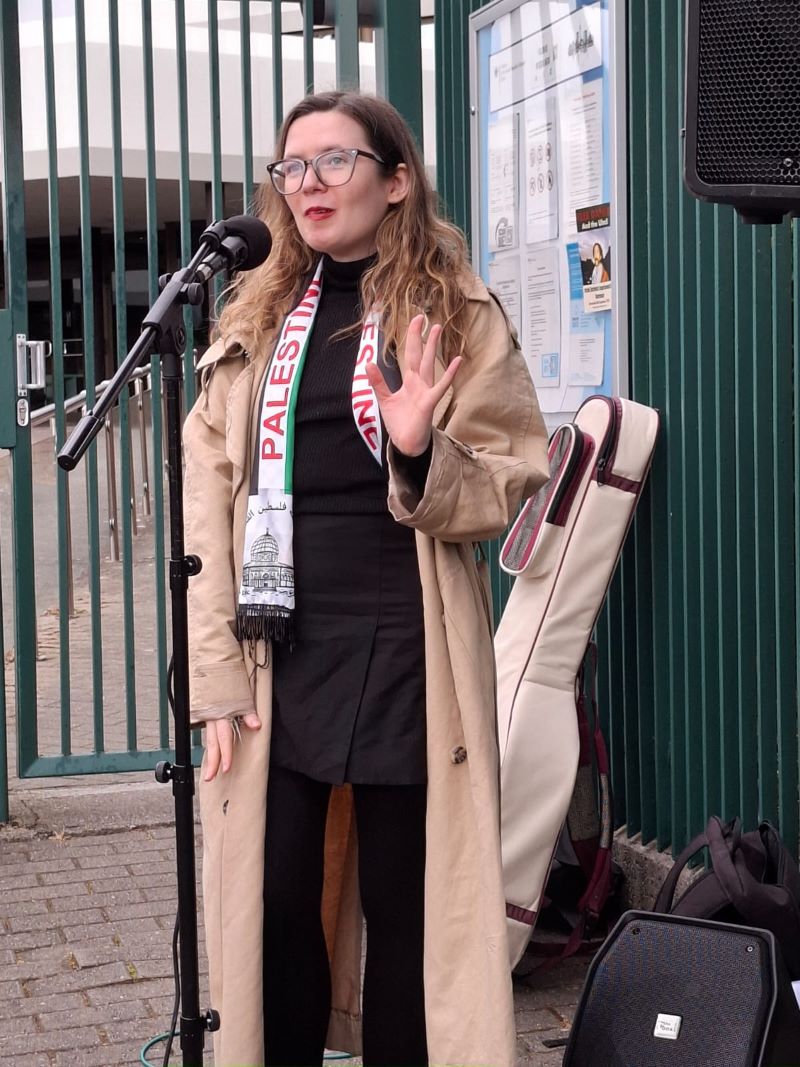
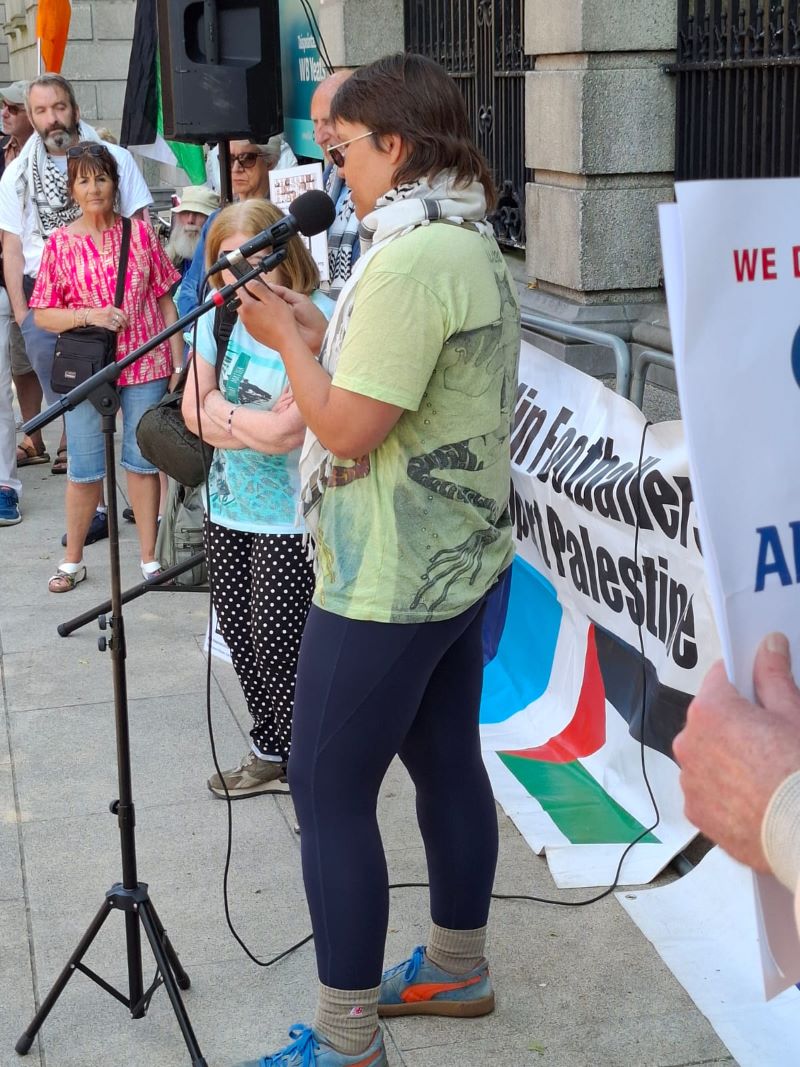
Lynn Treacy, of the Devally-Tatler family support grou, speaking outside gates of the German Embassy, Dublin on Ulm Five solidarity rally April 29th.
(Photo: R.Breeze)

Their action was in protest at the Israeli military systems company and its part in the genocide of Palestinians supported by the German state. One of the speakers was Daniel’s father, Conor Devally while Lynn Treacy, a friend of Daniel’s mother spoke on her behalf too.

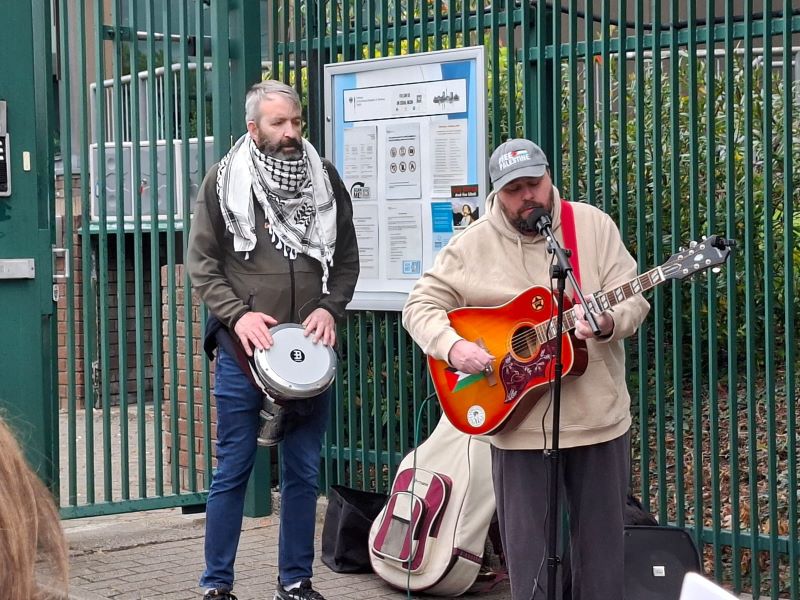
Jimi Cullen, accompanied by Dermot outside gates of German Embassy, Dublin on Ulm Five solidarity rally. (Photo: R.Breeze)

The activists are being treated as terrorists, in seven months of solitary confinement, separated and dispersed throughout different jails long distances apart. Their trial is scheduled for separate days over a period from April to July, also causing relatives and friends great difficulty.

Jimi Cullen singing and playing guitar performed his own We Are All Palestinians, developed from the well-known chant on Palestine solidarity demonstrations, accompanied by Dermot Sheehan on drum.

Two prominent members of People Before Profit spoke, Richard Boyd Barrett TD and Eoghan Ó Ceannabháin, a political and cultural activist and noted singer in the sean-nós style. Raymond Deane, composer and founding member of the IPSC spoke too as did political activist and singer Diarmuid Breatnach.

Richard Boyd Barret speaking at Ulm Five solidarity rally at German Embassy April 29th. (Photo: R.Breeze)

Ó Ceannabháin spent some time demolishing the discourse that Germany has an excuse for its repression of pro-Palestine solidarity because of alleged guilt due to its perpetration of the Hollocaust. He pointed to its genocidal history in Namibia and its leadership of EU imperialism.

The PBP member and election candidate for a councillor vacancy in DCC told the rally of Germany’s banning not only some Palestinian solidarity chants2 but also the song known as ‘Óró Sé do Bheatha Abhaile3 which he proceeded to sing, the participants joining the chorus with gusto.

Ó Ceannabháin at Ulm Five solidarity rally at German Embassy April 29th. (Photo: R.Breeze)

Diarmuid Breatnach pointed out that the German working class had a strong history of struggle and at one time led the world in socialist and social-democratic representation, even recording a vote of 4.8 million votes for the Communist Party in the midst of Nazi repression.

Hans Beimler, a communist trade union activist, Breatnach said, escaped from a Nazi concentration camp, went to Spain to fight in the Anti-Fascist War there and was killed. In his honour Breatnach sang two verses of The Peat Bog Soldiers4 followed by the ballad about Beimler.

Breatnach was accompanied on drum by Dermot Sheehan, a regular attendee at the weekly Wednesday Dubs for Palestine event outside Leinster House, seat of the parliament of the Irish State. An anti-Zionist Jewish activist spoke against Israeli Zionism and its support by Germany.

Naoise Dolan speaking at Ulm Five solidarity rally at German Embassy April 29th. (Photo: R.Breeze)

Speaking in German, Irish and English, Naoise Dolan, novelist, supporter of Palestine Action who was captured in piracy action by the IOF on the October 2025 Gaza aid flotilla, also spoke to denounce the attitude and actions of the German Government and Berlin police.

Ken Powell of Dubs for Palestine, who had acted as MC throughout, led the rally in chanting slogans of solidarity with Palestine including calling for the freedom of each of the Ulm Five by name before thanking all for their attendance and concluding the event.

end.

Early view of Ulm Five solidarity rally outside German Embassy April 29th as people are still arriving. (Photo: R.Breeze)

Note: If you found this article of interest, why not register with Rebel Breeze for free, so that you will be notified by email of subsequent articles. You can de-register any time you wish.
FOOTNOTES

1The day the trial began in Germany but however did not proceed due to the presiding judge refusing to allow the Defence lawyers to sit with their clients and the lawyers’ refusal to proceed under those restrictions

https://www.theguardian.com/world/2026/apr/27/pro-palestine-activists-face-trial-attack-israel-arms-factory-germany

2“From the River to the Sea, Palestine will be free,” which they claim is ‘anti-Semitic’; also “Globalise the Intifada.”

3An Dord Féinne is the actual title given by Patrick Pearse in his adaptation of a traditional song in Irish.

4A translation from the German song of the Communists in Nazi concentration camps which was eventually banned by the camp authorities under pain of death.