Diarmuid Breatnach (slightly edited repost from 2014)
(Reading time:3 mins.)
In England it is called “Boxing Day” but in Ireland the 26th of December is “St. Stephen’s Day”. Despite the Christian designation it has long been the occasion in Ireland for customs much closer to paganism.
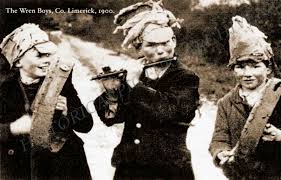
It was common for a group of boys (usually) to gather and hunt down a wren, a small songbird.
The wren can fly but tends to do so in short bursts from bush to bush and so can be hunted down by determined boys. The bird might be killed or kept alive, tied to a staff or in a miniature bower constructed for the occasion.
The Dreoilín singing on a mossy rock.
The Wren Boys would then parade it from house to house while they themselves appeared dressed in costume and/or with painted faces.
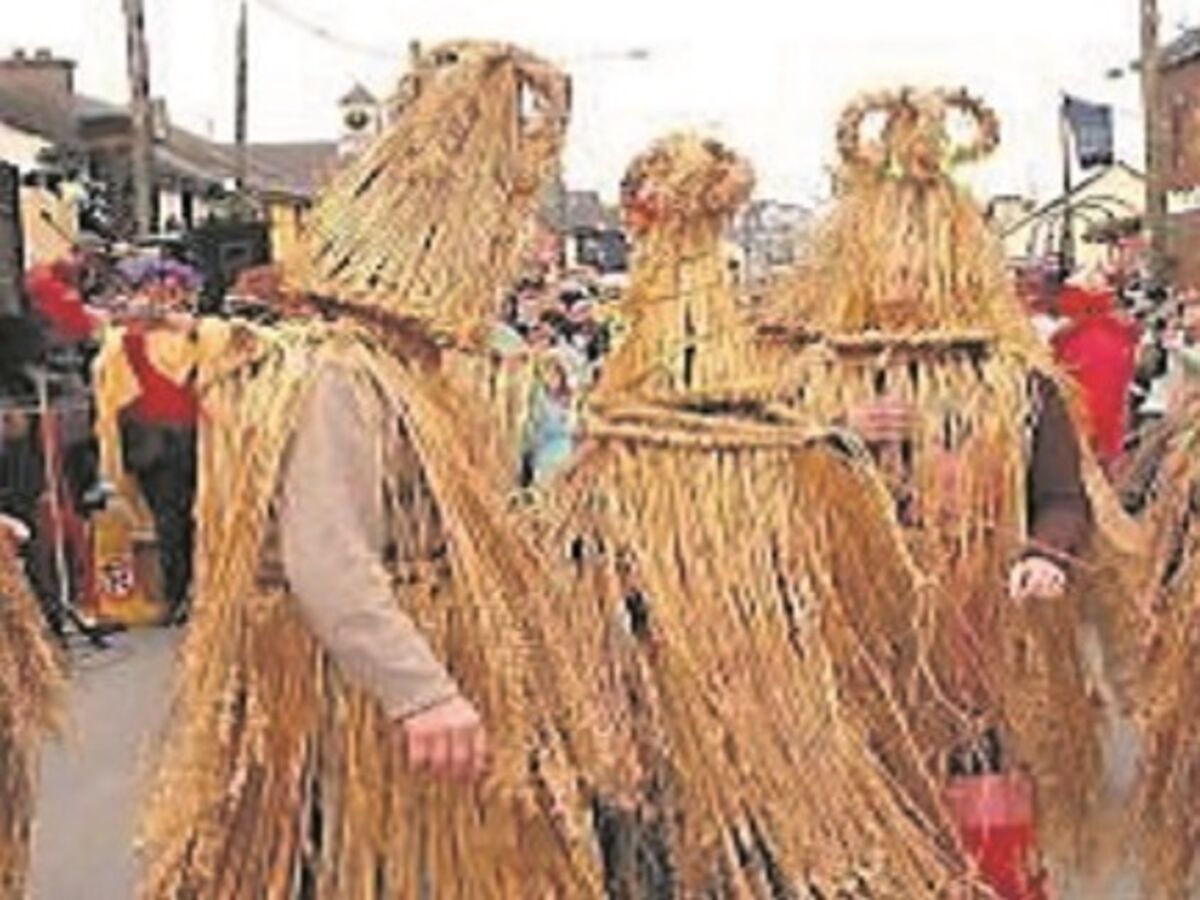
In some areas they might only carry staff or wands decorated with colourful ribbons and metallic paper while they might in other areas dress in elaborate costumes, some of them made of straw (Straw Boys) and these were sometimes also known as Mummers.
However a distinction should be drawn between these two groups. The Mummers in particular would have involved acting repertoires with traditional character roles and costumes, music and dance routines.
The simpler Wren Boys however might each just contribute a short dance, piece of music or song. In all cases traditional phrases were used upon arrival, the Mummers having the largest repertoire for in fact they were producing a kind of mini-play.
The origins of the customs are the subject of debate but a number of Irish folk tales surround the wren.
Straw Boys at a festival.
The bird is said in one story to have betrayed the Gaels to the Vikings, leading to the defeat of the former. There is a Traveller tradition that accuses the wren of betraying Jesus Christ to soldiers while another tradition has the bird supplying the nails (its claws) for the crucifixion of Jesus Christ.
Yet another tradition has the wren as King of the Birds, having used its cunning in a competition to determine who would be the avian King, hiding itself under the Eagle’s wind and flying out above the exhausted bird when it seemed to have won.
By the 1960s the Wren Boy custom was beginning to die out even in areas where it had held fast but it slowly began to be revived by some enthusiasts. Nowadays fake wrens are used.
Christmas Day in Ireland was traditionally a day to go to religious service and to spend at home with family or to go visiting neighbours.
It was not a day of presents or of lights or Christmas Trees, customs brought in by the English colonizers in particular from Prince Albert, the British Queen Victoria’s royal consort, who was German.
St. Stephen’s Day may have celebrated the turn of the season heralded by the Winter Solstice (the wren being a bird that on occasion sings even in winter) but moved to a Christian feast day.
In any case it produced colour and excitement at a time which did not have the religious and commercial Christmas season to which, in decades, we have become accustomed.
The lovely song The Boys of Barr na Sráide from a poem by Sigerson Clifford takes as its binding thread the boys in his Co. Kerry childhood with whom Sigurson went “hunting the wren” but follows also their fight against the invader and their subsequent emigration to England or the USA.
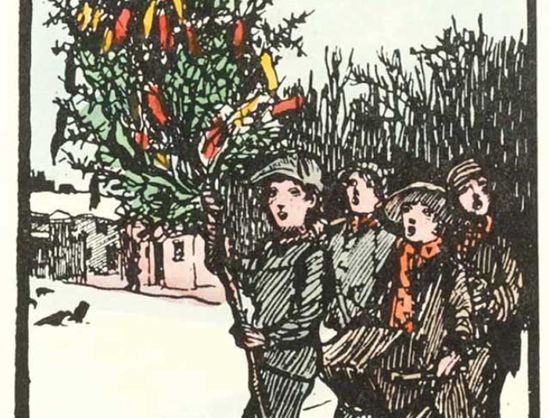
Drawing of Wren Boys out on their round.
I’ve been singing this song in private recently but also at the December gathering of the monthly 1916 Performing Arts Club in Dublin.
In this recording it is sung by Muhammed Al-Hussaini (then resident in London and part of the singing circle of Comhaltas Ceoltóirí na hÉireann, meeting in the Camden Irish Centre) in which I had the pleasure of participating on a visit to London in 2014 (see The London Visit on the blog).
There are recordings of others performing this song well but the unusual origin as well as its quality persuaded me to choose this one and, in addition the memory of participating in a singing circle with this lovely and modest singer in London, who greeted me in Irish.
Muhammed also plays the violin on this recording, accompanied by Mark Patterson on mandolin and Paul Sims on guitar.
Mummers from Fingal, north of Co. Dublin
Ends.
Note: If you found this article of interest, why not register with Rebel Breeze for free, so that you will be notified by email of subsequent articles. You can de-register any time you wish.
The photo with the recording shows some of the Limerick fighters of the Kerry IRA in the War of Independence (1919-1921) or perhaps in the Civil War (1922-1923)
On 13th September 1845 the widely-read British weekly publication The Gardener’s Chronicle apprehensively reported the appearance of the blight on potatoes in Ireland but doubtful if the full extent of the holocaust to follow was expected.
(Sourced: Internet)
True, no other national population in any other known part of the world was as heavily dependent on the potato as was Ireland’s. Other crops were grown but were mostly destined as feed for domestic animals1 or for export directly or indirectly as in the case of alcoholic drinks.2
A national diet is that of the mass of the population, which in Ireland was the peasantry. On the potato and a little milk the Irish peasantry grew strong enough to be recognised in Britain as healthy able workers, seasonally in agriculture or longer-term in manufacturing and construction.
They were reputed to be the tallest and most fecund in Europe, according to Frederick Engels writing in Britain a year before the piece in the Chronicle.3 In Ireland the peasantry were for the most part tenants-at-will or landless labourers for the settler big landowners and descendants.
The original Irish had been expropriated by sword, fire and pen (legal decrees) and their expropriators lived on the rents they extracted from their tenants in a mixture of crops, animals, cash and labour. After the abolition of the Irish Parliament,4 most big landowners found no reason to even live in Ireland.
The estates of the absentee landlords were then managed by agents, middlemen who forwarded the extracted wealth to their masters in Britain, or perhaps travelling ‘on the Continent’, or trying their hand in the American colony, minus the agents’ commission, of course.
As people went hungry, meat, dairy and grain continued to be exported.
The dependency of the Irish mass on the potato was known of course and even mocked in some ruling British quarters at times. But so were the Irish landlord aristocracy who seemed to have no interest in developing industry.
But could anyone predict that the blight would intensify each year and that the Government of the UK would tolerate such devastation in one of its parts? By the time it had run its course six years later, Ireland had lost at least 2.5 million of its original over eight million5 and more were emigrating.
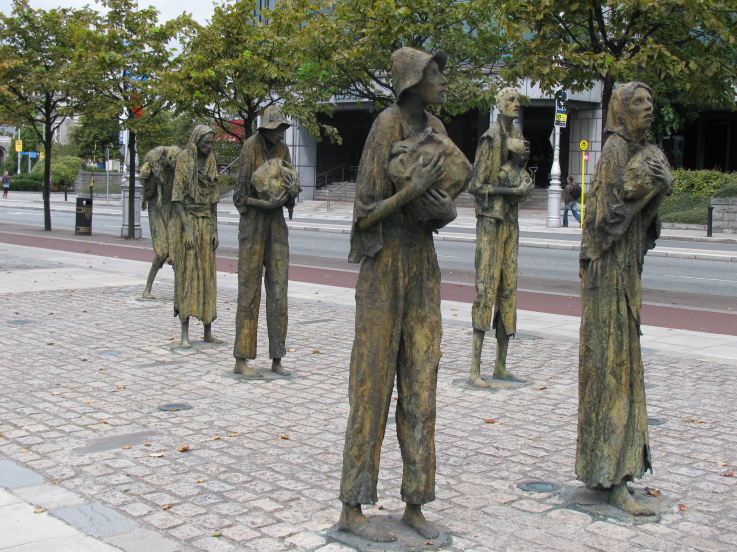
Memorial to the Great Starvation on Dublin’s north side quays. (Sourced: Internet)
And both the Irish planter aristocracy and the cotter class of Irish peasantry had been wiped out, leaving the field to the Gombeen6 class of money-lenders and bigger farmers, the latter now expanding their holdings and who would farm meat instead of agricultural produce.
When the overall national population stabilised again it did so at five million,7 at which level, despite a high birth and survival rate, it remained until the early 1990s. The magic trick was achieved by constant annual emigration, giving the Irish one of the largest diasporas in the world.8
The Gardener’s Chronicle’s writer noting the arrival of Phytophthora infestans could not have imagined the extent of its devastation. But if he knew the history of Ireland as well as that of the blight, he would have concluded that it was not the worst blight upon the Irish nation.
No, that was the arrival of the Anglo-Normans in 1169, with the second-worst blight being the growth of the Gombeen class.
end.
Note: If you found this article of interest, why not register with Rebel Breeze for free, so that you will be notified by email of subsequent articles. You can de-register any time you wish.
FOOTNOTES
1Grazing animals live on forage in Ireland but in winter or if overgrazed must be given additional food, while draught animals need cereal feed, typically oats. Pigs and domestic fowl were fed on mixtures of potato, beet, pulses and domestic leftovers.
2Typically eorna (barley) for beer brewing and whiskey distilling. These products continued to be produced and exported during the years of famine. Hops are also used for brewing but much was imported from southern England where climatic conditions are more favourable.
3The Condition of the Working Class in England (1844).
41799, followed immediately in 1801by Ireland becoming part of the United Kingdom and Irish MPs being required to attend the Westminster Parliament.
5A historical and statistical riposte to the anti-immigration claim that today “Ireland is full”.
6Originally from the Irish word Gaimbín and applied to moneylenders and land speculators during and following the holocaust period it, came to be applied by many to the Irish neo-colonial national bourgeoisie.
7Of the whole nation, with over 3 million in the Irish state and under two million in the British colony, the Six Counties.
8The bleeding through emigration was constant but fluctuated in degree, with a high point in the 1950s when it amounted to 15% of the Irish state (i.e. of the 26 Counties) and another in the 1980s.
The media announces that “the population of Ireland has reached 5 million … for the first time in 170 years”. Interesting – and a barefaced lie! The population of Ireland passed 5 million some time ago and is actually around 6.5 million now.1
Ireland remained with negative population growth until near the end of the last century – mismanaged for most of the population first by the British occupiers of the whole of the island, then by a combination of the native neo-colonial bourgeoisie and of the settler colonial ruling class.
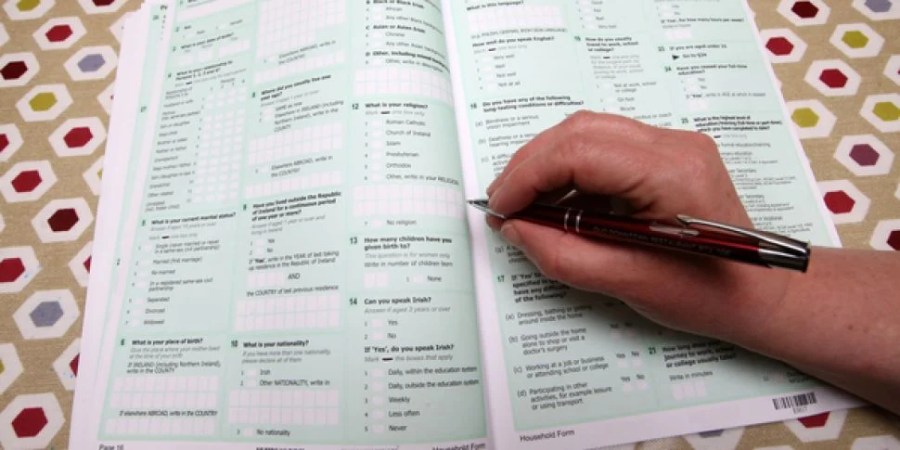
Filling in a census form from which population statistics can be extracted (Photo sourced: Internet)
For more than a century the population of Ireland stood at around 5 million, static despite a high birth rate. This was mathematically possible only through continual massive emigration – mostly to English-speaking regimes: Britain, USA, Australia, New Zealand and Canada.
But it is true that 170 years ago it was more than 5 million – in fact it was around 8.5 million. And it is worth reflecting on how they were able to produce enough food domestically to feed that entire population while now, with a smaller population, we import as much as 80% from abroad.2
It was the Great Hunger that wiped out much of the earlier population, statistics somewhat hiding the pain and sorrow of millions of Irish in death, disease and emigration — and the great transfer of land for cultivation (and rent) to pasturage, with its dangerous environmental impact.
It provided an opportunity for growth of the Catholic Irish capitalist class, the Gombeens, huckstering money-lenders buying up the lands of afflicted neighbours.
The kind of class that the British could depend on in 1921 to manage the neo-colony and to murder and jail those of national liberation3.
Emigration kept population stats steady and, combined with unemployment, ensured a low internal home market for development. An educated workforce and natural resources could be developed but the Gombeen class opened it all to foreign multinationals rather than develop it themselves.
Even with foreign exploitation of the workforce at home, the education system turned out mostly emigration fodder: the Irish tax-payers funded an education system to provide a literate and numerate English-speaking workforces for capitalist exploitation abroad.
No wonder the Irish political class declined to give the Irish abroad a vote in the Irish state – unlike for decades any other state in the European Market. Yet during the 1930s through to the 1960s, money sent home by Irish migrants accounted for an estimated 30% of the Irish State’s economy.4
The Irish state remains a neo-colony with low taxation and other incentives for foreign companies to take over our few industries5 and local and foreign property speculators to rake in profits out of the despair of homelessness or of struggling to meet rent or mortgage payments.
A neo-colonial market for produce of foreign companies and to plunder not only our labour force, not only our natural resources on land, sea and wind and but even our infrastructures in transport and communication, energy, health service, water supply and even our city sanitation.
TRUNCATED
The announced statistics were truncated, appropriate perhaps for a truncated country, with the history behind those statistics not so much truncated as obliterated.
That is our present and our past but not how the future has to be – we can write our own future but we won’t do it by putting a mark on a ballot paper.
3The Irish Civil War or Counterrevolution, 1922-1923.
4I have read this in the past but am unable now to find the reference; however I have posted some references on the figures of remittances from Irish emigrants.
5 For a few examples of foreign takeover: Irish stout, beer and lagers (Guinness, Smithwicks, Harp); Irish whiskey (Paddy, Jameson, Bushmills); cigarettes (Afton); preserved vegetables (Erin); aviation (Aer Lingus); public transport (Transport for Ireland; LUAS); sugar (Irish sugar beet replaced by subsidised cane sugar from the USA); woodlands (Coillte).
Driving out of frenzied Manhattan heading out over the 59th Street Bridge and through the highway traffic east into Queens, the dense urban landscape is suddenly broken up by a jarring sight- an immense sea of green. Coming closer, the driver, who sees a vast number of gravestones and monuments, realizes that this great green space is a huge city of the dead.
The Manhattan skyline is seen behind the Calvary Cemetery. Photo credit: REUTERS/Andrew Kelly
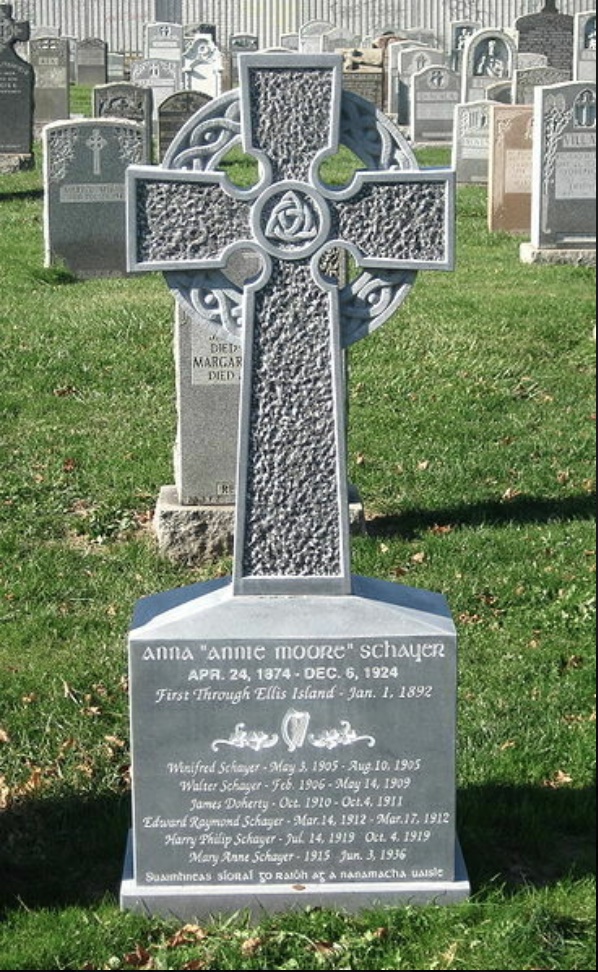
This great green city of the dead is Calvary Cemetery, a place rich in New York Irish history. Founded by the Archdiocese of New York, the graveyard contains the remains of a staggering three million people, more than all the current population of the borough of Queens. Calvary holds more burials than anywhere else in the United States, covering an unbelievable 365 acres of prime real estate. The cemetery reaches into two neighborhoods and is comprised of four large sections. Many of the most important characters in New York Irish history rest beneath its fields and walking around Calvary is a lesson in New York Irish history. It even holds the remains of Annie Moore, (1874-1924) the Irish immigrant who was the first person of the millions of hopeful immigrants who passed through Ellis Island.
Annie Moore, teenager from Ireland, first immigrant processed through Ellis Island (Photo sourced: Internet)
By the 1840’s, Lower Manhattan’s Old Saint Patrick’s Cathedral graveyard was filling up and it was no longer possible to bury its large population on the island. In 1847, faced with many corpses from a raging cholera epidemic the New York State Legislature passed the Rural Cemetery Act, authorizing non-profit corporations to operate commercial cemeteries. The trustees of St. Patrick’s bought the 151-acre Alsop farm in Queen, which became the original section of Calvary Cemetery, today known as Old Calvary. When Mrs. Ann Alsop sold the farm to the Trustees, she insisted that her Protestant Alsop family burial ground remain separate from the Catholics and the trustees have maintained this division to this day. The tiny family plot still remains walled off, dwarfed by the hundreds of thousands of Catholic tombstones around it.
Calvary was consecrated by the legendary Tyrone-born Archbishop “Dagger John” Hughes (1797-1864) in August 1848 and by 1852 there were 50 burials a day, half of them poor Irish kids under seven years of age, victims of the noxious conditions in the disease-ridden, teeming Manhattan slums. It cost seven dollars for an adult to be buried there, children under age seven cost three dollars and children aged seven to fourteen cost five dollars. In the early 20th Century, influenza and tuberculosis epidemics caused such a shortage of gravediggers that people were forced to dig graves themselves for their own loved ones.
In the days before highways and city parks, people reached Calvary by ferryboat and excursions to the graveyard were regular Sunday family outings. People often picnicked while visiting their loved ones and enjoyed the bucolic charm of the giant green expanse. With amazing statuary, marble mausoleums and towering trees, the graveyard remains a place of great beauty, though today there are few family visitors. Calvary, though retains a wonderful tranquility, making it a welcome refuge from the noisy city around it. Today, some harried New Yorkers visit Calvary to collect their thoughts or just to enjoy its wonderful calming silence. I have just written a book The Irish in New York and I realized that many of the characters in my book and hundreds of other famous Irish figures lie in Calvary’s ground. The Irish clawed their way to power and acceptance by creating an infamous political machine called Tammany Hall and dozens of its most notorious members lie in Calvary’s earth. The most famous Tammany Hall politico lies there, Al Smith, (1873-1944) the first Catholic Governor of New York, a reformer and the first Catholic nominee for President of the United States. A poor boy himself, Smith enacted many factory safety and labor reforms to help the working class. Another Tammany Hall figure who lies there is the infamous “Big Bill” Devery” (1854-1919). Serving as a notorious police chief of New York City, Big Bill stole enough money to become part-owner of a baseball team that would be known as the New York Yankees. A generous thief, Devery died almost broke.
William “Bill” Devery, Irish corrupt Superintendent NY Police DepartmentGravestone Al Smith, Tammany Hall politician, reformer and Irish Governor New York (Photo sourced: Internet).
Fr. Edward McGlynn, Irish social reformer in the US unfrocked by the Catholic Church hierarchy as a “communist” but reinstated at a later date (Photo sourced: Internet)
A contrast to the corrupt Devery, Fr. Edward McGlynn (1837-1900) also lies in the graveyard. McGlynn was so passionately attached to the ideas of socialism and helping the poor that the Catholic Church branded him as a Communist and had him defrocked, though he was later reinstated. He was so loved that three decades after McGlynn’s death a parishioner wrote these words in Gaelic and English on paper attached to his tombstone:
Fr. McGlynn, We thank the Lord who gave us you, Soggarth aroon, (beloved priest in Gaelic)
Learned and wise, kindly and true, Soggarth Aroon,
You know your cause was sanctified,
Stood till measures were rectified,
And rest with God’s beatified, Soggarth Aroon.
There are also many infamous characters in Calvary including “ The Queen of The Night Club” Tex Guinan (1884-1933), who became a legendary, and often arrested, hostess of speakeasies during the Great Depression. She became famous for her sharp tongue and for insulting her rich male clients who still spent vast sums in her clubs. Tex lies amongst many famous murdered Italian mafiosi who also sleep in Calvary.
The Irish have been valiant New York fire fighters and some who lie in Calvary died fighting fires. One of the memorable graves contains a life-sized statue of Charles Keegan (1858-1882), a Brooklyn firefighter killed in the line of duty while fighting a blaze at Locust Point (the long-lost locale is at Meeker Avenue where it meets Newtown Creek), caused by a lightning strike at the Sone and Fleming Kings County Oil Refinery in 1882. Explosions associated with the blaze claimed the first Penny Bridge; Keegan and fellow firefighter Stuart Deane suffered grisly deaths, being burned alive. Some of the teenage girls who were burned in the tragic 1911 Triangle Fire also sleep in Calvary.
(Photo sourced: Internet)
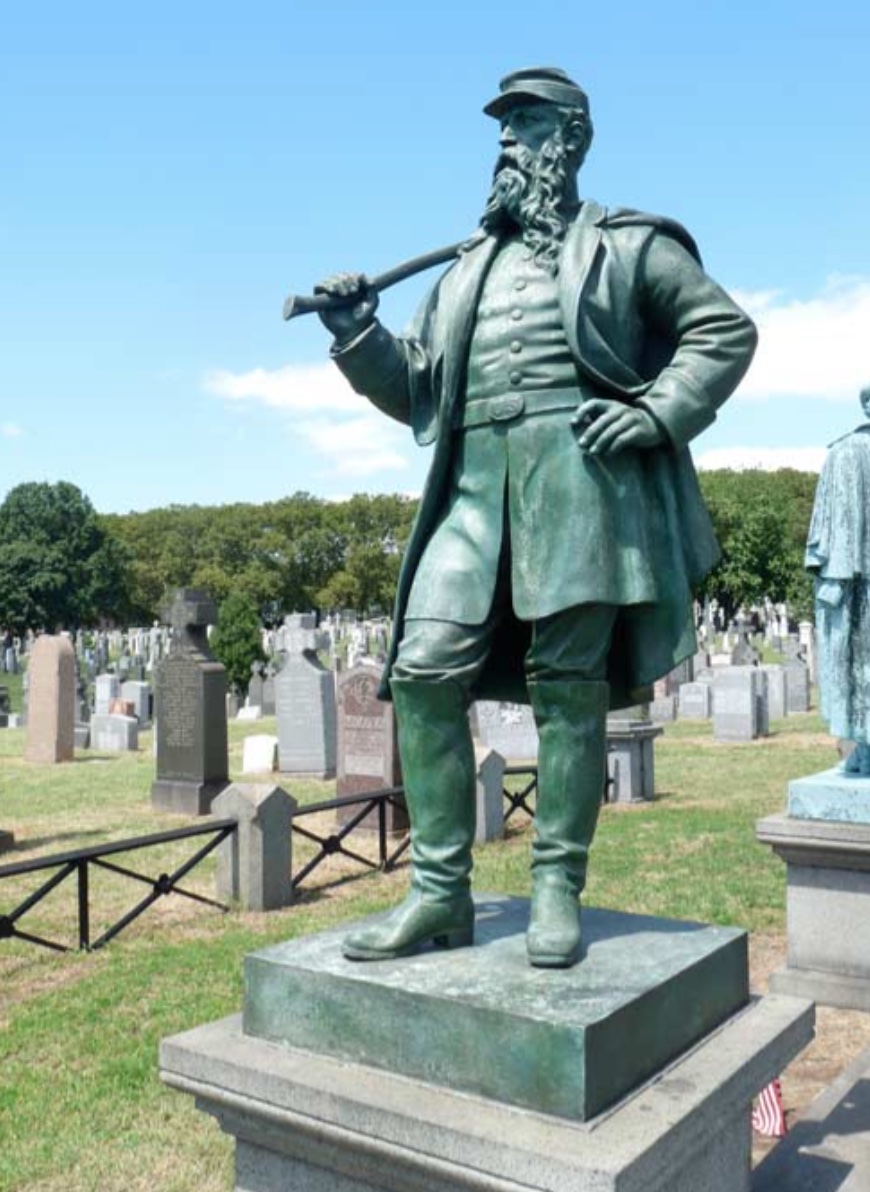
Union Civil War officer, one of a series of sculptures in Calvary Cemetery by Daniel Draddy from Cork (Photo sourced: Internet)
Perhaps the most striking feature in the cemetery is the city park located completely inside Calvary, dedicated to the Civil War soldiers who defended the Union. Irish sculptor Daniel Draddy from Cork created the park’s most stunning feature — amazing life-sized statues of Civil War soldiers. There is also a Fenian Monument in Calvary, erected in 1907 to honor members of the Fenian Brotherhood buried there, one of whom is the great Tipperary Fenian leader and Civil War veteran Michael Doheny (1805-1862) .
There is also — and a monument also honors — the legendary Civil War NY Irish regiment, the Fighting 69th, whose leader Thomas Meagher is also profiled in my book. My friend Peter McHale, author of Greenpoint Doughboy, wrote his excellent work about his great-uncle who fell in France fighting with the 69th in World War I. The book ends with the fallen hero’s return to be interred in Calvary.
Monument to the famous “Fighting 69th” Regiment US Army first formed from Irish migrants for the American Civil War (Photo sourced: Internet)
One of the most famous figures interred there is Mayo legend and Olympic Gold Medalist Martin Sheridan (1881-1919). Sheridan, a World Record-setting discus hurler, was cut down just short of his thirtieth birthday by the last great pandemic a century ago. He lies in sight of the former Celtic Park where a number of Irish immigrants formed a legendary sports club that brought home several Olympic medals.
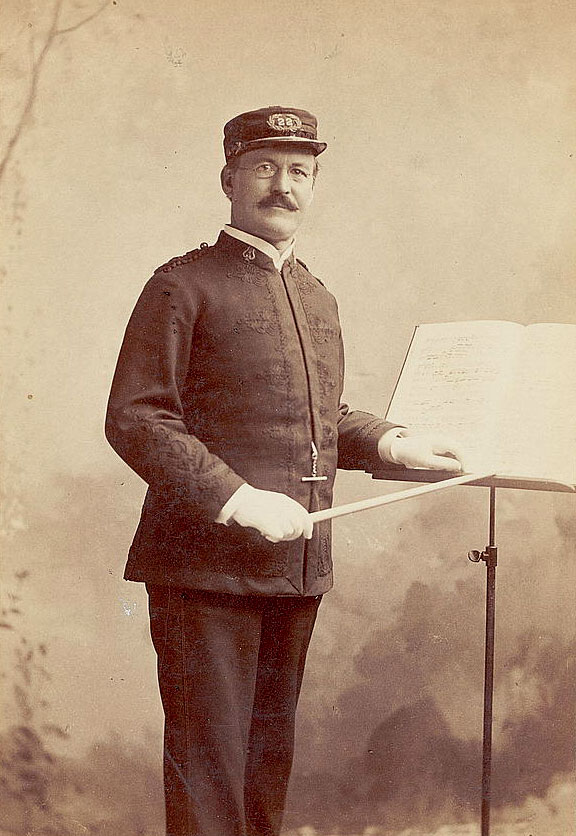
Artists and musicians also lie there. Galway-born Patrick Gilmore (1829-1892), song writer and band leader, known as “The Father of the American Band,” who wrote When Johnny Comes Marching Home and Meath’s John Mulvany (1839-1906) the great western painter of Custer’s Last Stand also rest there. Also among the dead is James Blake (1862-1935) who wrote the text to the iconic New York song “ The Sidewalks of New York.”
Millions of New Yorkers lie here, each with his or her own biography. Sadly, the Archdiocese shut down walking tours of the cemetery and unlike Brooklyn’s Green-Wood Cemetery, Calvary fails to commemorate its amazing history. Let’s hope that this changes soon.








 rebelbreeze