Five people sitting down to a meal were surprised by a knock on the door of their residence. What followed amounted to an hours-long Garda siege ending in arrests and the residents and supporters gathering outside being pepper-sprayed and beaten.
A housing activist who has witnessed many evictions said it was the most violent eviction they had ever seen.
A house empty for many years in the Phibsboro area had been occupied by around four people who invited a fifth to share a meal on Monday 15 December. As they were about to sit down to eat the Gardaí arrived and told the occupants that they were criminally trespassing.
The occupants explained that they had been living in the building for some time and had keys, so any accusation of trespass would be of a civil kind requiring court orders and not at all a criminal one on which Gardaí are empowered to act. The Gardaí however remained and more arrived.
Local people responding to a call for support against an illegal eviction began to arrive as did more Gardaí until there were around 13 Garda vehicles present, including the Public Order Unit; a number of attempts to batter the door down were made which were however unsuccessful.
People protesting what appeared to be an illegal eviction were pushed and shoved by Gardaí and after a while also pepper-sprayed and batoned. After some hours had elapsed the police succeeded in smashing a back window and battering down an internal door, gaining access to the building.
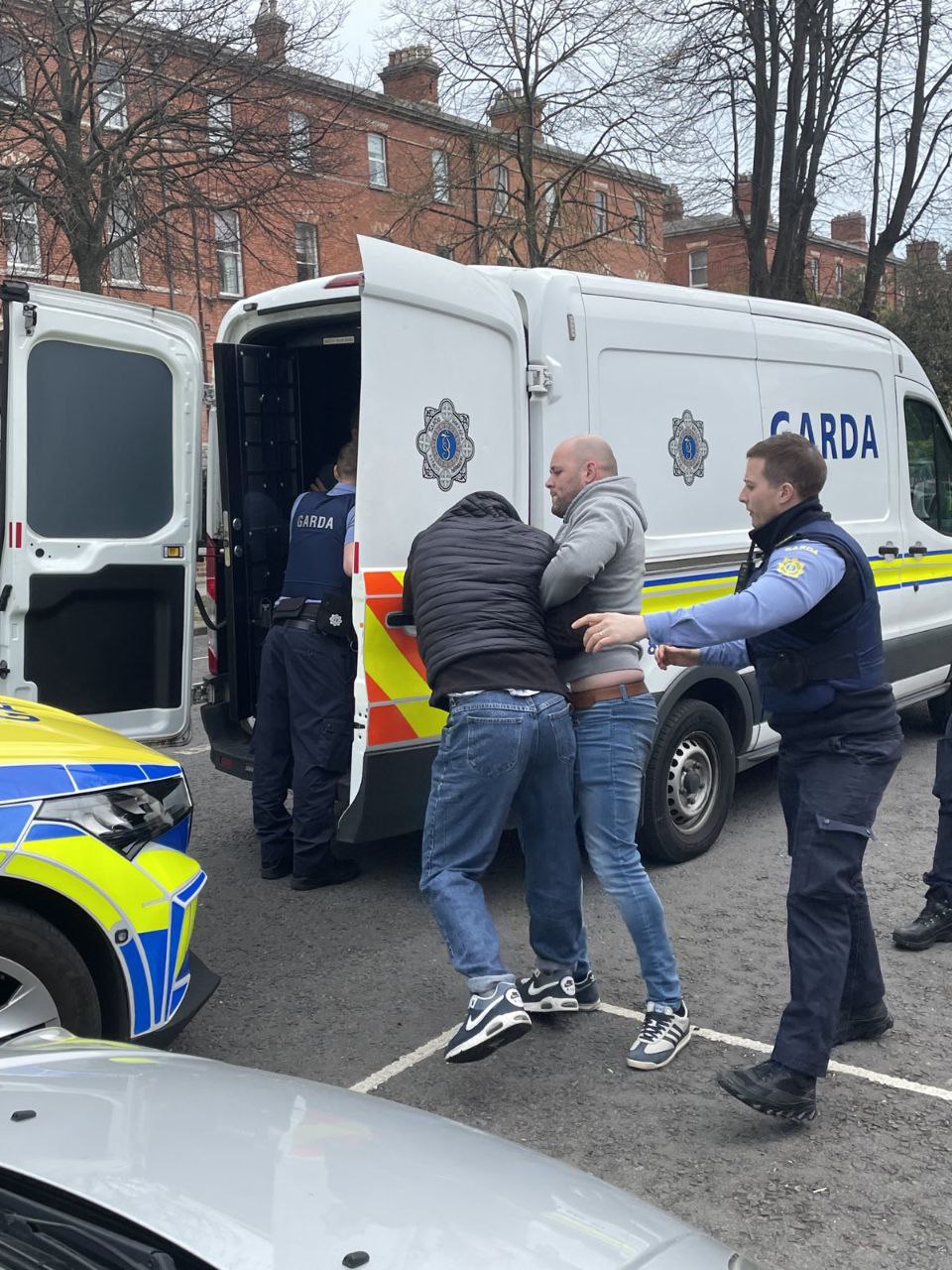
The people inside raised their hands to indicate no resistance being offered (some were reportedly even sitting down) but allege that they were nevertheless pepper sprayed and beaten. Four were dragged out to Garda vehicles and the remaining person was violently assaulted again.
The road outside had by this time been cleared by the Gardaí. The five arrested were taken to a police station where at least some, male and female, allege they were stripped and cavity searched, measures totally inappropriate in this kind of arrest or similar.
It will be recalled that a number of Mothers Against Genocide group protesting outside Leinster House complained of the same during their detentions in Dublin in June although the Government’s spokesperson denied to some TDs that this had occurred.
That same week anti-NATO peaceful protesters had also been pepper-sprayed and the ankle of one broken by Gardaí while a Palestine solidarity activist at DCU was dragged to the ground, with allegations of strip-searching among those too.
Video by Anti-Imperialist Action outlining the source of Dublin’s housing crisis.
All five residents of the house were charged with offences including causing fear (!) and criminal damage, kept in custody overnight and brought to court, where they were released on bail to return to court at a date in the New Year.
GARDAÍ HELPING MAINTAIN HOMELESSNESS
This Garda operation and abuse of legal powers took place in the context of the highest recorded number of homeless to that date, with 16,600 people in emergency accommodation, including morethan 5,200 children and over 4,600 women,1not counting those sleeping on the street.
And with well over a hundred thousand buildings lying empty,2 a situation constituting a paradise for property speculators, vulture funds, banks and big landlords – but misery for thousands renting, struggling with a mortgage, in unsuitable accommodation, sofa-surfing or on the street.
Indeed, the property at which the Garda violent eviction took place was reportedly empty for many years before its occupation.
A couple of years ago a group called the Revolutionary Housing League occupied empty Dublin buildings and called for people across Ireland to do the same. Sadly, their call was not followed and Gardaí mobilised huge operations including helicopters to evict a handful of occupants.
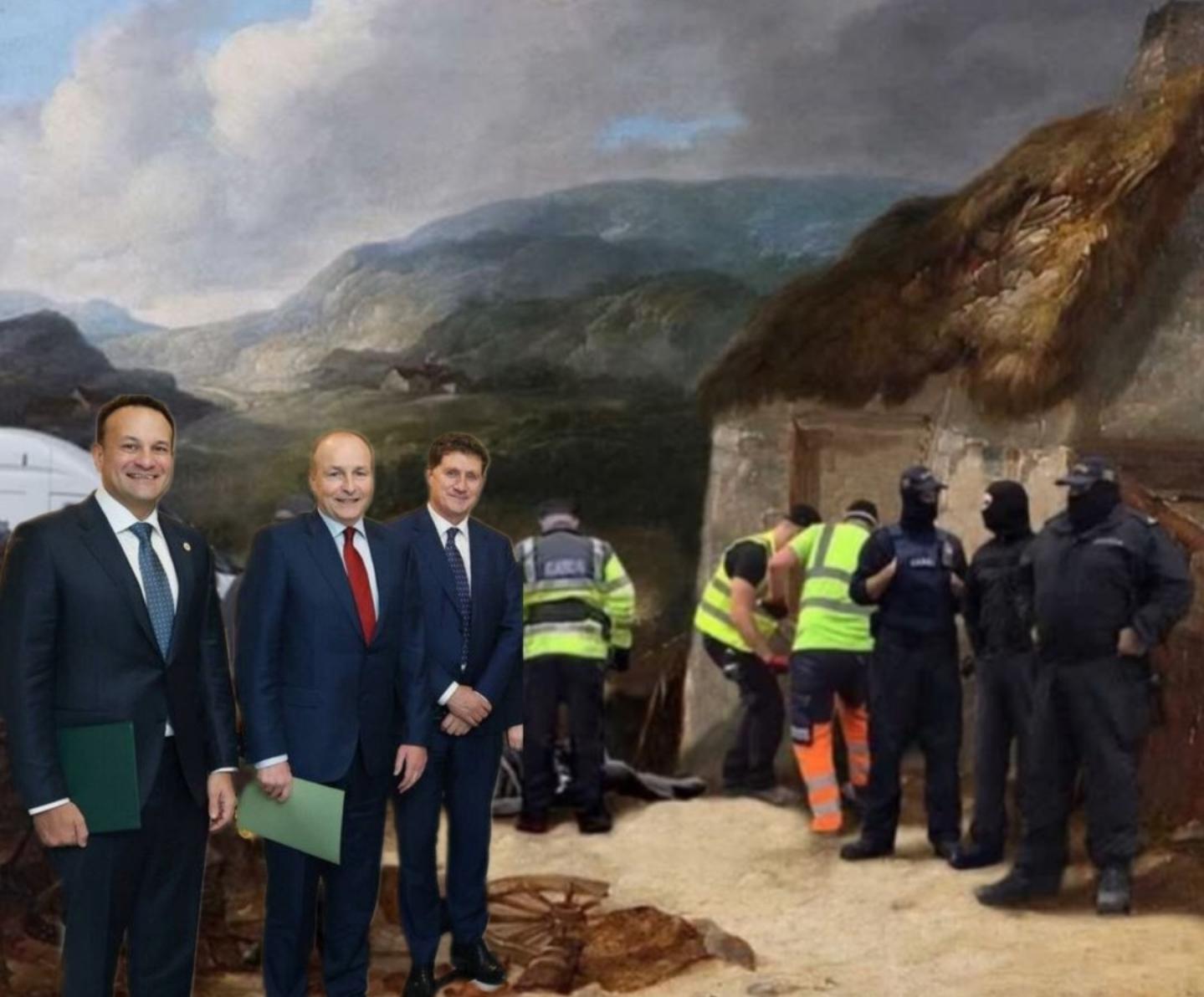
Three chief Irish Government Ministers some years past (one still in place) and Gardaí photoshopped on to 18th Century eviction scene in Ireland (original photoshopping of Gardaí by Spice Bag). (Image sourced: Internet)
HUMILIATION AND VIOLENCE
Strip and cavity-searching are demeaning psychological and physical invasions and should have no place in most policing actions. Even in jail, an x-ray chair is available. However strip-searching has been a constant over the years in use against political prisoners.
As violent and degrading actions become normalised in political repression they will be extended further, spreading to all kinds of policing operations.
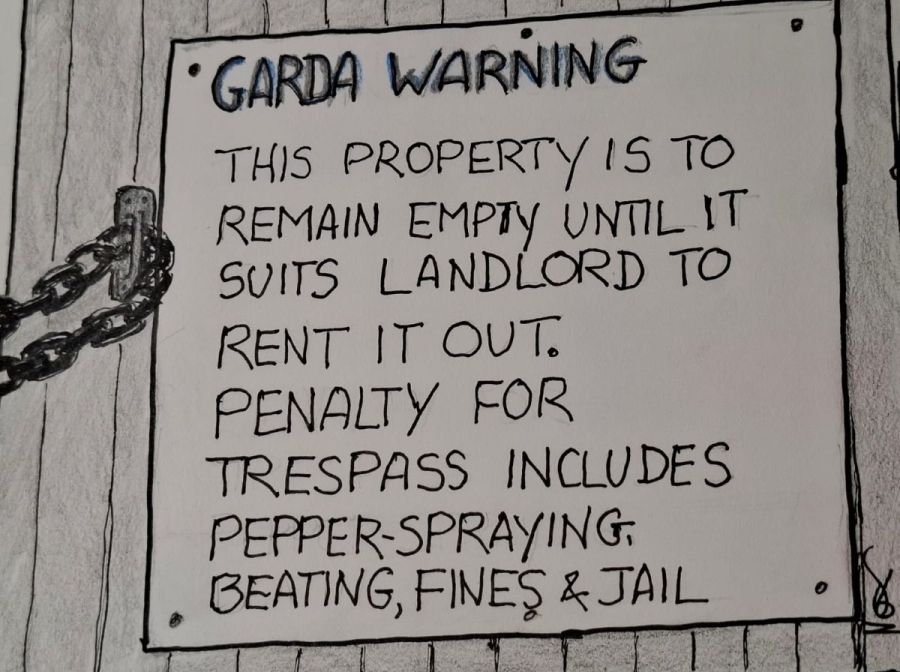
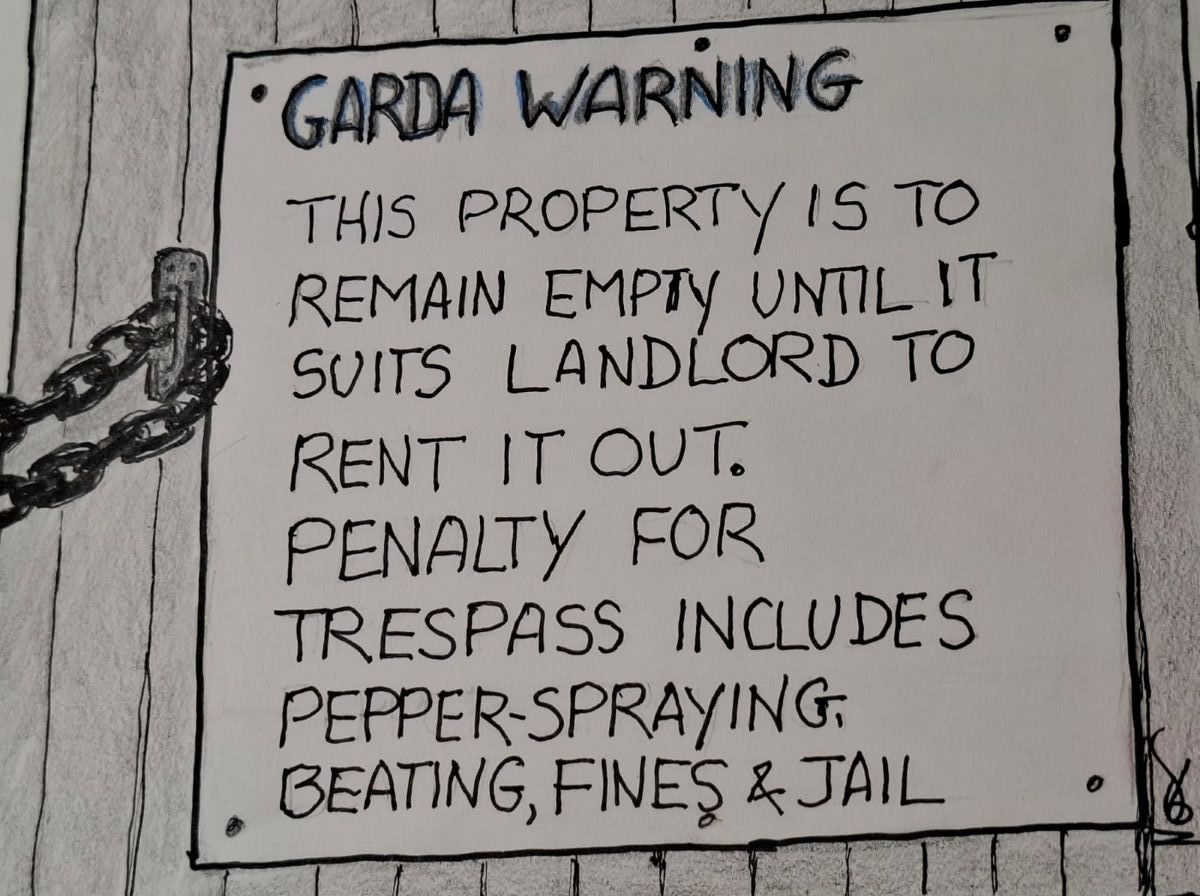
Cartoon by D.Breatnach
Gardaí normalising the use of pepper-spraying against Palestine solidarity and anti-NATO direct action activities are now extending this to other types of activities of which they disapprove, even those in the sphere of civil law and outside criminal law.
As the State increases its repression, the democratic and revolutionary movements will need to increase their resistance, calling also for the active solidarity of wider society with the victims and in condemnation of the State and its police force.
End.
Note: If you found this article of interest, why not register with Rebel Breeze for free, so that you will be notified by email of subsequent articles. You can de-register any time you wish.
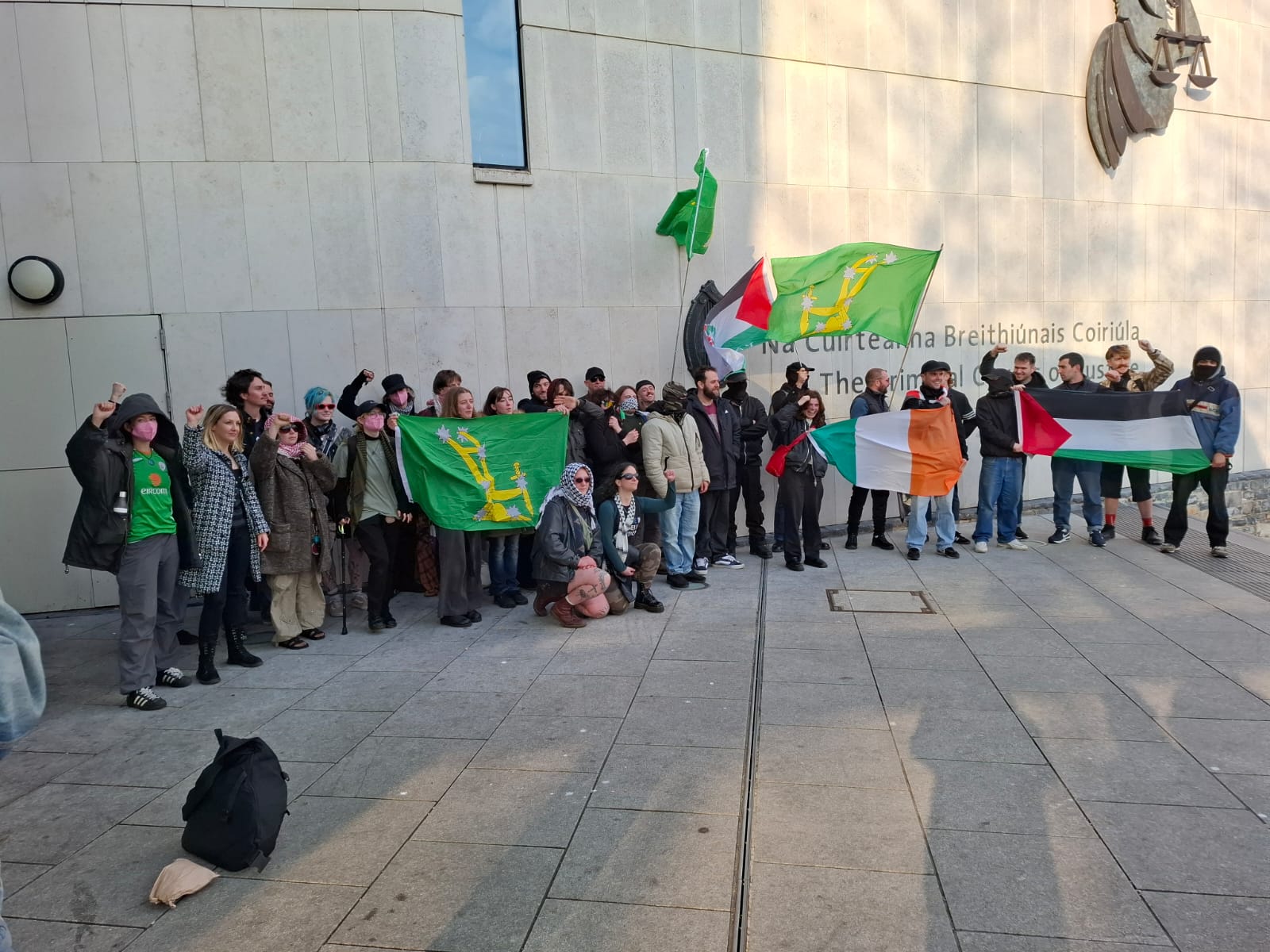
Many people endured heavy rain on Friday morning to support two Palestine solidarity activists in court as a result of the now-infamous Garda pepper-spray and baton attack on a peaceful march to Dublin docks on 18th October.
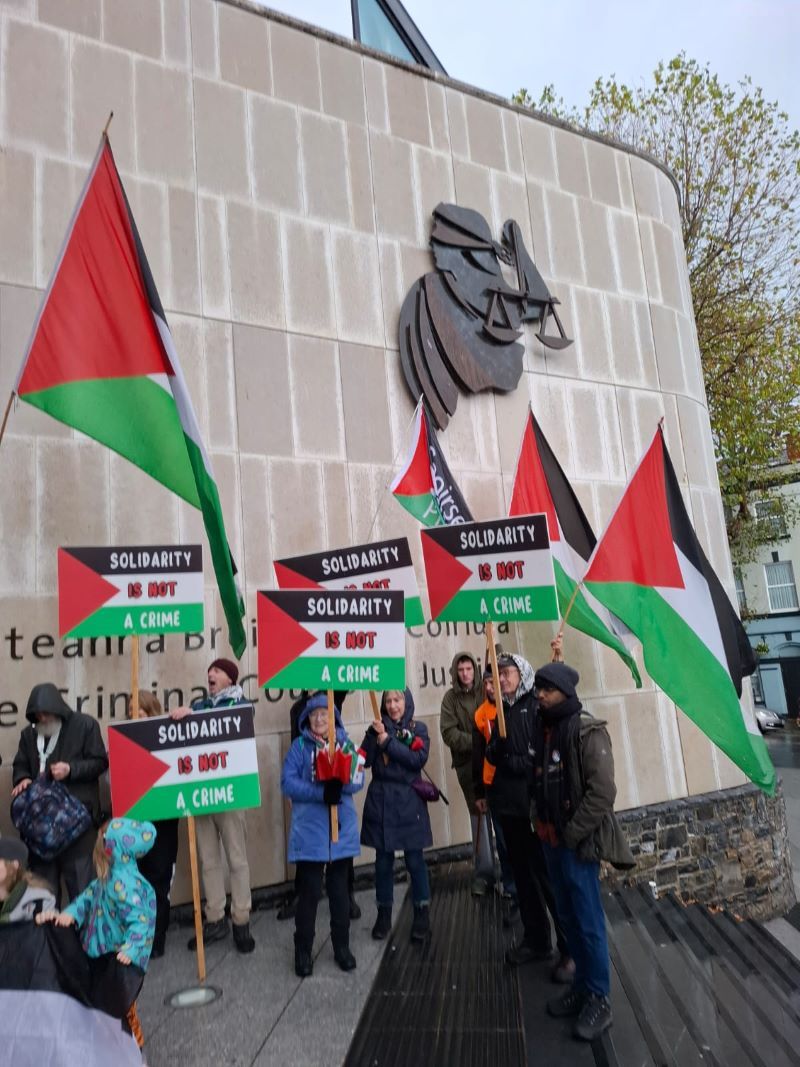
Small section of the crowd of supporters outside the Court on 31 October 2025 for the two pepper-sprayed and chargedPalestine solidarity activists (Photo: D. Breatnach)
The Port march was a breakaway from a periodic Ireland Palestine Solidarity Campaign national march to Leinster House, the home of the State’s parliament; some IPSC stewards denouncing it as it diverged at O’Connell Bridge and called on others to march on Dublin Port instead.
From video and eyewitness reports it is clear that the Public Order Unit of the Garda determined not only to stop them but to ‘teach the protesters a lesson’. No sooner had the linked-arms marchers reached the police line than some of them sprayed pepper-spray on the Palestine solidarity activists.
So heavy was the spraying that it affected a number of the Gardaí themselves. Many also drew their batons and attacked the demonstrators reeling from the effects of the spraying. The POU unit had their ID numbers concealed and Gardaí pursued activists moving away, spraying them again.
The Gardaí later claimed they had given a warning before spraying as they are required so to do by their own regulations but both Irish Council for Civil Liberties observers and video evidence show this to be untrue.
Solidarity activists were arrested at the scene of the Garda attack and one other outside a special sitting of the court on Saturday evening. The charges were of the usual kind with police repression of demonstrations: offences against Public Order, resisting arrest and obstruction of traffic.
The Irish State is the 2nd-largest single importer of Israeli products, second only to the USA and clearly has no intention of moving from that situation.
Nor of demilitarising Shannon Airport nor of banning Irish airspace to overflights ferrying military supplies to Israel. Two years of giant solidarity marches and smaller ones up and down the country have not moved the Irish ruling class to any degree beyond making statements.
As people move to take actions that have the potential to force the Government to end their collusion it seems inevitable that the State will increase its repression, which will work towards intimidation but also to increased resistance.
Small section of the crowd of supporters for the two pepper-sprayed and charged outside the Court on 31 October 2025. (Photo: D. Breatnach)
Those gathering at the court today were for the most part independent activists and activists of very small political organisations but many also of broad Palestine solidarity groups.
The two facing charges today had their cases postponed to January 2026, with talk of the Gardaí possibly returning shortly to court to press more serious charges, with the potential of heavier punishment — but conversely also of greater political statements made before a jury.
Solidarity with people fighting in struggles in other parts of the world often has a price of repression where the solidarity is originating, which makes solidarity to the targeted activists essential too. In that context, the numbers attending the court on Friday morning were very encouraging.
End.
Note: If you found this article of interest, why not register with Rebel Breeze for free, so that you will be notified by email of subsequent articles. You can de-register any time you wish.
Hundreds gathered Wednesday night near the rear entrance of Leinster House, home of the parliament of the Irish state, in a demonstration organised by Mothers Against Genocide to protest the police attacks on demonstrators of the previous week.
Background
Over four days the previous week the Gardaí, police force of the Irish State, had attacked demonstrators in a number of different locations in Dublin. On Monday the MAGS group at the front entrance of Leinster House was attacked as they neared the end of their overnight vigil there.
The women were calling for Government action to match the will of the Irish population by preventing military supplies sent to Israel through Irish airspace and airports, to end processing Israeli bonds through Irish banks and to institute sanctions against the Zionist Occupation.
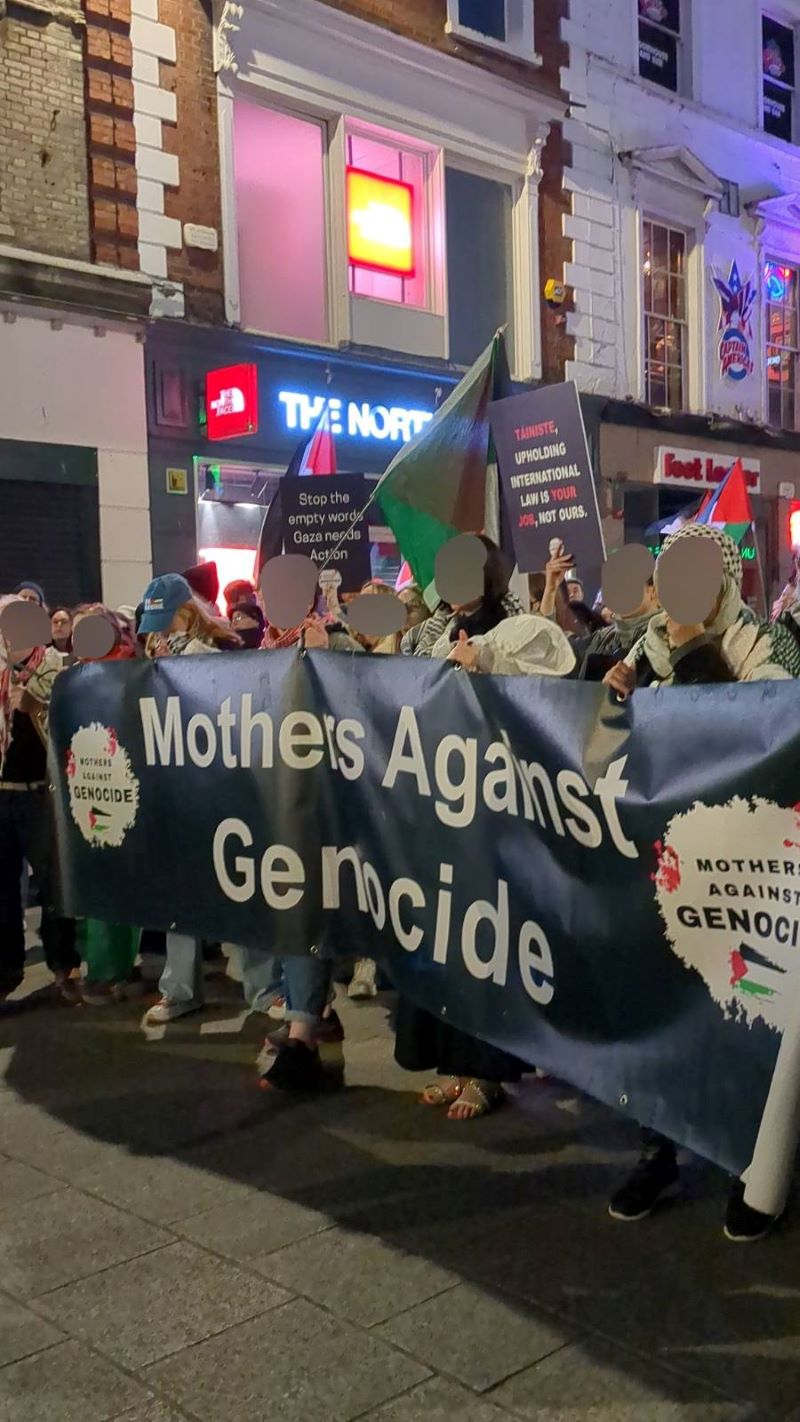
MAGS banner in Grafton Street later in the evening. (Source: Participant)
Eleven women and three men were arrested and taken to different Garda stations where a number of women were strip-searched, including one in an apparent cavity search; three men were charged under the Public Order Act and women pressured to accept an official caution.
Two days later, at a protest organised by the Boycott, Divestment and Sanctions (BDS) Society of the Dublin City University against the official opening visit of the Taoiseach (‘Prime Minister’) to a University building, Gardaí arrested a student for knocking on the window of the building.
On Friday, Gardaí attacked six protesters engaged in a protest at the front entrance to the Belgian Embassy in Dublin, where NATO is represented. The Anti-Imperialist Action protest was against the Irish elite’s attempt to slide the State into membership of the military alliance.
Those protesters were pepper-sprayed into their eyes, forced to the ground, handcuffed and treated so violently that the ankle of one man was broken; the breast of one woman was also grabbed. Two more picketing outside were also arrested, all again distributed around different police stations.
On public order charges, six also on trespass, all eight were brought to a special late court sitting that early evening where a crowd of supporters gathered.
All were bailed on a range of bizarre bail conditions including banned from protesting at Government buildings and a requirement to give 12 hours notice to the Gardaí with details before attending an embassy protest.
Wednesday night’s Leinster House protest
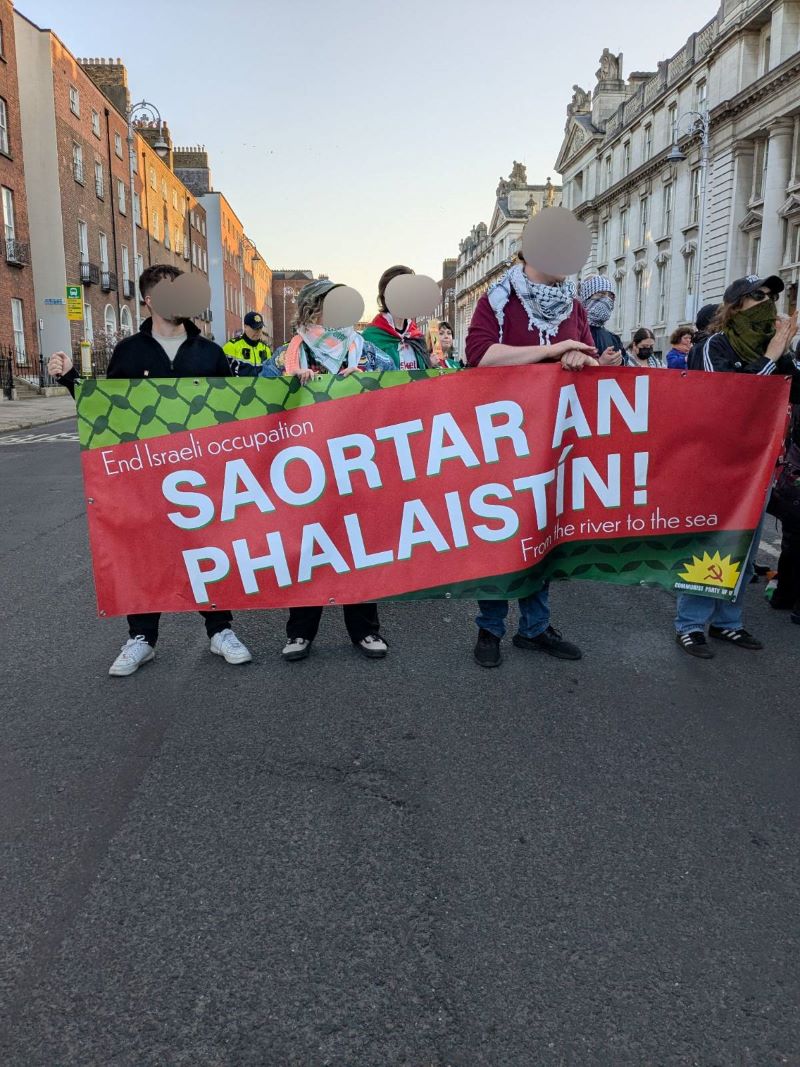
The mood of the crowd of over 500 last night in Merrion Street was militant, being addressed by a woman on behalf of the Mothers group. The crowd was joined by a group flying Starry Plough1 and Palestinian flags, bearing a banner of the AIA and a hand-painted one against NATO.
View of the rally in Merrion Street before the march. (Source: AIA)
The speaker introduced Aileen Malone, mother of Dara Quigley, a well-known blogger some years ago who appeared naked in public while suffering a mental ill health episode. One of the Gardaí dealing with the incident took a video of her and circulated it widely on social media.
Following that public shaming, Dara had taken her own life. Her mother pointed out that the offending Garda, instead of being dismissed, had been allowed to resign and keep his pension. She also condemned the Garda treatment of the women while extolling their courage in resistance.
Another speaker, introduced as representing Jews for Palestine Ireland spoke against the Irish State adopting the IHRA’s definition of antisemitism, the function of which, he stated is to protect the state of Israel against any criticism including regarding its genocide against Palestinians.2
He regretted the diversion from Palestine solidarity entailed in this focus, pointing out that genuine anti-Semitism is to be found among the far-Right while anti-racists and anti-fascists in Palestine solidarity, far from being anti-Semitic are on the contrary active against that variant of racism.
One of the banners at the rally in Merrion Street. (Source: Participant)
A woman from Mothers Against Genocide in Belfast spoke about the history of Irish resistance to colonialism and solidarity with Palestine which had no relation to the Irish Government, vehemently insisting also that being anti-genocide and for human rights is far from anti-Semitism.
Ruth Coppinger, Socialist Party TD, had signalled she wished to speak and was invited to so. She commented on Wednesday’s session in Leinster House when the Garda attack was defended by Mícheál Martin in respect of the right of access to Leinster House.3
A member of the Mothers in Dublin read a solidarity poem she had written and introduced the Resistance Choir, who sang Gonna Let No-one Turn Me Around, a lively song from the US Civil Rights4 movement of the 1960s,followed by slower lament about the Zionist slaughter in Gaza.
The energy in the crowd was dissipating by this point, almost an hour having elapsed and at last the direction to march was given. But where to? It was unclear. Earlier indications had been that one of the Garda stations would be the destination but now the Dept. of Justice was being mentioned.
The slogans shouted were those usually heard at Palestine solidarity events, with calls supporting the Intifada increasingly popular, and even one to Globalise the Intifada! US Warplanes out of Shannon! was another and NATO out of Ireland! was also heard.
Very appropriately also: One, we are the people! Two, We won’t be silenced! Three, Stop the bombing now, now, now, now!
Some banners during the march, seen here on the east side of Stephens Green. (Source: AIA)
The march proceeded, chanting, up Merrion Street, then into Merrion Row, turning left at the Huguenot Cemetery, then along the east side of Stephen’s Green, stopping briefly at the Dept. of Foreign Affairs building, then along the south side to the Dept. of Justice building.
But soon it was on the march again, perhaps heading for the Kevin Street Garda station … But no, along the west side of the Green now, past the Unitarian church where Edward Fitzgerald was married to his French revolutionary wife and then on again down through Grafton Street.
A meeting here was addressed mainly by one speaker, for some reason the crowd repeating his sentences. Not one speaker had yet referred to the attack on the anti-NATO protesters on Friday, much less their bizarre and repressive bail conditions. But perhaps we were heading for the GPO?
No, left and into Dawson Street, up to the Green again, then down Kildare Street to the front of Leinster House. There at last the crowd was addressed on behalf of the Anti-Imperialist Action group regarding the Garda attack on the anti-NATO protesters at the Belgian Embassy.
His talk was interrupted by cries of ‘Shame’ directed at the Gardaí and State. The speaker continued, referencing the resistance history of Irish Republicans and concluded by calling for unity of the Left against repression of any aspect of the Resistance, a call vigorously applauded.
To conclude the evening’s events a display concerning victims of Garda violence was presented, this including the case of Terence Wheelock, a working-class youth who died in Store Street Garda Station as a result of their violence, a crime then covered up by the State.
In Retrospect
It was important and a good act of resistance to organise an emergency protest5 this week and the eventual attendance of around 700 at such short notice was excellent. It is essential to meet repression of resistance with more resistance.
It was noticeable how low the numbers of Gardaí were and although uniformed and a number of plainclothes Special Detective Unit members followed the marchers, at no point did they attempt to stop the marchers or even to line up in numbers to protect the Government offices.
Most of the speakers at the commencing, intermediate and final rallies were clear that the Irish State had made a conscious decision to crack down on solidarity actions the previous week, using physical and sexual violence against activists, and of the need to continue solidarity and resistance.
The commencing rally was however too long and dissipated some of the energy. The lament as the last song just before that march, though no doubt appropriate in some contexts, continued that dissipation.
Coppinger, as a leading member of the Socialist Party was inappropriate as a speaker at the event. The party in the past has opposed boycotts against Israel and South Africa on the spurious grounds that it harms the oppressed people and works against solidarity between progressive settlers.
The Socialist Party also supports the Two-State proposal which would concede 80% of Palestine to the Zionist settlers. Coppinger personally and her party have also publicly condemned the Palestinian Resistance breakout operation of 7th October 2023.
The marching seemingly for ever, at times to symbolic but empty Government buildings was not helpful and most of the people already detest the Government. A good destination would have been at least one of the Garda stations where activists had been held the previous week.
Marching from and to an essentially closed Leinster House and Government buildings runs the risk of replicating the routine marches every month or so of the Ireland Palestine Solidarity Campaign.
The value of the Mothers has been their departure from that increasingly sterile practice and continuing in that vein would be a useful contribution to the solidarity movement and resistance in general.
Unity against repression is a historically-proven necessity and, as called for at the final rally last night, increasing unity between newer and longer-lived elements of the Resistance is also needed.
End.
An excellent riposte in the poster slogan/ meeting title. The design is based on the poster against strip-searching Republican women in the 1970s, design by Oisín Breatnach. (Source: Mid-Ulster IPSC)
1Flag of the Irish Citizen Army, first produced in 1914, the design is based on the Ursa Mayor constellation, including a plough in gold colour, with a sword instead of the ploughshare, all on a green background. A later version of the Republican Congress represents only the stars of the constellation in white on a blue background. The green and gold version was the one flown by the AIA.
3This was a spurious defence by the Taoiseach: a) It was before 7am and the Mothers were leaving at 7.30am; b) the pedestrian entrance was not blocked; c) the gates at the rear of the building were not blocked.
4But, like many of those songs, based on an earlier Christian song.
5There had also been an emergency protest outside Leinster House on last week’s Wednesday morning, Kildare Street being blocked for an hour without Garda action.
In the space of four days, Dublin has seen 23 activists in peaceful protests arrested and assaulted by Gardaí as the activists protested the slide of the Irish Gombeen1 ruling class towards NATO and their complicity in the Genocide in Palestine.
Mothers’ Day protest against genocide – 14 arrests
The Mothers Against Genocide group organised a vigil for Sunday night of Mothers’ Day outside Leinster House, seat of the Irish parliament and Government. The intention was to hold the event that evening but for some to remain there overnight, leaving at 7.30am.
At the gates of Leinster House, Kildare Street entrance. (Photo: D.Breatnach)
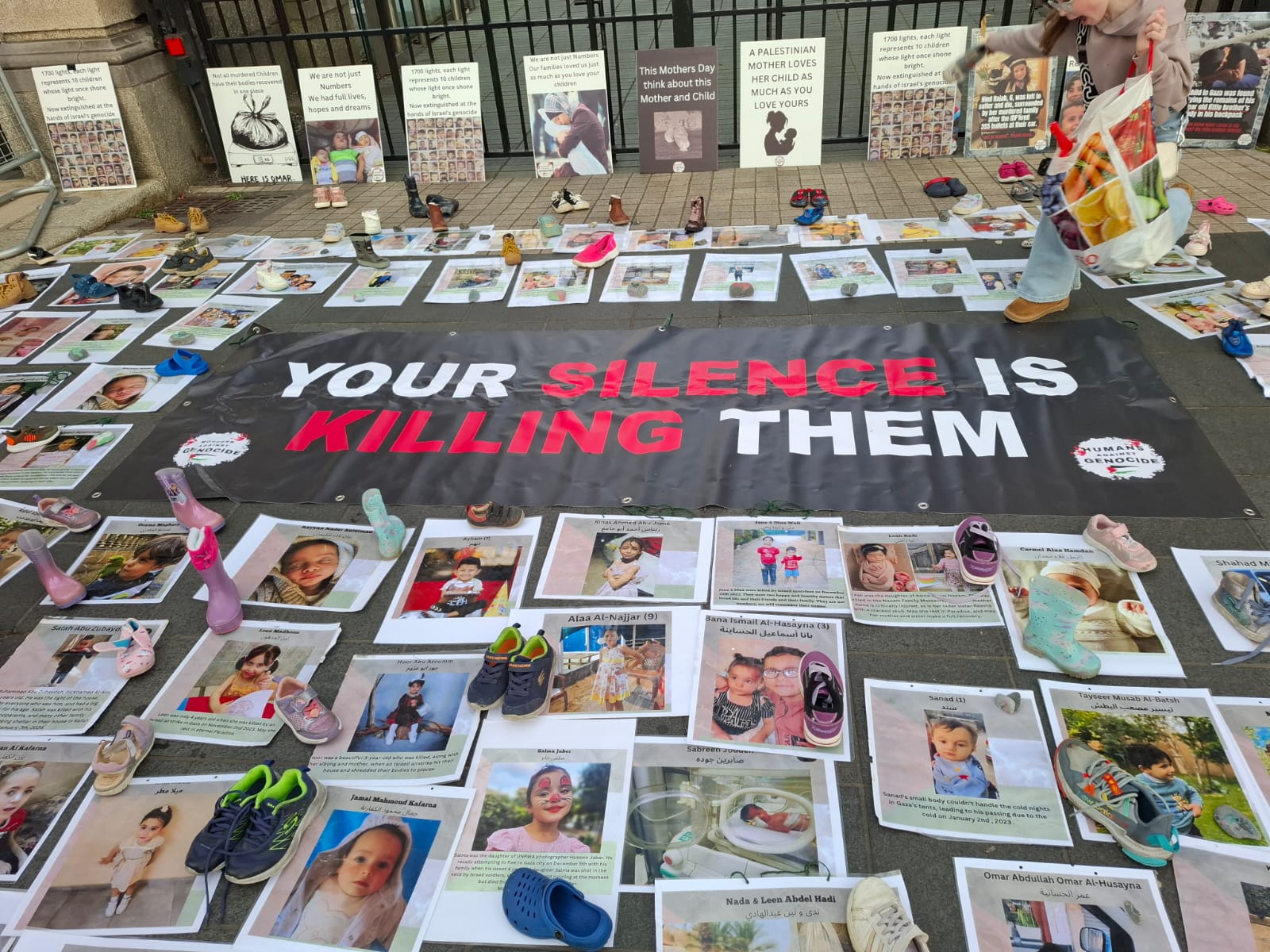
Plasticised printed photos of murdered Palestinian children were laid out on the ground with children’s shoes, toys etc spread around symbolically against the main gates with battery-powered ‘candles’ lit among them. Nearby a refreshment stall was set up.
By the advertised starting time of 7pm many had arrived and more kept coming, a very large crowd by nearly 8pm when there were some speeches, a few songs and a poem performed by different people, then a projection was being arranged after 9pm at which point I left.
Crowd at the event as dusk falls, approximately 8pm. (Photo: D.Breatnach)
The event was dignified, without even chanting. Policing was very sparse and low-key.
Despite the organisers’ commitment to leave at 7.30am and apparent agreement from the Gardaí present not to interfere with that arrangement, at around 6.00am more Gardaí2 arrived and demanded the clearing of the gates by removal of the icons to the murdered children.
In protest, some of the participants lined themselves up in front of the gates. The Gardaí approached the women, trampling over the photos and symbolic children’s items and began to remove the women, some of them quite violently, resulting in their arrests and those of three men also.
Banner of the organisers at Leinster House wall, Kildare Street. (Photo: D.Breatnach)
The 14 arrested were taken to different Garda stations where some women were strip-searched, an invasive psychological weapon used extensively by the British Occupation against Irish Republican women during the 30 Years War and still used by them against male Irish Republican prisoners.
All the women were obliged to choose right there and then between accepting a caution under the Public Order Act or to be charged and, under pressure, the women all seem to have been cautioned.
The three men were charged under the Public Order Act and will be obliged to attend the court to be processed. On Tuesday in Leinster House a number of TDs (elected parliamentary representatives) protested the treatment of the arrested. The Gardaí denied having carried out strip-searching.3
The Irish Council for Civil Liberties issued a brief statement to their network in response to the events, outlining the right to protest according to the Irish State’s Constitution:
We’ve heard from a lot of people who are worried by the Garda response this week to a peaceful vigil by Mothers Against Genocide. The fallout from this response along with potential new policing and public order laws and with the prospect of increased surveillance through facial recognition technology, risk undermining this fundamental democratic freedom. Today, as threats grow to restrict protest rights, defending this fundamental democratic freedom is crucial.
Protest isn’t the problem – it’s the solution:
You can protest – The Irish Constitution and European law protect peaceful assembly
You can film – Documenting interactions with Gardaí is allowed
You can’t be moved on without reason – Gardaí must give you a reason when asking you to move
The Irish Constitution guarantees your right to freedom of assembly, subject to public order. However, recent commitments in the Programme for Government have raised alarm.We continue to highlight how measures – including the expansion of police powers, banning face coverings at protest and the introduction of facial recognition technology into Irish policing – endanger our rights and freedoms.
The display outside the gates of Leinster House, Kildare Street entrance. (Photo: D.Breatnach)
On Wednesday morning a protest, composed mostly but not completely of women, at the treatment of people on Monday morning blocked the street outside Leinster House for a period of at least an hour4 without action by the Gardaí.
Protest at complicity of Irish Government in Dublin City University – another arrest
On Thursday evening Tánaiste (equiv. ‘Prime Minister’) Mícheál Martin’s visit to publicly open a building at the Dublin University Campus, accompanied by a heavy Garda presence was met with a protest organised by the Boycott, Divestment & Sanctions campaign branch of the University.
One of the students in the protest was arrested apparently for knocking on the window to convey the anger outside to those inside, Gardaí claiming at the time that he was damaging the window. The activist was released on bail amidst a crowd gathering in his support at the Garda station.5
Protest against NATO in the Irish State – 8 arrests
On Friday, a protest against attempts to push Ireland into joining the NATO military alliance was held at the latter’s representative facility in Dublin, the Belgian Embassy. Gardaí were very quick to respond and indeed had accosted and assaulted two of the participants a little earlier.
Protesters and Gardai in doorway of Belgian Embassy just before the attack of the latter on the former. (Photo source: Anti-Imperialist Action)
Six protesters lined up against the Embassy entrance at the Anti-Imperialist Action event were pepper-sprayed into their eyes and brutally assaulted, as were another two outside. As with those arrested on Monday morning, they were held in three different police stations in the city.
One of protesters, face down on the ground with his arms handcuffed behind his back, had his legs forced up behind, breaking his ankle.
(Photo source: Anti-Imperialist Action)
Supporters arrived to picket the police stations. After a few hours the arrested were taken to court, where supporters congregated also as the detained were processed for a late sitting of a judge. The charges were of criminal trespass or Public Order Act violation, both together for some.
In court they had legal representation and all were bailed in their own recognisance of 500 euro, which seemed fairly routine but the bail conditions were anything but. They were required to give 12 or 24 hours’ notice to the Gardaí of attending an embassy protest, supplying the details of the event!
The conditions for some included a ban on attending any state’s embassy in Dublin or demonstrating at any Irish Government building, while another is required to give notice – also of 12 hours — if crossing into the State from the Six Counties.
Facing a prospect of being locked up for the weekend otherwise, they did not decline the conditions for the moment and were released to meet a crowd of supporters outside the court in the early evening. As they lined up for a photo, all sang part of the Irish language Gráinne Mhaol song by Patrick Pearse.
The arrested and supporters outside the court after the former were released on bail. (Photo: D. Breatnach)
Repression of Palestine solidarity throughout the Western World
Throughout the Western world the response to the genocide being carried out in Gaza has had similar features: The complicity of the ruling classes, solidarity with the Palestinians of sections of the masses and the consequent repression by the ruling elites.
Within the territory of the Irish State the response of the masses has been marked in active solidarity with and public sympathy for the Palestinians, with little repressive action by the Irish State despite the proven collusion of the Irish ruling class.
The indications from this week are that the latter situation is changing and repression is being ramped up. This in turn indicates that the neo-colonial Irish ruling class feels threatened by action in Palestinian solidarity, other than routine marches through Dublin every month or so.
It is removing the liberal gloves and revealing the underlying sharp claws of a class that gained a state created in collusion with the British occupation to divide the country and to repress and control the insurrectionary forces upon the backs of which that neo-colonial class rode to power.
During the Civil War,6 the Irish state executed many more revolutionary fighters than had the British during the War of Independence7 and has executed a number since. Huge numbers have been imprisoned over years and it has colluded in covering for the bombers of its own capital city.
Where there is oppression, history teaches us, there will also arise resistance but that in turn usually results in more repression. Resistance rises to meet that repression and the movement must organise to educate, organise and unite that resistance, going forward until the masses achieve victory.
1A term somewhat equivalent to ‘carpetbagger’ describing opportunists amassing wealth through taking advantage of people’s misfortunes. Its origins are in the Irish language Gaimbín, applied to such Irish capitalist financiers during and in the wake of the Great Hunger of the mid-19th Century, now used to describe the neo-colonial capitalist Irish bourgeoisie.
2 The (mostly) unarmed police force of the Gombeen Irish ruling class.
Friends and relations of Terence Wheelock and supporters of the campaign for justice for his family rallied outside the GPO Thursday afternoon before marching to Leinster House and on to the Department of Justice.
Terence Wheelock was 20 years of age when he was arrested by Gardaí following a car stealing by others in Dublin and taken to Store Street Garda Station. Subsequently he was removed to hospital in a coma from which he never recovered, dying three months later.
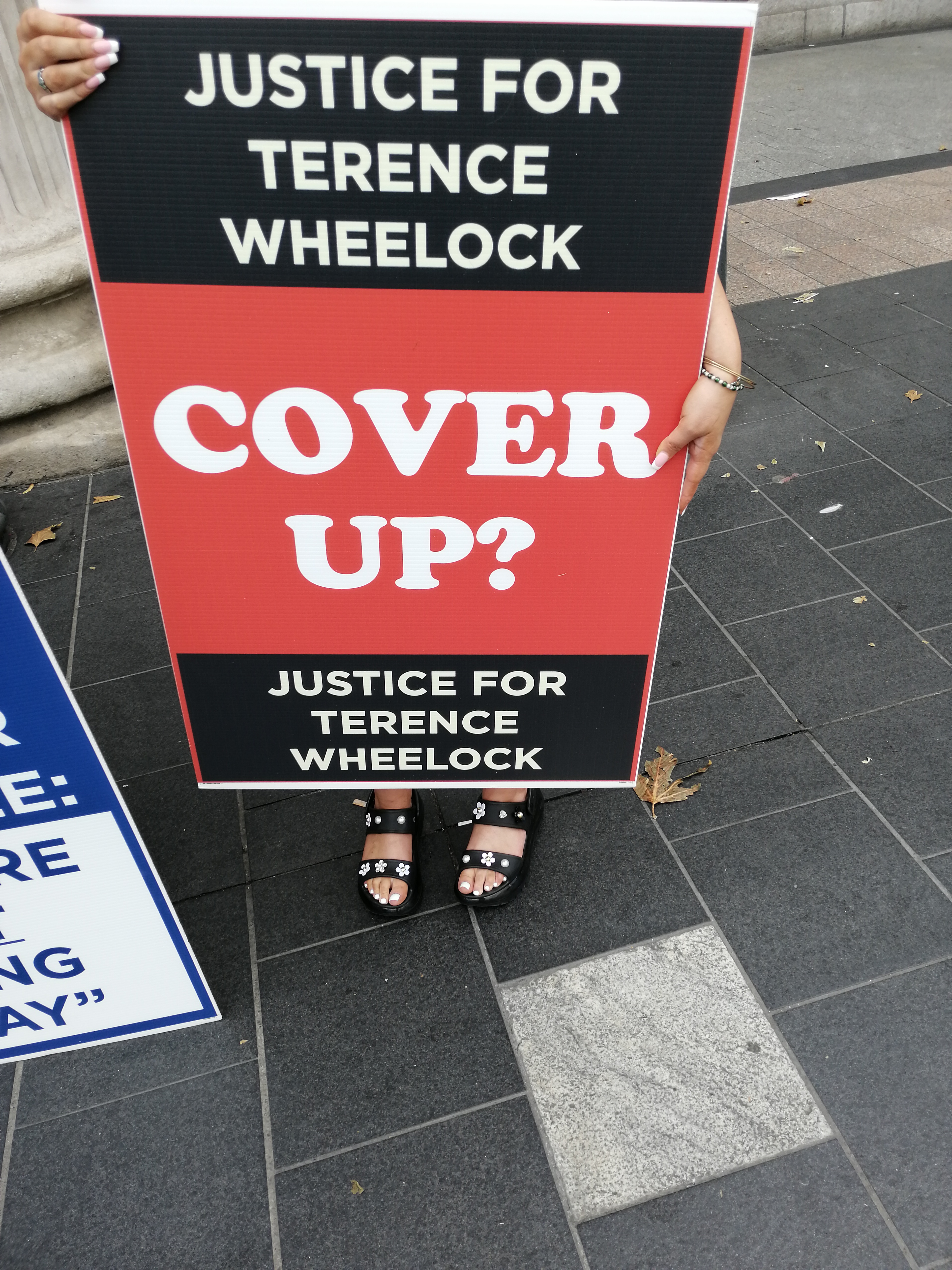
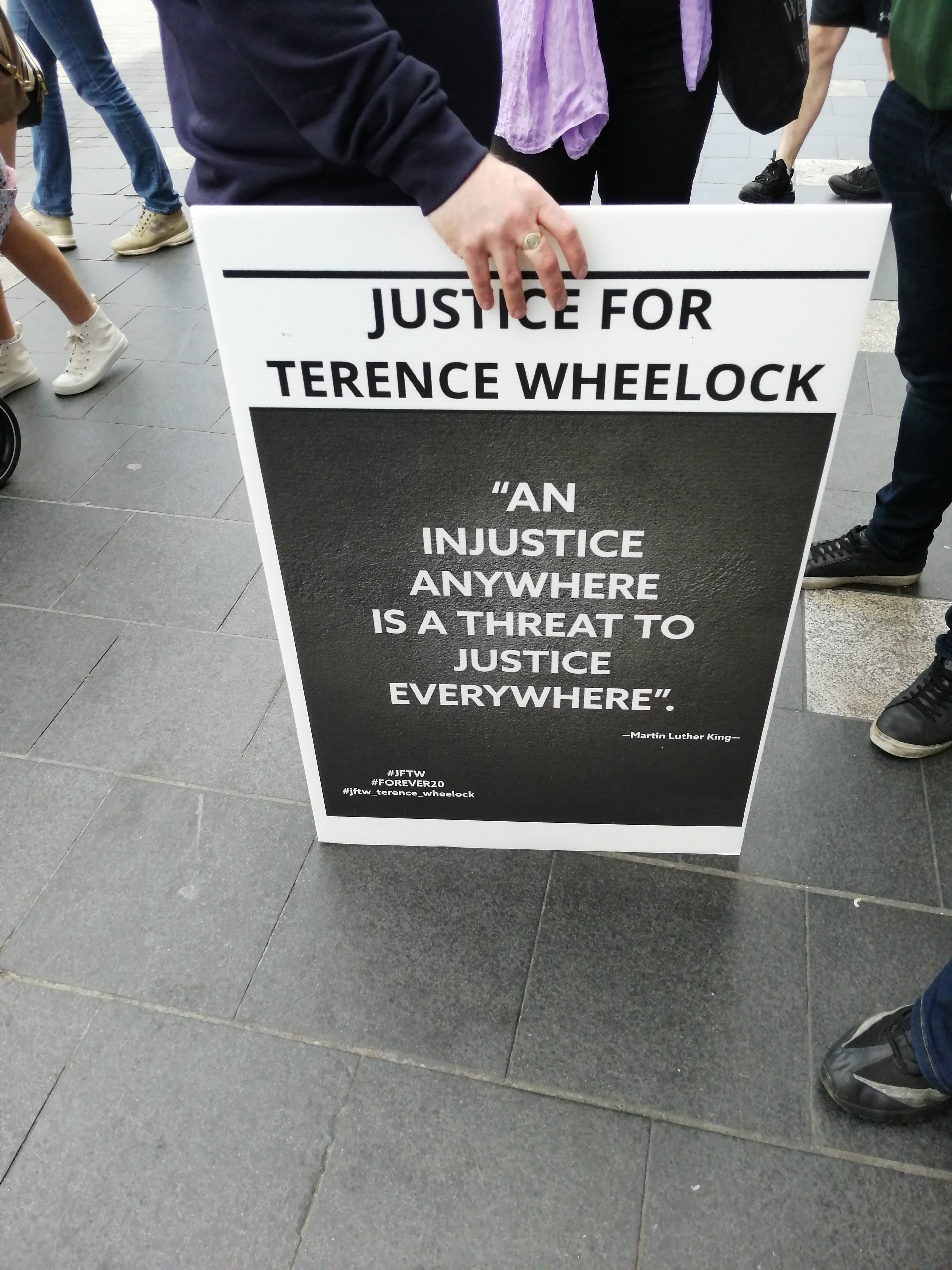
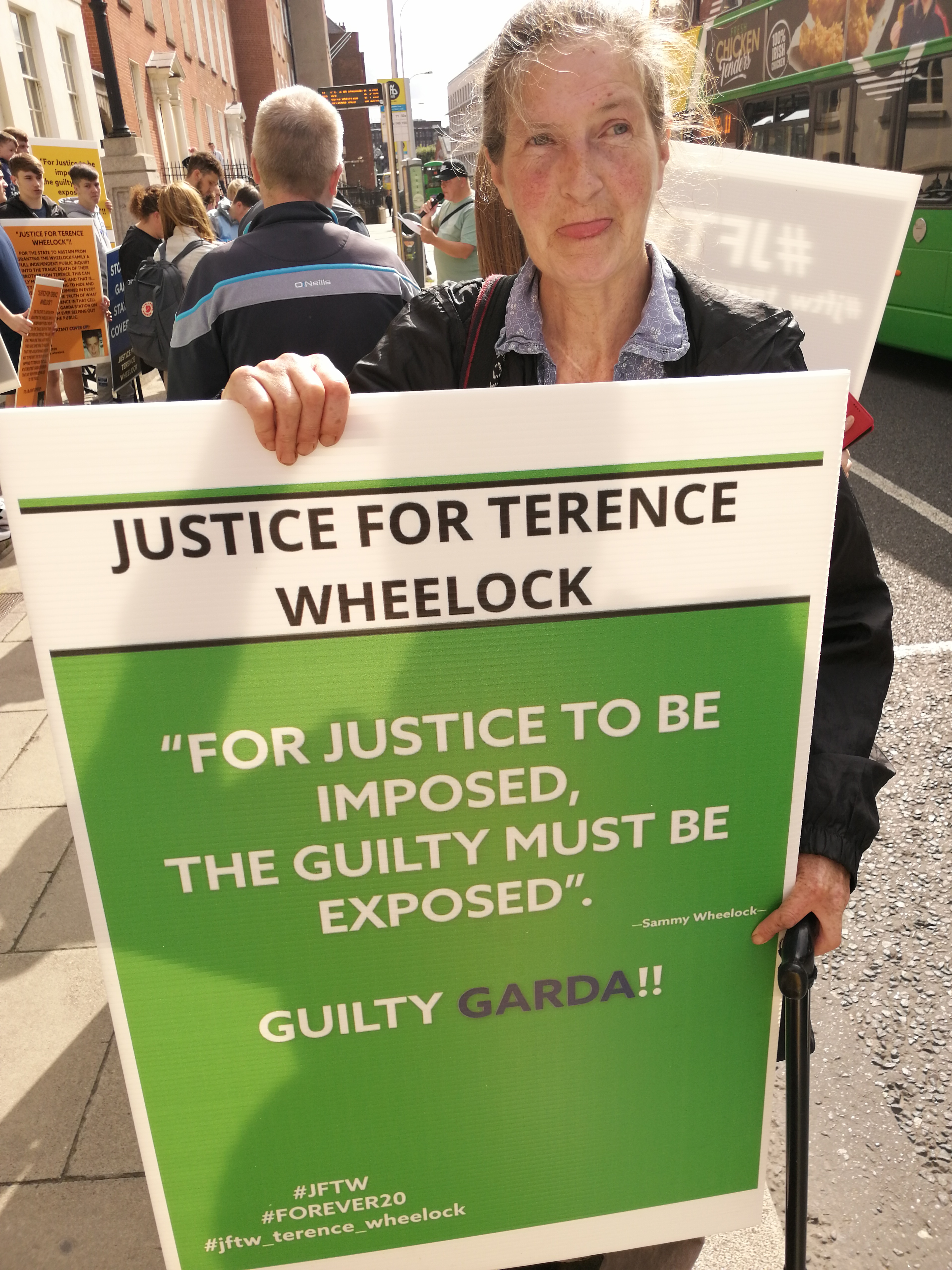
People gathering outside the GPO for the rally and march (Photo: D.Breatnach)Supporter of the campaign holds a placard (Photo: D. Breatnach)(Photo: D.Breatnach)
The cause of the coma? A severe beating. Not that it should be relevant but he had nothing to do with the car stealing and has been officially cleared of involvement. On the day of his arrest, Terrence was on his way to buy a paintbrush to decorate his room and stopped to talk to some youths he knew.
Though this occurred 18 years ago the family has not ceased seeking acknowledgement of the Garda crimes and are now insisting on an independent official enquiry.
(Photo: D.Breatnach)
MARCH THROUGH CITY CENTRE & THREE RALLIES
Wheelock family supporters, including people from Terence’s north inner city area, socialists, socialist republicans, anarchists and independent activists gathered at the advertised rally point outside the iconic building of the General Post Office on Dublin city centre’s main street.
James O’Toole of Rebel Telly briefly addressed the march supporters outside the GPO before the march set off, speaking about antisocial behaviour in the city and its connection to deprivation of working class areas, a fact admitted by the Gardaí in a report, a copy of which he held aloft.
James O’Toole addressing the rally outside the GPO (Photo: D.Breatnach)
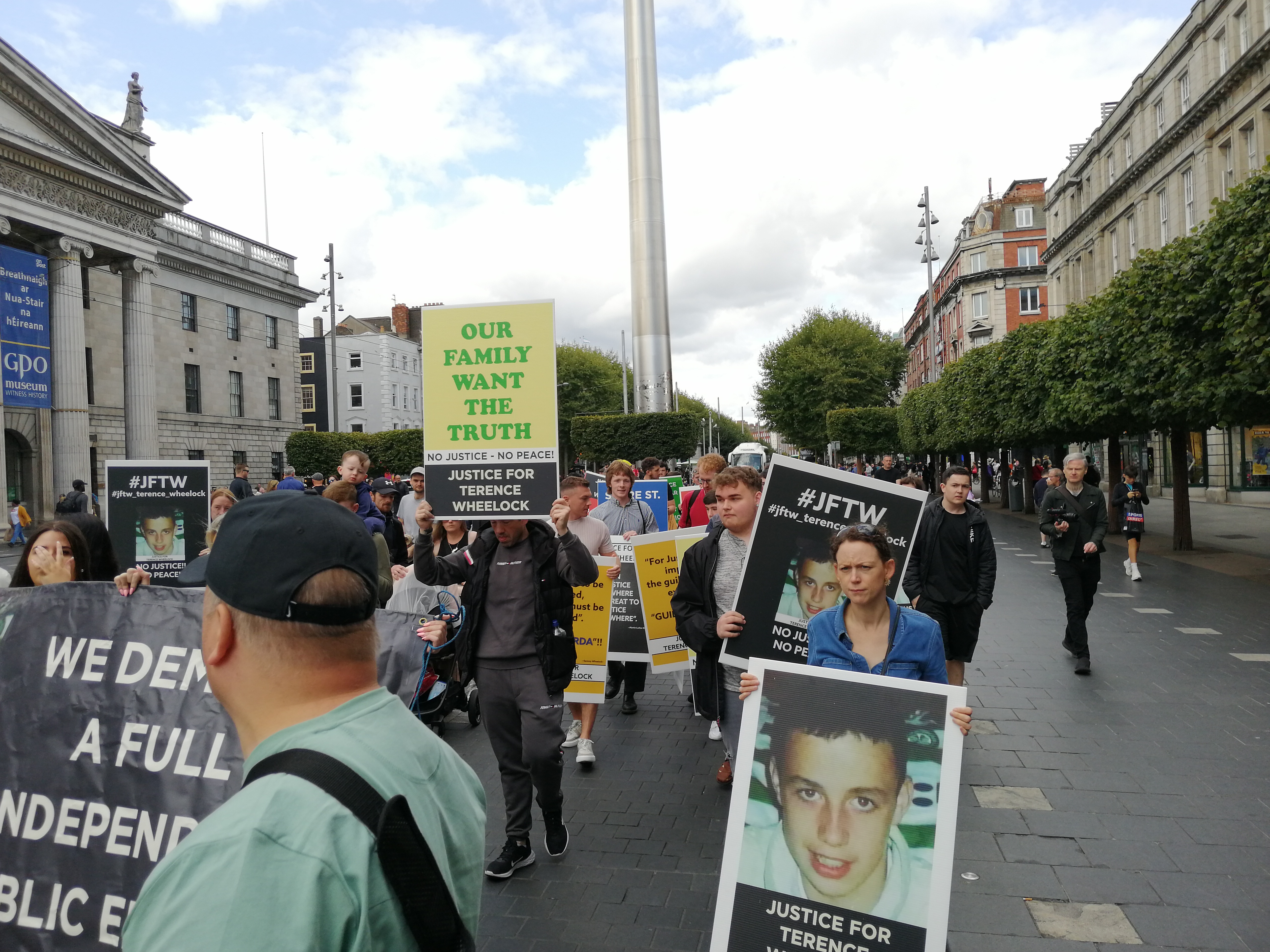
Large printed placards were provided with a variety of texts – one also carrying Terence’s image – and most participants carried one for a group photo and again as they crossed O’Connell Street to march southwards to Leinster House, seat of the Irish Parliament.
Many tourists and shoppers watched with interest, read the placards and listened to the chants of call and reply led by Sammy Wheelock, older brother of Terence: “Say his name!” “Terence Wheelock!” “For justice to be imposed, the guilty must be exposed!” “Guilty:” “Garda!”
“What do we want?” “Justice!” “When do we want it?” “Now!” “No justice!” “No peace!” “Say his name!” “Terence Wheelock!” The driver of an occasional passing car or taxi blew its horn in solidarity as the march crossed O’Connell Bridge and swung around Trinity College.
The march after leaving the GPO (Photo: D.Breatnach)
Outside Leinster House the marchers stopped for a second rally which was addressed by Sammy Wheelock and the slogans were repeated there too. Senator Marie Sherlock addressed the crowd also, promising her support for the campaign.
Cllr Madeleine Johansson, one of a group who recently fought a successful holding action against a mass eviction at Tathony House, also spoke at the rally outside the Dept. of Justice and quoted James Connolly as having stated that ‘an injury to one is an injury to all’.
Sammy Wheelock then led the crowd on again chanting slogans in a march up Kildare Street, left at the Shelbourne Hotel and right again, along the buildings facing Stephens Green to the Department of Justice building, where another rally took place.
Supporters of the campaign being addressed by Sammy Wheelock in front of Leinster House. (Photo: D.Breatnach)
GARDA HARASSMENT OF THE FAMILY
Larry Wheelock, another brother of Terence’s, had been the driver of the campaign but died in January last year. Outside the Department of Justice building Sammy read a letter from his widowed mother Esther, who felt unable in recent years to attend the protests.
“When this whole ordeal first happened it left a hole in my heart so big that for me it’s like a window … or a door that won’t close because as his mother I refuse to let it go, our family refuses … my son was stolen from me at such a young age …” Mrs. Wheelock had written.
(Photo: D.Breatnach)
For a long time during the campaign for justice, as Sammy told the rally outside the Dept. of Justice Thursday afternoon, the Gardaí harassed the family home by passing at night in vehicles blowing their horns and riding police horses on to the road outside their house.
In addition the Gardaí also stood in the family’s garden and shone lights on to the windows, raided the house and struck their pregnant sister in the stomach, knocking her to the ground, also stopping and searching Trevor’s brothers in the street.
The Gardaí also drove slowly in their vehicles past Trevor’s younger siblings, laughing as they made ‘hanging’ gestures at them through the windows. Despite the harassment and intimidation of the family, they “are not going away”, Sammy said.
Garda vehicles and personnel present while rally held outside the Dept. of Justice (Photo: D.Breatnach)
The initial ‘independent’ Garda investigation into Terence’s death, Sammy told his listeners, was headed by an officer who had spent 15 years of his career stationed at Store Street Garda station and it was no great surprise that he found that Gardaí had committed no wrong in the case.
Due to Terence’s case being in the public eye in 2006 when the Garda Síochána Ombudsman Commission (GSOC) was set up, it was the first case to be examined by them, Sammy Wheelock told the rally but once again the Gardaí were exonerated.
The Wheelock family believe such investigations, Sammy told the rally, are a case of “friends investigating friends”.
Announcing he was going to deliver a letter to Minister for Justice McEntee, Terence’s brother read its content out to the participants before mounting the steps to deliver the letter by hand to the Department of Justice, stepping inside for a period.
Sammy Wheelock delivering letter addressed to Minister for Justice McEntee to the Dept. of Justice (Photo: D.Breatnach)
Shortly thereafter, Sammy Wheelock once again thanked the participants for their solidarity on that day and in the past and assured them that the campaign for an independent public enquiry would continue.
(Photo: D.Breatnach)
DEATHS IN GARDA CUSTODY
There were 34 fatal incidents in 2001 in which people died either in or shortly after Garda custody, official figures show; this represents almost three per month. The statistics also reveal a steady increase in such deaths over the years.
The Garda Síochána Ombudsman Commission (GSOC) compiles a database of what are known as Section 102 referrals, which involve situations where the conduct of a member of the Gardaí may have resulted in the death of, or serious harm to, a person.
However, GSOC has not separated referrals for deaths from those of serious harm, meaning the number of people who have died in garda custody is not available.
Vicky Conway, Associate Professor at DCU School of Law and Government, who sadly died prematurely last year, attempted to compile the data on deaths in custody and expressed concern last year that this information is not readily available and broken down into categories.
Three youths from the area hold placards on the steps of the Dept. of Justice (Photo: D.Breatnach)
COMMENT:
The fatal treatment of Terence Wheelock by the Gardaí 18 years ago may or may not be an extreme case but the discriminatory treatment of working-class people is a pattern, of which violence often forms a part, followed by official collusion by ensuring impunity for the Gardaí.
The treatment of the family in their long campaign is a disgrace. It is said also that Terrence’s parents were told that he was in St. James’ hospital, which gave the Gardaí time to get to him first in the Mater and remove his clothes, which have never been produced for forensic tests.
It is of course of great importance to support campaigns to hold the repressive forces of the State to account, as pointed out by Conor Reddy (People Before Profit) to the rally at the Department of Justice building across from Stephens Green.
The message that revolutionaries give in such campaigns is of great importance in reflecting and strengthening the spirit of resistance of the working people, that it may serve them beyond overcoming individual injustices towards achieving justice for the class as a whole.
The reference at the rally outside the GPO by O’Toole to antisocial behaviour in the city, though a live subject at the moment, was inappropriate for the occasion since it could be understood to indicate that Terence had been engaged in such when he was arrested, which was not the case.
Conor Reddy addressing rally outside the Dept. of Justice (Photo: D.Breatnach)
Marie Sherlock, a Labour Party Senator, addressing the rally outside Leinster House, of course put forward the liberal positions of “Garda accountability” and the equivalent of the “few rotten apples in the barrel” analysis of the police force of the Irish State.
While the support of a senator in Leinster House is to be welcomed, revolutionaries have to ensure that social democrats are not permitted to steer campaigns towards unhealthy compromise and that the liberals’ view of the State is countered by the more realistic revolutionary one.
The Gardaí were founded to be a first-line repressive force of the Gombeen Irish State, replacing the repressive police forces of the British occupation, the Dublin Metropolitan Police Force, the Royal Irish Constabulary, Black and Tans and Auxiliary Division.
Their second Commissioner appointed , Eoin Duffy, was the founder of the Blueshirt Nazis in 1932 and the force has amply demonstrated its anti-working class and anti-Irish Republican bias repeatedly since; if the “apple” analogy is to be used, we’d have to say that the orchard itself is rotten!
The death of a teenager is a devastating experience for any family but the importance of this case goes far beyond that of one family as was pointed out by a number of speakers and as is clear from some of the statistics quoted earlier.
(Photo: D.Breatnach)
Garda violence towards sections of the community followed by impunity cannot be tolerated and must be combatted. In that respect it is sad to note the low number of Irish Republicans in the campaign, though they tend to be the chief political target of Garda repression.
Donal O Ceallaigh walked free on Wednesday to congratulations of his supporters after four years under the threat of a ten-year jail sentence and/ or unlimited fine. He had been charged with “violent disorder” arising out events in February 2016.
The charging of antifascists with “violent disorder” was a first use by the State against political activists of this vicious piece of legislation with such a heavy penalty and for which the burden of proof seems very slight.
All that seems required is for the State to prove that a situation of violence occurred or was threatened in which the accused were present (minimum of three) and “that would cause a person of reasonable firmness present at that place to fear for his or another person’s safety.”1
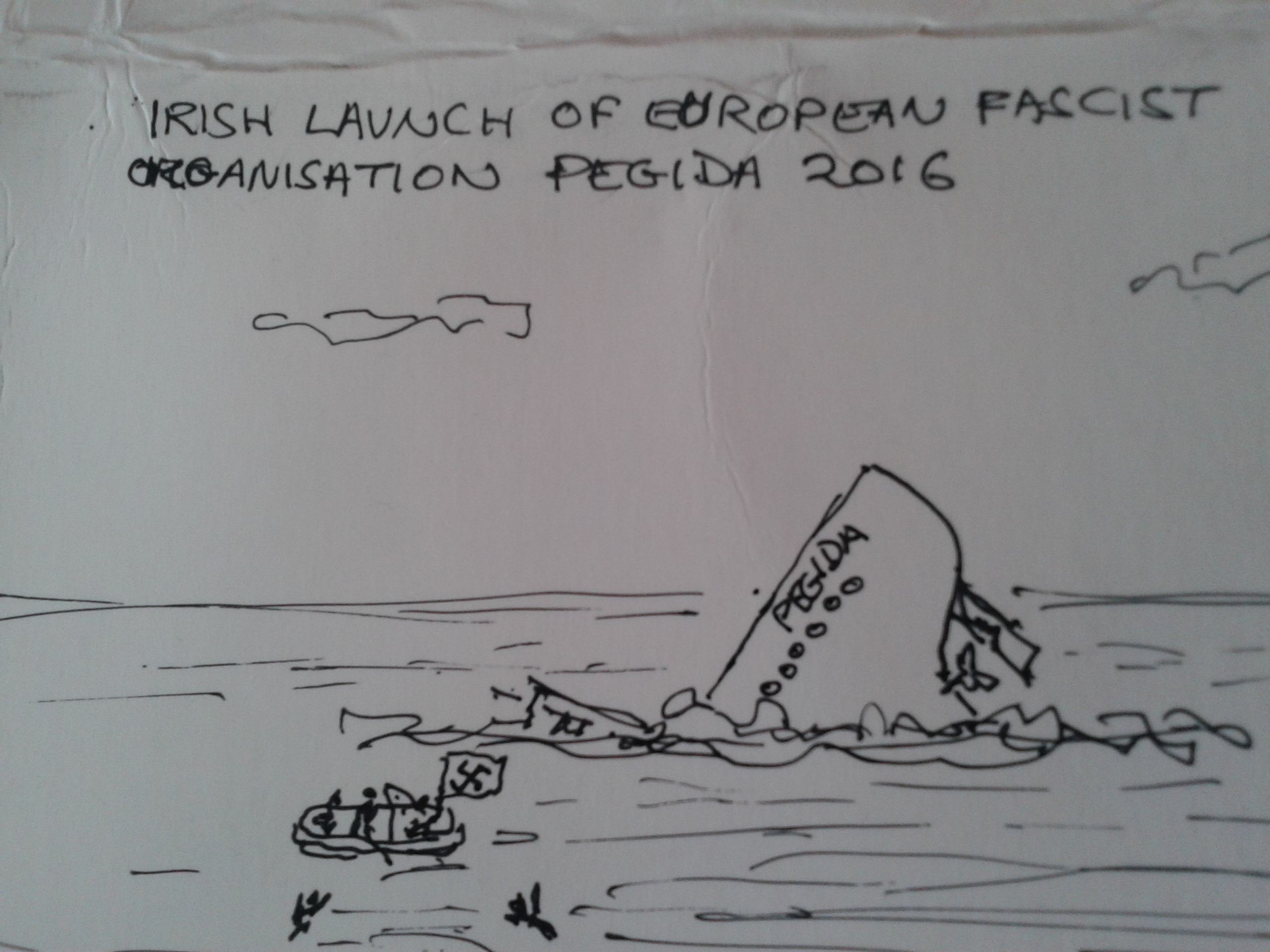
The background to the charges was the boast of fascist islamophobic organisation Pegida in 2016 that it would organise a public rally – and founding meeting – in every capital city in Europe and the rally they planned to take place outside the GPO on 6th February 2016.
In response, antifascists mobilised in Dublin with the intention of preventing Pegida’s launch.
IRELAND’S ANTIFASCIST RESPONSE
The mobilisation took a number of forms:
1) a large diverse group gathered outside the GPO, occupying the space well before the advertised time. A large proportion of these included religious and liberal organisations and individuals.
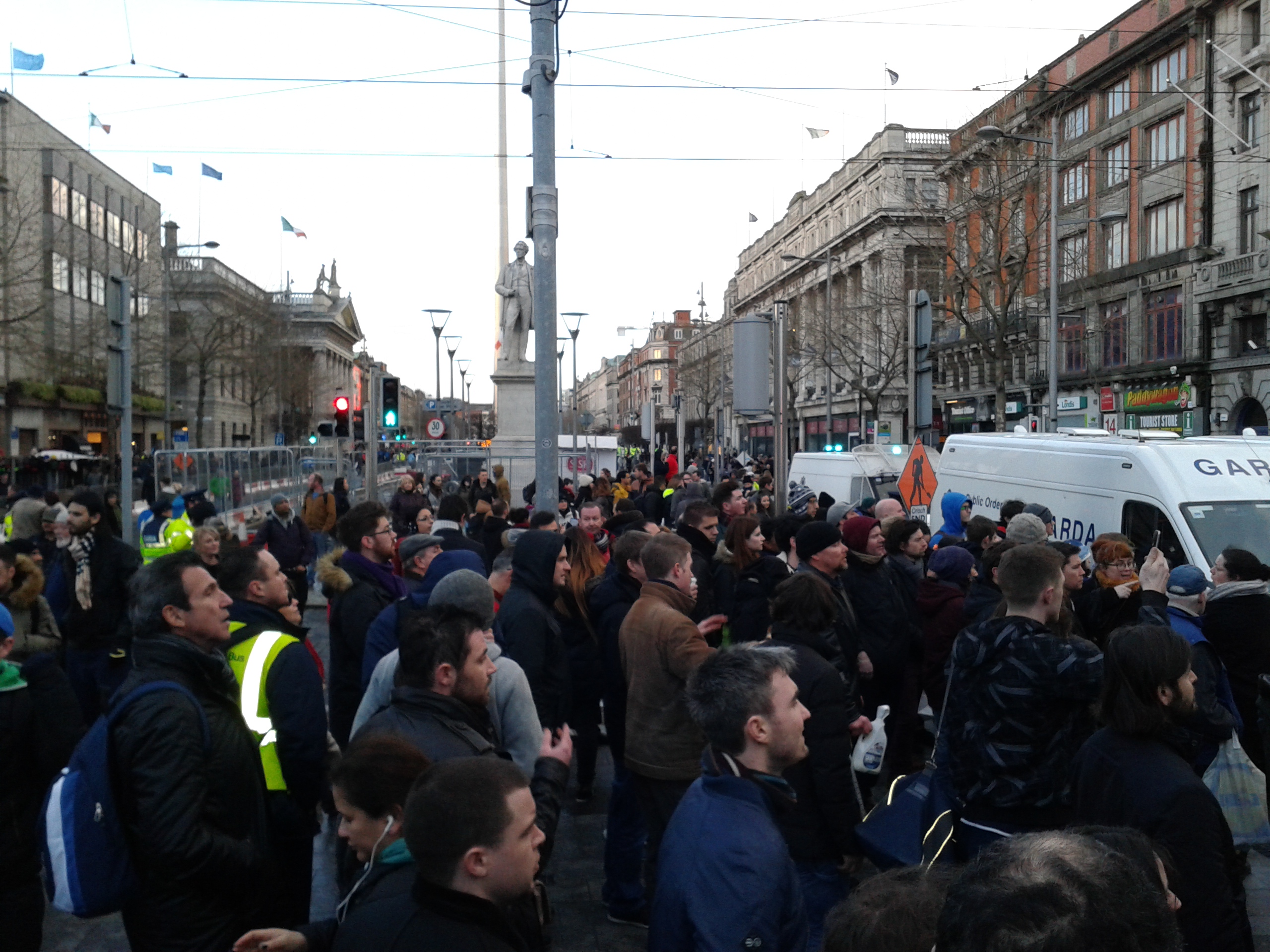
2) Another large group, of Republicans and Socialists of different organisations — and none — gathered in O’Connell Street, on the central pedestrian reservation and on the east side of the street.
3) Irish fascists arriving by Luas (tram system) were met on the tram itself by young antifascists.2
It appears that there were no confrontations between the GPO group and fascists which was fortunate, since some of the participants had publicly advocated non-violence and even encouraged bringing children to the event,3 no doubt in order to emphasise their pacifist nature.
The handful of known fascists of Irish background, whose intended movements were known in advance, apparently noticed or guessed the sympathies of some of the antifascist youth travelling in the Luas, addressed some unkind words to them and violence quickly resulted4.
The fascists concerned apparently abandoned their plan to attend the rally and some reportedly felt the necessity to attend A&E department in hospital instead.
There is no doubt that the longest-running conflict with the most people involved on both sides occurred around the east side of O’Connell Street and streets running off it, in particular North Earl Street and Cathedral Street.
The fascists who were involved there appeared to be all of East European origin. It seemed that they had not been spotted until some of them began to insult some women and when filmed, to make a negative comment along the lines of “your f..king communist filming”.
Once having identified themselves, a crowd of antifascists gathered around them and the situation developed quickly. The fascists were soon running, in the course of which one ran into a Euro-shop in North Earl Street with a number of anti-fascists behind.5
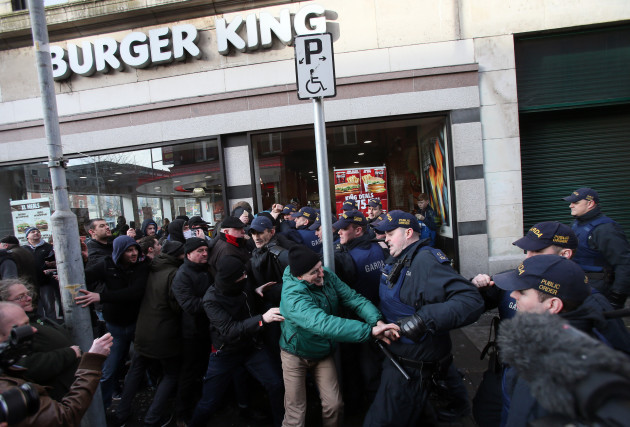
Some Gardaí lashed out with batons at people leaving the shop (which could clearly be seen on the police compilation of video footage shown in court), including an RTÉ cameraman.6
At least three of those fascists ran eastward down Talbot Street, which is a continuation of the short North Earl Street; two large white police vans appeared at the intersection with Marlsborough Street and the “robocops”, the Public Order Unit emerged.
The POU deployed with dogs in North Earl Street, clearing it and menacing both antifascists and shoppers.7
Shortly afterwards, word spread among the antifascists that some of the fascists were in a pub in the parallel Cathedral Street and had exchanged words with some antifascists who also happened to be in there;8 a crowd of antifascists flocked to the area concerned.
This area saw one of the sharpest confrontation between the Garda Public Order Unit and antifascists, with the former lashing out with drawn batons on largely unprotected hands and heads.
The Gardaí rescued the fascists from the pub and loaded them into one of their vans before driving off. A decoy Garda van was blocked in O’Connel Street by protestors and interested youth for a period but the fascists were spirited away to safety in another van.
Pegida had been prevented from holding their rally so the antifascists emerged victorious. The State actors sat down to decide how they would respond in the aftermath.
THE IRISH STATE SHARPENS ITS KNIVES
The first to be targeted by arrests were the antifascists in the confrontation on the LUAS tram. Visible in recordings of the CCTV camera which had remained uncovered throughout, they were identified, charged, convicted and heavily fined — as a deterrent, the judge made clear.
Next the Gardaí set about identifying antifascists active in the North Earl Street conflict and selected two Republicans from different organisations which, along with an independent antifascist from the pub in Cathedral Street, they charged with the serious offence of “violent disorder”.
This led to alarm in antifascist circles since, as outlined earlier the potential penalties with this charge are very high and it had never been used by the State before with regards to a situation of a political nature – in fact, it had hardly been used at all.
Two years after the events, one week to the day after he had been found “not guilty” on another political charge, Donal Ó Ceallaigh was charged with “violent disorder” in connection with the anti-Pegida protest too.
Through the intervening months and years, two of those charged with “violent disorder” separately agreed a deal to plead “guilty” to a lesser charge and avoid the danger of a ten-year sentence and this week at the commencement of the remaining two’s trial, another one did so.
Ó Ceallaigh then remained the only one of the original four on trial for “violent disorder”. His trial began on Monday 24th in Criminal Court No.7,9 six years after the events and four years after he was charged, with some supporters and his wife present in the public area.
TRIAL OF O’CEALLAIGH
Shortly after Ó Ceallaigh’s trial commenced, his defence counsel, Brian Gageby BL engaged by Sheehan & Partners, asked for a discussion in court in the absence of the jury and took the State’s witnesses through their process of protecting the chain of video evidence and identification of Ó Ceallaigh himself.
A compilation of six video clips was shown from: (1) the Euro Shop CCTV, (2) Garda cameras, the (1) TV cameraman’s footage (obtained by warrant) and (1) video taken by the shop’s security guard on his phone.
It emerged that 500 Gardaí have viewed the footage on an internal Garda system without identifying anyone on it.
The Garda officer responsible for ensuring identification then gave a convoluted account of how he had ended up going through associates of another activist to contacting another officer who had arrested Ó Ceallaigh in relation to water protests, who obligingly identified the activist.
That Garda said that he knew the defendant from a previous arrest and that it was he in a number of the videos, wearing a green hooded jacket and red scarf around his neck and that he has a tattoo there,10although only a very small portion of the man’s face is visible.
Another Garda who oversaw the identification claimed to have made his own statement a long time afterwards from memory alone but somehow included the exact times, in minutes and seconds on the video where the other’s statement had identified Ó Ceallaigh!
Defence counsel put it to him he could only have that precision from having written his statement to coincide with the other Garda’s, which he denied having done — of course that would have looked very much like conspiring to, as they say, “fit up” the defendant with regards to identification!
As Tuesday’s jury-less court session drew to a close, Defence counsel made two submissions to the Judge objecting to the challenged video identification evidence going to the jury, which Prosecution counsel defended and the judge retired to consider the arguments.
At resumption of the trial on Wednesday morning, the Judge announced her decision not to permit the challenged video evidence to go before the jury and the Prosecution counsel admitted that without that, effectively they had no evidence to place the activist at the scene.
The jury was then called in and the Judge directed them to return a verdict of “Not guilty”. Ó Ceallaigh was free to go and receive the embrace of his wife and congratulations of his supporters (and from some interested members of the public).
Though appearing glad he seemed to take it all quite calmly but admitted to the author that it had been “a bit of a strain”.
SUMMARY
As a result of the mobilisation and struggles on the day, Pegida was prevented from launching in Ireland, perhaps the only European country in which they failed to do so. This would have been important in any case but became especially so with the struggles around Covid to come.
The State had failed to protect the fascists’ “right” to hold their founding rally in Ireland and no doubt the Gardaí felt humiliated. They determined to recover ground and the State made a political decision of charging demonstrators with a very serious charge: “violent disorder”.
In that, the State hoped to establish a legal precedent with a view to its use against demonstrators in other situations in future. It did in fact establish the precedent in using the charge (and without an outcry from liberals and social democrats).
The State may have felt enough was gained for the moment in offering to accept a “guilty” plea to a lesser charge but when Ó Ceallaigh declined to accept the deal, they tried for a conviction, which would have given them the precedent they originally sought – but they failed.
However, many antifascist activists were punished and according to information received, 15,000 Euro in punitive fines was collected, not to speak of the worry and years spent in the shadow of the hanging sword.
Antifascists have hopefully learned the importance of going masked in similar situations and awareness of the role of CCTV cameras which are ubiquitous in the Dublin city area. The charge of “violent disorder” remains as a threat and punishment for demonstrators in future11.
The wording of the charge ensures that no actual violence need be used and the “fear” surrounding a situation remains open to subjective interpretation and even manipulation of witnesses by police.
The RTÉ’s camera footage – ironically in view of the fact of his assault by a Garda – was obtained by warrant which raises issues of concern with regard to press freedom and safety. If verified media’s film is to be used by the State, how then is the media to claim independence?
And if demonstrators know or believe that media footage of them is likely to be used by the State, are they likely to tolerate the presence of such camera operators? Will we not all be the poorer if the media cannot produce film and photos of events of a similar nature?
This is surely an issue on which the press, along with the respective trade unions should take a stand, if they truly believe in their independence and freedom and think it worth defending.
While there is no current evidence of a resurgent attempt to found Pegida in Ireland,12 a number of small fascist organisations have been founded in recent years, including Identity Ireland, the National Party, Irish Freedom Party and Síol na hÉireann.
History has shown that when the ruling capitalist class is in crisis, it suits it to use fascists as part of the repression of the people’s resistance struggles. Certainly there is something of a crisis in the capitalist system world-wide at the moment and repression is very much on the agenda.
Pegida does exist in Europe and as late as the 22nd, the Saturday before the trial in Dublin, planned to publicly burn the Koran in Rotterdam, Holland,13 to which the State there responded by arresting their leader and accusing Pegida of disseminating “hate speech”.14
End.
FOOTNOTES
1 The 1994 Public Order Act (see Sources) and this section at least uses even the same wording as the 1986 Public Order Act of the UK (see Sources).
2 That group was of Identity Ireland, led by Peter O’Loughlin, a long-time Irish fascist who apparently planned to be chairman of the Irish branch of Pegida. According to recollections of antifascists to the author, there were also much smaller groups of anti-fascists roaming the south city centre attempting to coordinate and collate information while searching for groups of fascists.
3 Pacifism in the face of potential fascist violence seems dangerously stupid to me but that pales into insignificance when compared to the criminal irresponsibility of putting children in danger of such attack.
4 This was one of the areas which the Gardaí used to bring charges against anti-fascists and footage from the LUAS CCTV was used against individuals. The antifascists involved seem to have been from Dublin soccer club supporters’ associations and those identified were fined within a relatively short period of time.
5 This site was one of those used by the Gardaí to charge a number of antifascists and footage from the security CCTV were used in evidence against the latter.
6 The management of the TV channel complained as did the cameraman. Quite some time later the Garda in question was found guilty of assault and, despite the viciousness of the assault on a clearly unthreatening person and his lack of remorse, was given a suspended sentence but remained in the police force without facing a disciplinary hearing.
7 “I was coming back from reconnoitring around the Connolly Monument in Beresford Place, in case fascists had gathered there. Cycling westward along Talbot St. I saw three young men running west; they appeared East European to me and had hair cropped very short. I assumed they were fascists but there appeared to be no-one in pursuit and three was too many for me so I passed them and at North Earl St. junction found a large crowd with Public Order Unit with barking dogs and batons drawn preventing people from entering the area. The crowd was of mixed shoppers, passers-by and anti-fascist demonstrations.” (Recollection of antifascist to author.)
8 This site too became one to attract police charges against at least one antifascist.
9 On Tuesday it was moved to No.12 instead, right next door, coincidentally, to the Special Criminal Courtroom where a trial is currently underway. The SCC was from its inception a no-jury political court for decades but recently began to try some high-profile criminal trials.
10 He does in fact but you’d need x-ray vision to see it through a scarf! There had been a mass campaign against the proposed additional water charges and the belief that the public water supply system in the Irish state was about to be privatised. Protesting in the context that water charges were already being paid through two different public taxes, hundreds of thousands marched and smaller groups mobilised to disrupt the installation of water meters outside people’s houses (the locations of those unused meters may still be seen around Dublin city in particular). Most arrests took place in this latter part of the struggle, though a number of defendants fought a successful battle to prevent the State convicting them of “kidnapping” a Government Minister while protesting against her ministerial visit to a school in Jobstown. The additional taxation and privatisation plan was abandoned in 2015 – at least for the moment.
11 Note that there have been many situations of actual violence by fascists wielding clubs in Ireland in recent years in which the State chose not to charge any of the perpetrators with “violent disorder” and in fact only with great reluctance charged one individual, Michael Quinn of the National Party with assault after widely-circulated video evidence refuted Garda public statements that no violence had occurred.
12 According to Anti-Fascist Action Ireland from people viewing the fascist communication traffic, the Eastern European fascists who participated on the day denounced the Irish fascists of Identity Ireland as cowards and declared they would never work with them again.
13 Religious book of greatest importance to Muslims, equivalent to the Bible for Christian and the Talmud for Jews.





















 rebelbreeze