CALL FOR UNITY IN ACTION AT 1916 RISING COMMEMORATION

Clive Sulish

(Reading time: 3 mins.)

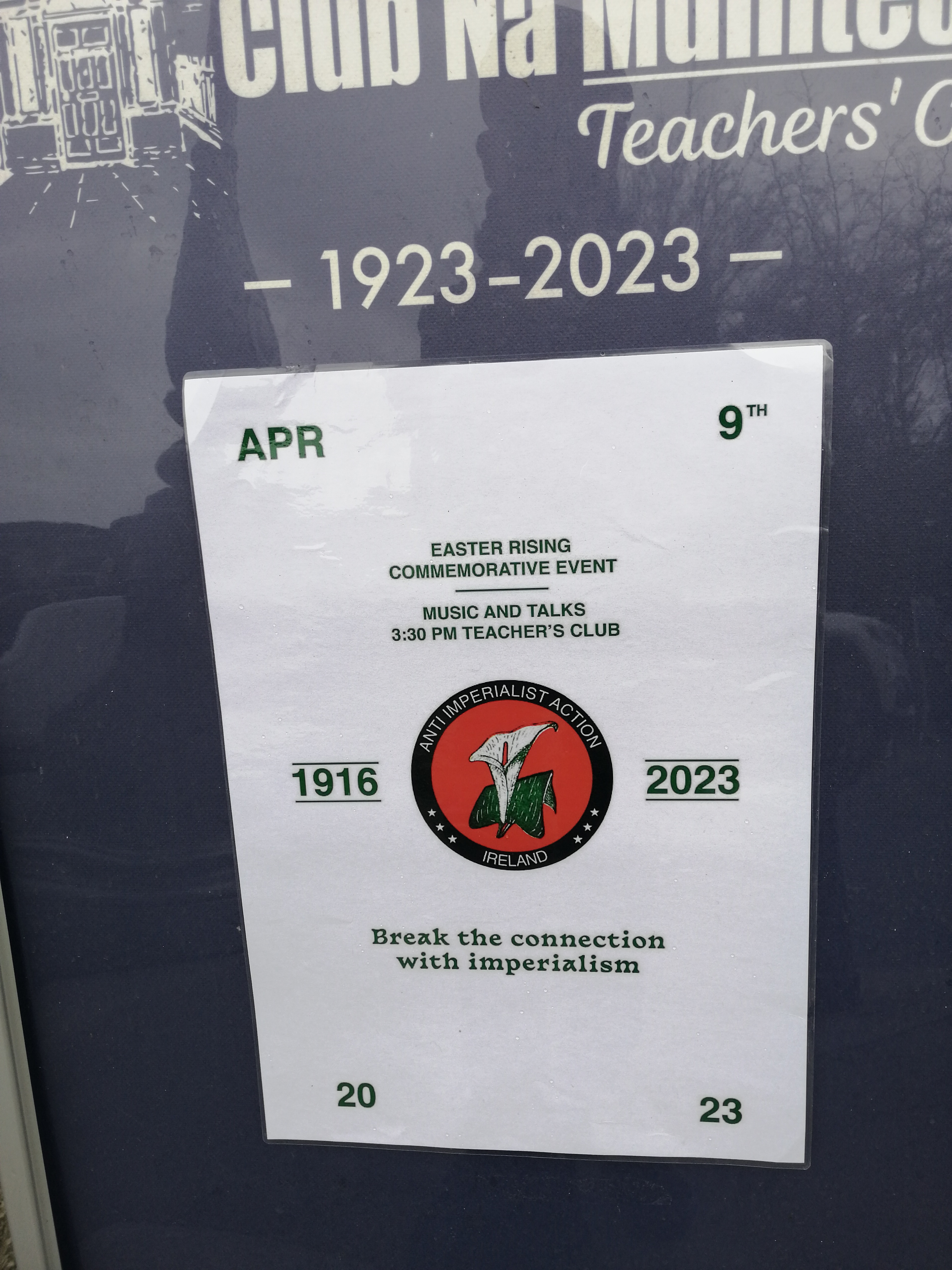
A call for unity of Irish Republicans in action to win Irish freedom and independence was made at a 1916 Rising commemoration in Dublin on Sunday, an event organised by the Anti-Imperialist Action Ireland organisation.
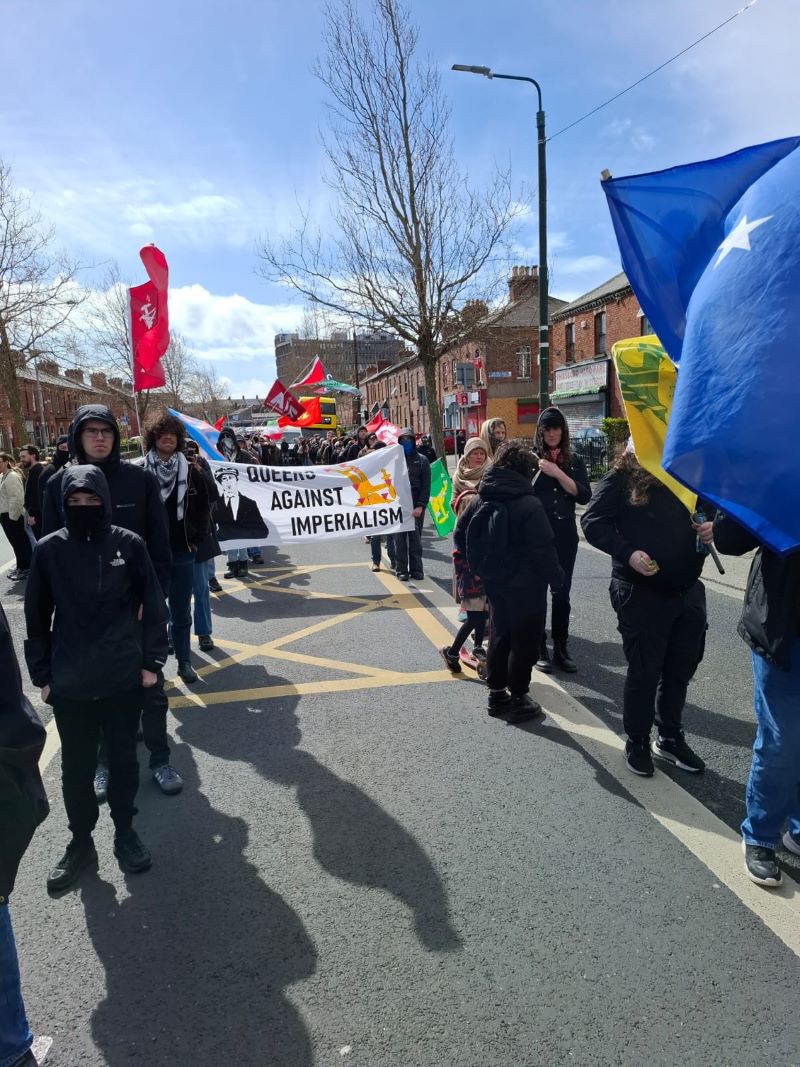
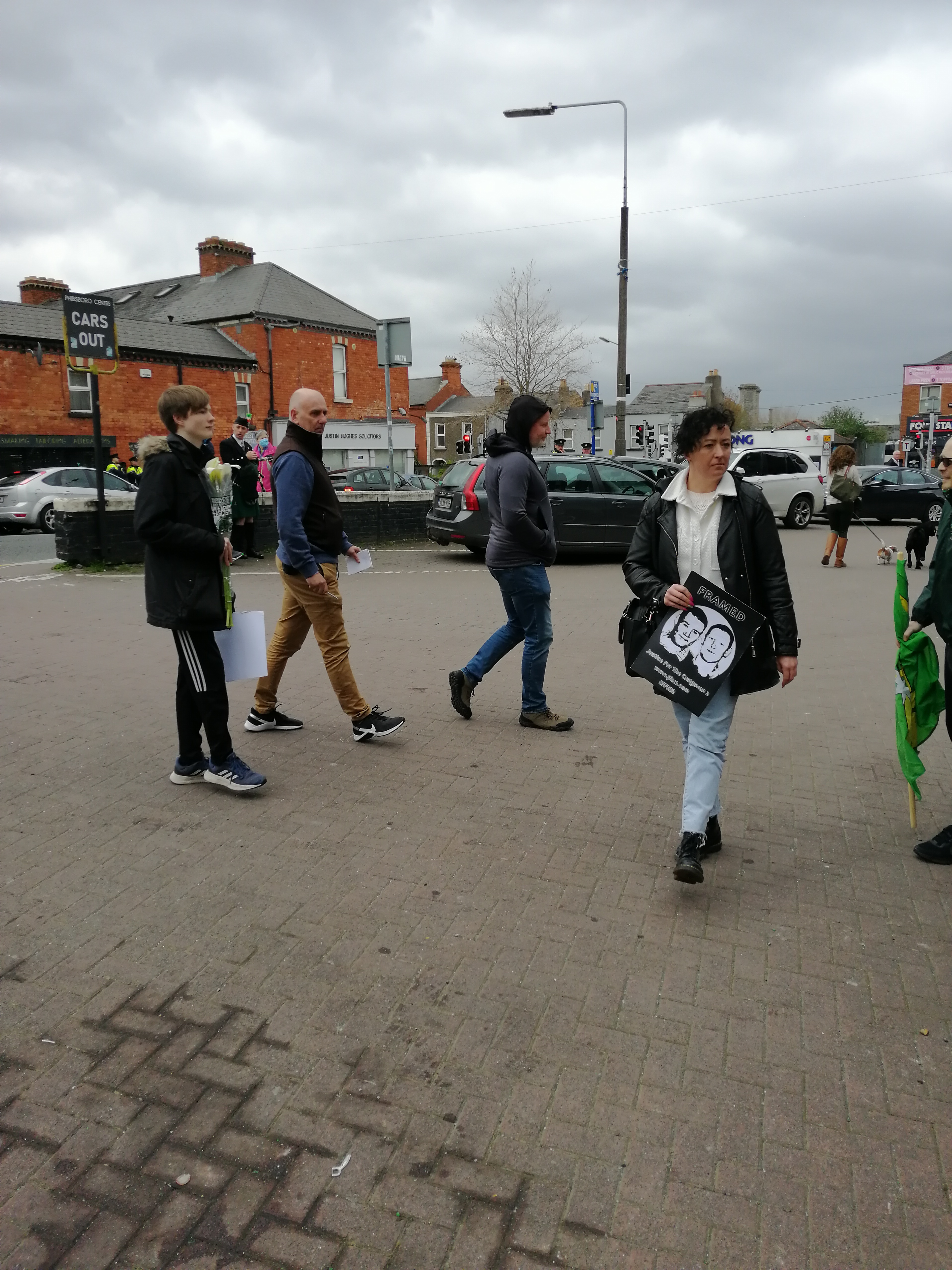
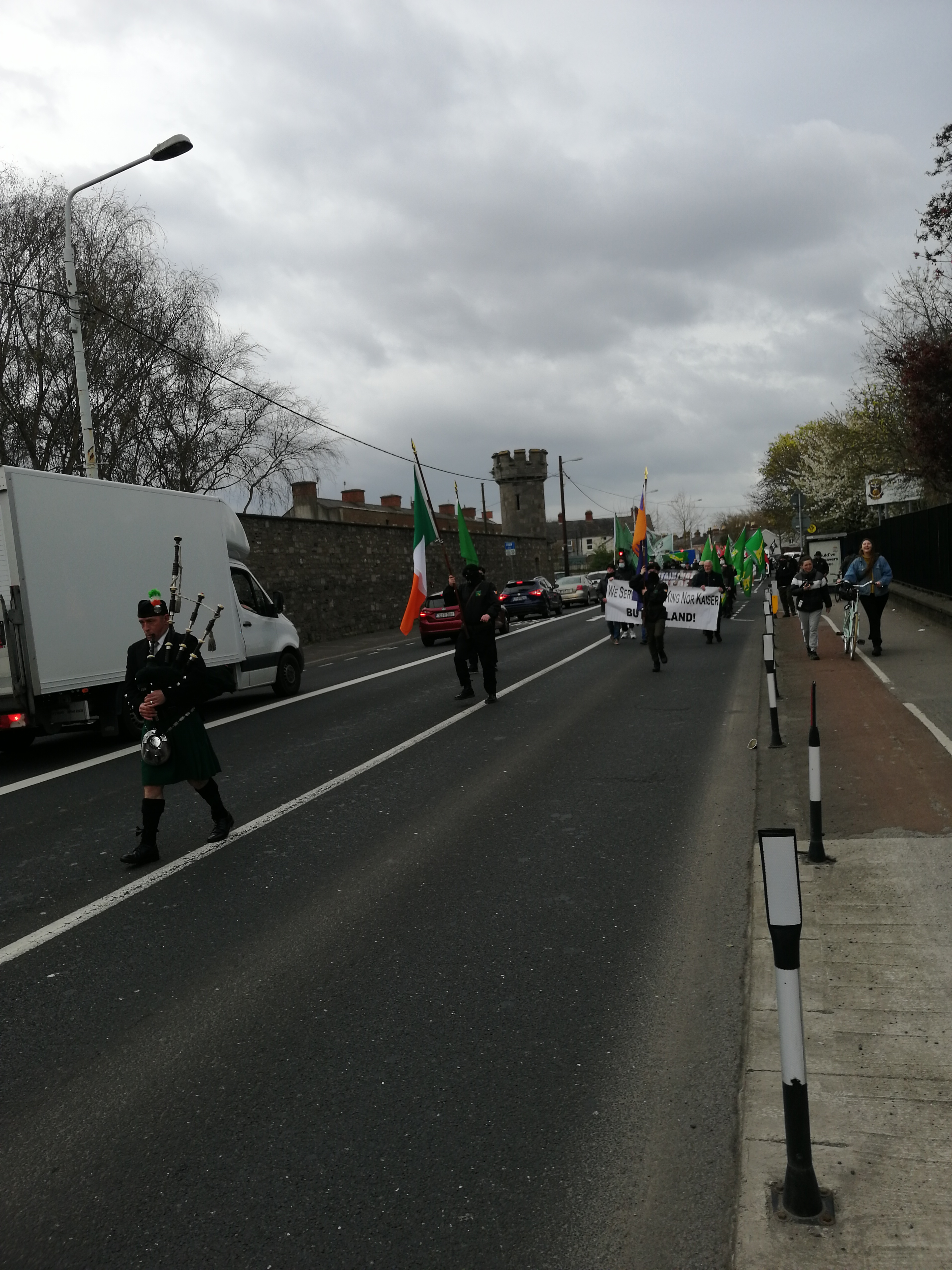
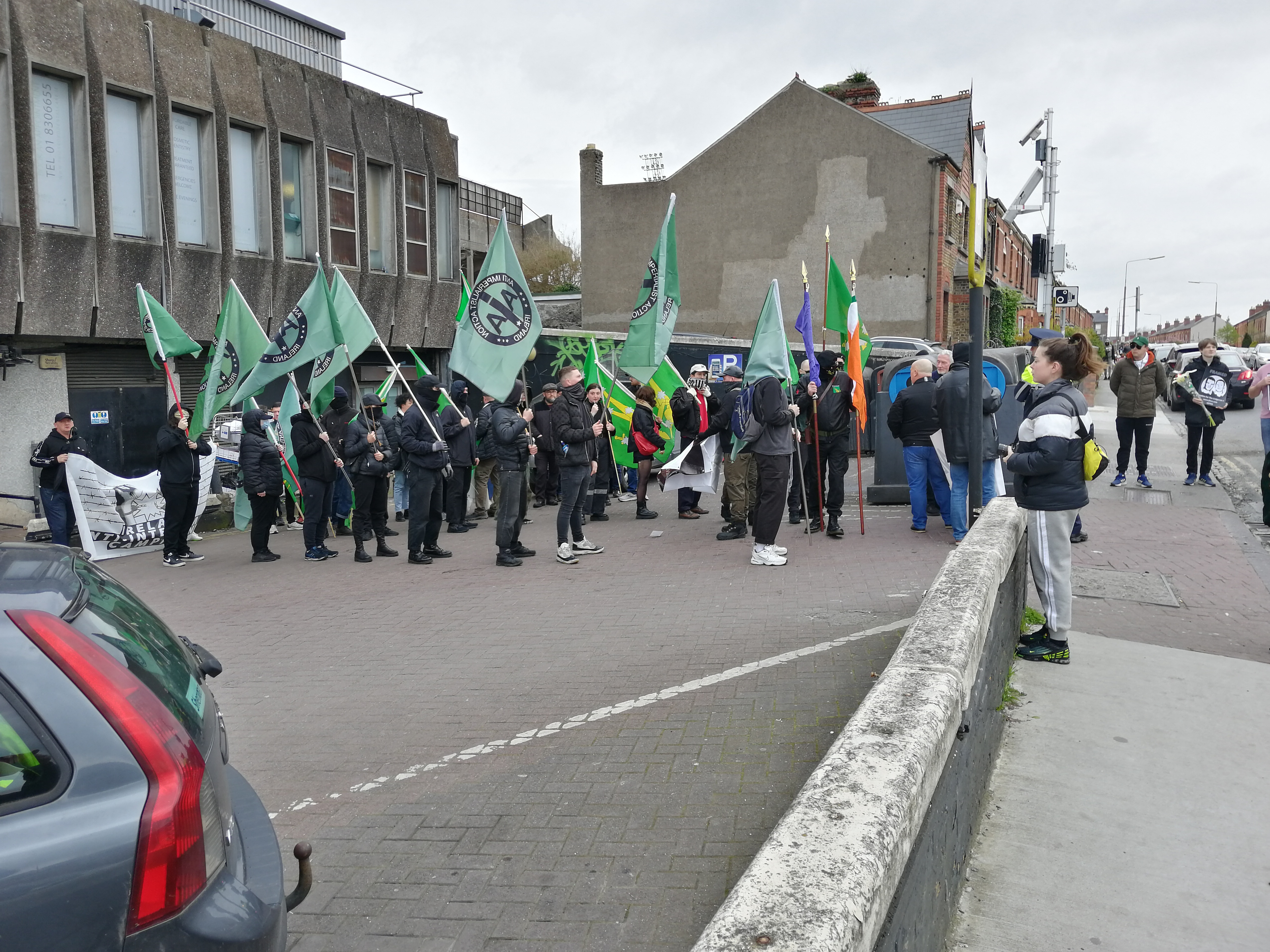
Section of the marchers looking back towards Phibsborough as they approach
Cross Guns Bridge from Phibsborough. (Photo: R.Breeze)

A relatively large number of people participated, including a number of delegations from organisations of struggle in the Spanish, Turkish, German and Italian states. Young people were particularly well represented.

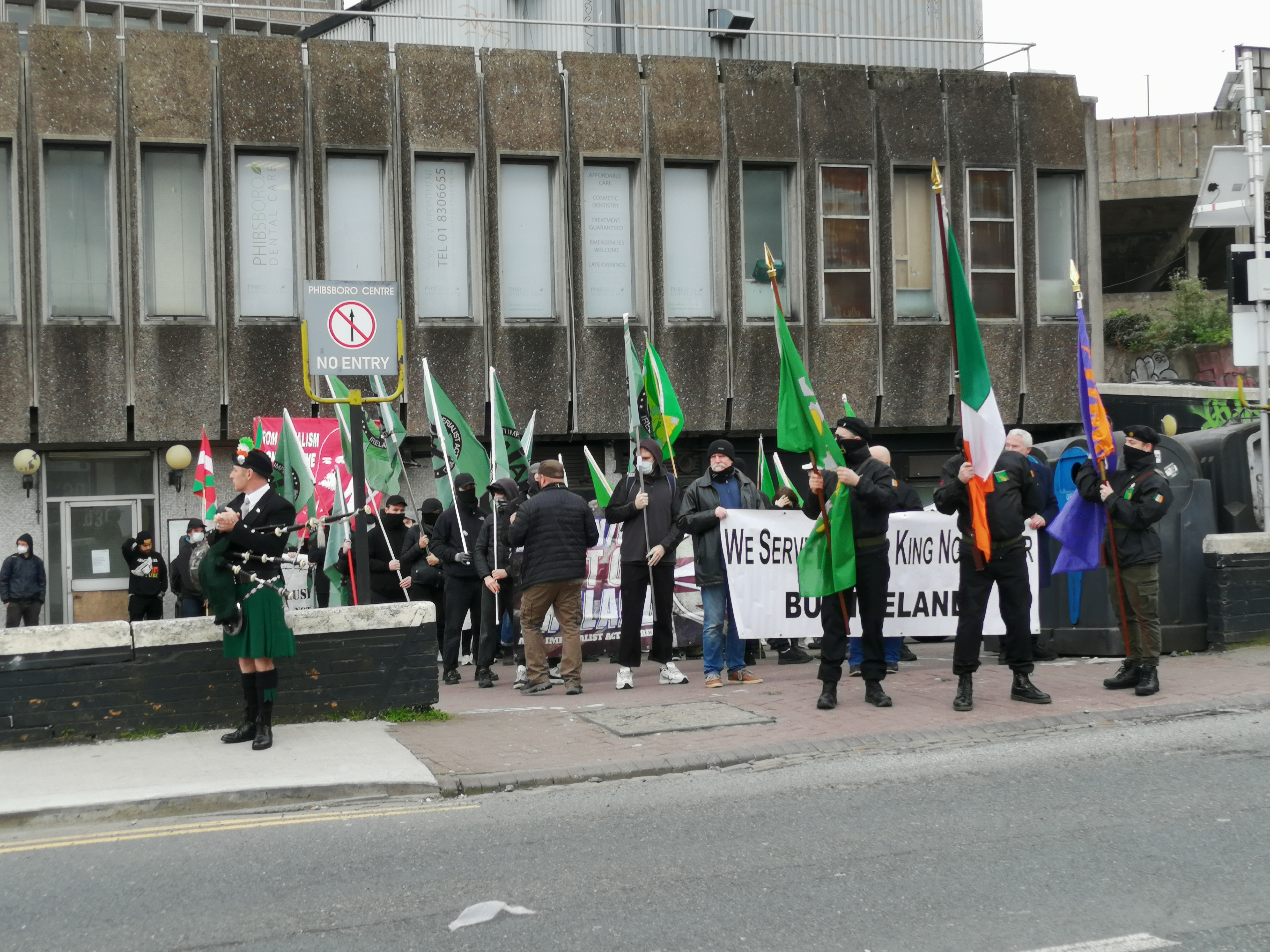
Participants met outside the Phibsborough shopping area on Dublin’s northside from which they were led by a lone piper, a colour party and a number of banners. Among them flew various flags of national and social struggle in Ireland, the Basque Country, Catalunya, Palestine, Turkey …
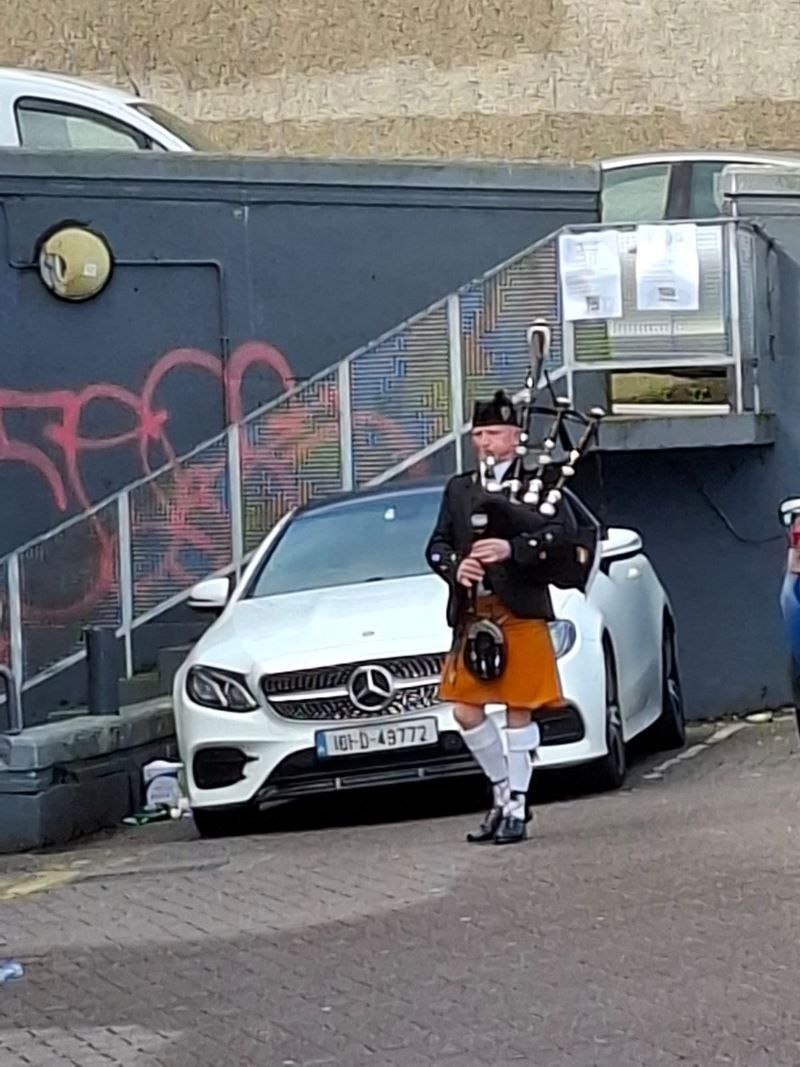
The lone piper in Phibsborough exercising his lungs and warming pipes and bag as he prepares to lead the procession towards Glasnevin. (Photo: R.Breeze)

The orders to the colour party, as is traditional, were all given in Irish.1 At Cross Guns Bridge, the march halted and, in what has become a tradition for the AIA, flares were lit in memory of the presence of Irish Volunteers there in 1916 and the murder of a civilian by British soldiers.

Proceeding along Finglas Road to the interest of passers-by and the odd ‘beep’ of solidarity from a passing vehicle, the march turned left outside the gates of the older Glasnevin Cemetery to cross over the railway pedestrian bridge to the St. Paul’s section of the Cemetery.
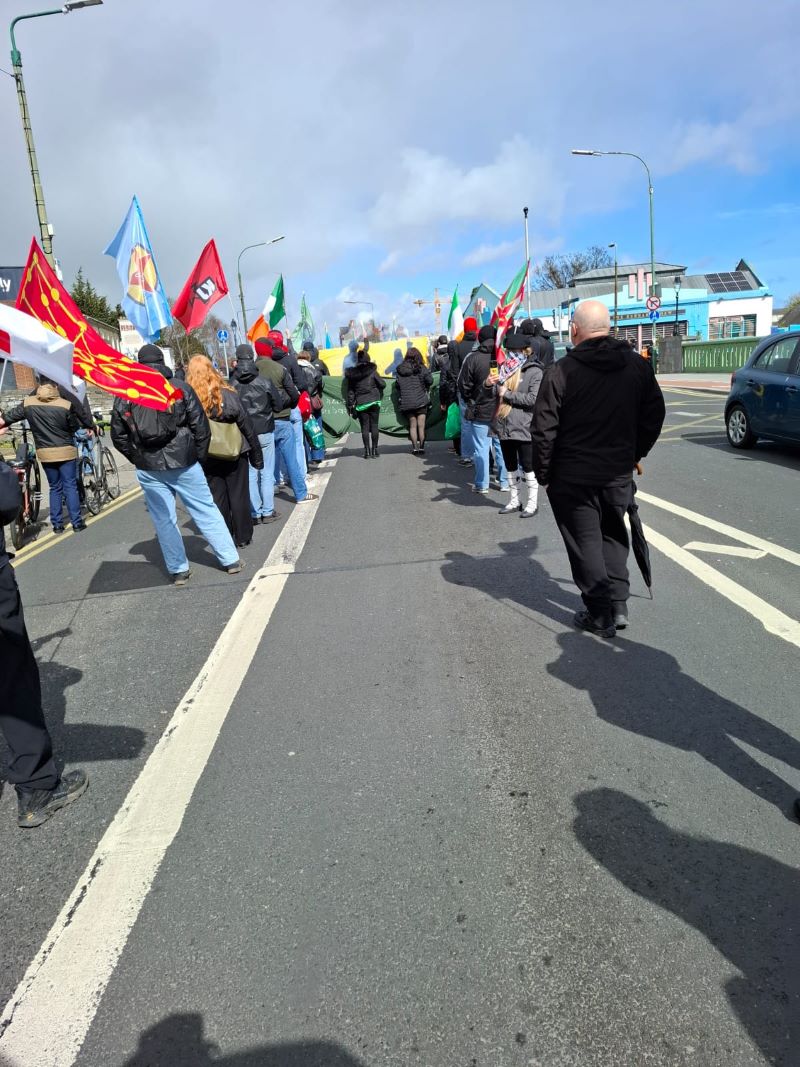
Section of the marchers approaching Cross Guns Bridge from Phibsborough, halting as flares are lit in memoriam. (Photo: R.Breeze)

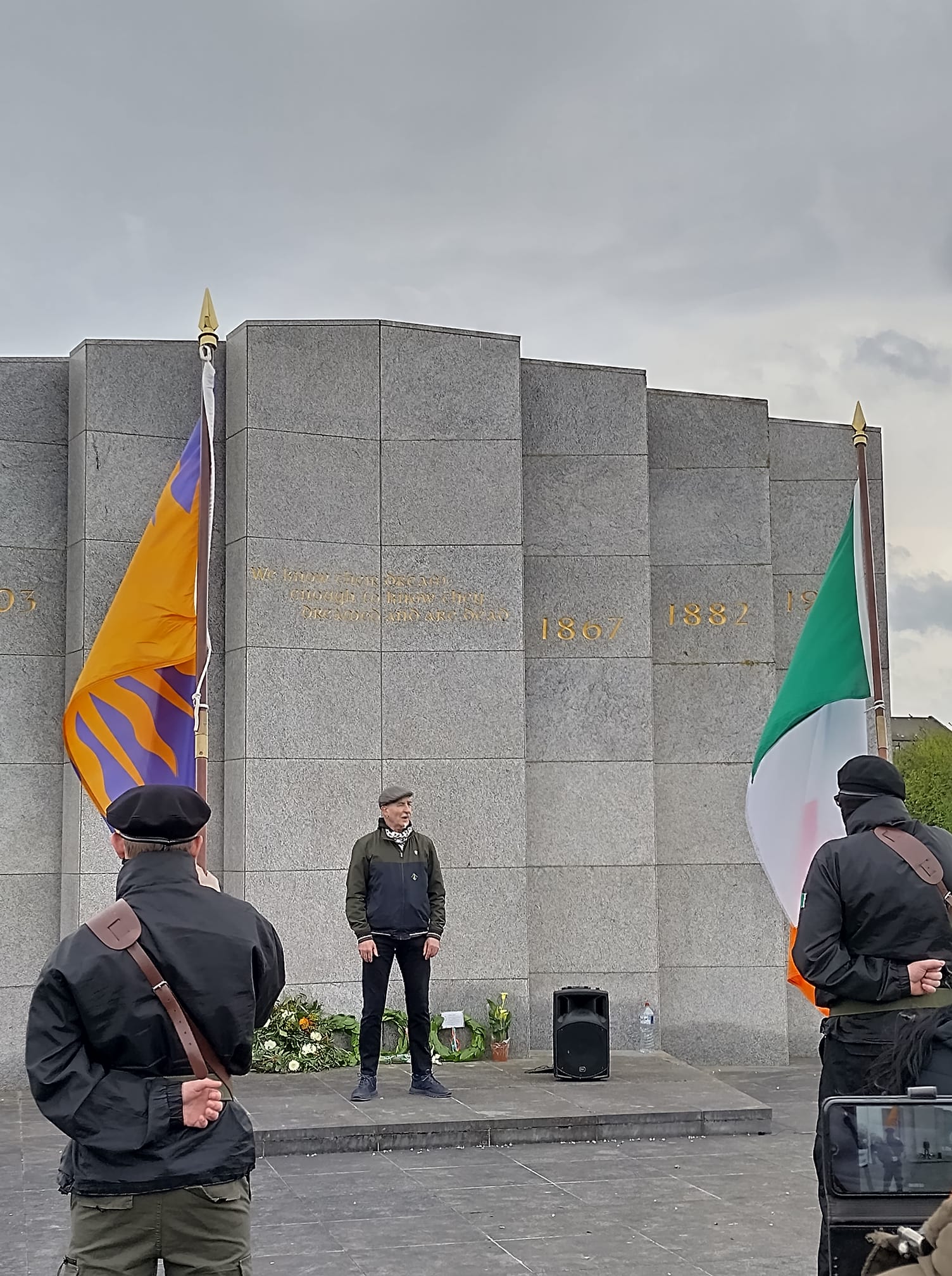
Winding their way on a path through the headstones, what was now one thick column approached the monument to six Irish Republican armed uprisings, commissioned by the National Graves Association, where a representative of the AIA greeted them.

From the Monument, the AIA representative introduced the reason for the commemoration and listed in honour the Irish Republican Brotherhood, Irish Volunteers, Irish Citizen Army, Cumann na mBan and Na Fianna Éireann, different organisations that fought together in the Rising.2
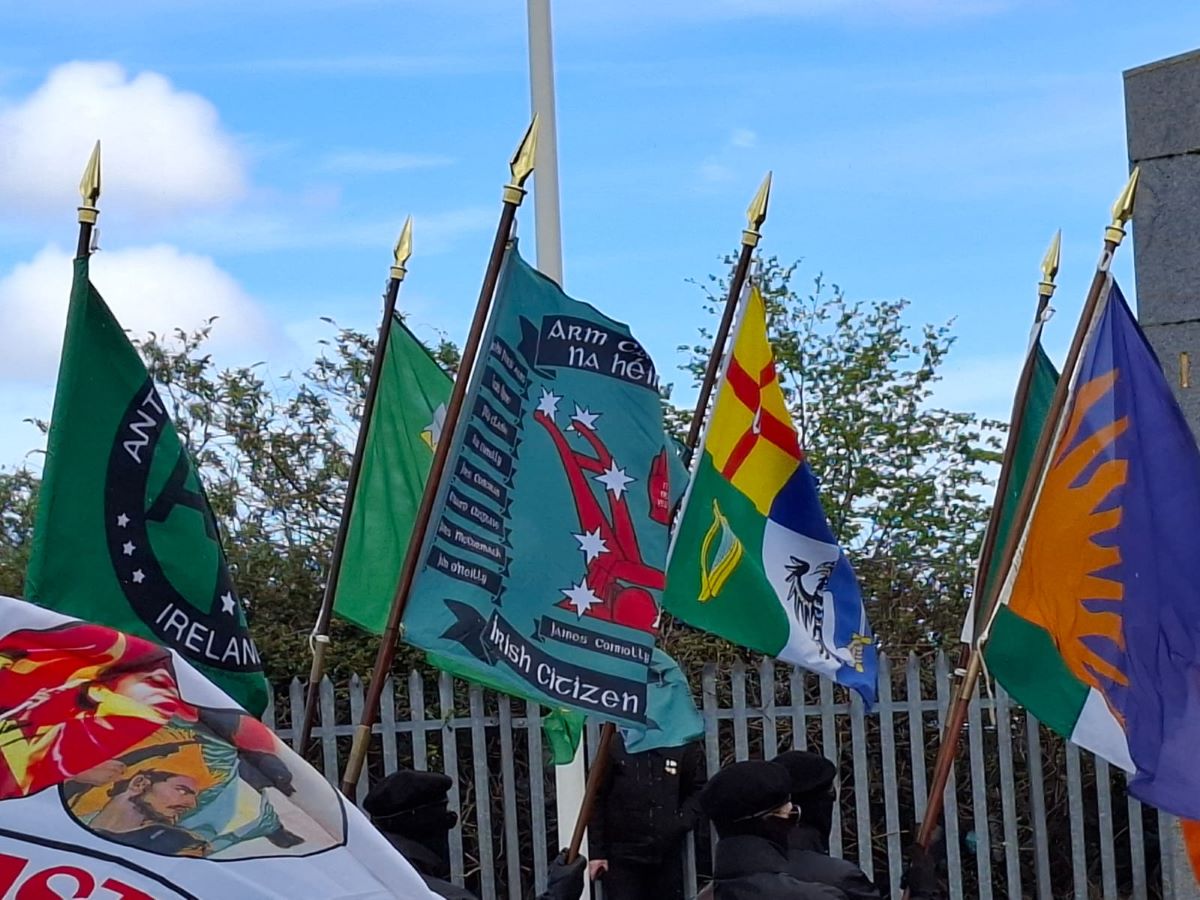
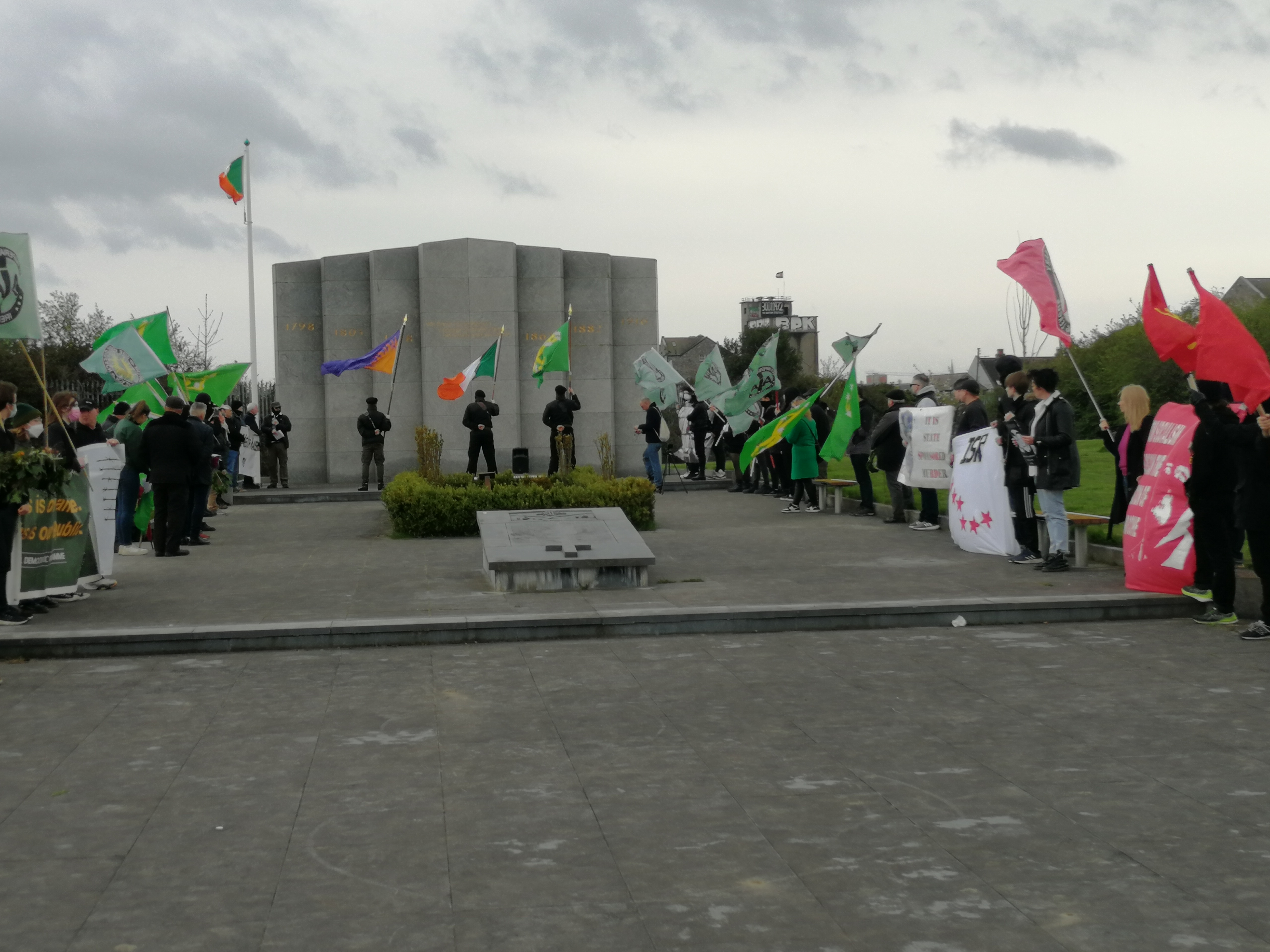
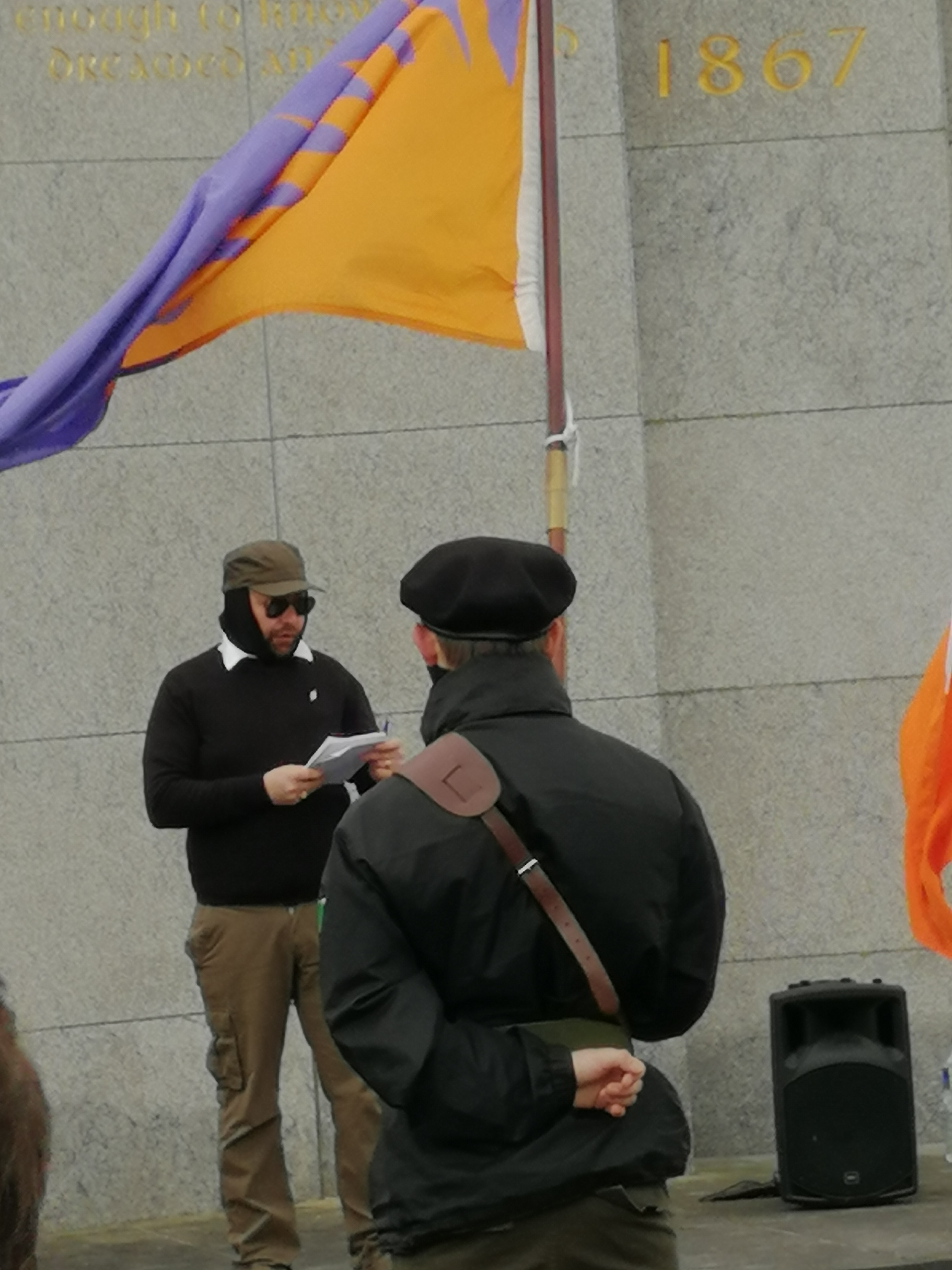
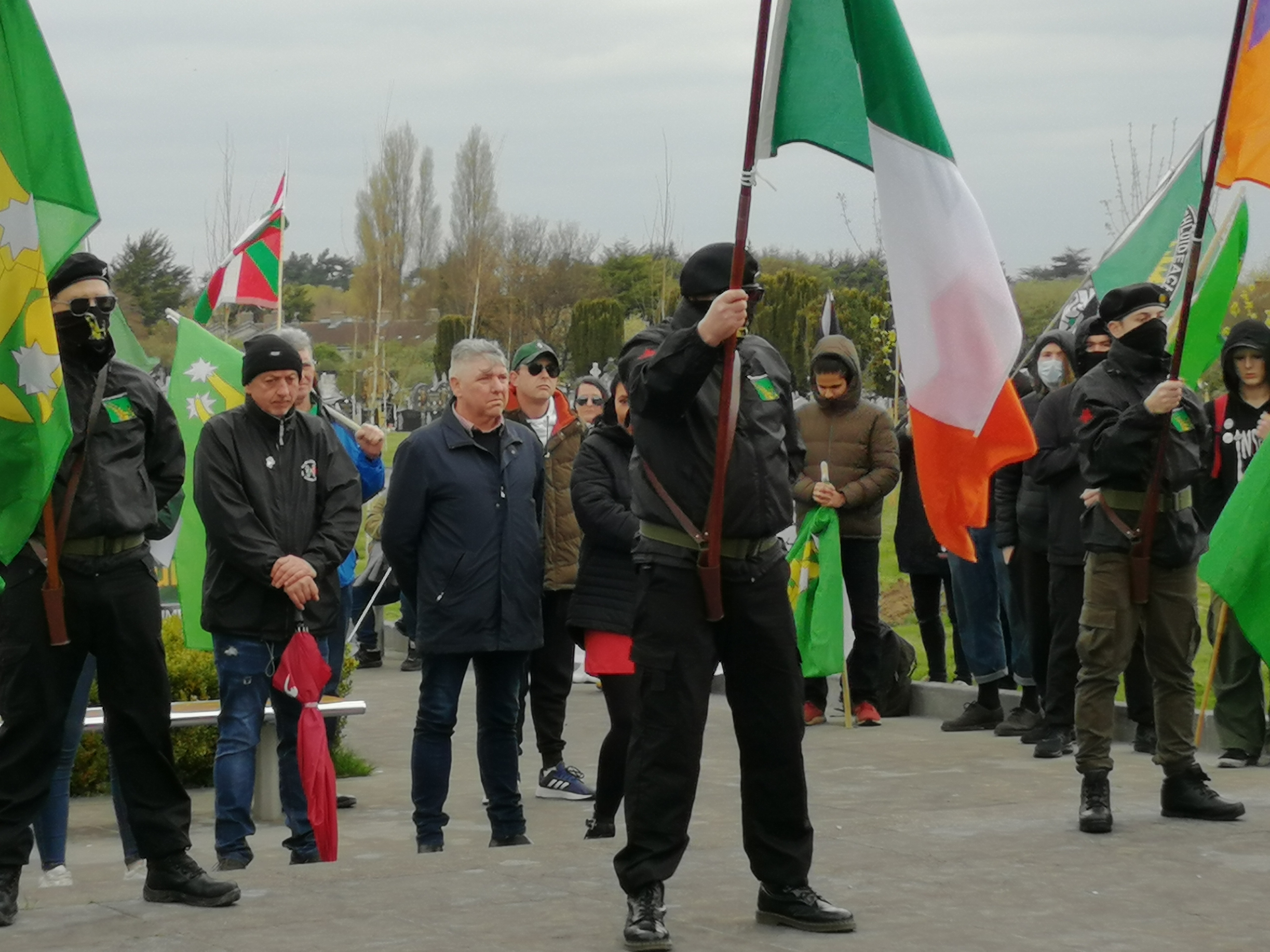
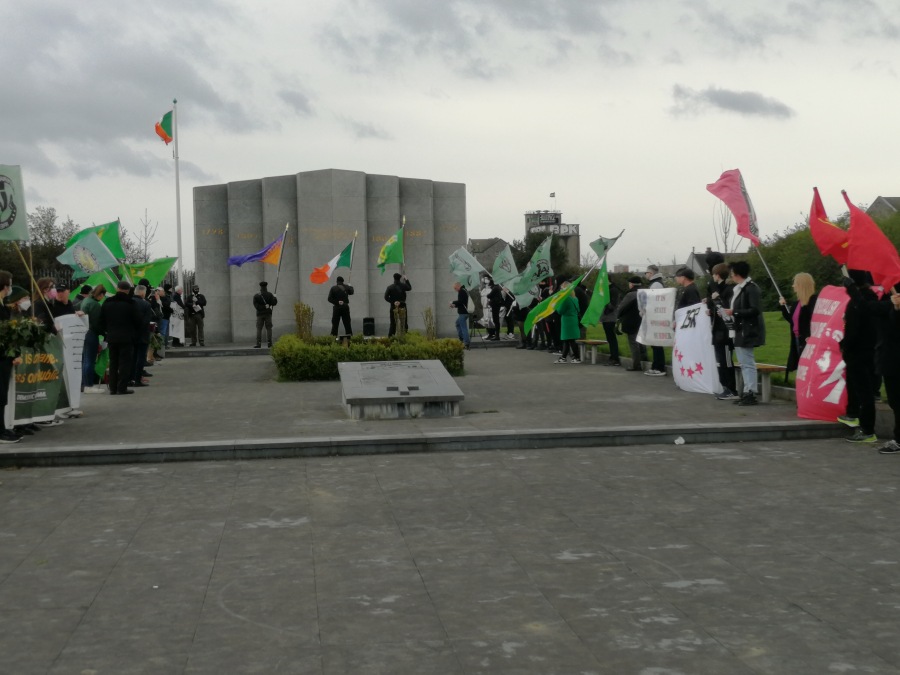
Central: Flags of the colour party, from left to right: Flag of AIA, Irish Citizen Army (mostly concealed), a version of Irish Citizen Army, emblems of the four provinces of Ireland, the Tricolour (mostly concealed), the Gal Gréine (Sunburst).
The flag intervening from the left is of some participants in the Anti-Imperialist Front, a different organisation. (Photo: R.Breeze)

He called for delegates of different organisations to meet to decide a basis for unity, following which, going on to note that the AIA has long been prepared to work alongside others for shared objectives, he announced floral wreaths to be laid on behalf of the CPI and IDR.3

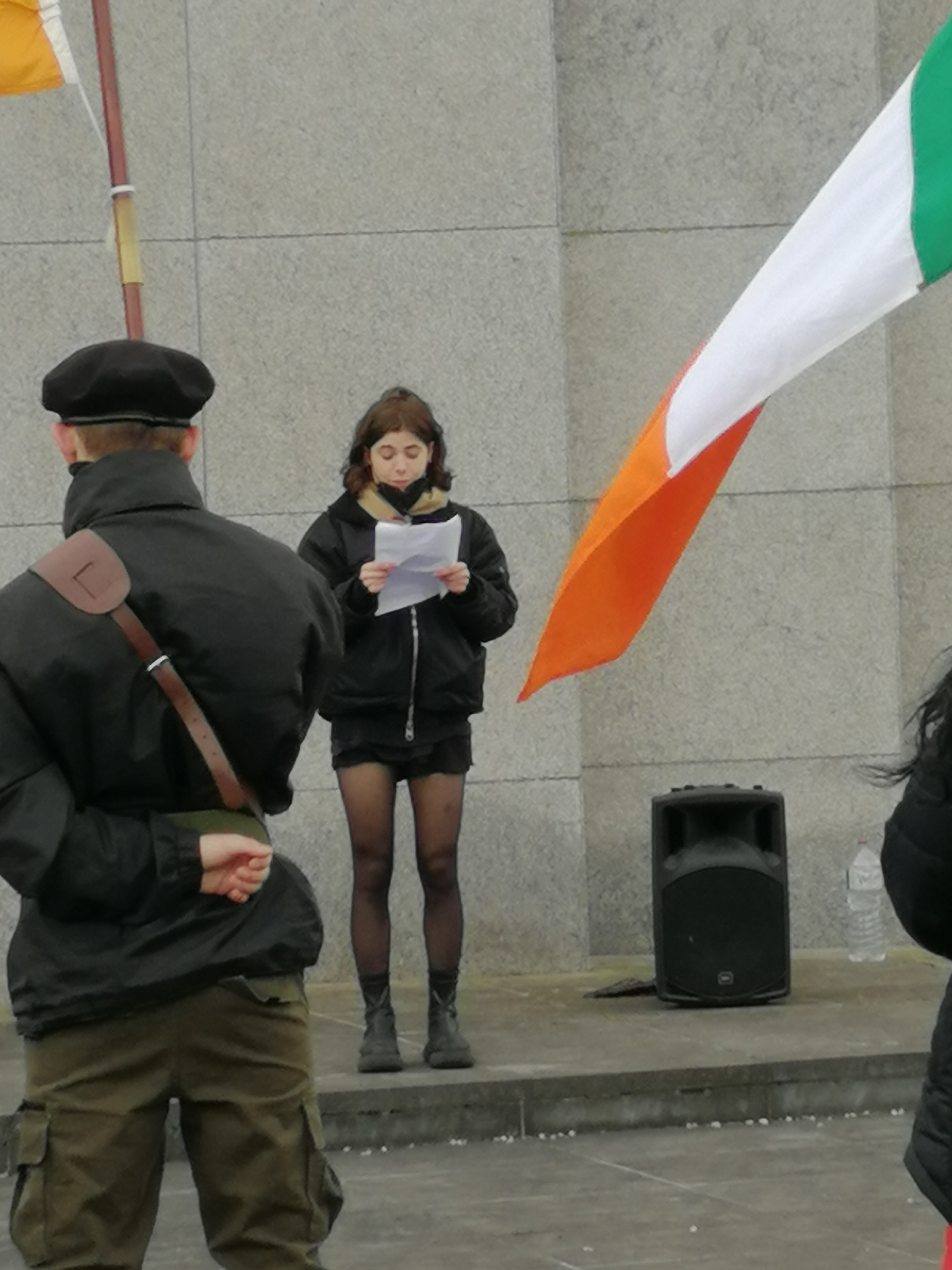
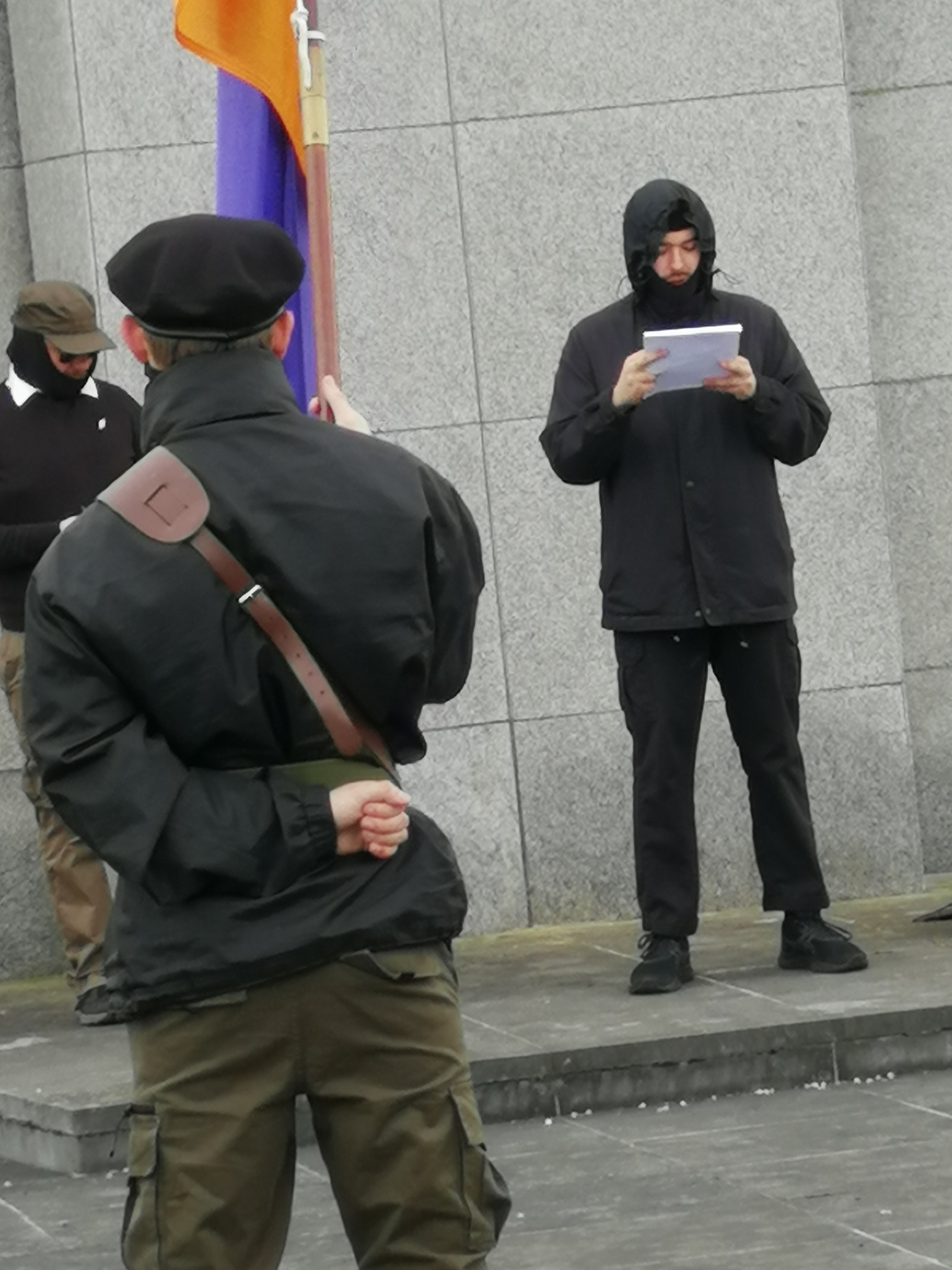
After the laying of those wreaths, another man was called to read the text of the 1916 Proclamation.

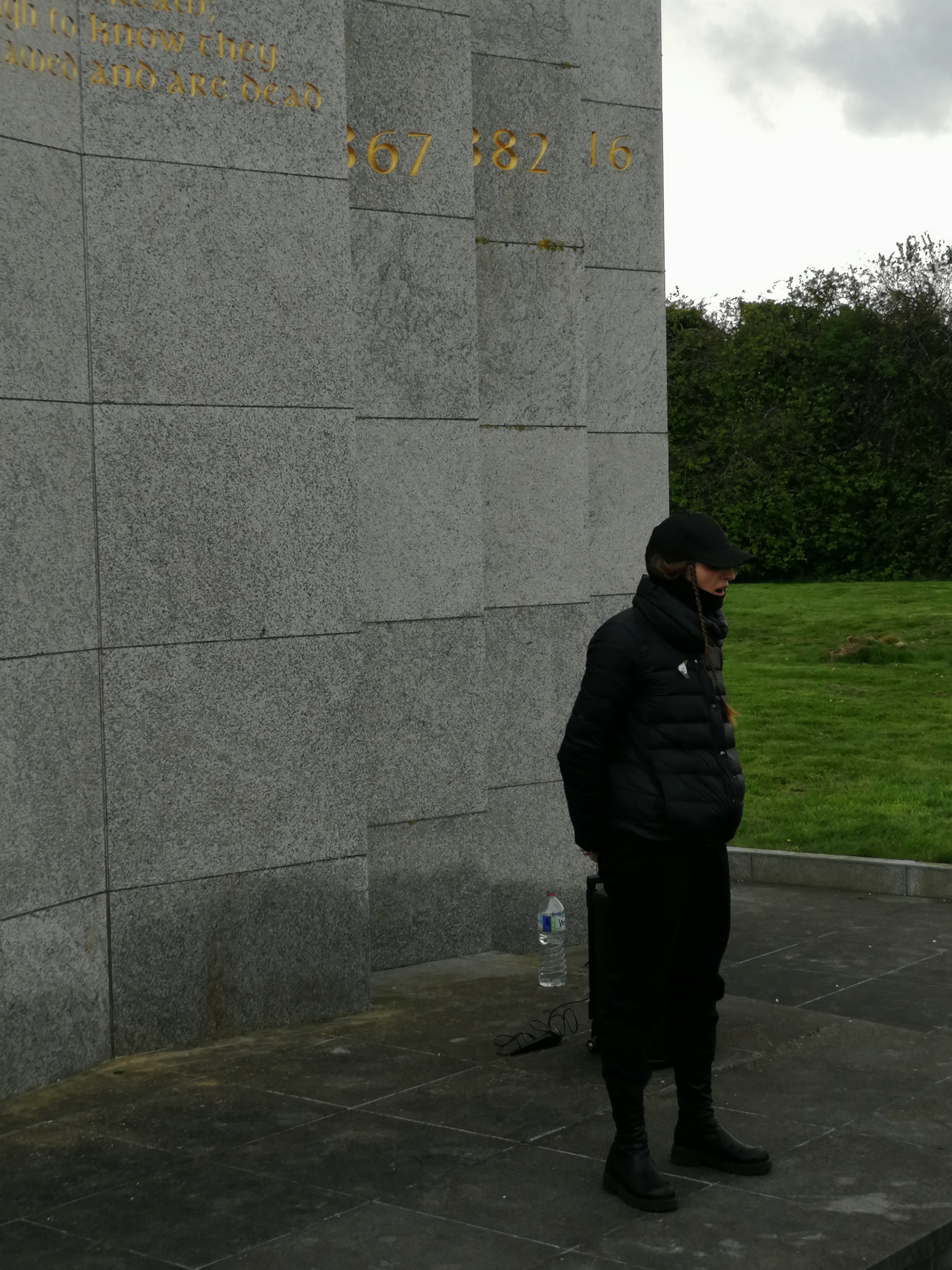
The keynote speaker, a veteran Irish Republican and former political prisoner, was then introduced. He began by reminding his audience of Irish Republican armed uprisings before 1916 going back to 1798 and forward up to the war in the occupied Six Counties.
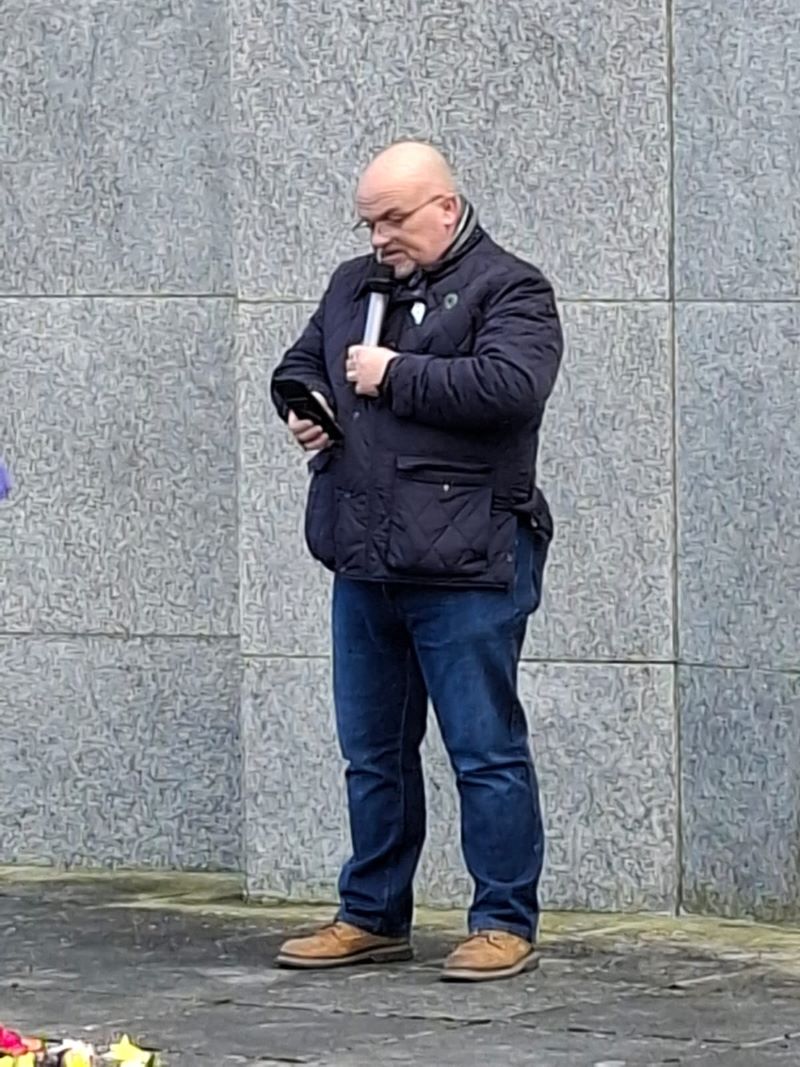
The main speaker, veteran Irish Republican and ex-political prisoner, delivering the oration for the commemorative event. (Photo: R.Breeze)

The speaker made a number of points regarding the text of the 1916 Proclamation, the declarations of which remain to be fulfilled, in its address placing women on an equal standing with men, ‘cherishing the children of the nation equally’ and guaranteeing ‘civil and religious freedom to all.’

Drawing on the example of those of varying ideological positions who in the 1916 Rising united to “fight against the largest world empire in history”, the ex-prisoner called on Irish Republicans to find the means to unite in action today against imperialism and colonialism.

The speaker also highlighted that the objective of the Rising had been an independent democratic republic which is still to be achieved and that Republicans need to honestly confront the failures which, despite strong resistance, have weakened the struggle to date.

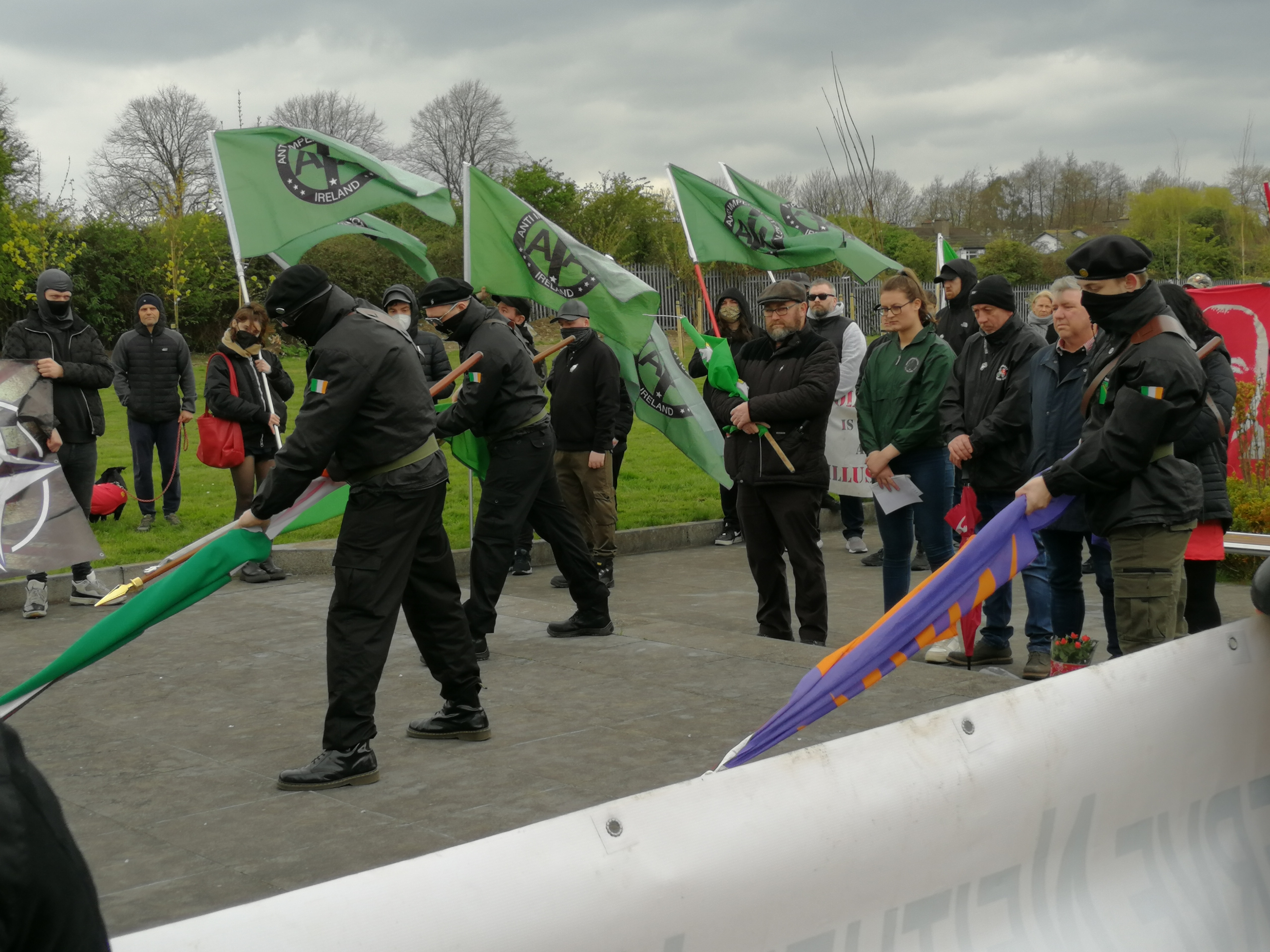
The piper played a slow air as the flags of the colour party were lowered and a few minutes’ silence observed – a traditional Irish Republican honouring of its martyrs in struggle. Announcing the end of the event the MC then called for the piper to play Amhrán na bhFiann4 to conclude.
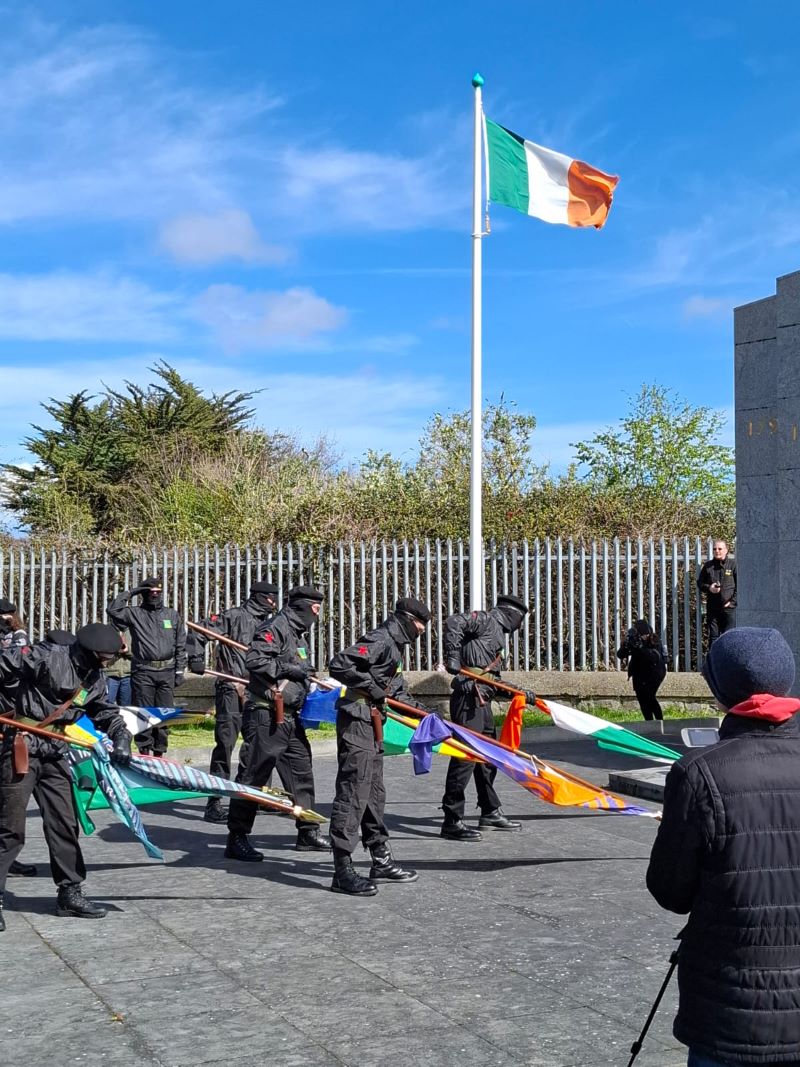
A moment in the lowering of the colour party’s flags during the moments’ silence in honour and remembrance of fallen martyrs. (Photo: R.Breeze)

COMMENT

The attendance at this year’s event was numerous and encouraging, even discounting the numbers from abroad. The latter has been a feature of AIA commemorations for some years but has also grown visibly in numbers and in countries of origin.

In previous 1916 commemorations of the AIA, songs had been performed by singers but that feature was missing this year. Another missing feature was a part-address in the Irish language, au contraire to the main speaker’s call for the restoration of Irish as the nation’s spoken language.

In common with a great many commemorations by varied organisations at this spot, there was no mention of the independent National Graves Association, for whose work and the monument itself much thanks are due.
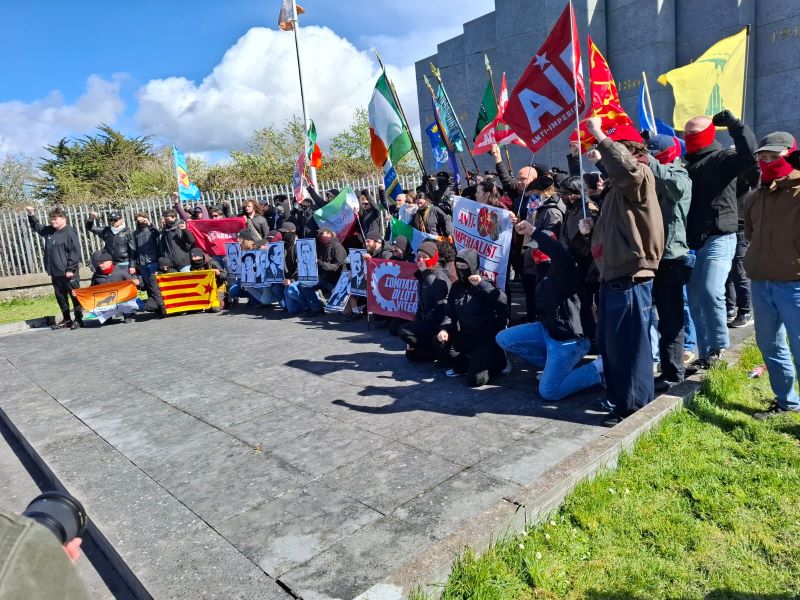
A large section of the participants chose to have their photo taken in a group with the monument behind them, their flags, banners and the portraits of the Seven Signatories of the Proclamation to the fore. (Photo: R.Breeze)

The call for unity in struggle is a common one in the Socialist and Republican movement though less verified in practice across their organisations. That said, on many occasions the AIA has put the desire into practice in joint action with other organisations and independent activists.

It is certain that without general unity in action across the resistance movement in Ireland, neither independence nor revolutionary change in society can be achieved.

In the city centre, at the GPO,5 site of the HQ of the Rising in 1916, the State held its own commemoration, with admittance to the area close to the podium by ticket only. According to reports, the speeches of the Taoiseach6 of the Coalition Government were received in silence.

This was in contrast to the speech of the new Uachtarán or President, a native Irish speaker and of broadly left-nationalist political outlook, which was enthusiastically applauded.

End.

Note: If you found this article of interest, why not register with Rebel Breeze for free, so that you will be notified by email of subsequent articles. You can de-register any time you wish.

FOOTNOTES

1However, no other instructions were given in the language, not even ‘dhá líne’ (i.e two lines) when the marchers were being instructed by stewards to separate into two columns.

2Omitted, as it often is, was the participation of the Hibernian Rifles unit, who though not part of the planned Rising joined it and acquitted themselves well in the GPO Garrison and in support of the City Hall Garrison.

3Communist Party of Ireland and Independent Dublin Republicans.

4This air and its lyrics are widely considered the National Anthem of Ireland but for the State, it is only the air of the chorus that is their National Anthem. Composed shortly before the Rising by Peadar Kearney and Patrick Heeney in English, it was sung during the Rising and widely adopted by the Republican movement afterwards. The lyrics were translated to Irish by Liam Ó Rinn in 1923 and, unusually, that version became dominant.

5The General Post Office, an imposing building in Dublin’s main thoroughfare,1 for which recently the Irish Government announced plans to remove the An Post (postal service) to develop in part as a shopping centre.

6Equivalent to Prime Minister. The Government is a coalition of formerly hostile parties Fine Gael and Fianna Fáil, from oppositional sides of the Irish Civil War (1922-1923) and supported by the Green Party and some Independents.

USEFUL LINKS

Anti-Imperialist Action Ireland: https://www.facebook.com/p/An-Phoblacht-Ab%C3%BA-61551946386300/

The National Graves Association: https://www.nga.ie/
https://www.facebook.com/NationalGravesAssociation/
FOR A SOCIALIST REPUBLIC, AGAINST THE FREE STATE, ENGLAND AND NATO

Diarmuid Breatnach

(Reading time main text: 6 mins.)

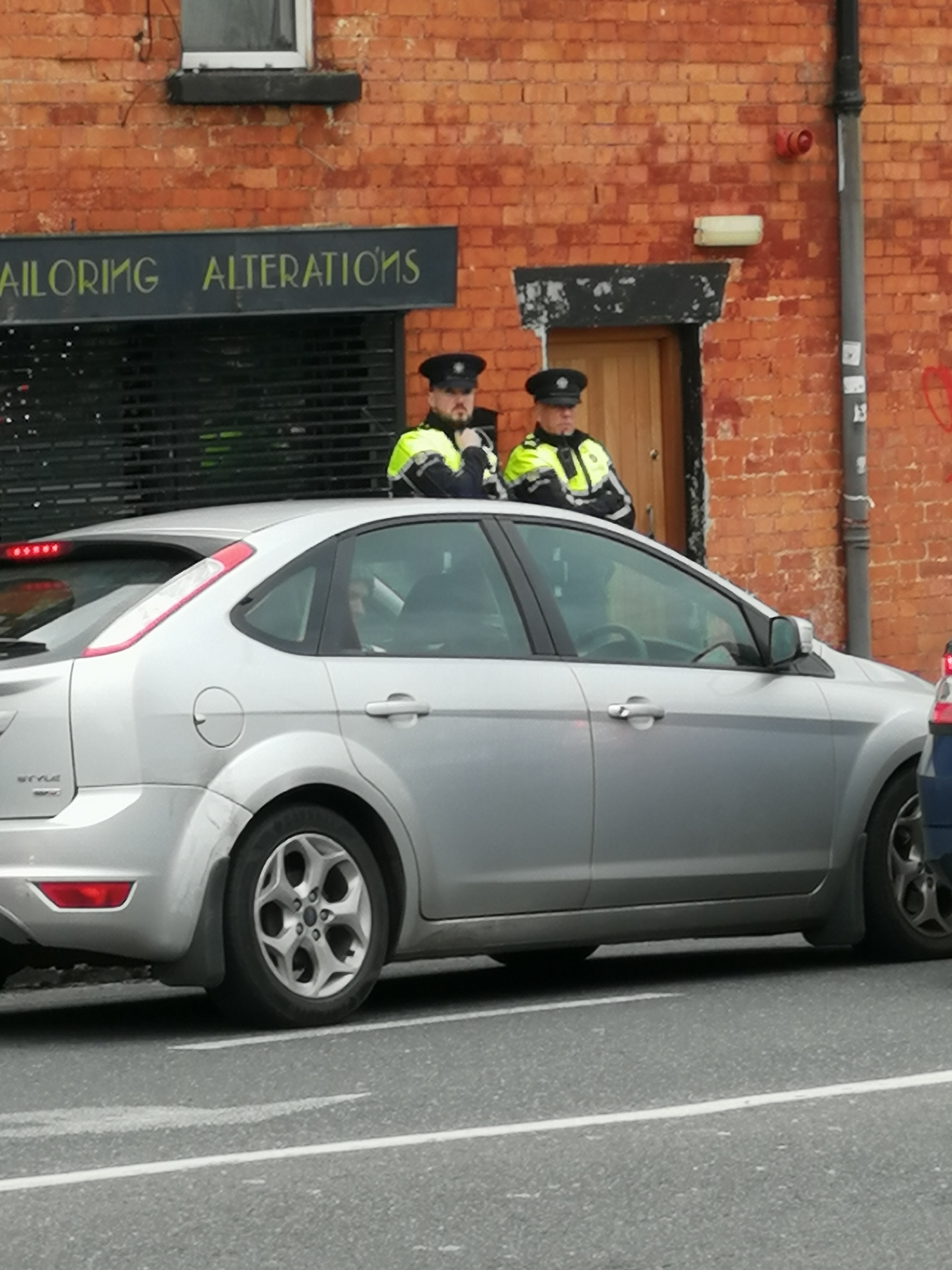
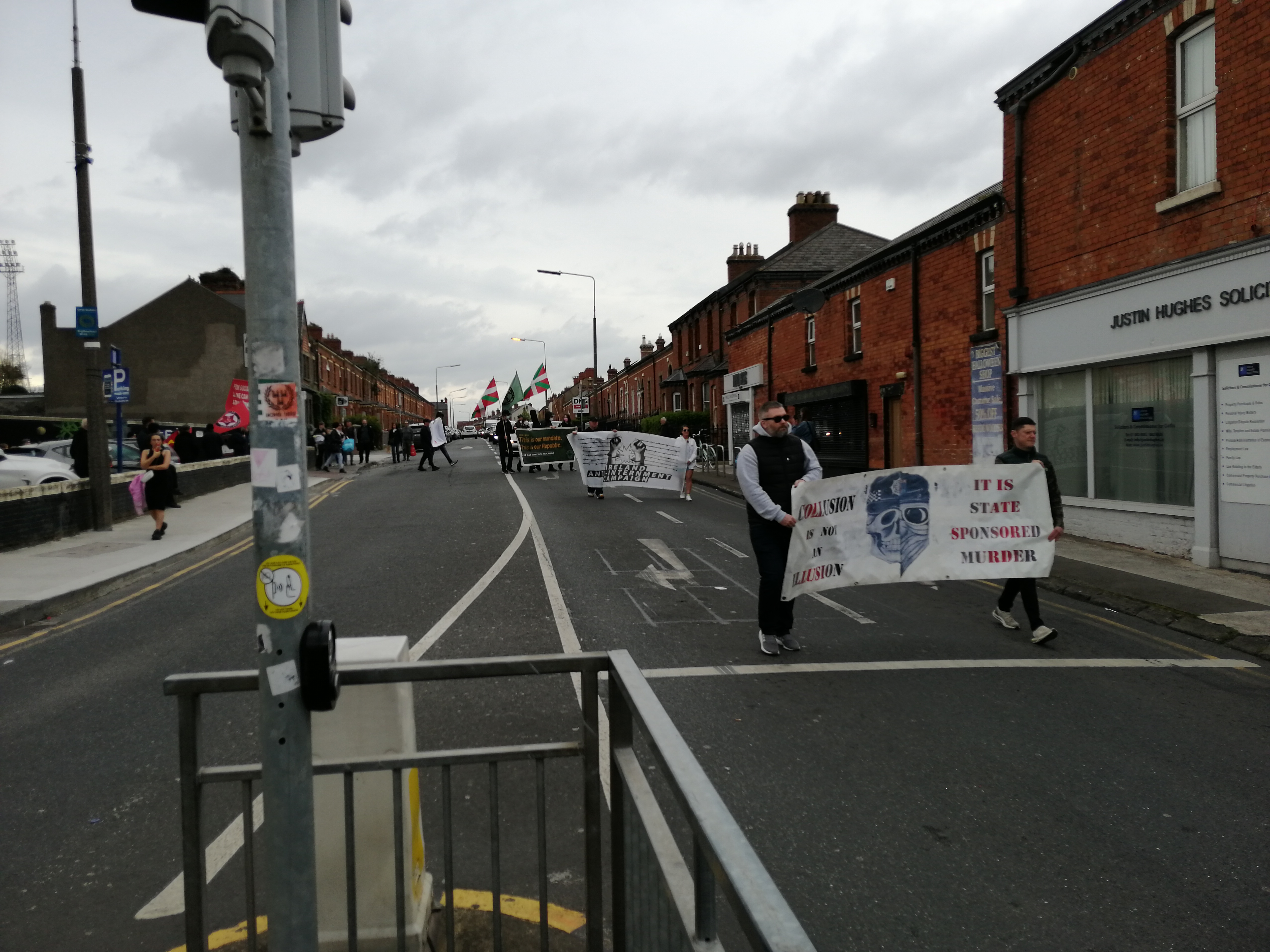
On Sunday participants in a 1916 Rising Commemoration organised by the Irish organisation Anti-Imperialist Action were harassed by police as they gathered to march to the Irish Citizen Army Republican plot in Glasnevin Cemetery.

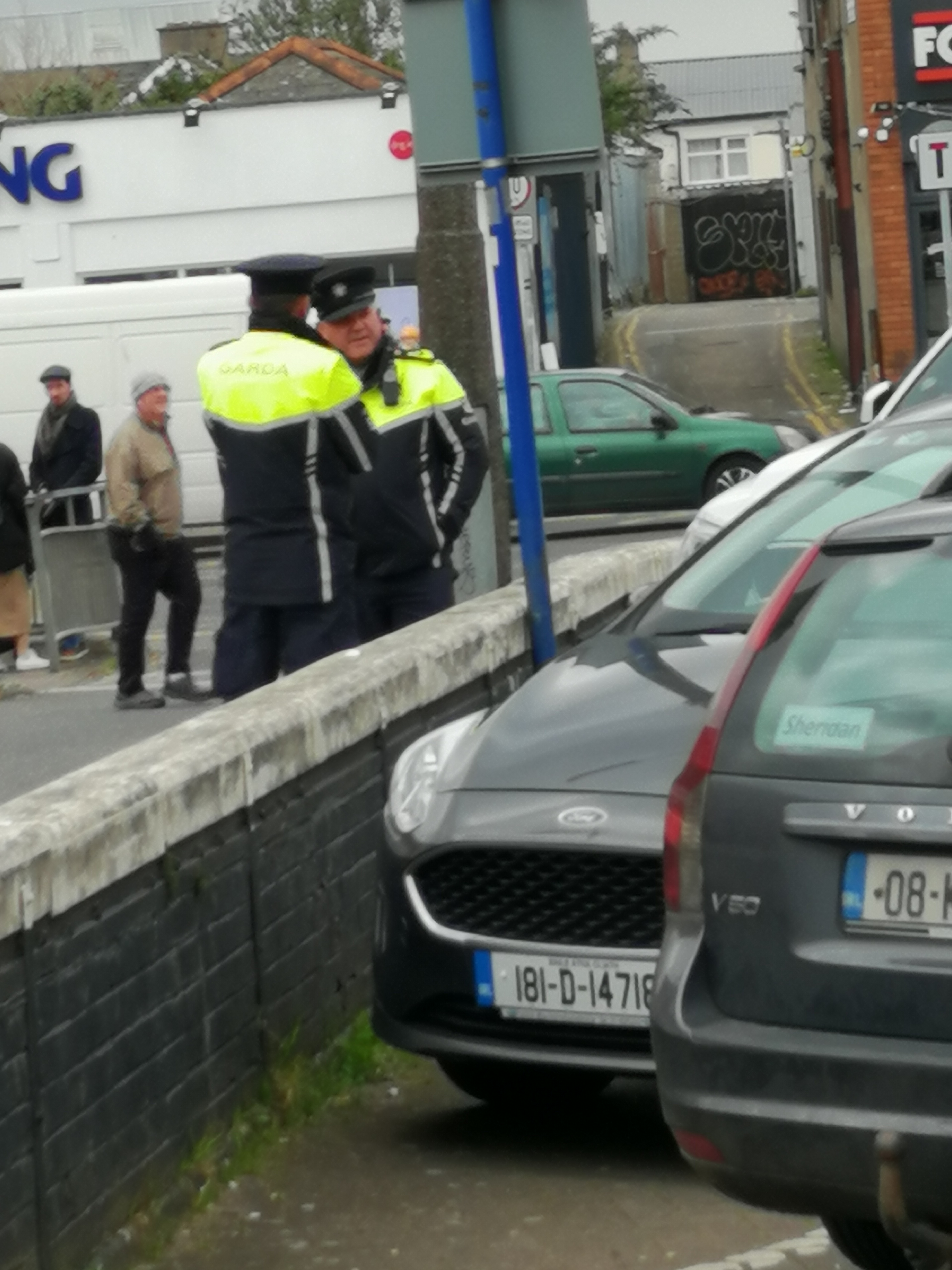
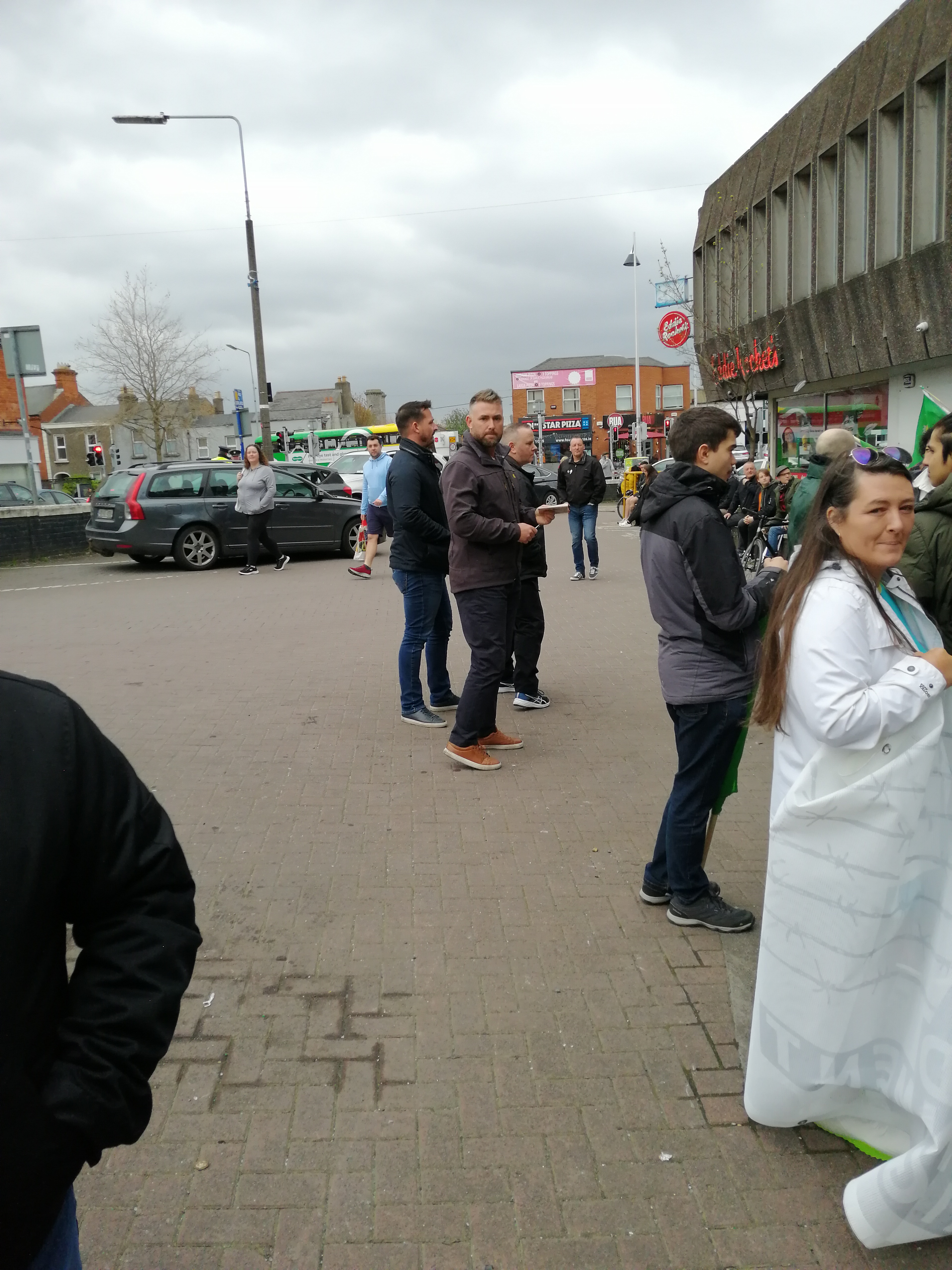
Six political police in plain clothes walked among those gathered beside Phibsborough shops demanding names and addresses of the participants, most of whom were fairly young. Four uniformed Gardaí also stood nearby and a Public Order Unit van parked at the cemetery entrance.

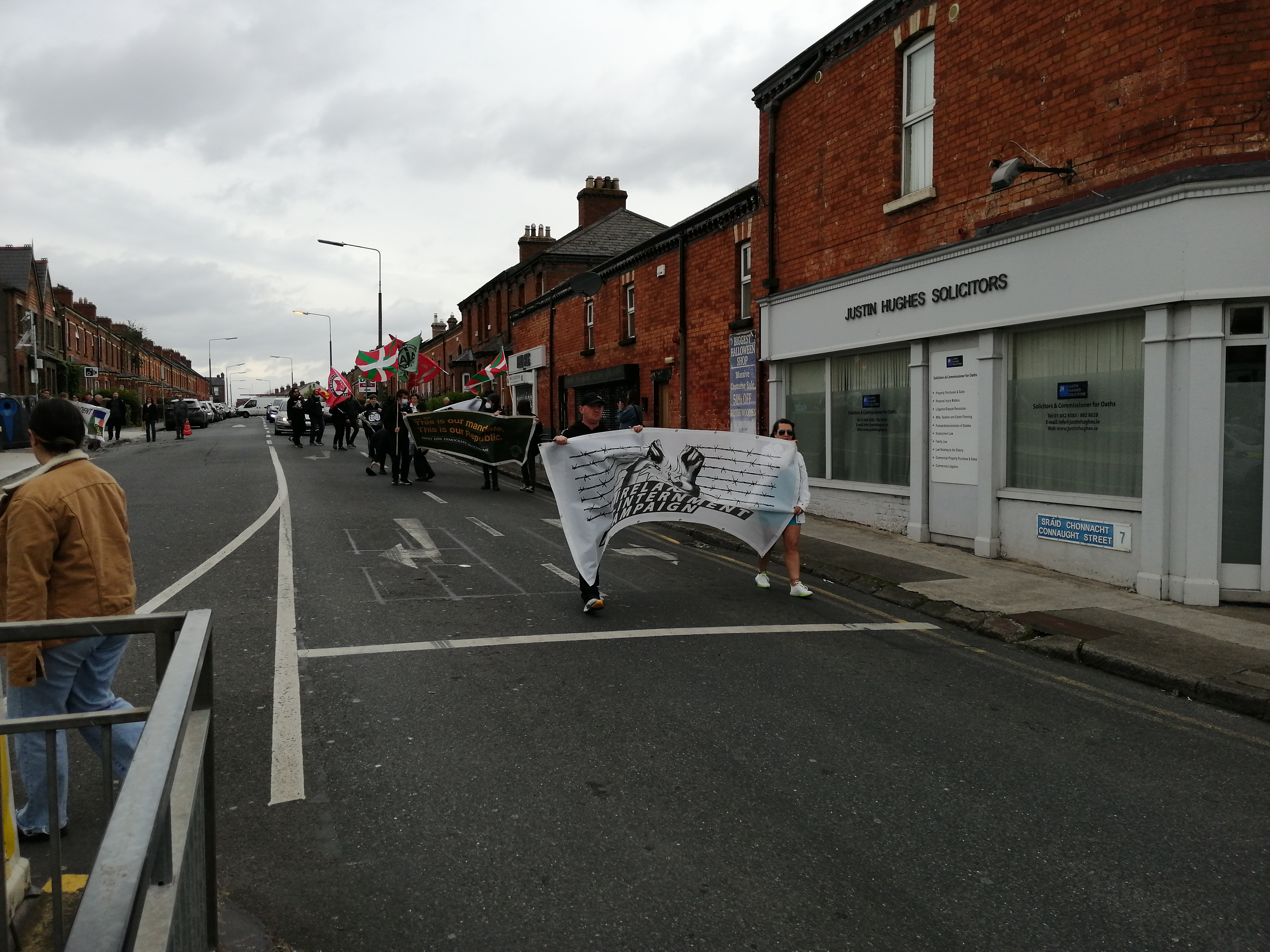
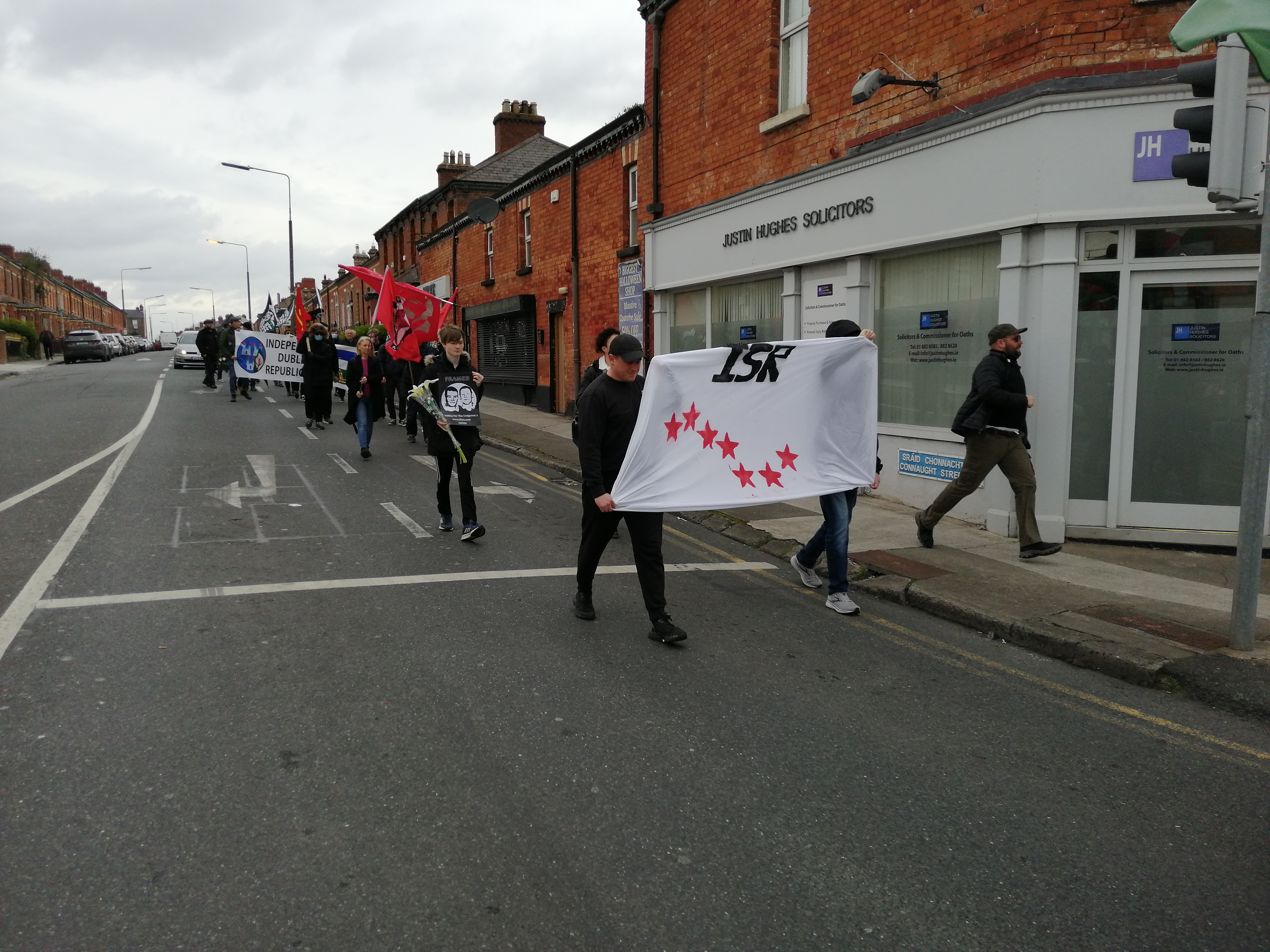
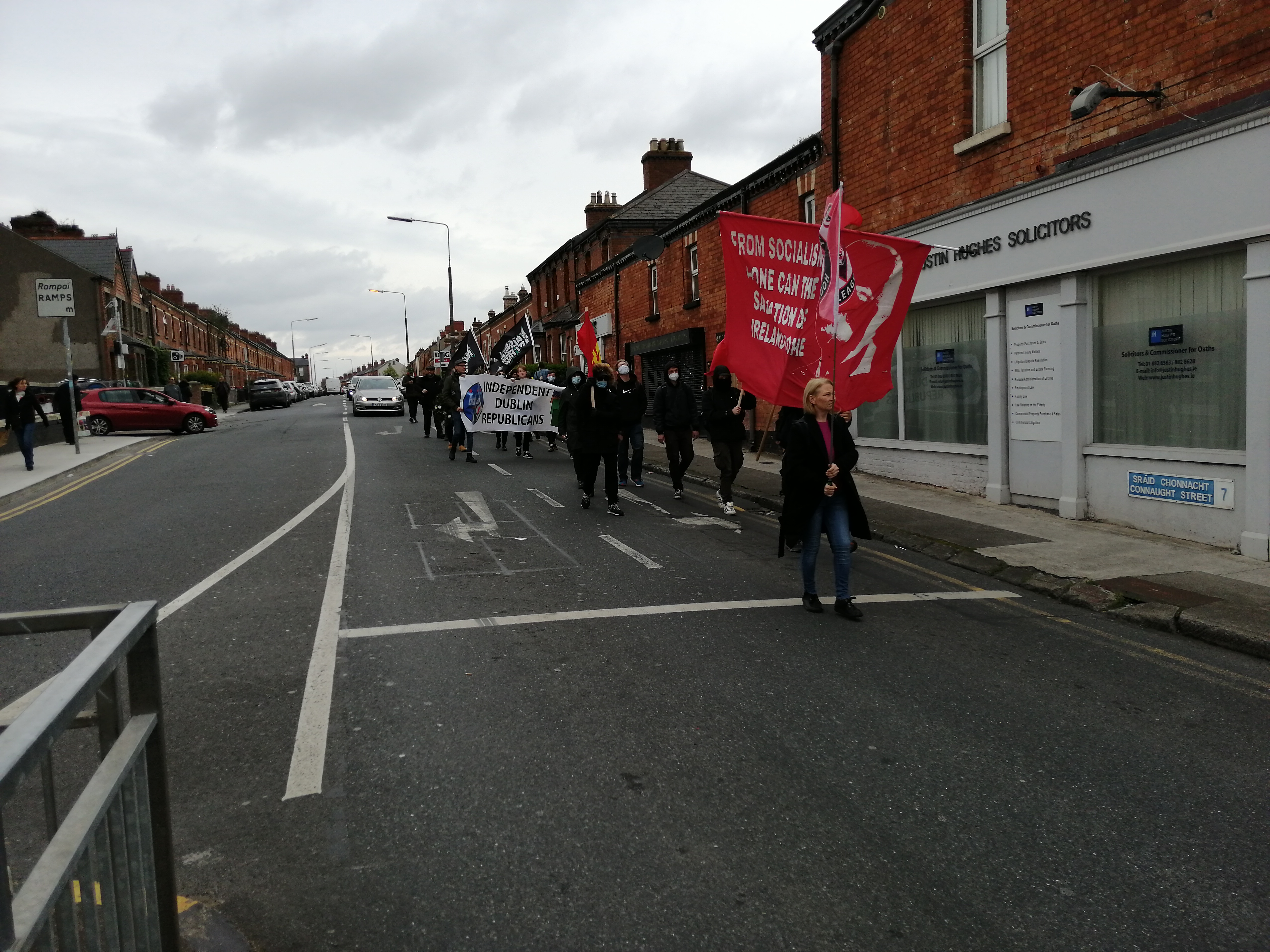
The participants declined to be intimidated and set off on their march, led by a lone piper playing Irish marching airs, followed by a colour party with different banners interspersed among the marchers, among which fluttered many flags.

Organisers had learned that the coach carrying members of the Republican Flute Band from Scotland that was to lead the parade had been prevented by police there from taking the ferry to Ireland.

Centre photo: Four of the six plainclothes political police violating the civil rights of the peaceful people commemorating the Easter Rising. (Photo: D.Breatnach)
Centre photo, another two plainclothes political police. The bald man joked while he harassed people. (Photo: D.Breatnach)
(Photo: D.Breatnach)

Historical background

In 1916 a broad alliance the Irish Volunteers, Irish Citizen Army, Cumann na mBan, na Fianna Éireann and Hibernian Rifles1 took part in a Rising organised by the Irish Republican Brotherhood against British rule in Ireland and against world war.

Due to a number of unfortunate circumstances, the leader of the Volunteers cancelled the Rising which however went ahead a day later than planned and was for the most part confined to Dublin, where a third of the numbers in the original plan took part and fought for a week.

The occupying British Army shelled the city centre from a gunship in the river Liffey and also from artillery on land. Explosions and resulting fires destroyed much of the city centre including the General Post Office in the main street, which had been the headquarters of the insurrection.2

After a week with the city centre including the GPO in flames, the rebel garrison evacuated to Moore Street where the following day, surrounded and vastly outnumbered, the decision was taken to surrender.3 A British military court passed death sentences on nearly a hundred prisoners.

All but fifteen of those sentences were commuted to long jail periods but the seven Signatories of the 1916 Proclamation4 and another seven were shot by British firing squad in Dublin, a fifteenth in Cork and after trial months later a sixteenth was hanged in Pentonville Jail, London.

At Easter 1917 Irish Republican and Socialist women commemorated the 1916 Rising; ever since then Irish Republicans and sometimes Socialists in Ireland and in many parts of the diaspora have commemorated the Rising, whether legally5 or otherwise, in jail or at liberty.

The War of Independence began in 1919 with many of the Rising’s survivors participating6.

(Photo: D.Breatnach)

The Parade on Sunday – local and national historical memory marked

At Cross Guns Bridge over the Royal Canal the parade halted and flares were lit in memory of events there in 1916.

Marching along the Cabra Road, the wall and a watchtower of the north side of Glasnevin Cemetery on the left of photo. (Photo: D.Breatnach)

On Easter Monday 1916 a small group of Irish Volunteers had marched from Maynooth along the canal bank to join the Rising in Dublin and found guarding the bridge two Irish Volunteers who advised them to wait until the following day to go into the city centre.

The Maynooth group spent the night in Glasnevin and the following day marched into the GPO, passing an empty Cross Guns Bridge on the way. Back towards Phibsborough, British artillery had blown a barricade and killed Seán Healy, a Fianna member at the Nth. Circular Road crossroads.

Later, the Dublin Fusiliers unit of the British Army blockaded the bridge, preventing people from crossing it in either direction. They shot dead a deaf local man who failed to heed their challenge because he did not hear it.

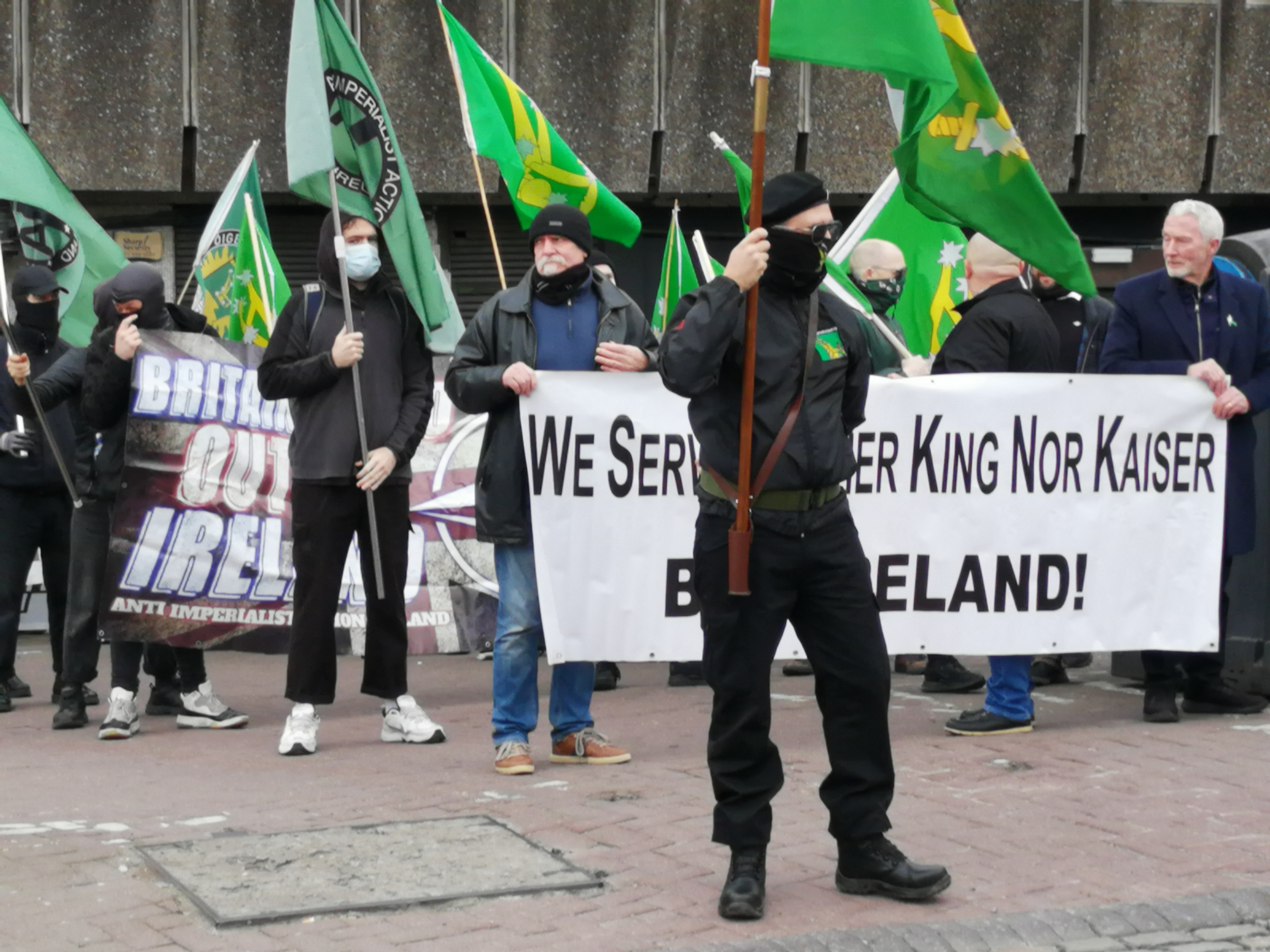
We Serve Neither King nor Kaiser but Ireland declared one banner carried last Sunday, Britain/NATO Out of Ireland another, This Is Our Mandate7, Our Republic and Collusion Is No Illusion, It Is State-Sponsored Murder were another two.

A large banner also declared alongside the image of James Connolly that Only Socialism Can Be the Solution for Ireland. Some organisations also carried their own banners, such as those of Dublin Independent Republicans, Ireland Anti-Internment Campaign and Irish Socialist Republicans.

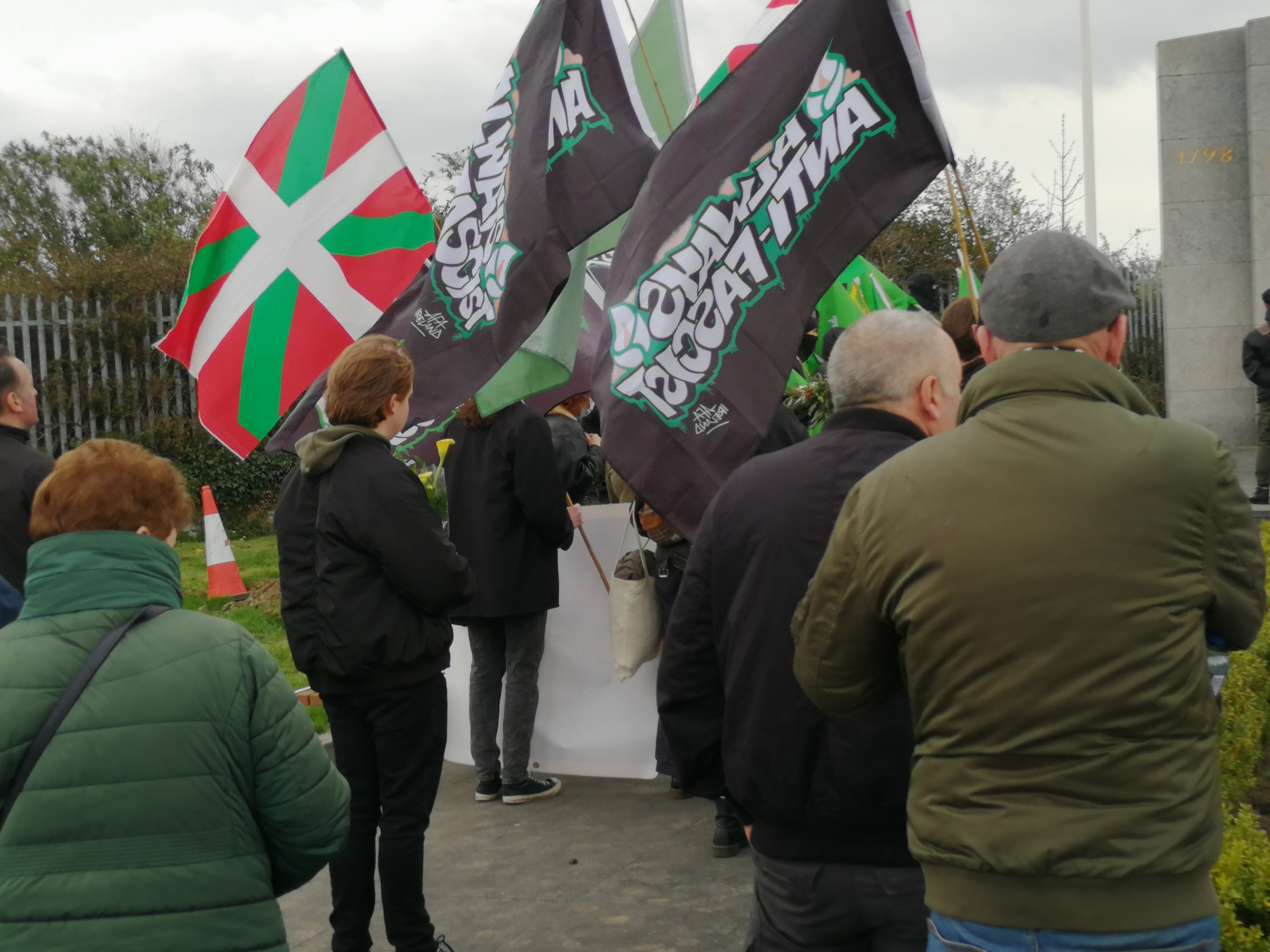
Flags fluttering included those bearing the logo of the organising group Anti-Imperialist Action and others bearing the slogan “Always Anti-Fascist”, green-and-gold Starry Ploughs, a couple of Ikurrinak (Basque flags) and another two of Red with Hammer & Sickle in yellow.

Basque and antifascist flags (Photo: D.Breatnach)

At the Monument: speeches and songs

At the monument (Photo: D.Breatnach)

Glasnevin Cemetery (Reilig Ghlas Naíonn) covers over 120 acres in North Dublin city and is in two parts, each with Republican Plots separated by the Cabra Road and contains the graves of both famous and ordinary people.

On the north side there is also access to the Botanic Gardens, both on the south banks of the Tolka river. The imposing Monument to numerous Republican uprisings and the Irish Citizen Army Republican plot is on the south side, across the pedestrian bridge over the railway line.

(Photo: D.Breatnach)

A man chaired the event for Anti-Imperialist Action and spoke briefly, introducing people for readings (all of which were from James Connolly) and for orations. The presentations of these were evenly divided between men and women, three of those being of young people.

Three songs were sung: a woman sang The Foggy Dew (by Charles O’Neill) and Erin Go Bragh (by Peadar Kearney), while a man sang Patrick Galvin’s Where Is Our James Connolly? Two women read out pieces by James Connolly and another read out the 1916 Proclamation.

Person chairing the event (Photo: D.Breatnach)

The words of the chairperson and of those giving orations were different but there were common themes: upholding the historic Irish spirit of resistance, the importance of the working class in history and the objective of a socialist Republic encompassing the whole of the Irish nation.

These words were balanced by denunciation of US and British imperialism and the colonial/ NATO occupation of the Six Counties by the latter; the Irish client regime; the special no-jury courts8 of both administrations in Ireland and repression by police forces and occupation army.

One of the singers (Photo: D.Breatnach)
One of the readers (Photo: D.Breatnach)

Also denounced were those political parties that had abandoned the struggle for the Republic and instead had become part of the colonial and neo-colonial administrations or, in the latter case, were on their way to becoming so.9

Floral tributes were laid by representatives of a number of announced organisations and then others came forward to lay floral tributes also. The colour party lowered flags for a minute’s silence in homage and salute before slowly raising them again and the piper played Amhrán na bhFiann.

The other singer
Lowering of the colour party flags in homage to the fallen in the struggle (Photo: D.Breatnach)
Colour party raises flags again in symbolism of the struggle continuing (Photo: D.Breatnach)

The chairperson thanked all for attendance, listing organisations by name and cautioning all to stay close together as they left, due to the threatening presence of Gardaí and in particular the Public Order Unit. In the event, the celebrants exited the cemetery and dispersed without incident.

End.

(Photo: D.Breatnach)

FOOTNOTES

1A small unit, an armed wing of a split from the more socially conservative USA version of the Ancient Order of Hibernians, their participation in the Rising was notable.

2Photos of much of the destruction are available on the Internet and accessible by search browser.

3The terrace they occupied still stands and is the object of a historical memory and conservation struggle against property speculator plans approved by the municipal city managers and Government political parties (see smsfd.ie).

4A remarkable document, the text of which is available from many postings on the Internet.

5Irish women commemorated it in public in contravention of British WWI martial legislation in 1917 and 1918 and for decades the public commemoration of the 1916 Rising (and even the flying of the Irish Tricolour) was forbidden in the British colony of the Six Counties with attendant colonial police attacks on any attempt to do so.

6Sometimes inaccurately called “the Tan War” (reference to a special colonial police auxiliary force that became known as the “Black n’ Tans”), the war saw the birth of the IRA and lasted from 1919-1921. A British “peace” proposal opened deep divisions in the nationalist coalition and was followed by a Civil War 1922-1923, in which the pro-Treaty government and armed forces were armed and supplied by the British to defeat the Republicans in a campaign of repression and jailing, military actions, kidnapping and torture, murder of prisoners, assassinations and over 80 formal executions.

7Also displaying text referring to the First Dáil’s Democratic Program of 1919.

8The Diplock court in the colony and the Special Criminal Courts in the Irish State, political special courts in all but name, with low proof bar and abnormally high conviction rate and refusal of bail while awaiting trial.

9References to 1) the 1930s split from the Sinn Féin party, the Fianna Fáil political party that became a preferred Government party of the foreign-dependent Irish ruling bourgeoisie and 2) to the Provisional Sinn Féin party who endorsed the British pacification plan in 1998 and embarked on the road to becoming a party of reformist nationalism in the colony and is heading for neo-colonial (and neo liberal capitalist) coalition government at the moment.

(Photo: D.Breatnach)