(Another one from the Rebel Breeze archives, this one from 2015)
I write to express my admiration for your work and my sympathies with regard to the criticisms with which you are currently being bombarded.
I hope you will forgive my ignorance of much of the work you have been doing in the area of Heritage, which is not really where my strengths lie. But I love the way you talk, the way you shoot down those critics, especially those TDs who ask those nasty questions.
And I’m sure you had something to do with removing Westport House from the NAMA sell-off, even if it is in Enda’s constituency. Such a fine example of our colonial architectural heritage!
Heather Humhpreys, Minister for Arts, Heritage and the Gaeltacht
But as we know, Minister, that wouldn’t be the kind of thing that would be appreciated by your critics. They’d rather you devoted your talents to a shabby row of Dublin houses of dubious architectural importance in a grubby street market.
A street which they say is “pre-Famine” — as if that were something to boast about! Laid down earlier than Sackville Street (now O’Connell Street) they say ….
Sure why would we want to keep a street that old …. or remember that embarrassing episode in our history either, when we lost a third of our population to over-reliance on one crop! We learned from that, though, didn’t we? Sure we grow hardly any crops at all now and get them all in from abroad.
And we live in cities now — who wants to be getting up at 6 a.m. in all kinds of weather and plodding through muck? If people like growing things that much, get a house with a garden, I say. And a gardener to do the donkey work.
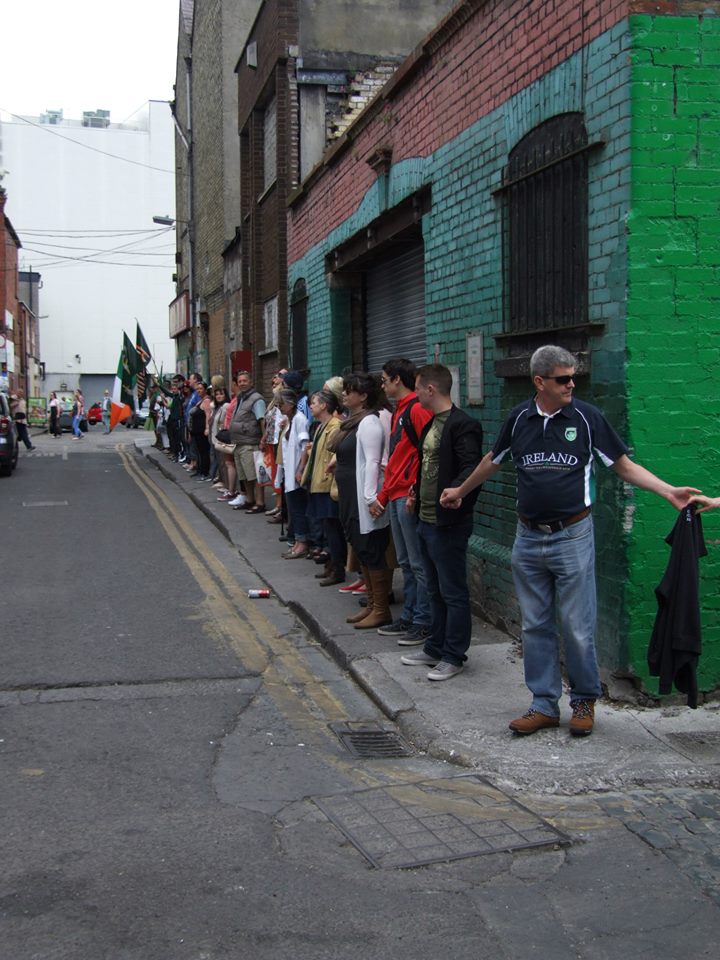
Supporters at the symbolic Arms Around Moore Street event organised by the Save Moore Street From Demolition campaign in June 2016. This is the corner of Moore Lane and Henry Place, across which Volunteers had to run under machine-gun and rifle fire from Parnell Street (at the end of Moore Lane, to the right of the photo) and at least one Volunteer died here.
But I’m digressing, Minister, my apologies. Apparently the reason they want to save that shabby terrace, that “pre-Famine street” — and the backyards and surrounding lane-ways, if you please! — is for HISTORICAL reasons. Historical!
Sure have we not had enough of history – Brehon Laws, Golden Age, Clontarf, Normans, 800 years of British occupation, blah, blah, blah! Weren’t we sick of it at school?
I’ve never liked Labour too much (somehow even the word sounds sweaty) but I have to admire their Education Ministry’s efforts to remove history as a subject from the compulsory school curriculum.
I’m sure they’re doing it for their own reasons – after all, wasn’t their party founded by that communist James Connolly? Sorry, revealing my own knowledge of history there, ha, ha! But whatever their reasons, they are on the right track.
Who wants to know where we are coming from? It’s where we ARE and where we are GOING TO, that matters!
But some people just can’t let it go, can they? They trail history around like something unpleasant stuck to a shoe. So what if 300 of the GPO garrison occupied that terrace in 1916?
The Rising, if you ask me, was a big mistake and I know plenty of people agree with me, even if most don’t have the courage to say so. Wouldn’t we be much better off if we’d stayed in the UK? And kept the Sterling currency? And as for the War of Independence …. don’t get me started!
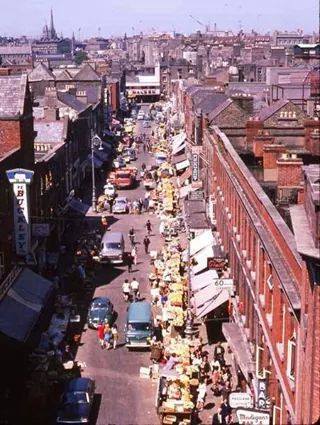
Aerial view Moore Street, looking northwards, 1960s, before the building of the ILAC and the running down of the street market.
And then there’s all that communist-sounding stuff about treating “all the children of the nation equally” — what kind of rubbish is that? Some are born to big houses with swimming pools and some are born to flats, or even rooms. That’s just the way of life.
And some will claw their way up to get to own big houses and if they are a bit uncouth, well that can’t be helped, they still deserve where they get to. And their children at least will be taught how to fit into their new station. That’s democracy! But everyone equal? Please!
Sorry, back to the Moore Street controversy. OK, after the mob pressured the Government, four houses in the street were made a national monument. But was that enough for the mob? Oh, no, not at all — eight years later the State had to buy the four houses to satisfy them.
Thankfully the specul ….. sorry, the developer, got back a good return on his investment – four million, wasn’t it? That’s the kind of thing that makes one proud to be Irish – buying run-down buildings and letting them run down more, then selling them for a million each.
That’s your entrepreneur! If only we had more like that, to lift this country up!
I must say I really liked that developer’s plan to build a big shopping centre from O’Connell Street into the ILAC, knocking those old houses in Moore Street down (although I know he had to leave those “national monument” four houses still standing in the plans).
I do hope whoever has bought the debt off NAMA and now owns those houses will carry on with that plan. Actually, I’d like the whole of O’Connell Street under glass if it were possible.
Wouldn’t it be great to do your shopping from the north end of the street to the south and from left to right, without ever having to come out into the weather? Of course, not much shopping there now, with Clery’s closed …. still ….
And then they’re going on about the market ….. traditional street market …. blah, blah. What’s wrong with getting your veg and fruit from the supermarket? Or getting them to deliver it your house, come to that? “Traditional street market” my ar….. excuse me, I got carried away there.
Those street markets are all very well for your Continentals, your Africans, Asians, Latin Americans and so on. Or for us to go wandering around in when we’re abroad on holiday, maybe. But back home? It’s the nice clean supermarkets for me any day.
Well now, if the mob insists on saving the street market, here’s an idea: why not provide a showcase stall or barrow, stacked with clean vegetables and polished fruit, right in the middle of the new shopping centre. After all, that’s heritage, isn’t it? And aren’t yourself the Minister for Heritage?
Most sincerely,
Phillis Tine-Fumblytil
Note: If you found this article of interest, why not register with Rebel Breeze for free, so that you will be notified by email of subsequent articles. You can de-register any time you wish.
Large numbers attending a rally Sunday afternoon were addressed by a number of speakers from a platform in the centre of the 1916 Terrace organised by the Moore Street Preservation Trust on part of the very site they wished to preserve.
Fintan Warfield, a Sinn Féin Senator (and cousin of Derek and Brian Warfield of the Wolfe Tones) came on stage to perform Come Out Yez Black ‘n Tans followed by Grace, about Grace Gifford’s wedding to Vol. Joseph Plunkett hours before his execution by British firing squad.
Fintan Warfield performing at the event, behind him the portraits of two of the Moore Street Garrison in 1916 may be seen. (Photo: R. Breeze)
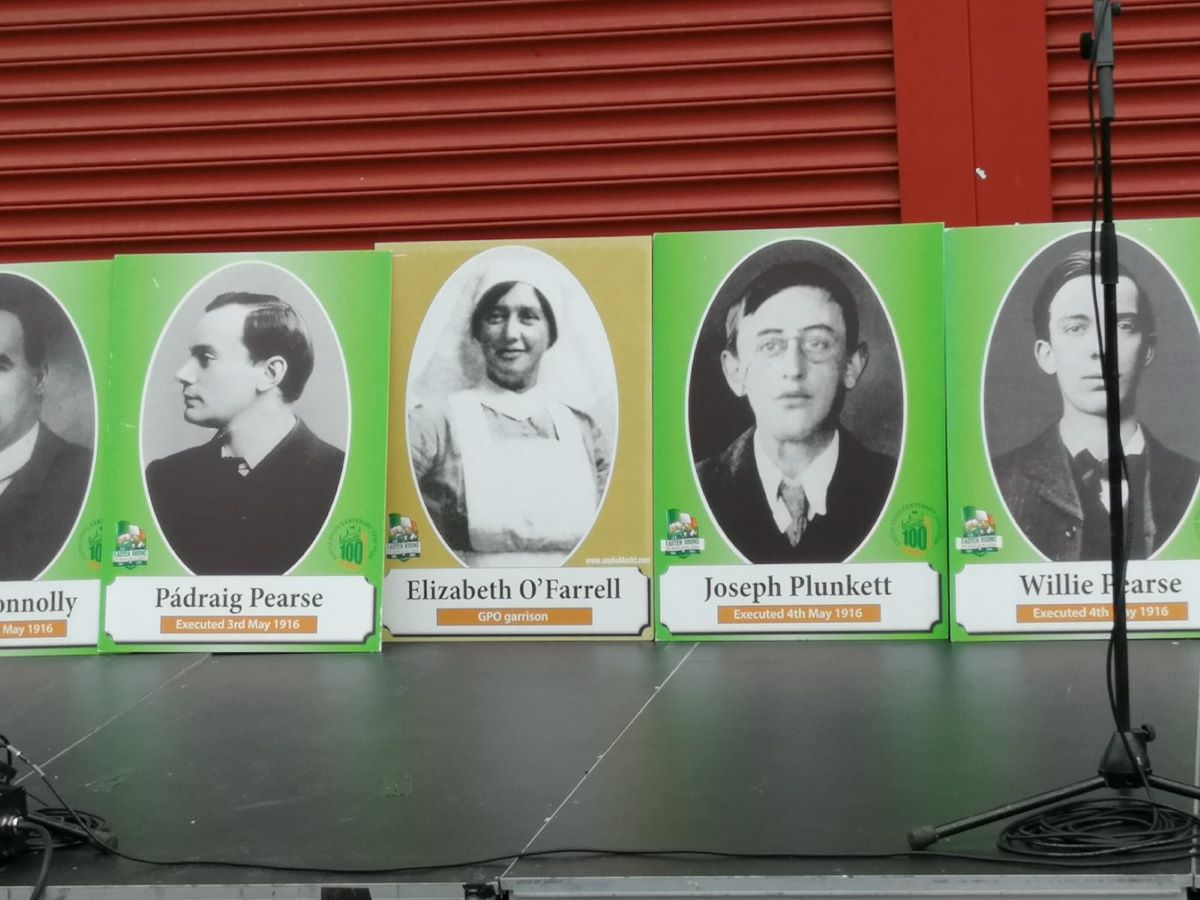
Warfield performed in front of a number of large board posters bearing the images of a number of leaders of the 1916 Rising who had occupied Moore Street in 1916 and Vols. Elizabeth O’Farrell and Winifred Carney, two of the three women Volunteers who had been part of the garrison.
The start of the rally however was delayed, apparently awaiting the arrival of Mary Lou Mac Donald, billed as the principal speaker on the Moore Street Preservation Trust’s pre-rally publicity.
Eventually Mícheál Mac Donncha, Secretary of the Trust and a Sinn Féin Dublin City councillor came on the stage to promote some MSPT merchandise (some of it for free) and to introduce the MC for the event, Christina McLoughlin, a relative of Comdt. Seán McLoughlin.
Christina McLoughline, MC of the event. (Photo: R. Breeze)
Vol. Seán McLoughlin had been appointed Dublin Commandant General by James Connolly during the GPO evacuation and was about to lead a charge on the British Army barricade in Parnell Street when the decision was taken to cancel after which he organised the surrender.
He later became a communist and was never acknowledged at Commandant level by the War Pensions Dept. of the State under De Valera, despite his rank in Moore Street and later also in the Civil War in Cork.
Sean’s relative Christina McLoughlin welcomed Mary Lou Mac Donald on to the stage.
Mac Donald’s appearance on the stage received strong applause. In fairness, many present, if not most, were of the party faithful. Despite the presence of some younger people, the general age profile was decidedly from the 40s upwards, indeed many being clearly in the later third.
Mary Lou Mac Donald, President of the Sinn Fein party, speaking at the event. (Photo: R. Breeze)
Mac Donald, who is not an Irish speaker, read the beginning of the address well in Irish before going on to talk in English about the importance of Moore Street site in the history of the 1916 Rising and in Irish history generally and how her party in government would save it.
After the applause for Mac Donald, the MC called Proinnsias Ó Rathaille, a relative of Vol. Michael The O’Rahilly, who was mortally wounded leading a charge up Moore Street against a British Army barricade in Parnell Street and who died in the nearby lane that now bears his name.
Ó Rathaille’s address was heavy in the promotion of the Sinn Féin party and, in truth rather wandering so that he had to return to the microphone after he’d concluded, to announce Evelyn Campell to perform a song she had composed: The O’Rahilly Parade (the lane where he died).
Evelyn Campbell performing her composition O’Rahilly’s Parade at the event. (Photo: R. Breeze)
Campell is a singer-songwriter and has performed in Moore Street on previous occasions, the first being at the invitation of the Save Moore Street From Demolition group who were the only group to campaign to have the O’Rahilly monument finally signposted by Dublin City Council.
McLoughlin announced Deputy Mayor Donna Cooney to speak, a relative of Vol. Elizabeth O’Farrell, one of the three women who were part of the insurrectionary forces occupying Moore Street. Cooney is a Green Party Councillor and a long-standing campaigner for the conservation of Moore Street.
Deputy Dublin Lord Mayor and Green Party councillor Donna Cooney speaking at the event. (Photo: R. Breeze)
While speaking about the importance of Moore Street conservation for its history and street market, Cooney also alluded to its deserving UNESCO World Heritage status, adding that the approval of the Hammerson plan for the street was in violation of actual planning regulations.
Next to speak was Diarmuid Breatnach, also a long-time campaigner, representing the Save Moore Street From Demolition campaign group which, as he pointed out has been on the street every Saturday for over a ten years and is independent of any political party or organisation.
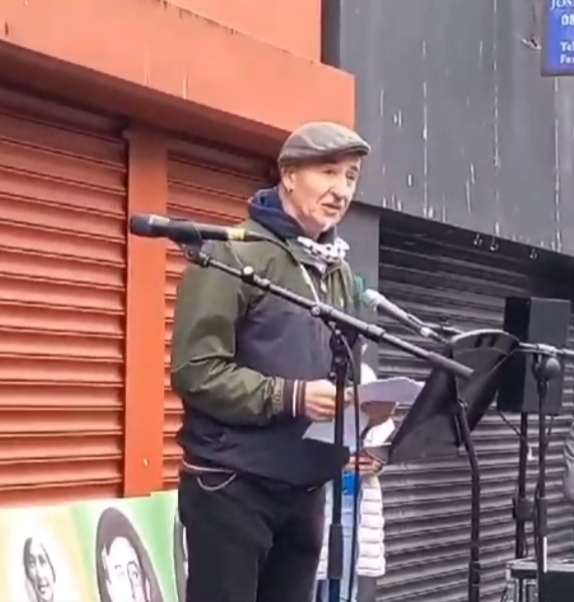
Diarmuid Breatnach speaking at event on behalf of the independent Save Moore Street From Demolition campaign group. (Photo: R. Breeze)
Breatnach also raised the UNESCO world heritage importance, as the SMSFD group were first to point out and have been doing for some years, based on a number of historical “firsts” in world history, including the 1916 Rising having been the first anti-colonial uprising of that century.
The Rising was also the first ever against world war, Breatnach said. He told his audience that the Irish State has applied for UNESCO heritage status for Dublin City, but only because of its Victorian architecture and that it had once been considered “the second city of the British Empire”.
Stephen Troy, a traditional family butcher on the street, was next to speak. He described the no-notice-for-termination arrangements which many phone shops in the street had from their landlord and how Dublin City Planning Department had ignored the many sub-divisions of those shops.
Stephen Troy, owner of family butcher shop on the street and campaigner, speaking at the rally. (Photo: R. Breeze)
Troy’s speech was probably the longest of all as he covered official attempts to bribe the street traders to vote in favour of the Hammerson plan and what he alleged was the subversion of the Moore Street Advisory Group which had been set up by the Minister for Heritage.
It began to rain as Troy was drawing to a close but fortunately did not last long.
Jim Connolly Heron, a descendant of James Connolly and also a long-time campaigner for Moore Street preservation was then called. Speaking on behalf of the Trust, Connolly began by reading out a list of people who had supported the conservation but had died along the way.
Connolly Heron went on to promote the Trust’s Plan for the street which had been promoted by a number of speakers and to announce the intention of the Trust to take a case to the High Court for a review of the process of An Bord Pleanála’s rejection of appeals against planning permission.
Jim Connolly Heron, great-grandson of James Connolly and prominent member of the Moore Street Preservation Trust, speaking at the event. (Photo: R. Breeze)
The MC acknowledged the presence in the crowd of SF Councillor Janice Boylan, with relatives among the street traders and standing for election as TD and Clare Daly, also standing for election but as an Independent TD in the Dublin Central electoral area.
MOORE STREET, PAST AND PRESENT
Moore Street is older than O’Connell Street and the market is the oldest open-air street market in Ireland (perhaps in Europe). It became a battleground in 1916 as the GPO Garrison occupied a 16-house terrace in the street after evacuating the burning General Post Office.
At one time there were around 70 street stalls in the Moore Street area selling fresh fruit, vegetables and fish and there were always butchers’ shops there too. But clothes, shoes, furniture, crockery and vinyl discs were sold there too, among pubs, bakeries and cafés.
Dublin City Planning Department permitted the development of the ILAC shopping centre on the western side of the street centre and the Lidl supermarket at the north-east end of the street, along with a Dealz as the ILAC extended to take over the space on its eastern side.
While many Irish families turned to supermarkets, people with backgrounds in other countries kept the remaining street traders in business; but the property speculators ran down the street in terms of closing down restaurants and neglecting the upkeep of buildings.
The authorities seem to have colluded in this as antisocial behaviour that would not be tolerated for a minute in nearby Henry Street is frequently seen in Moore Street.
The new craft and hot food stalls Monday-Saturday run counter to this but are managed by the private Temple Bar company which can pull out in a minute. On Sunday, the street is empty of stalls and hot food or drinks are only available in places that are part of the ILAC shopping centre.
The O’Reilly plan was for a giant ‘shopping mall’ extending to O’Connell Street and was paralysed by an objectors’ occupation of a week followed by a six-week blockade of the site, after which a High Court judgment in 2016 declared the whole area to be a National Historical Monument.
A judge’s power to make such a determination was successfully challenged by then-Minister of Heritage Heather Humphries in February of 2017. NAMA permitted O’Reilly to transfer his assets to Hammerson who abandoned the ‘shopping mall’ plan as not profitable enough.
The Hammerson plan, approved by DCC and by ABP is for a shopping district no doubt of chain stores like Henry Street or Grafton Street, also an hotel and a number of new streets, including one cutting through the 1916 central terrace out to O’Connell Street from the ILAC.
In the past dramatist Frank Allen organised human chains in at least three ‘Arms Around Moore Street’ events and the Save Moore Street 2016 coalition organised demonstrations, re-enactments, pickets and mock funerals of Irish history (i.e under Minister Humphries).
The preservation campaigning bodies still remaining in the field are the SF-backed Moore St. Preservation Trust and the independent Save Moore St. From Demolition group. The former is only a couple of years in existence and the latter longer than ten years.
However, both groups contain individuals who have been campaigning for years before that. The MSPT tends to hold large events sporadically; the SMSFD group has a campaign stall on the street every Saturday from 11.30am-1.30pm. Both have social media pages.
Fully in view, four prominent members of the Moore Street Garrison (L-R): Patrick Pearse, Commander-in-Chief; Vol. Elizabth O’Farrell, of Cumann na mBan; Vol. Joseph Plunkett, one of the planners of the insurrection; Vol. Willie Pearse, Adjutant to his brother Patrick. All but O’Farrell were tried by British court martial, sentenced to death and shot by British firing squad in Kilmainham Jail. (Photo: R. Breeze)
LEGISLATION & COURT CASES
2007 Nos. 14-17 Moore Street declared a National Historical Monument (but still owned by property developer Joe O’Reilly of Chartered Land)
2015 Darragh O’Brian TD (FF) – Bill Moore Street Area Development and Renewal Bill – Passed First Reading but failed Second in Seanad on 10th June 2015 by 22 votes against 16.
2015 – Colm Moore application — 18th March 2016: High Court judgement that the whole of the Moore Street area is a national historical monument.
2017 – February – Minister of Heritage application to Court of Appeal – judgement that High Court Judge cannot decide what is a national monument.
2021 — Aengus Ó Snodaigh TD (SF) – 1916 Cultural Quarter Bill – reached 3rd Stage of process; Government did not timetable its progress to Committee Stage and therefore no progress.
2024 – Property Developer Hammerson application to High Court Vs. Dublin City Council in objection to decision of elected Councillors that five buildings in the Moore Street area should receive Protected Structure status as of National Historical Heritage. Hammerson states that the decision is interfering with their Planning Permission. Case awaits hearing.
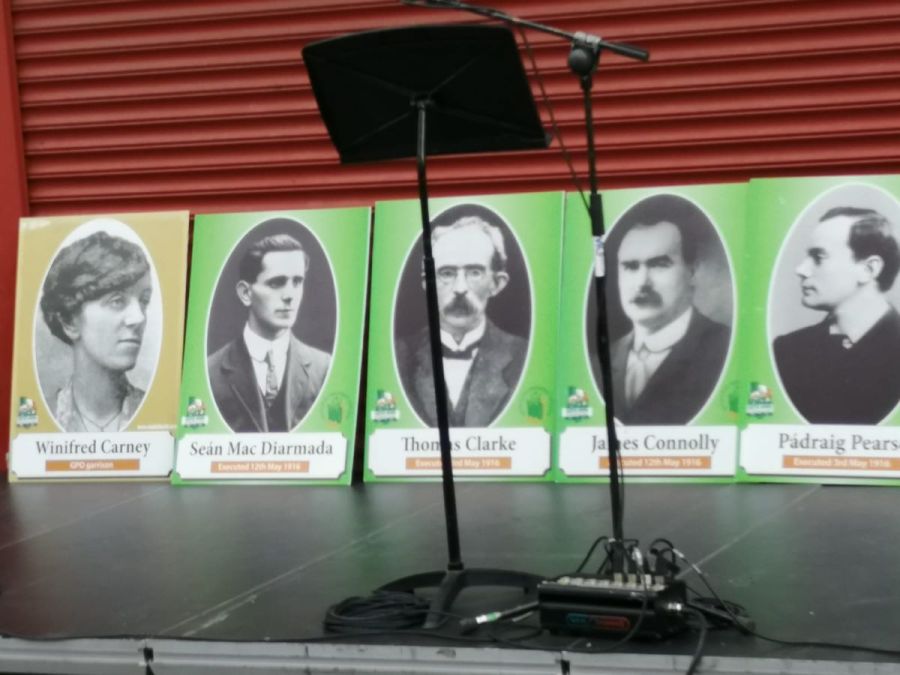
Five prominent members of the Moore Street Garrison (L-R): Vol. Winifred Carney of Irish Citizen Army and Cumann na mBan; Vol. Sean Mac Diarmada, one of the planners of the insurrection; Vol. Tom Clarke, one of the insurrection’s planners; revolutionary socialist James Connolly, Irish Citzen Army and Commandant General of the Rising (especially of Dublin); Patrick Pearse, Commander-in-Chie. All but Carney were tried by British court martial, sentenced to death and shot by British firing squad in Kilmainham Jail. (Photo: R. Breeze)
POSTSCRIPT
Someone commented later that in general the rally, from the content of most of the speeches, had been at least as much (if not more) of a Sinn Féin election rally as one for the conservation of Moore Street.
That should have been no surprise to anyone who knows that any position taken by Sinn Féin activists tends to be for the party first, second and third. And with the Irish general elections only weeks away, well …
And while Mac Donald spoke in Dublin of the importance of Ireland’s insurrectionary history and the need to conserve such sites, her second-in-command Michelle O’Neil was laying a wreath in Belfast in commemoration of the British who were killed in the First imperialist World War.







 rebelbreeze