If it is true that language at least influences the way we think, then surely it behoves us to pay more attention to our choice of words. But not only because of the influence of our words on others but indeed on us as we utter them.
Take the word ‘Ireland’ – surely a neutral one describing a geographical entity? But if we query “the population of Ireland” on line and receive a reply that the figure is 5.83 million, whereas we know it to be over 7 million, we experience at least puzzlement at the disparity in figures.
Of course, what has has occurred is that “Ireland” is being considered in political terms and the Six County colony’s population is being omitted. The reply may qualify that it is referring to “the Republic of Ireland” (as when commenting on the FAI’s football selection internationally).
But this does not really make everything alright semantically (i.e. in meaning) either. True, the Irish State holds regular elections and does not acknowledge a monarch, so it generally fulfils the description of ‘a Republic’. But that is not a historically or politically-neutral term in Ireland.
The word has a long history in Ireland as applied to the nation and was always imagined as referencing the whole geographical entity. The most influential use of the word in documentary form was probably the 1916 Proclamation, which did not in the least anticipate partition.
Even the 1937 Constitution, which formally baptised the Irish State a ‘Republic’, claimed sovereignty over the entire 32 Counties, a position that stood until the removal of Articles 2 and 3 from the Constitution by the current State in 1999.
The Football Association of Ireland is actually only the Association of the sport for the 26 Counties state and the use of “R.o.I” on the screen to refer to the State’s team during games is, as explained, deeply problematic. However the Irish Rugby Team is indeed an all-Ireland one.
As is the largest sports association of Ireland, the Gaelic Athletic Association. And also Tennis Ireland, Cricket Ireland, Table Tennis Ireland, and both Badminton Ireland and the Irish Judo Association organise on a four-province basis.1
If we call the entity the ‘Irish State’ instead we would be correct. And we could call its territory ‘the Irish state’, with a lower-case ‘s’ to distinguish between the political construction and the territory over which, in constitutional and legal terms, it holds power.
Or we could call it the ‘26 Counties.’ Or, seemingly becoming increasingly popular in some quarters: ‘the Free State’.2 But what about the entity’s parliament? That’s ‘the Dáil’, right?
That’s how we hear it described and, as “Dáil” is an equivalent of ‘parliament’ in Irish, that’s ok, right? No, not at all really; its full title is actually “Dáil Éireann” and we’ve already established that not even by Constitutional lip service does this parliament govern the whole nation.
The first time we had an all-Ireland parliament, open to election across the whole of the nation and open also to participation of all elected candidates was in January 1919 but it was banned in September by the occupying British authority, thenceforth operating under conditions of secrecy.
Then in January 1922, the pro-Treaty majority in the Dáil supported the British Treaty, including Partition, ending Dáil Éireann. There has not been a Dáil Éireann since. The most accurate brief description of the current institution is “Leinster House”.3
Is this the home of Dáil Éireann? Leinster House, west-facing side. (Image: Wikipedia).
Well, does it matter what we call them – we know what they are, right?
If it’s true that the words we use to describe things influence how we think about them, then it matters quite a lot. And how we describe them may also influence how others think about them, which also matters a great deal.
If we want to imply by the words we use that this state is independent and covers the whole nation – and that its parliament administers the whole nation – well then, there’s no need to change our words. Especially if we think that the extent of Irish sovereignty is fine or sufficient.
But if we don’t think along those lines then perhaps we need to examine our terminology more carefully and, where appropriate, amend it.
End.
Note: If you found this article of interest, why not register with Rebel Breeze for free, so that you will be notified by email of subsequent articles. You can de-register any time you wish.
FOOTNOTES
1Interestingly, I note that the Irish Ten-Pin Bowling Association (ITBA) is in the process of becoming a 32-county association.
2This was the official title of the State following its adoption of the terms of the Anglo-Irish Treaty.
3The building is actually formally called “Leinster House” since it was the city resident of the Duke of Leinster, of the Cambro-Norman invader dynasty of FitzGeralds and FitzMaurices. The Duke was Lord Deputy and at times Chief Justice of Ireland under the English Occupation.
Diarmuid Breatnach (Reading time main text: 11 mins.)
LANGUAGE IS A TREASURE CHEST – 2
I observed in Language Is a Treasure Chest 1 that while language is full of wonders, it has some horrors in it too. And I found that to be true again.
I was reading a novel in which the word “Cimarron” appeared and, doing some quick research on the word, I came across a 2004 query in an email website or page called Word Wizard:
What is the etymology of the word cimarron? I’ve always been told that it means “runaway slave” in Mexican Spanish. Can anyone verify this?
The reply is dated the same day:
From Greek. It refers to people who live in perpetual mist and darkness, akin to the ‘land of the dead’. Latin ‘Cimmerius’, Greek ‘Kimmerios’, Assyrian ‘Gimirri’ even the bible ‘Gomer’ Gen.10:2 and Esk. 38:6.
In Western United States it refers to a stretch of land that gets rainfall when other near by areas are desert year round.
Apart from the topographical reference, I thought the expert’s explanation highly dubious. And in fact I happen to know something about the Spanish-language origins of the word.
The searcher replied:
Thanks, Jim. I just wonder what connection this word has to Hispanics of Mexican origin because it shows up in their surnames (although not as common as Lopez or Vargas or Garcia).
Is it just Mexican in origin or did that also come from Spain? So the “runaway slave” theory has no foundation then?
The expert’s reply did come back with a Spanish-language connection and he may be on to something with the topography, though I think he has it the wrong way around (as we shall see).
The “runaway slave” theory is not so obsolete. Mexico did not have slaves (outlawed in 1810) but American slaves who fled to Mexico had to pass through lands with water, or else parish (sic).
When relating their tales of woe to the locals the word ‘cimmaron’ arose to describe their flight through the South West desert.
Very curiously, there was no further contribution to the discussion. I tried to leave one of my own but was required to register, which I did (though wondering if worth the trouble) and never received confirmation1.
“A view of the Cimarron National Grassland, the largest piece of public land in Kansas, a 108,175-acre property in the southwestern part of the state. It was recovered from the Dustbowl ecological devastation by soil recovery and management practices.” (Photo source: The Armchair Explorer – Kansas)
THE FOLK MEMORY WAS TRUE
Continuing with a little light online research I found that the Castilian-language (Spanish) origin is the explanation most often given, with rarely a reference to Greek or other classical or archaic languages. For example, in yourdictionary.com:
American Spanish cimarrón, wild, unruly (from Old Spanish cimarra, thicket): probably origin, originally referring to the wild sheep (bighorn) found along its banks.
(Latin America, of animals) feral (having returned to the wild)
Synonyms: alzado, bagual, feral
(Latin America, of people) rural; campestral
(Latin America, of plants) of a wild cultivar.
But …. what about the “runaway slaves”? Under the title Cimarron People, Wikipedia has this to say: The Cimarrons in Panama were enslaved Africans who had escaped from their Spanish masters and lived together as outlaws.
In the 1570s, they allied with Francis Drake of England to defeat the Spanish conquest.
In Sir Francis Drake Revived (1572), Drake describes the Cimarrons as “a black people which about eighty years past fled from the Spaniards their masters, by reason of their cruelty, and are since grown to a nation, under two kings of their own.
The one inhabiteth to the west, the other to the east of the way from Nombre de Dios”. (location in Panama — DB)
We may indulge ourselves in a sardonic smile at commissioned pirate Francis Drake talking about the cruelty of others, or about slave-owning by a country other than England in 1570.
But we remember also that at the time Spain was the main competitor with England in the rush to plunder the Americas – and had got there well before them.2 Both colonial powers were already plundering Africa for raw materials and slaves.
The meanings of animals having gone “feral” or “returned to the wild” would easily have been applied by the society of the time to escaped African slaves.
A European society which, despite evidence to the contrary including agriculture in Africa, would have considered indigenous inhabitants of Africa as people living in the “wild”. Once escaped and no longer under European control, they would be seen as “returning to the wild”.
So what happened to the Cimarron People? Their settlements were subject to punitive raids by the Spanish, killing people and burning crops, so that in the end they came to a treaty with their old enemy.
The Wikipedia entry says no more except that the “Cimarrons” and the English quarrelled (not surprising, given that they were of no further use to the latter).
I believe some of their settlements in Florida were raided and burned by US “pioneers” and soldiers, the remainder becoming part of the Seminoles, a native American tribe that resisted the USA in the longest and most costly of the USA’s wars against the indigenous people.
The Seminole had many tribe members of part-African origin in their midst.
And here – a surprise: The word “Seminole” is derived from the Muscogee word simanó-li, which may itself be derived from the Spanish word cimarrón, meaning “runaway” or “wild one”!
So, in line with what that on-line searcher back in 2004 had heard, no doubt a folk belief, the word cimarronis, in Mexico (and in the USA), of Castillian (Spanish) language origin and is connected to escaped slaves of African origin.
Some of the sources for “cimarron” also give us “marron” or “marrón” which is also related to escaped slaves and, in English, became “Maroons”. These were escaped slaves inhabiting mountainous regions of Jamaica and elsewhere and became a great problem to English settlers.
The latter had taken the island from the Spanish but they failed totally to quell the Maroons, these emerging victorious in many military engagements.
In the Cockpits area of Jamaica, I have read, there is a place called Nanny Town, which is believed to be one of the settlements of the Maroons; their chief was said to be a woman called “Granny Nanny”3, whether because of her former slave occupation or for other reason4.
In the end, like the Spanish with the Cimarron People, the English had to treat with them. Sadly the treaty required the Maroons to return newly-escaped slaves, which they did and for which they received payment.
Maroons in treaty with the British, shown here in a reversal of the actual power relations in the “Pacification with Maroons on the Island of Jamaica”, by Agostino Runias (1728-96). (Source image: Internet)
However if instead of being a voluntary escapee to go to a wild place, you were forced by people or circumstance, well then, like Alexander Selkirk’s “Crusoe”, you’d be “marooned”!
Well then, what about the “cimarron strips” in the southwest of the USA? Could the word refer to strips of land “gone wild”? Or could the expert replying to the question in 2004 have been on to something?
If the slaves escaping through the desert from the USA to Mexico did indeed make their way through strips of watered land (not just for the water, as the expert speculates but for vegetation to conceal them), then there is a connection between escaped slaves and these strips of land.
But not as the expert sees it, rather the other way around: since the escaped slaves, the “cimarrones” were travelling the strips, they would be called by those who knew about it (escapee hunters, escapee helpers and just observers), “cimarron strips”.
Or in other words, “those strips through which the runaway slaves travel.”
2. CHRISTIAN ETHNIC PREJUDICE
However, if the word comes from Castilian (Spanish) what were the origins of the word in that language?
Perhaps a year before this word-quest, I was reading a book that described the Spanish State as having been characterised, contrary to many other European states, by mass expulsions and exiles on a number of occasions throughout its history5.
First on the list of expulsions was the well-known example of the Moors and the Jews.
Those who were not slaughtered by the forces of the “Christian Monarchs” of Ferdinand and Isabella in the “reconquest” were obliged to convert to Christianity or to leave “with only the clothes on their backs”. This also occurred in Portugal.
Those Jews who left were the Sephardim or Sephardic Jews, who spoke Ladino, an archaic kind of Iberian Romance6 language with Aramaic and Hebrew words, along with the Moors, who spoke an Iberian-Arabic mixture or Arabic.
The key of their houses or gates have been handed down to this day in families of both groups.7
Many converted, often referred to by Christians as “conversos” (Jews) or “moriscos” (Muslims) but were constantly under suspicion of reverting to their old religion even with the threat and constant trials and torture of the Spanish Inquisition.
According to what I have read the latter too were sometimes called “marronos”, i.e in the eyes of the Spanish Christian ruling class, those who had been “domesticated” (Christianised) but had “returned to the their wild way” (Moslem), i.e “gone feral”.
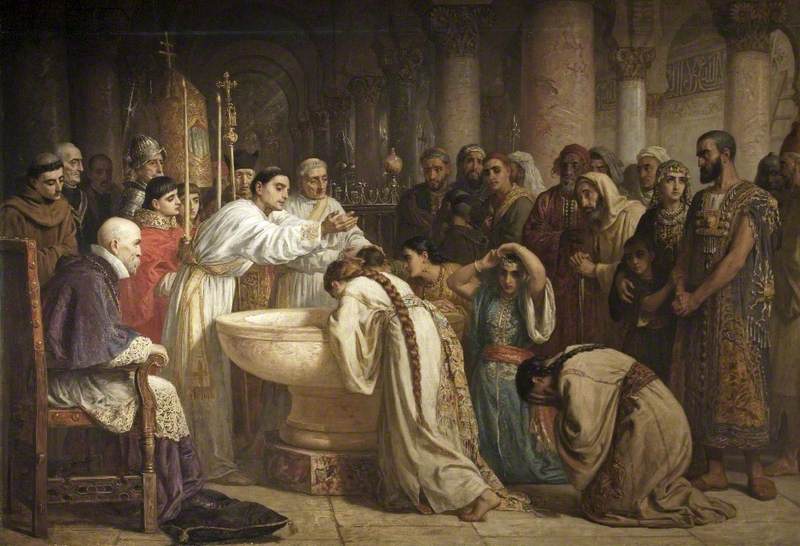
Forcedconversionsthat had to appear genuine: “The Moorish Proselytes of Archbishop Ximenes”, Granada, 1500 by Edwin Long (1829–1891). (Image source: Internet)
Wikipedia on Marrones in Iberia confirms: The (Spanish) Inquisition was aimed mostly at Jews and Muslims who had overtly converted to Christianity but were thought to be practicing their faiths secretly. They were respectively called marranos and moriscos.
However, in 1567 King Phillip II directed Moriscos to give up their Arabic names and traditional dress, and prohibited the use of Arabic. In reaction, there was a Morisco uprising in the Alpujarras from 1568 to 1571. In the years from 1609 to 1614, the government expelled Moriscos.
3. THE BUSH FROM THE NUT?
And is “ci” or “cy” in “cimarron” then merely a prefix? The word “marrón” exists as a colour in Castilian and a number of Romance languages and came into English as the colour “maroon”.
Its development is taken as originating from the colour of the large ripe edible chestnut, rather than given to it later. Of course there are a number of words for colours or tints which have a botanical origin, “orange” being an obvious one.
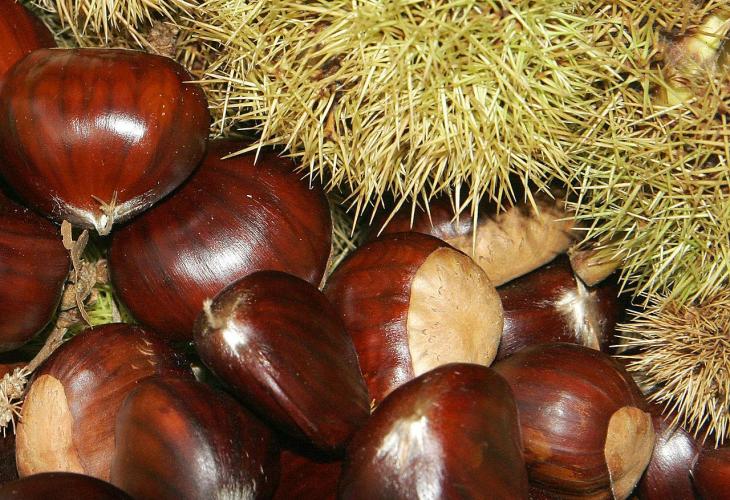
Castanea Silva, the edible or Sweet Chestnut in Mallora. (Image source: Internet)
Alright, then the nut and tree might have been associated with uncultivated or “wild” areas, similar to those to which the “cimarrons” would escape.
But where did the “ci” suffix come from? Somewhere in the midst of what I have been researching I came across an explanation, derived from Latin, meaning “towering”, “high” etc. But can I find it now? No.
The online sources are telling me that the relevant pages are up for deletion and I can join the discussion. No thanks, I do not have anything like sufficient knowledge to enter a debate on that, nor the patience of an academic to research it thoroughly.
But “high” and “wild” could easily correspond, given that valleys and plains lend themselves more easily to cultivation, as a rule, than mountainy areas, which might remain wooded or with with thick undergrowth.
And that might also give us the “bush” or “thicket” referred to in a number of references for “cimarron”, which in turn might describe the “cimarron strips”. In parts of Latin America such as Chile (and for all I know, in all of them), a “cimarra” is also a thicket or densely-grown area.
The article in the Language Journal (see reference) comments that the “arra” cannot be a Romance language word-ending.
But even if true it seems to me that the author (or authors) quoted might be unaware that among those from Iberia who colonised or settled in the Americas, Romance language speakers were not alone. There were also Basques who spoke Euskera/ Euskara.
And for evidence, they applied a number of toponyms and left family names from the Basque Country (Basque descendants make up to 10% of the population of some Latin American countries). And “-arra” would be a common enough suffix or word-ending in Euskera.8
Opening title for the weekly TV Western series ‘Cimarron Strip’, starring Stuart Whitman, Judy Gleeson, Percy Herbert and Randy Boone. Though popular, only a years’ worth of episodes were screened. (Image source: Internet)
OKLAHOMA PANHANDLE AND THE CIMARRON STRIP
In the 19th Century wars between the Mexican Republic, the USA and the Native Americans in the area, the area was carved up with less and less left to the Native Americans.
Prior to the American Civil War, white Texas wanted to join the Union as a slave state and due to a US federal law prohibiting slavery north of 36°30′ parallel north, white Texas surrendered a strip of land north of that latitude.
The settlement (temporary of course), left a strip as “Neutral Territory” (one can only imagine the temptation for African slaves in Texas to make for there). After the Civil War big cattle ranchers moved in, disregarding treaties and named the area the Cimarron Strip.
Map of Oklahoma territory and “Neutral Strip” before the American Civil War. (Image source: Wikipedia, Texas Panhandle)
But that was because the word ‘Cimarron’ was already in the area, from the “Cimarron Cutoff” leading to a crossing of the ‘Cimarron’ river.
And yes, there was a popular 1967-1968 TV series called “Cimarron Strip”, starring Stuart Whitman. But, though I have watched it, that is only faintly related to the story of the word that set me out on this quest.
End.
FOOTNOTES
1Which days later had still not arrived – perhaps the site is no longer in operation, which would explain the silence after those two posters.
2Columbus voyage to America 1641 and Spain’s first colonial settlement 1565 (now Florida); Mayflower expedition to America with English settlers 1587 (now Virginia). However, Europeans had founded settlements much earlier, as with the Norse in the 10th Century and very likely Irish monks in the 6th Century. But it was the English and Spanish who conquered most, the Dutch, French and Portuguese less. The descendants of the English settlers after gaining independence from England completed the seizure and colonisation of most of the North American continent, while English colonists remaining loyal to the English Crown seized land to form what is now Canada.
4All the folk tradition, albeit conflicting on some points, declares that she had not been a slave which leaves one to wonder how she might have reached Jamaica from Africa without having been enslaved.
5I borrowed the book from the public library and cannot remember its title at the moment. Interestingly it mentioned Ireland as having the only comparable history (though of course there the ‘expulsions’ were due to colonial occupation rather than actions of the indigenous state.
6“Romance languages” is a name given to the group of Indo-European languages including Castilian (Spanish), Catalan, Galician, Portuguese, Romanian, Italian and French. They are sometimes called “Latin-based” or “Latin Languages” but there is some dispute about the origins and developments of these languages.
7Ironically, the door or gate “key” is also a symbol of return for Palestinian refugees driven from their homes by Zionist massacres, threats and fear during the founding of the State of Israel.
8Among toponyms of North America’s southwest, Durango (Colorado and Mexico), Navarro and Zavala Counties (Texas) are perhaps the best known; while Aguirre, Arana, Bolívar (Bolibar), Cortazar (Kortazar), Duhalde, Echevarria (Etxebarria), García, Guevara (Gebarra), Ibarra, Larrazábal, Mendiata, Muzika, Ortiz, Salazar, Ugarte, Urribe and Zabala are but some among a host of family names of Basque origin from the American south-west in Latin America. And of course the country of Bolivia, from Simon Bolívar, a Basque surname from a Basque toponym.
Excerpt on-line from Language journal, Linguistic Society of America, Leo Spitzer, Vol. 14, No. 2 (Apr. – Jun., 1938), pp. 145-147: https://www.jstor.org/stable/408879?seq=1
Language is many things and only part-things too and languageS are only part of languaGE. All humans have it to some extent and some animals also. It communicates but it is not in itself communication. That might sound weird until you realise that when you say Ouch! or Oh! you have usually communicated pain or surprise to anyone within hearing but without any intention of doing so. So language must be intentional communication and that means it can be used to communicate information we believe to be true — but also that which we do not. I think it was Umberto Eco who commented to the effect that if you can’t lie in it, it is not language.
Of course, we do other things with it apart from just communicating our sense or reality or being deliberately false – we can add overtones of emotion, playfulness, disdain, love, respect, hate and many other things besides. If we could not, poetry, acting and novels would not exist in our cultures.
NON-VERBAL
It is strange to think that language is only the minor partner in a human communication system. We are told non-verbal communication is 73-91% of our communication1 and that that words are only part of even the verbal – which contains – apart from non-verbal sounds — also articulation, volume, tone, pitch, speed, rhythm and the pauses in between words or phrases. If we understood only words themselves we would stumble through interactions with other humans as through a mist. There are people who suffer something approaching that condition, in fact.
Despite its comparatively minor role in communication, we relate language to the spoken and intentional communication by the very name we give it: language, from langue, French for “tongue” and indeed in slightly archaic English, we use the word “tongue” also, as in “speaking in tongues” or “in a foreign tongue” for example. Not just in English – for example in Castillian (“Spanish”), lengua and Irish, teanga.
But there are other words too, even in those languages, for example idioma in Castillian and béarla in Irish. Wait a minute, doesn’t béarla mean the “English language”? With a capital letter it does, as we use it now but originally it was Sacs-bhéarla, i.e Saxon language2. I would hazard a guess (but avoiding doing the research) that the word “béarla” is related to béal, i.e “mouth”3. So, still something spoken and the German has that too, with its word for language: sprache (from “speaking”).
Not all languages are spoken and there are systems of codes and also sign languages, of which there are an estimated 300 in use around the world4, divided into deaf sign languages, auxiliary sign languages and signed modes of spoken languages.5 We all use auxiliary sign language, for example in traffic signaling to turn left or right, in pointing “over there”, in indicating “come” and “go” and to insult (various in different cultures) along with “maybe” or “sort of” (hand outstretched palm down, level, then wobbled a little one side to the other). We use a surprising number of those if we stop to count them and those are only hand-signals, without taking into account soundless movements of head, lips, eyes, eyelids, eyebrows, shoulders ….
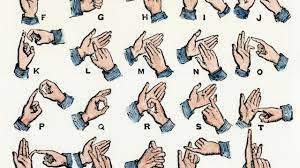
One of a number of alphabet sign languages, this one two-handed. (Image accessed: Internet)
Some work-trades or specific operations have their own signal-systems too and, for example, in sub-aqua in Europe at least, the “thumbs up” doesn’t mean what it does on land but rather the need to swim to the surface.
My brother Oisín expressed the interesting speculation that the Irish pre-Roman letters system of Ogham could have been used as a sign language also, using the position of fingers across the face. As the European invasion into parts of America pushed tribes out of their traditional areas, many met on the Great Plains and, lacking a common spoken language, developed a common sign language. Early European traders, hunters and explorers learned parts of that sign language too.
Many animalsuse sign communication and some of it, in animals of higher intelligence, is intentional,6 which means it is language. However we run into problems with that qualification in some cases: bees are not animals of higher intelligence and yet a worker bee acts out a “dance” to indicate to the hive where much nectar and pollen may be found, direction and distance included and clearly the communication of information is intended. However, one supposes that while the bee could not lie, those animals of higher intelligence have the ability to do so, for example pretending nothing is wrong (when it is) or that they have not just transgressed some prohibition (when they have) or that they do not intend to do so (when they do).7
A cleaner wrasse enters the mouth of a cod to remove its parasites; the cod holds its mouth open until the cleaner finishes. But the cod also comes to the ‘cleaner station’ and indicates its wish to be cleaned by remaining stationery and wobbling slightly from side to side. (Photo accessed: Internet)
There are, as we are all aware, many different spoken languages in the world but we may still be surprised by just how many: 6,500 according to one on-line source and 6,700 to another8. One state or country alone may be host to many; ask for a phrase translated to Nigerian language and you may be asked to specify which of over 500 languages you mean.9
And then there are dialects, distinct forms of the same language. People learning Irish sometimes complain that Irish has four (or five, by some calculations) main dialects: different words for the same things, distinct pronunciations of the same words ….. They rarely reflect on the different dialects in the language to which they are accustomed: for example, English may have the most dialects in the world, across English-speaking countries and even in Britain (anyone who doubts this should listen to typical examples of Newcastle, Glaswegian and South London speech). The English imposed a southern dialect as their standard but although a standard has been created in Irish too (an chaighdeán) it has official versions in the main dialects, in addition to non-standard Irish forms being recognised as valid in writing. This may make learning Irish seem more difficult to a learner but, apart from the respect this shows to different regional cultures, one might ask how well learning standard English equips one to exchange communication effectively at certain societal levels in many of the English-speaking cultures of the world.
Map of language groups in Nigeria (Photo accessed: Internet)
ONE WORLD LANGUAGE?
The Christian Old Testament (also containing a number of Hebraic texts) gives us the fable of how those who in their arrogance tried to build a tower to reach God were inflicted with so many languages that they could no longer understand one another, thereby causing the failure of the project. The fable is usually called the Tower of Babel (the words “babble” and “babbling” are supposedly not derived from it but I wonder). The fable seems a harsh judgement on the value of different languages in the world but even some atheists have expressed a wish to have only one language so that we could all instantly understand one another – and some socialists are not free of this notion and consequently disdain national cultures and languages.
As different cultures met one another across the world some types of languages in common have evolved, generally categorised as either pidgins or creoles. Both kinds are composites of two or more languages but a pidgin remains a second language while a creole becomes a mother tongue10. “Pidgins have been particularly associated with areas settled by European traders; examples have been Chinook Jargon, a lingua franca based on an American Indian language and English that was formerly used in Washington and Oregon, and Beach-la-mar, an English-based pidgin of parts of the South Seas. Some pidgins have come to be extensively used, such as Tok Pisin in Papua, New Guinea and the pidgins of the West African coast11.”
Traffic sign in Tok Pisin, one of the world’s pidgin languages (Photo accessed: Internet)
We know also of the past existence of a north-sea maritime pidgin that included words in Euskera (Basque) and Nordic and no doubt others have existed, probably at different times Phoenician or Greek or Chinese-based. Certainly there was a Norse-English-Irish one in existence which became a creole. Perhaps for a short while there was an Irish-Norman one too, before most of the settled Norman conquerors became Irish-speaking12. The Jewish community languages of Yiddish and Ladino probably started off as pidgins but became creoles, based in the first case on German and the second on archaic Spanish.13
Kouri-vini is a French-based creole spoken by less than 10,000 people mostly in the USA state of Louisiana.14Patois, Patwah or Patwa is a Jamaican Creole spoken in Jamaica and among parts of its diaspora15. “Notable among creoles is Haitan Creole, which grew primarily from the interactions between French colonists and enslaved Africans on Haiti’s plantations.”16 The Irish Traveller language, Shelta,Cant or De Gammon is also a creole, containing words from Irish, Latin and Romany as well as English.
ONE WORLD LANGUAGE?
To have a world language in addition to others would be no bad thing of course and there have been some attempts at that but never one that succeeded in encompassing the whole world; English has probably come closest, so far. That language had the earlier backing of the largest colonial empire the world has ever seen, the British but now primarily has the backing of the world’s strongest super-power, the United States of America17. In the past, English competed for world cultural dominance with French and both were agreed as official languages for shipping and air transport based sorely on the colonial power of both states rather than the number of speakers, in which case Chinese and Spanish would have been chosen. In earlier times, German was spoken over most of central Europe from Poland to Germany and in the Tyrol. Still further back in the past, Latin, because of the power of Rome and Greek, partly through its earlier colonisation but also through its science and culture, were widely spoken across large parts of the world. Still, even in the Roman Empire, many spoke only a few words of Latin, even in Rome itself at the height of its dominance, where Greek and Hebrew might be more common.
States where English is the official language (Image accessed: Internet)
Before its conquest by Roman legions and the destruction of its culture, a Celtic language or group of languages known as “Gaulish” was spoken from what is today the Italian side of the Alps to what is now northern France and possibly variants of it also in Iberia. Today, Gaulish is gone and of the Celtic languages, only Irish, Scots Gaelic, Manx (the Q-Celtic group) and Welsh, Breton and Cornish (the P-Celtic group) remain. Latin is no longer a spoken language.
Esperanto was conceived of as a world language, though largely euro-centric in origin and for a time was popular as a project with many socialists18. It is still in use but estimates give us a figure of only 100,000 speakers at present19. However that number may grow, through the Internet for example and as a project to internationalise ease of communication while at the same time resisting the current linguistic dominance of the US empire.
Even within one state, the need for a common language may struggle with the claims of different languages or even varieties of the same language. For example many different languages and varieties of language were spoken across what is now Italy and the unification of all that variety into a one-State Italy was assisted by the imposition of standard Italian20.
Huge states with many languages on the African and South Asian continents have adopted the languages of their colonisers as languages of state, which is why so many people from those parts of the world can speak English in addition to their native tongues (or French, especially in parts of Africa).
The adoption of a common language for use across different cultures and languages has its advantages but also its dangers, in particular for those languages that find themselves at a power disadvantage. Those languages may suffer a lowering of respect among speakers of the dominant language and, in time, even among their own native speakers. They can struggle with reduced resources in education, publishing or physical resources in their heartlands. They can even be forbidden and their speakers punished.
REPRESSION OF LANGUAGES
In fairly recent times child-speakers of Welsh and Irish were punished in school for speaking their maternal tongues, one example being the count of physical blows to be inflicted by a teacher for the number of words spoken in the forbidden language. That was an expression of the cultural domination of British colonialism through the English language21 in the respective conquered nations and it has a history dating back at least to the 14th Century in Ireland when a number of attempts were made to prevent its settlers from speaking Irish.22
Euskera (Basque), Asturian, Gallician and Catalan were all banned or restricted at different times in the Spanish kingdom and most definitely banned under three decades of the Franco dictatorship. Breton, Catalan, Corsican and Euskera are not forbidden in France but they do suffer from under-resourcing in education and infrastructure.
Irish suffers similarly in the British colony of the Six Counties and also in the Irish state despite being officially the latter’s first language.
Kurdish was forbidden in any official domain in Turkey and its speakers still suffer discrimination. Esperanto was banned by the Nazis and the Franco regime and though never officially banned in the Soviet Union, Esperantists did suffer severe persecution there for a period under Stalin23. Native Peoples’ languages were banned in the state (and many Christian) schools in the USA and in Canada.
As a result of past repression, cultural domination, starving of resources and other factors, 40% of languages in the world are in danger of extinction24, according to UNESCO, a great number of those being of colonised peoples.
LANGUAGE IS MUCH MORE THAN COMMUNICATION
Earlier on, we noted that as well as variations of tongue and speaking, there is another word forlanguage which we find in Castillian (Spanish) as idioma. There is a reflection of that word in English too, in idiom25, which a dictionary explains as
a group of words established by usage as having a meaning not deducible from those of the individual words (e.g. “over the moon”, “see the light”).
a characteristic mode of expression in music or art. (e.g. “they were both working in a neo-impressionist idiom”)
Digging deeper into the origins of the word, through etymology, we find: late 16th century: from French idiome, or via late Latin from Greek idiōma ‘private property, peculiar phraseology’, from idiousthai ‘make one’s own’, from idios ‘own, private’.
Clearly it cannot be private, by very definition of language, but language is ‘owned’, it does ‘belong’. It belongs to the culture from which it comes. It can be shared, of course but some at least of it always remains an expression of the culture that gave birth to it, that moulded it over centuries. And even of its adoption of other words, expressions or concepts in the course of its development.
The language of a culture expresses its way of seeing, its understanding of aspects of the world around it and how it sees itself. That also finds its expression in song, poetry, instrumental music, yes and even visual art.
When a language is lost, so is all that. And so too is the future of that language and its mother culture. It may be replaced of course. And the dead language may carry much of its furniture, baggage and knick-knacks into its replacement home26. But not all – much is lost and lost forever. Especially that language’s future – where it might have gone, could have become.
Bilingualism is good and multilingualism better but the better bilingual or multilinguist is aware, as is a good translator, of the many different ways of speaking and seeing and also the less than satisfactory experience of translating some expressions from one language into another. In the latter case, we search for approximations.
According to UNESCO, 40% of languages in the world are in danger of extinction27. According to the same organisation, Irish is one of 12 languages in the EU area that are in danger28. The loss of such a language would be a pity anywhere but perhaps particularly damaging for a small nation struggling to develop to serve the people it encompasses. Irish predates English by centuries and has a wide body of literature and artistic expression form and was the earliest expression in Europe of literature in the vernacular, i.e in the language of the common people. The harp is our oldest recorded musical instrument and also our national state symbol …. but its playing was often accompanied by spoken, chanted or sung words. In Irish. Most our place-names even in their English forms retain their Irish origin, including 29 of our 32 Counties.
Languages of Europe and their respective groups (note that Basque is an “isolate”, i.e not recognised as belonging to any other group; note also the current position of two languages of formerly great European reach: Greek is much reduced and Latin non-existent). Kurdish, of the Iranian family, does not appear appear because its area is out of view on the Turkish part of the map. (Image accessed: Internet)
A world containing one, two or three languages only may seem useful but it would kill so much history, so much variety in the world around us. Ultimately perhaps, even with globalisation and internet, speciation of language might take place, as areas developed dialects that might possibly develop into new languages. We don’t know that would happen, however and it makes sense to hang on the variety in the world at the moment. To spend some time, effort and yes, even physical resources to protect languages that are in danger. To speak more than one language ourselves and to protect our own if it is threatened. The strategies to carry out that protection are subjects for another day’s discussion. But first we have to understand the value of doing so or at the very least, some idea of what its loss will cost us.
We might begin by learning some Irish and speaking what we know of it – in Ireland, most everywhere. Beatha teanga í a labhairt29.
2In all the surviving Celtic languages, the English are still referred to as “Saxons” (e.g in Irish Sacsannach/ aigh, which became Sasanach/ aigh), which testifies to an enduring memory (and not a good one) of the people who overran the Celts in much of Britain many centuries ago.
3and that word can be found in many place-names around Ireland, usually denoting a river-mouth and corrupted in English to “bel”, as in Belmullet in Mayo and Belfast.
6Most of it, however (like our own), is unintentional: the startled cry and flight, the erection of ears to hear better or to focus, the turning of the head to look in the direction of movement, sound or scent, etc. All of those actions communicate information to neighbouring animals (even of different species) but they are not intentional.
7Most will have seen this behaviour perhaps in dogs, cats or pigs.
12The Yola of Wexford was more an ancient English sprinkled with Irish words.
13Of course, Hebrew is a Jewish language and many of its words are to be found in both Ladino and Yiddish but for centuries there were many more speakers of those creoles than there were of Hebrew.
15I heard it often enough in my decades in London.
16https://www.britannica.com/topic/language/Pidgins-and-creoles (and perhaps its survival is partly due to the fact that 1) the African slaves were from different language groups and 2) that Haiti was the first slave colony to achieve liberation in a successful uprising (1791-1804))
17Yet even there Hispanic has made great penetration from some US states, from Latin America and from the Caribbean.
18I use the word here to include reformist social democrats and revolutionary communists and anarchists.
21The irony here is that English is historically a fairly new language, a fusion of in the main of Anglo-Saxon with French, in which the latter is the origin of around 60% of its words.
22The Statutes of Kilkenny in 1366 castigated the Anglo-Normans who had conquered parts of Ireland and settled in them as “the degenerate English” who had “become more Irish than the Irish themselves” through their adoption of Irish customs and culture. The Statutes forbade the now Irish-Normans from adopting those cultures and from speaking Irish (without success except in the heart of the colonial administration in Dublin).
25In fact, reading a discussion on this word alone can teach us so much about language, expressions we use without thinking and how language works.
26Generations that have not spoken Irish still retain not only some words from the language but even forms of construction and of pronunciation. Take for example the reply to “Will you go?” as “I will” or “I won’t”, because in Irish there are no words for “yes” or “no”. Or to say “I have a thirst on me” instead of “I am thirsty” (very close in fact to the “I have thirst” in Romance languages – e.g tengo sed or j’ai soif). Hear also the pronunciation of a hidden vowel between L and M (or R and N) in pronouncing the Irish name Colm and words like “film” (fil-um).
In the midst the protests in Colombia the press can be heard denouncing the vandals and various politicians from the left and right have echoed these criticisms in one way or another. The headlines speak of the destruction of private property and in some cases they try to mark a distinction between what they say is legitimate protest and vandalism.
The word “vandal”, means someone who commits acts pertaining to savage and destructive people and is who destroys a public asset or installation. Other definitions speak of destroying or damaging what is beautiful. It should be said that the Transmilenio mass transport system stations are not one bit beautiful. But should the youths be ashamed or proud of being called vandals?
Resisters in Colombian city of Madrid shelter behind makeshift shields as they are bombarded with water canon in May 2021 (Photocrdt. Juan Pablo Pino, AFP/Getty)
We should look at the origin of the word. The first vandals were Germanic tribes that in 455 A.D. attacked and sacked Rome carrying away great riches and also destroying buildings, amongst them the Temple of Jupiter, though there is some dispute about the severity of the destruction of the city. However, they went down in history as the vandals who destroyed that city. The more modern use of the person who destroys public assets or private property or damages what is beautiful dates from the middle ages and its use is widespread nowadays.
Of course when Vicky Dávila and other right wing journalists speak of vandals they are not talking about Germanic tribes, or at least that is what we believe, though with Vicky even drug traffickers, paramilitaries and corrupt politicians are decent folk, so one is never sure about the meaning of the words that fall from her lips like the Police stun grenades.
“The Police rape and murder” (Photo: G.O.L)
But words and their meanings are not set in stone. Some words enter a language and in short time fall into disuse, others last for centuries and some come back to life when least we expect like when Kim Jong-un’s translator used the word “Dotard” to describe Trump. That word hadn’t seen the light of day since the US Civil War in the 19th Century. Other words simply change their meaning, sometimes slowly and on other occasions they do so more abruptly.
The press has used this word so often to describe and disparage the social protests that we may be witnesses to another change in meaning. The bourgeois press has emptied the word of any meaning and now in the marches people can be seen with placards that say Vandal’s Honour and in social media there are memes doing the rounds on the subject. One of them says “The country turned upside down and this one says, what are you and I? Well, vandals my love.” They used the word so often to describe any act of rebellion, nonconformity or to and try and shut down and discredit the demonstrators that it has lost its power, its meaning. Now it is a badge of honour for many. Vandal no longer means a savage destructive person but rather a person who fights to be heard, for justice. A vandal is whoever fights against Duque, neoliberalism and poverty.
The word is changing its connotation and once again it is closer to its original meaning, a tribe that defied an Empire, although in this case the Colombian emperor seems more like the Emperor Nero (54-68 A.D.) who played on his Lyre whilst Rome burned than the poor Petronius Maximus who only lasted a few weeks in power. Duque doesn’t play the Lyre but rather the Guitar, but there he is and Nero’s regime was one of extravagance, waste and tyranny and Nero in the middle of it all playing on his Lyre.
The sacking of Rome in 455 A.D. was the third sacking that the city suffered. There were a further five sackings after the Vandals. It should be remembered that the Vandals sacked the capital of a decadent Empire that deserved to be extinguished.
Burnt out bank from 2006 (G.O.L)
So as the meme puts it, ask the question, what are you and I? And answer:
We are Vandals my love, we damage the hated system of mass transport built with public funds legally stolen to set up a private transport business which to top it all takes 94% of the profits of a business and barely contributes a penny to its own maintenance.
We are Vandals my love, we destroy banks that receive more subsidies from the state than the poor who are denied loans by these banks, which don’t hesitate for a single moment to confiscate the houses of the poor.
We are Vandals my love, who in the face of the lives and censorship of the bourgeois press make our smothered voices reverberate on the walls of the city. Who needs Twitter when you even the poorest can see the walls?
We are Vandals my love, who in the face of the attacks by the Police throw rocks at them that are found all about the place in the poorly built public infrastructural projects, in a country where the thieves don’t know how to build a pavement and where half the bricks are badly placed.
We are Vandals my love, we fight against a decadent government and system.
We are Vandals my love, and our favourite letter is V:
V for Vengeance on the rich that kill us, rob us and lie to us.
Apparently the Subjunctive Mood is disappearing from modern languages, including the Indo-European groups of Celtic, Germanic, Nordic, Romance and Slavonic. The Subjunctive is the grammatical mood by which we expressed wishes and desires, with an underlying feeling that their realisation was uncertain. But why is the Subjunctive disappearing? I think that its disappearance reflects a profound change in our general thinking, a definite shift towards a scientific view of the world.
“Subjunctive forms of verbs are typically used to express various states of unreality such as: wish, emotion, possibility, judgement, opinion, obligation, or action that has not yet occurred; the precise situations in which they are used vary from language to language.” (Wikipedia)
Wishing while blowing the seed parasols off a dandelion ‘clock’. The form of words combined with an object and perhaps an element of chance was believed to have a power of realisation. (Image sourced: Internet)
Firstly, let’s look at relatively common phrases where we find the Subjunctive Mood and in English, these are not as common as in other Indo-European languages such as Irish and Castillian (Spanish), for example.
In its article on the grammatical use of the subjunctive mood in English, the online Collins Dictionary gives, among others, these examples:
Godsavethe Queen!
Godblessyou!
Godhelpus!
Heavenhelpus!
Heavenforbidthat that should happen to me.
Sufficeit to say he escaped with only a caution.
As an antidote to monarchical and religious expression, I give you the example Long live the Revolution! which is also in the subjunctive mood.
Often we can arrive at the subjunctive form by beginning the sentence with the word “May”: e.g May God bless you; May Heaven help us; May Heaven forbid. Sometimes when we use “May” we have to change the order of words a little: May it suffice to say from Suffice it to say; May you go with God from Go with God; May the Revolution live long from Long live the Revolution! And sometimes the May or even more words might have disappeared in common modern usage but be understood as in (May) thy Kingdom come1 and (May you be) welcome or (May) God speed (you).
Certainly the calling or greeting of Happy Christmas and a Merry New Year heard and read everywhere around this time of year were originally preceded by May you have a ….
Well and good2 but what has that to do with the “profound change in our general thinking, a definite shift towards a scientific view of the world” which I interpreted as the cause of the disappearance of the subjunctive?
Well, although the use of the subjunctive expressed a wish about the outcome of which we were not certain, it seems clear that its use was believed to have power. So to wish someone to (May you) go with God in English ((Que) Vaya con Dios3 in Castillian and still common in most of South and Central America and in the USA Southwest4) expressed a feeling that by saying those words, one could invoke protection upon the person leaving. Go5 dté tú slán, an equivalent in Irish but without any mention of God, one can find in the last line of the chorus in the Irish Jacobite song Siúil a Ghrá. And when we did not wish someone well, we might express a curse, invoking ill upon them: May you go to Hell! May you never prosper!
A curse tablet from ancient Athens — sometimes it was not enough to say or to write the curse but one had to attach it to an object (or to the object of the curse). (Image sourced: Internet)
Uncertain as the outcome of expressing a wish for another, whether good or ill, was believed to be in more ancient times, we are fairly convinced today that it is empty of any predictive or enforcement power, i.e we can’t make it happen by wishing alone. The only power left in the words is in the expression of emotion for us and to convey a strong wish of good (even if only socially conventional) or conversely an intense dislike towards the object of the phrases.
So when we wish someone well today we are only expressing a positive regard (whether strongly emotional or only as a social convention) and similarly the reverse with an ill-wish. Gone is the belief that the use of the words themselves had any power at all over the outcome. If we were to say nowadays May you go to Hell or the truncated Go to Hell, we would do so without the slightest belief that we can somehow convey the person to that destination6 by the use of those words – we’d merely be saying something like “I really dislike (or hate) you” or perhaps “I am angry with you at the moment”. To really express a malevolent feeling, we might instead use “I hope” but again with without any expectation of realisation, as when Bob Dylan sang to the Masters of War:
“I hope that you die
and your death will come soon”.
Today, we find the remains of the Subjunctive mostly in prayers and greetings7 and to some extent in curses and in prayers. In religion, the traditional forms of prayer tend to be preserved, whether through strong devotion, convention or habit. The survival of the Subjunctive in greetings is probably retained through the inertia of convention. We also find its survival in a few grammatical constructions and in the feeling that “I wish I were in Carrickfergus8” is somehow better than the more commonly-heard “I wish I was in Carrickfergus”.
Hands in prayer, by Albert Durer. (Image sourced: Internet)
In general we no longer believe in the power of invocation, in making things happen by expressing a wish for them in a certain verbal way. We know now or believe that to make something happen, that we need to act. Even if wishful thinking can still be seen in much of political and social expression, that is more a reflection of a reluctance to confront reality or of hope for the future, rather than a real belief in the power of expression in verbal form. A scientific outlook has replaced that of the religious, of the otherworld, giving us a stronger intellectual tool to govern our actions, to bring a wish to reality.
As with the study of history, the study of language tells us a lot about who we were and who we are now — and helps us to speculate on who we are becoming.
End.
La Malediction Paternelle (the Curse of the Father) by
Jean-Baptiste Greuze (1725–1805).
(Image sourced: Internet)
FOOTNOTES
1go dtaga do Ríocht in Irish, from The Lord’s Prayer of Christians.
2 Or the full Conditional Mood: That may be all well and good 🙂
3“May you go with God” — the subjunctive mood – compare with Ve te con Dios (“Go with God”), the imperative mood.
5The Irish word Go (pronounced as guh might be in English) in the Subjunctive precedes the verb to correspond to the use of the word May in English we saw earlier. In Irish, the name for the group of greetings is Beannachtaí which interestingly translates as “Blessings”.
6If we even believe any more in the existence of that place.
7And since greetings are important for social communication the Subjunctive often gives the learner of a language some difficulty, as in the Irish Go raibh maith agat, for example.
8A line in a centuries-old macaronic Irish song (i.e a verse in Irish followed by one in English etc), Do Bhí Bean Uasal or in English, Carrickfergus. Sadly most people are probably completely unaware of the verses in Irish.






 rebelbreeze

