LARGE RALLY ON HISTORICAL 1916 RISING SITE THREATENED BY SPECULATORS

Clive Sulish

(Reading time: 7 mins.)

Large numbers attending a rally Sunday afternoon were addressed by a number of speakers from a platform in the centre of the 1916 Terrace organised by the Moore Street Preservation Trust on part of the very site they wished to preserve.

Fintan Warfield, a Sinn Féin Senator (and cousin of Derek and Brian Warfield of the Wolfe Tones) came on stage to perform Come Out Yez Black ‘n Tans followed by Grace, about Grace Gifford’s wedding to Vol. Joseph Plunkett hours before his execution by British firing squad.

Fintan Warfield performing at the event, behind him the portraits of two of the Moore Street Garrison in 1916 may be seen. (Photo: R. Breeze)

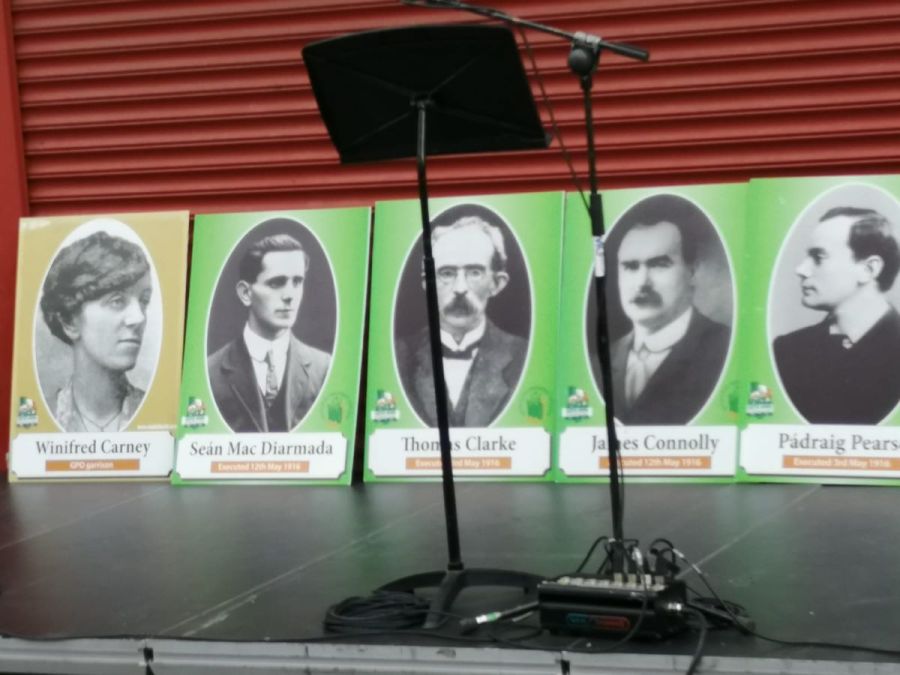
Warfield performed in front of a number of large board posters bearing the images of a number of leaders of the 1916 Rising who had occupied Moore Street in 1916 and Vols. Elizabeth O’Farrell and Winifred Carney, two of the three women Volunteers who had been part of the garrison.

The start of the rally however was delayed, apparently awaiting the arrival of Mary Lou Mac Donald, billed as the principal speaker on the Moore Street Preservation Trust’s pre-rally publicity.

Eventually Mícheál Mac Donncha, Secretary of the Trust and a Sinn Féin Dublin City councillor came on the stage to promote some MSPT merchandise (some of it for free) and to introduce the MC for the event, Christina McLoughlin, a relative of Comdt. Seán McLoughlin.

Christina McLoughline, MC of the event. (Photo: R. Breeze)

Vol. Seán McLoughlin had been appointed Dublin Commandant General by James Connolly during the GPO evacuation and was about to lead a charge on the British Army barricade in Parnell Street when the decision was taken to cancel after which he organised the surrender.

He later became a communist and was never acknowledged at Commandant level by the War Pensions Dept. of the State under De Valera, despite his rank in Moore Street and later also in the Civil War in Cork.

Sean’s relative Christina McLoughlin welcomed Mary Lou Mac Donald on to the stage.

Mac Donald’s appearance on the stage received strong applause. In fairness, many present, if not most, were of the party faithful. Despite the presence of some younger people, the general age profile was decidedly from the 40s upwards, indeed many being clearly in the later third.

Mary Lou Mac Donald, President of the Sinn Fein party, speaking at the event. (Photo: R. Breeze)

Mac Donald, who is not an Irish speaker, read the beginning of the address well in Irish before going on to talk in English about the importance of Moore Street site in the history of the 1916 Rising and in Irish history generally and how her party in government would save it.

After the applause for Mac Donald, the MC called Proinnsias Ó Rathaille, a relative of Vol. Michael The O’Rahilly, who was mortally wounded leading a charge up Moore Street against a British Army barricade in Parnell Street and who died in the nearby lane that now bears his name.

Ó Rathaille’s address was heavy in the promotion of the Sinn Féin party and, in truth rather wandering so that he had to return to the microphone after he’d concluded, to announce Evelyn Campell to perform a song she had composed: The O’Rahilly Parade (the lane where he died).

Evelyn Campbell performing her composition O’Rahilly’s Parade at the event. (Photo: R. Breeze)

Campell is a singer-songwriter and has performed in Moore Street on previous occasions, the first being at the invitation of the Save Moore Street From Demolition group who were the only group to campaign to have the O’Rahilly monument finally signposted by Dublin City Council.

McLoughlin announced Deputy Mayor Donna Cooney to speak, a relative of Vol. Elizabeth O’Farrell, one of the three women who were part of the insurrectionary forces occupying Moore Street. Cooney is a Green Party Councillor and a long-standing campaigner for the conservation of Moore Street.

Deputy Dublin Lord Mayor and Green Party councillor Donna Cooney speaking at the event. (Photo: R. Breeze)

While speaking about the importance of Moore Street conservation for its history and street market, Cooney also alluded to its deserving UNESCO World Heritage status, adding that the approval of the Hammerson plan for the street was in violation of actual planning regulations.

Next to speak was Diarmuid Breatnach, also a long-time campaigner, representing the Save Moore Street From Demolition campaign group which, as he pointed out has been on the street every Saturday for over a ten years and is independent of any political party or organisation.
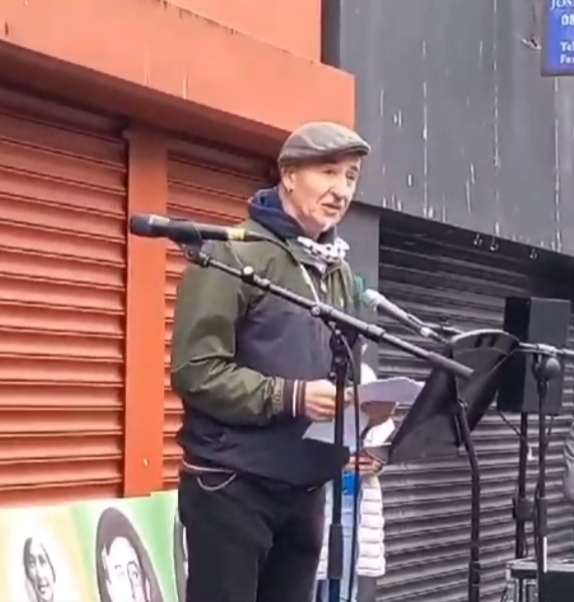
Diarmuid Breatnach speaking at event on behalf of the independent Save Moore Street From Demolition campaign group. (Photo: R. Breeze)

Breatnach also raised the UNESCO world heritage importance, as the SMSFD group were first to point out and have been doing for some years, based on a number of historical “firsts” in world history, including the 1916 Rising having been the first anti-colonial uprising of that century.

The Rising was also the first ever against world war, Breatnach said. He told his audience that the Irish State has applied for UNESCO heritage status for Dublin City, but only because of its Victorian architecture and that it had once been considered “the second city of the British Empire”.

Stephen Troy, a traditional family butcher on the street, was next to speak. He described the no-notice-for-termination arrangements which many phone shops in the street had from their landlord and how Dublin City Planning Department had ignored the many sub-divisions of those shops.

Stephen Troy, owner of family butcher shop on the street and campaigner, speaking at the rally. (Photo: R. Breeze)

Troy’s speech was probably the longest of all as he covered official attempts to bribe the street traders to vote in favour of the Hammerson plan and what he alleged was the subversion of the Moore Street Advisory Group which had been set up by the Minister for Heritage.

It began to rain as Troy was drawing to a close but fortunately did not last long.

Jim Connolly Heron, a descendant of James Connolly and also a long-time campaigner for Moore Street preservation was then called. Speaking on behalf of the Trust, Connolly began by reading out a list of people who had supported the conservation but had died along the way.

Connolly Heron went on to promote the Trust’s Plan for the street which had been promoted by a number of speakers and to announce the intention of the Trust to take a case to the High Court for a review of the process of An Bord Pleanála’s rejection of appeals against planning permission.

Jim Connolly Heron, great-grandson of James Connolly and prominent member of the Moore Street Preservation Trust, speaking at the event. (Photo: R. Breeze)

The MC acknowledged the presence in the crowd of SF Councillor Janice Boylan, with relatives among the street traders and standing for election as TD and Clare Daly, also standing for election but as an Independent TD in the Dublin Central electoral area.

MOORE STREET, PAST AND PRESENT

Moore Street is older than O’Connell Street and the market is the oldest open-air street market in Ireland (perhaps in Europe). It became a battleground in 1916 as the GPO Garrison occupied a 16-house terrace in the street after evacuating the burning General Post Office.

At one time there were around 70 street stalls in the Moore Street area selling fresh fruit, vegetables and fish and there were always butchers’ shops there too. But clothes, shoes, furniture, crockery and vinyl discs were sold there too, among pubs, bakeries and cafés.

Dublin City Planning Department permitted the development of the ILAC shopping centre on the western side of the street centre and the Lidl supermarket at the north-east end of the street, along with a Dealz as the ILAC extended to take over the space on its eastern side.

While many Irish families turned to supermarkets, people with backgrounds in other countries kept the remaining street traders in business; but the property speculators ran down the street in terms of closing down restaurants and neglecting the upkeep of buildings.

The authorities seem to have colluded in this as antisocial behaviour that would not be tolerated for a minute in nearby Henry Street is frequently seen in Moore Street.

The new craft and hot food stalls Monday-Saturday run counter to this but are managed by the private Temple Bar company which can pull out in a minute. On Sunday, the street is empty of stalls and hot food or drinks are only available in places that are part of the ILAC shopping centre.

The O’Reilly plan was for a giant ‘shopping mall’ extending to O’Connell Street and was paralysed by an objectors’ occupation of a week followed by a six-week blockade of the site, after which a High Court judgment in 2016 declared the whole area to be a National Historical Monument.

A judge’s power to make such a determination was successfully challenged by then-Minister of Heritage Heather Humphries in February of 2017. NAMA permitted O’Reilly to transfer his assets to Hammerson who abandoned the ‘shopping mall’ plan as not profitable enough.

The Hammerson plan, approved by DCC and by ABP is for a shopping district no doubt of chain stores like Henry Street or Grafton Street, also an hotel and a number of new streets, including one cutting through the 1916 central terrace out to O’Connell Street from the ILAC.

In the past dramatist Frank Allen organised human chains in at least three ‘Arms Around Moore Street’ events and the Save Moore Street 2016 coalition organised demonstrations, re-enactments, pickets and mock funerals of Irish history (i.e under Minister Humphries).

The preservation campaigning bodies still remaining in the field are the SF-backed Moore St. Preservation Trust and the independent Save Moore St. From Demolition group. The former is only a couple of years in existence and the latter longer than ten years.

However, both groups contain individuals who have been campaigning for years before that. The MSPT tends to hold large events sporadically; the SMSFD group has a campaign stall on the street every Saturday from 11.30am-1.30pm. Both have social media pages.
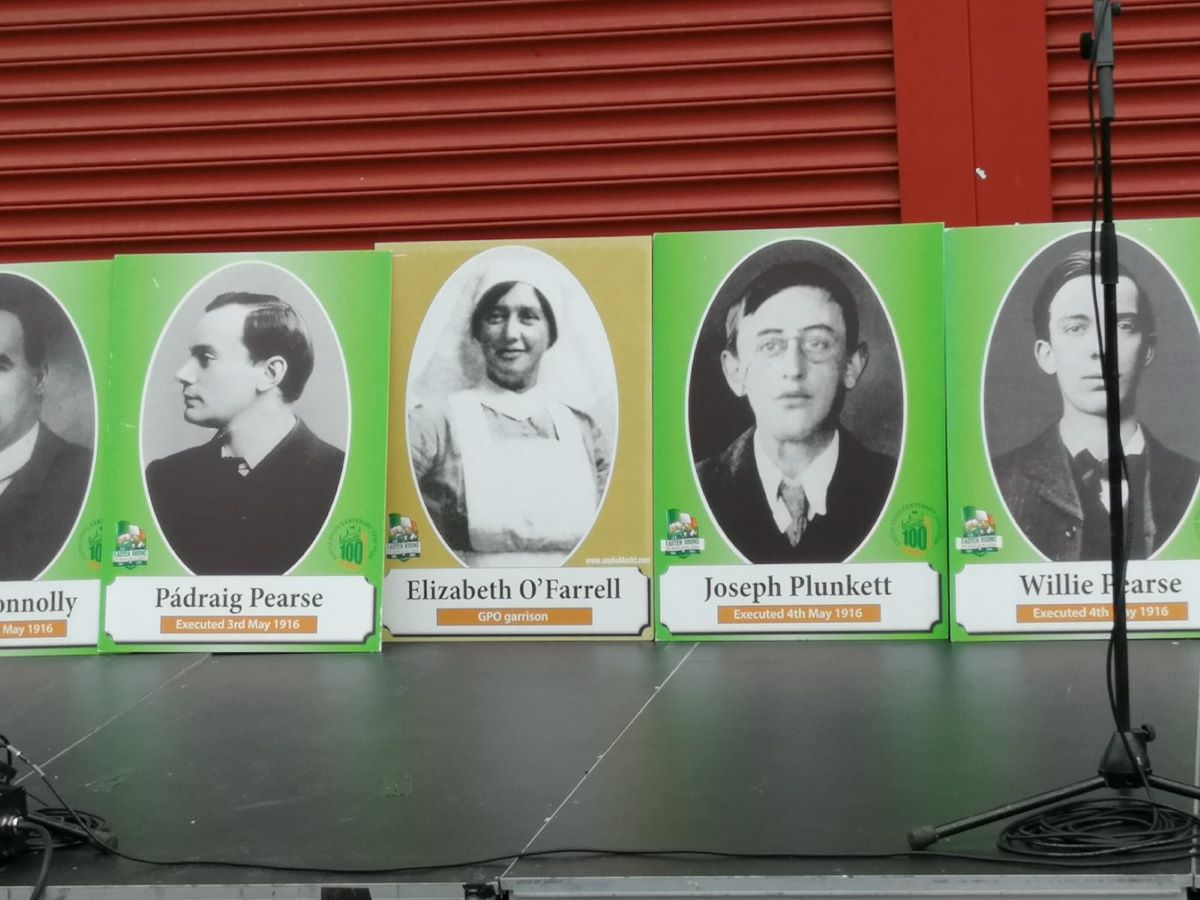
Fully in view, four prominent members of the Moore Street Garrison (L-R): Patrick Pearse, Commander-in-Chief; Vol. Elizabth O’Farrell, of Cumann na mBan; Vol. Joseph Plunkett, one of the planners of the insurrection; Vol. Willie Pearse, Adjutant to his brother Patrick. All but O’Farrell were tried by British court martial, sentenced to death and shot by British firing squad in Kilmainham Jail. (Photo: R. Breeze)

LEGISLATION & COURT CASES

2007 Nos. 14-17 Moore Street declared a National Historical Monument (but still owned by property developer Joe O’Reilly of Chartered Land)

2015 Darragh O’Brian TD (FF) – Bill Moore Street Area Development and Renewal Bill – Passed First Reading but failed Second in Seanad on 10th June 2015 by 22 votes against 16.

2015 – Colm Moore application — 18th March 2016: High Court judgement that the whole of the Moore Street area is a national historical monument.

2017 – February – Minister of Heritage application to Court of Appeal – judgement that High Court Judge cannot decide what is a national monument.

2021 — Aengus Ó Snodaigh TD (SF) – 1916 Cultural Quarter Bill – reached 3rd Stage of process; Government did not timetable its progress to Committee Stage and therefore no progress.

2024 – Property Developer Hammerson application to High Court Vs. Dublin City Council in objection to decision of elected Councillors that five buildings in the Moore Street area should receive Protected Structure status as of National Historical Heritage. Hammerson states that the decision is interfering with their Planning Permission. Case awaits hearing.

Five prominent members of the Moore Street Garrison (L-R): Vol. Winifred Carney of Irish Citizen Army and Cumann na mBan; Vol. Sean Mac Diarmada, one of the planners of the insurrection; Vol. Tom Clarke, one of the insurrection’s planners; revolutionary socialist James Connolly, Irish Citzen Army and Commandant General of the Rising (especially of Dublin); Patrick Pearse, Commander-in-Chie. All but Carney were tried by British court martial, sentenced to death and shot by British firing squad in Kilmainham Jail. (Photo: R. Breeze)

POSTSCRIPT

Someone commented later that in general the rally, from the content of most of the speeches, had been at least as much (if not more) of a Sinn Féin election rally as one for the conservation of Moore Street.

That should have been no surprise to anyone who knows that any position taken by Sinn Féin activists tends to be for the party first, second and third. And with the Irish general elections only weeks away, well …

And while Mac Donald spoke in Dublin of the importance of Ireland’s insurrectionary history and the need to conserve such sites, her second-in-command Michelle O’Neil was laying a wreath in Belfast in commemoration of the British who were killed in the First imperialist World War.

End.
ALTERNATIVE PLAN FOR MOORE STREET LAUNCHED IN HOME OF PATRICK PEARSE

Clive Sulish

(Reading time main text: 5 mins; total including backround: 7 mins.)

Last Thursday (7th October) the former home of the Pearse family saw the launch of a plan for Moore Street as an alternative to the current Hammerson plan. The latter, a large property development company based in England, currently has a planning application in to Dublin City Council awaiting a decision. Moore Street is a centuries-old iconic street market in the heart of Dublin city but was also a battleground during the 1916 Rising, as the insurgents’ headquarters garrison in the General Post Office building evacuated the building, set aflame by British shelling and strove to relocate to continue the insurrection to the north-west of the city.

The former home of Patrick Pearse, Commander-in-Chief of the 1916 insurrection and of his brother William, both executed by British firing squads, now a building held in trust with facilities for meetings and a small theatre, was the location chosen by the Moore Street Preservation Trust to launch their alternative plan.

A packed room of people sweltered in their Covid19 face-masks as they listened to a number of speakers on behalf of the Moore Street Preservation Trust, formed earlier this year along with a guest spot for Mary Lou Mac Donald, President of the Sinn Féin political party, prior to the unveiling of the scale model.

A section of the crowd at the launch inside the room, while others crowded the doorway and corridor beyond.

Mícheál Mac Donncha, a Dublin City councillor for the Sinn Féin party and Secretary of the Trust, chaired the event and, after an introduction to the subject of the meeting, announced Patrick Cooney who spoke for the Trust on their history, aspects of the long campaign and the alternative plan. Cooney outlined what the Trust considers the importance historically of the “Moore Street battleground” and remarked that their plan was the only alternative to the Hammerson plan, which he said is supported by no-one else.

In traversing aspects of the conservation struggle, Cooney referred to the High Court case taken against the Minister of Heritage and the property developer (which was then Joe O’Reilly’s Chartered Land) and the momentous judgement that the whole Moore Street area was a national historical monument. The capacity of the Judge to make that decision was overturned in a later appeal by the Minister of Heritage’s legal team.

Patrick Cooney also paid tribute to the week-long occupation of the buildings by others in January of 2016, which had prevented the demolition of three buildings in the sixteen-building terrace in Moore Street. He said that his group could not be identified with the occupation since they were part of the High Court case ongoing at the time but named two Irish Republicans (of a group opposed to the Good Friday Agreement) who had acted as their link with the occupation body, leaving a possible impression that his group had been involved in some way from behind the scenes in the occupation of the buildings.

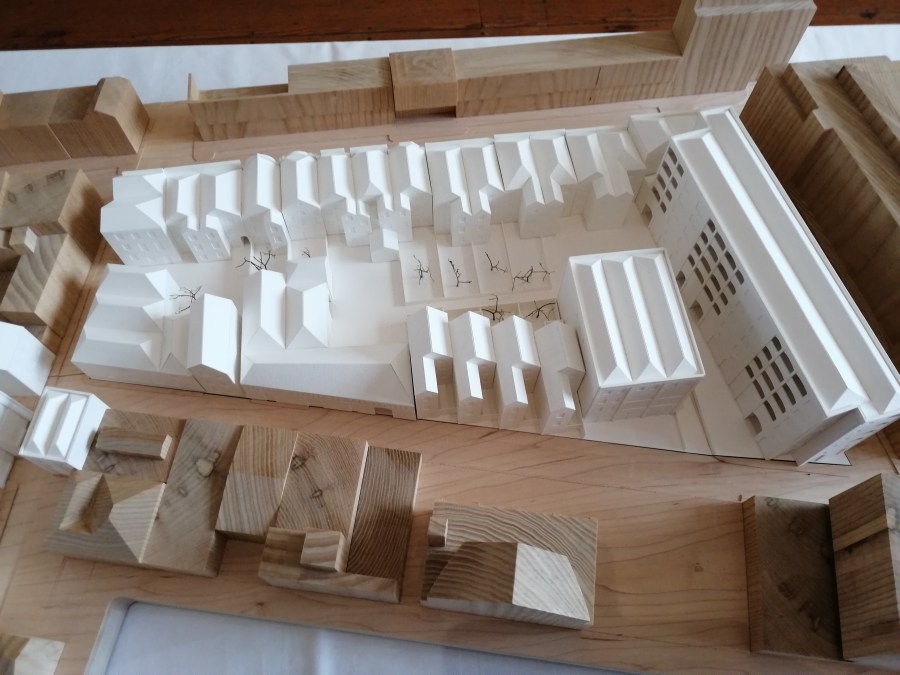
Closer view of the model, viewed from the east and looking westwardMoore Lane is represented at bottom, O’Rahilly Parade at far right and Moore Street at top of image.

Cooney also mentioned the Bill moved by Sinn Féin TD (parliamentary representative) Aengus Ó Snodaigh, currently awaiting debate in the Dáil (Irish parliament) and how it mirrored to a large degree that put forward formerly by a TD of the Irish political party Fianna Fáil, currently in coalition Government, which had not been proceeded with. Cooney paid tribute to the political party Sinn Féin as “the only political party to support” the Moore Street conservation struggle (which may have come as a surprise to Peadar Ó Tóibín, TD of the Aontú political party, who was present in the audience).

Mac Donncha thanked Cooney for his contribution and introduced Jim Connolly Heron, a great-grandson of James Connolly, one of the executed leaders of the 1916 Rising who talked about the historical importance of the site and the importance of its preservation. Connolly Heron talked about historical buildings in Dublin that had been demolished. He said their plan represented an opportunity for the State to atone for the “lamentable failure to save Wood Quay” and commented that “On that occasion the voice of the people was silenced; the loss to the city was immeasurable and we can ill afford another Wood Quay.”

Then Connolly Heron, with Proinnsias Ó Rathaille, grandson of The O’Rahilly, removed the Starry Plough flag of the Irish Citizen Army to unveil the architect’ scale model to loud applause and the clicking of phones and cameras.

A portion of the attendance then removed to the small theatre where Seán Antóin Ó Muirí, for the architects, took the audience through a slide show of drawings and maps while discussing their relevance to the Preservation Trust’s plan.

Outside the building, a large group of teenage Danish students, on a walking history tour conducted by Lorcán Collins of 1916 Rising Tours, had gathered, where they were addressed by Lorcán and also by Aengus Ó Snodaigh TD and, very briefly by Diarmuid Breatnach of the SMSFD group who, at Lorcán’s request, sang them the “Grace” ballad (in which Joseph Plunkett addresses Grace Gifford, his bride of only hours before he is to be executed by British firing squad).

THE ALTERNATIVE PLAN

The Alternative Plan as outlined by the architect involves a number of ideas that have been put forward over the years: refacing some of the buildings to match the pre-1916 facing surviving on some of the buildings, using appropriate matching construction materials, uncovering the cobblestones, etc. The two-story elevation has been promoted previously as have awning-covered ground-level shopfronts but the north end of the terrace at four storeys is a departure perhaps from previous plans other than the Hammerson and O’Reilly plans, as is perhaps the opening up of some spaces around the “back” of the terrace (accessed through Moore Lane). The plan foresees a unitary unbroken terrace which all campaigning groups have proposed.

Architect’s drawing imagining an arch leading to an internal courtyard from Moore Lane to the back of the museum in Moore Street.

Unlike some plans and visions previously mooted, the Alternative Plan as explained does not propose excluding chain stores, nor propose pubs and bakery among the businesses; street stalls were mentioned only in passing with no discussion of the range of hot and cold food or other merchandise that might be on sale. The housing units proposed do not specify local authority rental. Unlike a number of previous plans there was no mention of the benefits of linking the development of a Moore Street cultural quarter to a number of other nearby amenities and cultural quarters nor to that of rejuvenating the north city centre by day and by night.

The history component does not seem to vary much from the Hammerson/ O’Reilly one, being concentrated on the four buildings which the State has named “the historical monument”, a title also used by Trust. In the unbroken terrace proposed (and frequently demanded by campaigners) of course the Alternative Plan departs significantly from the Hammerson one but strangely this contrast was not alluded to in either the verbal or visual presentations.

In the overall presentation of a slideshow and scale model perhaps the most significant contribution of this plan is to present some of the possibilities in a manner more easily grasped and form easier for many no doubt to visualise. It is this that has been missing in past plans and proposals.

HAMMERSON AND DUBLIN CITY COUNCIL

On the west side of Moore Street is the ILAC shopping centre, built with DCC planning permission in 1977 on what was a patchwork of streets and laneways, many of them containing shops and stalls selling various new and second-hand merchandise. A university study group concluded that, apart from the construction companies, the ILAC had benefitted the big stores of Debenhams and Dunnes and that the compensation paid out to most stall-holders and small shops had been inadequate to relocate within the City Centre and workers had been made redundant. The ILAC is half-owned by Irish Life and the other half passed from O’Reilly to Hammerson.

In the early years of this century a consortium of property developers were applying for planning permission to carry out plans in the area from the northwest side of O’Connell Street to Moore Street but Dublin City Council Planning Manager froze the plans and in a very strange deal later handed it all over to Joe O’Reilly. The whole murky story (including city councillors being legally threatened to keep silent by the then Planning Manager Jim Keogan) was covered in a two-part program, Iniúchadh na Cásca, by the Irish language television channel TG4 before O’Reilly got his giant “shopping mall” planning permission (the program was re-broadcast in 2016).

Jim Keogan took early retirement from DCC and is now employed by McCutcheon Halley, a Cork-based planning consultancy company while the most recent Ireland Director for Hammerson is Mark Owen, straight from his previous employment as the Head of Asset Management & Recovery for NAMA.

The architects’ scale model, showing the quarter from a north-facing perspective (i.e from Henry Street). The street to the left is Moore Street and at the right, Moore Lane. Further to the right would be O’Connell Street, not shown here. The Henry Place lane is shown from the nearest part of the model.

INTERNAL CAMPAIGN CONTROVERSIES

Patrick Cooney in his presentation of their Alternative Plan referred to a split in the original conservation committee and in fact over the years there have been a number of controversies and conflicts among campaign groups. The remaining part of the committee containing Mr. Cooney and Mr. Connolly Heron also experienced a number of acrimonious departures. Due to internal difficulties the 1916 Relatives Association, to which both also belonged did not have a meeting for over a year and when it did so eventually, there were loud internal arguments and clashes between Mr. Connolly Heron and others, leading to a number of departures, including Marcus Howard of Easter Rising Stories, producer of many historical documentaries and filmed interviews, including a number on Moore Street.

In that atmosphere, Brian O’Neill was seen by many as a stable and quiet choice for Chair of the 1916 Relatives Association and was duly elected. Shortly afterwards Barry Lyons, a long-time campaigner was expelled from the Association as was also long-time campaigner Donna Cooney, grand-niece of Elizabeth O’Farrell and a DCC Councillor. Neither seems to have been given a formal hearing or allowed an appeal. Although formerly the 1916 Relatives’ Association opposed the developers’ plans, Brian O’Neill now represents the Association on the Minister’s Advisory Group on Moore Street and is on record supporting the Hammerson plan.

Clashes between different campaign groups and individuals have taken place on occasion inside the Lord Mayor’s Forum on Moore Street, including one between members of the Connolly Heron-Cooney group and Colm Moore, another campaigner for many years and the individual who took the High Court case against the Minister of Heritage.

The Ministers’ Consultative Group on Moore Street and its later iteration as the Minister’s Advisory Group, although it has a seat for Jim Connolly Heron, rejected the membership applications of the most active groups in the broad campaign, those who were involved in the 2016 Occupation and the six-week Blockade: the Save Moore Street From Demolition and the Save Moore Street 2016 groups. The SMSFD group has a stall on the street every Saturday, stated to have been since the founding of the group in September 2014, at 368 weeks to date and claims 380,000 signatures to its petition to save the area.

The Connolly Heron and Cooney group do not acknowledge the SMSFD group in public and on one occasion during the Blockade Mr. Cooney posted that the only campaign group they recognised outside of their own was the Save Moore Street 2016 one. However, among all the invitations that were sent out to attend the unveiling last Thursday, neither they nor the SMSFD groups received one – and nor did Colm Moore, the man who took the famous High Court case.

After the formal representation last week but while still inside the Pearse home building, Patrick Cooney was heard to clash with a prominent campaigner and City Councillor in the presence of a radio reporter. Immediately outside, Proinnsias Ó Rathaille verbally abused a member of the SMSFD group (who had learned of the event through the media) in the hearing of many people, including Danish teenagers on a walking history tour.

LOOKING AHEAD

At time of writing it is important to realise that the only plan with Planning Permission is the original O’Reilly one which Hammerson acquired. The latter have submitted their changed plan for a shopping district and new roads which is currently under review by the Planning Department who have asked for some minor changes and gave them six months to produce them. Many objections were registered (and paid for), even by the Housing Department and the feeling is that the vast sweep of popular opinion is against the Hammerson plan – however that is far from being a guarantee against its acceptance by DCC’s Planning Department. And, as NAMA failed to seize them from Joe O’Reilly, their largest debtor at the time and allowed him to transfer them, all the buildings but two (owned by Dublin City Council) are owned by Hammerson.

Should Hammerson receive approval from DCC’s Planning Department, on previous history a not unlikely event, campaigners are sure to appeal the decision to An Bord Pleanála but that avenue too holds little hope for conservationists, given the record of that body’s decisions in Dublin. In the event of an unwelcome decision there, the High Court remains the only recourse in law (for which leave has to be sought to take the case). Protests on the street are of course likely.

Given Hammerson’s financial difficulties in recent years, even if granted planning permission they may not be able to proceed with their plan immediately and despite Hammerson’s denials the suspicion of many is that they will sell the area on – but for that, they need the new Planning Permission attached first and the current one runs out next year.

End.

BACKGROUND TO A LONG CAMPAIGN

In 1916 Moore Street and surrounding streets and laneways became a battleground, as the Irish insurgent force evacuating its erstwhile HQ in the GPO ran into encircling forces of the British Army. A detachment of the GPO garrison proceeding up Moore Street ran into British rifle and machine gun fire, killing three including its leader, The O’Rahilly and wounding others. The main part of the evacuation forces also suffered casualties but occupied No.10 Moore Street and tunnelled through the 16-building terrace to the laneway at the end, where an assault group was being mobilised to attack the British Army barricade at the Moore Street/ Parnell Street junction. The decision to surrender, taken by the leadership, cancelled the assault. Along with William Pearse, five of the Seven Signatories of the 1916 Proclamation spent their last hours of freedom in Moore Street, not long after to be shot by British firing squads: Thomas Clarke, Patrick Pearse, James Connolly, Sean McDermott and Joseph Plunkett.

Prior to 1966 there was nothing in Moore Street to inform people of what happened there although in that year, amidst the 50th anniversary commemorations of the 1916 Rising, a small plaque was placed at first floor level on No.16 Moore Street, believed to have housed the last HQ of the 1916 Rising. That plaque was noted missing in 2002 – it turned up in a property speculator’s office – and fears of demolition plan for the buildings gave rise to a campaign to save it. A meeting was organised by the National Graves Association and a committee formed, hardly a single one of which is currently active in the campaign today for a number of reasons (Patrick Cooney alluded to one of them, a split when some sided with the property developer of the time but there have been many others).

The 50th anniversary of the 1916 Rising plaque in Moore Street, the only fixture to say anything of the sort that happened there.

The campaign extended its demand for the conservation of the whole terrace, backyards etc and in 2006 the State finally conceded a historical importance worth conserving in Moore Street by declaring Nos.14-17 a National Monument, though these still belonged to O’Reilly. In 2008, O’Reilly applied for planning permission for a huge “shopping mall” from O’Connell Street to Moore Street, with a “ski slope” on top and carpark underneath, entailing the demolition of all but Nos.14-17 and the renovation of these as a small museum. DCC’s Planning Department approved the plan but it was appealed to An Bord Pleanála which, against the advice of its own Inspector, rejected the appeal. With the removal of the “ski slope” top and the underground carpark, the giant “shopping mall” was approved but O’Reilly’s demolition plans faced a problem in that two buildings at the end of the terrace belonged to Dublin City Council and four in the middle are protected structures.

In 2009 and 2012 dramatist Frank Allen organised human chain “Arms Around Moore Street” events which gained some media attention.

The campaign gained prominence again when in September 2014 O’Reilly offered Dublin City Council the dilapidated Nos. 14-17 in exchange for Nos. 24-25, where the Council had a waste management depot, a “land-swap” favoured by the City Managers and the Minister of Heritage. A branch of the campaign set up a stall on the street and began to collect signatures to a conservation petition and to disseminate campaign leaflets. In November the majority of DCC councillors voted to reject the deal.

The campaign group with a weekly Saturday stall on the street, now called Save Moore Street From Demolition and separate from the other which had mainly concentrated on lobbying, organised the first public meeting about the campaign in November 2014, inviting as speakers Jim Connolly Heron and Donna Cooney (there had been some conflicts between the two). But in January 2016 the group noted hoardings going up around Nos.12-18 with plans for the demolition of three buildings. They called two emergency meetings during the week on the street and supporters, a mix of people including water protesters and Irish Republicans, occupied the buildings, an act which became headline news.

While the Minister of Heritage made ready to obtain an injunction against the occupiers, instead Colm Moore, who had registered a case with the High Court against the State plans, obtained an injunction against any demolition until the case should be decided and the occupiers left the buildings after one week. However, subsequently alarmed by sounds of heavy machinery inside the buildings, campaigners asked to inspect the works but were refused, as was also a delegation of politicians led by the Lord Mayor.

A new defence coalition called Save Moore Street 2016 had been formed of those who had occupied the buildings and including representatives of the weekly stall group, SMSFD and these now installed a blockade on the buildings from 6.30am to 4pm Monday to Friday. No building workers were admitted to the buildings until the decision of the High Court, on 18th March 2016, that the whole terrace and its surrounding area is a national historical monument.

In the meantime the SMSFD group separately and, in particular the SMS2016 coalition, had organised marches, history walking tours, street concerts and street theatre events in period costume, including mock “heritage funerals” and a reenactment of the 1916 surrender.

Towards the end of 2016, also the 100th anniversary of the 1916 Rising, the Minister of Heritage set up her Advisory Group on Moore Street and the 1916 Relatives’ Association, formed earlier that year, were invited to participate, as was the separate Jim Connolly Heron/ Paddy Cooney etc group, along with representatives of the political parties in the Dáil. Not invited were the National Graves Association, the Save Moore Street From Demolition or the Save Moore Street 2016 activist groups — the applications of the latter two were rejected, though they were permitted to make a submission.

By this time, O’Reilly had been permitted by the responsible officer at NAMA to transfer his Moore Street and Dundrum portfolio to Hammerson.

The Lord Mayor’s Forum on Moore Street, where all concerned have had representation, has met regularly some years but not on others. The 1916 Relatives Association has seen internal changes and ended with its Chairperson supporting the Hammerson plan. The Jim Connolly Heron/ Paddy Cooney group has gone through a number of name changes, shedding some individuals and gaining others, before the current group presenting the Alternative Plan.

Immediately outside the Pearse’s house, a group Danish teenage students, having arrived as part of a history walking tour conducted by Lorcán Collins (in cap, far right of photo, seen from the back) is addressed by Aengus Ó Snodaigh TD (mostly out of shot).

SOME SOURCES AND USEFUL LINKS

https://www.irishtimes.com/culture/heritage/alternative-plans-for-moore-street-proposed-by-1916-rising-relatives-group-1.4694252

https://www.irishtimes.com/culture/heritage/department-of-housing-criticises-moore-street-redevelopment-plan-1.4631143

Moore Street Preservation Trust:https://www.facebook.com/MooreStreetTrust/

Save Moore Street From Demolition:

https://www.facebook.com/save.moore.st.from.demolition

Website: smsfd.ie

Save Moore Street 2016: https://www.facebook.com/SaveMooreStreet2016/

Submissions on Moore Street to the Department of Heritage in 2016:https://www.gov.ie/en/publication/34a67-moore-street-consultative-group-submissions/

DCC Planning Department: https://www.dublincity.ie/residential/planning

TG4 Iniúchadh – Oidhreacht na Cásca: https://www.youtube.com/watch?v=k07qja5JJlU