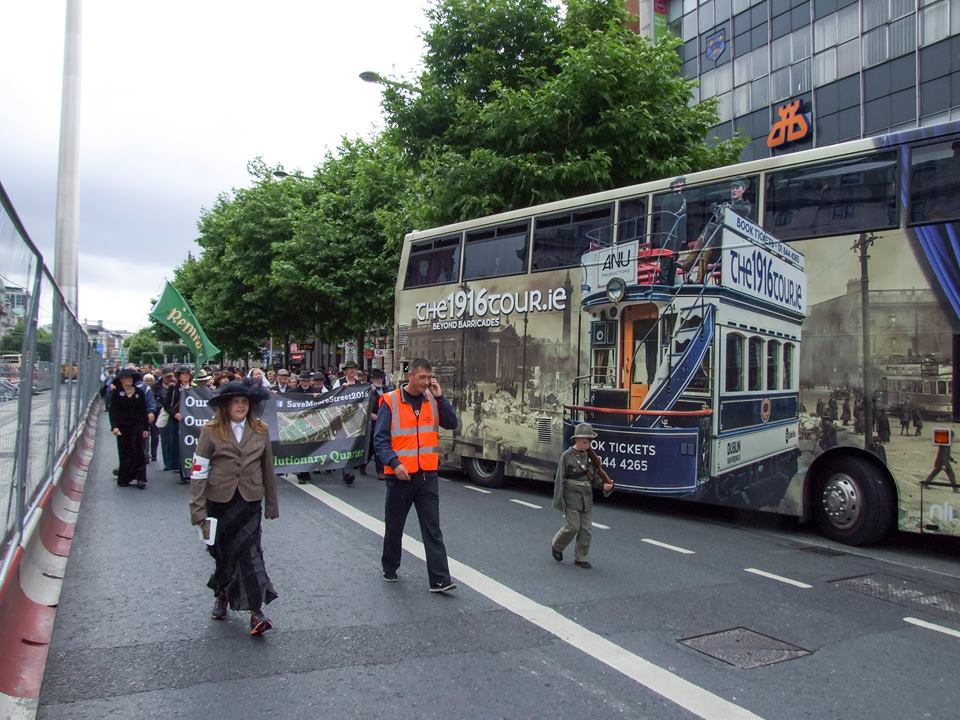
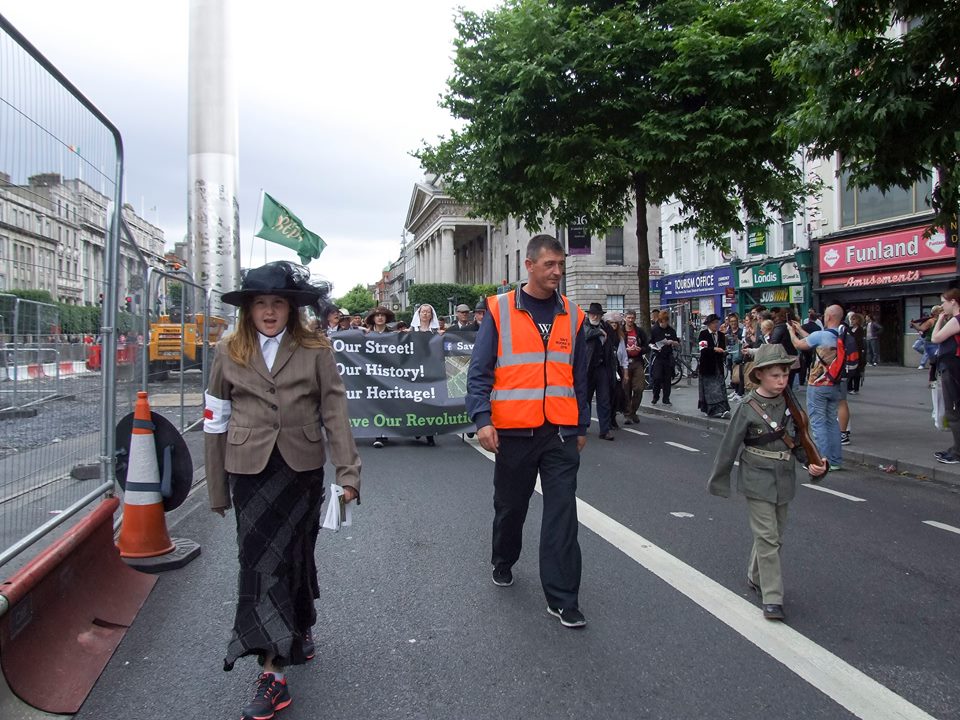
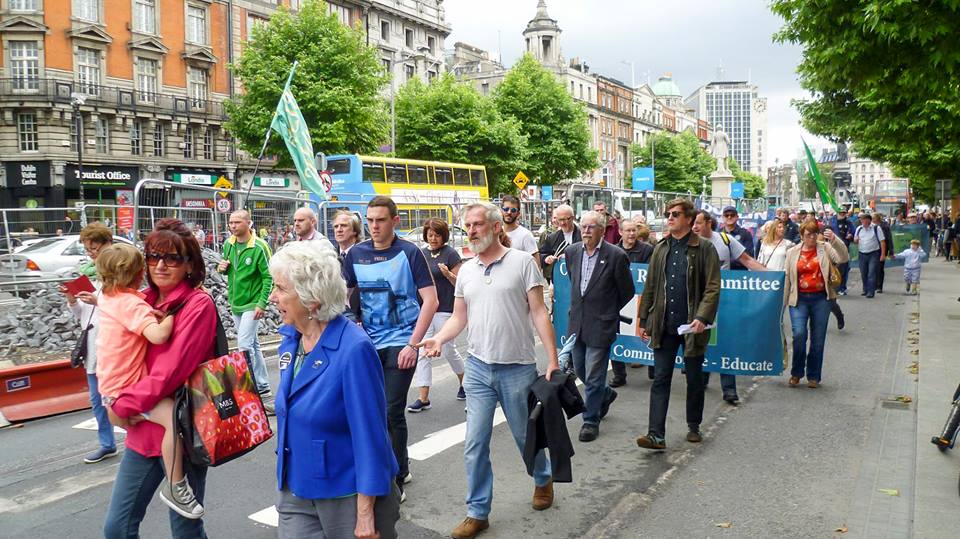
Tag: national liberation
OF WHAT USE IS HISTORY?
(words 7,420)
Diarmuid Breatnach
Of what use is history? It’s a question we may ask and, I would contend, should ask ourselves.
A lot of people would suppose that is of no real use at all – just part of one’s “education”, by which they mean gaining test certificates with favourable results, a number of which, at a high enough percentage of marks scored, will help gain access to desired employment. A probably smaller number would believe it is of some use, probably in giving them a sense of pride of belonging to a group. From my observation, it would seem that this sector, in Ireland at least, is mostly composed of working and lower middle class people. Some of these will go to third level education and study history – but very few.
Since History is a core subject on primary and secondary schools’ curricula in most countries around the World, and since at third level education entire departments of universities cater for the subject, one assumes that it must be widely considered to be of some use — by educational authorities at least. But those university departments receive funding so there must be people in political parties and perhaps industry who also think history is of value.
Many extensive libraries could be filled easily with published books of and about history, without taking into account related subjects of social studies and archaeology (for examples), not to mention historical novels, poetry and songs dealing with history, biographies, paintings, drama …. Clearly enough people think history sufficiently important to write it or to integrate it into their writing and enough companies can make a business out of publishing those products.
However, though many might agree that history is of use, the precise nature of that ‘use’ is a matter of some debate. It is linked to the question of what history is — and there’s an ongoing debate about that too. So it would be worthwhile to look at that issue first, if only to ensure that we agree on what we’re talking about.
WHAT IS HISTORY?
Los Angeles Police Sergeant Joe Friday, in the Dragnet television series of the 1950s, often asked witnesses to a crime to give him “Just the facts, ma’am, just the facts”. Which is actually what most people probably think of as being history – the facts or “what happened”. They might add “when”, “how” and even “why” to the definition “what happened”. But “what happened” is not, of itself, history. And when “what happened” IS history, there’s a lot more to it than just the bare facts.
Let’s imagine that John was knocked down in the road by a vehicle. We might say that those are facts, if there is sufficient evidence for them and, in a “history” of the event, they should be recorded. But more happened. John was taken to hospital, where he was diagnosed as being in a coma; he was operated on and put on life support regime. Those too are facts that should be recorded in the “history”.
But there are a myriad of other facts involved; for example: where John was going and why, what he was thinking, what his general health was like, what he was wearing, what he had for lunch – and that’s just about John. We could ask lots of questions also about the vehicle driver, staff at the hospital, relatives and friends visiting the hospital. And about the vehicle, the weather, the road ….. In fact, we could smother the story in an avalanche of facts. We have to select the facts that seem to us relevant and confine ourselves to those, if we want to write a meaningful (and readable) history of the event.
And how do we know which are the relevant facts? We don’t, at least not all of them – the selection of them is based on subjective opinion which may or may not be “informed” by experience. But also by ignorance, superstition, prejudice, bias – and even experience is not infallible, since it too is conditioned by place and time, among other variables.
Ask two people what, in their experience, are the dangers to watch out for in crossing rivers: the person accustomed only to African conditions might say that the main dangers are drowning, being killed by hippopotomus or being eaten by crocodiles, while another, accustomed only to European conditions, might say that drowning or slipping and incurring an injury in falling are the only possible dangers and perhaps, in winter, contracting pneumonia after hyothermia. Yet others around the world might reply “Being cheated by the ferryman” or “Bandits on the other side” and still a fifth might consider contracting illness from polluted water to be the most prevalent risk of all.
Obviously, the same question can receive different but equally valid answers in different contexts.
BIAS AND SUBJECTIVITY IN HISTORY-WRITING
EH Carr directly addressed the question we are discussing in a series of lectures which were published by Cambridge University Press in 1961 under the very title: “What Is History?” I would highly recommend this book as an introduction to the study of history to the ordinary reader who, if she or he were to read nothing else about the subject would, despite its publication date and the volumes written on the subject since, gain a good basis for understanding what history is and what it is about. And it is short.
In an extract from The Uses of Facts, historian G. Kitson Clark comments on EH Carr’s work:
“Invited to deliver the 1961 George Macaulay Trevelyan lectures, he chose as his theme the question ‘What is History?’ and sought to undermine the idea, then very much current, that historians enjoy a sort of objectivity and authority over the history they study.
“At one point he pictured the past as a long procession of people and events, twisting and turning so that different ages might look at each other with greater or lesser clarity. He warned, however, against the idea that the historian was in any sort of commanding position, like a general taking the salute; instead the historian is in the procession with everyone else, commenting on events as they appear from there, with no detachment from them nor, of course, any idea of what events might lie in the future.”
The historian is an observer but she is not impartial. She has her national or ethnic cultural background conditioning her, her class background, her gender, her sexuality and her political-religious-philosophical outlook. She can try for detachment but can never truly achieve it and, if as became the fashion for a while, she claims detachment or lack of bias, her history becomes accordingly suspect. Those historians who truly believe in their objectivity are the most dangerous of all. The historian herself is in the march of history, another actor – and people in her generation will be influenced by her writing to some degree, as may others in generations to come … and future historians will have something to say about her history writing.
The bias of the historian affects not only his interpretation of what he sees but also where he looks and what he looks for. Investigating a historical battle, for example, our past traditional historians would look to see who were the generals, who the overall commanders, what regiments participated, what weaponry and tactics were deployed and, of course the political-military objectives.
The political social historian will look for the economic causes underlying the conflict and the objectives of each side, the class and ethnic make-up of the leading participants but also of the participating masses, their culture and even their food. And at the attitudes to the conflict and the battle in the home grounds of the participants. Emperors may command (thinks this historian) and generals order battle … but which economic class rules and benefits or loses? Who does the actual fighting? What do they think? How fare the people at home and those where the military campaigns are being fought?
These are not small matters, even in affecting the outcome – we know the effect of morale on soldiers. The Russian Tsar’s participation in the First World War was one of the precipitating causes of the February Revolution in Russia in 1917 – it exacerbated civilian class tensions and economic complaints, as well as impeding delivery of food from the countryside to the cities as the use of trains was diverted instead to transporting troops. Lack of supplies and effective leadership, as well as defeats, affected the morale of soldiers; the failure of Kerensky’s Government to abandon that War was even more a cause of the October Socialist Revolution later that year. Soldiers and sailors took a decisive role in supporting both revolutions.
A year earlier, the morale of the insurgents in the 1916 Rising in Dublin was such that they were able to put up amazing resistance to attacking forces at least ten times their numbers, armed with artillery and machine guns, of which the insurgents had none. Later, during the War of Independence, in May 1921, General Sir Nevil Macready, in command of all British land military in Ireland, reported to the British Cabinet on the adverse impact of the resistance of the Irish people, both military and otherwise, on the morale of the British soldiers and police under his command.
Morale was also a big factor in the long attritional but successful defence of Leningrad, Stalingrad and of Moscow against Nazi forces in WWII, grimly positive on the defenders’ side and slowly seeping into negativity among the invaders.
Jumping forward in history, there was eventually huge civilian opposition to the Vietnam War in the USA as well as vehement support for it, which was splitting its society more seriously than probably at any time since the American Civil War. From 1969 to 1972 there were nearly 900 incidents recorded in which US troops in Vietnam attempted to or succeeded in killing or injuring their superior officers, typically by fragmentation grenade – they had become so common that the act gained a nickname: ‘fragging’. History records, ‘Rambo’ fantasies aside, that the USA lost that war.
THE CONSTRUCTION BASE OF THE NARRATIVE
There is no great mystery about the construction base of the story, the narrative of history. It is composed of primary sources, artifacts, secondary sources and bibliography.
Primary Sources are accounts by observers or participants, related or written (or otherwise recorded) during, shortly or a long time after the event. Those must be the most reliable, surely? Well, not necessarily. A soldier might want to justify why he ran from battle or a general to justify why he ordered a retreat or why he was defeated. A participant might want to denigrate one side, question their valour, discipline, intelligence or to depict their behaviour as bloodthirsty – while of course painting his own side’s behaviour in different colours.
We also know that witness accounts of the same event vary and that time and reflection and discussion or external manipulation can remove or add to some elements observed, in addition to ‘remembering’ ones that were not actually observed (imagined memory)1. Let’s imagine that John was knocked down in the road by a vehicle. What colour was the vehicle? Answers from witnesses immediately after the event may vary from green to blue to a number of other colours and shades. At what speed was it travelling? Some might say 40mpm, others 50 or 60. What was John’s behaviour immediately before? He wasn’t paying attention/ he was crossing with due care but the car was too fast/ maybe he could have avoided it had he been a bit more alert …. the brakes didn’t seem to work very well. And so on.
Now suppose John was well-liked and the driver whose vehicle hit him is unknown or a member of any group that might be the subject of mistrust or dislike. After a few weeks, all actual witnesses might be convinced that John had been crossing with due care and attention, the car had been speeding and driving erratically and had hit John without giving him a chance. Furthermore there might now be a widely-held belief, the origin and justification for which may murky, that the driver had been drinking. Or that he had been involved in previous accidents. Or a theory may even have arisen that the driver had some reason to kill John – it had been no accident!
On the other hand, can an investigator ignore the accounts of eye-witnesses? Of course not – but they need to be treated with caution.
Secondary sources is the name given to accounts written by people who gather the accounts of participants and contemporary observers and other evidence. What they report finding and their conclusions form the secondary sources – somewhat like the report of the investigator of a traffic accident. So surely the removed investigator, who writes a report, can be considered more reliable?
Well, perhaps the investigator didn’t like John or was bribed by a member of the driver’s family. Or she could be suspicious of or even hostile to the ethnic group to which the driver belongs. Perhaps the investigator drove the same make of car and thought the brakes were fine, or perhaps she was on a retainer from the car manufacturers. Or most of the witnesses were female and she felt they were trying for attention and tended to discount their evidence. Or she discounted the evidence of the witnesses from a particular social class because they used unscientific words and interjected swear words and on the whole she didn’t think their education was sufficient for her to rely on their accounts. Or she was aware that John was well liked and had a lot of powerful friends and that reporting that he crossed the road without due care and attention would do her career no favours.
No investigator is completely impartial and nor is the historian, as we discussed earlier.
Artifacts are a variety of inanimate objects such a trenches, weapons and fragments of tools and utensils, medals, uniforms and clothes, jewelry, tunnels, buildings, roads, vehicles, skeletons, grave stones, letters, graffiti, drawings, rubbish tips. All inanimate and, apart from some like drawings and gravestones, must surely bear impartial witness?
Impartial perhaps but they actually bear no witness at all – they must be evaluated, described and interpreted and it is the historian or archaelogist who does that. The investigator at the scene of the accident must measure the tyre skid marks, check the brakes, identify the model, check MOT examinations, collect the reports of the paramedics and pathologist. And remember, the investigator is never completely impartial and even less so is the historian.
Bibliography (or literature) is what other historians or investigators have written about the period or events, or biographies, or additional reading throwing some light on periods, people, lands, societies or some aspect covered in the history. Sometimes they contain accounts purporting to be primary sources which cannot be checked as they are anonymous or of which the source is not clear. It is not indeed unknown for some accounts to be deliberately falsified. But even without going to those extremes, we have already commented on the many sources of bias operating upon the historian.
The political social historian, the one who is consciously and admittedly investigating from a political and social standpoint will want to know what were the economic, social and cultural backgrounds of the combatants – and not just of both supreme commanders and their generals. She will want to investigate their conditions at home and at the war front, how well they were dressed for the conditions and fed. What was their opinion of the war, of their officers, of the enemy?
Letters home and from home, testimonies and biographies, records of oral history, courts martial, food commissary, equipment inventories, reports of public meetings at home, church sermons, political speeches, demonstrations for and against war – all these will be examined to build the story. Some of these are classified as Primary Sourcess, while others are Artifacts.
Of course the historian is unlikely to examine the original sources of all these and will be relying in many cases on special-focus work done by other historians, in published articles or books. Although their original authors draw on primary sources, unless the historian now goes to these directly herself but instead quotes from the literature, they become secondary sources, in the way that they are being used.
And here we have another factor – it is difficult to examine what cannot be found. If there were no letters or personal accounts surviving, as for example from the Peloponnesian Wars, we are reliant on the accounts of historians, while taking their probable bias into account – these contain Secondary Sources and are contained in the Bibliography, i.e the books and articles written about the period or events.
In those cases we are reliant too on archaeological finds – back to artifacts again. To take another Greek example, the truth or otherwise of most of the events recounted in Homer’s Iliad are a matter of speculation and the factual existence of the city of Troy was established only by comparatively recent archaeology – later in the 19th Century (most historians by that time had come to believe it all a fable). More recent archaeology and geographical work has come to the conclusion that a battle or battles did occur and that the probable site of the Greek invaders’ camp corresponds with the account given by Homer.1
To continue with the role of archaeology, the investigation of the wiping out of five companies of the US 7th Cavalry in 1866, went some way to undermining the myth of Custer’s “charge” against hostile Native American indigenous people and a long “last stand”, of a static battle against the surrounding Lakota Sioux, Northern Cheyenne and Arapahoe who gradually wiped out his 7th Cavalry and himself. Many elements of this story were disputed by witness accounts of Indigenous people and by their folk history or “historical memory”. According to Indigenous accounts, the battle was a short running one, as Custer’s troop had tried to attack a camp, believing it to be mostly occupied by women, children and the elderly. He didn’t know it was full of braves sleeping late. As the warriors poured out of their tents, according to those accounts, Custer and his men turned to flee, firing as they ran but were soon killed “in the time it takes a hungry man to eat a meal”. Much later, archaeological work with metal detectors found a pattern of shell cases that tended to bear out the Indigenous account.
In 1955-’56, Thor Heyerdahl’s expedition team to Easter Island were told a legend in which the people on the island had been ruled by a group called “long ears”, who were represented in the giant carved stone heads, against which the “short ears” had rebelled. Across one end of the island, to which the “long ears” retreated, the story went, they had dug a trench which they filled with flammable material, ready to fire if they were attacked. During an actual attack, the “long ears” fired the material in the trench but the “short ears” had found a way around and attacked them from behind, forcing them into the flames. There was indeed a depression in the ground across that part of the island but the story could have been created to explain the depression rather than the origin being the reverse. Excavating in the trench, Heyerdahl’s group found charcoal and human bones and teeth.2
What there is left to examine is of course a great help to the historian but it can also be a curse. We know how useful the Internet can be but also how much trivia and even incorrect information is stored there. Sifting through and making sense of it now is difficult enough but what will historians centuries from now make of it? In some historical periods, large number of household accounts were kept and these were preserved. Useful information, certainly but since they were available they were examined and written about by historians to a degree that was arguably out of proportion to the historical value of the information extracted.
All those things, the artifacts, the records, the personal stories, the marks left on the land, become history. But only when they are spoken about (oral history) or written about (written history). And in telling or writing about them, the historian is looking at them through his bias and, in doing that, becoming part of history himself.
THE CONSTRUCTION OF THE OVERALL NARRATIVE ITSELF
One might say that history is a story, a story of how we became who we are. In telling that story, it must also come to some kind of belief or statement about who we are now. In fact, the story teller makes an assumption about who we are now, then looks back to history, then according to findings adapts the view of who we are now, then looks back again and adapts the view of who we were and the road we travelled to get where we are now, and so on. And it is a story. In order to be history, it cannot be a totally imagined story unrelated to artifacts or scientific knowledge — but it is still a story.
So history is a story — and it needs to be, to an extent, an interesting story. Who wants to listen to a boring story? But not just for the reason of not boring the audience – the facts need to be significant. If “for the want of a nail a kingdom was lost”, as the old adage tells us, and that can be shown, then the loss of that nail was significant. But that doesn’t mean that every loss of a nail will be historically significant – indeed we might assume that most will not be. So we don’t want to fill every narrative with lost nails but nor would we want to exclude the loss of that particular nail, in that particular time, at that particular battle: the one for which the horseshoe was lost, and for which the horse stumbled, through which the king fell, and his troops lost heart and his kingdom was lost.
But was the nail loss, though significant then, a once-off, a chance in a million? If so, it is still history but not a general event in history, not one that we could apply to other battles. I don’t know, but perhaps examining horses’ shoes for possible loose nails became part of standard cavalry preparation for battle. Perhaps the cautionary tale arises from that practice and the knowledge that badly-disciplined or badly-trained cavalry or mounted infantry had suffered through insufficient attention to their horses’ shoes.
CHANCE IN HISTORY-WRITING
Some historians, especially perhaps from the Marxist school, have sought to eliminate the question of chance as factor in history. EH Carr was famous for his attack on historians who gave chance as an explanation for historical events and this is well expounded in the substantial Wikipedia article on his theory of history. What is not documented there, however, is that Carr conceded that chance had indeed influenced some important historical events and gave the example of the leader of an army who had become very ill at a crucial point during a military campaign. What Carr went on to say from that example was that yes, chance had affected the outcome but that one cannot generalise on chance and that therefore it is not worthy of historical study.
Despite my regard for Carr as a historian and a historiographer, i.e. as one who writes about the study of history itself, I wonder whether he was right on this. Napoleon famously asked about young officers being recommended to him, whether they were lucky. He seems to have ascribed great importance to “luck” and thought good luck accompanied certain people and bad luck others. He seems to have considered himself, on that basis, as lucky – but he did not neglect his study of military history, science or collection of current intelligence. His decisions then might have been influenced by feelings of luck but were not totally dependent on them.

And luck does seem to exist. Apart from the fact that we all know individuals who seem to be lucky and others who seem the opposite, some individuals are demonstrably more lucky at cards, for example. In scientific tests on drawing high or low cards, even when the human element is removed from the testers, some test subjects do score a higher than average rate of success. I don’t know but would expect that some subjects would also regularly achieve a lower than average score.
So it would seem to me that one can generalise about chance and luck – but only to extent that it is an unpredictable factor about which we need to be aware. Chaos theory in physics hints at this, although patterns are also being found in deeper study of chaos. And there exists a saying which sums up the importance of chance: “The first casualty of any battle is the plan of attack.” This does not come from a famous military strategist but from a writer, Cory Doctorow, in a kind of science fiction novel, For The Win (2010). This statement is becoming so widespread now that I expect it to become an adage widely quoted not only among civilians but also among military strategists.
WISE SAYINGS FROM LESSONS OF HISTORY
There’s a general warning in our cultures not to underestimate the enemy. And there are many examples in history of generals underestimating the fighting ability or determination of their opponents, or their ability to cross difficult terrain. The Romans under several successive military leaders underestimated Spartacus and his band, for example, until the end of the uprising, thinking that these were a rabble to be easily defeated by Roman soldiers. Those Roman leaders paid for their mistake with their lives and the lives of many of their soldiers.

The British at Singapore in 1942 had all their major artillery pointing to sea, because the Japanese could not march through the thick jungle on the peninsula mainland– but nobody told the Japanese that, so they did and took 130,000 British, Commonwealth and Empire troops prisoner after little fighting.
The German Nazis at Moscow, Stalingrad and Leningrad in 1941, thought they would take the cities in weeks at most; not only were the struggles there long and hard but they turned out to be locations or sources of disaster for the invaders. The leaders of the French military at Dien Bien Phu in 1954 did not consider that the Viet Minh could haul artillery up mountain sides in order to fire on the French forces below. The USA overall, in the Viet Nam war, a superpower fighting essentially a “Third World” enemy in a territory smaller than the US State of Virginia, expected to win through massive firepower, airpower and technology; history records that they did not.
So we could say that the danger of underestimating one’s enemy has been a constant throughout history with harsh lessons periodically for those who failed to take account of it. Presumably its opposite, overestimation of the enemy’s potential is also possible and no doubt there are historical examples of this too.
But this article is about history and not all of history by any means involves military affairs, although certainly a great deal of it does.
HISTORY IN EDUCATION
When all of Ireland was under British occupation, for a time the Catholic Irish (which is to say the vast majority) were obstructed from receiving education of any kind. But in the 1830s the National School System was set up and it proceeded to teach a history that would make each Irish child “Thank the goodness and the grace …… that made me a happy English child” (short school prayer)3. Patrick Pearse, himself a progressive educationalist though without formal qualification in that field, called this system “The Murder Machine” and wrote an essay about it under that title4. It was important for Britain, as a colonial power, that the Irish should identify themselves ideologically and culturally with their colonial master, in order to reduce the likelihood of movements for self-determination gaining a large following or to reduce the supply of manpower for its imperial armed forces. This was a process imposed not just on Irish people by British colonialism but was the general rule practiced by colonial powers on their subject peoples.
After Ireland gained partial independence in 1921 and the new Irish state had defeated its internal Republican opposition in 1923, it was concerned that the education system foster a kind of Irish nationalism and, apart from the addition of the Irish language to the national education curriculum, this was perhaps reflected nowhere as much as in the teaching of history.
Nations are built from different elements and it is necessary for those involved in nation-building to create a narrative that validates that which upon they are engaged. Therefore a largely shared history is necessary and where there are different elements, these need to be stitched or woven into the whole – or some deleted. The narrative may be largely ‘true’ or largely ‘not’ but all nations and all states embark upon creating such a narrative.
The national historical narrative for Ireland was basically that the Irish were Celts, Irish-speakers, sharing a common culture and ruled by the Brehon Laws, until we were first part-occupied by the Vikings and then by the Normans. The Normans in Ireland became largely Gaelicised while their brethren in England became English and then, largely because of the English King declaring himself Head of the Church instead of the Pope, most of the Irish-Normans allied with the indigenous Irish and fought at a number of junctures during the 17th Century but were defeated and the old Gaelic order destroyed. Subsequently the Irish (now including descendants of invaders and settlers) rallied and rose up again but this time for an independent Irish Republic, which subsequently they kept doing or trying to do until the 1916 Rising and the War of Independence, when they finally succeeded in part-defeating the English and won Independence for part of their country. Such was the narrative.
Since the new state was a Catholic confessional one, in which the Church was in close alliance with the temporal power (and in control of most first and second-level education), it was important that the historical narrative reflect that too and so the representation of “the island of Saints and Scholars” was prominent and the Brehon Laws, which were essentially a product of a pre-Christian, i.e. pagan society and later of “Celtic Christianity”, were not represented in standard primary or in secondary education. Furthermore, as the almost exclusively Anglican and Presbyterian leadership of the United Irishmen in 1798 could not be swept under the carpet, nor the overwhelming Presbyterian membership of the Antrim rising, it became necessary to promote the Wexford and Mayo uprisings (although it also true these lasted longer than the others) and to promote the role of Catholic priests in the Wexford Rising. It should be noted that this is not a matter of falsification but a process of emphasising the desired and glossing over the undesired aspects.
It was less logical during the 20th Century that the oppositional national movement to the colonial State, the Irish Republican movement, should also seek to represent itself as Catholic in so many ways, from public praying with rosary for their fighters condemned to die, for example, to incorporating religious services and personnel into Republican political ceremonies. This accommodation might seem particularly bizarre in view of the abiding public hostility of the Catholic Church’s hierarchy and much of the priesthood to the Republican Movement from the time of the United Irishmen up to the present.
Not only national states create a historical narrative but also national movements, both before gaining independence and after. In this narrative imagining an essentially Catholic nationalist movement, Jim Larkin, James Connolly and the Irish Citizen Army were represented as nationalists – somewhat different to the Irish Volunteers, perhaps, but nationalists nevertheless. It would not do for them to have been represented as socialists with a very different programme to that of the IRB and the Volunteers, however united they were in their desire to free Ireland from British colonialism.

As stated, not only the State created this narrative but also the Irish Republican movement, the leaders and members of which would see no contradiction in listing Connolly among the martyrs of 1916 and as one whose principles they were following while at the same time the IRA formally banned communists from membership in the 1930s 5 A song about the execution of Connolly sums it up in the title and refrain: “James Connolly, the Irish Rebel”: “He went to his death as a true son of Ireland” one of the lines of lyrics tells us but not one mention of the working class, the Irish Citizen Army, Connolly’s trade union or his socialist ideas.
HISTORICAL REVISIONISM
Revisionist historians in Ireland have come to be viewed not only as hostile to nationalism or Republicanism but further, as apologists for colonialism and imperialism. They are associated in the minds of nationalists and republicans with character assassination on martyrs and iconic figures of the anti-colonial movement and with depictions of the anti-colonial struggles which are even more distorted and partisan than any of the nationalist-republican view. The media courting of these historians, seemingly out of all proportion to their academic importance or degree of rigour in their investigation and research, has deepened their effect on historical perception in Irish society and caused much bitterness among those holding to the previously-dominant narrative or to a general anti-colonial and anti-imperialist viewpoint.
But in many other countries, historical revisionism has been espoused and promoted by progressive movements. In those parts of the world, historical revisionism has been concerned to ask questions like “What did so-and-so period mean to the workers/ women/ ethnic minorities at that time?” Also, “What was the role of workers/ women/ ethnic minorities in bringing about significant historical changes?” Historical revisionism also exposed the collusion with the German Nazi Occupation in a number of European countries where historians had previously sought to show the people in those countries as overwhelmingly actively resisting the Occupation. This debunking of the previous post-Occupation narratives had both positive and negative aspects, as with the debunking at times came an undervaluing of the heroism and sacrifice of those who did resist. Completely different of course were the revisionists who sought to deny the extent of the Nazi Holocaust (on Jews especially but also on Roma, Sinti, communists and socialists, homosexuals, disabled people).
But what is revisionism, actually? It is going over previous narratives and re-examining them critically, looking at alternative sources and documents, examining from a different perspective …. In fact, one might say that ALL historical writing is revisionist, to one degree or another. And essentially, that is as it should be – shoddy and dubious methodology and political motivation apart.
SO – AGAIN: WHAT IS HISTORY?
So, we can say that history is an account of events which are judged (subjectively) to be significant to the culture in which the history is being written, based on available evidence (subjectively chosen) and human accounts (subjectively “remembered”) and the whole subjectively interpreted by a person who is product of a time and place and a social, political and economic environment.
So anyone’s history is as good as another’s? I don’t think so. A historian who makes no attempt to allow for his or her bias and subjectivity, to weigh the evidence for and against, is not writing worthwhile history. And a person who does substantial research and then all the required weighing and sifting, but neglects to attempt a judgement, or whose prose is so boring that merely reading it becomes a great effort, is not writing worthwhile history. Of course, that is my subjective opinion too.
The narrative should be meaningful, based on sound research, open about its author’s bias, honest in its evaluation of sources and artifacts– and readable.
OF WHAT USE IS HISTORY?
Well, we have spent some time on answering the question “What is history?” — and now we need to go back to the original question, “OF WHAT USE IS HISTORY?”.
Of none, if we were to take Henry Ford at his word; “History,” he is famously quoted as saying, “is bunk!” Yet I doubt if even this anti-intellectual, anti-semitic and nazi-sympathiser Capitalist was entirely serious in that reply. He would surely have drawn some lessons from the history of motor-car development and mass production. Ford’s anti-semitic book, “The International Jew – The World’s Foremost Problem” (1920), drew on history and pseudo-history.
The Nazis, which Ford financed for a while, and who in 1938 presented him with their highest honour for a foreigner (though he subsequently made big money from the USA’s war against them) were certainly big on history. In proclaiming the start of the “Thousand-Year Reich” (“reign”, or “kingdom”), they were consciously seeking to surpass the 400 years of the Roman Empire; the adoption of the Swastika also drew on a historic (and pre-historic) symbol. Despite the non-Teutonic origins of the Roman Empire, the standards and flags of Nazi units with the eagle on top copied those of the Roman Legions and even the Nazi’s salute mimicked what is believed to have been the Roman salute.
The Nazis cared so much about history that they consciously went about searching for items that would agree with their view of the past and predict the future (upon some of which they had already decided), and consciously concealing items that would not support their view. Ironically, that process is most closely mirrored today in Israel’s study of the history of the Jews and of Palestine, which most non-zionist historians would agree is, for the most part, riddled with non-historical assumptions and inconsistencies. We may look with distaste or contempt at these attempts and yet need to be aware that all history is a construct and ‘national’ histories are constructed to suit a national identity. National identities in turn are constructed to suit a specific narrative which suits the dominant caste or class in the state in question.
HISTORY TELLS US WHO WE ARE, THE PATH WE HAVE TAKEN – BUT WHAT IF ….?
History tells us that we are human beings and, more precisely than any physiological examination of homo sapiens, of what we are capable – not so much as individuals, although that too, but as societies. It shows us that we are capable of measured reflexion and inflamed madness, of sadistic brutality and of great compassion, of incredible courage and craven cowardice, of sacrifice for principle and of self-seeking, of greed and of sharing, of honesty and of hypocrisy and deceit. And it also has something to say about which kinds of conditions have favoured the expression of one or the other attribute.
History shows us the path we have taken that has resulted in us being where we are now. In that, it is like an inquest or forensic examination (but on a living body), or a biography of an individual. Of course, in all cases there are some assumptions made about the body or the individual.
It also tells us what paths we have not chosen and we can only speculate, from educated to wild guesses, on what might have happened if we had chosen those other paths instead. Many historians have declared this “What If-ery” to be a fruitless field – “it didn’t happen and that’s that”, they say. Although indulging in endless “What If-ing” or failing to study what actually did happen may indeed be fruitless, it seems to me that some speculation on what might have happened is actually useful. Because we may be in a similar situation again and on that occasion may wish to try out a different path and having thought about it in advance will certainly be useful. Also, considering alternatives helps us to understand the nature and extent of what actually happened and its causes.
I hadn’t read the British historian Hugh Trevor-Roper’s essay when I wrote the above but he makes a similar point: he said Carr’s dismissal of the “might-have-beens of history” reflected a fundamental lack of interest in examining historical causation. Trevor-Roper said examining possible alternative outcomes of history is not a “parlour-game”, but is an essential part of historians’ work and that a historian could properly understand the period under study only by looking at all possible outcomes and all sides; historians who adopted Carr’s perspective of only seeking to understand the winners of history and treating the outcome of a particular set of events as the only possible outcomes, were “bad historians”.
History informs us of some mistakes to be avoided but also tells us that doesn’t prevent people from repeating them. Nevertheless, it must surely be better to study those mistakes than to ignore them. In our own history, we saw a part of the Republican movement rely on non-interference by the USA’s ruling circles in 1886, when the Fenians invaded Canada; for their support during the War of Independence, when the movement sought representation at the Paris Peace Conference and at the League of Nations; yet again during the recent 30 Years War in the Six Counties. The notion that the ruling class of the USA, at the behest of a pressure group within, no matter how numerous and organised, would go against its own foreign interests and confront another imperial power to do so, was silly in the extreme. It was silly the first time it was thought of, although at that time the US had a solid gripe against British imperialism, which had helped the Confederacy in the American Civil War. But the second and third times, there was no excuse for thinking that whatsoever. US Imperialism DID confront British imperialism sternly, and French Imperialism too and even its own protege, Israel – it did so when those three, in alliance, invaded Egypt to overthrow Nasser and seize the Suez Canal. When US Imperialism publicly condemned them, however, its rulers did so in their own interests and were telling the other two which power was now Boss of the World.
History tells us about the political biases of historians and the times in which they have written. We need to be aware of this because most of what we are going to learning about history is going to be from historians. Historians’ bias was discussed earlier on but we need to be aware of it in the specific conditions of the historian and the time, in order to understand where their writing is “coming from”. That helps us to judge how much of it to accept, how much to reject and upon how much to keep an open mind for the moment.
History is not only often about battles but is itself a battleground. In our own time we see history written from a nationalist perspective clashing with not only that written from a colonialist perspective, for example in Britain, but also from a neo-colonialist perspective, by Irish historians apologising for colonialism and imperialism. But nationalist-perspective history has also come under attack from social democracy, revolutionary socialism, left-wing republicanism and feminism. And these historical viewpoints criticising nationalist history, also clash against one another.
History hints at the future. This is strange, because the subject of history is the past.
We may view the existence of humanity as a tree, or perhaps as a tightly-knit copse of interwoven trunks: the roots are our past and history, the trunk (or interwoven trunks) our present and the branches spreading overhead, seen dimly, our possible futures.
https://rebelbreeze.wordpress.com/2016/01/21/all-our-history-a-short-poem/
HISTORY
Diarmuid Breatnach
ALL our history is important,
not just 1916,
teaching us what we are
and what we have been.
How we came to reach the now,
of those who fought
or those who bowed,
through bloody pages,
down through the ages;
it relives the struggle to be free
and whispers soft what we might yet be.
January 2016
Diarmuid Breatnach, April 2016
Footnotes:
1 Short review of some studies in this subject at http://psychologicalresources.blogspot.ie/2011/01/real-vs-imagined-memories.html
2 http://www.archaeologyexpert.co.uk/archaeology-myth-excavating-troy.html among other sources
3 Aku Aku – the secret of Easter Island, Thor Heyerdayl (1957, ve in rsion English 1958).
4 http://www.irishmusicreview.com/labhrás%20Ó%20Cadhla.htm and other sources; the prayer or hymn was contained in a number of English Protestant publications containing collected hymns or prayers for children.
5 First published by PH Pearse in 1912 and later by Whelan’s (1916)
6 Up until the 1960s, children and teenagers were usually taught about Connolly as one of the Irish patriots who had signed the proclamation, whereas his socialist teachings and organisational actions were concealed. In the Irish Republican Movement, Connolly’s image was similarly employed while his teachings were ignored (apart from some with regard to colonialism) – indeed there was a ban on Communism in the IRA until the 1960s. While it is common today to find Irish Republicans as individuals and organisations openly espousing “Socialism” as part of their Republicanism, there exists a wealth of confusion about what that entails and how it is to be implemented.
BIBLIOGRAPHY
Carr, E.H, What Is History? (1961) University of Cambridge Press.
E. H. Carr’s Success Story”, Encounter, Volume 84, Issue No 104, 1962 pp. 69– 77.
Will The Black And Tans Be Added To The Glasnevin Wall of Shame?
Timely article on the Necrology Wall at Glasnevin Cemetery and what seems like an intention to add to it the names of Black & Tans, Auxiiliaries and B Specials who were killed by Republicans.
https://ansionnachfionn.com/2016/04/06/will-the-black-and-tans-be-added-to-the-glasnevin-wall-of-shame/
Further on the divisive “Wall of Remembrance” unveiled in the historic grounds of Glasnevin Cemetery on Sunday, a monument which partly pays tribute to the members of the British Army and Police who lost their lives during the Easter Rising of 1916, the motivation behind its erection was clearly heralded by the Glasnevin Trust in a statement from its chairman, John Green, submitted to an Oireachtas committee in November of 2015. This includes a potentially troubling passage, highlighted below :
“…Glasnevin Trust has been working closely with the State in playing its part in the Decade of Centenaries. Glasnevin, true to its mission of serving people from all creeds, beliefs and walks of life, has been central to a number of State commemorative ceremonies. These have ranged from the commemoration of Irish men who lost their lives in the First World War to Collins and Griffith…
This work will continue right through the 1916 Centenary Commemorations with…
View original post 328 more words
OH HEATHER!
Oh Heather, it was so brave of you to go down to Moore Street to lay a wreath there on Easter Monday — so courageous! Bearding the lion in its den, so to speak. I do admire your courage, I really do … but was it wise, dear?

You must have known that Moore Street campaign mob would see that as a challenge – in fact, a red rag to a bull, if I can use another animal metaphor, for that is what they are, animals! Hooting and whistling! But you must have known they would do that. Surely some other Government representative could have gone. Why, oh why did you go there, Heather? Did I not invite you to have lunch out of town with me this weekend, my treat?
Well, maybe you expected that mob to act up and thought they would lose public sympathy? As I was saying to you before, times have changed. A couple of years ago that might have worked but the way that fickle public are these days … Of course, some did condemn them – but have you seen the numbers of people who were queuing up to congratulate them? No, don’t ask – I won’t tell you, it would only depress you. Citizens? Don’t make me laugh!
Or maybe you wanted to draw them out and let the uniformed Gardaí deal with them, or perhaps some of them in plain clothes, looking like outraged members of the public, give them the hiding they deserve? Not a bad plan, except for those mobile phone video cameras and IPads everyone seems to have (Joan Burton was right to suggest the mob shouldn’t have them). But our police tussling with demonstrators about Moore Street in that same street when you seem to have lost the case in court, and no government yet in place? Too much to ask of the Gardaí, darling, much too much. In another place, yes of course, like Rossport, out of sight …. Or even in this place, in a previous time ….
Oh, Heather, don’t be so stubborn! Come away down country or let’s even slip across to England somewhere and have a lovely long weekend. Oh I know what you’ll say.: “Everyone’s afraid to be out of town while back-room dealing is going on to decide who’s going to be in the next government and who’s getting what job” … Yes, I know you are a politician. At least promise me we’ll slip away soon. Yes?
Speaking of “slipping”: Are things slipping away from us? Is it all going to go to the mob? All we’ve built up and salted away over the years? Surely not …. but …. all this talk of “the Republic”! And “the words of the Proclamation”! … I can’t wait for this year to be over. But will things get back to normal afterwards? And there’s that nasty guerrilla war centenary coming in just another three years!
We just might need a little coup, darling. I was thinking that when I was watching all those soldiers and tanks going by our seats …. and all the Gardaí road blocks with military police around town too, keeping the mob out. Sometimes a coup is just what the mob needs, to pull them into line. “Setting boundaries” I think they call it nowadays.
Your friend always,
Phyllis Stein
Colonic News extract: Executions for State 1916 Commemoration in Dublin
Diarmuid Breatnach
The Colonic News, “Hanging Will Do Them Good”
Friday 24th April 2016

(Photo D.Breatnach)
(extract)………. As part of the Dublin State 1916 Commemoration a gallows has been erected at the approach to North Earl Street. It is understood that there will be ceremonial executions here over the weekend. Those listed to ‘take the drop’ over Easter (not at all to be confused with ‘taking A drop’) are believed to be a Water Charge Protester, a Minister Botherer, a Homeless Person and A Nother. Gardaí have refused to confirm the names prior to informing their families, “Out of humane considerations” said Garda Commissioner Battenum.
The gallows, constructed by Pierrepoint Solutions of London, can accommodate eight condemned people at once, according to the manufacturers, “with a little squeeze.” A number of Moore Street Blockaders had been in line to partake of the hanging also but a recent judicial decision has resulted in their surprise acquittal. Asked about the unexpected turn of events, Minister Humphreys said “chucky poor law” which is understood to be a Monghan Orange dialect variation of the Gaelic or Erse for “Our day will come”.
Rumours abound that Hillary Clinton and President Obama and other White House personnel are to have live footage of the executions beamed to them, in recognition of their interest in such events.
Other high points of the 1916 commemoration will be a reading out of the 1916 editorials of the Irish Times and Independent condemning the Rising and calling for stern punishment for the Rebels and, in the case of the Independent, calling not too subtly for the death penalty for Connolly and Mac Diarmada. Sir Bob Geldoff will read the Times editorial and Diarmaid Ferriter the Independent’s.
The full list of all British personnel killed during the Rising will also be read out and in a special addition which is sure to find favour with everyone, also the names of the Lancers’ horses, previously neglected and unrecognised but campaigned for by historian Ann Matthews for many years now, who makes the point that although they were military, they were working horses. Kevin Myers will read out the British Personnel’s names and Frank McDonald will perform the duty for the horses.
After ‘The Last Post’ has been played by an Irish Army bugler, the ceremony will conclude with the solemn “Je vous prie”, with all dignitaries present going down on one knee and, partly in Irish but wholly in English, begging Her Royal Majesty’s pardon for having risen against her predecessor and any and every vexation given since. Going down on both knees had been originally scheduled but was since ruled out as being too servile (and in view also of certain words on the nearby monument to Jim Larkin).
The ceremony will be televised in full and, in an exercise of civic involvement, people throughout the country will be encouraged to kneel at the same time and to repeat the words as they are pronounced.
Substantial security steps have been taken to prevent undesirable elements such as citizens attending the events.

In separate but related developments, Dublin City Council Executive Own Keegan and Jim Keoghan of the Planning Department have announced

plans for the changing of the North King Street name to “South Staffordshire Street” and the erection of a 1916 commemorative plaque with the words “Nothing happened here in 1916”.
Similarly, in Balbriggan the Development Association has unveiled plans to rename the main street “Auxiliary Boulevarde” in memory of the illuminations carried out by members of the Auxiliary Division on the night of 20th/ 21st September 1920. A street party will be held to mark the renaming with children’s face-painting (black or red, white and blue colours only, apparently) and dressing up in Auxilliary or RIC-type costumes for photos, ‘Knock-the-Volunteer Over’ ball-throwing etc. The candy floss and rock stick on sale will be in red, white and blue colours. All the cooked food will be char-grilled to commemorate the historic events in 1920.
end item
FACING THE PAST AND THE FUTURE
Diarmuid Breatnach
Many people, Irish, migrant and tourist, are questioning the decision to erect banners on the Bank of Ireland building, former site of the Irish Parliament, displaying the heads of four politicians, three of whom were dead long before 1916. These were prepared by Dublin City Libraries, a department of Dublin City Council, at the behest of the office of the Taoiseach (the Irish Prime Minister) and as part of the commemoration of the 1916 Rising.

The images of Grattan, O’Connell, Parnell & Redmond constitute a coherent collection, deliberately chosen — each represented a parliamentary approach and so are in direct opposition to the revolutionary approach in 1916 of the IRB, the Irish Volunteers, Irish Citizen Army, Cumann na mBan and Fianna and, in practice in Dublin, of the Hibernian Rifles.
Furthermore, each of the four politicians in their own time had a revolutionary opposition within the movement — Grattan had the United Irishmen, O’Connell the Young Irelanders, Parnell the Fenians though he flirted pretty heavily with the revolutionaries and vice versa for a while. And of course Redmond …. had the Irish Citizen Army, the IRB, Irish Volunteers, Cumann na mBan and Fianna!
While some may be puzzled by the choice of images and others annoyed by them, the message of the Taoiseach’s office and of the State is very clear: “Follow the parliamentary path and not the revolutionary one.” The subsidiary message could have been: “If you are forced into revolution, give over complete power as soon as possible to the capitalist class”. In that case, they could have put the pictures of Collins, Griffiths, Mulcahy and Higgins up, followed perhaps by De Valera’s.
Interestingly, each of those four displayed by Dublin City Council — except Redmond — used the threat of revolution to try to get what he wanted: Grattan, to get a united Irish bourgeoisie and civil rights for Catholics, in order to win greater autonomy for the Irish capitalists; O’Connell, in order to win greater power for the Irish Catholic capitalist class and greater autonomy from England; Parnell, in order to win tenant rights and win back an Irish parliament. Instead, Redmond tried to appeal to the colonialists’ gratitude.
Even more interestingly, EACH of the four FAILED SPECTACULARLY. While this can be said about the 1916 Rising leaders also, the revolutionary struggle initiated by the Rising which began three years later had in another three years won more concessions than had all the many preceding decades of parliamentary effort.
In feeling the need to post their message so crassly and clumsily, the Irish bourgeoisie have revealed also their fear. They are not ignorant of history and therefore know that commemorations are not only about the past — they very often play a role in shaping the future. Prior to the 1916 Rising, commemorations of the centenary of the 1798 and 1803 Risings played a part in building a revolutionary patriotic atmosphere and working associations, while O’Donovan Rosa’s funeral procession in Dublin and Pearse’s famous oration at the grave of the Fenian preceded the Easter Rising by less than a year.
As throughout Ireland, all 32 Counties, the Centenary has awakened a feverish interest, the Gombeen State, which since the 1980s has been trying to downplay the whole unfortunate Easter Rising business and now finds itself obliged to somehow manage the centenary commemorations, is deeply troubled that revolutionary patriotism has been awoken too. That too many people are comparing the various visions of the insurgents of 1916 with the reality which the gombeenmen and compliant politicians delivered us ….. and wondering whether they might not be able to make a similar vision come true, in another bid, 100 years after the previous attempt.
ends
DEAR HEATHER HUMPHREYS
Dear Heather,
I hope this finds you well — although how you could be, with the mob besetting you on all sides, is anyone’s guess. As if you wouldn’t have enough problems already with the economy! Who’d be a politician these days and especially in the year that’s in it? Well, yes, I do know that you get paid for your trouble. But what does the mob expect for their paltry €157,540 per annum? Sure one could never run a decent-sized house with servants and cars and kids going to university on that kind of money (not to mention the holidays you’d need, just to take a break from the mob).

The truth is, Heather, that the mob have had it in for you from the beginning – they never gave you a chance. First it was that you are not an Irish-speaker. Well! Who needs to be able to speak that dead language anyway (well, nearly dead, and the sooner the better)! Well, yes, ok, the Irish-speaking areas are part of your special responsibility, it’s called “the Department of Arts, Heritage and Gaeltacht”, it is true, but everyone knows that the “Gaeltacht” just got added on to your Department’s responsibilities because it had to be put somewhere.
However, I do think it was unwise of you, if you don’t me saying this to you as a friend, to put that McHugh in the Gaeltacht job as Minister of State. I know he’s doing his best but darling it’s simply excruciating to listen to him stumbling over his koopla fukal (no, I’m not being rude) in public speeches. Surely there must a Blueshirt somewhere who can speak decent Irish?
Thankfully, with the Arts budget cut so thoroughly by this Government and the previous one, you didn’t have too much to worry about there. But Heritage? Oh dear! You’d think for that, one would just have to stick some cement on crumbling castles and pay some staff to look after some cromlechs or something, wouldn’t you? Or pay for the upkeep of some of those lovely Georgian or Victorian big houses (like the one you sorted out for Enda in his Mayo constituency – no, no, I don’t blame you one bit. Always look out for the boss, I say, if you want him to look after you.)
But a row of dilapidated houses in the city centre next to an untidy and smelly street market! Heritage! God give me strength – and you too, Heather, poor darling. That mob, Heather – fifteen years, going on for sixteen, they’ve been banging away about that. What a pity that Joe O’Reilly (bit of a boor really, but still ….) fell on hard times and couldn’t proceed with the demolition of that whole sorry terrace years ago and save you all this heartache!
Nothing is enough for that mob, nothing! Give them an inch and they’ll be screaming for a mile. First it was a clamour for Joe O’Reilly to put back the State’s 1916 50th anniversary plaque that had fallen off the front of No.16 Moore Street and ended up in his Chartered Land office. Honestly, the hullabaloo! Then it was one house the mob wanted made a monument, then it was four. Then the whole terrace — they’ll want the whole country next!
And just when you were going to have some of the houses demolished, that mob, the worst of them, occupied the buildings and stopped the demolition. What are we coming to? If it were me, Heather, I’ll tell you now, I’d have sent our own SWAT team in right away. You have to be tough with that kind of element, Heather, like your party was back in 1922 and ’23 — and sometimes you’re too soft. Yes, you know you are. Oh, sure, some liberals and Republicans would have kicked up a fuss but those vandals in occupation would have been dead or in jail and the terrace a demolished pile within hours. Let them try and get up a campaign over a pile of rubble!
I wonder whether it was wise to call yourself “a proud Irish republican”, when you were appointed, Heather. You had the job, after all, so why say things like that? It’s not as though your FG colleagues would be expecting it of you and it was, as they say, giving a hostage to fortune. Was it perhaps because you felt a bit insecure, as the only Presbyterian in the Government? Oh, Heather – you should know by now that there’s only one religion in Government, and it’s above even Christianity, never mind its various sects.
I despise the mob as much as you do, Heather but I think you could have thrown them a couple of bones a bit earlier. Buying the four houses from O’Reilly (a million each? Not bad, not bad at all for inner-city run down properties!) at the end of 2015 was obviously going to be too little, too late, with Easter 2016 just around the corner. That might have worked a few years ago but not now. You’d have been better off hanging tough, as our masters across the pond say, and giving them nothing except the back of your hand. Now they’ve got the bit between their teeth, collecting thousands of signatures, marching, picketing, blockading …. and even talking about what kind of a Republic they should have.
Heaven forbid they should ever get the Republic they want for if they do, I’ll be transferring whatever assets I can liquidate and getting out of the country as fast as I can.
But I digress …. What about the elections? Nobody expects the Government to survive, so no point worrying about that. Who will take their place? Well, remember when your party and Labour ousted Fianna Fáil? Election promises aside, it was business as usual afterwards, wasn’t it? It’ll probably be the same this time. Well, let’s hope so, anyway.
And your own Dáil seat? Is it safe? I do worry about that. We must have lunch soon and have a good gossip. The Radisson perhaps? Or better still a trip to Blarney, my treat? Anyway, one wouldn’t want to be around Dublin, of all places, at Easter …. with the year that’s in it.
That’s all for now, best wishes,
Phyllis Stein
THE FIGHT FOR THE MOORE STREET HISTORICAL QUARTER IS A SOCIALIST STRUGGLE
Diarmuid Breatnach
The struggle for the preservation of Moore Street that is currently in the news (but has been going on for fifteen years) is one not only for nationalists and Republicans, but for socialists too. And for socialists of revolutionary ideology as well as for radical social democrats. But currently these sectors, apart from individuals independent of political party (and one or two belonging to parties), are keeping away from the issue. In this they are seriously mistaken and are doing the working class in Ireland and indeed internationally a disservice.

BACKGROUND TO MOORE STREET STRUGGLE
For those who may not be aware of the historical background, roughly 300 men and women of the GPO garrison in 1916, having to evacuate the burning building, made their way to Moore Street and occupied the terrace from the junction with Henry Place to what is now O’Rahilly Parade, entering at No.10 and tunneling through up to No.25 at the end of the terrace. On the following day, the decision was taken to surrender. Despite its historical status, nothing was done by the State to protect the ‘1916 Terrace’ for decades, although a small commemorative plaque was put on No.16 in 1966, when a number of such plaques were erected at sites throughout the city.
Fifteen years ago a campaign was started, by the National Graves Association and mostly by descendants of people who participated in the 1916 Rising, to have an appropriate historical monument on the site. In 2007 the State named buildings No.14-17 as a ‘National Monument’ but would take no steps regarding the other twelve buildings in the Terrace. By that time the four buildings belonged to a property speculator who allowed them to deteriorate but compliance with maintenance and upkeep obligations to a national monument were not enforced by the State. Also, shortly afterwards, the speculator put in a planning application for a huge shopping centre entailing the demolition of 12 houses of the Terrace and the State approved it.
Other threats emerged later, such as planning applications to extend the ILAC centre further into Moore Street and to build a tall budget hotel at the Moore Lane/ O’Rahilly Parade intersection; these were approved by Dublin City Council’s Planning Department although the majority of the Councillors have voted to preserve the 1916 Terrace and indeed the Historical Quarter.

At the end of 2015 the State bought the four houses of the ‘national monument’ from the speculator, paying him €1 million each for them and proposed to knock down houses either side of it. As soon as the intention to proceed with imminent demolitions became clear, emergency demonstrations were called in the street by a newer group, Save Moore Street From Demolition (founded in September 2014). A five-day occupation of the buildings ensued, ending only on foot of an order of the Court that no demolition take place while a High Court challenge to the Dept. of Heritage was awaited.

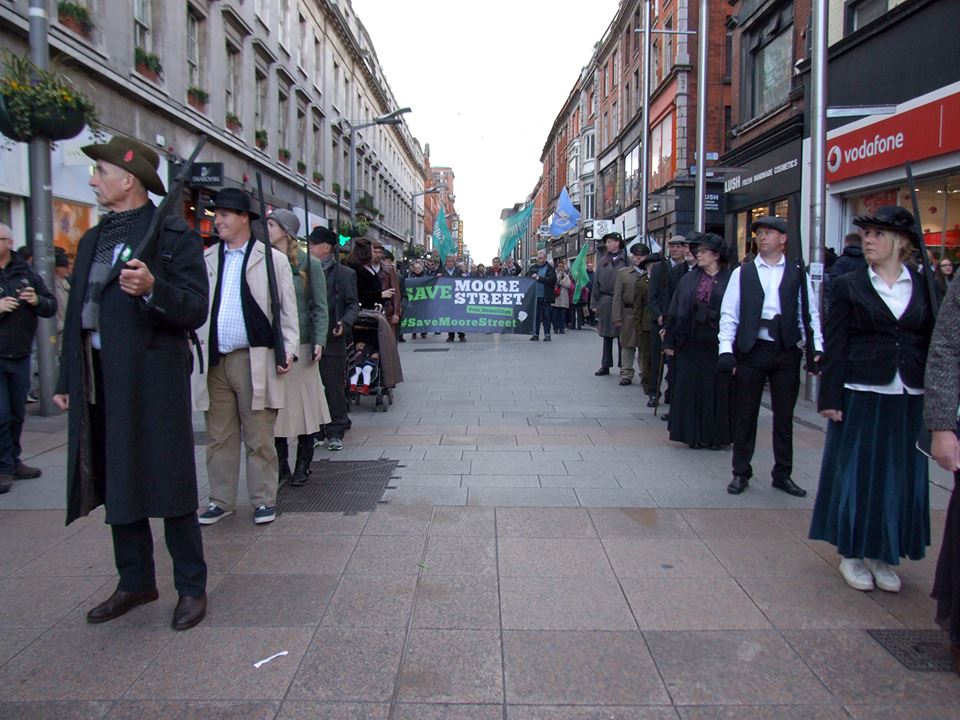
A number of protest actions have taken place since then including a street concert and a march from Liberty Hall to Moore Street ending in a rally at the GPO. The struggle continues at the time of writing with further events planned and the SMSFD group have joined with others, including people who occupied the buildings, to form the ‘Save Moore Street 2016’ group. It is a broad group containing activists from a number of Republican organisations and independents of community action, socialist and Republican background.
In a separate development, a High Court challenge against the process undertaken by the State to buy the properties and demolish others on either side opened on February 9th and has been adjourned a number of times since, apparently due to the State not having got its papers together.
NATIONAL HISTORY
Socialists may argue that the cause lying behind the struggle is one of preservation of Republican or even nationalist history. I would argue that is only partly true – but what if it were so? Who actually makes history? It is the masses of people that make history, even if individuals among all classes at certain times are thrust – or throw themselves – upon the stage. In that sense, ALL history of progressive social history belongs to the working class.
Furthermore, the underlying historical reason for which many are seeking to preserve the 1916 Terrace and, indeed, the Moore Street historical quarter, is because it related to a struggle against colonialism, against an immense colonial empire. Are socialists to say that they take no interest in anti-colonial struggles and their history? Or is it that they do, so long as they be in some other part of the world? And if the latter be their position, what possible political justification could they offer for it?
STREET MARKET – SOCIAL HISTORY
In the development of this city, Dublin, street traders have played a part – as indeed they have in the development of probably every city in the world. Working people and small-time entrepreneurs, working hard from dawn to dusk in all weathers to feed themselves and their families, a link between town and country or between coast and inner city. They brought fresh food to the city dwellers of all classes and brought colour to what was often a drab environment, colour to the eye and to the ear also.
Moore Street is the last remaining street of a traditional street market centuries old, the rest of which now lies buried under the ILAC centre and which even now threatens to extend further into Moore Street, squeezing the market street still further. This street market and its history as well as being physically threatened by the proposed extension of the ILAC, squeezed commercially by Dunne’s and Lidl, is threatened also by a planned budget hotel building of many floors and of course the giant shopping centre plan of Chartered Land/ Hammerson. Have the socialist groups nothing to say about this or, if they are against this monopoly capitalist assault, why do they distain to take their place in the ranks of the resistance?
AGAINST WORLD WAR
Some of the Volunteers undoubtedly planned the Rising to take place during the first imperialist World War purely on the basis of the maxim that ‘England’s difficulty is Ireland’s opportunity’. But others, including the revolutionary socialist leader James Connolly, also clearly wanted a rising against the slaughter of workers in a war between imperialists. Connolly wrote a number of articles denouncing this slaughter which socialists of his time had pledged themselves to fight but which few had actually done, when it came to the crunch. However, that position remains the correct one for the working class: in a situation where your masters wish to send you out to fight your class brothers abroad, turn your guns on your masters instead. The 1916 Rising stands as an example of this, the first of the 20th Century and world history would have to wait until the following year for another example in Europe.
WORKERS’ HISTORY
All the Irish socialist groups, as far as I’m aware, right across the spectrum from Anarchist to Communist, hold the memory of James Connolly and of the Irish Citizen Army in high esteem. And so do the radical social democrats.
James Connolly led the Irish Citizen Army into alliance with the Irish Volunteers, Cumann na mBan and na Fianna. The ICA, a trade union-based militia, had been formed to defend demonstrating and picketing workers against the attacks of the Dublin Metropolitan Police in 1913. When the ICA went out in the 1916 Rising, Ireland was the first country in the world that century for a workers’ armed unit to fight in its own uniforms and under its own leaders.

The ICA were allocated the Stephens Green and Dublin Castle areas but also had members in the GPO garrison. So when the GPO garrison retreated from the burning building, ICA members were part of that retreat. At least one died on that journey, struck down in Henry Place by British Army bullets at the intersection with what is now Moore Lane.
When the GPO garrison took possession of the 16 houses of the Terrace in Moore Street, tunneling from house to house, the ICA were part of that. And when the decision to surrender was taken, the ICA laid down their arms with the rest.
The 1916 Rising and the occupation of the Moore Street terrace and backyards is part of the ICA’s history and is therefore part of the history of the Irish working class and, indeed, of the international working class. If the socialist groups don’t wish to celebrate that episode in the history of the class, why? If, on the other hand, they do celebrate it, why then do they not join the struggle to have the place of their last stand preserved from demolition and to have the ICA’s place in history marked by a fitting monument?
The lack of engagement of most of the revolutionary and radical left with the Moore Street struggle has also meant no noticeable pressure within the trade unions, where the left have some influence, to even declare verbally for the preservation of the 1916 Terrace. To date, only one section of one trade union, the Construction Section of SIPTU, has declared in favour of saving the Terrace.
WOMEN
The struggle for gender equality is an important part of the struggle for the emancipation of the working class, i.e. for socialism: women represent slightly over one-half of the human race and this is true also for the working class. In addition, the oppression of one part of the class serves as a wedge into the solidarity of the class as a whole.
In 1916 women served as auxiliaries in Cumann na mBan and as equals in the Irish Citizen Army. That year was the first in the World in which women participated in an insurrection in a unit of their own, wearing a uniform of their own and under their own female officers, as was the case with Cumann na mBan. It was also the first time in the 20th Century in which women had formal equality with men in an armed workers’ organisation, as they did in the Irish Citizen Army.

The Proclamation was the first insurrectionary call to arms to address itself specifically to women alongside men (“Irish men and Irish women …”, it begins) and had been signed in secret a little earlier by the seven male signatories (or by most of them) in the alternative cafe and agricultural product cooperative run by Jenny Wyse Power at No.21 Henry Street.

CAPITALISM & THE STATE
The campaign for the saving and appropriate renovation of the 1916 Terrace first of all confronted the capitalist property speculator Joe Reilly and his Chartered Land company, while it lobbied the State to take over the Terrace.
When in 2007 the State declared four houses in the Terrace to be a ‘national monument’, the campaign continued confronting the speculator but now calling, without success, on the State to oblige Mr. O’Reilly to comply with his maintenance obligations to a national monument. When the State granted, with some changes, planning permission for the speculator’s giant shopping centre, the campaign moved into confrontation with the State, a confrontation which intensified after the State purchased the four buildings and prepared to demolish the buildings on either side.
The whole saga was an object demonstration of the function of the State in facilitating capitalist property speculation and furthermore, of the neo-colonial nature of a capitalist class unable to consider saving such a national historical treasure even with the support of the vast majority of the population.
In such a struggle, with people with democratic objectives on one side and, on the other, rapacious property speculators and a capitalist State facilitating those speculators, where does the duty of socialists lie? It is clear on which side they should stand if they should stand on the issue at all. And they should take a stand on it – how can the development of that struggle do anything but strengthen the democratic movement in general, including the movement for socialism, and harm its opponents, the State and capitalism in Ireland? And surely in the course of that struggle, with socialists side by side with Republicans, alliances would be formed which could be built upon for more ambitious projects later?

IN CONCLUSION:
For all the reasons given above, its social history, its anti-colonial history, the history of the common people as well as that of intellectuals, the history of the working class to assert its independence and dominance of the movement for liberation, the history of women’s struggles, and the current struggle of people against property speculator capital and State, the place of socialists, revolutionary and radical, is right there with the Moore Street 1916 Terrace campaigners. But where are they?
With the exception of a few honourable exceptions, they are notable by their absence. Yet, they will wonder at times why the mass of people do not follow them; why, for the most part, they regard them and their organisations as an irrelevance.
End.
‘JUST FOUR HOUSES’ — A SCENE FROM THE EASTER 1916 RISING
Diarmuid Breatnach
Introduction (for those who might need it):
In the last days of the 1916 Easter Rising, with the GPO in flames, the garrison had to evacuate and did so through Henry Place. When they came to Moore Street, it was being raked by machine-gun fire from a British Army barricade at the junction with Parnell Street. Consequently, the garrison entered the first house in the terrace to the their right, No.10 and tunneled from house to house until they reached the end of the terrace, No.25.
A struggle is taking place currently to have the whole terrace saved and declared a national monument, a battlefield site in the context of the Historic Quarter. In 2007, the State made only four houses a national monument, No.s 14 to 17 and at the very end of 2015, bought the four run-down houses from their speculator owner at a million Euro each. The Government plans to make them into a commemorative centre, in the course of which they wish to demolish buildings 13, 18 and 19. Speculators have planning permission for a giant shopping mall from O’Connell Street to Moore Street and from Parnell Street to Henry street, which envisages the demolition of the entire terrace except for No.s 14-17.
In reply to campaigners, Minister for Arts, Heritage & Gaeltacht, Heather Humphreys, has stated that some of the buildings are of post-1916 construction and therefore are of no historic value. In opinion pieces in the Irish Times, one week after the other, Frank McDonald and Diarmaid Ferriter wrote articles supporting the Government.
JUST FOUR HOUSES — a sketch for three actors
AT HENRY LANE/ MOORE STREET INTERSECTION
(Sounds of shells crashing, flames roaring, combustibles exploding, rifle fire, the chatter of machine-guns)
Irish Volunteer A: “Bloody hell, it was hot in the GPO!”
Irish Citizen Army Volunteer: “Hot as Hell. We were lucky to get out alive, with ammunition about to blow.”
Volunteer A: “We can’t stay here in this laneway in the open, though.”
ICA Volunteer: “No, let’s get under cover quick! Into that terrace there … Moore Street this is, right? Sixteen houses ….
Volunteer B: “No, we have to occupy just four houses in this street.”
Vol. A: “Only four? But there’s nearly 300 of us here!”
Vol. B: “I know. But orders …”
Vol. A: “Damnation! OK, best bash that door down, No. 10.”
Vol. B: “No, not that one.”
Vol. A: “Why not?”
Vol. B: “Only Numbers 14 to 17.”
ICA Vol: “But they’re in the middle of the terrace. We’d get shot to pieces by the British machine gun up at Parnell Street – and we have to carry Connolly’s stretcher so he’d get shot too!”
Vol. B: “Yeah, they’ve already shot up The O’Rahilly’s lads.”
Vol A: “Whose orders are these? Who says we should all pile in just four houses in the middle of the terrace?”
Vol. B: “Somebody called Humphreys …. and a Mac Donald …. and a man called Ferriter. Something about only those four houses being of historic significance.”
ICA man: “What? Bloody rubbish – look, go and ask Connolly what he thinks. He’s the Commandant of this garrison, not that lot, whoever they are.”
(A few minutes later)
Irish Volunteer B: “Well, what did Connolly say?”
Vol A: “His exact words? ‘Don’t be stupid lad – break down the door of No. 10 there and tunnel along the terrace, from house to house, aye, all the way to the end – No. 25, isn’t it?’ ”
ICA man: “That’s more like it – I knew we’d get some sense out of Jim – I mean, the Commandant.”
Vol A: “Thanks be to Jayzus for someone with sense in charge. Who the hell are that other lot and where did they come from, that Humphreys, MacDonald and Ferriter?”
Vol B: “I dunno. Give’s a hand with this door before we get shot out here, gabbing …”
(Sound of nearby hammering, wood splintering …)
MOORE STREET — A VISION (Part II)
MOORE STREET – A VISION
Part II
(Looking into the future, a couple of generations on)
Diarmuid Breatnach
THE GPO EVACUATION AND MOORE STREET LAST STAND
Our tour group gathered in the GPO for the Evacuation & Last Stand part of the tour; one can take this tour on its own or as part of longer tours. We said goodbye to Rónán, who handed us over to our Evacuation Guide, Pela.

Our tickets were checked and we were handed audio earphones, receivers and issued with our instructions – stay with the group, obey the instructions of the guide, etc.
Our group had about thirty people in it and ours had the only young children, although there were a few in their late teens. About half or more looked like tourists and some asked for the foreign-language options of receivers. There was one man in a wheelchair.
As instructed by the guide in a number of languages, we tested our receivers to find the volume settings appropriate for each individual. This took a bit longer for our two younger girls. Then our guide motioned for us to listen to our earphones … and the narration began. Gradually, we were pulled back across the decades until we were in that amazing Rising, taking place in what had once been considered the second city of the British Empire, rising up against that very same Empire, one of the largest the World had ever seen.
It was the fourth day of the Rising and many of the buildings in the city centre were ablaze. Through our earphones, against a backdrop of booming cannon and crashing shell, chattering machine guns, rifles’ crack and whining ricochet, we could hear the crackle of flames. Irish Volunteers’ voices reported that the glass in Clery’s building opposite had melted and was running across the street like water. The ledgers the Volunteers had placed in the GPO windows to protect against bullets were smouldering. Other voices added that despite fire-fighting efforts the roof was on fire and the roof lead melting. We could almost smell the smoke. Then finally, the order to evacuate given in an Edinburgh accent – James Connolly, the socialist commandant of the HQ of the Rising, the General Post Office.
In the hubbub of people getting ready to evacuate some voices stood out: Elizabeth O’Farrell, giving instructions about the moving of the injured James Connolly; calls to evacuate by the side door and caution about crossing Henry Street, with machine-gun sniper fire coming all the way down Talbot Street from the tower of the train station at Amiens Street.
A man’s voice in our earphones says “It’s lucky we have oul’ Nelson there to shield us some of the way!” and we hear a few people laugh.
Then, The O’Rahilly’s voice, calling for volunteers to charge the barricade at the top of Moore Street and a chorus of voices answering, clamouring to be chosen.
Now we are out in a group and crossing Henry Street. The man in the wheelchair, having politely declined offers to push his chair, is propelling his wheels strongly along with his leather-covered hands. It is weird to see the pedestrian shoppers and sightseers of the Twenty-First Century as half our minds are back in the second decade of the Twentieth. Across this short stretch to Henry Place we went, the crack of rifles and chatter of machine guns louder now in our earphones. And explosions of shells and of combustibles. The garrison scurried across this gap carrying the wounded Connolly on a bed frame and Winifred Carney, carrying her typewriter and Webley pistol, interposed her body between Connolly and a possible bullet from the train station tower.
With the rest of our tour group, Sadhbh and I cross into into Henry Place, holding the kids’ hands, following the route of the evacuation. Immediately we stepped on the restored cobbles of the lane-way, the sounds of battle receded somewhat.
“No bullets can reach us here!” shouts a voice in our earphones.
“No, but bejaysus them artillery shells can!” replies another.
Other shouts a little ahead warn us that gunfire is being directed down what is now Moore Lane from a British barricade on the junction with Parnell Street.

A sudden shouted warning about a building ahead of us, to our left, facing Moore Lane.
“See the white house? The bastards are in there too,” shouts a strong Cork-accented voice, almost certainly the young Michael Collins. “Let’s root them out. Who’s with me?”
Another chorus of voices, a flurry of Mauser and Parabellum fire, then only the steady chatter of the machine gun up at the British barricade and the sound of bullets striking walls.
The Cork sing-song voice again. “I can’t believe it — The place was empty, like!”.
“Aye, it was so many bullet’s hoppin’ off the walls made us think the firing was coming from inside,” a voice says, in the accents of Ulster.
Then an unmistakably Dublin working class accent: “Would yez ever give us a hand with this!” followed by the creak and rattle of wheels on the cobblestones as the cart is dragged across the intersection. Now we can hear the machine gun bullets thudding into the cart.
“Quick now, cross the gap!” comes the order and the dash across the gap begins. Nearly 300 men and women? Someone is bound to get hit and yes, they do and we hear that one of them died here.

Across the gap, nowadays mercifully free of enemy fire but still feeling vulnerable, we follow Pela, our guide, to the corner with Moore Street. In character, she peers carefully around as we hear machine-gun and rifle here too, but Mausers and Parabellum as well as Lee-Enfields.
“Gor blimey!” exclaims a London accent, reminding us that some of the Volunteers had been brought up in England. “O’Rahilly’s lads are getting a pastin’. None of ’em made it as far as the barricade!”
An Irish voice: “Into these houses then – no other way! We have to get into cover to plan our next move.” This is followed by the sound of a door being hit and then splintering as they break into No.10, the first house on the famous 1916 Terrace.
“Careful now,” Elizabeth Farrell’s voice, followed by a groan of pain as Connolly is manoeuvred through the doorway.
Pela sends the man in the wheelchair up in the lift and leads us up the stairs. When the lift and the last of our group arrive we proceed across the restored upper floors from house to house, passing through holes in the walls, as the GPO Garrison did in 1916 – except that they had to break through the walls themselves, working in shifts. Through a few unshuttered windows, we can see the busy street market below us going about its business, apparently oblivious of our passage above them. But then, thousands of tour groups have gone through here over the decades. Through the double glazing one can just barely hear the street traders calling out their wares and prices.
We pass through those hallowed rooms, listening to ghosts. Here and there a hologram appears and speaks, echoes of the past. Dummies dressed in the uniforms of the Irish Citizen Army, the Irish Volunteers, Cumann na mBan, Na Fianna and Hibernian Rifles are on display here and there. Imitation Mausers and Parabellums and Martinis, each one carefully made and to the same weight as the original, are there. They are security-chained but we know people are free to pick them up and feel the weight, as Rory does, to imagine carrying and firing one. But not to be flash-photographed, which is not permitted here. Replica Cumann na mBan medical kits are on display, open so one could inspect the replica contents. The houses also have period furniture, fireplaces, beds …. chamber pots …. kitchens with utensils … bedrooms ….. There are dummies dressed too in civilian clothes of the time typical of that area — women, men, children (even the dog that the last Volunteer to leave Moore St. fed).
We see magnified historical newspaper headlines, photos, badges and medals. A map of Dublin with fighting locations flashing on them, some of them going out as they fall, the dates appearing above them to show when that happened.
Snatches of poetry, of song come to us as we cross from room to room, from house to house. And for our eyes, the holograms of the Proclamation, the portraits of the executed 16 and many others who fought and died or who survived, flags, the Tricolour, the Irish Republic, the green-and-gold Starry Plough, waving in the wind above Clery’s ….
Half-way along the terrace we come to the discussion between the leaders, creatively reconstructed on the basis of some witness statements. Pearse wishing to surrender to avoid further loss of civilian life, Clarke arguing, a sob in his voice, Connolly saying maybe they should wait for Sean McLoughlin to get back (he is out reconnoitering a breakthrough route) …. Then the arguments with some of the other Volunteers, Mac Diarmada having to use all his powers of persuasion. Oh, such emotion in such short discussions! Then the decision, and Elizabeth O’Farrell volunteering to go with the white flag to open negotiations with the enemy …. even though a couple and their child have already died beneath a white flag in that street.
Shortly afterwards, the faces of the sixteen executed come into view, suspended in the air in front and a little above us. We stand there while passages are read out from their trials, letters from their condemned cells, words to relatives …. Then the dates appear above them and we hear the fusillades as by one their faces blink out, until finally only Casement remains, the image of the gallows and then he too is gone. All is dark for a moment, then all sixteen faces appear again, over a background of the three flags of the Rising, to a swelling chorus of The Soldiers’ Song, in English and in Irish.
At the end of the Terrace, we descend again and here view the O’Rahilly monument plaque and in our earphones hear the words of his final letter to his wife read out – he wrote it as he lay dying from a number of bullet wounds. I found my eyes moistening again as they had several times during the tour and some of the others were visibly crying – including foreign tourists.

The end of our tour lay ahead, through the underground tunnel under Parnell Street to the Rotunda. Here the Volunteers had been publicly launched and recruited in 1913 and here, in 1916, the GPO/ Moore Street garrison had been kept prisoners without food and water for two days, while G-Men of the DMP came down to identify whomsoever they could from among the prisoners.
Now the recordings in our earphones ask us to listen to the guide for a moment as she collects our earphones and receivers. Having gathered the sets and put them away in her bag, Pela asks us all to give a moment’s thoughts to the men and women and children of the centenary year of the Rising, 2016, who had fought to preserve this monument for future generations. Pela tells us that her own grandmother had been one of the activists.
Incredible though it may now seem, the whole terrace except for four houses had been about to be demolished to make way for a shopping centre, which would also have swallowed up the street market. It had taken a determined campaign and occupations of buildings with people prepared to face imprisonment to protect it for our generation and others to come. The State of those years had little interest in history and much in facilitating speculators. She invited us to applaud the campaigners, which we did, enthusiastically. She then asked us to turn around and view the building we had left. There was a plaque on the wall there “Dedicated to the memory of the men, women, girls and boys of 2016 ……” In bronze bas-relief, it depicts the 16 houses with activists on the scaffolding erected by those who intended demolition, with a chain of people of all ages holding hands around the site and in one corner, a campaign table surrounded by people apparently signing a petition.
Once through the underpass and inside the Rotunda, the tour officially over, we thanked our guide and made for the Republican Café. Sadhb and I found we couldn’t say much, as our minds were half back in 1916. Rory was quiet too but Eva and ‘Brigie’ seemed unaffected, brightly debating what to choose from the menu in the Rotunda café, or what souvenir they fancied from those on display.

There’s a Moore Street and Dublin Street Traders’ Museum and there are films one can see all day in the Rotunda, often too lectures, reenactments, plays …. We’d had enough for one day, however – we were full. It was truly an unforgettable experience and I knew that for Sadhbh too and probably for Rory, it was something that would remain forever alive in our memories. The girls? Years from now, who knows ….. but they had certainly not been bored, anyway.
End.