THE SCREAM ON A DECEMBER NIGHT


Diarmuid Breatnach


A high-pitched but hoarse scream cuts through the night. Again and again it is heard, then is silent. A frightening sound, perhaps of a person being attacked …. But no, it is a vixen, a female red fox (Vulpes vulpes). Why is she screaming? Is she in pain?  Not exactly — she is informing dog-foxes in the area that she is ready to mate and where they can find her.
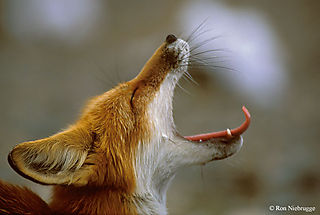
Vixen screaming (sourced on Internet)


But this is December and, according to Internet site after site dealing with foxes in Britain and in Ireland, she is at least a month early1. Perhaps she is a rare exception, this vixen in the Drumcondra area but it seems to me more likely that the sites have it wrong: either urban foxes breed earlier or the breeding pattern of foxes is changing. Actually, a combination of both is likely.

A vixen breeding in January would give birth to her cubs just over 50 days later, when in rural areas the earth is warming up in the Spring and when lambs are born, hares are boxing, eggs are being laid, greens are growing and being eaten by rabbits – in other words, food is becoming available for the vixen. Obviously vixens breeding in February or March will have yet more food available in April or May but may also find greater competition, in food and for a mate.

Say this rural vixen conceived on 1st January, then she would give birth on or around 22nd February. She will need feeding just before that and probably up to 24th March, a task falling to the dog fox and to unmated young females who may be part of the community. The cubs need the warmth of the mother’s body for up to three weeks after birth and she cannot leave the den. One month after giving birth the mother vixen may go hunting while the “aunts” look after the cubs, who are now venturing out of the den or “earth” (but staying very close to it).

The food brought to the young is carried inside the hunters’ bellies and regurgitated for the young to consume along with their mother’s milk which they will suckle until six weeks of age. After weaning, the cubs will eat solid food but cannot yet hunt for it themselves until perhaps mid-late Summer and, if males, will leave to establish their own territories in the Autumn.2 Males become sexually mature at one year of age.

A vixen breeding in December in an Irish rural area might have difficulty receiving enough sustenance in January or even early February, especially in decades past when winters were usually harder. However, with changing seasonal weather patterns tending to warmer winters – and in urban areas where a lot of food tends to be available for scavenging all year round – these problems are substantially reduced and so breeding in December should present little difficulties. So the thinking goes among the vixens in Drumcondra, anyway and, I suspect, in many other Irish and British urban areas.

The male or ‘dog’ fox can be heard sometimes too in a staccato bark, normally three (but occasionally four) rapid barks: bak, bak, bak!


THE URBAN FOX

The urban fox is a relatively new phenomenon in Ireland3, as far as we know, although in Bristol, for example, they have been recorded since the 1930s. Up to fairly recently, a number of experts maintained that the fox populations of city and countryside had little contact with one another. But in January 2014 “it was reported that “Fleet”, a relatively tame urban fox tracked as part of a wider study by the University of Brighton in partnership with the BBC’s Winterwatch, had travelled 195 miles in 21 days from his neighbourhood in Hove, at the western edge of East Sussex, across rural countryside as far as Rye, at the eastern edge of the county. He was still continuing his journey when the GPS collar stopped transmitting, due to suspected water damage.”4


and the Country Foxes

Decades before I heard of this I often fancifully imagined a conversation between a fox, now settled in the “big city”, and his country relations when he returned on a visit. After the initial customary welcoming, sniffing, licking etc are over, the conversation might go like this:

So, Darkie, tell us, what is life like in the big city?”

Ah, it was scary at first, with cars and buses and lorries going all day. You wouldn’t believe the noise.”

(Sympathetic whine from the audience).

But I’m used to it now, Redthree, I have to say. And the food! You could not imagine!”

Good, is it?”

Lovely, Whitepatch, absolutely delicious.”

(Sounds of salivating all around).

Chicken, beef, lamb, fish, potatoes, bread, rice, vegetables, fruit – just left out there to be eaten!”

Ah, you’re havin’ us on, Darkie. We might be “Culchies” but we’re not stupid! You expect us to believe the humans feed you like they do their dogs, do you?”

No, of course not, Greymuzzle. Well, actually a few do leave out food on purpose for us but no, this is mostly food that humans are throwing away. We find it in plastic bags and metal containers.”

They throw away food?”

They do and huge amounts of it too. Then big lorries come and take away what we have not eaten ourselves.”

Where do they take it?”

I am not sure. I’ve never troubled to find out because, to be honest, I have all the food I need nearby.”

(Silence while country foxes imagine a huge mountain of food somewhere).

Er …. Darkie, so you never hunt now?”

Oh, yes, some – the city rats and mice eat the discarded food too and they grow plump and big. Yes, I catch and eat them too.”

Well now, what about all the humans?”

What about them, Lighteyes? They don’t bother us.”

Don’t the humans have guns in the city?”

Some of them do, Lighteyes. But they don’t shoot foxes with them.”

Really? What do they shoot with their guns then?”

Other humans, Lighteyes, just other humans.”

(Noises of amazement and disbelief)


THE INNER CITY FOX

The Internet sites all agree that foxes are more likely in suburbia than in the inner city but I think they ignore some important features of the inner city which foxes can frequent in relative safety and around which they are likely to find sufficient food: railroad lines and their banks, canal and river banks, parks, allotments, cemeteries and derelict sites. One can’t get much closer to Dublin’s inner city than Parnell Square, yet I have seen foxes in a laneway off there and also squeezing through the railings to enter the Garden of Remembrance. They have been photographed near the Irish Parliament, the Dáil (though some people might say that’s less surprising with the number of scavengers nearby :). I’d be surprised if they are not to be found along the banks of the Dodder, the Liffey, the Tolka and both canals, also along the railway lines and in Glasnevin and other cemeteries.

Fox in Leinster House car park in the winter of 2013 (Source: Sasko Lazarov via Photocall Ireland, reproduced in Journal.ie)
Fox in Leinster House (Irish Parliament building) car park in the winter of 2013 (Source: Sasko Lazarov via Photocall Ireland, reproduced in Journal.ie)


According to one Internet site5, the urban fox population in Dublin may be growing too big for its own health, as the ready availability of food allows unhealthy individuals to exist, diseased and covered in mange infestation (mites that denude patches of fur). I would need to explore this argument before I could accept it.

I am familiar with the overpopulation argument in the case of grazing animals or rodents, where too many individuals consume the available resources and the whole population suffers – a fate usually occurring when natural predators are not present to thin out the weaker individuals and thereby unconsciously preserve the general population in a healthier state.

But how would this work with regard to Dublin foxes? It seems unlikely that the food available is being reduced yet and if and when it is, one presumes healthier foxes will outcompete their sicker species members. Also, sick and undernourished foxes are less likely to come into oestrous and should they do so and conceive, to be able to raise their young. It seems to me most likely that what is occurring is that foxes that would normally have been winnowed out in the struggle of survival are now able to sustain themselves, which might be distressing to see but which will not necessarily have any effect on the healthy population.6 And will healthy individuals necessarily succumb to mange infection from infested individuals? And if they do now, might they not in time learn to chase infected individuals away?

Theories of overpopulation and scare stories about foxes attacking babies, cats and so on seem prompted by the intention to cull foxes, as Boris Johnson, Mayor of London, proposed. Johnson seems unwilling to learn from history, as “there was a large and expensive effort to reduce the number of urban foxes across the UK in the 1970s, but the population subsequently bounced right back.”7 The average litter now may be four cubs but vixens have been known to bear up to a dozen and with a low population-to-high-food-sources ratio, are likely to bear a greater number of cubs. And a recent National Health Service survey in the UK indicated that nearly 60% of all stings and bites admitted to emergency rooms were inflicted by dogs8 but anyone suggesting a cull of urban dogs would probably find a gathering bearing pitchforks and burning torches outside their home.

Boris Johnson, Mayor of London, was proposing a cull of London foxes (source photo: Internet)

There have been claims that foxes kill and eat lambs, cats, other domestic pets and poultry. Most experts have concluded that if indeed a fox killed a lamb, such incidents are very rare. A ewe is capable of protecting a lamb from a fox, an animal not much larger than a cat. However, foxes have been found to eat the afterbirths of lambs and would of course eat a stillborn lamb or one that died soon after birth, after which its mother would leave and the opportunist would move in; such incidents may have convinced some people in rural areas that the fox was the cause of the lamb’s death.

The Foxwatch study program in Bristol city filmed a number of confrontations between urban foxes and cats and found that in all cases, it was the fox that backed down. This makes sense, for a predator does not usually take on another predator of similar size except in defence of its young, its own life or, at times, its kill.

Yes of course foxes will kill poultry if they can get at them and are often accused in such situations of going on a killing spree. Foxes do kill and gather more food than they need at times and, like many other animals, hide it for recovery later, marking the spot with their scent. But when a fox breaks into a poultry pen and kills its inhabitants, it usually has to leave with what it can carry and will not be permitted to return for the rest. The answer for humans is to build secure pens into which to bring the poultry at night – and that applies also to rabbits kept as pets or for the table, etc. — or keep a dog outside, unleashed.

Scare stories and unscientific suggestions to one side, wild animal populations living alongside humans frequently do need management. All species of bats are protected in Ireland and Britain and should you find them in your attic you are not permitted to remove them but must instead notify the appropriate authorities. Some people have suggested that the red fox should be granted protected species status but it is difficult to see the rationale for this, since it is on the species of “least concern” list of the International Union for the Conservation of Nature. Pigeons receive no protection and, though often fed by people who consider them cute or pretty, do have a negative effect on our urban environment and, in the case of seagulls, who are protected, may be responsible for the disappearance of the many species of ducks that once were common in Stephens’ Green. Rats and mice are not deliberately fed or considered cute by most people (though I have kept both myself and found the individuals tame and harmless and, in the case of rats, quite intelligent) and humanity wages war upon them with traps and poison.

Do urban foxes require management? Zoologist Dave Wall9, who has studied Dublin’s urban foxes for some years, thinks not. In his opinion, the fox population in Dublin has remained constant since the 1980s. According to statistics regularly quoted but never referenced that I can find, Dublin fox families occupy on average 1.04 Km². 10 Given a rough and probably low estimate of six individuals per fox family (a mated pair and two unmated females and two cubs) and a Dublin City area of 115 km² would give us a fox population of 663 in the city. That might seem a lot, until one hears that London holds an estimated 10,000.

Given statistics of that sort, and information that the average litter is of four cubs, one may wonder why most urban dwellers see them but rarely and also why urban foxes are not a massively growing population. There are a number of controlling influences, ranging from the need to establish territory and fight to hold it, which may cost in injuries or even death, to deaths by traffic, the most common cause of fox death according to Internet sites (although how often do we see a dead fox on the road?). A common non-captive life-span of from two to four years and a fertility “window” of only three days for a vixen would be population-controlling factors and yet the allegedly stable population is puzzling, to me at least.

The rural fox tends to inhabit, widening when necessary, burrows already excavated by rabbits and badgers. In urban areas, the fox may have to excavate its own – under buildings and sheds and into railroad banks, for example – but will also use and expand other holes and gaps.

Many urban human dwellers, probably most, never see urban foxes, although they are becoming increasingly visible. They are active mostly at dusk and shortly before dawn and are mostly likely to be seen by people who rise very early for work, or who work at night or who are returning from late night socialising on foot, by bicycle or on foot.

In the Lewisham area of South-East London where I lived for some decades, I regularly saw them on the roads while cycling home from a late music session or a friend’s house. Lewisham would be considered midway between being city and suburban in nature and contained parks, cemeteries, allotments, streams or rivers and railway lines, houses with gardens but also high-rise blocks of local authority housing and very busy roads. I once passed about three yards near to an adult fox on the housing estate I lived on for awhile between Grove Park and Eltham (also in SE London). On my allotment in Catford, if I worked until dusk (which I did often enough when I managed to find the time), they would come out and play and dig for food less than ten yards away from me. And I frequently found trainers (running shoes) and balls they had taken from outside local houses and gardens, discarded on my allotment.

A number of theories have been forwarded for the penetration of urban areas by the fox, including the shameful wiping out of rabbit populations by state-inflicted plagues of myxomatosis but the real reasons are probably the same as those of the pigeon, rat and mouse – availability of food and home provided by humans and the adaptability of the species themselves.


THE MOST WIDESPREAD CARNIVORE ON EARTH

Indeed, the red fox has proved an adaptable animal – much like ourselves. She is an omnivore, as are we and can take her prey from animals as large as a goose to those as small as beetles or earthworms, also frequently eating wild fruit, especially in the Autumn. Studies in the former Soviet Union found that up to 300 animal and a few dozen plant species were known to be consumed by her11. Mice and rats are frequently on her menu and her ancestors are thought to have developed as specialist rodent hunters in Eurasia five million years ago but her kind is now the most widespread carnivore on Earth, with 46 recognised subspecies.

The fox has binocular vision which is particularly effective at night, excellent hearing over distance, including the ability to detect the squeaking of mice at about 100 metres (330 ft) and capable of locating sounds to within one degree at 700–3,000 Hz, though less accurately at higher frequencies12, compensated for by an ability to hear at very low frequencies, including a rustle in grass or leaves and the burrowing of rodents underground. It has evolved many tactics for hunting, including tracking, ambush, stalking, leaping, pouncing and digging.

The fox can also run at a speed of 42 km/ hour, climb some trees, leap high and swim well. Considering the latter, its absence from many islands near to mainlands may come as a surprise but I think that is easy to explain through eradication by human agency.

The red fox is to be found everywhere in Europe (where she is thought to have reached 400,000 years ago) and in North America, Canada, China, Japan and Indochina. Sadly, in the mid-19th Century her species was introduced to Australia by European settlers (at first for sport and later perhaps to control the rabbit, also introduced there by Europeans), where a population of 7.2 million red foxes now is wreaking damage among rarer indigenous wildlife and is considered responsible for the extinction of a number of species. It is classified as the most harmful invasive species in Australia and eradication and population control measures are adopted against it there, as are also against feral domestic cats and dogs, also imported by Europeans.

The dingo is regarded as a controlling agent on red fox population growth in Australia though not totally effective due to the fox’s habit of burrowing; this is interesting for a number of reasons: firstly, the dingo (Canis lupus dingo) is itself a wild dog most likely imported from Asia by Aborigine settlers somewhere between 4,500 and 10,000 years ago and secondly, the red fox in Ireland and Britain does not tend to excavate its own burrows but rather to enlarge existing ones and then generally only for mating and rearing cubs. The Red Fox is currently absent from Iceland, Greenland, South America and sub-Saharan Africa.

The fox has been hunted by humans primarily for its fur, especially in winter when it is thicker and from foxes in the far north its silkiness is considered very valuable.

Reynard (one of the names traditionally given to the fox) has also been hunted for sport, usually by the aristocracy or country gentry, on horseback with hounds, an activity which gave rise to one of Oscar Wilde’s many memorable phrases: The English country gentleman galloping after a fox – the unspeakable in pursuit of the inedible.” Of course, it was not only the English who did this but also the Anglo-Irish Ascendancy (from which Wilde’s father himself came) and the upwardly-climbing Irish who aped them, ag sodar i ndiaidh na nuaisle.13 There have been numerous attempts to get fox-hunting banned and direct action such as protests and sabotage of hunts but it is still legal in Ireland and in Britain, though substantially reduced from a century ago.

Gamekeepers have also hunted the fox in order to keep it from killing ground-nesting birds such as wild pheasants, grouse and partridge, so that the landowner and his friends could shoot these birds down later14. Finally, the farmer has taken his toll, sending specially-bred dogs such as cairn terriers down earths to kill a hiding fox and in particular the cubs. The farmer wishes to protect his poultry but avoid the cost of building secure pens and so hunts foxes down; he could let his dogs roam his poultry area which would keep foxes away but dogs do often go chasing sheep too, which will also represent a loss to the farmer, either because the sheep are his or because his neighbours will claim compensation from him.


AN MAIDRÍN RUA and tradition

In Ireland, the fox was known as Sionnach, Madagh Rua (“red dog”) or Maidrín Rua (“little red dog”) and has given its name to a number of places, eg Cnoc an tSionnaigh (Fox Hill, Co. Mayo; another as a street name in Co. Laois); Oileán an tSionnaigh (Fox Island, Co. Galway); Carraig an tSionnaigh (Foxrock, Co. Dublin); possibly Léim an Mhadaigh, (Limavady, Co. Derry) and Lag an Mhadaigh (Legamaddy, Co. Down); possibly Ráth Sionnaigh (Rashenny, Co. Donegal), etc.15

Fox is also a family name and the Irish language version of it is Mac an tSionnaigh (literally “Fox’s son”).  The Maidrín Rua or Sionnach features in a number of songs in Irish and in English and here is one from the Irish language tradition of song but in a non-traditional choral arrangement: https://www.youtube.com/watch?v=6bJyqbPxTwU.

Widely represented in folklore from China to Ireland, the fox is also mentioned in the Old Testament Bible and in Greek stories such as the fables of Aesop as well as among the Indigenous people of the Northern Americas. He is never stupid but his intelligence or cunning is also often portrayed as devious, tricky and even malicious. On the other hand, let us not forget that the anti-feudal Mexican hero created by USA writer Johnston McCulley (February 2, 1883 – November 23, 1958), who fights for the downtrodden and indigenous people and mocks the Mexican aristocracy and large landowners, always escaping them, used the nom-de-guerre of “El Zorro”, the fox.

There is a sexual connection too in the representation for the fox: for example in English a “foxy lady” is one with a high level of sexual attraction and in Castillian (Spanish) a “zorra” (vixen) is a pejorative term for a woman trading in sexual favours or “of low morals”16. Have we come around in a circle to where we began, to the vixen’s scream? I think so, but loaded now with a patriarchal outlook. Men can openly want and enjoy sex, of course, that is natural – but a woman? Surely not … or, if she does, she must be bad!


End.


Internet Sources:

http://www.thejournal.ie/fox-urban-dublin-1537602-Jun2014/

http://www.newforestexplorersguide.co.uk/wildlife/mammals/foxes/family-life.html

http://www.wildlifemanagement.ie/dublins-urban-foxes/

http://www.irishtimes.com/life-and-style/people/our-confused-relationship-with-foxes-cull-them-feed-them-hunt-them-kill-them-1.1251806

http://www.newsfour.ie/2013/04/city-fox-controversy/

http://www.noticenature.ie/files/enfo/factsheet/en/WL33%20Foxes.pdf

http://www.conserveireland.com/mammals/red_fox.php

https://en.wikipedia.org/wiki/Red_fox

https://books.google.ie/books?id=GjK93IUdAX4C&pg=PA96&lpg=PA96&dq=fox+can+hear+low+frequencies&source=bl&ots=BdWCosvgXg&sig=z76bvVOGnUjEQMnGTf4w44mqTyU&hl=en&sa=X&ved=0ahUKEwjN-dOm7v7QAhXoKsAKHQtsCGcQ6AEILTAD#v=onepage&q=fox%20can%20hear%20low%20frequencies&f=false


Footnotes:

1This is one of the very few sites to state that breeding may start in December http://www.newforestexplorersguide.co.uk/wildlife/mammals/foxes/family-life.html and Wikipedia also gave December as the start of the mating season and also as the month when the dog-fox’s testes are heaviest.

2Young females may remain another season and help care for the next litter of cubs.

3Although one article, without giving a reference, stated that foxes have been in Dublin since Victorian times.

6Other feature which makes this claim suspect are a number of scare items in the article: a) the sensationalist reference to the alleged danger to a baby from a fox in a bedroom and a link to the article reporting this event. Such an event, supposing it occurred, must be on a level of likelihood way below the danger to babies from, for example, pet cats and dogs. Also b) the reference to the danger of contracting roundworm (Toxocara canis), which can cause toxocariasis in children, while not however mentioning how low that risk is and that infection for children is most likely to be encountered from dogs and cats.

9Dave Wall B.A. is a postgraduate researcher in zoology at UCD. He has studied otters, marine mammals and Alpine badgers as well as studying Dublin’s urban foxes for the past few years. He is a Director of the Irish Whale and Dolphin Group.

12Ibid

13“Trotting after the nobles”, a derogatory phrase in Irish.

14Gamekeepers in Ireland and Britain also shot, poisoned or trapped badgers, otters, pine martens, stoats, escaped mink, eagles, hawks, buzzards, crows and magpies and often hung their carcasses in near their lodges to display their diligence in their tasks

16Often the condemnation of “low morals” is applied to a sexually active female but not to a sexually active male.

LÁ FHÉILE STIOFÁIN/ ST. STEPHENS’ DAY

Diarmuid  Breatnach
(Traducido al castellano al fondo)

Singing Wren 46 (Michael Finn)

(Reading time: 5 minutes)

  ” We made it!  We made it!  Safe for another year!”

Wren on rock


“Shut up, you idiot!  The day’s not over yet!”


Meanwhile, not far away ….

Wren Boys Sligo
Mummers Sligo maybe

THE WREN-BOY TRADITION IN IRELAND

In England it is called “Boxing Day” but in Ireland the 26th of December is “St. Stephen’s Day”.  Despite the Christian designation it has long been the occasion in Ireland for customs much closer to paganism.

It was common for a group of boys (usually) to gather and hunt down a wren.  The wren can fly but tends to do so in short bursts from bush to bush and so can be hunted down by determined boys.  The bird might be killed or kept alive, tied to a staff or in a miniature bower constructed for the occasion.

The Wren Boys would then parade it from house to house while they themselves appeared dressed in costume and/or with painted faces.  In some areas they might only carry staff or wands decorated with colourful ribbons and metallic paper while they might in other areas dress in elaborate costumes, some of them made of straw (Straw Boys) and these were sometimes also known as Mummers although a distinction should be drawn between these two groups.  The Mummers in particular would have involved acting repertoires with traditional character roles and costumes, music and dance routines while the simpler Wren Boys might each just contribute a short dance, piece of music or song.  In all cases traditional phrases were used upon arrival, the Mummers having the largest repertoire for in fact they were producing a kind of mini-play.

The origins of the customs are the subject of debate but a number of Irish folk tales surround the wren.  The bird is said in one story to have betrayed the Gaels to the Vikings, leading to the defeat of the former.  There is a Traveller tradition that accuses the wren of betraying Jesus Christ to soldiers while another tradition has the bird supplying the nails (its claws) for the crucifixion of Jesus Christ.  Yet another tradition has the wren as King of the Birds, having used its cunning in a competition to determine who would be the avian King, hiding itself under the Eagle’s wind and flying out above the exhausted bird when it seemed to have won, having left all others behind and could fly no higher.

By the 1960s the Wren Boy custom was beginning to die out even in areas where it had held fast but it slowly began to be revived by some enthusiasts.  Nowadays fake wrens are used.  Christmas Day in Ireland was traditionally a day to go to religious service and to spend at home with family or to go visiting neighbours.  It was not a day of presents or of lights or Christmas Trees, customs brought in by the English colonizers in particular from Prince Albert, the British Queen Victoria’s royal consort, who was German.  St. Stephen’s Day may have celebrated the Winter Solstice (the wren being a bird that on occasion sings even in winter) but moved to a Christian feast day; in any case it produced colour and excitement at a time which did not have the religious and commercial Christmas season to which, in decades, we have become accustomed.

The lovely song The Boys of Barr na Sráide from a poem by Sigerson Clifford takes as its binding thread the boys in his childhood with whom Sigurson went “hunting the wren”.  It is sung here by Muhammed Al-Hussaini (currently resident in London and part of the singing circle of Comhaltas Ceoltóirí na hÉireann, meeting in the Camden Irish Centre).  There are recordings of others performing this song well but the unusual origin of this one as well as its quality persuaded me to choose this one.  In addition, I had the pleasure of participating in a singing circle with this lovely and modest singer in London in October this year (see The London Visit on the blog), who greeted me in Irish.  Muhammed also plays the violin on this, accompanied by Mark Patterson on mandolin and Paul Sims on guitar.

ends.

LA TRADICIÓN DE “CHICOS DEL REYEZUELO” EN IRLANDA

Diarmuid Breatnach


En Inglaterra se llama “Boxing Day”, pero en Irlanda el 26 de diciembre es “
la fiesta de San Esteban“. A pesar de la designación cristiana, ha sido durante mucho tiempo la ocasión en Irlanda de costumbres mucho más cercanas al paganismo.

          Para eso era común que un grupo de niños (generalmente) o chavales se reuniera y cazara a un reyezuelo. Ese pájaro es capaz de volar pero tiende a hacerlo en ráfagas cortas de arbusto a arbusto y, por lo tanto, puede ser cazado por niños determinados. El pájaro podía ser asesinado o mantenido vivo, atado a un bastón o en una glorieta en miniatura construida para la ocasión.

Los “Wren Boys” (Chicos del Reyezuelo) lo desfilarían de casa en casa mientras ellos mismos aparecían vestidos con disfraces y / o con caras pintadas. En algunas áreas, solo pueden llevar bastos o varitas decoradas con cintas de colores y papel metálico, mientras que en otras áreas pueden vestirse con trajes elaborados, algunos de ellos hechos de paja (Straw Boys/ Buachaillí TuI = Chicos de la Paja) y a veces también se los conoce como Mummers, aunque se debe hacer una distinción entre estos dos grupos. Los Mummers en particular tenían repertorios involucrados de actuación con roles y disfraces de personajes tradicionales, música y rutinas de baile, mientras que los Wren Boys más simples podrían contribuir con un baile corto, una pieza musical o una canción. En todos los casos se usaron frases tradicionales a la llegada, los Mummers tenían el mayor repertorio porque de hecho estaban produciendo una especie de pequeño teatro. Se les daba dinero , pastel o caramelos.

Los orígenes de las costumbres son objeto de debate, pero una serie de cuentos populares irlandeses rodean al reyezuelo. En una historia se dice que el pájaro traicionó a los Gaels a los Vikingos, lo que llevó a la derrota de los primeros. Hay una tradición de los Travellers (gente étnica nómada de Irlanda) que acusa al reyezuelo de traicionar a Jesucristo a los soldados, mientras que otra tradición dice que el pájaro suministra los tornillos (sus garras) para la crucifixión de Jesucristo. Sin embargo, otra tradición le tiene al reyezuelo como el Rey de los Pájaros, después de haber usado su astucia en una competencia para determinar quién sería el Rey de las aves, escondiéndose bajo el viento del Águila y volando por encima del pájaro agotado cuando parecía haber ganado, todos los demás detrás y no poder volar más alto.

En la década de 1960, la costumbre de Wren Boy comenzaba a desaparecer incluso en áreas donde se había mantenido firme, pero algunos entusiastas comenzaron a revivirla lentamente. Hoy en día se usan reyezuelos falsos. El día de Navidad en Irlanda era tradicionalmente un día para ir al servicio religioso y para pasarlo en casa con la familia o para visitar a los vecinos. No fue un día de regalos ni de luces ni de árboles de Navidad, costumbres traídas por los colonizadores ingleses en particular del alemán Príncipe Alberto, el consorte real de la Reina Victoria británica. El día de San Esteban puede haber celebrado el solsticio de invierno (el reyezuelo es un pájaro que en ocasiones canta incluso en invierno) pero se mudó a una fiesta cristiana; en cualquier caso, produjo color y emoción en un momento que no tenía la temporada de Navidad religiosa ni entonces la comercial a la que, en décadas, nos hemos acostumbrado.

La encantadora canción The Boys of Barr na Sráide (mezcla del inglés con el gaélico: “Los Chicos de la Altura de la Calle” [toponómico de puebo en el Condado de Kerry]) de un poema por Sigerson Clifford toma como hilo conductor a los chicos de su infancia con quienes Sigurson fue “cazando al reyezuelo”. Aquí lo canta Muhammed Al-Hussaini (actualmente residente en Londres y parte del círculo de canto de Comhaltas Ceoltóirí na hÉireann, reunido en el Centro Irlandés de Camden). Hay grabaciones de otros interpretando bien esta canción, pero el origen inusual de esta, así como su calidad, me convenció para elegir esta. Además, tuve el placer de participar en un círculo de canto con este encantador y modesto cantante en Londres en octubre de este año (ver The London Visit en el blog), que me recibió en irlandés. Muhammed también toca el violín en esto, acompañado por Mark Patterson con mandolina y Paul Sims con guitarra.

Fin.

THE FLIGHT OF THE UNDERGROUND QUEEN

Diarmuid Breatnach

                                                          They had been preparing for this for some time. The infants were selected, received special care and food and were raised carefully in the Palace chambers inside the Citadel. They were now adolescents, maturing sexually. As the time approached for their great expedition, the tunnels leading to the departure terminal were widened and cleared of all obstructions. Experts tested the weather conditions daily and, when the majority of these were in agreement, the Queen gave the order to launch.

The adolescents took off then, a great host of them, amidst great excitement. Their pheromones, male and female, filled the air around them and those who could, which was most of them, quickly found a partner and coupled. It was a maiden flight from which the adolescent females would land no longer maidens.  

Those who would land, that is.  For suddenly the air was filled with giant flying monsters with huge eyes and giant whirring wings.  Much more accustomed to flight, these monsters flew among them, gobbling them up.  Some even held rows of their hapless victims in their huge beaks as they flew off to feed them to their young.  Hundreds, perhaps thousands of the little flyers perished in minutes. 

Those who managed to land safely and didn’t end up drowning in a lake or a river, or snapped by denizens of the deep who sprang up at them as they passed overhead, or caught in sticky webs, or who were not stamped carelessly to death by huge walking giants or flattened by roaring, stinking monsters, still had to contend with smaller predators on the ground. The casualty rate was huge but some made it alive – some always did.

The males who made it down to ground safely would all die within a couple of days. Their wings were only intended for their nuptial flight; on the ground, they were nothing more than a nuisance, impeding their progress over and underground.

The females, sexually sated and no longer interested, had left their male partners behind. They bit off their own wings, ate them and, quickly finding some reasonably soft ground, began to dig. Each one dug down as though her life depended on it, which of course it did; and not only her own life – each one was pregnant. Then she blocked the entrance to her tunnel, went back down it, excavated a chamber and began to lay eggs. It was completely dark down there but she had been reared in darkness – she had one day of daylight only, the day she flew.

The young grubs who hatched were all females. She supplied them with some sparse nutrition from herself and cared for them as they grew, shed skin, grew … until they spun a cocoon from which they emerged as very small worker ants. They were infertile workers and tended to their large mother, their Queen; even when they were fully-grown she was still one-and-a-half times their size, although about half the size she had been when she left her old nest. Her most recent meal had been her own wings the day she had flown and mated. If she got past this crucial stage, she would recover her size and weight and lay more and more eggs.  

The workers soon went up the tunnel, unblocked it and spilled out into daylight for the first time in their lives, beginning to forage for food. They found small seeds and, if they were lucky, sweet material such as soft-skinned ripe or rotting fruit. They soon had their surroundings covered with their hive-scent, carried by each and every worker. Sometimes they found insects they could kill but these had to be very small indeed – these workers had been fed on insufficient nutrition and were, compared to the majority of their kind, puny. If they found a food-source worth another visit, they left a specially-scented trail on their way back to their home, to guide theirs sisters back to the prize later. A rich source of food typically would show two streams of traffic between their nest and the food – one emptyjawed heading for the food and the other, with pieces in their jaws, heading away from it and towards the nest.  The food gathered by the workers fed them and their Queen, while she continued laying eggs.  As time went by, more and more workers were born, who would care for the hundreds of eggs their matriarch laid and raise more and more workers.  Extensive tunnel networks were dug.

At some point the workers found aphids and began harvesting their sugary secretions; tending them on the stems of the plants the aphids infested and carrying them down to their citadel but bringing them back up later. The workers would fight to protect the aphids from those who preyed on their ‘herds’.

Successive generations of ant workers grew bigger, until they reached the optimum size of five milimetres (still four millimetres short of the Queen in her prime). A well-established citadel could in time house as many as 40,000 individuals (although between four and seven thousand would be more common) – they, and previous generations, all daughters of the same mother and the product of one mating only. Their Queen, barring unusual disasters, might live to 15 years of age.

Once the citadel is built, it is vulnerable in the ordinary course of things only to parasites, flood, fire and severe surface disturbance. In Ireland, without bears, wild boar and largely without foraging pigs, severe surface disturbance is unlikely away from human construction or ploughing and digging. Fire might not reach underground but the heat generated or the lack of oxygen might kill anyway; flood, of course, would be the biggest threat. If a citadel should be uncovered or invaded by flood waters, some workers will rush to deal with the problem while others rush to save the young, trying to carry eggs, pupae or cocoons away in their jaws to a safe place. Some others will rush to do whatever they can for their Queen. A black ant defends itself by running away if possible and if not, by biting. But intruders to the citadel are swarmed by biting ants. However most human skin is impervious to the bite and this species does not sting.

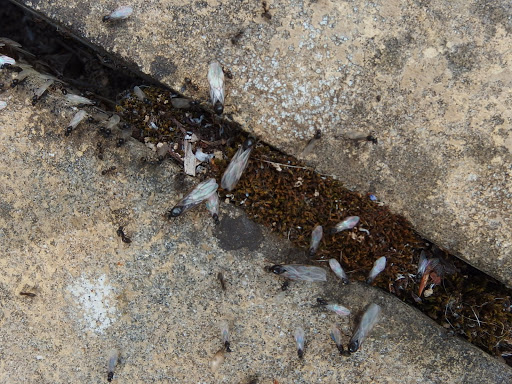
Black Ant nest under a stone, disturbed. Ant larvae and pupae visible as the workers rush to take them to safety.

One day, perhaps three years from the Queen’s maiden flight, she will decide it is time to send her own children into the wider world.  She will lay eggs and have these emerging grubs fed special food, which will produce males for the first time in her citadel, as well as other fertile females besides herself.  Then, one day in July or in August, she will send them out too, to start new colonies.  

Lasius niger, the Black or Garden Ant, is the most common of the 21 species of ant in Ireland. It is the most common also across Europe and a sub-species, L. neoniger, is known in the USA where however, it is not one of the most numerous ant species. Lasius niger is a very active, hardy and adaptable species, living mostly outdoors under rocks and but rarely inside houses (although it may well enter houses repeatedly if it learns of food within, especially sweet food). In cities, its nests are to be found in parks and gardens but also under street paving stones, the workers emerging to forage from tunnels leading to the joints between the stone. When those joints are surrounded by thin lines or small heaps of bright sand in summer, one knows that the workers are clearing the tunnels for the adolescents’ flights. Another indication is an unusual amount of

Black ants, emerging from under their nest. The larger winged ones are fertile and, if they survive, future queens. The winged males are much smaller and all are doomed.

seemingly erratic ant activity around a nest, though one would need to be aware of what normal activity looked like, for comparison. The ants may delay, awaiting what they judge to be optimum conditions but someday soon, mid to late afternoon, they will take to the air, to fly, to mate, to die or to live, to start a new population.

End

THE SCENT OF INTRUDERS

Diarmuid Breatnach

 The inhabitants of this land have fought invaders for at least a thousand years, some successfully and some less so.  Many of the invaders were assimilated.  Throughout this time, other invaders have quietly entered and spread throughout the land, mostly without encountering any organised opposition.


Last month and perhaps occasionally since, your nose might have picked up a scent drifting towards you, particularly as evening drew near but also at other times.  The aroma I speak of is one of those scents that is difficult to describe and that actually seems to change from time to time and also according to whether one is right beside it or farther away.  Sometimes it seems musky and very pleasant while at other times is not so welcome.  

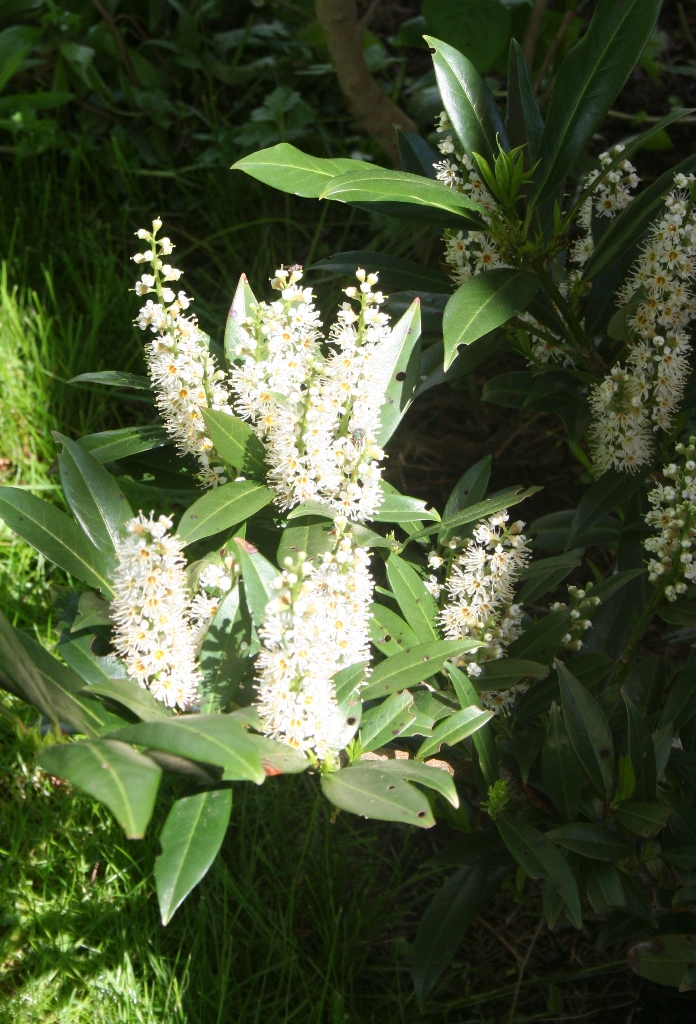
The scent may have been from the blossoms of the Cherry Laurel (Prunus laurocerus), a dense thicket-forming shrub that grows to small tree size with a strong thick trunk covered in a smooth dark grey bark.  It is neither a cherry variant nor a laurel (or bay), which its leaves supposedly resemble, these being thick and dark green but poisonous (containing cyanide).  The blossoms, white flowers clustered on upright spikes, produce blackish fruit in the Autumn about the size of cherries which are also poisonous to humans.  Originally from South-West Asia, it was introduced into Irish gardens as a shrub or hedge plant (uses to which it is still put) but it has “escaped” and established itself in the wild.

Cherry Laurel bush with flowering spikes in early stage

The Cherry Laurel has become very successful and a resultant problem for bio-diversity in Ireland. A quick perusal of the on-line references do not reveal the reason for its success; it tends to be grouped alongside another invasive species, the Rhododendron, which deposits a chemical in the ground surrounding it, thereby preventing other plant species competing with it for light, moisture and nutrients. Like the Cherry Laurel, the Rhododendron is a plant species invasive to Ireland.  Of course, since Ireland was almost entirely covered in ice 20,000 years ago, nearly all of the plant life now naturalised on our island had to have been invasive species originally — including trees, bushes, flowers, grasses, ferns …

Cherry Laurel flowering spikes at late stage

Invasive species are not always harmful to the existing balance (or to humans) but clearly they have to have some means of competing with the existing flora (plant life) or they would have been unable to establish themselves.  They may have better protection against herbivorous animals (undoubtedly the Cherry Laurel has at least that), or against insect or snail attack, or even against fungi (such as the ‘blight’ that attacked the potato a number of times in Ireland in the 1840s).  Or they may be able to occupy a niche not well exploited so far, as one of the Buddleida species has done (literally, one might say), growing out of thin gaps in stone or brick walls or on waste ground, its racemes of mauve or purple flowers attracting butterflies and other insects for pollination and later scattering its seeds on the wind.


The Luftwaffe helped the spread of the plant in Britain; so common did this shrub become on waste ground after the Second World War that it earned the popular name of « Bombsite Plant ». The species in question is Buddleia Davidii and according to The Online Atlas of British and Irish Florait was introduced into cultivation in the 1890s, quickly becoming very popular in gardens. By 1922 it was known to be naturalised in the wild in Merioneth and in Middlesex by 1927; it is shown as locally well established in S. England in the 1962 Atlas and “In recent decades it has spread rapidly throughout lowland Britain and, to a lesser extent, Ireland.” It is certainly ubiquitous in Dublin city and surrounds.

Buddleja Bush in bloom
Buddleia Bush in bloom

Buddleja davidii growing out of a wall
Buddleia davidii growing out of a wall

Buddleia (pronounced “budd-lee-ah) has about 100 species native to all continents except Europe and Australasia but a number of species and cross-breds are cultivated in European gardens, including the escapologist davidii. Although nearly all are shrubs growing to at most 5m (16ft) tall, a few species qualify as trees, the largest reaching 30m (98ft). There are both evergreen and deciduous species, not that unusual among trees and shrubs, as appropriate in tropical and temperate regions respectively. Some of the South American species have evolved long red flowers to attract hummingbirds, rather than insects, as exclusive pollinators.

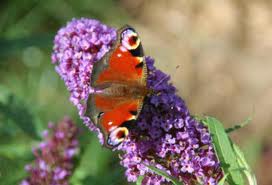
Peacock Butterfly on a Buddleja raceme
Peacock Butterfly on a Buddleia raceme

In Ireland, far from hummingbirds, davidii’s racemes of tiny purple or mauve flowers are a welcome sight as they flower in July, less so as the flowers, having done their work, die and turn brown (though repeated dead-heading can extend flowering until September). The flowers are scented but less so than those of the similar but not closely-related Common Lilac (Syringa vulgaris) which, incidentally, is an aggressive coloniser in parts of Southern Europe and of the USA.  The roots of davidii will do some damage to house walls and chimney stacks if allowed to become established, when pulling them out becomes impossible and the stump would need treating with an appropriate chemical. Checked early, it is easily controllable.

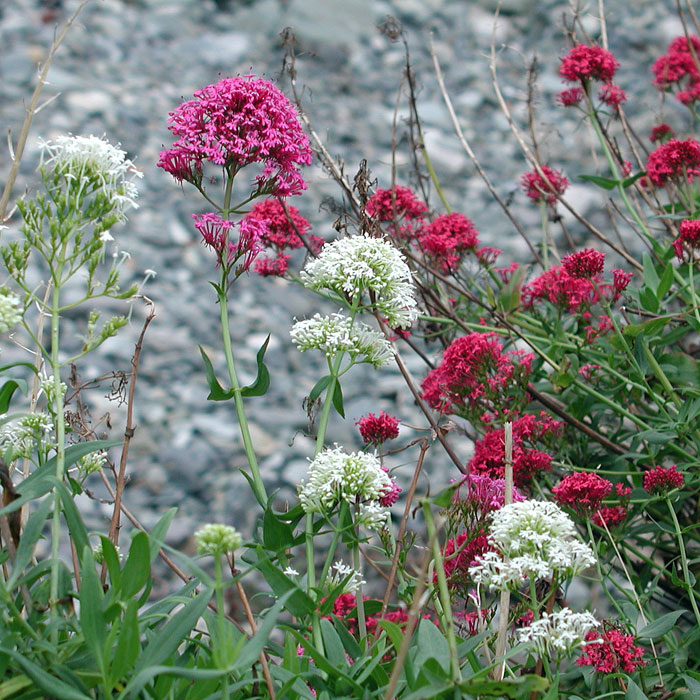
Another successful wall climber in Ireland is the Red Valerian (Centranthus ruber), sometimes known as Jupiter’s Beard. Despite its common name, the flowers are often pink or even white and at times clumps of two or even all three colours may be seen growing alongside one another. This one likes the tops of walls rather than the sides and grows well on dry or stony soil too.

Its seeds are wind-driven too and from anecdotal evidence, it made particular use of the railway cuttings and lines to distribute itself throughout Ireland.

Red Valerian growing on top of a wall

Despite its name, it is not closely related to the true Valerian (Valeriana officinalis), and no medicinal properties have been discovered in Centranthus. The leaves and the root may be eaten but there seems to be no great lobby recommending it as food.  Its scent is rather rank to the human nose.

The three colour variations of Ceranthus Ruber growing closely together on rocky ground

Originally from S.W. Europe and the Mediterranean region, the plant was grown in Britain as early as 1597, according to Online Atlas of British & Irish Flora. Like some cases in human history, when the newcomers were first invited and then became invaders, Red Valerian was first imported to be grown in gardens. By 1763 it was recorded in the wild in Cambridgeshire. Now it is to be found all over Ireland and is generally welcomed. Like some of the invading Vikings, Normans and English, Red Valerian and Buddleja have become part of the Ireland we know today and there seems no need to organise a resistance to them; the Cherry Laurel and the Rhododendron, despite the scent of one and the colour of the other, are a different case altogether.

end


Some on-line sources:

Cherry Laurel

http://www.conservationvolunteers.ie/images/buttons/submenus/news_and_advice/downloads/naa_bpmg_rcl.pdf

Buddleja http://www.brc.ac.uk/plantatlas/index.php?q=plant/unmatched-species-name-392

http://en.wikipedia.org/wiki/Buddleia

Red Valerianhttp://www.brc.ac.uk/plantatlas/index.php?q=plant/centranthus-ruber