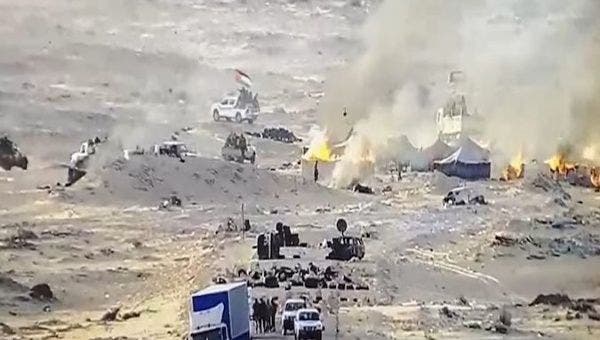
OFFICIAL DIPLOMATIC REPRESENTATION FOR THE POLISARIO IN IRELAND?

Clive Sulish

(Reading time: 6 mins)

A Dublin public meeting on Western Sahara attracted a high-powered attendance including ambassadors and other diplomats of four foreign states, along with the Prime Minister and Minister for Women and Social Affairs of Western Sahara.

Western Sahara – a Spanish colonial possession but then occupied by the Kingdom of Morocco, has been called “the last colony in Africa”, by which is meant the last African region remaining under formal occupation by its coloniser.1

The Western Sahara liberation politicians included the Prime Minister of the Polisario Front, the national political representation of the Saharawi nation, Mr. Boucharay Beyoun and Souilima Biruk, Minister for Women and Social Affairs.

Other diplomatic representation for the Saharawi people was provided by Mr. Oubi Bouchraya for the EU and Europe, Mr. Sidi Breika, for the UK and Mr. Nafi Sediki, for the Irish state.

For other countries, there were the Ambassadors to Ireland of Cuba Mr. Bernardi Guanche, of Algeria Mr. Mohammed Belaoura and of South Africa Ms. Yolisa Maya. For Colombia, Andres Echeverri, Deputy Chief of Mission and Consul attended.

Also in attendance at the meeting in the Teachers’s Club, in Dublin’s City centre were the diplomats’ support and security staff, a few solidarity activists and SIPTU officials. Earlier, the Saharawi delegation had met with TDs, members of the Irish parliament.
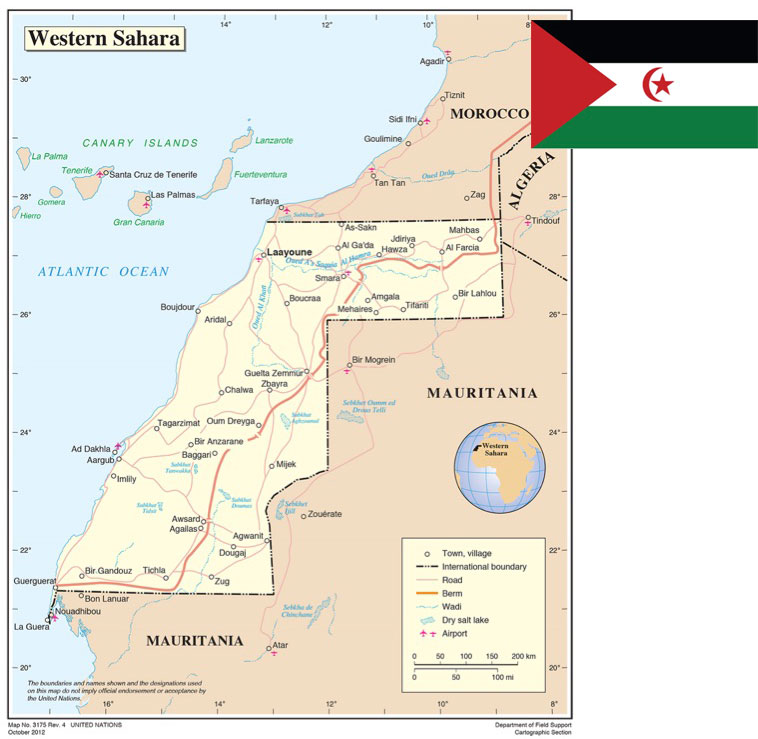
COLONIAL RULE AND RESISTANCE BACKGROUND

Western Sahara is a territory located between the internationally-recognised borders of Algeria to the south, Mauritania to the east and Morocco to the north. Along with much of North Africa it was colonised by the Spanish State in the latter’s various forms2 from 1884 to 1976.

In 1967 the Harakat Tahrir organisation was formed and challenged Spanish rule peacefully but publicly. In 1970 the Spanish police destroyed the organisation and ‘disappeared’ its founder, Muhammad Basiri, widely believed murdered.

As the Spanish state left without making any arrangements for decolonisation, holding a referendum or handing over power to Saharawi representatives, armies of the Moroccan and Mauritanian states invaded. In response, the Frente Polisario was created, raising armed and political resistance.

Mauritania withdrew in 1979 and revoked its territorial claim but Morocco, supported by France, rather intensified its occupation and attendant repression. Large numbers of Saharawi people fled over the border into Algeria where they currently inhabit refugee camps.

The population is of part-Berber, part-Arabic descent, mostly Muslim in religion and in many aspects of culture. The people are universally at least bilingual, common languages in the occupied area being Arabic and Castilian (Spanish) along with, in the refugee camps in Algeria, Arabic and French3.

The Polisario Front has been resisting the Moroccan occupation from the moment it began in guerrilla war but in 1991 the United Nations brokered a ceasefire which was supposed to be followed by arrangements for the Saharawi people to determine the territory’s future.

All attempts in this direction have failed due to the irreconcilable differences between the objectives of the mass of Sahrawi people on the one hand, i.e self-determination and independence and those of the Moroccan State on the other, colonisation and extraction of natural resources.4

The Moroccan state has built a 2,700 km (1,700 mi) long wall or berm of rocks and sand fortified by bunkers, topped by surveillance and communication equipment. Artillery posts dot the wall with airfields on the Moroccan occupiers’ side.

Running along this is the minefield, the longest in the world. The wall even penetrates the Mauritanean side for several kilometres.

Popular demonstrations of the Saharawi people broke out at different points since, including a “protest camp” of 12,000 people broken up by Moroccan militarised police with disputed claims about numbers of injuries and fatalities and in 2020 more military action against Saharawi protests.

After the latter, the Polisario Front considered that the Moroccan forces had broken the truce and, declaring their own abandonment of it, resumed the guerrilla war last fought in 19915.

DUBLIN MEETING: PRESENTATIONS, SPEECHES AND EXCHANGES
Mark McLoughlin opened the meeting welcoming people and giving a brief overview of the situation of the Saharawi, before introducing the first speaker.

Mark McLoughlin opening the meeting (Photo: Rebel Breeze)

Suelma Beirouk,Minister for Social Affairs and the Promotion of Women, spoke briefly in Spanish, with her words interpreted into English. The delegation had been received and listened to by representatives of most of the political parties, she said.

Ms Suelma Beirouk (centre), Minister for Social Affairs and Promotion of Women, speaking with her interpreter (left) and Oubi Bouchraya (right).

They had also met with some civil society organisations and were made welcome. Saharawi women, Ms Beirouk went on to say, were at the forefront of the struggle for the nation’s self-determination and had suffered much – including even rape — but continued to resist.

Mr. Oubi Bouchraya, Polisario representative for the EU and Europe was the next to speak and the main speaker. In fluent English he set out the current international situation regarding Western Sahara and the context of the Delegation’s visit to Ireland.

The speaker pointed to the diplomatic importance of Ireland with its presence in the United Nations Security Council in which the Saharawi would hope for its support when the question of a referendum is due to be discussed there at the end of the month.

The UN has had a mission called MINURSO based in W. Sahara since 1991, the only one in the world without a human rights observation role. If it is not going to oversee that referendum, what is the point of it being there? On the other hand, observing human rights would be useful.
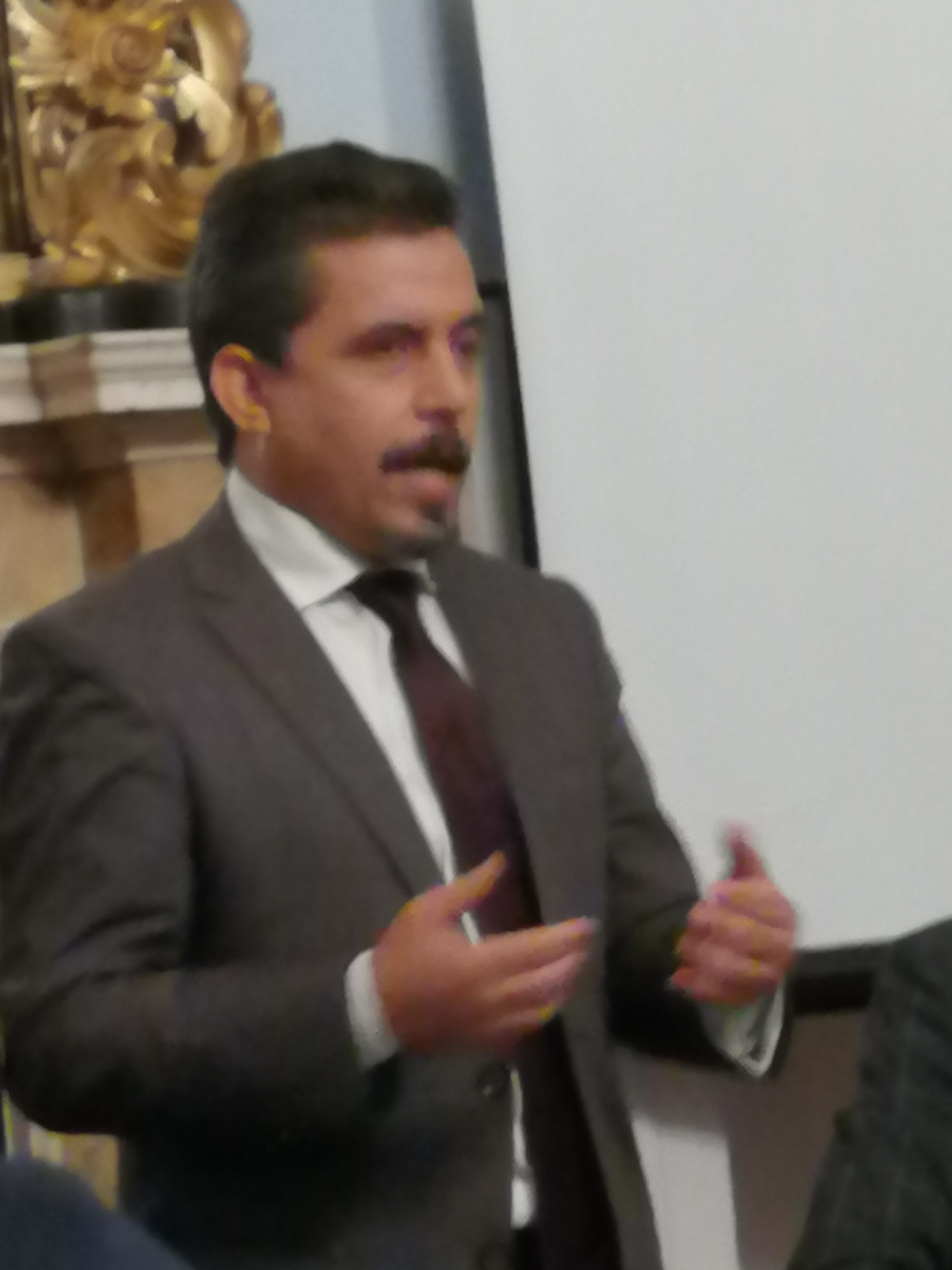
Mr. Oubi Bouchraya speaking (Photo: Rebel Breeze)

As a member of the European Union, Ireland also has an important role to play. The EU’s Ministers negotiated economic agreements with Morocco which included access to resources in Western Sahara. As WS is a non-self-governing colony, by international law, those agreements were illegal.

The European Court of Justice has judged accordingly and, though it allows them to stand temporarily, the agreements must fall, stated Mr. Bouchraya.
Questions, Contributions and Responses

From the floor there was a question as to whether the Polisario could have a national delegation recognised by the Irish government, as had happened in the cases of South Africa before the end of apartheid and currently with Palestine.

This question is being explored by the Saharawi mission. An aide to the South African Ambassador pointed out that that recognition for South Africa and Palestine had been gained as a result of pressure “from the bottom up” and went on to speak of the ANC’s unequivocal support.
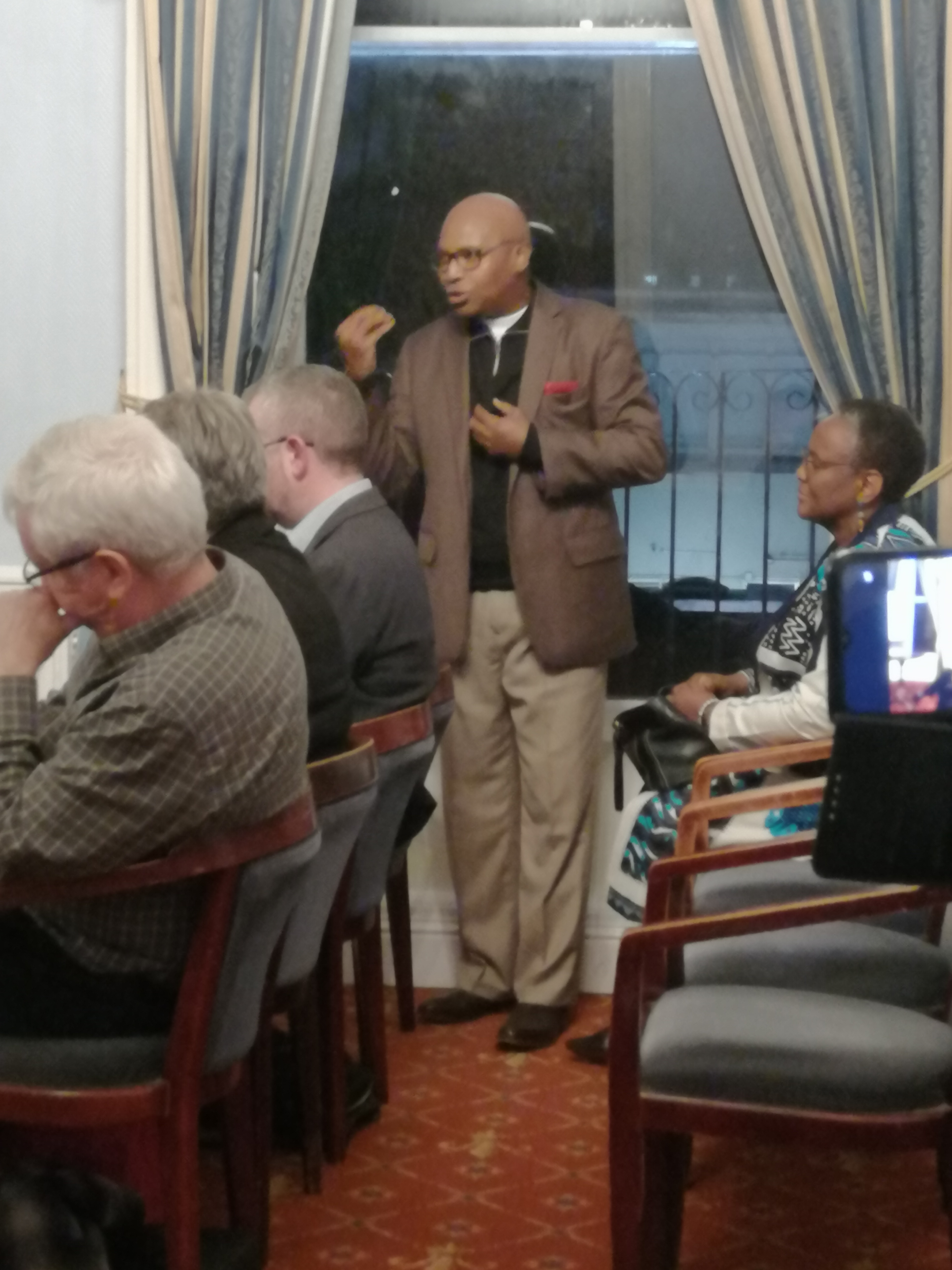
South African speaking from the floor, next to his state’s Ambassador. (Photo: Rebel Breeze)

A Dublin member of the audience, responding to the need for “bottom-upwards pressure”, related the history of the Western Sahara Action Ireland solidarity group some years ago which had been very active publicly to the extent of being harassed and even threatened by some Moroccans.

The WSAI group had however had suffered a number of departures of activists and with a number also active in other areas of struggle, was unable to maintain itself as an active group. He stated that he believed the group’s necessary reactivation needed an injection of some personnel.

A number of questions addressed the issue of the support for Western Sahara in Africa and generally. Over 80 states formally support the Saharawi people’s right to self-determination and most of those are in Africa, including the formal support of the African Union6.

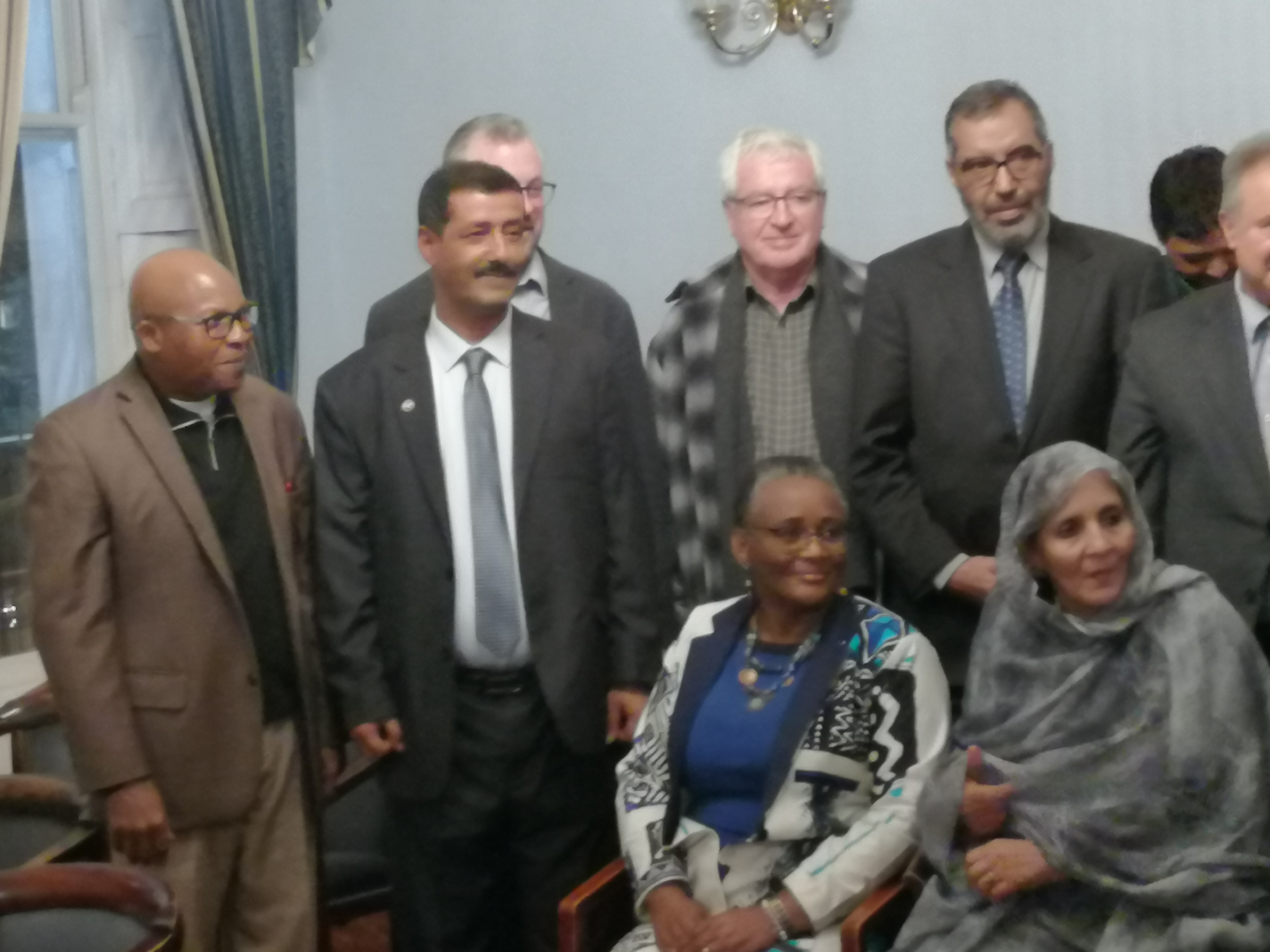
(Photo: Rebel Breeze)

FOOTNOTES

1Actually this is not accurate since Ceuta and Melilla are both colonial enclaves on the northern and north-eastern coasts of North Africa, surrounded on land by territory of the Kingdom of Morocco. It would be more accurate to say that Western Sahara is the only remaining un-decolonised large territory.

2The Spanish State was a monarchy until it became a French client 1807-1814, followed by monarchy again but interrupted briefly by the First Republic (1873-1874), a monarchy again until the Second Republic in 1931, in which it was briefly a military dictatorship, followed by a Popular Front democracy (1936-1939). A military-fascist rebellion against the Republic led to its defeat and rule by a military dictatorship 1939-1978, then to its current form, a monarchy once more.

3Algeria was colonised by the French in 1830, winning formal independence in 1962 after a fierce national liberation struggle.

4The major natural resources being exploited are the extremely rich fishing off the coast and phosphates being mined on land. Solar energy ‘farms’ are also being run without benefit to the indigenous people and though not discovered yet (“thank God!” commented a Saharawi in a meeting), sources of oil and gas are a possibility.

5And for which there had been sporadic periods of pressure in particular from Saharawi youth.

6Formed in 1963, the African all 55 states currently in Africa.

LINKS

Western Sahara Action Ireland: https://www.facebook.com/groups/256377861125569

Western Sahara Resource Watch: https://www.facebook.com/wsrw.org
https://www.irishtimes.com/politics/2022/10/12/western-saharan-delegation-lobbies-irish-parties-for-diplomatic-recognition/?

MOROCCO OCCUPATION USING DRONES AGAINST SAHARAWI RESISTANCE

POLISARIO FIGHTER WOUNDED IN DRONE-GUIDED ATTACK

JAIRO VARGAS MARTÍN@JAIROEXTRE

(Reading time: 3 mins.)

SPECIAL REPORT FROM THE SAHARAWI REFUGEE CAMPS IN TINDUF (ALGERIA)

(Report in https://www.publico.es/internacional/drones-marroquies-combatiente-saharaui-herido-guerras-marruecos-me-ataco-dron-gran-diferencia.html translated by D.Breatnach)

Mohamed Fadel states that he was seriously injured last April by a Moroccan drone, during the same action in which the head of the Saharawi National Guard was killed. Morocco is silent on the use of these unmanned devices that have become the obsession of the Polisario Front troops.

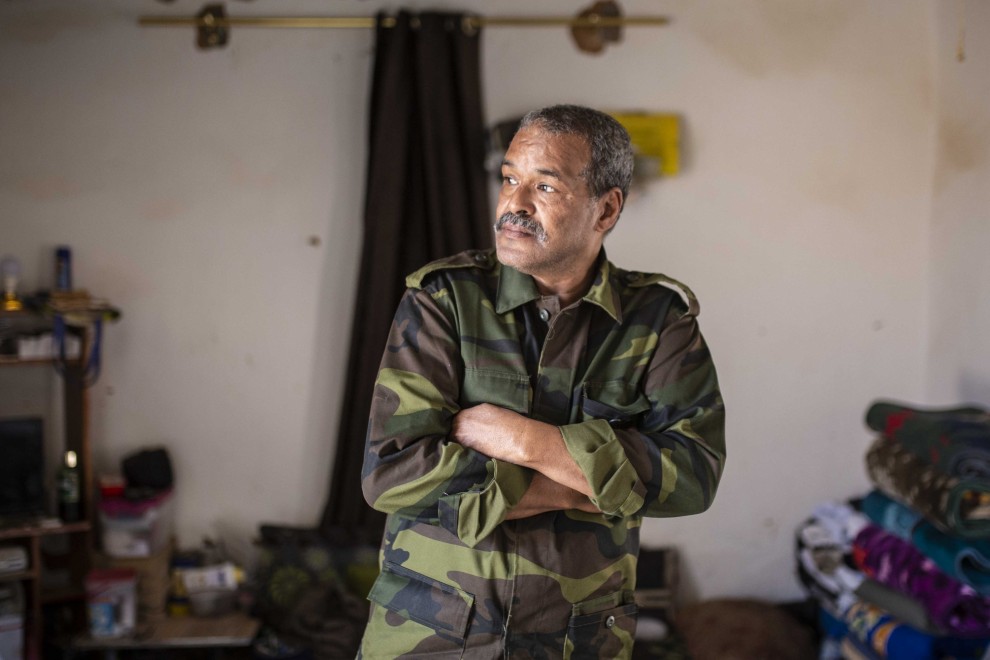
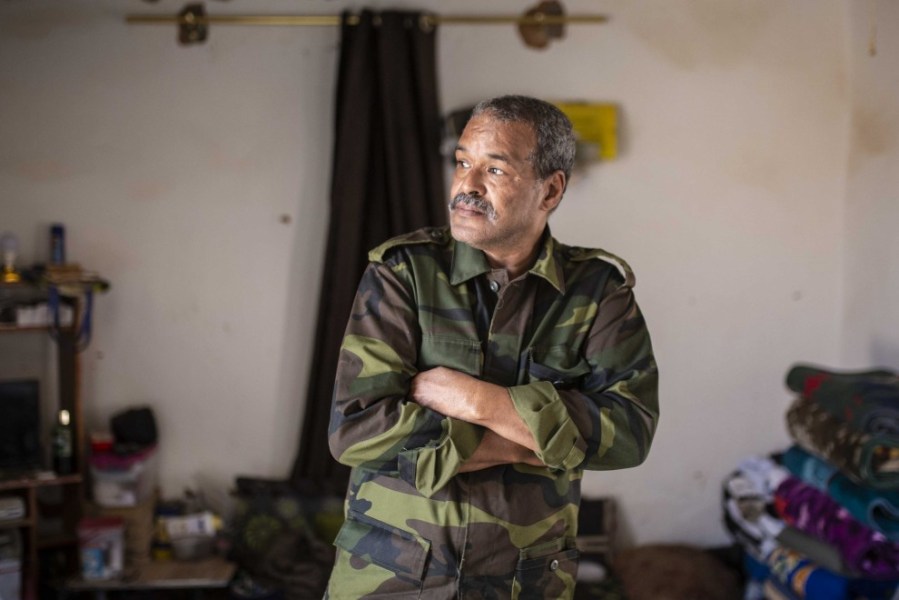
Mohamed Fadel, ‘Mundi’, in a tent in the Saharawi refugee camp of Bojador, in Tindouf, Algeria, on October 15.

Mohamed Fadel can say that he has firsthand experience of the changes between the two wars against Morocco in which he was wounded. The first was in 1985, when a shell fragment hit him in the arm. But he recovered and returned to the front in no time. The second time was the recent April one and “it was more serious,” he says, showing the marks on his body under his military jacket.

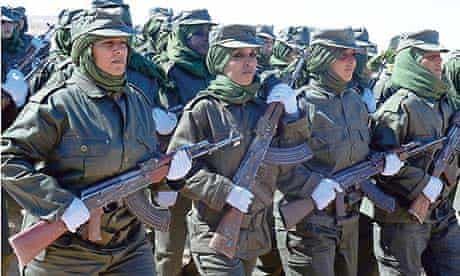
Polisario female fighters (Photo cred: Dominique Faget/ Getty)

Burns to his face, hands and arms, two scars the size of a coin on his right side and an incision of more than a foot long across the middle of his belly. “They had to open me up to remove the three pieces of shrapnel that I had inside. It took me three months to fully recover,” he explains in perfect Spanish. “It was a drone attack. That is now the big difference,” insists this seasoned 64-year-old Saharawi fighter.

But Mundi, as everyone knows him in the refugee camps in Tindouf, Algeria, does not like to talk about two different wars. This, he says, the one that the Polisario Front declared on November 13 after 30 years of ceasefire, “is just a continuation of the previous one”, the one that began in 1975, after the military occupation of the former Spanish Sahara by part of Morocco. “The enemy is the same and the objective is the same: the referendum that has not been held and the independence of the Sahara. The only things that have changed are the means, the technology,” explains the Saharawi fighter, in the shade of a tent in the Bojador refugee camp.

“They are neither seen nor heard, but they are there and attack at any moment”

Moroccan drones are the worst nightmare in this new stage of hostilities, according to all the Sahrawi fighters interviewed by Público during the Polisario-organized trip to the camps last week.

“They are neither seen nor heard, but they are there and attack at any moment,” insists Mundi, although at the moment they have not shown any documentary evidence certifying the presence of armed or surveillance drones. The two parties accuse each other of using them, although both deny it, according to the latest report on this conflict by the UN Secretary General, Antonio Guterres.

Saharawi women living in Gastheiz (San Sebastian) in the south-west Basque Country demonstrate in solidarity with their people’s struggle and the Polisario Front (“askatu” = “free”) in May 2020. (Photo source: Internet)

An almost paranoid obsession

After each Sahrawi attack against the defensive Wall built by Morocco, all eyes are on the sky. Drones feel close almost always, even if they are not there, like an almost paranoid obsession. One of the main military directives of the Polisario is to stay away from cars when they halt, because they are their main target. When they believe that a drone is following behind, the old Sahrawi vehicles separate, stop and the unit that was on board runs away.

Morocco has embraced the purchase of Turkish-made armed drones, according to ‘Reuters’

These unmanned devices make up much of modern warfare and have been instrumental in recent conflicts. One of the most recent, for example, was the capture by Azerbaijani troops of Nagorno Karabakh last year. They defeated the Armenians thanks to Turkish-made drones, deploying practically no soldiers to the front, recalls the arms trade expert Tica Font, from the Delàs Center for Peace Studies.

Font emphasizes that Turkey, Azerbaijan’s main ally in the conflict, is one of the few countries that manufacture and sell drones capable of loading and firing missiles, along with the United States, Rabat’s main military supplier, followed by France and Spain.

Indeed, as Reuters recently revealed, Turkey has expanded the sale of armed drones to Morocco. Specifically, several sources cited by the British agency speak of purchase requests from Rabat of the Bayraktar TB2 model, of which they would have already received a first batch ordered in May.

The Moroccan Army attack on the protest camp at Guergat on 13 Nov. 2020 which sparked the long-delayed renewal of Polisario armed struggle (Photo source: Internet)

As we moved away, a drone followed us

Although that was two months after the attack Mundi is talking about. According to him, the bombing that wounded him was on April 11. “In broad daylight, at four in the afternoon. We were near the Wall, we had just carried out an operation against a Moroccan base and they responded. First with artillery and, later, when we were moving away, a drone followed us,” he described.

His vehicle stopped and his three companions followed the rules of dispersing, but Mundi had no time to get to safety. “The missile landed very close to the car and I was level with the front wheel,” he recalls. He claims that that afternoon he was able to see one of the aircraft in the air, although he did not see it fire. He believes there had to be more than one, “because eight or nine missiles were launched, and that cannot be carried by a single drone,” he maintained.

Mohamed Fadel ‘Mundi’, wounded Saharawi Fighter photographed in Saharawi refugee camp, Tinduf, Algeria 15 Oct 2021 (Photo cred: Jairo Vargas)

In that Moroccan bombardment, Mundi explained, the esteemed head of the Saharawi National Guard, Adah el Bendir, 61, a noted military strategist expert in engineering and combat, died. The Polisario announced the important loss. Morocco, for its part, opted for its most effective tactic since the resumption of hostilities: silence and indifference. Only the Alawite news portal Le Desk reported that an Israeli-made Harfang model drone had participated in the attack on El Bendir. Morocco did not even want to claim a goal in a war that does not exist for Rabat.

However, the Delàs Center expert warned that most of the marketed drones are for surveillance and monitoring, and that they do not need to carry weapons to attack a target. “Many have all kinds of built-in radar and sensors that send information to a central computer. With that data, you can open fire with precision from any platform, be it a ship, an aircraft or a ground unit. Tens of kilometers from the target” says Font.

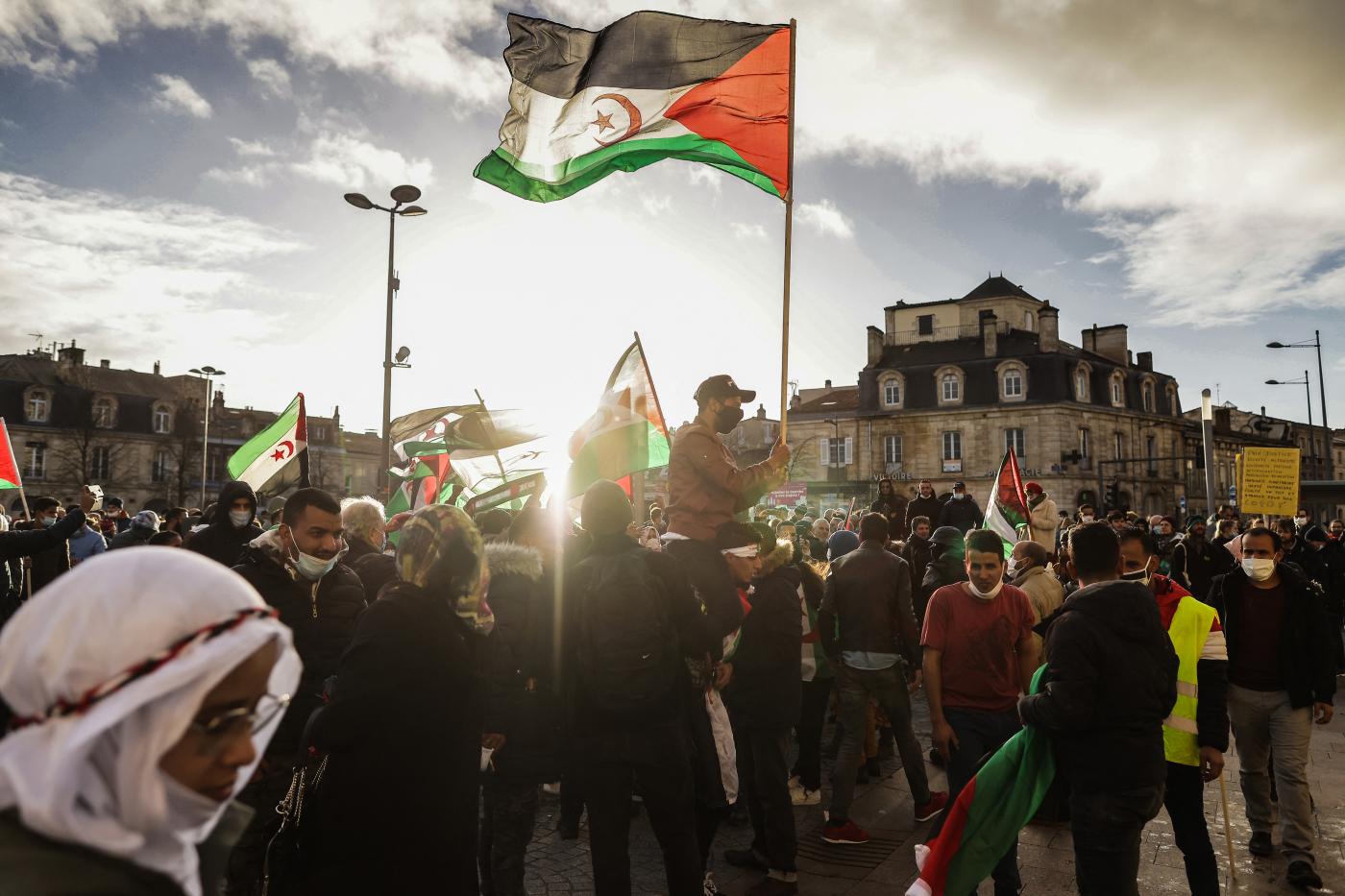
Saharawi struggle supporters in Bordeaux, France on 11 December 2020 (AFP). France is a Permanent Member of the UN Security Council and is the main European state supporting Morocco.

That’s Le Desk‘s version of the attack in which Mundi was wounded and El Bendir killed. According to this Moroccan portal, the drone laser marked the target and an F-16 fighter launched the projectiles.

“They do not scare us, because with fear nothing is done in war. But there is a lot of uncertainty, a lot of anxiety and tension,” he affirms after 46 years as a soldier in the Saharawi people’s army.

Mundi is confident that sooner or later they will find the formula to detect and demolish the Moroccan aircraft. “We learned to fight them when they raised the wall, we learned to shoot down their planes and we learned to capture their armour,” he says. “We are still starting. At the moment we are using a tactic of attrition. We attacked bases and retreated. In the 80s we also started that way when they built the wall. Until 1984 we did not carry out large-scale attacks. War has its times,” he says. This one has already lasted more than 40 years.

End.

USEFUL LINKS

SOLIDARITY

Western Sahara Action Ireland: https://www.facebook.com/groups/256377861125569/?

Algargarat Media

OTHER MEDIA ARTICLES

Youth yearning for independence fuel Western Sahara clashes: https://apnews.com/article/middle-east-africa-united-nations-algeria-morocco-507429fe13915902668f589179ce0c67?

https://www.mondaq.com/human-rights/1021716/war-resumes-in-occupied-western-sahara-an-interview-with-polisario-representative-kamal-fadel

https://www.euronews.com/2020/11/17/sahrawi-arab-democratic-republic-declares-war-on-morocco-over-western-sahara-region

https://www.middleeasteye.net/news/morocco-western-sahara-european-court-annuls-eu-deals

POLISARIO FRONT GIVES UN MISSION 12 HOURS TO GET OUT

Clive Sulish

(Reading time text: 5 mins.)

After a military invasion by the Moroccan Kingdom into the “buffer zone” in Western Sahara, the Polisario Front, liberation and resistance organisation of the Saharawi, gave the MINURSO (UN) mission in Western Sahara 12 hours to leave the territory. Meanwhile the Polisario also retaliated against the Moroccan occupation with an attack against the Wall, while young Saharawi confronted occupation forces in a number of localities.

According to sources close to Polisario, the Saharan People’s Liberation Army, in response to the Moroccan invasion, undertook artillery strikes against Moroccan military targets along the Moroccan military wall that cuts through Western Sahara. The targets of the attacks were the following Moroccan military bases and surveillance points along the wall: Moroccan military base No.23 (Mahbes), Moroccan military base No.4 (Hauza), Surveillance Point No.71, Moroccan military base No.17 (Oust), surveillance point No.172, Moroccan military base Nos. 17 and 18. A press release from the Saharan People’s Liberation Army added that its fire on Moroccan military positions led to human casualties and material losses for the Moroccan Army and that Moroccan soldiers fled some of their positions along the Moroccan Wall.

Conflict at the protest camp as Moroccan forces attack civilian protesters. (Photo source: Telesur)

The Polisario also alleged that Moroccan forces had attacked Saharawi civilians who had gone to protest peacefully at the first breach of the buffer zone, at Guerguerat, civilians which subsequently the Polisario had evacuated safely. Subsequently Moroccan military had breached the zone at another three points, it alleged.

The General Secretary of the Polisario Front, Brahim Ghali, gave a press statement in which he announced the retaliatory attacks against what he called a violation of the 1991 ceasefire, “repeatedly violated by Morocco” but which, with the invasion of the buffer zone, “has now gone past the point of no return”.

Leader of the Polisario, Brahim Ghali, giving a press statement. (Photo source: ec.saharaui)

“DIFFICULT TO RESTRAIN THE YOUTH”

Over the years since 1991, as no progress towards independence seemed to be made, the Polisario leadership has at times found it difficult to restrain its youth from returning to armed struggle. And Moroccan police have carried out much repression of peaceful protest demonstrations, plain-clothes officers beating even women and children in the street. At a conference in Dublin last year (see Rebel Breeze report link below) representatives of the Saharawi people spoke about the human rights abuses by the Moroccan authorities in Western Sahara and about the discrimination and deprivation of the Saharawi people in a number of important areas of life.

At the above conference, despite reference by a number of people to a “Western Saharan peace process”, in reply to a direct question from the floor, the European representative of the Polisario, Mr. Mohamed Belsat, tacitly admitted that no such process existed and talked about the Polisario’s difficulty in restraining the Saharawi youth.

Mohamed Belsat of the Polisario speaking at the conference in Dublin last year (Photo: D.Breatnach)

A source close to Saharan activists from the city of El Aaiún confirmed that dozens of young Saharauis in the El Inach Matalaa and Tatan districts were confronting Moroccan gendarmerie and police patrols during the early hours of Friday evening. According to the sources, these protests against the occupation and support for the start of war against the regime have shifted and hardened in the Ghiyadet, Bucraa and Lahum districts. The source consulted stated that as of Friday night, the riots against the occupation administration in the city of El Aai ún were continuing.

BACKGROUND

The Spanish colony of Western Sahara (also known in the past as “Spanish Sahara”) was abandoned by the Spanish State in 1975; instead of decolonising it and facilitating a referendum on independence, the Spanish State’s evacuation cleared the stage for two neighbouring states to invade the country: the Kingdom of Morocco and Mauritania.

The Saharawi people formed the Polisario Front guerrilla organisation to resist the invasion and occupation of their land and also formed a government in exile, the Saharawi Arab Democratic Republic, in Tindouf in Algeria. Mauritania relinquished the territory it occupied and any claim to Western Sahara in 1979 but Morocco continues to pursue its annexation and its attendant repression of the Saharawi people.

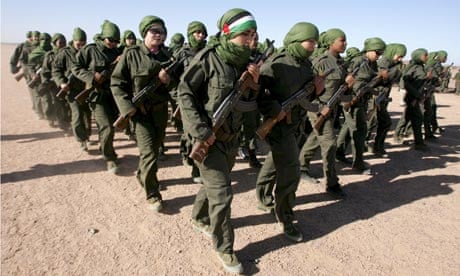
Female fighters of the Polisario about ten years ago (Photo source: Inernet)

“Western Sahara has been described as the last colony in Africa and has been illegally occupied by Morocco since 1975. Morocco is obliged under international law and as a member of the UN to  allow a vote of self-determination for the people of the territory. Yet for 35 years 165,000 Saharawi people have lived in refugee camps in Southern Algeria, ethnically cleansed from their own country. Morocco built a 2,700km wall visible from Google earth to stop the Saharawi people returniing to their country.” (From press release at the launch of Western Sahara Ireland Action group in November 2010).

Formally the UN considers that the Saharawi people have the right to self-determination and recognises the Polisario Front as the legitimate representative of the Saharawi people. In 1991 the UN brokered a ceasefire and established a mission on the territory. However over the years the UN has failed to take any action and many people have wondered at the point of its mission there. Interestingly, it is the only UN permanent mission that does not have a human rights watch brief. At the same time, the Moroccan authorities put a media blanket over Western Sahara to prevent reports of repression, including torture, emerging or, if leaked out, being investigated by journalists.

In addition, the ceasefire agreement authorised Morocco to administer two-thirds of the country and most of the Atlantic coastline, which has facilitated its plunder of Western Sahara’s natural resources and by others, including by EU states. One of the big member states of the EU, France is a big supporter of its former colony, the Kingdom of Morocco and the US has also tacitly to date supported Morocco.

A referendum was supposed to be held after 1991 but it kept getting blocked as Morocco disputed the terms under which it would take place. About 85,000 voters were identified by the UN in 1991, nearly half of which were in the Moroccan-controlled parts of Western Sahara, with the others scattered between the Tindouf refugee camps, Mauritania and other places of exile. The Polisario accepted this voter list, as it had done with the previous list presented by the UN (both of them originally based on the Spanish census of 1974), but Morocco refused and, as rejected voter candidates began a mass-appeals procedure, insisted that each application be scrutinised individually. This brought the process to a halt once more.

The ceasefire agreement of 1991 also provided for a buffer zone in Western Sahara which, in effect, protects the Moroccan wall from Saharawi attack but was supposed to protect the Saharawi also from further Moroccan incursion. This zone by Morocco’s Wall was to be patrolled by the UN but it was that same zone which the Moroccan Army has now invaded; the Polisario have obviously lost patience with the state of affairs, retaliated against Morocco’s troops on the Wall and ordered the UN Mission to leave the country.

A soldier of the UN MINICURSO in Western Sahara — where were they when the Moroccan Army came through the buffer zone supposed to be patrolled by the UN? (Photo source: PUSL — para una sahara libre)

SOURCES & USEFUL LINKS

https://www.ecsaharaui.com/2020/11/la-rasd-da-12-horas-la-minurso-para-que.html?fbclid=IwAR3YqiKJDBAeve_ORzl_1GR9CQWX8LX-XhZ7FyeIayFvVm3LniJPJUtJle0

https://www.facebook.com/groups/256377861125569

“THE LAST COLONY IN AFRICA” — REPRESENTATIVES SPEAK IN DUBLIN