Campaigners fighting for the release of individuals or of small groups of prisoners do not usually make the case that the release of those specific prisoners will affect the macro issues which led to their activism and encarceration. This has occurred on a number of occasions, however, those of Nelson Mandela in South Africa, the Kurdish PKK leader Ocalan and Basque movement leader Arnaldo Otegi being cases in point.
However, when the numbers of prisoners is large, their release is often connected by the campaigners to the objective of resolution of the conflict.
The line often taken is that “the prisoners are (or should be) a part of the resolution of the conflict” or that “release of prisoners is necessary to create goodwill” or “to win support for the resolution process”. These lines emerged here in Ireland, in Palestine, South Africa and in the Basque Country; they form part of a popular misconception, all the more dangerous because of its widespread acceptance and seductiveness.
At first glance this kind of line seems reasonable. Of course the political activists and the prisoners’ relatives, not to mention the prisoners themselves, want to see the prisoners home and out of the clutches of the enemy. The prisoners should never have been put in jail in the first place. And all the time they have been in the jail has been hard on them and especially on their relatives and friends. An end to the conflict is desirable and so is the release of the prisoners.
But let us examine the proposition more carefully. What is it that the conflict was about? In the case of the recent 30 years’ war with Britain, it was about Britain’s occupation of a part of Ireland, the partition of the country and the whole range of repressive measures the colonial power took to continue that occupation. In the case of the Basque pro-Independence movement, it was also about the partition of their country, occupation and repressive measures (particularly by the Spanish state). But what was the fundamental cause? In each case, occupation by a foreign state.
OK, so if Britain and the Spanish state ended their occupations, that would end the conflicts, would it not? It would end the anti-colonial conflicts – there would be no British or Spanish state forces for Irish or Basque national liberation forces to be fighting; no British or Spanish colonial administration to be issuing instructions and implementing repressive measures. Other struggles may arise but that is a different issue.
So, if Britain and the Spanish state pull out, leave, those struggles are over. What do prisoners have to do with it? They are obviously in that case not part of the solution, which is British or Spanish state withdrawal – though their release should be one of the many results of that withdrawal. Prisoners may well be part of rebuilding a post-conflict nation but that is a different issue. They are not part of “the solution”.
PART OF THE PACIFICATION
As pointed out earlier, here in Ireland it was said that “the prisoners are part of the solution” – and most of the Republican movement, some revolutionary socialists and some social democrats agreed with that. And British imperialism and most of Irish capitalism agreed too. But what happened? Only those Republican prisoners who agreed with the abandoning of armed struggle and signed to that effect were released. And they were released ‘under licence’, i.e. an undertaking to “behave” in future. And as the years went by, a number of those ex-prisoners who continued to be active —mostly politically — against the occupation, or against aspects of it like colonial policing, had their licences withdrawn and were locked up. Some who had avoided being prisoners because they were “on the run”, or had escaped – many of those, as part of the Good Friday Agreement, had been given guarantees of safety from future arrest but this too, it soon became apparent, could be revoked.
In other words, the prisoners’ issue became part of imperialism’s ‘peace’ or, to put it more bluntly but accurately, part of imperialism’s pacification. The issue also became part of the selling of the deal within the movement, on one occasion prisoners being released early, just in time to make a grand entrance at a Republican party’s annual congress.
The release of prisoners can be presented by those in the movement supporting pacification as evidence of the “gains” of the process. Those who argue for the continuation of the struggle then find themselves arguing not only against those who pushed the pacification process within the movement but also against some released prisoners and their relatives and friends.
THEY ARE NOT LEAVING
And prisoners continued to be hostages for the “good behaviour” of the movement. If British imperialism had left, there would have been no cause for the anti-colonial struggle to continue – so why would there be any need for any kind of release ‘under licence’ or any other kind of conditional release? Besides, the British would not be running the prisons in the Six Counties any longer. But the British are not leaving, which is why they need the guarantees of good behaviour.
Suppose the British were serious about leaving, sat down with the resistance movement’s negotiators and most details had been sorted out, including their leaving date in a few weeks’ time say, what would be the point for the British in trying to hang on to the prisoners? Can anyone seriously believe that they would take them with them as they left? If perhaps they had some in jails in Britain and were trying to be bloody-minded and hanging on to them there, well of course we’d want our negotiators to put as much pressure on the British as they could to release those as well. It would be in the interests of British imperialism to release them but the reality is that the anti-colonial war would be over, whatever ultimately happened to those prisoners.
In South Africa and Palestine, the prisoners’ issue became part of the imperialist pacification process too. It did not suit the imperialists to have numbers of fighters released who would be free to take up arms against them again. So in South Africa, they were incorporated into the “security forces” of the corrupt new ANC state, forces the corruption and brutality of which were soon experienced by any who argued with them or opposed the policies or corruption of the ANC, NUM and COSATU leadership – including the two-score striking miners the “security forces” murdered over a couple of days at Marikana in 2012.
In Palestine, the prisoners also became part of the “security forces” of Al Fatah after the shameful agreements at Madrid (1991) and Oslo (1993). The level of corruption of the Al Fatah regime and their “security forces” became so high that in order to oust them, in 2006 the largely secular Palestinian society voted for a religious party, the opposition Hamas. And then the “Palestinian security forces” took up arms against Hamas in order to deny them the fruits of their electoral victory. Unfortunately for them, Hamas had arms too and used them.
In both those countries, the occupiers had no intention of leaving and so it was necessary for them, as well as using the prisoners as bargaining chips, to tie them in to a “solution”. In fact, many of the prisoners became “enforcers” of the “solution” on to the people in their areas, i.e pacifiers in imperialism’s pacification process.
Teased out and examined in this way, we can see not only that the prisoners are NOT “part of the solution” but that accepting that they are plays right into the hands of the imperialists as well as facilitating their agents and followers within our movement, within our country.
Political prisoners, as a rule, are an important part of the struggle and need our solidarity. But for anti-imperialists, prisoners are not “part of the solution”, to be used as hostages for a deal with imperialism, even less as enforcers of a deal, forcing it upon the colonised people.
Our call, as anti-imperialists, without conditions or deals, is for the prisoners to be released and, while they remain in prison, to be treated humanely. We also call for them to be recognised as political prisoners. With regard to the solution to the conflict, there is only one: Get out of our country!
POSTSCRIPT:
The organisation representing relatives and friends of Basque political prisoners is Etxerat http://www.etxerat.info/. A separate organisation concentrating on campaigning, Herrira, has suffered a number of arrests and closure of offices by the Spanish state in 2013 and is under threat of outright banning.
Regrettably, I cannot give a similar link for Irish Republican prisoners, because of the existence of a number of organisations catering for different groups of prisoners and often with tensions between them. One day perhaps a united non-aligned campaign will emerge, along the lines of the H-Block campaign of the past, or the Irish Political Status Campaign that arose in London after the Good Friday Agreement. There is also a non-aligned Irish Anti-Internment Committee (of which I am a part), campaiging for an end to long periods of incarceration imposed on political “dissidents” through removal of licence, refusal of bail or imposition of oppressive bail conditions.
Your Most Exalted Majesty, Queen of the United Kingdom of Britain and Northern Ireland, Commander-in-Chief of the UK Armed Forces, Head of the Church of England, Queen of the Commonwealth.
We trust this letter finds your Highness well, as we do also with regard to Your Highness’ large family and of course your trusted corgis.
I am tasked with writing to yourselves in order to make some embarrassing admissions and to ask your Royal forgiveness.
No doubt your family carries the memory of an uprising in Dublin in 1916? Yes, of course one’s family does, as your Highness says. Well …. the embarrassing thing is this ……. it’s so difficult to say but no amount of dressing up is going to make it better so I’d best just come out with it: that was us. Yes, it’s true.
Not just us, of course. There were a load of Reds in green uniforms too, Connolly and Markievicz’s lot. And of course our female auxiliaries, and the youth group. But most of that rebellious band was us, the Irish Volunteers. I can’t adequately express to your Highness how ashamed we are of it all now. Your government of the time was quite right to authorise the courts-martial of hundreds of us and to sentence so many to death. Your magnanimity is truly astounding that only fifteen were shot by firing squads and that Casement fellow hanged.
But were we grateful? Not a bit of it! Does your Highness know that some people still go on about that Red and trade union agitator, James Connolly, being shot in a chair? What would they have your Army do? Shoot him standing up? Sure he had a shattered ankle and gangrene in his leg! One can’t please some people – damned if one does something and damned if one doesn’t. If the Army hadn’t kindly lent him a chair, those same people would be saying that the British wouldn’t even give him a chair to sit on while they shot him.
And how did we repay your Highness’ kindness and magnanimity in only executing sixteen? And in releasing about a thousand after only a year on dieting rations? By campaigning for independence almost immediately afterwards and starting a guerrilla war just three years after that Rising! A guerrilla war that went on for no less than three years. Your Majesty, we burn with shame just thinking of it now!
Our boys chased your loyal police force out of the countryside, shot down your intelligence officers in the streets of Dublin, ambushed your soldiers from behind stone walls and bushes ….. but still your Highness did not give up on us. Some people still go on and on about the two groups of RIC Auxiliaries and the things they did, referring to them by the disrespectful nicknames of “Black and Tans” (after a pack of hunting dogs) and “Auxies”. They exaggerate the number of murders, tortures, arson and theft carried out by them. Of course, your Highness, we realise now, though it’s taken a century for us to come to that realisation, that sending us that group of police auxiliaries was a most moderate response by yourself. But we were too blind to see that then and shot at them as well!
And that fellow Barry and his Flying Column of West Cork hooligans, wiped out a whole column of them. Your Highness will no doubt find it hard to believe this, but some troublemaker even went so far as to compose a song in praise of that cowardly ambush! Oh yes, indeed! And some people still sing it today – in fact they sing songs about a lot of regrettable things we did, even going back as far as when we fought against your Royal ancestors Henry and Elizabeth 1st! Truly I don’t know how your Highness keeps her patience.
Then we went on and declared a kind of independence for most of the country but …. some of us weren’t even satisfied with that! It was good of you to have your Army lend Collins a few cannon and armoured cars to deal with those troublemakers.
And then some time later, even after those generous loans, some of us declared a Republic and pulled the country (four fifths of it, at any rate), out of the Commonwealth. Left the great family of nations that your Highness leads! Words fail me ….well almost, but I must carry on, painful though it is to do so. A full confession must be made – nothing less will do. And then, perhaps …. forgiveness.
Of course your government held on to six counties …. You were still caring for us, even after all our ingratitude! It was like hanging on to something left behind by someone who stormed off in an argument – giving them an excuse to come back for it, so there can be a reconciliation. How incredibly generous and far-sighted of your Majesty to leave that door open all that time!
Fifty years after that shameful Rising, it was celebrated here with great pomp and cheering, even going so far as to rename railway stations that had perfectly good British names, giving them the names of rebel leaders instead. Then just a few years later, some of our people up North started making a fuss about civil rights and rose up against your loyal police force, forcing your government to send in your own Army. And was that enough for the trouble-makers? Of course not – didn’t they start a war with your soldiers and police that lasted three decades!
No doubt your Majesty will have noted that some of those troublemakers have changed their ways completely and are in your Northern Ireland government now. They’ve been helping to pass on the necessary austerity measures in your government’s budgets, campaigning for the acceptance of the police force and for no protests against yourself. Indeed, their Martin McGuinness has shaken your hand and rest assured were it not considered highly inappropriate and lacking in decorum, he would have been glad to kiss your cheek, as he did with Hillary Clinton when she visited. Or both cheeks, in your Majesty’s case! Your Majesty can see, I hope, that we can be reformed.
Our crimes are so many, your Highness; and we have been so, so ungrateful. But we were hoping, after you’d heard our confession, our humble apologies, after your Highness had seen how desperately sorry we are, that you’d forgive us. And if it’s not too much to hope for, that you’d take us back into the United Kingdom. Reunite us with those six counties, and so into the Commonwealth. Is there even a tiniest chance? Please tell us what we have to do and we’ll do it, no matter how demeaning. Please?
When the civil rights movement began in 1968 in the Six Counties, the general attitude in Britain, on the street and even in much of the media, was supportive of the campaigners. This was reinforced by the majority of the Irish community there, an estimated average of 10% of the population of most British main cities. The Irish were the largest ethnic minority in Britain and the longest-established, constantly renewed by high emigration since the Great Hunger of 1845-1849 (although seasonal and other migration had been a pattern long before that).
In the Six Counties, the sectarian police force were unable to vanquish the resistance and “liberated areas” emerged. The British imperialist ruling class could no longer tolerate this state of affairs and sent in its Army to “restore order” and also to “clear the no-go areas”. As the Provisional IRA (mostly), later also the INLA, entered the struggle against the British Army in the Six Counties, the mood in Britain began to shift somewhat. After all, a British soldier dead meant a British family mourning, whilst the same did not apply at all with an RUC or B-Special killed (however they might think of themselves as “British”). But still the Irish community in Britain held the line in solidarity with the support of large sections of the British Left (many of whom happened to be Irish or of Irish descent as well). Regular demonstrations were held, as well as pickets and public meetings. People wrote leaflets and letters. Solidarity delegations were sent. MPs were lobbied to ask questions in the House of Commons, which some did.
The introduction of Internment without trial in the Six Counties in 1971 was strongly protested, as was the Ballymurphy Massacre by the Paras that same year. The Bloody Sunday massacre in Derry in 1972 led to protests in many areas of Britain, including solidarity strikes on building sites and a huge demonstration in London — as the head of the wide packed march passed Trafalgar Square on its way to Downing Street, the end of it was still leaving Hyde Park Corner, where it had begun some time earlier, about 3 kilometres away. When the lines of police in Whitheall stopped those leading the march from presenting thirteen “coffins” to No.10 Downing Street, the residence of the Prime Minister, some of the “coffins” were thrown at the police and a riot began. Nor was it the only riot — an earlier march had tried to break through the heavy police cordon in front of Northern Ireland House at Green Park, a couple of mounted police had been knocked off their horses and the demonstration had ended with protesters being chased through Green Park by police on foot and in vehicles.
Protests even made it into the House of Commons as in 1970 when an Irishman called Roche threw a tear gas cannister in among MPs to make them aware of the tons of CS gas being pumped into the Bogside and other areas by the RUC (later by the British Army too), while in 1972, after Bloody Sunday, then People’s Democracy MP Bernadette Devlin (now McAlliskey and no longer an MP) walked up to the Home Secretary, Reginald Maudling, and slapped him in the face.
The IRA bombing campaign in Britain in particular impacted negatively to some extent on sympathy for the Irish struggle but solidarity from the Irish community, along with large elements in the British Left was still strong, despite some potentially lethal explosions such as postal pillar box bombs and the Post Office Tower bombing in 1971, which luckily did not cause any injuries. All that was to change in 1974.
The Birmingham Pub Bombing
In October and November 1974, the Guildford and Woolwich Pub Bombings killed six soldiers and two civilians whilst a further sixty-five people were injured (mostly in the Guildford explosion, where five of the dead had been). The pubs had been in regular use by personnel of the British Army but were also used by a number of civilians.
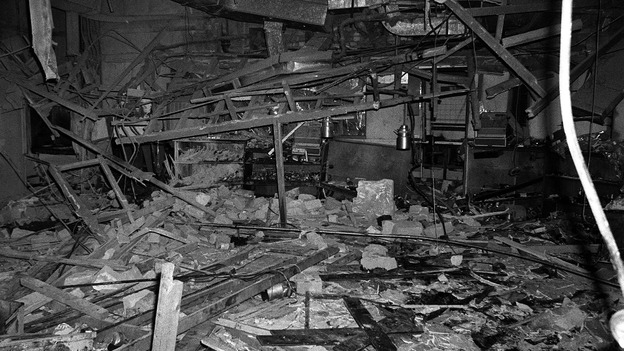
In between those two bombings, another two bombs exploded in completely civilian bars in Birmingham, killing 21 and injuring 182. It stunned the Irish community and the friendly British Left. The media of course went to town with “Bastards!” being used as a headline for the first time by a British tabloid, over a photograph of the atrocity. At first no-one claimed the Birmingham bombing and then it was denied by the IRA, who up to then had a very reliable record with regard to taking ownership of events (which could not be said of the Royal Ulster Constabulary or of the British Army). Some kind of “black operation” was the suspicion of many. As we know now and as some in the IRA admitted quite some time later, it had been an IRA bomb and the person whose responsibility it had been to telephone the warning, in a time long before mobile phones, had found a number of out-of-order public telephone kiosks and the warning had been too late.
Up to then, the Midlands IRA unit or units had been exploding bombs at targets without injury to civilians when one of their volunteers, James McDade, was killed in a premature explosion while planting a bomb at a telephone exchange in Coventry. His remains were prepared for return to Ireland and burial in his native Belfast. McDade had been well known in the Birmingham Irish community and through much of the Midlands as a talented GAA (Gaelic sports) player and was popular as a singer with a tenor voice. Eddie Caughey, of the Birmingham branch of Provisional Sinn Féin (later the party closed down all branches outside Ireland), was among others accompanying the coffin on McDade’s last journey. Another group of people set off from Britain to attend the funeral, including five Irishmen from the Six Counties resident in Birmingham, catching a train to connect with the ferry at Heysham.
Coincidentally, the Birmingham group arrived for the Heysham ferry the same evening as the Birmingham bombs exploded, although they were unaware of this. The five men were taken from the ferry at Heysham by police and interrogated, later beaten up by the West Midlands Serious Crime Squad and threatened with guns and dogs, four of them forced to confess to things they had not done; they were then were charged with multiple murder along with another Irishman from the Six Counties who had seen them off at the New Street Birmingham train station. They six men were taken to Winson Green prison where they received another savage beating from screws so that when they turned up in court all were bruised and battered. One screw witness many years later was reported to have said that he had not participated and found the brutality sickening (he may have been the inspiration for the scene in the H-Blocks 2008 film “Hunger” directed by McQueen, where a screw hides away from the other screws in riot gear as they go in to beat the “blanket men”).
The six Birmingham Irish were found guilty in a travesty of a trial and became “the Birmingham Six”. Another three, at least one of whom was an IRA volunteer and probably the organiser of the bombings, were convicted on charges relating to explosives and received nine years’ jail.
The Birmingham Six in 1974 — innocent but Irish in Britain — sixteen years in prison, twenty-six before compensated. No state employee has ever been convicted for this deliberate injustice.
Subsequent appeals and prosecutions by the Birmingham Six of officers for assault etc. were all dismissed or ruled out of order by the state judicial system. Individuals in the Irish community, such as Sr. Sarah Clarke, began to campaign for them. In 1976, Fr.s Raymond Murray and Denis Faul in the Six Counties published their booklet The Birmingham Framework: Six innocent men framed for the Birmingham Bombings. In 1981 the newly-formed Irish in Britain Representation Group became the first wide Irish community organisation in Britain to take up their case and made representations on behalf of the Six, including to the Irish Embassy in London (“The Birmingham who?” asked the Ambassador at the time, according to some IBRG who participated in the delegation).
In 1985 after repeated lobbying by the Birmingham Six Campaign, the IBRG and individuals, World In Action (Granada, ITV) made the first programme throwing doubt on the guilt of the Six. A year later, Chris Mullins (a researcher for the World in Action programme and later an MP and a Government Minister) published his book declaring their innocence. Campaigning continued in Britain and in Ireland.
But it was not until 1991, SIXTEEN YEARS after their unjust conviction, that they were finally released, their convictions quashed. The lives of many of them were ruined — marriages had broken up, livelihoods were gone, some never recovered from the trauma. It was not until ANOTHER TEN YEARS before they were awarded financial compensation.
Not one judge, one police officer or one prison officer was ever convicted of assault or perversion of the cause of justice. The British forensic scientist whose “evidence” and “expertise” were used to sway the jury to convict the Birmingham Six, Frank Skuse, suffered a blow to his professional reputation but that was all.
The impression is often given that the Birmingham Six jury was blinded by expert forensic evidence and/or that it could not be known then that the evidence was wrong. But it is also often forgotten that Skuse’s “evidence” contained contradictions suggesting interference and that his forensic conclusions were contested at the trial by those of another forensic practitioner, Dr Hugh Kenneth Black FRIC, the former HM Chief Inspector of Explosives, Home Office. The judge chose to believe Skuse and to sway the jury in that direction. Part of the judgement of the Court of Appeal that freed them in 1991 was that “Dr. Skuse’s conclusion was wrong, and demonstrably wrong, judged even by the state of forensic science in 1974.”
The Guildford and Woolwich Pub Bombings
In 1977, the “Balcolme Street” IRA unit (so named because of the address where they were trapped and besieged before capture) informed the authorities through their trial lawyers that they were responsible for the Guildford and Woolwich bombings. This was an unprecedented step for the IRA but their claim was denied by the State. The Home Office accepted in a memorandum at some point later that the Guildford Four were “probably not terrorists” but thought there was not enough to justify their release. Eventually falsified police notes were found by an investigating police detective and they were used as a reason to throw doubt on the whole case against the Four and they walked free in 1989. They had spent fifteen years in British jails and the father of one, Gerry Conlon, had died in prison.
The Guildford Four around the time of their arrest in 1974. Three of them were Irish in Britain but although obviously not anything like IRA, were framed and jailed. No state employee has ever paid for this crime against them or the other Irish framed prisoners.Giuseppe Conlon, who came to London to help his son Gerry when he heard of his wrongful arrest for the Guildford Pub Bombings. Incredibly, he was also convicted, along with the Maguire Seven — all innocent, but Irish in Britain. Giuseppe Conlon died in prison before the Maguire Seven were finally found “not guilty” on appeal.
The Maguire Seven had to wait another two years before their convictions were quashed in 1991, so that they spent 17 years in British jails. The court accepted that members of the London Metropolitan Police beat some of them into confessing to the crimes as well as withholding information that would have cleared them (this last was also a feature of the Guildford Four case).
In 2005, Tony Blair, then British Prime Minister, apologised to the surviving ten and to relatives of all the eleven for their “ordeal and injustice”. The British media, which had played a key role in creating the public atmosphere in which huge injustices could be and were done, never apologised nor even reviewed their procedures and guidelines and in fact even after their release, one British tabloid had to pay out libel compensation for suggesting that some of the framed prisoners were guilty but had got off on some kind of technicality. And again, not one forensic expert, not one Judge or state Minister was ever charged; some detectives were eventually charged with perjury but were never tried, nor were they ever charged with assault — not to mention torture.
The Prevention of Terrorism (sic) Act 1974
Back at the time when those bombings occurred, a legal measure of huge importance was being planned: at the end of November 1974, the Prevention of Terrorism Act was rushed through British Parliament. The PTA superseded the regulations requiring the police to charge a suspect within 48 hours and to bring them before a judge as early as possible or to release them on bail. The PTA legislation permitted holding of “suspects” for 5 days without charge and without access to lawyers, visitors or their own doctor; it also permitted stopping and questioning and searching without need to establish a reason and house raids and searches. Later this power was extended to seven days.
Finally, it permitted exclusion from Britain and deportation to the Six Counties (even though that was classed as part of the United Kingdom and therefore constituted internal exile), without any need to charge or show evidence of wrongdoing. One victim of such banning for a number of years was Brendan McGill, Provisional Sinn Féin organiser in Britain at the time (but who joined Republican Sinn Féin in 1986; deceased in 2011); he was banned from Britain despite having been a resident for 21 years and had his home, family and a shop in London.
Inside the Mulberry Bush, one of two target pubs in Birmingham in which 21 people were killed and 182 injured by two failed-warning IRA bombs in 1974. The horror helped disarm people ideologically and prepared the public, including the Irish diaspora, for the introduction of the Prevention of Terrorism Act and a campaign of terror against the Irish community in Britain.
It was clear to observers that the Act had been already in preparation; the shocking Birmingham explosion a few weeks earlier provided the right atmosphere for its introduction. Eddie Caughey, the Birmingham-based Irish Republican who had accompanied the remains of IRA volunteer James Mc Dade to Belfast, became the first person to be detained and questioned under the PTA but that was to happen to thousands in the decades to follow, nearly every one of them Irish. According to the West Midlands PTA Research & Welfare Association (set up by Midlands activists of the IBRG), 7,192 people were detained under the PTA between 1974 and 1992. Only 629 of these (8.7%) were subsequently charged with any offence and most of those were totally unrelated to any “terrorist” acts. Even when charges came under the Act they were only such charges as being a member of a proscribed organisation, assisting a proscribed organisation etc; one such conviction was of a young man for having pro-IRA posters and a badge in his possession.
Again according to the West Midlands organisation, 86,000 people each year between 1987 and 1990 were ‘examined’ for more than an hour at British ports and airports under the PTA. The watchdog organisation admits that these are only recorded stops and also did not include anyone stopped at a port or airport for less than an hour.
It only happened to me once: travelling alone from London home to Dublin on holiday with my daughter of seven years, I was taken aside by Special Branch at Heathrow and questioned as to my London address, occupation, destination in Ireland, length of stay and purpose in travelling to Dublin. The questioning was not heavy and probably lasted less than ten or fifteen minutes and, unlike many others, I was not made to miss my plane. But it was really frightening to know that I could be taken in for up to seven days and the overarching apprehension was about what would happen to my daughter. Those days it was not unusual for people, as did I, to make arrangements if they were not going to be met upon arrival, to telephone a friend or family each side, so that in the absence of such, enquiries could be initiated with the police.
“PTA Telephone Trees” were established and those who volunteered for service on them might receive a phone call in the early hours of the morning to say that this or that person had been arrested, or was missing, and to begin making phone calls to other people on the “tree” and/or to a named police station. The purpose of the calls was not only to gather possible information (the police often denied the presence of someone known to be in their cells) but also to make the police aware that their detainees had friends outside who were making enquiries.
It was a testament perhaps to the level of fear engendered that although Irish solidarity pickets were taking place in various places, including of course London, it was not until the early 1990s that a picket was first placed on Paddington Green Police station, the usual destination of people detained under the PTA in London. “The Lubyanka of the Irish Community”, with its sixteen windowless underground cells, too hot in summer and too cold in winter, with a 7-day incommunicado detention period, was frightening enough but had developed a terror mystique.
It was a Kilburn-based British Left group (but with high Irish membership and which had been expelled from the Troops Out Movement) which placed the first pickets on Paddington Green and some time later the Saoirse campaign and the Wolfe Tone Society (Provisional SF support group in London) did so too. These symbolic acts helped to somewhat erode the terror of the place but the overall atmosphere had been dispelled by the mobilisations in solidarity with the Hunger Strikers a decade earlier.
Spokespersons of the Irish community and some others repeatedly warned the British Left, social-democratic and liberal sections of society that if they allowed the PTA to be used temporarily against the Irish community, it would become permanent; and if they allowed it against the Irish community it would be used against others later. In 1991, an article published by conservative British newspaper The Telegraph complained that the police were using “anti-terror” legislation against people who were clearly political protesters; the article cited 1,000 anti-war demonstrators including an 11-year-old child at Aldermaston and 600 protesters at a Labour Party Conference, including an 84-year-old man, all of whom had been questioned under “anti-terror” legislation (http://www.telegraph.co.uk/comment/personal-view/3620110/The-police-must-end-their-abuse-of-anti-terror-legislation.html?fb). Since then, Muslim communities have also complained about the way in which “anti-terror” is used against them, in violation of their civil and human rights.
Repressive legislation labelled “anti-terror” in Britain since the 1970s began with the PTA and detention for five days, then for seven; subsequent legislation authorised it for 14 days; an attempt was made to extend it to three months on police recommendation but failed in Parliament; however the Terrorism Act 2006 authorises 28 days detention without charge.
Not “miscarriages of justice” but exercise in mass intimidation
The convictions and jailing of innocent Irish people were not “miscarriages of justice” but rather an exercise in the mass intimidation and coercion of the Irish community in Britain by the British state. The jailing of six innocent men for murder in 1975, who would have been hung were the death sentence for murder still on the statutes, was part of a campaign of terror against the Irish community in Britain which included the Prevention of Terrorism (sic) Act in 1974 and the convictions of Judith Ward (1974), the Maguire Seven (1975) and Guildford Four (1975).
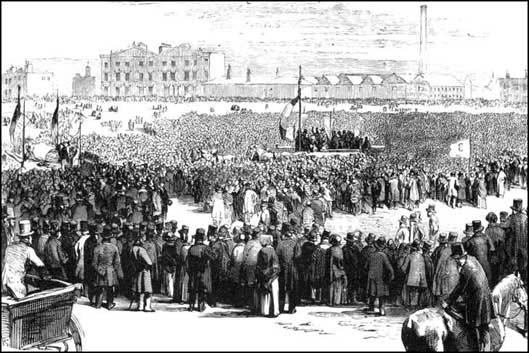
As remarked earlier, the Irish community in Britain was the largest and longest-established ethnic minority in Britain; it was and had long been a source of solidarity to the struggle in Ireland. It had also contributed significantly to the British Left and the struggle for socialism in the past: Bronterre O’Brien and Feargus O’Connor were renowned leaders of the Chartists in the 1840s and 1850s, TheRed Flag was written by Jim Connell in 1889, The Ragged-Trousered Philanthropists was written by Robert Tressell (real name Noonan) in 1914, the Irish were to the fore in the Battle of Cable Street in 1936 and so on.
Artist’s illustration of Chartist demonstration in Britain. The largest-ever popular political movement of the working class in Britain, two of its leaders were Irish.
The British police had a long hostile relationship with the Irish diaspora, both because of the social position and conditions of the majority of the Irish community but also due to the Irish diaspora’s support for the struggle “back home”. Scotland Yard set up “The Irish Special Branch” to gather intelligence on pro-Fenian activity in the Irish communities in the cities in British cities during the later 19th Century — it was later renamed simply “the Special Branch”, as they are (politely) known today in Britain, the Six Counties and in the Twenty-Six.
Irish communities could be insular in some places and Irish “ghettos” existed: among “The Rookeries” in London (several areas around the city centre) and Wapping, “Little Ireland” in Manchester and so on. But the community also had a high impact on the British working class, particularly in England and in Scotland but also in Wales (the SW Miners’ Federation originally featured Connolly’s image on their banner, alongside those of Lenin and Kier Hardie). The Irish community were ideally placed to call for solidarity for the anti-imperialist struggle in the Six Counties and to counter British media disinformation and censorship. In most places, Irish worked alongside British workers, married among them, followed sports teams and also played sports with them. In many places they also lived in the same streets or housing blocks.
The British ruling class realised the potential of the Irish diaspora in Britain even if the Provisionals seemed not to. When ordinary repression — surveillance, questioning, agents provocateurs, spies and informers, arrests and occasional police charges into demonstrations, along with a hostile media campaign — did not work, something stronger was needed. Very repressive legislation, a high level of arrests, thousands of detentions and jailing of 18 (there were a few other cases too) innocent people in four different high-visibility trials might work instead. Especially if allied to some atrocity with which most Irish people could not agree, so that they felt morally undermined too. For a while, with the combination of the Birmingham Pub Bombing, the framing for murder of innocents and the Prevention of Terrorism, largely this approach did work, with most of the Left running for cover and most of the Irish community keeping their heads down.
Many, many people in the Irish community in Britain knew for certain that the Maguire Seven, Guildford Four and Judith Ward were not IRA and could not be: the Guildford Four were living in a squat, taking drugs and engaging in petty crime and Judith Ward had been mentally ill and had accosted police to claim responsibility for a bombing. The Maguire Seven were a family including two minors, a family friend and a relative, Giuseppe, who had travelled over from the Six Counties to support his son Gerry of the Guildford Four. The feeling that the Birmingham Six were innocent too quickly gained momentum. But for the British authorities, it was actually GOOD that the Irish community knew they were innocent because, if innocent people can go to jail for murder, everyone is vulnerable and the only possible way to safety would be to keep one’s head down and one’s mouth shut.
This was the period in which the Troops Out Movement (TOM), initially founded to bring Irish solidarity into the broad British society, the Left and trade unions, largely abandoned that task and began instead to concentrate on the Irish community. In that pool were now swimming Irish Republican political activists, the IBRG, TOM, some British Left and, in some places the Connolly Association.
One of many Hunger Strikers solidarity march in Britain 1981. The effort to save the ten brought the Irish and some of the British Left out on to the streets, effectively breaking the terror grip of the Prevention of Terrorism (sic) Act and the jailing in separate murder trials of an innocent score of Irish people.
It was the Hunger Strikes of 1981 that broke the stranglehold of repression and fear on the Irish community and brought them out on to the streets again, in solidarity with prisoners and trying to save the Hunger Strikers’ lives. And after a columnist in The Irish Post noted that Bobby Sands had died during the AGM of the Federation of Irish Societies in Britain and not one word from the top table had marked his passing, not even in condolences to Sands’ family, it also led to the founding of the Irish in Britain Representation Group, a broad organisation campaigning on a wide range of issues, from anti-Irish racism in the media to framed Irish prisoners, from a fair share of resources from local authorities to self-determination for the Irish people in Ireland.
Irish solidarity work enjoyed a resurgence for the next decade and longer but external influences began to affect the work and divisions arose as the long road to the Good Friday Agreement in Ireland began to pull and push against different elements in the solidarity movement in Britain. But that’s another story.



 rebelbreeze