FENIANS, SCHOOLBOY STRIKE, LOCKOUT EVICTIONS, SPANISH CIVIL WAR – ALL ON EAST WALL WALKING HISTORY TOUR, WITH MUSIC & SONG AS WELL

Introduction with some very little additional text by Diarmuid Breatnach


Main text from East Wall History Group

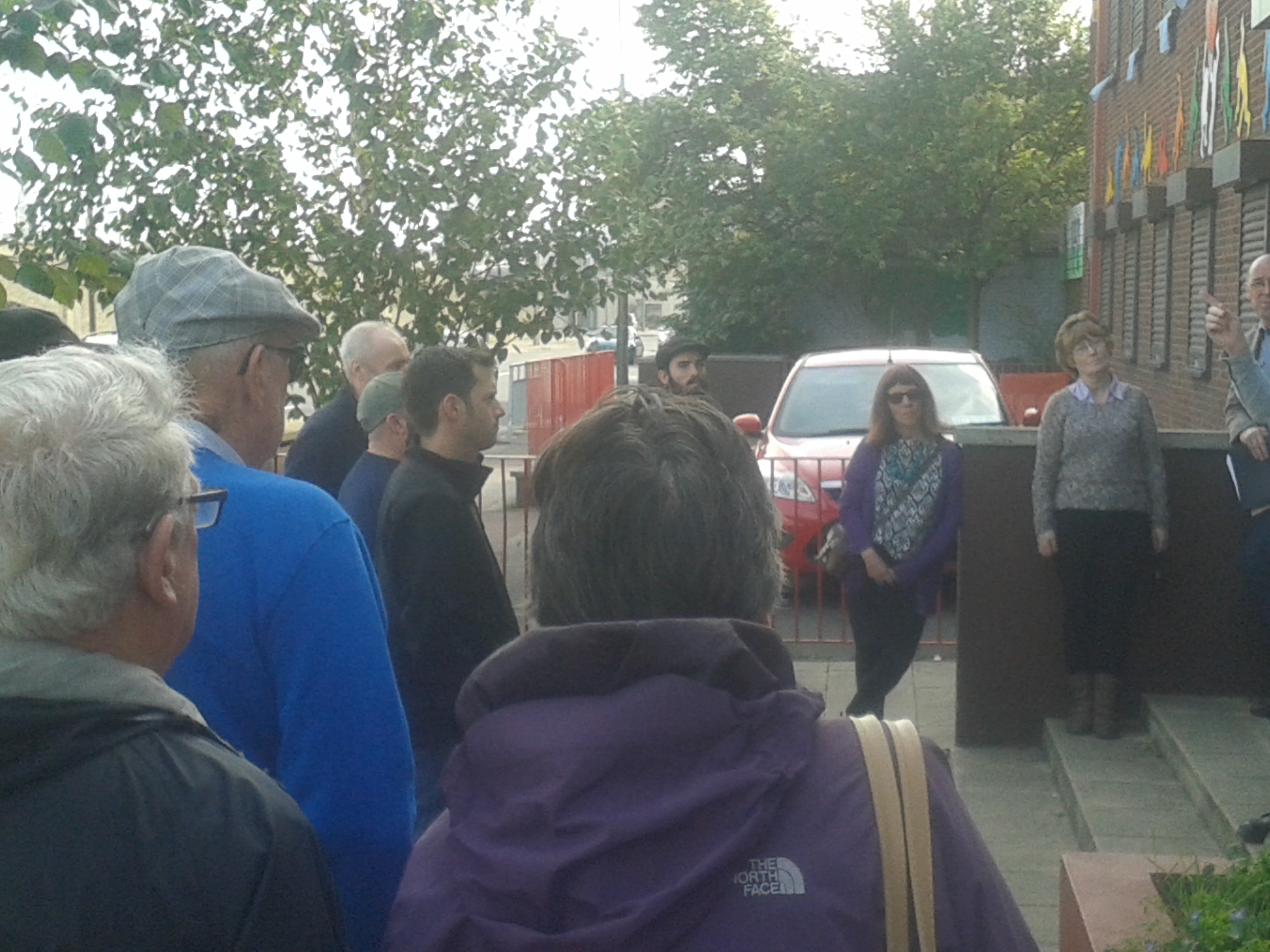
Among the many events packed into History Week by the East Wall History Group was a walking history tour of the area on Sunday 27th September. Over a score of people took part in “East Wall and the Irish Revolution” to hear Joe Mooney, a long-time community activist, outline the relevant events of history at various points along the way, covering

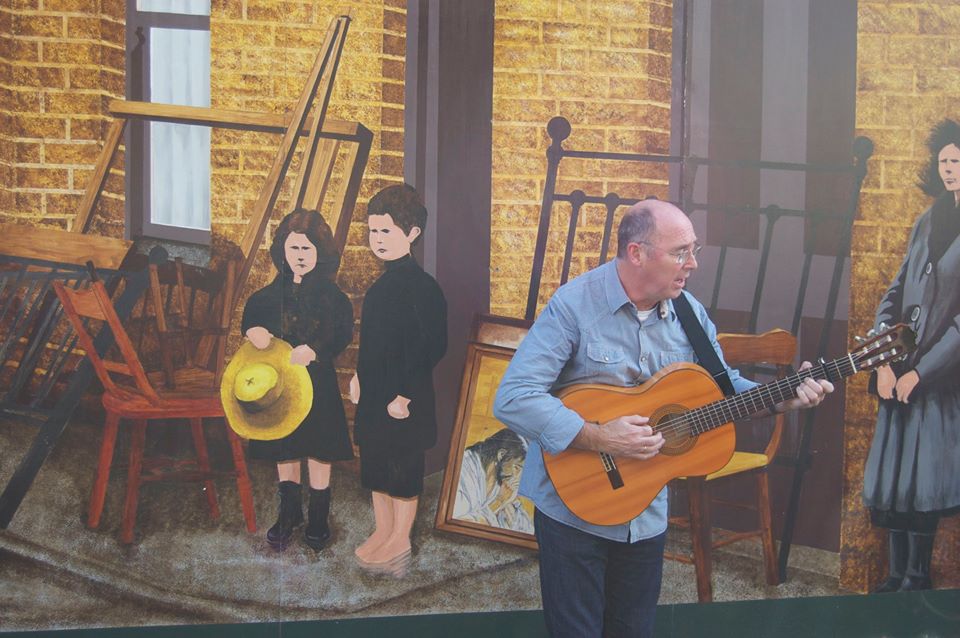
Paul OBrien Merchants Road Mural playing
Paul O’Brien performing his 1913 Lockout song in front of mural marking the eviction of 62 families from Merchant’s Road in December 1913 by the Merchant’s Company.  (Photo: EWHG) 

local connections with the Fenians, docks and migrants, the Lockout, 1916 Rising and the Spanish Civil War. Appropriate songs and music accompanied the tour, Paul O’Brien performing compositions of his own at some of those points and Diarmuid Breatnach singing verses from Viva La Quinze Brigada at another.

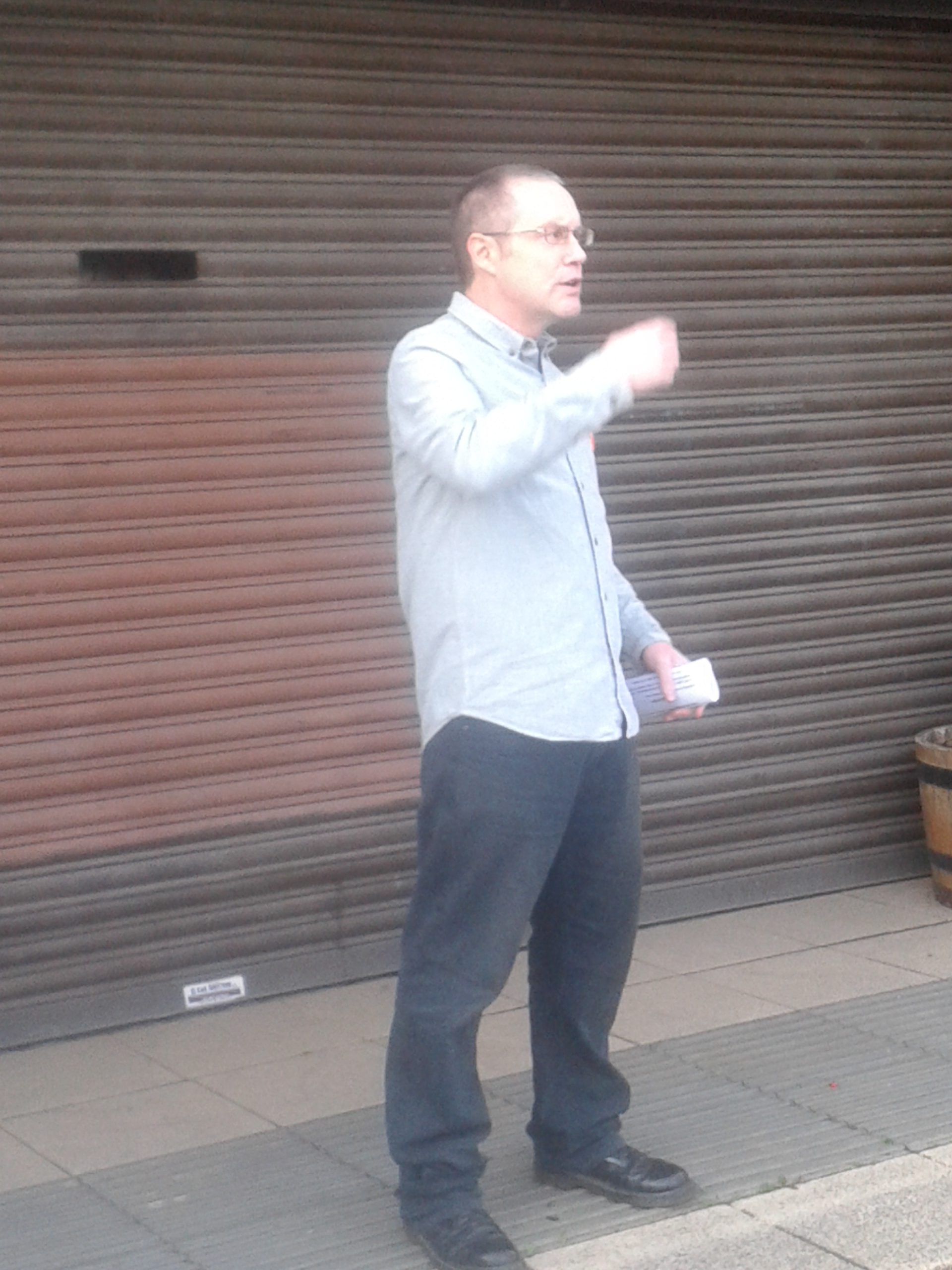
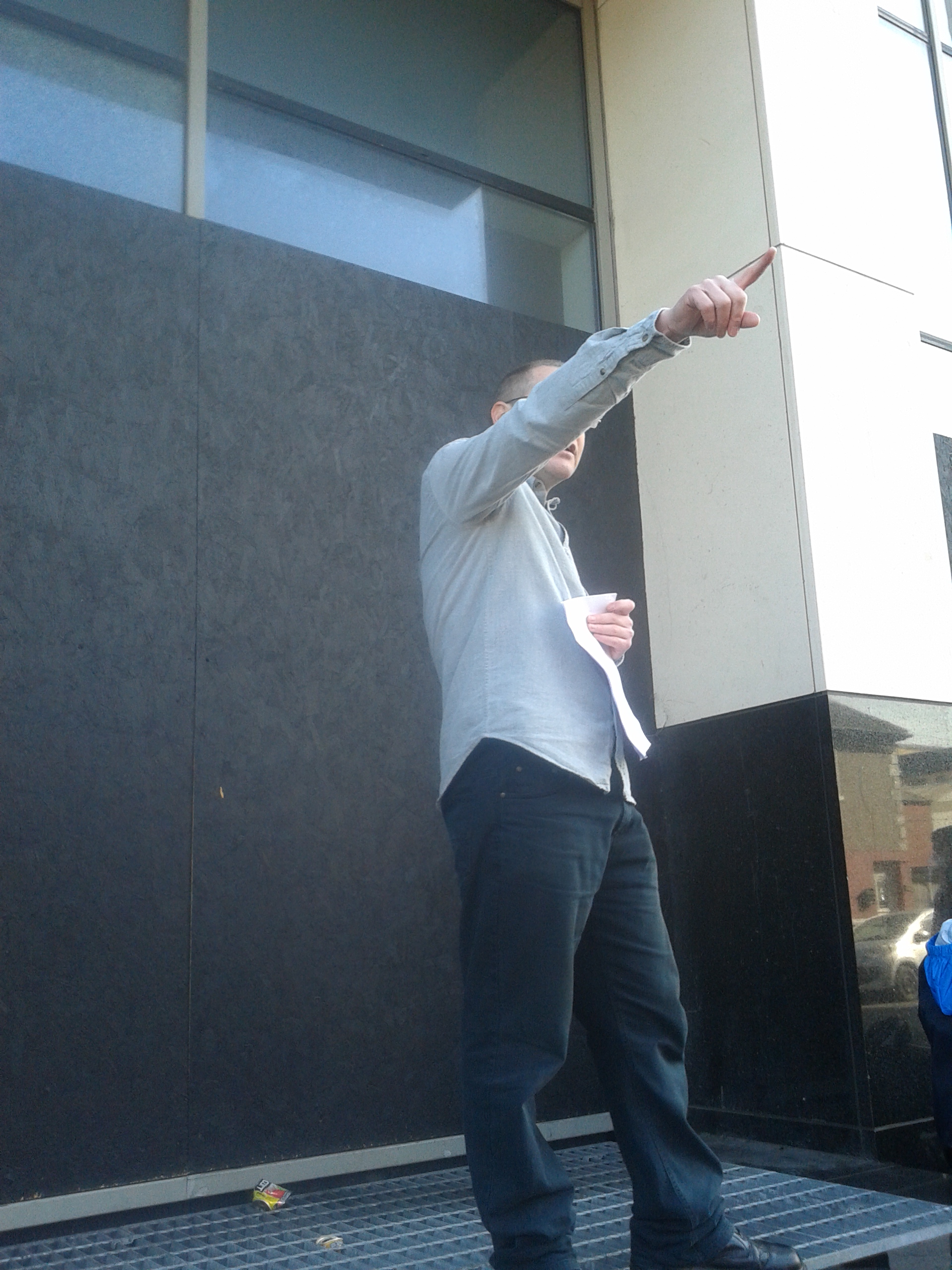
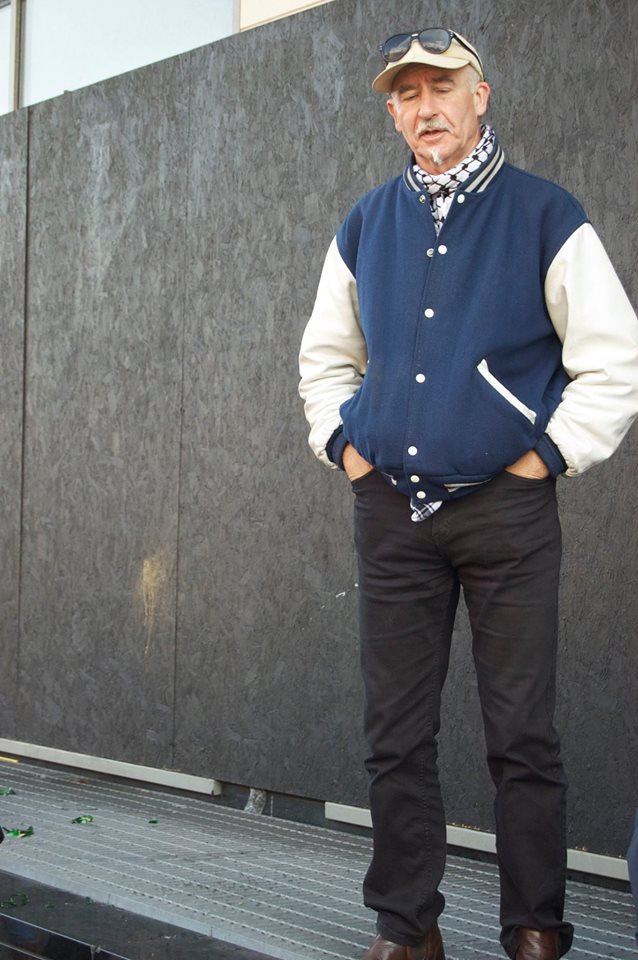
Joe Mooney, the tour guide
Joe Mooney, the tour guide.  Photo: D.B

The East Wall History Group has been in existence for a number of year; they may be contacted through https://www.facebook.com/eastwallhistory and http://eastwallforall.ie/?tag=east-wall-history-group and it would not be a bad idea to get on their mailing list. The following account has been shamelessly looted from their FB page:

We set out from St Joseph’s School, originally opened in 1895. The first Principal of the Boys’ school was J.F. Homan, who served as a St. John’s Ambulance Brigade volunteer during the Rising and also during the Civil war. A number of former pupils from the school were involved in the revolutionary events of the time (the following decades) and of course in 1911 a schoolboys’ union was declared and a short strike ensued (complete with pickets!). Their demands included a shorter day and free school-books.

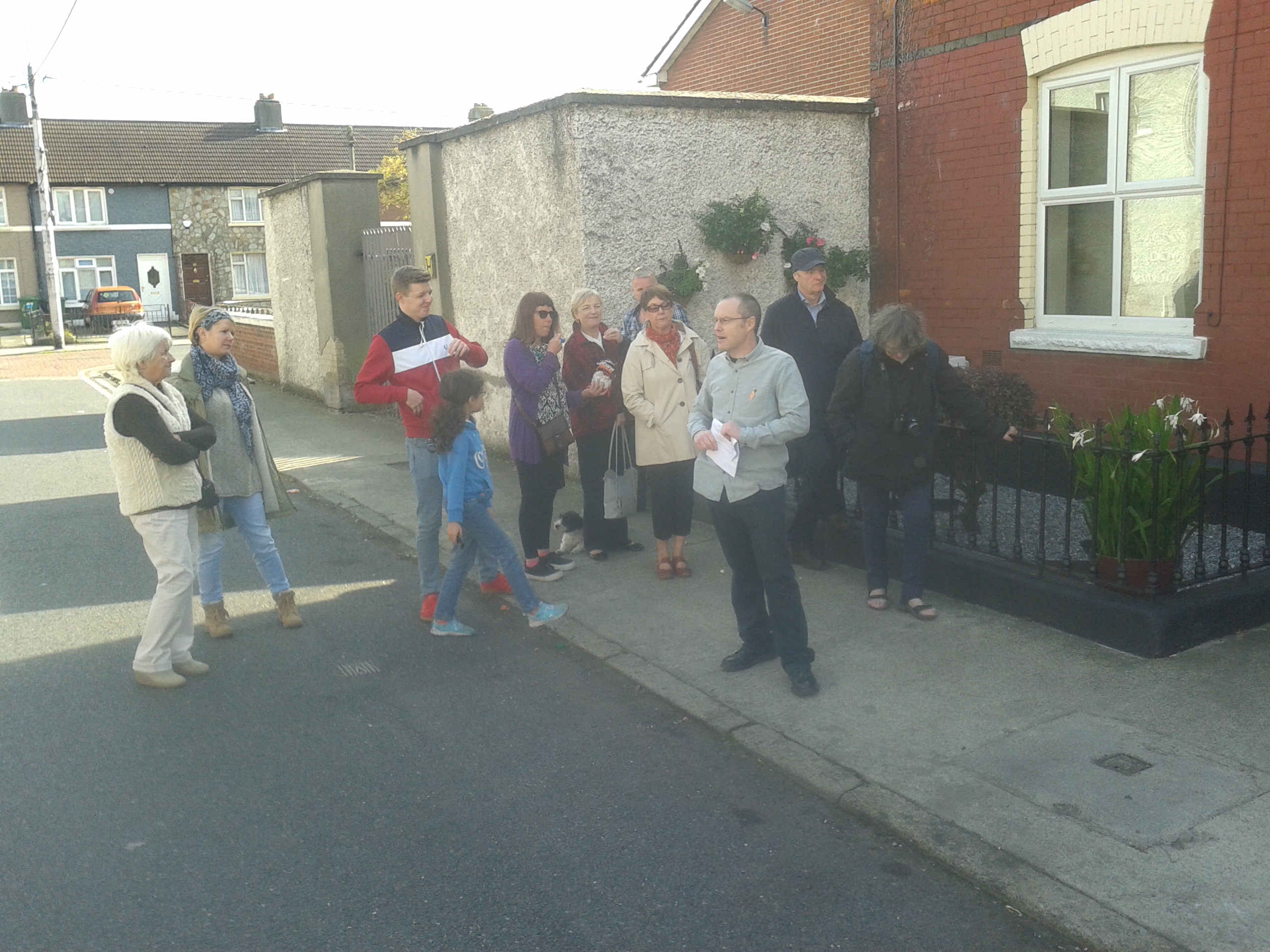
Part of crowd at the starting point
Part of crowd at the starting point.  (Photo: DB)

Our first stop was Merchants Road, where during the 1913 Lockout 62 families (almost the entire population of the street) were evicted by their employer the Merchants Warehousing Company (their yard was Merchant’s Yard on East Wall Road, just before the T-junction by the Port Authority. At the fantastic mural (erected by the community) Paul paid tribute to the families and the workers struggle with his song “Lockout 1913“. Amongst the evicted families were the Courtneys from number 1 – their son Bernard was a ‘Wharf’ school pupil and fought with the Jacobs garrison in 1916, before succumbing to TB in 1917.

Joe Mooney pointing out Jack Nalty's house
Joe Mooney pointing out Jack Nalty’s house.
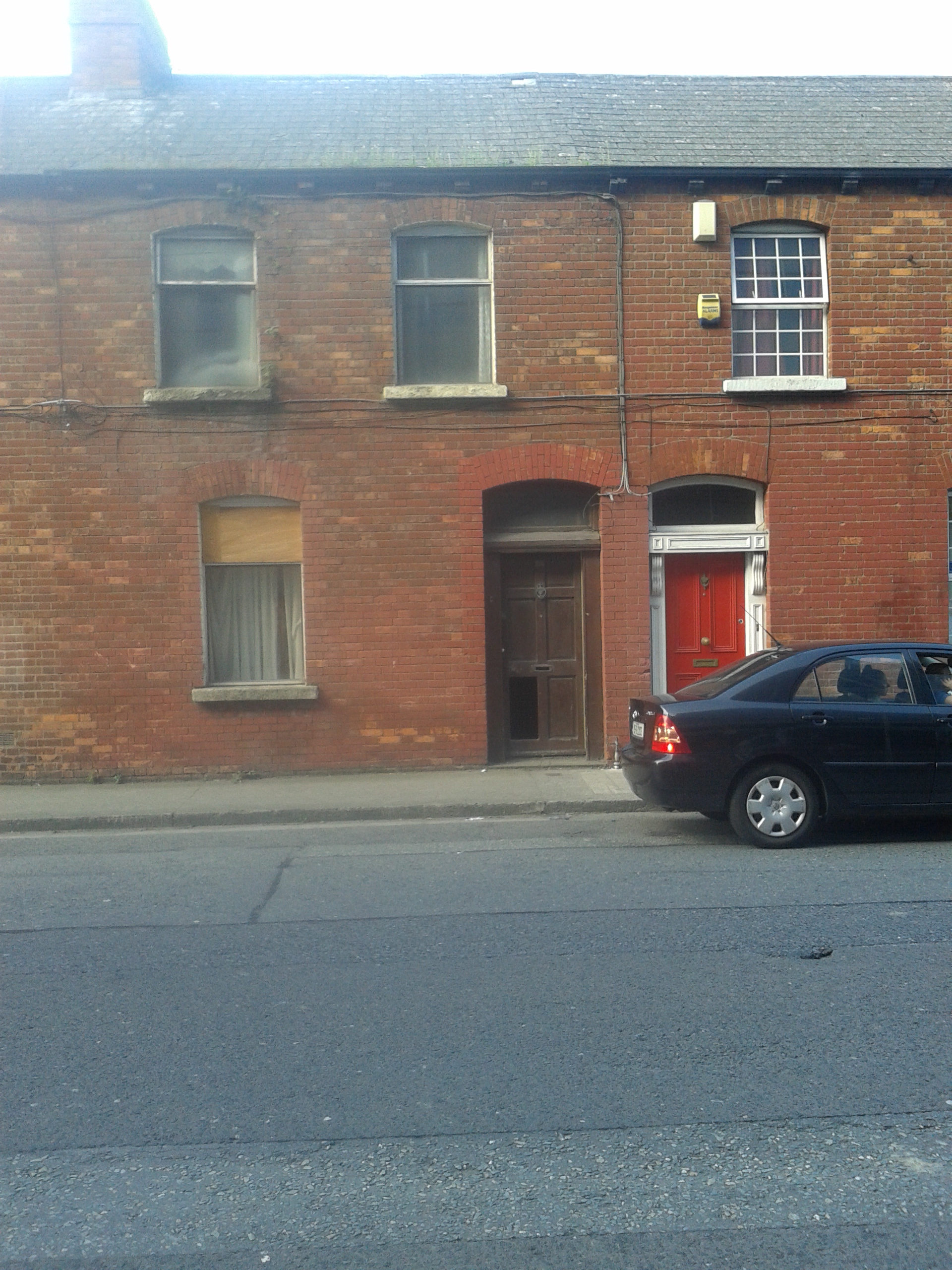
Jack Nalty's house
Jack Nalty’s house.
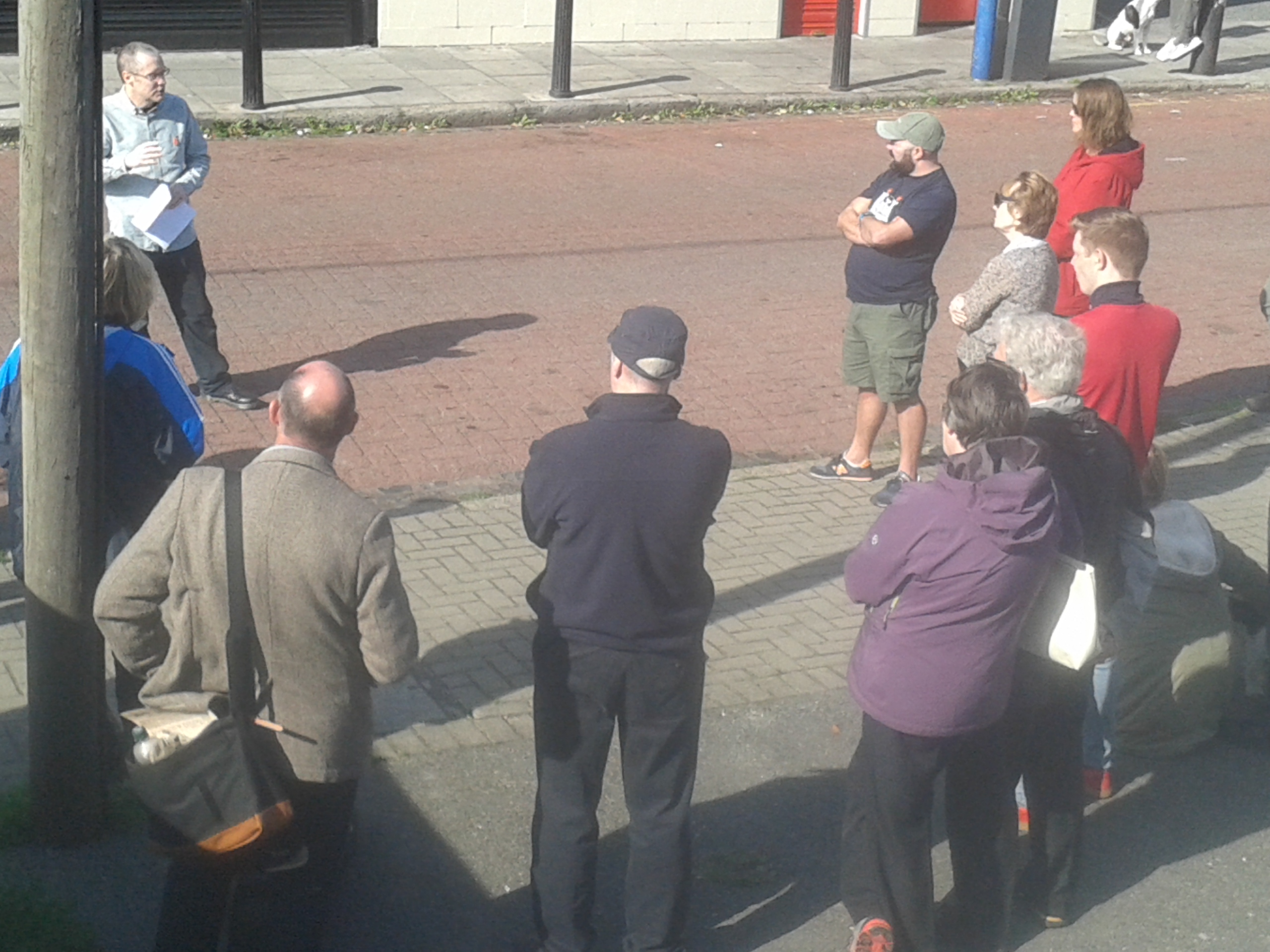
Joe & Crowd from above
(Photo: DB)

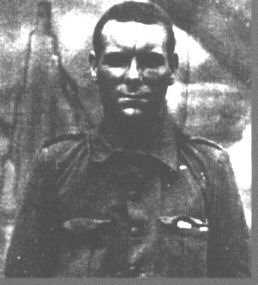
Next we visited the East Road, where Diarmuid set the tone with a stirring rendition of the Christy Moore song “Viva la Quinze Brigada(explaining that Christy incorrectly called it “Quinta” but had since corrected it – as the lyrics in English make clear, it was the FIFTEENTH Brigade). Gathered opposite the family home of Jack Nalty, we heard the story of another former ‘Wharf ‘ school-boy who became an active Republican and Socialist, eventually losing his life fighting Fascism in Spain in 1938. Jack (who was also a champion runner) was amongst the last of the International volunteers to die, while his friend and comrade Dinny Coady was amongst the first. Many of Dinny Coadys relatives still live locally, and we plan to commemorate them properly in the future.

Jack Nalty in uniform of the 15th International Brigade
Jack Nalty in uniform of the 15th International Brigade. (Photo: Internet)


Next was a quick stop at the junction of Bargy and Forth Roads, which along with Shelmalier, Killane and Boolavogue were the names given to streets of Corporation houses erected here in the 1930’s and ’40s. They are of course synonymous with places in Wexford in the 1798 Rebellion.

At the rear of the former Cahill printers premises we learned how an innovative glassmaking factory (Fort Crystal Works) once stood there, perhaps the first industry in the area, but by the early 1800’s lay in ruins. As reported in newspapers as far away as New York, in 1848 a hundred men gathered here and spent an entire day in musketry practice, even setting up a dummy of the Lord Lieutenant of Ireland (the Queen’s representative) to practice on. These were members of the Young Ireland movement, preparing for rebellion.

Joe speaking at the 'Scotch Block'
Joe speaking at the ‘Scotch Block’ — some of the crowd are out of shot, as is Paul O’Brien, who is just getting ready to play.  (Photo: DB)

On Church Road we remembered former resident Edward Dorin, a Sergeant in the IRA who was part of the operation to burn the Custom House during the War of Independence. Another former ‘Wharf’ school pupil (he started there the same year as Jack Nalty), he was shot dead alongside a young volunteer from Ballybough when they engaged a lorryload of Auxillaries at Beresford place (just by Liberty Hall). (They were covering the attacking party). There had been a suggestion in the 1950’s to rename Custom House Quay as Dorins Quay .

A short stop at the “Scotch Block”, Fairfield Avenue, where Paul played two songs recalling Glasgow immigrants to the area and also Edinburghborn James Connolly. An incident in 1918 when Union Jackwaving residents from these buildings attempted to disrupt a Sinn Féin election rally also got a mention.

Diarmuid Breatnach singing Viva La Quinze Brigada opposite house.
Diarmuid Breatnach singing “Viva La Quinze Brigada” opposite Jack Nalty’s house. (Photo: EWHG)

As we passed Hawthorn Terrace its most famous resident Sean O’Casey was briefly discussed, as was his former neighbour Willy Halpin, the diminutive Citizen Army man most famous for almost escaping capture at City Hall by climbing up a chimney.

As we passed Russell Avenue a dishonorable mention was given to those who attempted to raise a 5,000 strong Fascist militia from an address here in the late 1950’s. Thankfully they failed miserably, as did the Italian fascist sympathiser resident of Caladon road who was banned from the U.S.A. during World War Two and eventually arrested by the Irish state and handed over to British authorities via the Six Counties.

At Malachi Place the actionpacked tale of Fenian leader John Flood was recounted. He lived here in the 1860’s as he worked on plans to stage a rebellion against British Rule. After an audacious attempt to seize weapons from Chester Castle was betrayed, he was eventually arrested following a boat chase on the Liffey and deported to Australia on the last convict ship to sail there. A memorial stands above his grave, unveiled there in 1911, two years after his death. This story could be a movie script!

We finished off the day at the base of Johnny Cullens Hill at the block of houses formerly named Irvine Crescent (now incorporated into Church Road). It was here the Scott family lived and in 1916 their 8yearold son was shot from the gun boat Helga. He lingered on for months after his wounding before finally dying, making him the last of the child casualties of 1916. The same year his father died in an accident in the Port, leaving his mother to raise five children on her own while coping with this double tragedy.

Their nextdoor neighbours were the Lennon family. On Bloody Sunday 1913 Patrick Lennon was one of those injured in the baton charge on O’Connell Street. Bloodied but unbowed, he worked alongside Sean O’Casey to raise funds for the relief of strikers families, a project which eventually led to the establishment of the famous soup kitchen at Liberty Hall.

And finally on to Bloody Sunday 1920. Everybody knows the story of how the Squad under Michael Collins (and the Dublin Brigade of the IRA) targeted British Intelligence agents in the City but not many know of the East Wall operation. A house on Church Road was targeted but the agent had left the evening before and was in Cork when the IRA group arrived. The exact location is unknown but we suspect it was within this block here as many of the houses were sub-divided at that time.”

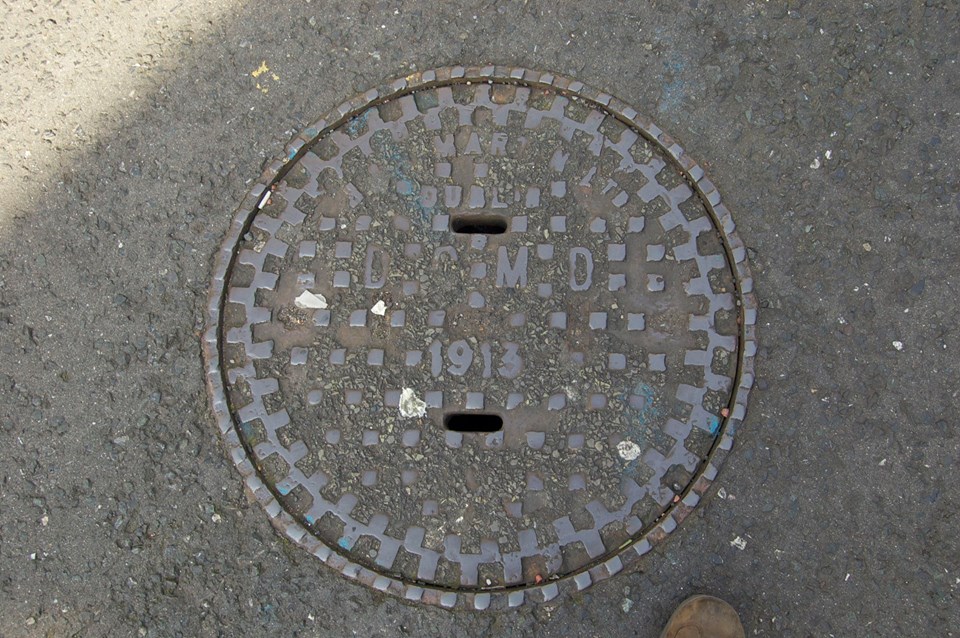
A coincidence in Merchant's Road, opposite the mural (note the date)
A coincidence in Merchant’s Road, opposite the mural (note the date).  (Photo: EWHG)

Even if they didn’t get to tell half the stories of East Wall and the Irish Revolution, it was an enjoyable and informative walking tour … and the weather was beautiful – and there’s always next year!


End

DUBLIN YOUTH 777 DAYS IN EGYPTIAN PRISON

Diarmuid Breatnach

777 Days & Photos Ibrahim
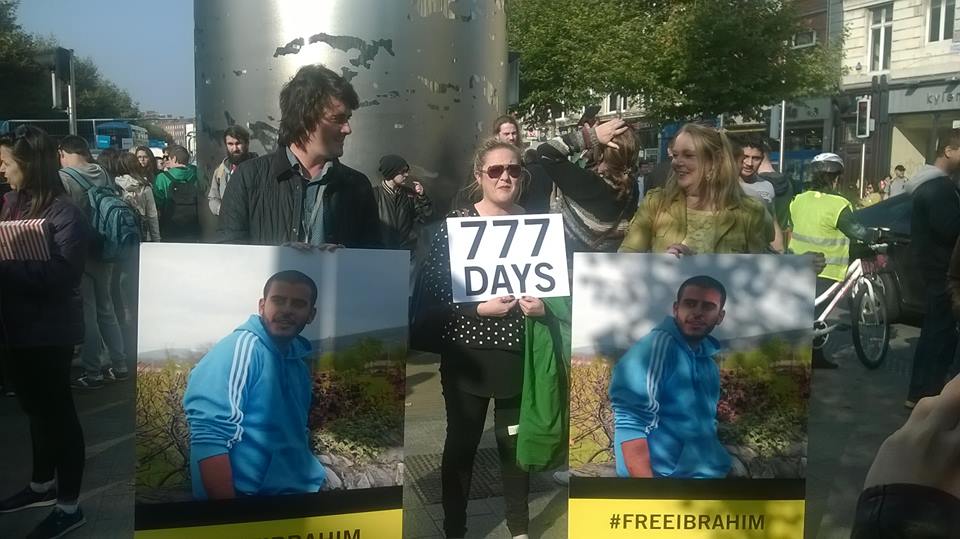
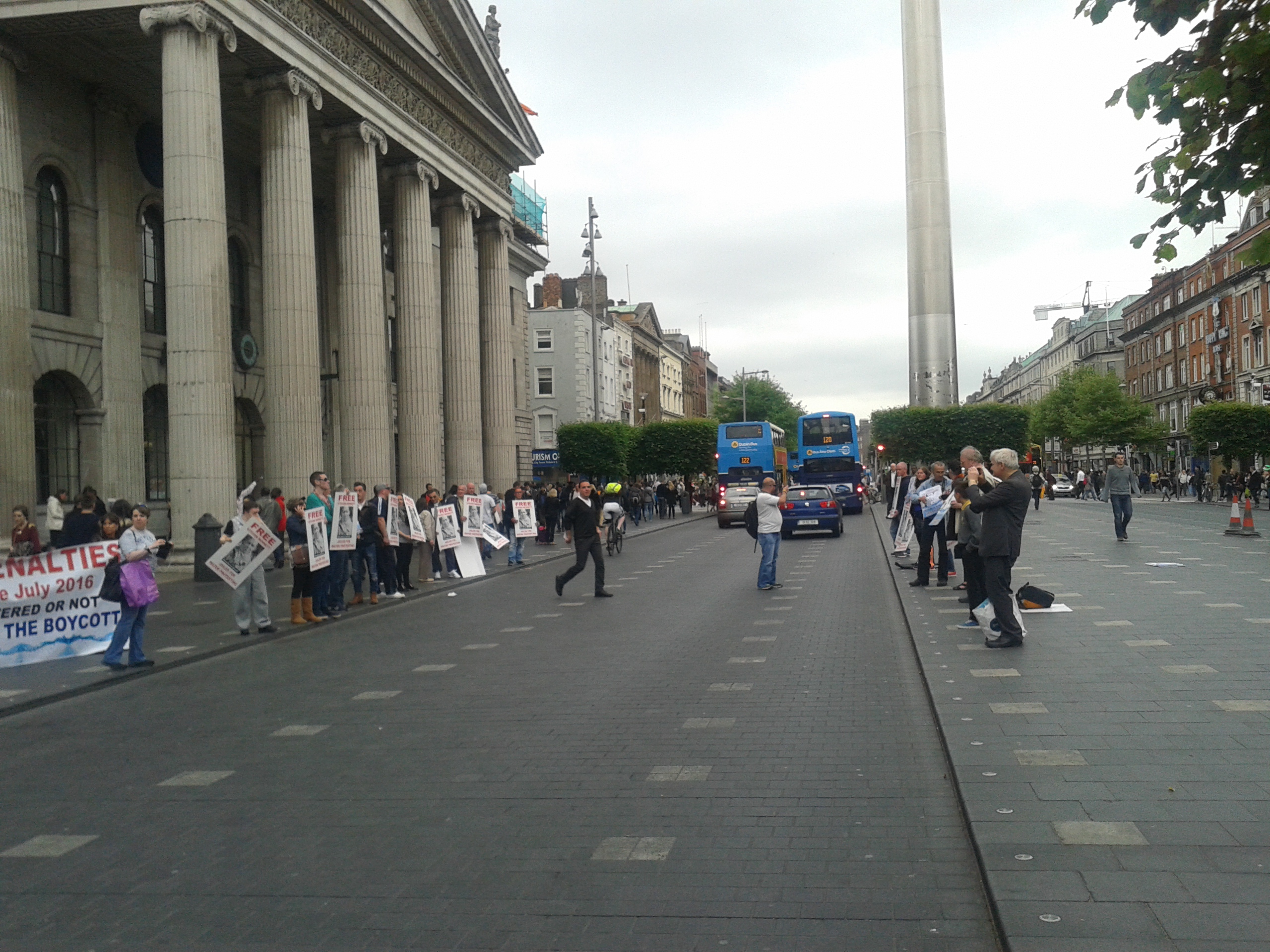
With the Spire in the background, supporters calling for the release of Ibrahim Halawa display placards in Dublin’s main street. (Photo: Ian O Kelly)

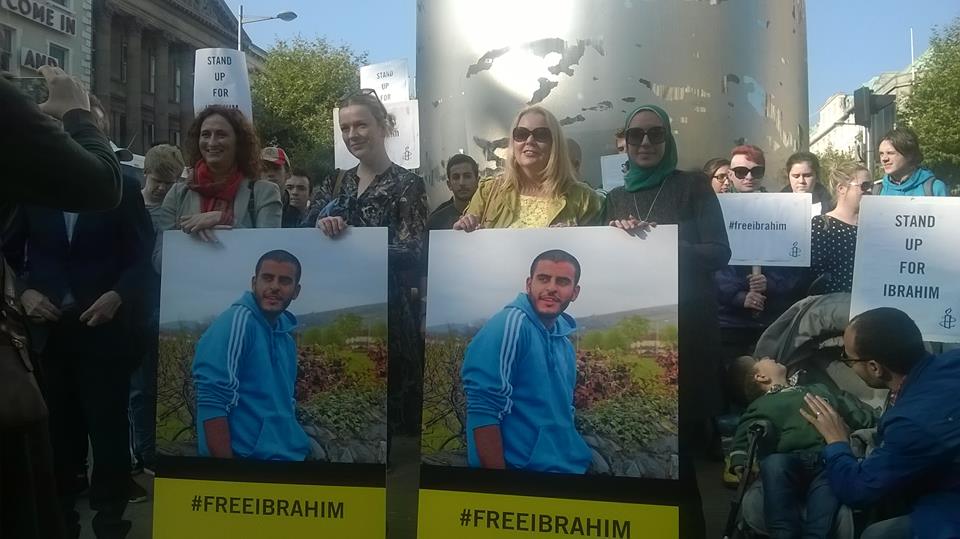
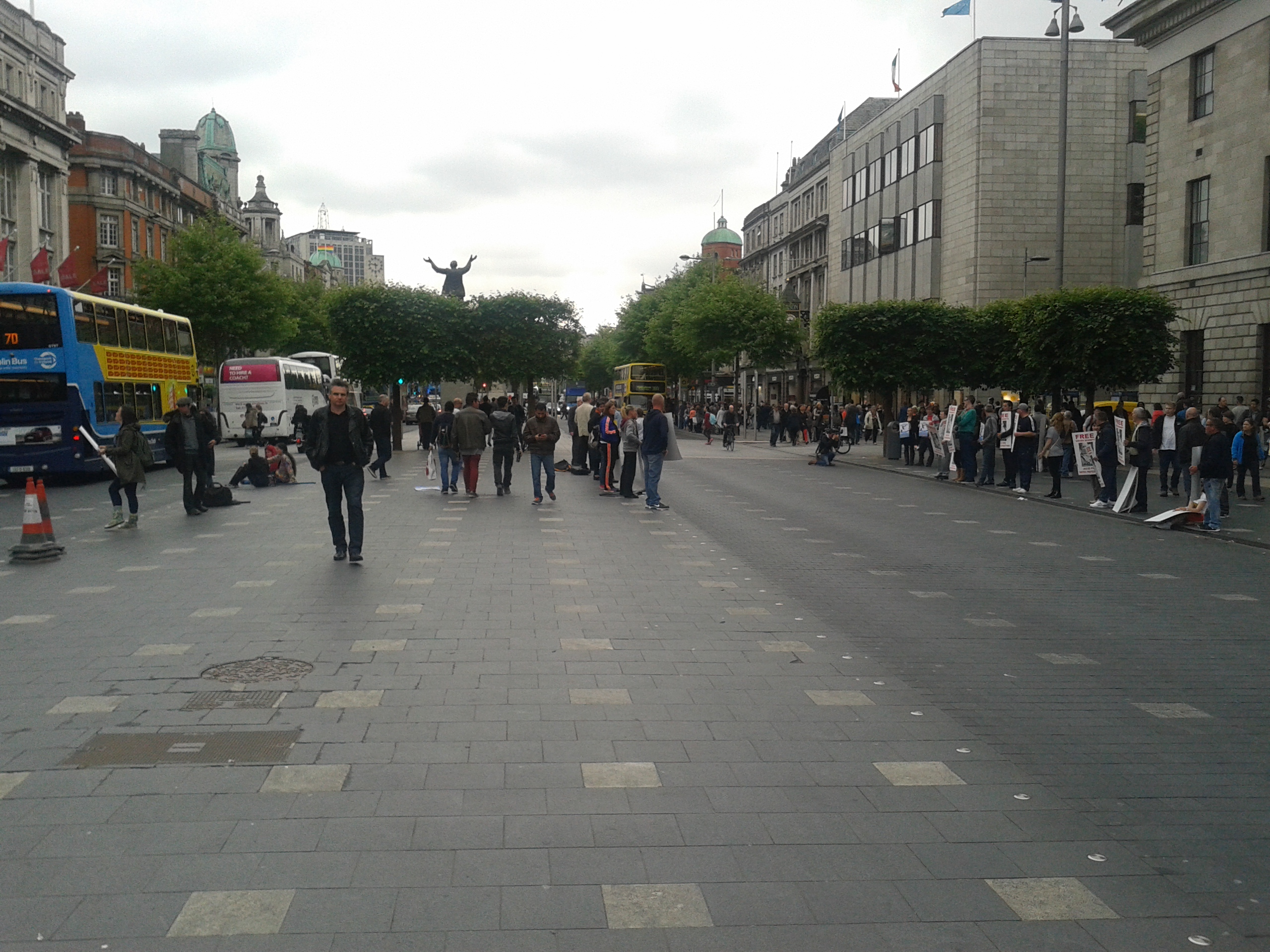
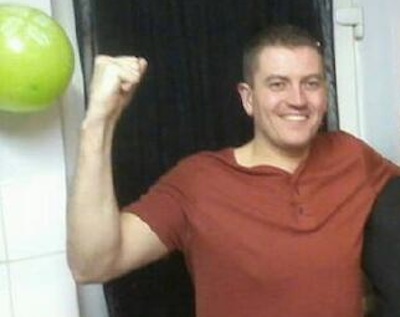
People clustered around the Spire structure in Dublin’s O’Connell Street on Friday 2nd October, many of them displaying a placard with the digits “777”, sometimes nothing else. But some also held an enlarged photo taken of a Dublin youth of Arab extraction, Ibrahim Halawa. Members of his family and community were there too with a banner, as were a relatively small number of supporters, including some Left and Republicans.

Colm O Gorman & Two Sisters
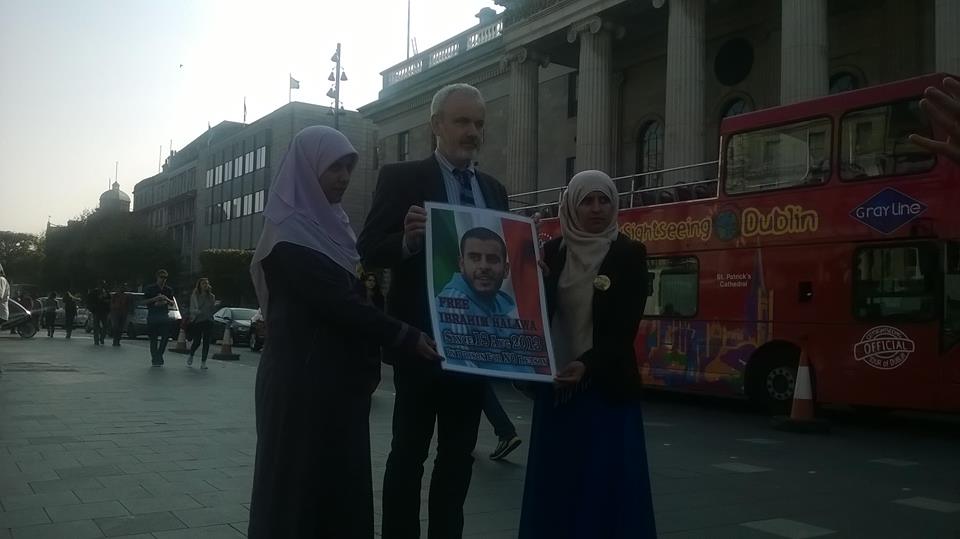
Colm O’Gorman, CEO Amnesty Ireland, with two of Ibrahim Halawa’s family in O’Connell Street, Dublin’s main street. The columns of the iconic GPO are on the right as a Dublin Tour bus passes. (Photo: Ian O Kelly)

Colm O’Gorman, CEO of Amnesty Ireland gave interviews to media personnel present and so did Lynn Boylan, Sinn Féin MEP and of course some members of Ibrahim’s family. Curiously, no leaflets were handed out to explain to passers-by what the rally was about. Nor were there speeches to inform even those gathered there about the background to the case or progress or what people could do to help further.

DAIC Political Prisoners banner Ian
Dublin Anti-Internment Committee activists support the picket, photographed here with members of the Halawa family. (Photo: D. Breatnach)

Ibrahim Halawa was 17 years of age and on holiday in Egypt nearly two and half years ago when arrested, apparently for participating in a demonstration banned by the Egyptian regime. He may have been a conscious participant or may merely have been swept up in it in passing. But now he faces a possible death sentence if found guilty. Another 420 are also charged, some of them with murder or attempted murder during an attack on a police station on the same day. Ibrahim was arrested with his three sisters but they were granted bail and permitted to return to Ireland after three months.

Friends and relatives were hopeful that the trial would proceed as scheduled at the weekend but on the day some of the defendants were said to be seriously ill and the state declined, despite Defence counsel requests, to proceed without all defendants being present. Defence counsel have now also submitted a motion for all to be released, since they have served two years without the State bringing them to trial – this motion is under consideration by the court at present.

Spire lineup photos CBoylan
Supporters of Ibrahim Halawa with placards in front of Dublin’s Spire, with Lynn Boylan furthest left in picture.  (Photo: Ian O Kelly)

The reason for serious illness among prisoners may well be conditions in the jail (which are believed to be atrocious and were described as “trying” by the Irish Department of Foreign Affairs’ representative after an earlier visit to Halawa in jail), coupled with punishment beatings which, according to one of Ibrahim’s sisters as reported by a human rights campaigning website, the Dublin youth has also received.

The Department has taken up the Dubliner’s case with the Egyptian authorities and it is almost certainly its intervention that has gained Halawa’s transfer to a better cell. Three Al-Jazeera journalists were sharing that facility after conviction in Egyptian court but all those have now been released and left Egypt. Others, including former President Hosni Mubarak and members of his family have also been released.

Charlie Flanagan, the Minister for Foreign Affairs, stated that he was “disappointed and concerned” at the adjournment, which is diplomatic language for “really pissed off”. He claimed that his department is doing all that they can. Perhaps they are – but is the Government as a whole? Would the threat of expulsion of a few Egyptian diplomats not gain the release of Ibrahim Halawa? Or perhaps the threat of a tourist embargo?

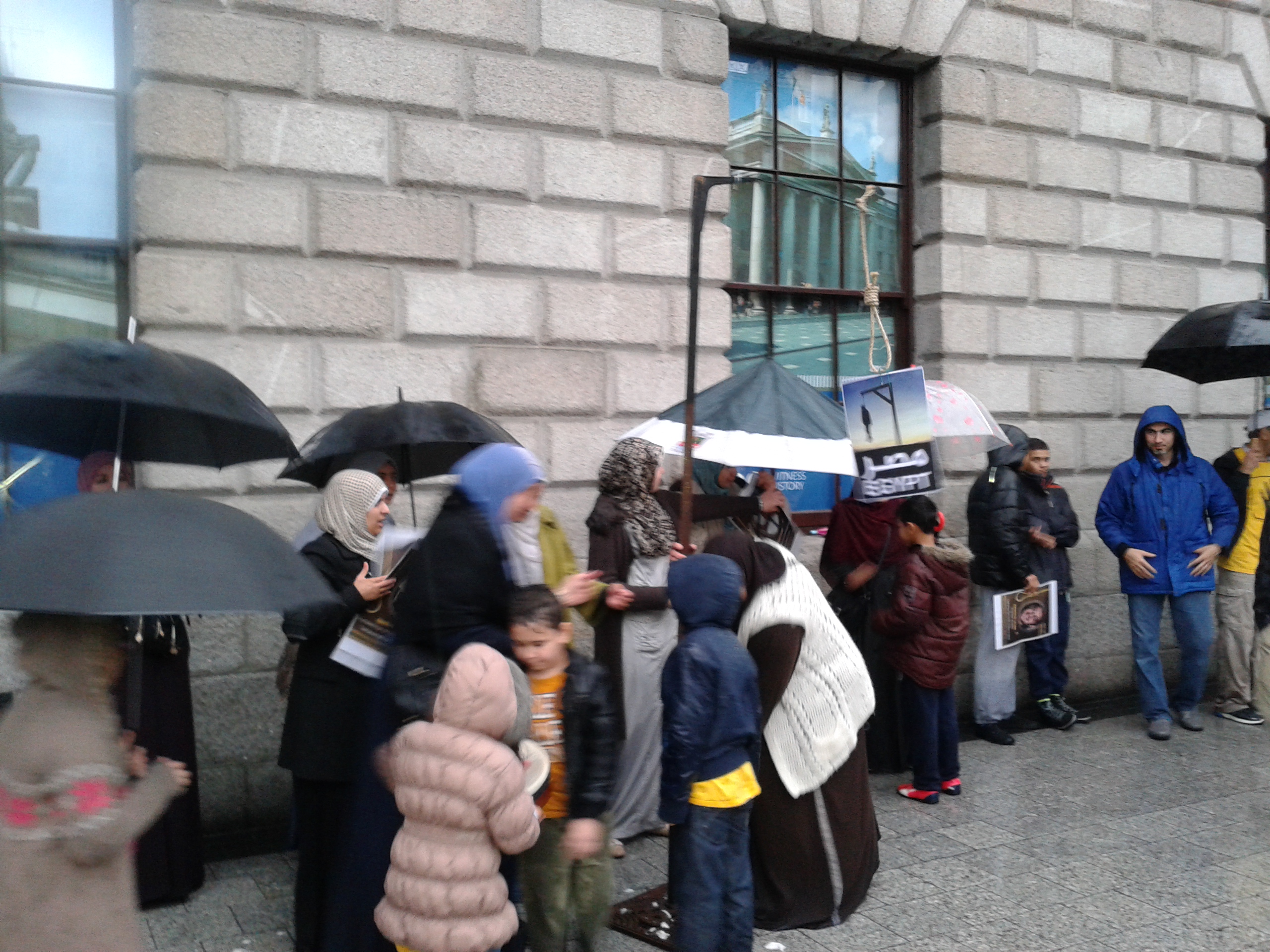
The relatively small numbers at the Dublin rally were probably due to it being called for 3pm on a Friday afternoon, i.e within office working hours. But there may be more to it than that – this case has not been generally pushed in Left and Republican political circles, nor indeed in the liberal human rights sector. Very recently some of Ibrahim’s Dublin Arab community held a protest at the GPO against the Egyptian regime getting ready to streamline its trial and death sentence procedures in order to facilitate the hanging of more political dissidents. It was notable that every single one of those on the protest was Arab in appearance. The word ‘on the street’ is that Ibrahim and members of his family belong to a religiously fundamentalist group. Whether true or not, this does not of course diminish his human rights one iota – but unfortunately it may diminish the enthusiasm of some on the Left to support him.

Amnesty International Ireland was the body that organised the rally. Their website said that they were calling “again” for the release of Ibrahim but it seems that this is the first time they have organised a rally for him in nearly two and a half years.

Some of Ibrahim's relatives and others of their community in protest at Egypt's streamlining of conviction and execution processes some weeks earlier outside the GPO.
Some of Ibrahim’s relatives and others of their community in protest at Egypt’s streamlining of conviction and execution processes some weeks earlier outside the GPO. (Photo: D. Breatnach)
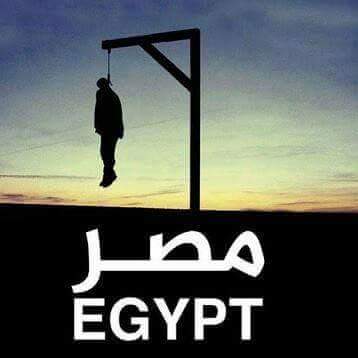
Executions Egypt image
Poster of the Stop Egypt Executions campaign

Generally the states in the West support the current Egyptian regime and the USA very much so. In turn, the Egyptian regime is very pro-Western and its armed forces very dependent on the USA, its main arms supplier. This friendship towards or dependency on the USA has been demonstrated in a number of way over the years and one of the most significant has been its policy towards Gaza.

The besieged Palestinian enclave, which has been called “the biggest concentration camp in the world”, has two land border exits, one of which is controlled by Egypt and the other by Israel. But Egypt has for years, under different governments, been restricting what and how much can go through its Rafah Crossing, more or less in line with Israeli prohibitions or restrictions, which include forbidding cement much in demand to repair the huge damage of Israel’s bombardment to housing, hospitals, schools, roads, bridges, reservoir, sewage treatment facility ….. and fuel for heating, electricity generation ….  The resourceful Palestinians dug tunnels under the border wire to circumvent Egyptian restrictions but the Egyptian regime has demolished these in the past and recently flooded them.

It is important for the Irish Left and all democratic people to show solidarity with Ibrahim and his family. It should not be ok for the Egyptian government to behave in the way it does and we should protect those that we are able to protect from them. That ability is strongest in cases where the citizenship of the victim is Irish. The Government needs to up the pressure on the Egyptian authorities and we need to up the pressure on our Government to achieve that. Those republicans, socialists and democrats who are tempted to pick and choose the recipients of their solidarity would do well to reflect on the oft-quoted words of Pastor Martin Niemoller.

Emd

PALESTINIAN TELLS DUBLIN MEETING ABOUT TEN YEARS OF BDS SUCCESS AGAINST ISRAEL

Diarmuid Breatnach

  A Palestinian speaker recounted ten years of success in the BDS campaign against the Israeli Zionist State and asked people to continue with it and, if possible, to step it up.

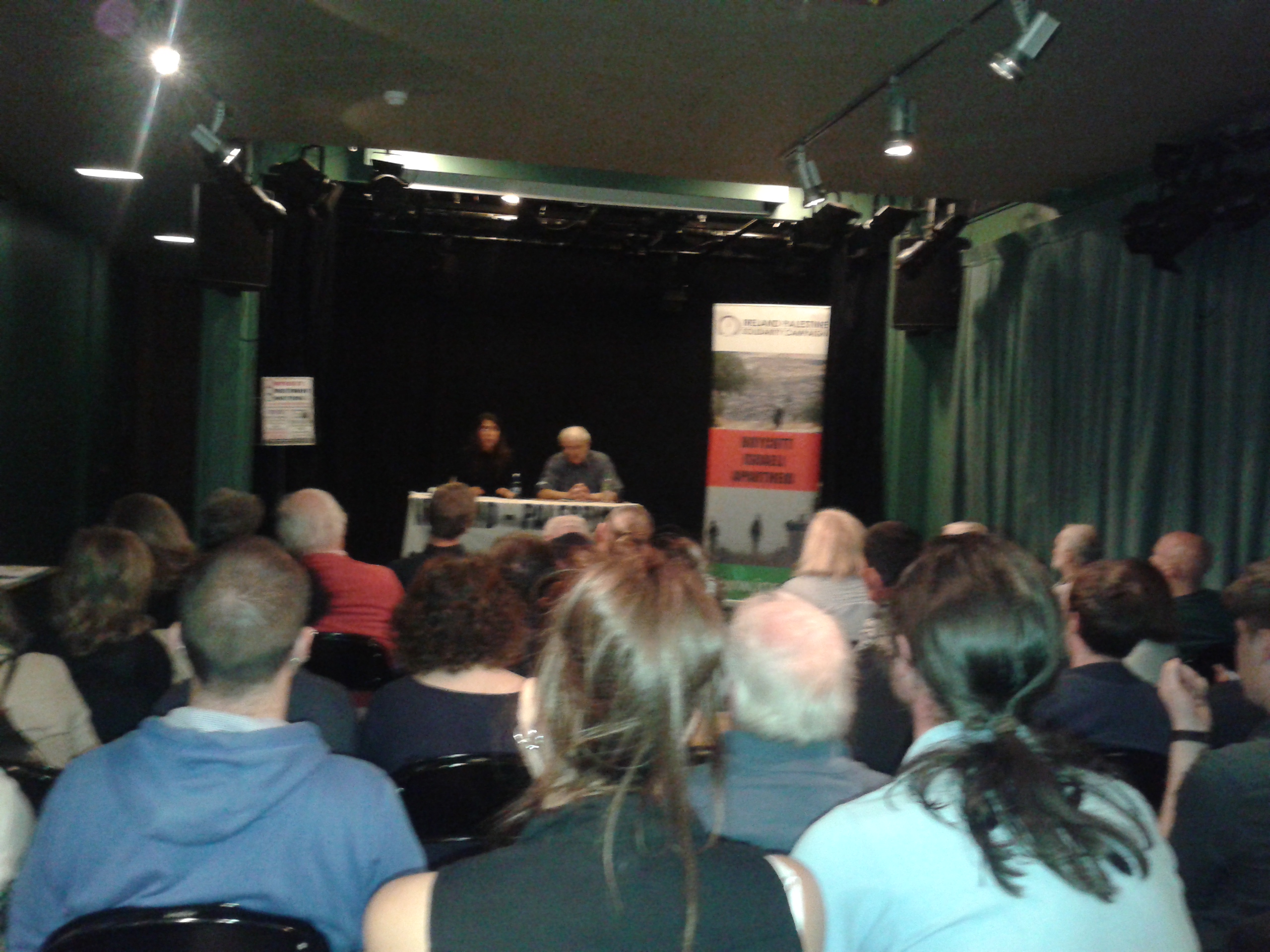
Riya Hassan addressed a crowd at the Pearse Centre in Dublin’s Pearse Street, just off Dublin City Centre, on Wednesday night. She spoke about the history of the oppression of Palestinians by the Israeli state and the ten-year history of the Boycott, Divestment and Sanctions (BDS) campaign, explaining its origins in Palestinian society and charting its growth and successes. The three basic aims of the BDS campaign are to pressure Israel to end the colonisation and occupation of Palestinian land, to give equal rights to Arab-Palestinians citizens in the Israeli state and to agree to the right of Palestinian refugees to return home.
Riya Hassan
Riya Hassan
Section of the crowd at the public mee

Riyah Hassan is European Coordinator of the BDS campaign, herself a Palestinian and, as she later explained when talking about the Israeli destruction of villages in the Negev, from near that area herself. Talking about the current refugee crisis in Europe, she pointed out that many of the refugees taking to sea in what she termed “death boats” (echoes of our own “coffin ships” during the Great Hunger) are in fact Palestinians. They are from refugee camps in Syria and are being made refugees for the second, third or even fourth time.

Speaking on the Palestinian refugee issue, a huge and outstanding one since 1948, Riya Hassan mentioned that their right to return home had been surrendered by the negotiators of the “peace process” at Oslo in the 1980s but that Palestinian society had not accepted this abandonment, whether in Israel, the occupied territory or in the refugee camps elsewhere.

Among a list of successes of the BDS campaign, Riya Hassan mentioned Veolia, a company which had been setting up the transport networks between settlements helping to carve up Palestine, had lost millions due to BDS – as a result, the company has pulled out of Israel (Veolia, by the way, runs the LUAS trams in Dublin). G4 Security, which runs surveillance on Israeli prisons, where there are currently well over 6,000 Palestinian prisoners, have said that they will pull out in 2017 but Riya said they should pull out now and called for pressure to be increased upon them. Another target should be our own Government, which has spent €14.7 million worth of arms and military components from Israel over the last decade (while Irish-based companies have exported €6.42m worth of military and ‘dual use’ hardware to Israel over the past five years). Riya reminded us of the complicity in murder entailed in buying equipment from the Israeli arms industry – an industry which boasts as a marketing point that its deadly equipment is “field tested”!

Among the measures of the impact of the BDS campaign on Israel and abroad, the audience were told that Netanyahu in addressing the recent AIPAC conference in the USA had given a quarter of his speech to attacking the BDS campaign and campaigners, in contrast to the early days when Zionists tended to dismiss the campaign as insignificant. More extraordinarily, perhaps, Hillary Clinton has given a promise, as part of her campaign for the Presidency of the USA, to do what she could against BDS.

Riya Hassan, BDS Europe Coordinator with Martin O'Quigley, Chairperson IPSC and who chaired the meeting
Riya Hassan, BDS Europe Coordinator with Martin O’Quigley, Chairperson IPSC and who chaired the meeting

Riya Hassan is eloquent, with excellent command of English and spoke clearly and confidently. If anything, she spoke for too long overall. It is hard for a visitor to judge what a typical Irish audience might know or what our cultural expectations are but the room was warm and after about 45 minutes one could hear some people shifting in their seats, a situation that did not improve as the talk extended well past the hour.

However, when the Chair of the meeting turned to the audience, it did not seem that anyone had missed an opportunity to ask questions or to comment and some even took several bites of the cherry.

As chair of the meeting (and of the IPSC) Martin Quigley drew the meeting to an end, he announced a boycott action of Tesco supermarkets for this Saturday and, for those in Dublin, asked them to meet at the IPSC office at 12 noon.

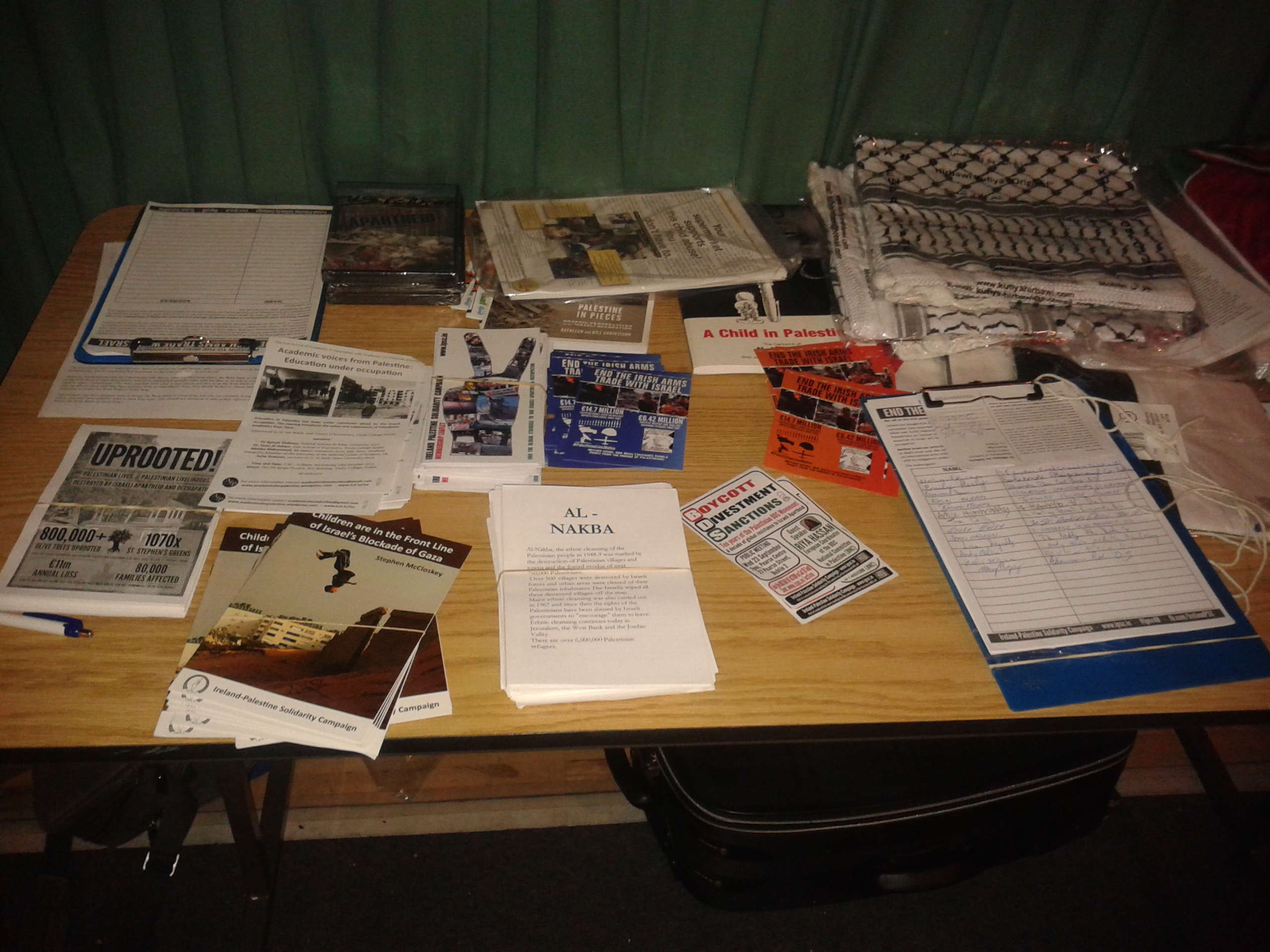
IPSC staff at the event
IPSC stall at the event

Riyah Hassan sets off over the next few days for Belfast and Cork before leaving our shores again and we wish go néirí an bóthair léithe!

end
NO CHANGE IN THE STATES’ POSITIONS ON DISPERSAL OF BASQUE POLITICAL PRISONERS

Diarmuid Breatnach


The French Government deny rumours of a relaxation in their policy of dispersal. The Spanish Government confirms it is business as before for Basque political prisoners.

On 3rd September French diplomatic sources refuted interpretations in some media that it had changed its position with regard to Basque political prisoners. The media interpretations had been built upon a statement by the Abertzale (Basque Patriotic) Left party Sortu, that it had met on July 8th with the French Minister of Justice. The diplomatic sources downplayed the significance of the meeting and denied bringing Basque political prisoners closer to the Basque Country. Etxerat, the organisation for relatives and friends of the prisoners, confirmed that there had been no move to moderate the dispersal.

The day previous to the release of information from French diplomatic sources, on Wednesday, French Justice Minister Christiane Taubira had met with her Spanish counterpart, Rafael Catala. The following day, Taubira said her Government’s approach is to analyse requests for transfer based on the length of the sentence and relocation near their family. Meanwhile, the Spanish Minister of Justice and the Interior reiterated his Government’s position that any individual prisoners’ transfer to a jail in the Basque Country required the prisoners to renounce their organisation and to accept responsibility for the damage caused by their action.

The French approach contrasts with the requirements of the Spanish Government, although Catalá reiterated yesterday that both states were acting in a “coordinated” manner and that the French Government “has not moved its policy by one iota .”

According to Etxerat on Thursday, of the nearly 100 Basque political prisoners in French prisons, only two are in Mont de Marsans prison (152 kilometers from the Basque city of Donosti), while six prisoners are in Lannemezen (231 kilometers). The rest are serving out their sentences at a greater distance from home, the vast majority at more than 600 kilometers. Although the support organisation viewed the French Minister’s statement positively, it was also at pains to disabuse people of any belief in a change in the French dispersal of prisoners and stated that any prisoners brought nearer were merely as a result of movement to which the relatives and friends have become accustomed, “bringing them close” before “bringing them far away again.”

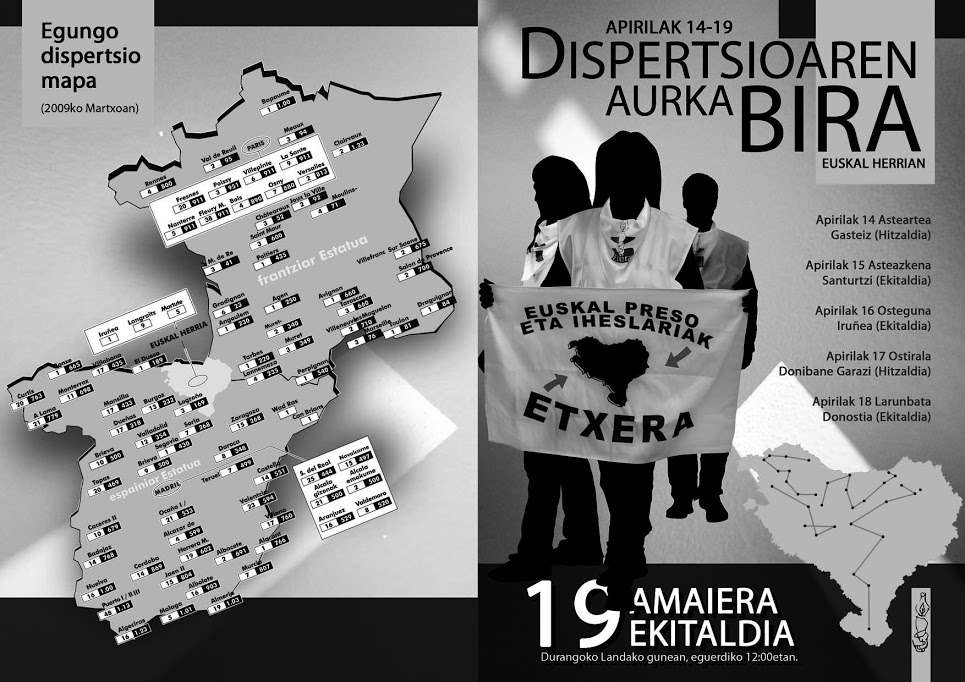
Map of the dispersal of Basque political prisoners across both states and Etxerat picket
Map of the dispersal of Basque political prisoners across both states and Etxerat flag in a poster calling for a protest and solidarity demonstration some years ago

The organisation of relatives and friends of Basque political prisoners stated that neither they nor any prisoners’ relatives participated in any meeting with the French Ministry of Justice – any meeting was with several members of Sortu only.

Spokespersons for the party of the Patriotic Left, Sortu, indicated that at their July meeting the French Ministry had been represented by Alain Christnach, Taubira’s Chief of Staff. Meanwhile the French, through diplomatic sources, asked observers not to “over-interpret” this meeting and indicated that participation in the meeting does not mean accepting Sortu’s proposals.

Another issue discussed by the Spanish and French Ministers was the possible transfer of prisoners under the law of mutual recognition of penal sentences in the EU, in force since January. This legislation provides the possibility for prisoners serving sentences in any EU Member state to be transferred to a Spanish prison; however, most Basque prisoners are unlikely to avail of this provision due to harder treatment in the Spanish prison system and the fact that dispersal throughout the state continues.

In a different aspect of the same legislation, the MEP of the Basque Nationalist Party (PNV), Izaskun Bilbao, asked the European Commission whether it will take Spain before the European Court of Justice for failure to take account of sentences served in French prisons by Basque political prisoners. This is because of the fact that the Spanish state often waits until a prisoner has served his sentence in France before extraditing him on a Spanish charge to face a further sentence in Spanish prisons.

Policy of dispersal of political prisoners — an abuse of human rights

There are many issues raised with regard to Basque political prisoners but the most universal one is the simple fact of dispersal. Relatives and friends face journeys of hundreds or even thousands of kilometers to visit their loved ones and the same distance back again. Many of these journeys are impossible without overnight stays. The expense drains financial resources while the long journeys themselves drain energy and, for elderly or unwell relatives, are an impossibility. An average of one serious accident a month occurs on these journeys for Basque political prisoners’ visitors and twelve have died in crashes over the years. Nor is it unknown for the relatives to be harassed by police on their journey or attacked by Spanish civilian fascists. As Etxerat has stated in its monthly reports and in a number of other statements: “The sentence was supposed to be on the prisoner but in actual fact was served on us as well, although we have been accused of nothing.”

It is a well-established principle of human rights that prisoners should, as far as possible, serve their sentences in a prison close to their families and relatives. This is in recognition of the rights of families as well as the desirability of easing the reintegration of prisoners as much as possible into society. The principle is covered in a number of United Nations policy paragraphs and also within the EU’s model rules for prisoners adopted in 2006 (https://wcd.coe.int/ViewDoc.jsp?id=955747).

Since both the French and Spanish states’ policy of dispersal appears to be in clear violation of the prisoners’ and relatives’ human rights and indeed of the EU’s own model rules for prisoners, some observers find it somewhat perplexing that the relatives’ organisation does not take a case against the states to the Court of Human Rights in Strasbourg. Granted, Strasbourg’s controversial decision on the Spanish State’s banning of the Herri Batasuna political party did not go in the Basques’ favour and the Court, albeit instructing the Spanish state to pay compensation to Basques for not investigating their claims of torture, continues to show a reluctance to find the Spanish State  guilty of actual torture. But the dispersal of prisoners is an observable and undeniable fact and, furthermore, one which has been confirmed in public statements by Government ministers of both states.


End item

(Main source on the various statements: Deia, 4th September 2015)

SPANISH STATE TO CLOSE OVER 100 BASQUE SOCIAL CENTRES

Diarmuid Breatnach


The Spanish state is set to close 107 Basque social centres, confiscate their funds and sell off their assets, including property. With allegiance to the Basque Patriotic Left, the “Izquierda Abertzale” as it terms itself in Spanish, the Herriko Tabernak (“Peoples’ Taverns”) function as centres for social, cultural and political activity. The sale of coffee, alcohol and pintxos (a variety of home-produced small items of food, mostly eaten cold) also generates income with which to employ some activists within the movement and also to fund some of its political activities.

Outside the Errondabide street Herriko Taberna in the Casco Viejo part of Bilbao

Those are the socially-useful functions of the Herriko Tabernak and precisely the reasons the Spanish state plans to close them down. Not that they say that openly, of course – the official line is that the taverns “fund terrorism”. Never mind that the police have never furnished any evidence of that, never mind too that the alleged recipient, the armed organisation ETA, has been in uninterrupted ceasefire since 5th September 2011, confirmed as “permanent” in a statement the following January and again as a “permanent cessation of armed activity” in October 2012.

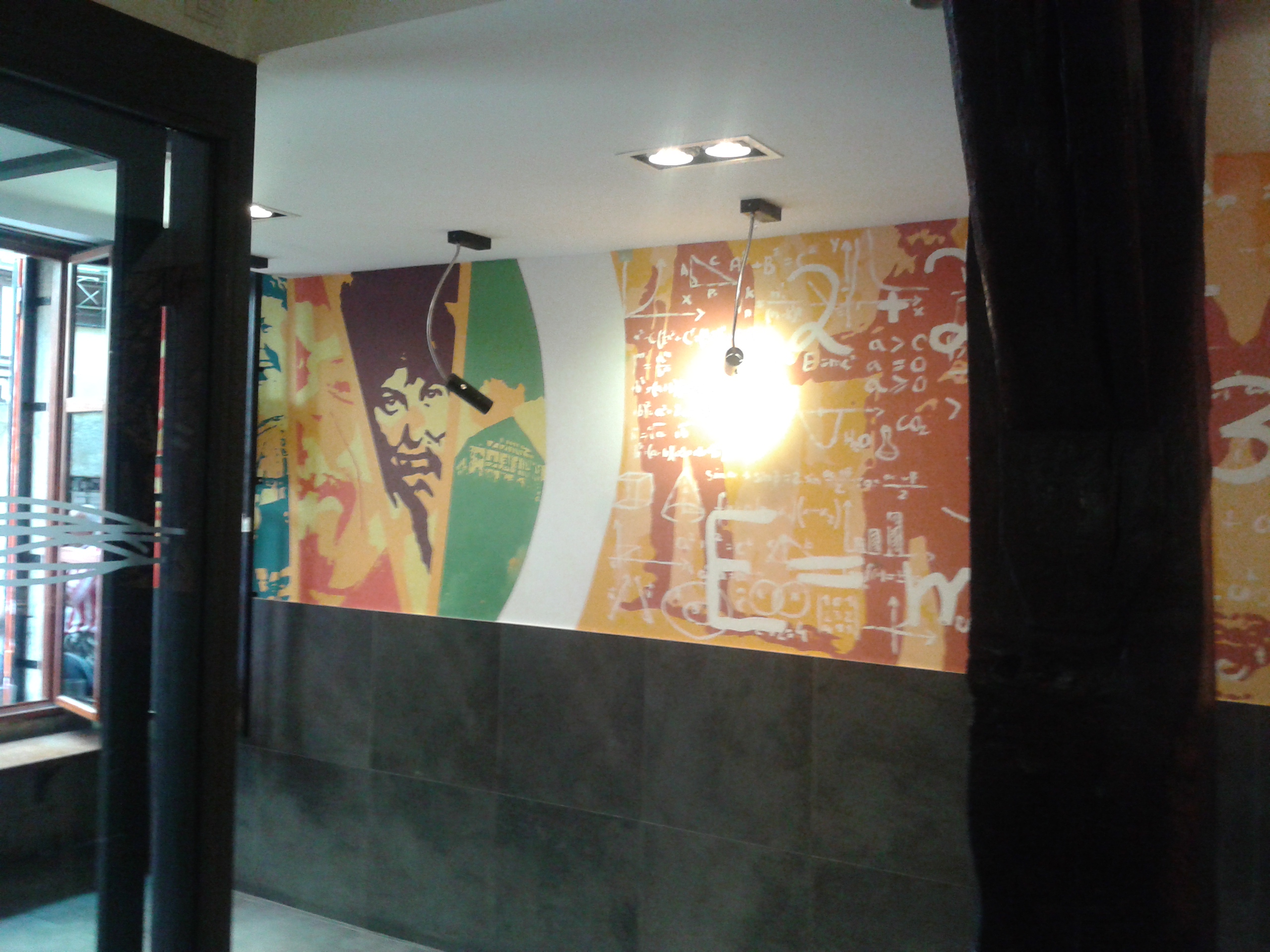
Entrance wall mural
Entrance wall mural

There is an herriko taberna in many vilages and in every town throughout much of the southern Basque Country (i.e the part under Spanish state rule) and Bilbao, for example, has several. They vary from one another but typically have a front bar area and a rear or upstairs function room which may be used for political, cultural,

Section of the function room at the back of the Herriko.

educational or social event, or hired for personal social functions such as celebrating a birthday, successful conclusion of studies, an engagement or wedding, a return for a migrant. Social functions of a more political nature such as welcoming a recently-released political prisoner or a commemoration of some figure of the resistance are also held there.

Inside the Herriko, the bar area and some afternoon customers

Although people hostile to the ‘herrikos’ would not usually enter one, anyone can do so and order coffee, beer or soft drink, perhaps buy some pintxos – no-one will bother them. The language of conversation inside may be Euskera (Basque) or Castellano (Spanish) but all the staff have at least enough Euskera for the customers’ needs and many are fluent.

On the walls notices and posters carry political, cultural or social messages or advertise an event, either specific to the Basque Country or perhaps in solidarity with the Palestinians, the Saharaui (Western Sahara people), or to do with gender and sexuality-social issues, workers’ and migrants’ rights, animal rights ….

Some pintxos in the Herriko, home-made Basque 'fast food'
Some pintxos in the Herriko, home-made Basque ‘fast food’

Banners and Basque flag propped against wall in the function area

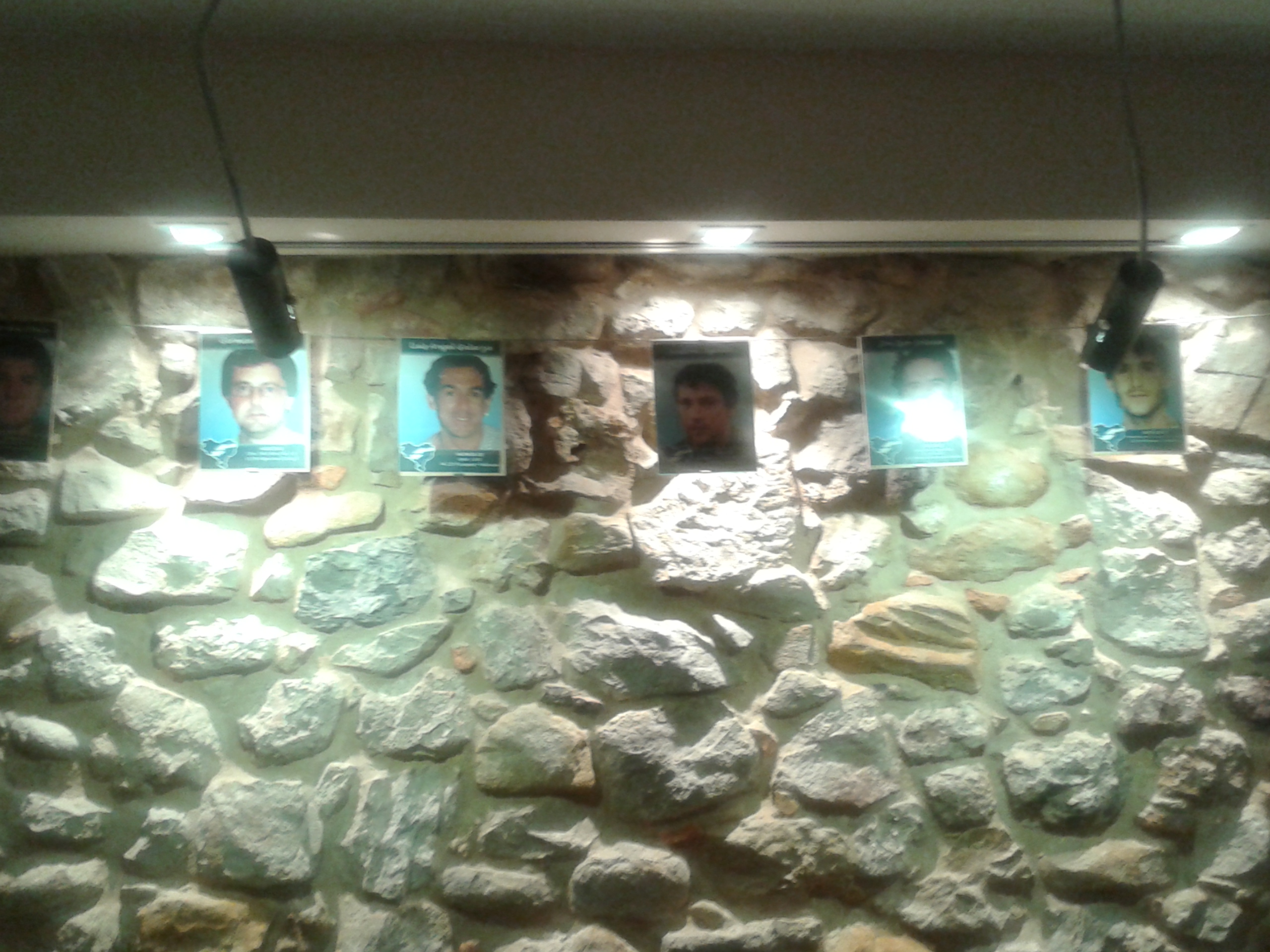
Photo portraits of prisoners are “glorification of terrorism”

Recently, the walls carried photo portraits of political prisoners from the area. After the Spanish National Court decreed, a few years ago, that these were expressions of “glorification of terrorism”, the police raided many herriko tabernak (and also sympathetic bars) and arrested those who refused to take them down. The herrikos and bars affected then removed the portraits but replaced them with black silhouettes. Despite a widespread expectation that those arrested would face prison terms, nothing happened and the pictures are back up on the walls of the herrikos.

Portraits of local activists in jail prominently displayed on the wall in the bar area of the Herriko

The herriko closures are expected after the Spanish state’s General Elections, which must be held before December and are expected in October or November. According to opinion polls, both traditional governing parties, the PP and the PSOE, are ahead of all others and even Podemos, with its meteoric rise to December 2014, did not overtake them and continues to show a decline in the voting intentions of those polled. In the southern Basque Country itself, the christian democratic Basque Nationalist Party continues to dominate and, even if they wished to help the party to their left (and they don’t), could not stand up against the Spanish state. A political solution therefore is out of reach.

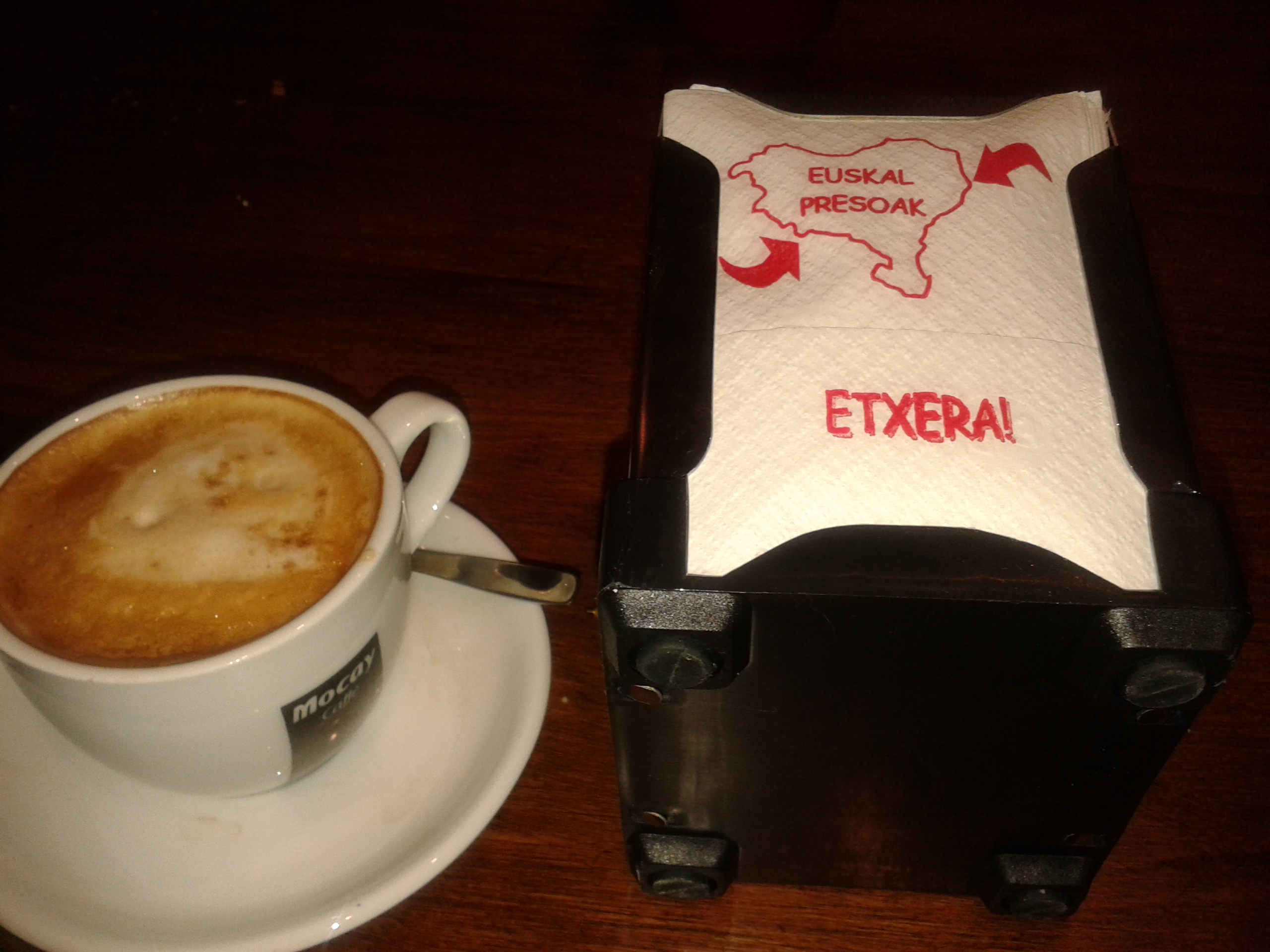
Cafesnea (coffee and milk) with the standard Herriko tissues, stamped with the slogan calling for the Basque prisoners to be sent home from dispersal (and also to be freed).

When the herrikos close, the loss will be enormous: the organised movement will suffer politically, culturally and financially and the social and cultural life of thousands will suffer. There seems little that the Abertzale Left movement can do within the Spanish state – its legal challenge in the Supreme Court has failed. It can apply to the Constitutional Court but decisions there usually concur with those of the Supreme. After the Constitutional, it can apply to Europe, to either the Court of Human Rights at Strasbourg or the Court of International Justice at the Hague but the delay in cases being heard there can take years and by the time they are heard, the herrikos will have been closed and properties auctioned off. Nor are the European Courts’ decisions necessarily to the benefit of the Basques – although a number of times Strasbourg has found against the Spanish state for failing to investigate a claim of torture by a political prisoner, it has never actually found the state guilty of the torture itself. And when the Abertzale Left’s political party, Herri Batasuna, was banned by the Spanish Supreme Court (and confirmed by the Constitutional) in 2003, the movement took the case to Strasbourg. Eventually, in 2009, the Court delivered its judgement – incredibly, it decided that banning a political party with electoral support varying from 15% to nearly 25% in the southern Basque Country was not an abuse of the human rights of the people concerned.

This Herriko is mainly patronised by youth but the age range is complete, from babies brought by their parents to the elderly


Considering the options and Spanish democracy

Now the people are considering their options in action outside the courts. Should they occupy the buildings and resist their takeover by the Spanish state? Maybe that would make sense where their location is a fairly high-profile one. But others are in back streets and laneways; the “Zipayos” (pejorative name for the Euskadi police, the Ertzaintza) can swarm those places, assault the occupants and evict them in a matter of hours. That they can do the same in the more high-profile locations is without doubt but at least the community and passers-by will see the resistance there. In the smaller villages, herrikos may change their name and perhaps replace the buildings’ renters or lessees. Whatever course they take, the disruption overall will be huge.

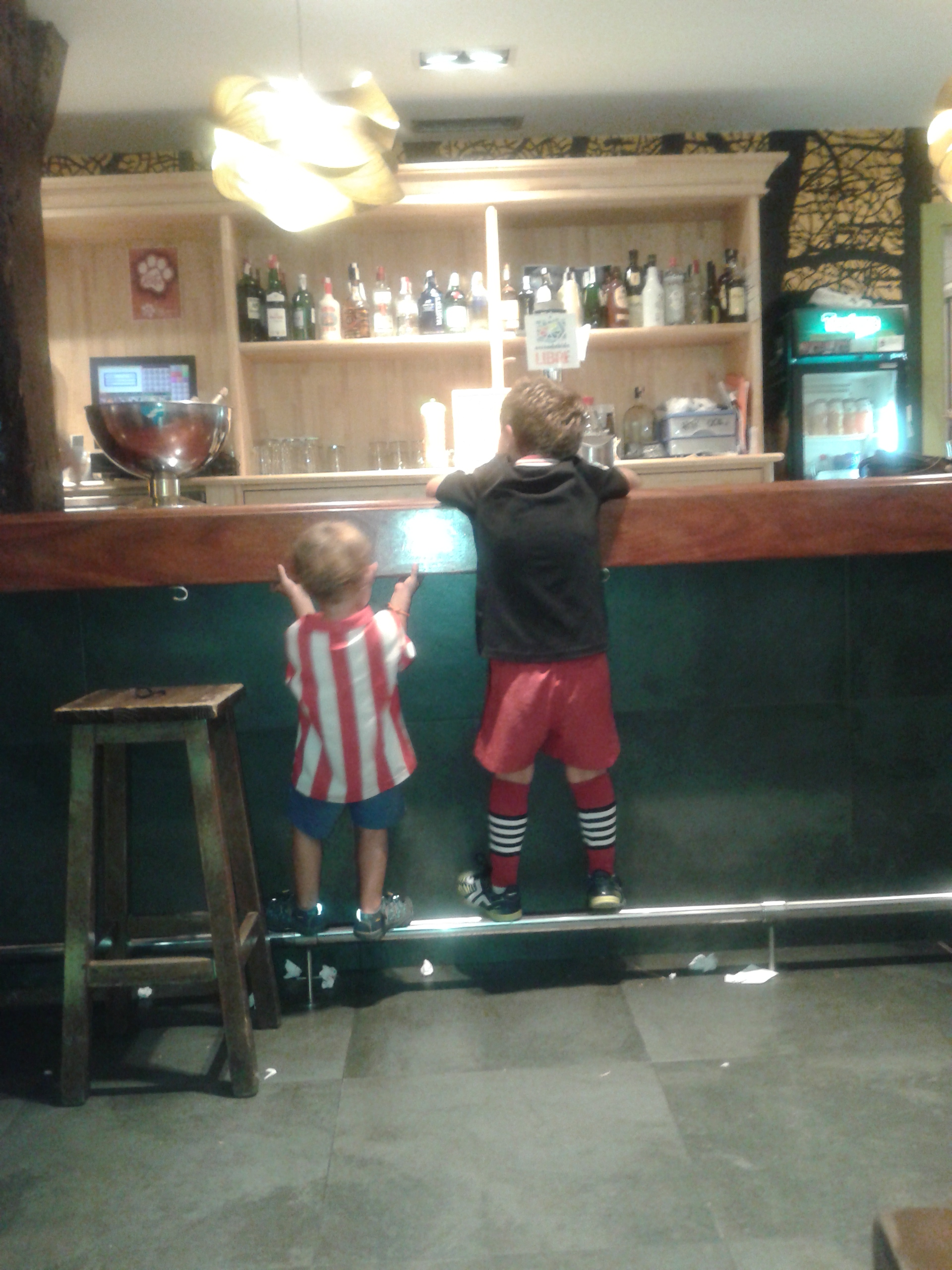
The upcoming generation, one wearing an Athletic Bilbao shirt

In 1998, the Spanish National Court judge Balthazar Garzon (beloved of many liberals around the world) closed down the Basque-language newspaper Egin, a bilingual daily in Euskera and Castellano first published 20 years earlier. Over a year later, a judge ruled that the newspaper could reopen but by then its machinery had been dismantled or left unusable and its owners left without funds as they were using them in court proceedings. In 2009, a Spanish court finally decided that there had been no grounds for closing it in the first place. A year later, there was a similar decision in the case of Egunkaria, the first-ever daily in the Basque language, closed down by the Spanish state in 2003. In 2010, the National Court decided that there had been no reason to close the newspaper and that the accused were innocent, hinting that the accusation of torture was true. But no formal apology followed, nor was there any compensation paid and Otamendi, the newspaper’s manager, had to take his torture case to Strasbourg, where in 2012 he was awarded compensation of €20,000 (and €4,000 legal costs) against the Spanish state because (as usual) they had not bothered to investigate his claims of torture. No compensation has yet been paid for Egunkaria‘s closure and its successor, Berria, reportedly struggles financially today.

Posters and information on the Herriko wall near the front of the bar area

Basques smile ruefully when students of recent Spanish history talk about the “democratisation” of the State through the “Transition” from General Franco’s dictatorship. Apart from the killing by Spanish police and state-supported fascist gangs during that Transition, the southern Basque Country has seen state-organised assassination squads, bannings of newspapers and radio stations, bannings of political parties, youth and cultural organisations and arrests, torture and jailing of political activists. This is the reality behind the words of “Spanish state democracy”.

End.

ANTI-INTERNMENT MARCH BLOCKED BY MASSIVE POLICE PRESENCE IN BELFAST

Diarmuid Breatnach

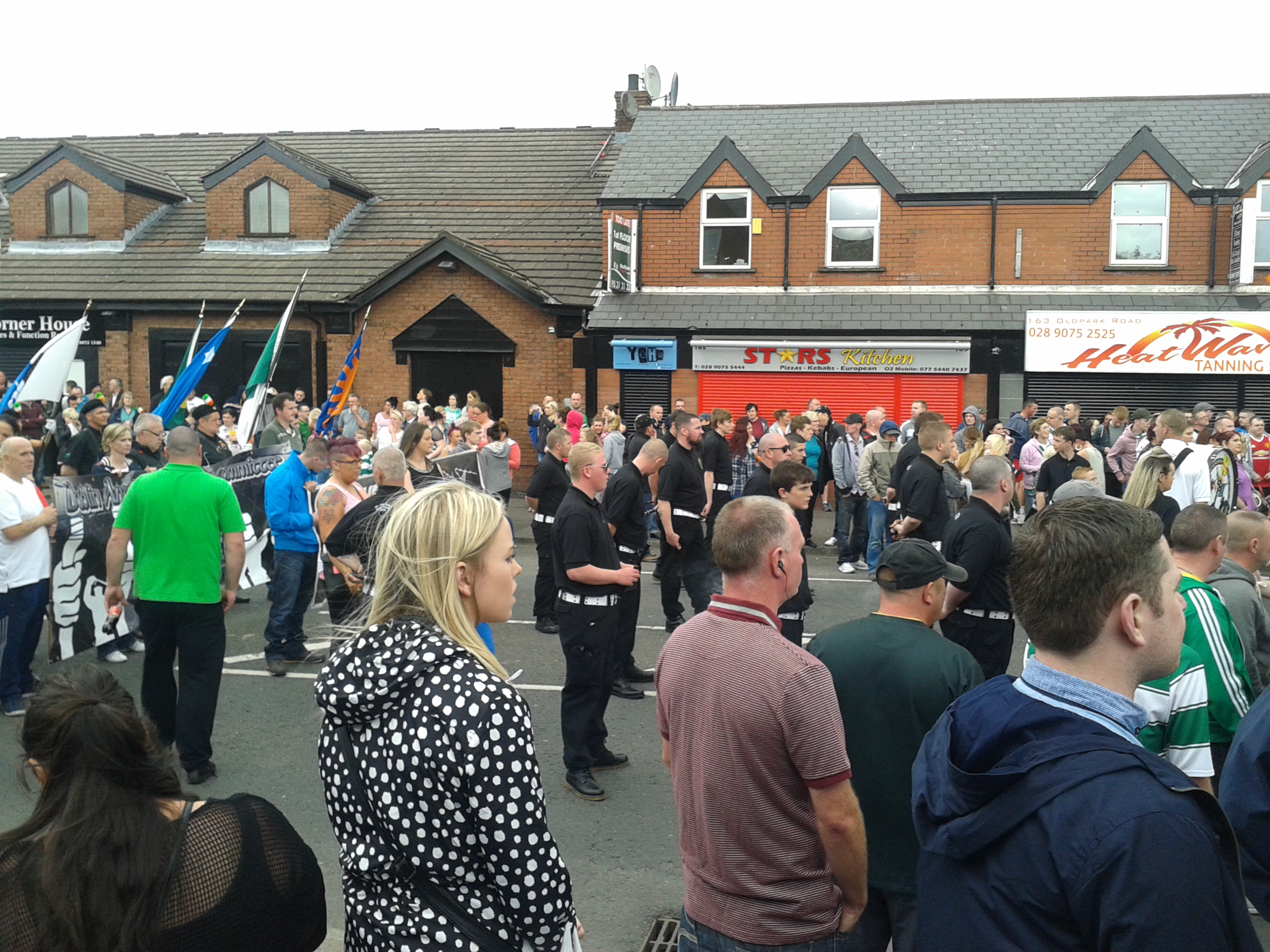
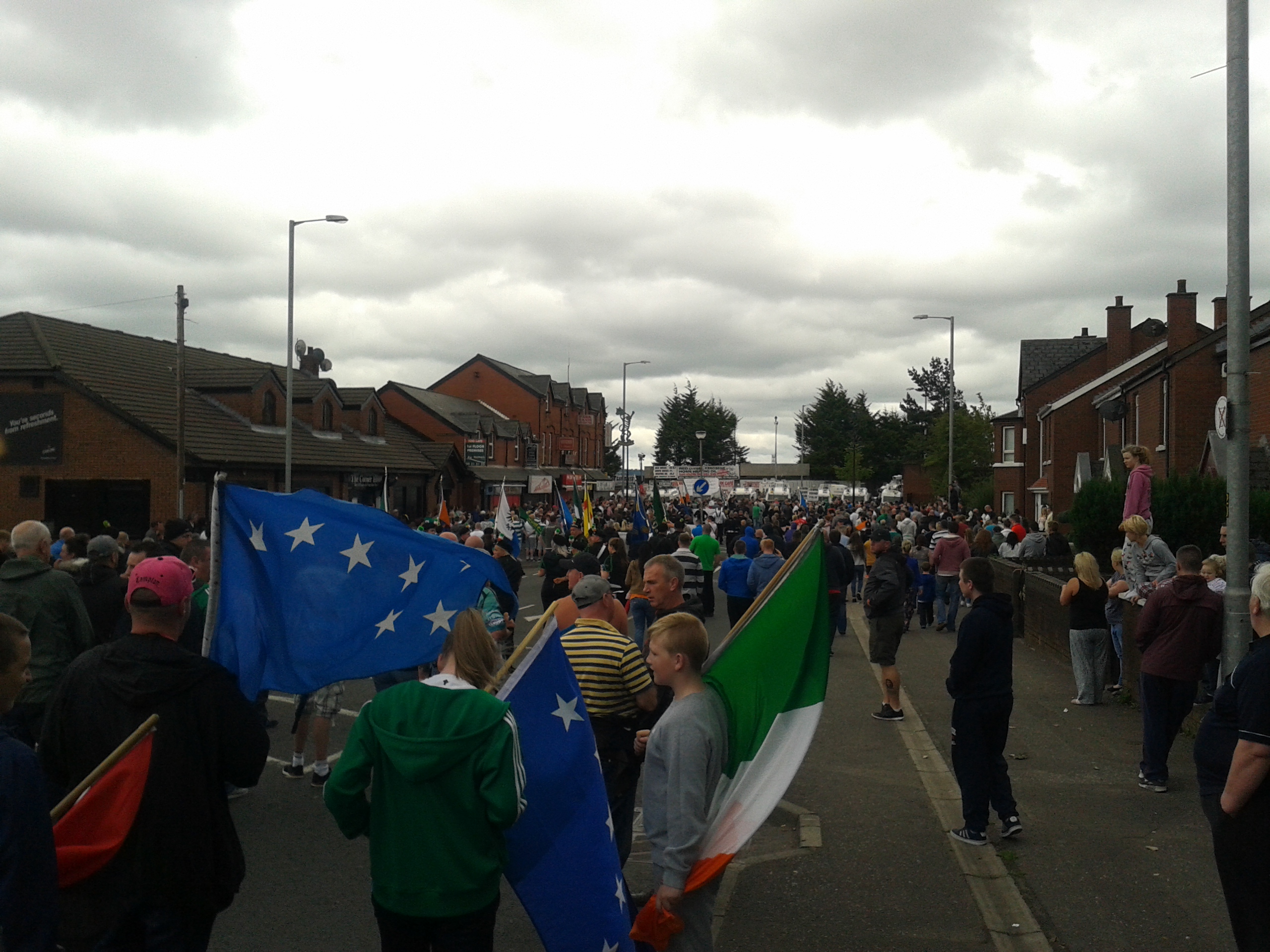
The annual anti-internment march in Belfast was blocked on Sunday 11th August by a very heavy police presence from proceeding beyond the Old Park Road. Road blocks had also been set up around the area and in the city centre. Although the march dispersed without incident, the continuing heavy police presence in the area provoked local people and altercations broke out between them and the police. In one incident, a reportedly pregnant woman was video-filmed being arrested and assaulted by male police, apparently for telling the police to get out of her garden.

Internment without trial was used by the British colonial regime in Ireland as one of its measures to repress resistance to its rule. After Partition, it was used by the regimes on both sides of the Border. Its most recent formal use was in the Six Counties from August 1971 until the last one was released in 1975, by which time almost 2,000 had been interned, initially only people from ‘nationalist community’ but later on some from the Unionist community had been added to the trawl. During immediate street protests against the introduction of internment, the Parachute Regiment shot dead 11 unarmed men over three days in the Ballymurphy area of Belfast. During a protest march in Derry against internment six months later, that same Regiment killed 14 unarmed civilians and injured many more. According to the authorities and to some others, including Sinn Féin, internment without trial no longer exist.

But since the Good Friday Agreement, Republican political activists who are not in agreement with its terms find themselves being locked up without trial through a number of other measures:

  • Some Ex-prisoners released under license have had that license revoked and are brought to prison without trial (e.g. cases in the recent pass have included those of Marian Price [2 years] and Martin Corey [4 years])

  • Activists are arrested on spurious charges and refused bail, to be found not guilty eventually but having spent years already in prison (Colin Duffy, among others)

  • Or the activists arrested on spurious charges are offered bail only on conditions that would immobilise them politically and kept in jail when they refuse (Stephen Murney who did 14 months remanded in custody before eventually being found “not guilty” and released)

For this reason many Republicans consider that internment still exists but in a more hidden form and this has led to the formation of the Anti-Internment Leagueand also to the Anti-Internment Group of Ireland, the Dublin branch of which has organised many events, from public meetings to pickets and information tables.  The main activity of the AIL is organising the annual march against Internment as near as possible to the anniversary of its introduction, August 9th.

It is worth mentioning that in addition to the covert internment methods, activists are also arrested and convicted and jailed on spurious evidence (examples include Brian Shivers – two years without bail awaiting trial and a third year convicted, before his conviction was quashed by the Supreme Court – and the Craigavon Two – still serving time although wrongly convicted).

The Parades Commission & Time Restrictions

Formerly in the Six Counties, Loyalist triumphalist parades were allowed wherever they wished to go in Belfast and in most other towns too. These marches did not so much celebrate their religious affiliation, Presbyterianism; rather, as demonstrated by their banners, colours and the airs played by their bands, they celebrated historic battle victories over Irish forces with Catholic affiliation. But their parades also celebrated in many ways the state’s institutional discrimination against communities raised in the Catholic faith. During these parades insults and threats against people in ‘nationalist communities’ were everyday occurrences. Any protests against them were repressed by the police.

On the other hand, civil rights and Republican parades were banned or subject to huge restrictions – for example many of the early civil rights demonstrations and all Easter Rising commemorations were banned and even the 1972 march in Derry, six months after internment was introduced was also banned. Most of those demonstrations went ahead and were attacked by police with batons, tear gas, water cannon, rubber and plastic bullets and on occasion live bullets; the one in Derry against internment became known as “Bloody Sunday”.

Some years ago people in nationalist areas began to resist the triumphalist and provocative sectarian Loyalist marches going through their areas and the Parades Commission was set up to regulate marches by Loyalists and by people from the ‘nationalist’ areas – all march organisers had to apply for permission and abide by the decisions of the Commissioners. However, the decisions of the Parades Commissioners have been widely regarded among the ‘nationalist’ areas as being biased in favour of the Loyalists. For example, every year the Commissioners approve a march by Loyalists through the Garvaghy Road, despite almost total opposition to it in that ‘nationalist’ area. They also approve many Loyalist marches through Belfast city centre without significant restrictions.

Republicans do not apply to march through unionist areas but there have been restrictions on parades planned to go through the city centre. Two years ago the police blocked the Anti-Internment march from going through the city centre and last year it was held up for quite a while by the police, the reason given being that they were trying to control Loyalists who had gathered in the city centre to oppose the marchers. When the marchers were eventually permitted to proceed, they found a few hundred Loyalists shouting abuse and hurling missiles at them, with hardly any police restraint, with a line of police in full riot gear facing the marchers.

This year, the Anti-Internment parade organisers were given permission to hold the march but on the condition that they were clear of the city centre by 1.30pm, apparently to ensure no disruption to shopping in the centre. The question needs to be asked: How would such a march prevent shopping and how long would it take them to pass? The only significant disruption would be from Loyalists wanting to attack the march and people wanting to avoid that trouble and, if the police were a neutral force, it would be their job to control the Loyalists and prevent them from breaching the peace. But the RUC (the PSNI after the force’s name change) have never been anything less than an extremely sectarian force and, during the 30 years’ war, were deeply implicated in collusion with Loyalist sectarian assassination squads.

The Anti-Internment Parade organisers objected to the times condition on the grounds that people would have to have to choose between attending their parade and the Ballymurphy Massacre March for Truth on the Springfield Road at 1pm on the same day.

But there are other reasons why such a time restriction is not reasonable, apart from clashing with another event and elevating freedom from a supposed impediment to shopping above exercise of democratic rights to protest. Apart also from the fact that Loyalists don’t have such restriction placed upon their parades, an 11.30 start means that people journeying from further away have to start even earlier – for example, even from Dublin, with a reasonably fast route, one would need to be getting on a coach in the city centre at 8a.m. All these problems and inconveniences resulting from a time restriction which, in turn, is to facilitate commercial interests by overcoming an alleged interruption to their making a profit.

The Anti-Internment League announced that they would begin the march at 2pm and the PSNI mobilised huge forces to prevent them, as they considered that “the march was illegal from the moment it started”, in the words of Deputy Chief Constable of the PSNI, Stephen Martin on a radio program the day after.

Police blockade

I arrived in Belfast too late to attend the Ballymurphy Massacre march but I learned that hundreds had participated to once again commemorate the massacre by the British Paratroopers of eleven unarmed people in the Ballymurphy area over two days in 1971 (which they had followed up six months later with their Bloody Sunday massacre of 14 in Derry).

Unaware of the police mobilisation to block the Anti-Internment march, I had arrived in what I imagined to be plenty of time to attend it. But the police were preventing a local taxi firm from stopping by the coach station in the city centre to pick up passengers – what reason could there be for that, since that was not on the route of the march? Could it be that the police were trying to make it difficult for supporters to reach the march?

Part of the PSNI invasion of the area
Part of the PSNI invasion of the area (Photo from AIL FB page)

It certainly seemed like that when I walked in to the depot of the shared “people’s taxis”, i.e. the Falls Road Black Taxis about 1.45p.m. The word was that the RUC/ PSNI had cordoned off the southern approaches to Ardoyne, in North Belfast. I began to worry but was told that they would get me there. With a small group of Ardoyne residents, I waited in the depot, which resembles a coach waiting room and has a shop for sweets and soft drinks and another printing T-shirts and posters. Taxis pulled in and out, mostly heading for the Falls Road but eventually a taxi for Ardoyne (Ard Eoin = “Eoin’s Heights”) drew up and six of us got in – apart from myself, two youths, a middle-aged woman and an elderly couple, one of them with an English accent but clearly established in the area.

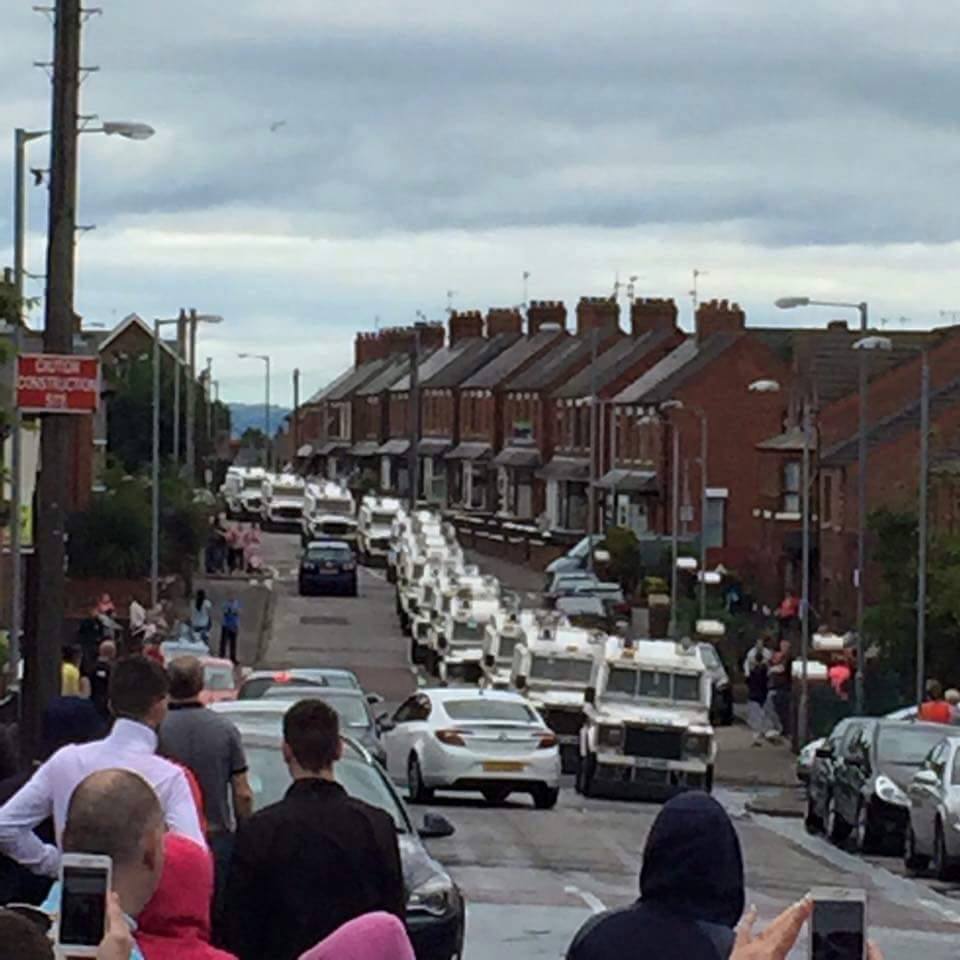
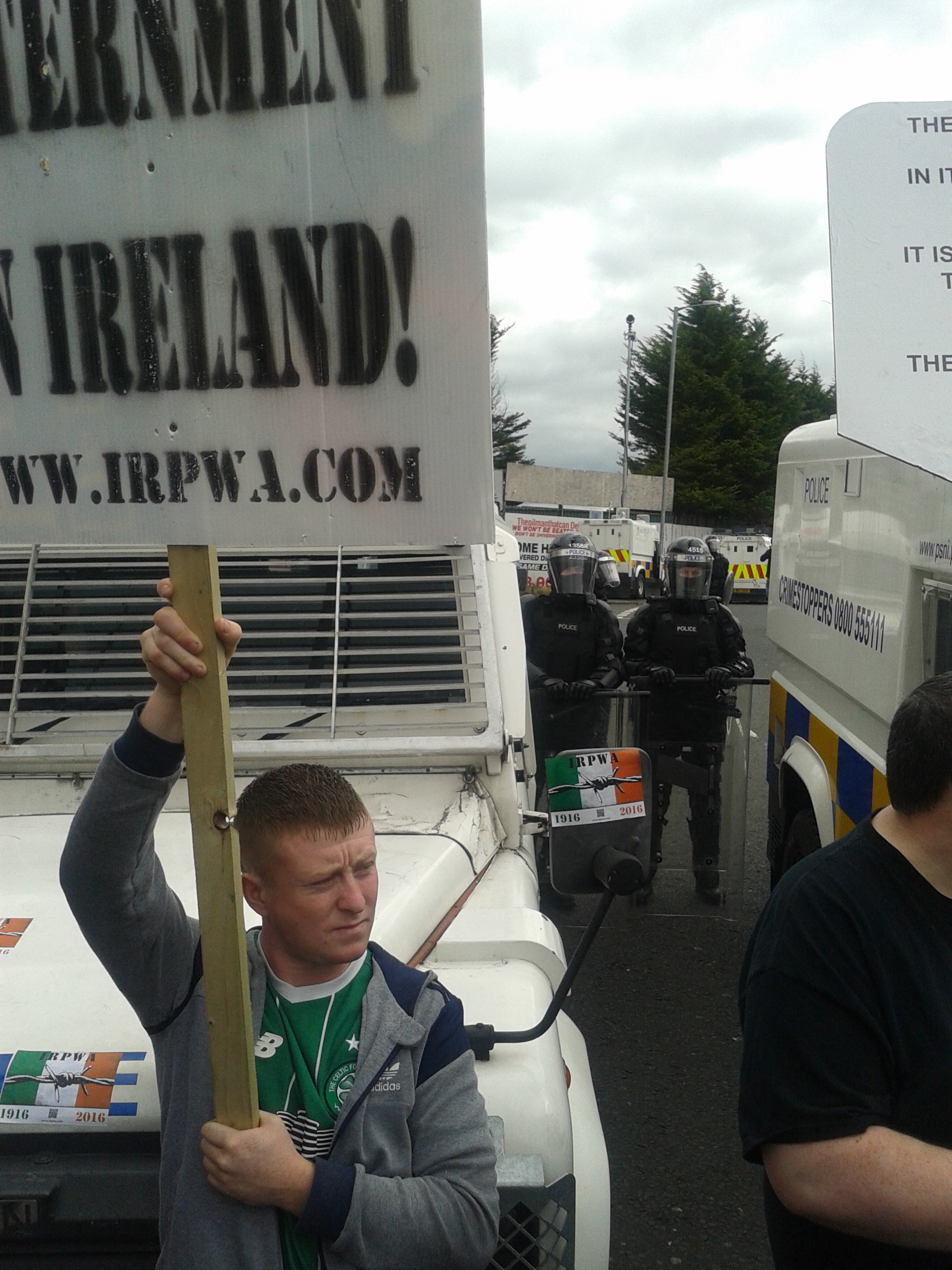
We had not gone far after dropping off one of the youths before we began to pass the PSNI vans, a kind of white boxed landrover, shields over windscreen, lights and siren and only slit windows in the back. From the taxi by now we had seen around 30 vans; we were all tutting at this massive police mobilisation. “Great day for a robbery,” I said. “Where’s the nearest bank?” quipped the elderly man. As we got nearer to Ardoyne we were suddenly confronted with a huge number of police vans and very soon afterwards, could go no further – PSNI vans, police on foot in black riot gear, shields and some with batons out already. Any belief I might have had that this was just an intimidation exercise by the police was dispelled. Our driver tried to negotiate with a female police officer who was dealing with traffic but all she could give were vague suggestions about which roads might yet be open. I heard our driver relaying information to his company’s control desk through his radio and I now realised that the police were determined to stop the march.

Our driver drove up and down other roads, gradually nearing Ardoyne and close to there apologised to us and pulled in outside a house in a residential street – it seemed that someone of some authority in Falls Road Black Taxis lived there. After conversing with our driver, this man got on our vehicle’s radio and spoke to someone at the depot, the terse conclusion of which was “Ardoyne is out”: Ardoyne was under police siege and the area was now out of bounds to their taxis.

The driver dropped us near to my destination, apologising again as he had done frequently. We assured him it was not his fault. As I walked down to approach the rallying point for the march, some of the local community were out in the street playing at an poc fada (“the long hit”), a one-shot competition with hurley to see who can hit the sliotar (the leather ball used in hurley games) the furthest. An poc fada is one of the features of the Féile Béal Feirste, an annual community festival which has been growing annually (and which some say has now largely become a commercial festival, far from its community roots, with dear admittance fees and drink prices, in an area with very high unemployment).

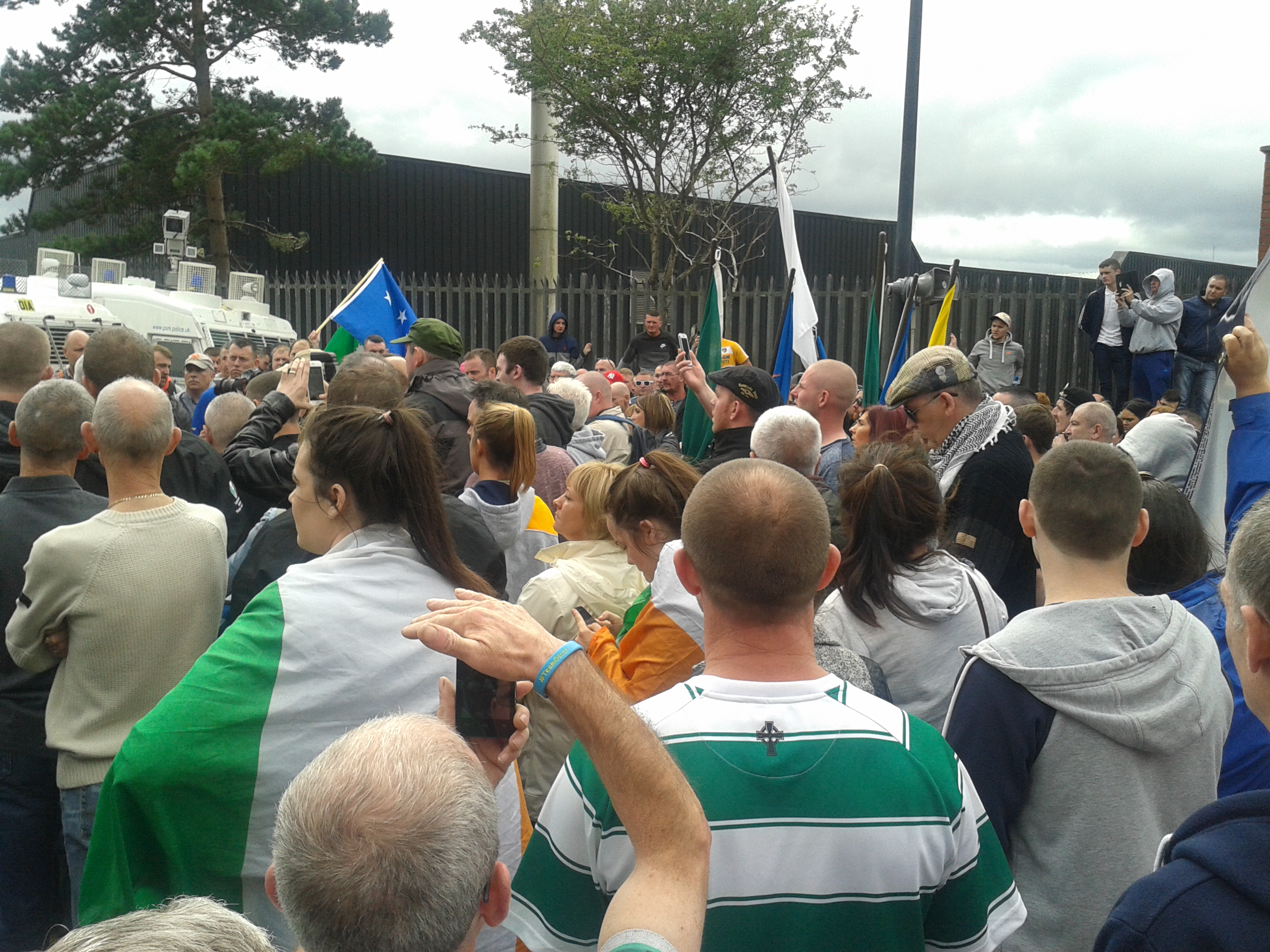
Rounding the corner to head up towards the Shamrock Bar, I was just in time to join the tail of the march as it set off. I sped up to try and catch up with the Dublin Anti-Internment Committee, passing some people I knew along the way, exchanging greetings. There were five Republican marching bands playing music: the Garngad, Brendan Hughes and Volunteers Black and Ryan bands were all from Glasgow, while the John Brady RFB was from Strabane and the Julie Dougan from Portadown.

One of the Dublin Anti-Internment Committee banners

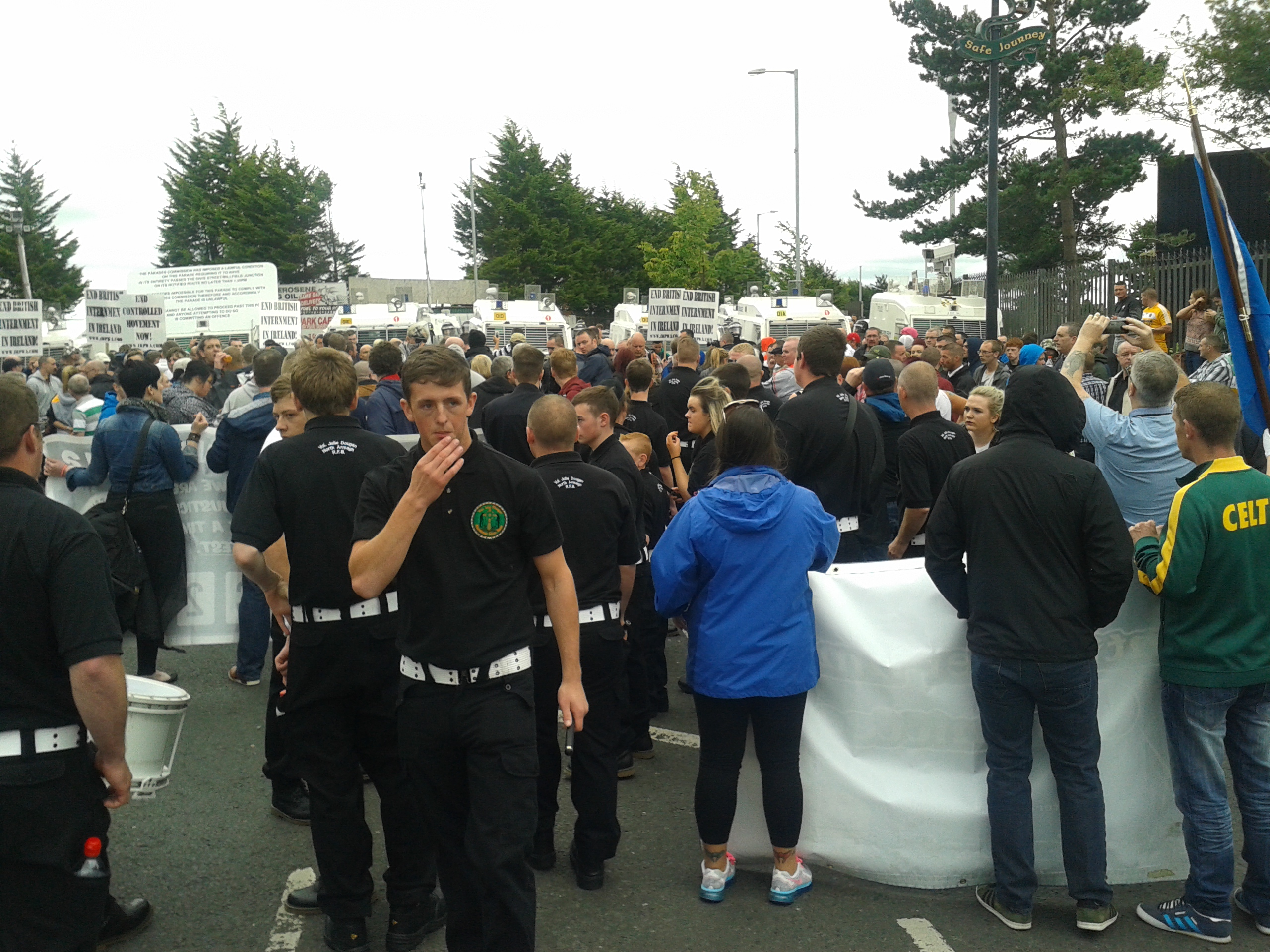
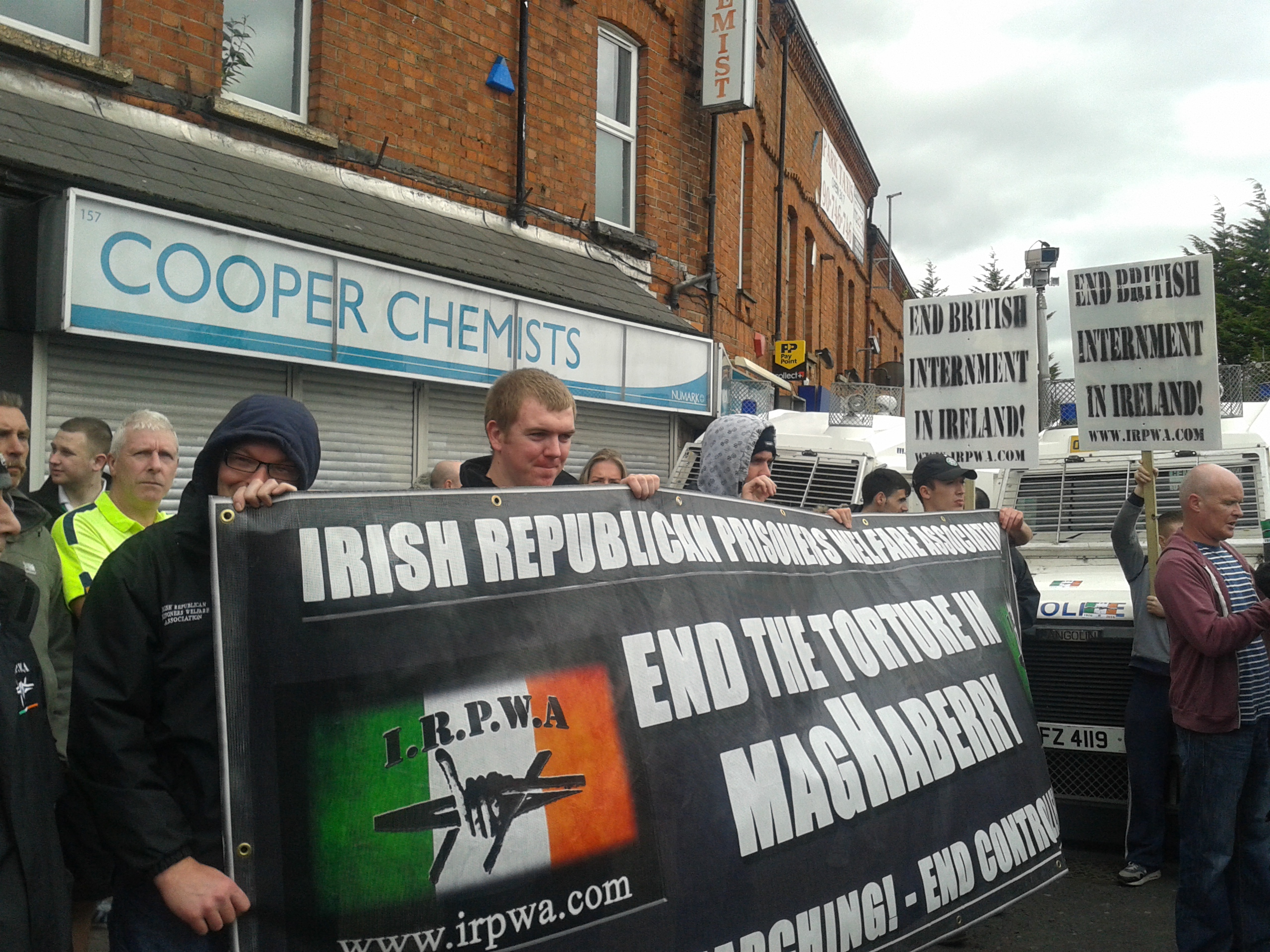
At the junction with Old Park Road I joined with the Dublin Committee comrades, apologising for my late arrival as we swung right to head towards the city centre. Further down the road, the police vans awaited us and as we got nearer we could see a blockade composed of police vans backed up by many police in full riot armour, holding shields and with batons drawn. We marched on and in minutes we were crowded against them. I feared for us if we tried to get through and I saw a drummer with one of the bands step out and retire to the sides with his drum. I didn’t blame him – drums are expensive pieces of equipment. The police had a big sign on one of their vans, saying that our march was illegal, a message they were reiterating from their p.a system, though difficult to decipher all the words.

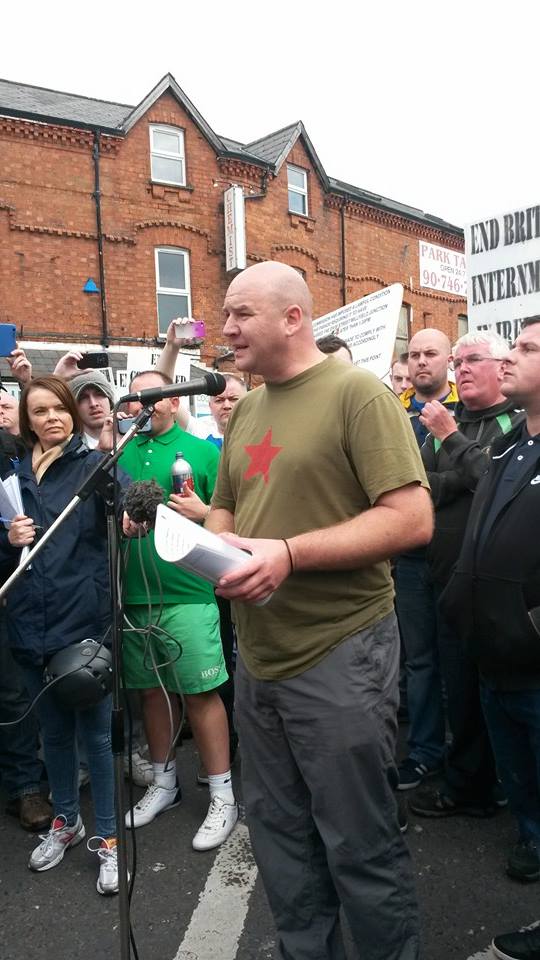
After a while in literal impasse, one of the organisers spoke briefly into the p.a system and introduced Mícheál Mac Giolla Easpuig, an Independent local authority representative in Donegal. Mac Giolla Easpuig spoke first for awhile in his native Irish and then changed to English. He summarised the history of English colonial repression in Ireland since 1970 and

Mícheál Mac Giolla Easbuig speaking at impromptu rally at PSNI Blockade
Mícheál Mac Giolla Easbuig speaking at impromptu rally at PSNI Blockade (Photo from AIL FB page)

made the point that the need of the authorities for that repression denied any legitimacy to their occupation of the Six Counties. He concluded with the words of Volunteer Tom Williams, who was hung by the colonial administration in the Six Counties in 1942: “Carry on no matter what odds are against you; carry on no matter what the enemy call you; carry on no matter what torments are inflicted on you. The road to freedom is paved with suffering, hardship and torture; carry on my gallant comrades until that certain day.

Impromptu short rally at PSNI Blockade in Old Park Road

As the applause and cheering died down, a spokesperson for the organisers spoke briefly about the suppression of our democratic rights to march, about the continuing use of internment by other means and announced the end of the march, asking people to disperse.

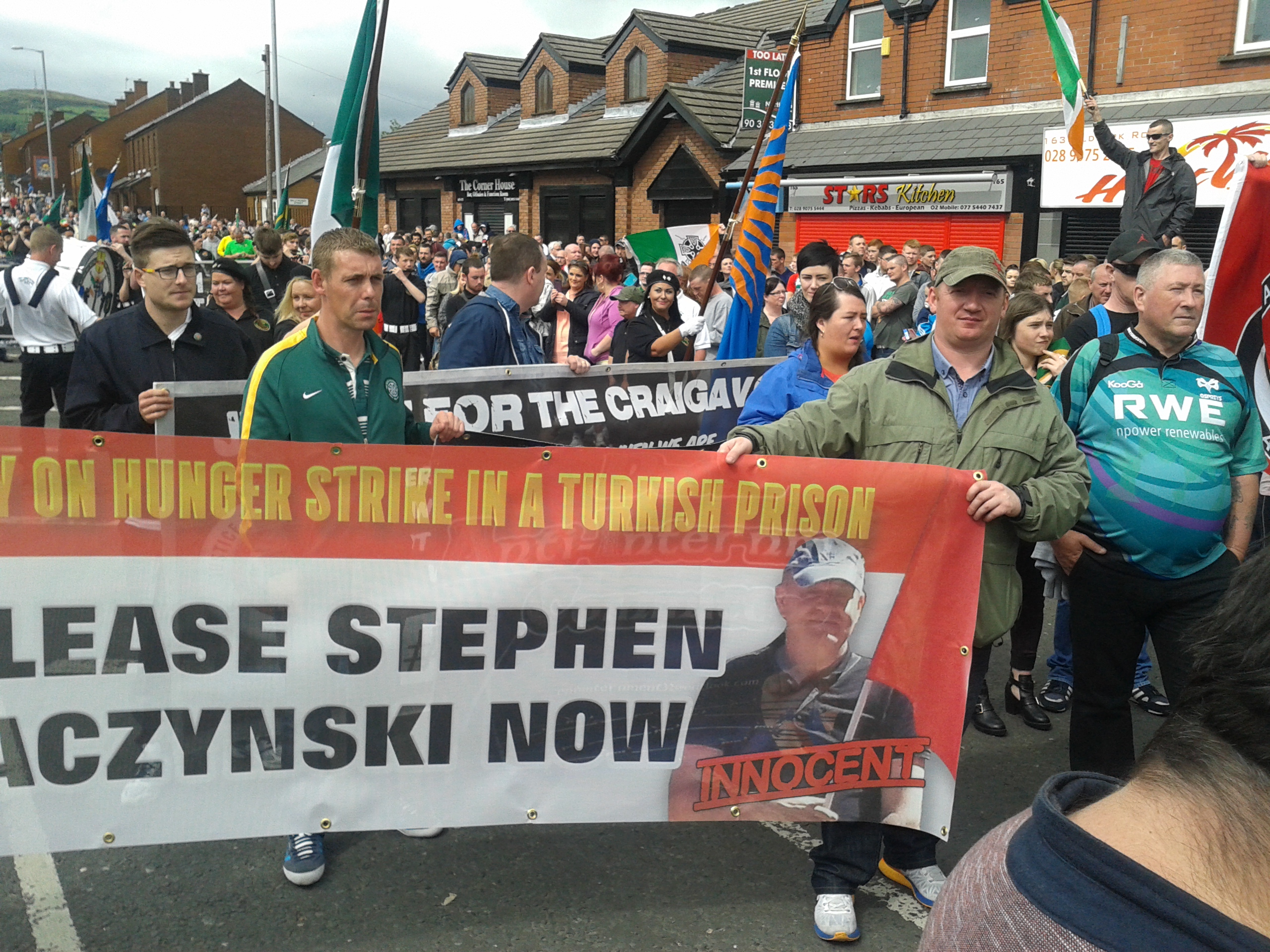
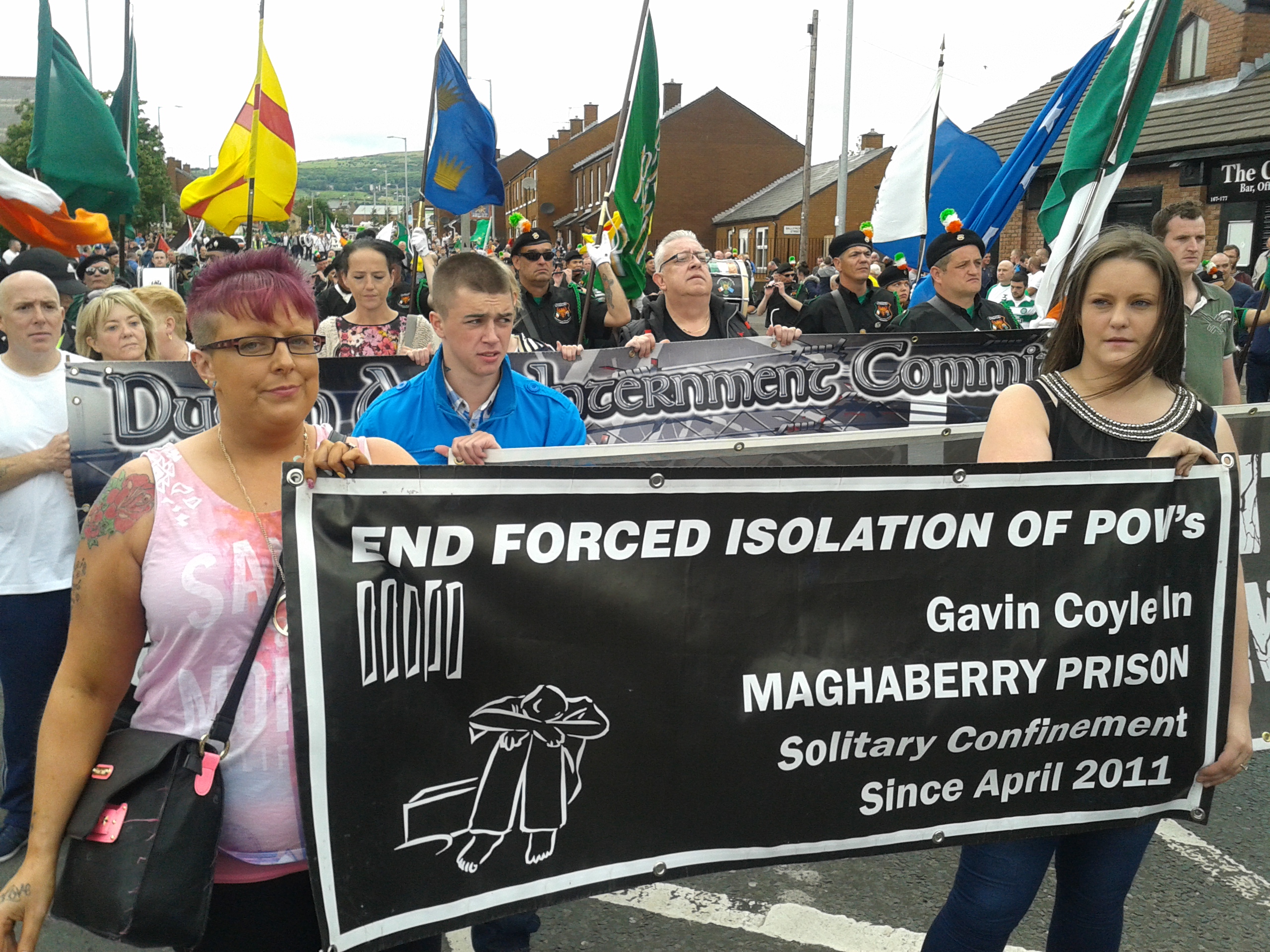
One of the Republican marching bands played the verse and chorus of the Irish national anthem, The Soldiers’ Song; I sang along to it in Irish as is our custom in Dublin (but seems not to be in Belfast) and the band began to march away from the police blockade. We marched away behind them with the banners of the Dublin Committee, as did others with different campaign banners: Craigavon Two, Ballymurphy Massacre, Stephen Kaczinsky, Gavin Coyle and various Republican prisoner support groups.

At some point the Dublin and Cork contingents pulled away and went back to near the original rallying point, where local people and visitors were meeting and chatting as the sliotair of the Poc Fada whizzed overhead. Rumours were now reaching us of the police attacking people on the other side of their barrier and also, from time to time, of Loyalists attacking people somewhere. It was hard for us to know exactly what was happening and where. Eventually we piled in to the back of a van to get out of the area. Our driver had to take a long circuitous route again and eventually we were back in West Belfast, from where we could make our separate ways back to Dublin and Cork.

The PSNI blockade of the march showing another line of police vans behind facing in the other direction -- only a fraction of the police vehicles in the area.
The PSNI blockade of the march showing another line of police vans behind facing in the other direction — only a fraction of the police vehicles in the area.

DB plus Dub AIC

Fighting in the area

Later I learned from a variety of sources that the local community in the Roseapenna Street area had reacted to a police, who were still there an hour after the march had left, in an occupation or siege of their area. This was an area through which the march had planned to pass and which was now blocked off by police vans and police on foot in full riot armour. A woman was shown on video being arrested by two police in riot armour – it was said that she was pregnant and was being mistreated in front of her three children. Apparently she had objected to the police being in her garden and had demanded they leave. The video showed her being pulled struggling to the back of a police van, being pushed inside and big policemen piling in on top of her, her head being apparently twisted as she disappeared from view. Another woman protesting this treatment was bashed by the shield of one of the police and the mobile phone filming the incident suddenly ended up on the ground, apparently having been knocked out of the hand of its owner by the police.

Later reports in the media spoke of stones being thrown and even petrol bombs. I could easily empathise with the throwers: confronted with that police blockade and our impotence in the face of it, I had found a part of me frustrated and itching to strike back at them. Had the area I lived in been blockaded by police and cut off for hours, then also occupied by police in a massive show of force, then seeing people abused and assaulted for objecting, I would have been sorely tempted to get a bit of rubber tubing and a bottle, go to a friend and ask to borrow some of the petrol from his car. Stones after all are not very effective against riot armour, shields and riot vans. True, the police riot armour is flame-retardant but …..

The Twadell Avenue Loyalist
The Twadell Avenue Loyalist “camp”, an illegal installation which receives no trouble from the PSNI.  According to reports, “nationalist’ people were bombarded by golf balls from here on Sunday. (Photo from Internet)

In addition, people living in the area and trying to leave it had been attacked by Loyalists hurling golfballs from the nearby Twaddel Road, which is a Loyalist area. In fact, they have had a Loyalist “camp” there for some time – illegally by Six County law but of course untroubled by the PSNI. Its purpose? To show those Fenians — those Taigues — up in the Old Park, Ardoyne and “The Bone” (Machaire Botháin) areas just who really runs the Six Counties!

Worse in a way was to come, as along with the ritual condemnations by Unionists and Loyalists, PSNI spokespersons and biased media reporting, Martin McGuinness of Sinn Féin blamed the violence entirely on the organisers of the march. As well as being a very senior figure in the Sinn Féin party, McGuinness is of course Deputy First Minister of the Northern Ireland colonial Government. Back in the day when he was the commanding officer of the IRA in Derry, he had condoned and defended participating in many marches that had not so much been restricted to particular times as completely banned by the Six County authorities. During one of those illegal marches in Derry, in 1972, the Parachute Regiment had opened fire on unarmed people and killed fourteen, injuring many. In those days the IRA and what was thought of as Provisional Sinn Féin placed their blame for all violence unreservedly upon the police and army (and occasionally the Loyalists), also on the 6-County Government and on the British colonialists, who should not be in Ireland at all, according to Sinn Féin. But that was then and their party now shares in the administration of that same British colony. Reading his reported words, I wondered whether if that Derry massacre of Bloody Sunday were to occur now, McGuinness would blame the marchers for going ahead with a banned march?

Mc Guinness posed shaking hands with the Chief Constable of the PSNI at a public meeting earlier in the week at a Falls Road venue
Mc Guinness posed shaking hands with the Chief Constable of the PSNI at a public meeting earlier in the week at a Falls Road venue (Photo from AIL FB page)

The Anti Internment League hit back with a statement of their own, condemning the comments made by Martin McGuinness. “The AIL responsibly took the decision to march away from a flashpoint that was of the PSNI’s own making”, the statement read. “No participants engaged in violence,” it continued, “which occurred over an hour after our dispersal and was caused by PSNI invasion of property and assaults on residents.” The statement went on to point out that Mc Guinness had praised the PSNI a few days earlier (a reference to his shared platform with PSNI’s Chief Constable on Thursday 6th in a venue on the Falls Road).

Uncannily (or perhaps not), the statement went on to mirror my own earlier speculation: “Using Martin McGuinness’s rationale, he would place responsibility for the murder of 14 civilians in his own city by the British Army on Bloody Sunday in 1972 on those who organised the Anti-Internment parade that day.”

“There is perhaps no greater indicator of how Mc Guinness now views Republicans as his opponents, while the forces of repressive state apparatus that he himself promotes and endorses are now his ‘comrades’ “, the statement concluded.

Follow-up meeting with area community


In a follow-up to the events of Saturday in the Lower Cliftonville area, on Tuesday night in Manor St Community Centre, the Anti Internment League hosted a meeting with Rosapenna residents affected by the PSNI lockdown on Sunday 9th August.

“Every house in the area received a leaflet making them aware of the meeting” according to a statement issued by the AIL. The panel was composed of representatives of the AIL, community workers from Lower Cliftonville and a local solicitor. A journalist from the Irish News was also in attendance to hear accounts and opinions from residents.

Because of Martin McGuinness’s “public criticism of both the AIL and local residents”, according to the AIL statement, Sinn Féin had been invited to send representation to the meeting “to challenge the AIL if they wished and to hear residents’ thoughts and opinions in a public forum”. According to the AIL statement, although SF had indicated that they would attend, they did not appear at the meeting.

The atmosphere in the meeting was angry, according to witnesses – all of it directed towards the PSNI with no-one criticising the march organisers, with the exception being those who chided the organisers for having turned the parade back “too soon”. The AIL represenatives’ explanation of the considerations and reasons for doing so seemed to satisfy the critics. One of the AIL representatives reportedly also asked whether residents would rather the parade did not pass through Rosapenna Street in future, which was “rejected unanimously by residents present, who all said they enjoy the music and atmosphere that the annual march brings to the area.”

A hitherto unreported aspect of the events on Sunday in the area was that local businesses reported having been forced to close down by the PSNI for no reason that they could determine. This was particularly interesting in view of the Parades Commission’s rationale for insisting that the march finish passing through the City Centre by 1.30 pm – to prevent any perceived disruption to big shopping commercial interests in that location.

The AIL statement went on to outline their plans to work with local community organisations to “jointly request and facilitate a “surgery” style event, inviting the Police Ombudsman to compile complaints against the PSNI from local residents.” Concluding their statement, the Anti-Internment League declared that they, working with “local community organisations and Republican activists will not allow the violent actions of the PSNI within the Lower Cliftonville community on 9th August to go unchallenged.”

End/ A Chríoch.

“Now where did our drummer go with his drum?”

Stephen Kazinski banner Stopped 20150809_144947IRPWA banner

Big Brother can fly Big Brother has an eye Big Brother can spy on us down below.
Big Brother can fly
Big Brother has an eye
Big Brother can spy
on us down below.


Craigavon Two banner

Gavin Coyle Isolation banner

BAIL CONDITIONS — A POLITICAL WEAPON BOTH SIDES OF THE BORDER

Diarmuid Breatnach

“In conclusion, it seems clear that both states in Ireland, the Irish one and the British colonial one, are employing refusal of bail and restrictive bail conditions in order to harass and intimidate political activists and to seriously disrupt their work.”

In excess of 50 Demonstrators formed three lines in Dublin’s O’Connell Street on Friday (19th June) to protest the continued incarceration of Steven Bennet, a political activist arrested while peacefully resisting the installation of water meters. Bennet was arrested on two consecutive nights – in the York Road area of Dun Laoghaire and in Bray – and on each occasion he was kept in custody overnight despite the Gardai knowing his address and where he could be contacted and despite the suggested charges not being particularly serious. Brought to court then, he was offered bail if he could provide a €1,000 surety, would submit to a nightly curfew between the hours of 10pm and 8.00am, would sign at a police station daily and would refrain from participation in political activity. A previous High Court ruling that his bail conditions should not interfere with his political activism was thereby changed by the same Court. Stating that these conditions were unreasonable, he refused and has been in jail now for nearly four weeks.

Protesters in Dublin outside GPO demand freeing of Steven Bennet (view northward excluding some on west side of central island)

The Irish Government has imposed a Water Tax on the population of the state although they pay for the maintenance of the public water system already through their taxes (and bizarrely, it was recently revealed, through their Motor Tax also). The Water Tax is extremely unpopular in Ireland and has given rise to huge national demonstrations as well as to local resistance and to the most widescale movement of civil disobedience since the resistance to the Household Tax a few years ago. Most people believe these new taxes are a means of funding the banking bailout and also that the public water service is being prepared for privatisation (a likely benificiary being Denis O’Brien, part-owner of the company currently installing the meters and among the 200 top world billionaires).

Banner and demonstrators protesting jailing of Steven Bennet
Banner and demonstrators protesting jailing of Steven Bennet (photo Vivienne)

Some of the local resistance involves blocking the road to the water meter trucks or, more usually, walking slowly in front of them to slow down their work. People have also interposed their bodies between the meter installation crews and the spot where they intend to drill into the pavement in order to install the meters.

Selection GPO Free Steven Bennet
(photo Vivienne)

We should ask ourselves and interrogate the State about why it wishes to impose these restrictions on an arrested political activist. Keeping someone in custody is a serious step in any democratic system. If they have not been convicted, the step is even more serious. Let us not forget that the legal system claims that any accused is presumed innocent until that changes by being found guilty in court. Keeping an innocent person in jail is supposed to be an extreme step, justified only by one or both of the following circumstances:

The accused is thought to be

  • a serious risk of flight from the jurisdiction before trial

  • a risk of interfering with witnesses expected to testify against him/her at trial

The “seriousness of the crime” is sometimes raised but that seems related to the “risk of flight”, i.e that the accused might contemplate fleeing the jurisdiction because of the likely seriousness of the punishment if s/he were to be convicted.

As observed earlier, the default position should be that bail is granted.

Free Steven Bennet centre island
(photo Vivienne)

Conditions of bail

Conditions of bail are usually that the accused reside at an address supplied to the court – this relates to the defendant being found if required by the State. The accused may be released in his or her “own recognizance”, i.e without any sum being set.

Where sums of money are required to be placed as a surety for bail, these seem again to be related to “risk of flight” — in other words, the accused is thought less likely to flee if it will cost money to the accused or to the person guaranteeing the bail.

The justification for requiring a person to report at a police station every day at a certain time also seems also to have been conceived with regard to risk of flight – it is hard to see what other justification there could be for this. But in fact this makes no sense, since one can present at a police station at eight or nine pm (a frequent time given) but yet be out of the jurisdiction by midnight (in the case no curfew) or by 12 noon when there is a curfew imposed. One supposes it does permit the police to issue a warrant for arrest should the accused fail to sign in at 8pm or 9pm the next evening but that can hardly be a great advantage.

A curfew is sometimes imposed and it is difficult to see the justification for that either, unless it too is related to fear of the accused absconding from the jurisdiction but the same reservations apply to that as to the signing on at the police station requirement.

When these conditions and restrictions are imposed on political activists on charges which normally attract only fines if the accused were found guilty and only very short prison terms in worst case scenarios, what can the justification be? As a rule the accused is still politically active, highly visible to the police and without a history of absconding from the jurisdiction (in fact, often a history of the exact opposite, as in Bennet’s case). The witnesses against the activist are normally the Gardaí, who are supposed to be impervious to “interference” and even when they are others, there is usually no allegation of a fear that the accused is going to intimidate them).

It seems clear that the real reason for these restrictions and conditions are

  • to disrupt the life of the accused and thereby make him/ her pay a price whether or not s/he is later convicted in court

  • to disrupt the political life of the accused (interfering with organising, traveling, etc.)

  • to make it difficult for the accused to get bail (in the case of financial sureties), in which case

  • to make the accused suffer imprisonment for a period (through refusal of bail or through setting difficult and unreasonable conditions) even though perhaps not convicted later or, if convicted, not receiving a custodial sentence

  • to discourage others from following in the footsteps of the accused.

Increasingly, particularly in the case of Irish Republicans in the Six Counties, another requirement imposed has been to wear an electronic “tag” or bracelet which may not be removed until the State orders that done. This is usually explained as merely an enforcement of the above conditions but is a physical reminder, every minute of every day, a demeaning intrusion into one’s life.

Three lines of protesters in front of GPO, Dublin's O'Connell Street  (view wesward), seeking freeing of Steven Bennet
Three lines of protesters in front of GPO, Dublin’s O’Connell Street (view southward), seeking freeing of Steven Bennet (Jim Larkin statue just visible in the background).

Also in the Six Counties, Irish Republicans on bail are being banned from use of the Internet, from having a mobile phone or, in the case where they are permitted one, being required to supply to the State the phone numbers dialed. Yet another condition has been not to reside within one’s own home town. Very common has been the requirement not to be in the company of others “convicted of terrorism” (if so, have they not served their time?) or merely “suspected of terrorism” (how would one know? The State will tell you!). In the Six Counties in particular, with its history of 30 years of war and subsequent political dissent from the Good Friday Agreement, not associating with anyone who has at some time been convicted of “terrorism” or is currently “suspected” of it, must be seriously difficult.

Apart from the restrictions on one’s personal freedom imposed by the above conditions, these are a massive interference with the facilities of a political organiser and there seems not even a pretence of any other justification for them. They are therefore unwarranted abuses of people’s civil liberties.

In conclusion, it seems clear that both states in Ireland, the Irish one and the British colonial one, are employing refusal of bail and restrictive bail conditions in order to harass and intimidate political activists and to seriously disrupt their work.  

Accept the conditions?

Steven Bennet is currently refusing to accept the unreasonable restrictions being required of him in order to avail of bail. In the past, particularly in the Six Counties, others have done so too. One example there was Stephen Murney, of the Éirigi republican party, who was expected to agree to curfew, daily signing at a police station, electronic bracelet, not to reside in his home town of Newry or to approach within five miles of it and not to attend any political events. He refused to accept those conditions for 14 months and eventually was released on bail without the conditions shortly before his trial – at which he was found “not guilty”, which was no surprise since the charges were completely spurious. But Murney had already spent 14 months in jail.

Stephen Murney happy to be out of bail as his trial collapsed -- but he had still done 14 months in custody before that.
Irish Republican Stephen Murney happy to be out on bail as his trial collapsed — but he had still done 14 months in custody before that.

In recent months, there seems to be a trend of people accepting the conditions in order to receive bail; this includes Republicans in the Six Counties and other water-meter protesters in Dun Laoghaire (on whom a variety of restrictions are being reported). Such acceptance represents in the short term a small victory for the State and in the longer term a significant defeat for civil liberties and the political opposition to the states.

One can hardly blame the activists who have accepted these conditions. The liberal civil liberties sector is silent on what is happening, as is largely the case with the organised Irish Left. When it seems that continued opposition to the bail restrictions can achieve no political objective due to lack of wide-scale protest, and one may be facing long months or even years in prison awaiting trial as a result of refusal, there seems little reason to continue the refusal to accept these restrictions.

Of course, these attacks are taking place on what the Left and liberal civil liberties sectors may see as the “fringes” — the Republicans and some unorthodox anti-water-meter protesters. Have we not learned the lessons of history? The attacks of fascism and the repressive State nearly always start at the “fringes”, from which they move in towards the core. Our silence on this now is in reality an assent to the State — “Go ahead if you like,” is the message the State is receiving, “we’re not going to do anything”. Unless the State goes for the core, of course. But will there be anyone left to mount a decent resistance when we finally decide we should?

End.

DISSIDENTS — A FLAWED CONTRIBUTION TO THE HISTORY OF A NEGLECTED GROUP

REVIEWING DISSIDENTS BY ANNE MATTHEWS:

Diarmuid Breatnach

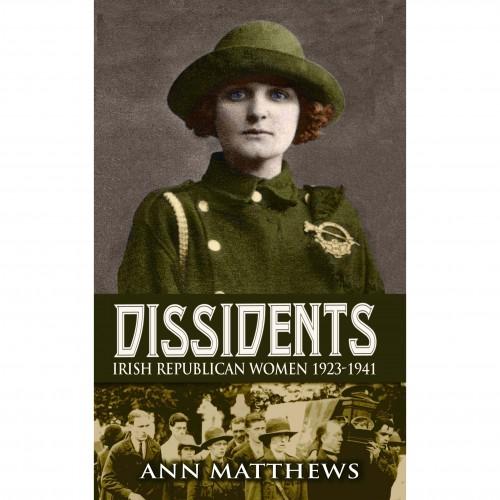
The role of women has been often ignored and undervalued in the body of Irish historical writing. Whatever the reasons for this state of affairs, a tendency in more recent writing has been, at least to a degree, to attempt to rectify this. In the decades since Margaret Ward’s Unmanageable Revolutionaries (Brandon, Ireland, 1983), this rectification has been slowly gathering pace. Dissidents – Irish Republican women 1923-1941, by Anne Matthews (Mercier, 2012), is a contribution to this movement in historical writing; it is essentially the history of an Irish women’s political movement, Cumann na mBan, during the years outlined. A previous work of hers, “Renegades”, deals with Irish Republican women from 1901 to 1922. 

Dissidents Irish Republican Women bookAlthough Dissidents deals with the period 1923-1941, Cumann na mBan was founded on 2nd April 1914 as an auxiliary to the all-male Irish Volunteers’ organisation, which had been founded in 1913. In 1914 the Volunteers split after John Redmond, leader of the Irish Parliamentary Party (in Westminster) and the main open Irish political party in Ireland, committed the Irish Volunteers to fight in the British Army in WW1. The smaller section of the split went on to participate in the 1916 Uprising and more coherently later in the War of Independence (1919-1921). Redmond’s party and “constitutional” Irish nationalism was all but wiped out in the British General Elections of 1918, at which time the whole of Ireland was still under British rule and Redmond’s nationalist opponents, then amalgamated under the name of the reformed Sinn Féin, gained the vast majority of parliamentary seats in Ireland.

Today it is common to define the ideology of both both Cumann na mBan and the Irish Volunteers as “Irish Republican” and, although they quickly became so, and the impulse in the formation of the Volunteers in 1913 was of the secret Republican organisation the IRB (Irish Republican Brotherhood), both organisations at first could be more accurately described as broadly nationalist. Both organisations contained prominently in their midst people whose ideology conformed to that of Irish Republicanism as well as those whose thinking did not, people who expressed a strong interest in equality for women as well as those who were against it, people with at least a sympathy for socialist ideas and those who condemned any such tendencies – and of course variations in between.

In the period specifically chosen by Matthews, 1923-1941, the Irish Volunteers had morphed into the political party Sinn Féin and the armed organisation the IRA (Irish Republican Army) and become Irish Republican in ideology, as had Cumann na mBan. They had in fact been that way since 1919, although the period 1921-’23 was to expose some deep fracture lines which found expression in the Civil War (1922-1923) and later again with the founding of Fianna Fáil and its eventual management of the Irish State (the 26 Counties).

In order to compile her history, Matthews has consulted minutes of committee meetings of Cumann na mBan in its various incarnations (she identifies four periods, or versions of the organisation), personal recollections of participants recorded in writings, interviews, comments quoted by contemporaries, newspaper reports and articles, the Republican movement’s own publications, as well as records of prisons and police under both British and subsequently Free State rule. And she has used some of this material to reproduce and also compile lists such as the numbers and names of women convicted and jailed, the women who went on hunger-strike and the length of time on that protest. The lists also include figures on the decline of Cumann branches between 1934 and 1936, as well as a list of “women in organisations listed as dangerous by the Free State CID in 1934”. These lists are a particularly valuable contribution and will be of great use to many writing on the political movements of the period in Ireland.

Looking at some of those lists alone, one is struck by the sheer extent to which the contribution of women activists to the struggle for Irish independence, and the price they had to pay, has been overlooked. In 1930 twenty-nine women were in organisations listed as “dangerous” by the Free State detective branch of the police – twelve of these were in senior positions of Cumann na mBan, three in directing positions in Saor Éire, three for Comhairle na Poblachta, three also for Sinn Féin, one for the Prisoners’ Defence Organisation, two for Women Prisoners’ Defence League and one for the Anti-Imperialist League. The rest were rank-and-file members of those organisations and one was in Friends of Soviet Russia.

The Free State interned 645 women during the Civil War (as against over16,000 men). In her Introduction, Matthews points out that “There were twenty-four strikes in the three (women’s) prisons during the period from November 1922 to November 1923, in which 219 women took part.”  According to the table drawn up by Matthews, one woman was on hunger strike for 35 days, another for 34, seven for 31, many for different amounts of days but the vast majority into double figures. Furthermore, some of them were on hunger strike more than once.

Matthews also provides a list of the occupations of 79 women activists jailed in the North Dublin Union, which were surveyed in August 1923: the highest number for a single occupation were the 19 listed as “at home”, while the next were 11 whose occupations were given as “packer in Jacob’s” (the biscuit factory in Dublin); 10 had been engaged in “printing”; eight were “shop assistants” while 15 were variously listed as “typist” or “clerk”. This list shows quite a variety of social background among what one presumes to be fairly politically-active women which the Free State considered its enemies.

Republican women acting as couriers or delivering weapons made many journeys by bicycle, often at night without lights in order to avoid Free State patrols, “often round trips of up to forty miles” Matthew tells us (p.32).

BIAS

As has been pointed out by a number of commentators, history writing involves a degree of bias. This bias is exercised not only in explicit judgements but in inferences made, choice of phrasing and so on. Choices are made in what sources to use and what prominence to give them as well as in the opposite, which sources to disregard.

If the Fall of Lucifer and his angel followers were a historical event, for example, we would expect Lucifer’s version to be very different from the Judaeo-Christian story with its sympathy for the Archangel Michael (a great example of history being written by the victors). There might be yet other versions, for example by the Seraphim and Cherubim, one of which might be in partial sympathy with the Fallen side and the other which might be against both sides of the conflict.

Whereas in the ancient past history writing was blatantly partial, in the past century historians have generally claimed to be impartial dispassionate observers recording what they discover. But every one of those writers had views influenced by class, ethnicity, gender, position in or out of power groups, status, upbringing and personal experience. And those views influenced their historical judgements, quite likely their choice of sources and possibly their choice of audience. Written records could only be left by literate people and yet for most of history the majority of people have been illiterate. A more recent trend in history writing is to recognise the inevitability of bias and for the historian to declare which is his or hers.

One should beware of historians who don’t declare their bias at the outset. That will not be a problem with Anne Matthews because although she does not formally introduce her bias to her readers, it very soon becomes clear. Or maybe that is not quite accurate, for in order to have a bias against a group one must presumably also have a bias in favour of another. It is difficult indeed in the pages of this book to find any group for which Matthews has any sympathy or, even more important for a historian, empathy.

To express a bias is expected, as I commented earlier. But unless one is engaged in pure propaganda or character assassination (or glorification), one should present the evidence in favour as well as that against and, in weighing one against the other, make a judgement. When Matthews has anything favourable to say about her subjects it seems to be an accident which will soon be remedied a little later – just keep reading!

A particularly clear and nasty example of this bias is in Matthews’ treatment of Constance Markievicz whom she calls a “self-proclaimed heroine” (p.28) but does not tell us when and where Markievicz allegedly “proclaimed” herself to be a “heroine”. Matthews also inferred that Markievicz was a given to warlike statements but a coward who ran away to Scotland. Whatever the reason for her departure in 1922, one wonders how, no matter how much she may dislike the person, someone could call Markievicz, who prominently took up arms and fought for a week against the British Empire, a coward.

In the Matthews view of the organisation, Cumann na mBan was a largely ineffective body, doctrinaire and full of in-fighting. The leadership and many prominent activists were aristocratic or upper middle class, used to the privileges afforded by their class. The working and lower-middle class members accepted the leadership’s decisions or just deserted.

Some of those things may be true and there might even be some truth in all of them — but where is the counter-argument before coming to judge? One doesn’t find it in Matthews, except by an inference that one can make from the lists I mentioned earlier and other information.

If a woman came from a higher social class and was used to having servants do her cleaning, do those facts diminish in the least her courage in facing bullets in insurrection, the threat of the firing squad, the pangs on hunger-strike and the risk of permanent damage to health, the risk of physical beatings and unhealthy prison conditions? Or on the contrary, in some ways, are those risks and sacrifices not all the more remarkable for one from such a background as that? And if an upper-class mother can pay a nanny to look after her children while she herself in in jail, does that take away from her courage and fortitude? A working-class mother without those resources (though she might be able to avail of extended family) of course has even more obstacles to surmount and deserves our greater praise but that is no reason to disparage the sacrifice or commitment of a woman of a higher class.

And if infighting and bad policy choices were a significant feature of the organisation, were there not others to weigh against them on the scales of judgement? What of transporting, hiding and distributing weapons? Of carrying secret correspondence and intelligence? Or of continuing to feed the flame of resistance while men were in prison, organising pickets and demonstrations, outside jails etc? What of creating the enduring 1916 emblem and Republican commemoration emblem, the Easter Lilly? Or of organising Republican commemorations year after year, as well as funerals of fighters in the midst of repression? Or the work of supporting prisoners and their dependents? Matthews records these and often the difficulties entailed but without a word of approval to balance the censorious words used in her criticisms. Nor do we see an attempt to understand the choices these women made or the constraints upon them, much less see anything to admire; we are shown few lessons to learn from, unless it is something like “don’t be these people or anything like them”.

In Dissidents, Anne Matthews has made a contribution to the story of Republican women but its judgement is clearly skewed and the work suffers as a result. Matthews could have recorded all the negative information that she did but also the points to throw in the balance – had she done so, her book would have been a much better return on her investment in historical research and writing as well as a better reward for the reader.

End.

“BELIEVE” — short poem by Donal O’Meadhra

From their homes stolen lives.
Injustice never new.
Not one crime done nor crime seen.
A sentence served undue.

Witness blind and judge astray.
Trial a kangaroo.
You want a reason to believe?
My friend, I’ll give you two.

Two sons of Craigavon Ireland,
Our voices now are due.
The cry should shout until it cracks
For justice to the two.

It happens time and time again,
Shadows of me and you.
Where once stood four and then the six,
The mirror shows the two.

Together we can make this right.
As one we’ll see it through.
You want a reason to believe?
My friend, I’ll give you two.

Believe poster J4C2


The poem is about the incarceration of the “Craigavon Two”, Brendan McConville and John Paul Wooton.  On the 30th of March 2012 both men were convicted and given life sentences.  They were accused of the fatal shooting of Constable Steven Carroll in Craigavon on the 9th of March 2010.  The evidence was a hotch-potch of questionable material including an “eyewitness” who only came forward a year later after both Republicans had been in jail for a considerable time, a man whose evidence was contested by that of his wife and of his own father.

The case against them was so riddled with inconsistencies and suspect material, alongside new evidence of police interference with witnesses for the Defence, that there were high hopes of both men being cleared and freed when the appeal concluded in October last year.  However, to the shock of many, including a number of Independent TDs (members of the Dáíl, the Irish parliament) and the late Gerry Conlon, their appeal was denied.

The campaign is on-going and supported by a number of organisations and individuals.  It was in support of the Two that Gerry Conlon, formerly of the Guildford Four (and a subject of the film In the Name of the Father), made his last public statement days before he died.

Their campaign website http://justiceforthecraigavontwo.com/we-are-innocent/

“Where once stood four and then the six” in the second-to-last stanza is a reference to the Guildford Four and to the Birmingham Six, ten people (all Irish save one) who in 1974 were wrongly convicted of bombings in Britain and were finally cleared only fifteen and sixteen years later.  Also wrongly convicted were the Maguire Seven (which included Giuseppe Conlon, Gerry’s father, and teenagers) and Judith Ward (a woman who was mentally ill at the time).

WHAT SHOULD WE DO?

“What should I do?” The anguish reached out to me; I felt it empathically. The cry of a person who is prepared to act and wants to change things for the better, to resist what is wrong around us on so many fronts – and that’s the problem.

There so many issues: the Water Tax, the persecution of Republican activists including framing and jailing them, the harassment and torture of Republican prisoners, the threat of fracking, privatisation of resources and services, cuts in services, cuts in salaries, high cost of private accommodation and low social housing provision causing homelessness, the decline of the Irish language and of the Gaeltacht …. and others. And that’s without mentioning international solidarity – and not because I don’t consider that essential, either.

Of course, we can put all these problems down to capitalism and, in the case of repression of Republicans (and with regard to international solidarity), to imperialism …. so let’s just overthrow those systems and then we can sort out those problems! But that leads to the question of “How” which in turn brings one back again to that anguished question, or to its variant “Which problem should I prioritise?”

Indeed, it is a question that cuts to the heart of the matter. For the issues call to us to act and since we can’t be everywhere at once we have to make choices. It is a question as old as class society and speeches are always being made recommending this choice or that while books have been written attempting to answer it. Lenin wrote a series of articles in the revolutionary newspaper Iskra (“Spark”) and published later as a booklet under a title that echoes that very cry above: What Is to Be Done? It had a subtitle too: “Burning questions of our movement” (by which he meant the socialist movement in Russia at the time).

Whether we choose to believe that work was absolutely correct, partly correct or completely wrong is in some ways irrelevant, for it was written for the movement in Russia in 1902 and published in 1905. I happen to think that it contains many useful ideas, although I am aware that there is a view that it has been mistranslated but, even so, in many ways, all that is beside the point. The fact is that today we have no blueprint and nothing more than perhaps the equivalent of a trouble-shooting manual: “for this problem, try this; if that doesn’t work, try that; while doing so beware of that other.” And that manual is cobbled together from older and more recent history of struggles, of analyses of the capitalist system and of how it behaves.

Scary, surely, to go up against a system that has ruled for around four centuries, that has spread across the world, that controls education, mass media, the State with its police, judges, prison and armed forces – and all without us having a blueprint. Well, if it’s any consolation, the capitalists don’t have a blueprint either … or if they do, they keep having to ignore it and react to events which they have not been able to predict, as well as to the extent of resistance for which they were unprepared. And they clearly make mistakes. Still, 400 years is a long time … a long time for them to learn tactics and strategy and to get comfortable in control and a long time to make us think that we can’t defeat them.

We can defeat them, of course and the indications from history and the internal workings of capitalism — and of its offshoot imperialism — are that we will. But what to do to make that happen? Yes, back to that question. And to the one that logically follows it: which issue to prioritise? For none of us is capable of being everywhere at once and even stretching over a few issues at a time begins to tear at our fabric.

The Marxist-Leninist approach argues for the creation of a revolutionary party that will make decisions on prioritisation and allocate resources to those struggles it chooses as it does so. Of course, the party will make mistakes from time to time and it will learn from those, getting better as it goes along. That’s the theory anyway. In application, or in alleged application, the results have not vindicated the theory – not in the long run, or even in the medium-term. Sure, we have been at it for less than 200 years: the first time workers captured a city was in 1871 and the first successful overthrow of the State was in Russia in 1917, very nearly a century ago. Much less time to learn, to make mistakes and to correct them but still ….

Of course, the alternative method of organising has even less to recommend it on results: amorphous, disparate collectives have not ever successfully overthrown a State and even their success in capturing a city (Barcelona, 1936) is debatable.

So, what is to be done? How to decide which struggle to prioritise? This is not a question I think can be answered by pointing and saying “That one and no other” or even, except at rare junctures, “That one and no other for the moment”. Individuals, collectives and parties will need to choose from the selection as a painter chooses from a palette: “this colour now, then that, no, scrub that one, now mix this with that, no, a bit more light …” and so on, always working towards the desired result which, although in the head, is also taking place on the canvas and making its own demands as it does so.

The truth is that all of those issues I mentioned in passing at the start of this piece, all of those, need addressing. All of them need people to fight in them. That is because they are all part of the same problem and also because we can’t just allow a cancer to grow unchecked in one part of the body while we address the tumours in another. Some individuals and perhaps even collectives are better suited to fight on some issues than on others: for example, a factory shop committee is probably not best placed to lead the struggle against fracking in a rural area, while a rural environmental collective is probably not in the best position to lead the struggle against the Water Tax. Individuals will need to pick and choose according to their own situation, their locality, their own knowledge.

And that would be fine, if the resistance movement as a whole were integrated enough to make creative use of that disparity – for particular struggles to be able to call for temporary additional resources and to be heard by the whole resistance movement, so that it could try to allocate those resources to one or other sector as seemed appropriate. But the resistance movement is far from integrated – it is fragmented and, even worse, it suffers from something akin to schizophrenia.

There a number of ways to imagine schizophrenia and the most popular is to see it as the development of two or more personalities in the one individual. But another is to see it as a disintegration of the personality – where the various aspects in our minds break free and appear as distinct personalities in themselves. The voices that speak in our heads to say things like “You shouldn’t have done that” or “Please make that happen” break free and seem to become different personalities. At times they conflict with one another while the central core personality tries to make sense of what is going on. Something like that, anyway. It is in that sense that I think the resistance movement in Ireland suffers from schizophrenia.

The splitting off of aspects of the revolutionary movement in Ireland has been towards two major poles of attraction: the Socialist one and the Republican. Of course there are some elements who incorporate both to one degree or another but I think examining them as distant poles of attraction is useful and much closer to their concrete manifestation within the revolutionary movement.  In order to examine them as opposite poles I think it is also useful to imagine a stereotype individual inhabiting each pole. Let us then imagine a stereotypical Irish Republican and a stereotypical Irish Socialist.

The Irish Republican is probably working class or maybe lower middle class; he may or may not have done well at secondary education but in any case he is unlikely to have gone to university. He sees himself in a tradition of resistance to British Colonialism and Imperialism stretching back at least to the United Irishmen and perhaps even back to the Norman conquest which began in 1169. His priority is the removal of the British from Ireland. He experiences “political policing” (of which some socialists are now complaining) practically from the moment he becomes publicly active – he has had his name and address taken by Special Branch and/or RUC/PSNI and they have opened a file on him. The Republican’s recent predecessors have been jailed (as are some of his contemporaries now), beaten or even shot dead; they were engaged in armed struggle against the colonial and imperial armed forces in the Six Counties for 30 years and perhaps he looks forward to take the gun up again some day, to strike back at the colonial overlord. He will turn out on demonstrations and pickets against repression of Republican activists, in support of Republican prisoners, including framed ones. He will almost certainly attend mass demonstrations against the Water Tax and may participate in local direct action against it. The Republican’s idealogues are Wolf Tone, Patrick Pearse and Bobby Sands.

The Irish socialist is probably medium or lower middle class and has finished secondary education; she has almost certainly gone on to university. She sees herself as belonging to a tradition of only a couple of centuries, with an Irish tradition going back to the early part of the 20th Century, in particular to the 1913 Lockout and the Limerick Soviet of 1919. She may or may not give a high place in her history to the Irish Citizen Army in the 1916 Rising. Her priority is the defeat of the capitalist class, probably in Ireland first but will turn out in demonstrations against racism, gender discrimination and homophobia in Ireland. The Irish Socialist aspires to a general strike giving rise to a revolutionary take over of the State; in the interim she may or may not think electing left-wing TDs or trade union officials an important activity. She probably can’t conceive of taking up a gun. The Irish Socialist has never had her name taken by the Special Branch or been framed by the RUC/PSNI and may never even have been detained by the police, though she has probably been pushed around by them. She will almost certainly attend mass demonstrations against the Water Tax and may participate in local direct action against this Tax. Her idealogues are Karl Marx, Lenin, possibly Trotsky and James Connolly.

Granted these are stereotypes but they are not so far from reality as to be unhelpful in describing in turn many and perhaps most Irish Republicans and Socialists and therefore in identifying one of the principal fracture lines in the Irish movement of resistance.

If the Republican and the Socialist parts of the Irish resistance movement were to be combined, or at the very least to work on a more collaborative basis, the “What should I do?” question would be easier to answer. It would be simpler to be on a picket for prisoners one week and resisting water meters the next, even if one’s main sphere of activity were among Republicans. The socialist could attend a picket against cuts one week and one for the human rights of Republican prisoners on another, even if her main sphere of activity was among Socialists. But that is not the situation that exists at the moment and, though a number of attempts have been made to combine the two trends in one organisation, they have not met with any great success to date.

So, I have not yet answered the question, have I? Am I saying that what we should be doing is creating some kind of synthesis or at least a collaborative alliance between the the socialist and republican parts of the resistance movement? Well, yes, certainly. But also, and as a contribution to that, as individuals we should try and spread our activity between the areas of greatest concern of each of those sections of the resistance movement. We should, I think, take some time to support resistance to the water tax, demonstrations against cuts etc. in their own right but also find some time to support resistance to British colonialism and its repression of Republican political activists. “If we are not part of the solution, then we are part of the problem” may be a glib truism but it is particularly applicable in this case.

So, how will we find the time to spread ourselves around? How do we ever? We balance and juggle priorities between our politically active and our social lives, with employment thrown in when we have a job. Or upskilling or studying. And possibly cultural or sporting or other activities. But how to choose, how to prioritise? Each of us has to make those decisions herself and himself. Not a very helpful answer? Well, I did state earlier on that there wasn’t a blueprint, so I couldn’t have one myself, could I? This however I feel fairly confident in predicting: if we don’t find a way to support both those parts of the resistance movement to some degree, it will always be fractured. And while it is so, it cannot be successful in either ridding Ireland of our capitalist classes or in finally throwing off the colonial yoke.

end