Diarmuid Breatnach
(Reading time: 3 mins.)
Stoppages, blockades, pickets and demonstrations took place on Friday in over 110 European, Australian and USA ports on the 2nd Day of Action of Dockworkers in solidarity with Palestine and against militarisation.1
In a growing movement dockworkers from Italy, Basque Country, Turkey, Greece, and Morocco were joined by others, the expanded list including organizations from Croatia, Cyprus, Denmark, France, Germany, Montenegro, the Netherlands, Portugal, Slovenia, Spain, and Sweden.
The action was at least partly in response to the call of the Palestinian General Federation of Trade Unions (PGFTU)in 2023 to workers and unions to “Stop Arming Israel.” 2
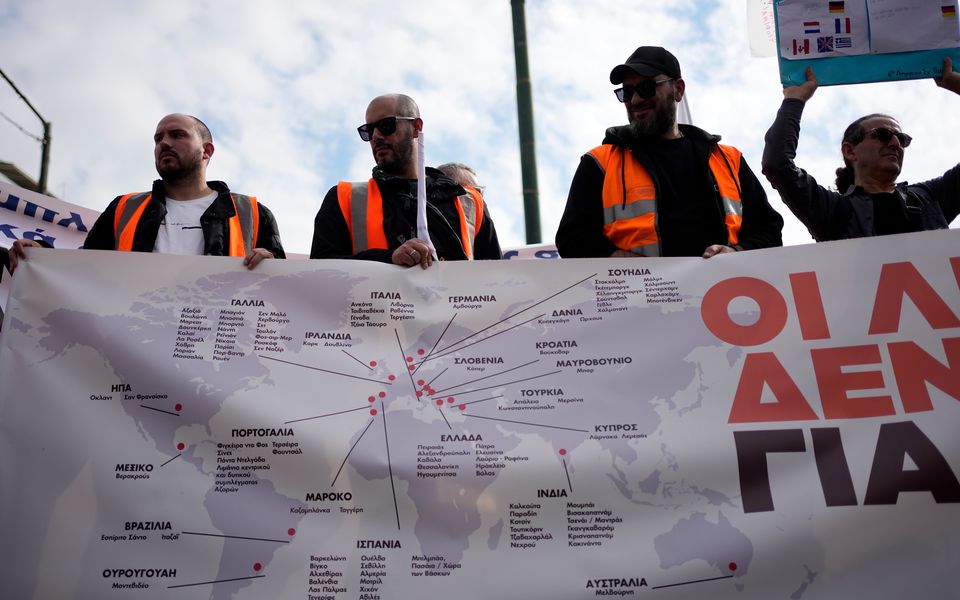
And in 2025, the PGFTU asked international workers to “organize days of rage and global solidarity in factories and workshops, in ports and airports, in the streets and public squares, in support of Palestine and its brave people.” 3
Meanwhile while 500 households were forcibly displaced in the West Bank, the Government Media Office in Gaza reported on 2nd November that the Zionist occupation committed 5,989 violations of the ceasefire agreement, killing 1,593 martyrs, injuring 5,748 people, and detaining 217.
The Occupation has made Gaza a rubble wasteland, thousands living in tents or ruins, hospitals and health centres destroyed, along with schools and universities, actively preventing sufficient food, medical and fuel supplies from entering, along with necessary equipment and spare parts.
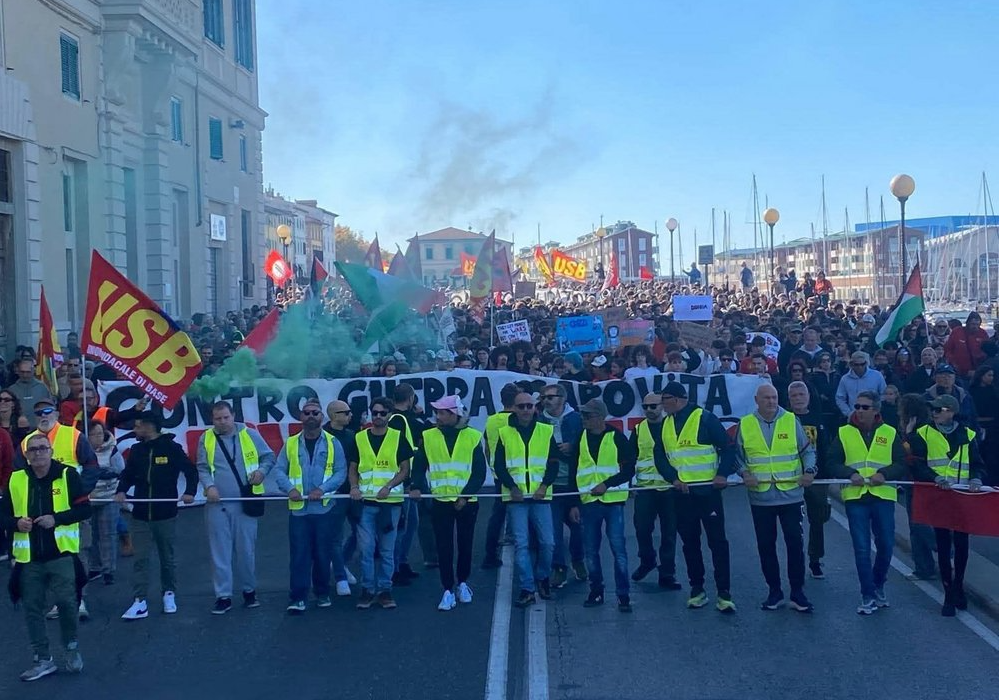
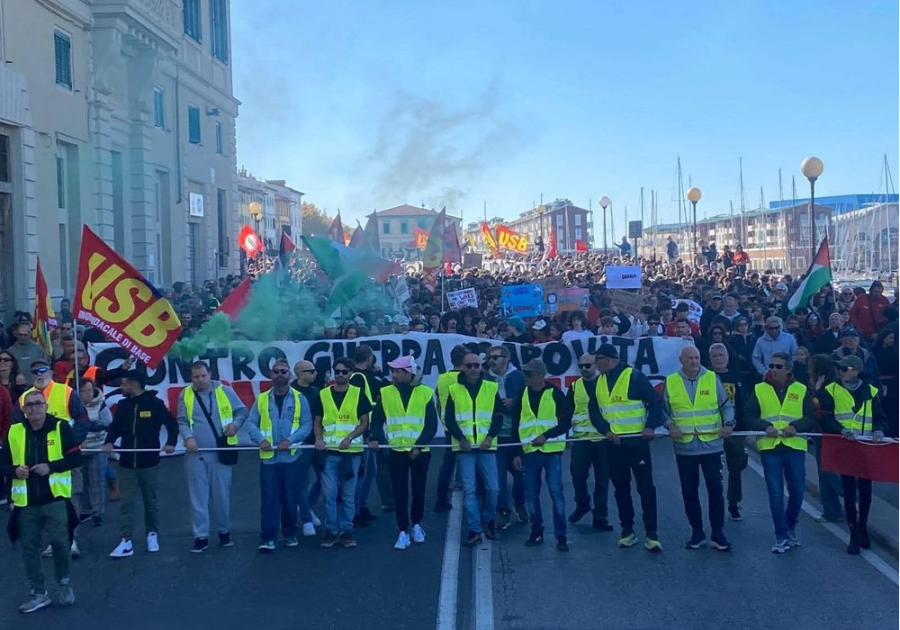
Internationalist strikers of Union Sindicale de Base (a rank-and-file union) in Livorno, Italy lead a Palestine solidarity and anti-war and militarisation march 30 October 2026 (Photo: USB)
Dockworkers Do Not Work for War! and No Harbour for Genocide! were two among many slogans finding expression on placards and in voice in dock strikes and blockades.4
Separately but related to docker actions, on Thursday, Canada’s main trade union, representing some 3 million workers across the country, announced that it will “refuse to handle weapons and military equipment destined for Israel” and called on the Government to end all such transfers to Israel.5
One of the reports of the planned action in docks across the world listed Ireland as one of the locations of workers’ action; however this seems to have been an optimistic error.
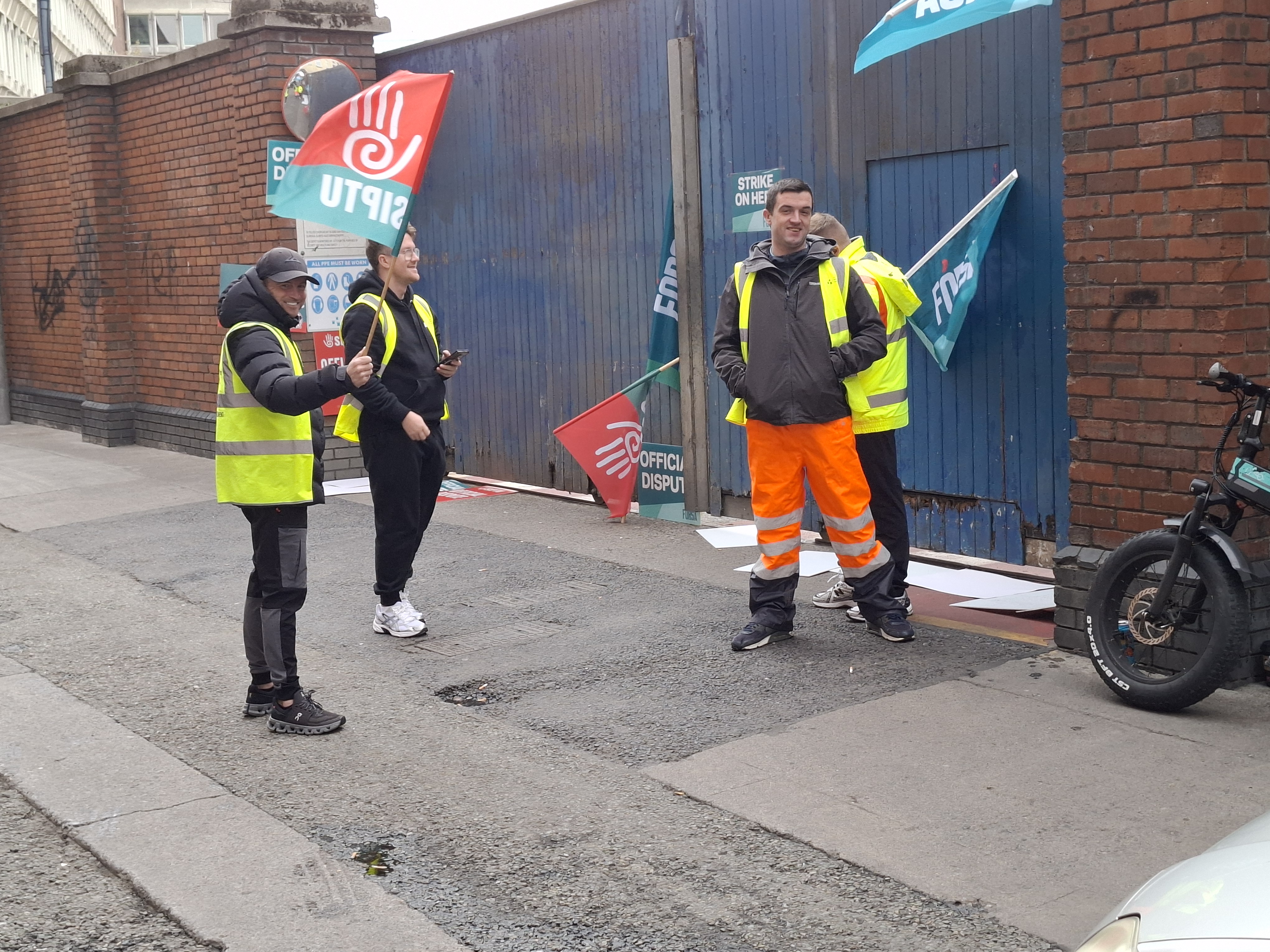
Photos showed Belfast docks blockaded by Palestine solidarity activists without the presence of union signage. SIPTU, the largest trade union in Ireland, restricted their participation to hanging a giant banner off Liberty Hall, their Irish state HQ6 in Dublin.
This lapse is of particularly importance in the case of Palestine solidarity; despite the dominant Irish society support for the Palestinians and against the Zionist genocide, the Irish state is the EU member importing the most Israeli exports, on the world stage second only to the US.7
DOCKWORKERS’ SOLIDARITY ACTION HISTORY
Dockworkers’ industrial actions in internationalist solidarity has a history. In 1920, dockworkers refused to load the Jolly George with munitions intended to support international imperialist intervention in support of Russian counter-revolution against the young Soviet Union.8
In 1935 – 36, dockworkers in the southern African ports of Durban, Cape Town, and Lüderitz Bay, as well as in San Francisco, refused to load cargo aboard Italian ships to protest that fascist empire’s invasion of Ethiopia.9
In the late 1930s, dockworkers in Local 10, the ILWU’s San Francisco Bay Area branch, partnered with the Chinese community to refuse to load cargo for imperial Japan to protest its invasion of China.10
The most widespread example of global dockworker activism was against apartheid South Africa. In San Francisco, Brooklyn, Sydney, Port of Spain (Trinidad), Gothenburg (Sweden), Copenhagen, and many other ports, union workers refused to handle cargo.11
In 1978, San Francisco dockworkers and clerks of ILWU Local 34 discovered the US military was secretly shipping weapons to Chile. Local 10 activists partnered with Chilean exiles, Bay Area Latinos, the Catholic Church, and others to press the US government to stop military supplies.12
In conclusion
The participation of organised dock workers in boycott and blockade actions against genocide and war is of course wonderful and potentially of great effect, since 80% by volume of world trade goes through ports13 and of course could spread to include transport and distribution workers.
The importance of such action spreads beyond effectiveness in internationalist solidarity however as workers become conscious of their potential in organised action not just locally or even nationally but even internationally. And of the historic task of their class to do so.
Of course the ruling classes around the world greatly fear such united action and even more the growing class consciousness and awareness of their potential. It will not be the case that “… all they have to do is to put their hands in their pockets and they have got the capitalist class whipped.”14
Of course not. Faced with such a scenario the ruling classes will shed whatever democratic facades they have erected and enact repressive decrees banning action and even militarisation of ports, jailing of organisers and perhaps even shooting of picketers will follow.
But the historic role of the working class is to bury the capitalist system and to replace it with the socialisation of the means of production. The history of both classes shows that this will not be a peaceful process and yet the organised working class must press on to their objectives.
Production, transport and distribution for need, not for greed and, in a socialist world of course not for war. The dockworkers’ actions point part of the way forward and not only revolutionary socialists but others against genocide and war and for the environment should welcome them.
End.
Note: If you found this article of interest, why not register with Rebel Breeze for free, so that you will be notified by email of subsequent articles. You can de-register any time you wish.
FOOTNOTES
1https://breakthroughnews.org/2026/10/30/dockworkers-at-110-ports-worldwide-strike-against-war-and-genocide/
2https://inthesetimes.com/article/dockworkers-palestine-gaza
3Ibid.
4https://inthesetimes.com/article/dockworkers-palestine-gaza
5The union called on the Canadian Government to “end all direct and indirect transfers of arms and military equipment to Israel”, amidst revelations that military equipment transfers had not only continued to Israel after the Government announced a pause in such exports but actually accelerated, some by indirect routes such as via the USA. https://www.middleeasteye.net/news/canadas-central-labour-union-says-workers-will-not-handle-military-cargo-going-israel
6Ironically actually situated on one of the Liffey’s quays, location of the union’s historic birth as the militant and originally syndicalist Irish Transport & General Worker’s Union led by Jim Larkin and James Connolly.
7The is USA is of course the biggest supporter of the Zionist State militarily, politically, financially and economically.
8See ‘Jolly George’ section in https://www.marx-memorial-library.org.uk/project/russian-revolution/british-labour-movement-responses-russian-revolution
9https://inthesetimes.com/article/dockworkers-palestine-gaza
10Ibid.
11Ibid.
12Ibid.
13https://www.worldbank.org/ext/en/topic/transport/shipping-and-ports
14Big Bill Haywood (1869 — 1928), a resolute class fighter and a leader of the syndicalist International Workers of the World in the USA, quoted in https://inthesetimes.com/article/dockworkers-palestine-gaza
SOURCES:
https://www.newarab.com/news/dockworkers-22-countries-strike-over-arms-shipments-gaza-war
A history of dockworkers’ international solidarity strikes: https://inthesetimes.com/article/dockworkers-palestine-gaza