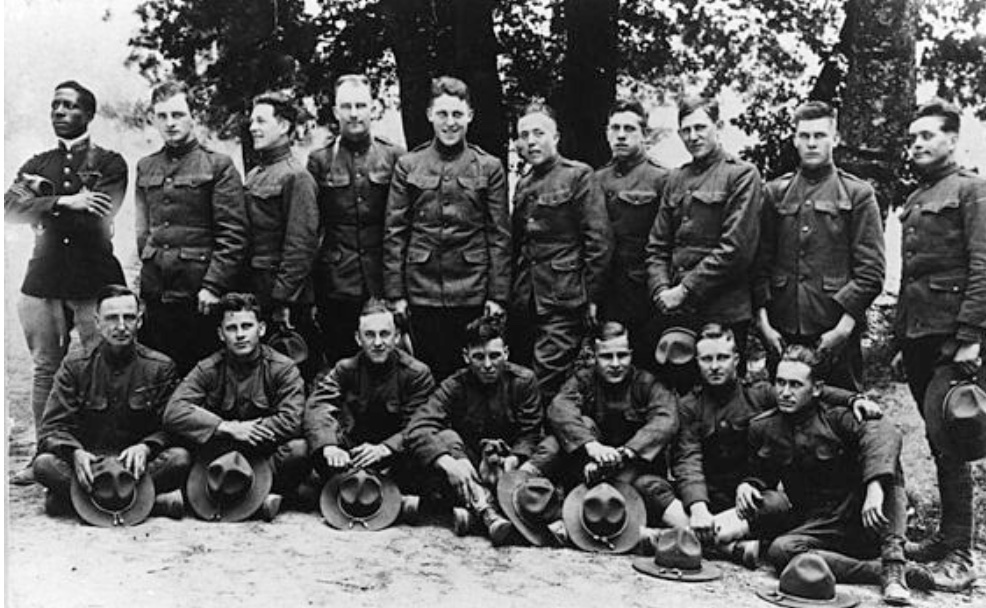
SOLIDARITY AND RESISTANCE IN MUSIC AND SPOKEN WORD IN DUBLIN

Clive Sulish

(Reading time: 3 mins.)

Thursday night (30th), with almost non-stop downpour of rain was a dreary and miserable one in Dublin. Not so however inside the Cobblestone’s back room where solidarity and resistance resounded in song, instrumental and spoken word.

The event organisers, Solidarity Sessions collective, an independent organisation founded late last year have declared a number of times that they wish to contribute to “creating a community of solidarity and resistance through culture.”

Certainly the flags on the stage of the Tricolour, Starry Plough and Palestine conveyed some of the context, as did posters of 1916 martyrs Connolly and Pearse with text pointing out that the first was a migrant and the second, son of a migrant.1

In addition a merchandise stall sold T-shirts figuring the Palestinian Resistance with funds raised going to Palestinian relief work on the ground. Solidarity Sessions have also donated to ‘buy’ a water truck from Uisce for Gaza and also donated to Streetlink Homeless Support in Dublin.

Mark Flynn performing at Solidarity Sessions No.3 in the Cobblestone. (Photo: R.Breeze)

The material performed on stage contributed much of solidarity and resistance also. This was the third event this year and the second at the Cobblestone pub, one other being at the International Bar and the fourth expected at the Peadar Brown pub on Southside’s Clanbrassil Street.

There was a lot of audience participation at times during the evening, with Alan Burke joined from the floor in the chorus of his spirited rendition of The Aul’ Triangle (to which he added a verse of his own) and Sive was accompanied on request by continuous refrain under her singing.

Mark Flynn was also backed by the audience in his adaptation of A Roving I’ll Go to a sailing to Portugal song he told his audience he had put together in minutes of a creative flash the like of which he ruefully admitted not having experienced since. Flynn also sang Bogle’s antiwar Waltzing Matilda.

Alan Burke performing at Solidarity Sessions No.3 in the Cobblestone. (Photo: R.Breeze)

The audience was extremely quiet during Dorothy Collin’s spoken word pieces about assassinations by the Zionist Occupation and Palestinian resistance, interrupting her performance with applause only after a haiku in Irish and at a point where she became visibly emotionally affected.

The Resistance Choir included in their performance an exuberant Bread and Roses, the lyrics originating in a speech at a mostly female textile workers’ strike in Massachusetts, USA in 1912 and Burke sang of an innocent miner framed on a murder charge and hanged – but pardoned posthumously.

Class struggle was also present in Burke’s singing My Name Is Dessie Warren, about a trade union activist with flying pickets2 during the 1970s construction workers’ strike in England. Some were tried under the Conspiracy Laws and jailed, including Ricky Tomlinson and Des Warren.3
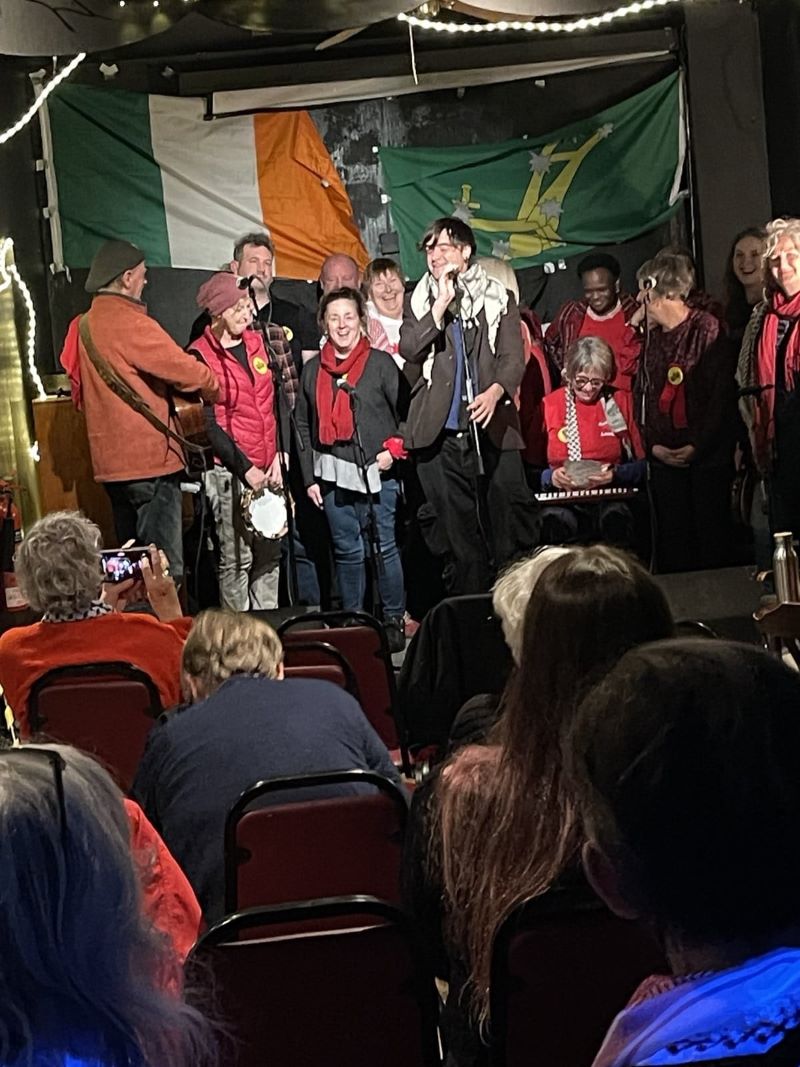
The Resistance Choir about to perform at Solidarity Sessions No.3 in the Cobblestone, being introduced by the MC, Ru O’Shea. (Photo: R.Breeze)

ANNOUNCEMENTS

Three imminent resistance events were announced from the stage: Friday morning, due to appear in court4 were two Palestine solidarity activists attacked by Gardaí at Dublin Port and a good show of numbers in solidarity was requested.5

On Saturday a picket in solidarity with Irish Republican prisoners would be held outside Kilmainham Jail6 and on Sunday a demonstration to blockade Dublin Port was announced, people being requested to gather at The Point on the north Liffey quays.
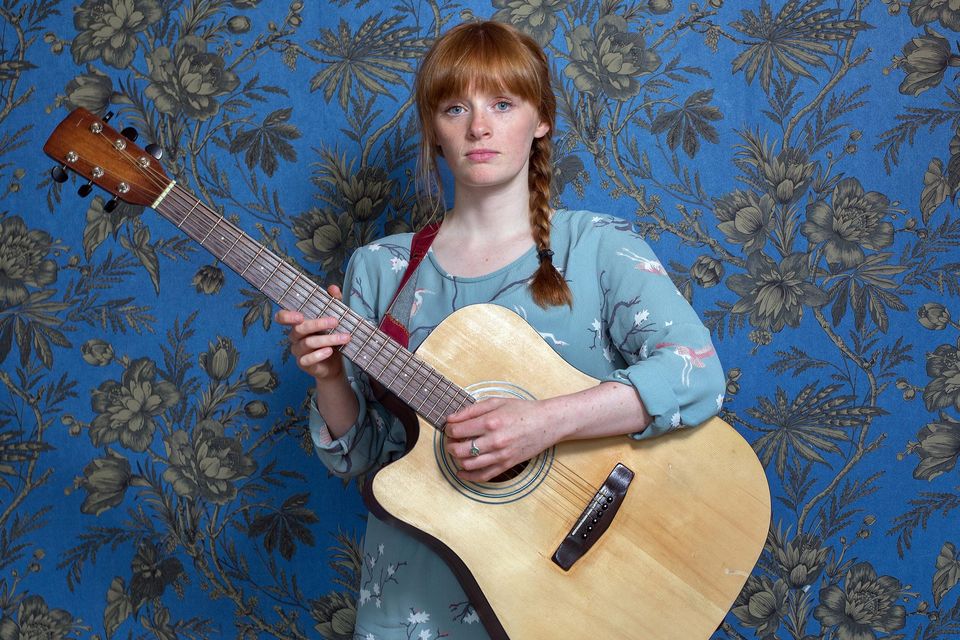
Sive, who performed at Solidarity Sessions No.3 in the Cobblestone. (Photo sourced: Internet)

The organising collective, volunteers on door duty and the performers all donated their services free of charge. Further donations will be made to causes considered worthy, the collective assured their guests and supporters.

Ru O’Shea, MC for the evening, thanked all the performers who gave their services for free, the audience for their attendance, supporters staffing the door, the Cobblestone and sound engineer. The next Solidarity Sessions night will be at Peadar Brown’s on Thursday 4th December.

Ongoing “contributing to building a community of solidarity and resistance.” And outside, it had stopped raining for awhile.

End.
Note: If you found this article of interest, why not register with Rebel Breeze for free, so that you will be notified by email of subsequent articles. You can de-register any time you wish.

FOOTNOTES

1James Connolly was born into the Irish diaspora in the poor area of Cowgate in Edinburgh and first came to Ireland as an adult in response to an invitation to found the Irish Socialist Republican Party. Subsequently Connolly went to the USA for a period before returning to Ireland (therefore 3 times a migrant). Patrick Pearse was born and raised in Dublin but his father was English. Both Pearse and Connolly were executed in Kilmainham Jail with another twelve by British bullets after their surrender of the 1916 Rising.

2‘Flying pickets’ operate in principle like the guerrilla ‘flying columns’, sending a large number of union picketers to specific locations chosen in secret, thereby reducing the opportunities for the police etc to mobilise at the spot in advance

3Ricky Tomlinson after release became a famous actor, mostly in comic roles. Warren developed Parkinson’s from forcible injections with restraining drugs and long periods in isolation in jail, dying not long after release. I remember the case and campaigns when I was working in England and a period afterwards when I was briefly active in the Construction Safety Campaign and read statistics about on average a construction worker killed weekly and one seriously injured daily on British construction sites.

4Yes, the Gardaí charging with criminal offences people they pepper-sprayed and batoned without warning.

5For report on that, see https://rebelbreeze.com/2025/10/31/strong-solidarity-support-for-arrested-port-blockade-activists/

6Kilmainham Jail was a British colonial prison in Dublin, also used for a while by the Irish Free State to imprison the Resistance during the Civil War/ Counterrevolution. It is now a very popular museum and holds the execution site of 14 prominent Irish Republicans after their surrender in 1916.

Eugene Bullard “The Black Swallow” — The First Black American Military Airman

By Geoff Cobb

(Reading time: 3 mins.)

A black American traveling entertainer, boxer and trainer, soldier in two world wars for two different countries, awarded 14 French military medals, airplane pilot, nightclub owner, musician, civil rights activist, associate of famous writers and musicians.

Bullard’s biography is so amazing I cannot believe it has never been made into a movie. Like the lives of many African Americans, it is also a tale full of suffering and pain that highlights the horrible racism that pervaded America in his day. He is such a remarkable person that more people should know about the achievements of this unique figure.

Bullard was born in 1895 in Columbus, Georgia, the seventh of 10 children born to William (Octave) Bullard, a black Caribbean and Josephine (“Yokalee”) Thomas, a Native American Creek woman. Georgia at the time of his birth was a dangerous place for “uppity” African Americans and tragically lynchings were common. His father’s people were Haitians who revolted against French slavery and following the revolution, Bullard’s ancestors left the Caribbean for the United States and took refuge with the Native American Creek people.

As a young boy, he was traumatized by the sight of a white mob attempting to lynch his father over a workplace dispute. A proud man, his father imbued his son with the conviction that African Americans had to maintain their dignity and self-respect, despite all the indignities heaped upon them. Bullard fell in love with his father’s stories of France where slavery had been abolished and blacks were treated equally. At age eleven, Bullard ran away from home hoping to reach France. In Atlanta, he joined a family of English gypsies and traveled throughout Georgia with them, tending their horses and learning to be a horse jockey. The gypsies told him that there was also racial equality in England and Bullard determined to go there instead of to France.

Bullard found work with the Turner family in Dawson, Georgia. Because he was hard-working as a stable boy, young Bullard won the Turners’ affection and was asked to ride as their jockey in the 1911 County Fair races, where he was victorious. Eventually, he made his way to Norfolk, Virginia where he stowed away on a ship to England.

In 1912, Bullard arrived in Scotland and soon went on to London where he boxed and performed in humiliating racist pieces for the Freedman Pickaninnies, an African American troupe. While in London, he trained under the then-famous boxer Dixie Kid who arranged a bout for Bullard in Paris. Bullard fell in love with the “city of light” and decided to settle there. He continued to box in Paris and worked in a music hall until the start of the First World War.

Eugene Bullard showcase (Photo source: Internet)

A SOLDIER IN WWI

When the War broke out Bullard enlisted in the French Foreign Legion and by 1915 had become a machine gunner, seeing combat on the Somme front in Picardy. He served in a regiment known as the “hirondelles de la mort” (“swallows of death”) and saw combat at Verdun where he was severely wounded on March 5, 1916. During his convalescence, Bullard was cited for acts of valor at the orders of the regiment on July 3rd 1917 and was awarded the Croix de Guerre.

After recovering, he volunteered on October 2nd 1916 for the French Air Service and became a machine gunner. He joined a group of American aviators fighting for France on November 15, 1916, called the Lafayette Flying Corps and became the first African American aviator in World War I. He took part in over twenty French combat missions, and is sometimes credited with shooting down one or two German aircraft.

When the USA entered the war, The United States Air Service created a medical board to recruit Americans serving in the Lafayette Flying Corps to fly for the United States. Bullard went through the medical examination but he was not accepted, because in the segregated American military only white pilots were chosen. Sometime later, while off duty in Paris, Bullard allegedly got into an argument with a French officer and was punished by being transferred out of his combat unit and into a service battalion. Before he left the French military, the French government awarded him three different medals for his heroism in battle.

NIGHT CLUB OWNER

After his discharge, Bullard went back to Paris, where he started to play drums in a jazz band at a nightclub named “Zelli’s”, which was owned by Joe Zelli. Bullard worked with Robert Henri, a lawyer and friend, to get Zelli’s a club license, which allowed it to stay open past midnight. Zelli’s soon became the most celebrated nightclub in Montmartre because few other clubs could stay open so late. With the money he saved from playing at Zellis, Bullard traveled to Egypt, where he played with a jazz ensemble at Hotel Claridge and fought two prize fights.

Missing Paris, Bullard returned to the City of Lights where his career was about to take off. He became an entrepreneur hiring jazz musicians for private parties with Paris’ social elites, worked as a masseur and exercise trainer. Bullard then got a job managing the nightclub “Le Grand Duc”, where he hired the famous American poet, Langston Hughes. Around 1928, Bullard had saved enough money to enable him to purchase “Le Grand Duc.” Thanks to being the owner of a hot Parisian club, Bullard made many famous friends, including the dancer-actress Josephine Baker, poet Langston Hughes and jazz musician Louis Armstrong. He eventually became the owner of another nightclub, “L’Escadrille” where he got to know writer Ernest Hemingway, who based a minor character on Bullard in his novel “The Sun Also Rises.” Bullard also opened his own gym and gave boxing lessons, training successful fighters such as “Panama” AL Brown and “Young” Perez. In 1923, he married Marcelle Straumann, a striking French woman from a wealthy family. The marriage ended in divorce in 1935, with Bullard gaining custody of their two surviving children, Jacqueline and Lolita.

A SOLDIER IN WWII

When World War II began in September 1939, Bullard, who also spoke German, agreed to a request from the French government to spy on the German citizens who still frequented his nightclub. When the Germans attacked France, Bullard volunteered and served with the 51st Infantry Regiment and was severely wounded in the battle for Orleans. When the Nazis took over Paris, he slipped over the border into Spain and then headed back to the United States.

Eugene Bullard with US Army comrades, WW2 (Photo source: Internet)

Bullard spent some time in a New York hospital and never fully recovered from his wound. He missed Paris and his minor celebrity there. In New York, he had no celebrity and had to work menial jobs. He longed to return to Paris but learned that his nightclub had become a casualty of the battle for Paris. The French government gave him a financial settlement with which he purchased an apartment in Harlem.

CIVIL RIGHTS

Returning to America after World War II, Bullard was active in the civil rights movement. During one confrontation, a bus driver ordered him to sit in the back of the bus. In 1949, Bullard was a victim of one of the most notorious incidents in New York State history, the Peekskill riots. Bullard was a fan of African American communist entertainer Paul Robeson who was scheduled to sing at a Civil Rights benefit. Before Robeson arrived, however, a mob attacked the concertgoers with baseball bats and stones. Thirteen people were seriously injured including Bullard who was knocked to the ground and beaten by an angry mob, which included members of the state and local law enforcement. The attack was captured on film in the 1970s documentary The Tallest Tree in Our Forest and the Oscar-winning narrated documentary Paul Robeson: Tribute to an Artist. Despite photographic evidence, none of his attackers were prosecuted. Graphic pictures of Bullard being beaten by two policemen, a state trooper, and a concert-goer were later published in Susan Robeson’s biography of her grandfather, The Whole World in His Hands: a Pictorial Biography of Paul Robeson.

Eugene Bullard clubbed to the ground by rioter and cops during the racist Peekskill Riots in 1949; captured on film and photograph but no-one was arrested for this and other assaults. (Photo source: Internet)

The 1950s were difficult years for Bullard whose daughters had married and he lived alone in his apartment, which was decorated with pictures of his famous friends and a framed case containing his 14 French war medals. His final job was as an elevator operator at Rockefeller Center, where no one suspected he had once been the “Black Swallow of Death.” In 1954, the French government invited Bullard to Paris to be one of the three men chosen to rekindle the everlasting flame at the Tomb of the Unknown Soldier under the Arc de Triomphe and in 1959 he was made a Chevalier (Knight) of the Legion De Honeur by President Charles De Gaulle, who called Bullard a “véritable héros français” (“true French hero”). He also was awarded the Medaille Militaire, another high military distinction. On December 22, 1959, he was interviewed on NBC’s Today Show presenting his amazing biography and received hundreds of fan letters.

Eugene Bullard in military uniform (Photo source: Internet)

Bullard died in New York City of stomach cancer on October 12, 1961, at the age of 66. He was buried in the French Veteran’s section of Flushing Cemetery, where nine years later his good friend Louis Armstrong would also be interred. On August 23rd 1994, 33 years after his death and 77 years to the day after the physical that should have allowed him to fly for his own country, Bullard was posthumously commissioned a Second Lieutenant in the United States Airforce.

End.

Unveiling of Eugene Bullard statue monument in Georgia near the USAF base that refused to enlist him as a pilot for WW2 because he was black, even though he had already flown in France.