
Category: 1916 Rising
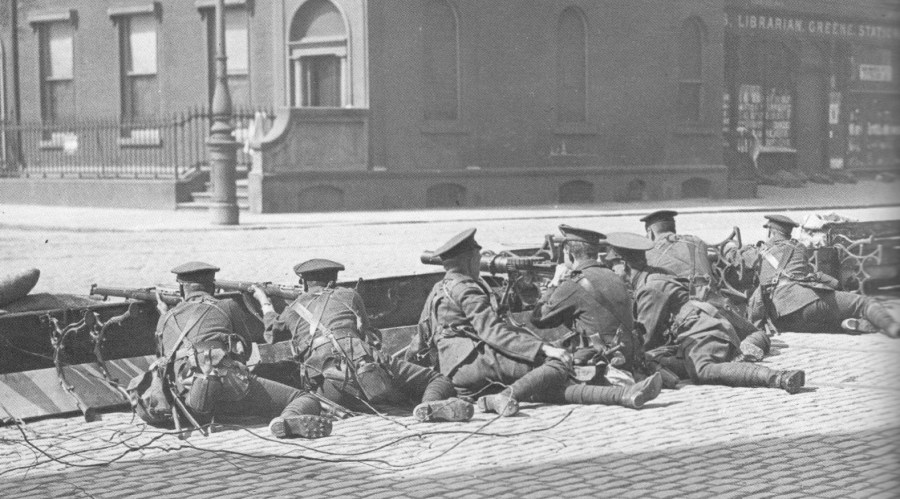
Will The Black And Tans Be Added To The Glasnevin Wall of Shame?
Timely article on the Necrology Wall at Glasnevin Cemetery and what seems like an intention to add to it the names of Black & Tans, Auxiiliaries and B Specials who were killed by Republicans.
https://ansionnachfionn.com/2016/04/06/will-the-black-and-tans-be-added-to-the-glasnevin-wall-of-shame/

Further on the divisive “Wall of Remembrance” unveiled in the historic grounds of Glasnevin Cemetery on Sunday, a monument which partly pays tribute to the members of the British Army and Police who lost their lives during the Easter Rising of 1916, the motivation behind its erection was clearly heralded by the Glasnevin Trust in a statement from its chairman, John Green, submitted to an Oireachtas committee in November of 2015. This includes a potentially troubling passage, highlighted below :
“…Glasnevin Trust has been working closely with the State in playing its part in the Decade of Centenaries. Glasnevin, true to its mission of serving people from all creeds, beliefs and walks of life, has been central to a number of State commemorative ceremonies. These have ranged from the commemoration of Irish men who lost their lives in the First World War to Collins and Griffith…
This work will continue right through the 1916 Centenary Commemorations with…
View original post 328 more words
MOORE STREET — A VISION (Part II)
MOORE STREET – A VISION
Part II
(Looking into the future, a couple of generations on)
Diarmuid Breatnach
THE GPO EVACUATION AND MOORE STREET LAST STAND
Our tour group gathered in the GPO for the Evacuation & Last Stand part of the tour; one can take this tour on its own or as part of longer tours. We said goodbye to Rónán, who handed us over to our Evacuation Guide, Pela.

Our tickets were checked and we were handed audio earphones, receivers and issued with our instructions – stay with the group, obey the instructions of the guide, etc.
Our group had about thirty people in it and ours had the only young children, although there were a few in their late teens. About half or more looked like tourists and some asked for the foreign-language options of receivers. There was one man in a wheelchair.
As instructed by the guide in a number of languages, we tested our receivers to find the volume settings appropriate for each individual. This took a bit longer for our two younger girls. Then our guide motioned for us to listen to our earphones … and the narration began. Gradually, we were pulled back across the decades until we were in that amazing Rising, taking place in what had once been considered the second city of the British Empire, rising up against that very same Empire, one of the largest the World had ever seen.
It was the fourth day of the Rising and many of the buildings in the city centre were ablaze. Through our earphones, against a backdrop of booming cannon and crashing shell, chattering machine guns, rifles’ crack and whining ricochet, we could hear the crackle of flames. Irish Volunteers’ voices reported that the glass in Clery’s building opposite had melted and was running across the street like water. The ledgers the Volunteers had placed in the GPO windows to protect against bullets were smouldering. Other voices added that despite fire-fighting efforts the roof was on fire and the roof lead melting. We could almost smell the smoke. Then finally, the order to evacuate given in an Edinburgh accent – James Connolly, the socialist commandant of the HQ of the Rising, the General Post Office.
In the hubbub of people getting ready to evacuate some voices stood out: Elizabeth O’Farrell, giving instructions about the moving of the injured James Connolly; calls to evacuate by the side door and caution about crossing Henry Street, with machine-gun sniper fire coming all the way down Talbot Street from the tower of the train station at Amiens Street.
A man’s voice in our earphones says “It’s lucky we have oul’ Nelson there to shield us some of the way!” and we hear a few people laugh.
Then, The O’Rahilly’s voice, calling for volunteers to charge the barricade at the top of Moore Street and a chorus of voices answering, clamouring to be chosen.
Now we are out in a group and crossing Henry Street. The man in the wheelchair, having politely declined offers to push his chair, is propelling his wheels strongly along with his leather-covered hands. It is weird to see the pedestrian shoppers and sightseers of the Twenty-First Century as half our minds are back in the second decade of the Twentieth. Across this short stretch to Henry Place we went, the crack of rifles and chatter of machine guns louder now in our earphones. And explosions of shells and of combustibles. The garrison scurried across this gap carrying the wounded Connolly on a bed frame and Winifred Carney, carrying her typewriter and Webley pistol, interposed her body between Connolly and a possible bullet from the train station tower.
With the rest of our tour group, Sadhbh and I cross into into Henry Place, holding the kids’ hands, following the route of the evacuation. Immediately we stepped on the restored cobbles of the lane-way, the sounds of battle receded somewhat.
“No bullets can reach us here!” shouts a voice in our earphones.
“No, but bejaysus them artillery shells can!” replies another.
Other shouts a little ahead warn us that gunfire is being directed down what is now Moore Lane from a British barricade on the junction with Parnell Street.
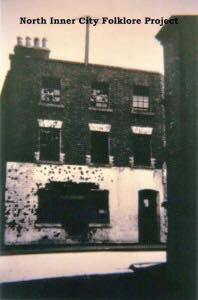
A sudden shouted warning about a building ahead of us, to our left, facing Moore Lane.
“See the white house? The bastards are in there too,” shouts a strong Cork-accented voice, almost certainly the young Michael Collins. “Let’s root them out. Who’s with me?”
Another chorus of voices, a flurry of Mauser and Parabellum fire, then only the steady chatter of the machine gun up at the British barricade and the sound of bullets striking walls.
The Cork sing-song voice again. “I can’t believe it — The place was empty, like!”.
“Aye, it was so many bullet’s hoppin’ off the walls made us think the firing was coming from inside,” a voice says, in the accents of Ulster.
Then an unmistakably Dublin working class accent: “Would yez ever give us a hand with this!” followed by the creak and rattle of wheels on the cobblestones as the cart is dragged across the intersection. Now we can hear the machine gun bullets thudding into the cart.
“Quick now, cross the gap!” comes the order and the dash across the gap begins. Nearly 300 men and women? Someone is bound to get hit and yes, they do and we hear that one of them died here.
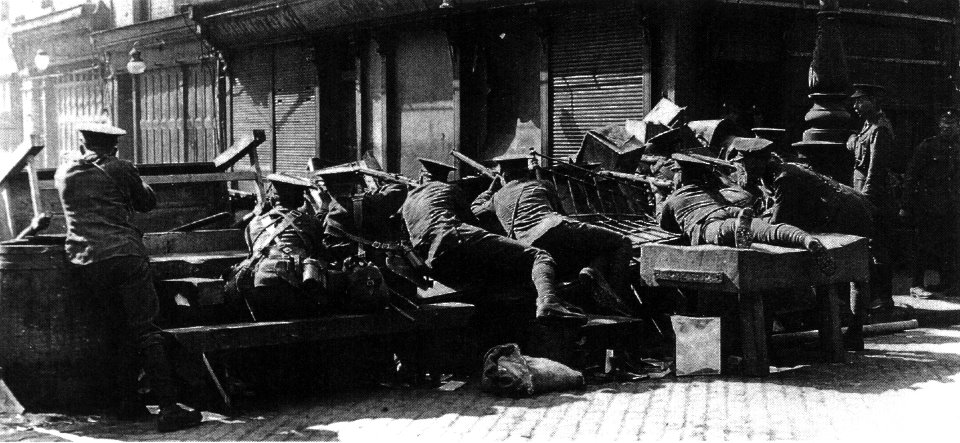
Across the gap, nowadays mercifully free of enemy fire but still feeling vulnerable, we follow Pela, our guide, to the corner with Moore Street. In character, she peers carefully around as we hear machine-gun and rifle here too, but Mausers and Parabellum as well as Lee-Enfields.
“Gor blimey!” exclaims a London accent, reminding us that some of the Volunteers had been brought up in England. “O’Rahilly’s lads are getting a pastin’. None of ’em made it as far as the barricade!”
An Irish voice: “Into these houses then – no other way! We have to get into cover to plan our next move.” This is followed by the sound of a door being hit and then splintering as they break into No.10, the first house on the famous 1916 Terrace.
“Careful now,” Elizabeth Farrell’s voice, followed by a groan of pain as Connolly is manoeuvred through the doorway.
Pela sends the man in the wheelchair up in the lift and leads us up the stairs. When the lift and the last of our group arrive we proceed across the restored upper floors from house to house, passing through holes in the walls, as the GPO Garrison did in 1916 – except that they had to break through the walls themselves, working in shifts. Through a few unshuttered windows, we can see the busy street market below us going about its business, apparently oblivious of our passage above them. But then, thousands of tour groups have gone through here over the decades. Through the double glazing one can just barely hear the street traders calling out their wares and prices.
We pass through those hallowed rooms, listening to ghosts. Here and there a hologram appears and speaks, echoes of the past. Dummies dressed in the uniforms of the Irish Citizen Army, the Irish Volunteers, Cumann na mBan, Na Fianna and Hibernian Rifles are on display here and there. Imitation Mausers and Parabellums and Martinis, each one carefully made and to the same weight as the original, are there. They are security-chained but we know people are free to pick them up and feel the weight, as Rory does, to imagine carrying and firing one. But not to be flash-photographed, which is not permitted here. Replica Cumann na mBan medical kits are on display, open so one could inspect the replica contents. The houses also have period furniture, fireplaces, beds …. chamber pots …. kitchens with utensils … bedrooms ….. There are dummies dressed too in civilian clothes of the time typical of that area — women, men, children (even the dog that the last Volunteer to leave Moore St. fed).
We see magnified historical newspaper headlines, photos, badges and medals. A map of Dublin with fighting locations flashing on them, some of them going out as they fall, the dates appearing above them to show when that happened.
Snatches of poetry, of song come to us as we cross from room to room, from house to house. And for our eyes, the holograms of the Proclamation, the portraits of the executed 16 and many others who fought and died or who survived, flags, the Tricolour, the Irish Republic, the green-and-gold Starry Plough, waving in the wind above Clery’s ….
Half-way along the terrace we come to the discussion between the leaders, creatively reconstructed on the basis of some witness statements. Pearse wishing to surrender to avoid further loss of civilian life, Clarke arguing, a sob in his voice, Connolly saying maybe they should wait for Sean McLoughlin to get back (he is out reconnoitering a breakthrough route) …. Then the arguments with some of the other Volunteers, Mac Diarmada having to use all his powers of persuasion. Oh, such emotion in such short discussions! Then the decision, and Elizabeth O’Farrell volunteering to go with the white flag to open negotiations with the enemy …. even though a couple and their child have already died beneath a white flag in that street.
Shortly afterwards, the faces of the sixteen executed come into view, suspended in the air in front and a little above us. We stand there while passages are read out from their trials, letters from their condemned cells, words to relatives …. Then the dates appear above them and we hear the fusillades as by one their faces blink out, until finally only Casement remains, the image of the gallows and then he too is gone. All is dark for a moment, then all sixteen faces appear again, over a background of the three flags of the Rising, to a swelling chorus of The Soldiers’ Song, in English and in Irish.
At the end of the Terrace, we descend again and here view the O’Rahilly monument plaque and in our earphones hear the words of his final letter to his wife read out – he wrote it as he lay dying from a number of bullet wounds. I found my eyes moistening again as they had several times during the tour and some of the others were visibly crying – including foreign tourists.

The end of our tour lay ahead, through the underground tunnel under Parnell Street to the Rotunda. Here the Volunteers had been publicly launched and recruited in 1913 and here, in 1916, the GPO/ Moore Street garrison had been kept prisoners without food and water for two days, while G-Men of the DMP came down to identify whomsoever they could from among the prisoners.
Now the recordings in our earphones ask us to listen to the guide for a moment as she collects our earphones and receivers. Having gathered the sets and put them away in her bag, Pela asks us all to give a moment’s thoughts to the men and women and children of the centenary year of the Rising, 2016, who had fought to preserve this monument for future generations. Pela tells us that her own grandmother had been one of the activists.
Incredible though it may now seem, the whole terrace except for four houses had been about to be demolished to make way for a shopping centre, which would also have swallowed up the street market. It had taken a determined campaign and occupations of buildings with people prepared to face imprisonment to protect it for our generation and others to come. The State of those years had little interest in history and much in facilitating speculators. She invited us to applaud the campaigners, which we did, enthusiastically. She then asked us to turn around and view the building we had left. There was a plaque on the wall there “Dedicated to the memory of the men, women, girls and boys of 2016 ……” In bronze bas-relief, it depicts the 16 houses with activists on the scaffolding erected by those who intended demolition, with a chain of people of all ages holding hands around the site and in one corner, a campaign table surrounded by people apparently signing a petition.
Once through the underpass and inside the Rotunda, the tour officially over, we thanked our guide and made for the Republican Café. Sadhb and I found we couldn’t say much, as our minds were half back in 1916. Rory was quiet too but Eva and ‘Brigie’ seemed unaffected, brightly debating what to choose from the menu in the Rotunda café, or what souvenir they fancied from those on display.
There’s a Moore Street and Dublin Street Traders’ Museum and there are films one can see all day in the Rotunda, often too lectures, reenactments, plays …. We’d had enough for one day, however – we were full. It was truly an unforgettable experience and I knew that for Sadhbh too and probably for Rory, it was something that would remain forever alive in our memories. The girls? Years from now, who knows ….. but they had certainly not been bored, anyway.
End.
THE DESIGN OF THE NEW €2 COIN — AN INAPPROPRIATE IMAGE REVEALING A NOSTALGIA FOR THE EMPIRE?
Diarmuid Breatnach
The new €2 coin design is now published and the coins will themselves be put into circulation in the New Year. Designs were submitted and the winning design for the ordinary currency coin is by Emmet Mullin, while the design for the gold and silver special editions is by Michael Guilfoyle. Both designs incorporate the statue of “Hibernia” and that name is prominently displayed on one of side of the coin and although Guilfoyle’s design incorporates some words from the 1916 Proclamation, they are in the background to the representation of “Hibernia”. The image is taken from a the centre one of a trio of statues erected on the GPO in 1814, while still under British occupation.
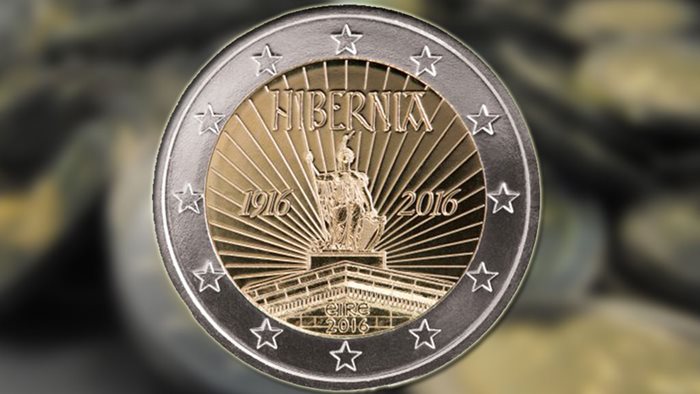
“Hibernia” was regularly used as an image to represent Ireland by “Punch”, a satirical racist British publication and she was always
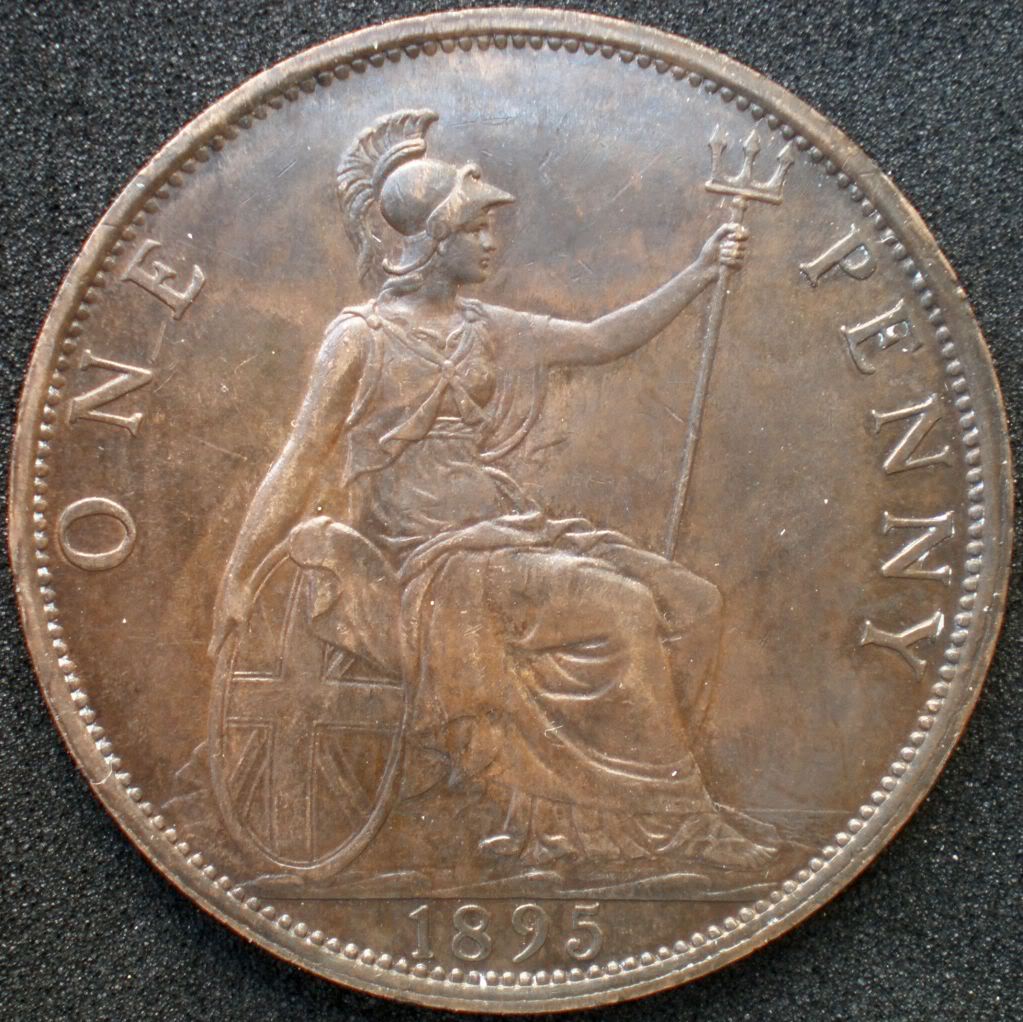
shown as a pretty younger sister of “Britannia”, in need of her older sister’s protection (usually from the rebellious Irish, the despair of poor “Hibernia”). She was never in martial garb, unlike Britannia herself who was usually represented as a majestic and martial figure, with a crested war-helmet and shield and sometimes carrying a trident (perhaps to indicate domination of the seas).
That representation of Britannia appeared not only in the cartoons of “Punch” and other publications but also in sculpture — for example at the top of Somerset House, in the Strand, London – and also on many mints of British penny coins.
Of course, in British history the most likely model for the representation of a female fighter was Boudicca (“Boudicea”) who, after her humiliation and the rape of her daughters by Roman Legionnaires, raised her formerly pacified tribe of the Icenii against the Roman occupation and came close to driving them out of Britain. The irony is that the whole of Britain at that time was Celtic, as were Boudicca and the Icenii. But the English ruling class appropriated Boudicca into their English iconography as they did also with King Arthur and the Round Table knights.
Romanised and civilised
Ireland had many names among the Gael but “Hibernia” was not one of them. “Hibernia” was a late Latin name for Ireland, which the Romans had previously called “Scotia” (yes, “Scotland” originally meant something like “the land the Gael have invaded and settled and defend”).
The Roman linguistic connection is interesting – Irish Anglophiles and some English lovers of Ireland have been wont to bemoan the fact that Ireland was never conquered by the Romans. These commentators have tended to see Romanisation as civilising, forgetting perhaps the words of Rome’s own greatest historian, Publius Tacitus (or Gaius Cornelius Tacitus; c. 56–after 117 AD) who said that “they have created a desert and call it peace.” Calling Ireland “Hibernia” might be a way to bring that Roman conquest belatedly to the unquiet isle, to make her more “civilized” — in fact more like her neighbour and therefore more accepting of her neighbour’s domination and of her ways.
When John Smyth designed the statues to go on top of the General Post Office building in Dublin’s main street, then Sackville (but now O’Connell) Street, Dublin was widely considered the second city of the British Empire, next to London. The building opened to the public in 1818 but Dublin’s slow decline in status had already begun. Since the abolition of the Irish Parliament by the Act of Union in 1801, following the suppression of the United Irish uprising three years earlier, the Irish Members of Parliament had to go to London to take their seats, taking a great deal of political, commercial and social life with them. Irish landlords deserted their Irish estates in greater numbers, leaving them in the hands of their often rack-renting agents as the owners demanded more and more rents to keep them in their homes in Britain and their lifestyle there and in Europe. Throughout the 19th Century the social focus slowly followed the political to England – except where a militant nationalist one arose.


Submission or subversion?
Perhaps the representation of Hibernia by John Smyth, reflecting that of Britannia, was meant to show Ireland as equal in grandeur to her dominant neighbour. The Society of the United Irish had been part of a wider cultural movement that sought to explore and appropriate an older Gaelic culture for the colonists, many of them settled for generations on Irish land. Assertions of autonomy and complaints about English political and commercial restrictions had been part of that movement too and had found sharpest expression in the republican and separatist ideas of the United Irish. Some aspirations remained, severely modified. Perhaps it was John Smyth’s intention to show Hibernia as grand but there was no mistake about who was really in charge in Ireland, Hibernia or Britannia.
As if to underline the relationship, Smyth placed a statue representing “Fidelity” on Hibernia’s left on top of the GPO. What could that fidelity be, except to the Empire? Some suggest that because Fidelity holds the Key and is with the Dog, that she really represents Hecate. I know nothing about Smyth nor have I the time to research him at the moment but it is possible he was being somewhat subversive in that representation. Hecate had a number of earlier and later interpretations and the key seems to have appeared later – the key to the household perhaps but also to Hades, the Underworld.
On Hibernia’s right, John Smyth erected the statue of Hermes, known to us as the messenger of the gods but also representing commerce. Commerce, then as now, was the backer of military and political initiatives, indeed often the driver. Of course, many of the Irish bourgeoisie, both native and colonist in origin, wanted a successful commercial Ireland. But after 1798 and 1801, they were not going to get it. From then on, most progress for Irish finance would be made through investing in the Empire rather than in Irish industry and trade.
Whether the representation of Hibernia was intended as some kind of subject of Britannia with pretensions to something grander or was in fact just aping her better, dressing in her mistresses’ clothes when the lady was away, is a moot point. What is certain is that neither the image nor the name itself is of native origin.
The names for Ireland
As noted earlier, among the many names of the Gael for Ireland, “Hibernia” does not appear. The clan-based resistance had used Irish names to describe the land and this continued in the wars against Cromwell and William, with “Ireland” being the most common name when speaking in English by both sides of the wars.
The United Irishmen, a late 18th Century republican movement for independence led mostly by descendants of colonists and largely English-speaking, called the land “Ireland”1 or “Erin” (a phonetic representation of the Irish-language “Éirinn”, the dative case of “Éire”). These names, along with the genitive “Éireann” later, continued to be those most often used by nationalists of the 19th Century, the Young Irelanders, the Fenians, the Land League, as well as by the various advanced nationalist and revolutionary organisations in the early years of the 20th Century2.

This continued to be the case during the War of Independence and by both sides in the Civil War and was the case with the setting up of the 26-County state and with the various national resistance movements to that state of affairs since then. One finds “Hibernia” in the Ancient Order of Hibernians, of course and in the Hibernian Bank but they are exceptions – it is “Éire”, “Erin” or “Ireland” over all – and has been so for many centuries.
“Hibernia” is a foreign colonial import, both in terminology and in concept. She is poor image of her big sister on “the mainland”, the real boss. The use of her image and of her name is inappropriate to commemorate the 1916 Rising but their use may signify much more than an error – they may reveal a subliminal desire to return to the Empire, or at least the Commonwealth, in the psyche of those who were never all that sure they should have left it.
End
Links for sources:
The design of the new €2 commemorative coin: http://www.joe.ie/news/pic-take-a-look-at-the-winning-designs-for-irelands-new-2016-coins/511479
The GPO building and the statues: http://archiseek.com/2010/1814-general-post-office-oconnell-street-dublin/ among other on-line sources
About origin and personification of Hibernia: https://en.wikipedia.org/wiki/Hibernia_(personification) http://victorianvisualculture.com/2010/10/13/hibernia-as-the-other-ireland/ and despite perhaps its name and appearance a good concise but short summary in http://www.proud2beirish.com/Irelands-Name-Origin.htm
1“From my earliest youth I have regarded the connection between Ireland and Great Britain as the curse of the Irish nation …” Theobald Wolfe Tone
2Inghinidhe na hÉireann, Na Fianna Éireann, The Irish Citizen Army, The Irish Transport & General Worker’s Union, The Irish Volunteers, Óglaigh na hÉireann. Also, when the Abbey Theatre was founded by W.B. Yeats and Lady Gregory in 1904, they declared it was “to bring upon the stage the deeper emotions of Ireland”.
DISSIDENTS — A FLAWED CONTRIBUTION TO THE HISTORY OF A NEGLECTED GROUP
REVIEWING DISSIDENTS BY ANNE MATTHEWS:
Diarmuid Breatnach
The role of women has been often ignored and undervalued in the body of Irish historical writing. Whatever the reasons for this state of affairs, a tendency in more recent writing has been, at least to a degree, to attempt to rectify this. In the decades since Margaret Ward’s Unmanageable Revolutionaries (Brandon, Ireland, 1983), this rectification has been slowly gathering pace. Dissidents – Irish Republican women 1923-1941, by Anne Matthews (Mercier, 2012), is a contribution to this movement in historical writing; it is essentially the history of an Irish women’s political movement, Cumann na mBan, during the years outlined. A previous work of hers, “Renegades”, deals with Irish Republican women from 1901 to 1922.
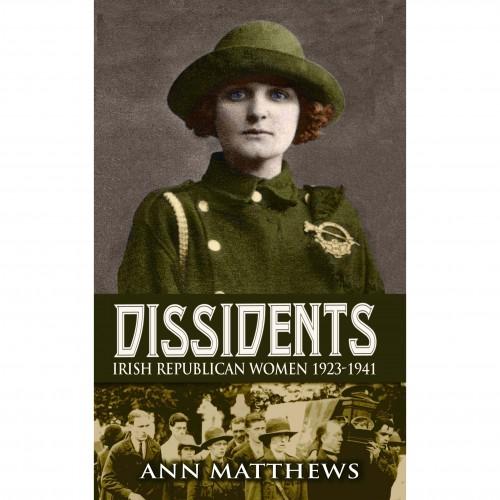 Although Dissidents deals with the period 1923-1941, Cumann na mBan was founded on 2nd April 1914 as an auxiliary to the all-male Irish Volunteers’ organisation, which had been founded in 1913. In 1914 the Volunteers split after John Redmond, leader of the Irish Parliamentary Party (in Westminster) and the main open Irish political party in Ireland, committed the Irish Volunteers to fight in the British Army in WW1. The smaller section of the split went on to participate in the 1916 Uprising and more coherently later in the War of Independence (1919-1921). Redmond’s party and “constitutional” Irish nationalism was all but wiped out in the British General Elections of 1918, at which time the whole of Ireland was still under British rule and Redmond’s nationalist opponents, then amalgamated under the name of the reformed Sinn Féin, gained the vast majority of parliamentary seats in Ireland.
Today it is common to define the ideology of both both Cumann na mBan and the Irish Volunteers as “Irish Republican” and, although they quickly became so, and the impulse in the formation of the Volunteers in 1913 was of the secret Republican organisation the IRB (Irish Republican Brotherhood), both organisations at first could be more accurately described as broadly nationalist. Both organisations contained prominently in their midst people whose ideology conformed to that of Irish Republicanism as well as those whose thinking did not, people who expressed a strong interest in equality for women as well as those who were against it, people with at least a sympathy for socialist ideas and those who condemned any such tendencies – and of course variations in between.
In the period specifically chosen by Matthews, 1923-1941, the Irish Volunteers had morphed into the political party Sinn Féin and the armed organisation the IRA (Irish Republican Army) and become Irish Republican in ideology, as had Cumann na mBan. They had in fact been that way since 1919, although the period 1921-’23 was to expose some deep fracture lines which found expression in the Civil War (1922-1923) and later again with the founding of Fianna Fáil and its eventual management of the Irish State (the 26 Counties).
In order to compile her history, Matthews has consulted minutes of committee meetings of Cumann na mBan in its various incarnations (she identifies four periods, or versions of the organisation), personal recollections of participants recorded in writings, interviews, comments quoted by contemporaries, newspaper reports and articles, the Republican movement’s own publications, as well as records of prisons and police under both British and subsequently Free State rule. And she has used some of this material to reproduce and also compile lists such as the numbers and names of women convicted and jailed, the women who went on hunger-strike and the length of time on that protest. The lists also include figures on the decline of Cumann branches between 1934 and 1936, as well as a list of “women in organisations listed as dangerous by the Free State CID in 1934”. These lists are a particularly valuable contribution and will be of great use to many writing on the political movements of the period in Ireland.
Looking at some of those lists alone, one is struck by the sheer extent to which the contribution of women activists to the struggle for Irish independence, and the price they had to pay, has been overlooked. In 1930 twenty-nine women were in organisations listed as “dangerous” by the Free State detective branch of the police – twelve of these were in senior positions of Cumann na mBan, three in directing positions in Saor Éire, three for Comhairle na Poblachta, three also for Sinn Féin, one for the Prisoners’ Defence Organisation, two for Women Prisoners’ Defence League and one for the Anti-Imperialist League. The rest were rank-and-file members of those organisations and one was in Friends of Soviet Russia.
The Free State interned 645 women during the Civil War (as against over16,000 men). In her Introduction, Matthews points out that “There were twenty-four strikes in the three (women’s) prisons during the period from November 1922 to November 1923, in which 219 women took part.” According to the table drawn up by Matthews, one woman was on hunger strike for 35 days, another for 34, seven for 31, many for different amounts of days but the vast majority into double figures. Furthermore, some of them were on hunger strike more than once.
Matthews also provides a list of the occupations of 79 women activists jailed in the North Dublin Union, which were surveyed in August 1923: the highest number for a single occupation were the 19 listed as “at home”, while the next were 11 whose occupations were given as “packer in Jacob’s” (the biscuit factory in Dublin); 10 had been engaged in “printing”; eight were “shop assistants” while 15 were variously listed as “typist” or “clerk”. This list shows quite a variety of social background among what one presumes to be fairly politically-active women which the Free State considered its enemies.
Republican women acting as couriers or delivering weapons made many journeys by bicycle, often at night without lights in order to avoid Free State patrols, “often round trips of up to forty miles” Matthew tells us (p.32).
BIAS
As has been pointed out by a number of commentators, history writing involves a degree of bias. This bias is exercised not only in explicit judgements but in inferences made, choice of phrasing and so on. Choices are made in what sources to use and what prominence to give them as well as in the opposite, which sources to disregard.
If the Fall of Lucifer and his angel followers were a historical event, for example, we would expect Lucifer’s version to be very different from the Judaeo-Christian story with its sympathy for the Archangel Michael (a great example of history being written by the victors). There might be yet other versions, for example by the Seraphim and Cherubim, one of which might be in partial sympathy with the Fallen side and the other which might be against both sides of the conflict.
Whereas in the ancient past history writing was blatantly partial, in the past century historians have generally claimed to be impartial dispassionate observers recording what they discover. But every one of those writers had views influenced by class, ethnicity, gender, position in or out of power groups, status, upbringing and personal experience. And those views influenced their historical judgements, quite likely their choice of sources and possibly their choice of audience. Written records could only be left by literate people and yet for most of history the majority of people have been illiterate. A more recent trend in history writing is to recognise the inevitability of bias and for the historian to declare which is his or hers.
One should beware of historians who don’t declare their bias at the outset. That will not be a problem with Anne Matthews because although she does not formally introduce her bias to her readers, it very soon becomes clear. Or maybe that is not quite accurate, for in order to have a bias against a group one must presumably also have a bias in favour of another. It is difficult indeed in the pages of this book to find any group for which Matthews has any sympathy or, even more important for a historian, empathy.
To express a bias is expected, as I commented earlier. But unless one is engaged in pure propaganda or character assassination (or glorification), one should present the evidence in favour as well as that against and, in weighing one against the other, make a judgement. When Matthews has anything favourable to say about her subjects it seems to be an accident which will soon be remedied a little later – just keep reading!
A particularly clear and nasty example of this bias is in Matthews’ treatment of Constance Markievicz whom she calls a “self-proclaimed heroine” (p.28) but does not tell us when and where Markievicz allegedly “proclaimed” herself to be a “heroine”. Matthews also inferred that Markievicz was a given to warlike statements but a coward who ran away to Scotland. Whatever the reason for her departure in 1922, one wonders how, no matter how much she may dislike the person, someone could call Markievicz, who prominently took up arms and fought for a week against the British Empire, a coward.
In the Matthews view of the organisation, Cumann na mBan was a largely ineffective body, doctrinaire and full of in-fighting. The leadership and many prominent activists were aristocratic or upper middle class, used to the privileges afforded by their class. The working and lower-middle class members accepted the leadership’s decisions or just deserted.
Some of those things may be true and there might even be some truth in all of them — but where is the counter-argument before coming to judge? One doesn’t find it in Matthews, except by an inference that one can make from the lists I mentioned earlier and other information.
If a woman came from a higher social class and was used to having servants do her cleaning, do those facts diminish in the least her courage in facing bullets in insurrection, the threat of the firing squad, the pangs on hunger-strike and the risk of permanent damage to health, the risk of physical beatings and unhealthy prison conditions? Or on the contrary, in some ways, are those risks and sacrifices not all the more remarkable for one from such a background as that? And if an upper-class mother can pay a nanny to look after her children while she herself in in jail, does that take away from her courage and fortitude? A working-class mother without those resources (though she might be able to avail of extended family) of course has even more obstacles to surmount and deserves our greater praise but that is no reason to disparage the sacrifice or commitment of a woman of a higher class.
And if infighting and bad policy choices were a significant feature of the organisation, were there not others to weigh against them on the scales of judgement? What of transporting, hiding and distributing weapons? Of carrying secret correspondence and intelligence? Or of continuing to feed the flame of resistance while men were in prison, organising pickets and demonstrations, outside jails etc? What of creating the enduring 1916 emblem and Republican commemoration emblem, the Easter Lilly? Or of organising Republican commemorations year after year, as well as funerals of fighters in the midst of repression? Or the work of supporting prisoners and their dependents? Matthews records these and often the difficulties entailed but without a word of approval to balance the censorious words used in her criticisms. Nor do we see an attempt to understand the choices these women made or the constraints upon them, much less see anything to admire; we are shown few lessons to learn from, unless it is something like “don’t be these people or anything like them”.
In Dissidents, Anne Matthews has made a contribution to the story of Republican women but its judgement is clearly skewed and the work suffers as a result. Matthews could have recorded all the negative information that she did but also the points to throw in the balance – had she done so, her book would have been a much better return on her investment in historical research and writing as well as a better reward for the reader.
End.
THE BLOODIEST BATTLE OF THE EASTER RISING
D. Breatnach
99 YEARS AGO ON 26th APRIL, THE BLOODIEST BATTLE OF THE EASTER RISING WAS FOUGHT IN A DUBLIN SUBURB
At a little past 6am on 26th April 1916, the SS Tynwald and SS Patriotic, two British troop-ships, had berthed in Dun Laoghaire harbour. The harbour and town had been renamed Kingstown by Unionist elements when King George IV came to visit the new port under construction in 1821. Although the town returned to its former name in 1920, it was known as “Kingstown” by most people in 1916, whatever their allegiance.
The troopships had been requested by General Maxwell, who had been given the responsibility for suppression of the Easter Rising, which was now in its third day. Several British thousand troops from the 59th Midland division began to disembark on a bright sunny morning. Hundreds of civilians went down to see them despite the early hour. Many in that town, especially around the seafront and some of the big houses, would have been sympathetic to the British – but by no means all and no doubt some eyes were noting the arrivals in order to report to the insurgents.
Around 9am, disembarkation completed, the soldiers were formed up and inspected, equipment checked and the Sherwood Foresters set off marching towards Dublin city centre, seven miles away, to be followed by Nottingham and Derby regiments around 10.30hrs. Their forces appear to have split up, with two Battalions marching to the city along the coast road and another two heading inland.
To reach the city centre from Dun Laoghaire, the most direct route is to proceed northward along the coast to Mount Merrion. Once there, the coast road goes through the railway level crossing to the right and continues along the seafront, into Ringsend and then along what is now Pearse Street to Trinity College. The British officers did not lead their men in that direction, perhaps because they had received intelligence of the Boland’s Mill strongpoint along their route. There would be no going past that without first taking it, which might prove a lengthy and difficult battle.
But one could avoid that by not turning right at Mount Merrion and instead continuing on what has become the main road, through Ballsbridge and Northumberland Road, across the Grand Union Canal at Mount Street Bridge, past the fashionable Merrion Square and into Nasseau Street and the city centre. That seemed the obvious choice, not just because of the Jacob’s garrison but also because at Mount Street Bridge was located Beggars’ Bush Barracks, one of the many such of the British Army in Dublin city.
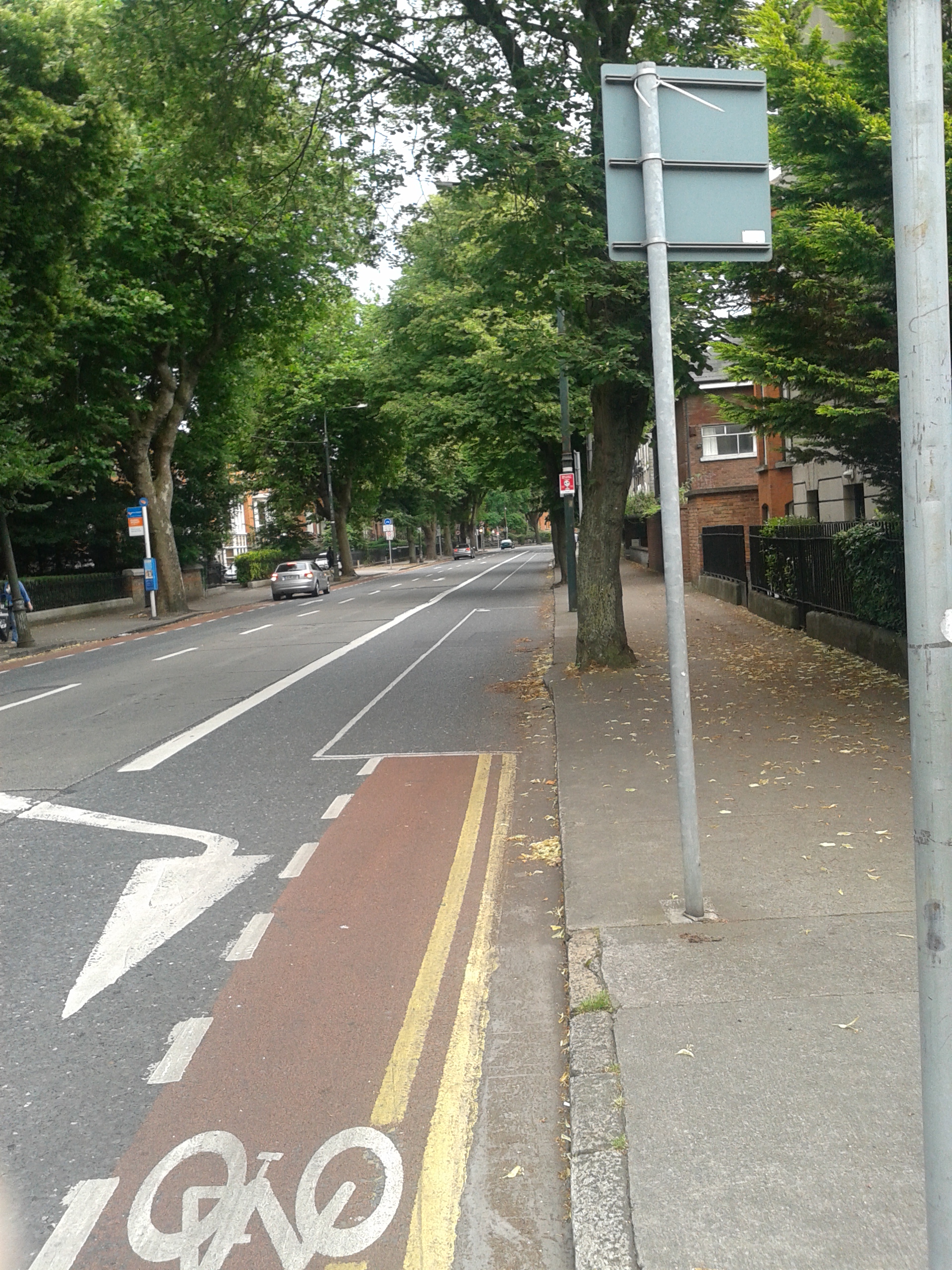
Before the British troops arrived in the area, a female courier, probably Cumann na mBan, had brought news of the troops landed in Dún Laoghaire and that they were heading towards them to the insurgents waiting in the Mount Street Bridge area.
At around noon a burst of fire hit the forward sections of the British troops marching in from Dun Laoghaire. When fired upon, in order to find effective cover, it is important to know from where the firing is coming but the soldiers were unsure. No. 25 Northumberland Road, a house at the junction with Haddington Road, seemed to some to be the source of the firing but by how many was unknown.
Screams from wounded men filled the air in the quiet suburban upper-middle class and largely Loyalist residential street.
Soldiers began to maneouver to outflank No.25 Northumberland Road and a detachment reached Baggot Street Bridge, further west, which was apparently undefended. From there it is a straight road into Stephens Green and the southside city centre. The rest of the soldiers were not led by their officers in that direction, a decision which was to cost them dearly. Instead, shortly after being fired upon, at least two British platoons attacked 25 Northumberland Road but were driven back in disarray by fire from the building’s upper floors; yet as they turned they were also shot down in droves.
Perhaps under cover of that assault, at around 1pm some of the 2/7th Battalion Sherwood Foresters got past the corner house and made their way on to Percy Place, which runs along the south side of the canal between Mount Street and Baggot Street bridges. Now they came under fire from in front and from their left. They huddled for cover along the Canal.
The fire from the left of the British at this point was coming at long distance from the towers of Jacob’s Factory in Bishop Street, one of the insurgent strongpoints. A defensive line with insufficient mobilised insurgent numbers to hold it for very long stretched from Jacob’s down to the railway connecting Dublin and Dun Laoghaire and to Boland’s Mill beside it, overlooking the south bank of the Liffey. Roughly in the middle of this chain or defensive line were the Irish Volunteers in the Mount Street Bridge area, an outpost of the Boland’s Mill garrison. The total strength of the insurgent force defending that area had been 17 Volunteers but two had been sent home, being thought too young.

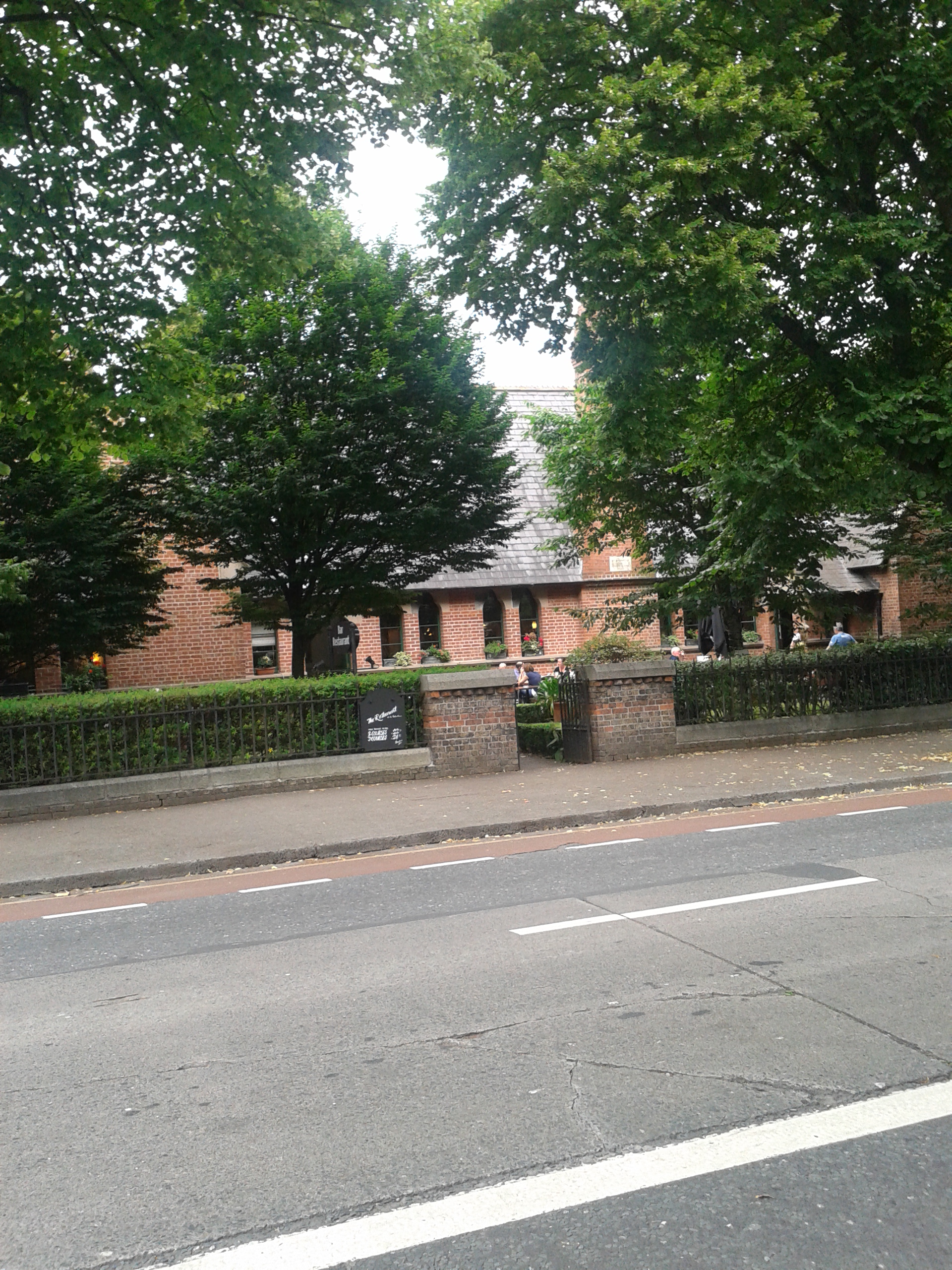
Incredible as it seemed to the British when they learned of it later, there were only two Volunteers in No.25 Northumberland Road: 27 year-old Volunteer Lieutenant Michael Malone, a carpenter by trade, and Section Commander James Grace. In the Schoolhouse on the right-hand side just before the Bridge, there were two Volunteers. Next to that building was the Parochial Hall, held by four men: P.J. Doyle in command, Joe Clarke, William Christian and J. McGrath. Clanwilliam House, across the canal on the right-hand corner with the junction with Mount Street Lower, was occupied by seven Volunteers; the frontal fire hitting the British was coming from there.
The British were scattered around gardens and behind the granite steps leading up the to front doors of the elegant houses in the street. Their officers called them out and they launched an attack on the Schoolhouse in Northumberland Road. As they charged up the road they came under fire from across the Canal from Clanwilliam House; about a dozen reached the Schoolhouse but they left many bodies behind. And they were still coming under fire from across the Canal too.
The officers now attempted to outflank Mount Street Bridge and Northumberland Road by advancing along Shelbourne Road to the east but were stopped as they came under fire from Volunteers along the railway line and from positions in and around Horan’s Shop nearby.
The column advancing from Dun Laoghaire had set up a temporary HQ in Ballsbridge Town Hall. Incredibly, the officers there, receiving regular dispatches reporting their troops being slaughtered around Mount Street Bridge and, presumably, knowing that other troops had found Baggot Street Bridge undefended, continued to press for an advance across the killing field.
But at least the officers on the battlefield for the time being seem to have had enough of death-or-glory charges, which were bringing plenty of death and no glory. The soldiers are now crawling along the road but whenever any are visible, which is often, they are being fired at. Clanwilliam House is wreathed in smoke.
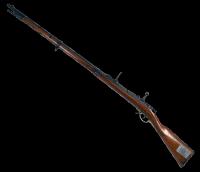
The weapon the Volunteers were using was almost certainly the Mauser Model 71, the weapon of most Volunteers and Irish Citizen Army during the Rising; 1,500 had been been delivered in two landings in July 1914, first at Howth, north Dublin and then at Kilcoole, Wicklow. It had been the first cartridge rifle adopted by the Prussian Army in 1872 which by 1914 had gone on to another more advanced model, presumably the reason that the rifle was being sold cheaply. The Model 71 fired a larger bullet than the British Army standard-issue Lee Enfield .303 but did not have a magazine, each cartridge having to be ejected and anew one inserted before firing again; its rate of fire was only four or five rounds a minute. The Lee Enfield took a ten-bullet magazine and the British Army were trained to fire fifteen rounds a minute. Despite this, the occupants in Clanwillian House and in No.25 in particular were able to lay down a tremendous rate of fire. Their guns grew so hot they burned to the touch and they had to cool them with wet rags. Down below, British officers blew their whistles and soldiers carried out more charges, only to be cut down by the Volunteers’ rifle fire.
During the late afternoon, a nurse ran on to the road and began treating the wounded British soldiers. The Volunteers agreed to a ceasefire as doctors and nurses from Sir Patrick Dunne’s hospital nearby went into Northumberland Road. But after a while the British attempted to use the ceasefire to advance their positions and the Volunteers ended it. Those wounded still to be tended lay where they were. This had been very different situation to what was to be seen in other areas of Dublin during the Rising, when British troops refused to allow wounded to be taken out unless the insurgents surrendered and when they accused Nurse Elizabeth Farrell of being a spy and tore her Red Cross bib–front off her.
The British got a machine gun up to the bell-tower of the church on Haddington Road so that they could fire over the roofs of the houses at Clanwilliam House, the bullets knocking chips off the outer walls and zipping through windows. They were also being backed by rifle snipers.
British soldiers recommenced attacking No.25, now with hand grenades as well as rifle fire. Finally they got close enough to blow the door in with explosives but incredibly were fired upon from inside as they tried to gain entry, injuring a number of them. They hurled grenades in and after they exploded, dashed in again. Coming down the stairs to meet them was Volunteer Lieutenant Michael Malone, his pipe in his mouth and was shot dead.
Section Commander James Grace had been downstairs using a cooker as cover from bullets and shrapnel and such was the bomb damage to the room that the British assumed anyone in there had to be dead. There was still plenty of fighting to do – they had not even crossed the Canal yet.
If they believed that two men alone had held out against repeated assaults for four hours and had inflicted such damage upon them, they must have been very fearful leaving No.25. But perhaps they thought there had been others who must have escaped in the last minutes. James Grace did escape to get out of the area after lying low for some hours; however he was arrested some days later.
With No.25 taken, the Sherwood Foresters are soon able to take the Parochial Hall but they find it empty. The garrison of four Volunteers had run out of rifle ammunition and evacuated into Percy Place, where British troops, who were now all around the area, captured them.
An officer takes Volunteer Joe Clarke‘s loaded pistol off him, puts him with his back to a door and fires at him. Missing Joe, the bullet goes through the door to where a doctor is attending to injured British soldiers. He storms out in rage, berating the officer and Joe Clarke’s life is saved (he continued active in the IRA and in Republican politics nearly until his death in 1976 at the age of 94).
British soldiers are occupying nearby houses for cover and for firing positions and they are also crouched behind the low wall along Percy Place. They are still being hit. Now, they attack the Schoolhouse from its front, running across enfilading fire from Clanwilliam House to their left as they attack and from other positions to their front. When they enter, they find the Schoolhouse unoccupied by any Volunteer, alive or dead. However, their storm of bullets during the attack has riddled the bodies of its caretaker and his wife.
The cost to the British has been enormous but they have at last taken the southern side of the Canal around Mount Street Bridge. Across it, waiting for them, is Clanwilliam House. And to the east, their right-hand side, snipers at Boland’s Mill and nearby positions are also firing at them.
Now the officers order forward their reserves who had been sheltering in St Mary’s Road. The soldiers charge for the Bridge, answering to their discipline and their officers as they and many like them will do across the WWI battlefields of Europe, Greece, Turkey and Russia for another three years. It is partly against this slaughter that James Connolly led the men and women of the Irish Citizen Army out this week. One of the ICA’s detachments is not far away, under the command of Michael Malin and Constance Markievicz, in the College of Surgeons on the side of Stephens Green and they have already taken casualties.
Despite the covering fire from the Vickers Machine Gun firing incendiary bullets from St Mary’s Church, this charge too is driven back, their casualties adding to the pile of khaki-clad bodies and wounded on Northumberland Road, the Canal banks and the Bridge.
Around 8pm, the British are finally across Mount Street Bridge. An officer was in the charge, one of their few unwounded, and is at Clanwilliam House’s outer walls. Firing continues from the windows of this last insurgent bastion and from the east, a hail of Mauser death is still hitting the Bridge and the northern side of the Canal.
The British are now close enough to throw grenades but one, thrown by a British NCO, bounced back from a second floor window and exploded next to his head, killing him. The British begin to make their way into the now-burning Clanwilliam House but are forced to retreat by the flames, leaving the fire to consume the bodies of the presumed dead Volunteers inside. They will not know now how many there were. In fact, there were only seven Volunteers, three are dead and the remaining four have escaped out the back.
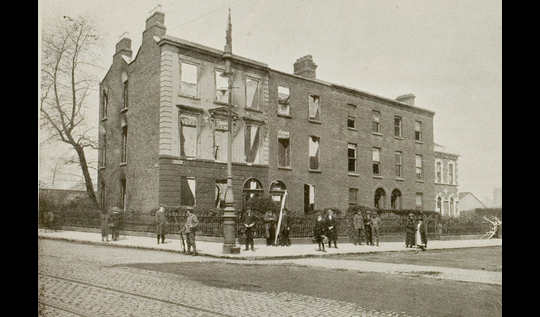
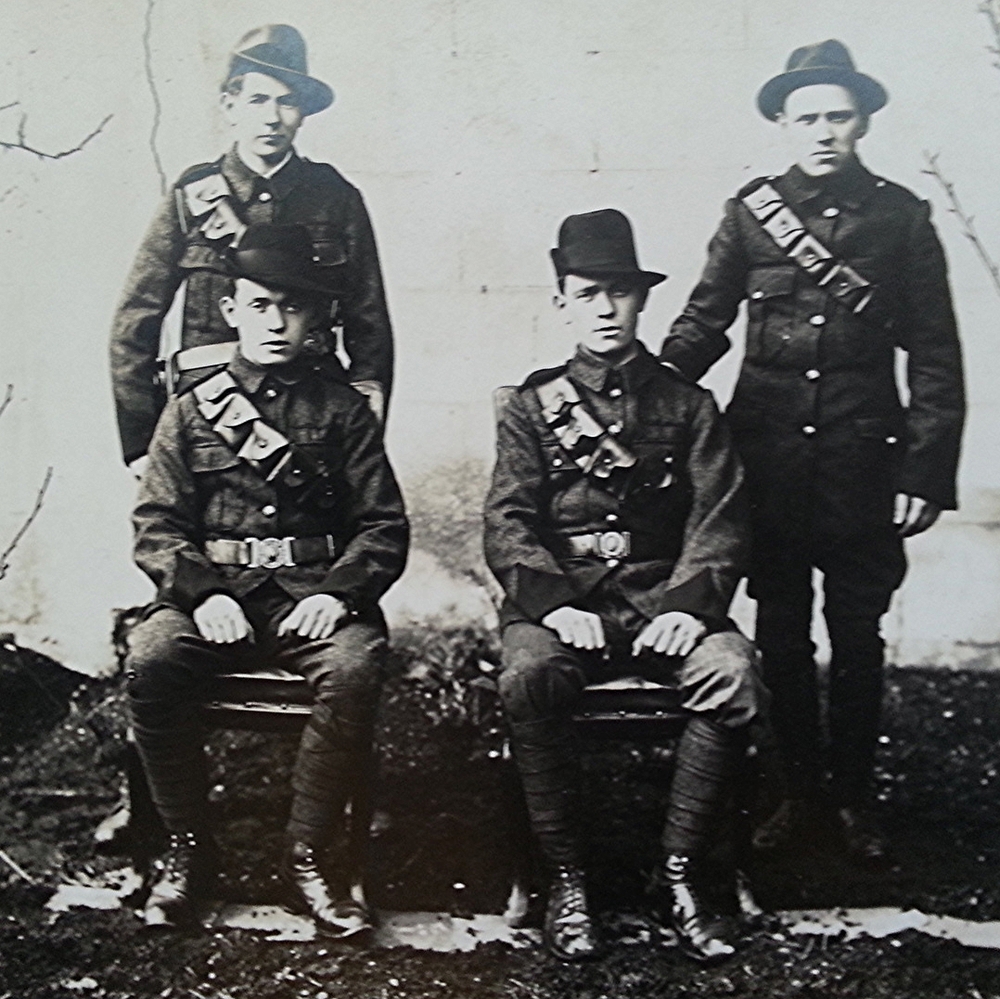
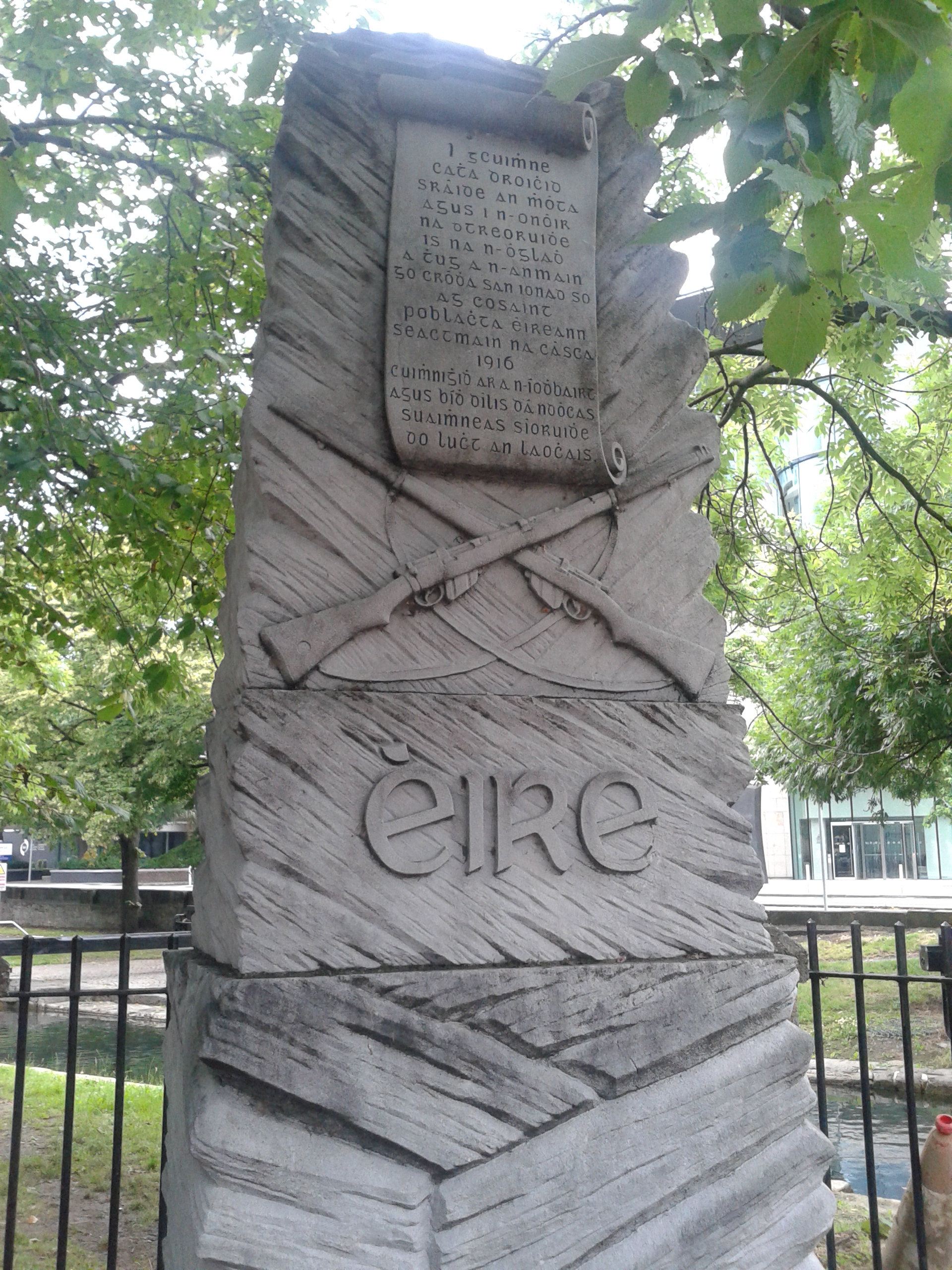
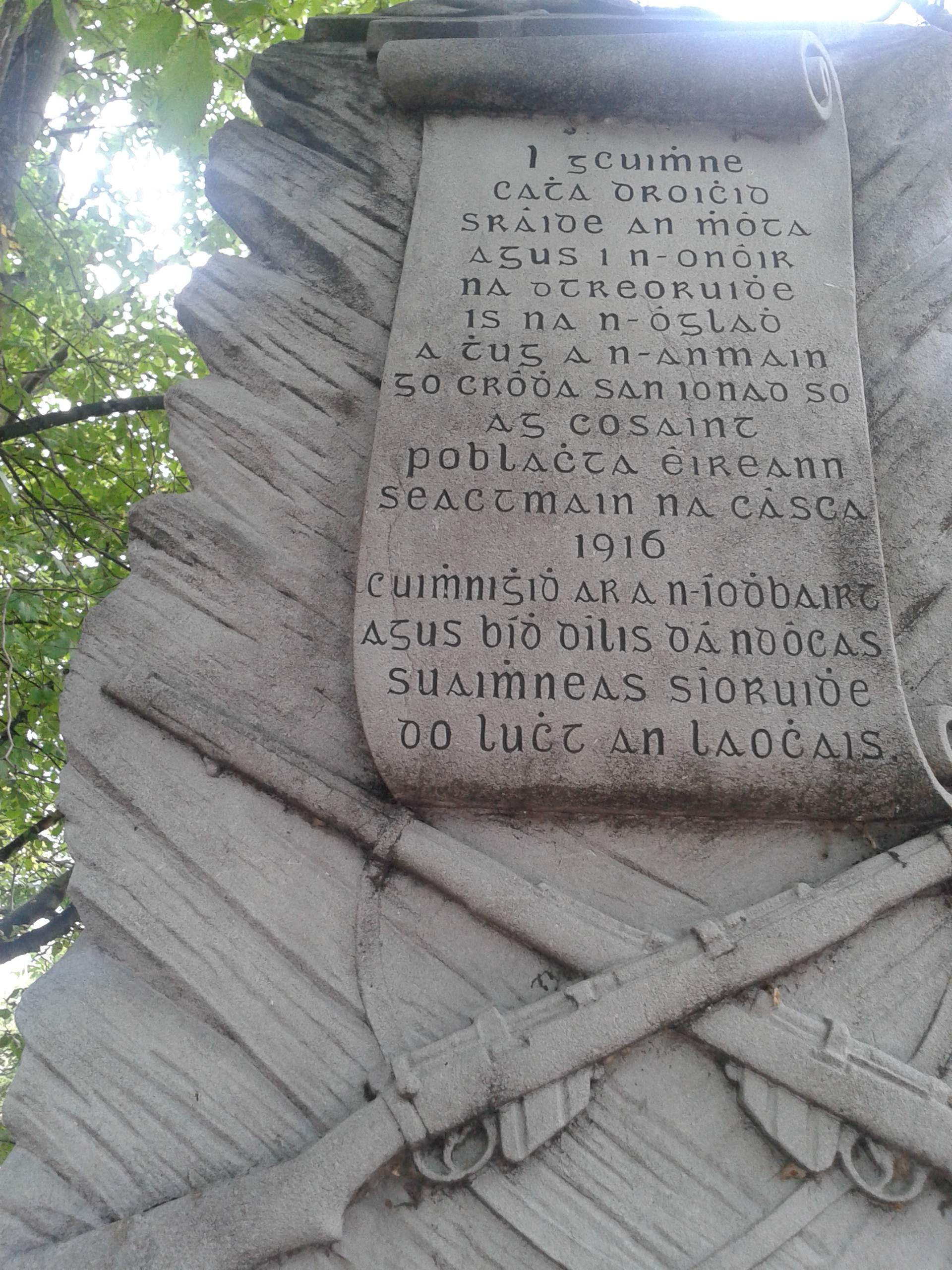
Ninety-nine years ago in the Battle of Mount Street Bridge, despite having only single-shot rifles and some pistols, the Volunteers held off two British Battalions, numbering approximately1,600 between them, for five hours. Approximately 234 men (including 18 officers) of the British Army had become casualties at the hands of fifteen insurgents.
End
Sources:
Article in http://www.irishtimes.com/culture/books/an-easter-rising-timeline-wednesday-april-26th-1916-1.2188089 drawing on When The Clock Struck in 1916 – Close-Quarter Combat in the Easter Rising by Derek Molyneux and Darren Kelly, Collins Press, at €17.99.
Remembering the Past – the battle of Mount Street Bridge, by Aengus O Snodaigh, article in http://www.anphoblacht.com/contents/6137
Article on the “Howth rifle” in http://www.historyireland.com/20th-century-contemporary-history/the-mauser-model-71-rifle/

