MARCH FOR MOORE STREET CONSERVATION FOLLOWS FOOTSTEPS OF 1916 RISING

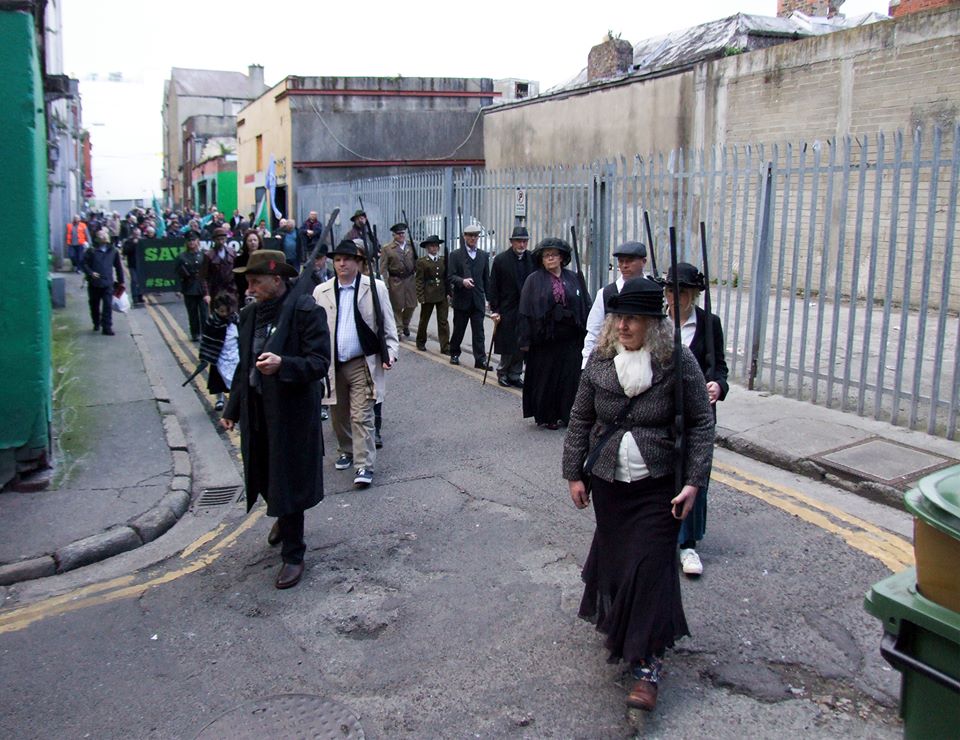
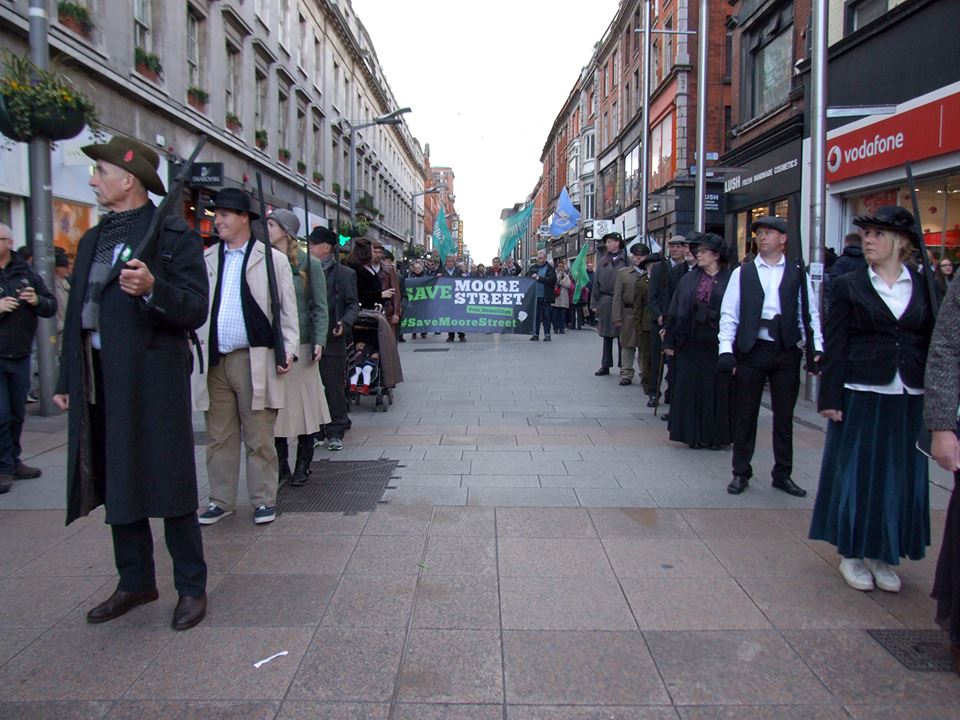
The march called to save “the Revolutionary Quarter” of Moore Street followed the footsteps of the GPO garrison on Easter Monday but, upon reaching the GPO, continued on along the that week’s Saturday surrender route up to the Rotunda.  Wheeling left then, the march proceeded on to the junction with Moore Street, where the British Army had their barricade and machine gun on Friday Easter Week — the cause, along with the sniper in the Rotunda tower, of many deaths and injuries in Moore Street.  The march wheeled left again into Moore Street and proceeded to the rally outside the GPO, where speakers were to address them and artists to perform.

from Save Moore Street 2016 campaign

https://www.facebook.com/SaveMooreStreet2016/photos/?tab=album&album_id=1260539983971351

The Save Moore Street 2016 campaigners and supporters gathered well over an hour before the advertised time outside Liberty Hall where their wardrobe department was busy outfitting people while a steward organised people for photo shoots, leafleting and kept the crowd informed.

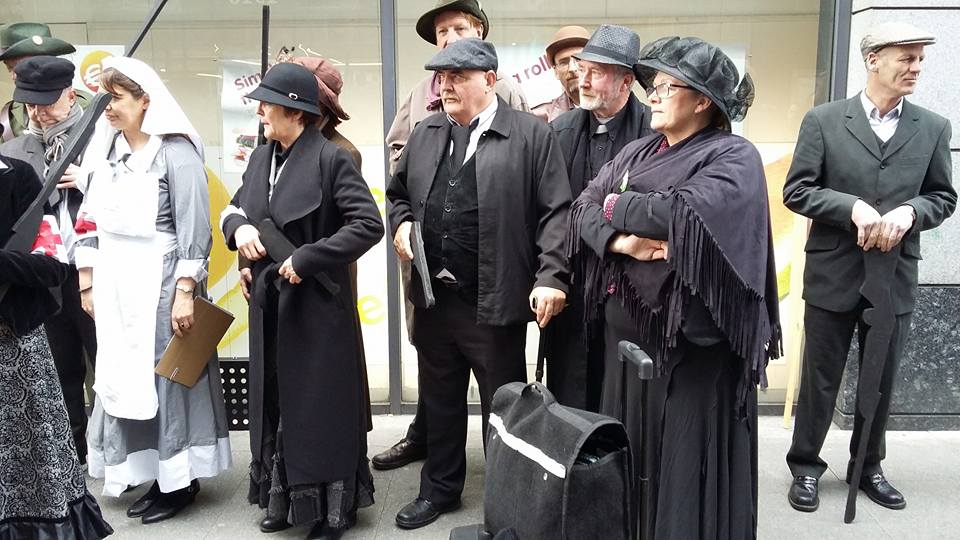
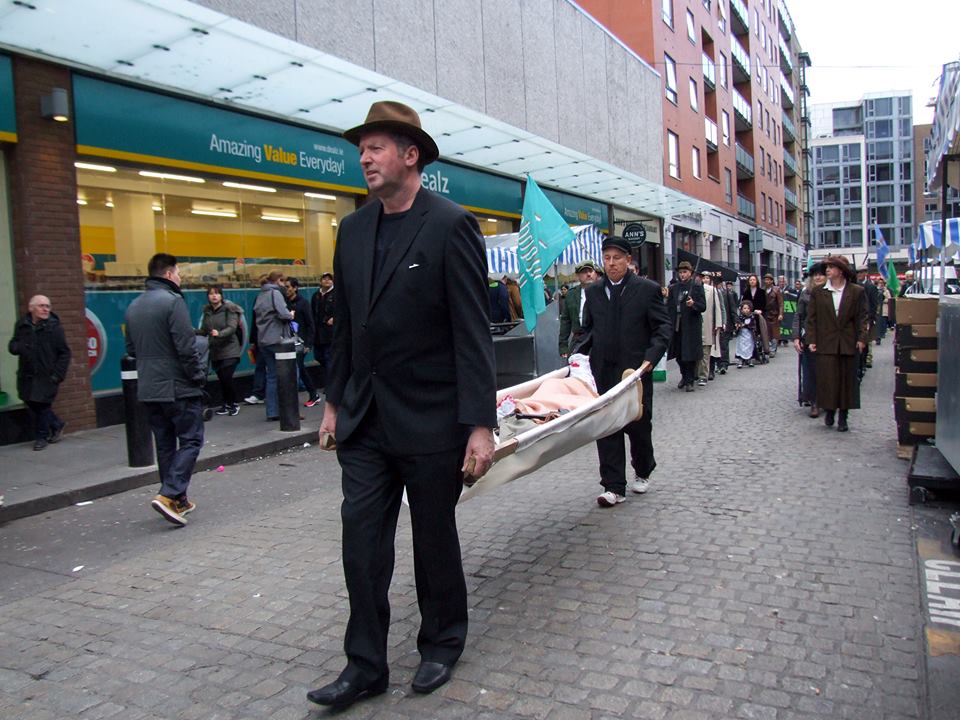
By the time the march set off from Liberty Hall it had gathered many, quite a few in period costume and some others joined it along the way. Many had come already dressed in period costume or were decked out by the wardrobe department of the Save Moore Street 2016 campaign and a solid group of them marched behind the new campaign banner.

Longish View March Abbey St Xroads DB megaphone
Section of march crossing to west side O’Connell Street in foreground; section of march in background passing Wynne’s Hotel in Lower Abbey Street. (Photo: )

Others marched behind the original Save Moore Street (from demolition) 2016 banner while others carried banners of some organisations supporting the march: the Cabra 1916 Society, O’Hanrahan Car1ow 1916 Society, Dublin Says No, Munster Anti-Internment Committee, Republican Sinn Féin, Dublin IRSP …..

Led by two people with megaphones and, at times, spontaneously, they shouted: “Save Moore Street from demolition!”

With reference to the Chartered Land and now Hammerson’s huge shopping centre plan for the area, the marchers shouted:

Do we need another shopping centre? No! Do we need our heritage? Yes! Do we need our street market? Yes!” Also, “What do we want? Hammerson out! When do we want it? Now!”

Other slogans included: “Our history! Our heritage! Our street! Our Rising!”

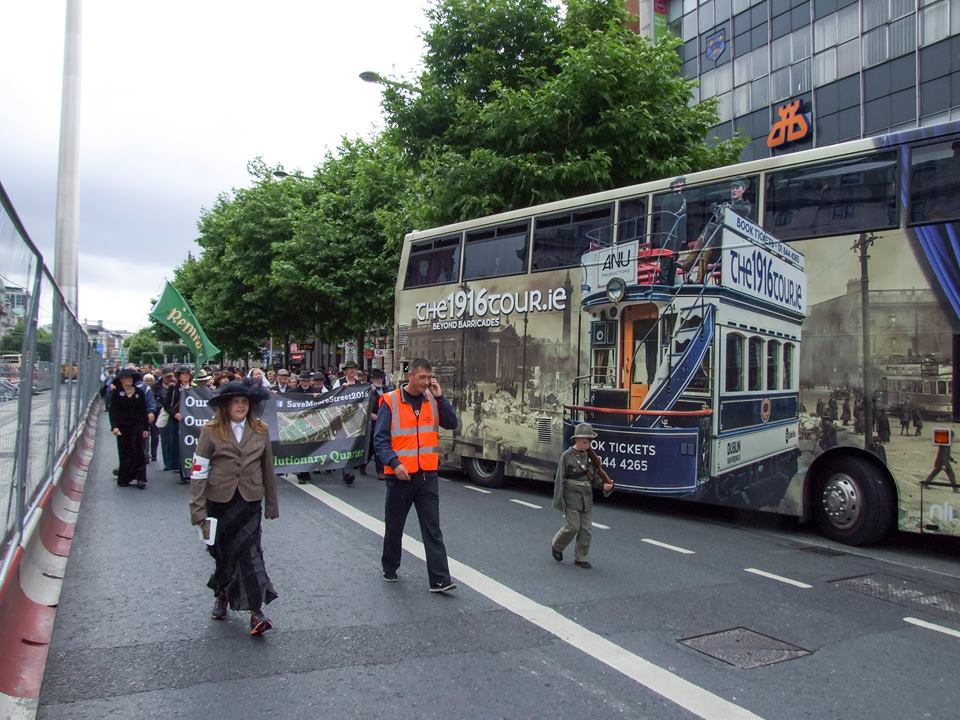
Moor St March passing 1916 Bus Tour.jpeg
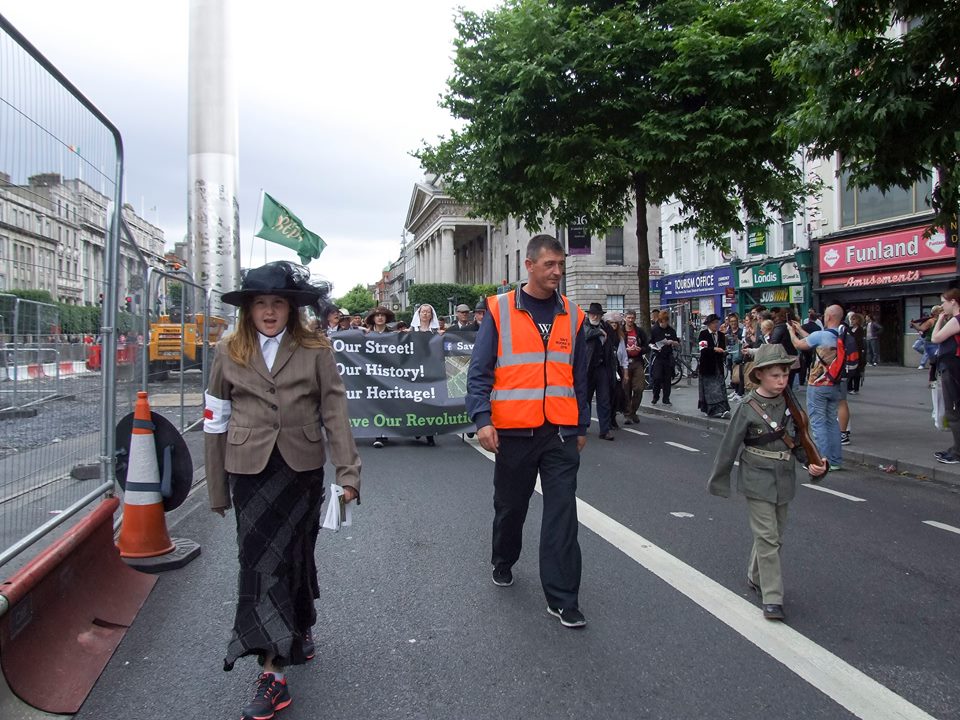
Amy and Josh youth supporters flank a march steward as the march passes one of the many kinds of 1916 tours being run in the city this year. (Photo: B.Hoppenbrouwers)

Amy Alan Josh leading OConnell StUp Lower Abbey Street the marchers went, in the footsteps of the GPO Garrison on that Easter Monday morning, past Wynne’s Hotel where Cumann na mBan had been formed in 1913, past the former Hibernia Bank on the corner of Abbey and O’Connell Street, where Volunteers fought and where Irish Volunteer Captain Thomas Weafer, from Enniscorthy was killed and his body consumed by the flames caused along the street by British shelling.

Turning into O’Connell Street, the marchers passed the location of Bloody Sunday 1913 when, after Jim Larkin defied a court ban to speak, the Dublin Metropolitan Police ran riot beating Lockout strikers and onlookers down to the ground with their truncheons.

COUNCILLORS, TDs, PROMINENT CAMPAIGNERS, ARTISTS AND HISTORIANS MARCHING

A number of elected representatives supported the march: seen in the crowd were Dublin City Councillors Cieran Perry, Pat Dunne, Anthony Conaghy and former Mayor Críona Ní Dhálaigh, also TDs Joan Collins and Maureen O’Sullivan.

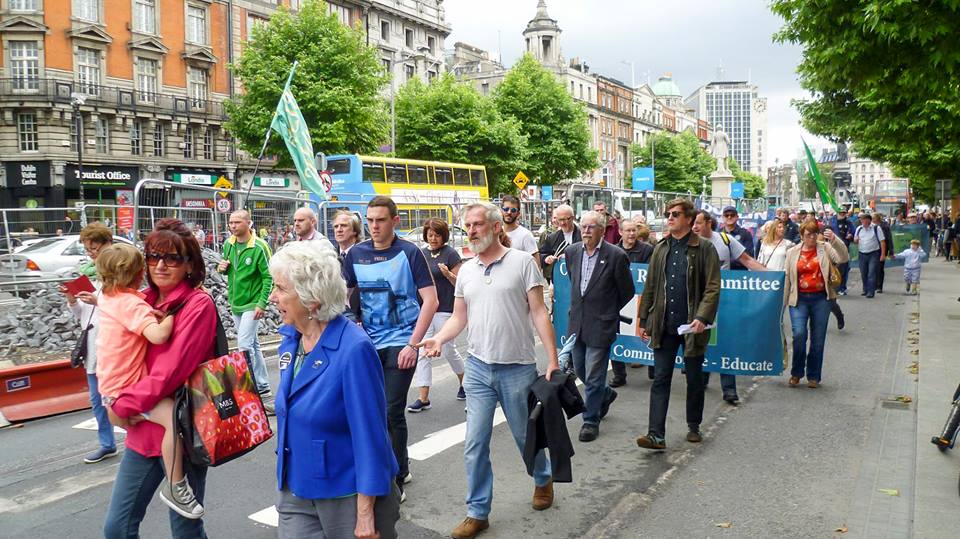
OSullivan Johnsons Ballagh Cooney
Section of the march in upper O’Connell Street, heading northwards, showing prominent supporters TD Maureen O’Sullivan in foreground and Robert Ballagh in middle section, flanked by Patrick Cooney, one of the founders of the 1916 relatives’ campaign Save Moore Street.

Among the artistic and dramatic sector whose participation was noted were artist and activist Robert Ballagh, drama director Frank Allen (who also organised the first Arms Around Moore Street event in 2009 — and has the T-shirt to prove it!), Brendan O’Neill — also an actor and long-time campaigner — and actor Ger O’Leary.

Relatives of prominent fighters in 1916 also participated and Jim Connolly Heron, great-grandson of James Connolly and among the earliest campaigners for Moore Street and Donna Cooney, great-grandniece of Elizabeth O’Farrell, who went out into the killing zone to organise the surrender, were both noted marching. Patrick Cooney, also of the specific 1916 relatives’ group that brought the legal challenge to the High Court marched along too and spoke from the platform at the rally. Gabriel Brady, grand-nephew of the printer of the 1916 Proclamation, Christopher Brady, was there too, as was Eoin Mac Lochlainn, a relative of the Pearse brothers and a relative of Seán Mac Diarmada was also present and in fact helped carry one of the SMS2016 banners.

A number of historians walked among the marchers, including Ruan O’Donnell, Dónal Fallon, Ray Bateson, Hugo McGuinness, along with local history activists such as Joe Mooney (of East Wall History Group) and Terry Fagan (of North Dublin Inner City Folklore Project). Ciarán Murphy, joint blogger and joint author with Dónal Fallon of the Come Here To Me publication marched along too. From the non-history world of academia, Paul Horan, lecturer of Trinity College (and who wrote the letter published in the Irish Independent on July 2nd denouncing the Minister of Heritage appealing the Barrett High Court judgement that the whole Moore Street quarter is a national monument) marched in period costume too.

THE SURRENDER ROUTE

Passing the General Post Office, the marchers continued along the route of the GPO/ Moore Street Garrison as they surrendered on the Saturday of Easter Week, up to the Gresham, where they laid down their weapons and on to the Rotunda, in the garden of which many had been kept for two days without food or water, while detectives of G Division from Dublin Castle came down to identify prisoners for execution. On the way the marchers passed the Parnell Monument, where British officers had displayed the battle-damaged “Irish Republic” flag upside down as a trophy for a photographer.
On this Saturday in 2016, volunteers (some in costume) accompanied the marchers along the route, handing out leaflets, which were eagerly taken by onlookers, while others – all in costume — collected donations along the way, distributing stickers in exchange. Well in excess of five hundred leaflets were distributed in the period of the short march.

SILENCE IN MOORE STREET

Minute Silence Moore St 9 July2016 T Byrne
The march stopped in Moore Street for a minute’s silence. (The building to the left is a section of the ILAC shopping centre; to the right may be seen a section of the hoarding in front of five buildings in the ‘1916 Terrace’ and the banner illegally placed on four of those houses (declared a ‘national monument’ since 2007) by the Department of Arts, Gaeltacht and Heritage.

Turning into and a little along Moore Street, the marchers were called to stop for a minute’s silence out of respect for the Irish Volunteers, Citizen Army and civilians who had been shot down in that street by British Army guns, for the six who had been shot by firing squad after they surrendered and for those who had risked their lives in an uprising against the biggest empire the world has ever seen.

All sound in the street died: marchers, street traders, bystanders, shoppers — all stood silent in a street which would otherwise be filled with the noise of a street market and busy shopping thoroughfare on a Saturday afternoon.

At the conclusion of the minute’s silence, the march recommenced, calling its demands with renewed vigour, out into Henry Street, right to O’Connell Street to form up for the rally by the stage in front of the GPO.

SPEAKERS AND PERFORMERS

The rapper Temper-Mental MissElayneous (Elaine Harrington) from Finglas was the first on the stage and performed her “Fakes and Manners” and “Buachaillí Dána” raps but continuous problems with the sound amplification at this stage of the rally meant much of what she was saying could not reach the audience (fortunately this was amended later).

Elayne Harrington torso stage
Rapper Temper-Mental MissElayneous (Elayne Harrington) from Finglas performing with bodhrán

Niamh McDonald, chairing the rally, welcomed the crowd and said that the campaign to save the Moore Street quarter was at a crossroads; developments had brought Irish property developers and the State into opposition to the appropriate conservation of the quarter but also now foreign vulture capitalists. “Save Moore Street 2016 will do what it takes to defend this historic quarter” she said, reiterating three basic demands of the campaign:

  • That a full independent expert assessment be carried out of the battlefield area

  • that all construction or remedial work be accessible to expert independent monitoring and

  • that the whole process by transparent to the public.

It was time for the campaign now to take the fight to the speculators and the next in a series of monthly events would be a demonstration against Hammerson themselves, McDonald told the rally.

Niamh Speaking, DB, Donal Fallon
Niamh McDonald, chairing the rally and speaking on behalf of Save Moore Street 2016 addressing the rally as one of the march stewards (in period costume) holds the megaphone for her. (Photo: )

The first speaker was then announced, historian and author Ruan O’Donnell, who reminded the rally that the Government of the time had been prepared to demolish Kilmainham Jail. The site had languished until volunteers took up the work of restoring it as a museum and now it is so successful that one has to queue to gain access to it.

Ruan O'Donnell speaking
Ruan O’Donnell, historian, lecturer and author addressing the rally. (Photo: )

O’Donnell castigated the attitude and thinking of successive Irish governments and pointed out that the GPO and Moore Street are sites of crucial importance in the struggle of the Irish people for nationhood.

O’Donnell’s speech, as did McDonald’s, received cheering and applause a number of times during their course as well as at the end.

Dónal Fallon, also author and historian, then stepped up to address the rally and also denounced the Gombeen state that had followed the struggle for independence, in which property speculators grew fat while the people suffer in a housing crisis.

Donal Fallon speaking
Donal Fallon, blogger, author & historian addressing the rally. (Photo: )

He reminded the rally of the struggle to save the Viking archaelogical site at Wood Quay and how, with Dublin City Council building over it, the writer and author of Strumpet City, James Plunkett, had said that Dublin had “shamed itself before the world.” Fallon said that Dublin needs to redeem itself and will do so in the struggle to save the Moore Street quarter.

Patrick Cooney (of the relatives’ group that took the High Court challenge against the Minister of Heritage) was then introduced and spoke of the recent Appeal Court appearance where the Minister’s team had been castigated by a Judge who insisted they had to specify against which part of Judge Barrett’s judgement they were appealing – her Department could not take a blanket position and say that they were against it all (SMS2016 comment: indeed, part of the judgement was that the banner erected on Nos.14-17 had been erected illegally, and the Minister has already stated that work would commence to remove it and to fill in the holes the builders put into the face of those buildings in order to fix the banner there). Cooney welcomed the announcement that the appeal would not be heard until December 2017, saying that this would give time for more pressure and perhaps a change of government.

Cooney also spoke of the long struggle to have the importance of the site acknowledged and to save it from property speculators and in passing also paid tribute to those who had occupied the building in January of this year.

Sean Doyle speaking
Sean Doyle, in period costume, addressing the rally. (Photo: )

Last to speak was Seán Doyle, speaking on behalf of the Save Moore Street 2016 campaign. Seán questioned whether we were worthy of the inheritance which had been bestowed upon us.

Referring to speculators and their facilitators, Doyle concluded by saying that “men in suits can be more dangerous than men in armour”.

All those speeches were enthusiastically applauded.

By this time the technical problems of the sound amplification had been overcome with the assistance of a member of the audience and Paul O’Toole stepped up to the microphone. He recalled that the best stage he had ever performed upon had been a couple of pallets drawn up in front of No.16 Moore Street in order to play at a rallying event there.

Paul O'Toole performing
Paul O’Toole playing and singing during the rally. (Photo: )

He then sang and played “The Foggy Dew” and “The Cry of the Morning”, followed by his own composition “We Will Not Lie Down”. The event could not end without Temper-Mental MissElayneous being given an opportunity to perform with the sound amplification in full working order and she launched into her “Fakes and Manners” rap.

The crowd having applauded the performers, everyone was thanked for contributing to the event, banners were rolled up and costumes packed back into cases.  Some people stood around chatting while the lorry that had provided the stage pulled out into the traffic, one of the organisers gave a radio interview to Newstalk and MissElayneous, on a roll now, performed for a small audience and video camera with the GPO as a background.

Across the road, outside the GPO, to which it relocated after some of its activists went to participate in the march, having earlier completed its 94th Saturday on Moore Street through which it has collected more than 50,000 signatures in support of Moore Street, the Save Moore Street From Demolition campaign table was also wrapping up.

And, despite threatening sky and pessimistic forecasts – it hadn’t rained once.

end

SPEECH BY REPRESENTATIVE OF CAMPAIGN TO SAVE MOORE STREET AT ANNUAL ANTI-INTERNMENT PICKET IN NEWRY 2nd July 2016.

A REPRESENTATIVE OF THE CAMPAIGN TO SAVE THE MOORE STREET HISTORIC QUARTER ADDRESSED THE ANTI-INTERMENT MEETING AFTER OTHER SPEAKERS, TO ASK FOR SUPPORT FOR THE FORTHCOMING CAMPAIGN MARCH IN DUBLIN.

Clive Sulish

Poster wall M St March 9 July 2016

A Chairde,

gabhaim buíochas libh as éisteacht a thabhairt dom agus buíochas freisin as cead cainte ag an ócáid seo ón Anti-Internment Group of Ireland.

A chairde, Níl saoirse gan stair. That is a saying in Irish which means “There is no freedom without history.” This is true in the sense that every struggle for freedom has a history but also in the sense that we cannot win freedom if we don’t know our history.

History is not dead; it is a living thing. We here today are all part of history, in our small way, part of the history of the struggle against the reintroduction of internment in our country, in particular in the Six Counties but creeping into the Twenty-Six as well.

DB speaking at Newry Annual AI 2016

History is not just about battles, although battles form an important part of the historical record. But more, history itself is a battleground! And there are historians who take their sides in that battle: some celebrate our struggles and relate the story of our heroes, while others lie about and twist our history, cast our heroes and martyrs as villains or even try to hide our history completely.

NÍL SAOIRSE GAN STAIR. Those who control the history of a people will find it much easier to control the people too.

On the Friday of Easter Week, as the GPO was in flames and the roof about to fall in, four evacuations from the GPO took place. There were two evacuations of Cumann na mBan, one of them taking the wounded under fire to Jervis Street Hospital. Then another two evacuations, one for a charge on the British barricade at the end of Moore Street, all of which were shot down, dead, dying or wounded. Another evacuation of more than 200 men and women occupied a terrace of houses, tunneling through the walls, from house to house and it was from there that they eventually surrendered on the Saturday.

For some reason that history was kept from us. As depicted in the Michael Collins film, where the GPO garrison is shown coming out from the GPO with their hands up, we thought that’s how it was. But it didn’t happen like that. The Moore Street history was kept from from us.

Decades later, in the 1970s, as property speculators crawled over Dublin and ripped it apart for their own constructions, a strong financial reason was created to conceal the Moore Street history. Then after 16 years of campaigning, the State finally granted a concession and nominated just four buildings as a National Monument. But their plan involved pulling down neighbouring buildings. This would then have facilitated the property speculator’s plan to demolish the rest and to build a huge shopping centre over and around those four houses, all the way from O’Connell Street down to Moore Street and all the way from Parnell Street down to Henry Street. Into that shopping centre, the four houses would be a shoebox museum, with a cafe inside and perhaps a Mac Donald’s on one side and a Starbucks on the other.

But they were stopped. They were stopped by men and women who occupied those buildings, and who blockaded it for six weeks.

Then there came that decision of a High Court judge, that the whole quarter was a historic battleground. Not just four buildings, not just a terrace, but other houses too, the streets and back lanes. He declared the whole to be a National Monument.

So of course there were great celebrations among the campaigners. But what happened next? The Minister of Heritage, which had been her title, announced she was going to appeal the decision. And the speculators asked for a seven-year extension on their planning permission, which it seems Dublin City Council will grant them.

NÍL SAOIRSE GAN STAIR. We are all a part of history. We need to know it. We need to defend it. Not for the past – or at least, not only for the past. But for our present. And for our future. The future of our children and of generations to come. A future free from colonialism. Free from speculators. Free from vulture capitalists.

As an aspect of that resistance, that defence of our history, we will be marching next week on Saturday in Dublin. There are leaflets here beside me on the table for you to take, not just advertising the event but also explaining the situation.

We would hope that you would all stand and march with us, shoulder to shoulder, in Dublin next week, in defence of our history against State and speculators, in defense of our heritage, our past and our future.

Go raibh maith agaibh.

SPEECH BY SAVE MOORE STREET FROM DEMOLITION REPRESENTATIVE AT RALLY AFTER MARCH 30th JANUARY 2016

Diarmuid Breatnach

Go raibh maith agat a Chathaoirligh agus a Choiste Eagraithe as an gcuireadh chun cainte ar son feachtas Shábhála Ó Leagaint Shráid an Mhúraigh. Go raibh maith agaibh freisin, a lucht tacaíochta, as a bheith i láthair agus as bhur néachtanna go dtí seo.

Thank you Chair and Organising Committee for the invitation to speak on behalf of the Save Moore Street From Demolition Group and to supporters of the campaign here today and for their deeds in the past.

The Save Moore Street From Demolition group began in September 2014, founded by a handful of people who had supported other Moore Street campaigners over the years and at times helped with organising events. Our call to do something different was the emergency looming when Chartered Land offered to hand over the houses of the national monument, No.14-17, to Dublin City Council in exchange for the ones owned by them, No.s 24-25. We knew that once O’Reilly got those two, he would have demolished them …. along with the rest of the 1916 Terrace all the way up and including No.18.

Brendan Viv man
Moore Street, November 2014, Vivienne Lee at the weekly campaign table while people sign the petition. Brendan O’Neill, an early supporter, signing.

The Council’s Chief Executive, Owen Keegan, was completely in favour but he had a problem: since this involved disposal of Council assets, the deal could not be agreed by officials but would have to be voted for by a majority of Councillors. So it was put to them and he recommended acceptance. And the SMSFD group was born to fight that.

We put up a table with a petition every Saturday in Moore Street. We lobbied Councillors on line and at Council meetings. We gave out leaflets in Moore St. We set up FB pages and kept them lively every week, slowly building up our support. Down in Moore Street, we interacted with the street traders, small shops and of course with passers-by.

Number of people signing the petition at the Moore Street stall in its early days
Number of people signing the petition at the Moore Street stall in its early days, Robbie Lawlor at the table.


I’d be lying if I said there were not times when we were tempted to stop. Maybe times when only three of us were there and when one of that three was off sick or away, or even two. But others did come by to help us from time to time.

And when we gave the emergency call about the planned demolition of the buildings, when we called the emergency demonstrations for two consecutive days in the street, the response was immediate. And it was active. The people who occupied those buildings saved them from being demolished.

And the campaign that we have now built together will hopefully ensure that the 1916 Terrace will be saved for the benefit of generations to come, both in Ireland and around the world.

TERRACE AND SITE

The experts employed by the State and the speculators tell us that one building or another in the terrace is not a 1916 building.  But the fact is that there has never been an independent survey of the site.  Can we trust experts employed by speculators who care nothing for history or heritage, whose only concern is making lots of money?  Can we trust experts employed by a State that has cared little throughout its history for heritage, culture or history but has been focused instead throughout on serving the Gombeens in our country and vultures from abroad?

I think we cannot. But regardless of what any expert may say, whether independent or not, no-one can deny that terrace is the site of the GPO garrison. The whole terrace. Sixteen houses. Not four.

Moore Stret December 2014, the weekly campaign stall in its early days -- Brónagh Ní Loing, Diarmuid Breatnach at table with Mel Mac Giobúin talking to an interested passer-by
Moore Stret December 2014, the weekly campaign stall in fourth month — Bróna Ní Loing, Diarmuid Breatnach at table with Mel Mac Giobúin talking to an interested passer-by

Sixteen – something of an important and recurring number in connection with the Rising. The year was 1916. The number of executions was sixteen. And there are sixteen houses.

That whole site is a historic site and by any rational, historically-minded appraisal, not only deserves preservation, but cries out for it. Cries out for preservation, Brothers and Sisters, in the midst of this historic quarter, this small area in the heart of Dublin, with its last remaining street of a whole market area, centuries old, now buried under the ILAC. A small historic quarter with artifacts, points of importance, buildings and sites of importance going back to the Land War, the 1913 Lockout, the 1916 Rising, the War of Independence, the Civil War ….

BRICKS AND MORTAR

It is just bricks and mortar,” some of our critics have said. “History is about people, not buildings.” Of course, history is about people. And not just leaders, but the mass of people who, in the midst of their daily struggles to live, to work, to raise families, dare to dream. And where do dreams happen? In the imagination.

And has psychology not taught us the importance of symbols? This building behind me has a symbolism of great potency. The faces of the our martyrs, our flags, the pictures of the starving people of the Great Hunger, the words of speeches and proclamations which we read in little symbols of written words, plaques and monuments …. the very letters on paper, also symbols to convey meaning …. even our spoken words ….

All these symbols give shape and expression to our dreams. Not only the dreams which we experience in our sleep but the great dreams of humanity, the waking and sleeping dream, of freedom, peace, in which to pursue our interests, in which to seek happiness.

SPECULATORS

These our dreams, our human dreams of progress for mankind, are not shared by all.  They are not shared by Joe O’Brien of Chartered Land.

They are not shared by the board of directors of Irish Life, who buried the rest of the centuries-old market under their architecturally-hideous ILAC shopping centre. And who seek to build further out into Moore Street and upwards and have been granted permission by Dublin City Council Planning Department to do so.

And so we must conclude, must we not, that our dreams are not shared by such senior officials in Dublin City Council as Owen Keegan and others running the Planning Department.

No. They do not share our dreams for the future, nor our respect for what was valuable in our past.

December 2014, crowd signing the petition in Moore Street, Brónagh at the table
December 2014, crowd signing the petition in Moore Street, Bróna at the table

An Bord Pleanála has approved the massive shopping centre plan to construct an architectural horror from O’Connell Street across to Moore Street, and from O’Rahilly Parade down to Henry Street, in the course of which they will destroy the 1916 Terrace and enclose a shoebox museum … next to a MacDonalds, perhaps, or a Starbucks …. Constructing a cathedral to Mammon, to the gods of chain stores and eatery franchises ….. So we must conclude that An Bord Pleanála does not share our dreams either.

Lobby of Dublin City Councillors against the 'Land Swap" in Moore Street, 4th October 2014
Lobby of Dublin City Councillors at City Hall 4th October 2014against the ‘Land Swap” in Moore Street, — picket organised by Save Moore Street From Demolition campaign. Signed petition sheets sellotaped together stretched — 2nd and 3rd participants from left are Paddy Cooney and Proinsias Ó Rathaile, of the Save Moore Street campaign.

But does an Bord Pleanála act independently? No it does not, as we well know and as been shown in many planning controversies in the past. It follows the dictates, nods and winks of its political masters, the political class and its nominees in the Dáil. And these do not belong to one political party only, but to several.

And Minister Heather Humphreys, their representative with special responsibility in this case, patently does not share our dreams nor our respect for heritage.

The board of directors of the giant property company Hammerson do not share our dreams either. They dream of big ugly buildings and giant car parks where chain stores and restaurants and franchise eateries can market their goods, depriving shops and goods of any individual regional or national character, making one city’s commercial centre look like any other, from Dublin to Dupont, from Cork to Caracas.

But behind all this array of servile public departments and officials and political representatives, aiding and abetting the clutch of home-grown speculators and foreign vultures, there are the final villains, the whole Irish class of neo-colonial, money-grabbing, huckstering, fumbling-in-a-greasy-til, greedy, incompetent, philistine shower that climbed up upon our backs in 1921 – the Irish gombeen class.

CAPITALIST CLASS

When we have viewed with dismay how little our native ruling class cares for our land, our history, our natural resources, or very PEOPLE ….. some among us have said: “But how can they treat with such disrespect the history and artifacts of the men and women who gave them independence?  Their own ancestors?”  But such commentators are mistaken, brothers and sisters.

The heroes of 1916 are not the political ancestors of the gombeen class – they are ours! A few who fought in 1916 and later became part of the gombeen class from the 1920s onwards, true …. but when they did so, they disowned their forebears.

WE have not disowned the heroes of 1913, nor of 1916, nor of struggles afterwards.

There has not been an independently-minded capitalist class in Ireland since the late 17th Century – and they were nearly all Protestants, of one sect or another. They sought national unity and independence and when they were denied it, rose in rebellion for political, economic and cultural independence in 1798 …. and again in 1803 … But they were defeated and their survivors changed their ideas or left the country.

This class of native capitalists that we have now in the 26 Co.s, mostly of Catholic religious background, grew up under foreign domination. They learned early on to doff the cap to the foreign master, ape him in clothes and manners, speak his language and carry out little deals behind his back.

They learned to be ‘cute hoors’ but they never learned to fight and risk life and limb for a principle. They scramble to get to the top of the dung-heap and crow from there. Or they push and jostle one another to get their snouts in the trough.

They never stood up on their two legs, with back straight and head up, and flew the flag of freedom. They could never stand straight on a gallows and cry “God Save Ireland!” before they were hung, or stand defiantly in front of a prison wall to receive the bullets of their executioners. They never faced the batons of the Dublin Metropolitan Police or the rifles and bayonets of the Royal Irish Constabulary.

And this is why James Connolly, who spent his last days in the building behind me and later in Moore Street, before he was taken away and they made sure to shoot him dead even when they realised that they were going too politically far with the executions …. And by the way the newspaper of Irish Catholic nationalist gombeen man William Martin Murphy, the Irish Independent, called for his execution …..
this is why James Connolly said:
“Only the working class remain as the incorruptible inheritors of the fight for Irish freedom.”

Connolly saw the foreign-dependent and internally corrupt nature of the native capitalist class even before they seized power over his body and the bodies of others who had fought for independence and a just society. And by the way, nor did they stop there – they added hundreds more bodies to ensure they kept the power they had grabbed. And out of our every generation, sent thousands of our youth into exile, rather than build a country that would keep them at home, give them work, housing.

THE CENTENARY & IDEALS

As I come to the end of what I have to say here, early in the centenary year of the 1916 Rising, and I thank you for your patience, I reflect that it appears to be a law of life that for everything we gain, there is a price to be paid.  We have learned that many, oh so many times throughout our history, have we not?

What we are asking for — no demanding — from our rulers, in the case of the campaign for the Moore Street historical quarter, is not much in the grand scheme of their plunder and exploitation.

It is in their power to give it and to pay the political price do so, without bringing down their house of cards.

But if they will not grant it, what then? Well, then we must fight for it. And we too must be ready to pay the price. And I think it is clear that there are many here, and not only here, prepared to pay that price.

And I can do no better than to quote the words of another one who spent his last few days in this building behind me and in the Moore Street 1916 Terrace, who also had some valuable words to say to us. Pádraig Mac Piarais, in his poem The Rebel:


And I say to my people’s masters:

Beware,

Beware of the thing that is coming,

beware of the risen people, 


Who shall take what ye would not give. 


Did ye think to conquer the people, 


Or that Law is stronger than Lfe and than men’s desire to be free?

We will try it out with you,

Ye that have harried and held, 


Ye that have bullied and bribed,

tyrants,

hypocrites,

liars!

End.

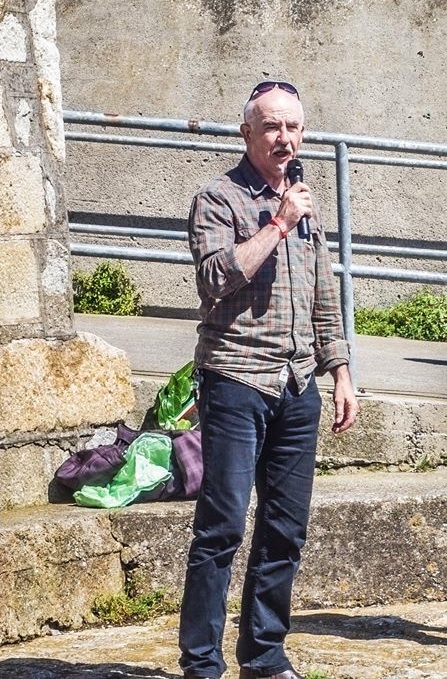
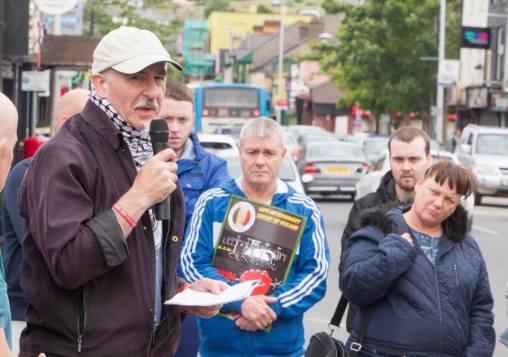
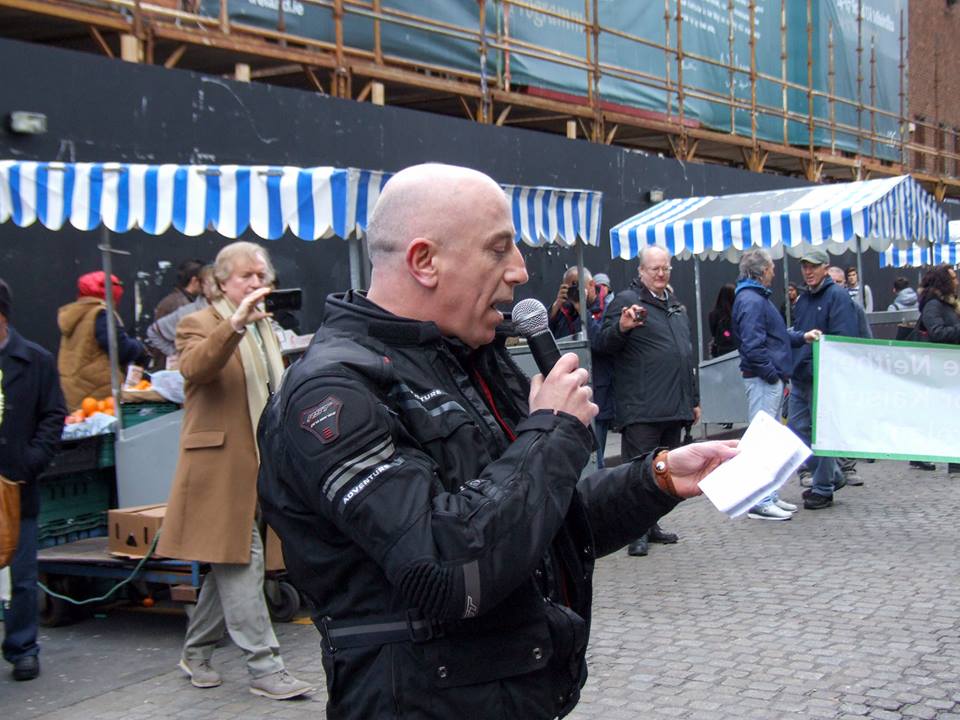
Diarmuid Breatnach, who gave the speech, earlier at the march, as it came down through Moore Street into Henry Street, heading for the GPO and the rally. Behind Diarmuid is the entrance to Henry Place, evacuation route of the GPO Garrison in 1916.
Diarmuid Breatnach, who gave the speech, earlier at the march, as it came down through Moore Street into Henry Street, heading for the GPO and the rally. Behind Diarmuid is the entrance to Henry Place, evacuation route of the GPO Garrison in 1916. (Photo: Save Moore Street 2016)

WORKING CLASS HERO IS COMMEMORATED IN THE EAST WALL AREA WHERE HE LIVED

Diarmuid Breatnach

On Sunday 8th May a working-class hero was commemorated in the East Wall area in which he lived. Walter Carpenter was a native of Kent, in SE England and came to Ireland to help found the Socialist Party of Ireland 1 with James Connolly in 1909 in Dublin. Among other activities a campaigner around housing issues for the Dublin working class, he reared his sons in socialist belief so that it was no surprise that both Wally (Walter jnr) and Peter joined the Irish Citizen Army and fought in the 1916 Rising. As a result of the repression of the Rising, one son ended up in Frongoch concentration camp in Wales, while the other was in hiding. Later, both brothers also fought against the Free State in the Irish Civil War; Wally was interned and went on hunger strike.

Lining Up Outside SOCC
Assembling to march outside the Sean O’Casey Community Centre

Jailed for opposing British Royal visit to Dublin

Rising to be Secretary of the Dublin Branch of the SPI in 1911, Walter Carpenter was jailed for a month for the production while speaking on a public platform of Connolly’s leaflet attacking the Royal visit that same year. Soon afterwards he was an organiser for the newly-formed Irish & Transport Workers’ Union. During the Lockout, he was sent by Connolly to Britain to rally the support of trade unionists for the struggle of the Dublin workers and was apparently an effective speaker there. That same year Walter Carpenter was elected General Secretary of the Tailors, Machinists and Pressers’ trade union, generally known as “the Jewish Union” due to the preponderance of its members being from that background.

Two sections march
United in purpose but fragmented in marching

Walter also became active in municipal politics, striving to make Dublin City Council meet its housing regulation responsibilities in the terrible housing conditions of the city of that time. There were many other sides to this campaigner too, which a read of Ellen Galvin’s pamphlet will reveal.

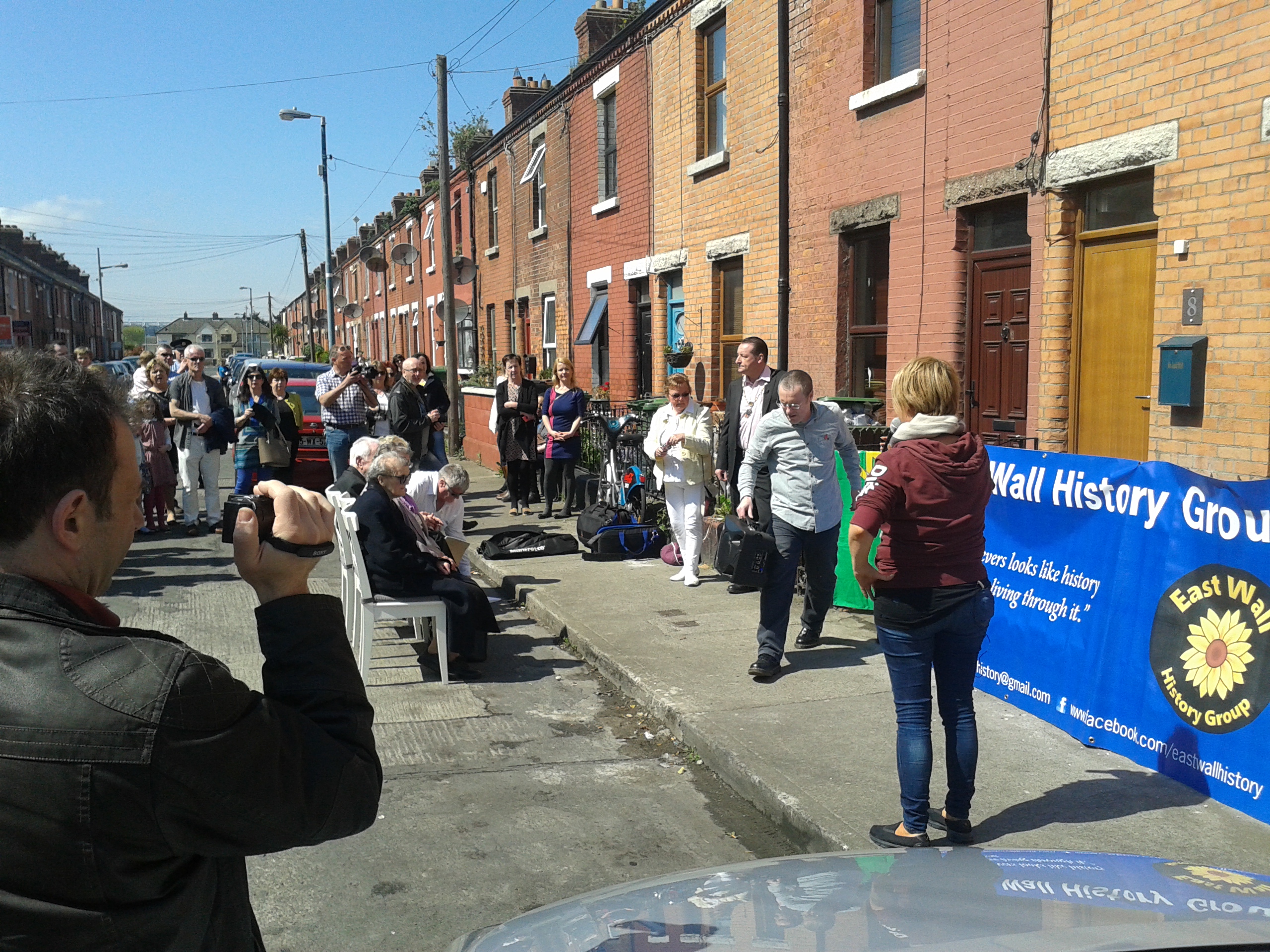
The East Wall History Group had earlier had a plaque erected on the wall of the house where he had lived, No.8 Caledon Road and organised an event around its unveiling on Sunday. The event began with a gathering at the Sean O’Casey Community Centre in East Wall, where an introduction to the event and to Walter Carpenter’s importance in the revolutionary and radical social history of Ireland was given by Joe Mooney, one of the organisers of the event. As well as local historians, socialists and Republicans, the event was attended by his surviving grandson, great-grandchildren and partners and their children. Also present was Ellen Galvin, who wrote a booklet on his life which was launched after the unveiling, back in the Sean O’Casey Centre.

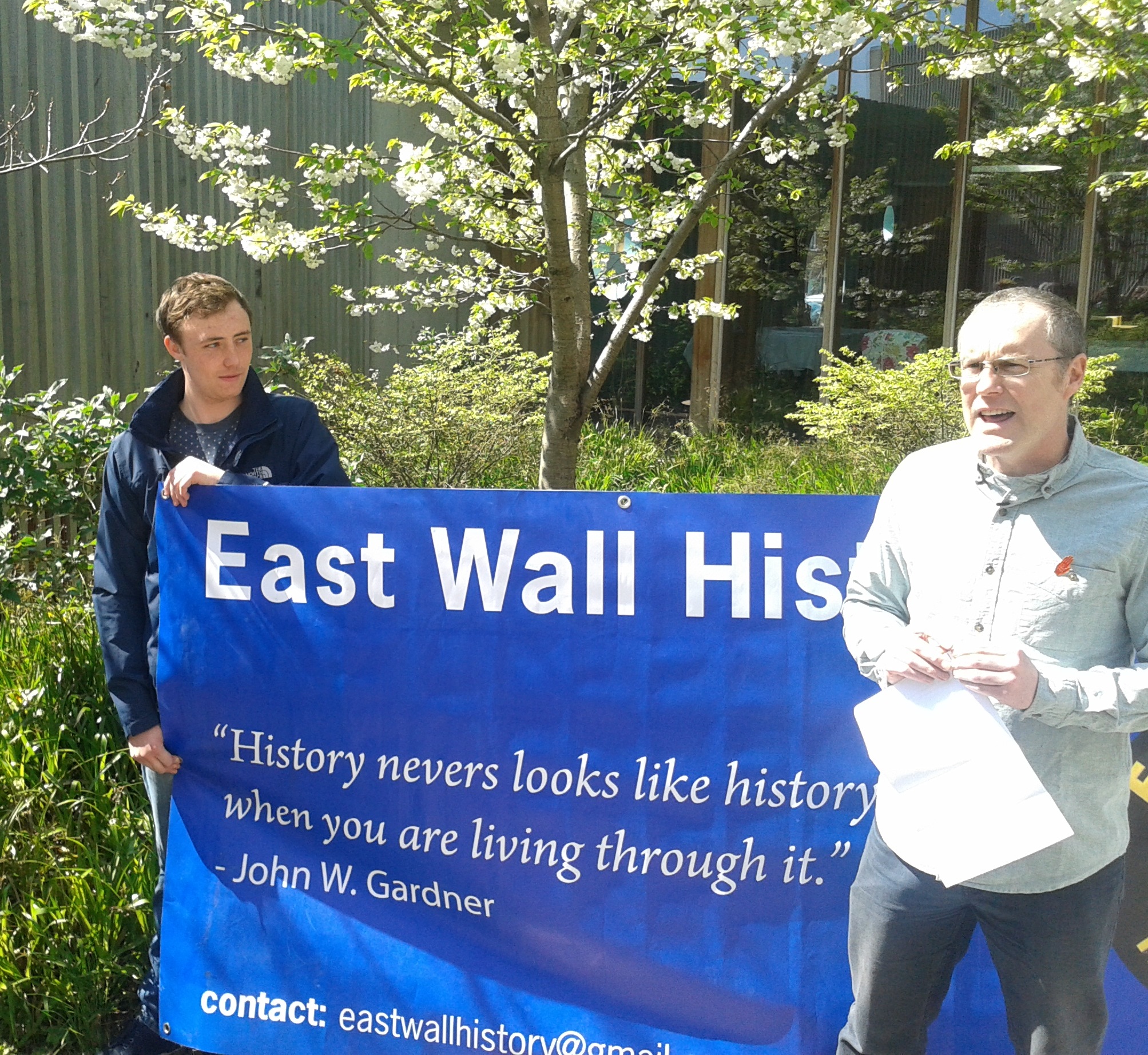
Joe Mooney with a few preliminary words about Walter Carpenter and the history of the area

Misfortune struck the event before it had even begun, with the news that Christy O’Brien, the piper who was to lead a march to the unveiling, had his pipes stolen from his car that very morning. Christy gives his service as a piper to many commemorative events, funerals etc. and, with the announcement of the misfortune, Joe Mooney also called for the spreading of the news in order to aid the recovery of the instrument. A set of bagpipes will cost thousands to buy or have made but it would be a rare musician or pawnshop that would negotiate for a stolen set (one which furthermore might be recognised at a musical event in the future).
(see also https://www.facebook.com/eastwallhistory/photos/a.593335330735681.1073741828.580261572043057/1042532349149308/?type=3&theater)

March to plaque past previous addresses of Irish resistance fighters

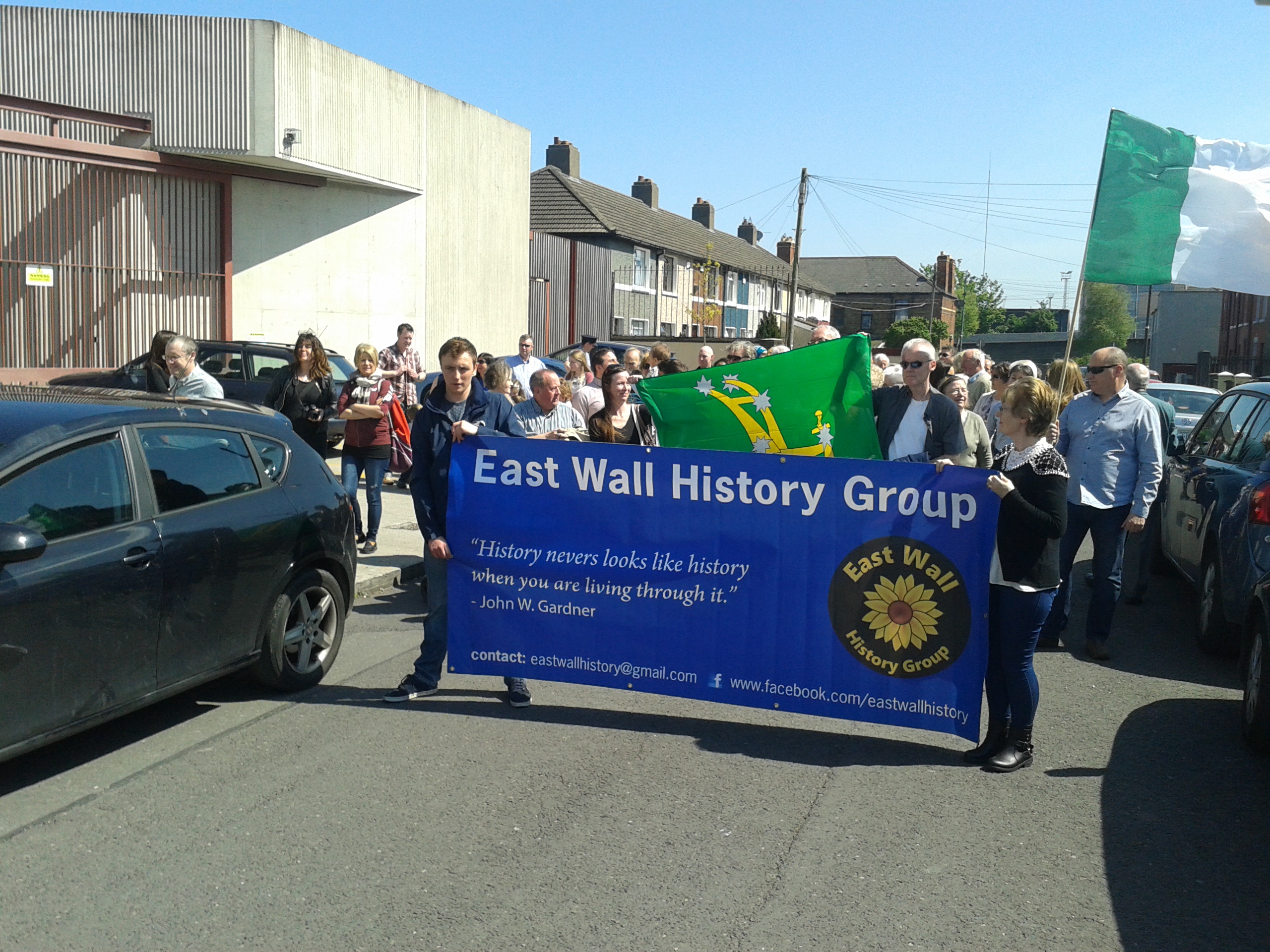
The march set off from the Sean O’Casey Centre without the piper, led by supporters carrying the banner of the East Wall History Group, a Tricolour and a Starry Plough (original green and gold version). Walking alongside were two Gárdaí and one wit commented that not only were descendants of the Irish Citizen Army present but also of the Dublin Metropolitan Police! 2

Caitríona Ní Casaidthe presiding over the plaque unveiling
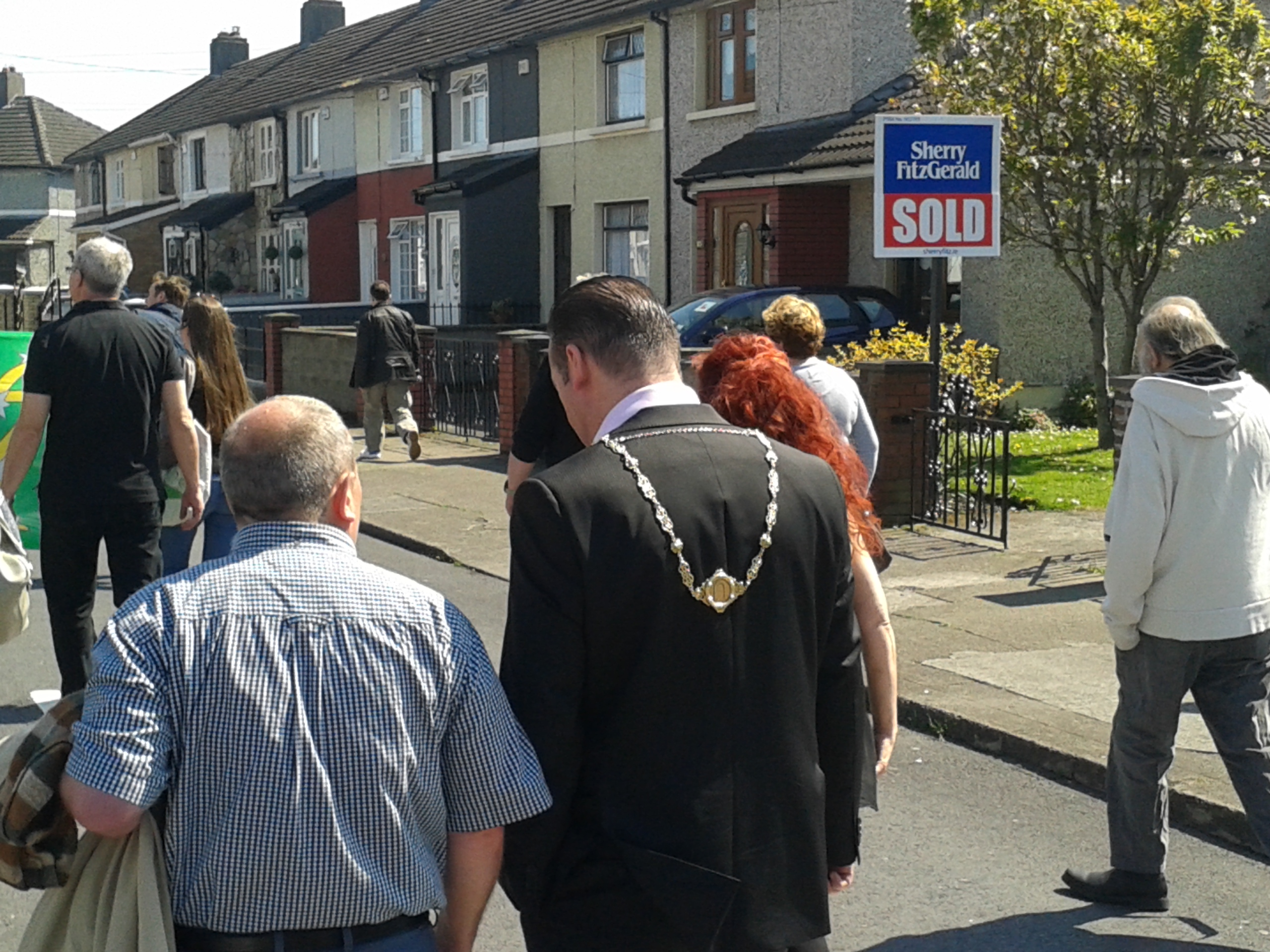
Deputy Dublin Mayor Cieran Perry in the march -- he also spoke at the unveiling.
Deputy Dublin Mayor Cieran Perry in the march — he also spoke at the unveiling.

Joe Mooney had told the crowd before the march began that they would pass a number of locations where fighters for Irish and working-class freedom had lived. These were: St Marys Road, Tim O’Neill at No.8 and father and daughter Patrick Kavanagh and May Kavanagh at No.24. Christy Byrne lived at No.45 and his brother Joseph Byrne was from Boland’s Cottages off Church Road, where also Christopher Carberry lived on Myrtle Terrace on Church Rd. All these were Irish Volunteers, while May was in Cumann na mBan. In Northcourt Avenue (now demolished, roughly where the Catholic Church stands), Patrick & William Chaney were in the Irish Citizen Army and in Hawthorn Terrace lived James Fox (Irish Volunteer) and Willie Halpin (ICA).

Joe added that at the junction of St. Mary’s Road and Church Street, the local Irish Volunteers had mustered to participate in the Rising, 100 years ago and also reminded the gathering that that very day, the 8th of May, was the centenary of the executions by British firing squad of Michael Mallin of the Irish Citizen Army and of Irish Volunteers Eamonn Ceannt, Sean Heuston and Con Colbert.

Eamon Carpenter, 94, grandson of Walter Carpenter (Photo D.Breatnach)

Upon reaching No. 8 Caledon Road, the former home of Walter Carpenter, Caitríona Ní Chasaide of the East Wall History Group introduced Eamon Carpenter, 94 years of age and a grandson of Walter Carpenter, who addressed the crowd in thanks and also about the life of his grandfather.

“The struggles of the past are not merely for commemoration”

Next Caitríona introduced the Deputy Mayor of Dublin, Cieran Perry, who pointed out the parallels between the dire housing situation in the early part of the last century, which Walter Carpenter had campaigned against, and the housing crisis in Dublin today. He castigated the officials of Dublin City Council who, despite the votes of elected Left Councillors, refused to use all the land available to them on a number of sites to build social housing and were instead preparing it for private development with a only fraction for social housing. For as little as 5% of the €4 billion of Minister Kelly’s oft-repeated proposed finance for social housing. i.e. €200 million, Dublin City Council could build over 1,300 homes. The struggles of the past are not merely for commemoration, Cieran went on to say, but are for celebration and for continuation, as he concluded to applause.

Caitríona then called on James Carpenter to unveil the plaque, which he did, to loud applause.Walter Carpenter plaque

After relatives and others had taken photos and been photographed in turn by the plaque and/or beside James Carpenter, Joe Mooney called on Diarmuid Breatnach to sing The Felons Of Our Land. Joe explained that Walter Carpenter had been fond of singing that son, that in the course of their participation in the struggle he and his son had also been felons, as had Larkin and many others. Joe also informed the gathering that Sean O’Casey related that during his childhood, there had been a tram conductor who had been fond of singing patriotic songs, including the Felons Of Our Land, of which Casey’s mother had disapproved. It had been an revelation for O’Casey that one could be a Protestant and an Irish patriot too.

Diarmuid, dressed in approximation of period clothing, stepped forward and sang the four verses, of which the final lines are:

Diarmuid Breatnach singing "Felons of Our Land" outside former home of Walter Carpenter. (Photo East Wall History Group)
Diarmuid Breatnach singing “Felons of Our Land” outside former home of Walter Carpenter.
(Photo East Wall History Group)

Let cowards sneer and tyrants frown
O! little do we care–
A felon’s cap’s the noblest crown
An Irish head can wear.
And every Gael in Innisfail
(Who scorns the serf’s vile brand)
From Lee to Boyne would gladly join
The felons of our land.

The crowd then marched back to the Sean O’Casey Centre to attend the launch of the booklet on Carpenter’s life.

Launch of book on Walter Carpenter by his granddaughter and grandson of his comrade

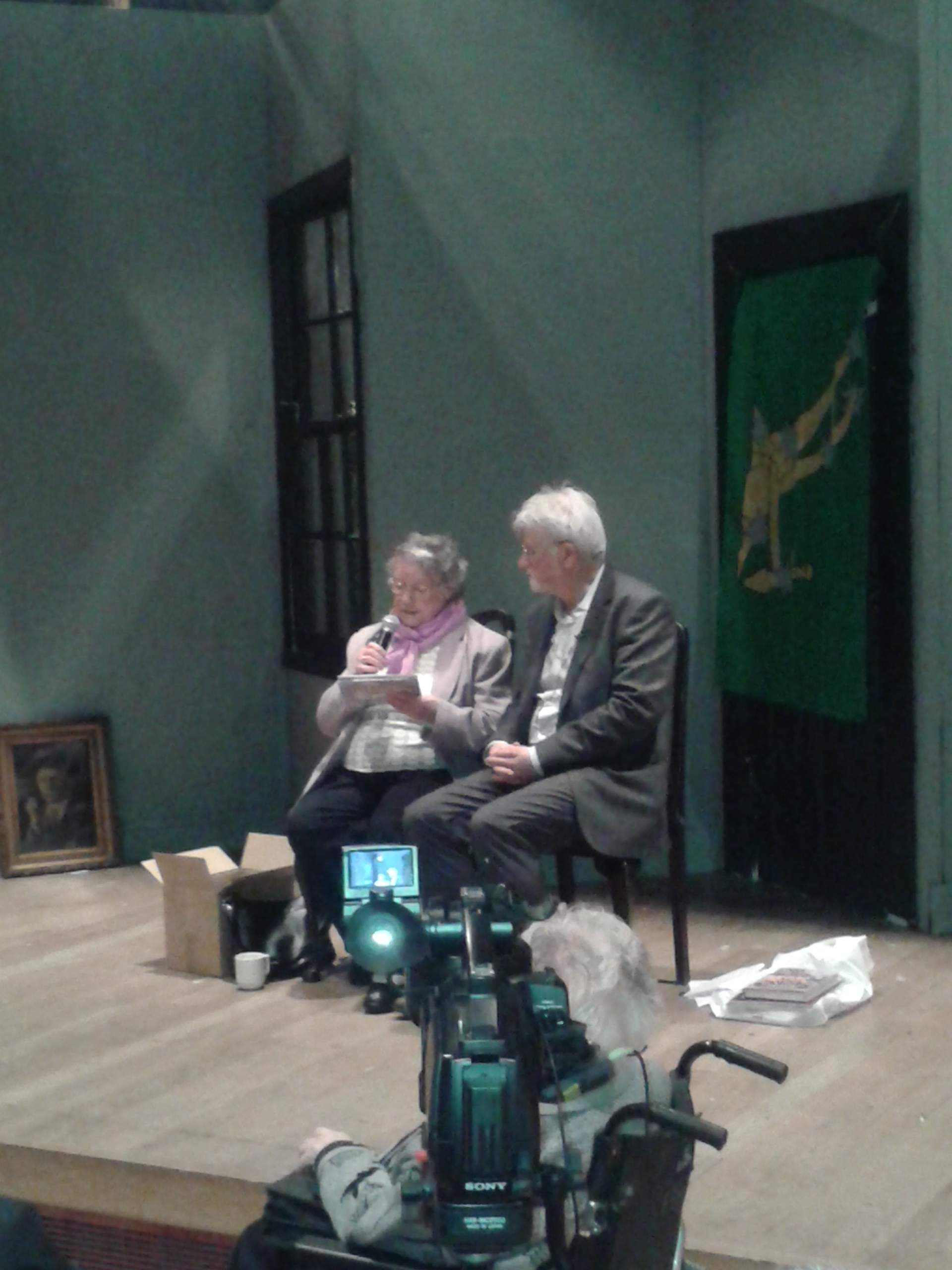
On the stage in the Centre’s theatre, were seated the author of the booklet, Ellen Galvin, alongside Michael O’Brien of O’Brien Press.

Ellen Galvin on stage at the Sean O'Casey Community Centre theatre and Michael O'Brien launching the book about Walter Carpenter. (Photo D.Breatnach)
Ellen Galvin on stage at the Sean O’Casey Community Centre theatre and Michael O’Brien launching the book about Walter Carpenter. (Photo D.Breatnach)

Michael O’Brien, addressing the audience, said he had wondered what qualification he might have to launch the book but on investigation discovered that he had not a few connections. His own grandfather, who was Jewish, had been a founder member of the Tailors, Machinists and Pressers’ Union, of which Carpenter had been the General Secretary until his retirement and so they must have known one another at least fairly well.

Also, Bill O’Brien’s father, Thomas, had been a communist and was active with Walter Carpenter in the Republican Congress in the 1930s. Walter Carpenter and Thomas O’Brien had both also been active in the Bacon Shops’ Strike of the early 1930s. Thomas O’Brien had been jailed during that strike along with Jack Nalty and Dinny Coady, both of whom had East Wall connections; subsequently Thomas went to fight Franco and fascism in Spain, where Nalty and Coady were both killed.

Joe Mooney called on Tommy Seery to sing The Bold Labour Men, a song about the 1913 Lockout written by a local man, which he did to strong applause. (Tommy is a member of the East Wall PEG Drama and Variety Group, in which he acts and also often sings – a recent performance, from which Tommy was unfortunately absent due to illness, may be seen here https://rebelbreeze.wordpress.com/2016/05/02/from-lockout-to-revolution-performance-of-east-wall-peg-drama-variety-group/).

Tommy Seery singing "The Bold Labour Men" about the 1913 Lockout (Photo D.Breatnach)
Tommy Seery singing “The Bold Labour Men” about the 1913 Lockout (Photo D.Breatnach)

Ellen Galvin spoke about Walter Carpenter’s life and his dedication to the advance of the working class and the struggle for justice.  Walter had been a supporter of equality for all, including gender, a man who read much and widely, who apparently learned Irish and campaigned for allotments for rent on Council-owned land while it was unused for housing.  He was against the consumption of alcohol but sympathised with people driven to its use by terrible housing conditions.

Joe then called on Diarmuid Breatnach to sing Be Moderate, written by James Connolly, to illustrate what it was that people like Connolly and those of the Irish Citizen Army fought for and for which some had given their lives. Diarmuid took the stage and explained that the song had been published in New York in 1910, the same year that he had returned to Ireland from the USA. There had been no indication of an air to accompany the lyrics, as a result of which it has been sung to a number of airs. Diarmuid heard it sung in London by an English communist to the air of a Nation Once Again 3 and at least one good thing about this is that it provides a chorus, with which he encouraged the audience to join in. He then sang the song, of which the final lines are:

For workers long, with sighs and tears,
To their oppressors knelt.
But never yet, to aught save fears,
Did heart of tyrant melt.
We need not kneel, our cause is high
Of true hearts 4 there’s no dearth
And our victorious rallying cry
Shall be “We want the Earth!”

Many in the audience joined in on the chorus:
We only want the Earth, 
We only want the Earth,
And our demands most moderate are:
We only want the Earth!

Eamon Carpenter delivered an impromptu tribute to Ellen Galvin, who he told the audience had lost her mother at the age of 13 years of age, from which time she had taken over the mother’s role for her younger siblings, ensuring the were fed, dressed and cared for. This tribute was warmly applauded while Ellen seemed embarrassed but also pleased.

This was another successful commemoration of the revolutionary history and, in particular, of the working class history of their area by the East Wall History Group. It is of great importance that the working class be appraised of their own history as distinct from the dominant historical narratives and that their revolutionary traditions be remembered, not as something dead and in the past but as part of a continuum of struggle for the emancipation of the class.

If there is a weakness in a number of such commemorations it is the lack of participation by local adolescent youth in these events – which may also imply a lack of engagement by this age-group. Nevertheless, should they go searching at some future date for the information and their connection to the history of place and class, they will find a treasure trove waiting for them in the work of this History Group.

Children & Parents left plaque

CONTACTS
The East Wall History Group may be contacted or viewed on FB at https://www.facebook.com/eastwallhistory/?fref=ts

Mother & 2 Daughters

Local Photographer Exhibition SOCC

FOOTNOTES

 There exists today an organisation called the Socialist Party of Ireland (which often organises under the banner of the Anti-Austerity Alliance) but it is not directly descended from the party founded in Ireland in 1909; rather it is closer to being an offshoot of the Socialist Party of England and Wales, with which it has close fraternal relations.

The Dublin Metropolitan Police gained particular notoriety for the violence against organised workers on behalf of Dublin employers, especially during the 1913 Lockout, during which they killed a number of workers with their truncheons. In later years, the force became a Dublin police force under the Free State, which was later subsumed into the Garda Síochána, a fact not generally known.

3  Written by Thomas Davis, first published in The Nation, Dublin, 1844.

4  “of true men there’s no dearth” in the original

THE 1916 RISING — THE FIGHT IN THE DUBLIN DOCKS

Diarmuid Breatnach

Many people know about the Battle of Mount Street and how 15 men fought a force of Sherwood Forresters 1,600 strong and, with the support of some rifle fire from the coastal railway line (and at very long range, from Jacobs Factory), kept them from crossing the Grand Canal for five hours. But what if the British soldiers had been landed at the Dublin docks instead? In fact, why did the British prefer to land them in Dun Laoghaire, seven miles away?

British Soldiers on roof of the Customs House, almost certainly after the 1916 Rising (source Internet)

THE FIGHTING IN THE NORTHSIDE DOCKLANDS

It has been historian Hugo McGuinness’ contention for some time that it was the resistance that British troops encountered around the docks and at Ballybough at the beginning of the Rising, coupled with a history of the workers’ resistance of the 1913 Lockout, that convinced the British that it would be a very bad idea to attempt to land troops in the Dublin docks. Hence the choice of Dún Laoghaire and bringing them from there into Dublin along the coast road. From there, unless they took a considerably roundabout route, they would pass by either the Volunteers in Bolands’ Mill or their comrades at the Mount Street and Northumberland Road outposts. And so, the Battle of Mount Street Bridge.

At the start  of the 1916 Rising on the outskirts of the northside Dublin area of Ballybough, the Volunteers and the Irish Citizen Army mobilised to prevent British troops approaching from the Musketry School in Fairview or from any other units approaching from that direction. For a number of recent years, the East Wall History Group and historian Hugo McGuinness have been working to acquaint people with the history of the 1916 resistance in this area.  See map of Annesley Bridge area today here: https://www.google.ie/maps/place/Annesley+Bridge,+Dublin/@53.3609037,-6.2409037,17z/data=!3m1!4b1!4m2!3m1!1s0x48670e5ee8f4dad1:0x9d9ebc34b28e0aa4

In 2014, the “1916 Rising: Battle at Annesley Bridge” walking tour organised by the East Wall History Group was a huge success. Led by Hugo McGuinness as guide, it was estimated that almost 200 people took part.

As the East Wall History Group commented in an introduction to eight videos they have put up from the walking tour ( http://eastwallforall.ie/?p=2376 ):

The events at Annesley Bridge in 1916 generally receive only a small mention in the history of the Rising. In fact, there was fierce fighting at the time, not only at the bridge but throughout the surrounding areas. There were a great number of casualties, including civilians, though an exact figure has been difficult to compile. Our walking tour, for the first time, attempted to tell the whole story – from the radicalisation of the local residents in the years previous, to the events on Easter Week 1916 and how sporadic sniper battles continued after the Rising had ‘officially’ ended.

That there was a military engagement at Annesley Bridge was known but it has been generally thought of as a minor skirmish. Hugo McGuinness’s original research along with compilation and examination of references has uncovered a much more important story, one containing a number of armed engagements – and with far-reaching consequences.


THE RECENT PRESENTATION

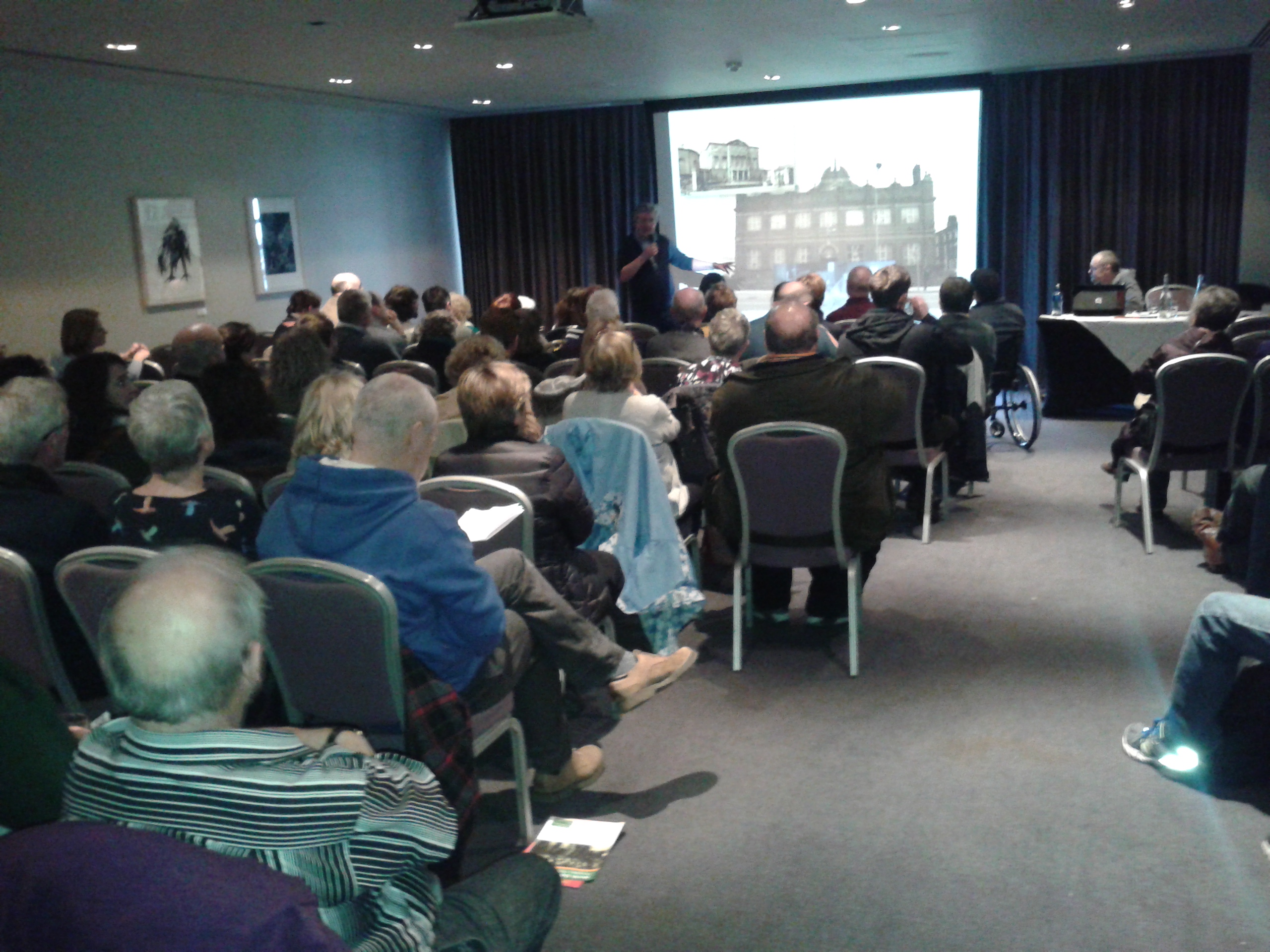
On 28th April, a full hall in the Gibson Hotel of mostly North Wall residents received a presentation from historian Hugo McGuinness on “The 1916 Rising: The Fight in the Docklands”, a talk organised by the East Wall History Group. Using an electronic slideshow of photos and maps to illustrate his talk, Hugo took the audience through an amazing story of Irish resistance courage, tragedy, comedy, bungling and initiative, with lots of little vignettes.

Front view of most of the audience at the talk
Front view of most of the audience at the talk (source D.Breatnach)

Of particular impressiveness was the group of Volunteers who ran down a street to engage a detachment of British soldiers from the Musketry School at Dollymount who were heading down East Wall Road towards the docks. The detachment of British soldiers had slipped out of an engagement with a blocking force facing Annesley Bridge. A small group of Volunteers ran down North Dock Road to cut them off and engaged them, stopping their progress. Then there was the Volunteer who put a British machine gun out of action with one shot when he hit the water-cooling mechanism.

Hugo McGuinness speaking beside screen
Hugo McGuinness speaking beside screen  (Photo: D.Breatnach)

(source Internet)

Hugo’s audience were told of the Irish sniper in the docks whom the British nicknamed the ‘trade unionist’ – he took up position around 8am and always finished at 5pm. There was the floating gun platform in the Liffey, not just the Helga. There were no feeding arrangements made for the soldiers sent into Dublin so they looted homes and warehouses.

Many local people were interned in a large goods shed.  Many houses were strafed by machine guns and a number of civilians shot dead – one man later put an empty picture frame on the wall in his hall to surround a pattern of bullet-holes there. A member of the Dublin Metropolitan Police was killed by British troops and his colleague pallbearers were held up for hours at a checkpoint manned by the Dublin Fusiliers – some residual hostility from the Lockout perhaps? Martial law here meant that if you were seen in the area, you were warned and, if seen again, you were shot! If you did not respond to a military challenge you would also be shot. Nevertheless, children hung around the troops and gathered intelligence for the insurgents – but one was killed too.

Just before concluding, Hugo mentioned the research of another historian (whose name I did not catch), showing a rise later in 1916 and in subsequent years of names give to children following some of the better-known participants in the Rising and also a rise in personal names in Irish.

Long Audience back
(source D.Breatnach)

As is often the case with those who are passionate about their subject, Hugo’s presentation was a little overlong, in my opinion and he had to rush the end. The projector threw the bottom part of the image frames, which often contained a separate photo or map, too low, so that one had to stand to see them over the heads of those in front. Those are the only two faults I felt in what was an engaging and engaged presentation of well-researched material about a fascinating but understated part of the history of the 1916 Rising, with a working class and lower middle class flavouring sprinkled throughout.

After the talk, a number of the audience joined the organisers in the bar of the Gibson Hotel where history continued to be discussed. In the foyer to the bar/restaurant, a small exhibition of panels entitled “Casualties and Prisoners” had been set up.

Part of the "Casualties and Prisoners" panel exhibition in the Gibson Hotel
Part of the “Casualties and Prisoners” panel exhibition in the Gibson Hotel (source D.Breatnach)
Part Exhibition 1916 Prisoners
(source D.Breatnach)
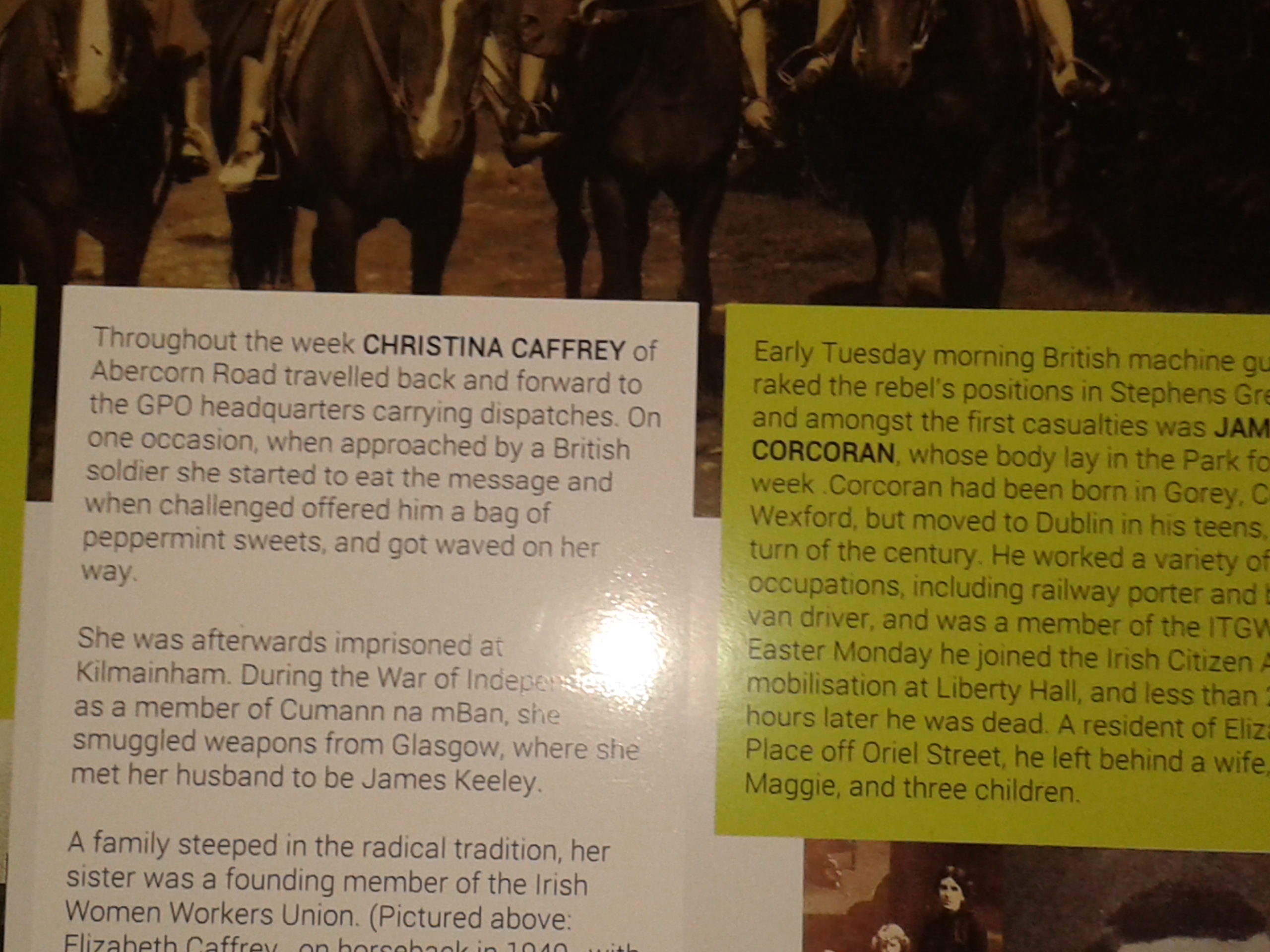
Christina Caffrey
(source D.Breatnach)

Inside the bar, the surroundings were plush and out of synch with the area. Although the bar was only moderately busy, the service was very slow; later we were harassed to leave as the bar was closing, although we had been served pints only ten minutes earlier. There was no arguing from the group but a number remarked that they would not be drinking there again.

The refreshments element apart, for which no responsibility lies with the group, this was another very successful event among a number organised by the East Wall History Group. Rumour has it Hugo may have a book coming out soon – I can hardly wait.


end

FROM LOCKOUT TO REVOLUTION — PERFORMANCE OF EAST WALL PEG DRAMA & VARIETY GROUP

“From the Lockout to Revolution”, performance of the East Wall PEG Drama & Variety Group at City Hall on April 9th 2016. This was part of a program of events organised in conjunction with the Cabra 1916 Rising Committee and Dublin City Council.


At the outset of the Easter Rising, City Hall was occupied by a detachment of the Irish Citizen Army and was the location of fierce fighting until the insurgents were forced to surrender.  Their commanding officer and another three fighters were killed there.

( Video produced and edited by Eoin McDonnell )

East Wall PEG Drama & Variety Group performers: Rebecca Dillon, Mary Colmey, Monica Horan, Paul Horan, Colm Meehan, Séamus Murphy, Tréasa Woods, with Diarmuid Breatnach.

SIXTEEN MURDERS IN ONE AREA OVER LESS THAN 24 HOURS

Diarmuid Breatnach

On a sunny but somewhat cool day on the 30th April, despite being on the cusp of the first day of Summer, a plaque was unveiled in North King Street. It was at last a memorial, a kind of formal recognition of a series of murders that took place in the locality 100 years ago. So many murders, in fact, that they have collectively become known as the “North King Street Massacre.”

In the closing days of the 1916 Rising the British army exacted brutal revenge on the civilian population of North King Street. Between 28th and 29th April sixteen civilian men and boys were brutally murdered by members of the South Staffordshire regiment of the British army.

The bodies of many of the victims were secretly buried in yards and cellars and personal items of the victims were stolen. Not one British soldier or officer was ever held to account for this atrocity.

The revenge on the civilian population of that small area of Dublin was for the spirited and well-planned defence of the area by Volunteers under Commandant Edward Daly, whose district HQ was the Four Courts. 60 Volunteers fought off repeated attacks by a force overall in their area of over 800 British soldiers — outnumbered 40 to 3 and, furthermore, without a single machine gun, of which the British had several (and better, faster firing rifles).  A video on the battle by Marcus Howard can be found here, with interviews with Darren Kelly and Derek Molyneux, authors of When the Clock Struck in 1916 https://www.youtube.com/watch?v=Kuy5u6BnjQo

Lone piper leading march from Stoneybatter along North Brunswick Street

THE MASSACRE

An account and contemporary statements on the murders may be found here http://source.southdublinlibraries.ie/bitstream/10599/11507/5/Fragment1916.pdf from which the following has been extracted:

‘These 15 unoffending citizens were murdered by the military under circumstances which mark the crime as a cold-blooded and calculated atrocity hardly equalled in the blackest annals of warfare. None of the victims had any connection whatever with the insurrection, and indeed some of them may have been entirely opposed to it. One of the- murdered men, immediately before being shot, pointed to a pictorial representation of the Royal Standard which hung over his bed as a proof of non-complicity with the Insurgents, but no mercy was shown him.

‘The doomed men were torn from the bosom of their family, and despite all exposulation and explanation regarding their views, or identity, and despite the tears and entreaties of their terror-stricken relatives and women-folk, were led away to be slaughtered. In some instances requests were made that the military should at least make enquiries at the neighbouring police stations or obtain information from some of the prominent citizens to whom they were known. But all appeals were fruitless, they all shared a common fate at the hands of their cruel captors.

‘The young son of poor Hickey — a lad of scarcely 15 years — was at the last moment heard pleading pathetically for his father’s life. Both father and son were butchered together.

‘The wife of one of the murdered men carried a baby a few weeks old in her arms; the wife of another gave birth to a child but a few weeks after her husband’s murder. Both saw their husbands led away to death without even a moment’s respite to snatch a last farewell to those they loved. The houses in which they were taken were never at any time occupied by the Volunteers and no traces of arms or ammunition were found on the premises.

‘None of the murders was done during a sudden attack of assault, or in the heat of passion. In some cases several hours elapsed, allowing ample time for consultation with the officers in command before the doomed men were slaughtered. The officers seem in all cases to have overseen or directed the “ military operations.’ It would be difficult to find a parallel to these atrocious crimes.

‘At the inquest on Patrick Bealan and James Healy, Lieut.-Col. Taylor did not appear but sent a statement to’ the Coroner in the course of which he said :

“ No persons were attacked by the troops other than those who were assisting the rebels, and found with arms in their possession.”

General Maxwell afterwards made the sufficiently candid and luminous statement in the “ Daily Mail ” respecting the conduct of the troops under his command:

“. . . . Possibly some unfortunate incidents, which we should regret now, mav have occurred . . . . it is even possible that under the horrors of this attack some of them ‘ saw red ’, that is the inevitable consequences of a rebellion of this kind. It was allowed to come into being among these people and could not be suppressed by velvet glove methods, where troops were so desperately opposed and attacked. Some, at any rate, of the allegations are certainly false, and are probably made in order to establish a claim for compensation from the Government.”

Past and Future
Past and Future
Section of crowd at North King Street at unveiling of plaque event

‘Repeated attempts were made to have a public enquiry into the facts of these military murders, but were opposed by the British Government.’

Sixteen civilians had been murdered in cold blood in one of the principal cities of the British Empire by soldiers of that very Empire.  No official investigation ever took place, no soldier or officer was ever charged.

NO MEMORIAL FOR NINETY-NINE YEARS

It is perhaps understandable that no memorial was put up to mark the massacre while the British remained in occupation of the city – it would have been taken down by the authorities. But after the 26-County State was set up in 1921, it is less easy to understand. These victims were innocent civilians and not partisan to either side during the Civil War or the years of anti-Republican repression that followed. Not even the allegedly ‘Republican’ governments of Fianna Fáil provided a permanent marker to commemorate the massacre.

But for some years, Terry Crosbie, a local history enthusiast, has been campaigning to get a memorial erected to remember the massacre and its victims. Slowly, over the years, his campaign attracted support and finally came to fruition this year, the 100th anniversary of the Easter Rising and of the massacre too. Terry had in mind a boulder with a plaque on it but found that difficult to advance and, faced with a plaque being at last permitted and the wish to see the massacre being marked in its centenary, was pleased to see the erection of the plaque 100 years after those hours of terror for the area.

Historians and Reenactors by the plaque
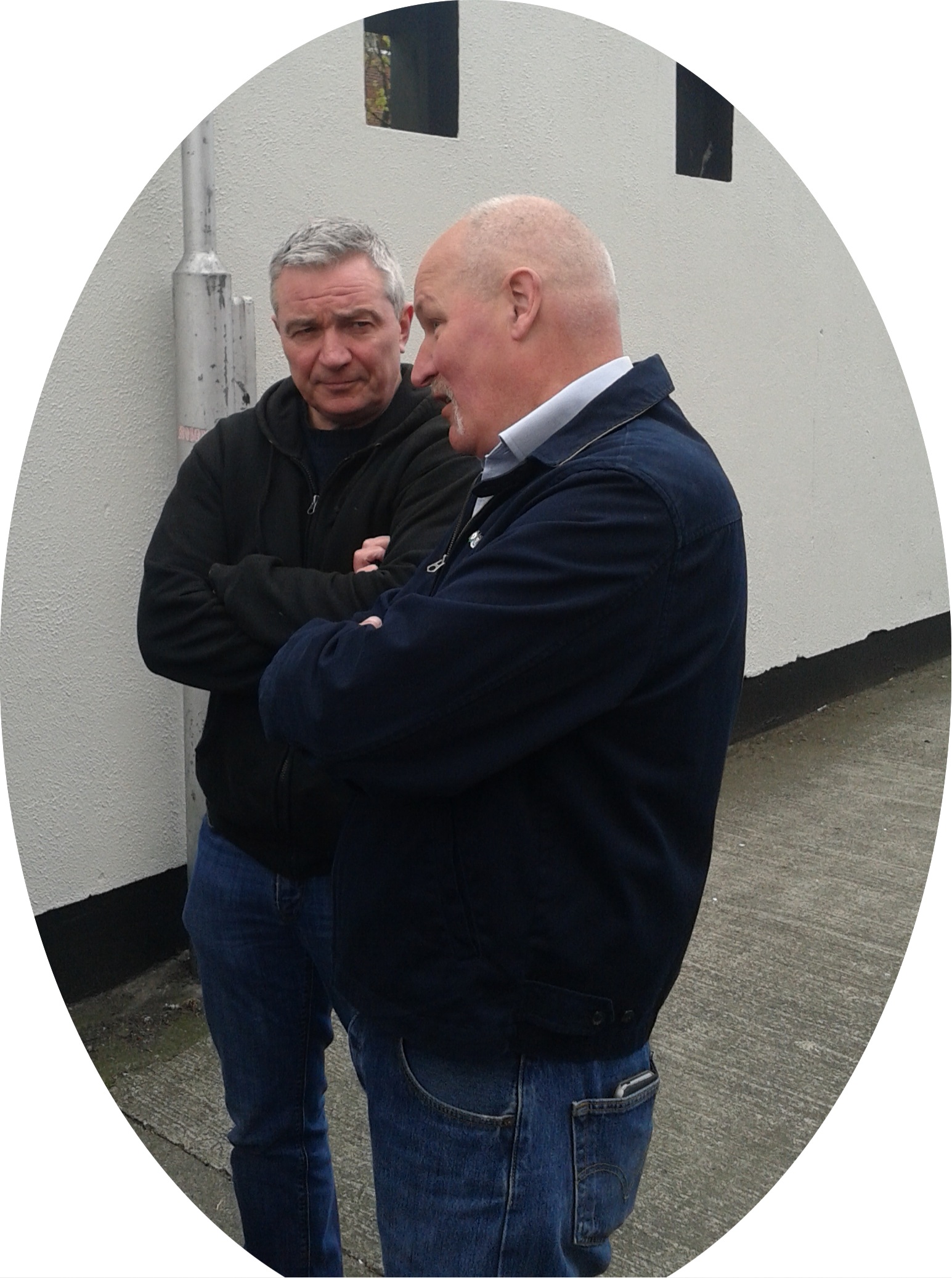
Terry Lyons (foreground), moving spirit behind the commemoration, in private conversation after the event

A PLAQUE AT LAST

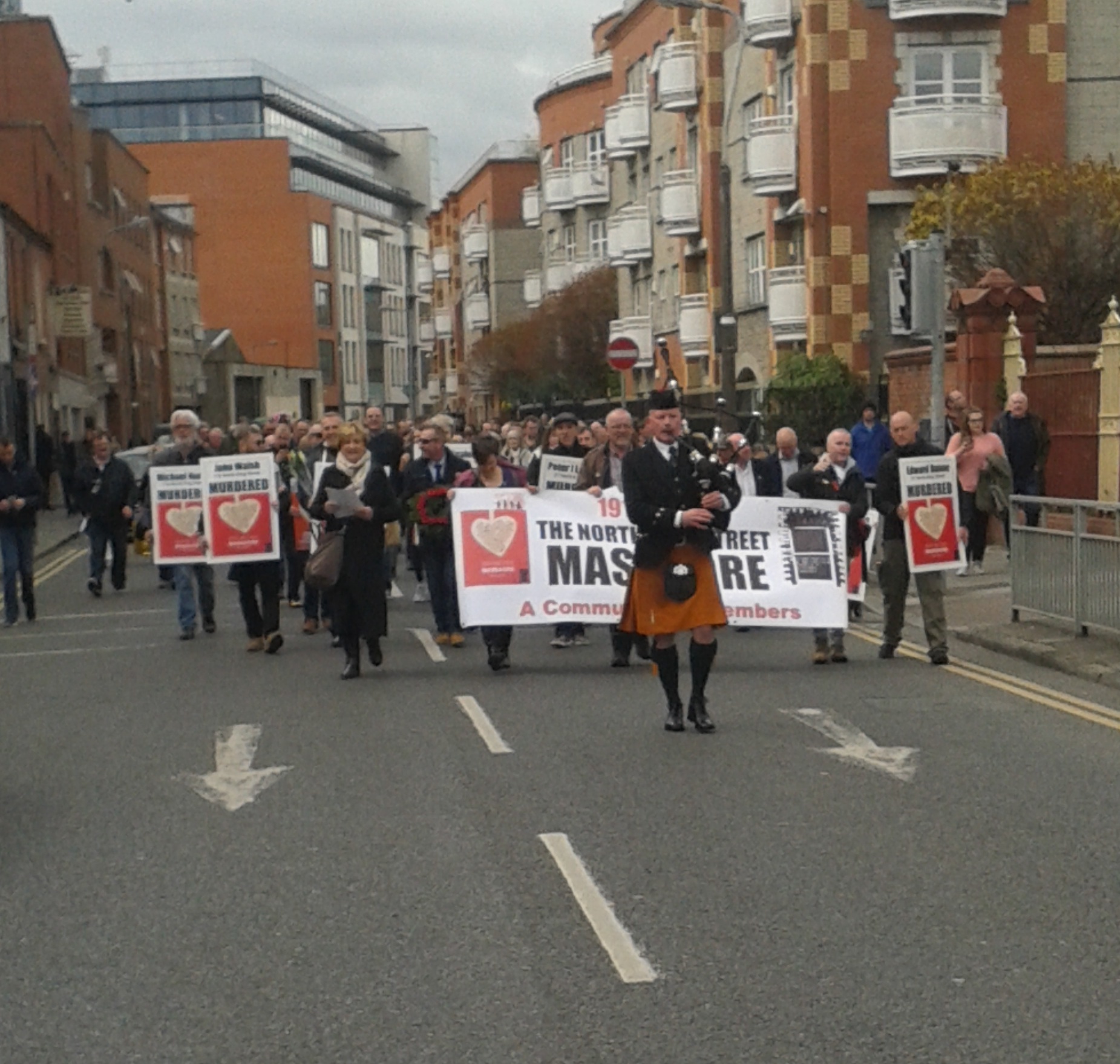
The parade for the march to the site assembled at 2.00pm outside Kavanagh’s Pub on Aughrim Street in Stoneybatter and not long afterwards departed in a short parade, led by a piper, to North King Street where the plaque was unveiled

Dr. Mary Muldowney of the Smithfield and Stoneybatter People’s History Project presided at the short ceremony. However, the amplification seemed poor and most people failed to hear what was being said. A number of “We can’t hear!” calls resulted in slightly better volume but still not enough for most to hear. A song that had been specifically written about the massacre was played but the same difficulty prevailed.Leacht

The plaque was unveiled to loud applause and wreaths and single lillies were placed before it by people related to the massacre victims.

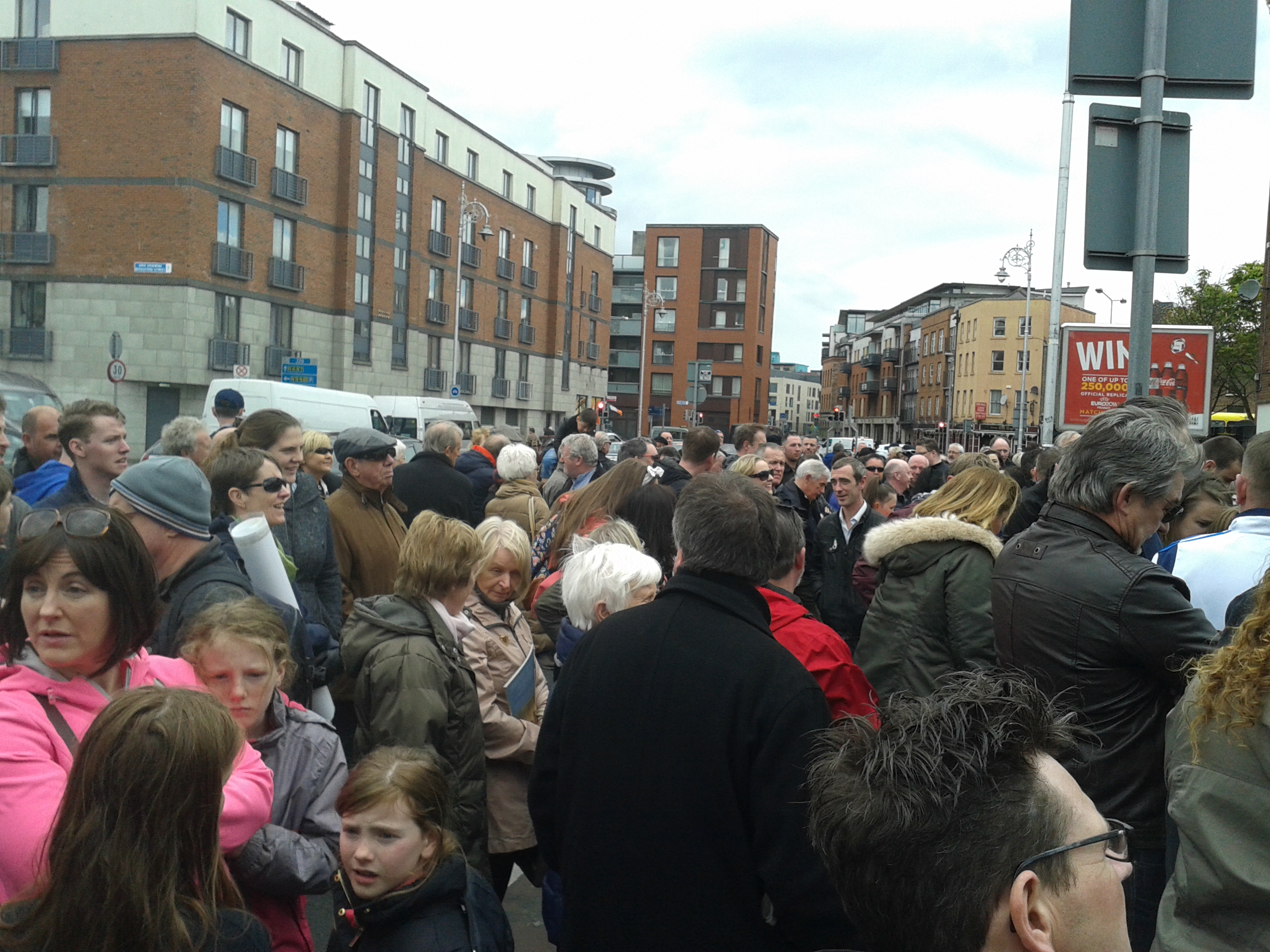
The attendance was a healthy one in numbers as may be seen from the photos but also attracted a great cross-section of the political spectrum: older Stickies and Provos, some Left Labour, independent socialists and Republicans, housing activists, Save Moore Street activists, anti-Water Tax campaigners mixed with historians and local people who had no political organisational or campaign affiliation to speak of.

It was good to see a permanent memorial at last to the murder in cold blood of 16 civilians by an Army that has been responsible for countless atrocities around the world, including a number during the 30 Years War in the Six Counties; at least one of their units is accused in bronze here for what they did over a period of less than 24 hours one hundred years ago.

End.

REENACTMENT OF MOORE STREET/ GPO GARRISON SURRENDER

Diarmuid Breatnach


At 5pm on Friday 29th April (2016), Save Moore Street 2016 campaigners and supporters followed in the footsteps of the Easter Rising surrender. The event was in part a reenactment but aimed at an evocation rather than an exact copy of what happened around 5pm on the 29th of April, 1916.

Reenactors gathering in Moore Street (Photo: Davidina Spinderella Bradshaw

On the 29th of April 1916, the Friday of Easter Week, the roof of the GPO, the HQ of the Rising, was in flames and evacuation was necessary. Earlier, all women who had no medical training were thanked for their service by the leaders and asked to leave. Later, all the remaining women were asked to take the wounded to Jervis Street Hospital, which they did, under fire. Three women refused to leave and remained — Julia Grenan, Elizabeth O’Farrell and Winifred Carney.

Derek Molyneux speech

Just after The O’Rahilly led a group of Volunteers out to charge the British barricade at the Parnell St. end of Moore Street, the main body evacuated the GPO under fire and, going down Henry Place, headed westward. Machine-gun and rifle fire down Moore Lane killed at least one of the insurgents and injured a number. When they reached Moore Street and saw the machine gun at the top of that street too, they began to occupy houses on the east side of the street. In particular, they entered No.10 and made it their HQ for that evening, as well as their hospital. Throughout the rest of that night, they tunneled through the walls, from house to house.

"Winifred Carney", "Elizabeth O'Farrell" and "Julia Grenan" in Moore Street (Photo: Bart Hoppenbrouwers)
“Winifred Carney”, “Elizabeth O’Farrell” and “Julia Grenan” in Moore Street (Photo: Bart Hoppenbrouwers)
Volunteer attaching Tricolour to rifle as near the GPO, walking through Henry Place (Photo: Bart Hoppenbrouwers)
Volunteer attaching Tricolour to rifle as near the GPO, walking through Henry Place
(Photo: Bart Hoppenbrouwers)

When, on the following day, Pearse sent Elizabeth O’Farrell out to discuss surrender terms, General Lowe (who had earlier issued an instruction to the forces under his command that the ‘rebels’ were not to be taken prisoner), demanded unconditional surrender. The instructions were that they were to leave their weapons in the houses and to come out under a white flag, retrace their steps to the GPO, then on to Sackville Street and proceed up towards the Rotunda.

(Photo: Bart Hoppenbrouwers)

Sean McLoughlin gave different instructions and they marched out in military order, carrying a white flag but carrying their weapons also. As they neared the GPO, one of the Volunteers fixed a Tricolour to his rifle. As they passed the smoking shell of the building, McLoughiin called “Eyes Right!” in recognition that there, earlier in the week, the Republic had been formally proclaimed by Pearse with Connolly by his side. (The fixing of the Tricolour and the “eyes right” was reenacted as was the route taken).

Moore Lane turning

They proceeded up O’Connell Street and stopped outside the Gresham Hotel, where

"Eyes Right!" at GPO in Henry Street (Photo: Bart Hoppenbrouwers)
“Eyes Right!” at GPO in Henry Street (Photo: Bart Hoppenbrouwers)

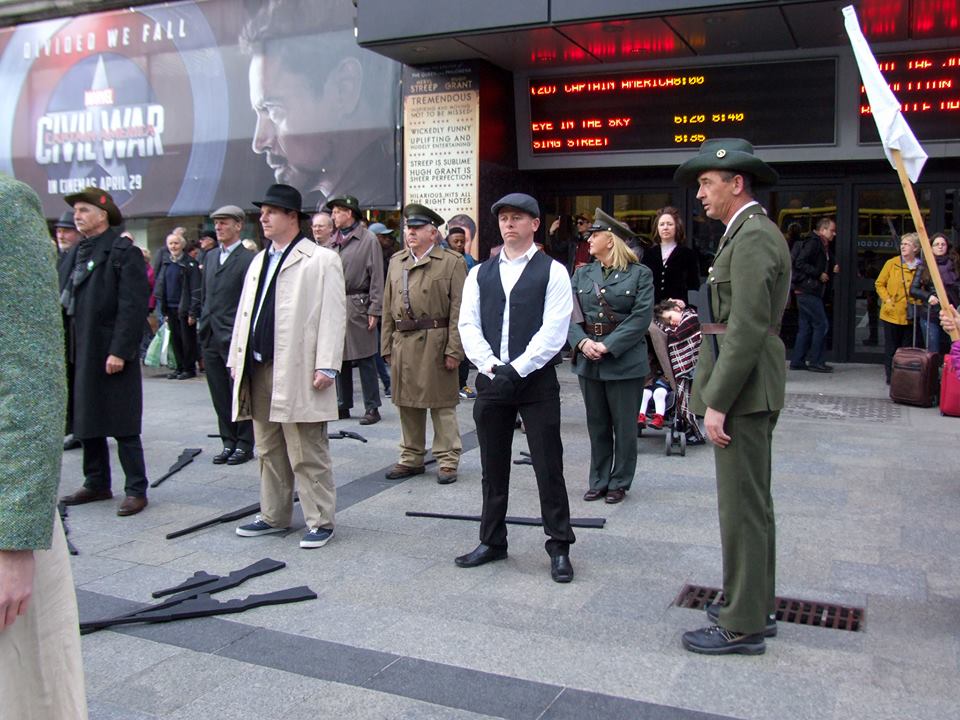
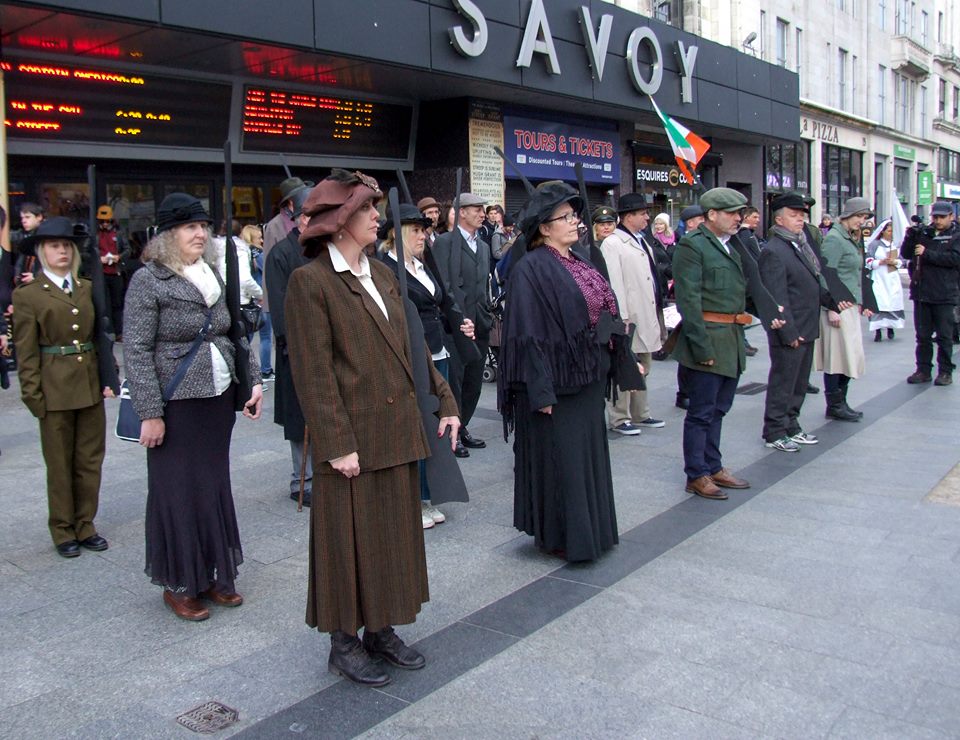
on McLoughlin’s order, they dropped their weapons (today, this was done in front of the Savoy). One hundred years ago, the insurgents were surrounded by British Army soldiers with loaded guns and fixed bayonets. In the reenactment, as in the past, McLoughlin gave the order to the front rank to take four paces forward and the rear ranks to take two steps back. What that did in 1916, was to bring the front ranks right up against the British so that their bayonets were touching the insurgents’ chests, while the rear ranks brought their back up against the bayonets of the soldiers behind them.

Guns surrendered
Guns surrendered

Lined Up Savoy

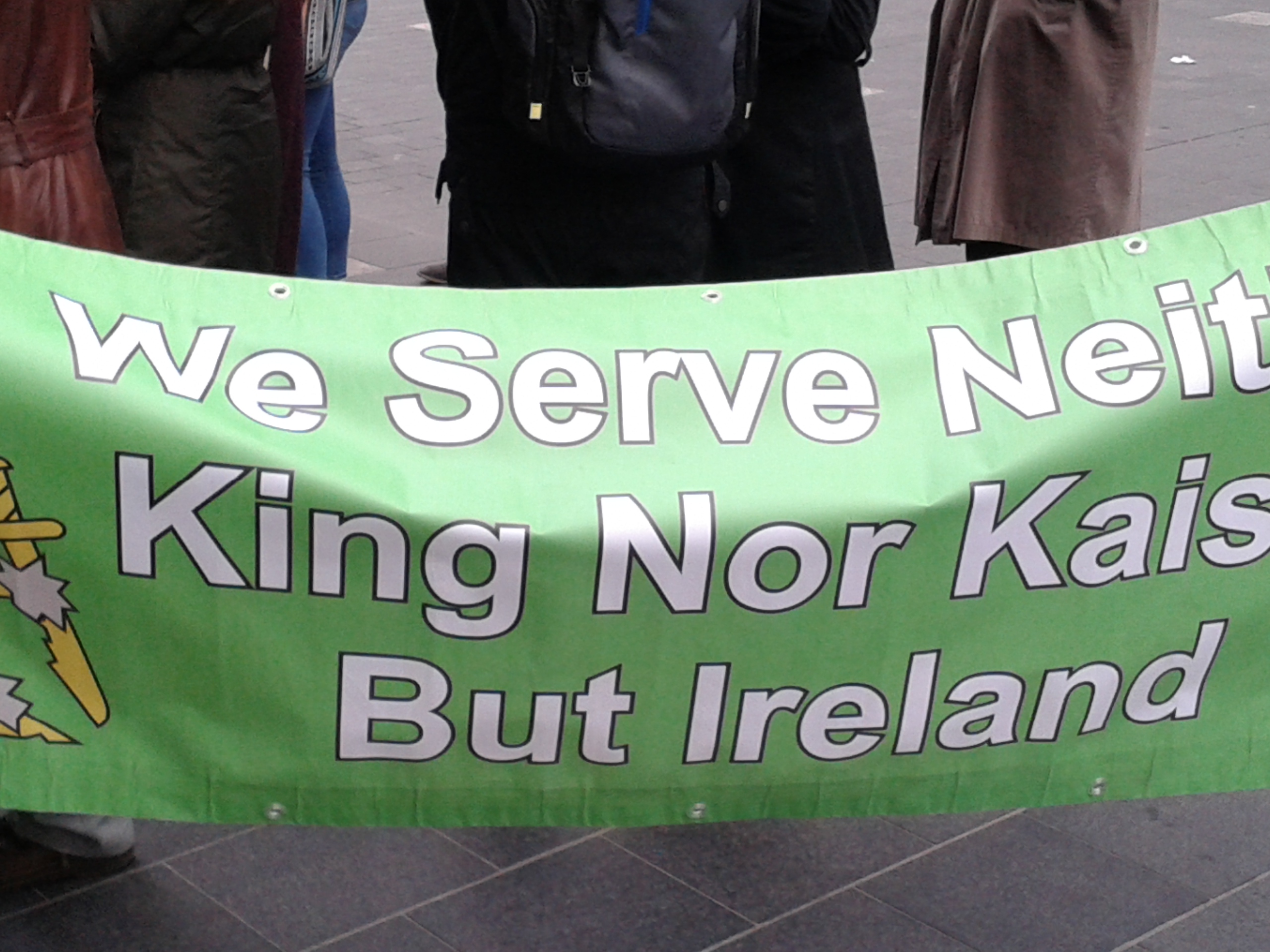
We Serve Neither
(Photo: Bart Hoppenbrouwers)

In 1916, the prisoners were then marched off to the Rotunda Gardens to be kept there overnight without food or water. Six of the fourteen who were shot by British firing squads in Dublin had spent their last hours of freedom in Moore Street, including five of the seven signatories of the Proclamation of 1916.

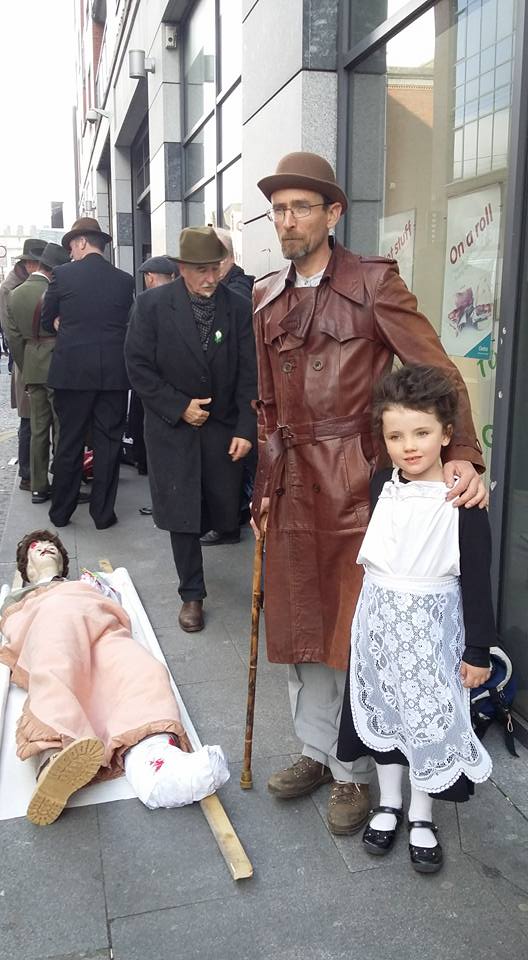
Man & little Girl period costume
(Photo: Davida Spinderella Bradshaw)
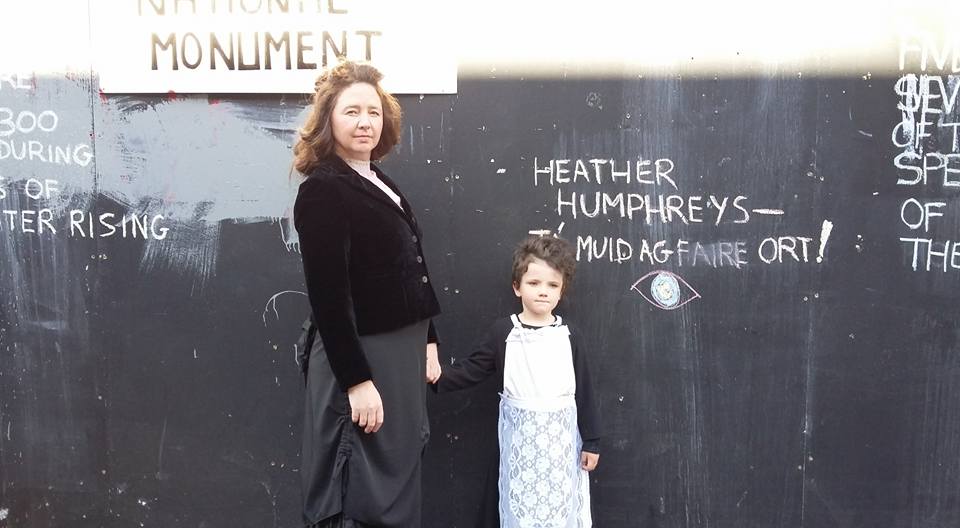
Woman & Girl in Period dress
In front of hoarding in Moore Street (Photo: David Spinderella Bradshaw)

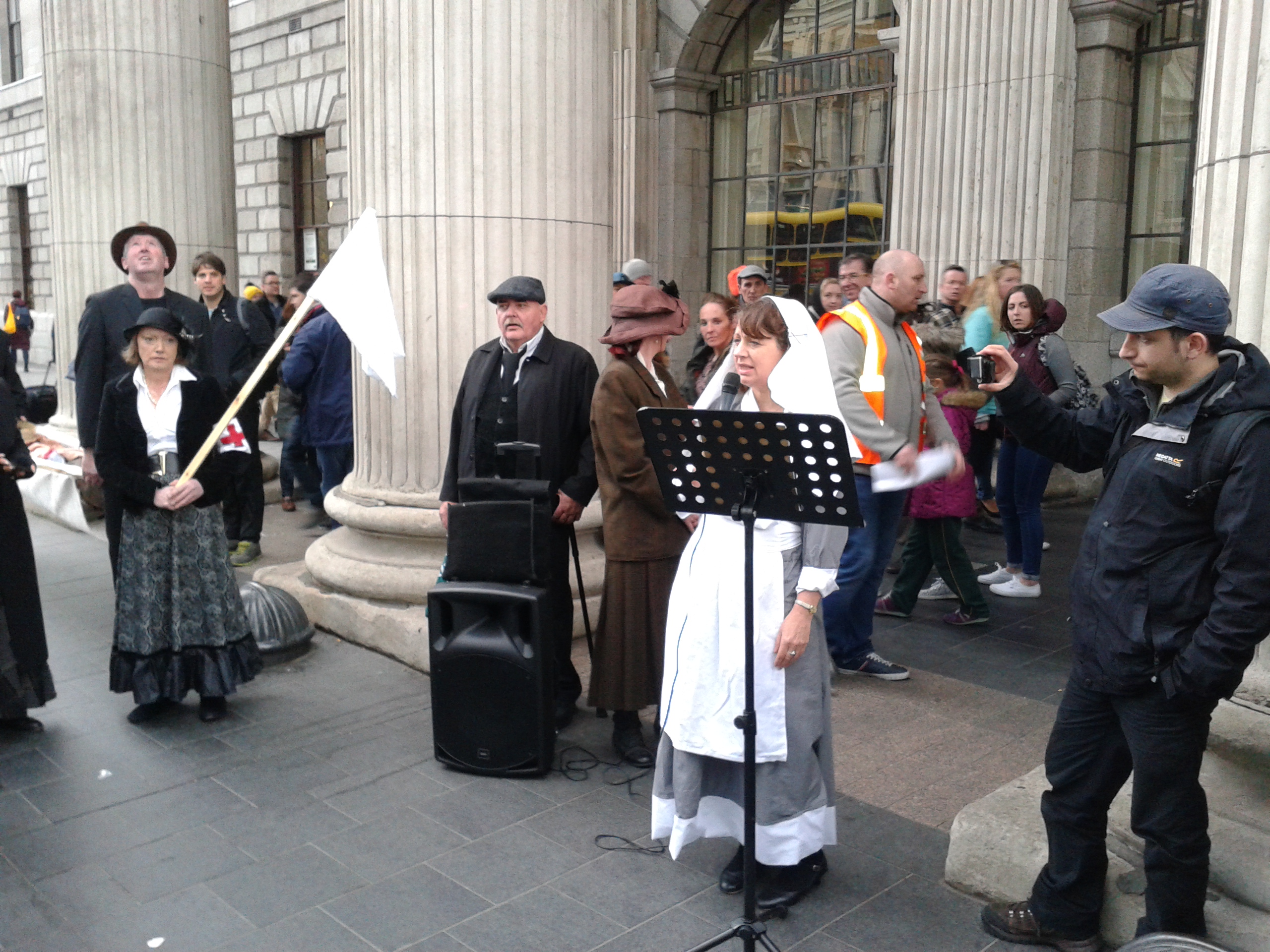
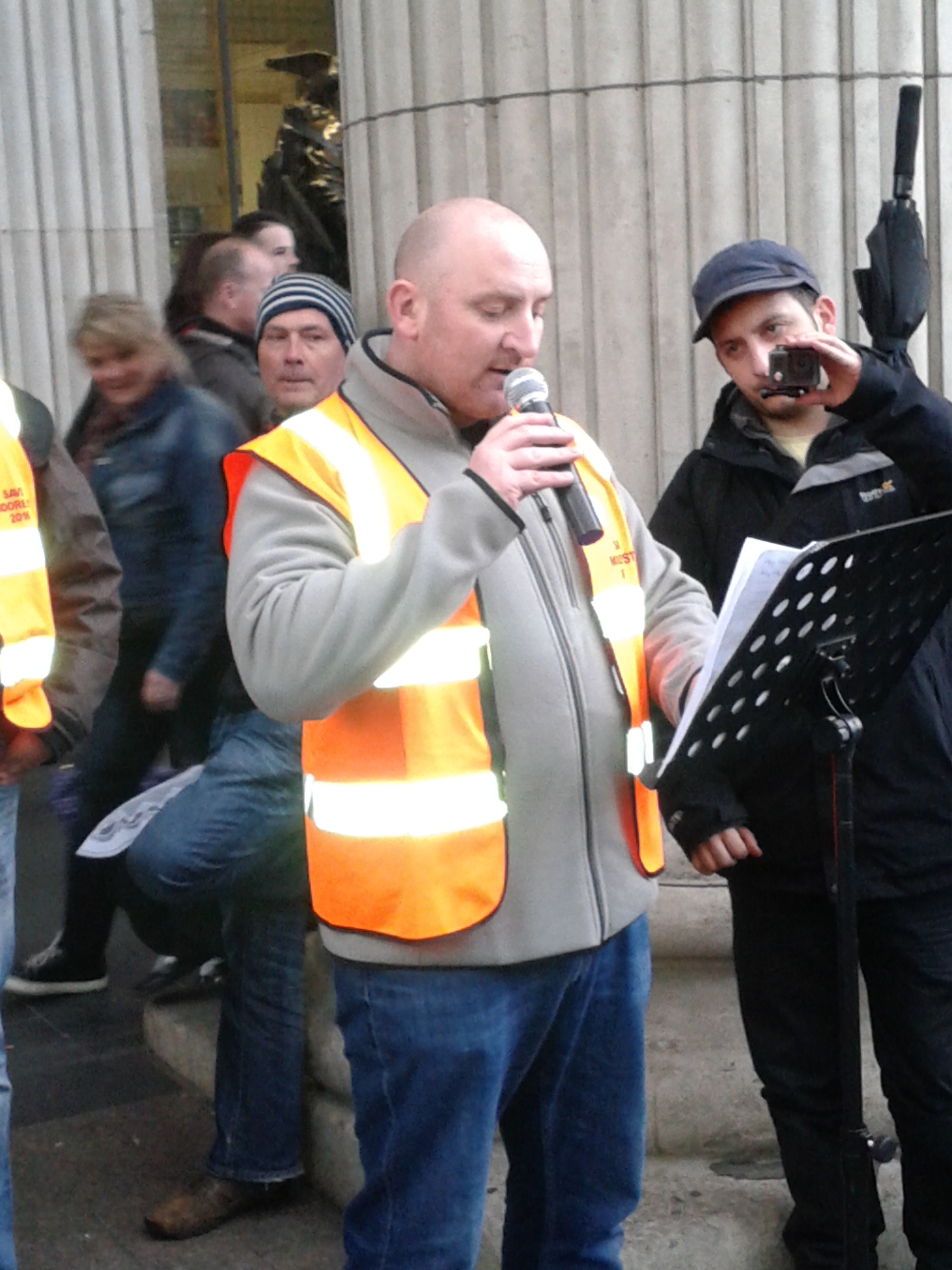
The reenactment procession turned and proceeded down towards the GPO where Niamh Mc Donald of Save Moore Street 2016 Campaign introduced Donna Cooney, great grand-niece of Elizabeth O’Farrell, to read a poem about the Rising by Theo Dorgan. Damien Farrell then spoke on behalf of the campaignd

Donna Cooney as Nurse O'Farrell, reading a poem by Theo Dorgan
Donna Cooney as Nurse O’Farrell, reading a poem by Theo Dorgan (Photo: D.Breatnach)


(Photo: Bart Hoppenbrouwers)
Damien Farrell speaking on behalf of the Save Moore Street 2016 campaign (Photo: D. Breatnach)

A NEW ROLL OF HONOUR NEEDED?

Ray Bateson raises questions about the accuracy of the current 1916 Rising Roll of Honour (of those who died while fighting or as result of fighting for Irish freedom in the 1916 Rising) and builds a case for a revision of the list and the inclusion of an additional number.  He also calls for recognition of the medical personnel who were killed in the course of administering to the wounded.

Republished with kind permission of Mícheál Ó Doibhlín from his Kilmainham Tales Internet site.
http://kilmainhamtales.ie/a-new-roll-of-honour.php

Will The Black And Tans Be Added To The Glasnevin Wall of Shame?

Timely article on the Necrology Wall at Glasnevin Cemetery and what seems like an intention to add to it the names of Black & Tans, Auxiiliaries and B Specials who were killed by Republicans.
https://ansionnachfionn.com/2016/04/06/will-the-black-and-tans-be-added-to-the-glasnevin-wall-of-shame/


An Sionnach Fionn's avatarAN SIONNACH FIONN

Further on the divisive “Wall of Remembrance” unveiled in the historic grounds of Glasnevin Cemetery on Sunday, a monument which partly pays tribute to the members of the British Army and Police who lost their lives during the Easter Rising of 1916, the motivation behind its erection was clearly heralded by the Glasnevin Trust in a statement from its chairman, John Green, submitted to an Oireachtas committee in November of 2015. This includes a potentially troubling passage, highlighted below :

“…Glasnevin Trust has been working closely with the State in playing its part in the Decade of Centenaries. Glasnevin, true to its mission of serving people from all creeds, beliefs and walks of life, has been central to a number of State commemorative ceremonies. These have ranged from the commemoration of Irish men who lost their lives in the First World War to Collins and Griffith…

This work will continue right through the 1916 Centenary Commemorations with…

View original post 328 more words