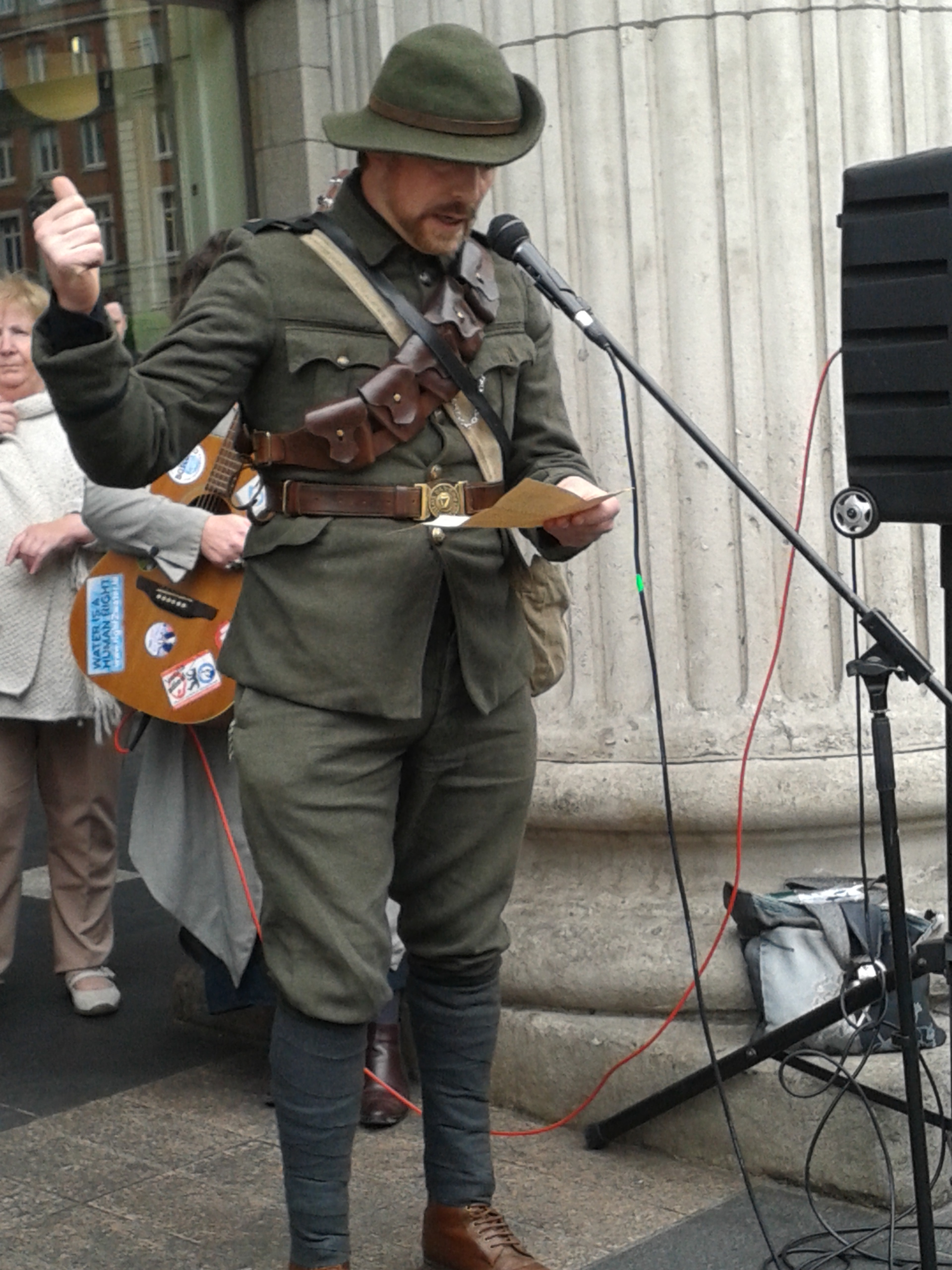
AN EASTER STORY


Diarmuid Breatnach

There are many different kinds of Easter stories – religious ones, or about Easter parades and processions, ones about family reunions, Easter egg hunts, even holidays …. this isn’t one of those.

The man, let’s call him Jeremiah or Jerry for short, stood outside the pub on a Sunday afternoon and struggled to quell the apprehension threatening to flood his mind and body. It had to be done. He turned to his companion, who seemed to view everything through laughing eyes and was no different now. Brian had three teenage kids with him, two of his own and a friend of one of them. Hardly ideal, but Brian had turned up with them a little while ago and there was no-one to leave them with. Well, they’d be all right – Jerry would be the target and, after him, Brian. They wouldn’t touch the kids.

Best give me the bag, Brian,” he said and, receiving it, checked inside. The stuff was there. Of course. Jerry folded the bag and stuck it under his jumper, under his coat.

He was focused on the tasks ahead but the trail that led them here had started days earlier. And, in some ways, years before that.

He squared his shoulders, turned and entered the pub. Brian and the kids followed.

**** **** ****

He had been at work on Friday afternoon when the call came from the Manager of the Irish Community Centre. Of course, he asked the staff to put it through to his office.

Do you know your event is in the newspapers?”

Something in the Manager’s voice alerts him that he is not being congratulated on the publicity.

The Easter Rising commemoration?”

Yes. It’s in the Evening Standard.”

Well, that answered the second question he had in mind.

No, I didn’t know. What are they saying?”

He knows what the British media are like and he’s got a sinking feeling.

It transpires that an Irish Republican organisation had put the event on their website, which had been noted by an Englishman who lost his son in the Omagh bombing of 1998. There are many questions to be answered about that bombing, both within the Republican and the State side, but for many years, not unnaturally, the father had been focused on the Republican group allegedly connected to the Real IRA, who had placed the bomb. In addition to his son, the bomb had killed 28 other people, the second-highest death toll for any day during the war in Ireland, the highest being the Dublin-Monaghan bombing of 1974, with a toll of 34. Jerry was aware that the 1974 bombings did not attract anything like the same media attention and understood the reason – they had been carried out by Loyalists under British Intelligence Service direction.

But what had all this to do with the Irish in Britain Representation Group in South London, and their Easter Rising Commemoration? Or with the Irish Community Centre? Well, the grieving father had noted the posting by the Irish organisation, noted the venue and rang, demanding that the event be cancelled.

I told him the commemoration is an annual event organised by an Irish community organisation and that there’s never been any trouble at it. I told him it has nothing to do with that Republican organisation …. it doesn’t, does it?”

No, it’s just us, the local Irish in Britain Representation Group branch. But surely any organisation is entitled to advertise the event?” replies Jerry.

Jerry is noting doubt in the Centre Manager’s voice responding to him. He is on the receiving end of huge pressure, working in his office, alone.

He wanted me to cancel the booking and I said I couldn’t do that,” said the Manager.

The grieving father had got on to the local authority, who replied that the event was the business of the Irish Centre. The father then contacted the media, who rang the local authority again and this time, instead of sticking to their original line and weathering what would be a short-lived storm, and without phoning the Centre Manger, their spokesperson condemned the event and stated they would be asking hard questions of the Centre, which they part-funded.

Jerry reads all this again when he slips out to get a newspaper. He feels for the beleaguered Centre Manager but can do nothing. It’s too late to contact the newspapers because the story is published. The event is to be held that evening. It has been advertised in the local area and in the Irish Post, the main newspaper at the time for the Irish diaspora in Britain. And in any case, one cannot – should not – give in to intimidation, coercion. The community had mostly caved under the Prevention of Terrorism Act in 1974 and had not really rallied again until the Hunger Strikes of 1981. The event must go on.

Jerry heads home, thinking about additional security needed on the door for the event, composing replies to the local authority, a letter in the newspaper ….

The IBRG Ard-Choiste, its governing body, had withdrawn its support of the Time To Go coalition in Britain some years earlier because of undemocratic maneuvering by some left Labour politicians, along with the sidelining of specific Irish community concerns. They had not been alone: Stop the Strip Searches Campaign and the Troops Out Movement had pulled out also, leaving the tiny Labour Committee on Ireland, the Socialist Workers Party and Communist Party of Great Britain to be supported by only the Wolfe Tone Association (SF support group in London) and the Connolly Association (linked to the CPGB) among the Irish campaigners .

Later, in 1998, the IBRG had been divided on the Good Friday Agreement. It was not the issue of continuing or ceasing the armed actions of the IRA that had been the source of the division, rather the acceptance of colonial rule, albeit claimed to be for tactical reasons only. A majority within the IBRG came out against the Agreement and that was in accordance with Jerry’s position too.

Although he supports none of the Republican groups opposing Sinn Féin, he has heard whispers in the Irish community at various times associating him with this or that group. This might well be feeding doubts in the Centre Manager’s mind.

Jerry is in a more difficult position than might seem. He is not only Secretary of the local IBRG branch that has organised the event and is affiliated to the Community Centre, but also the Chairperson of the Irish Centre’s Management Committee itself. The Management Committee is the Centre Manager’s employer and has a duty of care to him. And after nearly a decade of campaigning for the provision of the Centre and the meagre funding it receives, no-one on the Committee would want to antagonise the local authority.

But it was the IBRG branch itself and in particular the Irish Pensioners’ Association which was then a part of it, which had won the provision for the community in the end. And Jerry had been part of the campaign, elected as Chairperson of the Steering Group in the years while renovations of the building and available funding were discussed, elected Chairperson for the first six months after the Centre opened and at the Annual General Meeting for every year afterwards. In fact, recently Jerry had been trying unsuccessfully to step down, to ease a replacement into his position.

On the train from London Bridge on the last leg of his journey home, Jerry reflects ruefully that this controversy might cause his stepping down, which was hardly the way he had anticipated his leaving. No stepping back slowly, supporting someone new in position and easing himself out. No – thrown out instead! That would of course imply he had done something wrong, which he hadn’t and that the IBRG had been wrong to commemorate the Rising, which they hadn’t either. Ironically, if moves were made now to replace him, he’d have to fight them.

**** **** ****

Before he arrives at the Irish Community Centre, Jerry looks carefully around the mostly residential street. Nothing seems threatening but can one be sure? He is carrying the IBRG’s branch’s banner, wrapped up in black bin liners, which makes him a visible target if someone’s searching. On the other hand, one of the poles of the banner is loose within the bundle, in case of need ….

He drops the Centre’s keys in his nervousness and enters, disabling the alarm and turning quickly to retrieve the keys and lock the door. Then, into the hall, to begin arranging some of the material ….

He is anxious for some of the IBRG members to arrive but jumps when the doorbell rings. Checking through the fish-eye spyhole, he is surprised to see one of the Irish Pensioners, who lives locally.

Opening the door and ushering her in, he locks the door behind her, saying apologetically “There’s only myself here so far.”

Are others coming?” she asks – she has read the newspaper and unerringly touches Jerry’s main fear at the moment.

I’m sure they are, Ellie. What are you doing here so early?’

I thought you might need some help.”

Jerry is touched straight through to his heart but has to refuse. He can’t have her here if there’s an attack with no-one else but himself to defend her.

Oh no, Ellie that’s very kind of you. But I kind of know what I have to do and explaining it to others will just take longer and make me flustered. You know how it is. Thanks a lot. Besides the others will be here soon. Come back when we’re open …..” he trails off guiltilly.

Still, she goes and he heaves a sigh of relief, at the same time feeling shame.

But there’s work to be done.

A scattering of volunteers arrives over the next half hour. The reception table is set up in the lobby, to sell tickets and distribute leaflets. Hidden behind, are the lengths of wood in case of attack by one of the British fascist groups. Up goes the green-white-&-orange bunting, portraits of the executed 1916 leaders, enlarged copies of the 1916 Proclamation. At the back of the stage, facing the hall, the large artwork Jerry made a few years ago of green, white and orange flames bursting from the date 1916. And the IBRG branch banner.

The stage is ready for the band, a group called The Mc ____ Brothers, who play Irish ballads, including Republican material. Water jug and glasses for the speakers. Tables and chairs rearranged on the hall floor (the part-time Caretaker had laid them out but Jerry always prefers a more “club” arrangement, of smaller tables spaced apart surrounded by some chairs).

By the time the opening hour arrives, Jerry is sweating but it is the sweat of work, not of fear or apprehension. The hall looks good. People are starting to arrive. Maybe he can relax now. Maybe. Brian is on the door with others close by.

The event is a bring-your-own-alcohol one and Jerry and others in the lobby spend some time directing people to the nearest off-licence, so that people are coming in, going out, coming in, sitting in the hall …. Jerry is scanning their faces, looking for possible sources of trouble.

An hour later and the band has not arrived. Pol phones them but gets no reply. Phones their manager but no reply either. Another hour later, the reality dawns on the organisers. The band will not be coming. They have seen the newspaper and decided to look after their safety. But they haven’t even bothered to tell them.

The organisers confer, after which Jerry mounts the stage, calls for attention and begins to speak.

A Chairde Gael agus a chairde ó thíortha eile, go raibh míle maith agaibh for coming here tonight to commemorate the 1916 Easter Rising with us. This is a hugely important event in Irish history and indeed in the history of the world and the local branch of the IBRG has been not just commemorating but publicly celebrating this historic event every year for some time now.

But we are very sorry to say that we have some bad news for you now. Some of you will know that very recently pressure was put on us to cancel this event but that we refused to do so. Pressure was put on the Irish Centre to cancel the event which they also and rightly refused to do.
That the British media would attack us is no surprise, they have been doing that for years. But that the local authority’s spokesperson should bow down to them and, without consulting with us, imply that we are doing something wrong here, that the Centre should not have taken our booking, is something else.

And worst of all, that an Irish band, which makes a living playing Irish ballads, should allow themselves to be scared off and not even have the decency to ring us – well, I don’t really have the words to tell you what I think about that.

So, a chairde, we offer you your money back and no questions and our sincere apologies. However, those of you who wish to remain are welcome to do so and we’ll make our own entertainment with a few songs …. we have a guitar player here …. another man plays a whistle …. But please, you are entitled to your money back and those who wish to please go to the table in the lobby now.”

As though he had been primed to do so (but Jerry knew he had not), a middle-aged Irishman at a table nearer the stage jumps up and shouts: “NO! We will not ask for our money back! We’re not going to be chased out by no British newspapers!”

A round of applause from the audience and a few cheers greet his outburst. And just like that, the evening is saved.

The guitarist plays some numbers and sings. Jerry gives an abbreviated oration and sings a few ballads. The whistle player plays some tunes. People sing along to songs. They drink, chat and buy raffle tickets. One of the raffle prizes is auctioned by the winner, a local publican Jerry had been surprised to see in the audience. The money goes into the takings. At the end of the evening, as they finally cajole the last of the audience out of the Centre (still with a wary eye on the street) and finish cleaning and tidying up, they count the takings. Financially, it has been their most successful evening ever, especially since they didn’t have to pay a band.

But the band ….. their action and lack of notification have left a sour taste in the mouths of the organisers. And during the evening, they learned that the Mc___ Brothers are booked to play at an Irish pub, on Sunday afternoon, just two days away. And only a five minutes’ drive from the Irish Centre.

**** **** ****

A council of war decides that the bar will be visited, Jerry will mount the stage (“you’re our best speaker”) and present the band with white feathers, symbolising cowardice. Some can’t be there. One or two think it will be dangerous. Brian, Pol and Jerry think it’s a good plan — so then they just need some white feathers. How hard can it be to get some?

Visits to duck pond parks yield none. The quaysides along the Thames show no seagull feathers. Brian drives to the coast and walks some beaches – and finds a couple of wispy ones. In desperation on Sunday morning, they burst open a pillow and drag out a handful of feathers. They are small, not at all like the large ones they had envisaged presenting to the band but they are white and they are feathers. Into the plastic bag they go and then Brian is driving Jerry and the kids to the pub. Brian has remarkable personal resources and has been through some very serious situations so this might be small potatoes to him …. but Jerry’s guts are churning.

Some faces in the pub turn to look at them as they enter. Jerry has been here before only once but a number of the clientele are known to him from other pubs and events. And he is probably known to more of them, as Chairperson of the Irish Centre. A few catch his eye and he nods at them, keeping his face impassive.

Do they know that the band playing here let down the audience two days ago? Of course they do …. or at least many would. This is the Irish community in SE London. Besides, the Manager of this bar, Kate, until recently worked for the publican who auctioned the raffle prize at the event on Friday night. At least one of them was there that night too.  Are they wondering what Jerry intends to do?

The band, which Brian has taken to calling the “McChicken Brothers”, is already playing on stage. Jerry had meant to get here before they got on but the feather search had been a delay. To get in front of them now might be resented by the audience and anyway, the band’s control of the microphones could drown out what needs to be said. Jerry goes to the bar, orders pints for himself and Brian and soft drinks for the kids, stitches a smile on his face and chats to Brian. And they wait.

Eventually the band takes a break and Jerry waits tensely for the indication that they are returning for the second half of their gig. When he sees them coming he nods to Brian, whose job is to fend off anyone attacking him before he has finished.

Just as the band reach the low stage but have yet to mount it, Jerry jumps up on it and begins to speak in a loud voice.

Ladies and gentlemen, your attention for a moment please!” EVERYBODY turns to look.

These musicians here were booked to play at an Easter Rising commemoration at the Irish Community Centre on Friday. They didn’t turn up. They left the audience (ok, bump up the figures a little!, he thinks) — 200 people – and the organisers stranded. And they didn’t even have the decency to tell us they weren’t coming. They ran scared, my friends, from lies in the British press.”

Jerry has the plastic bag in his hand and now dips into it, withdrawing a handfull of fluffy little white feathers.

Shame on you!” he says, facing the band members. “And this is what we think of you!”

So saying, he tries to throw the bunch of feathers at them but they erupt in a cloud between them, some clinging to Jerry’s hands. No matter, it is done. He steps off the stage and heads for the door, hoping to make it before anyone tries to stop him, before Brian has to get into physical stuff.

Surprisingly, someone shouted “Hear, hear!” and there had been a scattered round of applause.

Outside, they head for Brian’s car. A man comes running out and Brian steps forward to confront him, Jerry getting ready too, the kids behind him. Kate, the Manager, comes running out too and grabs the man. She says some things to him and he goes back in reluctantly, Jerry thinking the man doesn’t know how lucky he is that he didn’t tangle with Brian. Then Kate comes up to Jerry, shaking with anger, her face white.

You had NO right, NO right to do that in my pub!” she says.

We couldn’t let them get away with that, Kate,” Jerry replies.

Anywhere else. Not in my pub,” she says again.

The adrenaline is now seeping away and Jerry knows that his leg will start to shake soon. He feels a little sorry for Kate but needs to get away.

Sorry, Kate, that’s where they were,” Jerry replies and turns to go.

Don’t ever come in my pub again,” she calls out at his back.

**** **** ****

Many things were probably said in the local Irish community about the IBRG branch before and after that incident but probably that action contributed to an estimation that whatever you might think of them, they stood up for themselves and didn’t back down. That and their annual Children’s Irish Hallowe’en Party, their weekly Children’s Irish Art and History Group, their participation in the South London St. Patrick’s Day Parade and their occasional dramatic productions earned the small group a kind of respect in the local Irish community, a community often quite conservative in social outlook, often insular, often riven by jealousies and back-biting.

One night two weeks after the 1916 commemoration, there was a crude arson attempt on the Centre – a bottle with accelerant leaned against the front door and set alight. It burned a hole in the door and set off the fire alarms. Jerry, as a keyholder, got a call to attend from Ellie. The police were already there and Jerry dealt with them politely. Any enemies? they asked. Jerry wondered whether he should give them a list.

My guess is some British far-right group”, he replied, very glad that back in the Steering Group days, he had insisted on all the windows being covered with wire mesh panels, thinking of possible rock or even petrol bomb attack.

The police suggested they look through a list of recent attendance at the Centre. Jerry politely refused. Security provisions were made at the Centre.  Nothing came of whatever investigations the police carried out and Jerry was not surprised.

Media attention went away and the local authority didn’t take the matter further. Jerry wrote a letter to the Irish Post, denouncing the pressure applied against the IBRG and the Irish Centre and which might even have encouraged the arson attack. He did so under an assumed name because, as Chairperson, he wished not to implicate the Centre in his denunciation of the craven action of the local authority spokesperson. The beleaguered Centre Manager did not see it that way, assuming that Jerry was trying to have his say while avoiding responsibility.

When, a number of years later, in a heavy round of cuts in expenditure, the Centre’s main funding, the Manager’s and caretakers’ salaries were targeted in the local authority’s budget, Jerry led the Management Committee in a campaign of resistance. They picketed Council meetings and drew up lists of elected Councillors to lobby. Irish musicians and children in Irish dancing school costumes were brought to perform in front of the Council offices, leading to photographs in the local press. The Pensioners’ Association, amicably separated some years earlier from the IBRG branch, played a prominent part once more. Some local English people came forward to support the Centre’s case. Jerry prepared a submission for the IBRG branch and spoke to it at a Council meeting. Eventually, their meagre funding, the removal of which would have meant the closing of the Centre except for sporadic events, was saved.

Jerry didn’t go back to that bar where he had confronted the “McChicken Brothers” for about a year after that incident. When he did, he wondered whether he’d be served. He was — but it was another two years before Kate spoke to him again.

End.

MOORE STREET AND 1916 RISING — OF GREAT INTERNATIONAL SIGNIFICANCE

Diarmuid Breatnach

(This is another part of my personal submission to the Minister of Heritage’s Consultative Group on Moore Street. Some others may be found on https://rebelbreeze.wordpress.com/2017/02/15/the-1916-history-of-moore-street/https://rebelbreeze.wordpress.com/2017/02/10/the-moore-street-market-a-possible-future/https://rebelbreeze.wordpress.com/2017/03/21/personal-recommendations-for-the-moore-street-quarter/ and https://rebelbreeze.wordpress.com/2017/03/22/moore-street-mus…tourists-account/.

I have tackled the particular subject of the International Importance of the 1916 Rising and therefore of the Moore St. Quarter on a number of occasions elsewhere and at some greater length on Rebel Breeze here https://rebelbreeze.wordpress.com/2016/01/20/the-moore-street-terrace-a-world-heritage-site/ )

The 1916 Rising, to which Moore Street is so closely linked, represented some very important events for the people of the world and it impacted on people in all populated continents of the globe.

FOR DEMOCRACY, EQUALITY

The 1916 Proclamation, printed in Liberty Hall and signed in No.21 Henry Street, just around the corner from Moore Street, is a document not only of clear patriotic and anti-colonial expression but also a democratic and inclusive one. At a time when hardly a state anywhere in the world permitted women to vote in elections, the document specifically addressed “Irishmen and Irish women”. It also clearly expressed the wish of the insurgents to overcome the religious sectarianism which had played such an important part in securing continued colonial rule: “ … religious and civil liberty … oblivious of the differences carefully fostered by an alien Government, which have divided a minority from the majority in the past.” 

Site of signing of 1916 Proclamation, 21 Henry St, almost opposite end of Moore Street.  At the time the business premises and cafe of Jennie Wyse Power of Cumann na mBan was there (plaque erected in 1919 by the 1916-1921 Club). 

The Rising had expressed the gender equality intentions of the insurgents in more than the words of its address: women fought in the Rising and, in two garrison areas, commanded for awhile. The British colonial authorities recognised the role of some of those women by sentencing one to death, albeit a sentence later commuted, and keeping a number of them in prison even after many men had been released.

Headline of 1916 Proclamation and specific mention address to Irish women (sourced oh Internet)

FOR GENDER EQUALITY

Irish women organised for and acted in the Rising in two separate organisations: Cumann na mBan and the Irish Citizen Army.

The women founded as an auxiliary force to the Irish Volunteers, Cumann na mBan, later to assert considerable organisational independence, wore their own uniforms and had their own female officers. Women had participated in many insurrections and resistance movements across the world but no insurrectionary force in history ever before had such a consciously women-organised force.

The women in the Irish Citizen Army had formally equal status with men and a number carried arms in the Rising and fired them at the enemy. Men acted on orders from women officers in at least two garrison areas and, in medical matters, also in at least a third.

Such a situation was of great significance in the struggle for women’s rights and gender equality, not only in Ireland but in the world.

FOR WORKERS AND SOCIALISM

Captain White & Irish Citizen Army on parade on their grounds at Croydon House, Fairview, N. Dublin City. (Sourced on Internet)

The Irish Citizen Army was founded in 1913 as a workers’ defence force by trade unionists and socialists and later as a workers’ army and, despite its strongly anti-colonial stance, until the 1916 Rising, maintained a strict separation from the nationalist republican organisations of the Irish Volunteers and Cumann na mBan. As detailed earlier, it formally recognised women within the organisation as of equal status with men.

Workers’ organisations had existed before, including armed ones but nowhere had such an armed organisation existed outside of armed conflict for so long (1913-1916), led by socialists and with equal status for men and women. In the history of socialist organisation and particularly of a revolutionary and insurgent kind, this was a development of enormous importance.

AGAINST WAR

The 1916 Rising took place in the middle of the first of two huge international conflicts that were later called World Wars. WW1 was a struggle for markets, resources and strategic positions and bases between a number of states ruled by capitalists and those states recruited heavily from among the nations they had colonised; in Britain’s case, that included Ireland.

To many nationalist Republicans, the War represented an opportunity, expressed in the maxim that “England’s difficulty is Ireland’s opportunity”. But to many socialists around the world, the War represented a disastrous pitting of the working people under one Power against the working people of another, as well as an excuse for the suppression of demands to fulfill the needs of their workers while the capitalists gathered huge profits. James Connolly was one of those socialists.

“WE SERVE NEITHER KING NOR KAISER banner on Liberty Hall (prior wartime repressive legislation), HQ of the IT&GWU, the WUI and of the ICA. (Sourced on Internet)

Connolly, Edinburgh-born Irish revolutionary socialist, formerly Acting General Secretary of the Irish Transport & General Worker’s Union, had joined the International Workers of the Word, the hugely influential in the USA syndicalist organisation. As well as being an energetic organiser, Connolly was a historian and revolutionary theoretician. Connolly took to heart the resolution formally adopted by representatives of the vast majority of European socialists to oppose war and, should it come, to turn it into class war against their rulers. In the event, Connolly was one of the few European socialist leaders to live up to that resolution: as Commandant of the Irish Citizen Army, GPO Garrison commander in a rising against Ireland’s British colonial masters, James Connolly was also striking a blow against imperial and colonial war.

That aspect of the Rising, of being consciously or unconsciously against War, predated the February Russian Revolution of 1917, also in part an anti-war uprising, by ten months. And of course, predated the October Socialist Revolution in Russia by seventeen months and the nearest uprising geographically to Ireland, also in part an anti-war one, the German socialist uprising in November 1918, by two-and-a-half years. For all these reasons, the 1916 Rising, the Headquarters of which were in the GPO and later removed to Moore Street, was and remains of enormous significance in the world-wide history of people’s movements against war.

AGAINST COLONIALISM IN THE WORLD

The 1916 Rising reverberated around the world. It took place in what had a century earlier been widely regarded as the second city of the British Empire and, when it erupted, did so against the largest empire, in terms of directly-controlled areas and population numbers ruled, that the world has ever known. How can such an event be of other than huge interest, not only to other peoples under British colonial rule but also to those under the colonial rule of France, Belgium, Germany, Holland, Portugal, Spain, Russia and the United States? How could it not have been of considerable interest to socialist revolutionaries everywhere?

Lenin speaking in Red Square in October 1918. He was among Russian revolutionaries who commented on the 1916 Rising. (Sourced on Internet)
Map of world empires, colonies and territories in 1914 (Sourced on Internet)


Socialists around the world discussed the Rising, at first often criticising it, while Lenin, of huge importance in the socialist movement at that time and some others commented favourably upon it. Consequently, the Rising and the War of Independence was to play an important part in the development of a revolutionary theory around the world that advocated the linking of the struggles of worker, peasant and small farmer, of anti-imperialism and anti-colonialism with struggle for a socialist republic.

August 4, 1916: From left: Irish American labor leaders Timothy Healy, William B. Fitzgerald, William D. Mahon, Hugh Frayne (general organizer in New York for the American Federation of Labor), and Louis Fridiger. Fitzgerald, Mahon, and Fridiger represented the Amalgamated Association of Street Railway Employees of America. (Source http://irishamerica.com/2016/02/hand-in-hand-for-freedom-u-s-labor-and-irish-rebels/

The Rising was a topic of great discussion in the United States and in Australia, and in the USA of financial and other support, as is well known. Connolly had been active there and had published his songbook in New York in 1910; Larkin was actually there in 1916. For a number of reasons, including the sentencing to death of Eamon Bulfin for his role in the GPO and in Moore Street, a sentence later commuted and Bulfin deported to Buenos Aires, the Rising was discussed in Argentina and in other Latin American countries (where, at that time, the British were the main imperialist power).

Eamon Bulfin, born in Argentina and exiled there after 1916, his photo in Australian paper the Southern Cross that year. (Sourced on Internet)
Members of 1st Battalion Connaught Rangers including the leader of the 1920 mutiny in the Punjab, James Daly. (Sourced on Internet)

It was certainly discussed in the huge country of India (which at that time included what is now the states of Pakistan and Bangladesh), whose revolutionary nationalists had contact with Fenian revolutionaries from decades earlier. The Connaught Ranger mutiny in the British Army was a direct result of the Rising and the War of Independence and, before the mutiny was crushed, the soldiers and oppressed Indians had begun to make movement towards reciprocal solidarity. And we know, from history and the writings of Indian nationalists and socialists, that the Rising and the War of Independence which organically followed the Rising influenced the struggles against colonialism and imperialism in India right up to the Second World War. We are also aware of correspondence between the Nehru and Ghandi families and the McSwineys.

A young Ho Chi Minh (not his name then) at Marseilles conference in 1919
(Sourced on Internet)

We know also that the War of Independence influenced African uprisings and Ho Chi Minh, later leader of successful wars against Japanese invasion and French colonialism. In South Africa, the Rising must have been a subject of discussion too, at least among the whites. John McBride, sentenced to death ostensibly for his role in Rising was probably in reality being shot for having organised and led an Irish Brigade to fight the British in the Second Boer War, which had ended but fourteen years earlier.

In Britain itself, the Rising influenced the huge Irish diaspora in England, Scotland and Wales and a significant proportion of the insurgent forces in Dublin had actually come from there. The Rising and especially the War of Independence caused a crises of a kind in British socialist thinking, threatening an irrevocable rupture between revolutionary socialists and even sections of radical social democrats on the one hand and pro-imperial social democracy on the other.

This is not the place to discuss this further but that situation, allied to anti-colonial struggles around the world, huge dissatisfaction and mutinies in the British armed forces and a growing strike movement in Britain, provided great opportunities for an Irish revolutionary movement to influence the history of the world in a direction other than that which it has taken.

For all the reasons outlined above, the Moore Street quarter should be of recognised World Heritage Status.

UNESCO WORLD HERITAGE AND OTHER CONSERVATION STATUS

The Irish State ratified the World Heritage Convention in 1991, which qualifies Ireland to apply for that status for the Moore Street quarter. Up to US$1 million is available from the World Heritage fund for the saving and development of a World Heritage site and funds are also available for urgent works to save it. World Heritage status attracts considerable tourist interest and substantial revenue is of course also available to the State and businesses surrounding the area from such tourist interest.

Currently Ireland has only two sites which have been accorded full World Heritage status (one of archaelogical and the other or natural, mainly geological, importance). However, another seven sites are under “Tentative” categorisation since 2010 and Dublin City is one of those. The Moore Street battleground could be afforded that full World Heritage status in its own right, which I believe its history deserves but it can also be used to strengthen the case for full such status for Dublin City.

The ten grounds on which UNESCO currently relies in order to examine the “the unique importance” of a site is admittedly rather restricted in the category of historical importance, particularly in the development of social movements. However, even under the existing list, I would submit that the Moore Street battleground meets four of the criteria: 2, 4, 6 and 8. The USA has the Statue of Liberty and Independence Hall building as World Heritage sites.

Registering under EU programs may also be possible, in particular Horizon 2020.

MOORE STREET MUSEUM — A FUTURE TOURIST’S ACCOUNT

A MOORE STREET HISTORY TOUR — A VISITOR’S EXPERIENCE IN THE FUTURE

Some decades into the future, I invite you to imagine a foreign-based tourist writing of her experience of the 1916 History and Cultural Quarter. Her name might be Isabela Etxebarria, from Argentina; she may be writing in her excellent English or perhaps her Castillian was translated.

This also formed part of my submission to the Minister’s Consultative Group on Moore Street which is soon to publish their recommendations.  A number of important, not to say crucial, campaigns were excluded from that group but were permitted to make submissions.  I contributed to two group contributions but this is piece is from my personal one, of which I have previously posted some sections:

https://rebelbreeze.wordpress.com/2017/02/15/the-1916-history-of-moore-street/

https://rebelbreeze.wordpress.com/2017/02/10/the-moore-street-market-a-possible-future/

https://rebelbreeze.wordpress.com/2017/03/21/personal-recommendations-for-the-moore-street-quarter/


“Dublin is an amazing city for someone interested in culture, literature or history. By virtue of its long existence as a centre of population, and also as a result of its history of invasions, occupations and resistance, it has enormous historical interest. It has also contributed three writers to the Nobel Prize pantheon and arguably would have contributed another one or more, were it not for certain prejudices of their times. I had read something about the Rising in Dublin against the British Empire early in the 20th Century — right in the middle of the First World War — and was eager to learn more.

I was also aware that an Argentinian citizen, Eamon Bulfin, of the Irish diaspora to my country, had raised the Irish Republic flag on the GPO, had been condemned to death after the Rising and then deported to Buenos Aires where he had functioned as a foreign representative of the revolutionary Irish Republican government. His sister Catalina had married Seán McBride, a Nobel laureate and also winner of the Lenin Peace Prize, son of John McBride, one of the sixteen executed in 1916, and of Maude Gonne, a prominent Irish Republican activist.

“Irish Republic” flag, the design of the flag which was raised by Eamonn Bulfin on top of the GPO.
(Photo source: Internet)

On Friday, we went to experience one of the famous historical tours of inner city Dublin. There are various history tours, some of which lead to a building called the General Post Office but which all the locals refer to only as “the GPO”. Other tours then take the ‘GPO’ as their starting point and it is one of those that I joined – its title was ‘The 1916 Rising – Evacuation, Advance & Surrender’.

The tickets of those participating were checked (except for children’s tours, the regulations restrict to no more than thirty at a time including ten children,) and we were handed audio earphones, radio receivers and issued with our instructions – stay with the group, obey the instructions of the guide, etc.

Our group contained some young children and a few in their late teens, with their parents. About half or more of the group looked like tourists and some asked for the foreign-language options of receivers. There was one man in a wheelchair.

As instructed by the guide in a number of languages, we tested our receivers to find the volume settings appropriate for each individual. Then our guide motioned for us to listen to our earphones … and the narration began.

Depiction of 1916 Rising in art
(Sourced on Internet)

Gradually, we were pulled back across the decades until we were in that amazing Rising, taking place in what had once been considered the second city of the British Empire, rising up against that very same Empire, the largest the World had ever seen.

Eamon Bulfin, from Argentina, who raised the Irish Republic” flag on the GPO at the Henry St. corner (Photo sourced on Internet)

In our imagination, aided by a commentary, it was the fifth day of the Rising and many of the buildings in the city centre were ablaze. Through our earphones, against a backdrop of booming cannon and crashing shell, chattering machine guns, rifles’ crack and whining ricochet, we could hear the crackle of flames. Irish Volunteers’ voices reported that the glass in Clery’s building opposite had melted and was running across the street like water. The heavy ledgers the Volunteers had placed in the GPO windows to protect against bullets were smouldering. Other voices added that despite fire-fighting efforts the roof was on fire and the roof lead melting. We could almost smell the smoke. Then finally, on the following day, the order to evacuate given in an Edinburgh accent – James Connolly, the socialist commandant of the HQ of the Rising, the General Post Office.

The scene inside the GPO just prior to the evacuation through Henry Place as imagined by Walter Paget
(Sourced on Internet)

In the hubbub of people getting ready to evacuate some voices stood out: Elizabeth O’Farrell, giving instructions about the moving of the injured James Connolly; calls to evacuate by the side door and caution about crossing Henry Street, with machine-gun sniper fire coming from the east all the way down Talbot Street from the tower of the train station at Amiens Street and indeed, some bullets traveling from the west along the street too.

A man’s voice in our earphones says “It’s lucky we have oul’ Nelson there to shield us some of the way!” and we hear a few people laugh.

Then, The O’Rahilly’s voice, calling for volunteers to charge the barricade at the top of Moore Street and a chorus of voices answering, clamouring to be chosen.

Now we are out in a group and crossing Henry Street. The man in the wheelchair, having politely declined offers to push his chair, is propelling his wheels strongly along with his leather-covered hands. Brass ‘footsteps’ laid into the street draw attention to the GPO Garrison’s evacuation route. It is weird to see the pedestrian shoppers and sightseers of the Twenty-First Century as half our minds are back in the second decade of the Twentieth.

Across this short stretch to Henry Place we went, the crack of rifles and chatter of machine guns louder now in our earphones. And explosions of shells and of combustibles. The garrison scurried across this gap carrying the wounded Connolly on a bed frame and Winifred Carney, carrying her typewriter and Webley pistol, interposed her body between Connolly and a possible bullet from the train station tower.

The laneway here has murals and marking on the ground to mark the route of the evacuation. Immediately we stepped on the restored cobbles of the lane-way, the sounds of battle in our earphones receded somewhat.

No bullets can reach us here!” shouts a voice in our earphones.

No, but bejaysus them artillery shells can!” replies another.

Other shouts a little ahead warn us that gunfire is being directed down what is now Moore Lane from a British barricade on the junction with Parnell Street.

A sudden shouted warning about a building ahead of us, to our left, facing Moore Lane.

See the white house? The bastards are in there too,” shouts a strong voice which I am told is Cork-accented, a representation of the young Michael Collins’. “Let’s root them out. Who’s with me?”

Another chorus of voices, a flurry of Mauser and Parabellum fire, then only the steady chatter of the machine gun up at the British barricade and the sound of bullets striking walls.

The Cork sing-song voice again. “I can’t believe it — The place was empty, like!”

Aye, it was so many bullet’s hoppin’ off the walls made us think the firing was coming from inside,” a voice says, in the accents of Ulster.

The “white house” at the junction of Henry Place and Moore Street, on the GPO Garrison’s evacuation route on the way to Moore Street, photographed soon after the Rising. (Photo sourced at the Internet).

Then an unmistakably Dublin working class accent: “Would yez ever give us a hand with this!” followed by the creak and rattle of wheels on the cobblestones as the cart is dragged across the intersection. Now we can hear the machine gun bullets thudding into the cart.

Quick now, cross the gap!” comes the order and the dash across the gap begins. Nearly 300 men and women? Someone is bound to get hit and yes, they do and we hear that one of them died here.

Across the gap, nowadays mercifully free of enemy fire but still feeling vulnerable, we follow Pela, our guide, to the corner with Moore Street. In character, she peers carefully around as we hear machine-gun and rifle here too, but Mausers and Parabellum as well as Lee-Enfields.

Gor blimey!” exclaims a London accent from our earphones, reminding us that some of the Volunteers had been brought up in Britain. “O’Rahilly’s lads are getting a pastin’. None of ’em made it as far as the barricade!”

An Irish voice: “Into these houses then – no other way! We have to get into cover to plan our next move.” This is followed by the sound of a door being hit and then splintering as they break into No.10, the first house on the famous 1916 Terrace.

“Careful now,” Elizabeth Farrell’s voice, followed by a muted groan of pain as Connolly is maneouvred through the doorway and up the stairs.

Pela sends the man in the wheelchair up in the lift and leads us up the stairs. When the lift and the last of our group arrive we proceed across the restored upper floors from house to house, passing through holes in the walls, as the GPO Garrison did in 1916 – except that they had to break through the walls themselves, working in shifts and our ‘holes’ are more like jagged doorways.

No.10 was the field hospital and here, represented by dummies and holograms, are the cramped bodies of wounded Volunteers and the British soldier rescued by George Plunkett. The woman of the house is trying to prepare food for the fighters.

Through a few unshuttered windows, we can see the busy street market below us going about its business, apparently oblivious of our passage above them. But then, thousands of tour groups have gone through here over the decades. The weather being fine, the transparent roof covering the street is withdrawn and through the double glazing of the houses one can just barely hear the street traders calling out their wares and prices.

We pass through those hallowed rooms, listening to ghosts. Here and there a hologram appears and speaks, echoes of the past. Dummies dressed in the uniforms of the Irish Citizen Army, the Irish Volunteers, Cumann na mBan, Na Fianna and Hibernian Rifles are on display here and there. Imitation Mausers and Parabellums and Martinis, each one carefully made and to the same weight as the original, are there. They are security-chained but we know people are free to pick them up and feel the weight, as a couple of children do, to imagine carrying and firing one. But not to be flash-photographed, which is not permitted here.

Working people’s bath in the early 1900s.
(Sourced on Internet)
Black cast-Iron kettle from the period
(Sourced on Internet)
Candleholder for lighting for the bedroom
(Sourced on Internet)

Replica Cumann na mBan medical kits are on display, open so one could inspect the contents. The houses also have period furniture, fireplaces, beds …. chamber pots …. kitchens with utensils … bedrooms …..

Mauser ‘Howth’ Rifle
(Sourced on Internet)

There are dummies dressed too in civilian clothes of the time typical of that area — women, men, children (even the dog fed by Tom Crimmins, the last Volunteer to leave Moore St.).

ICA Male Uniform
(Sourced on Internet)

Here are some Volunteers breaking through a wall; over there, exhausted Volunteers sleeping

Cumann na mBan uniform.
(Sourced on Internet)

We see magnified historical newspaper headlines, photos, badges and medals. A map of Dublin with fighting locations flashing on them, some of them going out as they fall, the dates appearing above them to show when that happened. But many were only surrendered on receipt of the order from Pearse or Connolly.

Snatches of poetry, of song come to us as we cross from room to room, from house to house, some of it nationalist, some traditional or folk, some even music hall from the era. And for our eyes, the holograms of the Proclamation, the portraits of the executed 16 and many others who fought and died or who survived, flags, the Tricolour, the Irish Republic, the green-and-gold Starry Plough, waving in the wind above Clery’s ….

Half-way along the terrace we come to the historical discussion between the leaders, creatively reconstructed on the basis of some witness statements. Pearse wishing to surrender to avoid further loss of civilian life (the names of the dead civilians in Moore Street, their ages and the manner of their dying appearing above him), Clarke arguing, a sob in his voice, Connolly saying maybe they should wait for Sean McLoughlin to get back (he is out preparing a diversion attack to allow a breakout) …. Then the arguments with some of the other Volunteers, Mac Diarmada having to use all his powers of persuasion.

Oh, such emotion in such short discussions! Then the decision, and Elizabeth O’Farrell volunteering to go with the white flag to open negotiations with the enemy …. even though civilian men and women have already been shot in died in that street, including one beneath a white flag.

Shortly afterwards, the faces of the dead civilians and Volunteers appear, then the sixteen executed come into view, suspended in the air in front and a little above us. We stand there while passages are read out from their trials, letters from their condemned cells, words to relatives …. Then the dates appear above them and we hear the fusillades as by one their faces blink out, until finally only Casement remains, the image of the gallows and then he too is gone. All is dark for a moment, then all sixteen faces appear again, over a background of the three flags of the Rising, with a list of the fallen rank-and-file, to a swelling chorus of The Soldiers’ Song, in English and in Irish.

Portrait of the 16 executed in 1916.
(Sourced on Internet)

At the end of the Terrace, we descend again, somewhat dazed and here view the O’Rahilly monument plaque and in our earphones hear the words of his final letter to his wife read out – he wrote it as he lay dying from a number of bullet wounds. I found my eyes moistening again as they had several times during the tour and some of the others were visibly crying – including other foreign tourists.

The end of our tour lay ahead, through the underground tunnel under Parnell Street to the Rotunda. There the Volunteers had been publicly launched and recruited in 1913 and there too, in 1916, the GPO/ Moore Street garrison had been kept prisoners without food and water or toilet, some for two days, while political colonial police came down to identify whomsoever they could from among the prisoners. Here Tom Clarke had been cruelly stripped by his captors, diagonally across the road from one of his two tobacconist shops, on the corner of Parnell and O’Connell Streets. Elizabeth Farrell had been kept prisoner in that shop too by the British, before being escorted to deliver the surrender order to a number of garrisons.

In between the shop and the Rotunda stands the Parnell Monument, as it did then, honouring “the uncrowned King of Ireland”, who had tried by mostly parliamentary means, two decades earlier, to bring about Home Rule for Ireland and had failed. British officers had been photographed in front of the monument with the “Irish Republic” flag held upside down – had they been entirely conscious of the irony?

British soldiers posing with captured Irish Republic Flag upside down in front of Parnell Monument, just near where prisoners were kept on Easter Saturday and Sunday. (Photo sourced on Internet).

Directly across the road from us stands a historic building too – the premises of the Irish Land League and where the Irish Ladies Land League had been formed and also raided by the police.

Now the recordings in our earphones ask us to remove our earphones and to hand them to our guide, also to listen for a moment after she has collected them. Having gathered the sets and put them away in her bag, Pela asks us all to give a moment’s thoughts to the men and women and children, particularly of the years each side of the centenary year of the Rising, 2016, who had campaigned to preserve this monument for future generations. Pela tells us that her own grandmother had been one of the activists.

Incredible though it may now seem, the whole terrace except for four houses had been about to be demolished to make way for a shopping centre, which would also have swallowed up the street market. It had taken a determined campaign and occupations of buildings with people prepared to face imprisonment to protect it for our generation and others to come. The State of those years had little interest in history and much in facilitating speculators.

Pela invited us to applaud the campaigners, which we did, enthusiastically. She then asked us to turn around and view the reconstructed building we had left. There was a plaque on the wall there “Dedicated to the memory of the men, women, girls and boys of the early 21st Century ……” In bronze bas-relief, the plaque’s image depicts 16 houses in a terrace with activists on the scaffolding erected by those who intended demolition, with a chain of people of all ages holding hands around the site and in one corner, a campaign table surrounded by people apparently signing a petition.

Once through the underpass and inside the Rotunda building, the tour officially over, we thanked our guide and made for the Republican Café. I found we couldn’t say much, as my mind was half back in 1916. My companion was quiet too as were some other from our tour but some of the children seemed unaffected, brightly debating what to choose from the menu in the Rotunda café, or what souvenir they fancied from those on display.

We took a program of events, including film showings, lectures, dramatic representations and music and poetry performances, in order to choose which to attend later. There’s also a Moore Street and Dublin Street Traders’ Museum in the Rotunda which we intend to visit, perhaps tomorrow, after some shopping in the existing ancient street market.

Some of our tour group, we could hear, including the indefatigable man in the wheelchair, were going on the short walk up to the Remembrance Garden and we heard mention also of the Writers’ Museum and the Hugh Lane Gallery adjacent to the Garden.

We’d had enough for one day, however – we were full. It was truly an unforgettable experience and I knew that for me and probably for my companion, it was something that would remain forever alive in our memories.”

PERSONAL RECOMMENDATIONS FOR THE MOORE STREET QUARTER

Introduction: Earlier this year I sent my personal recommendations for the conservation and appropriate development of the Moore Street Quarter to the Minster of Heritage’s Consultative Group on Moore Street.  Given that Group had been chosen by the Minister who has fought against the conservation of the quarter and denied it is a historic battleground and that she has appealed the judgement of the High Court Judge who ruled against her, I did not expect great things from this group.  When membership of the group was refused to important participants in the campaign such as the National Graves Association, the Save Moore Street from Demolition campaign and the Save Moore Street 2016 campaign, my cynicism was further justified.  However, “let them not be able to say that campaigners did not supply them with our opinions” is what I think and so I contributed to a number of group submissions and then presented my own.  Two parts of this I have already published here

https://rebelbreeze.wordpress.com/2017/02/15/the-1916-history-of-moore-street/

https://rebelbreeze.wordpress.com/2017/02/10/the-moore-street-market-a-possible-future/

and I have skipped ahead of some to other sections to publish this, the recommendations at the end of my submission. 

Aerial view of a part of the Quarter, with Moore Street in the foreground and Moore Lane nearly at the top of the photo. The four houses with red-painted shutters in the centre of the photo were the only ones the Minister wanted saved, the rest to become part of the huge shopping ‘mall’ (see diagram image below).                         (Photo sourced: Internet)

Diarmuid Breatnach


CONCRETE RECOMMENDATIONS FOR THE MOORE STREET QUARTER

In consultation with campaigners, street traders, the public, small shopkeepers, local residents, historians, architects and elected representatives: Save, Restore, Rebuild, Improve.

  • The whole area should be pedestrianised with the usual access exemptions for deliveries within certain hours, emergency services etc.

  • Buildings of the 1916 period in the Quarter should be preserved

  • All other buildings in the quarter should be preserved, renovated or reconstructed as necessary to appearance appropriate to the period and area (and appropriate to their current use – I am not advocating the building of public outside toilets or slaughterhouses)

  • The upper floor of the 1916 Terrace should be developed into a 1916 history experience, integrated with the GPO and the Evacuation Route, with disabled access

  • and the history being ‘social’ (i.e. how people lived) as well as a ‘political’ (about 1916)

  • The Evacuation Route should be conserved and appropriately renovated where necessary, with important events marked by plaques, panels and murals along its route

  • The Evacuation Route should be brought back to the period cobbles and kept clear of rubbish or graffiti with disabled access

  • Moore Lane and O’Rahilly Parade should be brought back to original cobbles with disabled access

  • The Moore Street Market should be valued and promoted

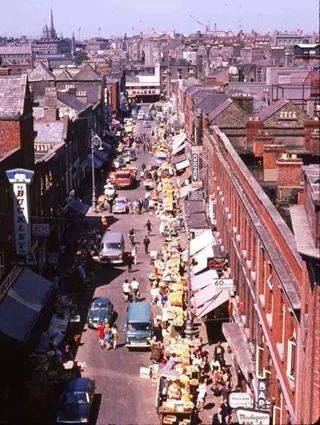
    Moore Street Market in busier days (but traders then also working in bad conditions), viewed from the GPO building presumably, looking northwards.
    (Photo source: Internet)
  • Petty official harassment of traders and small businesses should cease and appropriate expansion and regulations eased to assist in more varied use of the market

  • The traders should be provided with toilets, nearby water supply ports, heating and lighting for stalls

  • The whole street market should be provided with retractable transparent roof and sliding doors at each end

  • The street market should be made available as a “farmers’ market” on Sundays

  • The Historical Quarter and Cultural Quarter should be linked informationally

  • and with and underground pedestrian way connecting the two under Parnell Street

  • The development should take place in the context of upgrading the area as a history, culture and leisure area, most of it accessible by day and night

  • The part of Moore Street not currently part of the Barrett judgement should be included in the overall plan

  • The State should investigate the potential of applying for World Heritage Status, consulting widely and publishing its recommendations

  • Also for conservation within a European framework (some aspects of Horizon 2020 may be useful in this respect)

  • In order to do all this, a first priority is to formally urge the Minister to drop the appeal and I submit that the Consultative Group should do exactly that.

  • Develop a democratic, open and transparent partnership process to oversee the development, with representation for all stakeholders, including street traders and local small businesses, nearby residents, historians, campaigners (including activists currently excluded from the Consultative Group), historians ….


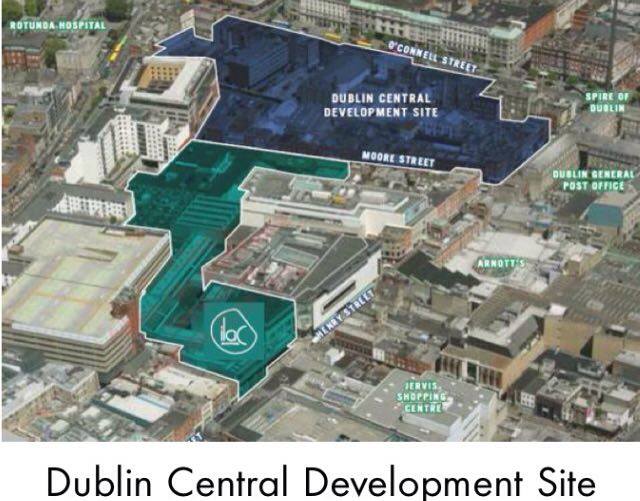
Two toxic waste spills for Moore Street? The Hammerson plan in dark blue and the existing Hammerson/ Irish Life/ Chartered Land ILAC centre in green. (Photo source: Internet).

The History Beat

Diarmuid Breatnach

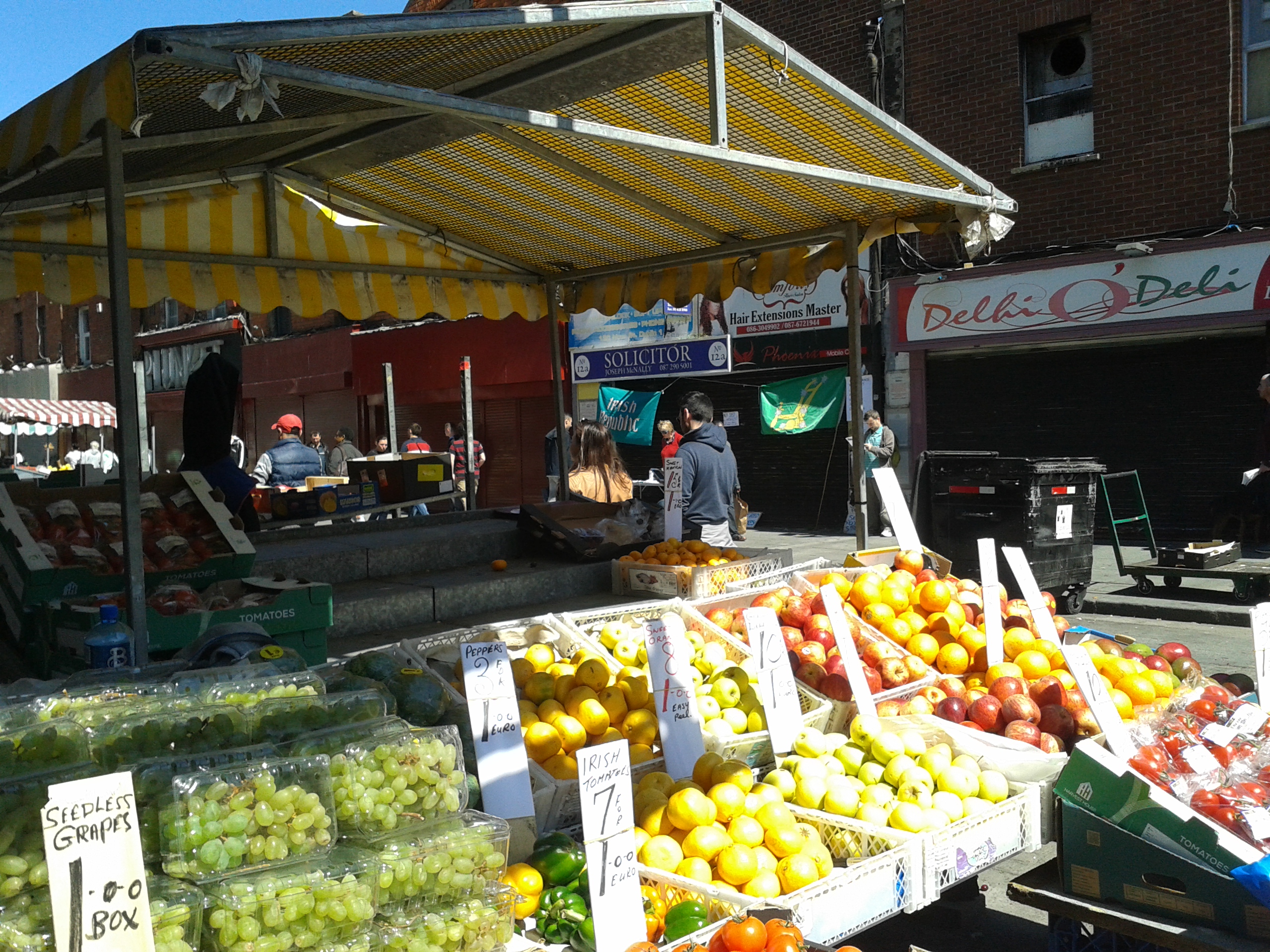
View of the campaign table through fruit stall on a sunny Saturday in Moore St in June 2015 (Photo D.Breatnach)


Here we are on famed Moore Street

in close touch with market beat,

in the air and beneath our feet,

defending heritage and history

knowing that it’s no mystery —

no accident or just a mistake —

why they want our history to take

to offer on the altar of the speculator,

Gombeen and foreign vulture taker.


A people without history is easier to rule

without that memory, easier to fool;

without a past, having no future

our masters hope we’ll be safely neutered

to be consumers dumbly tutored.


But history trembles beneath our feet

here we hear it and also feel it

we speak to the foolish and the wise

denouncing speculators and their allies

refuting Government Minister lies

our voice joining street traders’ cries.


Lemons and leeks here for selling

History stories here for telling

You never know who you’ll be meeting

Old friend or new to be greeting.


This whole area was a battleground;

A knot of people gather to sign the petition in Moore Street (photo: D.Breatnach)
A knot of people gather to sign the petition in Moore Street on a colder day in 2017 (photo: D.Breatnach)

it is again, the speculators found:

through city streets protests wound,

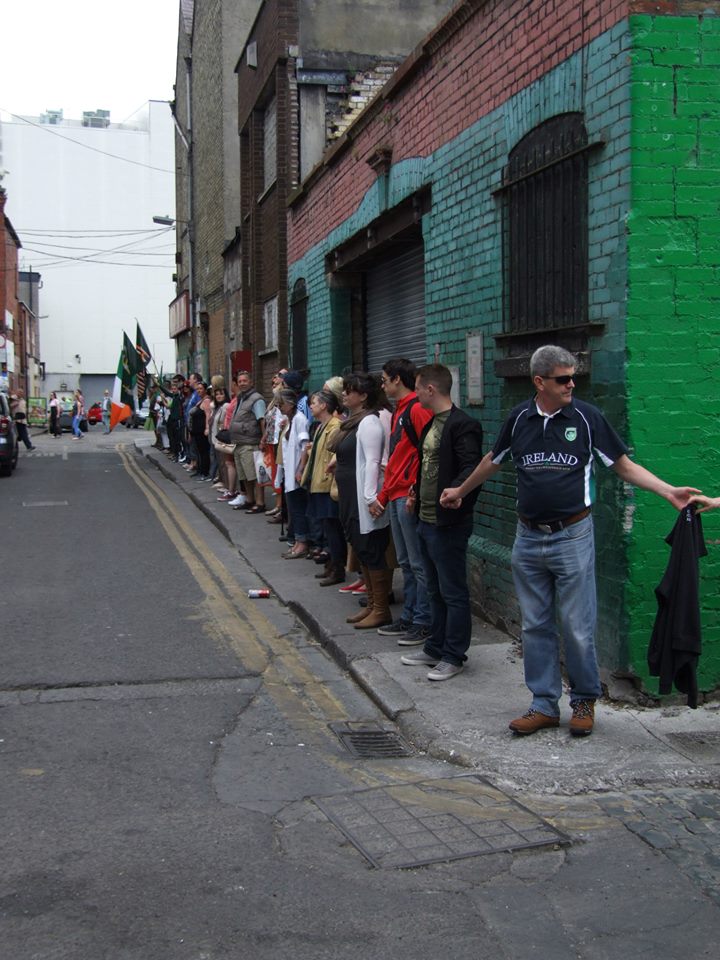
people stood and linked arms around,

occupied also against demolition,

blockaded five weeks of attrition;

and here on Saturday some of us meet

to set up our table on the street

a part of the Saturday market beat

in dry or wet or sun or sleet.


Diarmuid Breatnach, Feabhra 2017.

THE 1916 HISTORY OF MOORE STREET

Diarmuid Breatnach

The following is a part of the personal submission on the future of Moore Street which I made to the Minister’s Consultative Group on Moore Street; another section, 0n the Moore Street Market, has already been published.

The 1916 Rising historical aspect of Moore Street has been most commented upon, understandably and rightly so; however because of that I do not feel it is necessary for me to do aught than to outline the bare bones of the historical case.

The Easter Rising began on Easter Monday April 24th — it was a momentous occasion in Irish and in world history (see 1916 RISING – OF GREAT SIGNIFICANCE IN IRISH AND INTERNATIONAL HISTORY to be published separately) and of unparalleled significance in making possible the present national and international status of Ireland (whether it or subsequent events resulted in true independence or lived up to the dreams and vision of the Rising’s participants is another matter).

April 24th was not only the day the “Republic was asserted in arms” but also the day it was declared by written and spoken word, to Ireland and to the world. That was done through the Proclamation, signed earlier in the week at No.21 Henry Street and then read out by Patrick Pearse outside the GPO on behalf of the Irish Republic, copies being also distributed through the city.

Why read out at the GPO? Because the HQ of the Rising was there, the Provisional Government of the Irish Republic. And on Friday 28th, when that building was no longer habitable due to shell-fire and flames, the Government and those remaining of the GPO garrison evacuated the building.

Corner of Henry Place (centre) and Moore Lane (right) looking westward towards Moore Street (photo taken by supporter during "Arms Around Moore Street" event in June 2015)
Corner of Henry Place (centre) and Moore Lane (right) looking westward towards Moore Street (photo taken by supporter during “Arms Around Moore Street” event in June 2015)

Leaving by a side door that no longer exists, the evacuees crossed a smoke-covered and bullet-live Henry Street and entered Henry Place. There they made their way to the corner of Moore Lane and two men died on that journey. They entered houses seeking British soldiers, ready for hand-to-hand fighting and found none – the British soldiers were at distant remove and armed with machine-guns and rifles on the roof of the Rotunda and at a barricade on Parnell Street.

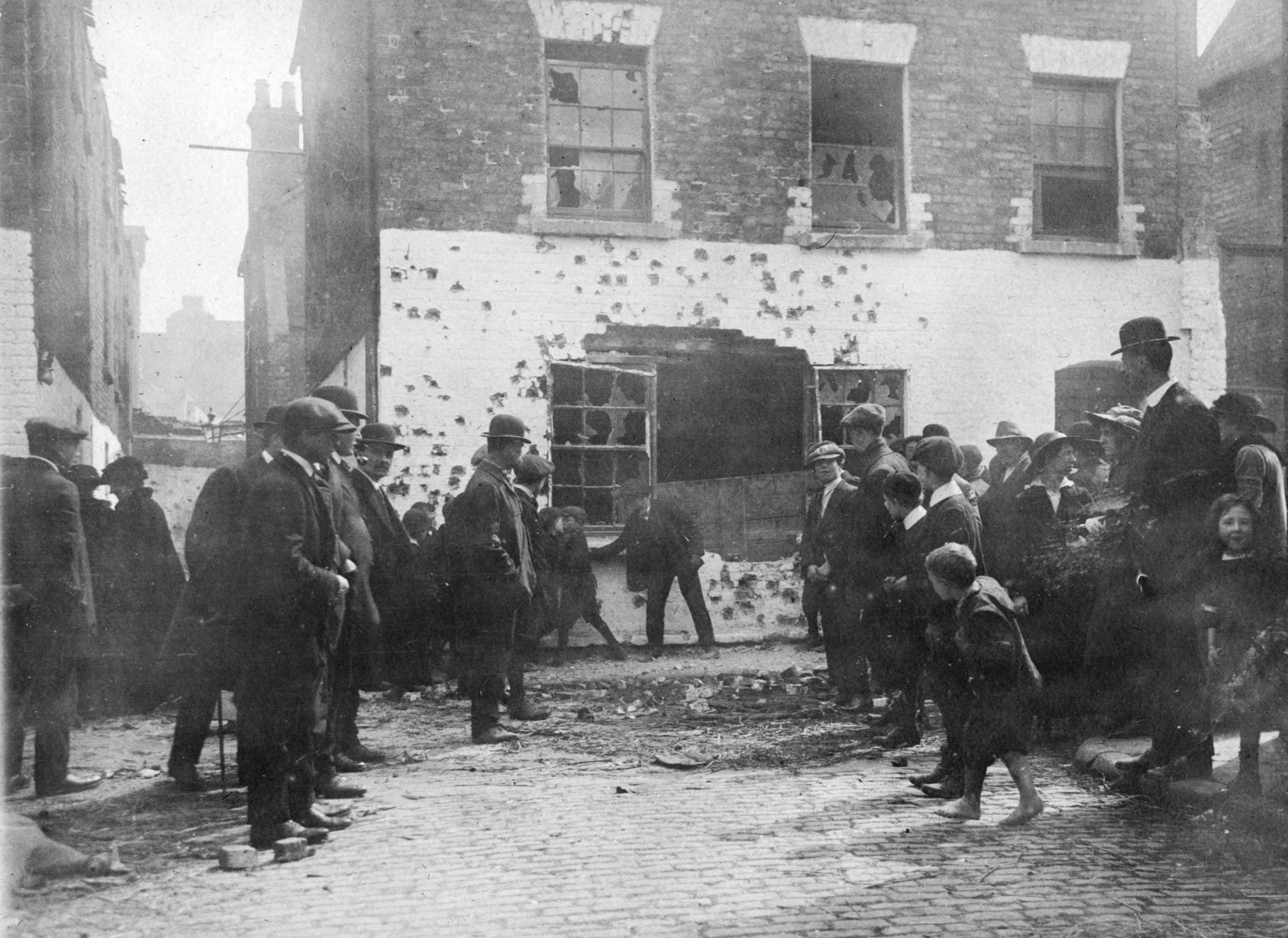
The `"white house`" in Henry Street, facing Moore Lane, showing the British Army machine-gun and rifle bullet damage from Parnell Street and from the Rotunda tower. The GPO Garrison had to cross this opening to proceed onwards to Moore St (to the right).
The “white house” in Henry Lane (photographer standing in  Moore Lane), showing the British Army machine-gun and rifle bullet damage from Parnell Street and from the Rotunda tower. The GPO Garrison had to cross this opening to proceed onwards to Moore St (to the right). Note also the little lane-way or “turning” to the left of the building which is now enclosed and built on).


Building a temporary barricade for cover, the evacuees made their way across this gap – indeed a bearna baoil — and continued on towards Moore Street. Here again the main body came to a halt, as another British barricade was firing down this street too.

Possibly one Volunteer died trying to cross here; certainly the majority instead decided to enter No.10 Moore Street (junction with Henry Place) and some houses in the southern terrace (that whole terrace and a part of No.10 were later destroyed by shelling and flames). Some volunteers also occupied the furthest house south but were forced by flames and heat to evacuate it later.

Nos.10, 14, the End of the Terrace and O’Rahilly Parade

market-stall-looking-south
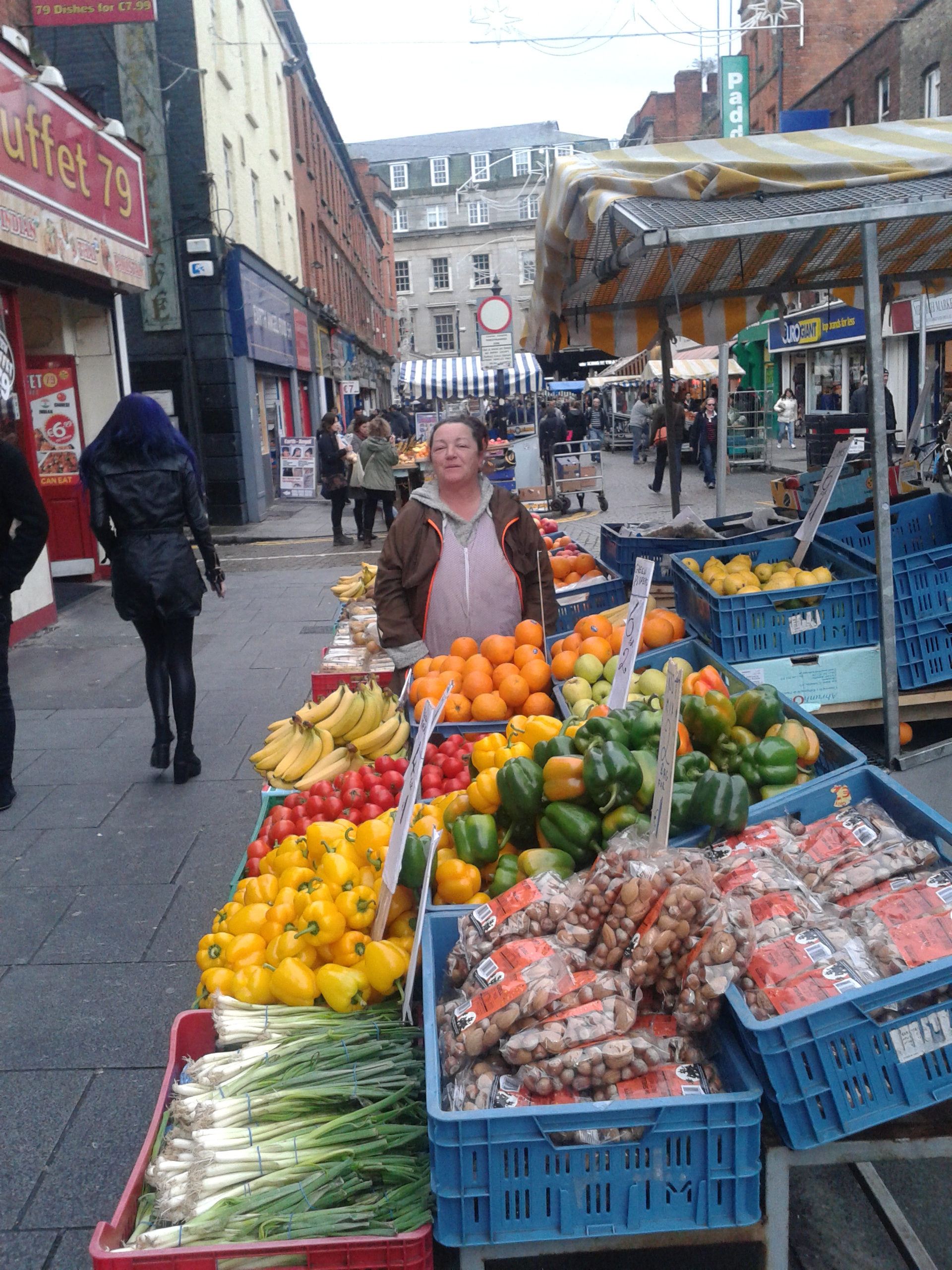
Moore Street market trader and stall. Past her to the left is the junction with Henry Lane and No.10, first HQ of the Rising after the GPO and field hospital of the GPO Garrison. In 1916, a storm of British bullets came down this street from Parnell Street (behind the photographer). (Photo D.Breatnach)

In No.10, Volunteer Nurse O’Farrell set up the field hospital, treating up to 20 wounded men, including a wounded British soldier picked up under British fire by George Plunkett from near a Volunteer barricade at the Moore St./ Salmons Lane junction and brought inside to be cared for.

Such details would make No.10 of great historical importance but it is trumped by another – this was also where the Provisional Government met on the evening of Friday 28th, the last night of the Rising. And it was here that the decision was taken to tunnel through the rest of the houses.

Through the rest of that night tunneling continued to the last house in the terrace, which is to say at the lane now named O’Rahilly Parade. And the Government relocated to nearer the centre of the terrace, almost certainly No.16. Those facts alone make the whole terrace of important historical significance.

Yet there is more. Just prior to the evacuation, The O’Rahilly led a detachment of volunteers (in both senses) in a charge along Moore Street at the barricade. Of those who remained in the street only one somehow appears not to have been wounded but his luck was about to run out: as he ran across the road to the laneway which now bears his name, The O’Rahilly was hit by five bullets and lay, dying, in the lane. Here he composed and wrote that prosaic and yet heart-rending simple letter of farewell to his wife and children, the script and content of which is reproduced in the monument currently on the wall in this laneway, near the junction known for generations locally as “Dead Man’s Corner”.

O'Rahilly monument in Parade now bearing his name (photo: D.Breatnach)
O’Rahilly monument in Parade now bearing his name (photo: D.Breatnach)

ANOTHER SUICIDE ASSAULT PLAN AND SURRENDER

In this laneway the next day, Saturday 29th, there gathered another barricade suicide attack party mobilised by Seán McLoughlin, to provide at least a diversion for the rest of the Garrison to escape and proceed westward to continue the resistance. Included in this group was Oscar Traynor, subsequently serving at different times as Minister for Post & Telegraphs, Defence and Justice (also President of the Football Association of Ireland) (but also later instrumental in denying McLoughlin a pension at commanding officer level).

Impressed by McLoughlin’s conduct earlier and during the evacuation, Connolly had appointed him to replace himself as head of the GPO Garrison now in Moore Street: yet another great historical importance of Moore Street – McLoughlin went on to become an IRA organiser in Limerick and also Commandant of a Flying Brigade in Limerick during the Civil War (by which time he had become a communist).

McLoughlin’s group were pulled back from their attack almost at the last moment as Pearse was now contemplating surrender. A number of civilians, including women, had been shot dead by the British in Moore Street (the Volunteers had shot one civilian, a teenage girl, with an accidental discharge upon entering No.10 – incredibly almost, the father pleaded the Volunteer be not punished and the mother cooked for the soldiers).

In pursuance of the decision to surrender, Elizabeth O’Farrell left the terrace (perhaps from No.14) under an improvised white flag of truce (despite a civilian man lying dead in the street under another such improvised flag), climbed over the British barricade and met with General Lowe, then returned to Moore Street and eventually emerged again with Pearse, whereupon the Surrender was formally agreed and Pearse’s order and Connolly’s co-signing was also decided.

All those events make the whole Moore Street quarter of huge national historical significance but there is yet one more – McLoughlin marched the garrison out under arms, in defiance of the orders of the British and they retraced their evacuation route, saluting the GPO as they passed it on their way up to the Gresham and captivity.

Apart from the civilians and Volunteers wounded and killed in that quarter, five of the Signatories of the Proclamation, including the Commander-in-Chief of the Rising and with his brother Willie, six of the fourteen executed in Dublin spent their last days of freedom in Moore Street.

During the Easter Rising Volunteers and their supporters or anxious relatives came and went to and from the GPO and other buildings in the area, some of them taking side streets to do so, many passing through the Moore Street quarter (including parts of it now buried under the ILAC). From the GPO to the Moore Street quarter is clearly the site of a historical urban (and WWI) battlefield, most of it intact.

Judge Barrett rightly pointed out that the issue is not how many of the houses are of pre-1916 construction (despite the State’s defence team making much of this issue) but rather of the historical footprint. In other words, Max Barrett took an archaelogical historical view rather than a historical architectural one.

Map developed by Save Moore Street From Demolition superimposed on an old map of the area. The area taken by the ILAC is shown in green and points of historic interest are numbered.
Map developed by Save Moore Street From Demolition superimposed on an old map of the area.
The area taken by the ILAC is shown in green and points of historic interest are numbered.

Without being unmoved by architecture, I would concur with this viewpoint and emphasise it in stressing the historical importance of the street, laneways and buildings (including the eastern side of the southern terrace of Moore Street, included in the threat from the giant shopping mall plan). Nevertheless, it is a fact that some of the buildings are of pre-1916 vintage and that virtually all contain some of the original building, or cellars or courtelage. On the northwest side, bullet marks may be found on houses including parts of the wings of the ‘grotesque’ (on the roof of a fine “Dutch”-style house) which were shot off by British Army soldiers during the Rising.

CONCRETE CONSERVATION, RESTORATION AND DEVELOPMENT RECOMMENDATIONS

In consultation with campaigners, street traders, the public, small shopkeepers, local residents, historians, architects and elected representatives: Save, Restore, Rebuild, Improve.

  • The whole area should be pedestrianised with the usual access exemptions for deliveries within certain hours, emergency services etc.

  • Buildings of the 1916 period in the Quarter should be preserved

  • All other buildings in the quarter should be preserved, renovated or reconstructed as necessary to appearance appropriate to the period and area (and appropriate to their current use – I am not advocating the building of outside toilets for public use or slaughterhouses)

  • The upper floor of the 1916 Terrace should be developed into a 1916 history experience, integrated with the GPO and the Evacuation Route, with disabled access

  • and the history being ‘social’ (i.e. showing how the people lived) as well as a ‘political’, i.e. aspects of the Rising (see A MOORE STREET HISTORY TOUR — A VISITOR’S EXPERIENCE IN THE FUTURE, article soon to be published)

  • The Evacuation Route should be conserved and appropriately renovated where necessary, with important events marked by plaques, panels and murals along its route

  • The Evacuation Route should be brought back to the period cobbles and kept clear of rubbish or graffiti with disabled access

  • Moore Lane and O’Rahilly Parade should be brought back to original cobbles with disabled access

  • The development should take place in the context of upgrading the area as a history, culture and leisure area, most of it accessible by day and night

  • The part of Moore Street not currently part of the Barrett judgement should be included in the overall plan

  • The State should investigate the potential of applying for World Heritage Status, consulting widely and publishing its recommendations

  • Also for conservation within a European framework (some aspects of Horizon 2020 may be useful in this respect)

  • In order to do all this, a first priority is to formally urge the Minister to drop the appeal and I submit that the Consultative Group should do exactly that.

  • Develop a democratic, open and transparent partnership process to oversee the development, with representation for all stakeholders, including street traders and local small businesses, nearby residents, historians, campaigners (including activists currently excluded from the Consultative Group), historians ….


End.

WE WANT CHANGE?


Diarmuid Breatnach

Yes we do – or at least most of us do. There are a few who do not.

Some people think that those few who do not want change are our rulers, the big capitalists — but they are mistaken. The capitalist class forced change to overthrow the feudal system, which was hampering their growth and the development of industry and commerce. And capitalists know that change is inevitable, so it is better to go with it than to try to stop it. That is why they set up courses such as those called “Change Management” — if change is inevitable, then manage it, the thinking goes. Manage it so that it comes out to capitalist advantage, naturally.

(Source Internet, using "change management" as search words)
(Source Internet, using “change management” as search words)

Change Management courses, particularly those dealing with personnel, emphasise managing change as smoothly as possible, making it non-traumatic. In that way, it is assumed, there will be less reaction against the change, less opposition.

But in fact, sometimes capitalism wants the exact opposite – it wants change to be as traumatic as possible. These are the situations described under the title “Shock Doctrine” by economic/ environmental activist and theorist Naomi Klein (2007). This has two mechanisms: in the first, the shocking change taking place disarms people from the psychological ability to organise resistance; in the second, the speed of the shock (or shocks) of the economic and political manoeuvres of the capitalists moves faster than the opposition can organise, achieving their goals before opposition can coordinate an effective resistance.

Klein has described how huge natural disasters such as earthquake (Haiti), tsunami (Thailand, Indonesia) and flood (New Orleans, USA) are used to force foreign or native private takeovers of sectors of the national economy while the people and the regime in power are reeling under the impact of the disaster.

Political and economic disasters are also used in this model, such as the military coup in Chile and the collapse of the USSR (in the case of Poland), the economic collapse in Bolivia, the invasion of Iraq, the financial collapse of the “Tiger economies” of SE Asia. Even a potentially beneficial change of great magnitude may be used, such as the collapse of white minority rule in South Africa, during which the black majority won formal equality and citizenship but lost control of most of the economy (and lost a lot more which I do not intend to discuss here).

Internet source http://sinkers.org/stage/?p=536

There is in fact a military precursor to this which has been called, in the context of US military strategy, “Shock and Awe”. This doctrine was described by its authors, Harlan K. Ullman and James P. Wade (1996), as “attempting to impose this overwhelming level of Shock and Awe against an adversary on an immediate or sufficiently timely basis to paralyze its will to carry on … [to] seize control of the environment and paralyze or so overload an adversary’s perceptions and understanding of events that the enemy would be incapable of resistance at the tactical and strategic levels”.

Of course there were many elements of this in the Blitzkrieg of the Nazi German army in its invasions of other countries and even the medieval invasions by the Huns and of the Mongols. Cromwell employed elements of it in Ireland in his army’s massacres at Wexford and Drogheda.

Aside from needing change to overcome feudalism, managing change to its advantage and use of shock doctrine to facilitate changes it wants, the capitalist system itself promotes change as part of its system. Small capitalists combine and form conglomerates, in which big capitalists come to power and, in turn, eat up smaller capitalists in order to dominate their sphere of economic activity. We have seen the growth of supermarkets and the decline of small shops, the rise of chain stores killing independent clothes shops, chain cafes and eateries driving indpendent cafes and restaurants out of business.

Capitalists also promote inventions and discoveries so as to increase their wealth but also in order to stay in front of the competition – a capitalist concern that stays at its original level will be taken over or driven out of business by its competitors. Our grandparents hardly knew about the possibility of mobile phones and computers, let alone small hand-held audio-visual connections to the Internet; our children today play with visual electronic games, films and music before they learn to talk. To be sure, monopolies also suppress inventions but they can only do so to an extent as some capitalist somewhere will break the embargo or consensus (if the discovery can be used to make sufficient profits making the attempt worth the risk).

OK, but we want change too and, we think, what we want is not the capitalist kind of change we’ve been talking about until now, although innovations and discoveries should continue and in fact accelerate – but for the benefit of the people, not the capitalists. Technological advances and innovations that do not make big profits may nevertheless be very valuable to us for all kinds of reasons.

So, yes, we want change. But what kind of change? Change to what? Change how? There a vast panorama opens.

We want to eliminate homelessness; have an efficient universally affordable health service; not to have to struggle for a decent standard of living in food, housing and small luxuries; to enjoy universal and affordable access to education at all levels; not to harm the environment; to have the positive aspects of our cultural inheritance, including history, valued and promoted. We want equal rights and respect between people regardless of race or ethnicity, gender, sexuality, ability … and freedom of choice.

In 1930s Germany, people wanted those things too, except that a lot of people were convinced that the contents of the last sentence above were harmful and not what they wanted. But there were many, many people who did want those contents too. The issue was in doubt for awhile.

In the 1928 elections the Nazi Party achieved just 12 seats (2.6% of the vote) in the Reichstag (German Parliament) and in three areas the Nazi Party failed to gain even 1% of the vote. In the Presidential elections of March 1929, the Nazi candidate Erich Ludendorff gained only 1.1% of votes cast, and was the only candidate to poll fewer than a million votes.

We know that elections are not everything – but still.

Five years later, the Nazis were in power — but even after the Communist Party was declared illegal their candidates polled a million votes.

The people definitely wanted change and the established ‘democratic’ parties were unable or unwilling to deliver it. The change the people ended up with was not probably what most had imagined and for some time it spelt disaster for Germany – and unbelievable suffering for large parts of the rest of the world … and also for millions of German citizens.

To look closer to home, people wanted change here too and from 1917 onwards they showed that electorally by voting for the newly-reorganised Sinn Féin party. From 1919 a significant section of the populace took to arms to pursue change and had the active or tacit support of a huge part of the population. But in 1921 the movement and the people split about what kind of change they wanted. A civil war followed with a heavy level of brutality against civilians and combatants, particularly by the State side, which won the contest — and we ended up with the State we now have.

Bombardment of Republican-held Four Courts in Dublin by Free State forces from the bottom of Winetavern Street (with British artillery on loan) starts the Civil War on 28 June 1922 (Source Internet)
Bombardment of Republican-held Four Courts in Dublin by Free State forces from the bottom of Winetavern Street (with British artillery on loan) starts the Civil War on 28 June 1922 (Source image: Internet)

It is well to be fairly clear about the change we want and what we do not want. There was no such general clarity in the ranks of those fighting for change from 1916 to 1921. It turned out that many who were fighting for change were fighting for different things.

Differences must have come up over the years of struggle and we know from some evidence that they did. We also must assume from the political nature of prominent people in the struggle that there were differences. Even within the IRB itself, only one of the organisations involved, there were differences that surfaced in attitude to the 1913 Lockout, the control of the Volunteers in 1914 and the Treaty of 1922.

Of course, we need maximum unity against the principal enemy. But that is unity in action only. If we put unity in thought, principles or political or social program first, as some organisations have and some others claim to do, we end up with small organisations unable to effectively counter the resistance of the ruling class to the change we want and, in the end, unable to overcome that resistance. On the other hand, if we sacrifice everything to unity against the enemy, we leave ourselves hostages to events in the future and to what kind of society will emerge from the struggle.

Somewhere between those two is where we need to be, preserving the freedom to discuss, explore and proclaim differences of opinion and social program, while avoiding unnecessary squabbles and maintaining unity in action. It is a difficult balance to strike but it needs to be done. In the midst of fighting the common enemy and striving for unity in action against it, we must fight for that freedom also inside the resistance movement, the freedom to discuss, explore and yes, also to criticise.

End.

The Ministry of Heritage is taking care of Moore Street


The irish state's Ministry of Arts, Heritage, Rural, Regional and Gaeltacht Affairs is facilitating speculators' plans to demolish the Moore Street 1916 Historical Quarte (with the exception of four houses) in order that they may build a giant shopping centre (mall). (Non-revenue copying welcome but acknowledgement expected)
The Irish state’s Ministry of Arts, Heritage, Rural, Regional and Gaeltacht Affairs is facilitating speculators’ plans to demolish the Moore Street 1916 Historical Quarte (with the exception of four houses) in order that they may build a giant shopping centre (mall).
(Non-revenue copying and distribution welcome but acknowledgement of source expected)

“SLASH AND BURN” IN MOORE STREET

Diarmuid Breatnach

“Almost slash and burn,” is how one of the people I am talking with describes the procedures they expect from Lisadell, the construction company employed by the Department of Heritage in Moore Street, to work on where the GPO Garrison retreated in the last days of the Easter Rising.

“The roof doesn’t need replacing,” says another. “It needs the hole in the roof fixed and the timbers carefully repaired, not replaced.” I remark that I’ve known people who’ve had water damage or dry rot and just had the timbers replaced. “Yes, of course, when conservation is not an issue. But when it is, the work is slow and painstaking, bit by bit, to conserve everything that can be conserved, putting in extra supports when needed.”

I am talking to people with expertise in the area of conservation of buildings of historical and/ or architectural value. They know what should be done to conserve the historic buildings in the Moore Street quarter and they feel certain that it will not be done. They feel impotent – they have the expertise, they care about conservation but they fear the combined powers of the State and big property speculators such as Hammerson, who plan to build a huge shopping centre over the whole Moore Street quarter. They will advise but if they go “too far”, they feel their professional lives will be seriously impaired. Perhaps they fear even more than that – who knows?

In 2007, just before Nos.14-17 Moore Street were made a national monument, TG4 in the their Iniúchadh Oidhreacht na Cásca program broadcast a remarkably in-depth exposure of the battle between Chartered Land and another firm of property speculators for control of the quarter and how Joe O’Reilly of Chartered Land, coming from behind, had been given an incredible advantage over his competitors with a preferential deal with the Planning Department of Dublin City Council.  This took place among more than a whiff of corruption and of complaints by elected Councillors who were excluded from a secret meeting and at another, threatened with financial penalties. Joe O’Reilly of Chartered Land (and also joint owner with Irish Life of the ILAC shopping centre) gobbled up most of Moore Street and only a fierce campaign in the autumn of 2014 prevented the Planning Department getting authorisation to swap him two Council properties in the Street, thereby clearing the way for him to begin demolition of the terrace.


“THESE TIMBERS HEARD …. MACHINE GUNS … SCREAMS … THE PAINFUL DECISION TO SURRENDER …”

Another of the experts intervenes. “These timbers they are going to rip out are the ones that heard the discussion around whether to surrender or to go on fighting,” she says. I am a little surprised at such poetic imagery from a person whose work is in bricks and mortar, plaster, timbers and slates – but there is no denying the passion and there is more to come.

“Those timbers heard the chatter of British machine guns, the crack of their rifles, screams in the street, the occasional crack of a Volunteers’ rifle, perhaps an occasional groan from the wounded Connolly. They heard Elizabeth O’Farrell volunteering to go out under a white flag although civilians had already been shot down under such a flag. They heard the discussions upon her return, the painful decision to surrender, Pearse’s decision to go out with O’Farrell, Seán Mac Lochlainn’s orders to march out in military order ….”

Can damaged timbers and bricks be conserved? I ask. “Oh yes, they do it in England on historic buildings, even genuine Tudor ones. All kinds of damaged timbers can be conserved. But if at all possible you do it in place, in situ – removing timbers causes further damage.”

And bricks? And slates? “Well,” breaks in another, “you’d photograph everything carefully in advance or as you uncovered sections. Anything to be temporarily removed would be numbered, slates or bricks. Then the supporting timbers or brickwork is slowly treated, then everything put back in the same order.”

What about missing or broken bricks or slates? “Broken bricks can sometimes be repaired but otherwise you’d source bricks from the same brickyard. Or if the brickyard is no longer in business, you’d look for other buildings of the same bricks being demolished and buy the material. The same with slates.” I think of the descriptions by campaigners occupying the buildings of how they found timbers just thrown into a set-aside room, and all kinds of objects left leaning against plasterwork that was probably in need of conservation.

A woman shows me on her Ipad a section on restoration procedures on the website of Historic England, a body sponsored by the British Department of Media, Culture and Sports. I quickly record three paragraphs (I will look up the rest later).
A conservative approach is fundamental to good conservation – so retaining as much of the significant historic fabric and keeping changes to a minimum are of key importance when carrying out repair work to historic buildings.

The unnecessary replacement of historic fabric, no matter how carefully the work is carried out, can in most situations have an adverse effect on character and significance.

“The detailed design of repairs should be preceded by a survey of the building’s structure and an investigation of the nature and condition of its materials and the causes and processes of decay.”

I remark that doesn’t seem to be what is going to happen to Nos.14-17 Moore Street. They nod – they agree.

“It’s just a building site to them,” says one. “What they have already done in defacing a national monument is criminal – but who will prosecute them?”

“They put more holes in the front of those buildings than British soldiers did in 1916,” says another man angrily. “Then they just ripped out their Hilti bolts and filled up the holes with an epoxy resin, instead of pointing material.”

This is a reference to the drilling of holes for the erection of a banner without planning permission, across Nos. 14-17 Moore Street, officially a national monument since 2007. Judge Barrett agreed it was illegal in the case taken by Colm Moore, the nominee of some 1916 fighters’ relatives. Although she is appealing that and other decisions of Barrett’s, the Minister had it taken down recently — but again using questionable methods.

“No wonder Humphreys doesn’t want independent inspection and monitoring”, says another, a reference to the Minister of Heritage’s consistent refusal to allow any independent conservation experts in, or indeed the Lord Mayor of last year, or a number of TDs and Councillors, always under the guise of “Health & Safety requirements” that no-one not of the workforce should enter. Yet when they had their media exercise after the Government’s purchase late last year, RTÉ camera crews were in there as was Caitriona Crowe of Trinity College, praising the purchase of the buildings and the Department’s alleged intentions. It later emerged that the demolition of three adjoining buildings was part of that plan but a five-day occupation of the building by concerned citizens put a stop to that, before an injunction was granted by Judge Barret preventing further demolition until the case taken against the State had been decided.

While the rest of the buildings in the quarter and the streets themselves, uncared for and subject to constant assault of weather and with broken drainpipes, heavy traffic and so on accelerate in deterioration, and the Minister’s appeal against the Barret Judgement will not even open until December next year, an assault is imminent on the roof and parapets of four of the buildings of the historic 1916 terrace, those with the best-preserved original frontages and among those with the highest specific historic importance within that terrace. If this were a case of some greedy or careless private owner or company, a complaint could be made to the National Monuments Service. Many such cases have ended in heavy fines for the perpetrators.

But Terry Allen, the Principal Officer of that very Service baldly said in his evidence to Judge Barrett that Moore Street was not a 1916 battlefield. His office comes under the Department of Arts, Heritage, Regional, Rural and Gaeltacht Affairs, of which Minister Heather Humphreys is the boss. And the Government’s Cabinet stands behind her, if not actually pushing her forward. We tend to look to the State to protect national monuments from people damaging them. But who can protect them from the State itself?


End.

NB: These conversations happened but not with all of the people present at the one time. I have put them together for the sake of a condensed narrative and for the protection of identities.


Further information:

Principles of Repair for Historic Buildings from Historic England website:

https://historicengland.org.uk/advice/technical-advice/buildings/maintenance-and-repair-of-older-buildings/principles-of-repair-for-historic-buildings/

The Facebook pages of the following campaigns:
Save Moore Street From Demolition

Save Moore Street 2016

Save Moore Street Dublin

The TG4 program Iniúchadh Oidhreacht na Cásca https://www.youtube.com/watch?v=Cx0Kah7dE80

And some of the Easter Rising Stories series of videos by Marcus Howard on Youtube

Description of Terry Allen’s responsibilities as Prinicpal Officer at the National Monuments Service http://whodoeswhat.gov.ie/branch/ahg/Monuments/terry-allen/641/


THREE EVENTS IN ONE ON HOWTH PIER

Clive Sulish

Foreign tourists and Irish-based visitors looked on with curious interest at a gathering at the foot of the East Pier, Howth on Sunday 24th – the group contained a number in military-type uniform, some were carrying flags, each one of a different design and a number of people in ordinary civilian clothes were carrying floral wreaths.

The Asgard, Molly Childers and Mary Spring-Rice on board at Howth
The Asgard, Molly Childers and Mary Spring-Rice on board at Howth (photos from Internet)

Participants, Tourists and Visitors
Participants, Tourists and Visitors (photo D.Breatnach)

Most onlookers at that point would not have known that those gathered there had a threefold purpose:

  • to commemorate the landing of Mauser rifles for the Irish Volunteers

  • to commemorate the massacre of civilians by enraged soldiers later that same day on Bachelors Walk and to

  • launch the Asgard 1916 Society.


The men and women in uniform formed up with the flags as a colour party and led the procession the full length of the pier to its end. There the procession came to a halt in front of a plaque on the wall commemorating the landing of 900 Mauser M1871 single-shot rifles and 29,000 rounds of ammunition in 1914 by a crew skippered by Erskine Childers with his wife Molly and friend Mary Spring Rice. The arms were taken ashore and whisked away in an operation planned by Bulmer Hobson of the IRB and carried out by the Irish Volunteers and Na Fianna Éireann.

Colour Party Marching
Colour Party marching along the pier towards the ceremony (photo D.Breatnach)

The Dublin Metropolitan Police and British Army were mobilised by Dublin Castle authorities to seize the guns (unlike at the previous much larger operation by the Loyalist UVF at Larne) but only managed to get a few. As the disgruntled Scottish Borderers marched back into town, they were jeered by Dublin crowds and some cabbage stalks were thrown at them. On Bachelors Walk, very near the Ha’penny Bridge, an officer brought them to a halt and they faced the crowd with guns pointed, then opened fire. Three men and a woman were killed and 38 wounded, including the father of singer Luke Kelly of the Dubliners ballad group (also called Luke). One of the victims died of bayonet wounds.

Margaret McKearney speaking and chairing the occasion on the pier
Margaret McKearney speaking and chairing the occasion on the pier (photo D.Breatnach)

Margaret McKearney, who has had three brothers killed in the Six Counties during the 30-years war, stepped forward to address the crowd as tourists and visitors took photos or watched and listened. After giving a brief account of the Howth landing and of the massacre on the Dublin quays, also of the smaller landing at Kilcoole, McKearney called forward Pól Ó Scanaill of the 1916 Societies to read the 1916 Proclamation of Independence. After he had finished, McKearney called for the young bearers of two floral wreaths to make their presentations:
Ellen O’Neill, with a wreath in memory of those killed and injured by the British soldiers at Bachelors’ Walk;

Roibeard Drummond, whose uncle Michael Moore was a crew member of the Nugget, landing rifles at Kilcoole, laying a wreath for the Asgard 1916 Society to commemorate the landing of the rifles and those who carried them in battle in 1916.

Last of the wreath-layers was Denise Ní Chanain on behalf of the Anti-Internment Group of Ireland.

Ellie after laying wreath in memory of the dead and injured in the Bachelors' Walk massacre
Ellie O’Neill after laying wreath in memory of the dead and injured in the Bachelors’ Walk massacre (photo D.Breatnach)


MOORE STREET SPEECH

Roibeard Drummond, after laying wreath on behalf of the Asgard 1916 Society
Roibeard Drummond, after laying wreath on behalf of the Asgard 1916 Society (photo D.Breatnach)

Niamh McDonald gave a short speech on the current situation in the struggle to save the revolutionary quarter of Moore Street. She informed her audience that NAMA had sold the debt of the Irish speculator company Chartered Land (Joe O’Reilly) to Hammerson, a British-based vulture capitalist company, who are continuing with the plan to build a huge shopping centre over the whole historic quarter. Meanwhile, the Minister for Heritage, Heather Humphreys, is appealing the High Court judgement that the whole quarter is a national monument. McDonald asked people to keep an eye on the campaign’s

Denise Ní Chatháin bringing forth the wreath from the Anti-Internment Group of Ireland
Denise Ní Chanain bringing forth the wreath from the Anti-Internment Group of Ireland (photo D.Breatnach)

Facebook page for updates and for calls to support actions.

McKearney then called on Diarmuid Breatnach to sing Me Old Howth Gun, pointing out that guns landed at Howth had been the first to fire on the Lancers in O’Connell Street on Easter Monday 1916. Breatnach introduced the song as having been written apparently in 1921, that is a year before the outbreak of the Civil War, by James Doherty, who also used the pseudonym Seamas Mac Gallogly.

Niamh McDonald speaking on behalf of the Moore Street 2016 campaign
Niamh McDonald speaking on behalf of the Moore Street 2016 campaign (photo D.Breatnach)

MAIN SPEAKER — JOHN CRAWLEY FROM THE MARITA ANN
The next speaker to be introduced by McKearney was John Crawley who was arrested on board the Marita Ann trawler, intercepted off the Kerry coast by the Irish Naval Service on September 29, 1984, when seven tonnes of arms were seized. The US heavy machine guns recovered on the Marita Ann had special mountings allowing them to be used as anti-aircraft weapons. Another of those detained on board – and later jailed for 10 years – was Martin Ferris who went on to become a Kerry TD for Sinn Fein, while John Crawley has taken a line of opposition to the Good Friday Agreement.

John Crawley giving his oration with the plaque commemorating the landing of the Howth guns behind him
John Crawley giving his oration with the plaque commemorating the landing of the Howth guns behind him (photo D.Breatnach)

John Crawley gave the main speech at Howth, in which he traced the history of the struggle for the Irish Republic from the Volunteers onwards, pointing out that many who fought the British in 1916 had different aspirations for the country, which explained why they parted ways in 1921. Crawley stated that the British have always been able to pick out those whose primary intention was to survive the struggle from those whose intention was if necessary to give their lives for the objective of the Irish Republic.

Pól Ó Scanaill reading the 1916 Proclamation
Pól Ó Scanaill reading the 1916 Proclamation at the head of the East Pier, Howth (photo D.Breatnach)

Crawley pointed out that some people had led a section of the Republican movement in accepting the right of a foreign country to decide the future of a part of our country; they had joined in the colonial administration and had accepted the colonial police force.

After the applause for the speech died down, McKearney thanked those who had participated and asked Diarmuid Breatnach again to step forward to sing the national anthem. Breatnach sang it in Irish, first verse and chorus (and noticeably sang “Sinne Laochra Fáil” instead of “Sinne Fianna Fáil”). Participants joined in with the chorus and then all made their way along the pier towards a local pub where refreshments had been made available by the new 1916 Society.

Diarmuid Breatnach singing Amhrán na bhFiann at end of the ceremony. Earlier he had sung "Me Old Howth Gun".
Diarmuid Breatnach singing Amhrán na bhFiann at end of the ceremony. Earlier he had sung “Me Old Howth Gun”. (Photo: Des Keane from Sean Heuston 1916 Society page)

end

Video of the event by John Rooney and put on Youtube by him, posted on FB by Mick O’Riordan (see below)
https://www.youtube.com/watch?v=RrG_7VLytfw