Written some time ago but never posted: Now, while the IOF once again threatens to bomb a hospital seems like an appropriate time for publication.
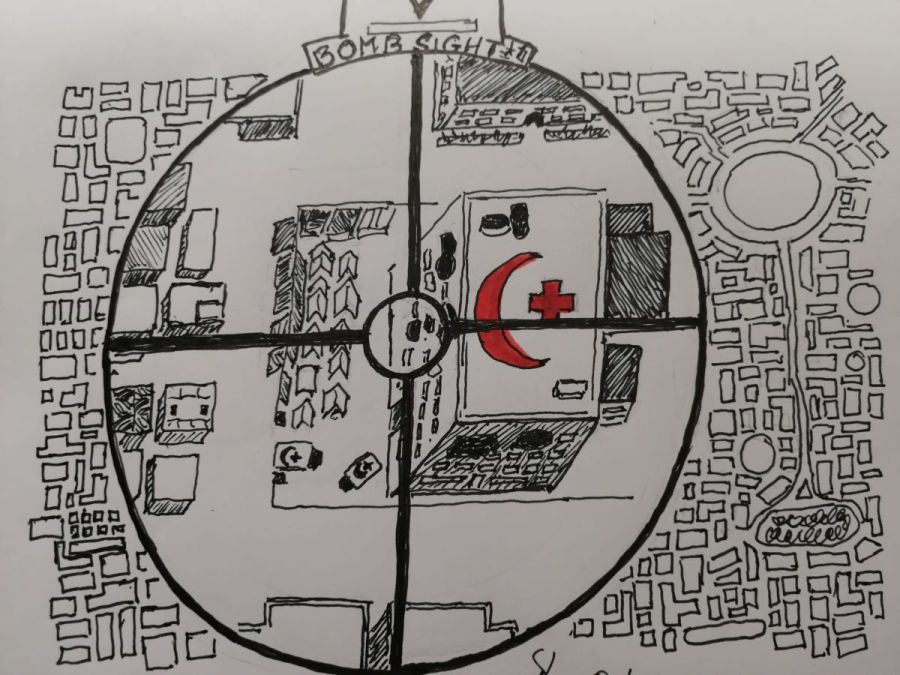
(Come for a quick peek into an ‘Israeli’ intelligence agents’ meeting as they get to the agenda item “Bombing Hospitals”. Names have been eliminated for the protection of the guilty)
Chairman: We all agree, whatever international law on conflicts says, that destroying the healthcare system of the enemy is important. However, X has requested a discussion on the current bombing of hospitals in Lebanon. X, over to you.
X: Thank you, Chairman. That was not clever, in my opinion, claiming the Lebanese hospitals have Hezbollah bunkers containing gold and weapons. Now the hospital administrators have brought the media on a tour around them so they can see for themselves that what we said was a lie.
Y: But your people agreed to bombing them – we had to have some reason for that. And anyway, that’s what we did in Gaza – bombed, sniped, invaded every one.
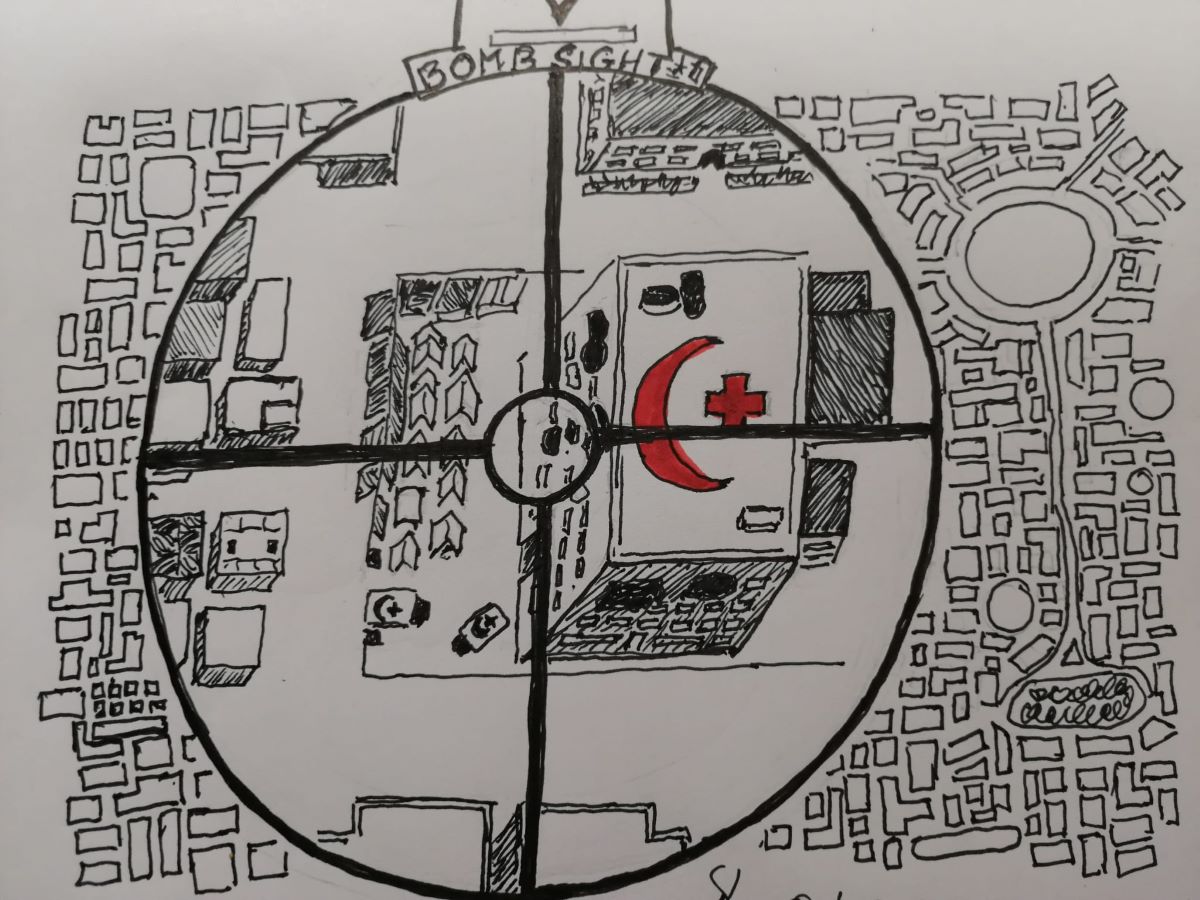
Hospital Bombsight (Cartoon by D.Breatnach)
X: Yes, but in Gaza WE controlled press foreign media access. And WE could make OUR videos, plant weapons etc.
Y: Wait a minute! Your videos showed maintenance shafts that didn’t look anything like Hamas tunnels. And planting weapons for media video? AFTER some media had ALREADY photographed the area WITHOUT weapons?
X: Did it matter? Did any international agency step in to stop what we were doing? Do you see the UN Security Council even bringing us to court in Brussels?
Y: Well then, why are you getting all steamed up about it?
X: Are you really that thick? Don’t put out lies that can and will be checked immediately! Either get some of our agents in Lebanon to plant stuff or … or just bomb the hospitals anyway. Nobody who matters will do anything. But don’t have us caught out lying, again and again!
Y: You’re not making sense. One minute it doesn’t matter what we do, then the next it matters what we say.
X: (Clap, clap). Congratulations. You finally get it!
Y: Don’t you patronise me! Your agency fucked up big time over October 7. Don’t think we’ve forgotten!
Chairman: Gentlemen! Decorum, please! We are all colleagues here …
(We leave the discussion at this point, the sound of raised voices fading behind us …)
end.
Note: If you found this article of interest, why not register with Rebel Breeze for free, so that you will be notified by email of subsequent articles. You can de-register any time you wish.
Reformatted entire for Rebel Breeze from article same title in his Substack
Iran, in response to Israeli aggression against it, launched a series of missile attacks. We should be clear that in this case the aggressor is the Zionist state and the Iranian response is a justified defence of its sovereignty in response to an act of war.
There can be no doubt about it.
But one of its missiles supposedly hit a hospital in Beer Sheva and Israel didn’t waste time in denouncing the attack on the hospital. Without blushing they said that attacks on hospitals are a war crime banned under International Humanitarian Law (IHL).
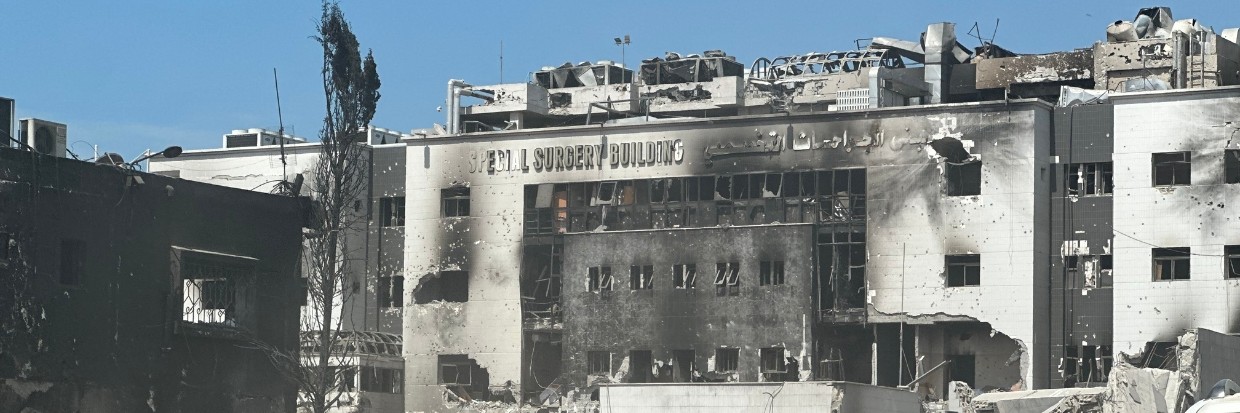
Their hypocrisy is plain to see, given that there is not a hospital left standing in Gaza thanks to the Nazis in Tel Aviv. But what does IHL say about hospitals?
Article 18 of The Geneva Convention (IV) relative to the Protection of Civilian Persons in Time of Warstates
Civilian hospitals organized to give care to the wounded and sick, the infirm and maternity cases, may in no circumstances be the object of attack, but shall at all times be respected and protected by the Parties to the conflict.[1]
It is not as simple as it would seem though. A hospital is protected but that protection is not just the responsibility of the attacking force, but of everyone. So, Israel is also obliged to not expose the medical installations to the danger of an attack. The same Article 18 reads
In view of the dangers to which hospitals may be exposed by being close to military objectives, it is recommended that such hospitals be situated as far as possible from such objectives.[2]
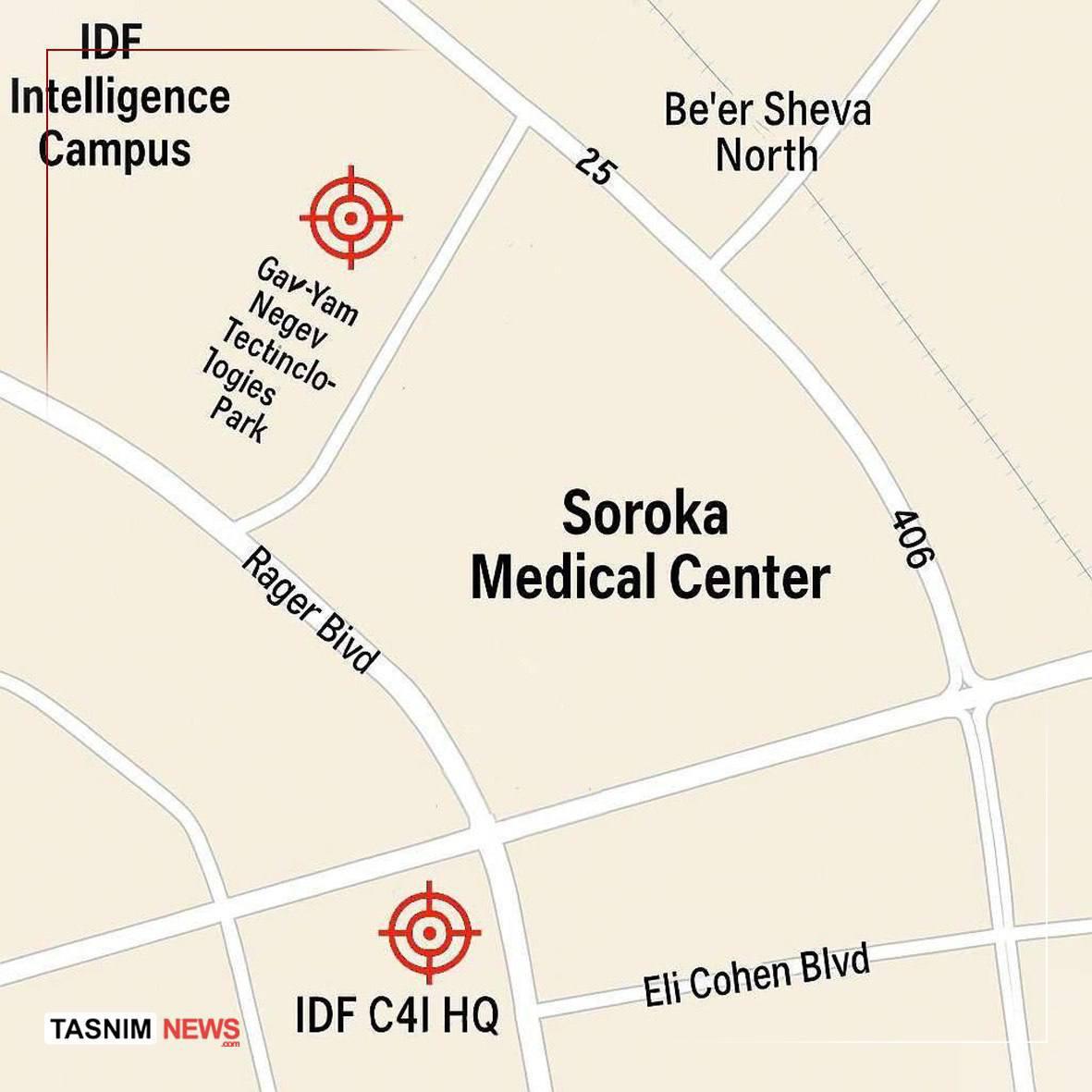
This means Israel should not place military targets near hospitals. And beside the hospital in Beer Sheva there are various military depots.
One of them is the HQ of C4i, the intelligence agency that controls the computer systems of the Zionist armed forces and communications in the battle field, i.e. a key part of the war against Iran.[3]
There is also the technological park Gav-Yam Negev which functions as C4i’s centre of technological development and the area is the epicentre of Israeli military industries.[4] A legitimate target in a war. In fact, Iran justified the attack for that very reason.[5]
Undisputed diagram developed by Iranian broadcaster Tasnim News. (Image sourced: The Cradle on Telegram)
Even in such situations the attacking force is obliged to ensure that it doesn’t damage civilian or protected installations under IHL, but there is a shared responsibility with those who violated IHL by placing military targets in the vicinity of a hospital.
And it is clear that the hospital was there first and then came the military installations. Israel uses them as human shields, something expressly prohibited by the Geneva Convention (IV). Article 28 bans it.
The presence of a protected person may not be used to render certain points or areas immune from military operations.[6]
Hospitals only lose their protected character under IHL if they are used as military installations. This does not mean that there are many soldiers in the hospital receiving medical attention, nor even if there are many soldiers present protecting them.
Article 19 of the Convention is clear about when a hospital becomes a military target.
The protection to which civilian hospitals are entitled shall not cease unless they are used to commit, outside their humanitarian duties, acts harmful to the enemy.[7]
It would seem that there was no base under the hospital just key installations for the war in the vicinity of the Soroka Hospital.
Al Ahli Hospital Gaza attacked by Israel April 2025, one of around 40 hospitals and medical centres in Gaza attacked by the IOF (Photo cred: Olga Cherevko/ OHCHR)
Up till now the only power in the region that has violated IHL by deliberately attacking hospitals protected under the Geneva Convention is Israel, with its attacks in Gaza that have destroyed all of the medical capacity in the zone.
Israel’s hysterical denunciation is more a confession than an accusation.
The coca zones of Colombia are in crisis. The cash crop par excellence, i.e. coca is going through an unprecedented crisis, or so we are told.
The main promotors of the idea that the coca is in crisis because fentanyl has displaced it and sooner or later it will finish off the coca were from the government. Amongst those promoting this stupidity are Colombian state functionaries from the NGOs, social organisations and of course high-ranking members of the Historic Pact. The very president of the country, Gustavo Petro stated in August that
The cocaine market in the USA has collapsed and has been replaced by an even worse one: fentanyl that kills 100,000 per year. Cocaine used to kill 4,000 due to the poisonous mixtures from the market clandestine.(1)
It is simply the case that nothing that Petro said at the time was true. Whereas Clinton exaggerated the deaths due to cocaine consumption in order to justify Plan Colombia, Petro sought to minimise them. First of all, we should be clear that fentanyl did not displace cocaine, but rather another opioid, heroin. And the most notorious aspect of fentanyl is not the increase in consumption, but rather that due to its toxicity, a dramatic increase in overdoses. Petro’s government makes statements on the drugs issue without even understanding basic concepts.
The overdue publication of its drug policy allows us to analyse properly what it aims to do, as up till now we have had to put up with a year of contradictory speeches, tweets that don’t say much and complete incoherence in the matter, without even mentioning his stated aim of handing over the Colombian Amazon region to the US military, something that not even Pastrana openly proposed when he announced Bill Clinton’s Plan Colombia.
In a US study published in May of this year, the researchers found that the deaths from fentanyl tripled between 2016 and 2021, increasing from 5.7 per 100,000 inhabitants to 21.6 in 2021. The deaths from cocaine overdoses increased in the same period from 3.5 to 7.9. At the same time there was a 40% decrease in heroin related overdoses, falling from 4.9 in 2016 to 2.9 in 2021.(2) The study just confirmed the analysis of previous research published in December 2022 that looked at increases in mortality since 2001.(3)
Fentanyl is a new problem for the USA, but neither the increase in its consumption nor deaths tell us anything about the future of coca as Petro and Roy Barreras claimed. Quite the opposite. According to the UN, coca crops reached the figure of 230,000 hectares in 2022.(4) Of course, Petro is not to blame for that, he only took over the presidency in August 2022, but it belies his statements that coca is a thing of the past due to the economic crisis in the coca regions of the country.
So, what can be said of Petro’s new drug policy? Well, the first thing is that there is at last a policy outlined in a public document. They took their time in doing it but better later than never. The document proposes with a certain amount of hyperbole Oxygen for the communities affected, through support from licit economies, environmental measures and treating the matter of consumption as a public health issue. It also proposes Asphyxiation for drug trafficking organisations. Furthermore, it proposes being the voice and leadership of “an international diplomatic strategy to change the paradigm in how the drugs phenomenon is dealt with.”(5)
The document kicks off with a correct analysis that contradicts the public declarations made by Petro and other high ranking government functionaries, a few weeks prior to its publication. It is inexplicable how the president can boast about the collapse of coca at a point when it is almost certain his drugs policy was at the printers. It must be due to mediocre functionaries, as this government has continued with the policy of Duque and the previous governments of hiring mediocre friends. But in any case, the document gets somethings right, at last.
For decades, Colombia has made an enormous investment in human and economic terms in fighting drug trafficking. Although there are no official figures on the outlay in fighting drugs, but the Drugs Observatory of Colombia calculates an annual average expenditure of 3.8 trillion pesos [885.2 million euros] ascending to an approximate investment in the last twenty years of 76 trillion pesos [17.7 billion euros]. Whilst some results have been achieved along the way, it is true that the two main goals have not been reached: reduction in the supply and demand for illicit drugs.
Even though 843,905 hectares of coca were forcibly eradicated between 2012 and 2022, the planted area in this period increased by 327%. In 2022, Colombia had 230,000 hectares of coca with a productive potential of 1,738 tonnes of cocaine. As for demand for psychoactive substances, between 1996 and 2019 an increase of 5.1% to 8.7% in the consumption of all illicit substances (marijuana, cocaine, base, extasy or heroin) was observed.(6)
The document then goes on to acknowledge that the collapse in cocaine consumption is not real but rather on the contrary there has been an increase. It states that one of the first hypotheses was a global fall in demand for cocaine.(7) They are trying to save their own skin. There was no data to sustain the supposed hypotheses: none. It was dreamed up by mediocres and no one else made the claim. The document goes on to say “However, according to the lastest Global Cocaine Report from the UNODC (2023), demand has risen.(8) At least we are having a debate about the reality of poorly written studies from the children of the lovers of their friends who they hired.
So, what do they propose? It would seem that they propose a shift in the punitive model without abandoning it completely. They accept that the fumigations have not worked and that the periods of greatest fumigation do not match those of a lesser supply of the drug.(9) But the punitive element continues to be an integral part of the policy, the supposed shift is a mirage.
The evidence has shown that a security strategy on its own is not enough [the emphasis is mine] but rather it must go hand in hand with actions to prevent crime and deal with the underlying causes.(10)
The document takes a look over the international treaties in the area, softening the real demands of the Single Convention of 1961 stating that it doesn’t prohibit anything but rather submits the plants and the drugs produced to a strict control. There is not enough space here to go into detail on that debate. But once again what the government is saying is not really the case. The Single Convention does actually allow for some coca crops for medical and industrial purposes, mainly in Peru and also opium in India. But it is not the case that Colombia has misinterpreted those treaties. And this is a major issue, as any change in the paradigm is dependent on changes in those treaties or better still their complete derogation and the drawing up of new treaties under a new paradigm.
Whilst it is true that a country can allow coca crops for licit purposes, that is done with the permission of the UN control bodies, i.e. the USA. Even traditional consumption of the coca leaf is frowned upon in the Convention. Article 26.2 states that.
The Parties shall so far as possible enforce the uprooting of all coca bushes which grow wild. [emphasis is mine] They shall destroy the coca bushes if illegally cultivated.
Although Article 49 permits chewing of coca leaf in countries where it was already legal on the 1st of January 1961 (subparagraph 2a), it does so on the condition of banning it and eradicating it once and for all by 1986 (subparagraph 2e), something which was not achieved. Whether they like it or not, this treaty has not been misinterpreted and the whole UN framework i.e. US policy in the area is the problem and not a misinterpretation of previous governments. The supposed freedom to grow and licit use of coca that Petro imagines is not real.
Some states in the US legalised the production and recreational consumption of marijuana and clashed with the federal banking system that was not willing to receive funds from the industry, forcing many producers to resort to mechanisms more suited to money laundering in illicit industries. Something similar happened in Uruguay. The country regularised the recreational production and authorised and regulated the state control of it. However, not even the Bank of the Republic of Uruguay was willing to receive money from a lawful activity in the country due to a fear of reprisals from the USA.
It would seem that the architects of the law did not foresee the problem that would arise in the banking industry, owner and lord of the commercial and financial transactions in Uruguay. Were the Uruguayan legislators aware that it was not just a matter of convincing the international system of prohibition to reclassify cannabis as a substance in the drugs conventions but that they also had to convince the banking system to accept money from cannabis transactions? Everything seems to indicate that the directives the banks implement are those that are simply related to the formality of Cannabis being a prohibited substance and the fact that the money from the cannabis market is legal, illegal, black or white has no bearing on decisions.(11)
Uruguay found itself at the mercy of the repressive whims of the US government and in practice was not autonomous nor sovereign. Any drugs policy should take as its starting point that Colombia is not sovereign in the matter and it faces a massive enemy when it comes to solving the problem: the USA. It is not a matter of a restrictive interpretation by Colombian governments, but rather the reality of imperialist domination. This was the case with Uruguay.
… according to the Uruguayan government implementing a national law [on drugs] depends on the modification of a foreign law. Note that at no stage is a modification of international drug treaties that Uruguay has ratified mentioned, but rather a federal law that internally classifies cannabis in the USA.(12)
The government has no proposals in the matter and its proposals for the peasants are remoulds of the previous policies with a slightly modified language. They no longer talk of crop substitution but rather licit alternatives or economies. And the licit alternatives for the countryside are the usual ones, exportable monocultures.
And the iron hand continues for the peasantry. They have talked a lot about distinguishing between large and small-scale coca producers, increasing the definition of small-scale producer as one that has up to 10 hectares. But the iron hand continues. They have said that they will not use forcible eradication but…
Forcible eradication will be applied to crops that: (i) do not fall into the category of “small-scale grower”, (ii) increase in area, (iii) planted after the publication of this policy (regardless of size), (iv) have infrastructure for the production of base and cocaine hydrochloride, (v) do not fulfil their commitments to substitution and other mechanisms on the path to licit economies.(13)
Many peasants have some infrastructure to produce base, an infrastructure that is not all that complicated. So, I don’t know who these peasants who will not be subjected to forcible eradication are. It is not all that different from the policies of Uribe and Pastrana and borrows policies from Plan Colombia, the Exporting Stake of Uribe and the directives of the former Social Action and of course the Peace Laboratories of the European Union and the nefarious apologist for the economic policies of Uribe and also in passing the World Bank, the priest Francisco de Roux: the so-called Productive Alliances.
Productive agreements between the public sector, private sector and grassroot economies
These consist of a tripartite collaboration between the state and the private sector as drivers of the productive reconversion, through actions such as capitalist investment, transfer of know-how and insertion into local, national and international markets. To that end the “Productive agreements for life and hope” will be implemented, in which the state will offer benefits to the businesses that commercially associate themselves with the communities. The Ministry of Industry, Commerce and Tourism will facilitate and strengthen these type of alliances.(14)
Not that long ago in 2017, various current senators and representatives of what is now called the Historic Pact publicly denounced a proposal from Santos on the countryside. They stated:
… limits [the communities] chances of defining the productive and economic model that would allow the building of peace with social justice, by tying it to technical criteria… that give priority to the establishment of alliances and chains of production between small and large producers and the efficient use of rural land, technological innovation, technical aid, credit, irrigation and commercialisation that favour an entrepreneurial large-scale agro-industrial production.(15)
So, what about now? Ah of course, the proposal is yours, and it doesn’t matter whether it is the same proposal or not, but rather who makes it. And if the peasants do not agree with the economic model being imposed, what will happen to them? Well, “a differential treatment will be promoted that will be transitory and conditioned on their signing up to processes on a path to licit economies”.(16) In other words, they are going to jail.
As for money laundering, there is nothing new. The government is obliged by various international treaties to fight against money laundering. But the language used is telling.
This last point [laundering] is based on identifying high value financial targets, understood to be persons or legal entities, goods, assets or bodies that due to their nature, volume or characteristics may be exploited by criminal groups (emphasis is mine) to hide or channel illicit funds and thus launder money from criminal activities.(17)
HBSC Tower, Mexico (Photo source: Wikipedia)
As with other governments, including the USA, the banks are seen as another victim. More so than the peasants, exploited by criminal groups when in reality they themselves are criminal enterprises. The massive laundering of assets that HSBC carried out in Mexico cannot be understood in any other light. There are no measures taken to jail the banks’ directors, cancel their banking licence, freeze their assets, fine them to the point of leaving them naked in the street. No. The asphyxiation the government talks about is like the law, to be applied to some but not to others. They are more concerned about illegal mining in coca zones than the laundering of assets only yards from the Presidential Palace.
The document is very similar to previous policies with some small changes, a slightly distinct language and “new” proposals that are not new. Perhaps we could say that it indicates some goodwill in some aspects, but nothing more. Petro can’t fight for a new paradigm without changing the current one.
Proposing a revision of the international legal framework does not imply a conflict between prohibition or total freedom in the market for psychoactive substances. On the contrary, it means coming up with intermediate solutions such as alternatives to prison, harm reduction strategies and the responsible regulation adult use substances such as cannabis. The progress, failure and lessons learnt from international cooperation on drugs represent an opportunity for the international community to evidence based innovative strategies and policies.(18)
Harm reduction is policy in most of the world, including some parts of the USA. Alternatives to prison also, though in practice it is not always the case in all countries. What is put forward is the current state of play, not a big struggle to change the paradigm. It is a disappointing document, more so than previous policies, as this one tries to play with the language to stupefy, fool and lie to us. In the end, it is another lost opportunity. If you want to see something innovative in drug policy, you would be better off taking a drug, preferably a magic mushroom.
(2) Spencer, M.R. et al. (2023) Estimates of drug overdose deaths involving fentanyl, methamphetamine, cocaine, heroin, and oxycodone: United States, 2021. Vital Statistics Rapid Release; no 27. Hyattsville, MD: National Center for Health Statistics. May 2023. DOI: https://dx.doi.org/ 10.15620/cdc:125504. P.3
(3) Spencer MR, Miniño AM, Warner M. Drug overdose deaths in the United States, 2001–2021. NCHS Data Brief, no 457. Hyattsville, MD: National Center for Health Statistics. 2022. DOI: https://dx.doi. org/10.15620/cdc:122556.
26 July 2023 (First published in Socialist Democracy, reprinted by kind permission of author)
Sinéad O’Connor has died. Her death at the age of 56 was announced on RTÉ.
The evening news programmes went into overdrive to pay tribute to an incredibly talented musician. As with all such tributes, the great and good were asked for their opinions or they offered them in any case and they were carried uncritically.
Sinéad O’Conner and daughter Roisín on anti-racist demonstration, Dublin, 2000. (Photo sourced: Internet)
You are not supposed to speak ill of the dead in Ireland, but more than that, you shouldn’t speak ill of those who seek to praise the dead, no matter how hypocritical they are.
There were many milestones in her musical career, not least her rendition of Nothing Compares 2 U. The media highlighted her musical talent, her voice, sometimes describing her as controversial and outspoken and much loved by the public.
Yes, she was loved by the public, to a point, and also by other musicians around the world. However, she was also despised by many, written off and derided by commentators. As with many artists when they die, there is a tendency to rewrite history.
Her politics were sometimes erratic and lurched from one thing to another, though she was always honest and forthright when she did so, unlike many a coward. As erratic as some of her opinions could be, there were no smug self-serving platitudes to fall from her lips. She was no Bono.
She was honest, frequently angry and went after the powerful at times.
The famous incident where she tore up a photo of then Polish Pope, Wojtla in protest at his covering up and enabling of child sexual abuse, a topic she was painfully personally aware of in her own personal life did not go down well with some of those now praising and lamenting her passing.
Bono doesn’t do tearing up photos of popes, he sups with George Bush, the late senator McCain, toured Africa with the head of the World Bank, to name just a few of the scumbags he was not only too happy to rub shoulders with but positively revelled in.
Fianna Fáil and Fine Gael leaders have expressed their sorrow at her death.
They weren’t expressing any support when she denounced child sexual abuse, the entire Irish political establishment were busy helping the Catholic Church cover it up, and later facilitated the institution to evade its legal, financial and moral responsibility.
Their attitude is best summarised in a typical hypocritical Irish attitude when dealing with those who make us uncomfortable that goes through phases of saying, “She’s mad, isn’t she great gas altogether, she may have a point but…, fair play to her, didn’t she speak up at the time”.
All of this without ever examining their own role in it all. The fact that, as we speak, reports of the sexual trafficking of children in care are being ignored by the government, says all you really need to know about their attitude.
If a new musician of her talent and courage were to speak out now, she would be cancelled and silenced by many of those now praising her, including some of those on the left, who have grown quite fond of not breaking ranks and clamping down on those who did.
She always spoke about mental health issues, though she became much more public about her own issues as she got older. She even broke down on a video about it, locked away in a hotel, crying. The video led to many expressing their concern, but also a bit of “there goes that one again”.
We will no doubt get many commentaries on air and in print about her struggles with her mental health, many expressing concern and sympathy with her plight. Many of them will be hypocritical.
It is true that Irish society is more open now about people who have mental health problems, though there is still a stigma attached to it.
Sinéad O’Connor (Photo sourced: Internet)
Ironically RTE followed up the news of her death with another story on the shambolic, criminal (my word, not the words of the media cowards) state of the child mental health services in Ireland (CAMHS).
Micheál Martin and Leo Varadkar may even refer to her troubles in their tributes, but they never cared about them then, they don’t care now and the proof is not only the state of CAMHS, but mental health facilities in general, with long waiting lists, a rush to medication and forgetting about the patient model of care.
Her politics were erratic in many ways, though in fairness they weren’t much more erratic than others who are not judged as quickly. She flirted with republicanism, then broke with them, even applied to join the more recent incarnation of Sinn Féin in 2014, before withdrawing it.
It may be hard to take that seriously, but it was no less ridiculous than Bono condemning the IRA and then spluttering out nonsense about how he admired Bobby Sands. He didn’t, never, ever, when it mattered.
Sineád for all her failings took positions that were unpopular unlike some of the vomit inducing smug types that populate the modern music industry.
For my own part, her politics on racism were without fault. Her song Black Boys on Mopeds is excellent. It points out the hypocrisy of Thatcher criticising China whilst British Police like James Bond had a licence to kill.
“Margaret Thatcher on TV Shocked by the deaths that took place in Beijing It seems strange that she should be offended The same orders are given by her”
The song goes on to say something truer today than before.
“These are dangerous days To say what you feel is to dig your own grave”
And then a description of England, that the great and good would run a mile from.
“England’s not the mythical land of Madame George and roses It’s the home of police who kill black boys on mopeds.”
Now she will be lionised in death, praised, described as troubled, talented, controversial and much loved. We should ignore the sanitised version we will be given and remember the Sineád O Connor who was treated with contempt and disdain at times.
Aside from her incredible musical talent, that is the version that is worth remembering and celebrating, the version they weren’t too happy to celebrate when she was alive.
In Ireland we like to celebrate talented uncomfortable artists and writers in death in a manner we don’t do when alive. She deserves some coherence from us on this.
The Irish State recently commemorated the end of the Irish Civil War but what it was really doing was celebrating its victory over the democratic national liberation forces.
The Irish national bourgeoisie, the Gombeen ruling class, armed and supplied by British Imperialism and colonialism, in 1922 launched a war against the forces that had brought the British Occupiers to the negotiation table.
In that short war or counterrevolution, the Irish State formally executed over 80 Irish Republican Volunteers – many more than had the British during the War of Independence 1919-1921. It also shot dead and blew up surrendered Volunteers and kidnapped, tortured and murdered others.
The Irish government of the day put the financial cost of the Civil War at 50 million sterling which today would be near to 3 billion euro.
A curtain of repression settled over Ireland, in the Irish state and in the colony in the Six Counties (in particular from the RIC re-baptised as RUC and the State-armed Loyalists of the B-Specials). Many Republicans were in jail and if not, could not find work and so emigrated.
The political party allegedly representing the Republicans, Fianna Fáil, led by a former leader of the forces attacked by the State, joined the Gombeen system and became in fact the preferred party of the Irish ruling class.
Though the Republican forces recovered and returned to the struggle in the 1930s (with the Communists against the fascist Blackshirts), again in the 1940s and onwards, they never again came close to winning control over the State.
What the Irish State has given us since its inception, even after the Civil War, has been generations of underdevelopment; unemployment and emigration; a huge decline in the Irish-speaking areas; inequality and social repression of women and LGBT people.
The latter was due to Catholic Church domination in every sphere of life, resulting in institutional physical, mental and sexual abuse, along with censorship in printed, audio and visual media and in banning of contraception.
The ruling class of the Irish State, the Gombeens, tolerated the foreign occupation and control of more than one-fifth of the island’s land mass and abandoned the large Catholic minority in the colony to discrimination and pogroms.
It tolerated also institutional and media racism against the Irish diaspora in Britain, the repressive legislation of the Prevention of Terrorism Act and the jailing for long sentences of a score of innocent Irish people in five different cases in the 1970s.
The Irish State tolerated Loyalist/ British Intelligence bombing inside its territory, failed to protect its citizens from terrorist bombing in the 1970s and covered up its complicity, for example with regard to the Dublin and Monaghan Bombings.
In addition, it used a Loyalist bombing to disarm the opposition to repressive legislation, not against Loyalists but against Irish Republicans, sending Republican activists to jail on the unsupported word of a senior police officer.
More recently this Irish State that we inherited has given us a housing crisis while it makes the territory a rich hunting ground for property speculators, bankers, landlords and vulture funds and also sells off/ gives away our natural resources, public transport and other infrastructures.
The selling-off includes our health service which is also in crisis while the private companies chop off parts of it and sell service back to the State at a profit. And a country that was able to feed 8.5 million prior to 1845 (and export foodstuffs) cannot now feed 5 million without huge imports.
They have given us nothing to celebrate but as always, there is a choice. We can bemoan the situation or we can “take back the nation they’ve sold” (Soldiers of Twenty-Two). And that cannot be done through electing any party or parties into the system.
First published in “Socialist Democracy” December 2022, republished here with kind permission of author.
The death of Vicky Phelan on November 14th was announced by the media. They were full of praise for a woman who was a victim in the cervical smear scandal.
She was one of over 200 women whose cervical smear tests were outsourced to a private US company, which gave back erroneous results.
Women who could have received treatment went on to develop cancer and in the case of Vicky Phelan die. But she didn’t just die. She was murdered.
Engels in his famous tract The Condition of the Working Class in England stated that
When one individual inflicts bodily injury upon another such that death results, we call the deed manslaughter; when the assailant knew in advance that the injury would be fatal, we call his deed murder.
But when society places hundreds of proletarians in such a position that they inevitably meet a too early and an unnatural death, one which is quite as much a death by violence as that by the sword or bullet; when it deprives thousands of the necessaries of life, places them under conditions in which they cannot live – forces them, through the strong arm of the law, to remain in such conditions until that death ensues which is the inevitable consequence – knows that these thousands of victims must perish, and yet permits these conditions to remain, its deed is murder just as surely as the deed of the single individual; disguised, malicious murder, murder against which none can defend himself, which does not seem what it is, because no man sees the murderer, because the death of the victim seems a natural one, since the offence is more one of omission than of commission.(1)
The Irish state has for a long time deprived its population of the necessaries, as Engels put it, of life in relation to health care. One of the first politicians to wreak havoc in the health system in pursuit of her ideology and profit was Mary Harney.
Mary Harney, former Health Minister who set up the Irish health service for privatisation – guilty of murder through neglect. (Photo sourced: Internet)
She and her party the Progressive Democrats were ideological in their commitment to the privatisation of health care. Under her rule and that of successive governments, the health service was privatised.
First, they ran it down, closing hospital wards and reducing the number of beds in the health service, paying Consultant Doctors extravagant salaries, allowing them to moonlight as private consultants, whilst there are now around one million people on public waiting lists.
The system is a shambles and compares poorly in terms of speed and quality of care to even Third World countries.
At the same time a private health care sector has arisen and expanded, all the time promoted by the state through tax breaks and discounts for the companies with affiliates being able to write off part of their private health insurance against tax.
In other words, a public subsidy to the health companies paid for through the taxes of many people who cannot afford to use these services. The Irish health service does not exist to provide health care but rather to generate profit. It is important to understand what this means in practice.
If profit is the motive, then the law of supply and demand takes over and prices and the quantity of services are calculated on the same or similar basis to the sale of a car. It also means that in order for some to be treated and live, others must die.
It is an intrinsic part of the system and they know it. For health care to be profitable some must not have full access to it, some must die in order for others to make profits. If everyone can access cancer treatment without problems then there is no need for private medicine.
This is not the situation in Ireland. Public services are run down in order to encourage private medicine and profit.
It is in this context that the Health Service Executive outsourced the testing of cervical smear tests not only to a private company, but to one in another jurisdiction. Money was to be made, and to hell with the consequences.
Dr David Gibbons, a former member of the screening programme, said he expressed concerns about the outsourcing of smear tests to the US in 2008 but they were dismissed.
Tony O’Brien, former head of the National Cancer Screening Service and Director General of the HSE until 2018 — another one of the guilty (Photo sourced: Internet)
Gibbons, chair of the cytology/histology group within the programme’s quality assurance committee, brought up his worries with Tony O’Brien, then chief executive of the National Cancer Screening Service and director general of the HSE until 2018, but they were not listened to.
Dr Gibbons resigned as a result. O’Brien defended the decision to outsource the testing saying that tests would have otherwise been left idle for a year or been examined by doctors “on their kitchen table”.(2)
Why would they lie idle for a year? Because they had decided not to spend money on it. Why would doctors end up examining them on their kitchen table? Because the facilities weren’t there.
When it all went wrong, they dragged their heels on informing the women, and this is where Vicky Phelan comes in.
She was diagnosed with cancer in 2014, but only informed of the false negative from the unapproved labs used by the HSE in 2011 and sued the US company and the HSE, but her case against the HSE was struck out.
The cat was out of the bag, however, but they continued to drag their heels on informing women that they may in fact have cancer and they stuck by their accountancy guns and continued to outsource the tests.
As Engels stated they know these victims will perish and yet permit the conditions to continue.
When she died, the great and good in Irish society expressed their praise for her. The murderers came back to the crime scene in a perverse act to say “It wasn’t me, I didn’t do it”. The Taoiseach, Micheál Martin stated on Twitter
Very saddened at the passing of Vicky Phelan, a woman of great courage, integrity, honesty & generosity of spirit. She will be long remembered as someone who stood up for the women of Ireland, & globally.(3)
The Tánaiste Leo Varadkar, for his part, was brazen in his Janus-like abilities.
Today Ireland has lost a woman of limitless courage, compassion and strength. I want to extend my deepest sympathies to Vicky’s family, particularly to her children on the loss of their incredible mother.
Vicky was a shining example of the power of the human spirit. Her fight to uncover the truth and the courage with which she faced her illness made her an inspiration to us all. We mourn her as a nation, as a society, and as individuals.(4)
Both of these men bear responsibility for what happened. To listen to them you would swear they were talking about some social justice warrior in a far-off land who stood up to a government that the Irish state is not on good terms with.
Condolences from murderers by neglect, Taoiseach Mícheál Martin and Tánaiste Leo Varadkar, presiding over the privatisation and degradation of the Irish health service. (Photo sourced: Internet)
Varadkar was a government minister in 2011 when Vicky Phelan was tested. He was Minister for Health when she was diagnosed with cancer and he was Minister for Social Protection when she was eventually informed about the mess up with her results.
Martin has been a T.D. in the Irish parliament (Dáil) since 1989 and has served as a minister on and off since 1997 and is the current Taoiseach.
They oversaw the dismantling of the health system, they made up the rules and implemented them. What happened to Vicky Phelan was on their watch. In other jurisdictions functionaries can be held liable for decisions they take, but not in Ireland.
They took decisions on the health service which affect the lives of millions, not just Vicky Phelan. Every year countless patients die in Ireland due to a lack of access to proper healthcare; Varadkar and Martin know this and yet they proceed with their actions.
In a criminal court case where a person carries out an act knowing it could result in the death of a person and decides to proceed nonetheless, they would be liable for that person’s death through recklessness.
Yet, politicians take decisions that kill people knowing that this is the likely outcome. They are guilty of what Engels termed social murder.
Vicky Phelan didn’t just die, Fine Gael and Fianna Fáil along with the Greens murdered her. No amount of praise from Vlad the Impaler a.k.a Leo Varadkar can hide the fact that he bears responsibility for death.
Vicky Phelan, cervical cancer campaigner, 1974-2022.
View of section of the crowd from Molesworth Street (Photo: Rebel Breeze)
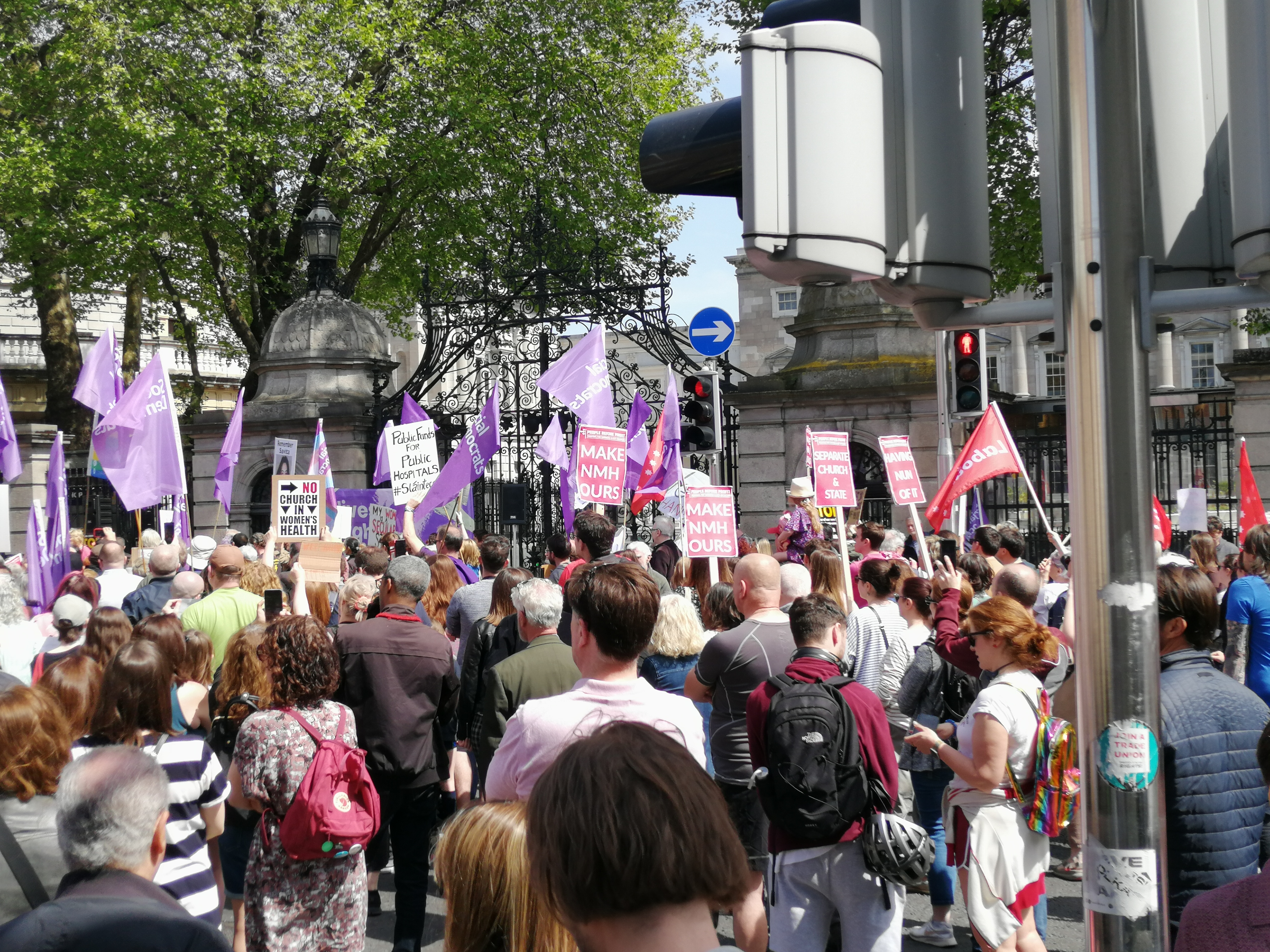
Around two thousand demonstrators, including a high proportion of women, held a rally on Saturday afternoon outside Leinster House, the building housing the Irish Parliament. They were protesting the lack of clarity around whether the new maternity hospital will carry out pregnancy terminations on demand — with the suspicion that it will not.
View of section of the crowd in Molesworth Street (Photo: Rebel Breeze)
But speaker after speaker went further still and demanded the secularisation of the Irish health service and of society in general.
The issue arises in the first place due to the necessity to relocate the Dublin maternity services currently based at Holles Street due to the inability of the latter to meet the demand. However, the Government decided to relocate the facility to land near St. Vincent’s Hospital, owned by a Catholic Church organisation, which in turn formed a company to buy the land and lease it to the State at a nominal annual rate. It is the perceived Church veto on some procedures that has raised so much concern.
View of section of the crowd in Kildare Street looking northwards (Photo: Rebel Breeze)
A SECULAR SOCIETY – A REPUBLICAN DEMAND
A secular society is a fundamentally republican demand, up there with opposition to monarchy. English Republicanism failed to achieve1 it even after the execution by Parliament of Charles I in 1649 but the French revolution did not, which was one of the reasons why the Irish Catholic Church hierarchy was against La Republique and against the United Irishmen too.
View of centre section of the crowd in Kildare Street (Photo: Rebel Breeze)
Irish Republicans after the United Irishmen have had at best an ambivalent attitude to the Catholic Church – although the Young Irelanders and even more so the Fenians were decidedly anti-clerical, the Republicans in the first two decades of the last century were not so in general and many actually courted the support of the Church. The fact that the Irish Republican movement during the rest of the century failed to lead social struggles is adequate testimony to its leadership at the very least not wishing to earn the hostility of the Catholic hierarchy. That in turn was one of the factors ensuring that the Republican movement failed to broaden its struggle to encompass the majority of the nation … a factor sufficient on its own to ensure its defeat.
On the whole it has been left to writers, revolutionary socialists, social democrats and liberals to fight the secularisation battles – but above all, left to women. Control of fertility, access to contraceptives, personal sexual freedom, gender equality in law, equal pay, and termination of pregnancy were all hard battles won over decades by women. And often at huge personal cost. Most of those battles confronted the authority of the Church Hierarchy and even when some did not so directly, they did so by implication, undermining its basic judgement that the role of a woman is as wife to husband and mother to children.
Section of the southern end of the protest crowd in Kildare Street (Photo: Rebel Breeze)
The position of the Church hierarchy in Irish society was one of moral judge, jury and practical punisher and when punishment failed to correct, the State took over. In fact, we can view the Irish State in social and political terms as a partnership of native capitalist class – the Gombeens – and the Church hierarchy. In return for its role in social control, the State permitted the education, health and social care systems to be run by the Church either wholly or in part. Which in turn increased the power and authority of the Church hierarchy further. And it was that unquestioned (and unquestionable) authority that fostered the decades of physical, mental and sexual abuse carried out by so many clergy, in particular on women and children.
Women are still to the forefront of the struggle for the secularisation of the State and they are too in this struggle over an important branch of the health service. The people need a well-resourced national health service, with free access – but it needs to be secular also. Irish Republicans who do not actively support this struggle are failing not only the society they hope one day to lead but, in secularisation, failing also a fundamental principle of republicanism. That one of the issues with regard to Church influence on the maternity hospital is a suspicion that it will not carry out elective pregnancy termination should not prevent even those Irish Republicans opposed to elective termination from supporting its secularisation.
Quite simply, one is either a Republican and therefore in favour of a secular health service — or one is not a Republican.
End.
FOOTNOTES
Since 1524, not only is the UK a monarchy but the monarch, the Head of State, is also the head of the (Anglican) Church of England.
In Henry Street on Saturday I stopped to contribute to a fund-raising event for a child to have an operation in the United States. I was partly motivated by remembering when a granddaughter of mine, Caitlin Rose, needed to go to the US also for a special operation. I remembered too how generous people had been to my fund-raising for that objective. I had no idea when I stopped in Henry Street that the girl, Sienna, was heading for the same surgeon who had operated on my granddaughter Caitlin Rose some years ago.
Dublin Fire Brigade truck parked at Henry Street/ Liffey Street junction for the fund-raising event. (Photo: D.Breatnach)
Sienna in June (Source photo: Sienna’s family)
Men from Dublin Fire Brigade were doing the fund-raising, their fire truck carrying big posters advertising the campaign. One of them told me that he does a number of charity fund-raisers a year, always in Henry Street, where he finds the response of the people supportive. They don’t get time off from work for this activity and he would be heading into his Blanchardstown Fire Station that evening for a 12-hour shift.
One of the Dublin Fire Brigade firefighters fund-raising in Dublin’s Henry Street for Sienna’s operation on Saturday 11th (Photo: D.Breatnach)
Another of the firefighters taking part in the fund-raising for Sienna on Saturday in Henry Street. (Photo: D.Breatnach)
As I stopped to take some photos, I noticed a woman wearing a fire-fighter jacket and went to talk to her, asking how many women were now in the Dublin Fire Brigade. But she wasn’t a firefighter — she was the girl’s mother and only wearing the jacket on loan for the occasion. Chatting to her I discovered that her daughter Sienna is heading to Louisville, USA, to be operated on by Dr. Park, just as was my granddaughter some years ago. When Dr. Park first pioneered it, the operation was a startling new one and, though it is now available through the NHS (Caitlin Rose lives in London) and the HSE, for some reason the recovery time is much slower than under Dr. Park’s treatment.
In the most crude and simplified explanation, in SDR operation the surgeon opens the patient’s back to test which of the sensory nerves are pulling limbs taught and — cuts them! It sounds scary and crazy even but when one sees the results ….!
Dr. Park, a US-based surgeon from Korea, perfected this operation which he carries out in Louisville, Kentucky. Of course, lots of other work is required, including physiotherapy, exercising and often, orthopaedic surgery to correct bone deformity, etc. On 15th November 2018, Dr. Park performed his 4,000th SDR operation.
Lesley Ann, Sienna’s mother, taking part in the fund-raising in Henry Street on Saturday (Photo: D.Breatnach)
The cost of the operation, for the flights and the accommodation for the parents while the child is in treatment, time off work – all this is piles up frighteningly high. My daughter, my son-in-law and my son all organised fund-raising events and I was lucky that singers and musicians here supported two fund-raising events I organised, with support from Club na Múinteoirí here in Dublin — and that so many bought tickets. Before the operation, Caitlin Rose could barely walk; now she can even run and dance a bit, ride a bike, etc, and go to school on her own.
I hope at least as much for Sienna.
And that the same operation at the same level of effectiveness be available to all people in Ireland without having to fundraise or leave the country to access it.
Politicians were last week briefed by the Irish Department of Health to the effect that the construction costs of the projected National Maternity Hospital are expected to reach €800 million — and it appears that neither the land nor the management of the hospital will be under the control of the State. The project has been controversial from the outset, with issues of its location, cost and religious institutional management and now conflicting narratives on discussions of ownership of the land have appeared between the Government and the religious bodies involved.
It is precisely concerns over governance arrangements at the hospital, linked to ownership of the site, which have stalled progress on construction over the years, while projections of costs have grown from the original €150 million. The most recent estimate was around €350 million but on Friday, a spokesperson for Minister of Health Stephen Donnely said: “The building infrastructure cost has been priced at €500 million. Further commissioning costs, including fit-out and transferring an entire hospital to a new site, will be a further €300 million.”
The Religious Sisters of Charity, which order owns the land, is transferring it to the newly-created private charity St Vincent’s Holding CLG, which will then lease it to the State for 99 years. The directors and members of this new private charity are the shareholders of St Vincent’s Healthcare Group, of which in turn the Sisters of Charity are the sole shareholders.
According to a report in the Irish Times, politicians were told on Thursday that several attempts had been made to purchase the site but this was contradicted by the religious institutions.
The Religious Sisters of Charity said it had “never at any point been contacted by Government or the State to discuss purchasing the site”, while SVHG – on whose campus the new hospital is to be located – said in a statement: “At no stage was any proposal or approach to sell the land, meaningful or otherwise, received or considered by the board of SVHG.”
While the text of a letter in 2017 from the St. Vincent’s Group may appear at one reading to contradict their later statement, another reading may see it as purely forestalling any attempt to purchase the site from them. The text, shown to the Irish Times presumably by Government sources reads: “This is why SVHG cannot countenance any sale or lease of part of the land on site, or any separate ownership of a hospital on site”.
The versions of the Government and of the religious institutions contradict one another and which is correct remains to be ascertained. What is certain however is that the religious institutions wish to control the site and at least influence governance, while at the same time it is the taxpayer who will fund the construction and the running costs of the hospital.
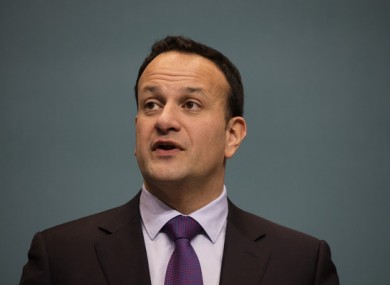
Asked on Saturday if the site might have to be abandoned for the hospital, the Tánaiste Leo Varadkar said: “Of course there is that risk, that’s the reality of the situation.” He added: “This hospital has to be publicly owned and it has to be the case that any obstetric or gynaecological service that’s legal in the State has to be available in that hospital.”
Earlier, the Taoiseach (Prime Minister of Irish government) Mícheál Martin told RTÉ, the national TV network: “But there’s a very basic point in terms of the taxpayer, and I think into the future we’re in a new era, when the State is building new hospitals and paying the full total of the costs, the State should own the facility.”
UNHEALTHY SERVICE IN THE IRISH STATE
The Irish State has never had a comprehensive public health service, unlike the rest of Europe. When the State was created in 1921, there were a number of health care institutions run by the Catholic Church and the State integrated them into the state-funded service, leaving them under religious institutional management but providing them funding through the state’s health care budget. And so it continued to this day.
This means not only that the public taxes of residents of the Irish state are funding private health care but that those institutions are not answerable to the public in terms of policy on what they consider moral issues – in other words Catholic Church ideology. Hence it is not known at the moment whether the new proposed National Maternity Hospital will provide a service within the terms of what is legally permitted in the Irish state such as voluntary sterilisation, gender adjustment or IV fertilisation. Or pregnancy termination along the lines of what is agreed and desired by the majority of the citizens in the State, as shown in public opinion polls and the 2018 Referendum on Abortion.
In addition, private health centres compete with public services for funding and for staff.
The controversy around the governance and construction costs of the National Maternity Hospital is not alone since there is also another with regard to the projected National Children’s Hospital siting and construction costs, with BAM company claims against the National Paediatric Hospital Development Board (NPHDB) totalling €300 million. The original construction cost estimate was €1.74 but some projections now are estimating an excess of €2 billion — and completion not until 2024.
Since construction companies in the Irish state are all private capitalist companies, these problems of course end up in the profits of the companies and a loss to the common taxpayers.
INCREASED HEALTH FUNDING – FOR WHOM?
Leo Varadkar, Tánaiste (Photo credit: Eamonn Farrell/ Rolling News)
The Tánaiste (Ireland’s Deputy Prime Minister) Leo Varadkar has stated that the funding of the State for the Health Service which was increased to deal with the Covid19 pandemic is not to be cut when the pandemic is over but will be kept at €22 billion. If the projected costs of the maternity hospital construction works of €800 million are going to come out of that (without any estimate on site purchase cost), it would leave only €21.2 billion to run the whole health service which is actually less than the 2018 budget of €22.5 billion. And if the €300 million of BAM’s claims were granted, this to be deducted from the budget, only €20.9 billion would remain.
If we assume that the projected construction costs of the National Maternity Hospital are to come from a different budget then it still leaves us the question of who is to benefit from the health budget, the public health service or the private services (Church and other).
In 2019, €1.311 Billion of public funding went to just five private health services1
Sisters of Mercy (including Mater Hospital, Mercy University Hospital — €432 million
Sisters of Charity (including St. Vincent’s University Hospital — €373 million
Brothers of Charity — €218 million
St. John of Gods – 166 million
Daughters of Charity €122 million
A TWO-TIER HEALTH SERVICE
The existence of private alongside public health care facilities creates a two-tier system, one with fast access to treatment alongside another with long, sometimes fatal delays (especially in the case of cancer diagnosis and treatment). Yet both are funded, as we have seen above, by the taxpayer.
With the disparity in waiting time and, to some extent quality of treatment, people who can do so of course tend to opt for the private service. And in order to afford that access, they take out private health insurance.
“According to the Health Insurance Authority, the average health insurance premium has increased from €423 per person in 2002 to €1,200 today”, “which has led to tripling of premium income for the insurance industry, from €822 million in 2002 to €2.5 Billion in 2016, as the numbers taking out insurance have also increased substantially.”2
IN CONCLUSION
It is not tolerable that our taxes are going to fund health care facilities that may not, because of religious ideology, provide a full service within what is legally permitted. Nor is it tolerable that our taxes are funding private healthcare facilities at all, never mind funding them to compete with public ones.It is not acceptable that our two-tier system discriminates against the less wealthy and promotes the huge growth in the private health insurance sector. Nor that people are being driven to take out private health insurance which has that sector’s companies raking in profits.
People resident in Ireland need and are entitled to a public health service that is well-funded and staffed to undertake timely illness prevention and health care at all levels in all areas of medicine. And a service that has the spare capacity to deal with emergencies without straining its facilities and harming its staff.
That is what we need and the vast majority of the population would support that, in this state and even in a united Ireland3. But which political party would give us that in government? Not FG, FF, Lab, Greens or SF, on any rational prediction. Although it would be just a reform, will it take a revolution to achieve it?
Let the religious fund their religious-ethos health services and let the rich fund their own private services but ALL PUBLIC FUNDING FOR ALL-PUBLIC SERVICES ONLY.
End.
FOOTNOTES
1From “A brief history of Ireland’s two-tier system”, (Rupture Issue 2, p.22).
2Ibid, p.23, quoting the HIA 2004 / 2005 report and Irish Times article.
3People in the Six Counties have a part of the UK’s NHS there and use and by all indications approve of a public health service.












 rebelbreeze