STATEMENT AGAINST DEMONISATION OF WATER METER RESISTERS ISSUED BY COMMUNITIES AGAINST WATER CHARGES NETWORK — a very good statement apart from falling into the trap of agreeing to put “sinister, dissident republicans” in it and to separate themselves from political activists. “Standing together” includes “dissident republicans” and other political activists. Diarmuid Breatnach.
“Resisting the Water Charges and Defending Our Right to Protest.
“We are residents of a number of communities in Dublin North East. Over the last number of months we have come together to resist the installation of water meters in our areas, and to oppose this unfair double taxation that the government calls water charges.
“For most of us, this is the first time in our lives that we have engaged in any sort of protest and have only done so because we simply cannot take any more of this government’s austerity agenda. At all times we have sought to resist the installation of these meters in a peaceful, dignified and resolute manner.
“We are therefore appalled at the recent developments in how An Garda Síochána have policed our protests, and with the blatant campaign to vilify and demonise us that the government and Gardai, supported by segments of the media, launched in recent days.
“They have claimed that Gardai are routinely assaulted at protests, and that our movement has been infiltrated by a “sinister fringe” or by “dissident republicans”. We categorically reject these claims. In recent weeks we have been subjected to heavy handed and abusive policing by the Gardai. Men and women, protesting peacefully, have been pushed, pulled and punched by Gardai. To our knowledge not one of our fellow protesters has been convicted of assaulting a member of An Garda Síochána, and violent protest is not something we would endorse or tolerate.
“With respect to the claim that our movement has been infiltrated by sinister elements, we reject this also. We are the people on the streets, day in, day out, peacefully resisting these meters; we are mothers, fathers, parents, pensioners, workers and unemployed – we are not sinister, dissident republicans.
“In light of these developments, we are genuinely fearful that the Gardai, at the behest of the government, are preparing to become even more aggressive towards our protests and to eviscerate our right to protest.
“We therefore call on all of the people of Ireland to come out and support us this coming Monday, 10 November 2014, in Dublin North East. We fear that GMC Sierra will attempt, with heavy Garda support, to enter our areas and install meters that we do not want. It is our intention to continue to resist this unjust tax in a peaceful and dignified manner, but we fear that the decision has been made to strip us of a meaningful right to protest.
“Each and every one of us has resolved to resist this tax and these meters, we will continue to do so in a peaceful way, but if we are to succeed we need the support of other communities. If we all stand together, we can resist these charges, retain water as a public good and human right, and vindicate our right to protest.
communitiesagainstwatercharges@gmail.com”
Video against water charges — excellent lip-synching dubbing of excerpt from The Fiield film:
Video of Garda Armed Response Unit attending in support of Irish Water at housing estate in Clonmel:
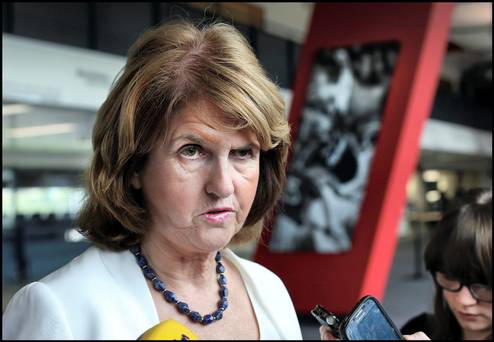
Joan Burton, Labour Party TD, Minister for Social Protection in Fine Gael/ Labour coalition Irish Government.
I thought I should write to you to express my appreciation of your standing up to that bully Joan Collins and that baying mob of reds and general hooligans that is always howling for the blood of those few, like yourself, who are willing to stand up and tell a few home truths.
You were quite right to point out that videos hostile to the Gardaí were being posted on the Internet by people who had access to expensive mobile phones and Ipads. Some of these are obviously professional red agitators (in the old days, we could be sure that they were receiving funding from Soviet Russia but it’s harder to say where they get their money from these days).
Other people filming and posting are bound to be ne’erdowells who’d rather spend their money on these Ipads and things rather than pay their water bills like good citizens. They probably have expensive television sets on which they’re watching the news too, not only RTÉ but “alternative” media, such as that muck-raking “Democracy Now!”. To be honest, I’ve wondered sometimes whether it was wise to educate the working classes but now, sure one doesn’t have to be able to read to watch videos and news reports, does one?
And attacking the poor Gardaí, who are only doing their job! Their critics say that they don’t deal effectively with crime in working class areas but turn out in big numbers to police protests. That is clearly nonsense. Why, I had a burglar alarm tripped in my Killiney Hill residence the other day and two squad cars were there within four minutes! It was a false alarm, but still ….. Some people say that if the Gardaí weren’t behaving badly, they wouldn’t be giving their critics anything to put on the Internet, but that’s not the point. Sure you can’t deal with the kind of people who live in places like Darndale or Clare Hall without being a little robust – it’s what they understand, what they practice among themselves. It’s only the Gardaí being culturally sensitive, if you like. But who likes doing his job while being videoed (well, film stars maybe … and celebrities … and politicians, maybe)?
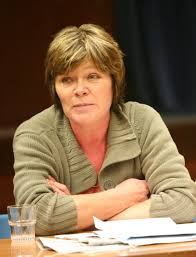
Joan Collins, TD (elected Member of Irish Parliament), many years a socialist community activist.
As for your one, that Joan Collins? A postal clerk, I ask you! What can a postal clerk know about what it takes to run a country? Not like yourself, now, having previously worked as a lecturer in accountancy. But getting back to that Collins …. sure looking at her history is like a career in far-left organisations – the Socialist Party, People Before Profit, the United Left Alliance, and now in the United Left, with that other red get, Clare Daly.
The Collins woman has no sense of propriety or occasion. Did she not give Bertie Ahern a tongue-lashing as he was being interviewed on TV on the day of his resignation outside the Dáil! “Shame on you!” she shouted at him; no, shame on her! I know you’ll agree with me here, although the Soldiers of Destiny party has never been one of our closest friends. Poor Bertie had put in years of service as a TD and Taoiseach and was entitled to his pension of €135,000 (and he hadn’t even been condemned by the Mahon Tribunal yet)! I hope he has opened a bank account since, as with rising crime, stuffing money under the mattress is no longer a safe option.
But forgive me, I’m drifting off the point. I just wanted to say “fair play” to you for speaking the truth and standing up to that red rabble-rouser Collins. And if you ever get around to banning the trouble-makers from carrying mobile phones or from putting such provocative videos up on the Internet, you’ll have my full support. Our democracy needs to be protected from people like them.
Respectfully,
Shleevy N. Fawning
Video of exchange between the two Joans in the Dáil in which the Minister makes comments about protesters with “expensive Ipads”: https://www.youtube.com/watch?v=y6RmC9a82P8
Ian Paisley addressing an outdoor meeting in typical style
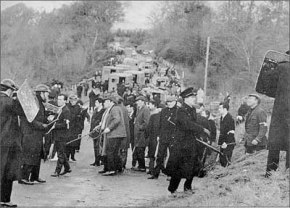
Ian Paisley died on 12th September, five days ago. Much of the mass media portrayed him a man who participated in building peace in the Six Counties. Some of the media painted a different picture or, at least, permitted a different telling of his story. I have searched for but failed to find a photo I remember from decades ago, in the early days of the campaign for civil rights for Catholics in that sectarian colonial statelet, a photo of Ian Paisley and Ronald Bunting standing side by side. In Bunting’s right hand was a pick-axe handle. It was around the time of the Burntollet Ambush of Civil Rights campaigners (who were marched into it by the good old RUC, nowadays the Police Service of Northern Ireland). At Burntollet, the B-Specials and civilian Loyalists had pickaxe handles too, and rocks as well.
Loyalists waiting to attack Civil Rights marchers at Burntollet Bridge mingle with RUC, January 1969.Civil Rights marchers duck from hail of missiles while RUC stand by. Note clubs also wielded by Loyalists, many of them also police reservists.
In an interview around that time, side by side with Ronald Bunting, Paisley made much of how law-abiding they and their crowd were. They could afford to be, since the statelet’s laws gave it enormous powers which nullified every civil right the large Catholic minority might try to use. But illegal violence was never far from the weapons of the State and its Loyalist supporters, to which the imperial master usually turned a blind eye (as it had to the landing of weapons in 1914, including 30.000 assorted rifles with ammunition at Larne and Donaghdee for the Ulster Volunteer Force). Nevertheless, Ian spouted in public about law and order – an old trick of fascists who have their armed thugs already breaking the law … and arms and legs too.
Not long after, Paisley and Bunting went to jail for breaking the law, as the statelet’s rulers strove to control them and also to show the world how “fair” and “even-handed” they were. Unfortunately for them at that time, the world had already seen and was to see more of it – and it was not a pretty picture.
An ex-British Army Major, Bunting had his own paramilitary unit and though he was somewhat sidelined later for a decade, who knows where he might have ended were it not for the 1980 murder of his son, Ronnie, who had joined the Official IRA and later the Irish National Liberation Army. Ronnie was murdered by SAS or Loyalists and after that, the grieving father dropped completely out of politics.
Paisley broke away from his Unionist Party because he could not rise high enough in it, could not control it and so he created his own party, the Democratic Unionist Party. He broke away from his Presbyterian Church for the same reason and created his own, making himself a vicar and Moderator of it. He never joined the Orange Order, perhaps because he did not wish to be answerable to it. When Bernadette (Devlin) McAlliskey warned people not to fear the DUP but rather the Official Unionist Party (so named to distinguish it from other unionist parties), because the former represented the real colonial power in the Six Counties, she could not have anticipated that Paisley would adapt, outflank the Official Unionists and gather the support of the old colonial class and their imperial masters. (As an aside, it’s a curious fact that in Ireland, calling one’s party the “Official” version, is to invite outflanking and eventual marginalisation).
Paisley was a skilfull demagogue and those who, in Britain or in the 26 Counties, laughed at him and his rabid roaring oratory, underestimated him. For he was not talking to them, even when giving an interview on TV, but to his own die-hard Loyalist audience. And most of them loved “Big Ian” or “Bigyan”, even if some of the paramilitary leaders thought at times that he was trying to manipulate them for his own ends (for example, during the Ulster Workers’ Strike of 1974) .
But when different times called for a different act, a different Ian emerged. A man of many smiles, a man who could go back on most of what he had said to his troops when he felt the time was right, a man who could play his part in the newest game of the British Empire in their colony, that of power-sharing with Provisional Sinn Féin, just as the latter’s leadership too adjusted to play the new game, now “the only game in town” for them.
Paisley was a fundamentalist Protestant from the ranks of the “Dissenter” churches, those who opposed the established Anglican church of the imperial state and many of whom had in 1798 taken arms against that state for Irish independence. But those dissenting churches had by now been purged and were loyal servants of the Empire, though still dissenters in religion. Echoing the old Loyalist slogan from the early years of the last century that “Home Rule is Rome rule”, Paisley fulminated against any involvement in Six County affairs by the 26 County “Free State” and also ranted against the Catholic Pope, “the Scarlet Harlot”.
Those who rightly condemn the Catholic Church’s control of the Irish state often forget that the Six County state was as fundamentalist and restrictive in most things. Divorce was already party of UK law when Ireland was partitioned and was incorporated into the new statelet. Contraception was later permitted under UK legislation and entered the Six Counties largely without problem. But they drew the line at gay rights, even after the Sexual Offences Act of 1967 decriminalised sexual acts between consenting males of 21 years of age or over in England and Wales (lowered to 18 years of age only in 1994 and to 16, equally with heterosexuals in 2000). Scotland, another stronghold of fundamentalist Presbyterianism, took another 13 years to pass the same legislation. It did not become law until 1982 in the Six Counties, with Paisley leading the “Save Ulster from Sodomy” campaign against it. Sadly, another eleven years had to pass before similar legislation was passed in the 26 Counties. Abortion, although legal in Britain is still not legal in either part of Ireland.
It was said by many that as a parliamentary representative, Paisley was effective and represented his Catholic constituents on an individual basis equally with his Protestant ones. He also represented a Protestant constituent against the British Army and RUC. The man in question had confronted men with long hair, dressed in combat jackets and jeans and stealing a neighbour’s car. Later in the police station, he saw the same men, some without their long-haired wigs and heard them speaking in English accents, apparently on good terms with the police. The witness made an issue to the RUC of what he assumed to be a British Army undercover squad stealing a car in order to carry out some nefarious act. Some time after that a door in the man’s street was shot at, the door number of which was the reverse of his own. Whether it was a warning or a confused murder attempt is not clear but Paisley came out with a public statement, presumably to make sure the man stayed alive.
Paisley was a sectarian, authoritarian, homophobic bigot, a bully, a fundamentalist Christian, a servant of the colonial statelet masters and in turn of their British imperialist masters. The fact that he proved more adroit than most of his opponents had given him credit for changes none of that. It is entirely appropriate that he should have received an emotional tribute from Martin McGuinness, senior figure in Sinn Féin and Deputy First Minister of the colonial administration he had shared with Paisley, when the latter was First Minister. Martin McGuinness is also a man who has been different things to different men at different times, a man who has lied and also contradicted himself in public without shame or apology. Both got on so well together, at least in public, that they soon came to be described in terms of a British comedy act, as “the Chuckle Brothers”.
Palestinian supporters and other critics of Israel’s bombardment of Gaza have long complained about the western mass media’s reporting of the conflict in Palestine. The complaints have outlined reporting slanted in the Israeli state’s favour and/or specifically against the Palestinians and their representatives.
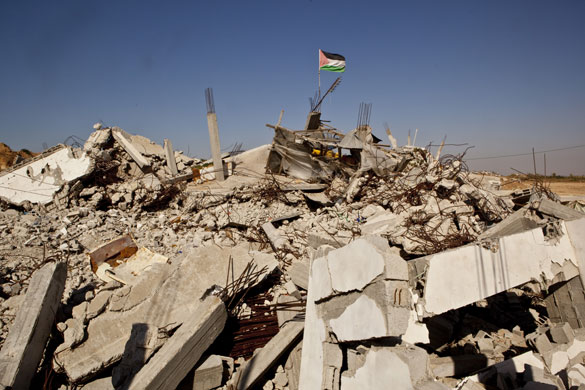
Palestinian flag flies over the rubble of a Gaza neighbourhood after Israeli bombardment 2014 (photo Antonio Olmos)
Umberto Ecco once defined language as a system of communication through which one could tell lies. There is no doubt but that our mass media uses language. Their editors and reporters herd us as sheep are herded by trained dogs, sometimes with barks and snaps of teeth but more usually through nudges and subtle changes of posture. They direct us to the pen where we are wanted or, at the very least, away from freedom.
In order to demonstrate the techniques used I have taken an example of reporting on the conflict and analysed it. The piece chosen is far from being one of the worst pro-Israeli or anti-Palestinian pieces of journalism – it is actually quite mild and even points out the statistical imbalance in the killing of civilians by Israel’s armed forces on the one hand and by Palestinian guerrillas on the other hand. The report is by the Irish on-line newspaper The Journal and was put up by them in the middle of August 2014.
The piece opens by saying that“Palestinian negotiators have been considering an Egyptian proposal to end the month-long Israel-Hamas war as the latest 72-hour ceasefire in the Gaza Strip is due to expire.”
This first of all says that the conflict is a war which also implies some kind of equal balance in fighting forces and also a share in blame. But it is not a war between any two sides; if it can be called a war at all, it is a war by Israel only. Israel is the fourth-largest military power in the world, with an army, navy and air force equipped with some of the latest armament and surveillance equipment. The Palestinians have a number of guerrilla groups, operating as infantry and no air or naval force at all. Their “artillery” are low-level rockets and mortars which cause very little damage to Israeli civilians and even less to the Israeli armed forces (except at close quarters, if Israeli soldiers invade territory held by the guerrillas). Israel’s armament causes huge damage to Palestinian infrastructure, huge loss of civilian life and does cause some damage to the guerilla groups.
The phrasing also suggests that Hamas is the only opponent of Israel on the Palestinian side. However, Israel has been in conflict with the Palestinians since the very day it came into existence and long before Hamas appeared on the scene. Even today, there are a number of Palestinian political and military organisations that are opposed to Israel and its actions and all together they represent the whole of Palestinian society inside the occupied territories, inside the 1948 borders of the state of Israel and in the refugee camps and settlements. In the sense that one could say that there is a war going on, it is Israel waging war against the Palestinian people.
The very next paragraph in the Journal’s piece says that “Since the truce, which will expire at midnight, went into effect on Sunday, Israel has halted military operations in the coastal territory and Gaza militants have stopped firing rockets.”
We see presented here that on the one side we have “Israel” and on the other, “Gaza militants”. As in bourgeois media reporting “militants” usually has a negative connotation, this is already tending to turn the reader against the Palestinians in Gaza. On the other hand, we have “Israel” which we can interpret either as “a legitimate state” or as the Biblical “promised land of the Jews”. And that is being opposed by “militants” in Gaza. The phrasing legitimises the status of one side while de-legitimising the other.
We are also told that Israel has halted “military operations”, two words that hardly convey the sustained bombardment of Gaza’s civilian houses, schools, mosques, civil administration facilities, power plant, water treatment plant, factories, hospitals and emergency vehicles in recent weeks. It does not bring to mind the slaughter of over 2,000 Palestinians, the vast majority of them civilians and including 430 children. Not to mention the 9,567 wounded, including 2,878 children and hundreds of injured jamming the remaining ill-equipped hospital treatment centres.
Shuja’iyya neighborhood of east Gaza City during a 12-hour ceasefire on July 26 2014.
The paragraphs states that in return for the cessation of “military operations” by the Israelis, the Palestinians have “stopped firing rockets”. Actually, if this report had just gone into a little detail, how pitiful by comparison with Israeli deadly ordnance would be the Palestinian rockets! Nevertheless, it is the rockets that are recently used as propaganda excuses by Israelis (before them it was something else) to justify the unjustifiable, the terrorising and collective punishment of a largely civilian population. So it is very rare indeed that western media reports omit any mention of the rockets.
“The ceasefire was meant to give the two sides time to negotiate a more sustainable truce and aroadmap for the coastal territory.”
Again, “two sides” gives the impression of some kind of equal antagonists in balance. The “roadmap” may be a vague reference to some future deal but may also be a reference to something that was much bandied about in Clinton’s time as President of the USA. This “roadmap” was supposed to lead to a two-state solution and, apart from the fact that it completely supported the supposed right of the European settlers who created the state of Israel to steal Palestinian land, has now been rendered completely inoperable. This is due to the continuing Israeli Zionist greed for land and building of illegal settlements throughout much of what was imagined as being part of the Palestinian state. And besides, the “roadmap” did not apply to the Palestinian refugees, who were given no right to return to their land. But it is useful for zionist-friendly propaganda purposes to pretend that this “roadmpap” ‘solution’ still exists and is viable.
“A member of the Palestinian delegation to Egyptian-brokered talks in Cairo said today that his team was considering an Egyptian proposal, which was tabled yesterday. Egyptian mediators have been ferrying between the Palestinians and their Israeli counterparts in an attempt overcome the differences between the sides.”
While it is true that Egypt has been “brokering talks”, that state is hardly an innocent bystander. Egypt has kept the Rafah Crossing, the only official exit point from Gaza not entirely controlled by Israel, closed or constricted. Egypt has also worked to destroy the tunnels which the people of Gaza used to smuggle in those items of daily life and, no doubt the arms they need, which Egypt is preventing from getting through the Rafah Crossing. The Egyptian state could nullify much of the Israeli blockade of Gaza, merely by opening their crossing into Gaza for normal traffic 24 hours a day.
The Egyptian armed forces, the real power in that country, are clients of the USA – another power which is hardly innocent but which on occasion tries to present itself as impartial in the conflict, despite its massive funding of the state of Israel. But those are not facts that the western media wish to disclose about the USA, Egypt or the conflict in Palestine.
Another thing, notice that while Egypt is “brokering”, it is “ferrying” between the Palestinian and Israeli negotiators. Clearly the antagonists are not face-to-face. If we think about that at all, as readers we are left with a feeling that maybe each side hates the other so much that they can’t bear to be in the same room. Or we might even think that Hamas, since it doesn’t recognise the right of Israel to exist, might not deign to speak to them directly. But actually, the reverse is true — as throughout most of its history, Israel is refusing to speak to the Palestinians directly. But no point telling the readers about that, is there? Who knows what they might come to think of such an attitude and behaviour of the Israeli state?
“The Egyptian proposal calls for easing parts of the Israeli blockade of Gaza, bringing some relief to the territory, according to Palestinian officials in the talks. But it leaves the key areas of disagreement, including Hamas’ demand for a full lifting of the blockade and Israeli calls for Hamas to disarm, to later negotiations.”
This is a bald enough statement which seems neutral but notice the unchallenged call for Hamas to disarm. From a state that is granted legitimacy to an insurgent force often painted as illegitimate, such a call seems reasonable. It has been and continues to be the basis for “peace (i.e. pacification) processes” throughout the world. But is there a call for Israel to disarm? Of course not. Yet it is the most heavily-armed power in the Middle East, the only one in possession of a nuclear arsenal and the one which has most often attacked its neighbours (not to mention the Palestinians). And the piece above leaves us to draw the conclusion that the lifting of the Israeli blockade may require Hamas disarming — a ‘fair exchange‘. And a reasonable reason, if Hamas does not comply, for Israel to continue its blockade on the whole population of Gaza.
“The Palestinian negotiator said he had some reservations about the proposal and would try to improve it. “We would like to see more cross-border freedom, and also to have the question of a Gaza seaport and airport discussed,” he said.
Note no reason is given for the Palestinian wishes – they seem trivial almost and no reason not to agree to a truce. “Cross-border freedom” might seem like being free to go on shopping trips or holidays abroad. “Gaza seaport and airport” likewise may facilitate daytrips and holidays, or tourist traffic or imports of luxuries. Maybe even exports of craftwork, or olives from remaining trees not destroyed by Israel. Such phrases and word do not give us a picture of over 1,816,300 people locked into a piece of land of 5,046 square kilometres (13,069 square miles), under permanent hostile control and sporadic bombardment and invasion, short of clean water and with other water polluted, destroyed infrastructure, destroyed hospitals, schools, mosques and churches, ruined industries and agriculture, infrequent power supply for lighting and heating, hardly any transport, a polluted coast and Israeli attacks on fishermen.
During the existence of the USSR and its satellite states, the western media regularly attacked them for their restrictions on most of their citizens’ travel beyond their borders. They never did then — nor do they now – inform their readers of the much stricter Israeli control on travel by Palestinians, not only beyond Israel’s 1948 borders but also beyond the borders of Palestine occupied by Israel in the years since. In fact, even travel within the occupied territories is extremely difficult for Palestinians.
The next four sentences of the Journal’s piece are unproblematic enough as far as reporting goes although it could have commented on why lifting the blockade on Gaza might have been of such concern to Hamas and to the people of Gaza:
An Israeli government spokesman had no comment on the negotiations.
In recorded remarks broadcast on Hamas radio, Ismail Haniyeh, the top Hamas leader in the region, said that “achieving a permanent truce can come only through lifting the blockade on Gaza”.
Amid the ceasefire, an Associated Press video journalist and a freelance Palestinian translator working with him were killed today when ordnance left over from the war exploded as they covered a story about the conflict’s aftermath.
Italian national Simone Camilli, 35, and Ali Shehda Abu Afash, 36, died when an unexploded missile believed to have been dropped in an Israeli airstrike blew up as Gazan police engineers worked to neutralise it in the northern Gaza town of Beit Lahiya.
However, the report could have gone on to tell us that the explosion also killed the four Gaza police engineers trying to neutralise the explosives and that another four people, including AP photographer Hatem Moussa, were badly injured. Unimportant details? News that might make us think worse of the Israeli armed forces? Or sympathise with courageous Palestinian police and at-risk civilians?
But it is not long before the more suspect reporting reemerges:
“The war began on July 8 with Israel’s air campaign against Gaza’s Hamas rulers, whom Israel blamed for the kidnapping and murder in June of three Israeli teenagers in the West Bank. Nine days later, Israel sent in ground troops to destroy Hamas’ underground cross-border tunnels constructed for attacks inside Israel.
Here Hamas are presented as “rulers”, as distinct and opposed to – once again – the state of Israel, conferring legitimacy on one party to the conflict, the aggressor, while subtly suggesting that the other antagonist is anything but legitimate and perhaps even despotic.
But the paragraph goes beyond that and suggests that Israel has a legitimate claim that Hamas kidnapped and murdered three Israeli teenagers. The three were in fact kidnapped and murdered and, although Israel wrongly accused Hamas of responsibility, its intelligence organisation Shin Bet later admitted that it no longer believed that. It may have been some other smaller Palestinian group or even individual members that carried it out but it was not the Hamas organisation nor its leadership. But this paragraph leaves us with the impression that Hamas’ culpability was a reasonable supposition by Israel and a reasonable cause of it going to war against Gaza.
The paragraph goes on to accept Israel’s public rationale for the bombardment and invasion, viz. “to destroy Hamas cross-border tunnels for attacks inside Israel”. Israel first quoted the deaths of the three teenagers as their reason for attack and now it is the “Hamas tunnels”. So if the stated reasons change, doesn’t that suggest that they are suspect, not to be relied on, with maybe the real reason unspoken? No comment from the media. Where are the tunnels? Which “border” are they crossing (putting aside for the moment the fact that Israel has never defined its borders)? Where are they attacking “inside Israel”? When was the most recent Hamas attack “inside Israel”? If this is a reference to the paltry rockets Hamas has fired, Israel has never claimed that these were fired at it from “inside Israel”. If it is not a reference to the rockets, then to what? We are not told but instead left with a feeling that Israel’s concerns could somehow be legitimate.
“The fighting has so far killed more than 1,900 Palestinians, the majority of them civilians, Palestinian and UN officials say. On the Israeli side, 67 people have died, all but three of them soldiers.
This is an unadorned statement of the shocking facts and we could not fault this paragraph.
But how about the very next sentence?
“The latest outbreak of fighting is the third between Israel and Palestinian militants in Gaza since Hamas took over control of the densely-populated territory in 2007.”
Here we have a repeat of that formulation which we saw earlier: the conflict, we are being asked to see, is between the ‘legitimate’ state of Israel on the one hand and “Palestinian militants” on the other. And it is “fighting” between the two sides, rather than the truth: the attack of Israel’s military force upon the population of Gaza and the Palestinian guerrilla forces’ attempts to reply with their meagre resources.
Also, we are told that “Hamas took over control” of Gaza in 2007. In an invasion, perhaps? A coup d’etat? The fact, uncomfortable for the western media, is that it was in a democratic general election while Israel and western agents poured out anti-Hamas propaganda. And Hamas won not just in Gaza, incidentally – but in the West Bank too, although others are currently in power there. Are we told that Israeli political parties in government “took over control” of Israel? Of course not.
Continuing, the report states that“Hamas has been consistently pushing for an end of an Israeli Gaza blockade, which Israel says is necessary to prevent the group from gaining access to weapons and munitions it deploys against Israelis.”
In this sentence, we learn that Hamas wants an end to Israel’s blockade but not why. We are not told that it is so that they can have sufficient fuel for heating and transport, food, medicine, clean water, industrial and building materials, teaching and learning materials, spare parts, etc, etc. Nor are we told that Gaza could then actually export products and gain some self-sufficiency. Nor are we told that Israel is illegally holding monies, such as tax revenues, that belong to Gaza. But we ARE told why Israel wants the blockade — “to prevent the group from gaining access to weapons and munitions it deploys against Israelis.” Well, there you are – that’s only reasonable, surely? !!
Glasnevin Cemetery (Reilig Ghlas Naíon) is a famous Irish graveyard on Dublin’s northside, on the south bank of the Tolca river and not far from the Royal Canal and Mountjoy Jail. As well as those of other people of great fame and none, it contains the remains of the fallen in a number of battles. However, the cemetery itself has become something of a battleground of late.
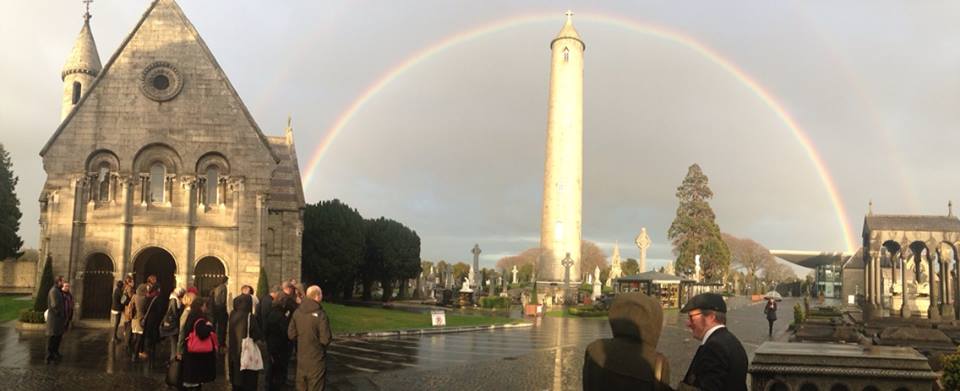
Rainbow over the tower in Glasnevin Cemetery (photo by Lorcán Collins as mourners left the funeral of his colleague, Shane Mac Thomáis, resident historian of the Cemetery, who died 20th March 2014)
There was the Alan Ryan funeral around this time last year, early September 2013. Ryan had been a prominent member of the 32-County Sovereignty Movement and allegedly head of the Dublin Real IRA (also now known as “the New IRA”) and was shot dead, reportedly as a result of a conflict with drug dealers.
Ryan’s funeral was a massive affair attended by hundreds of mourners; the Irish state police, the Gardaí, policed it heavily. The hearse and cortege were temporarily stopped at the cemetery’s entrance by uniformed and plainclothed police while the grieving mother and family members were taken out of their car, which was searched. Scuffles with police broke out a number of times as the latter even penetrated to Ryan’s graveside.
More recently, on 31st March this year, a commemoration in Glasnevin of soldiers of the British Commonwealth who had been killed in the First World War attracted a smallish protest from Irish Republicans and socialists across the road from the cemetery’s gates. These commemorations are viewed by Irish Republicans and many socialists as events glorifying Britain’s part in WWI and also an attempt to build unity between Irish people and the British Armed Forces. The Commonwealth event, the unveiling of a “Cross of Sacrifice”, was attended by a member of the British Royal Family, which added metaphorical fuel to the fire. However, there were real flames as a British Union flag, brought by the protesters, was set alight and Gardaí Special Branch rushed to apprehend the burners. In the melee, a number of protesters were handled roughly by the police, some were pepper-sprayed and one was handcuffed and taken away by Gardaí, reportedly beaten on the way. Another who objected to being jostled by Gardaí was also promptly arrested.
Most recent of all was the Hunger Strikers’ Commemoration in the Republican Plot inside the cemetery on 23 August. The event was organised by the Sean Heuston 1916 Society to honour the 22 Irish Republicans who have died on hunger strike between 1917 and 1981. The 1916 Societies is a broad collection of organisations of Irish Republicans in different localities who do not agree with the Good Friday Agreement and wish to see Ireland united and independent; one of their main objectives in the interim is to campaign for a referendum on the question of Irish unity. The commemoration was the second of its kind organised by the Sean Heuston 1916 Society and, as the previous year’s had passed without any untoward incident other than the usual Special Branch photographing and taking notes, they had no reason to believe that this year’s would be any different.
The event proceeded as planned with orations, song and laying of wreaths but the trouble came as people tried to leave the cemetery. They were waylaid inside the cemetery’s gates by plainclothes police of the Special Branch, i.e. the political police, and told to identify themselves and to give their addresses. Two who refused to do so unless they were shown reasonable cause were handcuffed and bundled into separate police vehicles. Others who had attended the event then blocked the police vehicles from leaving and many uniformed Gardaí arrived to assist the Special Branch. In the struggle, police were again quite rough and one punched a child in the face. Eventually the Gardaí were successful but both detained men were released later that day without charge.
Many visitors and unconnected mourners attending the famous cemetery were visibly shocked by the incidents. The organisers made it clear to the staff of the cemetery who it was who had initiated the disturbance and had chosen to do so inside the cemetery grounds.
Apart from general harassment and attempted intimidation of Irish Republicans, it is difficult to see what the Gardaí hoped to gain from this provocation and why they had escalated their behaviour at a peaceful commemoration. `One possibility is that the intention was to discourage the management of the Cemetery from permitting such commemorations in future. The organisers moved quickly to call a meeting with the Cemetery management, which has already taken place and reportedly concluded positively. And so it should.
The Republican Plot, managed by the National Graves Association, a voluntary body which does great work, is within the Cemetery. The graves of many Irish Republican and Socialist martyrs and prominent activists are within this plot and also in other places within the grounds. Some, like the great hero Anne Devlin, go back as far as the United Irish of 1798 and of 1803. James Connolly gave the oration here in 1913 at the graveside of the ITGWU martyr Jame Byrne, a victim of the State during the Lockout that year.
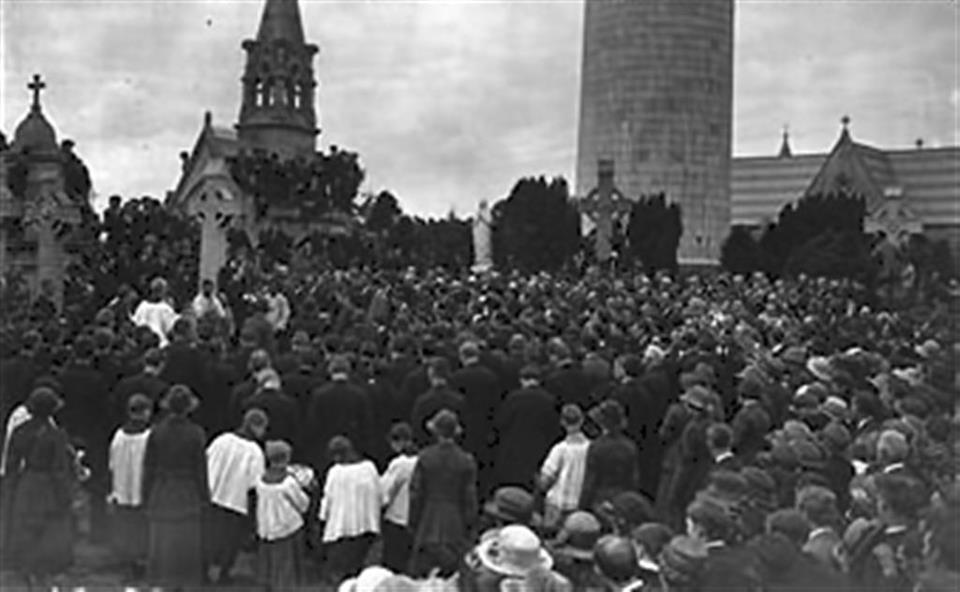
Funeral at Glasnevin of Republican Cathal Brugha, shot dead by Free State Army in O’Connell Street, 1922.
In 1915, Patrick Pearse gave his famous oration to a huge crowd at the Glasnevin graveside of the Fenian Jeremiah O’Donovan Rossa, whose body had been returned to Ireland by the IRB in the USA. O’Donovan Rossa had been jailed for planning an insurrection against the British in 1865 and, though released in 1870 as part of a general amnesty, had to agree to emigrate. In 1922, Cathal Brugha, having survived 14 bullet wounds during the 1916 Rising, was killed in O’Connell Street by Free State Army soldiers and his funeral cortege too, also to Glasnevin Cemetery, was a huge affair. In 1966, the remains of Roger Casement, hanged by the British for his role in the 1916 uprising (the last of the death sentences of the 1916 insurgents to be carried out), were brought home from England and reinterred in Glasnevin with an Irish state ceremony.
These historic moments and connections between Glasnevin Cemetery and the national and class struggles may be uncomfortable for some and the police harassment may be intended to deepen that discomfort. However, it is difficult to see how anyone, whether of State or of Cemetery management, could successfully impose a ban on commemorations within this famous graveyard where so many of the Republicans and Socialists of previous years lie and which has been the scene of commemorations for over a century.
A suicidal woman refused an abortion, is then force-fed to preserve her embryo which is later delivered at 25 weeks by caesarian section.
Diarmuid Breatnach
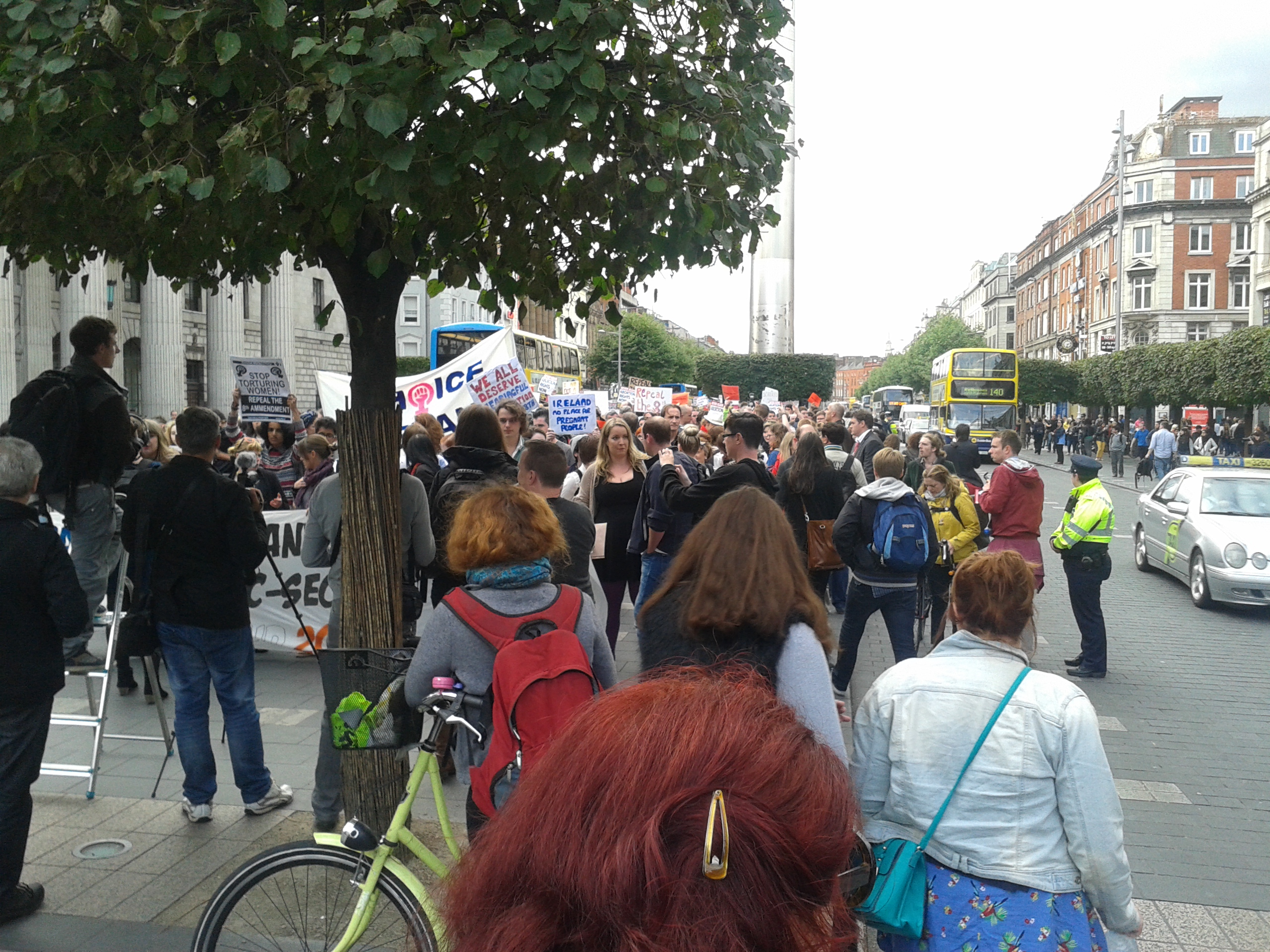
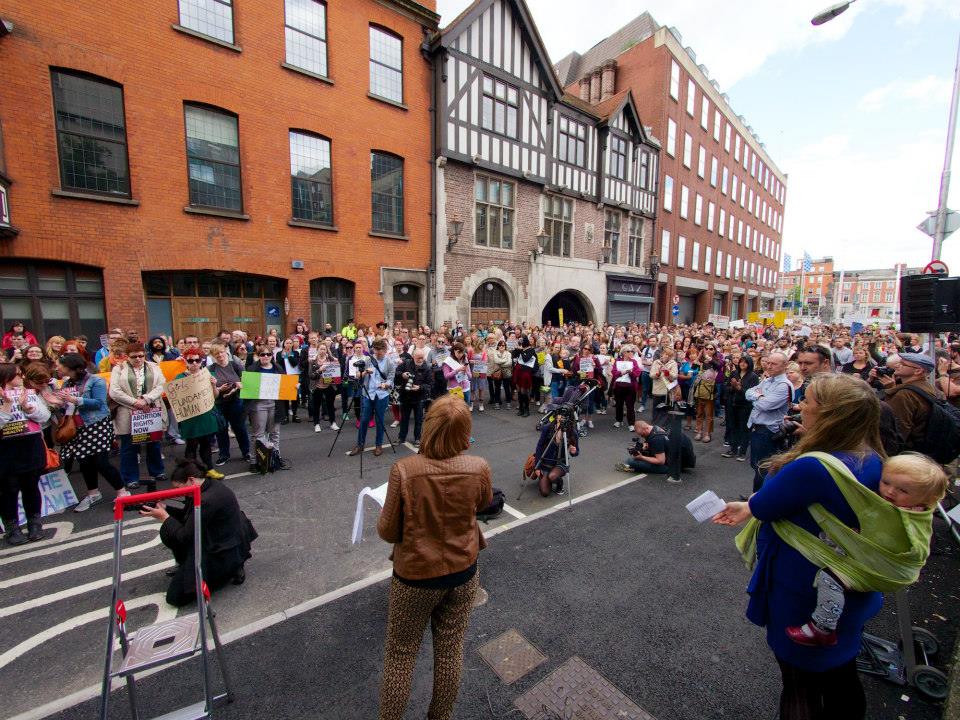
A woman considered suicidal by a medical panel was recently refused an abortion in Ireland and was subsequently force-fed. Within days a call was made for a protest demonstration and was answered by a substantial number in Dublin on Wednesday night last. The protestors filled the central section of O’Connell Street from the Spire to the Larkin monument and also spilled out into the road. Numbers of protestors took up station on the pavement fronting the GPO. A weekend demonstration was also convened in Dublin and another in Cork.0
Protesters in Dublin on Wednesday evening denouncing the treatment of the woman refused an abortion and force-fed. They called for the repeal of the Eight Amendment to the Irish Constitution. (photo D. Breatnach)
The pregnant young woman, apparently under 18 years of age, was a migrant, who sought an abortion in Ireland. Some media reports say that her pregnancy arose as a result of a rape in her native country prior to her travelling to Ireland. Not all the details are clear but it seems that an Irish advice centre gave her the necessary information to travel to Britain to receive an abortion but that she was unable to afford it (there is also some question about her immigration or asylum status should she wish to reenter Ireland). It seems she then became depressed, not surprisingly, and expressed suicidal ideation. Under the Right to Life During Pregnancy Act 2013, introduced following the “X” case, a woman is entitled to receive an abortion if carrying the foetus should result in a substantial risk to her life – suicidal ideation being one of of those risks.
In accordance with the 2013 Act the young woman’s case was reviewed by a panel, consisting of two psychologists and an obstetrician. According to reporting in the mass media, the psychologists agreed that she was suicidal and that she she should therefore have the termination. The obstetrician apparently agreed that she was suicidal but argued that in a short while (two weeks has been mentioned), a caesarian could be carried out and a baby delivered alive and viable. Since the Act requires the unanimous concurrence of all three members of the panel, the young woman was refused an abortion.
It seems the woman became further depressed and stopped eating, whereupon lawyers for the hospital went to the High Court to obtain a court order permitting the woman to be force-fed, which procedure was carried out (probably intravenously). The woman is said to have subsequently agreed to a caesarian section by which method a baby was delivered. The fate of the woman is not in the public domain at this time but the baby was reportedly delivered alive and well after 25 weeks in the womb.
A number of speakers at the rally made the point that “here we are again”, i.e. that the lack of the necessary legislation has led to another case of terrible mistreatment of a young woman, a reference to other cases of refusal of abortion that have become scandals and lead to demonstrations such as about the death of Sadita Halappanavar in 2012 and the “X” case in 1992.
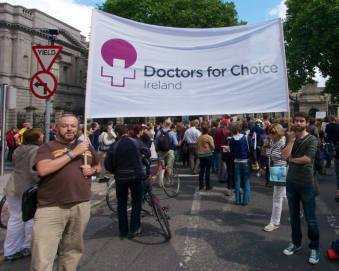
At the rally, all the speakers, campaigners and providers of services and a male doctor from Doctors for Choice, called for a referendum to repeal Amendment Eight of the Bunreacht (Irish Constitution). This is the amendment passed in 1983 in order to prevent abortion becoming legal. Some very telling points were made, one speaker saying that no-one in Ireland but a pregnant woman would be force-fed or bullied into submitting to an invasive surgical operation. Perhaps we cannot say that none of those things would ever happen to anyone else but it is certainly true that only in the case of a pregnant woman would that combination of coercive and intrusive procedures, clearly in violation of the Hippocratic Oath, have been considered so readily and applied in conjunction. That the woman was a migrant probably made it easier for the authorities but it is the legal position on abortion in Ireland and its moral underpinning which reduces the pregnant woman to the status of some kind of living vessel, the status of the unborn foetus being higher than that of the mother.
Men’s place in the movement
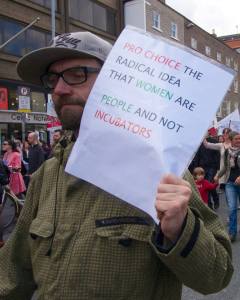
Breaking from the general trend at the rally, one of the speakers addressed many of her remarks specifically at the males present there in support. She told them “they should know their place” and that they had no right to express any opinion on the issue except to support the women. Some women applauded her and some did not.
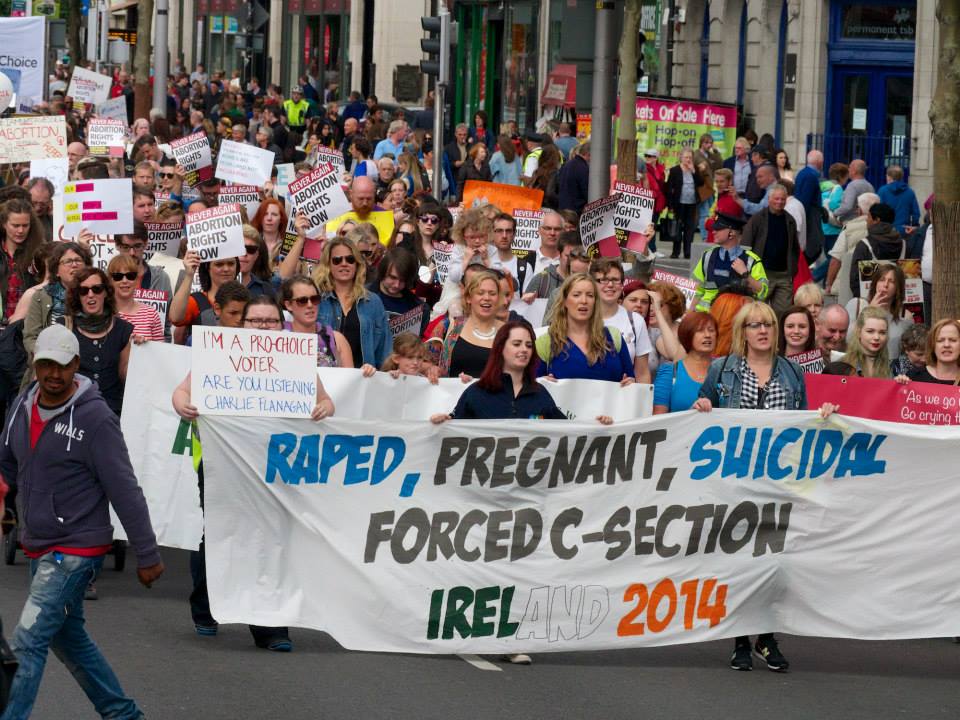
On the Dublin march for the repeal of the 8th Amendment on Saturday. This banner was also present at the Wednesday protest rally where one of their representatives spoke. (photo Andrew Flood)
Since variations of this view have emerged quite frequently, including the view that it’s a women’s issue or that men should just follow the opinion of women in the movement, it is worth examining this a little further. The current situation on abortion in Ireland of course impacts in the first place on women but it does not affect them only. An unwanted pregnancy, especially at an early age or stage in a relationship can force decisions that may later be regretted, including marriage or abandonment. Raising a child from what was an unwanted pregnancy has long-term social and economic implications, not just for the mother but for a much wider circle – as well as for the child growing up in society. The existence of legislation on abortion and its repeal is in the realm of criminal law — but above all it is a social issue, one affecting society. The provision of abortion is also a medical and social question: medical and social structures and services will need to be put in place, funded, monitored and its practitioners trained. Therefore all of adult society has a right to a voice on it. To call on a section of society to be mute supporters is to treat them as voting fodder and should not be supported by any genuinely democratic person.
Man on the Dublin march for repeal of the 8th Amendment (photo Andrew Flood)
Also, if men, because they are not after all going to be the ones being impregnated and bearing children, should not have a voice but should only support women, which women’s opinions should they support? Why not support the many women who are totally against abortion? And even if supporting women who are for greater access to abortion, which section of opinion about which degree of access should men support?
Clearly men have to think about these issues to come to decisions. Are they to think silently, expressing no opinion and discussing with no-one, and then be expected to develop rational opinions to inform their actions and, in the case of a referendum, their voting too? Clearly the expectations expressed in such calls or statements are not only undemocratic but unrealistic too. Men not only have the right to express opinions on these issues but need to be able to do so in order to have the discussions that make it possible for them to make rational choices.
The attitude of the state and a referendum
The Dublin pro-choice demonstration on Saturday, according to observers, matched the numbers at the anti-abortion demonstration in the city on the same day – about seven hundred. The pro-choice demonstration took an unusual route from O’Connell Street and became the third demonstration to cross the Rosie Hackett Bridge (opened in May this year). The Bridge is the only one in Dublin named after a woman and Rosie was a trade union militant active in the Dublin Lockout of 1913, as well as taking part in the 1916 Rising as a member of the Irish Citizen Army. The demonstration rallied just across the river at the Department of Health in Hawkins Street (the Department under which the young woman had been refused an abortion and force-fed) and then went on to demonstrate at the Dáil (the Irish parliament).
Speaker addresses the crowd in Hawkins Street, outside the Department of Justice — Rosie Hackett Bridge is to the far right of the photo. (photo Andrew Flood)
Some supporters of a change in the law have presented the issue as though it is essential to the State and to the Catholic Church, two institutions closely linked, to control women’s bodies through refusing access to abortion, free and on demand. I do not think it is so. Certainly those forces may want to control women’s bodies (and indeed, men and women’s minds) but such control is not essential for the continued existence of the State. Many capitalist countries have either easy access to abortion or much more liberal laws than has the 26-County state. This state can afford to give that right but that does not mean that it will. When a state is able to give something but does not want to, sufficient force must be mobilised in order to convince it that yielding will cost it less than denying. Substantial pressure will need to be brought to bear on the State so that it agrees to holding a referendum.
But having a referendum does not mean that the correct and necessary outcome will be the result. We have had referenda in which the side of progress and justice was successful but also those in which it was not. The present Amendment Eight to the Bunreacht (Constitution), which the movement seeks to repeal, was the result of a referendum.
Yes, true, that was 30 years ago and opinions have changed since. In recent years, opinion surveys have shown a majority in favour of some relaxation of the law. Also, two legislative attempts to tighten restrictions on access to abortion, in 1992 and 2002, failed. On the other hand, the Thirteenth and Fourteenth amendments, both in 1992, were successful in loosening the ban, establishing the right of a pregnant woman to travel, even if to obtain an abortion, and to be given information about abortions services abroad. However, although the numbers in favour of unfettered access to abortion have grown substantially they do not yet constitute a majority.
According to analysts of the socio-economic background of respondents to the questionnaire, the indication is that the areas of greatest resistance are among a section of the middle class and a section of the working class. That particular section of the middle class is one of generally right-wing views and not amenable to change. Besides, they have the economic resources to lessen the chances of unwanted pregnancies including, despite their ideological position against it, to send their pregnant daughters quietly to Britain, having them return after a brief holiday without the neighbours being any the wiser. Or for a wife to go on a weekend visit to a friend in Britain even without her husband knowing the real reason for the trip.
The working class is in a different situation. High social and economic deprivation in Western countries tends to be accompanied by a higher degree of unplanned pregnancies and single parenthood than is the case with other socio-economic groups. Most working class families would also struggle to find the funds to send a family member to Britain (or to the Netherlands, apparently a new trend) to have an abortion, usually accompanied by at least one friend or family member, paying for travel, accommodation and the procedure itself. And the level of care is likely to be at the lower end of the scale. Of course many, many families and friend groups do manage it somehow.
The working class has a vested interest in this reform and this is recognised among some sections of the class but not in others. Traditional obedience to the Church has broken down in many areas, for example in ideas about sex before marriage and in using barriers to impregnation. However, the opposition to abortion remains, for many, a line not to be crossed. If a referendum is to be forced from the State and, in particular if the outcome is to be such as needed, a change in the outlook of at least a substantial section of this class needs to be achieved. Most working class people outside the immediate circles of the pro-choice movement tend not to see any campaigning on the issue except after such scandals hit the headlines – then a flare-up is briefly visible until things die down again.
The pro-choice movement will need to get out on to the streets and into communities on a regular basis if it is to win. I think it also needs to counter the work of the anti-choice propagandists, particularly those who put up their stalls in public areas or picket information centres. In discussion with some activists in the pro-choice movement, they say they do these things to some degree but don’t have the numbers of activists needed to do it more regularly. I confess that I find it hard to believe that in Dublin, for example, the movement is incapable through lack of activists to put a stall – indeed a number of stalls in different areas – on the street at least once a month. Some of those in the movement have been campaigning for decades and others for many years – and yet, as so many of their speakers said on Wednesday night in O’Connell Street, “here we are again”, responding to another fatal tragedy or shocking violation of human and civil rights.
Front of the march on Saturday in Dublin (photo Andrew Flood)
Facebook organising and networking by pro-choice campaigning groups can produce quick mobilisation of substantial numbers of people. These people are already convinced. Most of the working class remains untouched by these mobilisations and certainly their overall outlook remains unchanged. If the pro-choice movement is to have its desires become reality, it needs to get out into the working class communities and promote its cause, hopefully recruiting from among those communities to better carry the message among their own. The movement needs to engage in dialogue with movements with a high percentage of people of working class background, such as – dare one say it? — the Irish Republican movement. The latter is, despite one very deep idealogical divide and the existence of a number of factions, the political opposition movement with the largest active participation of people of working class background. At the moment, the overall position of the movement is anti-choice but that is nowhere near as monolithic or as unassailable as it was even a decade ago.
The hope is that the necessary mobilisation will be done and that very soon the State will be forced to concede a referendum on the abolition of Amendment Eight. The hope is also that the necessary educational work will be done to achieve an overwhelming victory in that referendum. The activists in the movement need our support, men as well as women, in all of that.
Lorna was nervous but tried not to show it – especially to Kevin. He drove competently and seemed unaware of her tension. Of course she had known for months it would come to this. There had to be an end to the hiding some day. And now she was going to have to present him to her parents. She shuddered …. or thought she had; thankfully, Kevin hadn’t noticed.
They passed a small wood in a hollow, the trees still wearing their autumn leaves but some already lying on the road, jewels of yellows, oranges and reds, mixed with green, glittering with the wet of a recent shower. In that wood one summer, in her teens, a picnic and a boy, hands trembling exploring, fast-beating heart, her virginity gladly given. at The memory sparked a little arousal; she looked out the passenger window in case it showed in her face. Kevin could be very perceptive …. often just when she didn’t want him to be.
As they drove through the Sligo village she remembered so well from her childhood and teens, she began surreptitiously to do her breathing exercises. Approaching the side road, she had a sudden impulse to say nothing, to just keep going. “Left ahead,” she said instead. And, a little further, “Turn right there, Kevin. Right … that’s the house.”
Slightly uphill from the parking space, the path ran up to and curved along the house to the front door. The house, traditionally whitewashed and, with the exception of the conservatory added to the end, pretty traditional in appearance too. The treetops, grown taller, visible behind the roof, the fuschia bushes growing along the path and the cotoneaster hugging the house wall. Bel, kept inside the house so as not to frighten the expected visitor, barking an intruder warning.
The engine switched off, Kevin looking at the house, then at her. “Looks lovely”, he said and sounded as though he meant it. She turned to him, smiling brightly: “Get the bags, will you? Do the traditional male thing. I’ll carry the wine and the flowers.”
He kissed her quickly, grinned and got out of the car, leaving her free to do her breathing exercises unobserved. In …. hold, two, three, four, five. Out, two, three, four, five …..
Walking up the path, Bel barking madly now, hearing the crunch of gravel. As Lorna got near the door, she called out to the dog. The barking stopped a second at voice recognition, then started again – welcoming this time. The outer door opened, her father there, the skin around his eyes crinkling as he smiled. A hug, careful with the flowers, and a “Fáilte abhaile, a stór.” Then the appraising look at Kevin, the hand stretched out: “And to you too, young man.”
Her father turned and opened the inner door. There was her mother, holding Bel back by his collar as he whined and wriggled, his tail whipping from side to side. Lorna put the flowers and wine on the table and went to the dog, giving him her hand and, while he lathered it with his saliva, hugged her mother cautiously. Then she took the dog to introduce him to Kevin. Of course Bel could smell her on the stranger and that made the introductions easier.
After the greetings, matters proceeded through stages – coffee and tea and biscuits, inquiries about the journey, traffic and road surfaces, comments on the weather, a little local news, as Bel gazed at Lorna and thumped his tail from time to time, her mother jumping up regularly to check on the cooking, the aroma growing around them.
And so to dinner, the table set with the best delf and cutlery, grace said by her mother; Kevin, her atheist lover bowing his head respectfully and agnostic Lorna chiming “Amen” at the end. The dinner delicious of course and greatly enjoyed by Kevin, her father appreciating the Rioja selected by Kevin and brought with them, the flowers they had brought now with some fern leaves picked by her mother, making a nice display in the vase in the window, the westering sun filling the dining area with gorgeous light. The conversation flowed around her job, Kevin’s, Lorna’s parents’ farm, the local area …. It was all going so well. Lorna wasn’t fooled for a moment.
A little after dessert, her father stood up. “Come now, Kevin …. I’ll show you around a little of our wee farm. We have to walk a little of that dinner off.”
Kevin got up eagerly, then hesitated, glancing towards Lorna. “You can do the washing up tomorrow, Kevin,” she smiled. “Go on, while there’s still light to see.”
The two most important men in her life walked out the back door, Bel eagerly escorting them, her father putting his cap on his balding head and picking up his ash stick on the way.
The men’s voices faded and the women turned to meet one another’s eyes, then quickly down to the table, going about their shared tasks with the ease of custom, of practice thousands of times through the years …. and the tension slowly building while desultory conversation centred around the tasks. Then, so soon, all the washing-up done and rinsed, their hands dried and the kettle on the ring for tea. Her mother turned to her and said: “He seems very nice.”
“He is”, she replied, knowing it was an opening shot. “I’m serious about him,” she added, as though this were not obvious, the first of her lovers down through the years that she had ever brought to meet her parents. She was hoping to head off the barrage.
“But Lorna, how could you! Of all the fine men you could have had!”
“He is a fine man. I already told you he’s black but I didn’t think …”
“Lorna Patricia, you wash your mouth out this minute! You know very well that neither your father nor I are racist.”
“But it’s different when your daughter wants to marry one, is that it? ‘We’re not racist but …’ ”
“No, Lorna, it has nothing to do with that – we’re not bothered by the colour of his skin …. that’s not it all.”
“Then what is it? Is it because he’s not a Catholic, then? Because, as I think you know, I’m not much of a one myself!”
“That’s not it at all, Lorna. That’s between you and God …. and between Kevin and God. That’s what He gave you free will for.”
“Then what on earth is all this about? What’s wrong with him?”
“Oh Lorna, do you really not know? Can you not see?” Her mother’s voice rising in a wail.
“No … no, I can’t. See what? What’s wrong?”
“He’s from Dublin, Lorna. Dublin! He’s a jackeen!”
They had been preparing for this for some time. The infants were selected, received special care and food and were raised carefully in the Palace chambers inside the Citadel. They were now adolescents, maturing sexually. As the time approached for their great expedition, the tunnels leading to the departure terminal were widened and cleared of all obstructions. Experts tested the weather conditions daily and, when the majority of these were in agreement, the Queen gave the order to launch.
The adolescents took off then, a great host of them, amidst great excitement. Their pheromones, male and female, filled the air around them and those who could, which was most of them, quickly found a partner and coupled. It was a maiden flight from which the adolescent females would land no longer maidens.
Those who would land, that is. For suddenly the air was filled with giant flying monsters with huge eyes and giant whirring wings. Much more accustomed to flight, these monsters flew among them, gobbling them up. Some even held rows of their hapless victims in their huge beaks as they flew off to feed them to their young. Hundreds, perhaps thousands of the little flyers perished in minutes.
Those who managed to land safely and didn’t end up drowning in a lake or a river, or snapped by denizens of the deep who sprang up at them as they passed overhead, or caught in sticky webs, or who were not stamped carelessly to death by huge walking giants or flattened by roaring, stinking monsters, still had to contend with smaller predators on the ground. The casualty rate was huge but some made it alive – some always did.
The males who made it down to ground safely would all die within a couple of days. Their wings were only intended for their nuptial flight; on the ground, they were nothing more than a nuisance, impeding their progress over and underground.
The females, sexually sated and no longer interested, had left their male partners behind. They bit off their own wings, ate them and, quickly finding some reasonably soft ground, began to dig. Each one dug down as though her life depended on it, which of course it did; and not only her own life – each one was pregnant. Then she blocked the entrance to her tunnel, went back down it, excavated a chamber and began to lay eggs. It was completely dark down there but she had been reared in darkness – she had one day of daylight only, the day she flew.
The young grubs who hatched were all females. She supplied them with some sparse nutrition from herself and cared for them as they grew, shed skin, grew … until they spun a cocoon from which they emerged as very small worker ants. They were infertile workers and tended to their large mother, their Queen; even when they were fully-grown she was still one-and-a-half times their size, although about half the size she had been when she left her old nest. Her most recent meal had been her own wings the day she had flown and mated. If she got past this crucial stage, she would recover her size and weight and lay more and more eggs.
The workers soon went up the tunnel, unblocked it and spilled out into daylight for the first time in their lives, beginning to forage for food. They found small seeds and, if they were lucky, sweet material such as soft-skinned ripe or rotting fruit. They soon had their surroundings covered with their hive-scent, carried by each and every worker. Sometimes they found insects they could kill but these had to be very small indeed – these workers had been fed on insufficient nutrition and were, compared to the majority of their kind, puny. If they found a food-source worth another visit, they left a specially-scented trail on their way back to their home, to guide theirs sisters back to the prize later. A rich source of food typically would show two streams of traffic between their nest and the food – one empty–jawed heading for the food and the other, with pieces in their jaws, heading away from it and towards the nest. The food gathered by the workers fed them and their Queen, while she continued laying eggs. As time went by, more and more workers were born, who would care for the hundreds of eggs their matriarch laid and raise more and more workers. Extensive tunnel networks were dug.
At some point the workers found aphids and began harvesting their sugary secretions; tending them on the stems of the plants the aphids infested and carrying them down to their citadel but bringing them back up later. The workers would fight to protect the aphids from those who preyed on their ‘herds’.
Successive generations of ant workers grew bigger, until they reached the optimum size of five milimetres (still four millimetres short of the Queen in her prime). A well-established citadel could in time house as many as 40,000 individuals (although between four and seven thousand would be more common) – they, and previous generations, all daughters of the same mother and the product of one mating only. Their Queen, barring unusual disasters, might live to 15 years of age.
Once the citadel is built, it is vulnerable in the ordinary course of things only to parasites, flood, fire and severe surface disturbance. In Ireland, without bears, wild boar and largely without foraging pigs, severe surface disturbance is unlikely away from human construction or ploughing and digging. Fire might not reach underground but the heat generated or the lack of oxygen might kill anyway; flood, of course, would be the biggest threat. If a citadel should be uncovered or invaded by flood waters, some workers will rush to deal with the problem while others rush to save the young, trying to carry eggs, pupae or cocoons away in their jaws to a safe place. Some others will rush to do whatever they can for their Queen. A black ant defends itself by running away if possible and if not, by biting. But intruders to the citadel are swarmed by biting ants. However most human skin is impervious to the bite and this species does not sting.
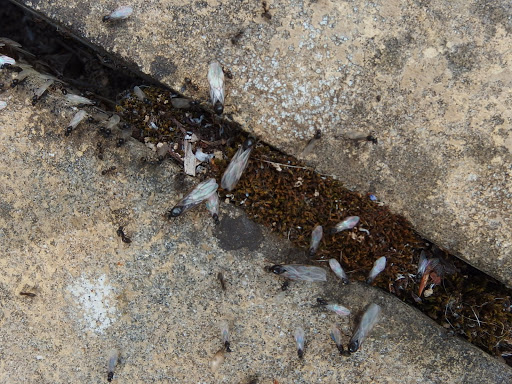
Black Ant nest under a stone, disturbed. Ant larvae and pupae visible as the workers rush to take them to safety.
One day, perhaps three years from the Queen’s maiden flight, she will decide it is time to send her own children into the wider world. She will lay eggs and have these emerging grubs fed special food, which will produce males for the first time in her citadel, as well as other fertile females besides herself. Then, one day in July or in August, she will send them out too, to start new colonies.
Lasius niger, the Black or Garden Ant, is the most common of the 21 species of ant in Ireland. It is the most common also across Europe and a sub-species, L. neoniger, is known in the USA where however, it is not one of the most numerous ant species. Lasius niger is a very active, hardy and adaptable species, living mostly outdoors under rocks and but rarely inside houses (although it may well enter houses repeatedly if it learns of food within, especially sweet food). In cities, its nests are to be found in parks and gardens but also under street paving stones, the workers emerging to forage from tunnels leading to the joints between the stone. When those joints are surrounded by thin lines or small heaps of bright sand in summer, one knows that the workers are clearing the tunnels for the adolescents’ flights. Another indication is an unusual amount of
Black ants, emerging from under their nest. The larger winged ones are fertile and, if they survive, future queens. The winged males are much smaller and all are doomed.
seemingly erratic ant activity around a nest, though one would need to be aware of what normal activity looked like, for comparison. The ants may delay, awaiting what they judge to be optimum conditions but someday soon, mid to late afternoon, they will take to the air, to fly, to mate, to die or to live, to start a new population.
I no longer watch television at home. It was not a case of rejecting that form of mass media, as some assume, but the result of a tiresome tussle with the huge US-based UPC monopoly, out of which, not surprisingly, I came off worst – they control the aerial in my block of flats and I am not permitted to put up my own dish to receive through a competitor.
Anyway, I used to darn socks sometimes while watching TV, especially during advertisements. Radio would have been ideal but I have long ago lost the habit of listening to that medium. When I lost my struggle with UPC, I stopped watching TV; I could have watched it on my laptop but I find it unsatisfying to watch on a small screen. And when I stopped watching TV, I also ceased darning. The pile of socks with holes in them grew, to be mended “some day”, until eventually I had to buy new ones.
I am aware that for many in our society here today, darning would be considered a quaint or even archaic activity, associated with oil lamps and making your own butter, perhaps. Or cooking on a range and the absence of indoor plumbing. For others, darning might signify poverty or meaness. To me, it is about using and reusing what can be used, and about mending what can reasonably be mended to use again. Clothes, like all other items we use, are produced by human labour and it seems wrong to me to waste that labour unnecessarily – a kind of negation of the labour in the first place and, following that, a negation of the activity that might follow when the workers have produced enough of the items.
Of course, in our time and in this place, it is likely that the socks that I buy have been made in some sweat-shop in a more undeveloped country where, if they think about it at all, the sweated workers hope that we’ll go throwing away our socks as soon as the first hole appears, or even sooner if possible, so that they can continue to sweat producing replacements and being paid their meagre wages in order to pay for food, shelter and medicines. So that they can continue sweating and raise their children who, in turn, will become sweated wage slaves producing articles of clothing, undercutting the wages of those who might produce the same articles here, but who rightfully demand more humane working conditions, annual holidays, health insurance and the level of wages necessary to maintain an average standard of living. My darning my socks does not help, even in the tiniest way, the workers in those foreign sweated shops, nor the unemployed clothing workers in the country in which I live.
So why do it? I am not well-off by standards in this country but any amount I save by darning will make little difference. True, I was raised in a different time and I have imbibed some of the culture of that time (and also rejected much of it). But it is neither meaness, habit nor a perception of helping workers that causes me to think I should darn my socks, but a respect for labour. I am aware that practically all items we use were created by labour. I am aware that the power to create that material wealth has been, for centuries, appropriated by a parasitic class that many call capitalists. Before them, that labour power was expropriated by the feudal lords and their monarchs and before them, by the huge slave empires of Rome and Greece and of others outside Europe.
I aspire to a society where that labour power will no longer be expropriated and where the workers shall decide how that power is to be used, for the benefit of all. “The labourer is worthy of his hire” (Luke 10:7, King James Bible) but s/he is worthy of much more than that — s/he is worthy to control all of her/his labour power and of the distribution of the wealth it produces. And so labour must be valued – not just some day in the future, I believe, but now. The new society takes form within the old, although it must destroy the old from which it was born and will, for a time also, carry some of the taints of the old. But it begins now, in the present – in my case, with me.
So the other day, although I still have undamaged pairs, I began to darn old pairs of socks. It was surprisingly restful. But after darning a pair, I fretted at the time spent on this, time spent away from other work, piling up. I darned one of another pair and put its companion and darning away materials away. I will return to darning socks, a few at a time, on other days. Or, at least, I hope to.
The auditorium in Trinity College on Friday 20th June was nearly empty at the advertised starting time for the lecture on “The Legacy of Power, Conflict and Resistance”. The start was delayed and more people came in but, by the time the speaker and the theme was introduced, the hall was still not full. That was surprising, because the speaker was Bernadette Mc Alliskey (nee Devlin), who had been at 18 years of age one of the leaders of the Civil Rights movement in the Six Counties (“Northern Ireland”), at 21 years of age elected MP for Mid-Ulster in 1969 and still, 45 years later, holding the record for the youngest woman ever elected to the British Parliament.
Bernadette Devlin early 1969. She was elected MP on a People’s Democracy ticket in 1969 but later classified herself as an “independent socialist”.
The same year as her election, Bernadette went to the USA to gather support for the Civil Rights movement in a trip being used by others, rumouredly, to gather funds for arms. She shocked the conservative part of Irish USA, Ancient Order of Hibernians and Democratic Party political allies, by some of her statements and actions regarding blacks and chicanos and in visiting a Black Panthers project. Bernadette returned home to serve a short prison sentence after conviction for “incitement to riot” arising from her role in the defence of Derry against police (RUC and B-Specials) and Loyalist attack.
In 1972, during her five-year tenure as a Member of Parliament, enraged by his comments about the murder a few days previously of 13 unarmed protesters (a 14th died later of his wounds) by the Parachute Regiment in Derry, she stormed up to the then British Home Secretary and, in front of a full House of Commons, slapped him in the face. Bernadette had been there in Derry that terrible day – she was to have addressed the anti-internment march upon which the Paras opened fire.
The Tyrone woman was also a founder-member of the Irish Republican Socialist Party in 1974, which she left after failing to bring the armed organisation, the Irish National Liberation Army, under party control. She continued to be a Left-Republican political activist, in particular campaigning against the treatment of Republicans on arrest and subsequently as prisoners in jail, in the H-Blocks Campaign. She learned to speak Irish. In January 1981, she and her husband Michael McAlliskey were the victims of an assassination attempt by a squad of the “Ulster Freedom Fighters” (a cover name for the Ulster Defence Association, which was not banned until 1992). They both survived, though Bernadette had been shot seven times.
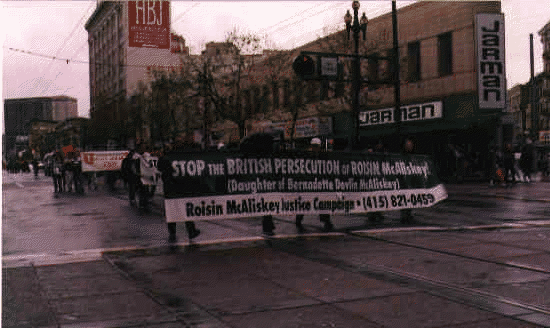
In 1996, while four months pregnant, Bernadette’s daughter was arrested on a German extradition warrant, charging her with being part of a Provisional IRA mortar attack on a British Army base in Osnabruck, Germany. Although taken to England, where a judge agreed to her extradition to Germany, a long and vigorous campaign fought by Roisín’s mother and her supporters eventually defeated the extradition and Roisín gave birth to a healthy daughter.
Recent portrait of Bernadette (Devlin) McAlliskey by Francis McKeeBernadette’s daughter was arrested twice on the same charge but vigorous campaigning impeded her extradition. Photo shows banner resisting the earlier attempt.
In 1998 and for some years after, Bernadette was an outspoken critic of Sinn Féin and of their direction in the “Peace Process”, which she saw as the party coming to accept British colonialism and Irish capitalism. In 2003 she was banned by the USA and deported, widely interpreted as being due to her speaking against the Good Friday Agreement, but continued her campaigning. However in 2007, another extradition warrant was issued for her daughter Roisín on the same charges as before and the young woman became emotionally ill. The whole trauma was seen by many as a warning to Bernadette to cease criticising the “new dispensation” and subsequently she was seen to fade from the ranks of public critics of the GFA, Sinn Féin and of the treatment of Republican prisoners.
Bernadette remained active through working with migrants in a not-for-profit organisation in Dungannon. In recent years she has returned, on occasion, to the issues upon which she was so outspoken previously, for example standing surety for Marian Price’s bail to attend her sister Dolores’ funeral and speaking at the ceremony herself. Bernadette also spoke at the Bloody Sunday Commemoration/ March for Justice in January this year in Derry.
With a c.v. of that sort, one would reasonably expect a packed auditorium.
Bernadette Mc Alliskey on the platform upon which she had earlier spoken in February 2014 at a rally following the annual Bloody Sunday Commemoration/ March for Justice.
Bernadette has walked the walk and thought the thought too but she can also talk the talk. With one A4 sheet in front of her, she spoke for over an hour, hardly ever glancing at her notes. Her talk was as part of Trinity College’s MPhil Alumni Conference on ‘Power, Conflict, Resistance’ organised by the Department of Sociology for its Mphil course in “Race, Ethnicity and Conflict”.
Bernadette McAlliskey began her talk with the theme of fear of conflict, developing the thesis that this fear is inculcated in us from childhood, as conflict arises out of challenging power and hierarchy. She traced this further back to religious indoctrination where dogma is to be accepted without question and finds its reflection in all aspects of life but particularly in the political.
Talking about Tom Paine, who expounded the theory that human beings, each independently, are responsible for themselves, she stated that this is fundamental to citizenship. Some aspects of this self-responsibility are delegated to institutions when we live in large groups but any decisions made for us without our consent are “an usurpation”. Tom Paine was an English Republican, author of, among other works Common Sense (1776) and The Rights of Man (1791). He had to flee England because of disseminating his ideas, which were considered revolutionary in his time.
Much of Bernadette’s talk was given over to this theme, to the lack of consideration of women even by such as Tom Paine, and also to the racism spread by colonialism, which the Christian hierarchies condoned and even encouraged.
When she finished to sustained applause and took questions, there were two from people identifying themselves as Travellers, another from a person from an NGO working with migrants, another regarding anti-Irish racism in English colonial ideology and the continuing power of the Catholic Church in the education system.
One question seemed to throw her and she admitted that she found it difficult to answer. Ronit Lentin, Jewish author, political sociologist and critic of Israeli Zionism asked Bernadette was it not true that racism in the Six Counties came mostly from within Loyalism, allied to anti-Catholic sectarianism. Bernadette struggled in replying, at one point denying it and pointing to anti-Traveller discrimination in the ‘nationalist’ areas but following this up by observing that Travellers would only camp in or near ‘nationalist areas’ (presumably because the hostility in a ‘unionist area’ would be worse).
Bernadette then went on to recall the recent anti-Muslim remarks made by a prominent Belfast evangelist preacher, James McConnell, and how the First Minister of Stormont, Peter Robinson, had defended the evangelist’s right to free speech. Asked for his own opinion of Muslims, the First Minister had replied that he also distrusted them “if they are fully devoted to Sharia law” but would trust them to go to the shop for his groceries and to bring him back the correct change. All the examples Bernadette drew on, apart from the generalised one about Travellers in ‘nationalist’ areas, were in fact from the Unionist sector.
The final question was from an SWP activist who pointed out that the State does not admit to its institutional racism and often takes no action on racist attacks or denies that the motive for the attack was racism. The activist asked Bernadette how she thought racism can be dealt with in this context. She replied that the legal structures are there and should be used and persisted with.
It seemed a strange response from one who would have described herself in the past as a revolutionary. Earlier in her talk she herself had quoted the black Caribbean lesbian, Audre Lorde, who said that the instruments of the State could not be used to dismantle it (actually I.V. Lenin had made the same point in The State and Revolution in 1917, nor was he the first to do so). A revolutionary’s answer to that question would presumably have been that while the structures should be used in order to expose them that ultimately the capitalist State’s power is the enemy of unity among the people; disunity rather than unity among the people is in the interest of the system. Mobilisation of the people against racism and directing them towards the source of their ills, the capitalist system, and building solidarity in action, is the only realistic way forward. Perhaps Bernadette felt constrained by the academic environment in which she was speaking but that is not the answer she gave.