The 1916 Rising, to which Moore Street is so closely linked, represented some very important events for the people of the world and it impacted on people in all populated continents of the globe.
FOR DEMOCRACY, EQUALITY
The 1916 Proclamation, printed in Liberty Hall and signed in No.21 Henry Street, just around the corner from Moore Street, is a document not only of clear patriotic and anti-colonial expression but also a democratic and inclusive one. At a time when hardly a state anywhere in the world permitted women to vote in elections, the document specifically addressed “Irishmen and Irish women”. It also clearly expressed the wish of the insurgents to overcome the religious sectarianism which had played such an important part in securing continued colonial rule: “ … religious and civil liberty … oblivious of the differences carefully fostered by an alien Government, which have divided a minority from the majority in the past.”
Site of signing of 1916 Proclamation, 21 Henry St, almost opposite end of Moore Street. At the time the business premises and cafe of Jennie Wyse Power of Cumann na mBan was there (plaque erected in 1919 by the 1916-1921 Club).
The Rising had expressed the gender equality intentions of the insurgents in more than the words of its address: women fought in the Rising and, in two garrison areas, commanded for awhile. The British colonial authorities recognised the role of some of those women by sentencing one to death, albeit a sentence later commuted, and keeping a number of them in prison even after many men had been released.
Headline of 1916 Proclamation and specific mention address to Irish women (sourced oh Internet)
FOR GENDER EQUALITY
Irish women organised for and acted in the Rising in two separate organisations: Cumann na mBan and the Irish Citizen Army.
The women founded as an auxiliary force to the Irish Volunteers, Cumann na mBan, later to assert considerable organisational independence, wore their own uniforms and had their own female officers. Women had participated in many insurrections and resistance movements across the world but no insurrectionary force in history ever before had such a consciously women-organised force.
The women in the Irish Citizen Army had formally equal status with men and a number carried arms in the Rising and fired them at the enemy. Men acted on orders from women officers in at least two garrison areas and, in medical matters, also in at least a third.
Such a situation was of great significance in the struggle for women’s rights and gender equality, not only in Ireland but in the world.
FOR WORKERS AND SOCIALISM
Captain White & Irish Citizen Army on parade on their grounds at Croydon House, Fairview, N. Dublin City. (Sourced on Internet)
The Irish Citizen Army was founded in 1913 as a workers’ defence force by trade unionists and socialists and later as a workers’ army and, despite its strongly anti-colonial stance, until the 1916 Rising, maintained a strict separation from the nationalist republican organisations of the Irish Volunteers and Cumann na mBan. As detailed earlier, it formally recognised women within the organisation as of equal status with men.
Workers’ organisations had existed before, including armed ones but nowhere had such an armed organisation existed outside of armed conflict for so long (1913-1916), led by socialists and with equal status for men and women. In the history of socialist organisation and particularly of a revolutionary and insurgent kind, this was a development of enormous importance.
AGAINST WAR
The 1916 Rising took place in the middle of the first of two huge international conflicts that were later called World Wars. WW1 was a struggle for markets, resources and strategic positions and bases between a number of states ruled by capitalists and those states recruited heavily from among the nations they had colonised; in Britain’s case, that included Ireland.
To many nationalist Republicans, the War represented an opportunity, expressed in the maxim that “England’s difficulty is Ireland’s opportunity”. But to many socialists around the world, the War represented a disastrous pitting of the working people under one Power against the working people of another, as well as an excuse for the suppression of demands to fulfill the needs of their workers while the capitalists gathered huge profits. James Connolly was one of those socialists.
“WE SERVE NEITHER KING NOR KAISER banner on Liberty Hall (prior wartime repressive legislation), HQ of the IT&GWU, the WUI and of the ICA. (Sourced on Internet)
Connolly, Edinburgh-born Irish revolutionary socialist, formerly Acting General Secretary of the Irish Transport & General Worker’s Union, had joined the International Workers of the Word, the hugely influential in the USA syndicalist organisation. As well as being an energetic organiser, Connolly was a historian and revolutionary theoretician. Connolly took to heart the resolution formally adopted by representatives of the vast majority of European socialists to oppose war and, should it come, to turn it into class war against their rulers. In the event, Connolly was one of the few European socialist leaders to live up to that resolution: as Commandant of the Irish Citizen Army, GPO Garrison commander in a rising against Ireland’s British colonial masters, James Connolly was also striking a blow against imperial and colonial war.
That aspect of the Rising, of being consciously or unconsciously against War, predated the February Russian Revolution of 1917, also in part an anti-war uprising, by ten months. And of course, predated the October Socialist Revolution in Russia by seventeen months and the nearest uprising geographically to Ireland, also in part an anti-war one, the German socialist uprising in November 1918, by two-and-a-half years. For all these reasons, the 1916 Rising, the Headquarters of which were in the GPO and later removed to Moore Street, was and remains of enormous significance in the world-wide history of people’s movements against war.
AGAINST COLONIALISM IN THE WORLD
The 1916 Rising reverberated around the world. It took place in what had a century earlier been widely regarded as the second city of the British Empire and, when it erupted, did so against the largest empire, in terms of directly-controlled areas and population numbers ruled, that the world has ever known. How can such an event be of other than huge interest, not only to other peoples under British colonial rule but also to those under the colonial rule of France, Belgium, Germany, Holland, Portugal, Spain, Russia and the United States? How could it not have been of considerable interest to socialist revolutionaries everywhere?
Lenin speaking in Red Square in October 1918. He was among Russian revolutionaries who commented on the 1916 Rising. (Sourced on Internet)Map of world empires, colonies and territories in 1914 (Sourced on Internet)
Socialists around the world discussed the Rising, at first often criticising it, while Lenin, of huge importance in the socialist movement at that time and some others commented favourably upon it. Consequently, the Rising and the War of Independence was to play an important part in the development of a revolutionary theory around the world that advocated the linking of the struggles of worker, peasant and small farmer, of anti-imperialism and anti-colonialism with struggle for a socialist republic.
August 4, 1916: From left: Irish American labor leaders Timothy Healy, William B. Fitzgerald, William D. Mahon, Hugh Frayne (general organizer in New York for the American Federation of Labor), and Louis Fridiger. Fitzgerald, Mahon, and Fridiger represented the Amalgamated Association of Street Railway Employees of America. (Source http://irishamerica.com/2016/02/hand-in-hand-for-freedom-u-s-labor-and-irish-rebels/
The Rising was a topic of great discussion in the United States and in Australia, and in the USA of financial and other support, as is well known. Connolly had been active there and had published his songbook in New York in 1910; Larkin was actually there in 1916. For a number of reasons, including the sentencing to death of Eamon Bulfin for his role in the GPO and in Moore Street, a sentence later commuted and Bulfin deported to Buenos Aires, the Rising was discussed in Argentina and in other Latin American countries (where, at that time, the British were the main imperialist power).
Eamon Bulfin, born in Argentina and exiled there after 1916, his photo in Australian paper the Southern Cross that year. (Sourced on Internet)Members of 1st Battalion Connaught Rangers including the leader of the 1920 mutiny in the Punjab, James Daly. (Sourced on Internet)
It was certainly discussed in the huge country of India (which at that time included what is now the states of Pakistan and Bangladesh), whose revolutionary nationalists had contact with Fenian revolutionaries from decades earlier. The Connaught Ranger mutiny in the British Army was a direct result of the Rising and the War of Independence and, before the mutiny was crushed, the soldiers and oppressed Indians had begun to make movement towards reciprocal solidarity. And we know, from history and the writings of Indian nationalists and socialists, that the Rising and the War of Independence which organically followed the Rising influenced the struggles against colonialism and imperialism in India right up to the Second World War. We are also aware of correspondence between the Nehru and Ghandi families and the McSwineys.
A young Ho Chi Minh (not his name then) at Marseilles conference in 1919 (Sourced on Internet)
We know also that the War of Independence influenced African uprisings and Ho Chi Minh, later leader of successful wars against Japanese invasion and French colonialism. In South Africa, the Rising must have been a subject of discussion too, at least among the whites. John McBride, sentenced to death ostensibly for his role in Rising was probably in reality being shot for having organised and led an Irish Brigade to fight the British in the Second Boer War, which had ended but fourteen years earlier.
In Britain itself, the Rising influenced the huge Irish diaspora in England, Scotland and Wales and a significant proportion of the insurgent forces in Dublin had actually come from there. The Rising and especially the War of Independence caused a crises of a kind in British socialist thinking, threatening an irrevocable rupture between revolutionary socialists and even sections of radical social democrats on the one hand and pro-imperial social democracy on the other.
This is not the place to discuss this further but that situation, allied to anti-colonial struggles around the world, huge dissatisfaction and mutinies in the British armed forces and a growing strike movement in Britain, provided great opportunities for an Irish revolutionary movement to influence the history of the world in a direction other than that which it has taken.
For all the reasons outlined above, the Moore Street quarter should be of recognised World Heritage Status.
UNESCO WORLD HERITAGE AND OTHER CONSERVATION STATUS
The Irish State ratified the World Heritage Convention in 1991, which qualifies Ireland to apply for that status for the Moore Street quarter. Up to US$1 million is available from the World Heritage fund for the saving and development of a World Heritage site and funds are also available for urgent works to save it. World Heritage status attracts considerable tourist interest and substantial revenue is of course also available to the State and businesses surrounding the area from such tourist interest.
Currently Ireland has only two sites which have been accorded full World Heritage status (one of archaelogical and the other or natural, mainly geological, importance). However, another seven sites are under “Tentative” categorisation since 2010 and Dublin City is one of those. The Moore Street battleground could be afforded that full World Heritage status in its own right, which I believe its history deserves but it can also be used to strengthen the case for full such status for Dublin City.
The ten grounds on which UNESCO currently relies in order to examine the “the unique importance” of a site is admittedly rather restricted in the category of historical importance, particularly in the development of social movements. However, even under the existing list, I would submit that the Moore Street battleground meets four of the criteria: 2, 4, 6 and 8. The USA has the Statue of Liberty and Independence Hall building as World Heritage sites.
Registering under EU programs may also be possible, in particular Horizon 2020.
Yes we do – or at least most of us do. There are a few who do not.
Some people think that those few who do not want change are our rulers, the big capitalists — but they are mistaken. The capitalist class forced change to overthrow the feudal system, which was hampering their growth and the development of industry and commerce. And capitalists know that change is inevitable, so it is better to go with it than to try to stop it. That is why they set up courses such as those called “Change Management” — if change is inevitable, then manage it, the thinking goes. Manage it so that it comes out to capitalist advantage, naturally.
(Source Internet, using “change management” as search words)
Change Management courses, particularly those dealing with personnel, emphasise managing change as smoothly as possible, making it non-traumatic. In that way, it is assumed, there will be less reaction against the change, less opposition.
But in fact, sometimes capitalism wants the exact opposite – it wants change to be as traumatic as possible. These are the situations described under the title “Shock Doctrine” by economic/ environmental activist and theorist Naomi Klein (2007). This has two mechanisms: in the first, the shocking change taking place disarms people from the psychological ability to organise resistance; in the second, the speed of the shock (or shocks) of the economic and political manoeuvres of the capitalists moves faster than the opposition can organise, achieving their goals before opposition can coordinate an effective resistance.
Klein has described how huge natural disasters such as earthquake (Haiti), tsunami (Thailand, Indonesia) and flood (New Orleans, USA) are used to force foreign or native private takeovers of sectors of the national economy while the people and the regime in power are reeling under the impact of the disaster.
Political and economic disasters are also used in this model, such as the military coup in Chile and the collapse of the USSR (in the case of Poland), the economic collapse in Bolivia, the invasion of Iraq, the financial collapse of the “Tiger economies” of SE Asia. Even a potentially beneficial change of great magnitude may be used, such as the collapse of white minority rule in South Africa, during which the black majority won formal equality and citizenship but lost control of most of the economy (and lost a lot more which I do not intend to discuss here).
There is in fact a military precursor to this which has been called, in the context of US military strategy, “Shock and Awe”. This doctrine was described by its authors, Harlan K. Ullman and James P. Wade (1996), as “attempting to impose this overwhelming level of Shock and Awe against an adversary on an immediate or sufficiently timely basis to paralyze its will to carry on … [to] seize control of the environment and paralyze or so overload an adversary’s perceptions and understanding of events that the enemy would be incapable of resistance at the tactical and strategic levels”.
Of course there were many elements of this in the Blitzkrieg of the Nazi German army in its invasions of other countries and even the medieval invasions by the Huns and of the Mongols. Cromwell employed elements of it in Ireland in his army’s massacres at Wexford and Drogheda.
Aside from needing change to overcome feudalism, managing change to its advantage and use of shock doctrine to facilitate changes it wants, the capitalist system itself promotes change as part of its system. Small capitalists combine and form conglomerates, in which big capitalists come to power and, in turn, eat up smaller capitalists in order to dominate their sphere of economic activity. We have seen the growth of supermarkets and the decline of small shops, the rise of chain stores killing independent clothes shops, chain cafes and eateries driving indpendent cafes and restaurants out of business.
Capitalists also promote inventions and discoveries so as to increase their wealth but also in order to stay in front of the competition – a capitalist concern that stays at its original level will be taken over or driven out of business by its competitors. Our grandparents hardly knew about the possibility of mobile phones and computers, let alone small hand-held audio-visual connections to the Internet; our children today play with visual electronic games, films and music before they learn to talk. To be sure, monopolies also suppress inventions but they can only do so to an extent as some capitalist somewhere will break the embargo or consensus (if the discovery can be used to make sufficient profits making the attempt worth the risk).
OK, but we want change too and, we think, what we want is not the capitalist kind of change we’ve been talking about until now, although innovations and discoveries should continue and in fact accelerate – but for the benefit of the people, not the capitalists. Technological advances and innovations that do not make big profits may nevertheless be very valuable to us for all kinds of reasons.
So, yes, we want change. But what kind of change? Change to what? Change how? There a vast panorama opens.
We want to eliminate homelessness; have an efficient universally affordable health service; not to have to struggle for a decent standard of living in food, housing and small luxuries; to enjoy universal and affordable access to education at all levels; not to harm the environment; to have the positive aspects of our cultural inheritance, including history, valued and promoted. We want equal rights and respect between people regardless of race or ethnicity, gender, sexuality, ability … and freedom of choice.
In 1930s Germany, people wanted those things too, except that a lot of people were convinced that the contents of the last sentence above were harmful and not what they wanted. But there were many, many people who did want those contents too. The issue was in doubt for awhile.
In the 1928 elections the Nazi Party achieved just 12 seats (2.6% of the vote) in the Reichstag (German Parliament) and in three areas the Nazi Party failed to gain even 1% of the vote. In the Presidential elections of March 1929, the Nazi candidate Erich Ludendorff gained only 1.1% of votes cast, and was the only candidate to poll fewer than a million votes.
We know that elections are not everything – but still.
Five years later, the Nazis were in power — but even after the Communist Party was declared illegal their candidates polled a million votes.
The people definitely wanted change and the established ‘democratic’ parties were unable or unwilling to deliver it. The change the people ended up with was not probably what most had imagined and for some time it spelt disaster for Germany – and unbelievable suffering for large parts of the rest of the world … and also for millions of German citizens.
To look closer to home, people wanted change here too and from 1917 onwards they showed that electorally by voting for the newly-reorganised Sinn Féin party. From 1919 a significant section of the populace took to arms to pursue change and had the active or tacit support of a huge part of the population. But in 1921 the movement and the people split about what kind of change they wanted. A civil war followed with a heavy level of brutality against civilians and combatants, particularly by the State side, which won the contest — and we ended up with the State we now have.
Bombardment of Republican-held Four Courts in Dublin by Free State forces from the bottom of Winetavern Street (with British artillery on loan) starts the Civil War on 28 June 1922 (Source image: Internet)
It is well to be fairly clear about the change we want and what we do not want. There was no such general clarity in the ranks of those fighting for change from 1916 to 1921. It turned out that many who were fighting for change were fighting for different things.
Differences must have come up over the years of struggle and we know from some evidence that they did. We also must assume from the political nature of prominent people in the struggle that there were differences. Even within the IRB itself, only one of the organisations involved, there were differences that surfaced in attitude to the 1913 Lockout, the control of the Volunteers in 1914 and the Treaty of 1922.
Of course, we need maximum unity against the principal enemy. But that is unity in action only. If we put unity in thought, principles or political or social program first, as some organisations have and some others claim to do, we end up with small organisations unable to effectively counter the resistance of the ruling class to the change we want and, in the end, unable to overcome that resistance. On the other hand, if we sacrifice everything to unity against the enemy, we leave ourselves hostages to events in the future and to what kind of society will emerge from the struggle.
Somewhere between those two is where we need to be, preserving the freedom to discuss, explore and proclaim differences of opinion and social program, while avoiding unnecessary squabbles and maintaining unity in action. It is a difficult balance to strike but it needs to be done. In the midst of fighting the common enemy and striving for unity in action against it, we must fight for that freedom also inside the resistance movement, the freedom to discuss, explore and yes, also to criticise.
“GUNFIGHTS IN DUBLIN SUBURB — TWO OFFICERS KILLED – POLICE HUNT GUNMEN”
Those words above might have been the headline of the national media in Ireland on a Monday 95 years ago. On the Tuesday a headline might have declared INTENSE POLICE HUNT — DRUMCONDRA MURDERERS STILL AT LARGE! to be followed on Thursday by SHOOTOUT YESTERDAY IN DUBLIN CITY CENTRE – FOUR DEAD!
The events to which those headlines might have referred occurred on 13th, 14th and 15th October 1920 and they involved two men, Seán Treacy and Dan Breen. They were events of amazing initiative, determination and courage – and also of tragedy. They took place in Dublin city centre and in a location roughly a mile away. And they were shortly to lead to further amazing deeds of determination and courage – and even greater tragedies.
Dan Breen and Sean Treacy were both Tipperary men and members of the newly-created Irish Republican Army unit in their home county. Already they had participated in the event that touched off the War of Independence in January 1919, the Solohodbeg Ambush. Their unit, under Séamus Robinson, had acted without any order from their Dublin Headquarters on the day the First Dáil met in the Mansion House in Dublin and their action was disapproved of by at least some of the TDs, including some in the newly-reorganised Sinn Féin political party. The attack in which Treacy and Breen participated killed two members of the colonial Royal Irish Constabulary, captured arms and an amount of gelignite.
Dan Breen had been sworn into the secret organisation, the Irish Republican Brotherhood, in 1912 at the age of eighteen. In 1914, he joined the Irish Volunteers but due to Mac Neill’s cancellation order and resulting confusion, like most of the Volunteers, took no part in the fighting of 1916. He made up for that omission afterwards.
Sean Treacy, whom Breen admired tremendously had, according to Breen himself a much wider and more defined political ideology. He left school at the age of 14 and joined the IRB at the age of 16, in 1911. He was also a member of Connradh na Gaeilge. Arrested in the roundups after the 1916 Rising, he spent two years interned without trial. As soon as he was released in 1918, Treacy was made vice-commander of the Third Tipperary Brigade of the Volunteers which, in 1919, became the IRA and he was eager to start the war to rid Ireland of British colonialism.
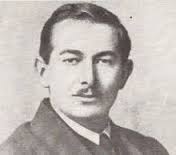
Sean Tracey (Photo from Internet)(Photo from Internet)
Treacy and Breen had eventful times in Tipperary and nearby counties as they escalated their war against the British colonial occupation, attacking RIC barracks and carrying out ambushes. Among their most dangerous and famous events was the daring IRA rescue at Knockalong of Sean Hogan from the train in which he was being carried as a prisoner under armed escort on 13th May 1919, in which a fierce hand-to-hand struggle took place and both Treacy and Breen were seriously wounded.
Towards the end of that year, on 19th December in Dublin, Breen and Treacy were in action with Sean Hogan in an attempt on the life of General Sir John French, the British King’s representative and chief of HM Armed Forces in Ireland. The operation was led by Paddy Daly (of “Collins’ Squad” notoriety and later infamous for his part in the Civil War) and consisted of ten Volunteers, to which Martin Savage was added the previous night due to his own earnest request. Through misinformation the waiting Volunteers barely missed French as he headed in convoy towards his Residence (now the US Ambassador’s) in Phoenix Park and in the shootout that followed with the other convoy vehicles Breen was wounded in the leg and Volunteer Martin Savage in the neck, dying in Breen’s arms (Martin Savage is remembered in the song Ashtown Road by Dominic Behan).
At least a number of Sinn Féin TDs and activists were incensed by this action, including Charlotte Despard, who also happened to be John French’s sister. There was more than family relations involved – many in Sinn Féin were ambivalent about armed struggle and although both were banned later in 1919, neither the party nor the Dáil declared war on the British until a few months before the Truce in 1921.
After the Knockalong rescue, things had got a bit hot for Treacy and Breen in Tipperary and Collins invited them up to Dublin, where they were expected to merge more easily in the busy city centre.
They returned to Tipperary in the summer of 1920, where they continued to be active in the war, until Collins invited them up to the city again, partly for their own safety and partly to help him out in Dublin in the work of his “Apostles”, the “Squad”, especially in assassinations of British Intelligence agents, troublesome police and informers.
CIS — BRITISH INTELLIGENCE IN IRELAND REORGANISED
However, British Intelligence in Ireland had already been re-organised. The RIC’s intelligence and its personnel were by this time considered unreliable by British Army Intelligence and many in the force had also resigned or become disaffected. “By the spring of 1920 the political police of both the Crimes Special Branch of the Royal Irish Constabulary (RIC) and G-Division (Special Branch) of the Dublin Metropolitan Police (DMP) had been effectively neutralised by IRA counter-intelligence operatives working for Michael Collins. The British thoroughly reorganised their administration at Dublin Castle, including the appointment of Army Colonel Ormonde de l’Epee Winter as Chief of a new Combined Intelligence Service (CIS) for Ireland. Working closely with Sir Basil Thomson, Director of Civil Intelligence in the Home Office, with Colonel Hill Dillon, Chief of British Military Intelligence in Ireland, and with the local British Secret Service Head of Station Count Sevigné at Dublin Castle, Ormonde Winter began to import dozens of professional Secret Service agents from all parts of the British Empire into Ireland to track down IRA operatives and Sinn Féin leaders.” (Wikipedia).
Ormonde developed or introduced lots of intelligence-gathering procedures and “black propapaganda” in Ireland. After the war he joined the British fascisti for a while and in 1940 fought for the Finns in the Winter War against the Red Army.
Ormond L’Epee Winter, head of CIS in Ireland
As part of the reorganisation under CIS, a number of Royal Irish Constabulary officers had been posted to Dublin from country areas where the IRA were active and Breen and Treacy were noted coming into Dublin or soon after their arrival and were placed under surveillance.
On the evening of 13th October 1920, Breen and Treacy had been to see a film in Dublin with the Fleming sisters, who told them that they were sure that Breen and Treacy were being followed. Neither of the men believed this to be true and before the start of the nightly curfew, headed out towards their safe house, “Fernside”, a little past the corner of Home Farm Road and Upper Drumcondra Road, which belonged to a Professor Carolan, who lived there and taught in the nearby St. Patrick’s College, Drumcondra.
Closeup of the name “Fernside” on the house today, scene of the gunfight. (Photo D.Breatnach)The “Fernside” house today, scene of the gunfight (Photo D.Breatnach)
BRITISH EARLY MORNING RAID
By this time, the Fernside address was known to British Intelligence. Around 1.00 or 2.00am, a party of DMP and British Army knocked on the door and when Professor Carolan answered, they entered, began to question him and a number started up the stairs. Both Treacy and Breen had slept in most of their clothes and with their guns ready. Instead of barricading themselves inside their room or escaping through the window, they charged down the stairs, firing as they went at the intruders, who fled. Breen and Treacy then went back upstairs and jumped from a first floor window. They seem to have been different windows, for Breen went through a glass house or conservatory and received a number of glass cuts, while Treacy suffered only a very slight injury of some sort, whether by glass or some such or by bullet, is not clear. Or possibly Breen jumped first and left little glass remaining to cut Treacy.
In the back garden of the house, Breen later recounted firing at the heads of either police or British soldiers he observe over the fence and saw some fall; in return fire he was seriously injured but managed to get out of the garden and work his way across the road down to the wall of the nearby St. Patrick’s College, Drumcondra (still there today). Although short of stature and badly injured, he scaled the wall and making his way across the College grounds, came out on the other side, by the Tolka and then went up the road to Phibsboro, where he knocked on doors. A man who opened the door to him got him a doctor, who then had him smuggled into the private patients’ part of the Mater Miserecordiae Hospital (known to Dubliners as “the Mater”), at the corner of Eccles Street and Dorset Street, under an assumed name in the care of the nuns. Another version has him going to Finglas before being smuggled to the Mater.
We know little of Treacy’s escape except that he too got away, only slightly hurt, to a house in Inchicore. Professon Carolan was shot during the event (probably by the enraged British who might have thought he had somehow signaled Breen and Treacy or in panic — they seem to have shot some of their own men) and died days later.
The Occupation forces admitted to only two of their dead, both officers in the British Army, although a contemporary Irish Times report mentioned three. But Joe Connolly, a member and later Chief of the Dublin Fire Brigade, which then as today operates ambulance services in Dublin, spoke of twelve bodies having been collected for delivery to the British Military Hospital in Arbour Hill.
The forces of the colonial Occupation were in a frenzy searching for both Treacy and Breen around the city and the Dublin IRA organised protection for them both.
ANOTHER SHOOTOUT
Word reached Michael Collins that the Occupation forces were going to organise a formal funereal procession to take the dead British officers’ bodies to the quays for their journey home to Britain and that top officers of the Occupation’s army and police would be in attendance. Collins planned to shoot a number of them and assembled a group for the operation and notified the meeting place.
However, Collins cancelled the operation (and meeting) when he learned that the high-ranking British officers would not be attending the dead officers’ send-off to England. Treacy arrived late at the meeting place, a draper’s shop called “Republican Outfitters” (!) owned by the Boland family, at 94 Talbot Street, as did another man and both learned of the cancellation (according to one account; according to another he delayed leaving after the others had left). However, the British were closing in on Talbot Street with the intention of capturing Treacy, it seems. As Treacy came out into the street, an agent approached him with gun drawn and Treacy saw the British vehicles coming down the street from O’Connell (then Sackville) Street. He drew his Parabellum firearm and shot two agents but the machine-gunner caught Treacy in a burst as he was trying to mount his bicycle as people dived for cover and several were injured.
Republican Outfitters, 94 Talbot Street. This may also be a photo taken after the shooting.
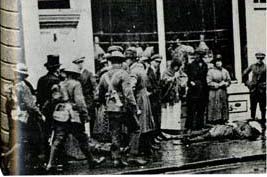
Sean Treacy died from the machine-gun bullets in that street, along with two civilians, a John Currigan, a tobacconist from Eden Quay and “a messenger boy named Carroll”, according to a press report at the time. A policeman on point duty was shot in the arm, which had to be amputated. Another boy, 15-year old apprentice photographer John J. Hogan, claiming to be out practicing with his employer’s camera, followed the action and took the famous photo of Treacy lying dead in the street.
Sean Treacy lying dead in Talbot Street, very soon after he had been shot. (Photo from Internet).
It seems the Chief of the CIS himself, Ormand Winter, had attended the operation or had followed it up and was shocked at the outcome – an agent dead and another wounded and Treacy dead, along with two innocent bystanders, one only a boy. He told a press reporter it had been “a tragedy”.
It had long been believed that Treacy shot two agents dead but although Liuetenant Gilbert Price was definitely dead, another, Colour-Sergeant Frank Christian, later received compensation of £1,250 (a substantial amount in those days) for injury received during the event, according to press reports. Christian claimed to have been off duty and just passing at the time but this was more than likely said to preserve his cover and also to increase the amount of compensation. http://www.cairogang.com/incidents/treacy-talbot/treacy-talbot.html
Some of the IRA and their supporters were still in the area when the British Army arrived in Talbot Street and one, Dick McKee, barely made it away on a bicycle. He would not be so lucky another time which was fast approaching.
I once or twice heard some speculation that Treacy had been betrayed from within the IRA and even that Collins wanted him killed but these kinds of rumours often arise and no evidence has ever been provided to substantiate the speculation. It is indeed curious that Treacy had miraculously escaped on the 13th and had been recruited for a dangerous operation to take place two days later, then to be shot at the scene of a cancelled meeting but such things happen. It would take remarkable prescience on Collins’ part to have anticipated the course of the War of Independence in 1920 so as to have removed one of the most effective fighters that would help bring the struggle to truce, negotiation and a Treaty. The simplest explanation and the one that fits the best is that Treacy had been marked and followed and that after their debacle at Fernside, the colonial military authorities in Dublin had decided to take him prisoner there in Talbot Street if they could and, if not, kill him.
Treacy was buried in his native county at Kilfeakle, a funeral attended by thousands of mourners and a heavy concentration of RIC, holding rifles with fixed bayonets. Breen remarked that though not intended in that way, it was an appropriate mark of respect for the fallen guerrilla fighter.
MORE SHOOTINGS …. AND A MASSACRE
The police and army raids in Drumcondra and in Talbot Street, the first from which two tough and experienced IRA men had been lucky to escape and the second which had resulted in the death of one of them and nearly netted a few others, must have rung very loud alarm bells for IRA leaders and ordinary Volunteers. Apparently it convinced Collins that some very thorough offensive action was needed to remove or reduce the threat.
Just over a month later, in the early morning of Sunday 21 November 1920, Collins’ ‘Squad’ and teams mobilised by the Dublin IRA Brigade, went out to assassinate 35 men believed to be members of the British Intelligence network in the City. Collins had originally drawn up a list of 50 but Cathal Brugha, acting as Minister of Defence, had reduced the list on the basis that there was insufficient evidence against fifteen of them.
Most of the shootings by the IRA that morning took place in the southern suburbs of the city – Baggot, Upper Pembroke and Lower Mount streets, Fitzwilliam Square, Morehampton Road and Earlsfort Terrace. There were also shootings in the Gresham Hotel and on O’Connell Street. Some agents were, luckily for them, not in when the IRA came calling and some operations were bungled. A passing Auxilliary patrol (they were brought into Ireland in July 1920) got involved in one location and, in the subsequent fight, two of them were killed and one IRA man wounded and captured. But by midday, the British Army and colonial administration were counting their fatal losses, a total of:
10 Intelligence officers (one RIC and 9 Military)
1 military prosecutor
1 civilian informer
2 Auxiliaries
1 Army Veterinary officer (apparently a case of mistaken identity)
In addition, some more officers had been wounded, albeit not fatally.
Just as the operations organised by British Intelligence in the previous month had raised the alarm for the IRA, the response of the latter did the same in turn for the British military and political administration in Ireland. Henceforth, intelligence personnel would be accommodated in Dublin Castle or in barracks. But if the Intelligence establishment was rattled, the Auxilliaries and loyal RIC and DMP (Dublin Metropolitan Police) were incensed.
That afternoon, a Gaelic football game was scheduled to take place in Croke Park, the national stadium of the Gaelic Athletic Association, between Tipperary and Dublin teams. The IRA had considered advising the GAA to cancel the match but there were fears that — apart from alerting British Intelligence that something was planned — it might implicate the GAA in the planned operation that morning. In any case, the match went ahead with an estimated attendance of 5,000, unaware that a convoy of British Army troops was driving along Clonliffe Road from the Drumcondra Road end, while a convoy of DMP and Auxiliaries approached the Park from the south or Canal end.
At 3.25pm, ten minutes after the start of the match, the police burst into the ground, firing. Despite their claims later there is no evidence they received any return fire but nevertheless their own commander admitted they kept shooting for about a minute-and-a-half. They fired at spectators and players, some firing from the pitch while others fired from the Canal Bridge at those who tried to escape by climbing over the wall at the Canal end. The soldiers on Clonliffe Road fired machine gun bullets over the heads of the fleeing crowd in an unsuccessful effort to turn them back.
According to the commander of the operation, Major Mills, the police had fired 114 rifle rounds (revolver rounds were not counted) and the Army had fired 50 rounds in the street. The casualties were 9 people shot dead, five dying of wounds and two trampled to death in the panic. Two of the dead were boys aged 10 and 11. Michael Hogan, a player was dead and another player, Egan, wounded but survived. Dozens more were wounded by bullets or injured in the panic. Unlike the “Croke Park” scene in Neil Jordan’s Michael Collins film (1996), it appears that the British Army shot no-one that day – that was all the work of the police.
The Castle issued a cover story in a statement that IRA men from outside Dublin had used the football game as a cover for getting into the city and, after the assassinations they had carried out, had gone to the game. When the police arrived to search fans for weapons, according to the statement, these men had fired on the police, who had been obliged to return fire. The most credulous would have found that story difficult to believe since not a single policeman had even been injured and even the loyalist Irish Times poured scorn on their story.
MURDER IN THE CASTLE
One of the planners of the earlier IRA operation was already in custody before the events of that day. Dick McKee, commander of the Dublin Brigade and another IRA man, Peadar Clancy, had been arrested by Crown Forces in the early hours of that Sunday morning. They were being interrogated in Dublin Castle.
Also being interrogated was Conor Clune, who had been arrested by the Auxilliaries in a raid on Saturday evening of Vaughan’s Hotel in Parnell Square, on the corner of Granby Lane. Clune was no IRA man but an language enthusiast who had come up to Dublin that day with his employer, Edward McLysaght, on business for the Raheen cooperative. Clune had gone on to meet Piaras Béaslaí, a member of the First Dáil (Irish Parliament set up in defiance of Westminster by the majority of Members of the British Parliament elected in Ireland). Béaslaí and some IRA men using Vaughan’s that evening were alerted by a hotel porter to the suspicious behaviour of a visitor, apparently a spy, and departed before the arrival of the “Auxies”, who arrested Clune on suspicion. Leading the interrogation team was Ormond Winters.
Later that awful day, McKee, Clancy and Clune were reported “shot while trying to escape”. Their captors said that, because there was no room in the cells, they had been placed in a guardroom and were killed while grabbing arms to shoot their captors and to make a getaway. To bolster the Castle’s story, they produced a number of photographs: one shows three civilians sitting apparently in conversation in a room, where a number of Auxiliaries and British Army are also shown relaxed, some eating a meal and another reading. Untended weapons are in view; another photograph shows a blur of men “trying to escape”. In none of the photos are the faces of any of the three prisoners clearly shown.
Family of the dead Irishmen said they had been tortured and then shot and few believed the Castle’s story (although apparently some historians today give it credence). It is said Collins wanted their bodies displayed to show bayonet wounds but was persuaded not to, however one of Collins’s Castle informers, Nelligan, was later adamant that they had not been bayoneted. All sides agree that the bodies did show extensive bruising. In any case, McKee and Clancy died without giving their captors any of the long list of names they carried in their heads, while Clune of course had none to give.
Conor Clune’s body was recovered by Mac Lysaght, who had it medically examined, revealing that he had been shot 13 times in the chest. The Army doctor who examined the bodies prior to their release said that Clancy had been hit with up to five bullets, which caused eight wounds, while Dick McKee had three wounds caused by two bullets.
Unfortunately for the Castle, Conor Clune was a nephew of Patrick Clune, Archbishop of Perth, Australia which caused the authorities some embarrassment.
View further back of plaque to the three murdered by the British Occupation forces on Bloody Sunday 1920 (City Hall on the right). (Photo DB)Closer view of plaque.
A plaque commemorating the men (albeit listing Clune as a “Volunteer”) was placed by the National Graves Association on the wall of Dublin Castle near the eastern side of City Hall and every year a small commemoration ceremony takes place there.
There was a sequel to the deaths of the three, although it did not take place until the following year. An ex-British Army soldier, James “Shankers” Ryan, had betrayed McKee. On February 5, 1921, as Ryan was enjoying a pint in Hyne’s pub in Gloucester Place and studying the horse racing page of the newspaper, an IRA squad led by Bill Stapleton walked into Hynes’ pub in Gloucester Place and shot him dead.
REMEMBRANCE IN SONG AND STORY
A plaque was erected in Talbot Street, Dublin, by the voluntary non-party organisation, the National Graves Association, on the front facade of No. 94, the building outside of which Treacy was killed. The anniversary of his death is marked each year at a commemoration ceremony in Kilfeacle. Also at noon on the morning of All-Ireland Senior Hurling Finals in which the Tipperary GAA team participates, a ceremony of remembrance is held at the spot in Talbot Street where he died, organised “by people from West Tipperary and Dublin people of Tipperary extraction. The most recent such ceremony was held at midday on Sunday, 7 September 2014 and attracted a large attendance, most of whom were en route to Croke Park.” (Wikipedia).
Sean Treacy Plaque Talbot Street
It is worthy of note that every single one of those commemorations and memorial plaques is organised by voluntary bodies rather than by the State.
A number of songs about Sean Treacy are in existence: Sean Treacy by Dominic Behan and Tipperary So Far Away (author disputed: by Patsy O’Halloran OR Paddy Walsh/ Pádraig Breatnach/ Paddy Dwyer, with — if about Treacy — some obviously inaccurate versions by the Clancy Brothers and Wolfe Tones). Strangely neither Treacy nor Breen is mentioned in The Station of Knockalong, about the May 13th 1920 rescue of Sean Hogan from his captors on a train, after a fierce hand-to-hand struggle in which both Treacy and Breen were seriously wounded. The Galtee Mountain Boy is said to be also about Treacy but some of the lyrics make this unlikely and a contributor to Mudcat (a folk song website) claimed that song is about Paddy Davern, who was sentenced to die by both the British and the Irish Free State but escaped them both.
Strangely too, no song comes to light about the Drumcondra shoot-out. I have heard a few lines quoted, “He shot them in pairs coming down the stairs”, allegedly from a song about Sean Treacy by Dominic Behan. However, my searches have failed to turn up the source of those wonderful lines. If the song existed and was about Treacy, it could have referred to his death in Talbot Street but even more likely to the battle at Fernside.
Dan Breen is mentioned in a number of songs but none of which I am aware directly about him. Breen was very saddened at the death of his close comrade-in-arms and recovered slowly from his wounds, having been shot four times, twice in the lungs. He was smuggled out of Dublin while still recovering from his injuries and very weak, returning to active service later. In June 1921, Breen married Brigid Malone of the Dublin Cumann na mBan, who had helped nurse him while recovering from his wounds. The long Truce of 1921 followed in July which, according to his autobiography My Fight for Irish Freedom (1921 and many reprints since), Breen frowned upon, commenting that IRA discipline grew slack and information on identities of fighters and their locations would have come much more easily to Crown forces.
Dan Breen dissented from the Treaty of 1921 and took up arms on the Republican side, was captured and interned, went on hunger strike and was released. Breen was an anti-Treaty TD for Tipperary from 1923 for Sinn Féin, the TDs of which refused to take their seats in the “Partitionist” Fourth Dáil. When the Fianna Fáil party was created in a split away from Sinn Féin in 1926 with the intention of their representatives entering the Dáil if elected, Breen joined and was the first anti-Treaty TD to take his seat in the Dáil in 1927.
When he later failed to be reelected he went to the USA, which was under alcohol Prohibition at the time and there he ran a speakeasy. (He would probably have known Joe Kennedy, grandfather of President John F. Kennedy, who was a prominent gangster in that epoch). Returning to Ireland in 1932, Breen regained his Fianna Fáil seat. He died in 1969 and the attendance at his funeral was estimated at 10,000.
Politics is about the present and the future, obviously … but it is also about the past.
Different political interests interpret and/or represent the past in different ways, emphasising or understating different events or aspects or even ignoring or suppressing them entirely. There is choice exercised in whom (and even what particular pronouncement) to quote and upon what other material to rely. And by “political interests” I mean not only groups, formal (such as political parties) or informal, but also individuals. Each individual is political in some way, having opinions about some aspects of questions that are political or at least partly-political. For example, one often hears individuals say today that they have no interest in politics, yet express strong opinions of one kind or another about the right to gay and lesbian marriage, the influence of the Catholic Church, and how the country is being run by Governments.
So when an individual writes a history book, there are going to be political interpretations, although not all writers admit to their political position, their prejudices or leanings, in advance or even in the course of their writing. One historian who does so is Padraig Yeates, author of a number of historical books: Lockout –Dublin 1913 (a work unlikely to be ever equalled on the subject of the title), A City In Wartime — 1914-1919, A City in Turmoil – 1919-1921and his latest, A City in Civil War – Dublin 1921-’24. The latter was launched on Tuesday of this week, 12th May and therefore much too early for people for who did not receive an earlier copy to review it. So it is not on the book that I am commenting here but rather on the speeches during the launch, which were laden with overtly political references to the past and to the present. If a review is what you wanted, this would be an appropriate moment to stop reading and exit – and no hard feelings.
The launch had originally been intended to take place at the new address at 17 D’Olier Street, D2, of Books Upstairs. However the interest indicated in attending was so great that Padraig Yeates, realising that the venue was going to be too small, went searching for a larger one. Having regard to how short a time he then had to find one and with his SIPTU connections, Liberty Hall would have been an obvious choice. Whether he had earlier been asked to speak at the launch I do not know but, having approached Jack O’Connor personally to obtain the use of Liberty Hall, in the latter’s role of President of SIPTU, the owners of that much-underused theatre building, it was inevitable too that O’Connor would be asked to speak and act as the MC for the event.
O’Connor’s introduction was perhaps of medium length as these things go. He talked about the author’s work in trade unions, as a journalist and as an author of books about history. O’Connor’s speech however contained much political comment. Speaking of the period of the Civil War (1919-1923), he said it had “formed what we have become as a people”. That is a statement which is of dubious accuracy or, at very least, is open to a number of conflicting interpretations. The Civil War, in which the colonialism-compromising Irish capitalist class defeated the anti-colonial elements of the nationalist or republican movement, formed what the State has become – not the people. The distinction between State and People is an essential one in our history and no less so in Ireland today.
Talking about the State that had been created in 1921 (and not mentioning once the creation of the other statelet, the Six Counties) and referring to the fact that alone among European nations, our population had not risen during most of the 20th Century and remained lower than it had been up to nearly the mid-Nineteenth, a state of affairs due to constant emigration, O’Connor laid the blame on the 26-County State and in passing, on the capitalist class which it served. He was undoubtedly correct in blaming the State for its failure to create an economic and social environment which would stop or slow down the rate of emigration – but he did not explain why it was in the interests of the capitalists ruling the state to do so. Nor did he refer to the cause of the original drastic reduction in Ireland’s population and the start of a tradition of emigration – the Great Hunger 1845-’49.
The Great Hunger memorial on Dublin’s Custom House Quay. The Great Hunger and its immediate aftermath initiated mass Irish emigration.
Even allowing for the fact that O’Connor wished to focus on the responsibility of the 26-County State, the Great Hunger was surely worthy of some mention in the context of Irish population decline. Just a little eastward along the docks from Liberty Hall is the memorial to that start of mass Irish emigration. It was the colonial oppression of the Irish people which had created the conditions in which the organism Phytophthora infestans could create such devastation, such that in much less than a decade, Ireland lost between 20% and 25% of its population, due to death by starvation and attendant disease and due also to emigration (not forgetting that many people emigrating died prematurely too, on the journey, upon reaching their destination and subsequently). Phytophthora devastated potato crops in the USA in 1843 and spread throughout Europe thereafter, without however causing such a human disaster as it did in Ireland. In Mitchell’s famous words: “The Almighty, indeed, sent the potato blight, but the English created the famine.” And that is what makes that period of population decline uncomfortable for some historical commentators.
Indeed, O’Connor did not mention British colonialism once, nor Partition, nor imperialism. And nor did either of the other two speakers, nor the author. I remarked on this to an Irish Republican present, to which he responded with a rhetorical question: “Did you expect them to?” Well, yes, perhaps naively, I did. While not expecting an Irish Republican analysis from Padraig Yeates and perhaps not either from anyone he would consider appropriate to speak at the launch of one of his books, dammit, we are talking about history. The presence of Norman/English/British Colonialism for 800 years prior to the creation of the Irish Free State, and its influence on that state’s creation and on subsequent events in Ireland, is worthy of at least a mention in launching a book about the Civil War. Not to mention its continuing occupation of one-fifth of the nation’s territory.
Colonialism and Imperialism and, in particular, the Irish experience of the British variant, were not so much ‘the elephant in the room‘ at the launch as a veritable herd of pachyderms. They overshadowed us at the launch and crowded around us, we could hear them breathing and smell their urine and excreta – but no-one mentioned them. The date of the launch was the anniversary of the execution of James Connolly 99 years ago, a man whom the Labour Party claims as its founder (correctly historically, if not politically), a former General Secretary of the ITGWU, forerunner of SIPTU and the HQ building of which, Liberty Hall, was a forerunner too of the very building in which the launch was taking place. His name and the anniversary was referred to once, though not by O’Connor, without a mention of Sean Mac Diarmada, executed in the same place on the same day. And most significantly of all, no mention of who had Connolly shot and under which authority.
That circumspection, that avoidance, meant that a leader of Dublin capitalists, William Martin Murphy, could not be mentioned with regard to Connolly’s death either — i.e. his post-Rising editorial in the Irish Independent calling for the execution of the insurgents’ leaders. But of course he did get a mention, or at least the class alliance he led in 1913 did, in a bid to smash the ITGWU, then under the leadership of Larkin and Connolly. This struggle, according to O’Connor and, it must be said also to Padraig Yeates, was the real defining struggle of the early years of the 20th Century, not the 1916 Rising, the War of Independence nor yet the Irish Civil War. It was in 1913 that “the wrong side won”.
One-eyed as that historical vision must be, we have to question whether it is even partially correct. The Lockout was a great defeat for the ITGWU and for the leading elements in the Irish workers’ movement. But the Lockout did not break the trade union and, in fact, it later began to grow in membership and in branches. Other trade unions also survived and some expanded. So in what manner was 1913 decisive in ensuring that “the wrong side won” in later years? The Irish trade union movement was still able to organise a general strike against conscription in April 1918 and the class to organise a wave of occupations of workplaces in April 1919.
True, the Irish working class had lost one of its foremost theoreticians and propagandists by then, in the person of James Connolly. And who was it who had him shot? Not Murphy (though he’d have had no hesitation in doing so) nor the rest of the Irish capitalist class. In fact, worried about the longer-term outcome, the political representatives of the Irish ‘nationalist‘ capitalist class for so long, the Irish Parliamentary Party, right at the outset and throughout, desperately called for the executions to halt. General Maxwell, with the support of British Prime Minister Asquith, ordered and confirmed the executions of Connolly and Mallin of the Irish Citizen Army and British Army personnel pulled the triggers; in essence it was British colonialism that executed them, along with the other fourteen.
For the leaders of the Labour Party and of some of the trade unions, and for some authors, Padraig Yeates among them, the participation of Connolly and the Irish Citizen Army in the Rising was an aberration. For these social democrats, the struggle should have been against the Irish capitalist class only (and preferably by an unarmed working class). It is an inconvenient fact that Ireland was under colonial occupation of a state that had strangled much of the nation’s economic potential (and therefore of the growth of the working class) in support of the interests of the British capitalist class. It is an inconvenient fact that the Irish capitalist class had been divided into Unionist and Nationalist sections, the former being descendants of planter landowners and entrepreneurs whose interests were completely bound up in Union with Britain. It is an inconvenient fact that the British and the Unionists had suppressed the last truly independent expression of the Irish bourgeoisie, the United Irishmen and, in order to do so effectively, had created and enhanced sectarian divisions among the urban and rural working and middle classes. It is also an inconvenient fact that the British cultivated a client “nationalist” capitalist class in Ireland and that the police and military forces used to back up Murphy’s coalition in 1913 were under British colonial control.
To my mind, a good comprehensive analysis of the decline inprominence of the Irish working class on the political stage from its high point in early 1913 and even in 1916, has yet to be written. One can see a number of factors that must have played a part and the killing of Connolly was one. But something else happened between 1913 and 1916 which had a negative impact on the working class, not just in Ireland but throughout the World. In July 1914, WW1 started and in rising against British colonialism in Ireland, Connolly also intended to strike a blow against this slaughter. As the Lockout struggle drew to its close at the end of 1913 and early 1914, many union members had been replaced in their jobs and many would find it hard to regain employment, due to their support for the workers and their resistance to the campaign to break the ITGWU. It is hard to avoid the conclusion that many joined the British Army or went to work in war industries in Britain. Although the Irish capitalist class supported the British in that War (up to most of 1917 at any rate) it was imperialism which had begun the war and British Imperialism which recruited Irish workers into its armed forces and industries.
Reaching back in history but to different parts of Europe, Padraig Yeates, in his short and often amusing launch speech, cracked that “for years many people thought Karl Kautsky’s first name was ‘Renegade’ ” — a reference to the title of one of Lenin’s pamphlets: The Proletarian Revolution and the Renegade Kautsky. Yeates apparently admires Kautsky and quoted him on Ireland. But Kautsky advocated no uprisings against imperialism or colonialism in the belief that “super-imperialism” (also called “Hyper Imperialism”) would regulate itself peacefully, letting socialists get on with the task of evolving socialism. Two World Wars since then and current developments have negated Kautsky’s theory but more to the point, to advocate his theory as a guiding principle at the time he did was a major ideological threat to proletarian revolution and to the evolving anti-colonial struggles of the world and therefore he was a renegade to any variant of genuine socialism and socialist struggle.
This is relevant in analysing the position of the trade union leaders and the Irish Labour Party today. They are social democrats and their central thesis is that it is possible to reform capitalism, by pressure on and by involvement in the State. They deny what Lenin and others across the revolutionary socialist spectrum declare, that the state serves the ruling class and cannot be coopted or taken over but for socialism to succeed, must be overthrown.
It is the social-democratic analysis that underpinned decades of the trade union leaders’ social partnership with the employers and the State, decades that left them totally unprepared, even if they had been willing, to declare even one day’s general strike against the successive attacks on their members, the rest of the Irish working class and indeed the lower middle class too since 2011. Indeed Padraig Yeates, speaking at a discussion on trade unions at the Anarchist Bookfair a year or two ago, conceded that social partnership had “gone too far”. Can Jack or any other collaborationist trade union leader blame that on the transitory defeat of the 1913 Lockout? They may try to but it is clear to most people that the blame does not lie there.
Two other speakers addressed the audience at the launch, Katherine O’Donnell and Caitriona Crowe. Catriona Crowe is Head of Special Projects at the National Archives of Ireland and, among other responsibilities, is Manager of the Irish Census Online Project, an Editor of Documents on Irish Foreign Policy, Vice-President of the Irish Labour History Society. She is also Chairperson of the SAOL Project, a rehabilitation initiative for women with addiction problems, based in the North Inner City. It was her, I think, who made the only mention of “Blueshirts” and her also that mentioned the anniversary of James Connolly. Although her speech was overlong in my opinion for a book launch in which she had already been preceded by two longish speeches, strangely I can remember very little of what she had to say.
Katherine O’Donnell’s contribution however made a considerable impression upon me. She declared herself early in the speech to be lesbian and a campaigner for gay and lesbian rights and is Director of the Women’s Studies Centre at the School of Social Justice at UCD. O’Donnell began by praising Padraig Yeates’ work, of which she declared herself “a fan”. In a speech which at times had me (and sometimes others too) laughing out loud, she discussed the contrast in the fields of historical representation between some historians and those who construct historical stories through the use of imagination as well as data; she denounced the social conservatism of the state, including the parameters of the upcoming referendum on same-sex marriage, the legal status of marriage in general and the climate of fear of prosecution engendered by the shameful capitulation of RTE to the Iona Institute on the accusation of “homophobia” (she did not mention them specifically but everyone knew to what she was referring).
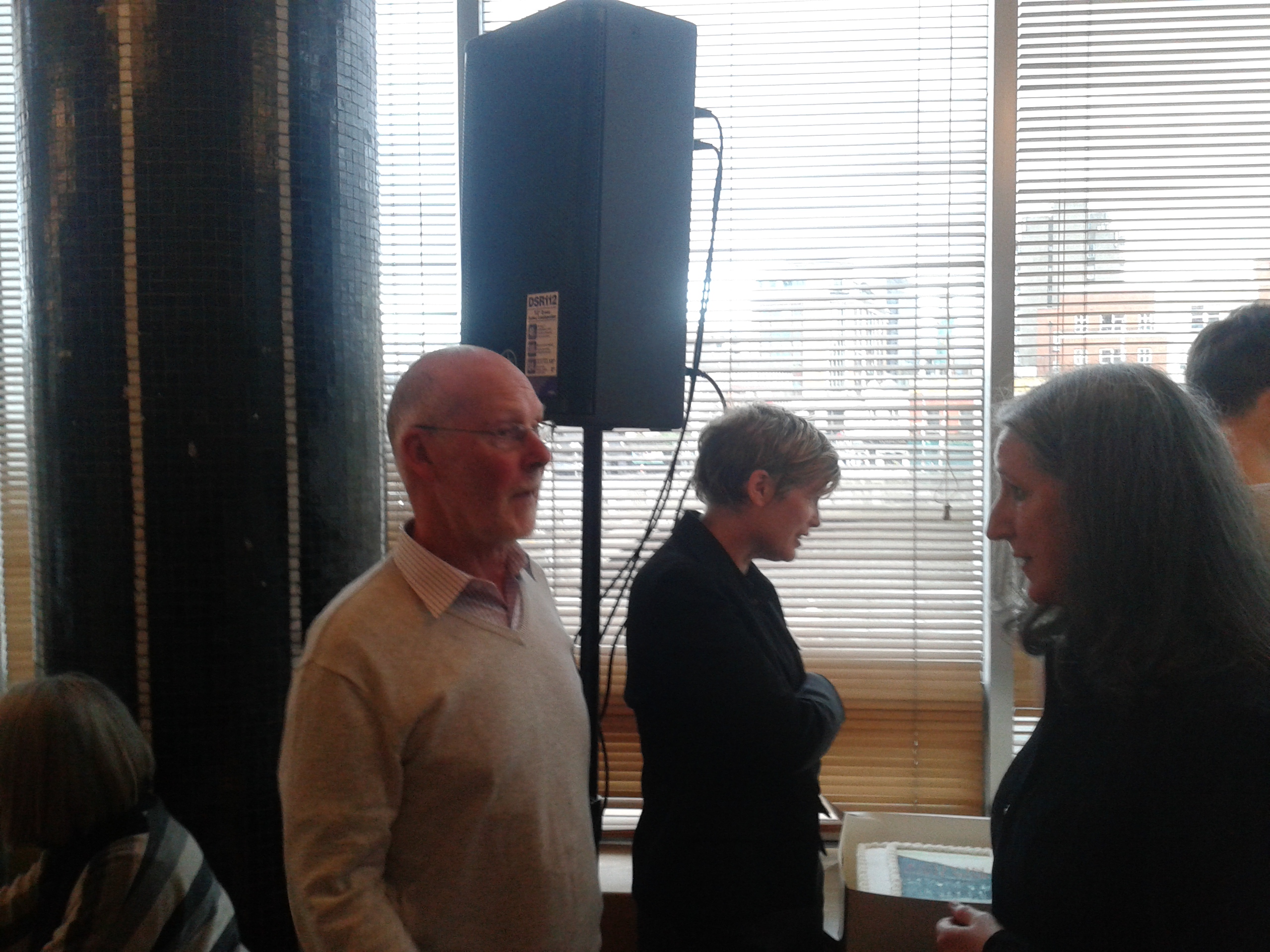
After the launch speeches — (L-R) Padraig Yeates, Katherine O’Donnell, Caitriona Crowe.
Jack O’Connor, between speeches, made a reference to a giant banner hanging off Liberty Hall which had the word “NO” displayed prominently, saying that they had received congratulatory calls from people who thought it was against same-sex marriage. The banner was however against privatisation of bus services. The current banner on Liberty Hall says “YES” to the proposal in the forthcoming referendum and he said that now busmen were calling them up complaining …. to laughter, O’Connor commented that “it’s hard to the right thing, sometimes”. Presumablywhat he meant was that it is hard to know what the right thing to do is, or perhaps to please everybody.
It is indeed hard to please everybody but I’d have to say that it is not hard to know that the purpose of and‘the right thing to do’ for a trade union, is to fight effectively and with commitment for its members and for the working class in general. And that is precisely the responsibility which has been abrogated by Jack
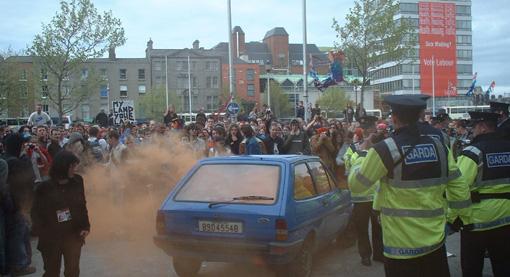
In the background to this photograph of a Reclaim the Streets demonstration in 2002 is Liberty Hall, draped in a hug “Vote Labour” banner. SIPTU has maintained that position through a number of coalition governments in which Labour has participated and that have attacked the living standards and rights of workers.
O’Connor personally, along with other leaders of most of the trade unions, including the biggest ones for many years, SIPTU and IMPACT. And also by the Irish Congress of Trade Unions. That is why Jack O’Connor gets booed now if he ever dares stand on a public platform related to trade union struggle, a treatment received also by David Beggs before he retired from the Presidency of ICTU.
Back in 2011, another giant banner hung from Liberty Hall – that time it urged us to VOTE LABOUR, as did leaders of other trade unions. Stretching magnanimity, we might give the trade union leaders the benefit of the doubt and say they had forgotten that the Labour Party had only ever been in Government in coalition, most often with the right-wing Blueshirt Fine Gael party and that its most recent spell sharing power had given us one of the most repressive governments in the history of the State. Let us imagine for a moment that these social-democratic union leaders had forgotten all that. But, after February 2011, as Labour and Fine Gael went into coalition and both reneged on their election promises, as the Coalition government began to attack the working class and the lower middle class, what is their excuse then? When did they denounce the Labour Party to their members, publicly disaffiliating from the party? No, never, and the fact that those disgusting connections continue was underlined by the presence at the book launch of a Labour Party junior Government Minister and the late arrival of noneother than Joan Burton, Minister for Social Constriction …. er, sorry, Protection.
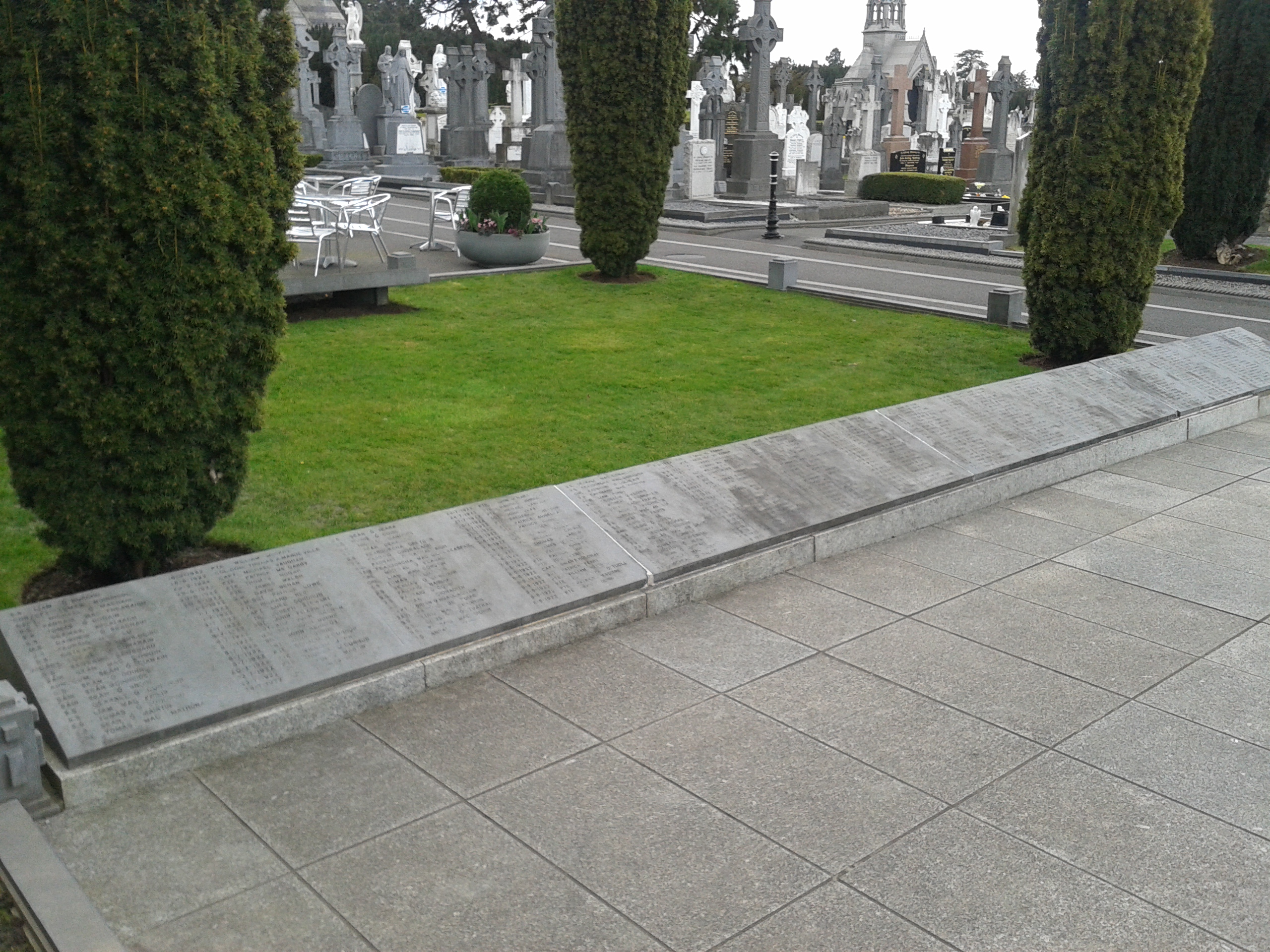
Plaques in Glasnevin’s Republican Plot recording the names of 77 of the 81 Irish Volunteers officially executed by the Free State between November 1922 and May 1923. Their police and military killed about another 150 without judicial procedure.
Considering that the book being launched was about the Civil War, it is really extraordinary that no speaker mentioned the repression by the Free State during and after that war. I am certain that Padraig Yeates has not glossed over that, he is much too honest and too good a historian to do so. But that only one speaker at the launch (Catriona Crowe) should mention the sinister Oriel House and none the at least 25 murders its occupants organised, nor the 125 other murders by Irish Free State soldiers and police, nor the 81 state executions between November 1922 and January 1923, sets one wondering at just how much self-hypnosis sections of our political and academic classes are capable.






 rebelbreeze