DARN IT


Diarmuid Breatnach

I no longer watch television at home. It was not a case of rejecting that form of mass media, as some assume, but the result of a tiresome tussle with the huge US-based UPC monopoly, out of which, not surprisingly, I came off worst – they control the aerial in my block of flats and I am not permitted to put up my own dish to receive through a competitor.

Anyway, I used to darn socks sometimes while watching TV, especially during advertisements. Radio would have been ideal but I have long ago lost the habit of listening to that medium. When I lost my struggle with UPC, I stopped watching TV; I could have watched it on my laptop but I find it unsatisfying to watch on a small screen. And when I stopped watching TV, I also ceased darning. The pile of socks with holes in them grew, to be mended “some day”, until eventually I had to buy new ones.

I am aware that for many in OLYMPUS DIGITAL CAMERAour society here today, darning would be considered a quaint or even archaic activity, associated with oil lamps and making your own butter, perhaps. Or cooking on a range and the absence of indoor plumbing. For others, darning might signify poverty or meaness. To me, it is about using and reusing what can be used, and about mending what can reasonably be mended to use again. Clothes, like all other items we use, are produced by human labour and it seems wrong to me to waste that labour unnecessarily – a kind of negation of the labour in the first place and, following that, a negation of the activity that might follow when the workers have produced enough of the items.

Of course, in our time and in this place, it is likely that the socks that I buy have been made in some sweat-shop in a more undeveloped country where, if they think about it at all, the sweated workers hope that we’ll go throwing away our socks as soon as the first hole appears, or even sooner if possible, so that they can continue to sweat producing replacements and being paid their meagre wages in order to pay for food, shelter and medicines. So that they can continue sweating and raise their children who, in turn, will become sweated wage slaves producing articles of clothing, undercutting the wages of those who might produce the same articles here, but who rightfully demand more humane working conditions, annual holidays, health insurance and the level of wages necessary to maintain an average standard of living. My darning my socks does not help, even in the tiniest way, the workers in those foreign sweated shops, nor the unemployed clothing workers in the country in which I live.


So why do it? I am not well-off by standards in this country but any amount I save by darning will make little difference. True, I was raised in a different time and I have imbibed some of the culture of that time (and also rejected much of it). But it is neither meaness, habit nor a perception of helping workers that causes me to think I should darn my socks, but a respect for labour. I am aware that practically all items we use were created by labour. I am aware that the power to create that material wealth has been, for centuries, appropriated by a parasitic class that many call capitalists. Before them, that labour power was expropriated by the feudal lords and their monarchs and before them, by the huge slave empires of Rome and Greece and of others outside Europe.

Darning wool & scissors

I aspire to a society where that labour power will no longer be expropriated and where the workers shall decide how that power is to be used, for the benefit of all. “The labourer is worthy of his hire” (Luke 10:7, King James Bible) but s/he is worthy of much more than that s/he is worthy to control all of her/his labour power and of the distribution of the wealth it produces. And so labour must be valued – not just some day in the future, I believe, but now. The new society takes form within the old, although it must destroy the old from which it was born and will, for a time also, carry some of the taints of the old. But it begins now, in the present – in my case, with me.

So the other day, although I still have undamaged pairs, I began to darn old pairs of socks. It was surprisingly restful. But after darning a pair, I fretted at the time spent on this, time spent away from other work, piling up. I darned one of another pair and put its companion and darning away materials away.  I will return to darning socks, a few at a time, on other days. Or, at least, I hope to.

End

BERNADETTE McALLISKEY SPEAKING AT TRINITY COLLEGE

Diarmuid Breatnach

The auditorium in Trinity College on Friday 20th June was nearly empty at the advertised starting time for the lecture on “The Legacy of Power, Conflict and Resistance”. The start was delayed and more people came in but, by the time the speaker and the theme was introduced, the hall was still not full. That was surprising, because the speaker was Bernadette Mc Alliskey (nee Devlin), who had been at 18 years of age one of the leaders of the Civil Rights movement in the Six Counties (“Northern Ireland”), at 21 years of age elected MP for Mid-Ulster in 1969 and still, 45 years later, holding the record for the youngest woman ever elected to the British Parliament.

Bernadette Devlin circa 1968 or 1969.  She was elected MP on a People's Democracy ticket in 1969 but later classified herself as an "independent socialist".
Bernadette Devlin early 1969. She was elected MP on a People’s Democracy ticket in 1969 but later classified herself as an “independent socialist”.

The same year as her election, Bernadette went to the USA to gather support for the Civil Rights movement in a trip being used by others, rumouredly, to gather funds for arms. She shocked the conservative part of Irish USA, Ancient Order of Hibernians and Democratic Party political allies, by some of her statements and actions regarding blacks and chicanos and in visiting a Black Panthers project. Bernadette returned home to serve a short prison sentence after conviction for “incitement to riot” arising from her role in the defence of Derry against police (RUC and B-Specials) and Loyalist attack.

In 1972, during her five-year tenure as a Member of Parliament, enraged by his comments about the murder a few days previously of 13 unarmed protesters (a 14th died later of his wounds) by the Parachute Regiment in Derry, she stormed up to the then British Home Secretary and, in front of a full House of Commons, slapped him in the face. Bernadette had been there in Derry that terrible day – she was to have addressed the anti-internment march upon which the Paras opened fire.


The Tyrone woman was also a founder-member of the Irish Republican Socialist Party in 1974, which she left after failing to bring the armed organisation, the Irish National Liberation Army, under party control.  She continued to be a Left-Republican political activist, in particular campaigning against the treatment of Republicans on arrest and subsequently as prisoners in jail, in the H-Blocks Campaign.  She learned to speak Irish.  In January 1981, she and her husband Michael McAlliskey were the victims of an assassination attempt by a squad of the “Ulster Freedom Fighters” (a cover name for the Ulster Defence Association, which was not banned until 1992).  They both survived, though Bernadette had been shot seven times.


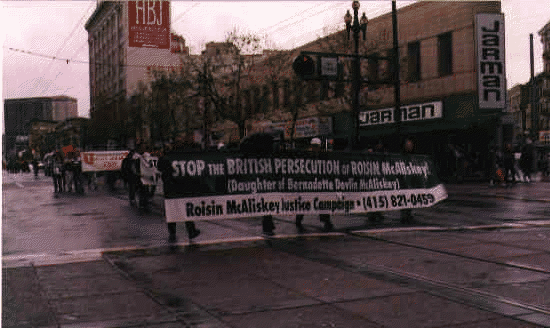
In 1996, while four months pregnant, Bernadette’s daughter was arrested on a German extradition warrant, charging her with being part of a Provisional IRA mortar attack on a British Army base in Osnabruck, Germany. Although taken to England, where a judge agreed to her extradition to Germany, a long and vigorous campaign fought by Roisín’s mother and her supporters eventually defeated the extradition and Roisín gave birth to a healthy daughter.

Recent portrait of Bernadette (Devlin) McAlliskey by Francis McKee
Bernadette's daughter was arrested twice on the same charge but vigorous campaigning impeded her extradition.  Photo shows banner resisting the earlier attempt.
Bernadette’s daughter was arrested twice on the same charge but vigorous campaigning impeded her extradition. Photo shows banner resisting the earlier attempt.


In 1998 and for some years after, Bernadette was an outspoken critic of Sinn Féin and of their direction in the “Peace Process”, which she saw as the party coming to accept British colonialism and Irish capitalism. In 2003 she was banned by the USA and deported, widely interpreted as being due to her speaking against the Good Friday Agreement, but continued her campaigning. However in 2007, another extradition warrant was issued for her daughter Roisín on the same charges as before and the young
woman became emotionally ill. The whole trauma was seen by many as a warning to Bernadette to cease criticising the “new dispensation” and subsequently she was seen to fade from the ranks of public critics of the GFA, Sinn Féin and of the treatment of Republican prisoners.

Bernadette remained active through working with migrants in a not-for-profit organisation in Dungannon. In recent years she has returned, on occasion, to the issues upon which she was so outspoken previously, for example standing surety for Marian Price’s bail to attend her sister Dolores’ funeral and speaking at the ceremony herself. Bernadette also spoke at the Bloody Sunday Commemoration/ March for Justice in January this year in Derry.

With a c.v. of that sort, one would reasonably expect a packed auditorium.

Bernadette Mc Alliskey on the platform upon which she had earlier spoken in February 2014 at a rally following the annual Bloody Sunday Commemoration/ March for Justice.

Bernadette has walked the walk and thought the thought too but she can also talk the talk. With one A4 sheet in front of her, she spoke for over an hour, hardly ever glancing at her notes. Her talk was as part of Trinity College’s MPhil Alumni Conference on ‘Power, Conflict, Resistance’ organised by the Department of Sociology for its Mphil course in “Race, Ethnicity and Conflict”.

Bernadette McAlliskey began her talk with the theme of fear of conflict, developing the thesis that this fear is inculcated in us from childhood, as conflict arises out of challenging power and hierarchy. She traced this further back to religious indoctrination where dogma is to be accepted without question and finds its reflection in all aspects of life but particularly in the political.

Talking about Tom Paine, who expounded the theory that human beings, each independently, are responsible for themselves, she stated that this is fundamental to citizenship. Some aspects of this self-responsibility are delegated to institutions when we live in large groups but any decisions made for us without our consent are “an usurpation”. Tom Paine was an English Republican, author of, among other works Common Sense (1776) and The Rights of Man (1791). He had to flee England because of disseminating his ideas, which were considered revolutionary in his time.


Much of Bernadette’s talk was given over to this theme, to the lack of consideration of women even by such as Tom Paine, and also to the racism spread by colonialism, which the Christian hierarchies condoned and even encouraged.

When she finished to sustained applause and took questions, there were two from people identifying themselves as Travellers, another from a person from an NGO working with migrants, another regarding anti-Irish racism in English colonial ideology and the continuing power of the Catholic Church in the education system.

One question seemed to throw her and she admitted that she found it difficult to answer. Ronit Lentin, Jewish author, political sociologist and critic of Israeli Zionism asked Bernadette was it not true that racism in the Six Counties came mostly from within Loyalism, allied to anti-Catholic sectarianism. Bernadette struggled in replying, at one point denying it and pointing to anti-Traveller discrimination in the ‘nationalist’ areas but following this up by observing that Travellers would only camp in or near ‘nationalist areas’ (presumably because the hostility in a ‘unionist area’ would be worse).

Bernadette then went on to recall the recent anti-Muslim remarks made by a prominent Belfast evangelist preacher, James McConnell, and how the First Minister of Stormont, Peter Robinson, had defended the evangelist’s right to free speech. Asked for his own opinion of Muslims, the First Minister had replied that he also distrusted them “if they are fully devoted to Sharia law” but would trust them to go to the shop for his groceries and to bring him back the correct change. All the examples Bernadette drew on, apart from the generalised one about Travellers in ‘nationalist’ areas, were in fact from the Unionist sector.

The final question was from an SWP activist who pointed out that the State does not admit to its institutional racism and often takes no action on racist attacks or denies that the motive for the attack was racism. The activist asked Bernadette how she thought racism can be dealt with in this context. She replied that the legal structures are there and should be used and persisted with.

It seemed a strange response from one who would have described herself in the past as a revolutionary. Earlier in her talk she herself had quoted the black Caribbean lesbian, Audre Lorde, who said that the instruments of the State could not be used to dismantle it (actually I.V. Lenin had made the same point in The State and Revolution in 1917, nor was he the first to do so). A revolutionary’s answer to that question would presumably have been that while the structures should be used in order to expose them that ultimately the capitalist State’s power is the enemy of unity among the people; disunity rather than unity among the people is in the interest of the system. Mobilisation of the people against racism and directing them towards the source of their ills, the capitalist system, and building solidarity in action, is the only realistic way forward. Perhaps Bernadette felt constrained by the academic environment in which she was speaking but that is not the answer she gave.

End.

Interesting retrospective piece on McAlliskey’s visit to the USA in 1969: http://www.historyireland.com/20th-century-contemporary-history/fidel-castro-in-a-miniskirt-bernadette-devlins-first-us-tour/

Interview with McAlliskey at a Scottish conference on radical independence https://www.youtube.com/watch?v=H4LdcnxMb9Q

SONGS FROM THE DOCKS

A well-prepared Paul O’Brien and a much-less prepared Diarmuid Breatnach singing at the Seán O’Casey Centre as part of the Songs From the Docks events. 

Paul sings mostly his own compositions.

Diarmuid singing the Ballad of Pat O’Donnell and (most of) the Jim Larkin Ballad. I believe this is the first posting of “Pat O’Donnell” on Youtube.


Thanks to Bas Ó Curraoin for the videoing.

Pat O’Donnell was a man with an interesting life — the little we know of it — which was sadly cut short.  Born in Gaoth Dobhair (Gweedore) in Donegal, even still an Irish-speaking area, he had spent time mining in the USA and had also spent time with cousins who were in the Molly Maguires in the coal-mining area of Pensylvania there.  A further article on him and on the killing of Carey, along with other links and a clip of another version of the song is here: https://rebelbreeze.wordpress.com/2014/12/17/pat-odonnell-patriot-or-murderer/


POLITICAL PRISONERS – are they really “part of the solution”?

Political prisoners
Political prisoners
Diarmuid Breatnach

Campaigners fighting for the release of individuals or of small groups of prisoners do not usually make the case that the release of those specific prisoners will affect the macro issues which led to their activism and encarceration. This has occurred on a number of occasions, however, those of Nelson Mandela in South Africa, the Kurdish PKK leader Ocalan and Basque movement leader Arnaldo Otegi being cases in point.

However, when the numbers of prisoners is large, their release is often connected by the campaigners to the objective of resolution of the conflict.

 The line often taken is that “the prisoners are (or should be) a part of the resolution of the conflict” or that “release of prisoners is necessary to create goodwill” or “to win support for the resolution process”. These lines emerged here in Ireland, in Palestine, South Africa and in the Basque Country; they form part of a popular misconception, all the more dangerous because of its widespread acceptance and seductiveness.

At first glance this kind of line seems reasonable. Of course the political activists and the prisoners’ relatives, not to mention the prisoners themselves, want to see the prisoners home and out of the clutches of the enemy. The prisoners should never have been put in jail in the first place. And all the time they have been in the jail has been hard on them and especially on their relatives and friends. An end to the conflict is desirable and so is the release of the prisoners.

But let us examine the proposition more carefully. What is it that the conflict was about? In the case of the recent 30 years’ war with Britain, it was about Britain’s occupation of a part of Ireland, the partition of the country and the whole range of repressive measures the colonial power took to continue that occupation. In the case of the Basque pro-Independence movement, it was also about the partition of their country, occupation and repressive measures (particularly by the Spanish state). But what was the fundamental cause? In each case, occupation by a foreign state.

OK, so if Britain and the Spanish state ended their occupations, that would end the conflicts, would it not? It would end the anti-colonial conflicts – there would be no British or Spanish state forces for Irish or Basque national liberation forces to be fighting; no British or Spanish colonial administration to be issuing instructions and implementing repressive measures. Other struggles may arise but that is a different issue.

So, if Britain and the Spanish state pull out, leave, those struggles are over. What do prisoners have to do with it? They are obviously in that case not part of the solution, which is British or Spanish state withdrawal – though their release should be one of the many results of that withdrawal. Prisoners may well be part of rebuilding a post-conflict nation but that is a different issue. They are not part of “the solution”.


PART OF THE PACIFICATION

As pointed out earlier, here in Ireland it was said that “the prisoners are part of the solution” – and most of the Republican movement, some revolutionary socialists and some social democrats agreed with that. And British imperialism and most of Irish capitalism agreed too. But what happened? Only those Republican prisoners who agreed with the abandoning of armed struggle and signed to that effect were released. And they were released ‘under licence’, i.e. an undertaking to “behave” in future. And as the years went by, a number of those ex-prisoners who continued to be active mostly politically — against the occupation, or against aspects of it like colonial policing, had their licences withdrawn and were locked up. Some who had avoided being prisoners because they were “on the run”, or had escaped – many of those, as part of the Good Friday Agreement, had been given guarantees of safety from future arrest but this too, it soon became apparent, could be revoked.

 In other words, the prisoners’ issue became part of imperialism’s ‘peace’ or, to put it more bluntly but accurately, part of imperialism’s pacification. The issue also became part of the selling of the deal within the movement, on one occasion prisoners being released early, just in time to make a grand entrance at a Republican party’s annual congress.

The release of prisoners can be presented by those in the movement supporting pacification as evidence of the “gains” of the process. Those who argue for the continuation of the struggle then find themselves arguing not only against those who pushed the pacification process within the movement but also against some released prisoners and their relatives and friends.

THEY ARE NOT LEAVING

 And prisoners continued to be hostages for the “good behaviour” of the movement. If British imperialism had left, there would have been no cause for the anti-colonial struggle to continue – so why would there be any need for any kind of release ‘under licence’ or any other kind of conditional release? Besides, the British would not be running the prisons in the Six Counties any longer. But the British are not leaving, which is why they need the guarantees of good behaviour.

Suppose the British were serious about leaving, sat down with the resistance movement’s negotiators and most details had been sorted out, including their leaving date in a few weeks’ time say, what would be the point for the British in trying to hang on to the prisoners? Can anyone seriously believe that they would take them with them as they left? If perhaps they had some in jails in Britain and were trying to be bloody-minded and hanging on to them there, well of course we’d want our negotiators to put as much pressure on the British as they could to release those as well.  It would be in the interests of British imperialism to release them but the reality is that the anti-colonial war would be over, whatever ultimately happened to those prisoners.

In South Africa and Palestine, the prisoners’ issue became part of the imperialist pacification process too. It did not suit the imperialists to have numbers of fighters released who would be free to take up arms against them again. So in South Africa, they were incorporated into the “security forces” of the corrupt new ANC state, forces the corruption and brutality of which were soon experienced by any who argued with them or opposed the policies or corruption of the ANC, NUM and COSATU leadership – including the two-score striking miners the “security forces” murdered over a couple of days at Marikana in 2012.

 In Palestine, the prisoners also became part of the “security forces” of Al Fatah after the shameful agreements at Madrid (1991) and Oslo (1993). The level of corruption of the Al Fatah regime and their “security forces” became so high that in order to oust them, in 2006 the largely secular Palestinian society voted for a religious party, the opposition Hamas. And then the “Palestinian security forces” took up arms against Hamas in order to deny them the fruits of their electoral victory. Unfortunately for them, Hamas had arms too and used them.

In both those countries, the occupiers had no intention of leaving and so it was necessary for them, as well as using the prisoners as bargaining chips, to tie them in to a “solution”. In fact, many of the prisoners became “enforcers” of the “solution” on to the people in their areas, i.e pacifiers in imperialism’s pacification process.

Teased out and examined in this way, we can see not only that the prisoners are NOT “part of the solution” but that accepting that they are plays right into the hands of the imperialists as well as facilitating their agents and followers within our movement, within our country.

Political prisoners, as a rule, are an important part of the struggle and need our solidarity. But for anti-imperialists, prisoners are not “part of the solution”, to be used as hostages for a deal with imperialism, even less as enforcers of a deal, forcing it upon the colonised people.

Our call, as anti-imperialists, without conditions or deals, is for the prisoners to be released and, while they remain in prison, to be treated humanely. We also call for them to be recognised as political prisoners. With regard to the solution to the conflict, there is only one: Get out of our country!

POSTSCRIPT:

The organisation representing relatives and friends of Basque political prisoners is Etxerat http://www.etxerat.info/. A separate organisation concentrating on campaigning, Herrira, has suffered a number of arrests and closure of offices by the Spanish state in 2013 and is under threat of outright banning.

Regrettably, I cannot give a similar link for Irish Republican prisoners, because of the existence of a number of organisations catering for different groups of prisoners and often with tensions between them. One day perhaps a united non-aligned campaign will emerge, along the lines of the H-Block campaign of the past, or the Irish Political Status Campaign that arose in London after the Good Friday Agreement. There is also a non-aligned Irish Anti-Internment Committee (of which I am a part), campaiging for an end to long periods of incarceration imposed on political “dissidents” through removal of licence, refusal of bail or imposition of oppressive bail conditions.

end

“WE ONLY WANT THE EARTH”

(Grma to Irish Republican and Marxist History Project for the invitation to sing, the recording and the Youtube posting).


The song is Be Moderate (also known as”We Only the Want the Earth”) by James Connolly from the James Connolly Song Book, edited by Connolly and published in New York in 1907. No air or tune was indicated in that publication and it has been sung to a number of airs over the years. It’s a wonderful song in my opinion.

I sing it to the air of a “A Nation Once Again” composed by Thomas Davis in the 1840s, which I think suits it and supplies a chorus for others to join in. I first heard it sung to that air many years ago in London by a group of musicians and singers including Cornelius Cardew, of the CPE (m-l) (who was killed by a hit-and-run driver in an incident without any witnesses).  He is here singing it with a ska back-beat(!): https://www.youtube.com/watch?v=pTxVBsg4u30


In my rendition here there is an adaptation and an error. The adaptation is my singing “workers” instead of “Labour” so as to distance the revolutionary content from the social democratic collaboration with capitalism, as illustrated by the unfortunate evolution of the party of that name founded by Connolly. My error is in the verse beginning “The Labour fakir …” in which I say “….. teaches” in two different lines.


I should have sung the lines thus:
The Labour fakir full of guile false doctrine ever teaches
and whilst he bleeds the rank and file,
tame moderation preaches;
Yet in his despite we’ll see the day, when with swords in their girths,
workers shall march in war array to claim their own, the Earth!

End


THIRTEEN ROSES ….. AND 43 CARNATIONS

MILICIANAS 2

RAFAEL NARBONA

(Translation by Diarmuid Breatnach; original version published in Spanish in Rafael Narbona’s blog August 2013, also republished by kind permission in Rebel Breeze https://rebelbreeze.wordpress.com/2014/03/28/trece-rosas-y-43-claveles/)

On the morning of August 5th 1939 thirteen women were shot dead against the walls of the Eastern Madrid Cemetery.

Nine were minors, because at that time the age of majority was not reached until twenty-one. Ranging in age from 18 to 29, all had been brought from the Sales women’s prison, a prison that was designed for 450 people and in 1939 contained 4,000. Apart from Brisac Blanca Vazquez, all belonged to the Unified Socialist Youth (JSU) or PCE (Communist Party of Spain). Although they had not participated in the attack that killed Isaac Gabaldon, commander of the Civil Guard, they were charged with being involved and conspiring against the “social and legal order of the new Spain”.

The trial was held on August 3rd and 56 death sentences were issued, including the perpetrators of the attack. The Thirteen Roses went to their execution hoping to be reunited with their JSU comrades. In some cases it would have meant a boyfriend or husband but their hopes crumbled upon learning that the men had been shot already.

conesa

The brick wall clearly showed the bullet holes and the earth had been turned dark by blood. Some days, the death toll exceeded two hundred and machine guns were used to facilitate the work. Between 1939 and 1945, four thousand people were shot in the Eastern Cemetery, including Julián Zugazagoitia, Minister of the Interior with Juan Negrín and remarkable writer and socialist politician.

According to Maria Teresa Igual, prison officer and eyewitness, the Thirteen Roses died with fortitude. There were no screams or pleas. In an eerie half-silence, only the steps of the firing squad were heard, the sound of the guns striking the straps and the voice of the commanding officer. Lined up shoulder to shoulder, after the shooting all received the coup de grace, which was clearly heard in the Sales women’s prison. Apparently, one of the condemned (whether Anita or Blanca is not known), did not die immediately and had shouted, “Am I not to be killed?”

Antonia Torre Yela was spared execution by a typing error.  In transcribing her name, the letters danced and became Antonio Torres Yera. The error only postponed death for Antonia, a member of the JSU and only 18. She was shot on February 19th, 1940, becoming the 14th Rose. In her farewell letter, Julia Conesa, nineteen and member of the JSU, wrote: “Let my name not be erased from history.” Her name and that of her comrades has not been forgotten, unlike those of their tormentors, who enjoyed impunity for 38 years of dictatorship and a shameful amnesty which only helped to deepen the hurt suffered by all victims of Francoism.

The PSOE (main social-democratic party — DB) tried to appropriate the Thirteen Roses, concealing that at the time of the executions the PSOE had split from the JSU to found the Socialist Youth of Spain (JSE), with the purpose of clearly distancing themselves from the Communist Party of Spain (PCE). In fact, the Law of Historical Memory of Zapatero’s government (the first PSOE government after Franco — DB) did not even consider overturning the dictatorship’s judicial verdicts. It should be remembered that nearly fifty men were also shot dead that sad August 5th, the “43 Carnations”. Franco showed the same ruthlessness to men and women.

A hell

Sales jail was a hell, with children, elderly and mothers with children huddled in hallways, stairs, patios and bathrooms. Manuela and Teresa Basanta Guerra were the first women executed against the walls of the Eastern Cemetery. They shot them on June 29th 1939 along with a hundred men. Some historians claim that other women preceded them but their names were not recorded in the cemetery’s files. Like others on death row, the Thirteen Roses could only write to their families after receiving confession. If they did not take confession, they gave up the opportunity to say goodbye to their loved ones.

Brisac Blanca was the eldest of the thirteen and active in no political organization. Catholic and one who voted for the Right, she nevertheless fell in love with a musician who belonged to the PCE, Enrique Garcia Mazas. They married and had a son. Both were arrested and sentenced to death in the same trial. In fact, Enrique was in Porlier prison and would be shot a few hours before her. Blanca wrote a letter to her son Enrique, asking him not to harbour ill-will towards those responsible for her death and to become a good and hardworking man.

MILICIANAS 3

In postwar Madrid there was vicious persecution and resentment of any citizen suspected of “joining the rebellion”, the technicality that was used to reverse the law, accusing supporters of the Second Republic of violating the law in force. Only the military, the clergy, the Falange and the Carlists could breathe easily. No one dared to walk around in workers’ overalls or wearing the traditional local bandanna (worn by men around the neck and by women as a kerchief around the head, it is still worn today at festival in Madrid — DB).

The city was a huge prison where “hunt the red” was taking place. The earlier militia-women aroused particular animosity. The Arriba newspaper edition of May 16th 1939, featured an article by José Vicente Puente in which his contempt does not mince words: “One of the greatest tortures of the hot and drunk Madrid were the militia-women parading openly in overalls, lank-haired, with sour voice and rifle ready to shoot down and end lives upon a whim to satiate her sadism. With their shameless gestures, the primitive and wild, dirty and disheveled militiawomen had something of atavism, mental and educational. … …. They were ugly, low, knock-kneed, lacking the great treasure of an inner life, without the shelter of religion, within them femininity was all at once extinguished.”

In this climate of hatred and revenge, denunciations proliferated — they were the best means of demonstrating loyalty to the fascist Movement.

The interrogations …. copied Gestapo tortures

The interrogations in police stations copied Gestapo tortures: electric shock on the eyes and genitals, the “bathtub”, removing fingernails with pliers, mock executions. Women suffered especially because the torture was compounded by sexual abuse, castor oil and hair cut down to the scalp. In some cases they even shaved eyebrows to further depersonalize. Rapes were commonplace.  The testimony of Antonia Garcia, sixteen, “Antoñita” is particularly chilling: “They wanted to put electric currents on my nipples but since I had no chest they just put them in my ears and burst my eardrums. I knew no more. When I came to I was in jail. I spent a month in madness”.

Among those responsible for the interrogations was General Gutierrez Mellado, hero of the Transition and Captain in the Information Service of the Military Police (CPIS ) during the toughest years following the war. He regularly attended executions, seeking last-minute confessions. On August 6th 1939 he pulled Cavada Sinesio Guisado, nicknamed “Pioneer”, military chief of the JSU after the war, out of the execution line. “Pioneer” had been lined up against the Eastern Cemetery wall and was awaiting the discharge of lead along with the rest of his comrades. Gutiérrez Mellado stepped forward and ordered his release. He forced him to witness the executions and asked for more information about PCE clandestine activity. Although he was cooperative and diligent, he was shot in the end on September 15th. Some claim that Gutierrez Mellado witnessed the execution of the Thirteen Roses but I was not able to verify the data.

MILICIANAS 4

The women’s prison in Sales was run by Carmen Castro. Her inflexibility and lack of humanity found expression in the conditions of life of the children in prison with their mothers. No soap or hygienic facilities — almost all had ringworm, lice and scabies. Many died and were placed in a room where the rats were trying to devour the remains. Adelaida Abarca, JSU activist, said the bodies were only skin and bones, almost skeletons, for hunger had consumed them slowly. Another prisoner said: “The situation of the children was maddening. They were also dying and dying with dreadful suffering. Their glances, their sunken eyes, their continuous moans and stench are branded on my memory.” (Testimony given to Giuliana Di Febo in Resistance and the Women’s Movement in Spain [1936-1976] , Barcelona 1979).

The prisoners lived within the shadow of the “pit”, the death penalty. Since the execution of the Basanta Guerra sisters, they knew that the regime would have no mercy on women. On the morning when the Thirteen Roses were shot, Virtudes Gonzalez ‘s mother was at the jail doorway. When she saw her daughter climbing into the truck that was carrying prisoners to the cemetery walls, she began shouting: “Bastards ! Murderers ! Leave my daughter alone!” She chased the truck and fell. Alerted by the commotion, the Sales jail officers went outside and picked her off the ground, taking her into the prison. She was kept inside as yet another prisoner.

“If I had been sixteen they would have shot me too”

No less dramatic were Enrique’s repeated attempts to find out the whereabouts of his parents, Blanca and Enrique Garcia Brisac Mazas. In an interview with journalist Carlos Fonseca , author of the historical essay Thirteen Red Roses ( Madrid, 2005 ), Enrique gave his bitter account: “I was eleven years old when they shot my parents and my relatives tried to conceal it. They said they had been transferred to another prison and therefore we could not go to see them, until one day I decided to go to Salesas and there a Civil Guard Brigadier told me they had been shot and that if I had been sixteen they would have shot me too, because weeds had to be pulled up by the roots.

My grandmother and my aunts, my mother’s sisters, who had fallen out with my mother, ended up telling me that if Franco had killed my parents it would be because they were criminals. They even concealed my mother’s farewell letter for nearly twenty years.”

MILICIANAS 6

I will not end this article by invoking reconciliation, because the Transition was not based on repairing the pain of the victims, but rather on the acquittal of the executioners. In fact, the reform of the criminal dictatorship was designed by those as low as Manuel Fraga, Rodolfo Martín Villa and José María de Areilza. Martín Villa concealed and destroyed documents to bury the crimes of Francoism and the dirty war he organized against anarchist and pro-independence activists of the Basque, Catalan and Canaries areas, from his post as Minister of the Interior between 1976 and 1979. Among his achievements one should list the Scala case (an attack that killed four workers, which was blamed on the CNT), the attempted assassination of Canaries independence leader Antonio Cubillo, the machine-gunning of Juan Jose Etxabe, historic leader of ETA and his wife Rosario Arregui (who died from eleven bullet wounds), also the murder of José Miguel Beñaran Ordeñana, “Argala”.

The impunity of the perpetrators

He is now a successful businessman, who gets excited talking about his role in the Transition. He lives quietly and no one has called for his prosecution. His example is an eloquent one of the impunity of the perpetrators, who continue to write the narrative while demonizing those who dared to stand against the miseries of the dictatorship and false democratic normalization.

No justice has been done. So it is absurd to talk of reconciliation, because nobody has apologized and repaired the damage. Franco committed genocide but today Manuel Gonzalez Capón, Mayor of Baralla (Lugo), of the Partido Popular (the main right-wing party), dares to declare that “those who were sentenced to death by Franco deserved it.” The Biographical Dictionary of the Royal Academy of History, funded with nearly seven billion euros of public funds, says Franco “set up an authoritarian but not totalitarian regime”, although in his speech in Vitoria/ Gastheiz, Franco himself said that “a totalitarian state in Spain harmonises the functioning of all abilities and energies of the country …”. The current scenario is not a reconciliation but instead is a humiliation of the victims and society, obscenely manipulated by a media (ABC, El País , El Mundo, La Razón), playing a similar role to newspapers of the dictatorship (ABC, Arriba, Ya, Pueblo, Informaciones, El Alcázar), covering up and justifying torture cases and applauding antisocial measures that continue reducing working class rights.

Let us not remember the Thirteen Roses as passive and submissive but instead for their courage and determination. With the exception of Blanca, trapped by circumstances, all chose to fight for the socialist revolution and the liberation of women. I think that if they were able to speak out today, they would not talk of indignation and peaceful disobedience, but would ask for a rifle to stand in the vanguard of a new anti-fascist front, able to stop the crimes of neo-liberalism. Let us not betray their example, forgetting their revolutionary status, they who sacrificed their lives for another world, one less unjust and unequal.

rosario dinamitera

TRECE ROSAS …. Y 43 CLAVELES

MILICIANAS 2

RAFAEL NARBONA
(originalmente publicado en su blog Agosto 2013)

(Encabezemientos por Rebel Breeze)
(versión traducido al inglés aquí https://rebelbreeze.wordpress.com/2014/03/28/thirteen-roses-and-43-carnations/)

La madrugada del 5 de agosto de 1939 fueron fusiladas trece mujeres en las tapias del Cementerio del Este de Madrid.

Nueve eran menores de edad, pues en aquellas fechas la mayoría no se alcanzaba hasta los 21. Con edades comprendidas entre los 18 y los 29, todas procedían de la cárcel de mujeres de Ventas, una prisión que fue concebida para 450 personas y que en 1939 albergaba a 4.000.

Salvo Blanca Brisac Vázquez, todas pertenecían a las Juventudes Socialistas Unificadas (JSU) o al PCE. Aunque no habían participado en el atentado que costó la vida a Isaac Gabaldón, comandante de la Guardia Civil, se las acusó de estar implicadas y de conspirar contra “el orden social y jurídico de la nueva España”. El juicio se celebró el 3 de agosto y se dictaron 56 penas de muerte, que incluían a los autores materiales del atentado. Las Trece Rosas acudieron a su ejecución con la esperanza de reencontrarse con sus compañeros de las JSU. En algunos casos se trataba del novio o el marido, pero sus expectativas se desmoronaron al saber que ya habían fusilado a los hombres.

conesa

La tapia de ladrillo visto mostraba claramente los agujeros de bala y la tierra se había vuelto negra por culpa de la sangre derramada. Algunos días, el número de  víctimas superaba los dos centenares y se empleaban ametralladoras para facilitar el trabajo. Entre 1939 y 1945 se fusiló a 4.000 personas en el Cementerio del Este, incluido Julián Zugazagoitia, Ministro de la Gobernación con Juan Negrín y notable escritor y político socialista.

Según María Teresa Igual, testigo presencial y funcionaria de prisiones, las Trece Rosas murieron con entereza. No se produjeron gritos ni súplicas. En mitad de un silencio sobrecogedor, sólo se escuchaban los pasos del piquete de ejecución, el sonido de los fusiles al chocar contra los correajes y la voz del oficial al mando. Alineadas hombro con hombro, todas recibieron un tiro de gracia después de la  descarga, que se oyó nítidamente en la cárcel de mujeres de Ventas. Al parecer, una de las condenadas (no sé sabe si Anita o Blanca), no murió en el acto y gritó: “¿Es que a mí no me matan?”

Antonia Torre Yela se libró de la ejecución por un error mecanográfico. Al transcribir su nombre, bailaron las letras y se convirtió en Antonio Torres Yera. El error sólo aplazó el fin de Antonia, militante de las JSU y con sólo 18 años. Fue fusilada el 19 de febrero de 1940, transformándose en la “Rosa” número 14.

En su carta de despedida, Julia Conesa, diecinueve años y afiliada a las JSU, escribió: “Que mi nombre no se borre de la historia”. Su nombre y el de sus compañeras no ha caído en el olvido, pero sí el de sus verdugos, que disfrutaron de la impunidad de 38 años de dictadura y de una vergonzosa amnistía que sólo contribuyó a profundizar el agravio de todas las víctimas del franquismo.

El PSOE intentó apropiarse de las Trece Rosas, ocultando que en el momento de la ejecución ya se había desligado de las JSU para fundar las Juventudes Socialistas de España (JSE), con el propósito de manifestar su alejamiento del PCE. De hecho, la Ley de Memoria Histórica del gobierno de Rodríguez Zapatero ni siquiera se planteó anular los juicios de la dictadura.

Conviene recordar que ese triste 5 de agosto se fusiló además a casi medio centenar de hombres, los 43 Claveles. El franquismo mostró la misma crueldad con hombres y mujeres.

Un infierno

De hecho, la cárcel de Ventas era un infierno, con menores, ancianas y madres con hijos, hacinadas en pasillos, escaleras, patios y baños. Manuela y Teresa Guerra Basanta fueron las primeras mujeres ejecutadas en las tapias del Cementerio del Este. Se las fusiló el 29 de junio de 1939, con un centenar de hombres. Algunos historiadores sostienen que otras mujeres las precedieron, pero sus nombres no figuran en los archivos del cementerio.

Al igual que otras condenadas a muerte, las Trece Rosas sólo pudieron escribir a sus familias después de confesarse. Si no lo hacían, perdían la oportunidad de despedirse de sus seres queridos.

Blanca Brisac era la mayor de todas y no militaba en ninguna organización política. Era católica y votaba a la derecha, pero se enamoró de un músico que pertenecía al PCE, Enrique García Mazas. Se casaron y tuvieron un hijo. Ambos fueron detenidos y condenados a muerte en el mismo proceso. De hecho, Enrique se hallaba en la Cárcel de Porlier y sería fusilado unas horas antes. Blanca le escribió una carta a su hijo Enrique, pidiéndole que no guardara rencor hacia los responsables de su muerte y que se convirtiera en un hombre bueno y trabajador.

MILICIANAS 3

En el Madrid de la posguerra, se persiguió con saña y encono a cualquier ciudadano sospechoso de “adhesión a la rebelión”, el tecnicismo jurídico que se empleó para invertir la ley, acusando a los partidarios de la Segunda República de atentar contra la legalidad vigente. Sólo los militares, los curas, los falangistas y los requetés podían respirar tranquilos. Ya nadie se atrevía a pasear con un mono de obrero o un pañuelo castizo. La ciudad era una enorme cárcel donde se ejercía la “caza del rojo”.

Las antiguas milicianas despertaban una especial inquina. En el diario Arriba, el 16 de mayo de 1939 aparece un artículo de José Vicente Puente, que no escatima palabras de desprecio: “Una de las mayores torturas del Madrid caliente y borracho del principio fue la miliciana del mono abierto, de las melenas lacias, la voz agria y el fusil dispuesto a segar vidas por el malsano capricho de saciar su sadismo. En el gesto desgarrado, primitivo y salvaje de la miliciana sucia y desgreñada había algo de atavismo mental y educativo. […] Eran feas, bajas, patizambas, sin el gran tesoro de una vida interior, sin el refugio de la religión, se les apagó de repente la feminidad”. En ese clima de odio y venganza, proliferaban las denuncias, pues eran el mejor recurso para demostrar la adhesión al Movimiento.

Torturas copiadas de la Gestapo

Los interrogatorios en las comisarías se basaban en torturas copiadas de la Gestapo: descargas eléctricas en los ojos y los genitales, la bañera, extracción de las uñas con alicates, simulacros de ejecución. Las mujeres sufrían especialmente, pues a las torturas se sumaban las vejaciones sexuales, el aceite de ricino y el corte del pelo al cero. En algunos casos, se les afeitaban incluso las cejas para despersonalizarlas aún más. Las violaciones eran moneda corriente. Es particularmente escalofriante el testimonio de Antonia García, de dieciséis años, “Antoñita”: “Me quisieron poner corrientes eléctricas en los pezones, pero como no tenía apenas pecho me los pusieron en los oídos y me saltaron los tímpanos. Ya no supe más. Cuando volví en mí estaba en la cárcel. Estuve un mes trastornada”.

Entre los responsables de los interrogatorios, se encontraba el general Gutiérrez Mellado, héroe de la Transición y capitán del Servicio de Información y Policía Militar (SIPM) durante los años más duros de la posguerra. Solía ser un testigo habitual de las ejecuciones, buscando confesiones de última hora. De hecho, el 6 de agosto de 1939 sacó de la hilera de condenados a Sinesio Cavada Guisado, “Pionero”, jefe militar de las JSU al acabar la guerra. “Pionero” había sido alineado en la tapia del Cementerio del Este y esperaba la descarga de plomo con el resto de sus compañeros. Gutiérrez Mellado se adelantó y ordenó su liberación. Le obligó a presenciar el fusilamiento y le pidió más información sobre la actividad clandestina del PCE. Aunque se mostró colaborador y diligente, el 15 de septiembre sería finalmente fusilado. Algunos afirman que Gutiérrez Mellado presenció la ejecución de las Trece Rosas, pero no he conseguido verificar el dato.

MILICIANAS 4

La cárcel de mujeres de Ventas estaba dirigida por Carmen Castro. Su intransigencia y falta de humanidad se reflejaba en las condiciones de vida de los niños encarcelados con sus madres. Sin jabón ni medidas de higiene, casi todos tenían tiña, piojos y sarna. Muchos morían y eran depositados en una sala, donde las ratas intentaban devorar los restos. Adelaida Abarca, militante de las JSU, afirma que los cadáveres sólo eran huesos y piel, casi esqueletos, pues el hambre los había consumido poco a poco. Otra reclusa afirma: “La situación de los niños era enloquecedora. También estaban muriendo y muriendo con un sufrimiento atroz. Tengo clavadas sus miradas, sus ojitos hundidos, sus quejidos continuos y su olor pestilente” (Testimonio recogido por Giuliana Di Febo en Resistencia y movimiento de Mujeres en España [1936-1976], Barcelona 1979).

Las presas convivían con la “pepa”, la pena de muerte. Desde la ejecución de las hermanas Guerra Basanta, sabían que el régimen no tendría misericordia con las mujeres. La madrugada en que fusilaron a las Trece Rosas se hallaba en la puerta de la cárcel la madre de Virtudes González. Cuando vio cómo subían a su hija al camión que trasladaba a las reclusas a las tapias del cementerio, comenzó a gritar: “¡Canallas! ¡Asesinos! ¡Dejad a mi hija!”. Corrió detrás del camión y cayó de bruces. Alertadas por el escándalo, las funcionarias de la cárcel de Ventas salieron al exterior y la recogieron del suelo, introduciéndola en la prisión. Quedó ingresada como una reclusa más.

“Si yo hubiera tenido dieciséis años también me habrían fusilado a mí”

No fueron menos dramáticos los reiterados intentos de Enrique de averiguar el paradero de sus padres, Blanca Brisac y Enrique García Mazas. En una entrevista con el periodista Carlos Fonseca, autor del ensayo histórico Trece Rosas Rojas (Madrid, 2005), Enrique cuenta sus amargas peripecias: “Yo tenía once años cuando fusilaron a mis padres y mi familia trató de ocultármelo. Me decían que habían sido trasladados de prisión y por eso no podíamos ir a verlos, hasta que un día fui decidido a las Salesas y allí un Brigada de la Guardia Civil me dijo que los habían fusilado, y que si yo hubiera tenido dieciséis años también me habrían fusilado a mí, porque las malas hierbas había que arrancarlas de raíz. Mi abuela y mis tías, hermanas de mi madre, con quien estaban enemistadas, llegaron a decirme que si Franco había matado a mis padres sería porque eran unos criminales. Incluso me ocultaron durante casi veinte años la carta de despedida de mi madre”.

MILICIANAS 6

No voy a terminar este artículo invocando la reconciliación, pues la Transición no se basó en la reparación del dolor de las víctimas, sino en la absolución de los verdugos. De hecho, la Reforma de la dictadura fue diseñada por criminales tan abyectos como Manuel Fraga, Rodolfo Martín Villa y José María de Areilza. Martín Villa ocultó y destruyó documentos para enterrar los crímenes del franquismo y organizó la guerra sucia contra anarquistas e independentistas vascos, catalanes y canarios desde su cargo de Ministro de la Gobernación entre 1976 y 1979. Entre sus hazañas, hay que mencionar el caso Scala (un atentado atribuido a la CNT que causó la muerte de cuatro trabajadores), el intento de asesinato del líder independentista canario Antonio Cubillo, el ametrallamiento de Juan José Etxabe, dirigente histórico de ETA, y su esposa Rosario Arregui (que murió a consecuencia de once balazos), y el asesinato de José Miguel Beñaran Ordeñana, “Argala”.

La impunidad de los verdugos

Ahora es un empresario de éxito, que se emociona hablando de su papel en la Transición. Vive tranquilamente y nadie ha planteado su enjuiciamiento. Su ejemplo es una muestra elocuente de la impunidad de los verdugos, que siguen escribiendo la historia, mientras demonizan a los que se atrevieron a resistir contra las miserias de la dictadura y de una falsa normalización democrática.

No se ha hecho justicia. Por eso, es absurdo hablar de reconciliación, pues nadie ha pedido perdón ni se ha reparado el daño causado. El franquismo cometió un genocidio, pero hoy mismo Manuel González Capón, alcalde de Baralla (Lugo) por el PP, se atrevía a declarar que “los que fueron condenados a muerte por Franco se lo merecían”.

El Diccionario Biográfico de la Real Academia de la Historia, costeado con casi siete millones de euros de fondos públicos, afirma que Franco “montó un régimen autoritario, pero no totalitario”, pese a que en el Discurso de la Victoria el propio Franco afirmó que “un estado totalitario armonizará en España el funcionamiento de todas las capacidades y energías del país…”. El actual Estado español no es un escenario de reconciliación, sino de humillación de las víctimas y de la sociedad, obscenamente manipulada por unos medios de comunicación (ABC, El País, El Mundo, La Razón) que desempeñan un papel semejante a los periódicos de la dictadura (ABC, Arriba, Ya, Pueblo, Informaciones, El Alcázar), encubriendo y justificando los casos de torturas y aplaudiendo las medidas antisociales que no cesan de restar derechos a la clase trabajadora.

No recordamos a las Trece Rosas por su pasividad y sumisión, sino por su coraje y determinación. Salvo Blanca, atrapada por las circunstancias, todas eligieron luchar por la revolución socialista y la liberación de la mujer. Creo que si hoy pudieran alzar su voz, no hablarían de indignación y desobediencia pacífica, sino que pedirían un fusil para ocupar la vanguardia de un nuevo frente antifascista, capaz de frenar los crímenes del neoliberalismo. No malogremos su ejemplo, olvidando su condición de revolucionarias que inmolaron sus vidas por un mundo menos injusto y desigual.

rosario dinamitera

 Agosto 2013

Did Mandela really change South Africa?

[Article by TOM, a contributor to Socialist Voice, newspaper of the Communist Party of Ireland and reprinted with their kind permission.  In essence it agrees with the analysis of Mandela and South Africa given by Stephen Spencer and Diarmuid Breatnach in an article reviewing statements of the Irish Left and Republican movement following the death of Mandela — Rebel Breeze]

The presence of such friends of genuine democracy as the war criminals George W. Bush and Tony Blair, David Cameron, Bill Clinton and such right-wing media hangers-on as Sir Bob Geldof and Sir Paul Hewson (Bono) at Nelson Mandela’s funeral raises questions about the real content of the new South Africa that appeared in 1994, when the apartheid elite seemed to cede political power to the African National Congress.

Twenty years later, given the continuing racial inequality in present-day South Africa, the much lower life expectancy of blacks and their much higher rate of unemployment, the increased vulnerability of the country to world economic fluctuations and accelerated environmental decay during his presidency, did Mandela really change South Africa? And, if not, how much room had he to manoeuvre?

For many are still remembering the Mandela years as fundamentally different from today’s crony-capitalist, corruption-riddled, brutally securitised, eco-destructive and anti-egalitarian South Africa. But could it be that the seeds of the present were sown earlier, by Mandela and his associates in government?

Ending the apartheid regime was, undoubtedly, one of the greatest events of the past century. But, to achieve a peaceful transition, Mandela’s ANC allowed whites to keep the best land, the mines, manufacturing plants and financial institutions, and to export vast quantities of capital.
The ANC could have followed its own revolutionary programme, mobilising the people and all their enthusiasm, energy, and hard work, using a larger share of the economic surplus (through state-directed investments and higher taxes), and stopping the flow of capital abroad, including the repayment of illegitimate apartheid-era debt. The path chosen, however, was the neo-liberal one, with small reforms here and there to permit superficial claims to the sustaining of a “National Democratic Revolution.”

The critical decade was the 1990s, when Mandela was at the height of his power, having been released from jail in February 1990, taking the South African presidency in May 1994 and leaving office in June 1999. But it was in this period, according to the former minister for intelligence services Ronnie Kasrils, for twenty years a member of the Central Committee of the South African Communist Party, that “the battle for the soul of the African National Congress was lost to corporate power and influence . . . We readily accepted that devil’s pact and are damned in the process. It has bequeathed to our country an economy so tied in to the neo-liberal global formula and market fundamentalism that there is very little room to alleviate the dire plight of the masses of our people.”

Nelson Mandela’s South Africa fitted a pattern, that of former critics of old dictatorships—whether from right-wing or left-wing backgrounds—who transformed themselves into neo-liberal rulers in the 1980s and 90s: Alfonsín (Argentina), Aquino (Philippines), Arafat (Palestine), Aristide (Haïti), Bhutto (Pakistan), Chiluba (Zambia), Kim (South Korea), etc. The self-imposition of economic and development policies, because of the pressures of financial markets and the Washington-Geneva multilateral institutions, required insulation from genuine national aspirations—in short, an “elite transition.”

This policy insulation from mass opinion was achieved through the leadership of Mandela. It was justified by invoking “international competitiveness.” Obeisance to transnational corporations led to the Marikana Massacre in 2012 and the current disturbances on the platinum belt, for example. But the decision to reduce the room for manoeuvre was made as much by the local principals, such as Mandela, as it was by the Bretton Woods institutions, financiers, and investors.

Much of the blame, therefore, for the success of the South African counter-revolution must be laid at the door of the ANC leadership, with Nelson Mandela at its head. Hence the paeans of praise for the dead leader from the doyens of international reaction.
[TOM]

The Defendant — a short play

Diarmuid Breatnach

“We have had ‘stepping stones’ presented to us before in our history – they turned out to be stone walls.”

 (A revolutionary is on trial).

judge in full wig etc

Act 1.

Scene: A courtroom – Judge’s bench high, clerk at lower bench nearby, faced by dock, containing defendant and two guards, one at each side.  Long bench in front of dock containing Prosecution and Defence barristers or lawyers.

Judge:  Read the charges, clerk.

Clerk: The defendant is charged with treason, sedition, incitement to rebellion against the lawful government, conspiracy with persons unknown to incite discontent, unlawful assembly, obstruction of the highway and membership of an illegal organisation.

Judge:  Defendant, you have heard the charges?

Defendant:        I have.

Judge:  Address the Court properly.

Defendant:        I have heard the charges, Judge.

Judge:  The proper manner to address me is Your Honour.

Defendant:        I have heard the charges, Judge.

Judge:  I see.  Very well, let us proceed.  How do you plead to the charges?

Defendant:        Not guilty of any crime against the people.

Judge:  Clerk, enter a plea of “Not Guilty.”

Prosecuting Counsel stands up, approaches defendant in the dock.

Prosecuting Counsel:    You are against the Agreement?

Defendant:        I am.  It clearly does not deliver what we fought for, an independent united Republic.  In addition, I and some others fought for a socialist republic and it has not delivered that either.

Prosecuting Counsel:     You are aware that the electorate voted to accept the Agreement?

Defendant: Yes, but…

Prosecuting Counsel:    Just answer ‘yes’ or ‘no’.

Defendant:        Yes.

Prosecuting Counsel:     And do you believe in democracy?

Defendant:        Define ‘democracy’.

Prosecuting Counsel:     The will of the majority.

Defendant:        With suitable safeguards for certain minorities, certainly.

Prosecuting Counsel:     Yet you have admitted to undertaking actions against the Agreement, have you not?

Defendant:        I have.

Prosecuting Counsel:     You consider yourself above the will of the people, the majority, then?

Defendant:        No.  But I consider that I have a duty to act according to what is right and I can see clearly that the Agreement delivers nothing of what we fought for.

Prosecuting Counsel:     Yet the people voted for it.

Defendant:        The people were tired of war and repression and were lied to.  Many of our leaders betrayed us and brought many of our movement with them.

Prosecuting Counsel:     That is your interpretation.  Might it not be that your leaders and those of your movement who followed them were wiser than you?

Defendant:        No.

Prosecuting Counsel:     No?  You could not possibly be wrong?

Defendant:        I am not wrong on this.  The movement fought for a an independent, united republic.  We did not get it.

Prosecuting Counsel:     Your leaders and your movement – I beg your pardon, many in your movement – consider it a stepping stone.

Defendant:        We have had ‘stepping stones’ presented to us before in our history – they turned out to be stone walls.

Prosecuting Counsel:     So you would pursue a strategy of violence in the face of the clear will of the majority!

Defendant:        I do not choose violence.

Prosecuting Counsel:     You do not?  Have you not admitted earlier a statement attributed to you, that violence would be necessary to achieve a successful revolution?

Defendant:        Yes.

Prosecuting Counsel:     So you do choose violence.

Defendant:        I do not.

Prosecuting Counsel:     Pray explain.

Defendant:        I said that the history of classes and of imperialism shows us that no class has ever been permitted to overthrow the one above it by peaceful means; similarly that no nation has won independence from the state oppressing it without having to face violence.  It is the oppressors of the people who choose violence, not us.

But naturally, we should defend ourselves.  Anyway, it is hypocrisy for a state to accuse us of violence, when they have a long history of violence and are at this moment collaborating with others who are waging war and armed invasion of countries.

Prosecuting Counsel:     That is a different matter and not the concern of this court.

( Defendant mutters something)

Prosecuting Counsel:  What did you say?

Defendant:        I said ‘You would say that and anyway it should be the concern of any court of justice.’

Prosecuting Counsel:     This is a court of law and it is trying a case to decide whether you are guilty or innocent.  Let us proceed along another track.  Do you believe in dialogue?

Defendant:        Certainly.

Prosecuting Counsel:     Why then do you not use the Agreement as a basis for dialogue to achieve your aims?  Surely that is the democratic way?

Defendant:        I’d be happy to engage in dialogue as to the details of Britain’s withdrawal from Ireland.  I’d be happy to engage in dialogue as to the details of the capitalists handing over the wealth they have plundered from the people.

Prosecuting Counsel:  You would confiscate the property of businessmen?

Defendant:           That wealth was created by working people.  I would consider it one of the first tasks of a socialist government to confiscate the wealth of the rich, yes.

Prosecuting Counsel:     And ruin the country!

Defendant:        I consider that it is the imperialists and the capitalists that are ruining the country.  Our native industries are undeveloped or taken over by foreign monopolies.  There is wide-scale poverty, homelessness, ill-health, unemployment and emigration.

Prosecuting Counsel:     These are hard times internationally, yes.

Defendant:        Exactly.

Prosecuting Counsel:     What do you mean ‘exactly’?

Defendant:        The capitalists and imperialists internationally have caused these ‘hard times’ as you call them.  They grow richer while the people grow poorer.  The second is the direct result of the first or, if you like, the first is the cause of the second.

Prosecuting Counsel:     Let us take another track.  Do you admit that this present government was elected by a majority?

Defendant:        No.

Prosecuting Counsel:     No?  You do not?

Defendant:        No.  It gained an overall majority of parliamentary representatives.

Prosecuting Counsel:     Is that not the same thing?

Defendant:        No.  There are those who were eligible to vote but did not and those who voted for other parties but did not elect enough representatives.

Prosecuting Counsel:     You quibble.

Defendant:        I do not, those are facts and the figures will clearly demonstrate that this present government was elected by a minority of the electorate.  But even if it had been elected by the majority ….

Prosecuting Counsel:     Yes, please do continue.

Defendant:        Even then, it broke many important promises it had made prior to coming to power.  It has de-legitimised itself.

Prosecuting Counsel:     No party can carry out everything it promises ….. situations arise, measures have to be taken to respond ….

Defendant:        I agree that capitalist parties do not carry out their promises.  They need the votes of the people but represent the interests of a tiny minority.

Prosecuting Counsel:     Oh, please, spare us your socialist rhetoric!

Defendant:        I am attempting to respond to your questions.

Prosecuting Counsel:     You have encouraged sedition against the lawful government.

Defendant:        Sedition according to the laws of this state – capitalist laws.

Prosecuting Counsel:     Would you not agree that you are in a minority opinion?

Defendant:        On what?

Prosecuting Counsel:     In your political views.

Defendant:        I am in majority opinion that imperialist war is a bad thing.  I am in a majority opinion that poverty, homelessness, unemployment and emigration are bad things.  I am not in a minority opinion that the rich get richer while the poor get poorer.

But I do admit that I am in minority opinion as to the feasibility of the solutions I propose.  I admit that I am in a minority as to the confidence that revolutionary change is within our power.  In that I am in a minority – for the moment.

Prosecuting Counsel:     Ah, you believe that the people will see sense and support your ideas.

Defendant:        I wouldn’t put it quite like that but … yes.

Prosecuting Counsel:     A bit arrogant, would you not say?

Defendant:        Not at all.  In the history of this and many other lands, many thinkers and activists have been in a minority before their opinions became accepted by the majority.  Most accepted scientific opinion now was once that of a minority – indeed, often of a persecuted minority.

Prosecuting Counsel:     You consider yourself a persecuted minority?

Defendant:        My presence here and the charges are proof enough of that.  But one day we shall be a majority.

Prosecuting Counsel:     May the Court please, I have no more questions of this defendant.

(Prosecuting Counsel sits)

(All freeze)

Act 2.

 (All unfreeze)

  State Prosecution Counsel standing, summing up, addressing the Judge …………….

Prosecuting Counsel:        The Defendant has pleaded ‘not guilty’ but his own answers under cross-examination have belied that plea.  He has in effect admitted to treason, sedition, incitement to rebellion against the lawful government, conspiracy with persons unknown to incite discontent, unlawful assembly and obstruction of the highway.

The only charge to which he has not admitted is membership of an illegal organisation.  However, we have clearly shown from the evidence of the police and army witnesses that he is indeed a member of an illegal organisation.

The State submits that the case has been proven in all respects and asks for a verdict of  “Guilty as charged.”  In addition the State asks for the maximum sentence — the prisoner is a danger to society and totally without remorse.

 (Prosecution Counsel sits.)

(All freeze)

Act 3.

 (All unfreeze) ….

Judge addressing the Defendant ….

Judge:  Defendant, you have been found guilty as charged on all counts.  Do you wish to say anything before sentence is passed?

Defendant:        Yes.  I once again contend that I am not guilty of any crime against the people.  The actions I undertook were for the victory of my class, the working class, which entails the defeat of the local ruling class and foreign imperialism.  If I am guilty of anything, it is that I did not always work hard or competently enough for the cause.

Time and again, others like me have stood before your courts and of the British before yours and been sentenced to imprisonment or even death.  They faced it with courage and I will try to do the same.  I do not expect mercy and I will not ask for it.  I do not apologise for doing what I know was right.

But I tell you this: one day, it will be representatives of my class that will sit up there and it will be you down here to answer for your crimes.  I bid my farewell to comrades, family and friends and I ask them to forgive me for any way in which I have failed them.  And may my place in the ranks be filled by many more.

Judge:  Have you quite finished?

Defendant:        I have.

Judge:  You will be kept in custody while the court considers your sentence.  Guards, take the Defendant down.

Defendant is escorted out by guards.

Clerk (in muttered but audible aside to the Judge):  “Surely your honour is going to sentence him to death?”

Judge (whispering but audible):  “Possibly …. however, I need to consider what harm may be done by making a martyr of him.  Possibly some years in jail will have him forgotten more quickly …. and possibly break that arrogance of his too.”

(Loudly):  “Clerk, record the verdict and decision made here this day … 12th of January …. 1923, Irish Free State”.

(All freeze momentarily)

End.

OPEN LETTER TO THE SOCIALIST COMRADES

solidarity woodcutDiarmuid Breatnach, Feabhra 2014


I have something I need to say to you again, socialist comrades in Dublin (though this may apply elsewhere also); I hope you can spare me the time to read. Comrades ….. shall I call you that? It was common, once, to call people that, if one was in the same struggle with them. You, communists, anarchists, revolutionary socialists, you are all in the same struggle as am I, for socialism. For the workers to rise up and take control. So on that level alone, I should call you “comrades”.

But more than that: I have marched in protest marches with you, stood on picket lines with you, attended meetings and conferences you organised; in years past in another land, I have shared blows of police truncheons and police cells with you and also joined you in giving out some of our own blows to fascists … yes, of course, “comrades” must surely be appropriate.

Solidarity!

But ….. isn’t there also a solidarity factor among comrades? That even though we may not be in the same party, or have the same ideas for socialist organisation of society, or even on the steps to take to reach socialism ….. are we not supposed to stand in solidarity with one another when we are physically attacked? Yes, of course! We say to the State, to the bourgeoisie, to fascists: “Touch him or her, and you touch us!” We repeat the motto or slogan: “United we stand, divided we fall!” We regularly chant “El pueblo unido jamás será vencido!

And we say those things because of the lesson the workers learned when they combined into trade unions, that a large part of their strength lay in unity. Many, many times workers struck work because of the victimisation of one or a few of their number. “Touch him or her and you touch all of us!” Yes, it was a hard-learned lesson, but it was well learned. And we took that into our socialist creed too, didn’t we? Whether we were old-style communists, new-style marxist-leninists, anarcho-syndicalists, anarchists, trotskyists of various belief ….. even radical social-democrats ….. solidarity!

And we learned, didn’t we, just like the workers did, that this “unity” and “solidarity” weren’t idealistic wishful thinking but actual survival stuff! That otherwise we’d get picked off all over the place. We know that one of the main things that keeps us somewhat safe, gives us space to work, is the knowledge that if some of us get arrested and beaten up, some of you will be protesting outside the police station, outside the courts, and so on. And vice versa. “Touch her or him and you touch all of us.”

And when we took up struggles other than directly for socialism, for example against imperialism, against racism and fascism, against gender discrimination, against homophobia ….. we extended that net of solidarity, didn’t we? “You touch that anti-imperialist, that anti-fascist, that ethnic minority, that feminist, that gay or lesbian person …. and you touch all of us!”

 Solidarity?

Didn’t we? Didn’t you? Well, there’s a problem right there, you know. Because in theory you said that but did you live up to it? Certainly not with the anti-British imperialists. Here in Ireland, that means Irish Republicans. And you haven’t stood by them, have you? Certainly not since the Good Friday Agreement. You didn’t stand by many who were “railroaded” by the 26 County state, such as Michael McKevitt, who is serving 20 years on FBI informant and Garda “evidence”. You didn’t do it for Colin Duffy and Brian Shivers, who were railroaded by the Six-County state, spending two years and ten months in custody until their case came to trial in 2012 and then Duffy was found “not guilty” while on the same evidence, more or less, Shivers was sentenced for murder and possession of explosives. He had been diagnosed terminally ill with multiple sclerosis, by the way. Then Shivers too was found “not guilty” on appeal too after another year in jail (with the colonial judge criticising his being chosen even as a suspect) so he can now live out his last days with his family. But no thanks to the Irish socialist movement.

Certainly in Dublin, you did not stand, expect for a brief token appearance at one demonstration, with Marian Price, a sick woman of sixty years of age, two years in jail without recourse to the courts, some of it without even a charge. She is out now, her health broken, probably never going to be fit to stand trial anyway, but out. No thanks or not much thanks to you.

I haven’t seen you standing by Colin Duffy, back in jail again on another trumped-up charge (he has already been cleared in three separate murder trials), or by his two family members, who were also jailed for awhile. You didn’t stand by Martin Corey, just short of four years in jail without even a charge and only just recently released on ridiculously restrictive conditions. You didn’t stand with Stephen Murney, in jail on spurious charges but without bail for a year unless he agreed to wear an electronic tag, not go to any political protests and not to live where his partner and child live. He is out on bail at last now, under night curfew but able to live in his home without a tag, able to go to protests. But no thanks to the Irish socialist movement.

You didn’t support the Republican prisoners who are being subjected to humiliating and invasive strip-searching and who have been beaten up resisting it, who went on a long dirty protest campaign as a result. Nor have you stood with Republicans who week in, week out, were harassed by Special Branch in the 26 Counties and uniformed police in the Six, in an attempt to intimidate them, blandly violating their democratic rights to picket, march or hold meetings.

In fact there are so many people you have not stood by; in the Six Counties, the state there must be thinking by now that it can do pretty much what it likes before any of it is going to reach a wider public in the 26 Counties. And Republicans in the 26 Counties are getting used to the harassment. Dangerous that is, too, when political harassment and attempted intimidation are accepted as everyday, as normal …. Dangerous for a lot of people and not only Republicans.

Limits of solidarity?

You see why I’m hesitating about this “comrade” tag? Because it’s clear to me that for you, in practice, it has limits. And there seems to be rather a sizeable chunk that is off-limits for solidarity. Anti-imperialism seems to be off-limits, which is rather strange for comrades who would say that they are anti-imperialist, in a country that is subjected to imperialism, in which the biggest anti-establishment movement is anti-imperialist, which is to say Republican, and which contains the most people of working-class background.

So maybe it’s not “united we stand, divided we fall” for everyone? Maybe it’s “united we stand, so long as you’re not an Irish Republican”? Or maybe even “so long as you’re not doing ‘Republican things’”? Like getting arrested on a picket for a Republican prisoner? Or a demonstration against a visit from the British Queen? Maybe ‘Republican things’ would even include being arrested for standing up for Irish language rights? It would help to be sure where the dividing line was, where I cannot count on your solidarity and where I can.

But I’m pretty clear about the Republicans, don’t worry, it seems none of them are going to receive your solidarity unless they get arrested on a clear class issue, like a …. like a …. like a strike. But wait ….. what if they were waving an Irish tricolour or with a Republican placard when they got arrested on that strike solidarity picket? Hmmm ….. it can get difficult to draw that line.

You see, the thing is, comrades – yes, I know I was having doubts about using it, but I was kind of brought up to use the term, call it a convention – I know that if YOU were arrested, I would be outside the police station and the courthouse and the jail for YOU. But I’m not at all sure that you’d return the favour. Because as an anti-imperialist (the revolutionary socialist variety, not the Republican), I often find myself at protests and events organised by Republicans. And not being sure about whether you’d support me, perhaps I should not offer you my solidarity in the first place? You see where all this could lead, right? The total breakdown of solidarity. Instead of “you touch her or him and you touch all of us”, it becomes “just don’t touch me.” Of course, the answer from any repressive agency to that appeal will be “Why the hell not? Who’s going to stop us?”

And that’s not too bad for you guys for now …. the repression is non-existent or fairly low on your organisations and members at the moment. But do you think it will stay like that? If you do, it’s because you know something about a dramatic upturn in the economy no-one else has heard about, or you have no plans to try to do anything about the situation. Because should you get close, repression there will be. Then you will feel what the Republicans have been feeling a lot of the time already, or what some smaller marginalised groups got at particular times. The Republicans will probably survive it better than you – they have had it for so much longer and their support network is wider. But who will be there for you?

Looking back on what I’ve written above I see that it can be considered harsh and hurtful. It was  not my intention but I do want to jolt you. Am I or my words capable of doing that? I don’t know. Who am I, anyway? No famous figure of past struggles, no leader of a party or well-known independent politician, not a well-followed theorist nor Left academic. A man of many years of experience of struggle at one or other level, perhaps …. but we have seen many of those go wrong too, haven’t we? Too many! Well then, why should you listen to what I have to say? I will give you one reason and if that is not compelling enough, there is no other that will do. I am still a revolutionary. I want to see the end of capitalism and imperialism; I want to see a world of justice and equality and I expend a considerable amount of time, thought and effort in that direction.

 An unfortunate and unhelpful division of labour

Our historical development as a people in Ireland has led to a deep division in our revolutionary motion – it is almost as though some power decreed:
“Republicans, you will take on the question of British Imperialism and Colonialism; Socialists, you will take on the questions of domestic capitalism and US Imperialism. But never the twain shall meet!”

If we think this through it is obvious that this division serves only our masters. While the Socialist movement keeps itself from ‘contamination’ by Republicanism, it likewise keeps the Republican movement pure from ‘contamination’ by socialist ideas and even some ideas acceptable to social democracy. A number of efforts have been made over the years to bridge this gap organisationally but they have failed; not since the days of Connolly and the early Larkin have we even come close. And I am not proposing that now.

What I am asking you to do is to stand up against the repression of Republicans, activists and prisoners. Whether you do this initially out of enlightened self-interest, for human and civil rights or whatever other reason perhaps matters less at this stage than that you do it. Start with those who are being interned by other processes in Maghaberry. Attend the pickets of the broad Irish Anti-Internment Campaign – bring your own (non-party) placards and colour flags if you like. Take your place in marches about internment or against mistreatment of prisoners (no problem with party banners or placards there). Unite those important branches of our struggle in action. How about it, comrades?  Your presence will be welcome.

End.

revolutionary solidarity

PS: EXCELLENT SHORT VIDEO ON POLITICAL PRISONERS AND ‘DEMOCRACY’ received as I finished this: https://www.youtube.com/watch?v=jVa7dPOKLXM