Sourced from post by Anti-Imperialist Action (Reading time: One minute)
Hamas (Islamic Resistance Movement), Palestinian Islamic Jihad, Popular Front for the Liberation of Palestine, Democratic Front for the Liberation of Palestine, and Popular Front for the Liberation of Palestine – General Command:
The five Palestinian powers held a leadership meeting, in Beirut, today, Saturday, October 28, 2023, to discuss the course of Al-Aqsa Flood Battle with the zionist enemy and its brutal aggression against the Gaza Strip.
In their statement, the five powers saluted the martyrs of our Palestinian people and our steadfast and proud people in the Gaza Strip who are facing an organized campaign of extermination, stressing that they are the people of pride, dignity and steadfastness and that they are the people of victory who are loyal to their cause and their homeland, and [the Palestinian forces] pledged to them to continue on the path of resistance until victory is achieved over the zionist enemy.
The attendees affirmed the following:
• This heroic epic is the battle of the entire Palestinian people, which they are waging in defense of their land, their sanctities, their existence, and their right to freedom, against a barbaric enemy that does not spare any of our people from its crimes. It targets hospitals, mosques, churches, universities, and ambulances, and cuts off electricity, water, fuel, the Internet, and cellular communications for our besieged people.
• Adhering to national unity is a main pillar in confronting the zionist war of genocide against our people, as well as rejecting the enemy’s attempts to divide our people or monopolize any part of it. We stress unifying efforts and closing ranks in this fateful battle.
• We call on the masses of our Arab and Islamic nation and the free people of the world to continue their movements to stop the American-zionist aggression, open the border crossings, bring in humanitarian aid and fuel, and remove the wounded from the Gaza Strip.
• We salute the resistance forces in our nation, especially in Lebanon, Syria, Iraq, Yemen and Iran, and we affirm that our Palestinian people are not alone in this battle.
• We hold the United States of America fully responsible for the war of genocide against our people as it chose to support, escalate, and participate in the war of genocide against our people, which requires a strong response from the Arab and Islamic countries as well as countries friendly to our people to stop this ongoing massacre of our Palestinian people.
• We demand the opening of the Rafah crossing and the entry of aid, humanitarian needs, fuel, and medical and relief teams to our people without delay, allowing the wounded to be transported to Egypt and the Arab and Islamic countries, without interference from the occupation or any of the aggression countries.
• We call on the masses of our people throughout occupied Palestine to escalate all forms of resistance and struggle against the zionist enemy, targeting its soldiers and settlers, and strengthening popular initiatives of struggle in the face of settler attacks and the encroachment of enemy forces.
• The enemy’s cutting of all access to Gaza, besieging it, and cutting off communications and the Internet completely is a cover for a major crime of genocide that the enemy does not want witnesses to, and we stress breaking this siege with an “official and popular” Arab position.
• We adhere to the right of our people to resist, and its confidence in the victory of our people in this battle, as we fight this battle in defense of our land, our people, and our sanctities, and for the sake of liberation, return, self-determination, and the establishment of the Palestinian state with Jerusalem as its capital.
Glory to the martyrs.
Healing for the wounded.
Freedom for the prisoners.
Victory to our people and their valiant resistance.
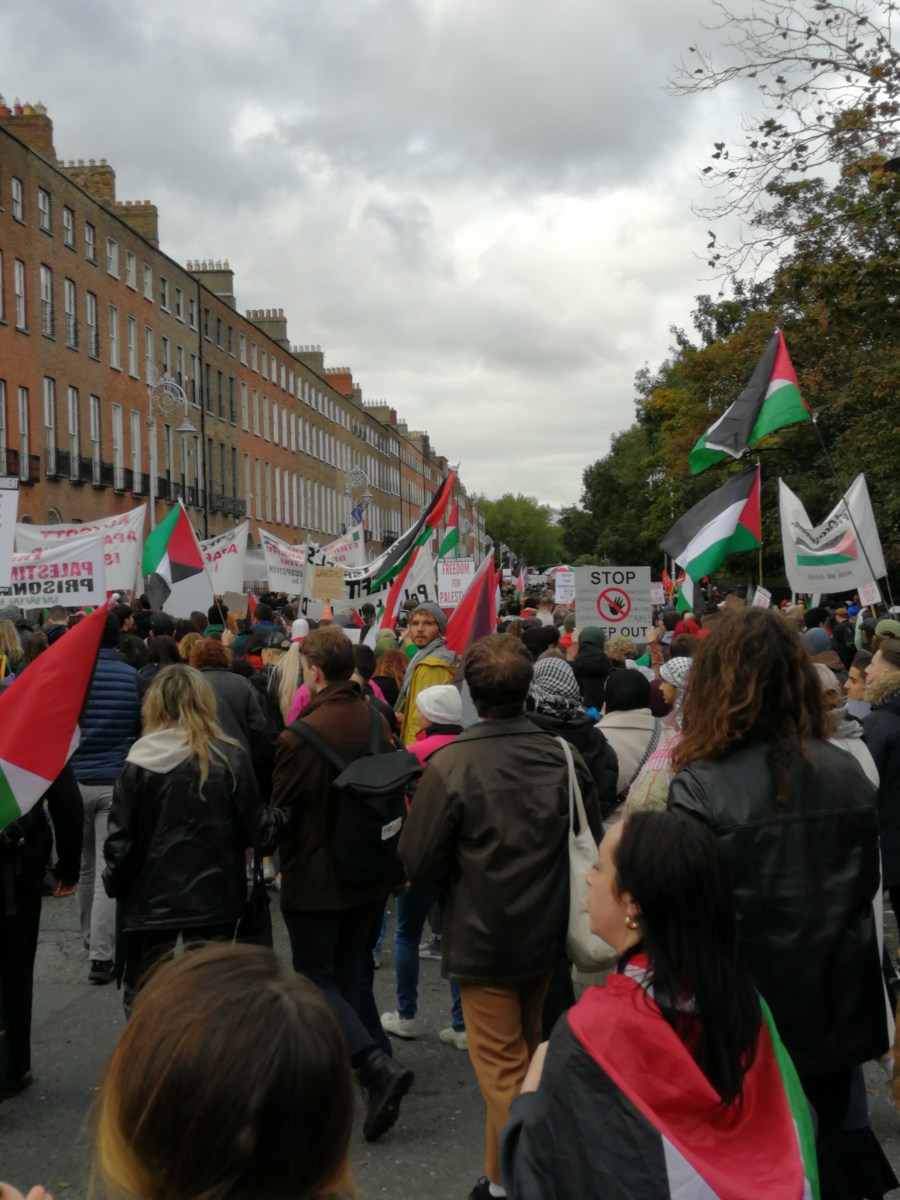
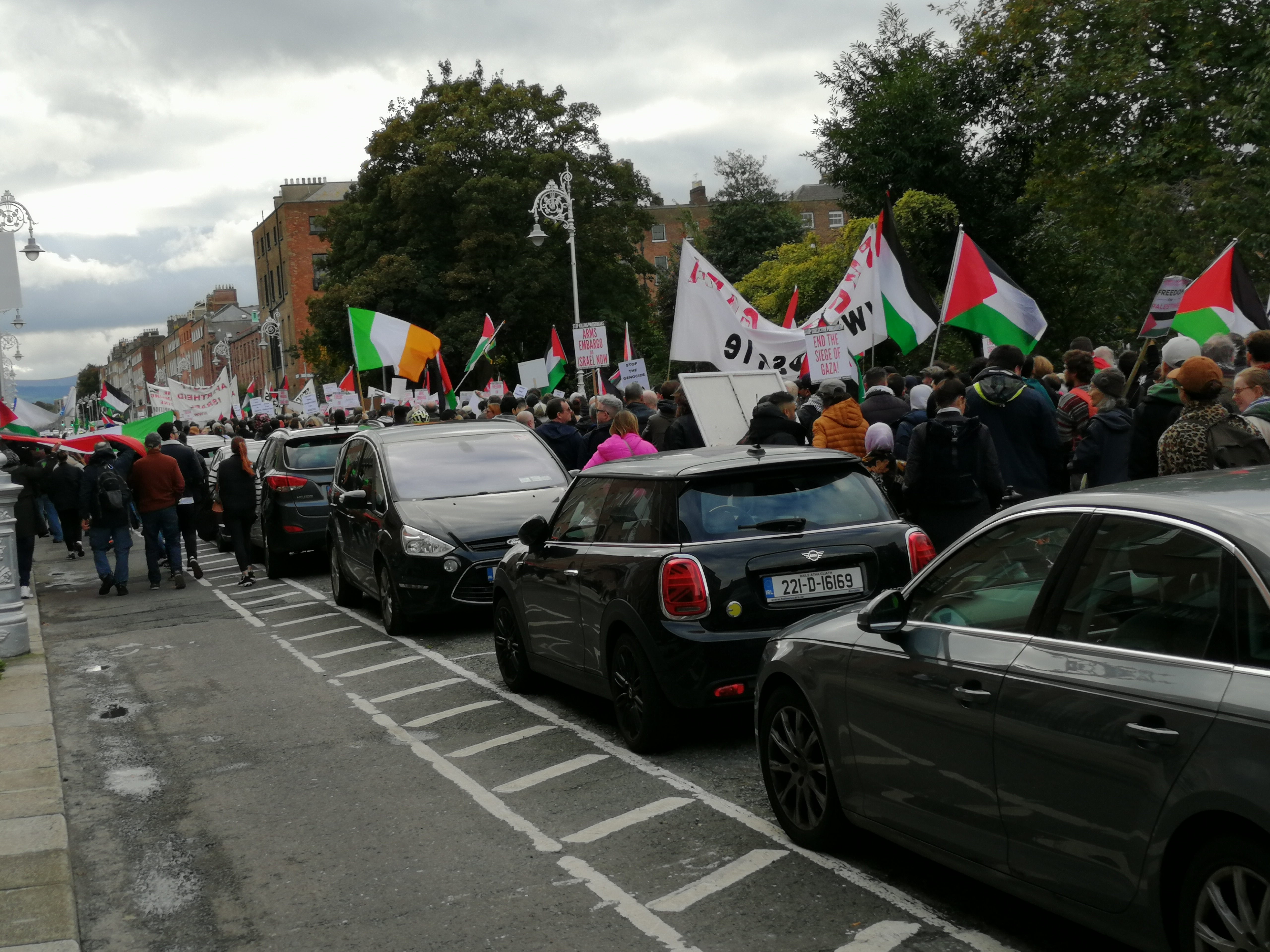
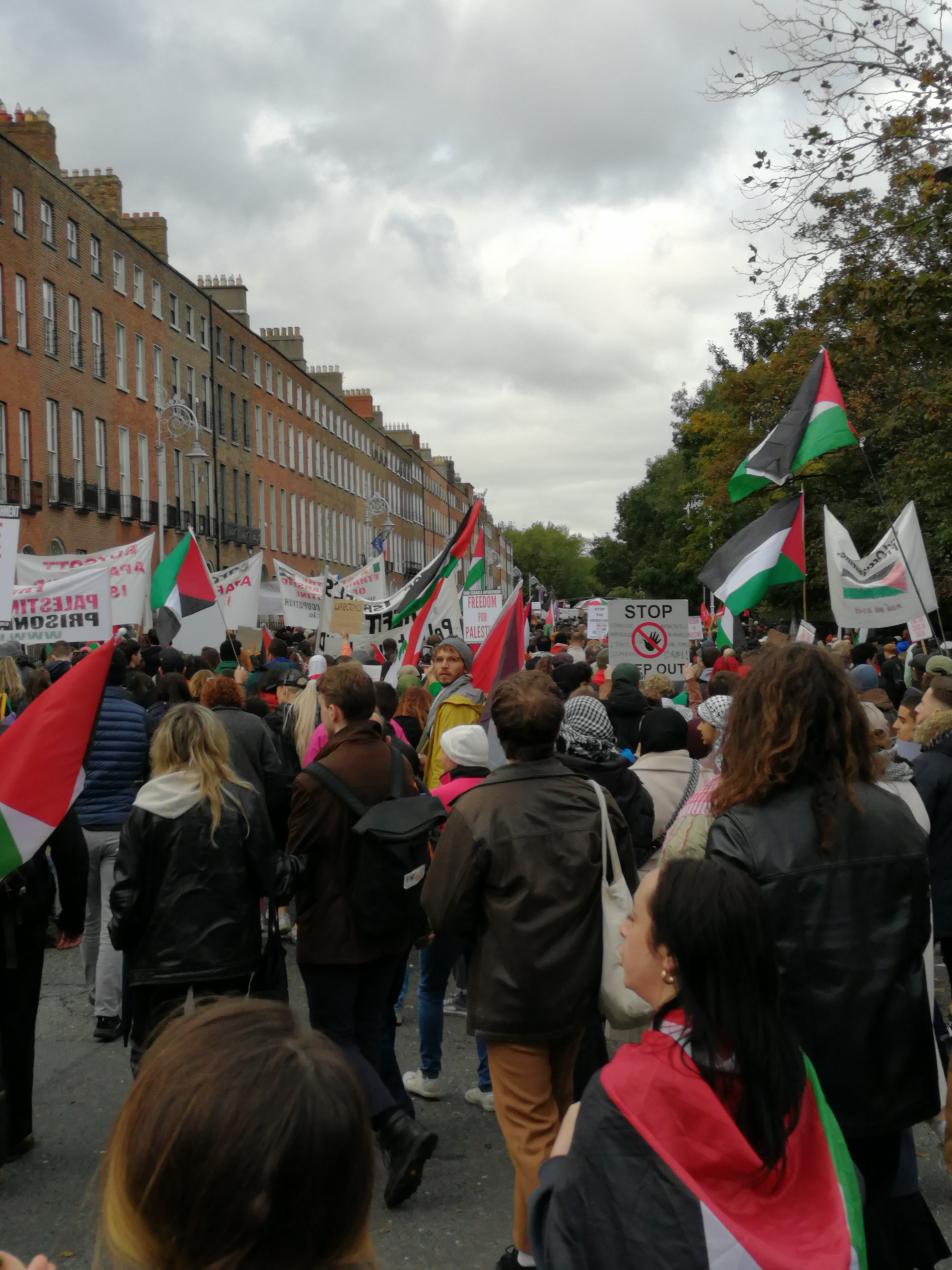
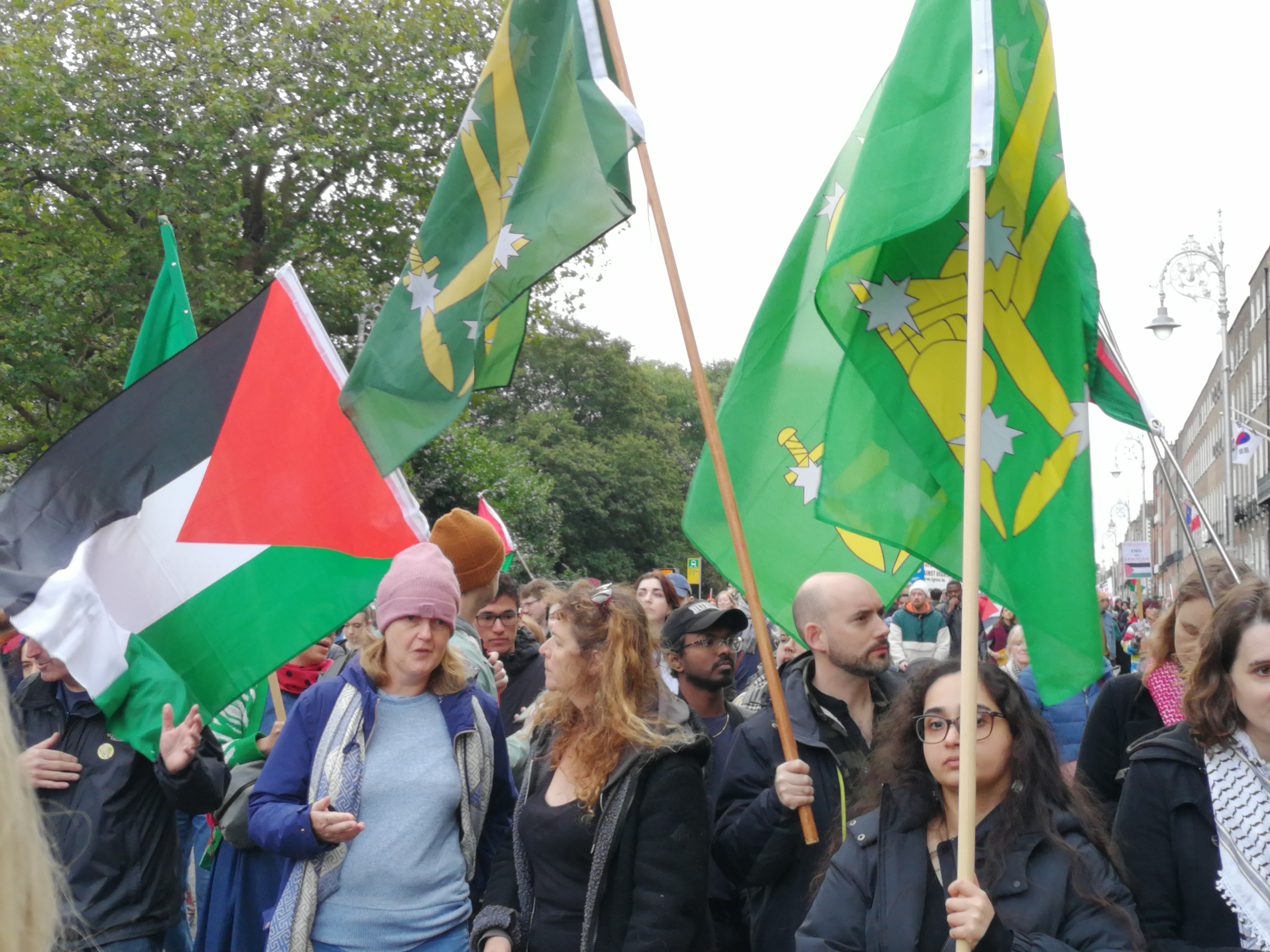
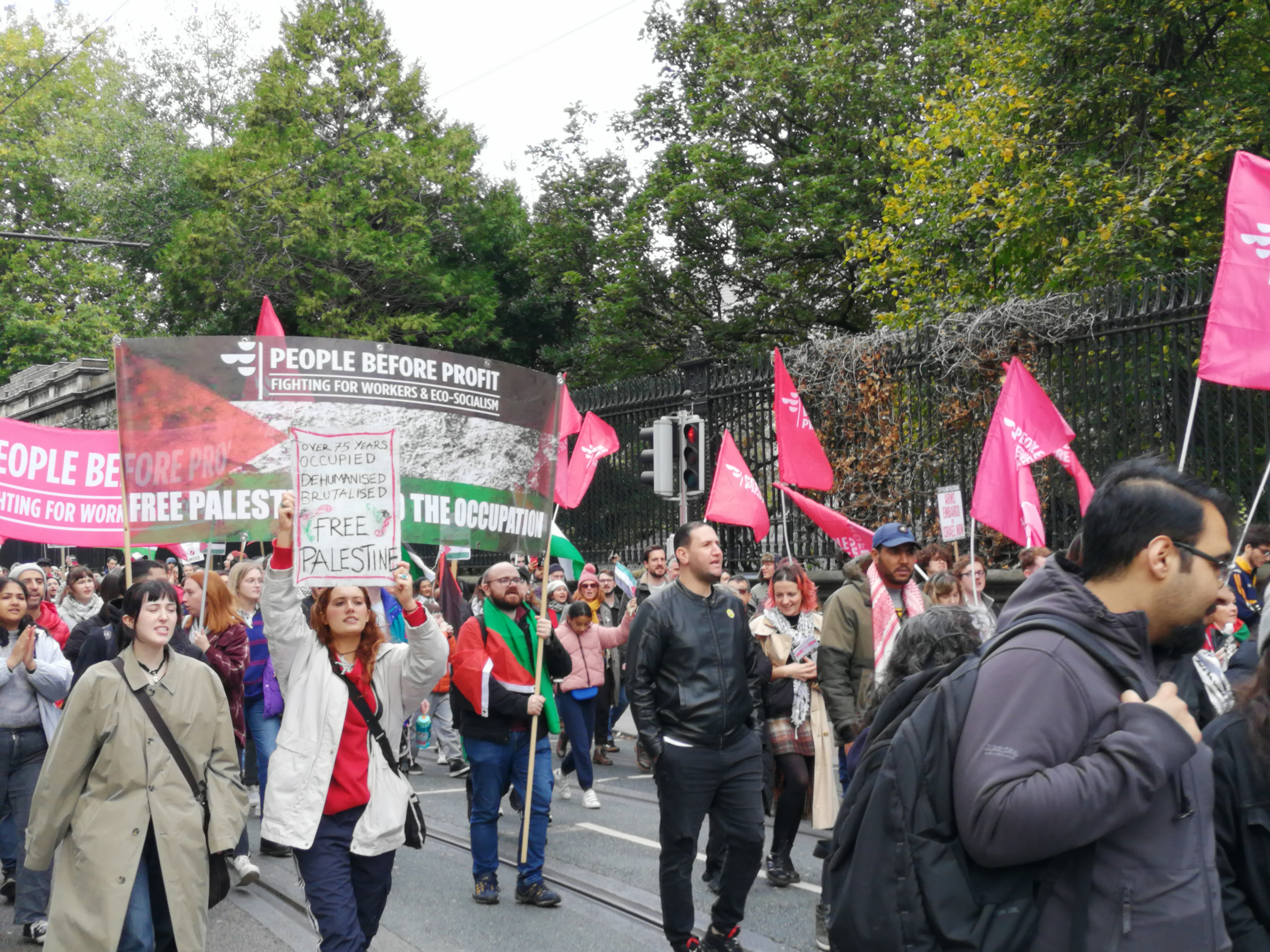
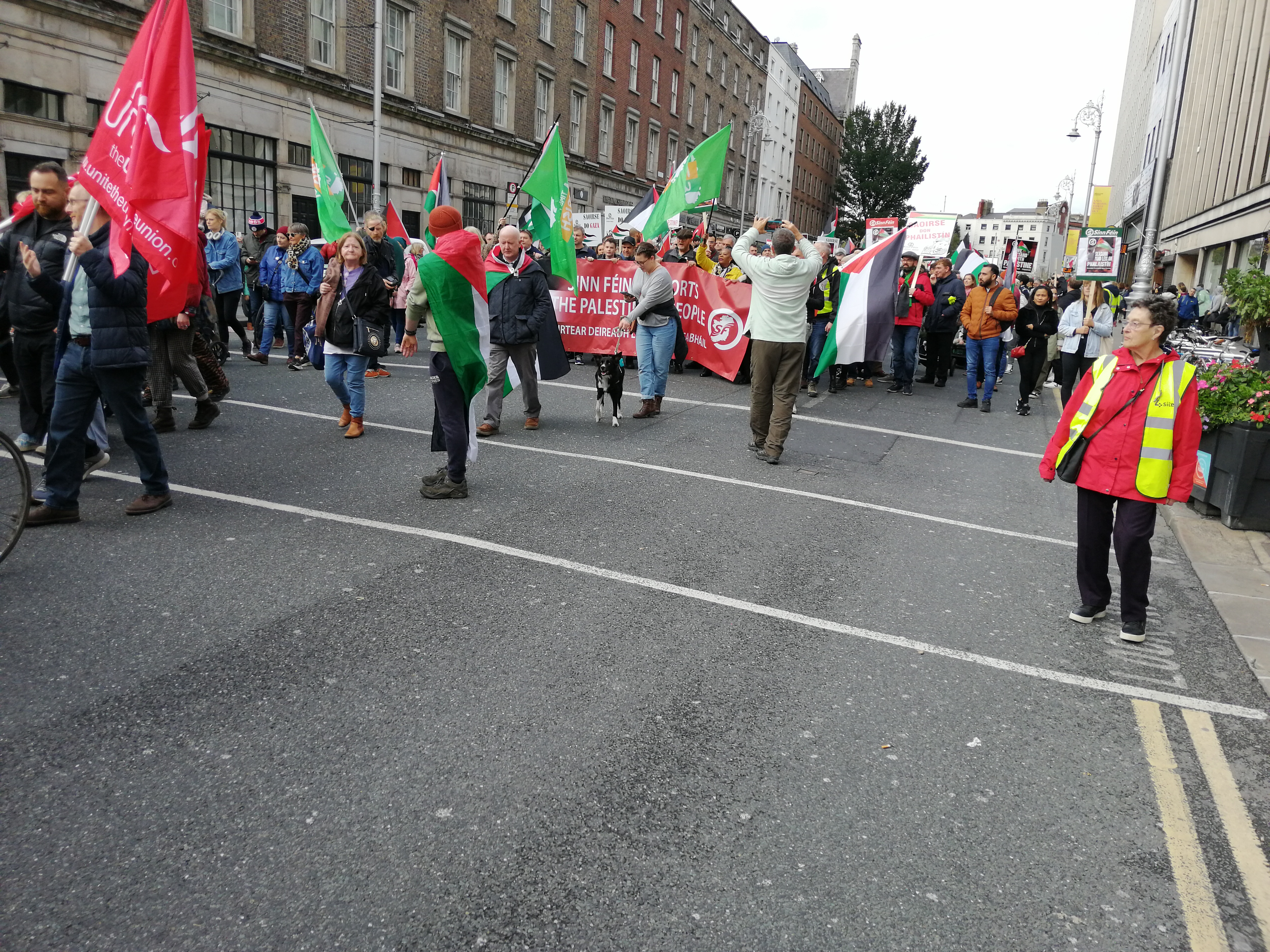
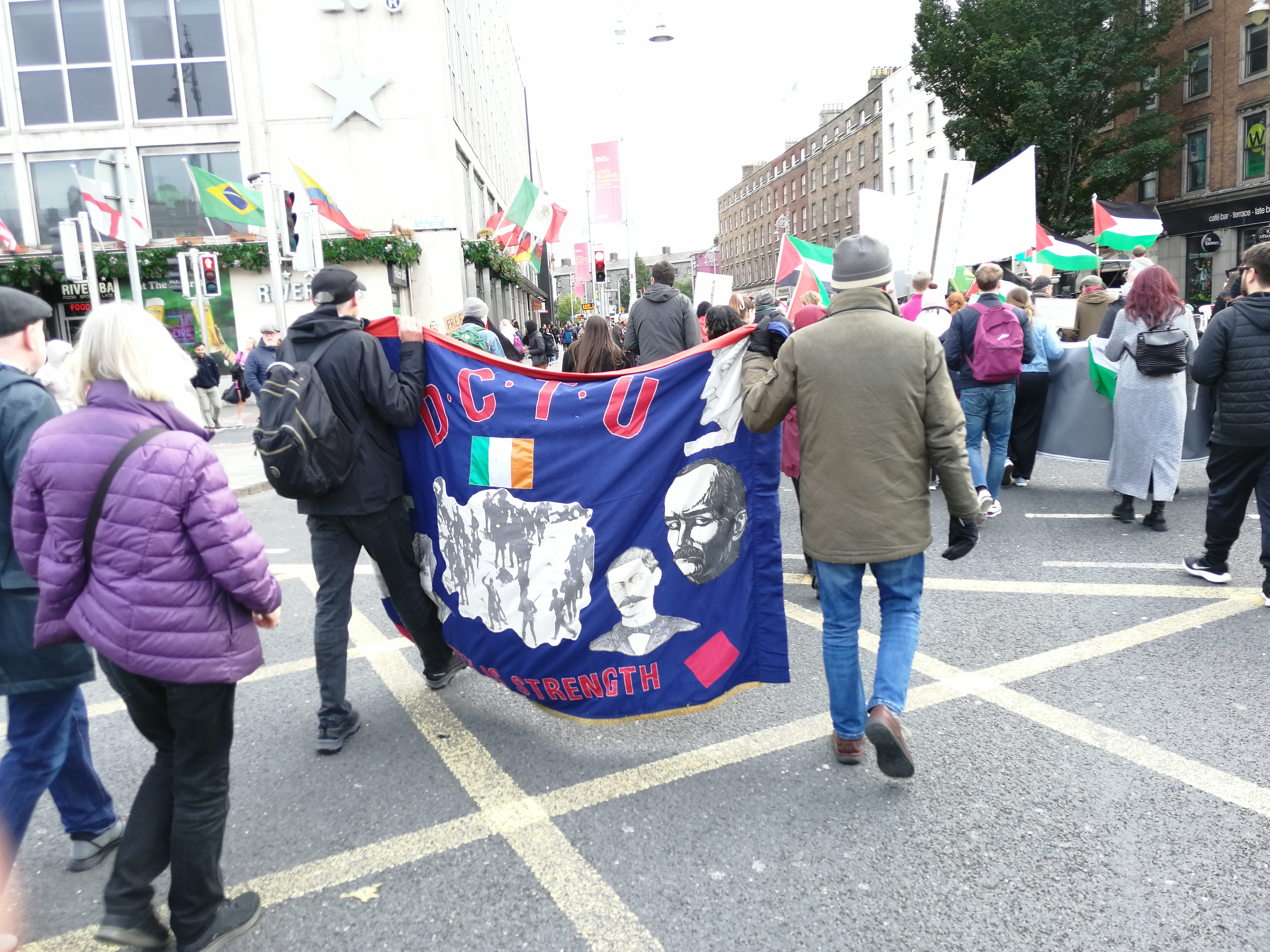
Up to 10,000 people marched in Dublin in solidarity with Palestine in the 5th in a series of rallies and marches supported by thousands in the Irish capital since the Israeli attack on Gaza last week.
Out of a population of a little over half a million for the city, that is an extraordinary attendance. Of course this was a national mobilisation in Dublin but London would also draw on hundreds of thousands from the surrounding “Home Counties”.1
Note giant Palestine flag being carried on the left of photo as section of the crowd marches perhaps along the south side of Merrion Square (Griangraf: D.Breatnach
London on the same day saw a doubling of their more recent march to 100,000 which is excellent also but that is out of a population of nearly 9 million!
Since Israel launched its genocidal missile bombardment on Gaza’s homes, mosques, hospital, schools and bakeries, millions have participated in Palestine solidarity protests in cities around the world and in towns and cities around Ireland – but banned in France and Germany.2
Indeed the censorship that has been whipped up by imperialism in defence of their Zionist outpost in the Middle East has shattered illusion of liberal freedom of speech. A number of giant tech companies pulled out of a planned “web summit” over the CEO’s comment.
(Griangraf: D.Breatnach
Paddy Cosgrave’s “anti-semitic crime”? Commenting on the Israeli bombardment of Gaza, he posted that “”War crimes are war crimes even when committed by allies, and should be called out for what they are.” Apparently not and should be colluded in, it seems.3
The BBC has sacked six Palestinian journalists and the allegedly liberal daily newspaper The Guardian sacked cartoonist Steve Bell for alleged anti-semitism. In fact, this wave of repression is likely to add belief to the anti-semitic conspiracy theories about Jewish “control of society”.
(Griangraf: D.Breatnach
British Government figures such as Gove4 have suggested – though others fear it may be counterproductive – that they may call for slogans such as “From the river to the sea, Palestine shall be free” to be classified as hate speech, for which people chanting the slogan may be arrested.
On this occasion, unlike with recent previous protests, the whole route of the march and rally was closed to vehicular traffic.
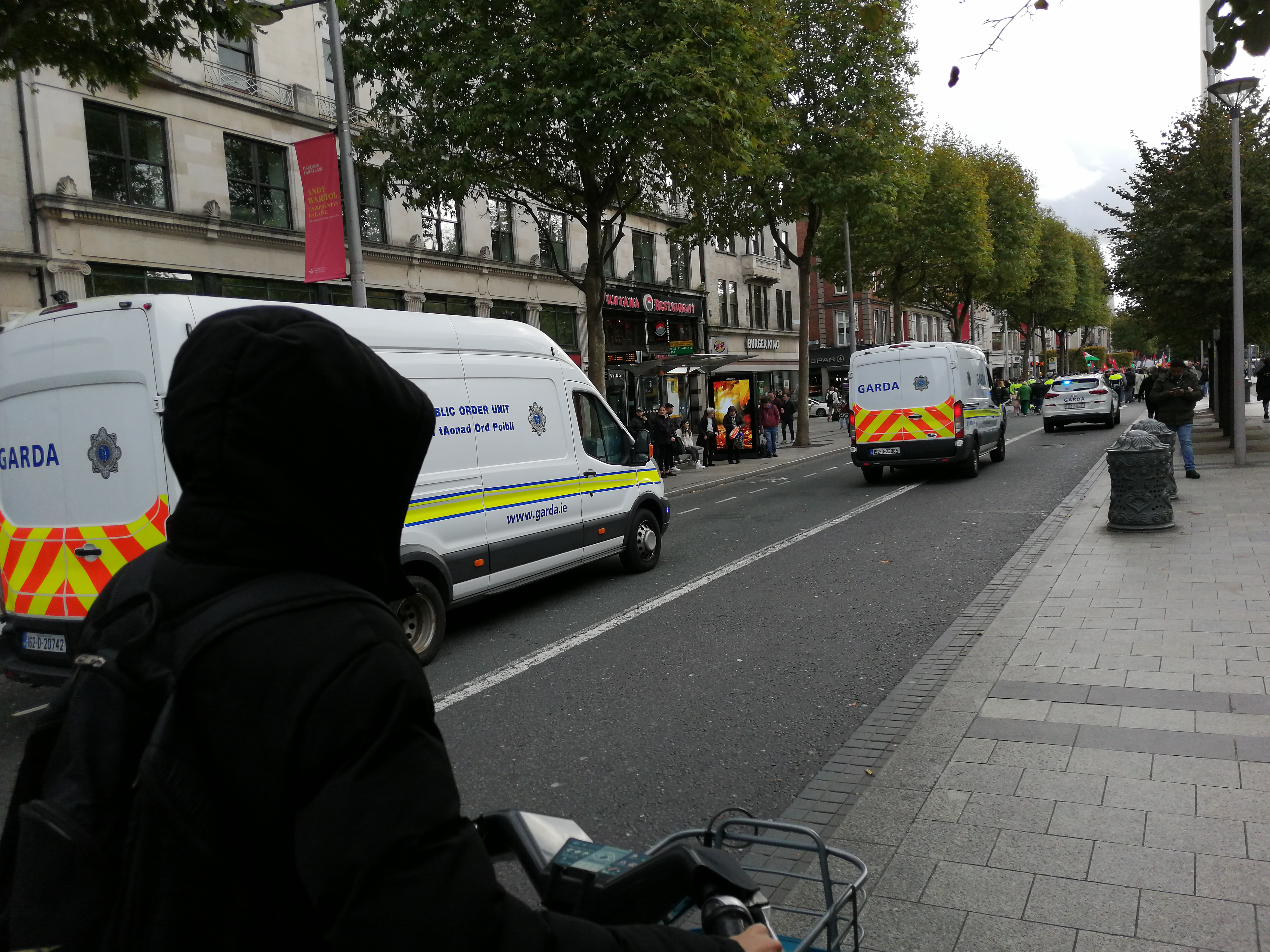
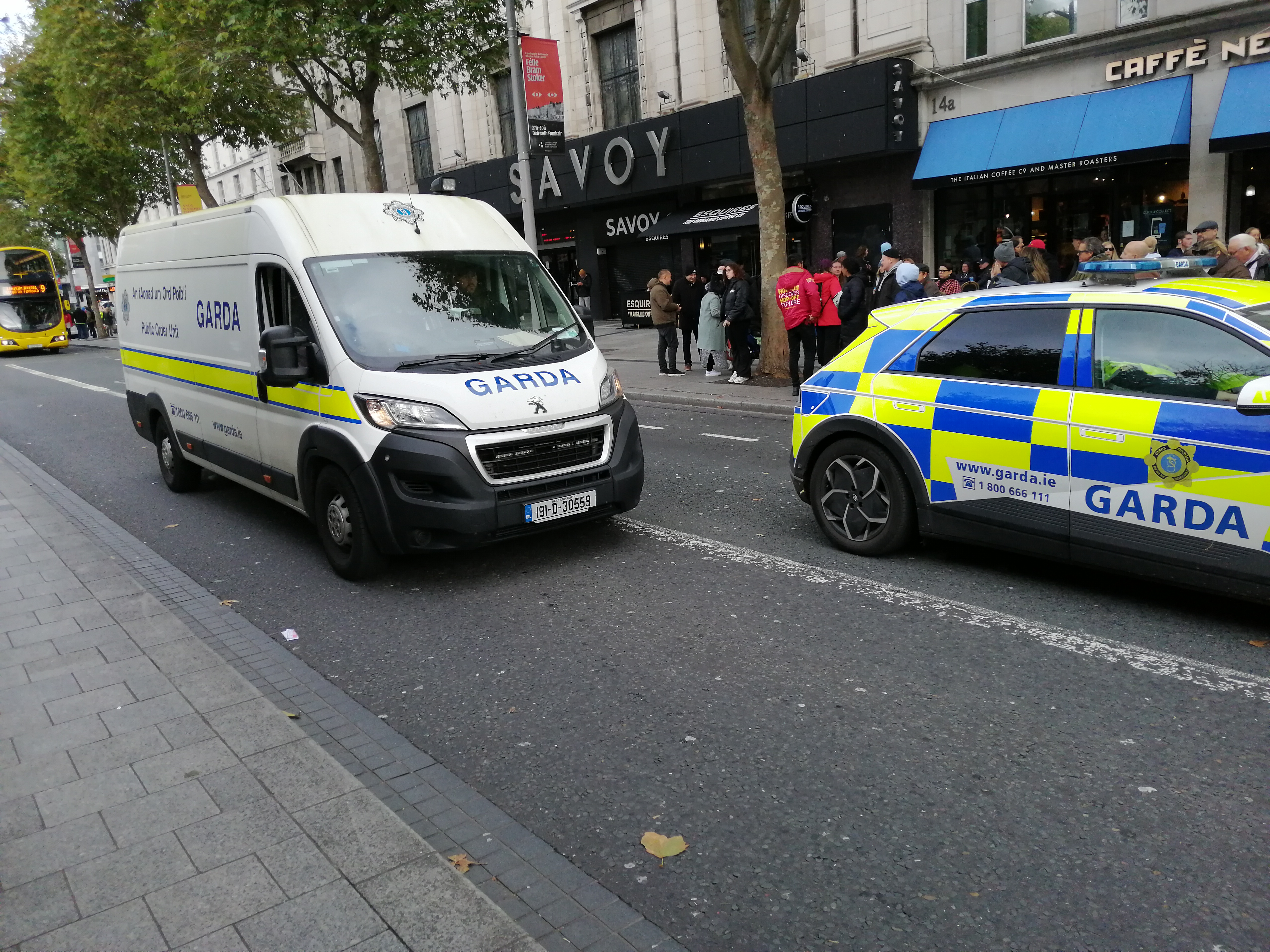
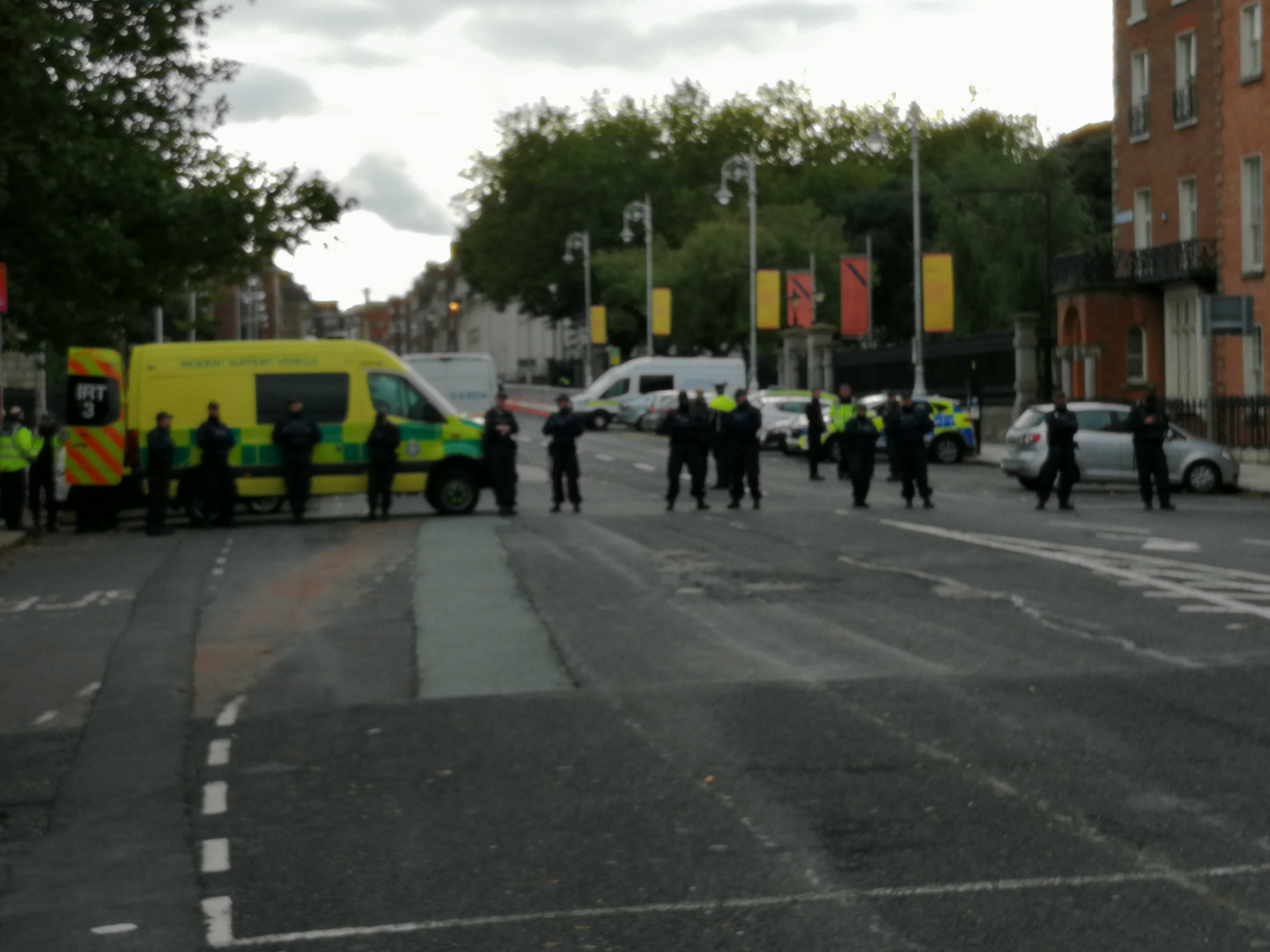
The Gardaí must have feared trouble as an unusual number of vans and patrol cars followed the march; a Public Order Unit had the entire Merrion Square North street cordoned off and the whole front of Leinster House blocked by interlocking mesh aluminium panels with a step behind each.
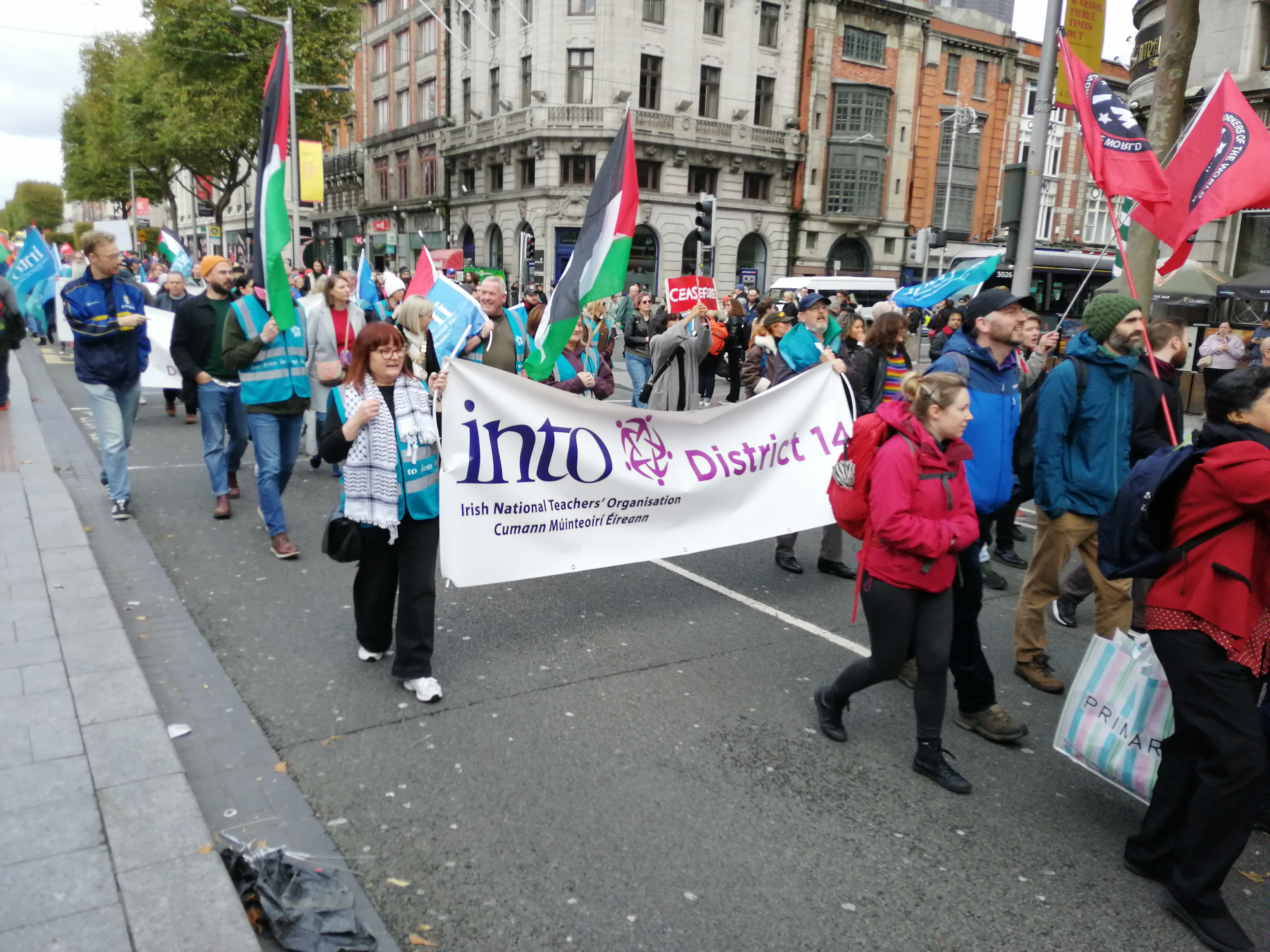
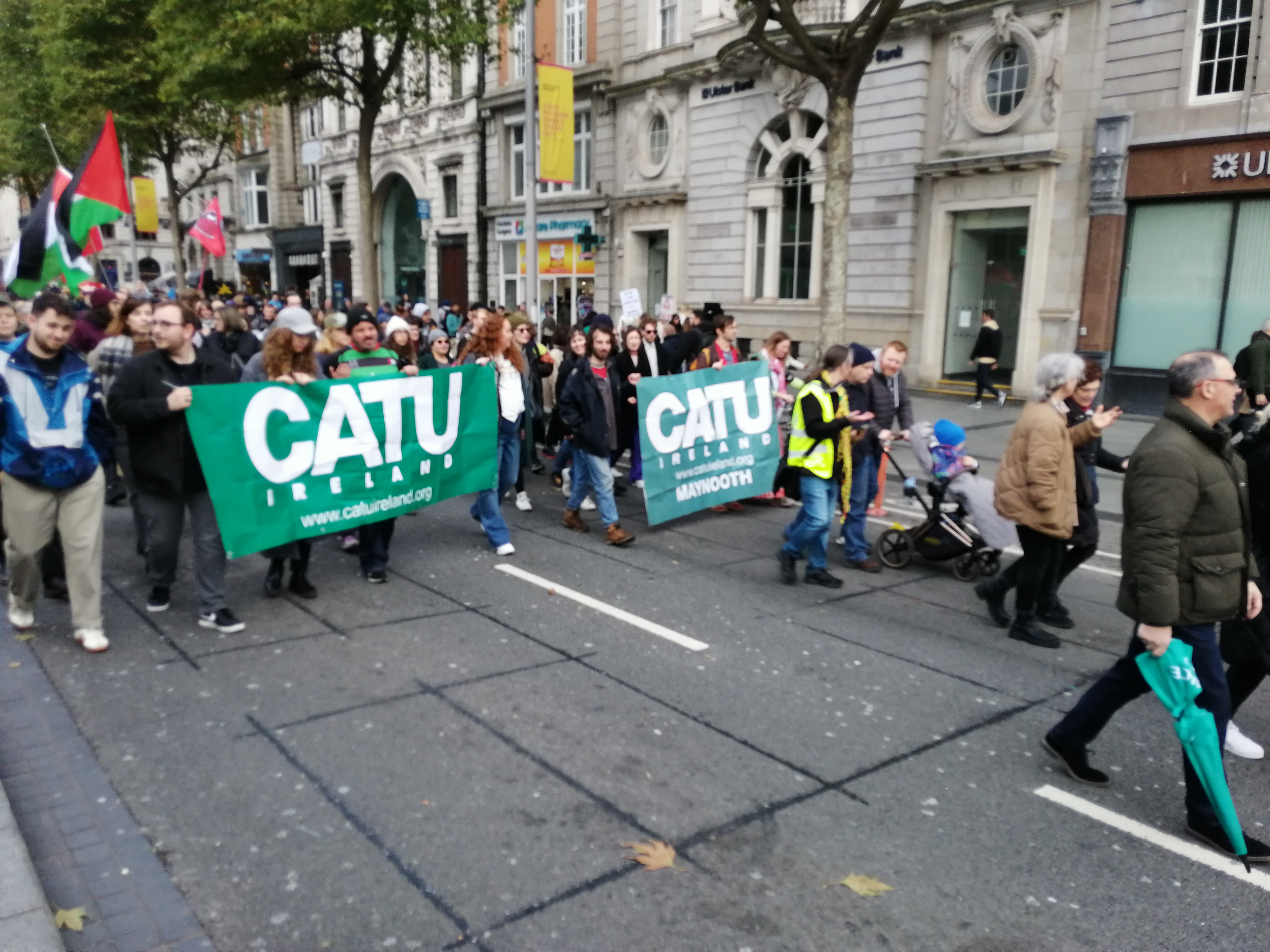
Part of the heavy Garda presence following the march along O’Connell Street. (Griangraf: D.Breatnach)More of the heavy Garda presence following the march along O’Connell Street. (Griangraf: D.Breatnach)
Those allow defenders to stand on the step and club down protesters.
On Saturday’s march in Dublin, of course all wanted the bombing of Gaza to end immediately but also clear that many supported the call for sanctions against the Zionist state including the expulsion of the Israeli Ambassador.
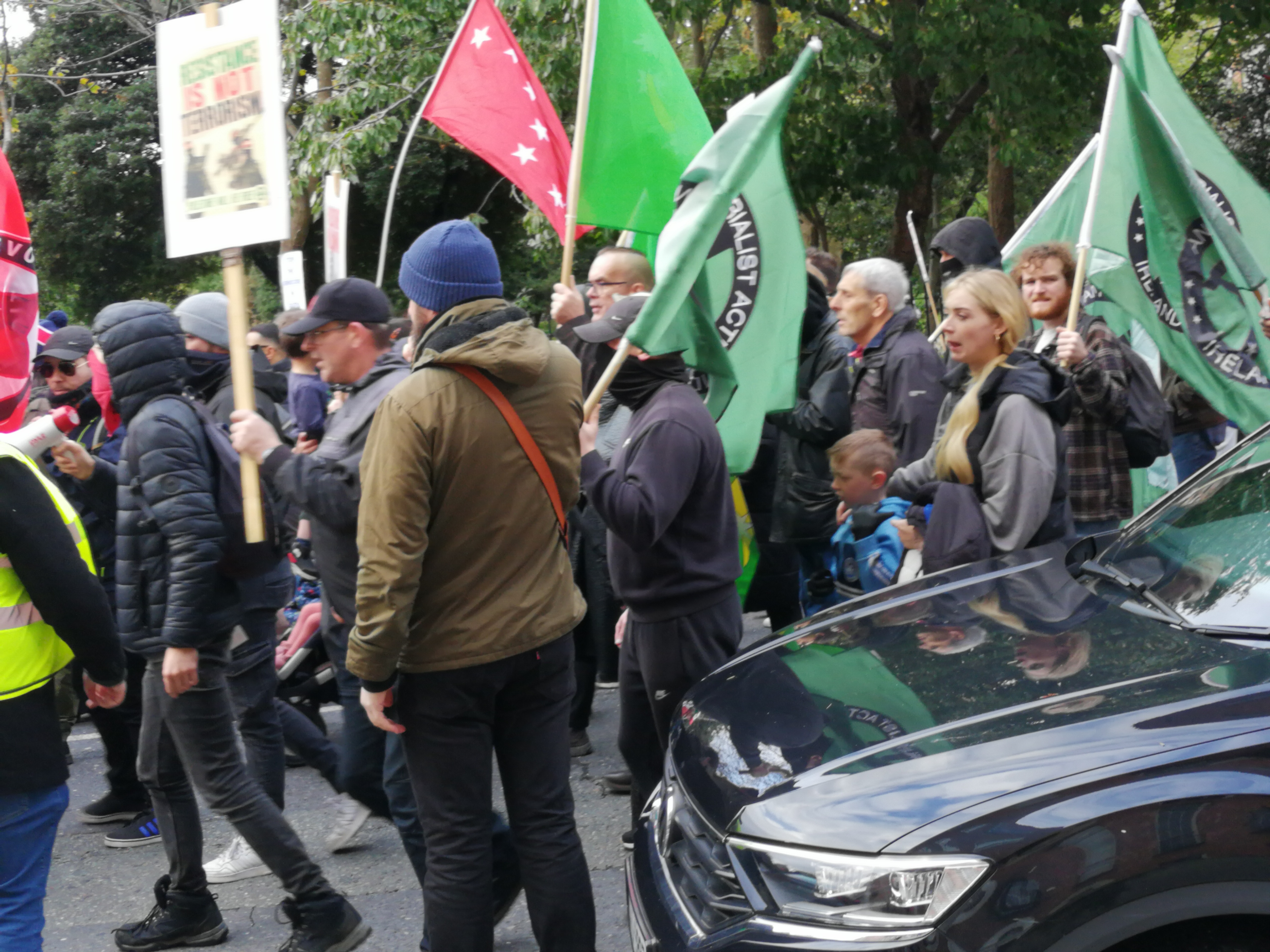
Sections also unmistakably supported the Palestinian resistance with the call “Only one solution, intifada revolution!”5 Others, particularly in trade union sections or those of parties that have been part of – or are aspiring to be – part of Government, refrained from those.
(Griangraf: D.Breatnach)
With the exception of that of the socialist republicans Anti-Imperialist Action, though I might have overlooked a banner somewhere, I saw no banners of an Irish Republican movement group on the march, despite their long-standing support for Palestine national liberation.6
DLÚTHPHÁIRTÍOCHT IN NGAEILGE
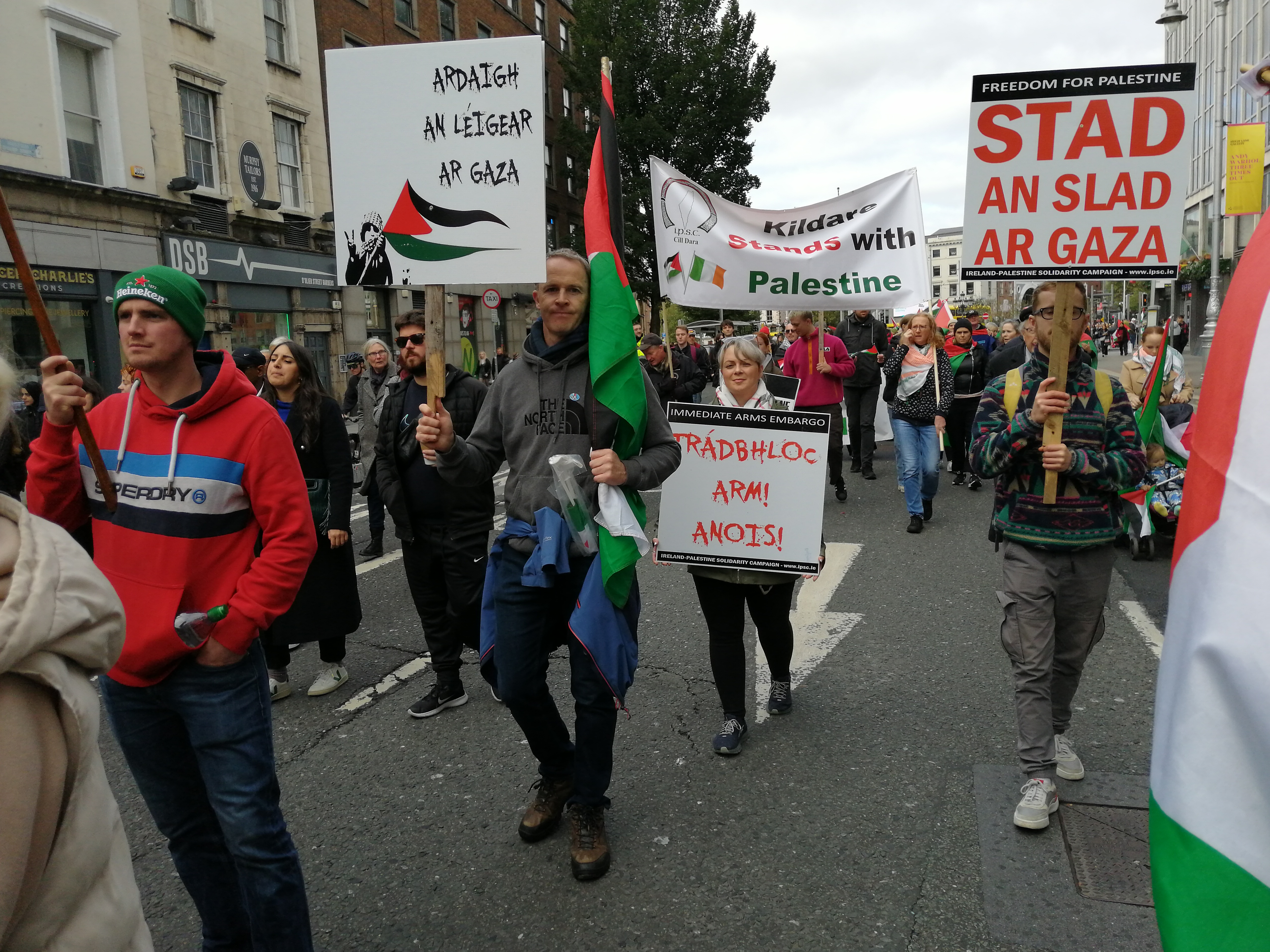
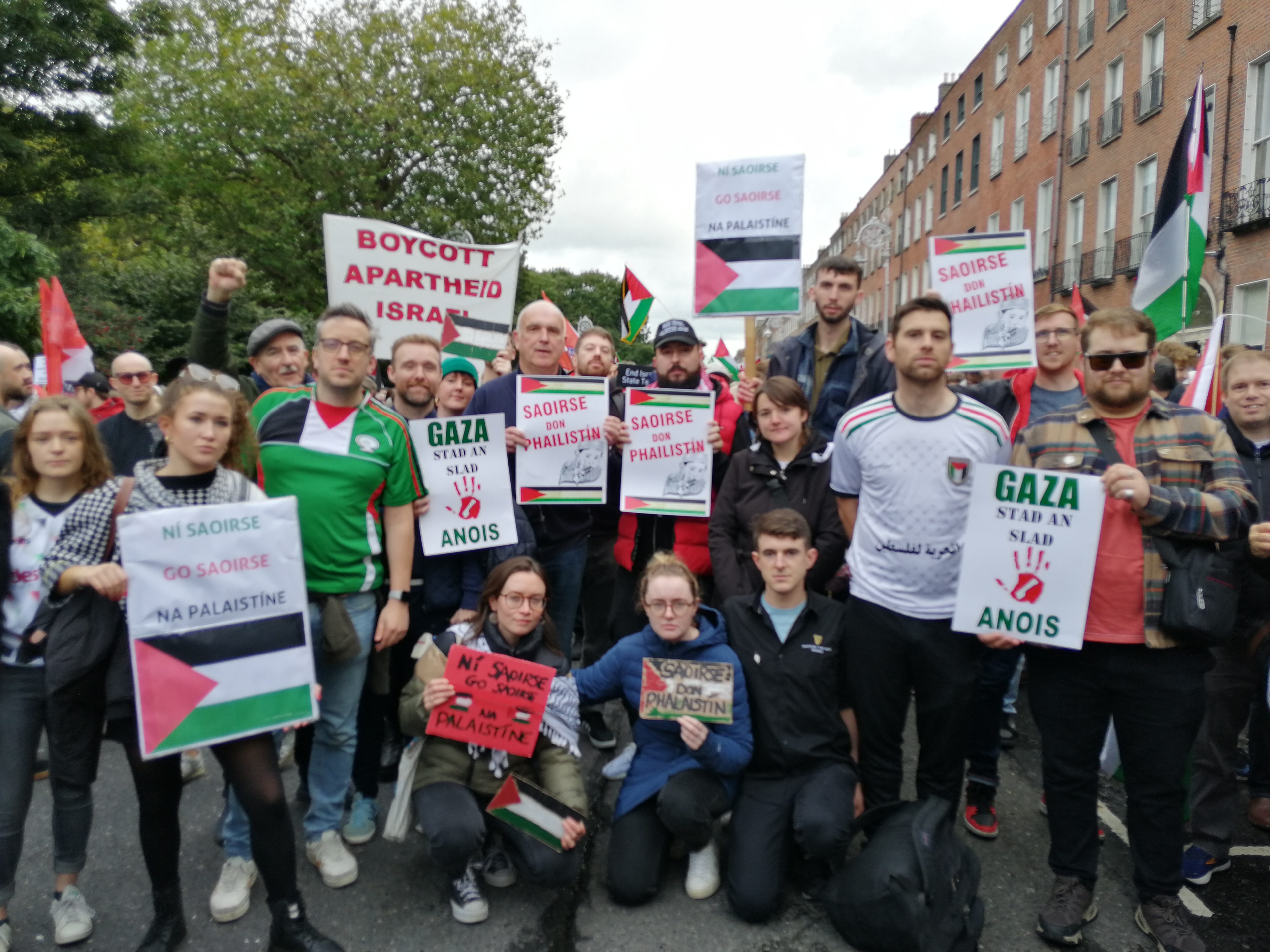
From at least two sections of the march, widely-separated, slogans in Irish could be heard: Saoirse – don Phalaistín! And 800 bliain
In addition, though but a tiny fraction of the overall number, a range of placards in Irish could be seen, some printed and some hand-made, including: Ní saoirse go saoirse na Palaistíne and Gaza – stad an slad ANOIS!7 Saoirse don Phalaistín!
(Griangraf: D.Breatnach)
Palestinians seemed to like them in Irish as well as in English and some took photos, no doubt interested in a manifestation of the country’s native language being alive (other than in bilingual signs and recorded announcements on public transport).
For the language movement, it is of crucial importance that it is seen and heard in progressive circles, not only because it is from there that progressive changes normally come rather than bureaucratically but also because the language needs to be a part those changes.
(Griangraf: ar cheamara D.Breatnach)
I heard not a word in Irish from the stage but I didn’t stay to the end, so can hope …
SPEECHES
Zoe Lawlor spoke eloquently and passionately for the organisers, the Ireland Palestine Solidarity Campaign and gave a long detailed list of the atrocities committed by the Zionist State in the bombing of Gaza, in addition to shooting Palestinians in military raids the West Bank.
Public Order Unit of the Gardai on the west side of Merrion Street (which also has entrance to Leinster House, the Irish Parliament. This deployment blocked access on a Saturday to the Natural History Museum as well as access to Baggot Street from here. (Griangraf: D.Breatnach)
She also said our anger and concern should lead to action and of course that is absolutely correct. Among the actions she called for were intervention by the Irish Government in the EU calling for a ceasefire and allowing humanitarian supplies into Gaza.
That is of course the very minimum one could expect from a civilised state – or even from Israel, if it were such a state …
Section of the march as it turns into Merrion Square North, heading for the rally stage at the end of the street. (Griangraf: D.Breatnach)
She also called for the Government to stop blocking and to bring forward for enactment the Occupied Territories Bill, agreed years ago on all sides of the Irish parliament but obstructed since then by the coalition government of Fianna Fáil, Fine Gael and the Green Party.
But desirable though that last is and needed though the former is, it brings but a pause in the oppression and ethnic cleansing of the Palestinians by the Zionist State.
The state itself, the Zionist, racist, genocidal project, must end and we should do all we can to hasten that end. Of course, there is not the slightest chance that our Gombeen state will call for that.
(Griangraf: D.Breatnach)
What then about sending a clear message through the expulsion of the Zionist Ambassador, who tried to blame the Palestinian resistance for the Israeli bombing of the hospital? Unlikely that the Government, which won’t even condemn Israel’s actions, will do that either.
But certainly not if we don’t push hard for it! The truth is that we have not got our government under any serious pressure at all. They are tied to British colonialism and western imperialism and the parliamentary opposition parties, with the exception of the tiny Left there, are too.
If they are not under pressure, why should they do anything at all such as we would like or that would help the Palestinians?
One can feel the resultant feeling of helplessness sometimes in the speeches and even when the chant-leaders call for people to shout louder and louder, as though that will make the difference.
(Griangraf: D.Breatnach)
Short of revolution and trending towards revolution is the need to put the ruling class under pressure to achieve some progress. At the minimum that means mobilisations such as have been done this fortnight but also progressive and hard demands, possibly backed by other actions.
if we can’t even unite the Irish people behind the consistent and repeated call for the expulsion of the bloodstained Zionist Ambassador, then we’re in a pretty bad position. I believe however that we CAN, that the people will unite behind that call.
(Griangraf: D.Breatnach(Griangraf: D.Breatnach
Yes, some people now supporting the IPSC will drop out, hide, prevaricate – whatever. There are enough good people and true in our island however who would carry that demand through and the mass of the population seems to support such a demand.
It is in reality the most significant step of which we are capable at this moment in our history and Palestine’s – and it would be a lamp lit in the darkness of Western world.
End.
FOOTNOTES
1London and its suburbs contain towns, some very large and villages in four counties: Middlesex, Surrey, Essex and Kent, from which many commute to London to work and are relatively well served with train lines, buses and in the cases of Essex, Buckinghamshire and Hertfordshire, have stations on the London Underground system.
5In particular People Before Profit and Anti-Imperialist Action Ireland.
6The Sinn Féin party had a medium-sized contingent there under their banner but the organisation, from the actions of its leaders, has for decades ceased to be part of the Irish Republican movement.
7“There cannot be freedom until Palestine is free. Stop the massacre NOW!”
I am engaged in an extermination war and I’m not winning.
It’s against those tiny brown fruit flies. Apparently they live by consuming bits of fruit and other vegetable stuff. But no matter how much I seal kitchen refuse and fruit into bags, large of small, they still fly around and around, annoying me. Deliberately taunting me.
Since I seal the bags, what do they live on? Just the faintest of smells is enough for the little f…ers, it seems! And I use the term advisedly. They are renowned fast breeders and an adult female fruit fly can lay up to 2,000 eggs on the surface of anything that’s moist and rotting.
Within 30 hours, tiny maggots hatch and start to eat the decayed food. Within 2 days, they’re all grown up and ready to mate, too! Luckily a fruit fly only lives 8 to 15 days – but still.
With such a fast turnaround, they’ve been used for genetic experiments, with even a flightless subspecies developed for the purpose.
Unfortunately, the ones at my place are all fully able to fly. And sometimes not just around me but flying right at me, inches away from my eyes. Do you know how difficult it is to kill something tiny mere centimetres away from your eyes? I really, really hate them.
I could spray them with insecticide, or course but that would mean poisoning my living space environment. I use anti-bacterial surface cleaner spray instead, hopefully less toxic for me. I know it’s less toxic for them also but it does slow them down or stick them to the wall so I get them.
Sometimes.
When they’re at a good distance for me to focus, I reach out really fast and smack my two hands together on them. Success rate? About one in ten. And even then, sometimes, when I open my hands, the little f..ker flies away, apparently unharmed and no doubt fly-sniggering.
But what about all those times I know for certain I caught one, open my hands and … nothing there. It’s not like I missed it because I didn’t see it fly away and it is nowhere to be seen. Except a few seconds later, it reappears – from nowhere.
Of course, it can’t appear from nowhere, not really.
So where did it go? Obviously, into an alternate universe and then back out to laugh at me. You don’t believe in alternate universes? Well a lot of physicists treat the subject with great seriousness and even think they might conform to quantum theory.
Don’t ask me to explain quantum theory but the multiple universes theory has to do with time and space or something. And we do know that time is objective (we’re getting older) but also subjective, as we experience when we sit through an interview or a haranguing from a partner.
Anyway, my war with the fruit flies continues. But what is their alternate universe like and why do they come back into mine? No fruit there? No oxygen? Really clever (but not quite quick enough) spiders?
I’m engrossed by the possibilities. Maybe there’s no cops or other fascists there.
So, I talked to this tech geek I know and he’s working on designing a micro-micro video camera. When he has it developed, we’ll trap some of those irritating flies, attach the micro-camera to one, threaten it until it jumps into the next universe and catch it when it returns.
Then, remove the camera and download the film.
What will we see? Who knows. Wonders, perhaps. But maybe only a giant hand swatting at the camera carrier as the fly dodges and shifts-universes back into this one.
ANOTHER FAILURE OF THE TRADE UNION MOVEMENT
“Today in Ireland, migrant workers earn 22% less per hour than their Irish counterparts (ESRI, 2023), while migrant women earn 11% less than their male counterparts and 30% less than Irish men (ESRI, 2023). Here is another fact. According to the latest Discrimination Report in Ireland, the workplace is the second place where discrimination and racist incidents occur, as also documented in the previous reports (INAR, 2023).”
The paid work migrants do is a coin of two sides, one bright and the other dark.
On the bright side, we know that, in Ireland, the employment rate among the migrant population is higher than that of the national population (71.6 and 76.4, respectively). But, simultaneously, the unemployment rate is lower among migrants (4.6 and 5.9, respectively). In other words, compared to the national population, the migrant population has more working and fewer unemployed migrants.
This is good news and bad news. Because on the one hand, we can all see that migrants are making a necessary and important contribution to local economies through their work (often taking essential positions in the food and agri industry and other low-paid jobs that do not attract the national population). Still, on the less visible side of the coin, we can also see that it is in the work environment where most…
¿Sabrías decir cuál de los tréboles silvestres que crecen en Irlanda es el trébol ‘genuino’ (Seamair óg)?
Acercamiento del trébol en flor, Glasnevin, Dublín. (foto: D.Breatnach)
Ahora, mientras todavía está en flor, es un buen momento para ver la planta, las hojas más pequeñas y la flor amarilla (buí) en ella es lo que realmente la distingue de sus primos los tréboles, con sus hojas más grandes y flores en blanco (S . Bhán, T. repens) o rosa-rojo-púrpura (S. Dhearg, T. Pratense).
¿Cómo sabemos que el Seamair Bhuí (Trébol menor, Trifolium dubium) es el auténtico “trébol”? Bueno, tal vez no podamos estar seguros, pero en la década de 1890, a partir de una encuesta de opinión en una sociedad irlandesa todavía bastante tradicional, T. Dubium surgió como la primera opción.
Foto: El trébol, Seamair Bhuí/ Trifolium dubium/ Lesser trefoil, de tamaño real, fotografiado en la ciudad de Dublín con hierba creciendo a través de él. (Foto: D. Breatnach)
El botánico y zoólogo aficionado Nathaniel Colgan (1851-1919) pidió a personas por toda Irlanda que le enviaran especímenes de lo que creían ser un trébol irlandés, de los cuales los dos más comunes eran el trébol amarillo seguido por el blanco.1
Cien años después, el Dr. Charles Nelson repitió el experimento en 1988 y descubrió que el trébol de flor amarilla seguía siendo el más elegido.2 Según Wikipedia, el trébol amarillo es la especie nominada por el Departamento de Agricultura de Irlanda como el trébol “oficial” de Irlanda.
Si deseas elegir tu propio trébol para el Día de San Patricio, deberás aprender a identificarlo por sus hojas, ya que en Irlanda no florecerá en marzo. Sin embargo, puedes reconocerlo actualmente por sus flores y crear una imagen mental del tamaño de sus hojas para retenerla en tu memoria.
LOS IRLANDESES Y EL TRÉBOL
¿Qué pasa con el trébol y los irlandeses de todos modos? La historia infantil sobre el misionero cristiano Patricio usando la hoja para explicar la Santísima Trinidad cristiana es solo eso, una historia ficticia, aunque mencionada en una de las entradas de Wikipedia para “trébol”.
Ni los celtas en general ni los gaélicos en particular necesitaban que nadie les explicara una deidad tres en uno, ya que tenían sus propias trinidades paganas (Éiriu, Fódlha, Banba; las de la Mór-Righean/ Morrigu). Los investigadores no han encontrado ninguna referencia a la importancia del trébol antes de 1681.3
El propio Patrick, en lo que se considera su genuina Confessio autobiográfica, nunca mencionó el trébol ni una sola vez. Mi sospecha es que la fábula del trébol-cristiano-trinidad fue creada fantasiosamente por colonos británicos como el botánico Caleb Threkeld o por cristianos irlandeses nativos alrededor de 1726.4
Aunque algunas fuentes en por el Internet han afirmado propiedades medicinales o uso druídico para el trébol, nunca citan las fuentes originales reales, lo que puede indicar que las referencias no son confiables u oscuras, si es que verdaderamente existen.
Curiosamente, en el periodo previo a la Rebelión de 1798, un vecino de Drogheda llamado John Sheil, que era presbiteriano y miembro de los United Irishmen, utilizó el trébol como una metáfora para representar una trinidad diferente: la de los católicos, los protestantes (anglicanos) y los disidentes (todas las denominaciones protestantes no anglicanas).
“….. la planta de tres hojas….
son tres en uno
Para probar su unidad
en esta comunidad
Que aguanta con impunidad
A los Derechos del la Humanidad.”5
Sin embargo, el verde era el color de los Irlandeses Unidos y, en momentos de represión por parte de las fuerzas de ocupación y por la Orden Leal de la Naranja, una ramita de trébol en el Día de San Patricio podría ser una forma útil de indicar resistencia y al mismo tiempo afirmar que era un reverencia inofensiva a un santo cristiano.
Sin embargo, incluso usarlo el día de San Patricio podría haber sido peligroso en algunos sectores, como cuando The Wearing of the Green informó, en referencia al trébol, que
“… Es el país más angustioso que jamás hayas visto
Porque están ahorcando a hombres y mujeres por llevar el verde.”
3 “Thomas Dinely, un inglés que viajó por Irlanda en 1681 notó que personas de todas las distinciones usaban cruces para conmemorar al santo en este día, pero notó que solo los vulgares, como él los llamaba, usaban tréboles”. https://www.museum.ie/en-IE/News/From-shamrock-and-rosettes-to-Patricks-Pot
5 Los Derechos del Hombre, por John Sheils. El aire con el que se canta más comúnmente es el de la canción en lengua irlandesa Eanach Cuain/ Anach Cuan, pero he compuesto un aire original para él y lo canto un poco más rápido que la canción sobre la tragedia del hundimiento del barco.
Recently the Taoiseach1 of the Irish State criticised people protesting the Government’s plans to slide the state into external military alliances of “misappropriating” the Irish Tricolour and, incredibly, even of “weaponising” it.
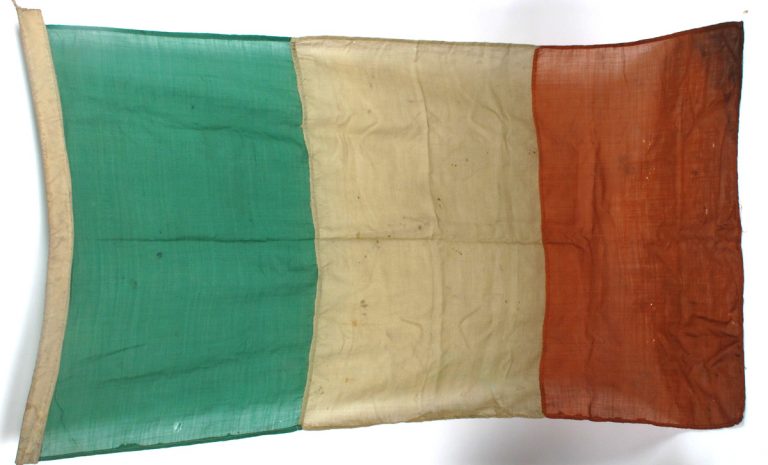
The Irish tricolour was a weapon from the moment it was sewn – a psychological weapon, laden with political meaning, sewn by French revolutionaries, presented to and flown by Irish Republican revolutionaries from generation to generation.
Painting by Philoppoteaux depicting the revolutionaries of the French 1848 Revolution outside the Paris Town Hall and Lamartine rejecting the Red Flag in favour of the French Republican one. Women participants in this revolution presented the Irish Tricolour sewn in silk to Young Irelanders including Thomas Francis Meagher (Source photo: Wikipeda) [When Paris rose again in 1871 under the Paris Commune, the preference was for the Red flag.]
Prior to the advent of the Tricolour, the Irish Republican flag was typically the gold harp on a green background2 but when a group of Young Irelanders went to Paris in solidarity with the revolution of 1848 there, the Tricolour sewn in silk was presented to them by revolutionary French women.
The symbolism of the Tricolour was firstly in its form; the French Revolution adopted a tricolour in opposition to the monarchist Fleur-de-Lison a blue background and different tricolours became popular as flags of new republics.
In the Irish Tricolour, the ancient Irish and the Norman-Irish, basically Catholics, were represented symbolically by green, with orange for the settlers (after William of Orange) of one sect or another of the Protestant faith; the colour white, symbolised peaceful national unity in an Irish Republic.
And it presented an equal unity, as opposed to the unity of Scotland and Ireland with England but under the clear domination of the latter, as represented in the Union Jack, which incorporates the St. Andrew’s and St. Patrick’s crosses with the English one of St. George.
THE TRICOLOUR UNFURLED IN IRELAND
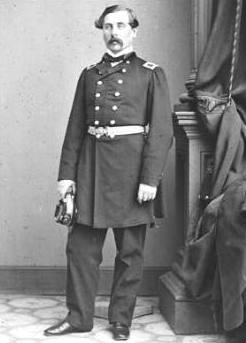
The Irish Tricolour we know was first unfurled by Thomas Francis Meagher “of the Sword” at the Wolfe Tone Club in Wexford on 7th March 1848 and in Dublin in Lower Abbey Street on 13th April 1848.
Meagher’s nickname was due to his renunciation of the Gombeens of his day trying to deny the right to resort to arms if necessary to win freedom3.
Meagher and other Young Irelanders were arrested around the failed uprising of 1848, just after the worst year of the Great Hunger and, after wide-scale international and domestic protests at the sentences of execution, transported to penal colonies, from which many escaped.
Taking his Republicanism and inclusivity seriously, both in Ireland and abroad, Meagher raised and commanded the Irish Brigade (composed of five regiments4) in the United States, fondly nicknamed Mrs. Meagher’s Own, to fight for the Union against the Confederacy and slavery.
As the years of struggle progressed, the Tricolour took its place among the ranks of Irish Republicans alongside the older Harp on Green or, for some Fenians, the gold or orange Sunburst on a blue background and so it was in the 1916 Rising when it began to be the most chosen.
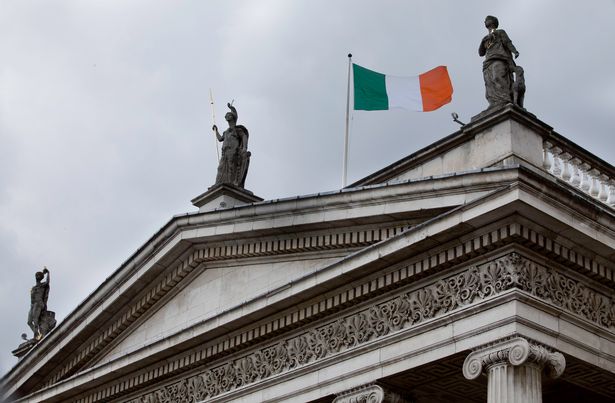
Other flags were flown during the 1916 Rising also but the Tricolour was one of two erected on the roof of the GPO, headquarters of the Rising and became the most prominent during the War of Independence (1919-1921).
The Irish Tricolour in modern times flying over the General Post Office building in Dublin City’s main street (Source photo: Internet)
During the Irish Civil war by the British-supported, armed and provisioned Free State Army against the Republican movement (1922-1923), it was flown by both sides. Even after the defeat of the Republican movement and repression, it was not immediately named the state’s flag.
Though it was displayed by the Free State when joining the League of Nations in 1923, and denounced by the Republican movement as an usurpation, it did not seem that the new state was too attached to it5 and some Irish ships flew the British Red Ensign until 1939 and WW2.
The first time the Tricolour was formally adopted by the Irish State was in the 1937 Bunreacht (Constitution) which was brought in by De Valera’s Fianna Fáil6 Government and even then it was under a pretence of Republicanism with claim laid to the whole of Ireland.
Display of the Tricolour was suppressed in the Six Counties colony from 1922 and officially banned under the Flags and Emblems Acts (1954). Many a battle was fought with the colonial police by people asserting their right to display it, the Act not being repealed until 1987.7
“A FLAG OF INCLUSIVITY, MISAPPROPRIATED BY A MINORITY”
One must agree with Varadkar that the flag signifies inclusivity and was misappropriated by fascists and other racists in recent years but it is shameful of him to attribute similar exclusivity to Republicans, who in many cases fought those same fascists to which he referred.
Leo Varadkar, current Taoiseach of the Irish Government, who accused protesters for Irish neutrality of “weaponising” the Irish Tricolour (Source photo: Internet)
Not only fought them in recent years but also back in the 1930s, when Irish fascists were called the Blueshirts. Surely Varadgar is familiar with the latter’s history also, since they were one of three reactionary groups that joined to create Fine Gael – yes, Varadkar’s own political party.
And the first Irish Republicans, the United Irishmen, sought the unity of “Catholic, Protestant (Anglican) and Dissenter (other Protestant sects)” for an independent Republic, an ideology carried on by all Republican groups thereafter and given expression in the 1916 Proclamation.
But this is not the first time that people in authority have tried to equate Irish Republicans with fascists, as a few years ago Garda Commissioner Drew Harris issued a press statement in which he accused Republicans of having organised a far-Right demonstration — which he later recanted.
One would think Drew Harris, ex-Assistant Commissioner of the British colonial police force, the PSNI8, well-known for their sectarianism and collusion with the colonial brand of fascism, the Loyalists, would be able to distinguish between Irish Republicans and fascists with ease.
Varadkar is ridiculous in accusing Republicans of “weaponising” the Tricolour since it wasalways an ideological weapon from the moment of its creation and then eventually used by the State to try, with monumental lack of success, to deny it to Republicans.
But Varadkar is right in that the Irish Tricolour has been misappropriated by a minority; but rather than Republicans, that minority is the Gombeen ruling class, foreign-dependent, neo-liberal, selling out the country’s resources and networks to foreign capitalist monopolies.
And causing homelessness, or rent and mortgage hopelessness, emigration and austerity for the vast majority of the people in the Irish state, both native and immigrant, for the benefit of a tiny minority of parasites incapable of even developing a viable Irish national economy.
Republican groups, like all groups are minorities but so are the elites, though even smaller. But in representation? Republicans, whatever faults they may have from time to time clearly represent a much larger and wider section of society than do the Gombeens.
This has been evidenced by the militant opposition of wide Irish society to triple water taxation and privatisation, repugnance for the celebration of British occupation forces and the wide opposition to joining a military alliance, all projects pushed by the Gombeens in different governments.
The Irish Tricolour has been commented upon in a number of Irish Republican songs, sometimes even in the song title: White, Orange and Green and Green, White and Gold.
Probably it is most appropriately referenced in the chorus of a song directed at the Gombeens, the very minority who have misappropriated it:
Take it down from the mast, Irish Traitors, It’s the flag we Republicans claim; It can never belong to Free Staters For you’ve brought on it nothing but shame9.
End.
The Irish Tricolour that was flown over the GPO in 1916 (Source photo: 1916 Rebellion Tours)
FOOTNOTES
1 Currently Prime Minister of the Coalition Government of Fianna Fáil, Fine Gael and the Greens.
2 Flag of the Society of United Irishmen, who led insurrections in 1798 and 1803.
3 Daniel O’Connell’s son intended to force a motion of that kind on the Irish Repeal Association founded by his father and also sought to have the motion passed without debate. O’Meagher said that while he did not exalt violence, neither would he allow his sword to be taken from him in case it should be needed. He and others such as Thomas Davis left the Association at that point and became known as “the Young Irelanders”, first mockingly and later with pride.
4 Including the 69th New York Infantry or “Fitghting 69th”. 7,715 men served in the brigade, 961 were killed or mortally wounded and around 3,000 were wounded. (Wikipedia The Irish Brigade)
5 A 1928 British document said: The government in Ireland have taken over the so called Free State Flag in order to forestall its use by republican element and avoid legislative regulation, to leave them free to adopt a more suitable emblem later. (Wikipedia)
6 The party was a split from the losers of the Civil War of which De Valera had been leader, formed in order to participate in elections for Government and presented itself as Republican. The 1937 Bunreacht also laid claim in Articles 2 & 3 to the whole of Ireland which were removed in
7 During a period of direct rule by the British Government.
8 The colonial gendarmerie, formerly the Royal Ulster Constabulary for the Six Counties, preceded by the Royal Irish Constabulary for the whole of Ireland.
9 Soldiers of ‘22 by Brian Ó hUigín, acclaiming the Republican resistance to the counter-revolution of the Free State during the Civil War.
A deadly disease has struck some people in Ireland, affecting tendons in the legs, control of the tongue and causing partial amnesia. By a strange twist, some of those affected are attracted to the very site of the first outbreak of the disease.
The effect on the tendons in the legs of those affected is dramatic: they can no longer stand up straight and find themselves bending a knee or even collapsing on to both knees, the tongue protruding in bizarre licking motion.
Less visible but in many ways more striking is the amnesia effect. Those affected lose memories of parts of what they learned in school or what they themselves thought and said in the past – even in recent years.
According to Dr. P O’Neill of the Institute of Research and Adjustment, a new symptom was observed recently: “Affected people spent four hours staring vacantly at a film of some anachronistic ritual”.
Dr. T.W.Tone, who has been studying similar outbreaks in the past observed on the affinity of the disease for people of higher social classes: “No-one is guaranteed immunity but it does seem that the lower the social class, the less likely the person is to contract this disease.”
Commenting on the low recovery rate of those who contract the disease, Dr. J.Connolly pointed to the crucial importance of prevention, for which community programs of education can be very effective. “We rely especially on Volunteers,” he said, “men and women who are dedicated to preventing the spread of this disease.”
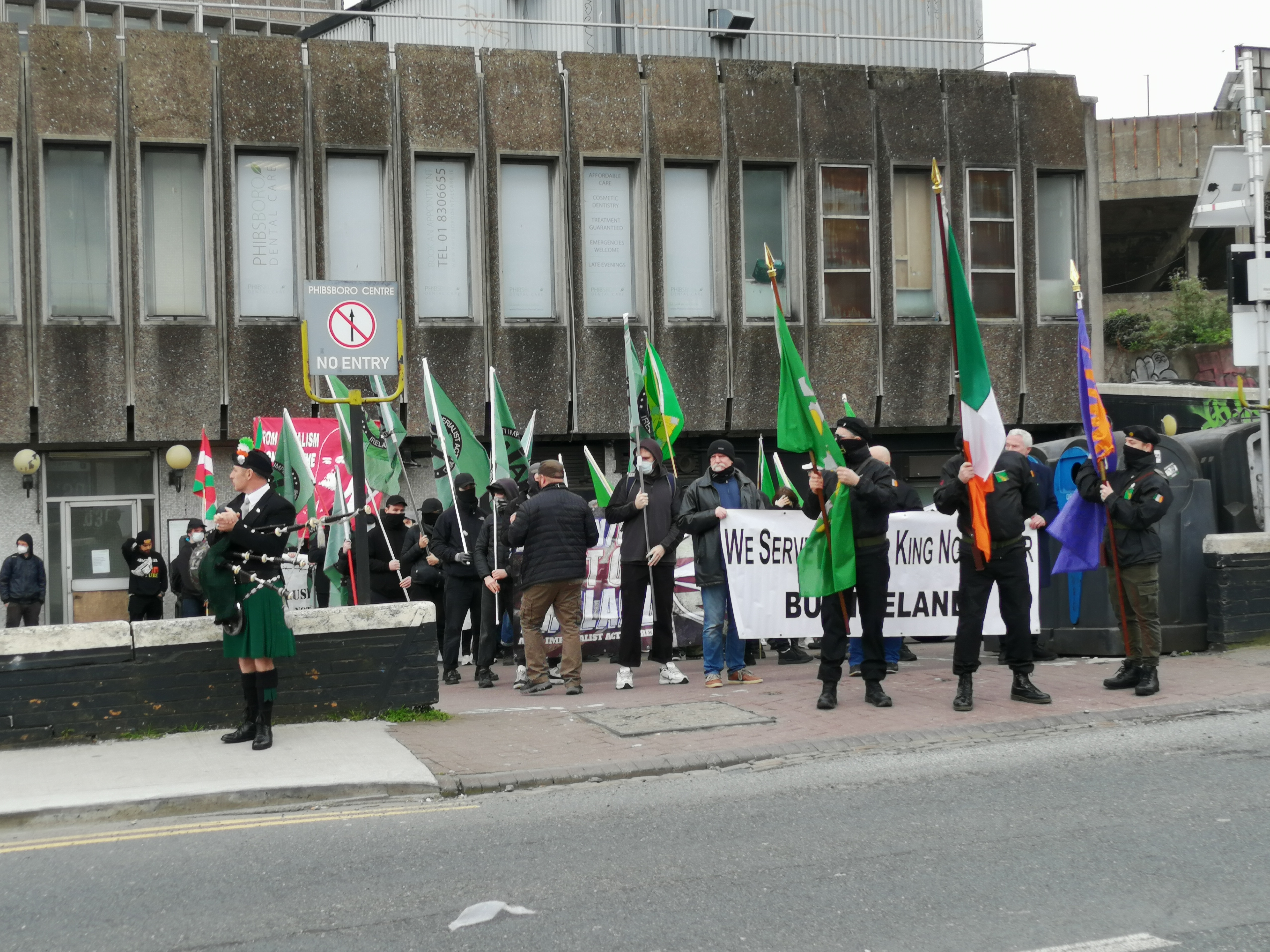
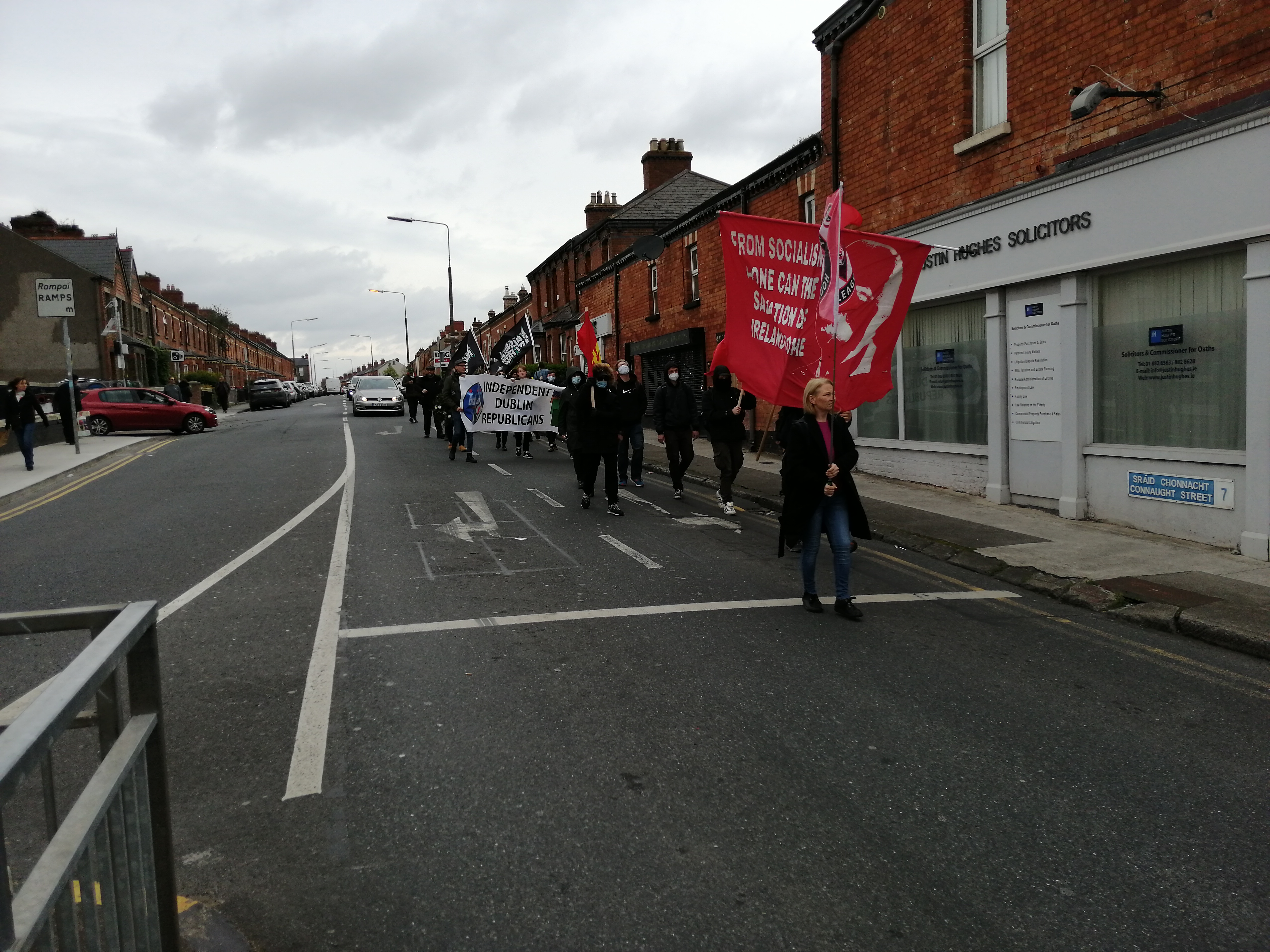
El domingo 9 Abril, gente asistiendo a la Conmemoración del Alzamiento de 1916 organizada por Acción Anti-Imperialista fueron acosados por la policía mientras encabezaban una marcha hacia el complot republicano del Ejército Ciudadano Irlandés en el cementerio dublinés de Glasnevin.
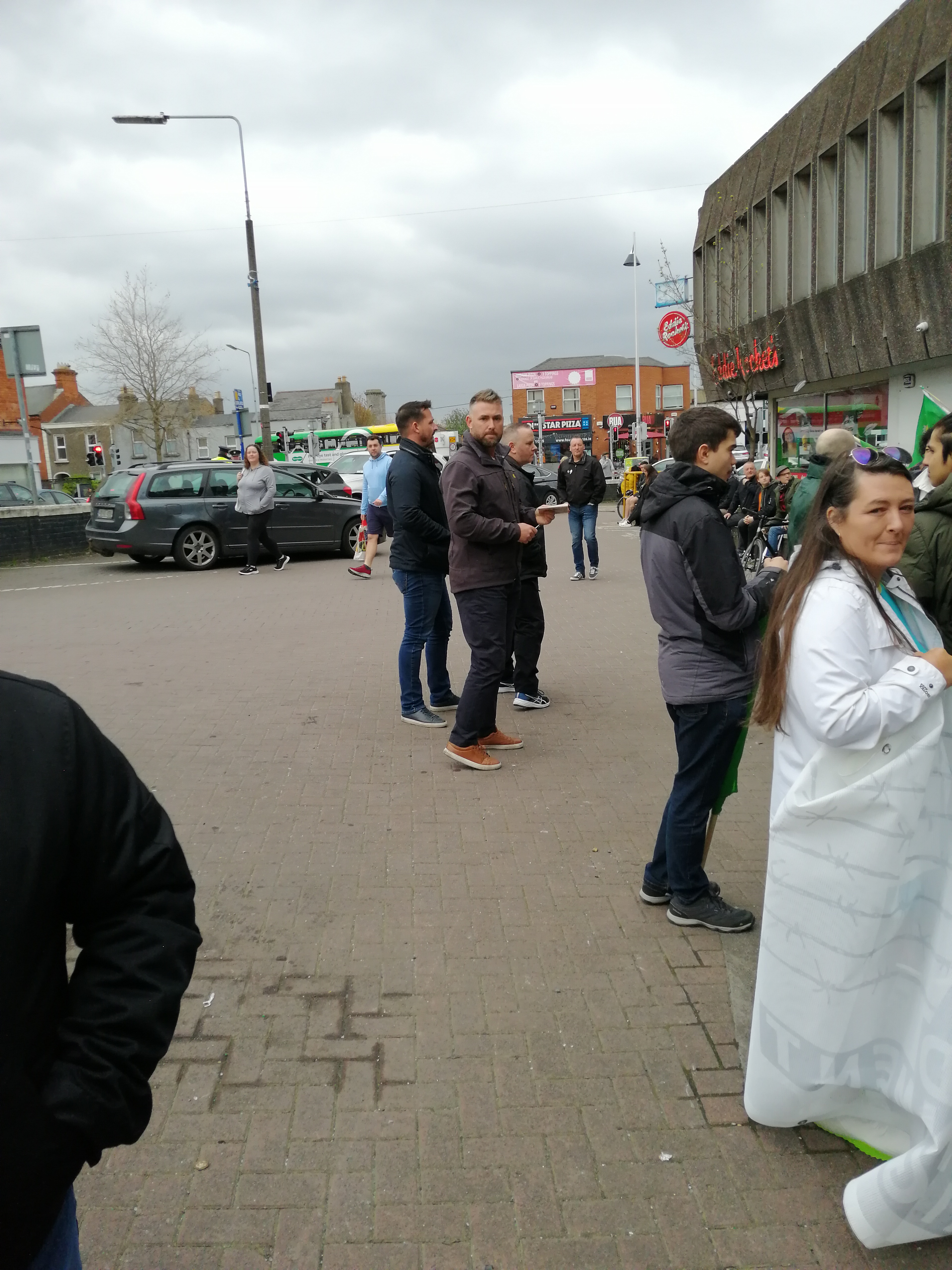
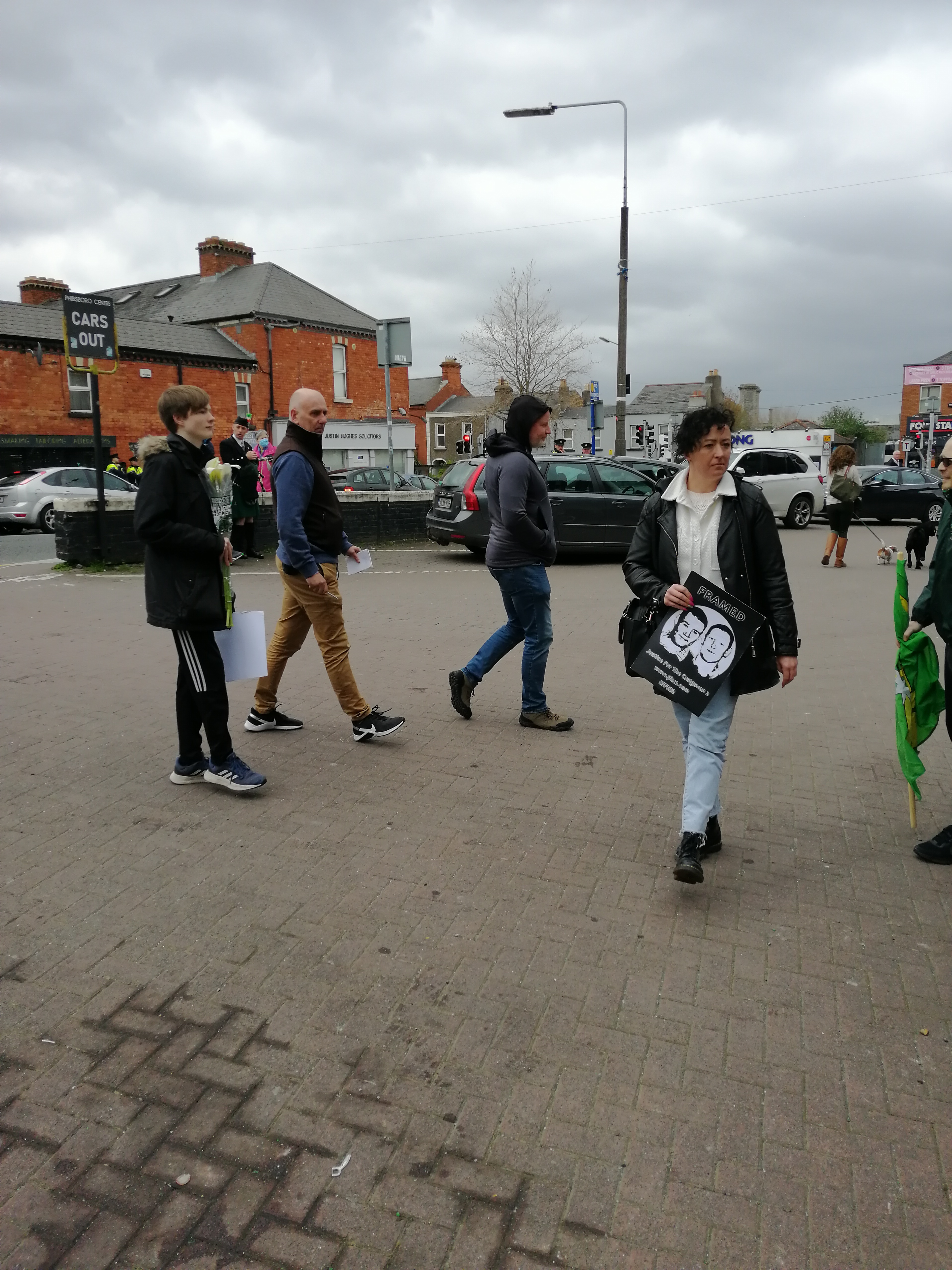
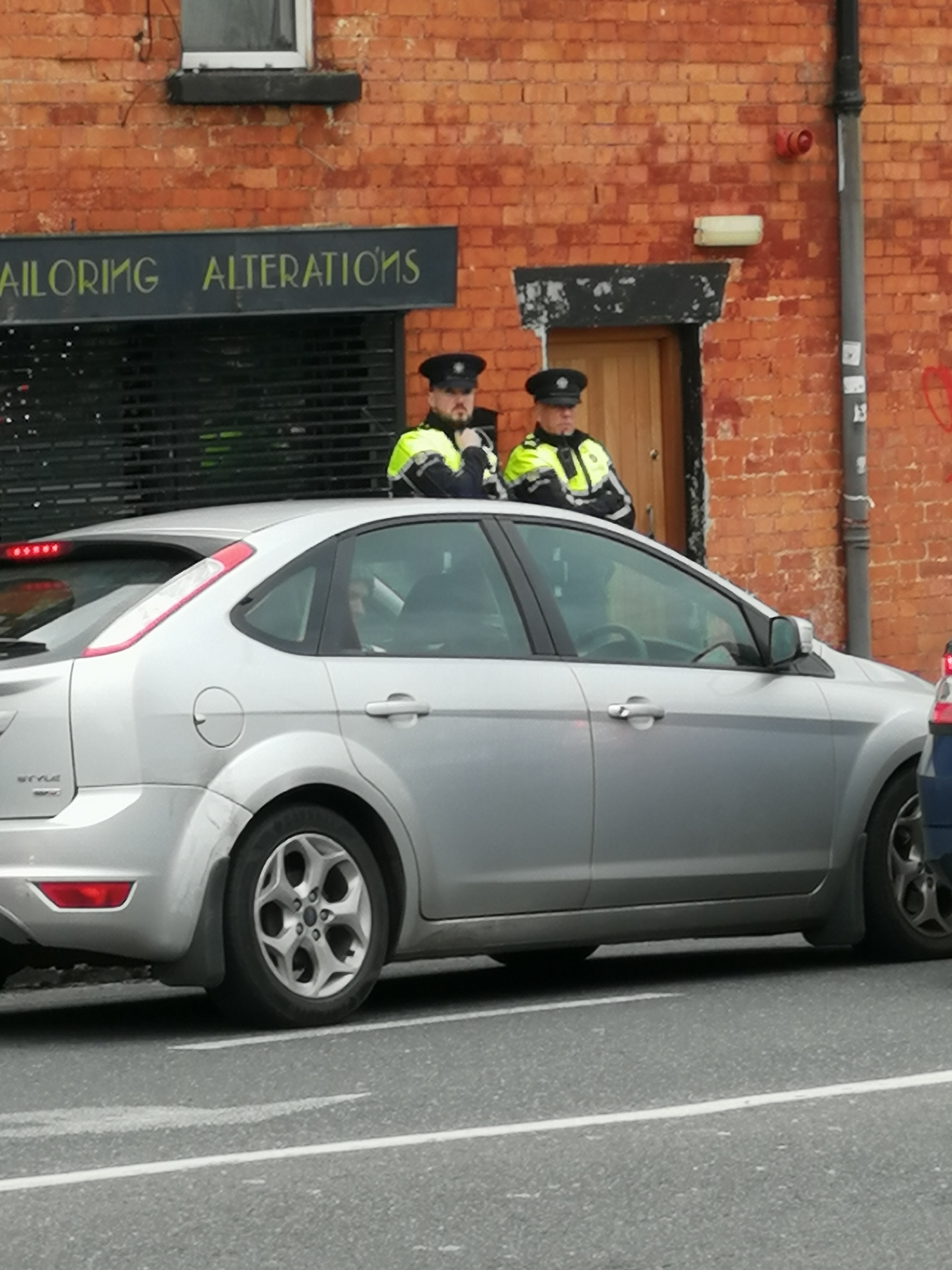
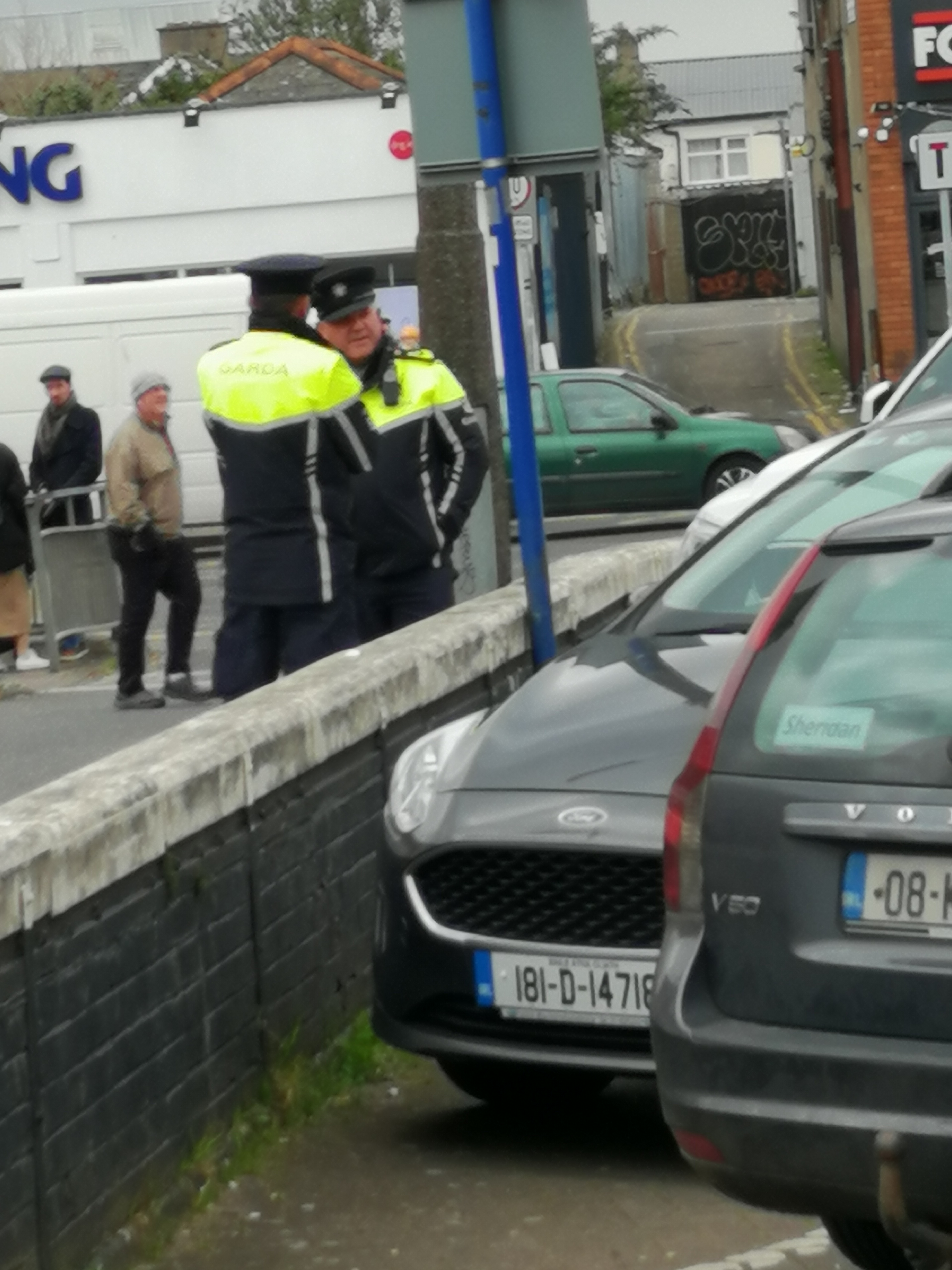
Seis policías políticos vestidos de paisano caminaron entre los asistentes junto a las tiendas de Phibsborough identificando los participantes, la mayoría de los cuales eran bastante jóvenes. Cerca también se encontraban cuatro uniformados de la Garda y una camioneta de la Unidad de Orden Público estacionada en la entrada del cementerio.
El desfile se prepara a partir. (Foto: D.Breatnach)Centro y a la derecha de la foto, cuatro de la policia politica preparando a hostigar a los asistentes. (Foto: D.Breatnach)Centro de la foto: dos de la policia politica de paisano — el calvo hacia chistes mientras hostigaba a los asistentes. (Foto: D.Breatnach)
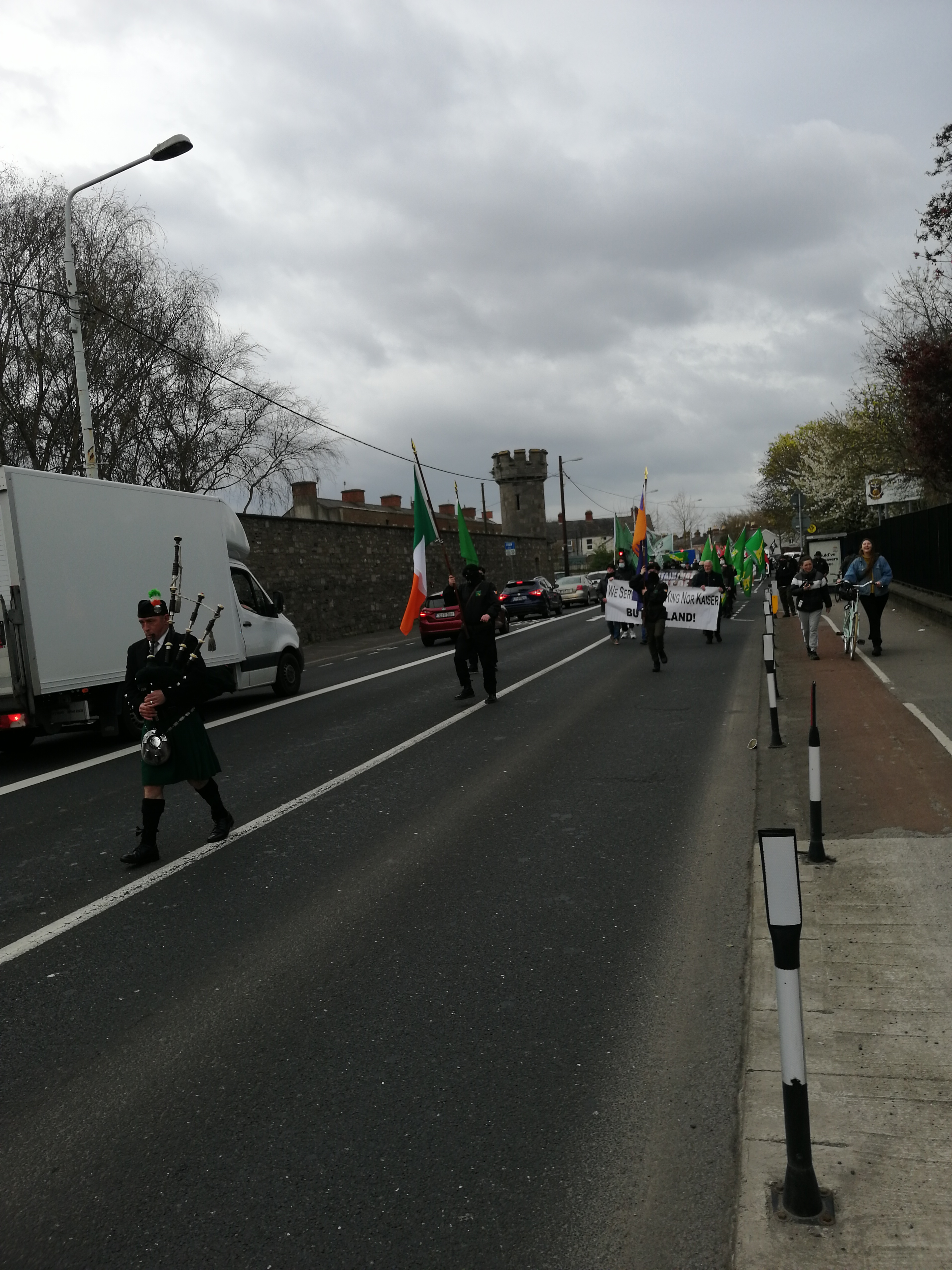
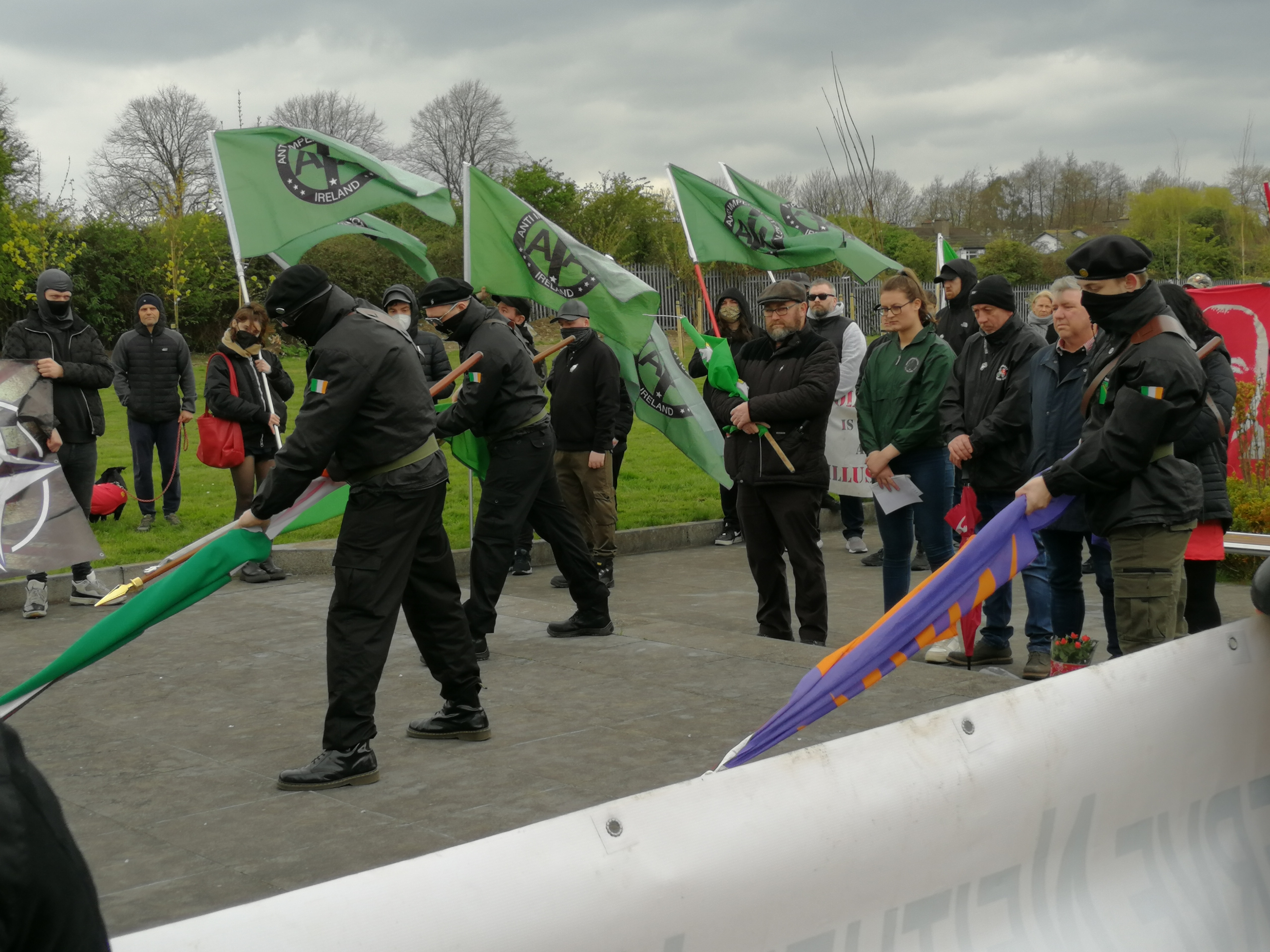
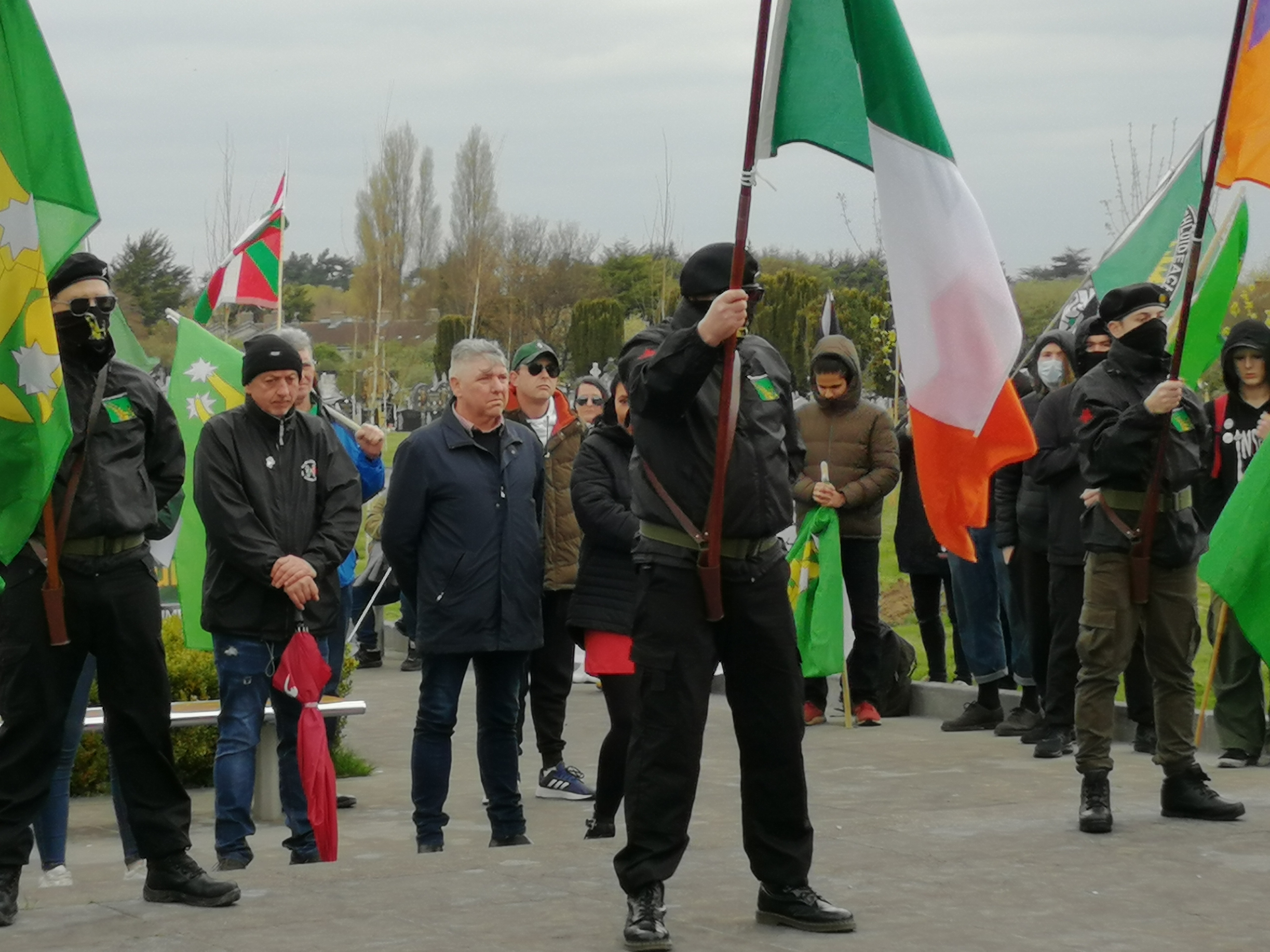
Los participantes no se dejaron intimidar y emprendieron su marcha, encabezados por un gaitero solitario que tocaba aires de marcha irlandeses, seguido de un ‘colour party’ con diferentes pancartas intercaladas entre los manifestantes, entre las que ondeaban muchas banderas.
Los organizadores se enteraron de que la policía había impedido que el carruaje que transportaba a los miembros de una Banda de Flauta Republicana de escocés que encabezaría el desfile tomara el ferry a Irlanda.
(Foto: D.Breatnach)
(Foto: D.Breatnach)
(Foto: D.Breatnach)
Antecedentes históricos
En 1916, una amplia alianza de los Voluntarios Irlandeses, el Ejército de Ciudadanos Irlandeses, Cumann na mBan, na Fianna Éireann e Hibernian Rifles(1) participó en un Alzamiento organizado por la Hermandad Republicana Irlandesa contra el dominio británico en Irlanda y contra la guerra mundial.
Debido a una serie de circunstancias desafortunadas, el líder de los Voluntarios canceló el Levantamiento que, sin embargo, se llevó a cabo un día más tarde de lo planeado y se limitó en su mayor parte a Dublín, donde luchó una semana por un tercio de los números en el plan original.
El ejército británico de ocupación bombardeó el centro de la ciudad desde una cañonera en el río Liffey y también desde la artillería en tierra. Las explosiones y los incendios resultantes destruyeron gran parte del centro de la ciudad, incluida la Oficina General de Correos en la calle principal, que había sido el cuartel general de la insurrección.(2)
Después de una semana con el centro de la ciudad, incluido la OGC, en llamas, la guarnición rebelde evacuó hacia Moore Street, donde al día siguiente, rodeados y superados en número, se tomó la decisión de rendirse.(3)
Un tribunal militar británico condenó a muerte a casi un centenar de prisioneros. Todas menos quince de esas sentencias fueron conmutadas por largos períodos de cárcel.
Pero los siete firmantes de la Proclamación de 1916 (4) y otros siete fueron fusilados por un pelotón de fusilamiento británico en Dublín, un decimoquinto en Cork y, después del juicio, meses después, un decimosexto fue ahorcado en la cárcel de Pentonville, Londres.
En la Pascua de 1917, las mujeres socialistas y republicanas irlandesas conmemoraron el levantamiento de 1916.
Desde entonces, los republicanos irlandeses y a veces los socialistas en Irlanda y en muchas partes de la diáspora han conmemorado el levantamiento, ya sea legalmente5 o no, en la cárcel o en libertad.
La Guerra de la Independencia comenzó en 1919 con la participación de muchos de los sobrevivientes del Alzamiento6.
El desfile del domingo – memoria histórica local marcada
En Cross Guns Bridge sobre el Royal Canal, el desfile se detuvo y se encendieron bengalas en memoria de los eventos allí en 1916.
El lunes de Pascua de 1916, un pequeño grupo de voluntarios irlandeses había andado desde Maynooth a lo largo de la orilla del canal para unirse al levantamiento en Dublín encontró vigilando el puente a dos voluntarios irlandeses que les aconsejaron que esperaran hasta el día siguiente para ir al centro de la ciudad.
El grupo de Maynooth pasó la noche en Glasnevin y al día siguiente entró en la Ofecina General de Correos (que servia de cuartel general del Alzamiento), pasando por el puente Cross Guns vacío en el camino. De regreso a Phibsborough, la artillería británica voló una barricada y mató a Seán Healy, miembro del grupo juvenil na Fianna en el Cruce del North Circular Road.
Más tarde, la unidad Dublin Fusiliers del ejército británico bloqueó el puente, impidiendo que la gente lo cruzara en cualquier dirección. Mataron a tiros a un lugareño sordo que no respondió a su desafío porque no lo escuchó.
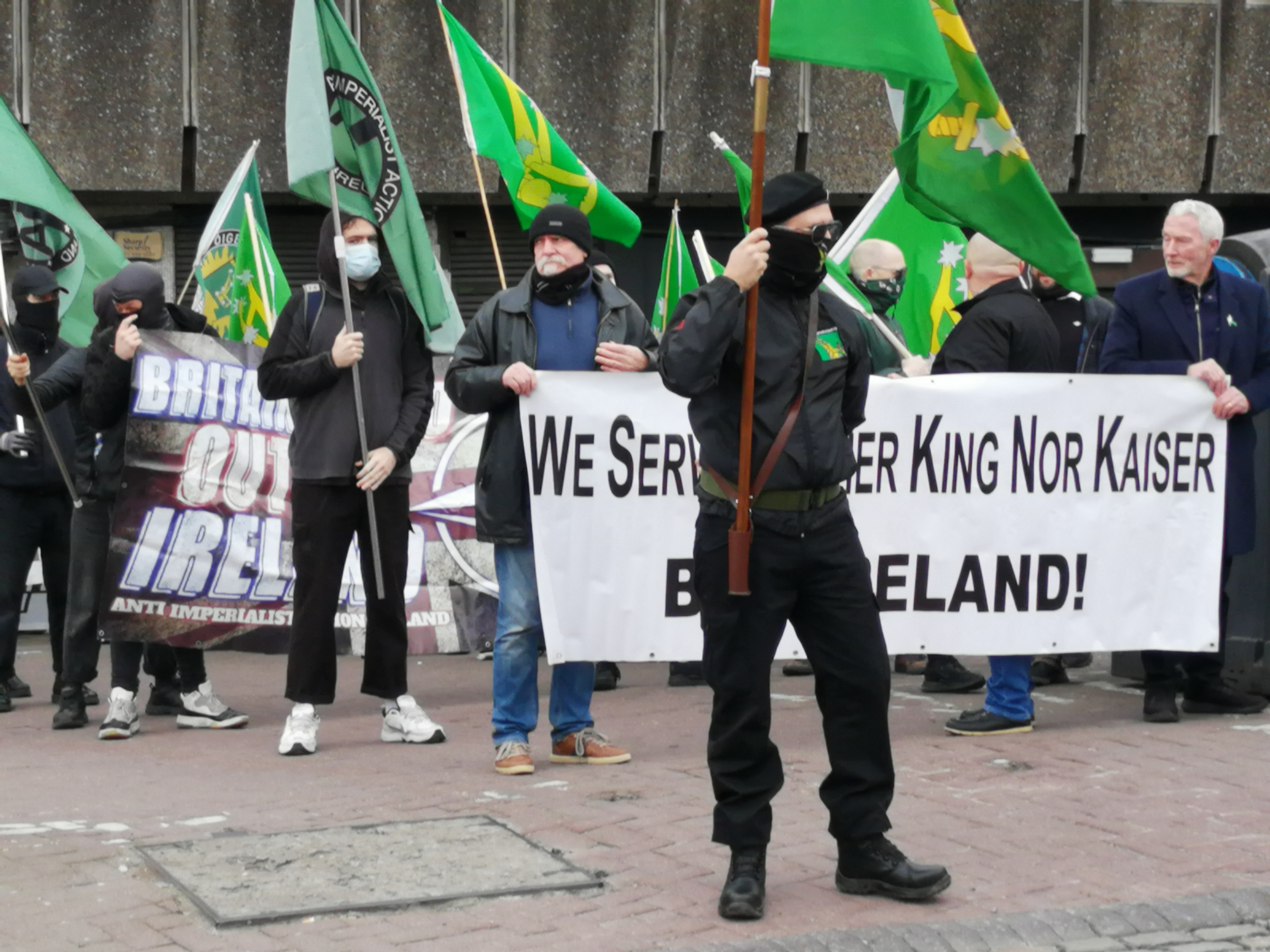
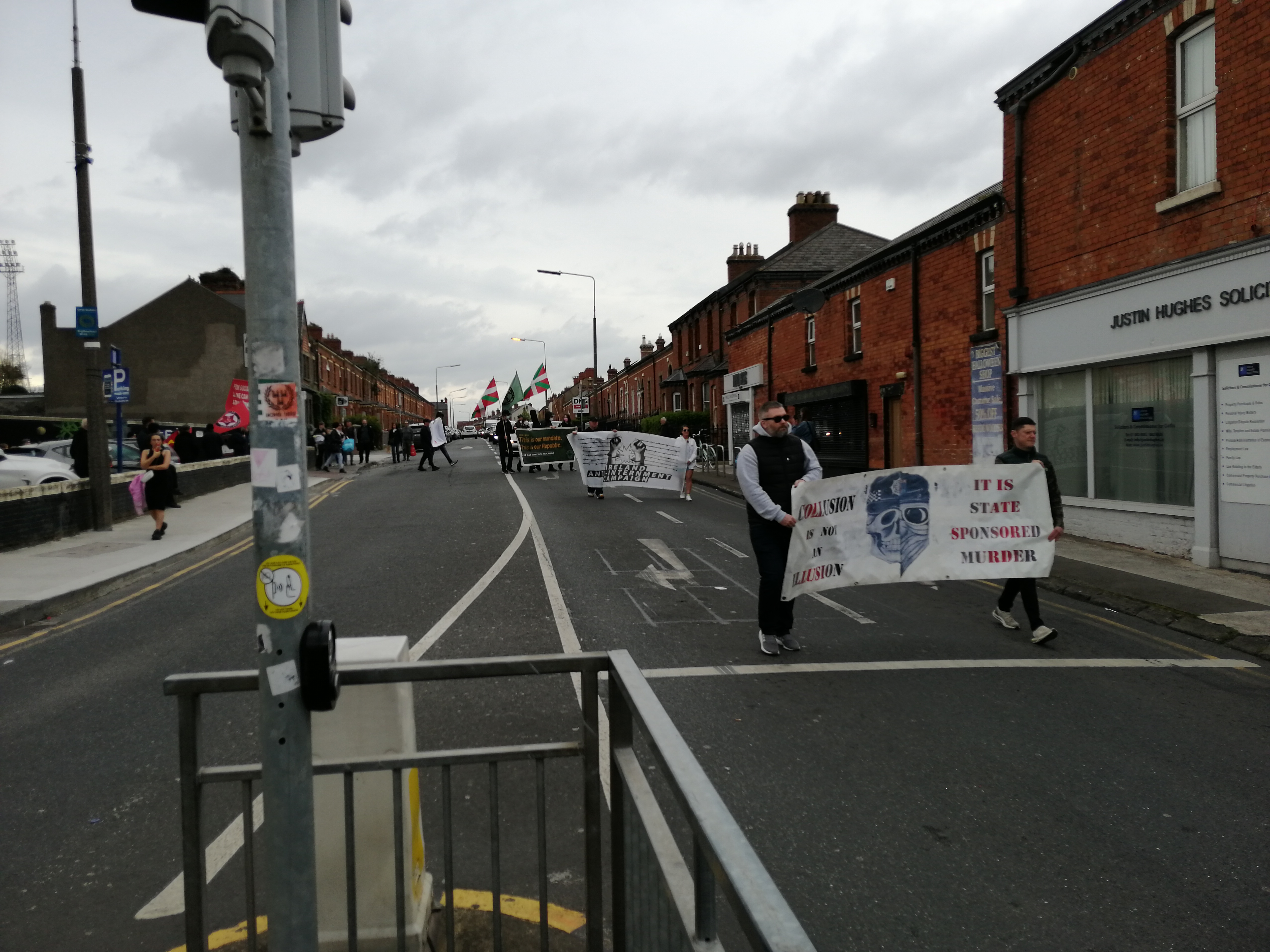
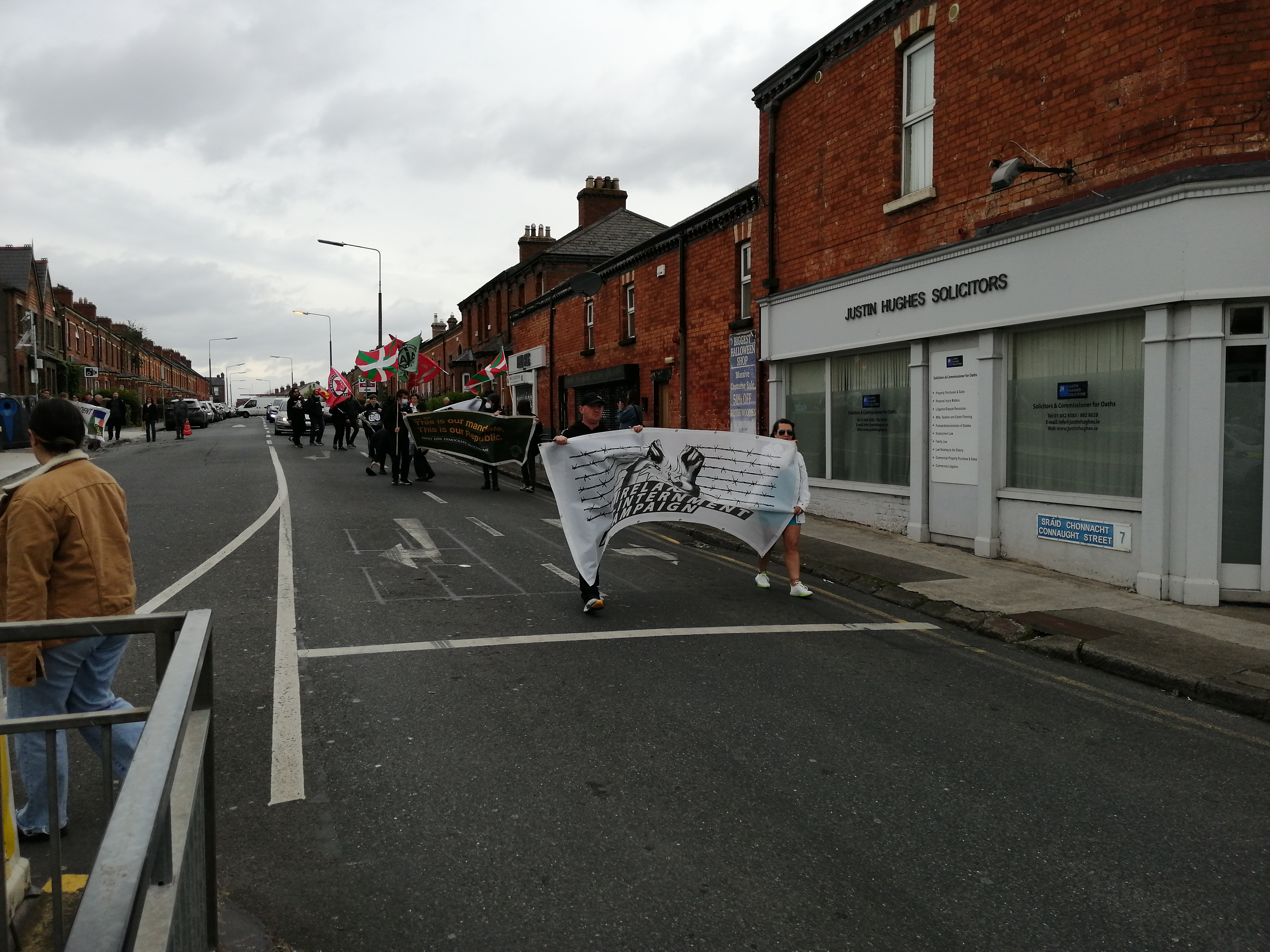
“No servimos ni al rey ni al káiser, pero a Irlanda” declaró una pancarta que se llevó el domingo pasado, “Gran Bretaña/OTAN fuera de Irlanda” otra, “Este Es Nuestro Mandato(7), Nuestra República” y “La colusión no es una ilusión, es un asesinato patrocinado por el estado” fueron otras dos.
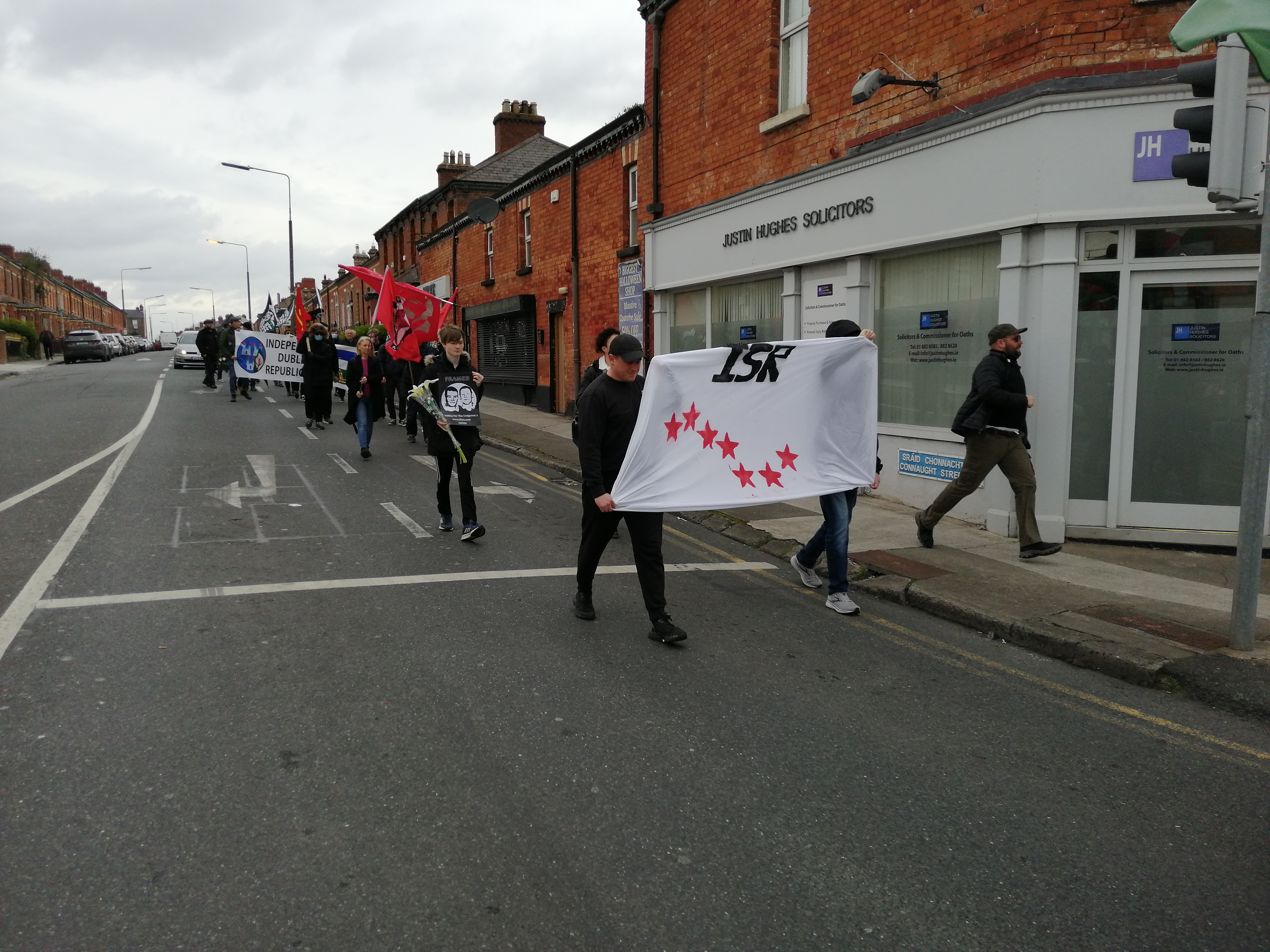
Una gran pancarta también declaraba junto a la imagen de James Connolly que “solo el socialismo puede ser la solución para Irlanda”. Algunas organizaciones también llevaron sus propias pancartas, como las de los Republicanos Independientes de Dublín, la Campaña contra la Internación de Irlanda y los Republicanos Socialistas Irlandeses.
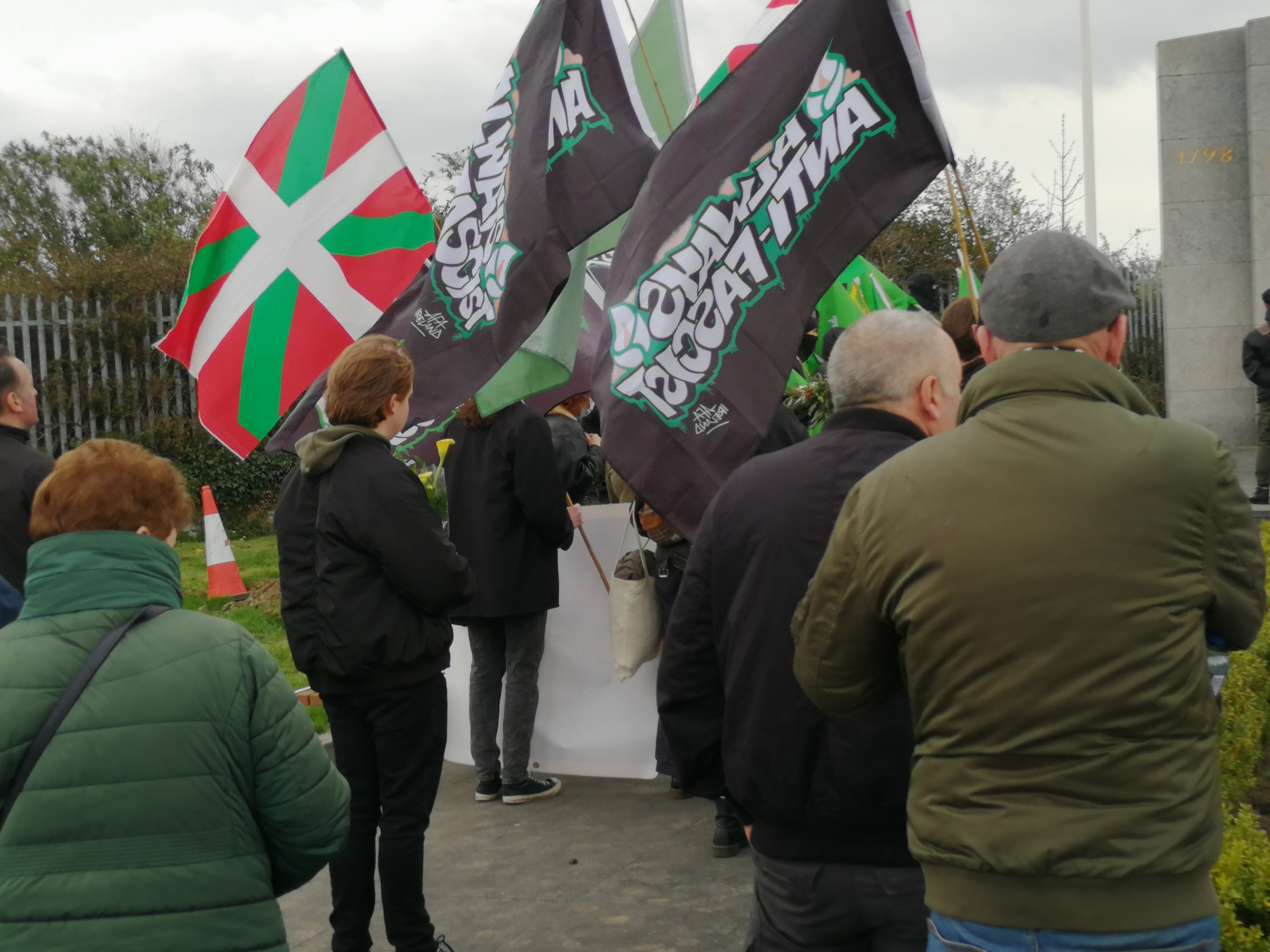
Las banderas que ondeaban incluían las que llevaban el logo del grupo organizador Acción Anti-imperialista y otras con el lema “Siempre Antifascistas”, Arados Estrellados verde y dorado, un par de Ikurrinak (banderas vascas) y otras dos de Roja con el Martillo & Hoz en amarillo.
(Foto: D.Breatnach)
Republicanos Socialistas de Irlanda (Foto: D.Breatnach)
(Foto: D.Breatnach)
Campana Anti-Internacion de Irlanda (Foto: D.Breatnach)
(Foto: D.Breatnach)
En el Monumento: discursos y cantos
El cementerio de Glasnevin (Reilig Ghlas Naíonn) cubre más de 120 acres en el norte de la ciudad de Dublín y está dividido en dos partes, cada una con parcelas republicanas separadas por Cabra Road y contiene las tumbas de personas entre famosas y comunes.
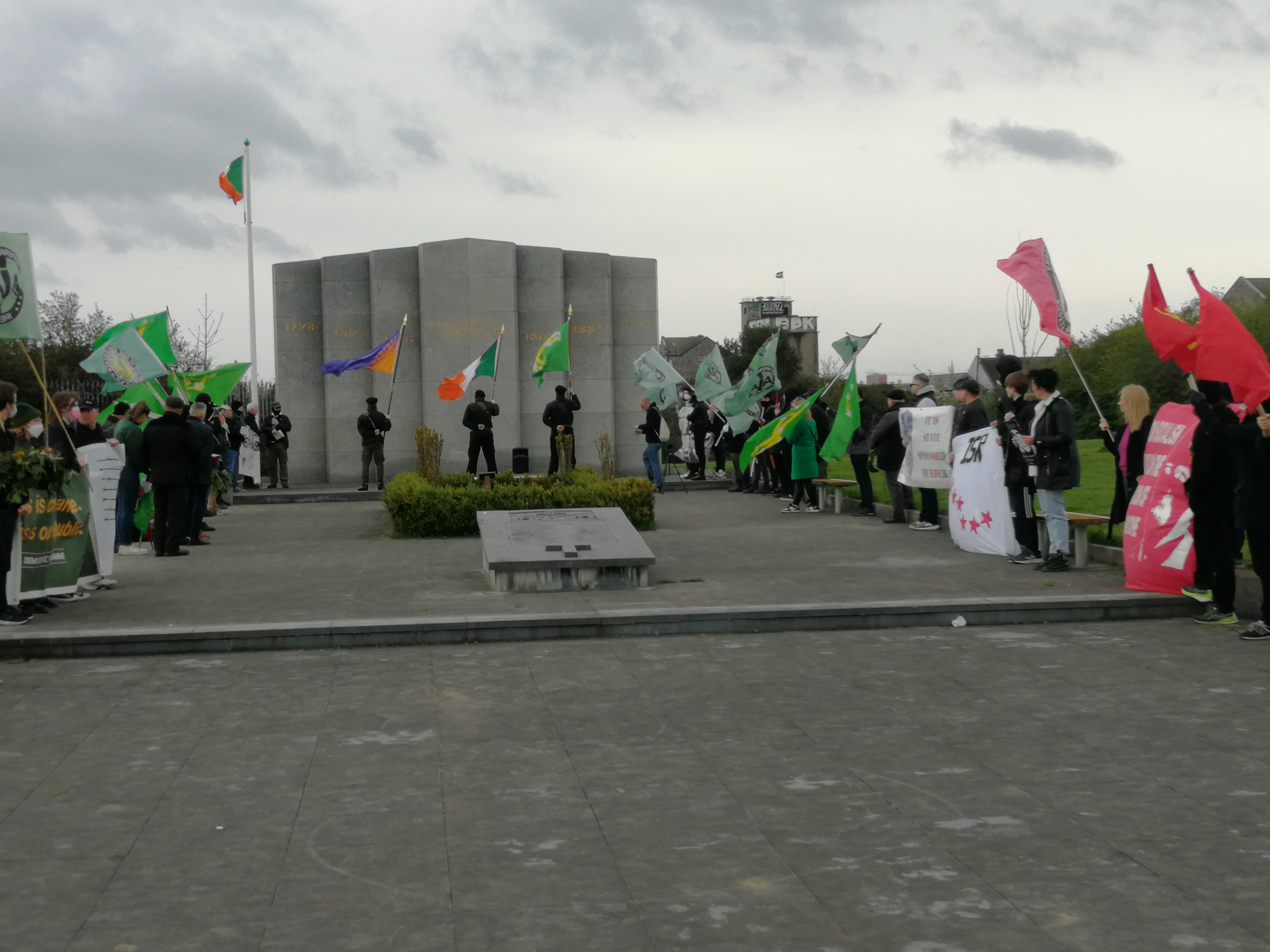
Por el lado norte también se encuentra el acceso a los Jardines Botánicos, ambos en la margen sur del río Tolka. El imponente Monumento a numerosos alzamientos republicanos y complot al Ejército Ciudadano Irlandés está en el lado sur, cruzando el puente peatonal sobre la vía del tren.
(Foto: D.Breatnach)
Un hombre presidió el evento de la Acción Anti-imperialista y habló brevemente, presentando a las personas para las lecturas (todas de James Connolly) y para los discursos. Las presentaciones de estos se dividieron equitativamente entre hombres y mujeres, siendo tres de ellos de jóvenes.
Se cantaron tres canciones: una mujer cantó The Foggy Dew (de Charles O’Neill) y Erin Go Bragh (de Peadar Kearney), mientras que un hombre cantó Where Is Our James Connolly? de Patrick Galvin. Dos mujeres leyeron piezas de James Connolly y otra leyó la Proclamación de 1916.
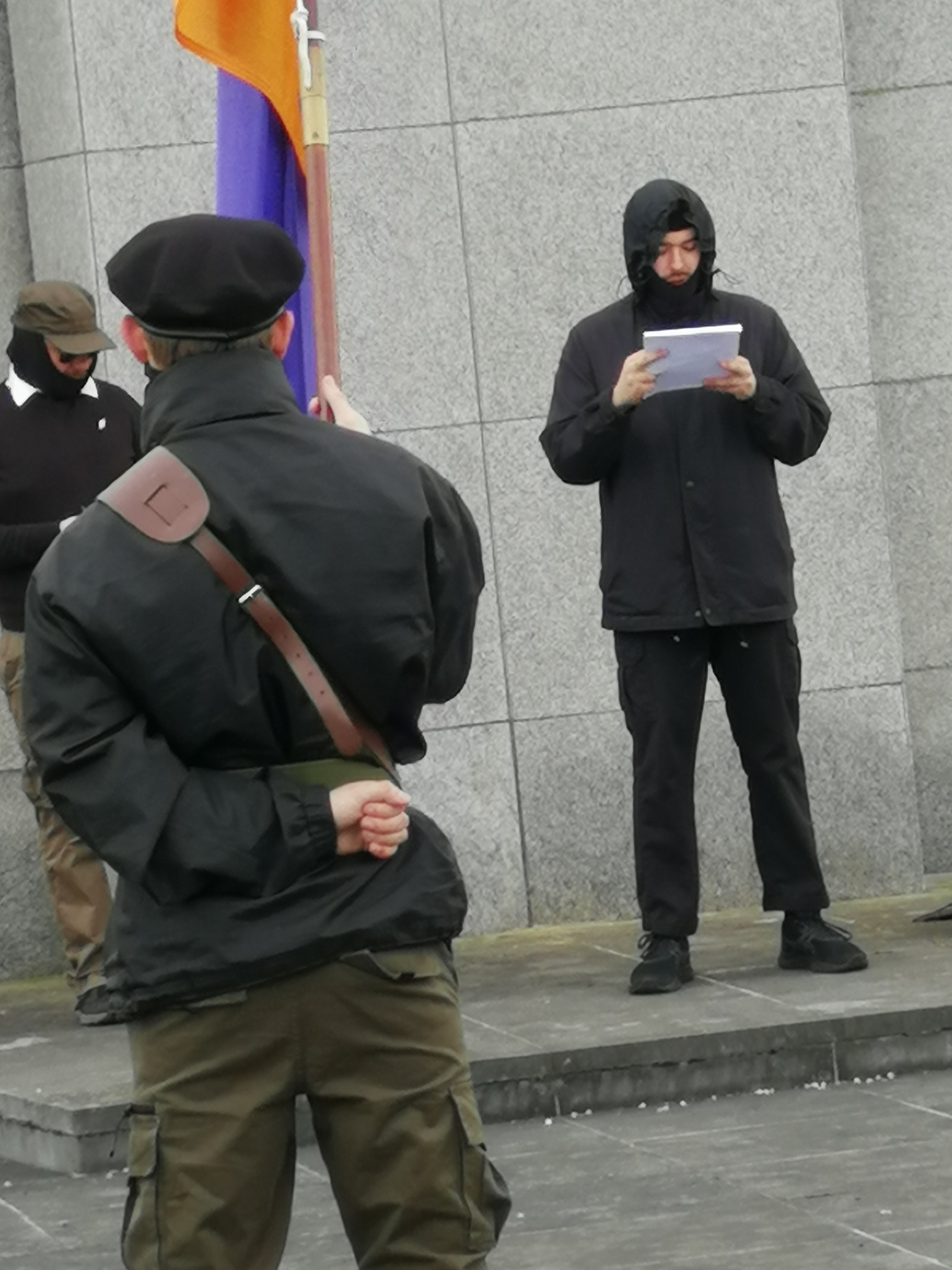
Un lector (Foto: D.Breatnach)
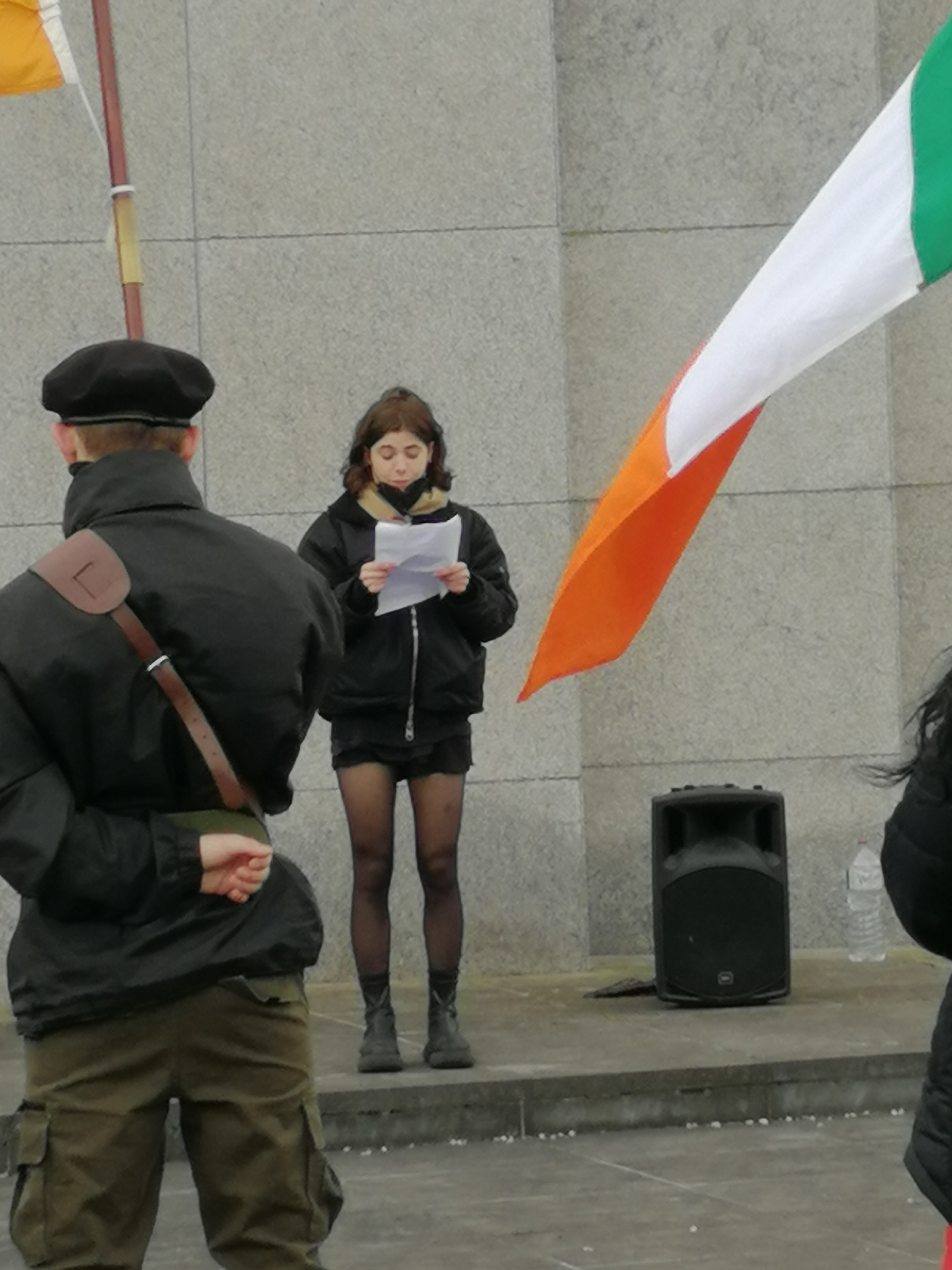
Una lectora (Foto: D.Breatnach)
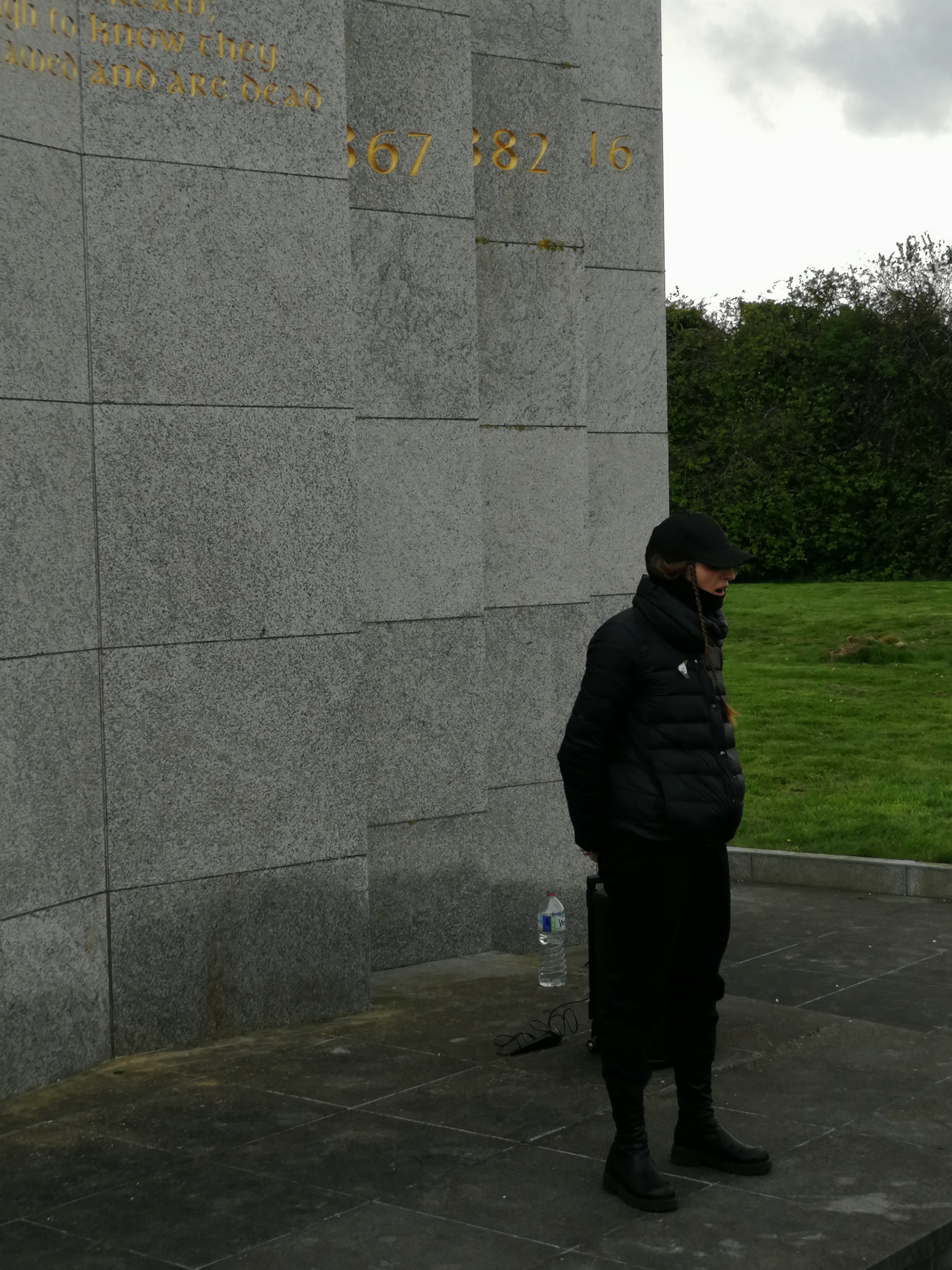
Una cantante (Foto: D.Breatnach)
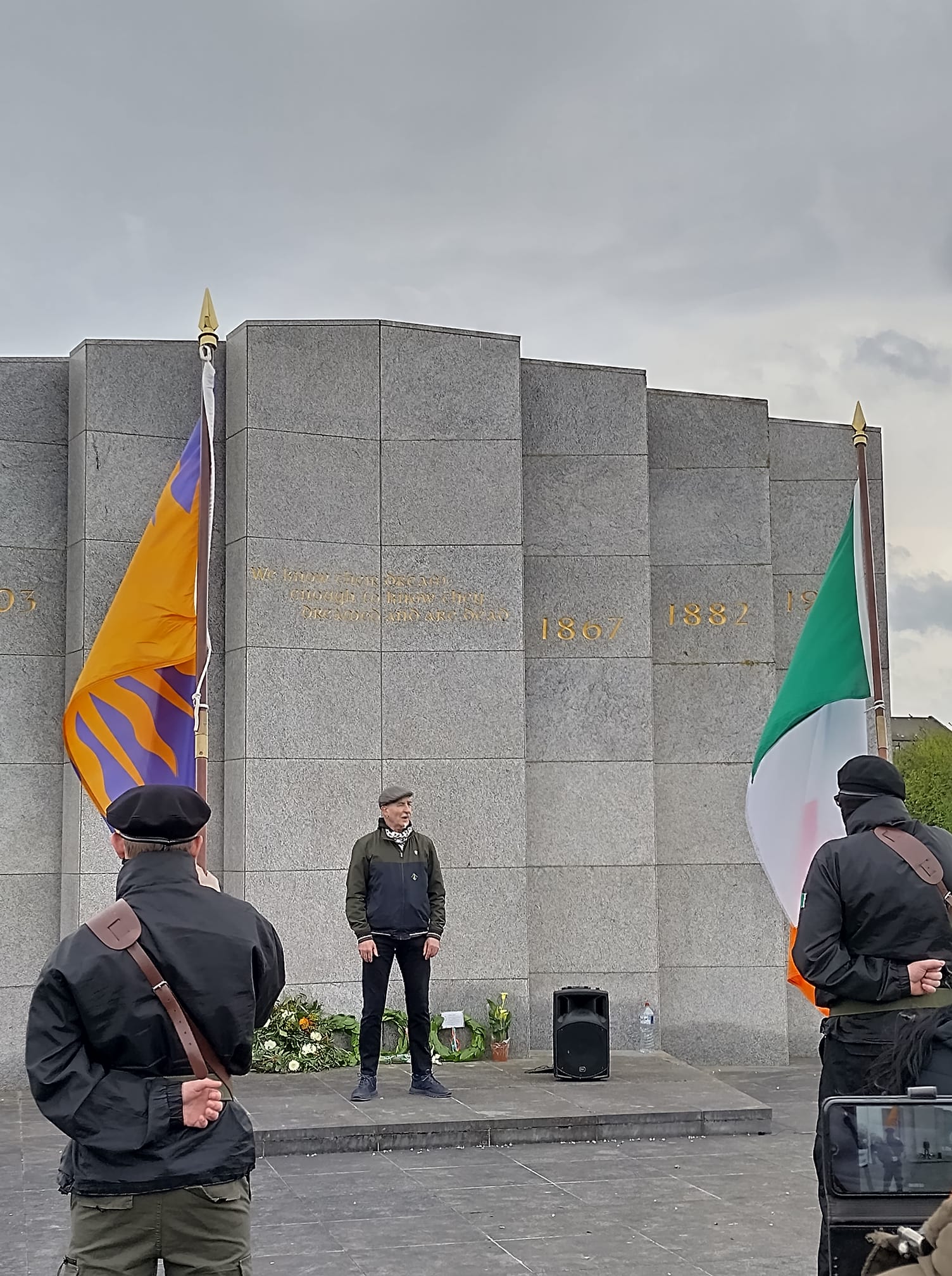
Uno de los cantantes.
Las palabras del presidente y de los oradores fueron diferentes pero hubo temas comunes: defender el espíritu histórico de resistencia irlandés, la importancia de la clase trabajadora en la historia y el objetivo de una República socialista que abarque a toda la nación irlandesa.
Estas palabras se equilibraron con la denuncia del imperialismo estadounidense y británico y la ocupación colonial/OTAN de los Seis Condados por parte de este último; el régimen cliente irlandés; los tribunales especiales sin jurado(8) de ambas administraciones en Irlanda y la represión por parte de las fuerzas policiales y el ejército de ocupación.
También se denunciaron aquellos partidos políticos que habían abandonado la lucha por la República y en su lugar habían pasado a formar parte de las administraciones coloniales y neo-coloniales o, en este último caso, que estaban en vías de serlo.(9)
Representantes de organizaciones nombradas colocaron tributos florales y luego otros se adelantaron para colocar tributos florales también.
El presidente agradeció la asistencia de todos, nombró a las organizaciones por nombre y advirtió a todos que se mantuvieran juntos mientras se marchaban, debido a la presencia amenazante de Gardaí y, en particular, de la Unidad de Orden Público. En el evento, los celebrantes salieron del cementerio y se dispersaron sin incidentes.
Pero esa noche los domicilios de algunos sufrieron redadas policiales y algunos detenidos bajo ley represiva del Estado para quedar dos dias en comisaria y liberados sin, por ahora, carga.
Fin.
Banderas de Euskal Herria cerca de las anti-fascistas de Irlanda (Foto: D.Breatnach)
El colour party baja las banderas en homenaje a los caidos en la lucha (Foto: D.Breatnach)
El colour party levanta las banderas de nuevo en simbolismo de que la lucha continua, el pueblo de pie. (Foto: D.Breatnach)
NOTAS AL PIE
1Una pequeña unidad, un brazo armado de una escisión de la versión estadounidense más socialmente conservadora de la Antigua Orden de los Hibernianos, su participación en el Alzamiento fue notable.
2Las fotos de gran parte de la destrucción están disponibles en Internet y se puede acceder a ellas mediante un navegador de búsqueda.
3La terraza que ocuparon sigue en pie y es objeto de una lucha de memoria histórica y conservación contra los planes especuladores inmobiliarios aprobados por oficiales del Municipio y los partidos políticos del Gobierno (ver smsfd.ie).
4Un documento notable, cuyo texto está disponible en muchas publicaciones en Internet.
5 Las mujeres irlandesas lo conmemoraron en público en contravención de la legislación marcial británica de la Primera Guerra Mundial en 1917 y 1918 y durante décadas la conmemoración pública del Levantamiento de 1916 (e incluso el vuelo del Tricolor Irlandés) estuvo prohibida en la colonia británica de los Seis Condados con ataques policiales colones ante cualquier intento de hacerlo.
6 A veces llamada incorrectamente “la Guerra Tan” (referencia a una fuerza auxiliar especial de la policía colonial que se conoció como “Black n’ Tans”), la guerra vio el nacimiento del IRA y duró desde 1919-1921. Una propuesta de “paz” británica abrió profundas divisiones en la coalición nacionalista y fue seguida por una Guerra Civil de 1922-1923, en la que el gobierno pro-Tratado y sus fuerzas armadas fueron armados y abastecidos por los británicos para derrotar a los republicanos en una campaña de represión. Y con encarcelamientos, acciones militares, secuestros y torturas, asesinatos de presos, asesinatos y más de 80 ejecuciones formales.
7 También se muestra texto referente al Programa Democrático del Primer Dáil de 1919.
8 El tribunal Diplock en la colonia y los Tribunales Penales Especiales en el Estado Irlandés, tribunales especiales políticos en todo menos en el nombre, con un nivel de prueba bajo y una tasa de condena anormalmente alta y denegación de fianza mientras se espera el juicio.
9 Referencias a 1) la década de 1930 se escindió del partido Sinn Féin, el partido político Fianna Fáil que se convirtió en el partido gubernamental preferido de la burguesía gobernante irlandesa dependiente del exterior y 2) al partido Sinn Féin Provisional que respaldó el plan de pacificación británico en 1998 y emprendió el camino de convertirse en un partido del nacionalismo reformista en la colonia y en este momento se encamina hacia un gobierno de coalición neocolonial (y neoliberal capitalista).
Car alarms are mostly of a kind, emitting shrill noise. But why not have them use voice? And why not allow the car-owner to choose from a variety of voice alarms, find one perhaps more suited to their own personality?
Don’t forget, you saw this idea and this selection here first!
SIX CATEGORIES, VARIOUS MODELS
Insistent (2 models)
(in English public school accent – not recommended for certain areas of Ireland, Scotland, Wales or inner-city England) You are crowding me. Please desist. In other words, stop!
B. (gradually increasing in volume)
This is not your car. You are not an authorised driver. You are performing an illegal act. There are serious consequences. You must stop now.
This is not your car. You are not an authorised driver. You are performing an illegal act. There are serious consequences. You must stop now.
This is not your car. You are not an authorised driver. You are performing an illegal act. There are serious consequences. You must stop now. (etc.)
Threateningselection (6 models)
A. (in northern USA accent) Step away from the car. STEP AWAY FROM THE CAR. DO IT NOW!
B. SMILE. THANK YOU. YOUR PHOTO IS ON ITS WAY TO THE POLICE.
C. God does not like you standing too near me or trying my door handle. He sees everything you do.
D. Stand back. You are about to receive a mega electric shock. Charging …
E. SCRATCH MY CAR AND PREPARE TO DIE. (available in a selection of accents, from Russian mafia to LA Gangsta).
F. That spike you have just received from my door handle has taken a sample of your DNA and carries a powerful sleep drug. You have seconds before you collapse. Find somewhere safe to lie down.
Sinister (1 model)
Yes, come in, come in! Welcome! Welcome! I’ve been waiting for someone like you. Just like you. Never mind the bloodstains. Just an accident. Or two. Come in, come in! (Available in a variety of voices, creaky, sibilant, etc.)
Persuasiveselection (2 models)
A. You’d steal a Metro? Seriously?
B. Yes, yes, listen to my voice. Breathe deeply. Lisssten to my voice. You feel com-fort-ably warrrrm and relaxed. Tot-all-y rel-axed. You don’t want to steal a car any more. Certainly not this one. You want to find a cafe and sit in it. Tot-all-y rel-axed. You will leave now.
Attention-attracting with Embarrassment Deterrence selection (5 models)
A. HELP! I AM BEING BROKEN INTO! HELP!
B. BARRRP! (Yes, a loud fart-noise. With sewer smell). BRAAPP! BARRRP!
C. I HAVE DISCHARGED A BAG OF URINE ON YOUR LEG. IT CARRIES A PERMANENT PURPLE DYE TOO.
D. EVERYBODY! THE PERSON STANDING BY THIS CAR IS A CHILD MOLESTER AND TORTURES PUPPIES AND KITTENS!
E. Ooh! Ah, stop. That tickles. No. Ahahahaha! No, please! No! AHAHAHAHAHA! Oh gosh, stop, please stop. Ahahahahaha!
Other
Think about what you’re doing. Do you really want to steal this car? Think about the conseq …










 rebelbreeze