Ian Paisley addressing an outdoor meeting in typical style
Ian Paisley died on 12th September, five days ago. Much of the mass media portrayed him a man who participated in building peace in the Six Counties. Some of the media painted a different picture or, at least, permitted a different telling of his story. I have searched for but failed to find a photo I remember from decades ago, in the early days of the campaign for civil rights for Catholics in that sectarian colonial statelet, a photo of Ian Paisley and Ronald Bunting standing side by side. In Bunting’s right hand was a pick-axe handle. It was around the time of the Burntollet Ambush of Civil Rights campaigners (who were marched into it by the good old RUC, nowadays the Police Service of Northern Ireland). At Burntollet, the B-Specials and civilian Loyalists had pickaxe handles too, and rocks as well.
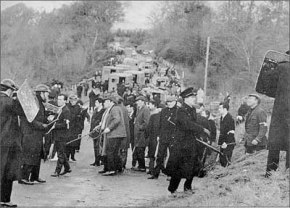
Loyalists waiting to attack Civil Rights marchers at Burntollet Bridge mingle with RUC, January 1969.Civil Rights marchers duck from hail of missiles while RUC stand by. Note clubs also wielded by Loyalists, many of them also police reservists.
In an interview around that time, side by side with Ronald Bunting, Paisley made much of how law-abiding they and their crowd were. They could afford to be, since the statelet’s laws gave it enormous powers which nullified every civil right the large Catholic minority might try to use. But illegal violence was never far from the weapons of the State and its Loyalist supporters, to which the imperial master usually turned a blind eye (as it had to the landing of weapons in 1914, including 30.000 assorted rifles with ammunition at Larne and Donaghdee for the Ulster Volunteer Force). Nevertheless, Ian spouted in public about law and order – an old trick of fascists who have their armed thugs already breaking the law … and arms and legs too.
Not long after, Paisley and Bunting went to jail for breaking the law, as the statelet’s rulers strove to control them and also to show the world how “fair” and “even-handed” they were. Unfortunately for them at that time, the world had already seen and was to see more of it – and it was not a pretty picture.
An ex-British Army Major, Bunting had his own paramilitary unit and though he was somewhat sidelined later for a decade, who knows where he might have ended were it not for the 1980 murder of his son, Ronnie, who had joined the Official IRA and later the Irish National Liberation Army. Ronnie was murdered by SAS or Loyalists and after that, the grieving father dropped completely out of politics.
Paisley broke away from his Unionist Party because he could not rise high enough in it, could not control it and so he created his own party, the Democratic Unionist Party. He broke away from his Presbyterian Church for the same reason and created his own, making himself a vicar and Moderator of it. He never joined the Orange Order, perhaps because he did not wish to be answerable to it. When Bernadette (Devlin) McAlliskey warned people not to fear the DUP but rather the Official Unionist Party (so named to distinguish it from other unionist parties), because the former represented the real colonial power in the Six Counties, she could not have anticipated that Paisley would adapt, outflank the Official Unionists and gather the support of the old colonial class and their imperial masters. (As an aside, it’s a curious fact that in Ireland, calling one’s party the “Official” version, is to invite outflanking and eventual marginalisation).
Paisley was a skilfull demagogue and those who, in Britain or in the 26 Counties, laughed at him and his rabid roaring oratory, underestimated him. For he was not talking to them, even when giving an interview on TV, but to his own die-hard Loyalist audience. And most of them loved “Big Ian” or “Bigyan”, even if some of the paramilitary leaders thought at times that he was trying to manipulate them for his own ends (for example, during the Ulster Workers’ Strike of 1974) .
But when different times called for a different act, a different Ian emerged. A man of many smiles, a man who could go back on most of what he had said to his troops when he felt the time was right, a man who could play his part in the newest game of the British Empire in their colony, that of power-sharing with Provisional Sinn Féin, just as the latter’s leadership too adjusted to play the new game, now “the only game in town” for them.
Paisley was a fundamentalist Protestant from the ranks of the “Dissenter” churches, those who opposed the established Anglican church of the imperial state and many of whom had in 1798 taken arms against that state for Irish independence. But those dissenting churches had by now been purged and were loyal servants of the Empire, though still dissenters in religion. Echoing the old Loyalist slogan from the early years of the last century that “Home Rule is Rome rule”, Paisley fulminated against any involvement in Six County affairs by the 26 County “Free State” and also ranted against the Catholic Pope, “the Scarlet Harlot”.
Those who rightly condemn the Catholic Church’s control of the Irish state often forget that the Six County state was as fundamentalist and restrictive in most things. Divorce was already party of UK law when Ireland was partitioned and was incorporated into the new statelet. Contraception was later permitted under UK legislation and entered the Six Counties largely without problem. But they drew the line at gay rights, even after the Sexual Offences Act of 1967 decriminalised sexual acts between consenting males of 21 years of age or over in England and Wales (lowered to 18 years of age only in 1994 and to 16, equally with heterosexuals in 2000). Scotland, another stronghold of fundamentalist Presbyterianism, took another 13 years to pass the same legislation. It did not become law until 1982 in the Six Counties, with Paisley leading the “Save Ulster from Sodomy” campaign against it. Sadly, another eleven years had to pass before similar legislation was passed in the 26 Counties. Abortion, although legal in Britain is still not legal in either part of Ireland.
It was said by many that as a parliamentary representative, Paisley was effective and represented his Catholic constituents on an individual basis equally with his Protestant ones. He also represented a Protestant constituent against the British Army and RUC. The man in question had confronted men with long hair, dressed in combat jackets and jeans and stealing a neighbour’s car. Later in the police station, he saw the same men, some without their long-haired wigs and heard them speaking in English accents, apparently on good terms with the police. The witness made an issue to the RUC of what he assumed to be a British Army undercover squad stealing a car in order to carry out some nefarious act. Some time after that a door in the man’s street was shot at, the door number of which was the reverse of his own. Whether it was a warning or a confused murder attempt is not clear but Paisley came out with a public statement, presumably to make sure the man stayed alive.
Paisley was a sectarian, authoritarian, homophobic bigot, a bully, a fundamentalist Christian, a servant of the colonial statelet masters and in turn of their British imperialist masters. The fact that he proved more adroit than most of his opponents had given him credit for changes none of that. It is entirely appropriate that he should have received an emotional tribute from Martin McGuinness, senior figure in Sinn Féin and Deputy First Minister of the colonial administration he had shared with Paisley, when the latter was First Minister. Martin McGuinness is also a man who has been different things to different men at different times, a man who has lied and also contradicted himself in public without shame or apology. Both got on so well together, at least in public, that they soon came to be described in terms of a British comedy act, as “the Chuckle Brothers”.
Palestinian supporters and other critics of Israel’s bombardment of Gaza have long complained about the western mass media’s reporting of the conflict in Palestine. The complaints have outlined reporting slanted in the Israeli state’s favour and/or specifically against the Palestinians and their representatives.
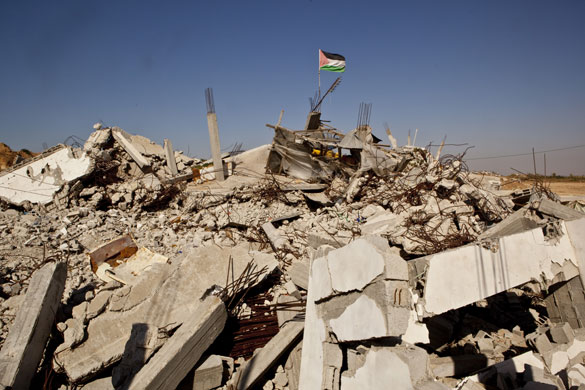
Palestinian flag flies over the rubble of a Gaza neighbourhood after Israeli bombardment 2014 (photo Antonio Olmos)
Umberto Ecco once defined language as a system of communication through which one could tell lies. There is no doubt but that our mass media uses language. Their editors and reporters herd us as sheep are herded by trained dogs, sometimes with barks and snaps of teeth but more usually through nudges and subtle changes of posture. They direct us to the pen where we are wanted or, at the very least, away from freedom.
In order to demonstrate the techniques used I have taken an example of reporting on the conflict and analysed it. The piece chosen is far from being one of the worst pro-Israeli or anti-Palestinian pieces of journalism – it is actually quite mild and even points out the statistical imbalance in the killing of civilians by Israel’s armed forces on the one hand and by Palestinian guerrillas on the other hand. The report is by the Irish on-line newspaper The Journal and was put up by them in the middle of August 2014.
The piece opens by saying that“Palestinian negotiators have been considering an Egyptian proposal to end the month-long Israel-Hamas war as the latest 72-hour ceasefire in the Gaza Strip is due to expire.”
This first of all says that the conflict is a war which also implies some kind of equal balance in fighting forces and also a share in blame. But it is not a war between any two sides; if it can be called a war at all, it is a war by Israel only. Israel is the fourth-largest military power in the world, with an army, navy and air force equipped with some of the latest armament and surveillance equipment. The Palestinians have a number of guerrilla groups, operating as infantry and no air or naval force at all. Their “artillery” are low-level rockets and mortars which cause very little damage to Israeli civilians and even less to the Israeli armed forces (except at close quarters, if Israeli soldiers invade territory held by the guerrillas). Israel’s armament causes huge damage to Palestinian infrastructure, huge loss of civilian life and does cause some damage to the guerilla groups.
The phrasing also suggests that Hamas is the only opponent of Israel on the Palestinian side. However, Israel has been in conflict with the Palestinians since the very day it came into existence and long before Hamas appeared on the scene. Even today, there are a number of Palestinian political and military organisations that are opposed to Israel and its actions and all together they represent the whole of Palestinian society inside the occupied territories, inside the 1948 borders of the state of Israel and in the refugee camps and settlements. In the sense that one could say that there is a war going on, it is Israel waging war against the Palestinian people.
The very next paragraph in the Journal’s piece says that “Since the truce, which will expire at midnight, went into effect on Sunday, Israel has halted military operations in the coastal territory and Gaza militants have stopped firing rockets.”
We see presented here that on the one side we have “Israel” and on the other, “Gaza militants”. As in bourgeois media reporting “militants” usually has a negative connotation, this is already tending to turn the reader against the Palestinians in Gaza. On the other hand, we have “Israel” which we can interpret either as “a legitimate state” or as the Biblical “promised land of the Jews”. And that is being opposed by “militants” in Gaza. The phrasing legitimises the status of one side while de-legitimising the other.
We are also told that Israel has halted “military operations”, two words that hardly convey the sustained bombardment of Gaza’s civilian houses, schools, mosques, civil administration facilities, power plant, water treatment plant, factories, hospitals and emergency vehicles in recent weeks. It does not bring to mind the slaughter of over 2,000 Palestinians, the vast majority of them civilians and including 430 children. Not to mention the 9,567 wounded, including 2,878 children and hundreds of injured jamming the remaining ill-equipped hospital treatment centres.
Shuja’iyya neighborhood of east Gaza City during a 12-hour ceasefire on July 26 2014.
The paragraphs states that in return for the cessation of “military operations” by the Israelis, the Palestinians have “stopped firing rockets”. Actually, if this report had just gone into a little detail, how pitiful by comparison with Israeli deadly ordnance would be the Palestinian rockets! Nevertheless, it is the rockets that are recently used as propaganda excuses by Israelis (before them it was something else) to justify the unjustifiable, the terrorising and collective punishment of a largely civilian population. So it is very rare indeed that western media reports omit any mention of the rockets.
“The ceasefire was meant to give the two sides time to negotiate a more sustainable truce and aroadmap for the coastal territory.”
Again, “two sides” gives the impression of some kind of equal antagonists in balance. The “roadmap” may be a vague reference to some future deal but may also be a reference to something that was much bandied about in Clinton’s time as President of the USA. This “roadmap” was supposed to lead to a two-state solution and, apart from the fact that it completely supported the supposed right of the European settlers who created the state of Israel to steal Palestinian land, has now been rendered completely inoperable. This is due to the continuing Israeli Zionist greed for land and building of illegal settlements throughout much of what was imagined as being part of the Palestinian state. And besides, the “roadmap” did not apply to the Palestinian refugees, who were given no right to return to their land. But it is useful for zionist-friendly propaganda purposes to pretend that this “roadmpap” ‘solution’ still exists and is viable.
“A member of the Palestinian delegation to Egyptian-brokered talks in Cairo said today that his team was considering an Egyptian proposal, which was tabled yesterday. Egyptian mediators have been ferrying between the Palestinians and their Israeli counterparts in an attempt overcome the differences between the sides.”
While it is true that Egypt has been “brokering talks”, that state is hardly an innocent bystander. Egypt has kept the Rafah Crossing, the only official exit point from Gaza not entirely controlled by Israel, closed or constricted. Egypt has also worked to destroy the tunnels which the people of Gaza used to smuggle in those items of daily life and, no doubt the arms they need, which Egypt is preventing from getting through the Rafah Crossing. The Egyptian state could nullify much of the Israeli blockade of Gaza, merely by opening their crossing into Gaza for normal traffic 24 hours a day.
The Egyptian armed forces, the real power in that country, are clients of the USA – another power which is hardly innocent but which on occasion tries to present itself as impartial in the conflict, despite its massive funding of the state of Israel. But those are not facts that the western media wish to disclose about the USA, Egypt or the conflict in Palestine.
Another thing, notice that while Egypt is “brokering”, it is “ferrying” between the Palestinian and Israeli negotiators. Clearly the antagonists are not face-to-face. If we think about that at all, as readers we are left with a feeling that maybe each side hates the other so much that they can’t bear to be in the same room. Or we might even think that Hamas, since it doesn’t recognise the right of Israel to exist, might not deign to speak to them directly. But actually, the reverse is true — as throughout most of its history, Israel is refusing to speak to the Palestinians directly. But no point telling the readers about that, is there? Who knows what they might come to think of such an attitude and behaviour of the Israeli state?
“The Egyptian proposal calls for easing parts of the Israeli blockade of Gaza, bringing some relief to the territory, according to Palestinian officials in the talks. But it leaves the key areas of disagreement, including Hamas’ demand for a full lifting of the blockade and Israeli calls for Hamas to disarm, to later negotiations.”
This is a bald enough statement which seems neutral but notice the unchallenged call for Hamas to disarm. From a state that is granted legitimacy to an insurgent force often painted as illegitimate, such a call seems reasonable. It has been and continues to be the basis for “peace (i.e. pacification) processes” throughout the world. But is there a call for Israel to disarm? Of course not. Yet it is the most heavily-armed power in the Middle East, the only one in possession of a nuclear arsenal and the one which has most often attacked its neighbours (not to mention the Palestinians). And the piece above leaves us to draw the conclusion that the lifting of the Israeli blockade may require Hamas disarming — a ‘fair exchange‘. And a reasonable reason, if Hamas does not comply, for Israel to continue its blockade on the whole population of Gaza.
“The Palestinian negotiator said he had some reservations about the proposal and would try to improve it. “We would like to see more cross-border freedom, and also to have the question of a Gaza seaport and airport discussed,” he said.
Note no reason is given for the Palestinian wishes – they seem trivial almost and no reason not to agree to a truce. “Cross-border freedom” might seem like being free to go on shopping trips or holidays abroad. “Gaza seaport and airport” likewise may facilitate daytrips and holidays, or tourist traffic or imports of luxuries. Maybe even exports of craftwork, or olives from remaining trees not destroyed by Israel. Such phrases and word do not give us a picture of over 1,816,300 people locked into a piece of land of 5,046 square kilometres (13,069 square miles), under permanent hostile control and sporadic bombardment and invasion, short of clean water and with other water polluted, destroyed infrastructure, destroyed hospitals, schools, mosques and churches, ruined industries and agriculture, infrequent power supply for lighting and heating, hardly any transport, a polluted coast and Israeli attacks on fishermen.
During the existence of the USSR and its satellite states, the western media regularly attacked them for their restrictions on most of their citizens’ travel beyond their borders. They never did then — nor do they now – inform their readers of the much stricter Israeli control on travel by Palestinians, not only beyond Israel’s 1948 borders but also beyond the borders of Palestine occupied by Israel in the years since. In fact, even travel within the occupied territories is extremely difficult for Palestinians.
The next four sentences of the Journal’s piece are unproblematic enough as far as reporting goes although it could have commented on why lifting the blockade on Gaza might have been of such concern to Hamas and to the people of Gaza:
An Israeli government spokesman had no comment on the negotiations.
In recorded remarks broadcast on Hamas radio, Ismail Haniyeh, the top Hamas leader in the region, said that “achieving a permanent truce can come only through lifting the blockade on Gaza”.
Amid the ceasefire, an Associated Press video journalist and a freelance Palestinian translator working with him were killed today when ordnance left over from the war exploded as they covered a story about the conflict’s aftermath.
Italian national Simone Camilli, 35, and Ali Shehda Abu Afash, 36, died when an unexploded missile believed to have been dropped in an Israeli airstrike blew up as Gazan police engineers worked to neutralise it in the northern Gaza town of Beit Lahiya.
However, the report could have gone on to tell us that the explosion also killed the four Gaza police engineers trying to neutralise the explosives and that another four people, including AP photographer Hatem Moussa, were badly injured. Unimportant details? News that might make us think worse of the Israeli armed forces? Or sympathise with courageous Palestinian police and at-risk civilians?
But it is not long before the more suspect reporting reemerges:
“The war began on July 8 with Israel’s air campaign against Gaza’s Hamas rulers, whom Israel blamed for the kidnapping and murder in June of three Israeli teenagers in the West Bank. Nine days later, Israel sent in ground troops to destroy Hamas’ underground cross-border tunnels constructed for attacks inside Israel.
Here Hamas are presented as “rulers”, as distinct and opposed to – once again – the state of Israel, conferring legitimacy on one party to the conflict, the aggressor, while subtly suggesting that the other antagonist is anything but legitimate and perhaps even despotic.
But the paragraph goes beyond that and suggests that Israel has a legitimate claim that Hamas kidnapped and murdered three Israeli teenagers. The three were in fact kidnapped and murdered and, although Israel wrongly accused Hamas of responsibility, its intelligence organisation Shin Bet later admitted that it no longer believed that. It may have been some other smaller Palestinian group or even individual members that carried it out but it was not the Hamas organisation nor its leadership. But this paragraph leaves us with the impression that Hamas’ culpability was a reasonable supposition by Israel and a reasonable cause of it going to war against Gaza.
The paragraph goes on to accept Israel’s public rationale for the bombardment and invasion, viz. “to destroy Hamas cross-border tunnels for attacks inside Israel”. Israel first quoted the deaths of the three teenagers as their reason for attack and now it is the “Hamas tunnels”. So if the stated reasons change, doesn’t that suggest that they are suspect, not to be relied on, with maybe the real reason unspoken? No comment from the media. Where are the tunnels? Which “border” are they crossing (putting aside for the moment the fact that Israel has never defined its borders)? Where are they attacking “inside Israel”? When was the most recent Hamas attack “inside Israel”? If this is a reference to the paltry rockets Hamas has fired, Israel has never claimed that these were fired at it from “inside Israel”. If it is not a reference to the rockets, then to what? We are not told but instead left with a feeling that Israel’s concerns could somehow be legitimate.
“The fighting has so far killed more than 1,900 Palestinians, the majority of them civilians, Palestinian and UN officials say. On the Israeli side, 67 people have died, all but three of them soldiers.
This is an unadorned statement of the shocking facts and we could not fault this paragraph.
But how about the very next sentence?
“The latest outbreak of fighting is the third between Israel and Palestinian militants in Gaza since Hamas took over control of the densely-populated territory in 2007.”
Here we have a repeat of that formulation which we saw earlier: the conflict, we are being asked to see, is between the ‘legitimate’ state of Israel on the one hand and “Palestinian militants” on the other. And it is “fighting” between the two sides, rather than the truth: the attack of Israel’s military force upon the population of Gaza and the Palestinian guerrilla forces’ attempts to reply with their meagre resources.
Also, we are told that “Hamas took over control” of Gaza in 2007. In an invasion, perhaps? A coup d’etat? The fact, uncomfortable for the western media, is that it was in a democratic general election while Israel and western agents poured out anti-Hamas propaganda. And Hamas won not just in Gaza, incidentally – but in the West Bank too, although others are currently in power there. Are we told that Israeli political parties in government “took over control” of Israel? Of course not.
Continuing, the report states that“Hamas has been consistently pushing for an end of an Israeli Gaza blockade, which Israel says is necessary to prevent the group from gaining access to weapons and munitions it deploys against Israelis.”
In this sentence, we learn that Hamas wants an end to Israel’s blockade but not why. We are not told that it is so that they can have sufficient fuel for heating and transport, food, medicine, clean water, industrial and building materials, teaching and learning materials, spare parts, etc, etc. Nor are we told that Gaza could then actually export products and gain some self-sufficiency. Nor are we told that Israel is illegally holding monies, such as tax revenues, that belong to Gaza. But we ARE told why Israel wants the blockade — “to prevent the group from gaining access to weapons and munitions it deploys against Israelis.” Well, there you are – that’s only reasonable, surely? !!
Glasnevin Cemetery (Reilig Ghlas Naíon) is a famous Irish graveyard on Dublin’s northside, on the south bank of the Tolca river and not far from the Royal Canal and Mountjoy Jail. As well as those of other people of great fame and none, it contains the remains of the fallen in a number of battles. However, the cemetery itself has become something of a battleground of late.
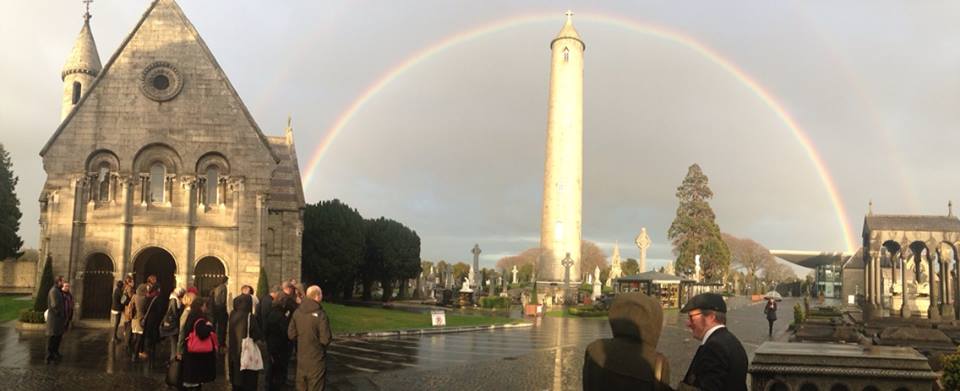
Rainbow over the tower in Glasnevin Cemetery (photo by Lorcán Collins as mourners left the funeral of his colleague, Shane Mac Thomáis, resident historian of the Cemetery, who died 20th March 2014)
There was the Alan Ryan funeral around this time last year, early September 2013. Ryan had been a prominent member of the 32-County Sovereignty Movement and allegedly head of the Dublin Real IRA (also now known as “the New IRA”) and was shot dead, reportedly as a result of a conflict with drug dealers.
Ryan’s funeral was a massive affair attended by hundreds of mourners; the Irish state police, the Gardaí, policed it heavily. The hearse and cortege were temporarily stopped at the cemetery’s entrance by uniformed and plainclothed police while the grieving mother and family members were taken out of their car, which was searched. Scuffles with police broke out a number of times as the latter even penetrated to Ryan’s graveside.
More recently, on 31st March this year, a commemoration in Glasnevin of soldiers of the British Commonwealth who had been killed in the First World War attracted a smallish protest from Irish Republicans and socialists across the road from the cemetery’s gates. These commemorations are viewed by Irish Republicans and many socialists as events glorifying Britain’s part in WWI and also an attempt to build unity between Irish people and the British Armed Forces. The Commonwealth event, the unveiling of a “Cross of Sacrifice”, was attended by a member of the British Royal Family, which added metaphorical fuel to the fire. However, there were real flames as a British Union flag, brought by the protesters, was set alight and Gardaí Special Branch rushed to apprehend the burners. In the melee, a number of protesters were handled roughly by the police, some were pepper-sprayed and one was handcuffed and taken away by Gardaí, reportedly beaten on the way. Another who objected to being jostled by Gardaí was also promptly arrested.
Most recent of all was the Hunger Strikers’ Commemoration in the Republican Plot inside the cemetery on 23 August. The event was organised by the Sean Heuston 1916 Society to honour the 22 Irish Republicans who have died on hunger strike between 1917 and 1981. The 1916 Societies is a broad collection of organisations of Irish Republicans in different localities who do not agree with the Good Friday Agreement and wish to see Ireland united and independent; one of their main objectives in the interim is to campaign for a referendum on the question of Irish unity. The commemoration was the second of its kind organised by the Sean Heuston 1916 Society and, as the previous year’s had passed without any untoward incident other than the usual Special Branch photographing and taking notes, they had no reason to believe that this year’s would be any different.
The event proceeded as planned with orations, song and laying of wreaths but the trouble came as people tried to leave the cemetery. They were waylaid inside the cemetery’s gates by plainclothes police of the Special Branch, i.e. the political police, and told to identify themselves and to give their addresses. Two who refused to do so unless they were shown reasonable cause were handcuffed and bundled into separate police vehicles. Others who had attended the event then blocked the police vehicles from leaving and many uniformed Gardaí arrived to assist the Special Branch. In the struggle, police were again quite rough and one punched a child in the face. Eventually the Gardaí were successful but both detained men were released later that day without charge.
Many visitors and unconnected mourners attending the famous cemetery were visibly shocked by the incidents. The organisers made it clear to the staff of the cemetery who it was who had initiated the disturbance and had chosen to do so inside the cemetery grounds.
Apart from general harassment and attempted intimidation of Irish Republicans, it is difficult to see what the Gardaí hoped to gain from this provocation and why they had escalated their behaviour at a peaceful commemoration. `One possibility is that the intention was to discourage the management of the Cemetery from permitting such commemorations in future. The organisers moved quickly to call a meeting with the Cemetery management, which has already taken place and reportedly concluded positively. And so it should.
The Republican Plot, managed by the National Graves Association, a voluntary body which does great work, is within the Cemetery. The graves of many Irish Republican and Socialist martyrs and prominent activists are within this plot and also in other places within the grounds. Some, like the great hero Anne Devlin, go back as far as the United Irish of 1798 and of 1803. James Connolly gave the oration here in 1913 at the graveside of the ITGWU martyr Jame Byrne, a victim of the State during the Lockout that year.
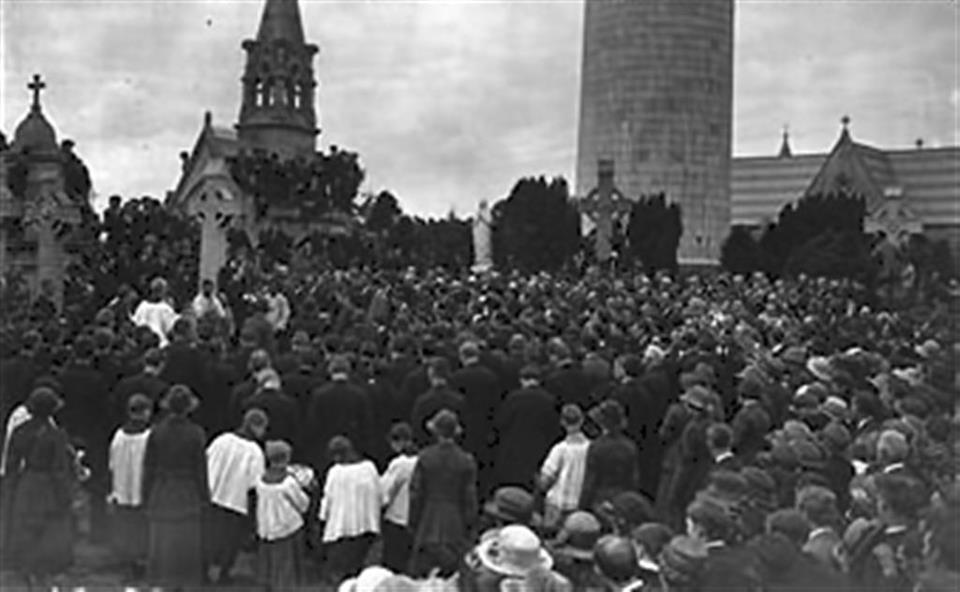
Funeral at Glasnevin of Republican Cathal Brugha, shot dead by Free State Army in O’Connell Street, 1922.
In 1915, Patrick Pearse gave his famous oration to a huge crowd at the Glasnevin graveside of the Fenian Jeremiah O’Donovan Rossa, whose body had been returned to Ireland by the IRB in the USA. O’Donovan Rossa had been jailed for planning an insurrection against the British in 1865 and, though released in 1870 as part of a general amnesty, had to agree to emigrate. In 1922, Cathal Brugha, having survived 14 bullet wounds during the 1916 Rising, was killed in O’Connell Street by Free State Army soldiers and his funeral cortege too, also to Glasnevin Cemetery, was a huge affair. In 1966, the remains of Roger Casement, hanged by the British for his role in the 1916 uprising (the last of the death sentences of the 1916 insurgents to be carried out), were brought home from England and reinterred in Glasnevin with an Irish state ceremony.
These historic moments and connections between Glasnevin Cemetery and the national and class struggles may be uncomfortable for some and the police harassment may be intended to deepen that discomfort. However, it is difficult to see how anyone, whether of State or of Cemetery management, could successfully impose a ban on commemorations within this famous graveyard where so many of the Republicans and Socialists of previous years lie and which has been the scene of commemorations for over a century.
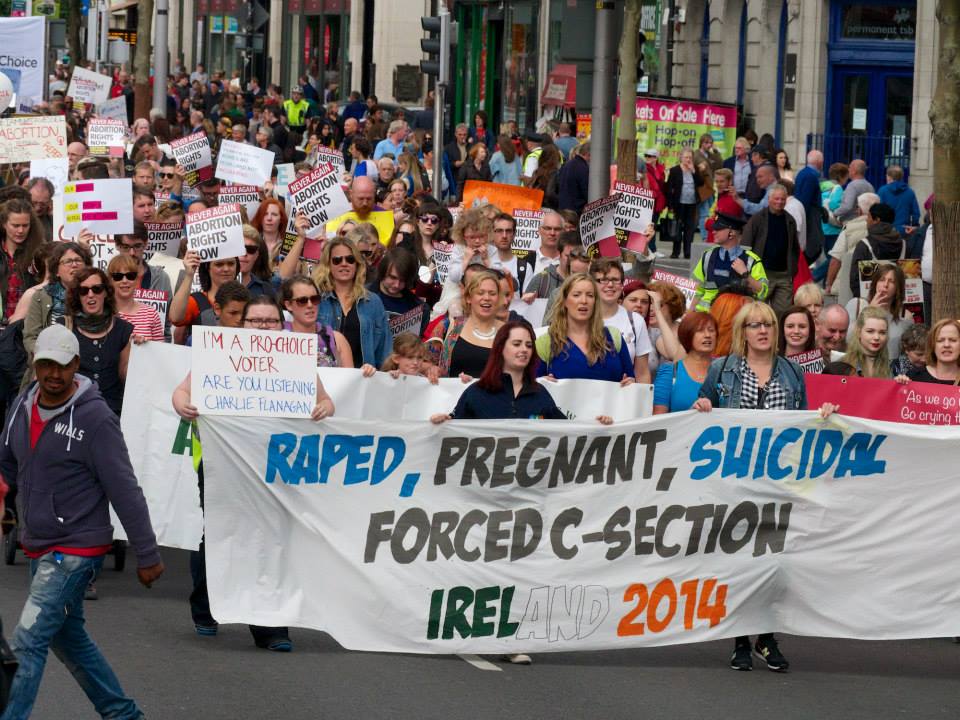
A suicidal woman refused an abortion, is then force-fed to preserve her embryo which is later delivered at 25 weeks by caesarian section.
Diarmuid Breatnach
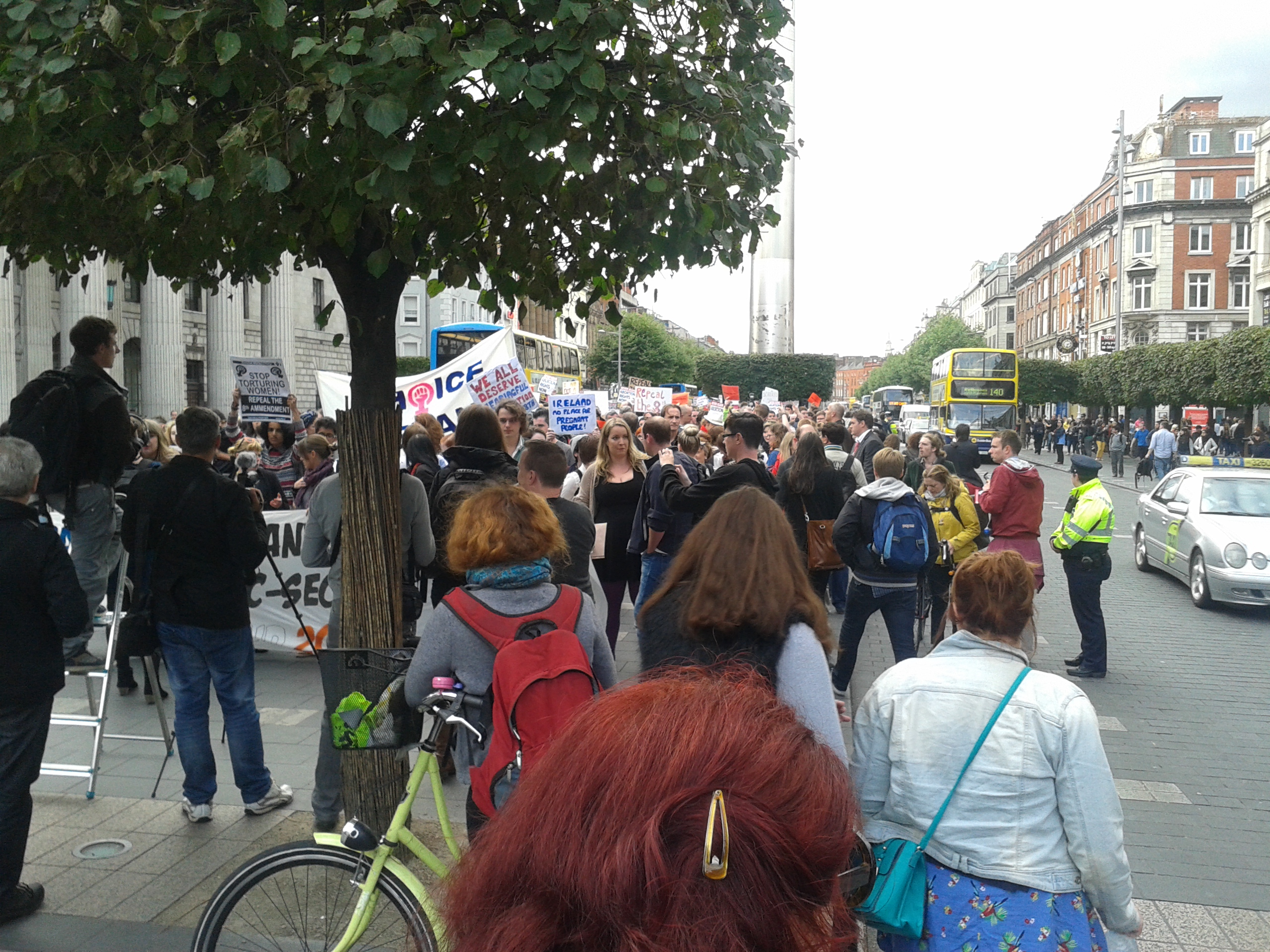
A woman considered suicidal by a medical panel was recently refused an abortion in Ireland and was subsequently force-fed. Within days a call was made for a protest demonstration and was answered by a substantial number in Dublin on Wednesday night last. The protestors filled the central section of O’Connell Street from the Spire to the Larkin monument and also spilled out into the road. Numbers of protestors took up station on the pavement fronting the GPO. A weekend demonstration was also convened in Dublin and another in Cork.0
Protesters in Dublin on Wednesday evening denouncing the treatment of the woman refused an abortion and force-fed. They called for the repeal of the Eight Amendment to the Irish Constitution. (photo D. Breatnach)
The pregnant young woman, apparently under 18 years of age, was a migrant, who sought an abortion in Ireland. Some media reports say that her pregnancy arose as a result of a rape in her native country prior to her travelling to Ireland. Not all the details are clear but it seems that an Irish advice centre gave her the necessary information to travel to Britain to receive an abortion but that she was unable to afford it (there is also some question about her immigration or asylum status should she wish to reenter Ireland). It seems she then became depressed, not surprisingly, and expressed suicidal ideation. Under the Right to Life During Pregnancy Act 2013, introduced following the “X” case, a woman is entitled to receive an abortion if carrying the foetus should result in a substantial risk to her life – suicidal ideation being one of of those risks.
In accordance with the 2013 Act the young woman’s case was reviewed by a panel, consisting of two psychologists and an obstetrician. According to reporting in the mass media, the psychologists agreed that she was suicidal and that she she should therefore have the termination. The obstetrician apparently agreed that she was suicidal but argued that in a short while (two weeks has been mentioned), a caesarian could be carried out and a baby delivered alive and viable. Since the Act requires the unanimous concurrence of all three members of the panel, the young woman was refused an abortion.
It seems the woman became further depressed and stopped eating, whereupon lawyers for the hospital went to the High Court to obtain a court order permitting the woman to be force-fed, which procedure was carried out (probably intravenously). The woman is said to have subsequently agreed to a caesarian section by which method a baby was delivered. The fate of the woman is not in the public domain at this time but the baby was reportedly delivered alive and well after 25 weeks in the womb.
A number of speakers at the rally made the point that “here we are again”, i.e. that the lack of the necessary legislation has led to another case of terrible mistreatment of a young woman, a reference to other cases of refusal of abortion that have become scandals and lead to demonstrations such as about the death of Sadita Halappanavar in 2012 and the “X” case in 1992.
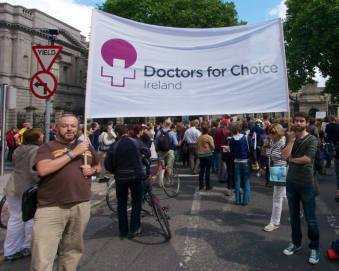
At the rally, all the speakers, campaigners and providers of services and a male doctor from Doctors for Choice, called for a referendum to repeal Amendment Eight of the Bunreacht (Irish Constitution). This is the amendment passed in 1983 in order to prevent abortion becoming legal. Some very telling points were made, one speaker saying that no-one in Ireland but a pregnant woman would be force-fed or bullied into submitting to an invasive surgical operation. Perhaps we cannot say that none of those things would ever happen to anyone else but it is certainly true that only in the case of a pregnant woman would that combination of coercive and intrusive procedures, clearly in violation of the Hippocratic Oath, have been considered so readily and applied in conjunction. That the woman was a migrant probably made it easier for the authorities but it is the legal position on abortion in Ireland and its moral underpinning which reduces the pregnant woman to the status of some kind of living vessel, the status of the unborn foetus being higher than that of the mother.
Men’s place in the movement
Breaking from the general trend at the rally, one of the speakers addressed many of her remarks specifically at the males present there in support. She told them “they should know their place” and that they had no right to express any opinion on the issue except to support the women. Some women applauded her and some did not.
On the Dublin march for the repeal of the 8th Amendment on Saturday. This banner was also present at the Wednesday protest rally where one of their representatives spoke. (photo Andrew Flood)
Since variations of this view have emerged quite frequently, including the view that it’s a women’s issue or that men should just follow the opinion of women in the movement, it is worth examining this a little further. The current situation on abortion in Ireland of course impacts in the first place on women but it does not affect them only. An unwanted pregnancy, especially at an early age or stage in a relationship can force decisions that may later be regretted, including marriage or abandonment. Raising a child from what was an unwanted pregnancy has long-term social and economic implications, not just for the mother but for a much wider circle – as well as for the child growing up in society. The existence of legislation on abortion and its repeal is in the realm of criminal law — but above all it is a social issue, one affecting society. The provision of abortion is also a medical and social question: medical and social structures and services will need to be put in place, funded, monitored and its practitioners trained. Therefore all of adult society has a right to a voice on it. To call on a section of society to be mute supporters is to treat them as voting fodder and should not be supported by any genuinely democratic person.
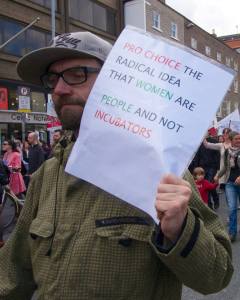
Man on the Dublin march for repeal of the 8th Amendment (photo Andrew Flood)
Also, if men, because they are not after all going to be the ones being impregnated and bearing children, should not have a voice but should only support women, which women’s opinions should they support? Why not support the many women who are totally against abortion? And even if supporting women who are for greater access to abortion, which section of opinion about which degree of access should men support?
Clearly men have to think about these issues to come to decisions. Are they to think silently, expressing no opinion and discussing with no-one, and then be expected to develop rational opinions to inform their actions and, in the case of a referendum, their voting too? Clearly the expectations expressed in such calls or statements are not only undemocratic but unrealistic too. Men not only have the right to express opinions on these issues but need to be able to do so in order to have the discussions that make it possible for them to make rational choices.
The attitude of the state and a referendum
The Dublin pro-choice demonstration on Saturday, according to observers, matched the numbers at the anti-abortion demonstration in the city on the same day – about seven hundred. The pro-choice demonstration took an unusual route from O’Connell Street and became the third demonstration to cross the Rosie Hackett Bridge (opened in May this year). The Bridge is the only one in Dublin named after a woman and Rosie was a trade union militant active in the Dublin Lockout of 1913, as well as taking part in the 1916 Rising as a member of the Irish Citizen Army. The demonstration rallied just across the river at the Department of Health in Hawkins Street (the Department under which the young woman had been refused an abortion and force-fed) and then went on to demonstrate at the Dáil (the Irish parliament).
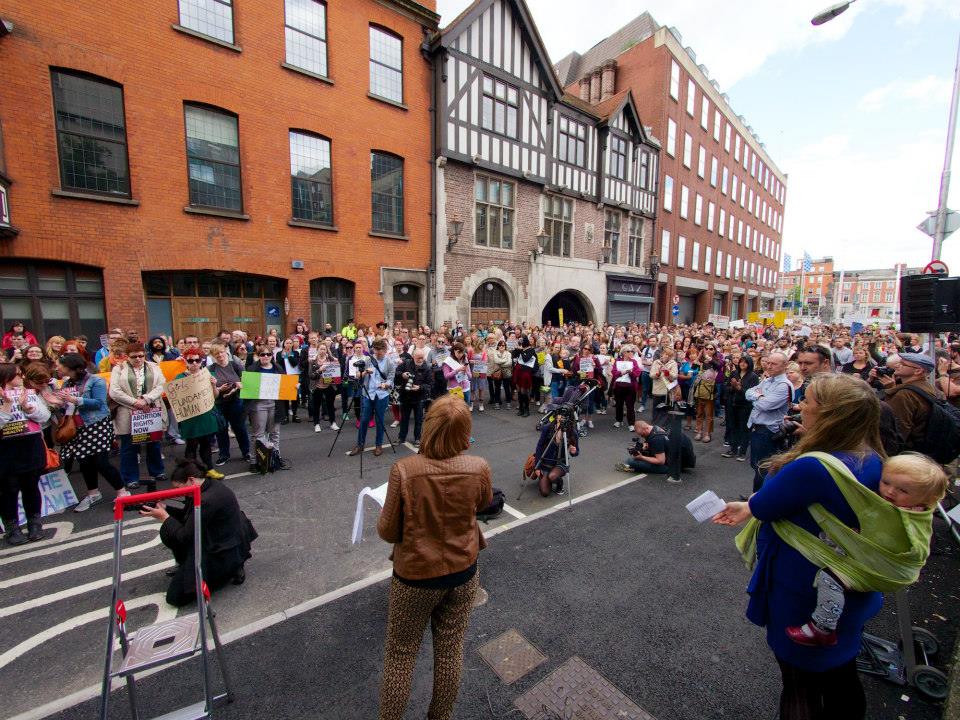
Speaker addresses the crowd in Hawkins Street, outside the Department of Justice — Rosie Hackett Bridge is to the far right of the photo. (photo Andrew Flood)
Some supporters of a change in the law have presented the issue as though it is essential to the State and to the Catholic Church, two institutions closely linked, to control women’s bodies through refusing access to abortion, free and on demand. I do not think it is so. Certainly those forces may want to control women’s bodies (and indeed, men and women’s minds) but such control is not essential for the continued existence of the State. Many capitalist countries have either easy access to abortion or much more liberal laws than has the 26-County state. This state can afford to give that right but that does not mean that it will. When a state is able to give something but does not want to, sufficient force must be mobilised in order to convince it that yielding will cost it less than denying. Substantial pressure will need to be brought to bear on the State so that it agrees to holding a referendum.
But having a referendum does not mean that the correct and necessary outcome will be the result. We have had referenda in which the side of progress and justice was successful but also those in which it was not. The present Amendment Eight to the Bunreacht (Constitution), which the movement seeks to repeal, was the result of a referendum.
Yes, true, that was 30 years ago and opinions have changed since. In recent years, opinion surveys have shown a majority in favour of some relaxation of the law. Also, two legislative attempts to tighten restrictions on access to abortion, in 1992 and 2002, failed. On the other hand, the Thirteenth and Fourteenth amendments, both in 1992, were successful in loosening the ban, establishing the right of a pregnant woman to travel, even if to obtain an abortion, and to be given information about abortions services abroad. However, although the numbers in favour of unfettered access to abortion have grown substantially they do not yet constitute a majority.
According to analysts of the socio-economic background of respondents to the questionnaire, the indication is that the areas of greatest resistance are among a section of the middle class and a section of the working class. That particular section of the middle class is one of generally right-wing views and not amenable to change. Besides, they have the economic resources to lessen the chances of unwanted pregnancies including, despite their ideological position against it, to send their pregnant daughters quietly to Britain, having them return after a brief holiday without the neighbours being any the wiser. Or for a wife to go on a weekend visit to a friend in Britain even without her husband knowing the real reason for the trip.
The working class is in a different situation. High social and economic deprivation in Western countries tends to be accompanied by a higher degree of unplanned pregnancies and single parenthood than is the case with other socio-economic groups. Most working class families would also struggle to find the funds to send a family member to Britain (or to the Netherlands, apparently a new trend) to have an abortion, usually accompanied by at least one friend or family member, paying for travel, accommodation and the procedure itself. And the level of care is likely to be at the lower end of the scale. Of course many, many families and friend groups do manage it somehow.
The working class has a vested interest in this reform and this is recognised among some sections of the class but not in others. Traditional obedience to the Church has broken down in many areas, for example in ideas about sex before marriage and in using barriers to impregnation. However, the opposition to abortion remains, for many, a line not to be crossed. If a referendum is to be forced from the State and, in particular if the outcome is to be such as needed, a change in the outlook of at least a substantial section of this class needs to be achieved. Most working class people outside the immediate circles of the pro-choice movement tend not to see any campaigning on the issue except after such scandals hit the headlines – then a flare-up is briefly visible until things die down again.
The pro-choice movement will need to get out on to the streets and into communities on a regular basis if it is to win. I think it also needs to counter the work of the anti-choice propagandists, particularly those who put up their stalls in public areas or picket information centres. In discussion with some activists in the pro-choice movement, they say they do these things to some degree but don’t have the numbers of activists needed to do it more regularly. I confess that I find it hard to believe that in Dublin, for example, the movement is incapable through lack of activists to put a stall – indeed a number of stalls in different areas – on the street at least once a month. Some of those in the movement have been campaigning for decades and others for many years – and yet, as so many of their speakers said on Wednesday night in O’Connell Street, “here we are again”, responding to another fatal tragedy or shocking violation of human and civil rights.
Front of the march on Saturday in Dublin (photo Andrew Flood)
Facebook organising and networking by pro-choice campaigning groups can produce quick mobilisation of substantial numbers of people. These people are already convinced. Most of the working class remains untouched by these mobilisations and certainly their overall outlook remains unchanged. If the pro-choice movement is to have its desires become reality, it needs to get out into the working class communities and promote its cause, hopefully recruiting from among those communities to better carry the message among their own. The movement needs to engage in dialogue with movements with a high percentage of people of working class background, such as – dare one say it? — the Irish Republican movement. The latter is, despite one very deep idealogical divide and the existence of a number of factions, the political opposition movement with the largest active participation of people of working class background. At the moment, the overall position of the movement is anti-choice but that is nowhere near as monolithic or as unassailable as it was even a decade ago.
The hope is that the necessary mobilisation will be done and that very soon the State will be forced to concede a referendum on the abolition of Amendment Eight. The hope is also that the necessary educational work will be done to achieve an overwhelming victory in that referendum. The activists in the movement need our support, men as well as women, in all of that.
The crowd stood in the rain and gusting wind in Ardoyne, Belfast. In front of them, the gable end of a house shrouded in black. The crowd was dotted with uniforms of the various Republican marching flute-and-drum bands from Scotland, some green and some black. Irish Tricolour flags fluttered and here and there the Starry Plough and the Palestinian flag was in evidence, including above the shrouded mural.
After what seemed like a long wait, the MC, life-long Republican activist Martin Óg Meehan, called forward those who had commissioned the mural, the Independent Principled Ex-POWs group; around thirty of them, all dressed in black, carrying a banner with their group name on it, they formed a kind of honour guard during the ceremony. As indicated by its name, this is a collective aligned to no political party or group; it was established earlier this year by North Belfast Republican ex-prisoners.
Then after a short dedication speech, the shroud was pulled down to unveil the newest Republican mural in Belfast, which is surely Ireland’s city of murals (certainly of political murals). The centre-piece was a section of The Rythm of Time poem, written by Republican prisoner and hunger-striker to the death, Bobby Sands; around that central piece a number of panels depicted scenes from the struggles of Republican prisoners from the 1970s onwards. A special mention was made of the families and relatives of Republican prisoners, those who bore much of the brunt of the system that encarcerated their loved ones. One of the Scottish bands was then called to play The Soldiers’ Song, the Irish national anthem written and composed by two Republicans and which had been sung by some of the insurgents during the 1916 Rising against British colonial rule.
Section of the Anti-internment march in Belfast 10th August 2014– The Dublin Committee banner is the high narrow blue one behind the marching band.
Some time after this ceremony, the primary purpose of the day was attended to as people assembled for the march against internment organised by the Irish Anti-Internment League. The British colonial statelet abandoned internment without trial after four-and-a-half years in 1975 but since then has been finding other means to remove its active political opponents from the streets. Some ex-prisoners who were released under Temporary Licence as part of the Good Friday Agreement in 1998 have been returned to jail without charge, trial or right of appeal. Others have been faced with ridiculous charges — of in some way “assisting terrorism” — and jailed while awaiting trial; when eventually found not guilty, they have nevertheless already spent between one and two years in jail. Still others, after periods in jail awaiting trial, are being found “guilty” on highly suspect evidence in the special courts and sentenced to long terms of imprisonment (some of these too have eventually been released on appeal against conviction).
After outlining the order of march, Dee Fennel warned the participants that Loyalists had gathered in the city centre on the route of the march to oppose us. Dee urged us to obey the stewards and not to permit ourselves to be provoked into responding to Loyalist provocation. “The law is on our side, for a change,” he stated, meaning that permission for the parade had been applied for and granted, so that the police, if carrying out their duty, had to prevent others from attacking or obstructing us.
The march was headed by the prisoners’ relatives group and followed in sequence by the Justice for the Craigavon Two Campaign, Wolfe Tone RFB (Republican Flute Band), Anti-Internment Group of Ireland (including the Dublin Anti-Internment Committee), Independent Principled Ex-POWs, Parkhead RFB, IRPWA, Vol.s Patricia Black and Frank Ryan RFB, Cabhair, Vol. John Brady RFB, Cógus, Erin Go Bragh RFB, Éirigí, 32 CSM plus other groups bringing up the rear. The Vol. John Brady band is from Strabane but all the rest are from Scotland: two from Glasgow and the Wolfe Tone and Erin Go Bragh bands from North Lanarkshire.
We worked our way down from Ardoyne in driving rain and strong gusts of wind, through the streets in twists and turns towards the city centre. Along the route we noted occasional Palestinian flags hanging from windows of people’s homes and from some flats in tower blocks. As we turned into Donegal Street coming in from the east and heading for Victoria Street, what sounded like a bestial howl arose ahead of us – the Loyalist mob had sighted the relatives’ group leading the march. There we halted for what seemed a long delay, while our march organisers brought the stewards up to the front. Tension mounted, the worse for the wait and not being able to see what lay ahead. Then the march started forward again.
The howls grew louder and then we could see the Loyalists, about 400, many waving Union Jack flags, straining against yellow-jacketed PSNI, the British colonial police, who faced them. Then a line of colonial police in full black riot gear, including shields, facing us (!). Between us and them stood a line of our stewards, their backs to the police and to the Loyalists. A number of police were videoing the marchers, intelligence-gathering, but I saw only one filming the Loyalists.
Two loud fireworks exploded fairly close ahead, presumably aimed at the relatives or the colour party of the band. The storm of abuse was so loud and varied that it was hard to make out any actual words. On video recordings one can hear us being called “baby killers” and – no doubt totally unconscious of the irony — calls in support of Israel! This last no doubt a response to a number of Palestinian flags showing among the marchers.
In front of our contingent, the Wolfe Tone RPF band marched without playing but to a steady rap …. rap … rap …. of the side-drums. One of the mature members of the band called out some words of encouragement to the younger members and, in time, began to call out “clé …. clé …. clé, deas, clé …” (“left … left … left, right, left …”). Behind me in the crowd, somebody began to shout “the I … the I … the I, R, A” in response to the Loyalists.
By now other missiles were flying from the Loyalist crowd and, not surprisingly to us, the police seemed to be making no effort to arrest the perpetrators. I saw a plastic bottle full of water land ahead – a marcher picked it up and threw it back; an orange or red umbrella landed among the marching band and a tall bass drummer stooped, picked it up and threw it back almost without looking and without breaking stride …. Some police struggled with a very large Loyalist woman, her face contorted in rage, as she tried to break through to attack us. Those of us carrying the Dublin Committee banner brought it to flank between a section of the band and the Loyalist missiles while one continued to film the event. One of our contingent was struck on the head by a flying object but continued to march. Another firework exploded somewhere behind. The band continued marching, facing forward …. clé …. clé …. clé, deas, clé …
In a short enough time (though it seems longer watching the video later), our section of the march had passed the hostile mob but the roaring continued, aimed at the marchers coming behind us. On the main road heading up to the Falls Road, a fierce gust of wind caught us – we failed to lower the banner quickly enough and one of the bamboo poles snapped. We carried our banner the rest of the way, on up the Falls Road, past the Cultúrlann, then past Milltown Cemetery.
As we approached the Felons’ Club, stronghold of Provisional Sinn Féin, the band began to play “Take It Down from the Mast”, a Republican song from the 1930s castigating Republicans who had abandoned the path of fighting for independence. Originally the lyrics had been aimed at the Irish Free State government, then at the Fianna Fáil party; since then they have been thrown in turn at Official Sinn Féin, the Workers’ Party and now, at Provisional Sinn Féin. After Fianna Fáil, each party had sung the lyrics at those considered traitors before them, only for each to become, in turn, the target themselves.
“Take it down from the mast, Irish traitors,
It’s the flag we Republicans claim;
It can never belong to Free Staters,
For you’ve brought on it nothing but shame.”
As we passed the Felons’ Club, a number of their patrons leaned on the rail watching us go past. I wondered what they thought and felt. Before 1998, presumably it would have been them participating in the march – perhaps even having organised it. What did they think of a march for civil and human rights in their heartland of which they were not a part? Of 5,000 demonstrators marching in driving wind and rain on an issue around which PSF no longer organises? An issue, in fact, which they find threatening, now that they are part of the colonial administration … This is perhaps the reason for their dismissal of those independent Republicans and groups they call “dissidents” and “micro-groups” who, they say, “have no programme”. No doubt they are aware that it is a long time since Provisional Sinn Féin were able to mobilise 5,000 people to march on any issue.
The march came to an end at the Andersonstown shopping centre, the participants to be congratulated by Dee Fennel; we stood to one side, applauding the soaked marching bands as each one passed us. A couple of speakers were announced but, too cold and wet, some of us decamped to our coach, which had been summoned to meet us nearby. There we found that our thermos flasks of coffee and tea had fallen inside the coach and that the linings had smashed – so no hot drink for us.
When all our Dublin party were at last aboard and some had changed into dry clothes, we headed back up the Falls Road in search of food. Some of us were annoyed to find the Cultúrlann, in the restaurant of which we had looked forward to a cooked meal, closed and had to be content with a Chinese take-away for some hot food at last. Then back to Dublin; in our own city, our publicity and organising work as an anti-internment committee awaited us, as well as whatever other political work we might undertake as individuals or as members of other groups.
Additional information: IRPWA is the Irish Republican Prisoner Welfare Association and is linked to the 32-County Sovereignty Movement and campaigns for political prisoners.
Cabhair is an Irish Republican prisoner welfare and campaigning organisation linked to Republican Sinn Féin.
Cógus is also an Irish Republican prisoner campaigning and welfare organisation and linked to the Republican Network for Unity.
The Anti-Internment League and the Anti-Internment Committee of Ireland are campaigning groups independent of any political party or organisation.
Lorna was nervous but tried not to show it – especially to Kevin. He drove competently and seemed unaware of her tension. Of course she had known for months it would come to this. There had to be an end to the hiding some day. And now she was going to have to present him to her parents. She shuddered …. or thought she had; thankfully, Kevin hadn’t noticed.
They passed a small wood in a hollow, the trees still wearing their autumn leaves but some already lying on the road, jewels of yellows, oranges and reds, mixed with green, glittering with the wet of a recent shower. In that wood one summer, in her teens, a picnic and a boy, hands trembling exploring, fast-beating heart, her virginity gladly given. at The memory sparked a little arousal; she looked out the passenger window in case it showed in her face. Kevin could be very perceptive …. often just when she didn’t want him to be.
As they drove through the Sligo village she remembered so well from her childhood and teens, she began surreptitiously to do her breathing exercises. Approaching the side road, she had a sudden impulse to say nothing, to just keep going. “Left ahead,” she said instead. And, a little further, “Turn right there, Kevin. Right … that’s the house.”
Slightly uphill from the parking space, the path ran up to and curved along the house to the front door. The house, traditionally whitewashed and, with the exception of the conservatory added to the end, pretty traditional in appearance too. The treetops, grown taller, visible behind the roof, the fuschia bushes growing along the path and the cotoneaster hugging the house wall. Bel, kept inside the house so as not to frighten the expected visitor, barking an intruder warning.
The engine switched off, Kevin looking at the house, then at her. “Looks lovely”, he said and sounded as though he meant it. She turned to him, smiling brightly: “Get the bags, will you? Do the traditional male thing. I’ll carry the wine and the flowers.”
He kissed her quickly, grinned and got out of the car, leaving her free to do her breathing exercises unobserved. In …. hold, two, three, four, five. Out, two, three, four, five …..
Walking up the path, Bel barking madly now, hearing the crunch of gravel. As Lorna got near the door, she called out to the dog. The barking stopped a second at voice recognition, then started again – welcoming this time. The outer door opened, her father there, the skin around his eyes crinkling as he smiled. A hug, careful with the flowers, and a “Fáilte abhaile, a stór.” Then the appraising look at Kevin, the hand stretched out: “And to you too, young man.”
Her father turned and opened the inner door. There was her mother, holding Bel back by his collar as he whined and wriggled, his tail whipping from side to side. Lorna put the flowers and wine on the table and went to the dog, giving him her hand and, while he lathered it with his saliva, hugged her mother cautiously. Then she took the dog to introduce him to Kevin. Of course Bel could smell her on the stranger and that made the introductions easier.
After the greetings, matters proceeded through stages – coffee and tea and biscuits, inquiries about the journey, traffic and road surfaces, comments on the weather, a little local news, as Bel gazed at Lorna and thumped his tail from time to time, her mother jumping up regularly to check on the cooking, the aroma growing around them.
And so to dinner, the table set with the best delf and cutlery, grace said by her mother; Kevin, her atheist lover bowing his head respectfully and agnostic Lorna chiming “Amen” at the end. The dinner delicious of course and greatly enjoyed by Kevin, her father appreciating the Rioja selected by Kevin and brought with them, the flowers they had brought now with some fern leaves picked by her mother, making a nice display in the vase in the window, the westering sun filling the dining area with gorgeous light. The conversation flowed around her job, Kevin’s, Lorna’s parents’ farm, the local area …. It was all going so well. Lorna wasn’t fooled for a moment.
A little after dessert, her father stood up. “Come now, Kevin …. I’ll show you around a little of our wee farm. We have to walk a little of that dinner off.”
Kevin got up eagerly, then hesitated, glancing towards Lorna. “You can do the washing up tomorrow, Kevin,” she smiled. “Go on, while there’s still light to see.”
The two most important men in her life walked out the back door, Bel eagerly escorting them, her father putting his cap on his balding head and picking up his ash stick on the way.
The men’s voices faded and the women turned to meet one another’s eyes, then quickly down to the table, going about their shared tasks with the ease of custom, of practice thousands of times through the years …. and the tension slowly building while desultory conversation centred around the tasks. Then, so soon, all the washing-up done and rinsed, their hands dried and the kettle on the ring for tea. Her mother turned to her and said: “He seems very nice.”
“He is”, she replied, knowing it was an opening shot. “I’m serious about him,” she added, as though this were not obvious, the first of her lovers down through the years that she had ever brought to meet her parents. She was hoping to head off the barrage.
“But Lorna, how could you! Of all the fine men you could have had!”
“He is a fine man. I already told you he’s black but I didn’t think …”
“Lorna Patricia, you wash your mouth out this minute! You know very well that neither your father nor I are racist.”
“But it’s different when your daughter wants to marry one, is that it? ‘We’re not racist but …’ ”
“No, Lorna, it has nothing to do with that – we’re not bothered by the colour of his skin …. that’s not it all.”
“Then what is it? Is it because he’s not a Catholic, then? Because, as I think you know, I’m not much of a one myself!”
“That’s not it at all, Lorna. That’s between you and God …. and between Kevin and God. That’s what He gave you free will for.”
“Then what on earth is all this about? What’s wrong with him?”
“Oh Lorna, do you really not know? Can you not see?” Her mother’s voice rising in a wail.
“No … no, I can’t. See what? What’s wrong?”
“He’s from Dublin, Lorna. Dublin! He’s a jackeen!”






 rebelbreeze