APOLOGIA FOR REPRESSION BY SPANISH STATE IN DUBLIN

Diarmuid Breatnach

(Reading time: 10 minutes)

The “Global Spain” initiative of the Spanish State to 215 Spanish embassies and its sub-title “Touch Democracy” was presented to a small audience at the Instituto Cervantes in Dublin on Monday while Catalan and Basque solidarity demonstrators picketed outside.

While some people, perhaps in the know, were directed straight to the auditorium, a number of others, not regular users of the Instituto’s services, were asked to wait in another area but when the start time had been exceeded by 20 minutes without sign of the event, they went to make enquiries again at Reception and learned where the event was being held, entering to find it had already started.
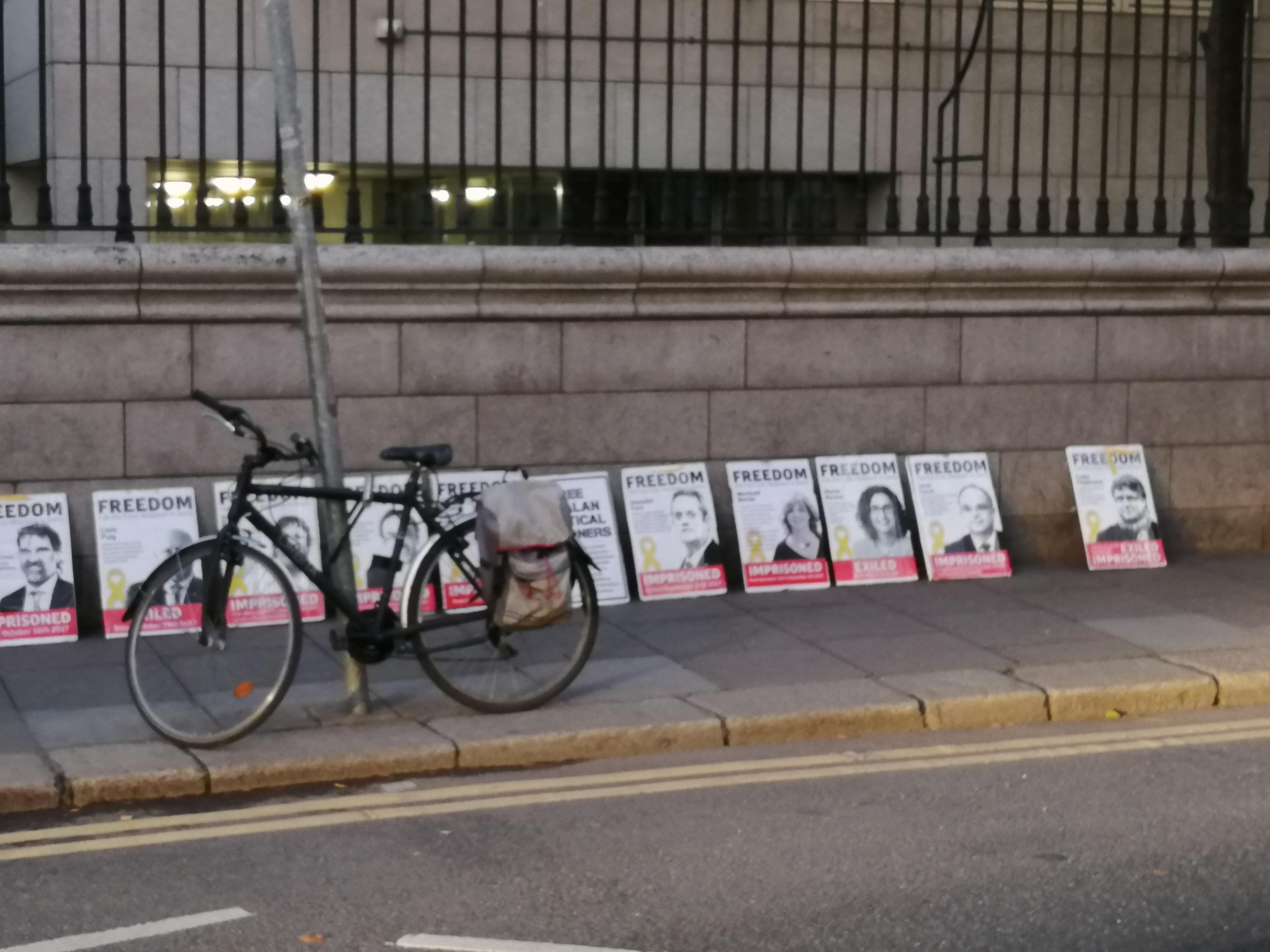
Portraits of Catalan political prisoners and exiles displayed across the street from the Instituto Cervantes on Monday.
(Photo: D.Breatnach).

PROPAGANDA VIDEO         

          Mr. Ildefonso Castro,the Spanish State’s Ambassador to Ireland was speaking and shortly launched the event with a showing of a short video which, he said, would bring out the main questions in the initiative. In this video, Lucía Mendez, journalist for the right-wing Spanish daily El Mundo seemed to be interviewing Gabriela Ybarra about the novel she had written (The Dinner Guest). But actually later in the film Mendez began a speech about how good was the Spanish democracy while her interviewee was left with little to say. The author had said earlier that though her grandfather (a Mayor of Bilbao who had fought in Franco’s Army and supported the Dictator regime, not mentioned in the video), had been killed by the Basque armed group ETA in 1973, this was not discussed in her family. She felt that the memory of “terrorism” was disappearing and that children in school were not being taught about it, which is why she wrote her book.

In fact, Spanish media constantly refers in negative terms to ETA and a 2016 case of a brawl between Basque youth and off-duty Spanish policemen in a late-night bar, in which no-one was seriously hurt and no weapons used, was being treated in the media and by the State Prosecutors as a case of terrorism! Although the judge rejected the accusation of “terrorism”, in 2018 the youth receive a range of sentences between two and 13 years jail. An important part of the silence and lack of teaching children history is in fact about the almost four decades of Franco dictatorship and the conduct of the victors in the military-fascist uprising against the democratically-elected government of the Spanish Popular Front in 1936. And of the State assassinations and torture of captured ETA fighters and arrested Basque activists. And of the continued legal battles to uncover mass graves of Franco’s victims and try to identify the remains for the relatives.

Considering that ETA ceased its armed activities in 2012 and has since dissolved itself, the relevance and intention of the film seems to be to show an embattled Spanish “democracy”, fighting against Basque independentist “terrorism” in the past as it is now embattled with the Catalan independentists (seven activists of which it has also accused of “terrorism” a couple of weeks ago).
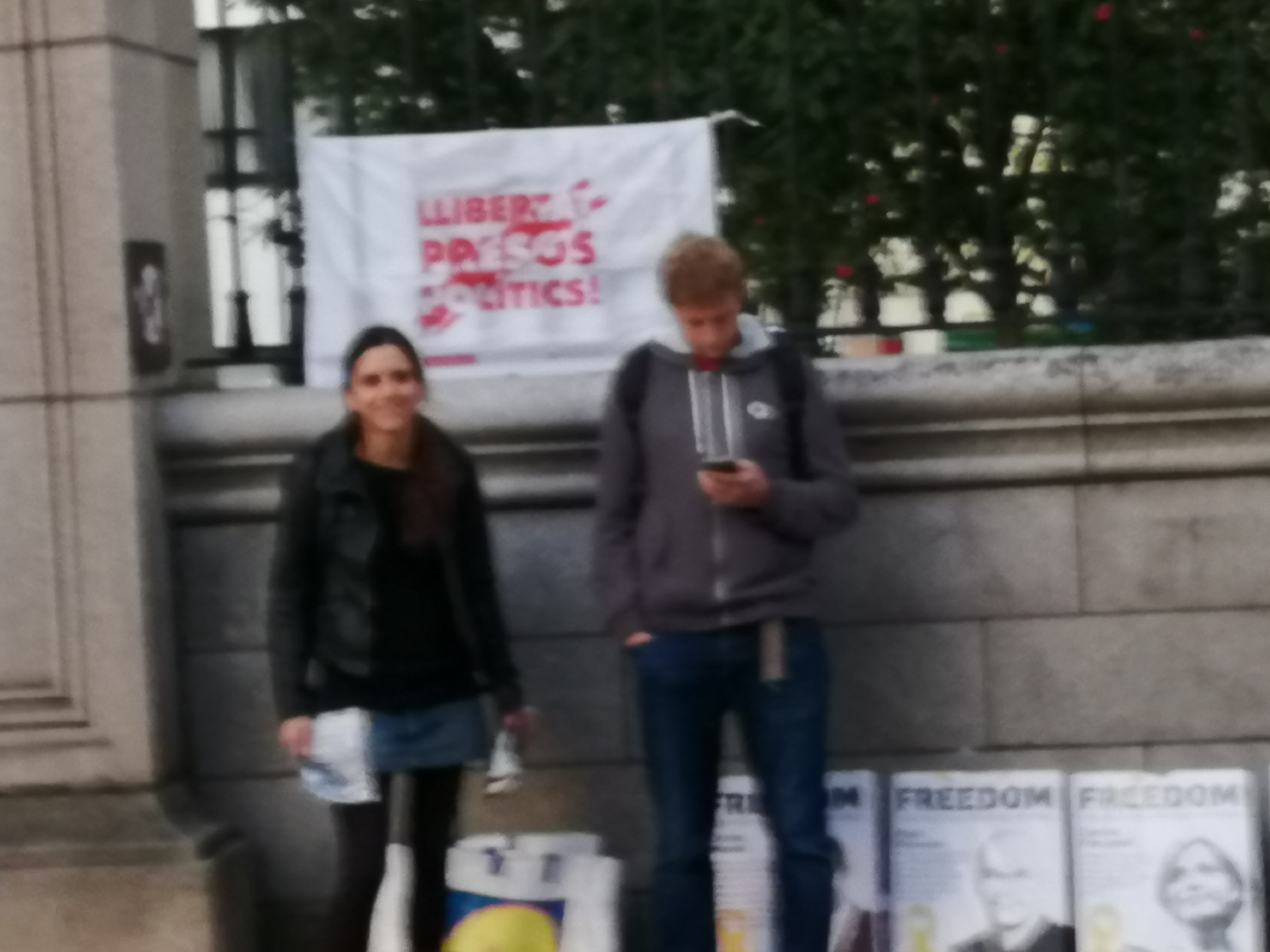
Some demonstrators and banner by Trinity College exit across the street from Instituto Cervantes on Monday.
(Photo: D.Breatnach).

DISCUSSION BUT NO DEBATE

          There was no discussion on the content of the film and, after its end, Víctor Andresco Peralta, Director of the Instituto Cervantes, cultural body of the Spanish Embassy, took to the stage and invited five people by name to take chairs laid out around a table. Launching into a chatty monologue full of jokey self-deprecatory comments (so many that they were actually self-promotional), he eventually asked his questions of his picked panel.

Questions included what were their earliest memories of consciousness of being Spanish, what reactions they had received about Spain from people in Ireland, or in other countries (positive and negative), what they valued about Spain, what they thought about the coup attempt in 1981 (lots of jokes about that), etc.

Referring to his father’s recent stay in hospital, Peralta asked for comparison of the Spanish health service with the Irish one (apparently the former is far better, which would not be difficult) and for other comparisons.

The discussion was skillfully managed by the showmaster to bring his group to paint a picture of a wonderful pluralist Spanish State, of freedom of expression, and of a democracy which had been able to defeat the coup attempt without much difficulty but even so, some discourse arose at times to shake the equilibrium, as when one referred to a relative telling him about the horrors of the Francoist suppression as they entered Barcelona and when another referred to the perception (mistaken, of course!) of many people outside Spain that the State was undemocratic and had violent police.

One of the panel, who appears to be an employee of the Spanish State, said she was proud of the defeat of ETA by the “Spanish democracy”.  Another said she was proud of Spanish history and culture, without explaining further. She might have meant the foremost writer of Castillian-language literature, Cervantes himself, who was exiled from the Spanish kingdom because of his anti-feudal views. Or the Andalusian poet Federico Lorca, who was executed by Franco’s soldiers; or the Malagan artist in exile Picasso, who created the famous painting of the Nazi and Fascist aerial bombing of Gernika (most of the poets, writers and artists of the era were against the military-fascist coup and the four decades of dictatorship that followed). Or about the dramatist Alfonso Sastre, whose distaste for the Spanish State’s behaviour towards the Basques was such that he moved to the Basque Country.

Perhaps the woman was proud of the defeat of the learned and tolerant Moorish colony of Al Andalus and its replacement by the racist Spanish Christian Inquisition, along with the expulsion of Arabs and Jews? Or of the centuries-long suppression of the governments of the Basques, Galicians and Catalans, along with their languages? Or of the invasion, massacre, enslavement and plunder of the indigenous people of America, the Caribbean and the Philippines? Or the invasion and colonisation of the Rif in North Africa, when the French saved the Spanish colony after the Spanish army had been wiped out by lesser-armed (and often less numerous) Berber guerrillas.

Of course she might have been referring to the revolt of the Reapers in Catalonia or of the Comuneros in Castille; or of the resistance of Spanish, Catalans and Basques to the military-fascist coup and the four decades of dictatorship …. We don’t know because she did not say.
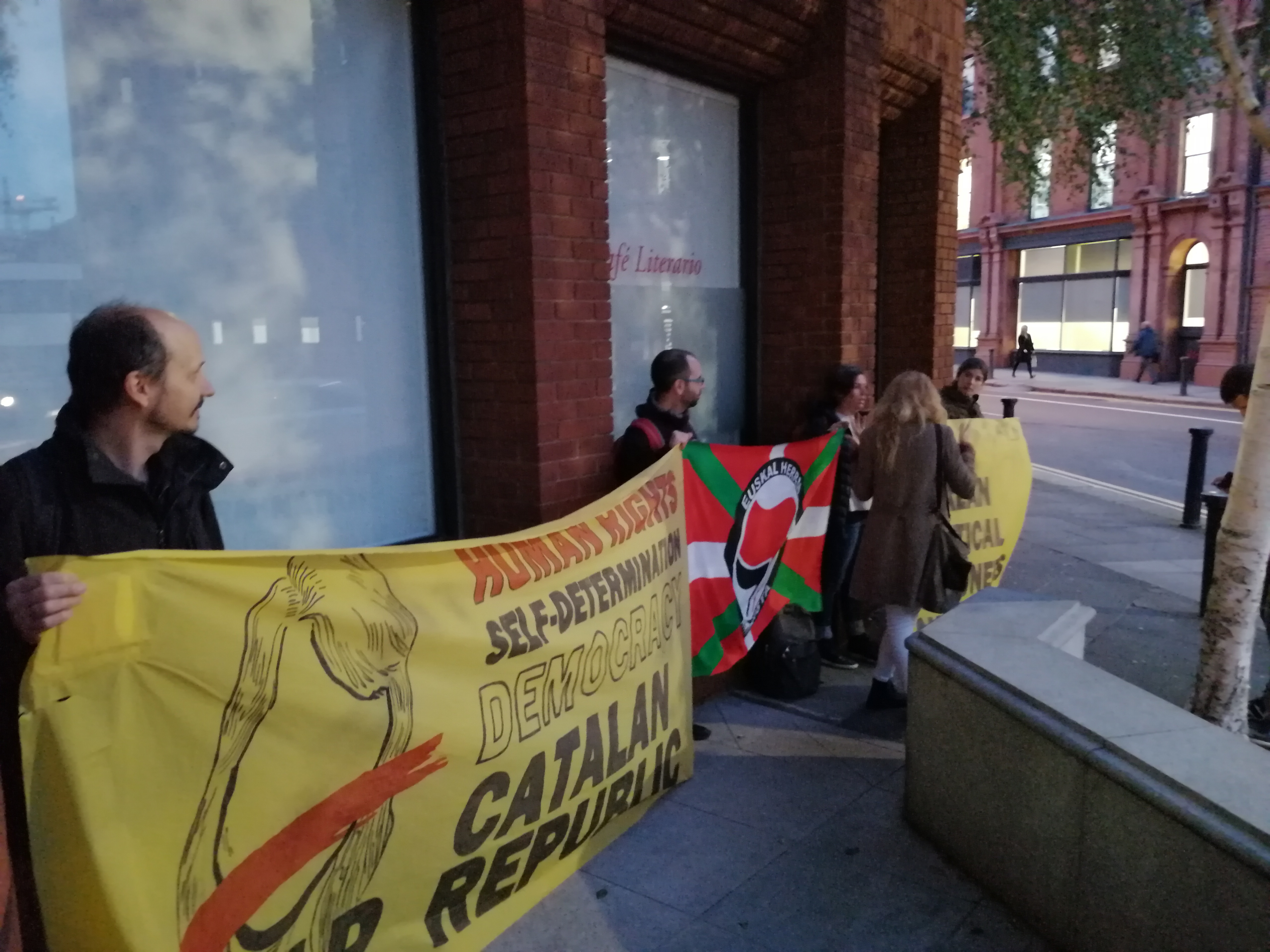
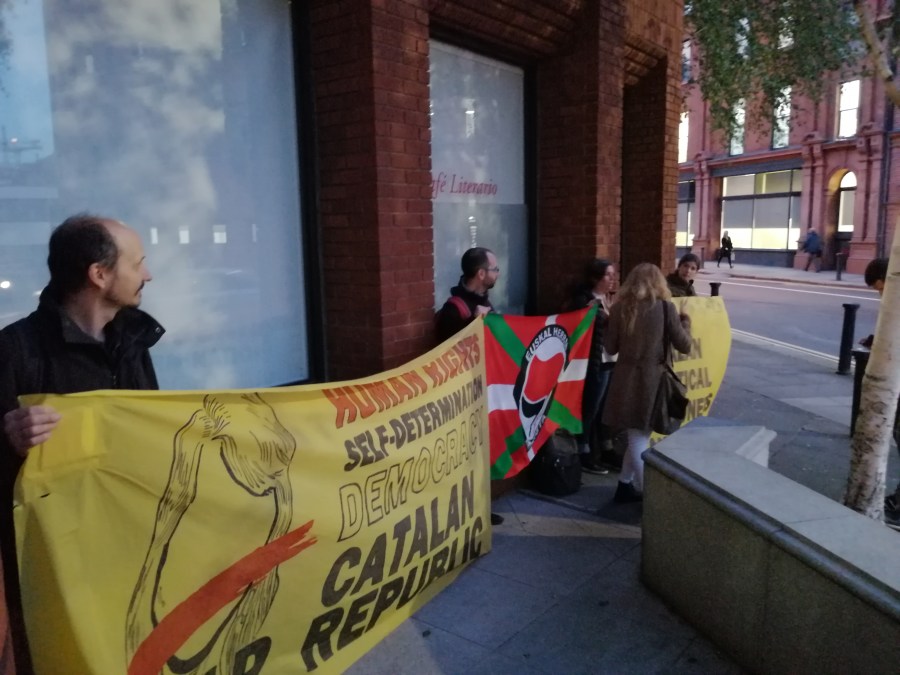
A view of some of the protesters outside the Instituto Cervantes on Monday.
(Photo: D.Breatnach).

WHAT ABOUT THE RIGHT TO SELF-DETERMINATION?

          The event had been advertised as a debate but no debate took place. Nor was there a question-and-answer session, nor engagement with the audience except to send them witty asides from Peralta and to thank them at the end.

This was too much for at least one of the small audience, an Irishman who interrupted the concluding remarks of the Director by saying, in Castillian (Spanish) that it was a pity that the question of self-determination had not been discussed. The event was taking place in Ireland, he commented, where another state had denied the people the right to self-determination on grounds of that state’s constitution also. Denied permission to exercise their right, the Irish people had to fight for it and eventually won part-independence.

Peralta commented that the Spanish people were cognizant of Irish history and appreciated it.

The Irishman replied that in the Spanish state things were the complete opposite.

Peralta commented that unfortunately there was no time left for that debate, thanked participants and audience and brought the event to a close.
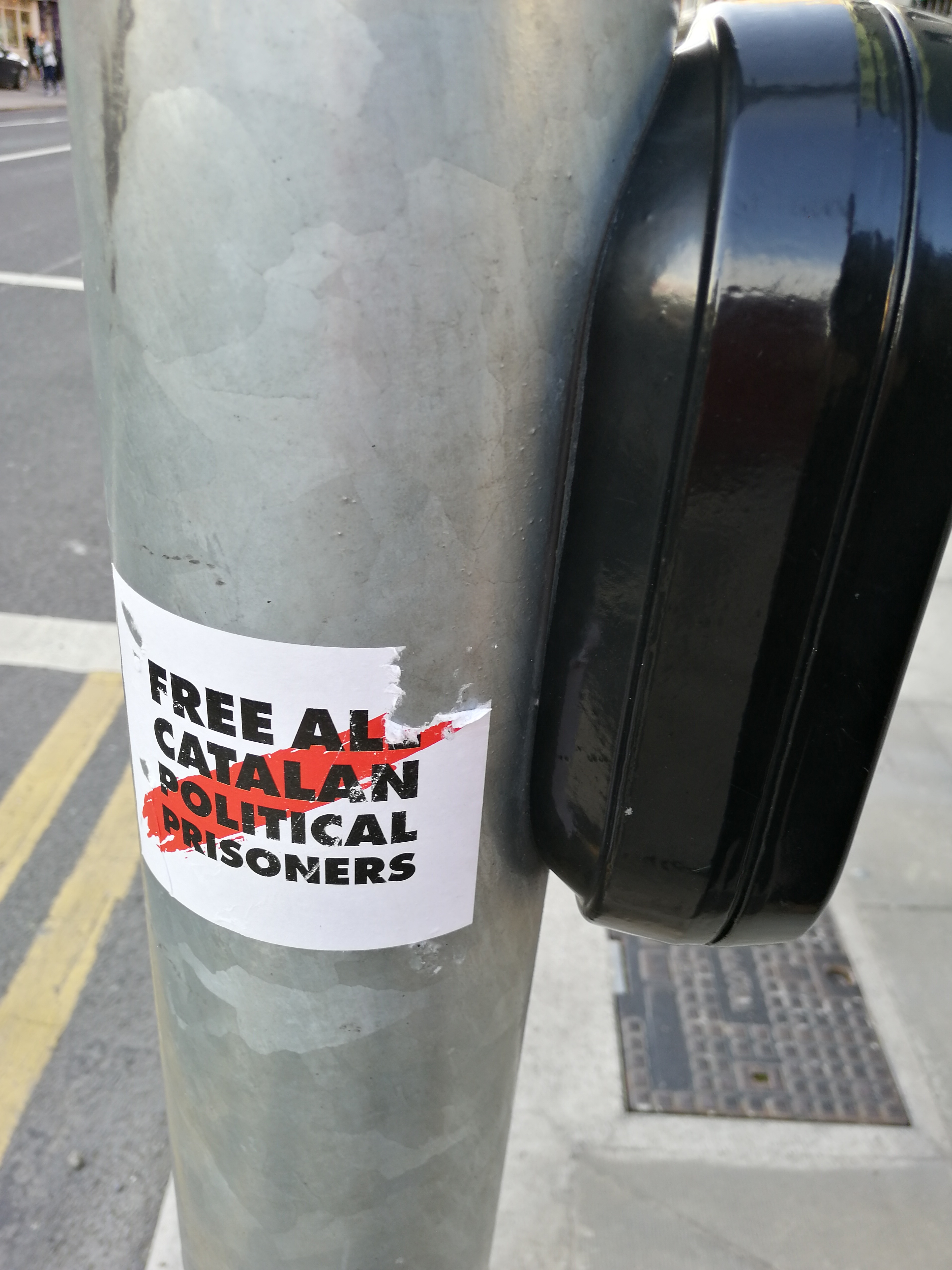
Sticker on pole near the Instituto Cervantes on Monday.
(Photo: D.Breatnach).

WHAT WAS THE POINT?

          Outside the meeting up to dozen protesters had taken up positions on both sides of the street. On the Trinity College side a couple of protesters stood beside portraits of the Catalan grass-roots activists and politicians who are in jail awaiting sentence or in exile. On the Instituto side, a larger group of protesters held two banners and a Basque Antifa flag.

One of the Catalan supporters, an Irishwoman, addressed several of the panel participants as they exited. It emerged that they had not understood the nature of the event and that they thought it had to do with October 12th, which is a Spanish State celebration of its former empire and spreading of the Castillian language1 (and for which one of the panel, who seems to work for the Instituto, is organising an event in Rathmines). They said they had not seen the “Global Spain” publicity (81 pages of propaganda justifying the actions of the Spanish State and attacking the principle of Catalan self-determination and the pro-independence movement!).

There was in truth not much point in attending the event unless one wanted receive a smooth-talking patter about an imaginary State occupying most of the Iberian Peninsula. For the protesters, it was important to give a response to the paint-over job. For the producers of the show, the importance was to try to distract an Irish audience from the reality of what is an unreconstructed fascist state with a thin veneer of democracy that is constantly peeling away.
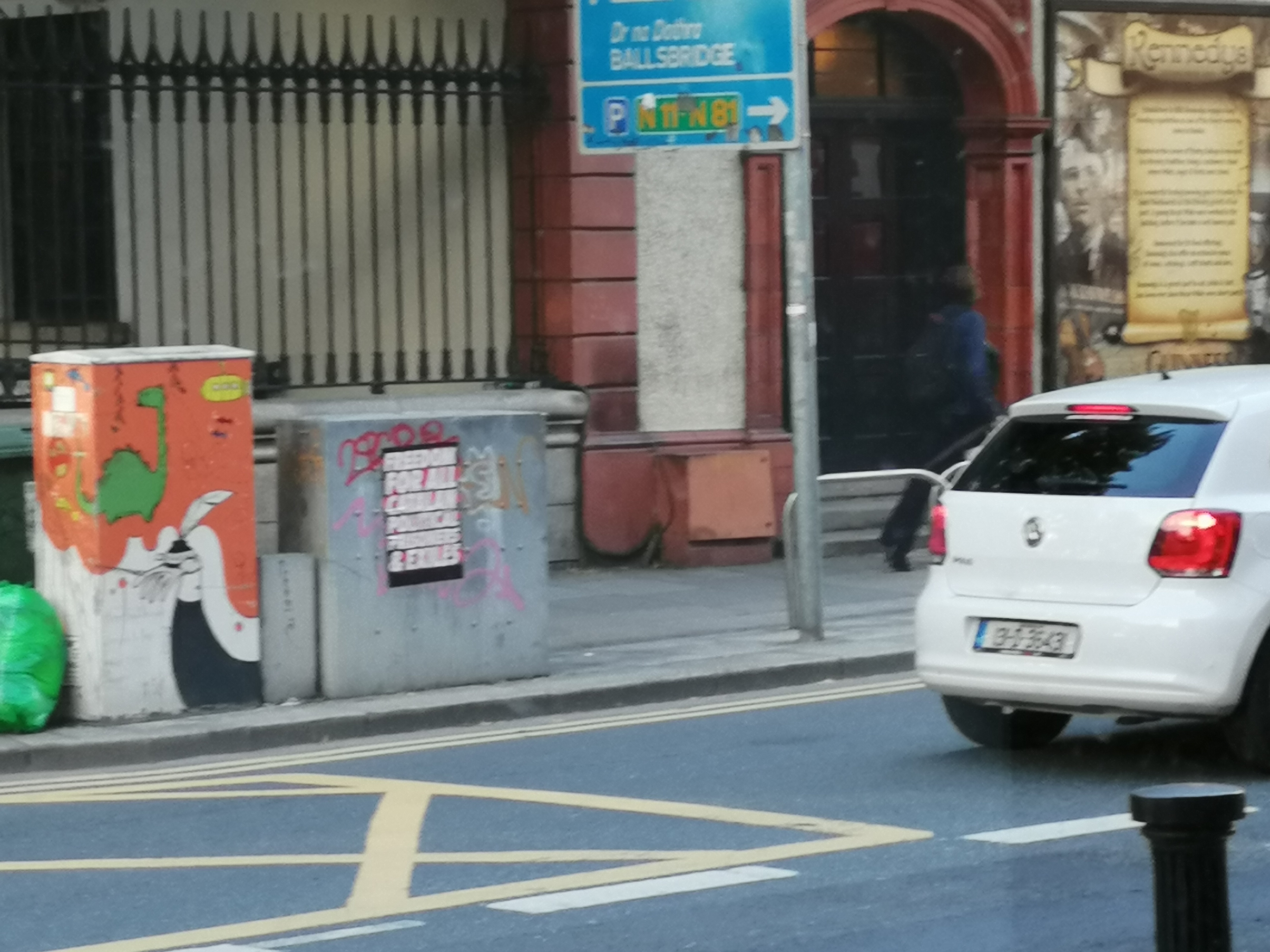
Poster seen on Dublin street near Instituto Cervantes on Monday.
(Photo: D.Breatnach).

End.

FOOTNOTES:

1 El Dia de la Hispanidad was formerly called “El Dia de la Raza Española” (Day of the Spanish Race). It is also the Spanish Armed Forces Day, obviously not inappropriately in context!

REFERENCES AND FURTHER INFORMATION

Article by El Nacional, independent and pro-independence Catalan newspaper: https://www.elnacional.cat/en/news/global-spain-advertising-campaign-democracy_426827_102.html

The Instituto Cervantes, Dublin: https://dublin.cervantes.es/en/about_us_spanish.htm

CDR Dublin: https://www.facebook.com/CDRDublin/

ANC Irlanda: https://www.facebook.com/IrlandaPerLaIndependenciaDeCatalunya/
With Catalonia/ Leis an Chatalóin: https://www.facebook.com/WithCataloniaIreland/
SPANISH SECRET SERVICE AND TERROR CELL: INCOMPETENCE – OR SOMETHING ELSE?

Diarmuid Breatnach

Recently the left-wing Spanish on-line newspaper, Publico, got a scoop on other media when it broke the story of the Spanish secret service and the terrorist1 cell in Catalonia, the one that carried out the killing spree in La Rambla in Barcelona in October 2017. Publico revealed that the head of the cell had been recruited as an informant while in jail on drug smuggling charges and that the secret service had helped him become an imam, a Muslim priest, in the province of Girona. Not only that but that they had the photos and mobile phone numbers of a number of the Ramblas terrorists and had been following them up to days before the attack.

Aftermath Rambla Attack
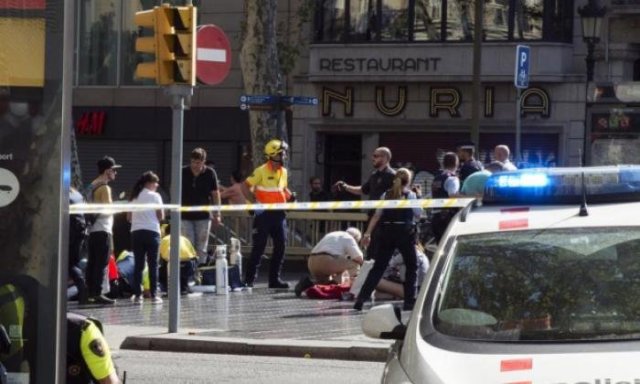
Aftermath of terrorist attack in the Rambla, Barcelona in 2017. (Photo image sourced: Internet)

So why had the whole lot not been apprehended? It’s a question many people are asking, along with the Catalonian and many foreign newspapers – but, strangely, only one of the main Madrid newspapers.

THE LEADER OF THE TERRORISTS WAS WORKING FOR THE SPANISH SECRET POLICE

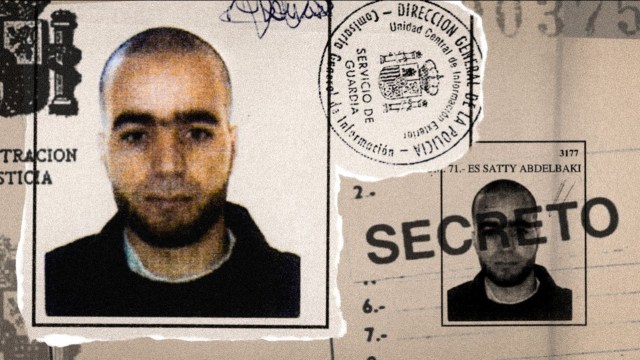
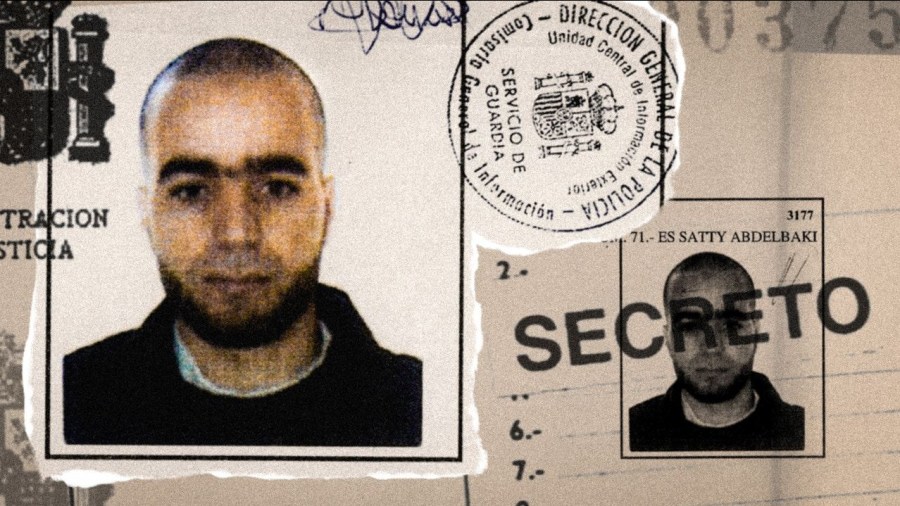
          Abdelbaki Es Satty came to the Spanish State in 2002 and was around 44 years of age when he died in an explosion in Catalonia. According to Wikipedia,

Es Satty was implicated in the 2006 Operation Chacal, in which five Islamists were arrested for sending jihadis to fight in Iraq. From 2003 he had shared an apartment with Islamists connected to the Moroccan Islamic Combatant Group (GICM) and the 2003 Casablanca bombings.

In 2012, (he) completed a four-year prison sentence for drug trafficking in Castellón. While in prison, he is reported to have established a “special friendship” with Rachid Aglif, who was serving an 18-year sentence for his role in the 2004 Madrid train bombings.

He was convicted of drug smuggling in 2014 and was to be deported from Spain, but …… A successful asylum application in November 2014 facilitated him moving freely in the 26 EU countries of the Schengen area.

catalonia-bomber-leader-es-satty.jpg
Es Sattty, believed leader of the terror cell that carried out the attacks in Catalonia in 2017. He was an informant of the Spanish Secret Service (CNI). (Photo image sourced: Internet)

The suggestion in the Publico articles is that Es Satty was recruited by the Spanish secret service (CNI) while in jail and that they ensured that he was not deported, also that they assisted him in getting employed as an imam (a Muslim priest) at the mosque in Ripol in 2015, a post he suddenly resigned in June of 2017. Ripol is a town in the province of Girona, Catalonia.

Publico now reports that the CNI file on Es Satty has been “wiped”!

THE EVENTS

          On the evening of 16 October 2017, El Satys and another man were killed, presumably by a premature explosion while handling the material. There were over 120 gas canisters which appeared stored for a number of terrorist bombs. The explosion occurred in the town of Alcanar, the southernmost of Catalonia and almost on the border with the province of Valencia.

When other in the cell heard that El Satys had been killed and another with him while handling the explosives, it seems they decided on a ‘revenge’ spree to honour their ‘martyr’ and carried out the attacks on innocent civilians in Catalonia.

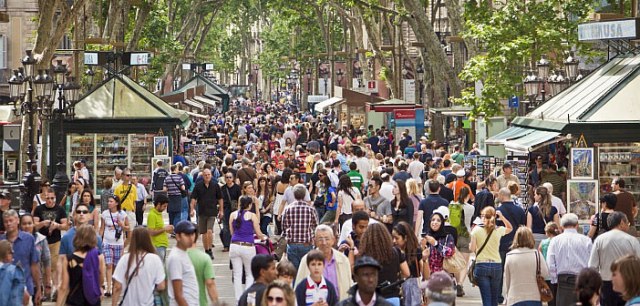
La Rambla is in Barcelona city centre, a medium-length wide street heading towards the port, with a tree-shaded pedestrian reservation down the middle, where stalls sell all kinds of ware and coffees, snacks etc. It is a favourite destination of tourists (and pickpockets).

Barcelona Rambla Packed
La Rambla, Barcelona, on a happier day.

On the late afternoon of 17 October, a member of the terrorist cell driving a van zigzagged down the Rambla, running down pedestrians and cyclists. During his escape from the scene, he hijacked a car and fatally stabbed the driver, bringing his total death-toll to 15 and injuring 131.

Later that evening, five men, apparently of the same cell, purchased knives and an axe and, at 1.00 am, drove into the Catalonian coastal town of Cambrils (not far from the popular tourist destination of Salou) and into a crowd of pedestrians, where they fatally stabbed a 63-year old woman and injured another six, before being shot by Catalan police. Four died at the scene and the fifth later of his injuries.

On 21st August, five days after the Alcanar explosion and four after the Barcelona massacre, the Rambla killer was fatally shot by the Mossos, the Catalan police, in Subirats, about 25 miles (40 Km) from Barcelona.

Initially, Catalan police believed the first violent event, the Alcanar explosion, had been caused by an accidental gas leakage but once they discovered the explosions and other events had occurred, connected them. Not only did the Spanish secret service, the CNI, fail to inform the Catalan police about the existence of this cell prior to the Alcanar explosion but it seems that at no time during the subsequent operations of the Catalan police did the CNI give them any information whatsoever.

Publico On Line Image
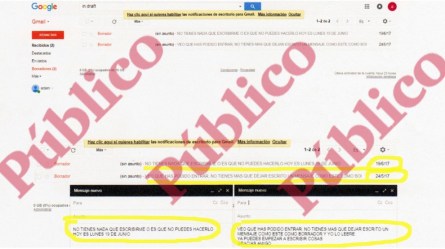
The on-line newspaper that broke the story. (Photo image sourced: Internet)

THE DIRTY WORLD OF STATE SECRET SERVICES

          Secret services penetrate cells and movements opposed to the status quo as a matter of course, whether they have an armed agenda or not. But when they do have such an agenda, typically they try to recruit some inside people for information, building up a wider and more detailed picture as time goes on. This takes time and meanwhile the informants’ ‘handlers’ will typically give their insider ‘asset’ money, protect him or her from prosecution, feed the informant’s fear or ego – or both.

As not-so-distant history shows with the British and US secret services (and probably all others around the world), these informants are permitted to break the law, even to kill, in order to keep up their cover. Yes and even to kill another, less-valued or more exposed informant, as the British had at least one informant do inside the Provisional IRA.

But it goes even further and informants or deep-cover agents also often act as agents provocateurs. They actually incite people around them to carry out armed actions. This can vary from encouraging them to attack where, unknown to the victims, the state forces are ready and waiting to kill them, as is believed happened at Loughgall, in occupied Co. Armagh in 1987. The informant can also be used to incite a group of political activists to carry out armed actions to facilitate the breaking up of the organisation2. Or to set off bombs that will, intentionally or not, kill uninvolved civilians, thereby losing insurgents popular support. Or that might set off inter-communal violence in an occupied country.

And religion-based organisations have long been recognised by secret services as useful opposition to leftist national liberation movements. Or against the USSR, for example, when the latter were invited into Afghanistan by the ruling circles. They may also be used to incite inter-communal violence in a country occupied by a foreign power or to help overthrow a ruling group which a foreign power wishes to replace with another more amenable to the power concerned — or in a country it wishes to invade.

The role of the Phalangist militias, Christian, in Lebanon is well-known, in their war against the growing power of the Muslim community. The CIA and Israel3 armed the Phalangists and encouraged them in their attacks Lebanese Muslims and on Palestinian refugee camps, not only against fighters but also massacres of the elderly, women and children. The CIA funded, supplied and even often trained Islamic fundamentalist jihadists4 and warlord bands in Afghanistan, Al Qhaeda among them, as they did also in Iraq. They did it in Syria too but ended up having to fight one such jihadist group, ISIS, which threatened to take the whole cake and the commanders of which were unpredictable in terms of future policy. But many of the war bands in the NATO-led Alliance fighting Assad and ISIS were themselves Jihadists too.

SUSPICIONS AND SILENCE

          There are many people within the Spanish state territory that distrust the State and Catalans, due in particular to their recent experiences, would figure prominently among them. When Publico broke the story about the CNI and their close connection to the terrorist cell, it was inevitable that speculation would take off and that it would not stop at the secret service’s ineptitude.

Some thought that the original intention had been to discredit the Mossos, who were later accused by some Spanish politicians of not cooperating fully with the Spanish police operations against Catalan independence campaigners. Presumably the explosions planned by the terrorist cell would leave the Catalan police looking useless.

Another theory went that explosions would be blamed in some way on the Catalan independence movement, which has until the present been remarkably peaceful in the face of Spanish police violence. In fact Aznar, the Spanish Prime Minister at the time of the Madrid train bombing by another cell, immediately blamed the bombing on the Basque armed group ETA. When it was proven to be an Islamist fundamentalist cell, his false claim contributed to his party losing the elections soon afterwards.

No doubt there were other theories speculated also and the response from Madrid did not help to quell them.

Many commentators have wondered at the Spanish state’s silence on the matter but even more so at the silence of all but one of the Madrid main newspaper. Surely this is a really big story? If the Government says that “it’s not a big issue (for them) to investigate”, would one not expect the Spanish media to be hounding them? That media silence is, really, the most puzzling aspect. One can readily see that the Government might not want to expose the ineptitude and dirty work of their State’s secret service … but the media?

The only answer that makes any sense is its Catalonia connection, that all locations in which the events occurred are in Catalonia. And that the independence movement for Catalonia is locked in a struggle with the Spanish unionist State. Therefore reporting on Spanish secret service ineptitude in Catalonia could well go to justify separatist wishes in Catalonia.

Or have the editors been made aware that this terrorist cell had an important role to play in that independentist conflict and asked to keep quiet? What if a campaign of terrorist massacres in Catalonia gave a plausible excuse for the Spanish State to impose emergency legislation on Catalonia, an excuse that would be thought convincing not only within the Spanish state but abroad also?5 Of course, if that was the gameplan, it did not work out for the Spanish State since the cell messed up and it was finished off by the Catalan police, the Mossos d’Escuadra.6

So, to answer the question in the title of this piece: in my opinion it is incompetence – and something else. But probably not the various “something elses” that are being most widely speculated.

However, the Spanish media silence tells us something about the Spanish state too. In what other European state would its media remain silent about its secret service penetrating a terrorist cell but then failing to prevent attacks on its citizens by members of that cell?

End.

FOOTNOTES

1The word “terrorist” is frequently applied in the mass media to a wide range of organisations employing armed, from small cells to popular movements, of a wide variety of ideological motivation ranging from fascist to communist or just national liberationist. There can even be paid terrorists, such as the Contras run by the CIA against the Sandinista-run Nicaragua. Even some animal liberation organisations have come under this term and, indeed individuals without an organisation backing them (such as the Australian who carried out the massacre in New Zealand last year). In addition, some states have been labelled “terrorist” by others. Therefore the term cannot have a precise definition and I use it here only to describe small or larger organisations that target uninvolved civilians in order to cause terror among a population and instability among the rulers.

2British secret services did this in a case in England where they got a member of the local Sinn Féin branch (the party had branches in Britain at the time) to incite them to raise funds for the cause by carrying out a bank robbery, during which the robbers were arrested. Then he incited breaking them out of jail and that group got arrested too. After that he feared he was exposed and confessed to, strangely enough Jazz musician George Melly and then to the National Council for Civil Liberties (now Liberty). Very shortly after that he was killed, whether by the IRA or by his handlers is unclear. Though a famous case at the time several Google searches have failed to turn it up for me.

3The French may well have done so too as many of the Lebanon Christians had their origins in former French colonisation.

4From Jihad, a term meaning “struggle”, usually used in religious contexts. It can mean a moral struggle in society, within oneself or against “the enemies of Islam”, when it is sometimes characterised as a religious war, which may be defensive, or offensive (as with the Christian Crusades). In the political sense, especially when used in the West, it can be either defensive (e.g repelling or overthrowing a non-Islamic invader) or aggressive (e.g invading territories under non-Islamic rulers or under a different Islamic sect, or overthrowing such) but is always military and that is the sense in which I am employing it here.

5After the Twin Towers and other bombings by Al Qhaeda, US legislators were able to introduce the Patriot Act 2001 which gave the US State wide powers violating many civil rights.

6Whose Chief is currently on trial in Madrid, accused of undermining Spanish police operations against Catalan independentism through lack of cooperation.

REFERENCES

https://www.irishtimes.com/news/world/europe/spanish-intelligence-knew-of-terror-cell-ahead-of-barcelona-attack-say-reports-1.3959554

https://en.wikipedia.org/wiki/Abdelbaki_Es_Satty