The coca zones of Colombia are in crisis. The cash crop par excellence, i.e. coca is going through an unprecedented crisis, or so we are told.
The main promotors of the idea that the coca is in crisis because fentanyl has displaced it and sooner or later it will finish off the coca were from the government. Amongst those promoting this stupidity are Colombian state functionaries from the NGOs, social organisations and of course high-ranking members of the Historic Pact. The very president of the country, Gustavo Petro stated in August that
The cocaine market in the USA has collapsed and has been replaced by an even worse one: fentanyl that kills 100,000 per year. Cocaine used to kill 4,000 due to the poisonous mixtures from the market clandestine.(1)
It is simply the case that nothing that Petro said at the time was true. Whereas Clinton exaggerated the deaths due to cocaine consumption in order to justify Plan Colombia, Petro sought to minimise them. First of all, we should be clear that fentanyl did not displace cocaine, but rather another opioid, heroin. And the most notorious aspect of fentanyl is not the increase in consumption, but rather that due to its toxicity, a dramatic increase in overdoses. Petro’s government makes statements on the drugs issue without even understanding basic concepts.
The overdue publication of its drug policy allows us to analyse properly what it aims to do, as up till now we have had to put up with a year of contradictory speeches, tweets that don’t say much and complete incoherence in the matter, without even mentioning his stated aim of handing over the Colombian Amazon region to the US military, something that not even Pastrana openly proposed when he announced Bill Clinton’s Plan Colombia.
In a US study published in May of this year, the researchers found that the deaths from fentanyl tripled between 2016 and 2021, increasing from 5.7 per 100,000 inhabitants to 21.6 in 2021. The deaths from cocaine overdoses increased in the same period from 3.5 to 7.9. At the same time there was a 40% decrease in heroin related overdoses, falling from 4.9 in 2016 to 2.9 in 2021.(2) The study just confirmed the analysis of previous research published in December 2022 that looked at increases in mortality since 2001.(3)
Fentanyl is a new problem for the USA, but neither the increase in its consumption nor deaths tell us anything about the future of coca as Petro and Roy Barreras claimed. Quite the opposite. According to the UN, coca crops reached the figure of 230,000 hectares in 2022.(4) Of course, Petro is not to blame for that, he only took over the presidency in August 2022, but it belies his statements that coca is a thing of the past due to the economic crisis in the coca regions of the country.
So, what can be said of Petro’s new drug policy? Well, the first thing is that there is at last a policy outlined in a public document. They took their time in doing it but better later than never. The document proposes with a certain amount of hyperbole Oxygen for the communities affected, through support from licit economies, environmental measures and treating the matter of consumption as a public health issue. It also proposes Asphyxiation for drug trafficking organisations. Furthermore, it proposes being the voice and leadership of “an international diplomatic strategy to change the paradigm in how the drugs phenomenon is dealt with.”(5)
The document kicks off with a correct analysis that contradicts the public declarations made by Petro and other high ranking government functionaries, a few weeks prior to its publication. It is inexplicable how the president can boast about the collapse of coca at a point when it is almost certain his drugs policy was at the printers. It must be due to mediocre functionaries, as this government has continued with the policy of Duque and the previous governments of hiring mediocre friends. But in any case, the document gets somethings right, at last.
For decades, Colombia has made an enormous investment in human and economic terms in fighting drug trafficking. Although there are no official figures on the outlay in fighting drugs, but the Drugs Observatory of Colombia calculates an annual average expenditure of 3.8 trillion pesos [885.2 million euros] ascending to an approximate investment in the last twenty years of 76 trillion pesos [17.7 billion euros]. Whilst some results have been achieved along the way, it is true that the two main goals have not been reached: reduction in the supply and demand for illicit drugs.
Even though 843,905 hectares of coca were forcibly eradicated between 2012 and 2022, the planted area in this period increased by 327%. In 2022, Colombia had 230,000 hectares of coca with a productive potential of 1,738 tonnes of cocaine. As for demand for psychoactive substances, between 1996 and 2019 an increase of 5.1% to 8.7% in the consumption of all illicit substances (marijuana, cocaine, base, extasy or heroin) was observed.(6)
The document then goes on to acknowledge that the collapse in cocaine consumption is not real but rather on the contrary there has been an increase. It states that one of the first hypotheses was a global fall in demand for cocaine.(7) They are trying to save their own skin. There was no data to sustain the supposed hypotheses: none. It was dreamed up by mediocres and no one else made the claim. The document goes on to say “However, according to the lastest Global Cocaine Report from the UNODC (2023), demand has risen.(8) At least we are having a debate about the reality of poorly written studies from the children of the lovers of their friends who they hired.
So, what do they propose? It would seem that they propose a shift in the punitive model without abandoning it completely. They accept that the fumigations have not worked and that the periods of greatest fumigation do not match those of a lesser supply of the drug.(9) But the punitive element continues to be an integral part of the policy, the supposed shift is a mirage.
The evidence has shown that a security strategy on its own is not enough [the emphasis is mine] but rather it must go hand in hand with actions to prevent crime and deal with the underlying causes.(10)
The document takes a look over the international treaties in the area, softening the real demands of the Single Convention of 1961 stating that it doesn’t prohibit anything but rather submits the plants and the drugs produced to a strict control. There is not enough space here to go into detail on that debate. But once again what the government is saying is not really the case. The Single Convention does actually allow for some coca crops for medical and industrial purposes, mainly in Peru and also opium in India. But it is not the case that Colombia has misinterpreted those treaties. And this is a major issue, as any change in the paradigm is dependent on changes in those treaties or better still their complete derogation and the drawing up of new treaties under a new paradigm.
Whilst it is true that a country can allow coca crops for licit purposes, that is done with the permission of the UN control bodies, i.e. the USA. Even traditional consumption of the coca leaf is frowned upon in the Convention. Article 26.2 states that.
The Parties shall so far as possible enforce the uprooting of all coca bushes which grow wild. [emphasis is mine] They shall destroy the coca bushes if illegally cultivated.
Although Article 49 permits chewing of coca leaf in countries where it was already legal on the 1st of January 1961 (subparagraph 2a), it does so on the condition of banning it and eradicating it once and for all by 1986 (subparagraph 2e), something which was not achieved. Whether they like it or not, this treaty has not been misinterpreted and the whole UN framework i.e. US policy in the area is the problem and not a misinterpretation of previous governments. The supposed freedom to grow and licit use of coca that Petro imagines is not real.
Some states in the US legalised the production and recreational consumption of marijuana and clashed with the federal banking system that was not willing to receive funds from the industry, forcing many producers to resort to mechanisms more suited to money laundering in illicit industries. Something similar happened in Uruguay. The country regularised the recreational production and authorised and regulated the state control of it. However, not even the Bank of the Republic of Uruguay was willing to receive money from a lawful activity in the country due to a fear of reprisals from the USA.
It would seem that the architects of the law did not foresee the problem that would arise in the banking industry, owner and lord of the commercial and financial transactions in Uruguay. Were the Uruguayan legislators aware that it was not just a matter of convincing the international system of prohibition to reclassify cannabis as a substance in the drugs conventions but that they also had to convince the banking system to accept money from cannabis transactions? Everything seems to indicate that the directives the banks implement are those that are simply related to the formality of Cannabis being a prohibited substance and the fact that the money from the cannabis market is legal, illegal, black or white has no bearing on decisions.(11)
Uruguay found itself at the mercy of the repressive whims of the US government and in practice was not autonomous nor sovereign. Any drugs policy should take as its starting point that Colombia is not sovereign in the matter and it faces a massive enemy when it comes to solving the problem: the USA. It is not a matter of a restrictive interpretation by Colombian governments, but rather the reality of imperialist domination. This was the case with Uruguay.
… according to the Uruguayan government implementing a national law [on drugs] depends on the modification of a foreign law. Note that at no stage is a modification of international drug treaties that Uruguay has ratified mentioned, but rather a federal law that internally classifies cannabis in the USA.(12)
The government has no proposals in the matter and its proposals for the peasants are remoulds of the previous policies with a slightly modified language. They no longer talk of crop substitution but rather licit alternatives or economies. And the licit alternatives for the countryside are the usual ones, exportable monocultures.
And the iron hand continues for the peasantry. They have talked a lot about distinguishing between large and small-scale coca producers, increasing the definition of small-scale producer as one that has up to 10 hectares. But the iron hand continues. They have said that they will not use forcible eradication but…
Forcible eradication will be applied to crops that: (i) do not fall into the category of “small-scale grower”, (ii) increase in area, (iii) planted after the publication of this policy (regardless of size), (iv) have infrastructure for the production of base and cocaine hydrochloride, (v) do not fulfil their commitments to substitution and other mechanisms on the path to licit economies.(13)
Many peasants have some infrastructure to produce base, an infrastructure that is not all that complicated. So, I don’t know who these peasants who will not be subjected to forcible eradication are. It is not all that different from the policies of Uribe and Pastrana and borrows policies from Plan Colombia, the Exporting Stake of Uribe and the directives of the former Social Action and of course the Peace Laboratories of the European Union and the nefarious apologist for the economic policies of Uribe and also in passing the World Bank, the priest Francisco de Roux: the so-called Productive Alliances.
Productive agreements between the public sector, private sector and grassroot economies
These consist of a tripartite collaboration between the state and the private sector as drivers of the productive reconversion, through actions such as capitalist investment, transfer of know-how and insertion into local, national and international markets. To that end the “Productive agreements for life and hope” will be implemented, in which the state will offer benefits to the businesses that commercially associate themselves with the communities. The Ministry of Industry, Commerce and Tourism will facilitate and strengthen these type of alliances.(14)
Not that long ago in 2017, various current senators and representatives of what is now called the Historic Pact publicly denounced a proposal from Santos on the countryside. They stated:
… limits [the communities] chances of defining the productive and economic model that would allow the building of peace with social justice, by tying it to technical criteria… that give priority to the establishment of alliances and chains of production between small and large producers and the efficient use of rural land, technological innovation, technical aid, credit, irrigation and commercialisation that favour an entrepreneurial large-scale agro-industrial production.(15)
So, what about now? Ah of course, the proposal is yours, and it doesn’t matter whether it is the same proposal or not, but rather who makes it. And if the peasants do not agree with the economic model being imposed, what will happen to them? Well, “a differential treatment will be promoted that will be transitory and conditioned on their signing up to processes on a path to licit economies”.(16) In other words, they are going to jail.
As for money laundering, there is nothing new. The government is obliged by various international treaties to fight against money laundering. But the language used is telling.
This last point [laundering] is based on identifying high value financial targets, understood to be persons or legal entities, goods, assets or bodies that due to their nature, volume or characteristics may be exploited by criminal groups (emphasis is mine) to hide or channel illicit funds and thus launder money from criminal activities.(17)
HBSC Tower, Mexico (Photo source: Wikipedia)
As with other governments, including the USA, the banks are seen as another victim. More so than the peasants, exploited by criminal groups when in reality they themselves are criminal enterprises. The massive laundering of assets that HSBC carried out in Mexico cannot be understood in any other light. There are no measures taken to jail the banks’ directors, cancel their banking licence, freeze their assets, fine them to the point of leaving them naked in the street. No. The asphyxiation the government talks about is like the law, to be applied to some but not to others. They are more concerned about illegal mining in coca zones than the laundering of assets only yards from the Presidential Palace.
The document is very similar to previous policies with some small changes, a slightly distinct language and “new” proposals that are not new. Perhaps we could say that it indicates some goodwill in some aspects, but nothing more. Petro can’t fight for a new paradigm without changing the current one.
Proposing a revision of the international legal framework does not imply a conflict between prohibition or total freedom in the market for psychoactive substances. On the contrary, it means coming up with intermediate solutions such as alternatives to prison, harm reduction strategies and the responsible regulation adult use substances such as cannabis. The progress, failure and lessons learnt from international cooperation on drugs represent an opportunity for the international community to evidence based innovative strategies and policies.(18)
Harm reduction is policy in most of the world, including some parts of the USA. Alternatives to prison also, though in practice it is not always the case in all countries. What is put forward is the current state of play, not a big struggle to change the paradigm. It is a disappointing document, more so than previous policies, as this one tries to play with the language to stupefy, fool and lie to us. In the end, it is another lost opportunity. If you want to see something innovative in drug policy, you would be better off taking a drug, preferably a magic mushroom.
(2) Spencer, M.R. et al. (2023) Estimates of drug overdose deaths involving fentanyl, methamphetamine, cocaine, heroin, and oxycodone: United States, 2021. Vital Statistics Rapid Release; no 27. Hyattsville, MD: National Center for Health Statistics. May 2023. DOI: https://dx.doi.org/ 10.15620/cdc:125504. P.3
(3) Spencer MR, Miniño AM, Warner M. Drug overdose deaths in the United States, 2001–2021. NCHS Data Brief, no 457. Hyattsville, MD: National Center for Health Statistics. 2022. DOI: https://dx.doi. org/10.15620/cdc:122556.
(Published elsewhere earlier in December, including Red Line; published here with author’s permission and section headings, photo choices (except one) and intro line are by Rebel Breeze editing)
The issue of drugs is one that is never far from public discourse on the Colombian conflict. Biased or just simply lazy journalists use the issue to ascribe motives for an endless list of events, massacre and murders. It is true that drug trafficking has permeated all of Colombian society and there is no sector that has not been impacted by it. But not everyone in Colombia is a drug trafficker. However, once again the King of Clubs is played to describe the conflict in terms of a drug problem.
Several Colombian newspapers have recently published articles on the supposed relationship of the guerrillas of the National Liberation Army (ELN) with drug trafficking and there are already eleven commanders who are under investigation for such crimes and are sought in extradition.[1] They talk as if the ELN dominated the drugs trade, and talk of settling of accounts over drug money, as if they were a crime gang, instead of saying that the ELN takes drastic measures against its members who get involved in drug trafficking and that those internal executions are due to the indiscipline and betrayal of principles of some people and are not an internal dispute over money.[2] Of course, the ELN in an open letter widely distributed on social networks and alternative press, denied any links to the drug trade.[3] But, how true is this new tale? Before looking at the accusations levelled against the ELN it is worth going over the history of drug trafficking in Colombia and the reality of the business in international terms.
POLITICIANS, GUERRILLAS AND BANKS
Let’s start with the obvious. When the FARC and the ELN were founded in 1964 drug trafficking was not a problem in the country and there were no large plantations, i.e. the existence of the guerrillas predates the drugs trade. Later in the 1970s the country went through the marijuana bonanza on the Caribbean coast, but it is the emergence of the large drugs cartels in 1980s around the production of cocaine that would define forever the shape drug trafficking in the country would take. Up till the 1990s the country was not self sufficient in coca leaf, even though it was the main manufacturer of the final product: cocaine. Escobar was dead by the time Colombia achieved self sufficiency and it is in that context that the discourse of blaming the FARC for the drugs trade gained ground, completely ignoring that the main narcos were the founders of the paramilitary groups. One of the most notorious paramilitary groups in the 1980s was the MAS (Death to Kidnappers) founded by the Cali Cartel and other drug traffickers in response to the kidnapping by M-19 of Marta Nieves Ochoa a relative of the Ochoa drug barons.
That discourse, however, was useful in justifying Plan Colombia and there was an element of truth to it, but not that much back then. The FARC’s relationship with the drugs trade has not been static and has evolved over time. Almost everyone accepts that they began by imposing a tax on the production of coca leaf, coca base or cocaine in the territories they controlled. The initial relationship changed and the FARC went from just collecting a revolutionary tax to promoting the crop, protecting laboratories and even having laboratories of their own and in some cases, such as the deceased commander Negro Acacio, got directly involved in the drug trade. There is no doubt on the issue. But neither were they the big drug barons that they tried to have us believe, those barons are in the ranks not just of the Democratic Centre but also the Liberal and Conservative parties. It is forgotten that Samper’s (1994-1998) excuse regarding drug money entering his campaign’s coffers was and still is that it was done behind his back, but no one denies that drug trafficking has to some degree financed every electoral campaign in the country. Although companies like Odebrecht play a role at a national level, at a local and regional level drug trafficking decides who becomes mayor, governor, representative in the house and even senators. Even the brother of the current Vice-President Marta Lucía Ramírez was a drug trafficker and there are loads of photos of many politicians with Ñeñe Hernández and Uribe appears in photos with the son of the paramilitary drug trafficker Cuco Vanoy. It is a matter of public knowledge that several high ranking police officers close to Uribe such as his former head of security Mauricio Santoyo were extradited to the USA for drug related crimes and Uribe’s excuse was the same as Samper’s: it was all done behind his back.
Alvaro Uribe, ex-President of Colombia and patron of current President Duque is under house arrest and investigation for close links with drug cartels and murder paramilitary organisations. (Photo source: Internet)
Late drug mafia boss”Nene” Jose Guillermo Hernandez (r) with President Ivan Duque ((Photo source: La Nueva Prensa)
NOT THE ELN
But when we look at the extent of illicit crops in Colombia, we can clearly see the reason why they are linked to the FARC for so long and not to the ELN. The reason is simple, the majority of the large plantations of coca and opium poppy were to be found in areas under the influence of the FARC. If we look at the crop monitoring carried out by the United Nations Office on Drugs and Crime (UNODC) we can see that in 2001 the main departments (administrative regions: Colombia has 32 — RB editing) where there were crops were almost exclusively FARC fiefdoms.
In 2001, coca was to be found in 22 departments of the country, compared to just 12 in 1999. However, despite the expansion, just two areas accounted for the majority of the crops: Putumayo-Caquetá had 45% of the total amount of coca (about 65,000 hectares) and Meta-Guaviare-Vaupés with 34% of the area (about 49,000 hectares) i.e. 79% of the total area under coca.[4] They were areas that were completely dominated by the FARC, not a single eleno was to be found in those territories and if they did venture in, it was undercover at the risk of execution by the FARC were they discovered as the FARC did not tolerate political competition in their fiefdoms. When one looks at the map of crops back then, one can see not only the concentration in those areas but also almost all the other departments were dominated by the FARC and those where there were significant amounts of coca and also an ELN presence, one finds Cauca with 3,139 hectares, Nariño with 7,494 hectares and the Norte de Santander with 9,145 hectares. But in those areas there was a certain territorial balance between the different guerrillas and one of the few departments where the ELN was clearly the dominant force was Arauca with 2,749 hectares.[5] But when we look at the counties we can see that it is not as clear cut, as in the Norte de Santander 83% of the coca crops were to be found in just one county: Tibú, FARC fiefdom for many years before the paramilitary takeover in 1999.[6] In Arauca the county of Araquita accounted for 60% of the crops in the department and it was also a FARC fiefdom within an area dominated by the ELN. Thus it is obvious as to why they spoke almost exclusively about the role of the FARC in drug trafficking and not the ELN at that time.
Years later the situation had not changed much, the main producing departments were the FARC fiefdoms. The UNODC study on coca crops in the country in 2013 continues to show a concentration in FARC fiefdoms, with a displacement from Putumayo to Nariño due to aerial spraying and the persecution of the FARC by the State. In 2013, there were just 48,000 hectares of coca in the entire country, with significant reductions in some parts. Nariño, Putumayo, Guaviare and Caquetá accounted for 62% of the land under coca, with Norte de Santander representing 13% and Cauca with just 9%.[7] There was a reduction and a displacement of the crops towards new areas with Nariño accounting for the most dramatic increase of all departments.
In 2019, there was 154,000 hectares of coca, a little over three times the amount grown in 2013, though it was slightly down on 2018 when there was 169,000 hectares.[8] Coca production recovered after 2014 in the middle of the peace process with the FARC. It stands out that in 2019, Arauca, a department dominated by the ELN the UNODC did not report any coca crops.[9] Once again Norte de Santander is a department with widespread coca leaf production almost quadrupling the amount reported in 2001. It had 41,749 hectares of coca but the county of Tibú alone had 20,000 hectares and the same UNODC report indicated that these are not new areas and show that the crop has deep roots in the area.[10]
THE BANKS, THE BANKS!
However, despite the role of the FARC in the drugs trade, they weren’t the big drug barons we were led to believe. How can we be sure? Their demobilisation did not alter the flow of cocaine towards the USA and Europe. The big drugs capos in the companies, the Congress of the Republic, the international banks did not stop for a second. Neither did people such as Ñeñe Hernández and other associates of right wing political parties in Colombia stop for a single instant.
Neither the production nor consumption of cocaine halted. The UNODC’s World Drug Report says as much about both phenomena. According to the UNODC consumption of cocaine fell from 2.5% in 2002 to 1.5% in 2011 in the USA, but from that year it increased again reaching 2.0% in 2018 and also there are indications of an increase in the sale of cocaine of high purity at lower prices between 2013 and 2017. The price of a gram fell by 29% and the purity increased by 32%.[11] The report also indicates that in Europe there was a significant increase in various places such as the Netherlands, Norway, Denmark, Estonia and Germany. Nevertheless, some of those countries had seen decreases in consumption in the first years of the century.[12] All of this suggests that there is a greater supply of the drug. This can be seen not only in the previously mentioned figures of an increase in the production of coca leaf in Colombia (or in other countries such as Peru and Bolivia), but can also be seen in drug seizures. An increase in seizures may indicate greater efficiency by the police forces, but combined with stability or an increase in consumption and a reduction in price, rather indicate an increase in production and availability.
According to the UNODC cocaine seizures have increased dramatically since the commencement of Plan Colombia, indicating, although they do not acknowledge it, the failure of their anti-drugs strategy and the tactic of aerial spraying with glyphosate. In 1998 400 tonnes were seized globally and that figure remained relatively stable till 2003, reaching 750 tonnes in 2005 and surpassing the threshold of 900 tonnes in 2015 to finish off at 1,300 tonnes in 2018,[13] i.e. there was no reduction in consumption or the production of cocaine. Throughout the years with or without the FARC there has been coca production and of course the main drug barons never demobilised, the heads of the banks remain in their posts.
The real drug traffickers wear a tie, own large estates, meet with President Duque, it is not the ELN that moves hundreds of tonnes of cocaine around the world. In 2012, the Swiss bank HSBC reached an agreement with the US authorities to pay a kind of fine of $1,920 million dollars for having laundered $881 million dollars from the Sinaloa Cartel and the Cartel of Northern Valle, Colombia. The bank had, despite everything, classified Mexico as a low risk country, thus excluding $670 billion dollars in transactions from monitoring systems and the bank was notified by the authorities but ignored them.[14] Nobody went to jail, in fact no one was prosecuted. As Senator Warren in a session of the Senate Banking Commission pointed out, no one was going to go to jail for this massive crime. Moreover, the Sub Secretary for Terrorism and Financial Intelligence, David S. Cohen refused to recommend a criminal investigation against the bank. There is no need to state that no ELN commander is on the board of this or other banks. The ELN is usually accused of infiltrating universities, but to date no one has accused them of having infiltrated the boards of banks.
In 2012, the Swiss bank HSBC paid US authorities a penalty of $1,920 million for having laundered $881 million dollars from the Sinaloa Cartel and the Cartel of Northern Valle, Colombia. The bank had classified Mexico as a low risk country (!), thus excluding $670 billion dollars in transactions from monitoring systems. (Photo sourced: Internet)
HSBC bank has bought building of former Central Bank Ireland on Central Plaza, Dame Street, Dublin (Photo sourced: Internet).
It is not the only bank implicated in money laundering, in 2015 London was described as one of the main centres for money laundering the proceeds of drug trafficking.[15] A report by the UK National Crime Agency states, on the basis of a UN calculation that between 2% and 5% of global GDP are laundered funds “that there is a realistic possibility [defined as between 40-50%] that it is in the hundreds of billions of pounds annually”[16] and the majority of it comes from crimes committed outside of the UK. There is no need to say that no ELN commander is a director of those companies, nor is there any need to state that these companies continue to operate and their directors are walking about free and according to the report they could only recover £132 million.[17] The NCA cites favourably the reports of Transparency International. According to this organisation, 1,201 companies operating in the British Overseas Territories inflicted £250 billion in damage through corruption in recent decades. They analysed 237 cases of corruption in the last 30 years. The majority of the companies are registered in the British Virgin Islands (92%) and the majority (90%) of the cases happened there[18] in the favourite headquarters of many companies that operate in Colombia, without mentioning those who finance election campaigns. Once again, the ELN does not operate in those territories, although many mining companies in Colombia are registered there. The report points out that due to legislative changes there are fewer reasons to buy property in the UK through those companies registered in the Overseas Territories, yet the number of properties has remained relatively stable at some 28,000.[19] Of course not all them are the result of illicit funds, however… As far as we know the ELN’s Central Command is not the owner of any of these properties.
Transparency International continued with its investigations and its last report highlighted the number of British companies involved in money laundering or dubious transactions. It states that there are 86 banks and financial institutions, 81 legal firms and 62 accounting companies (including the big four that dominate the market). According to this NGO
Whether unwittingly or otherwise, these businesses helped acquire the following assets and entities used to obtain, move and defend corrupt or suspicious wealth: 2,225 Companies incorporated in the UK, its Overseas Territories and Crown Dependencies directly involved in making payments; 17,000 more companies incorporated in the UK that we have reasonable grounds to suspect have facilitated similar activity; 421 Properties in the UK worth more than £5 billion; 7 Luxury Jets 3 Luxury Yachts worth around £237 million worth around £170 million. [20]
Of course not all the laundered funds are drug related but they are all illicit in origin. However, the USA has not sought in extradition any of the banking capos, legal firms and less still the four big accountancy companies in the world. It would simply collapse the financial system were they to do so.
The extradition of criminals from Colombia has always been problematic in legal and political terms. Nowadays, the majority of those extradited are extradited for drug trafficking. The USA receives 73% of all those extradited from Colombia and 60% of them face charges of drug trafficking or money laundering.[21] Though not all those extradited are guilty and there are various cases of people being returned to Colombia, after their extradition, or others more fortunate who managed to demonstrate their innocence before being extradited, such is the case of Ariel Josué, a carpenter from San Vicente del Caguán who didn’t even know how to use a computer and yet for
… the United States and then the Colombian justice system, Ariel Josué was the head of an electronic money laundering network, and had to pay for his crime in a north American prison.
In the absence of an independent investigation nor the verification of his identity, the Supreme Court issued a court order in favour of his extradition and even President Juan Manuel Santos signed the order for him to be taken.[22]
OPEN LETTER FROM THE ELN
Despite those extradited, when not innocent, being poor people or those who have some relationship with right wing political parties or the economic elites of the country, the media and the Colombian and US governments’ focus on the problem is always the same: the guerrillas and not the banks or business leaders. In fact, one of the most famous people extradited is Simón Trinidad, a FARC commander and part of the negotiating team in the Caguán. Trinidad was extradited for drug trafficking and despite being a FARC commander they didn’t manage to prove any link to the drugs trade and thus resorted to the detention and captivity of three north American mercenaries hired by the Dyncorp company, a company denounced for crimes such as trafficking in minors, prostitution, sexual abuse amongst others.[23] So we should be very careful when it comes to accepting these new allegations against the ELN.
Private company mercenaries in Yemen conflict, paid by United Arab Emirates. Dyncorp have replaced Blackwater/ Academi there, who were faring badly against President-loyal troops and guerrillas’ resistance. Vulture capitalists Cerberus now own Dyncorp which has ex-Vice President USA Dan Quayle and Israeli billionaire Steve Feinberg as directors. (Photo source: voltairenet.org)
The ELN in its open letter acknowledges that they collect taxes from the buyers of coca base and cocaine who come into their areas of influence, as they do with other economic activities. So if the ELN is not involved in drug trafficking, how can we explain the presence of illicit crops[24] in their areas? The ELN commanders explain the presence of these crops in the same manner and the same dynamic they describe could be seen in all the regions where they had to deal with the FARC. There was a dispute between the two organisations as to what to do regarding the crops and drug trafficking itself. Initially the ELN opposed the planting of coca and opium poppy in the regions, but the FARC said yes and they authorised the peasants to grow it and moreover in some parts they were willing to buy base or cocaine itself, depending on the region. Faced with this reality the ELN felt that it had no choice but to allow the growing of the crop, as otherwise they would have to militarily face the FARC and the communities. That is why the ELN is to be found in areas with a coca tradition and as they acknowledge in their open letter they tax the buyers as they do with other economic activities. However, it is worth pointing out that the FARC also initially only charged taxes, but given the long ELN tradition on drugs it is unlikely, though not impossible that they do the same.
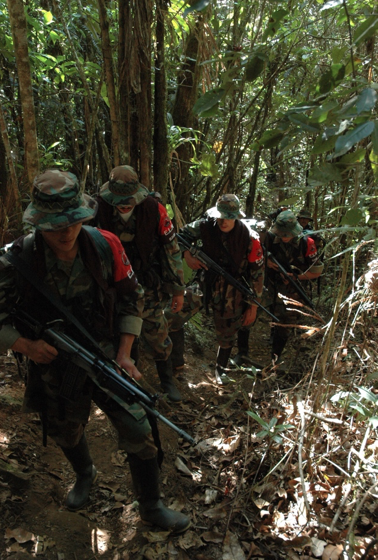
ELN guerrilla patrol in Colombia (Photo source: GL)
Its open letter not only refutes the allegations against it, but they also put forward proposals as to what to do regarding the problem of crops and drug consumption. It extends an invitation to various organisms to carry out in situ visits and inspections to see the reality of their relationship to the drugs trade, but they go further than clearing up the question of their links or otherwise to the drugs trade and they put forward proposals on the drugs problem as such.
PROPOSALS — SOLUTIONS?
To pick up the proposals made on various occasions by the ELN with the aim of reaching an Agreement that overcomes the phenomenon of drug trafficking that includes the participation of the international community, the communities in the regions that suffer this scourge and various sectors of Colombian society.[25]
The issue of drug trafficking is not one that Colombia can solve on its own, it is an international issue in nature, not just in terms of the distribution and consumption of the final products, such as cocaine and heroine or ecstasy and other drugs generally produced in northern countries, but also because Colombia’s obligations on the issue are covered by various international UN treaties. The ELN makes various points.
Only the legalisation of psychotropic substances will put end to the extraordinary profits of drug trafficking and its raison d’être.
This position has been discussed thousands of times in various fora and international settings. It is partially true. No doubt the legalisation demanded by various social organisations, including health organisations, would put an end to the mafia’s profits, but not the profits as such. The medicinal uses of coca and opium have never been banned, rather the International Narcotics Control Board (INCB) regulates and controls its production and end use. The UNODC calculates that in 2018 there just under 12 billion daily doses of opiates available in the legal market, double the amount available in 1998.[26] Cocaine and medicinal opiates, including heroin, have always been used in a medical context and the use and regulation of cannabis is a growing market. The legalisation of recreational consumption is another matter, the state of Colorado in the USA and Uruguay are two places where they legalised the recreational consumption, with various benefits in terms of crime, health and taxes. The profits are lower in these legal markets but they are large, nonetheless, as are they for other legal drugs such as alcohol and tobacco, products that are controlled in terms of quality and their impact on the health of the consumer. The legal marijuana market in Colorado amounted to $1,750 millions in 2019 with 69,960,024 transactions with an average price per transaction of $51.89, but the price to the consumer continues to fall and quality is guaranteed.[27] However, both Colorado and Uruguay have experienced legal problems with the banking system as their legalisation has no international recognition. The ELN’s proposal could only happen in the context of an international debate and a paradigm shift in the states and regulatory bodies at an international level such as the UNODC and the INCB, amongst others and the recent decision by the WHO on the medicinal use of cannabis is a good start.[28]
A pact on shared responsibility between drug producer and consumer countries is required
This pact already exists. There are various UN pacts on the issue starting with the Single Convention of 1961, the Convention on Psychotropic Substances of 1981 and United Nations Convention Against Illicit Traffic in Narcotic Drugs and Psychotropic Substances. This last treaty deals with aspects related to organised crime, precursor chemicals etc. What is lacking is political will, not another pact. The factories where the acids used to make cocaine are not bombarded but they do attack and bombard the producer communities, neither do they bombard the factories of illegal drugs such as ecstasy in the Netherlands. It is not the case that there is a lack of pacts but rather as they say the law is for the ragged and in geopolitical terms, Colombia is very ragged
The drug addicts are sick and should be treated by the states and should not be pursued as criminals.
This is one point that is always overlooked in the discussions on illicit crops and despite the belligerent tone of the USA, both the north American health system and that of the majority of countries in Europe deal with it as such, some countries do not even pursue consumption as such, acknowledging its character as a health problem and only go after related crimes. The UN accepts the need for treatment for drug addicts and calculates in its World Drug Report that 35.6 million people in the world abuse drugs and just 12.5% of those who need treatment get it, i.e. about 4.45 million people.[29]
The peasants who work with illicit use crops, should have alternative plans for food production or industrial raw materials, financed by the states in order to solve their sustenance without seeking recourse in illicit use crops.
Although this point is well intentioned it makes the same mistake as the FARC, the NGOs, international aid etc. Whilst it is true that the peasants should have alternative plans and receive economic support from the states, the problem is a core issue and cannot be solved through projects or credits: the economic aperture ruined the agricultural production of the country and the peasants can’t compete with the imports subsidised by the US and European governments. The underlying problem is not agricultural, nor economic but political and requires national and international changes. The free trade agreements, the monopoly in the agricultural and food sector exercised by multinationals such as Cargill, Nestlé, Barry Callebaut amongst others are not resolved by subsidies or projects.[30]
As well as pursuing the Cartels in the narcotic producing countries they should also pursue the distribution Cartels in the industrialised consuming countries; as well as the Cartels for the precursor chemicals and money laundering of narco funds in the international financial system and the tax havens.
This is a key point. As long as drugs are illegal, they should go after the points in the production chain there, both the banks and the companies that engage in money laundering and the companies whose chemicals are used in the manufacture of cocaine. They don’t do this, one little bit or not much at least. Whilst the USA seek in extradition just about anyone in Colombia, they have never sought nor will they seek the directors of banks such as HSBC.
There are reasons to accept the ELN’s word on the issue of drugs, and there are more than sufficient reasons to accept the debate on drugs and what to do about them. It is a debate that never occurred in the context of the negotiations with the FARC. The FARC opted to negotiate benefits for themselves, their social base and they never touched the structure of the agricultural economy in the country nor the international law in force on drugs.[31]
The allegations against the ELN lack any basis in fact, but the media does not ask us to treat it as truth, rather it serves as an excuse to delegitimise this organisation in the eyes of Colombian people and in the international area they are useful as excuse to continue to militarily support the Colombian state and in a given moment can be used as a pretext for more direct interventions against the ELN and perhaps Venezuela.
End.
“Freedom for political prisoners; Jail for those who oppress the people.”
Cartoon poster from Chile but which applies to Colombia with thousands of political prisoners
(Image sourced: Internet)
[24] Some NGOs prefer the expression illicit use crops, but it is misnomer. The international treaties on the matter leave us in no doubt on the issue, the crop itself is illicit. The Single Convention of 1961, the convention in force on the issue, in Article 22 No.1 demands the total eradication, the coca leaf and its derivatives are banned. The treaty demands that even the plants belonging to indigenous people be destroyed.







 rebelbreeze