COLONIAL PROXY MILITIAS, FROM IRELAND TO PALESTINE

Diarmuid Breatnach

Reading time main text: 5 mins.)

Currently the Palestinian Resistance is engaged in an important struggle to eliminate four Israeli-proxy militias. This type of militias of colonial and imperial powers have a long history, not least in Ireland from the 1800s to the present.

SETTLER AND NATIVE MILITIAS IN IRELAND

The British colonial occupation of Ireland had an army to quell native resistance but many settlers also organised themselves into armed bands (as in Palestine), such as the Hearts of Steel or Hearts of Oak in the late 18th Century in order to resist the big landlords.

The United Irishmen were successful in uniting a number of these, both native and settler bands such as the Whiteboys and Hearts of Oak, particularly in Antrim but the Peep O’Day Boys went mostly with the sectarian and royalist Orange Order.

The settlers also organised yeomanry militias which they labelled ‘Volunteers’, initially to defend against a feared invasion from Napoleonic France. Some of those contained Republican sympathisers and some quite the opposite.1

In response to the successful uniting efforts of the mostly Protestant-led United Irishmen, the Orange Order was founded by British loyalists and soon received official support in organising anti-Catholic pogroms and in exposing United supporters, especially among the Protestant communities.

LOW INTENSITY OPERATIONS AND “PSEUDO-GANGS”

During the three-decades war towards the end of the 20th Century mostly in the 6 Counties, the British Occupation also organised proxies such as the Ulster Volunteer Force and the Ulster Defence Association. These were recruited among the Protestant/unionist community.

But not only among civilians.

As has been a pattern among colonial possessions, the occupying power organised a gendarmerie, i.e an armed police force under central command of the occupying power. In Ireland that was the Royal Irish Constabulary which came to prominence in the suppression of the 1867 Fenian rising.

After the partition of Ireland by the British in May 1921, the RIC within the remaining direct colony of the Six Counties was renamed the Royal Ulster Constabulary2. British Intelligence used this force to channel intelligence, arms and recruits into the Loyalist gangs.

In addition, many members of the disbanded RUC’s semi-militia, the part-time B-Specials, were reorganised into the RUC Reserve of the colonial police or recruited into the British Army as the newly-formed Royal Ulster Regiment, from which the Loyalist militias could be supplied as before.

Brigadier Frank Kitson was a leading colonial counter-insurgency strategist who had served in Kenya and Malaya before he was sent to the Six County colony to coordinate the Loyalist militias and the official armed forces and gendarmerie, no doubt in coordination with MI5.

Kitson published Gangs and Pseudo-Gangs (1960) and Low Intensity Operations (19713) based on the experience of colonial resistance repression in Malaya and Kenya, going on to introduce these ideas organisationally in the occupation of the Six Counties.

Pseudo gangs give the occupying power deniability and, being generally from the occupied country,4 have local knowledge. They can carry on terrorism and assassinations at ‘a remove’ from the occupying power.5 In the case of criminal gangs, they have an existing organisation.

Such gangs may have family or other social relationships with some in the targeted community, introducing allegiances and communal fragmentation as has been occurring to some extent in Gaza. However, in Ireland, the gangs were all originating from the unionist community.

Frank Kitson (now Brigadier) in 1971 (Photo source: Internet)

Jeffrey Sluka summarises6 “… beginning in 1972, there has been a vicious, continuous campaign of sectarian assassination against Catholics in Northern Ireland waged by Loyalist paramilitary groups (the Ulster Defence Association [UDA] and Ulster Volunteer Force [UVF]) …

“… and their associated death squads (the Ulster Freedom Fighters [UFF], Red Hand Commandos, Protestant Action Force, etc.), who have killed nearly 700 innocent Catholic civilians – the largest category of casualties in the war.

“Thousands of other Catholics have survived Loyalist attempts to murder them.

“The existence of this campaign has never been publicly acknowledged by the British authorities, who have ignored it, downplayed it, and actively misrepresented it …

“… to influence the media and public in this regard, both at home and abroad, as an integral part of their counterinsurgency strategy.

“The official position of the British authorities is that there is no state terror in Northern Ireland, and certainly no death squads. When pressed, they admit that there is Loyalist terror against Catholics, but insist that they have nothing to do with it.

“When pressed with evidence such as the fact that hundreds of members of the Security Forces have been convicted of involvement with Loyalist paramilitaries, they claim that this collusion is informal – individual acts by rogue soldiers and policemen

“- and not a reflection of government policy or military strategy. All of these are political lies.”7

SEPOYS

The use of military forces recruited among the occupied people dates back further even than the Roman Empire and the British Empire used them extensively in India, where they called them ‘Sepoys’,8 which is what the Basque pro-independence people call the Basque Autonomous Police.9

In India, one of the most serious uprisings against British rule was sparked by a mutiny of its Sepoys.10

In Palestine, the ‘Zipaios’ equivalent are the police of the Fatah-controlled Palestine Authority. They are bad enough, brutally suppressing dissent, spying on and even attacking Palestine organisations in the West Bank, arresting and even killing critics.

The Royal Irish Constabulary in Ireland were a gendarmerie mostly composed of sepoys and of course there were many Irish regiments in the British Army and Irishmen also served in other British Army units, the Royal Navy and the Royal Air Force.

WORSE THAN SEPOYS

The militias in Gaza are however even worse. Based on criminal gangs and social groups, they have consistently looted aid trucks coming into Gaza before Israel closed all the gates, then selling the goods at high prices to the hungry population as Gaza starved and medicine became scarce.

According to reports there are currently four Zionist-linked militias in Gaza: Abu Shabab around Rafah in southern Gaza; Husam al-Astal in Khan Younis, Ashraf al-Mansi in Beit Lahia in the North, and Rami Heles in eastern Gaza.

Sourced from The Cradle based on Sky News investigation.

Their looting, supported by the Zionist state, was even used to try to blame on the Resistance, with Israeli spokespersons claiming that Hamas was stealing the aid. Conversely, as the Resistance strove to counter the proxy militias, the fighters were targeted by the Israeli Occupation Force.

Consequently it was almost impossible for the Resistance to suppress the proxy militias – until the current ‘ceasefire’. Now, able to operate to some extent more openly, the Resistance is settling accounts with the proxy militias. And it is very important that they do so.

Not only for what they have done, the plundering of emergency aid, attacks on displaced persons, torture and murder of famed journalist Salah al-Jafarawi.11 But because they are a serious infection, injected into Gazan society by the Zionazi occupation in order to cause serious harm to the society.

According to reports, undercover operatives of the Resistance have infiltrated the gangs and managed to appropriate a large number of weapons and vehicles of the gangs donated by the IOF or by the United Arab Emirates.12

Hamas advertised a truce for gang members to hand over their weapons and surrender themselves to the authorities, which some have done but many have not. The Resistance has operational clashes with the militias and has captured many. Some were publicly executed by gunshot.

Whether full-scale war returns to Gaza after this ‘ceasefire’ (full of IOF bombings, shelling and shooting) or not, their presence in Palestinian society cannot be tolerated, not by the civil government, nor by the broad community, nor by the armed resistance.

End.

Note: If you found this article of interest, why not register with Rebel Breeze for free, so that you will be notified by email of subsequent articles. You can de-register any time you wish.

APPENDIX:

A Sky News investigation has revealed that Israel is backing four Palestinian militias inside Gaza to weaken Hamas as part of what militia leaders call “Project New Gaza.” Hossam al-Astal, head of one of the groups, said the militias are coordinating their efforts to remove Hamas from power.

He claimed that Yasser Abu Shabab and Ashraf al-Mansi, leaders of other groups, have also joined the project. All four militias are reportedly positioned along the yellow line in areas under Israeli control.

Astal told Sky News his headquarters is only 700 meters from an Israeli military outpost and that an Israeli coordinator had agreed to establish a “Green Zone” free of shelling or gunfire. Footage reviewed by the outlet showed militia vehicles with Hebrew markings scratched off.

Astal admitted the group receives logistical support and ammunition from outside Gaza and has bought Hamas weapons on the black market. A senior fighter in the Abu Shabab militia also said Israel had enabled the smuggling of guns, cash, and vehicles.

The militias reportedly coordinate their movements with Israeli forces at Kerem Shalom to bring in supplies, while western powers are said to provide indirect material support. Two of the militia leaders are former Palestinian Authority security officers.

While the Mansi militia denied direct contact with the Israeli military, it acknowledged coordination with Israel’s District Coordination Office. Abu Shabab previously told Army Radio he was open to working with Israel, calling Trump’s ceasefire plan “a way to end the war.”

“Soon we will achieve full control of the Gaza Strip,” he told Sky News.

(Summarised by The Cradle online news updates on Telegram 26 October 2025).

FOOTNOTES

1The yeomanry militias deployed in Wexford, such as the North Cork, proved to be the most vicious and indisciplined of the Occupation’s forces and are noted in a number of songs in English and Irish:
“… He led us on against the coming soldiers,And the cowardly yeomen we put to flight…” (Boolavogue, Patrick McCall, 1898);

“… Is go gcuirfeam yeomen ag crith in a mbrógaibh
Ag díol a gcomhair ar Shliabh na mBan.”
(Sliabh na mBan, believed by Mícheál Óg Ó Longáin, 1798).

2Since then renamed the Police Service of Northern Ireland (sic).

3The same year that mass internment without trial was introduced by the British Occupation and that the Ballymurphy Massacre of protesting nationalist civilians was carried out by the Parachute Regiment.

4Sometimes even from the oppressed native community.

5They are more easily dispensed with too, should they be no longer needed or their relationship become too public.

6In his own chapter For God and Ulster: The culture of terror and Loyalist Death Squads in Northern Ireland in Death Squad: The Anthropology of State Terror, Ed. Jeffrey Sluka (200), USA.

7Excerpt from ibid, sourced in https://cain.ulster.ac.uk/issues/violence/docs/sluka00.htm

8The term in Persian originally denoted ‘soldier’ but borrowed into Urdu and Hindi and under British rule, denoted native soldiers and their units in the British armed forces.

9The Ertzaintza. The Navarran police (‘Forales’) could also be called ‘Sepoys’ but are more usually called by other uncomplimentary names.

10https://www.bbc.com/news/world-asia-india-40528129

11https://www.aljazeera.com/news/2025/10/12/palestinian-journalist-saleh-aljafarawi-shot-dead-in-gaza-city-clashes

12Weapons, warlords, and wasteland: Israel’s new strategy for Gaza

SOURCES

Weapons, warlords, and wasteland: Israel’s new strategy for Gaza

https://news.sky.com/story/revealed-the-plan-for-a-new-gaza-and-the-four-militias-israel-is-backing-to-defeat-hamas-13456416

BRITISH IMPERIALIST ESCAPES JUSTICE

(from Anti-Imperialist Action Ireland)    (Reading time: 2 mins.)

Frank Kitson, a leading terrorist and General in the British Army, died today at the age of 97.

As the national liberation struggle of the Occupied 6 Counties began, Kitson was appointed as commander of British forces in Belfast in 1970. He organised “countergang” death squads such as the Military Reaction Force and the Force Research Unit.

These units bombed and randomly targeted innocent nationalists, attempting to place the blame on the IRA. He promoted infiltration of and psyops against the Republican movement. He emboldened and directed Loyalist death squads and deployed the Paras to massacre nationalists.

Kitson was a leading figure in the British counterinsurgency campaigns in Malysia and Kenya. It was here he developed his theories on how to crush national liberation and communist struggles.

He advocated for massive population control and terror to deprive struggles of support. He advocated for forming paramilitary groups that were free to terrorise and assassinate at will, as well as spread doubt among natives. He drew from these campaigns and deployed them in occupied Ireland.

As an advocate of psyops, Kitson used the mainstream media to spread malicious lies about the Republican movement, including absurd propaganda such as claiming that the IRA were found to be worshipping Satan.

Under his command and through his recommendations prisoners were tortured, civilians brutalised and countless were interned.

While Kitson was removed from his position in 1972, his theories and the framework he established in Belfast came to be adopted by the British imperialists in Ireland for decades.

Many of the terror strategies he developed are used in Ireland and in imperialist occupations around the world today as part of “low intensity operations”.

Frank Kitson was a crusader for Empire and he was well rewarded for his campaign of murder and terrorism. He also lauded by the British press and given countless awards.

It is shameful that he never faced the People’s Justice for his crimes. That this man was allowed to retire and live out his life in peace is a symptom of the deep sickness in British society. That this man dies with full honours shows that collusion, terror and murder were official British state policy in Ireland.

As the imperialists have developed their tactics and strategies, so have the people. No matter what new innovations in subversion, terror and brutality the enemy comes up with they will be overcome. The struggle of the Palestinian Resistance today has taught the imperialists that lesson once again.

The struggle for the All Ireland Republic continues despite the best efforts of British imperialism. One day soon the British Empire will be buried along with Frank Kitson.

BRITISH STATE TERROR-BOMBING OF DUBLIN COMMEMORATED

Clive Sulish

(Reading time: 4 mins.)

The 1974 British Intelligence and Loyalist bombing of Dublin and Monaghan towns, with the highest number of people killed in one day during the 30 Years’ War, was commemorated in Dublin today at the Memorial in Talbot Street, near the corner with Amiens Street. The commemoration, organised by the perennial Justice for the Forgotten campaign, was addressed by the Taoiseach (Irish Prime Minister) and elected representatives of Dublin and Monaghan municipalities. A poet and two musicians performed, wreaths were laid and one former politician gave a strong oration highly critical of the Irish, British colonial and British authorities.

On 17th May 1974, around the work-leaving and shopping-ending busy time of 5.30pm, three car bombs exploded within minutes of each other in the centre of Dublin. The car bombs had been parked in the mainly working and lower-middle class sParnell Street, Talbot Street, and South Leinster Street (as distinct from such streets as Henry, Grafton or Dawson streets, for example). Twenty-six people were killed in Dublin. To cover their way back across the British border, another car-bomb was set off in Monaghan Town, killing another seven. Even excluding a full-term unborn child, the total death toll was 33, the highest number killed in any one day of the three decades of conflict. Around 300 were injured.

Suspicion should naturally fall in the first place on the British Loyalists, since they had been planting bombs in Dublin since 1969 and in 1972 and 1973 their bombs had killed Dublin public transport workers. But the authorities had pretended to believe that the IRA was responsible for the 1972 bombing and used the panic around it to steamroll repressive political legislation through the Dáil, thereby setting up the no-jury Special Criminal Courts to sent Irish Republicans to jail.

However, it is believed that Irish Army Intelligence and Garda Intelligence were quickly aware that the Dublin and Monaghan bombers had in fact been Loyalists of the Ulster Volunteer Force and even knew the names of a number of them.

The Irish parliament‘s Joint Committee on Justicecalled the attacks an act of international terrorism involving British state forces.The month before the bombings, the British government had lifted the UVF’s status as a proscribed organisation.

No one has ever been charged with the bombings. A campaign by the victims’ families led to an Irish government inquiry under Justice Henry Barron. His 2003 report criticised the Garda Síochána‘s investigation and said the investigators stopped their work prematurely. It also criticised the Fine Gael/Labour government of the time for its inaction and lack of interest in the bombings. The report said it was likely that British security force personnel or MI5 intelligence was involved but had insufficient evidence of higher-level involvement.” (Wikipedia)

Incredibly, despite long-standing allegations of collusion between the colonial police, the RUC (now the PSNI) and Loyalists, the Gardaí sent the car-bomb remnants to the RUC for analysis. Shortly after that, Ned Garvey rose from the Deputy position to Gárda Commissioner and met with a British secret agent in his office – without informing his superiors. When the agent began to blow the whistle on his past activities he exposed Garvey as a British “asset” – Garvey of course denied it but had to admit he had indeed met clandestinely with the agent in his office. When the Fianna Fáil goverment came in, they sacked Garvey as “not having confidence” in him but did it so baldly and outside established procedures that Garvey was able to take the Government to court, have his pension secured and have damages awarded to him!

BRITISH POLICY OF COLLUSION WITH LOYALIST MURDER GANGS

Most experts have been clear that construction of the type of bomb used was beyond the capability of the Loyalists at that time and, in any case, it is clear that British Intelligence and military were working with Loyalist gangs, as were the RUC (some of whom were members of the gangs) and RUC Special Branch. In addition there were reports of British accents in connection with suspects.

Collusion of that type had been openly advocated by a British military expert on counter-insurgency, Major (later Brigadier) Frank Kitson, for example in his “Gangs and Counter-gangs” (1960), based on his experiences in fighting the Kenyan insurgency for national liberation.

Frank Kitson (now Brigadier) in 1971 (Photo source: Internet)

Brigadier Frank Kitson was operational commander of the occupation forces in the British colony from 1970-’72 and left a substantial legacy of military assassinations and collusion with Loyalist murder gangs, along with other “dirty war” operations before he went on to lecture at British military training college.

….. the de Silva Report (2013) on collusion with loyalist paramilitaries led to two further ‘unconditional’ British apologies for the behaviour of its security forces in Northern Ireland. In November 2013, a BBC ‘Panorama’ investigation into British counterinsurgency in Northern Ireland in the early 1970s revealed that members of a special covert operations unit known as the Military Reaction Force (MRF) admitted to the murder of suspects and unarmed Catholic civilians. These admissions by the state or its agents confirm previous claims by critics dating back many decades. Such abuses were not merely low-level tactical excesses by undisciplined and racist troops but were institutional, systematic, and approved or covered up at the highest levels ….”1

The British State has admitted it has secret papers relating to this atrocity but has refused to hand over copies to successive Irish goverments.

THE LARGEST MASS MURDER IN THE HISTORY OF THE STATE”

Maureen O’Sullivan, ex-TD (Member of Irish Parliament) for the local area gave the main oration for the Justice for the Forgotten Campaign and called the bombing “the largest mass murder in the history of the State”. She went on to castigate successive governments and most of the political class for their lack of interest in pursuing the planners and perpetrators of the massacre over the years. In her repeated reference to their “ignorance”, O’Sullivan inferred that the legislators’ lack of interest was such that they could not even be bothered to inform themselves of the known facts.

Maureen O’Sullivan castigating the authorities (Photo: Rebel Breeze)

In addition to the Taoiseach, the Ard-Mhaora of Dublin and Cathaoirleach of Monaghan Council spoke and a Catholic priest delivered a short blessing. The event was chaired throughout by a representative of the Justice for the Forgotten campaign group.

Rachael O’Hegarty introduced and recited one of her collection of poems about the victims, this one about Maureen Shields who was 44 years of age when she was killed in Talbot Street.

Rachael O’Hegarty speaking and reciting her poem (Photo: Rebel Breeze)

Cormac Breatnach and Eoin Dillon on whistles played Sí Beag, Sí Mór and later Dillon playing the lament known as Táimse I Mo Chodhladh (I Am Asleep), accompanied by Breatnach on whistle, concluded the event.

Cormac Breatnach and Eoin Dillon on whistles (Photo: Rebel Breeze)
Eoin Dillon on uileann pipes and Cormac Breatnach on whistle (Photo: Rebel Breeze)

THE BOMBINGS EXPOSED THE NEO-COLONIAL NATURE OF THE IRISH CAPITALIST CLASS

In summary, a foreign power — which is also occupying by force one-sixth of Ireland — carried out a number of terrorist attacks in the capital city of the Irish State culminating in a massacre intended to cause maximum loss of life and limb – “the largest mass murder in the history of the Irish State”, as Maureen O’Sullivan correctly characterised it.

The Irish ruling elite failed to stop the escalating attacks and turned the investigation of the massacre into a farce. The Irish ruling elite failed to prevent the foreign power subverting the highest rank of its police force (and no doubt other levels in other areas).

Section of the crowd at the commemoration, the Taoiseach, Mícheál Martin speaking (Photo: Rebel Breeze)

The Irish ruling elite failed to take a full range of diplomatic and legal action to condemn the UK, the foreign power over its actions and failure to respond to requests for release of relevant secret papers. The ruling elite continues in that failure today as can be read into the weak speeches of Government Ministers at this ceremony – this time by the Taoiseach and last time the Minister for Justice.

No self-respecting elite or ruling class of any independent state would permit such violations of the security of its capital city and citizens without taking resolute and persistent action. The Irish ruling class is a neo-colonial capitalist class, undeserving even within capitalist terms to be in charge of any Irish state.

The north side of the Memorial (Photo: Rebel Breeze)
The south side of the Memorial (Photo: Rebel Breeze)
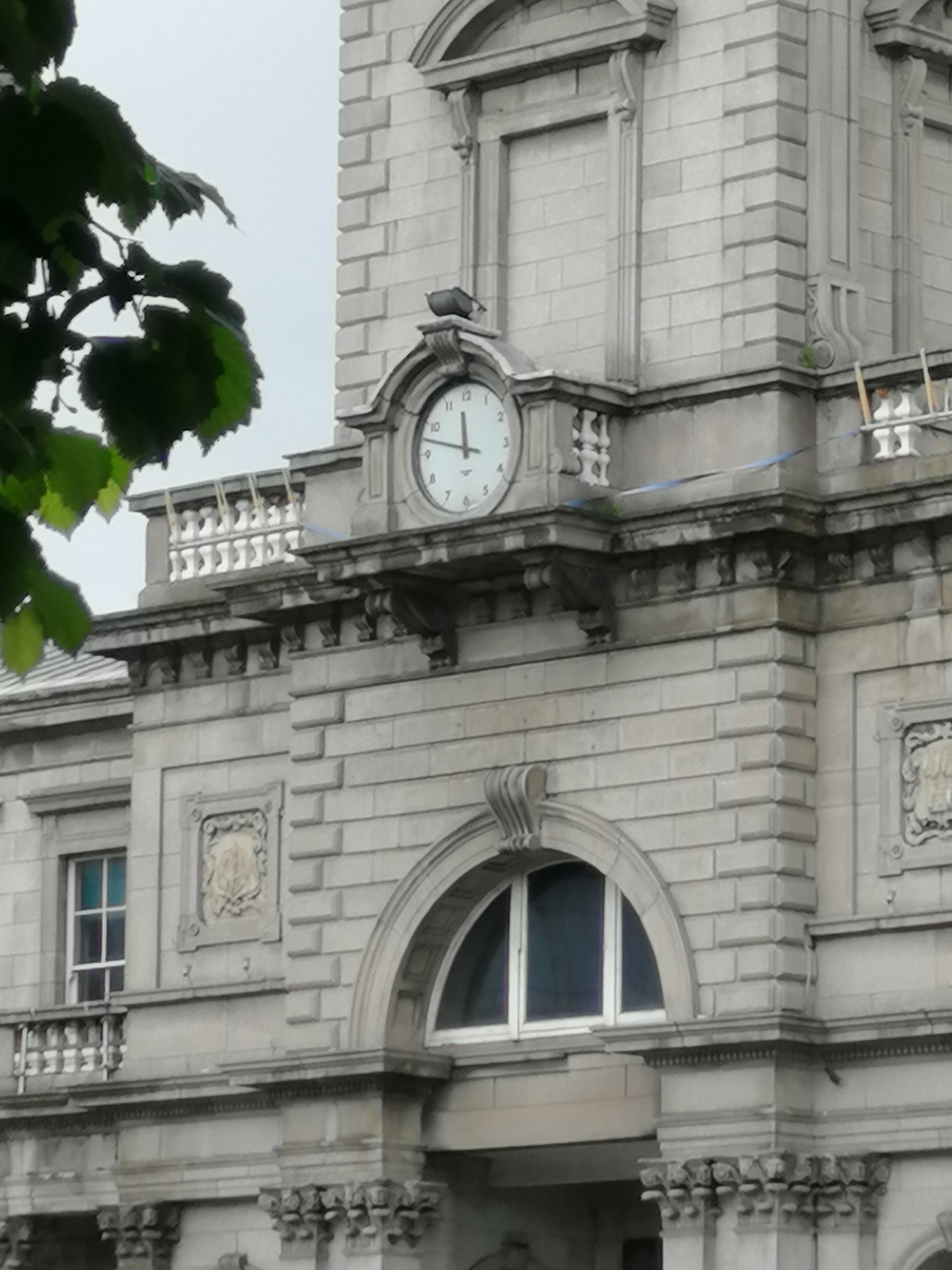
The clock on the tower of Connolly (formerly Amiens Street) Station — British soldiers fired a machine gun from that tower at Irish insurgents in 1916. (Photo: Rebel Breeze)

FOOTNOTES

SOURCES & USEFUL LINKS

Justice for the Forgotten campaign: http://www.dublinmonaghanbombings.org/home/

Media reports of commemoration:

https://www.irishtimes.com/news/politics/dublin-and-monaghan-bombing-failed-in-its-objective-says-taoiseach-1.4880954

https://www.lmfm.ie/news/lmfm-news/event-takes-place-to-commemorate-dublin-and-monaghan-bombings/

Taoiseach Mícheál Martin speech: https://www.gov.ie/en/speech/3b971-speech-by-the-taoiseach-micheal-martin-td-at-the-48th-anniversary-commemoration-service-for-the-victims-and-families-of-the-dublinmonaghan-bombings/

https://www.independent.ie/irish-news/politics/taoiseach-criticises-british-government-inaction-on-48th-anniversary-of-dublin-and-monaghan-bombings-41658511.html

https://en.wikipedia.org/wiki/Dublin_and_Monaghan_bombings#Allegations_of_British_Government_involvement

British military collusion with Loyalist paramilitaries: https://www.historyireland.com/frank-kitson-northern-ireland-british-way-counterinsurgency/

Kitson tactics: https://www.kalasnyikov.hu/dokumentumok/frank-kitson-gangs-countergangs.pdf

1https://www.historyireland.com/frank-kitson-northern-ireland-british-way-counterinsurgency/