“THEY WANT US TO MOVE OUT – BUT WE’RE STAYING”

Diarmuid Breatnach

(Reading time: 6 mins.)

In Dublin’s south docklands the property developers and the corporations dominate city planning and therefore the landscape. And the working class community there feel that they’re being squeezed out.

I’ve met with some concerned people from parts of this community in the past to report on their situation and concerns for Rebel Breeze and did so again recently.

A view eastward of a section of the south Liffey riverfront, showing a very small amount of more traditional buildings squashed between or loomed over by the “glass cages that spring up along the quay”. (Photo 1 March 2024: D.Breatnach)

YOUNG PEOPLE – education, training, socialising

“There’s nothing here for our young people” said one, expressing concern over the attraction for teenagers of physical confrontations with other teens from across the river which have taken place on the Samuel Beckett Bridge over the Liffey.

A young man training as an apprentice in engineering attends a mixed martial arts club but has to go miles away to another area to attend there. Between his industrial training, travel and athletic training he has little time to spare for socialising.

I comment that those sporting activities tend to concentrate on male youth and only some of those also but he tells me that nearly half the regular membership of his club is female. A community centre could provide space and time for such training but they say they have no such centre.

St. Andrew’s Hall is a community centre in the area and there are mixed opinions in the group about it but I know from my own enquiries that the available rooms are committed to weekly booked activities (and our meeting had to take place in a quiet corner of an hotel bar).

As a former youth worker and in voluntary centre management, I know that a community centre can serve all ages across the community, from parents and toddlers through youth clubs to sessions for adults and elders.

Discussing youth brings the talk into education and training. As discussed in a previous report of mine, the youth are not being trained in information technology, which is the employment offered in most of the corporations in “the glass cages that spring up along the quay.”1

Section of the south Liffey docks showing some of the few remaining older buildings as they are swamped by the “glass cages”. The building on the far right of photo, very near to Tara Street DART station, once an arts centre, is already targeted for demolition and replacement with commercial building. (Photo sourced: Internet)

“If they’re lucky, they’ll get work in the buildings as cleaners or serving lattes and snack in the new cafes”. Some opined that the corporations in the area should be providing their youth with the training while others thought Trinity College should be doing so.

HOUSING – price and air quality

Universal municipal housing in the area has declined due to privatisation of housing stock and refusal to build more. A former municipal block in Fenian Street, empty for years is now to be replaced but the “affordable” allocation has been progressively reduced, ending now at zero.

Pearse House in south Liffey docklands, believed earmarked for demolition and site sold to property speculators. (Photo 1 March 2024: D.Breatnach)

Property speculators (sorry, “developers”) with banker support are building office blocks and apartment blocks in the areas, the latter units priced beyond the range of most local people. The average rent for a two-bed apartment in the area is €2,385;2 to buy a 3-bedroom house €615,000.3

The Joyce House site and attached ground area could provide housing and a community centre but appears planned to go to speculators.

Continuation of ‘Pearse House site’ in south Liffey docklands, believed earmarked for demolition and site sold to property speculators. (Photo 1 March 2024: D.Breatnach)

The Markievicz swimming pool near Tara Street has been closed and the local people are told they can go to Ringsend for swimming, an area which already has better community facilities than are available to the communities further west along docklands

A huge amount of traffic goes through the area and one person stated that Macken Street tested as having the worst air quality in Ireland. “I have to close my windows to keep out the noise and pollution,” said another; “the curtains would be black.”

Townsend Street side of ‘Pearse House site’ in south Liffey docklands, believed earmarked for demolition and site sold to property speculators (prospective property speculators must be salivating). The gambling advertisement coincidentally erected there seems to show the likely social types to benefit from these kinds of deals. (Photo 1 March 2024: D.Breatnach)

They want us out’

If some town planner were intending to establish a community somewhere, s/he would plan for housing, obviously, so the people would have somewhere to live. But a proper plan would provide also for education and training, along with social facilities — and employment.

But if someone were intending instead to get rid of a community, s/he would target exactly the same elements, whittling them down or removing them altogether. This what some local people feel is intended for their community.

“We feel we’re not wanted here,” said one and others agreed, “They want us to move out.” “But we’re not going! We’re staying,” said another, to grim nodding of heads around.

HISTORY of struggle … and of neglect

In the late 1800s and early 1900s, Dublin had the worst housing in the United Kingdom and many of its elected municipal representatives – including a number of Nationalists of Redmond’s party – were themselves slum landlords.

When the Irish Transport and General Workers Union was formed by Jim Larkin with assistance from James Connolly and the Irish Women Workers’ Union founded by Delia Larkin, many of the dockers, carters and Bolands Mill workers who joined them came from the south docklands.

And when the employers’ consortium led by William Martin Murphy set out to break the ITGWU in 1913, many of those workers

… Stood by Larkin and told the bossman
We’d fight
or die but we would not shirk.
For eight months we fought
And eight months we starved,
We stood by Larkin through thick and thin …4

And the women of Bolands’ Mill were the last to return to work, which they did singing, in February 1914.

They also formed part of the Irish Citizen Army, the first workers’ army in the world,5 to defend the striking and locked-out workers from the attacks of the Dublin Metropolitan Police and which later fought prominently in the 1916 Easter Rising.6

Many also joined the larger Irish Volunteers which later became the IRA, along with Cumann na mBan,7 fighting in the Rising, the War of Independence and the Civil War, supporting resistance of class and nation for decades after.

The Irish Republican Brotherhood (the Fenians) was founded in the area; Peadar Macken8 was from here and has a street named after him; Elizabeth O’Farrell9 is from the area too with a small park named after her and Constance Markievicz10 also lived locally.

The Pearse family lived in the area too and Willie Pearse and his father both worked on monumental sculpture at the same address; Connolly and his family for a while lived in South Lotts.

Home of the Pearse family and monumental sculpting business (Photo: Dublin Civic Trust)

The working class communities in urban Ireland suffered deprivation throughout the over a century of the existence of the Irish state and the colonial statelet. The communities in dockland suffered no less, traditional work gone, public and private housing in neglect in a post-industrial wasteland.

The population of Ireland remained static from the mid-1800s until the 1990s, despite traditionally large families — emigration in search of employment kept the numbers level. Married couples lived with parents and in-laws while waiting for a house or flat – or emigrated.

In the 1980s, like many parts of the world, Ireland fell prey to what has been described as the “heroin epidemic” and the neglected urban working class worst of all, with the State assigning resources to fight not so much the drug distributors as the anti-drug campaigners.

One of those in the meeting became outwardly emotional when he talked of “the squandered potential” of many people in the local community.

A workers’ day out trip on the Liffey ferry (Photo sourced: Dockers’ Preservation Trust)

The heirs of these then are the marginalised and abandoned that are targeted with disinformation and manipulated by the far-Right and fascists, to twist their anger and despair not against the causes of their situation but against harmless and vulnerable people.

But the Left has to take a share of the blame, for leaving them there in that situation, for not mobilising them in resistance. After all, issues like housing, education and employment are supposed to be standard concerns for socialists, of both the revolutionary and the reformist varieties.

Republicans cannot avoid the pointing finger either. These communities provided fighters and leaders not only in the early decades of the 20th Century but again from the late 1960s and throughout the 30 years war.

The Republicans led them in fighting for the occupied Six Counties but largely ignored their own economic, social and educational needs at home. Perhaps this is why the people are now organising themselves.

Protest placard by housing block in Macken Street protesting noise and dirt from nearby construction (Photo: Macken Street resident)

THEY DON’T VOTE”

A number of the local people to whom I spoke quote a local TD (Teachta Dála, elected representative to the Irish parliament) who commented that most of the local residents don’t vote in elections.

Whether he meant, as some have interpreted, that therefore they don’t matter or, that without voting, they cannot effect change, is uncertain. However, community activism is not necessarily tied to voting in elections.

Protest placard by housing block in Macken Street protesting noise and dirt from nearby construction. (Photo: Macken Street resident)

As we know from our history and that of others around the world, voting is not the only way to bring about change and, arguably, not even the most effective one.

Whatever about that question, people are getting organised in these communities and those who hold the power may find that they are in for a fight.

End.

The landscape (and airscape) viewed from a housing block in Macken Street (Photo: Macken Street resident).

FOOTNOTES

1From song by Pet St. John, Dublin in the Rare Aul’ Times.

2https://www.statista.com/

3https://www.dublinlive.ie/

4From The Larkin Ballad, about the Lockout and the Rising, by Donagh McDonagh, whose father was one of the fourteen shot by British firing squad after the 1916 Rising.

5Formed in Dublin in 1913 to defend strikers and locked-out workers from the Dublin Metropolitan Police; members were required to be trade union members. The ICA was unique for another reason in its time: it recruited women and some of them were officers, commanding men and women.

6Historian Hugo McGuinness based on the other side of the Liffey believes that the reason the British troops sent to suppress the Rising disembarked at Dún Laoghaire rather than in the Dublin docks was because they feared the landing being opposed by the Irish Citizen Army and its local supporting communities.

7Republican Female military organisation, formed 1914.

8Fenian, socialist, trade unionist, house painter who learned and taught Irish language, joined the Irish Volunteers, fought in the Rising and was tragically shot by one of the Bolands Mill Garrison who went homicidally insane (and was himself shot dead).

9Member of the GPO Garrison in the 1916 Rising, subsequently negotiator of the Surrender in Moore Street/ Parnell Street and courier for the 1916 leadership to other fighting posts.

10Member of multiple nationalist organisations, also ICA and in the command echelon of the Stephens Green/ College of Surgeons Garrison. Also first woman elected to the British Parliament and first female Labour Minister in the world.

SOURCES & FURTHER READING

Biography Peadar Macken: https://www.dib.ie/biography/macken-peter-paul-peadar-a5227

COLLAPSE OF BUILDING KILLING TWO GIRLS COMMEMORATED

Diarmuid Breatnach

(Reading time: 6 mins.)

The collapse of multi-occupation buildings in Dublin’s Fenian Street killed two girls. A day from the anniversary of the tragedy ​​​​sixty years later, local residents in a working-class block of flats organised a moving and informative commemoration.

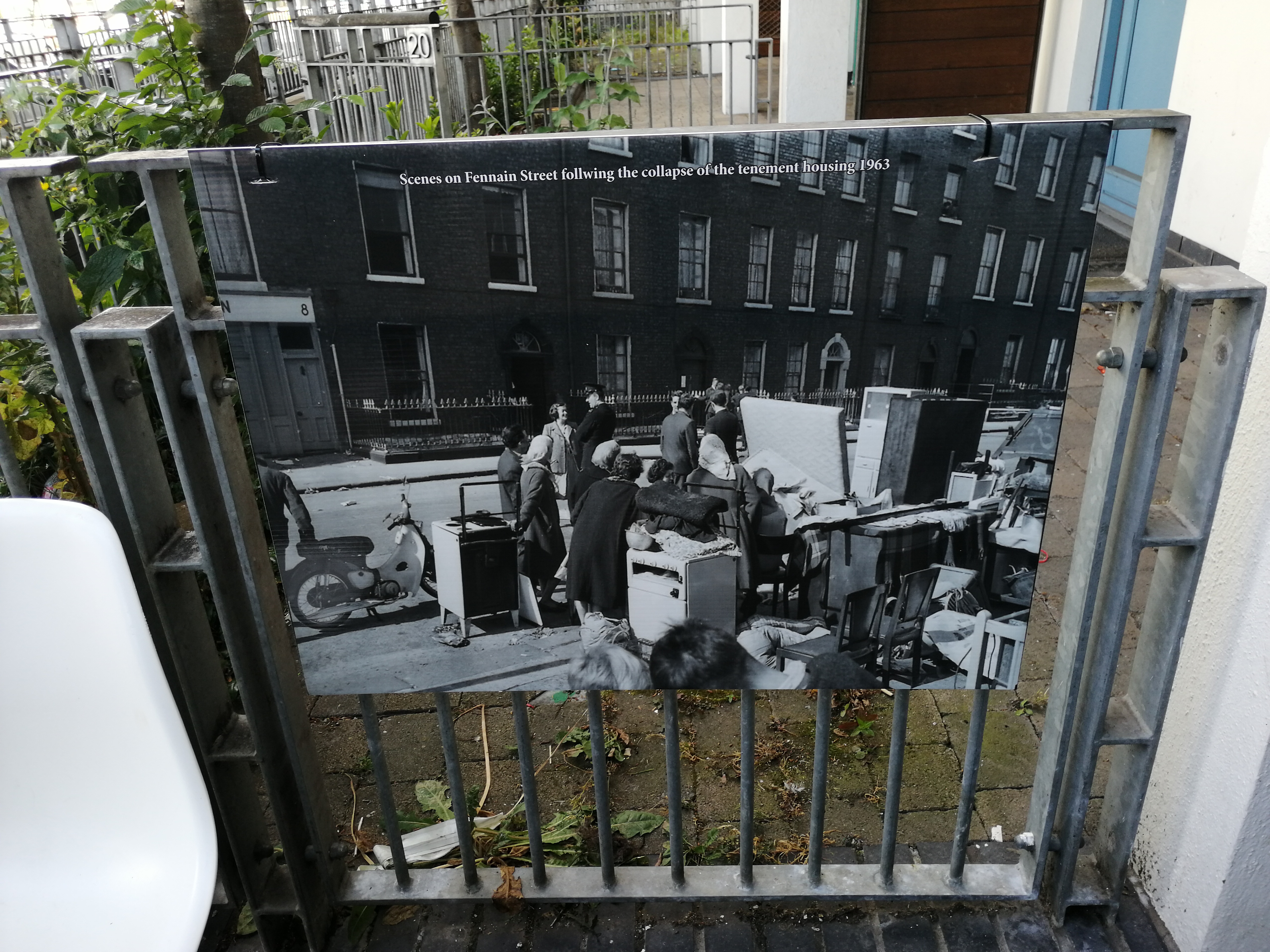
On 12th June 1963, Marion Vardy and Linda Byrne, returning from a shop were killed when the buildings collapsed.

After another two people were killed in a Bolton Street collapse, a galvanised Dublin City Council inspection condemned many other buildings in the city and 155 families were rehoused immediately, though some in Army barracks.

And a number had to camp out for some days in the street. But it was not the first fatal building collapse in Dublin. On 2nd September 1913 (with the epic Lockout struggle only days old), two adjacent buildings had collapsed in Church Street, killing seven people.1

All the buildings in question were privately-owned with working class people paying rent to the owners. Emergency inspections by Dublin City Council inspectors in 1963 resulted in the condemning of 156 Dublin buildings as too dangerous for residence.

For years, other buildings in the Dublin inner city could be seen braced on a side by a massive timber frame.

Organisers’ panel photographed by D.Breatnach

COMMEMORATIVE EVENT

A display of panels describing the tragedy and panels of photos had been erected around the entrance to St.Andrew’s Court block of flats in Fenian Street, where a crowd had gathered for the well-organised commemoration.

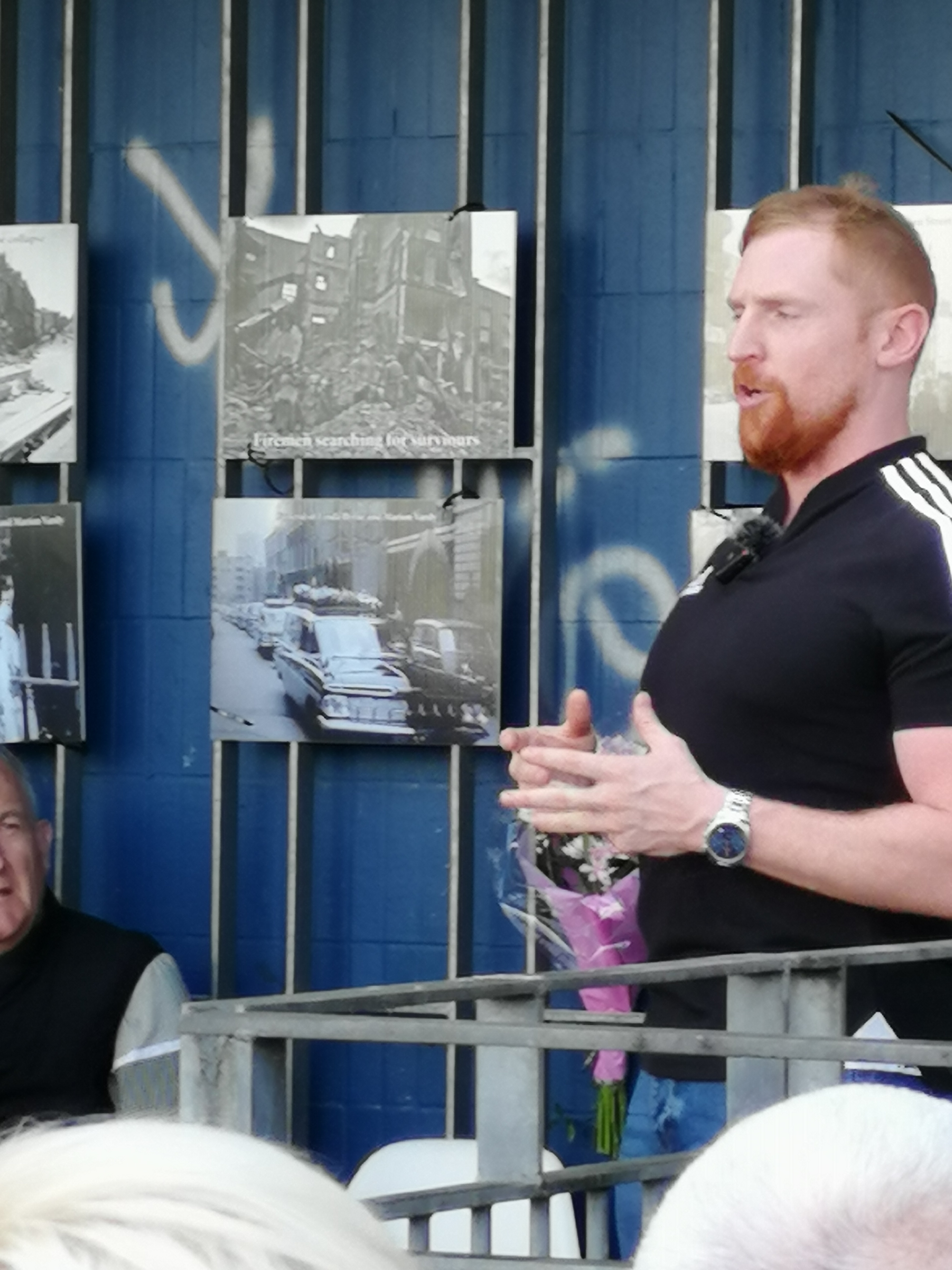
Paul McKeown chaired the event speaking eloquently when he could be heard (there was no public address facility) about the actual tragedy and the context of housing provision for working class people in the inner city.

Paul McKeown, who chaired the event, speaking. (Photo: D.Breatnach)

As a Catholic priest had performed the religion’s Last Rites over the bodies of the girls in 1963, McKeown invited a priest to recite some prayers at the event, which he duly did, after which the MC introduced a representative from the Henrietta Street Tenement Experience.2

The Henrietta Street speaker provided interesting snapshots of what past life was like for working people of the inner city in terms of occupation, accommodation and schooling. Some women sewed shirts in a factory while others sold items in street markets, such as Moore Street.3

Speaker from the Henrietta Street Tenement Museum. (Photo: D.Breatnach)

The floors in the poorest homes had no covering and toilets were very few, their use often shared by a great many residents. Although virtually all children would end schooling at the age of 14, the eldest boy often left years earlier to work, as a newsboy or shop messenger, for example.

Labouring on the nearby docks and carting would be the main employment for the men. No doubt emigration, almost a constant in Irish history, played a part too. Rats and mice were endemic in the buildings.

Though alternative and eventually new housing was found for all, it was to Dublin’s outlying areas, breaking up communities and their ways of life, separating them from services used, employment, etc. Many felt isolated and took the long journey to return to the city centre for social contact.

Organisers’ panel photographed by D.Breatnach

ATTACK ON NEARBY REFUGEES

The local flats overlook the location in Sandwith Street that in May had seen an attack by fascists on refugees who had been living in tents because the nearby International Protection Office, a State body, had failed to allocate them accommodation while processing their applications.

A few locals might have joined in and certainly some had attended the crowd but the fascists were imported (as indeed were the refugees and subsequently their antifascist defenders). Some locals at least resented the way they were being portrayed in some social media subsequently.

Refreshments, some of which were provided by Dublin City Council, were served by residents in the inner courtyard after the speeches. (Photo: D.Breatnach)

“We’ve had generations of Travellers4 in the flats and migrant people too,” commented one. “We’re more ethnically diverse than Dalkey,” he added. “Middle class people don’t talk to us, they talk down at us,” was another comment.

They claim that they have been neglected for generations by all the government parties but also by small left-wing parties, also by people who were quick to criticise them and to see them in negative stereotypes. “Nobody talks about class prejudice”, commented McKeown.

The inner city working class population has been moved out of much of the city and this area, which was previously seen as the least valuable real estate in Dublin, as McKeown observes, is now attracting property speculators for gentrification.

Some of the residents and others in attendance in the inner courtyard after the speeches. (Photo: D.Breatnach)

McKeown feels his people are not wanted in the area and he’s probably right. It’s not just that they are not the typical users of the wine bars and coffee bars of gentrified areas but that their current location would take in big rents after construction of hotels and upper-market flats.

Past the site of the attack on the refugees there is a new block of apartments, two bedrooms for 3,000 euro a month, one bedroom for 2,000. An empty bloc across the road which people say was well-maintained, remains empty since Dublin City Council moved the residents out 5 years ago.

The local residents say that they have been promised that a new block of apartments will be built on the latter site and that all the units will go for “social housing”, presumably meaning for affordable rent.5They want that to be true but are not sure whether they should trust the authorities.

After the speeches of the commemoration people were invited to partake of food and music in the inside square of the flats which contains minimal playground facilities.

Shay Connolly (centre) and friends performing at the event (Photo: D.Breatnach)

The music was provided by a trio including Shay Connolly playing ballads with the food served by local residents, in a relaxed atmosphere. The area at the back of the flats had become a sun-trap and while some soaked it up, I and some others eventually fled the heat.

PAST, PRESENT AND FUTURE

The commemoration of historical events can be of great importance. The event in 1963 forms part not only of an older story but also of the present, which is the lack of decent housing provision for the population of Ireland, in particular for those living in the inner cities.

Some of the residents and others in attendance in the inner courtyard after the speeches. (Photo: D.Breatnach)

Working and lower middle class people were wanted in the inner city to work its industries and its shipping port and to service the houses of higher social classes. As industry and port declined and the higher social classes moved out, the need for their work declined.

When their poor areas are seen instead as development prize areas, there is even less demand for the people who have lived in these areas for generations.

One can see this as the inexorable play of impersonal market forces or as the operation of finance and rentier capitalism in a capitalist economy and more, a Gombeen capitalist state where everything is done for the foreign capitalists and as little as possible for the working classes.

From the latter viewpoint, voting different political parties in to government will make no essential difference; what is needed is a fundamental change in the economy which can only be brought about by an organised, conscious and militant working class seizing their rightful inheritance.

End.

Organisers’ panel photographed by D.Breatnach

FOOTNOTES

1 I recall reading that a number of Dublin City Councillors, including Nationalist ones, were slum landlords.

2 It is open for visits from Wednesdays through to the weekend, I am told.

3 The market and area are subject to a long war between property speculators and conservationists (see smsfd.ie)

4 An Irish indigenous nomadic ethnic group of at least five centuries existence, much discriminated against.

5 “Social housing” is often understood as provision for people unemployed and on state welfare provision. Perhaps “Public housing on affordable rent” is a better description, housing both people working and those on benefits, the rents adjusted to means. This was widely built in the middle of the last century but none has been built in Dublin for decades, all governments insisting that the “private sector” (i.e big landlords, property speculators and vulture funds) can solve the problem while the housing crisis intensifies year after year.

SOURCES & OTHER READING

1963 Collapse: https://www.rte.ie/archives/2023/0531/1386694-fenian-street-homes-collapse/

1913 Collapse: https://www.historyireland.com/the-church-street-disaster-september-1913/

Tenement conditions 1913: https://csu1916.wordpress.com/lockout/dublin-1911/tenements/

2023 DCC failure to enforce standards on landlords: https://www.irishexaminer.com/news/arid-41080388.html

https://www.fm104.ie/news/fm104-news/tathony-house-landlord-rejects-councils-attempt-to-buy-the-property/