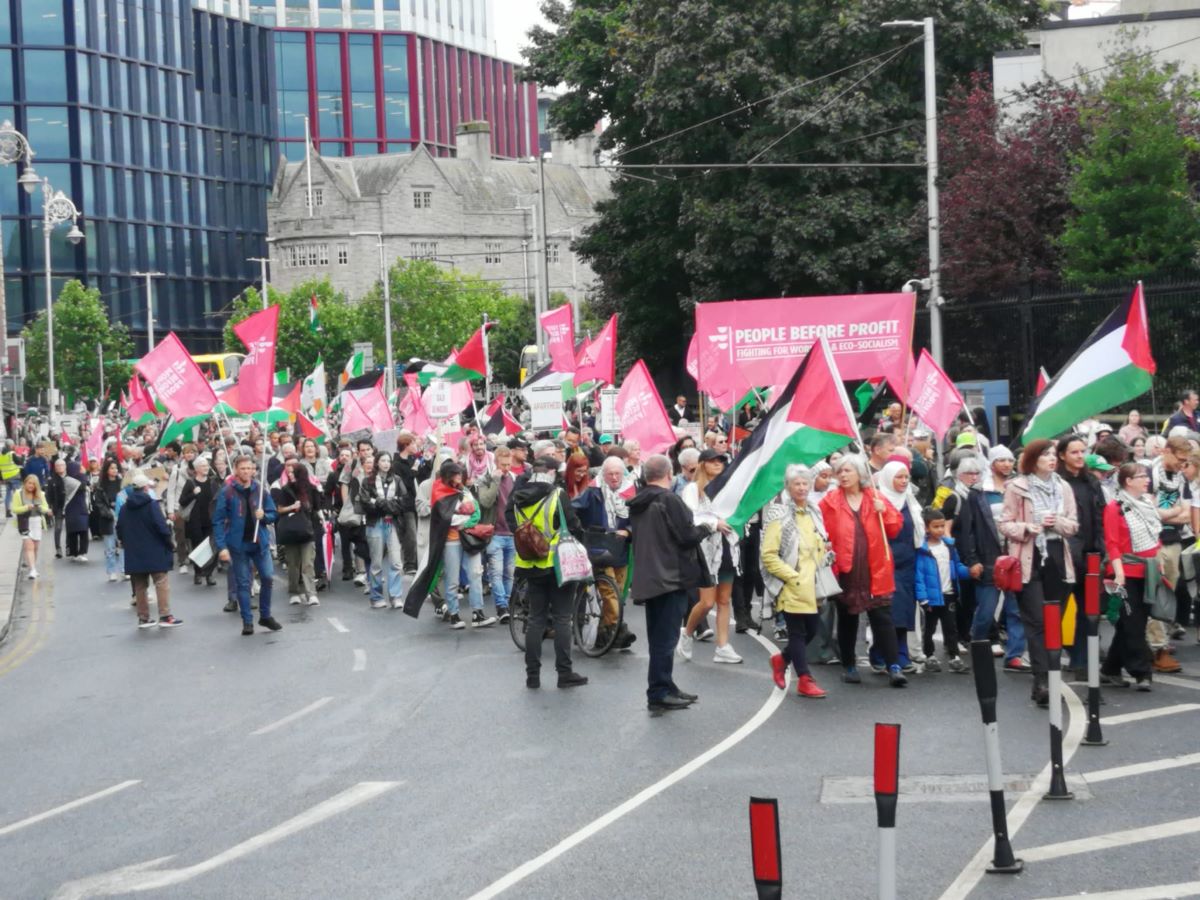
Many who supported Saturday’s march of the Ireland Palestine Solidarity Campaign advertised as going to protest at the US Embassy found themselves led to a rally in a residential street bordering the Embassy and far from the main road.
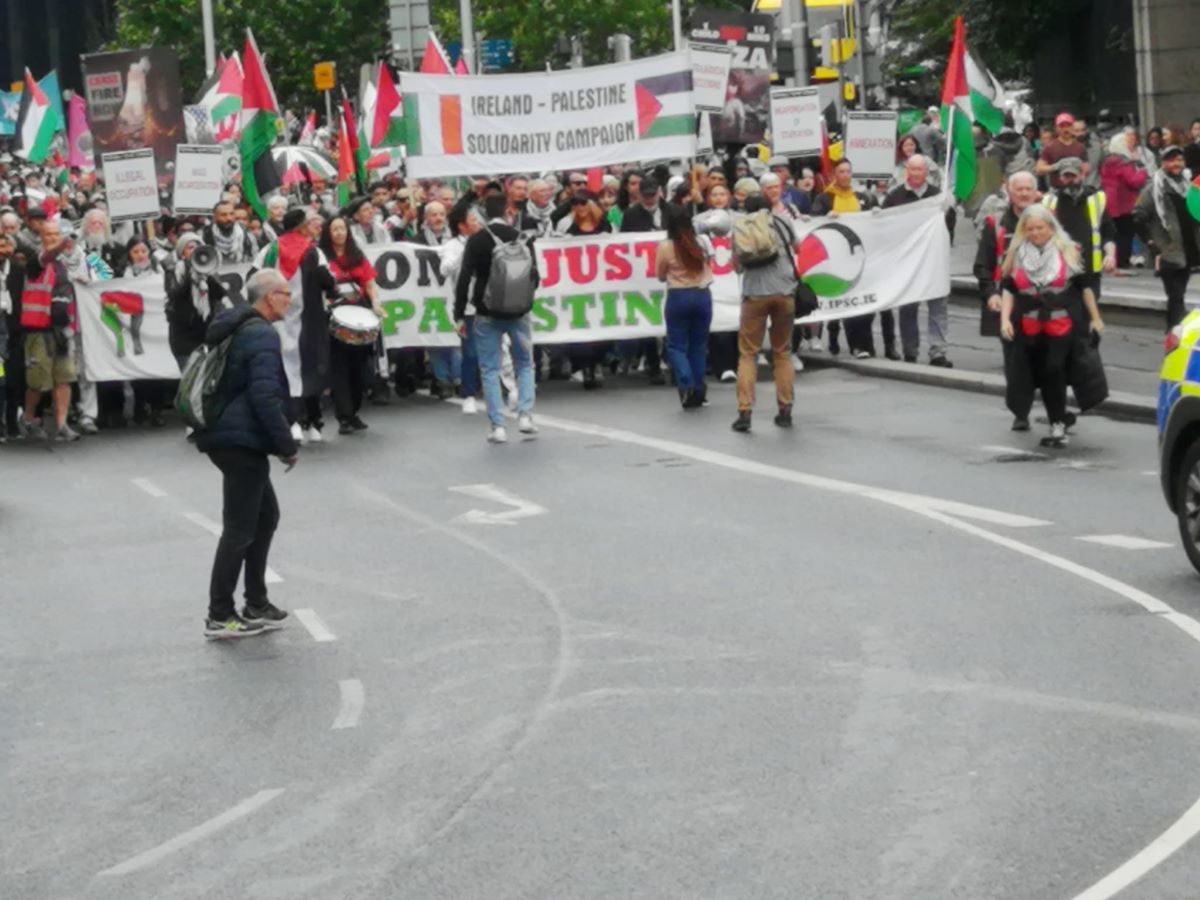
The IPSC march had gathered at the Department of Foreign Affairs on Stephens Green and proceeded from there to Ballsbridge, the last section passing through quiet residential streets to hold the rally in Elgin Road, some distance from and hardly visible from the main road.
Section of the IPSC march on Saturday (Photo cred: IPSC)
Before the arrival of the IPSC march a handful of people gathered near the main road, displaying Palestine national colours to acclamation from passing motorists. As the IPSC march arrived nearby some others with flags, banner and placards joined them near the front entrance of the Embassy.
From that position one could see the IPSC rally taking place quite some distance down the quiet street, distant enough that speeches could not be heard, though chants from the crowd were audible.
Earlier in the day the Palestinian resistance had released three of their prisoners in good health while the Palestinian prisoners of ‘Israel’ were beaten and insulted as they were leaving and made to wear special demeaning clothes (which they burned). Four had to be rushed to hospital after release.
Long before Trump’s proposal of ethnically cleansing Gaza of Palestinians, it is important to understand that Israel’s genocide could not have been sustained for more than a week without funding and munitions supply by the USA, which also supported them politically.
In the sixteen-plus months of the current phase of Israeli genocide, the IPSC has led a march to the ‘Israeli’ Embassy only a few times and to the US Embassy exactly twice, each time to the side road (though the stage of the first one was closer to the Embassy’s main entrance than was today’s).
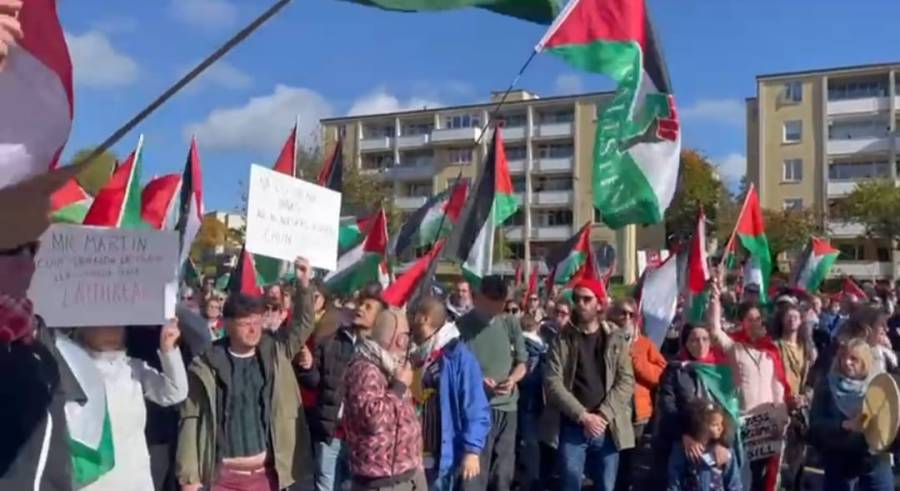
The front of the IPSC march at its destination at the rally on Saturday. (Photo cred: IPSC).The IPSC rally in the distance, taken from in front of the US Embassy main entrance. (Credit photo: Rebel Breeze)
A police officer approached the early demonstrators near the Embassy main entrance to encourage them to move down to the location of the IPSC rally but they politely declined. One of the IPSC’s committee members also wandered by to see who these mavericks could be.
A Zionist passing by claimed the demonstrators should be ashamed but they told him it was he who should feel shame, supporting genocide. Anger soared when he called for killing more Palestinians – including children– until some began to suspect he was provoking an assault leading to arrest.
Certainly he felt safe enough with Gardaí close by.
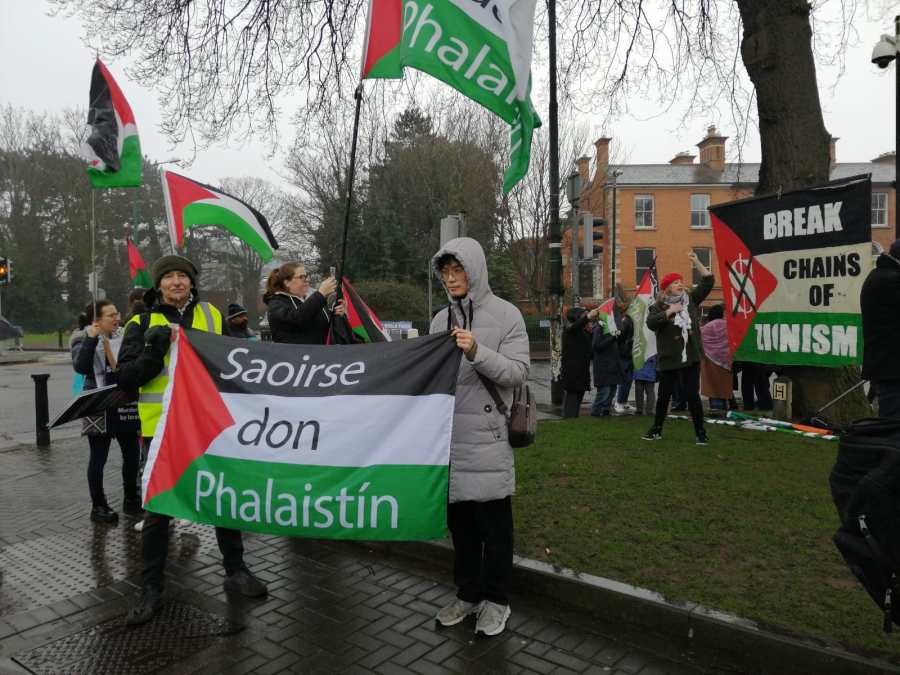
As the group consolidated a woman began to lead call-and-answer chants which were taken up: Saoirse – don Phalaistín! Resistance is an obligation- in the face of occupation! 1, 2, 3, 4 – Occupation no more! 5, 6, 7, 8 – Israel is a terrorist state! Free, free – Palestine!
Section of those who chose to stand near the US Embassy main entrance (out of shot to the right of photo) and in full view of passing traffic on the main road (just out of view to left of photo). (Photo credit: Rebel Breeze)
Also From the river to the sea – Palestine will be free! From Ireland to Palestine – Occupation is a crime! Car horns of passing motorists joined in, beeping in solidarity.
It began to rain heavily and the protesters endured it for a while before heading for shelter.
Irish trade unions could play a significant role in Palestine solidarity but they are not doing it. They are well-placed to do so by virtue of the crucial role of their members in production and distribution.
Union members are also members of families, neighbourhood communities, sports fans, social groups, clubs ……………
Every trade union or joint unions in a workplace could form committees to plan and organise Palestine solidarity activity both within their workplaces but also more generally, forming links with community solidarity groups where these exist or helping to create them where they do not.
Every workplace trade union notice board – which employees are entitled to have installed – should carry updated information on the genocide and on solidarity actions such as boycotts, marches, pickets etc.
Every union could mobilise its members to support Palestine solidarity actions and in the case of demonstrations, marches etc., to organise strong contingents to attend, marked out by banners, flags and in some cases by clothing (hi-viz vests, surgical scrubs for health service workers, etc.)
INFORMATION, PROPAGANDA, MEDIA
The trade unions in the media could help the campaign against genocide by countering the dominant western propaganda narrative, e.g. that “Israel has a right to self-defence”, that the Palestinian resistance are “terrorists”, that the “Hamas rampage” (sic) on 7th October 2024 started the genocide.
Those unions could take protest industrial action, pay for advertisements in the media, produce their own database and news detailing media misrepresentation and censorship and update their members on the reality of the situation in Palestine through a newsletter or social media group.
Their members could hold pickets protesting against disinformation, Zionist propaganda and censorship and in solidarity with the almost two hundred of their counterparts murdered by the Zionist military in Palestine in a little over a year.
SUPPLIES, DISTRIBUTION, BOYCOTTS
Unions involved in transportation and deliveries could refuse to transport goods from or to the State of Israel, as well as maintaining a database of products and companies identified as boycott targets.
Pickets could be placed on centres of sale of boycotted goods, such as supermarkets and chain stores, also of distribution centres at haulage firms, docks and airports. Pickets on chain stores in local areas would attract local people to support and widen the net of active solidarity.
Irish healthcare workers in solidarity with healthcare workers and people in Palestine, marching in an IPSC national march on 31 August 2024. But where is their trade union? (Photo: D.Breatnach)
MOBILISATION
Every union national HQ or regional HQ, or Palestine solidarity committee could mobilise its union members to support Palestine solidarity actions and in the case of demonstrations, marches etc, to organise strong contingents to attend, marked out by banners, flags or hi-viz vests,
Health workers could march in solidarity with Palestinian health workers who are threatened and prevented from reaching victims of IOF bombing or shooting, other health workers shot or bombed, ambulances targeted, health workers kidnapped to the terrible ‘Israeli’ jails and possibly tortured.
Education workers could march in solidarity with their counterparts in the bombed universities and schools of Gaza, of the teachers and students bombed and shot. Athletes and sport workers might identify their solidarity with Palestinian athletes bombed, shot or maimed for life.
Construction workers might be organised to express their solidarity with Palestinians’ destroyed homes, roads and facilities, while civil defence and municipal workers march in support of their counterparts in Palestine, deliberately targeted by the IOF.
The destruction of Palestinian olive groves, fruit trees, farms and grow-tunnels could be protested by union members in agriculture and food processing. Workers in fishing and fish-processing might protest the blockading, harassment and even shooting of Palestinian fishermen.
Sanitation and water supply workers could increase public awareness of the deliberate destruction of those types of infrastructure in Gaza, while workers in telecommunication might protest regular cutting of access to the Internet and also the weaponisation of handheld communicators.
Banners of two main Irish trade union contingents marching in solidarity with people in Palestine, in an IPSC national march on 20 July 2024. But FÓRSA has a membership of “88,000” and SIPTU of “around 200,000” — it does not appear as though these unions made any attempt to mobilise their members to support the march. (Photo: D.Breatnach)
OBJECTIONS
There might be some – and not only among the paid officials of the trade unions — who would say that internationalist solidarity is all very well but that it’s a distraction of from domestic bread-and-butter issues, or fighting closures of workplaces, casualisation of work contracts etc.
Others might object to anything that might smack of illegality, such as industrial action of a solidarity nature or ‘political’ actions by a trade union. They might also point out trade unions in Ireland are much reduced in membership and strength.
Indeed. Unions did not come into being without facing anti-union laws, or indeed police batons, courts and jail. Collusion with the system exemplified by twenty years of Social Partnership has weakened the unions to the degree that many workers do not even understand their relevance.
History teaches us that solidarity work does not weaken organisations, least of all militant ones. It makes them stronger. And visibly active and fighting trade unions will surely attract the interest and appreciation of lapsed or as yet non-unionised workers.
The Irish trade unions on the whole, with some exceptions such as primary school teachers, are not doing this Palestine solidarity work. But are people of Palestinian solidarity minds organising in their trade unions to bring any of that work forward? If they are not to do it, then who?
The founding of workplace Palestine solidarity action committees is probably the place to start, the first small step with many and bigger steps to follow.
End.
Cartoon by D.Breatnach depicting the general inactivity in Palestinian solidarity by most Irish trade unions, despite traditions of internationalist solidarity and the daily genocide by the Israeli Zionists.
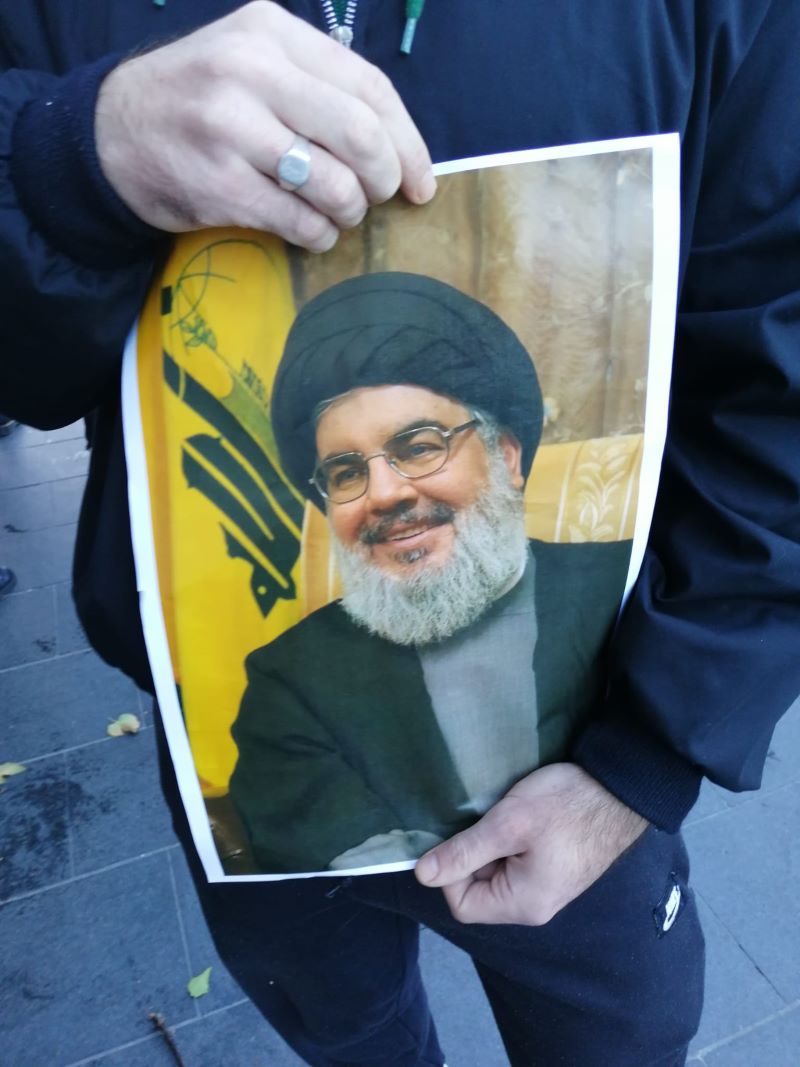
People with Palestinian flags including one containing a slogan in Irish, flags of Palestinian resistance factions and holding portraits of Ismail Haniyeh and Nasrallah rallied on Sunday evening outside Dublin’s General Post Office.
(Photo cred: Rebel Breeze)
The Action for Palestine organisation had advertised the solidarity and honouring event at short notice. Originally planned to take place on O’Connell Bridge, the storm conditions1 made that venue unsuitable and the GPO2 was chosen as an appropriate alternative.
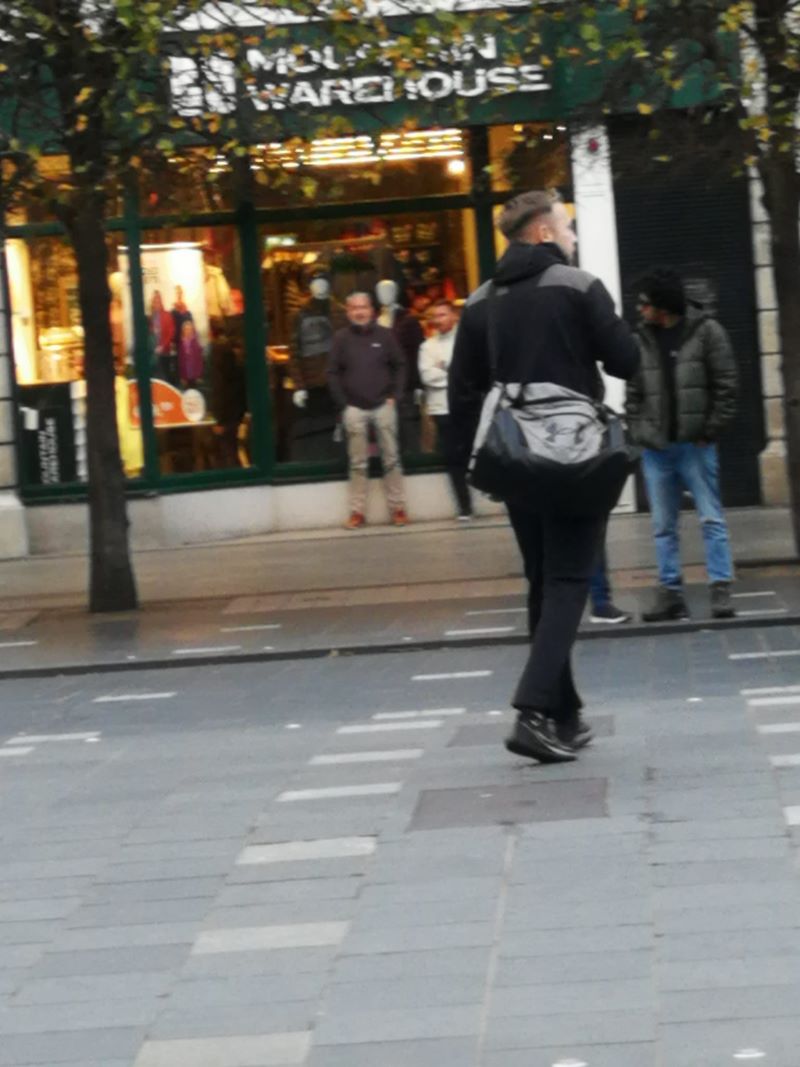
Calling and replying to solidarity chants, the crowd of Irish people and others from the Middle East also listened to four speakers, two Irish and two Palestinian, while two plain-clothes Special Branch Gardaí photographed them from east side of the street.
(Photo cred: Rebel Breeze)
One passing Zionist sympathiser insulted the gathering, giving rise to a wave of chants in solidarity with the Palestinian Resistance. On the other hand, many pedestrian passers-by congratulated demonstrators and some stopped to join or pressed horns on their vehicles.
The speakers referred to the horrors of the genocide being inflicted upon the Palestinian people in particular in North Gaza3 at this time by the IOF, the armed forces of the Zionist state, backed up and supplied by the USA and a number of European states.
(Photo cred: Rebel Breeze)
They spoke also to praise the resistance of all kinds of the Palestinian people, including armed resistance and at all levels up to leadership, who are assassinated and replaced, always under threat of death.
One speaker also spoke about the need to also support the resistance struggles and the prisoners as a result of resistance too. “It is not required of us that we agree with everything they say or do but it is required of us that we support the resistance”, he said.
Among the slogans chanted were Long live the Intifada! There is only one solution – intifada revolution! From the River to the Sea – Palestine will be free! Resistance is an obligation – in the face of occupation! Saoirse – don Phalaistín!
(Photo cred: Rebel Breeze)
From Ireland to Palestine – Occupation is a crime! From the Sea to the River – Palestine will live forever! In our thousands, in our millions – we are all Palestinians! Free, free Palestine! Netanyahu you can’t hide – you’re committing genocide! (Repeated also for Joe Biden).
A speaker also reminded the crowd of the long resistance to occupation of the Irish people, against Vikings and English occupation and the need to support the resistance of people around the world. “Resistance is everything”, he said and referred to the heroic resistance of the Palestinian people.
To conclude an organiser thanked all for their attendance at short notice and promised other actions in future, then encouraged those who wished to gather for a photo in front of the statue to “our hero in Irish myth, Cú Chullainn”,4 which stands in the central front window of the GPO building.5
Some gathered for a photo in front of the representation of the Irish mythological hero Cú Chulainn statue in the display window of the GPO. (Photo sourced: Action For Palestine)
While they were doing so, another reminded them that in the epic legend, Cú Chulainn’s enemies dared not approach him while he was alive and only finally did so when they saw a carrion crow or raven alight on his shoulder to reassure them that he was dead.
“Yahya Sinwar’s enemies did not face him while he was alive either. They fired a tank shell into the building where they believed the fighters were, retreating when grenades were tossed at them, firing another shell into the building and even then only dared send a spy drone in.
“When they saw on their monitor the badly-injured Sinwar throw a stick at the drone, they fired yet another shell into the building, finally killing him.”
End.
View of the Cú Chullainn statue in the GPO window on a working day (Photo cred: Cambridge University)Far distant from any kind of heroism or solidarity, two plainclothes members of the political police, the Special Branch of the Gardaí, surveilling the participants. (Photo cred: Rebel Breeze)
2Also a central location, i.e on Dublin’s main city centre street but also the HQ of the 1916 Rising against British rule.
3Some Palestinian commentators have called this phase the worst of all in the intensified genocide since October last year. Constant aerial strikes on buildings and tent encampments, shooting at people, besieging hospitals and blocking food or fuel from entering and constantly insisting that the people move out in ethnically cleansing.
4The hero is a central figure in the epic of the Táin Bó Cuailgne (The Cattle Raid of Cooley), along with back and after-stories, in the Ulster Cycle of Irish myths and legends. The sculpture, cast in bronze, is by Oliver Sheppard.
5The sculpture by Oliver Sheppard was later dedicated to the martyrs of the 1916 Rising.
As the Zionist state of Israel made headway in its genocide of Palestinians, although it dithered, the Petro government took various solidarity actions with Palestine such as deciding not to allow the sale of Colombian coal to Israel.
One of the other measures it announced earlier in the midst of the genocide was the suspension of military purchases from Israel.
It is worth pointing out that it was he, as President, who revived those contracts through his decision to buy Howitzers from Israel instead of the Caesar from the French company Nexter.[1]
However, Petro announced that he would replace the Israeli-made KFir planes as they were old, and difficult and expensive to maintain and opened up negotiations to buy 16 Rafale planes from the French company Dassault.[2]
In October of last year, Israel suspended the sale of arms to Colombia,[3] due to the differences and tensions between the two governments.
Now Petro has gone into reverse and announced that he set aside US $ 761,000 for the maintenance of the KFir in addition to the sum from the contract signed in December 2022.[4] Of course this contract is with the Israeli company Israel Aerospace Industries.
It openly contradicts his public statements regarding Israel and also regarding the “modernisation” of the Colombian fleet and as El Tiempo points out.
… itis indeed surprising the large financial increase made last September 30th(bold in original) to reactivate the maintenance contract on the aeroplanes. Money that, furthermore, comes in the midst of serious questioning from political groups given the increase in air accidents amongst the Armed Forces.[5]
Barely 25% of the Kfir fleet is in working order at the moment.[6] But its maintenance is an unnecessary expense. The KFir are fighter jets, with the capacity for air to ground attacks and are supposedly needed to protect the country’s infrastructure.
KFir fighter jets (Photo sourced: Internet)
But that isn’t true either. More than to protect pipelines or other installations from guerrilla attacks they are to repel an attack from neighbouring countries. Their specifications are clear.[7]
The last time Colombia went to war with another country was in 1933 and it lost it, along with a significant part of its Amazon territory.
If Petro really wants to demilitarise the country, why does he insist on maintaining a fleet of planes that are not much use? He should give up on the maintenance of the KFir and as was done in another period with the buses in Bogotá, turn them into scrap metal.
Also, he should forego an unnecessary military expense in a country with so many needs. Are there not schools, hospitals and universities to be built or equipped?
And where is the solidarity with Palestine that he has so often proclaimed?
Gustavo Petro in Palestine-solidarity mode (Photo sourced: Internet)
If breaking off relations with Israel and suspending military contracts in the name of solidarity is a good idea, then it is a good idea at all times and more so now when there can be no doubt that Israel is a genocidal state …
and every dollar that its arms industry receives is another bomb falling on Gaza or an attack on Lebanon. Cheap talk is costly to the Palestinians, but also to Colombians who see how his proposal to demilitarise society has come to nought.
He did not abolish the ESMAD (specialised riot squad), as he promised, nor the obligatory military service, rather they now propose an obligatory social service for those who refuse to carry out military service.
If the rich can’t have youths to fight their wars, at least they will have cheap or free labour through this supposed social service. It is worth remembering that in Spain military service was defeated by a campaign that also defeated the alternative social service. Neither cannon fodder nor slaves.
It is time to be coherent. What does Petro want? Solidarity with Palestine or war planes? He can’t have both. The demilitarisation of society or a social service in addition to military service? It is one thing or the other.
On Saturday 12th October, thousands of people descended on Shannon Airport1 in an organic action to protest our land and airspace being used in the transport of U.S. munitions bound for Zionist Israel.
Demonstrators arriving in buses and cars were immediately met with Garda pushback at checkpoints about 2 kilometres from the entrance of Shannon Airport.
The diverted protestors were led down side roads and cul-de-sacs away from the mini roundabout area where regular anti-war protests occur. Such diversions epitomise government strategy perfectly: Divert. Distract. Divide.
The protestors were met with a hostile environment of steel barriers erected to separate and divide them upon entering the airport from all directions.
The weather was not so unkind, as the sun emerged around noon in time for the beat of the drums striking up an atmosphere of resistance and bold defiance.
Drums, placards, flags and chants at Shannon Airport Saturday (Photo source: Participant)
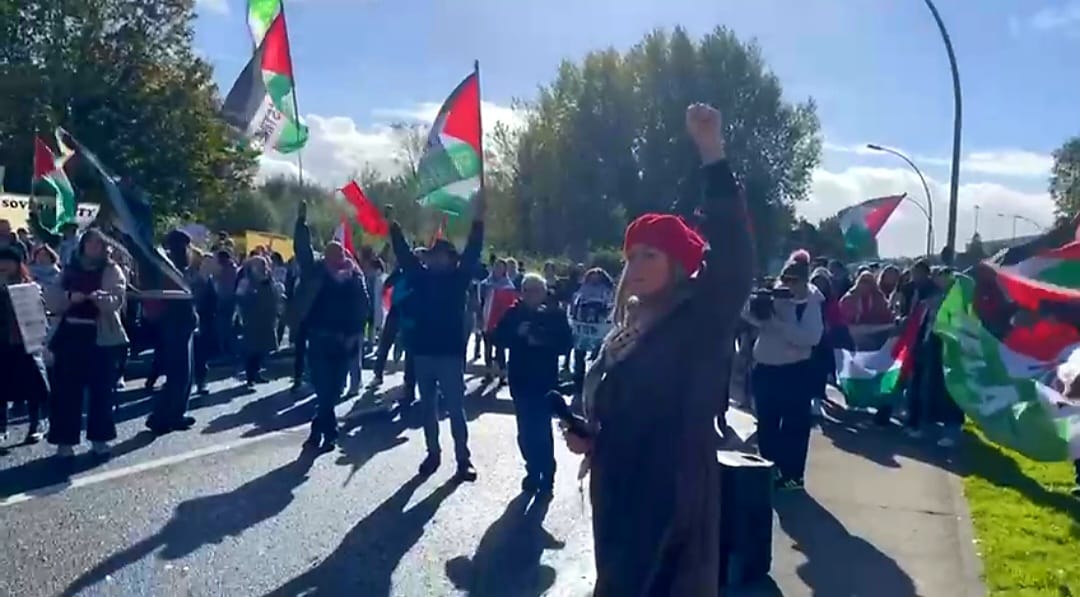
As the crowd descended, the silence was broken by Social Rights Ireland with a number of speeches given addressing Ireland’s connection with Palestine’s struggle for liberation, whilst our banners, “Break the Chains of Zionism” and “Sovereignty for Ireland NOW!” acted as a backdrop.
Various chants ensued, such as, “From Ireland to Palestine, occupation is a crime!”, “Resistance is an obligation in the face of occupation!” and “Saoirse don Phalastín!” Overall, the protest was peaceful and lasted several hours.
Two arrests were made under Section 6 of the Public Order Act following some pushing at barriers where protestors were gathered.
(Photo source: Participant)
As we know, genocide has been ripping through Palestine, devastating an entire population. Reports of the most brutal and dehumanising acts have forced people of conscience from all corners of the earth to confront the questions: how can this happen?
Why is no government or institution able to stop this Zionist terrorism?
For the first time in human history, a government has openly declared and is conducting a live-streamed genocide. This government also claims it is civilised, democratic and an upholder of human rights.
What started as a war of displacement has turned into a war of total obliteration. Meanwhile, the Irish people look on aghast, lost for words and running out of ideas as to how to make it stop.
The Free State2 watches too, unwilling to act but feigning concern and placating the masses with saccharine-coated words and vacuous gestures.
On the 9th October 2024, Fine Gael blueshirt,3 Simon Harris4 declared, “I think the world in general has failed the children of Gaza,” speaking in abstraction as if he is indeed not “part of the world”.
Not only is this an expression of abdication of responsibility, this admission to the people of Ireland confirms that he knows he is indeed powerless, a mere subject of his U.S. imperialist masters. Whether most Irish voters realise this, is debatable.
Allowing U.S. weapons to pass through our civilian airport, while claiming to be a neutral country and letting on to be concerned about the children of Gaza, is not simply an example of Fine Gael’s hypocrisy or gaslighting.
It is also blatant testimony to Harris’s and the state’s complete unwillingness to cut any ties with the U.S. Today the Free State is a tool of the Zionist ruler, it cannot fathom a future that is not connected to U.S. imperialism.
It is important for the Palestinian solidarity movement to not confuse solidarity and sovereignty.
How can Irish voters fully and genuinely express solidarity with the oppressed and work hand in hand with the oppressor? How can Irish voters call for an end to genocide whilst continuing business as usual?
How can politicians feast with genociders and sympathise with the starving?
Those who understand how oppression works know instinctively that hypocrisy is inbuilt to the psyche of politicians and the ruling class. The idea that politicians or the ruling class can be appealed to is pointless.
(Photo source: Participant)
The façade of Western democracy has completely unravelled. European values have been dismantled and replaced by E.U. interests best illustrated in the rise of Zionist leaders such as Ursula von der Liar and fascist governments across the E.U.
Anti-genocide protestors must stop trusting, appealing to, working with or appeasing the oppressor, be that Fine Gael, Fianna Fáil, the Green fascist Party, or indeed, so-called opposition parties on the neo-liberal Left.
While those who descended on Shannon had a common, collective demand for the government to STOP THE PLANES! STOP THE BOMBS! what is still missing from our collective conversation is the topic of Ireland’s sovereignty.
To question WHY the U.S. or indeed the British forces can use our land, sea and air ports is of vital importance. Socialist Republicans understand that only a 32-county socialist workers’ republic can be truly sovereign, free from the chains of imperialism, free from Zionism.
We know Ireland’s long history of oppression. We know occupation, dispossession and genocide. We know what displacement means and being stripped of our land, our resources, our mother tongue.
However, the slow erosion of our identity as a people through persecution, plantation, genocide, occupation and pacification is not always grasped by the Irish population following the successful assimilation process which still has a tight grip on our people.
This process is mediated through a pervasive neo-colonial mindset which continues to infect many in our places of work, education and society more generally.
Yes, since October 2023, the Irish people have turned their outrage in action, mobilising in local communities and workplaces to take a stand against genocide.
(Photo source: Participant)
Yes, many have applied pressure to the government via petitions, rallies and calls to support bills in government that they believe will effect change.
In response, the Irish government agreed to recognise the state of Palestine, but of course, this action means nothing for the people in Palestine who continue to be bombed, brutalised and slaughtered. But nothing tangible has happened.
If anything, the situation grows worse as the threat of nuclear confrontation becomes imminent.
Trying to quell the rising anger on the streets, the Free State government has attempted to placate Irish voters by deceiving them in the run up to election time.
Real action begins with expelling the Zionist Ambassador from Ireland. Real action begins with stopping U.S. war planes from using our airports. The Free State’s social control mechanism via its fake support for Palestine may fool some voters and placate neo-liberals, just in time for the general election.
In the words of Connolly,5 “Yes, ruling by fooling is a great British art – with great Irish fools to practice on.”
Section of the protest at Shannon Airport on Saturday (Photo cred: Mostafa DarwishAnadolu via Getty Images).
End.
Footnotes
1Located in Co. Clare in the west of Ireland, one of two international airports in the Irish state and has been the target of protests over the years due to documented cases of US military planes landing and taking off from there and Irish Government refusal to inspect alleged non-military US planes for military personnel, materials or indeed prisoners subject to ‘extraordinary rendition’ to CIA dark sites in client states.
2This was the name the neo-colonial state adopted when it was formed in 1921 and the name stuck particularly among the abandoned nationalist population of the occupied Six Counties colony.
3A pejorative term for Fine Gael, recalling its founding from a coalition of three parties, one of which was the fascist Army Comrades Association, commonly known as the ‘Blueshirts’ which described a part of their uniform.
4Taoiseach (Prime Minister) of the current 3-party coalition government of the Irish state: Fianna Fáil, Fine Gael and the Green Party.
5James Connolly, revolutionary socialist worker intellectual, historian, journalist, song-writer and trade union organiser, born and raised in Edinburgh, one of the Seven Signatories of the 1916 Proclamation of Irish Independence and Dublin Commandant of the Rising, executed along with the other signatories after the surrender of the Rising in Moore Street.
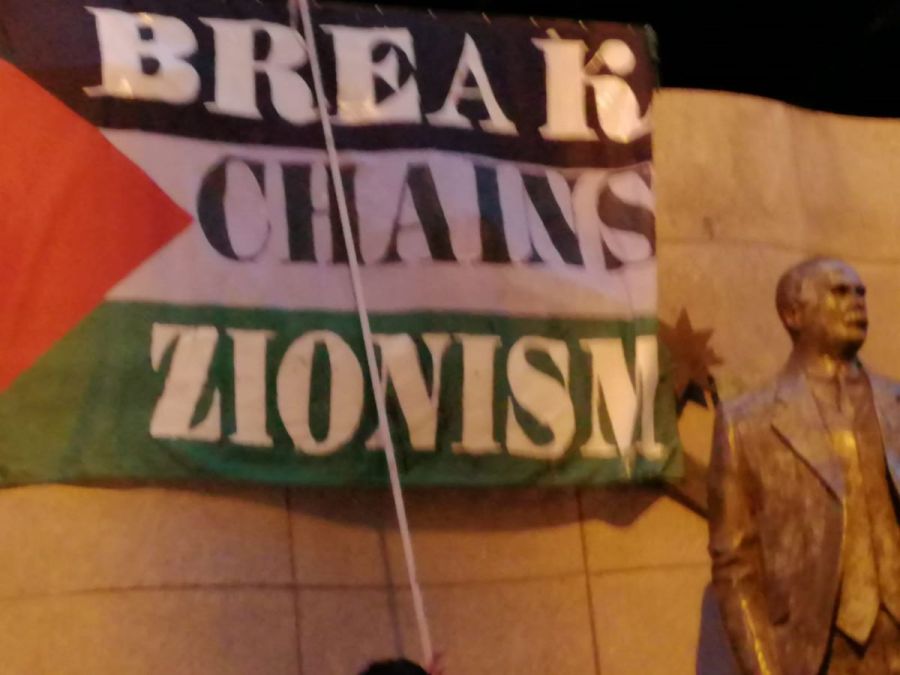
Scores of people participated in a symbolic ‘funeral of Zionism’ on Monday evening (7th October) in Dublin’s city centre. In front of the James Connolly monument1 and near a mock coffin of ‘Zionism’, they listened to a song and short speeches.
This was followed by a march carrying the ‘coffin’ through city centre streets to O’Connell Bridge, where it was dumped in the Liffey river.
The ethnic composition of the mostly young mixed-gender crowd, by appearance and accent, seemed to be a mixture of Irish and Middle Eastern origin.
The chairperson of the event recalled that a year had passed since the heroic action from Gaza of October 7th and the events that followed, all being gathered there at the James Connolly memorial to hold a funeral for Zionism, the ideology of settler colonialism and genocide.
The first contribution was from a man introduced as Seán Óg with a song of his own composition, three verses rendered acapella in fine voice to the air of two well-known Irish patriotic ballads, Men of the West/ Fir an Iarthair and The Boys of Killmichael.2
The audience began to pick up and join in the chorus lines:
So here’s to the boys of Gaza, Jenin, Nablus and Hebron, Who fought ‘neath the brave flag of Palestine and sent the Settlers on.
Section of crowd at event listening to speeches, viewed facing north-eastwards. (Photo: R. Breeze)
Two speakers followed, pointing out the unanimity of imperialism nowadays in supporting Zionism as distinct from the 1950s and the importance of struggles such as that in Palestine to our own in Ireland, of internationalist solidarity and the need for that solidarity to be for the Resistance.
One speaker interspersed his words in English with some phrases in Irish and recalled the protest against the 1897 visit of the British Queen Victoria which saw James Connolly and Constance Markievicz leading a funeral cortège through the streets bearing a coffin for British Imperialism.
Though a ‘funeral’ for British Imperialism might’ve seemed only aspirational in 1897, the speaker said, signs of its decline were there to be seen for the educated, the intelligent and those who wished to see them — and before two decades elapsed it had received a major challenge.
(Photo: R. Breeze)
It survived that challenge of the First World War victorious but weakened and the embers of revolt were burning around its Empire. Before two decades after that funeral march, the torch of freedom had been lit in Dublin,3 the first uprising against world war of that century anywhere in the world.
The speaker went on to recall the subsequent War of Independence in Ireland three years later and remarked that had it not been for some Irish failures in unity and resolution that British Imperialism might have been given its mortal blow then in Ireland.
Subsequently British Imperialism survived by serving as a subject ally to US Imperialism. “Zionism is a rotten tree”, he said, “planted in Palestine by British Imperialism and nurtured by US Imperialism. Even so, Zionism is damaging its very fosterers and we welcome that.”
“Rotten trees don’t fall on their own,” the speaker continued. Trees that are rotten inside may seem healthy on the outside but when a strong storm comes along, they are knocked down. It is then we can easily see the rot inside them that we may not have noticed before.
Storms are now breaking out around the world, he said. We can and need to play our own part in those storms, “to knock down the rotten tree of Zionism and go on to demolish the whole rotten evil forest of imperialism.”
Section of crowd listening to speeches at the event, photo taken facing south-eastwards. (Photo: R. Breeze)
After applause some chants were led, among them: From Ireland to Palestine – Occupation is a crime! Saoirse don-Phalaistín! There is only one solution – Intifada revolution! From the river to the sea – Palestine will be free! Resistance is an obligation – in the face of Occupation!
The attendance then took to the street, carrying the coffin and flying Irish and national flags of Palestine along with those of factions of the Resistance, also Hezbollah’s and Lebanon’s, continuing the chants as they marched up lower Abbey Street,4 then turning left along O’Connell Street.
Along the way, some bystanders cheered and a man leaned out of a delivery van to shout encouragement with clenched fist in the air.
On O’Connell Bridge, after a few words, the ‘coffin’ containing ‘Zionism’ was pushed over the parapet into the river Liffey, to cheers, which then changed to cycling through the accustomed solidarity chants.
The ‘coffin’ is on the Bridge parapet (left of photo) and about to be dumped into the river Liffey. (Photo: R. Breeze)
There were three external interventions.
A known Irish Zionist who regularly tries to harass Palestinian solidarity participants appeared at the outset in attempted intimidation of an activist but was quickly discouraged from doing so. At the Bridge, a person under the influence of alcohol and shouting confusedly was calmed by activists.
Break the Chains of Zionism banner next to James Connolly Monument (Photo: R. Breeze)
A Garda patrol car crew whose political undercover colleagues had clearly overlooked keeping informed drew up at the Bridge bemusedly during the chanting and, after attempting to gain some information as to events, left again – as did the participants soon afterwards.
The event was organised by Anti-Imperialist Action Ireland and Saoirse Don Phalaistín, the former’s Facebook page having been taken down by Meta while the event was being organised but the groups may be followed on Instagram and Twitter.
End.
Footnotes
1The location of this fine monument is in Beresford Place, across from the site of the original Liberty Hall, home of the Irish Transport and General Workers Union which Connolly led after Jim Larkin departed for the USA at the end of the 1913 Dublin Lockout. The site is now occupied a multi-storey building of SIPTU.
2The first is about the last major engagements of the 1798 Republican uprising, when a relatively small French force landed in Co. Mayo and was joined by Irish Republican insurgents; the second celebrates the IRA ambush of a column of the Auxiliary Regiment in West Cork, wiping it out almost to the last British terrorist.
4Until they reached O’Connell Street they were following in the footsteps of the GPO Garrison on Easter Monday, 1916 and passed by a number of historical political and artistic locations of 1848 and of the early 20th Century.
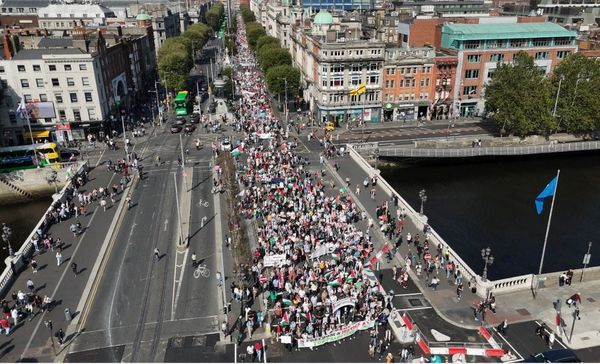
The national demonstration called by the Ireland Palestine Solidarity Campaign for 31st August began at the Garden of Remembrance and, traversing the city’s main boulevard, crossed the river to rally across from Leinster House, the Irish Parliament.
Having a weekly Saturday commitment until 1.30 and the IPSC march start advertised for 1pm, I had to run to catch it up as it marched away up O’Connell Street. I hurried alongside it to try to reach the front but failed to do so before I had to stop and fly the flag with comrades.
Having to run to catch up with the demonstration after an earlier weekly commitment. (Photo: D.Breatnach)
Looking back southward from O’Connell Bridge I could see the march stretching back along part of O’Connell Street while ahead I could see the front of the march winding along the outside of the Trinity College entrance.
Since early October last year, the IPSC and others have organised Palestine solidarity marches at least every second week through different parts of the city, mostly to Government offices and the Parliament. Similar events have also taken place across the land.
There have also been pickets of Zionist-friendly businesses and motorway bridge flag and banner drops, weekly roadside pickets in addition to building occupations and university protest/solidarity encampments.
This community solidarity banner may be seen every Thursday evening in four different areas of North Dublin (but for some reason the IPSC does not include it in its weekly list of events). (Photo: D.Breatnach)
Meanwhile, in Palestine the Zionist genocide grinds on unabated through bombing, ground attack, starvation and disease, along with torture of prisoners, destruction of infrastructure, including buildings, while the Resistance fights back with their missile launchers, guns and explosives.
While the fluid tactics of the Resistance are appropriate to the genocidal and well-armoured enemy, we must ask ourselves whether ours are too. Marches are important in showing numbers and in increasing the feeling of wider participation among individuals and small groups of friends.
(Photo: D.Breatnach)(Photo: D.Breatnach)
However the demonstrations are not moving the Government, much less the State, not even to bring forward the agreed Occupied Territories Bill, much less keeping Irish state airspace free of genocidal collusion.
Targeted direct action seems more likely to exert the necessary pressure, as was the case with Axa Insurance, where regular pickets and some occupations resulted in its divestment from ‘Israeli’ banks. University protest encampments also scored some successes.
But where are their trade unions? (Photo: D.Breatnach)But where are their trade unions? (Photo: D.Breatnach)
There are other possibly suitable targets of protest in terms of assistance to the Resistance. Is the Irish Red Cross fulfilling its duty in seeking access to Palestinian prisoners being tortured and starved? Are ‘Israeli’ imports being blocked?
Quite possibly other kinds of organisation are necessary to discuss, plan and lead these kinds of processes and indeed it was such sprung-up organisations that led those direct action events. Perhaps it is wrong to expect and organisation like the IPSC to lead them.
But is it wrong to think that the IPSC should advertise or at the very least tolerate such actions and not discourage them? Or even more, not warn people off from supporting such groups?
(Photo: D.Breatnach) (Photo: D.Breatnach)
Watching IPSC stewards shepherding people to clear the Molesworth Street from Dawson Street to the junction, even when they are packed solid from there to the rally across the road from Leinster House sometimes looks as though they see themselves as policing the march — and the movement.
Those who want that road cleared are the police but a) that is their concern and b) the demonstration is on the road which it has a right to be and traffic will just have to avoid it.
(Photo: D.Breatnach)(Photo: D.Breatnach)
We don’t have to work against one another. If the IPSC doesn’t want to lead some kinds of actions, they don’t have to. And if others want to do things the IPSC doesn’t, then they can. But no-one has the right to be the police within the movement, much less restrict development.
End.
(Photo: D.Breatnach)Aerial view of the march crossing O’Connell Bridge and the numbers all the way back to the Garden of Remembrance. (Photo sourced: IPSC Facebook)
The photo of the massive antifascist rally in London on 28th July following a march from Russel Square shows the recapture of Trafalgar Square from Tommy Robinson and his sea of Union Jacks. Not for the first time, the Irish made their mark upon the place.
There the only two high flying flags were the Irish Tricolours and the Palestinian flags, the Irish contingent being one of the few on the day to see the fight in Britain against the fascists as part of the same fight against the fascist Zionist regime.
Irish and Palestinian flags in Trafalgar Square rally against racism, end July 2024 (Photo cred: PA)
We are mindful of the history of our occupied territories and our 1930s fight against the anti-Semitic Blackshirts1 in London (e.g. standing with the Jewish community at the Battle of Cable Street, 1936) and against the Bridgeton Billy Boys in Glasgow in the 1930s.2
On 28th July our flags sent out a message: We stand against all fascists, at home or abroad. That day we could not but remember all our brave men and women who marched past here from 1971 to 1998 carrying our fight to the heart of government3 in harder times.
We also know that the anti-racist movement now takes its new life from the strength of the Palestinian solidarity movement in Britain and needs to recognise this.
It was strange being in Trafalgar Square again with Tricolours given that we were barred from being there during the ‘Troubles’. Irish solidarity events were banned from using the Square under any circumstances from 1972 to 2001, well after the Good Friday Agreement.
The ban was lifted only once for an Irish event during that period and that was for the Peace Women4 (sic) calling for an ‘end to violence’ (mainly that of the Resistance) and famous US folk singer/ political activist Joan Baez displayed her ignorance of the Irish situation by speaking there.
It was interesting that a reporter for GB News of the British mass media was aware that a picket had been held in Dublin in protest against the assassinations of Palestinian and other Arab resistance leaders. He tried to link the Irish contingent in Trafalgar Square with ‘support for Hamas’.
The linkage was hinted in his broadcast report though he was careful enough not to report a direct link as the Irish group in Trafalgar Square had in fact no connection with the Dublin group. The reporter asked how to pronounce ‘Saoirse Don Phalaistín’ — but still got it wrong in his report.
One of the Irish contingent spoke to the young GB News journalist: He had the stuff from Dublin on his phone and wanted to say that the Irish in the Square were part of the Dublin group.
“Next thing you’d know the Zionists would call for a ban on the Irish for ‘supporting Hamas’”,5 commented one of the veteran Irish activists. “We also get targeted because of the flag and our placards.”
The UK State and the police are all pro-Zionist and the Zionist press tries to trap the Irish into dangerous statements but “We know our history and are well able for them; we just say we support Palestinian resistance to Israeli occupation just as we did with the British in Ireland.”
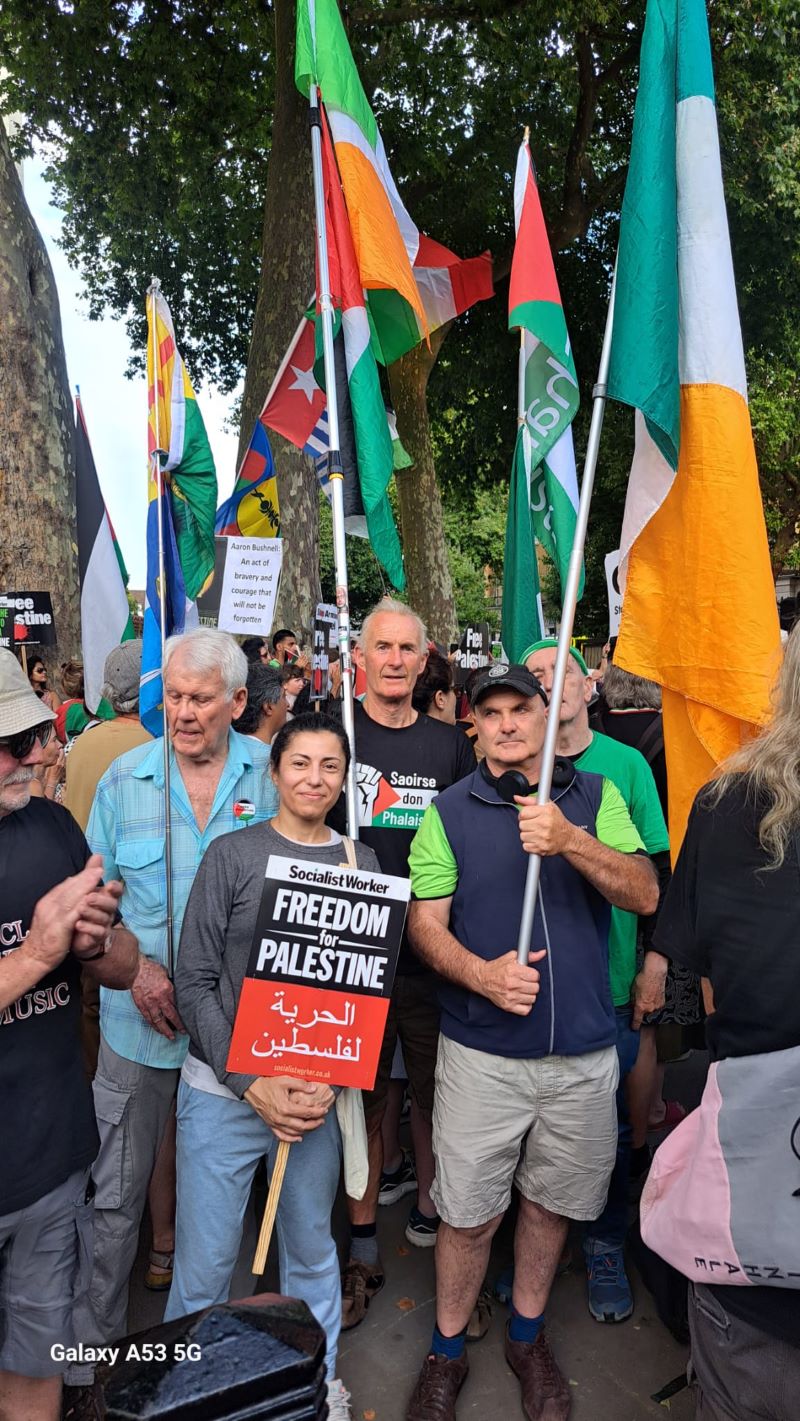
Irish contingent with flags on Palestine solidarity march to Downing Street very recently (not sure whether the SW person is part of it). (Photo sourced from participant).
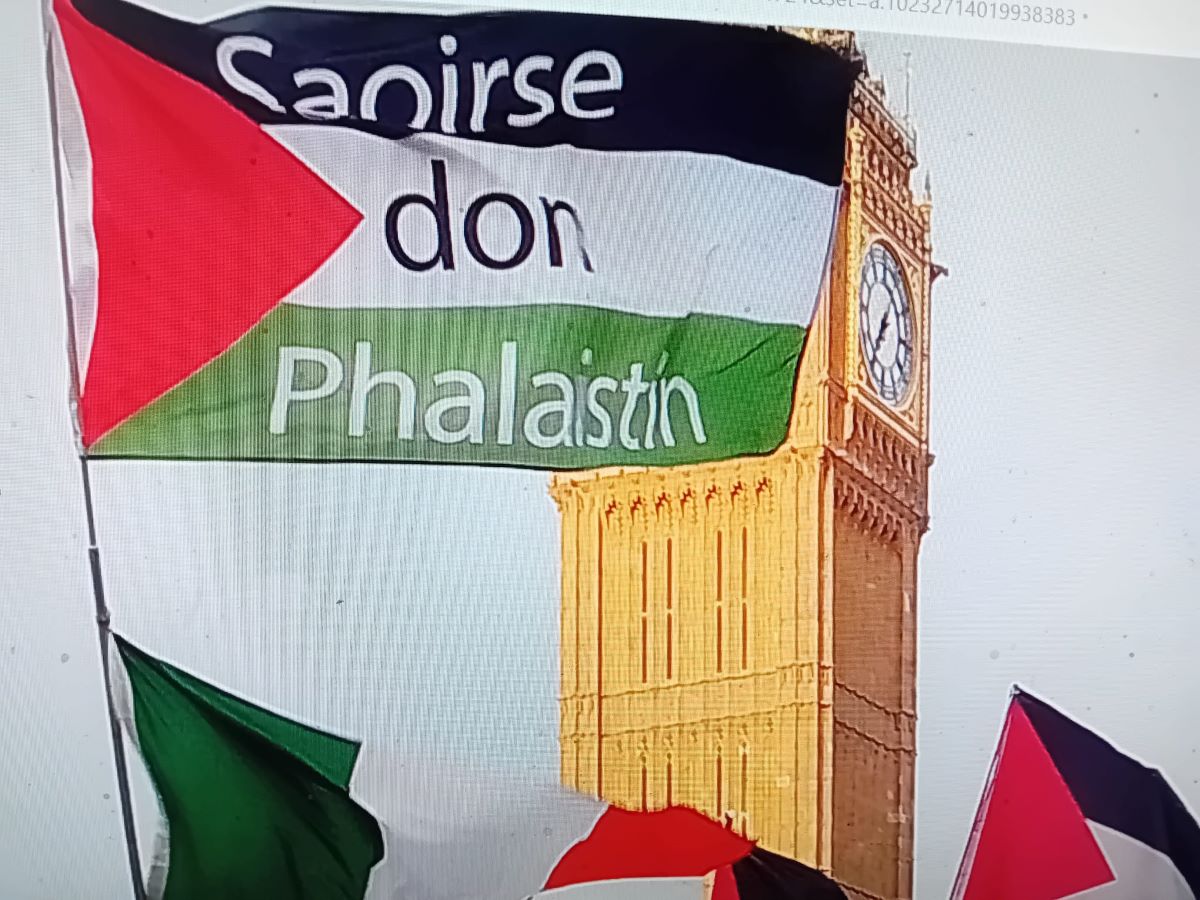
The Irish Tricolours, often in the company of the Palestinian national flag with Saoirse Don Phalaistín printed on it have been seen on Palestine solidarity marches in London since the current Zionist genocide began but also on anti-fascist rallies and in support of Julian Assange.
This is in keeping with the history and tradition of the Irish in Britain who helped found the republican United Englishmen6, the Chartists,7 many trade unions, a section of the First International8 and also gave the British working class their anthem9 and their classic novel.10
Classic novel of the working class in Britain was written by Robert Noonan, aka Robert Tressell, from Dublin. (Image sourced: Internet)
In later times they were prominent in organising solidarity with Vietnam and of course Ireland, against repressive legislation and fascist organisations, solidarity with Nicaragua, Palestine etc. and in struggles against state repression, including within the jails.
The Prevention of Terrorism Act (1974), forerunner of the current Terrorism Act (2000) specifically targeted the Irish community in Britain with suspension of habeas corpus for a period of up to five days, refusal of access to solicitor, as did also the framing of a score of people.
In the midst of the Irish Hunger Strikes of 1981, the Irish community broke out of the State terror stranglehold and formed the Irish in Britain Representation Group, among its objectives being the abolition of the Labour Government-introduced Prevention of Terrorism Act.
End.
Saoirse don Phalaistín and Irish Tricolour flags on Palestine solidarity march this year photographed against Westminster’s ‘Big Ben’. (Photo cred: being investigated)
NOTE ON AUTHORS
Pat Reynolds is a former trade unionist, social worker, a veteran anti-racist, anti-fascist activist, also for Irish independence and for rights for the Irish community in Britain. He was PRO for the Irish in Britain Representation Group for two decades, founding the Haringey Branch and the Green Ink Bookshop. Reynolds is from Granard in Co. Longford and lives in London.
Diarmuid Breatnach is a former trade unionist, worker with homeless/ substance misusers (manual worker before that), also a veteran anti-racist, anti-fascist activist and campaigner for Irish independence. For a decade he was on the Ard-Choiste of the IBRG, founder of the Lewisham Branch and of the Lewisham Irish Centre. Breatnach is from Dublin to which he has returned to settle.
FOOTNOTES
1The British Union of Fascists led by Sir Oswald Moseley which had substantial support in the British elite, including the publisher of the The Daily Mail with police attacks on anti-fascists.
2The Billy Boys were founded and led by Billy Fullerton, a former member of the British Fascists. Fullerton also later became a member of the British Union of Fascists in the 1930s. The Billy Boys adopted a militaristic style of behaviour, marching on parades, forming their own bands, composing their own songs and music, and all dressed in a similar manner.[3] The Billy Boys also formed a junior group whose members were teenagers called the Derry Boys. (Wikipedia)
3From Trafalgar Square to the Houses of Parliament in Westminster runs a broad thoroughfare, in the centre of which is the Cenotaph and a little further, the entrance to Downing Street.
4The organisation/ campaign was founded by Betty Williams and Mairead Corrigan in 1976 after a car driven by an IRA fighter mortally wounded by British soldiers in Belfast crashed into pedestrians and mortally wounded three children of Anne Maguire, sister of Mairead. Branding itself as against all violence the Peace Women in fact targeted primarily the Republican movement, secondarily the Loyalist paramilitaries and hardly ever the Occupation Army. Williams accused the IRA unit of having fired on the Army unit that killed the driver which was untrue (but is repeated on her Wikipedia entry). Both founders received the Nobel Peace Prize in 1976 and a substantial cash prize. Williams resigned from the group in 1980 and disappeared from Irish-related activities though prominent externally. Corrigan however remained politically active in Ireland and elsewhere against war and has campaigned among other things for the end of the ‘Israeli’ siege on Gaza, being arrested with crew and passengers on the Spirit of Humanity aid ship in 2009 by by the Zionist navy, taken to ‘Israel’ and subsequently deported.
5Hamas is proscribed organisation in the UK since March 2001 and a person promoting it would be liable to prosecution under the Terrorism Act.
6A spin-off from the United Irishmen in Ireland; the English chapter led the Spithead and Nore naval mutinies. The Irish also reformed the United Scotsmen when it was faltering.
7Karl Marx called the Chartists “the true mass movement of the working class” – two of its principal leaders, Bronterre O’Brien and Fergus O’Connor were Irish, as their surnames would suggest.
8The Fenians were accepted into the First International Workingmen’s Association.
9The lyrics of The Red Flag were composed by Jim Connell from near Kells, Co. Meath and set to the brisk air of The White Cockade, later changed to the mournful air of Tannebaum.
10The Ragged-Trousered Philanthropists was written by Robert Tressell (real name Robert Noonan) from Dublin.
(Reading time:3 mins. Note: Apologies for delay in publishing this report)
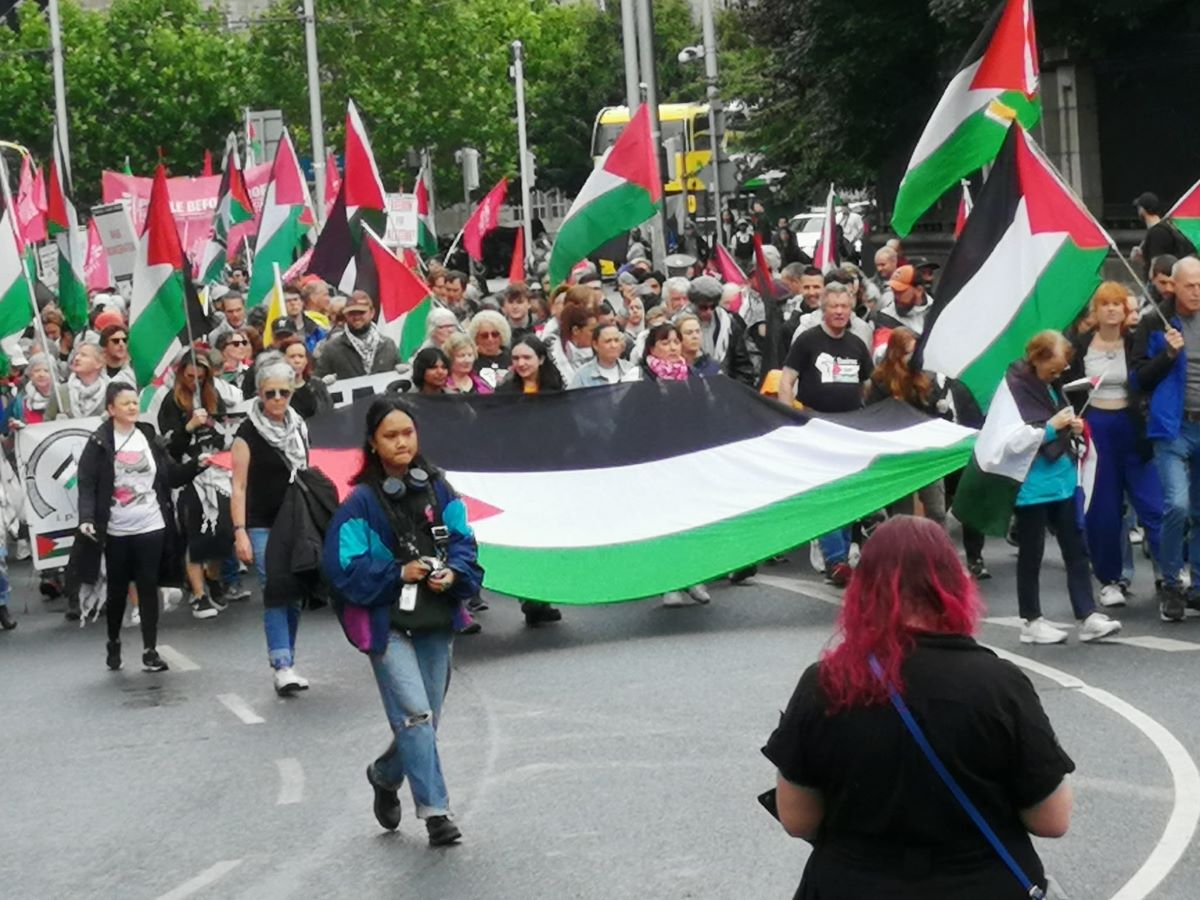
On Saturday 20th June the Irish people, despite their Governments once again marched in a national demonstration to show the Irish majority solidarity with Palestine and horror at their continuing genocide by the ‘Israeli’ armed forces.
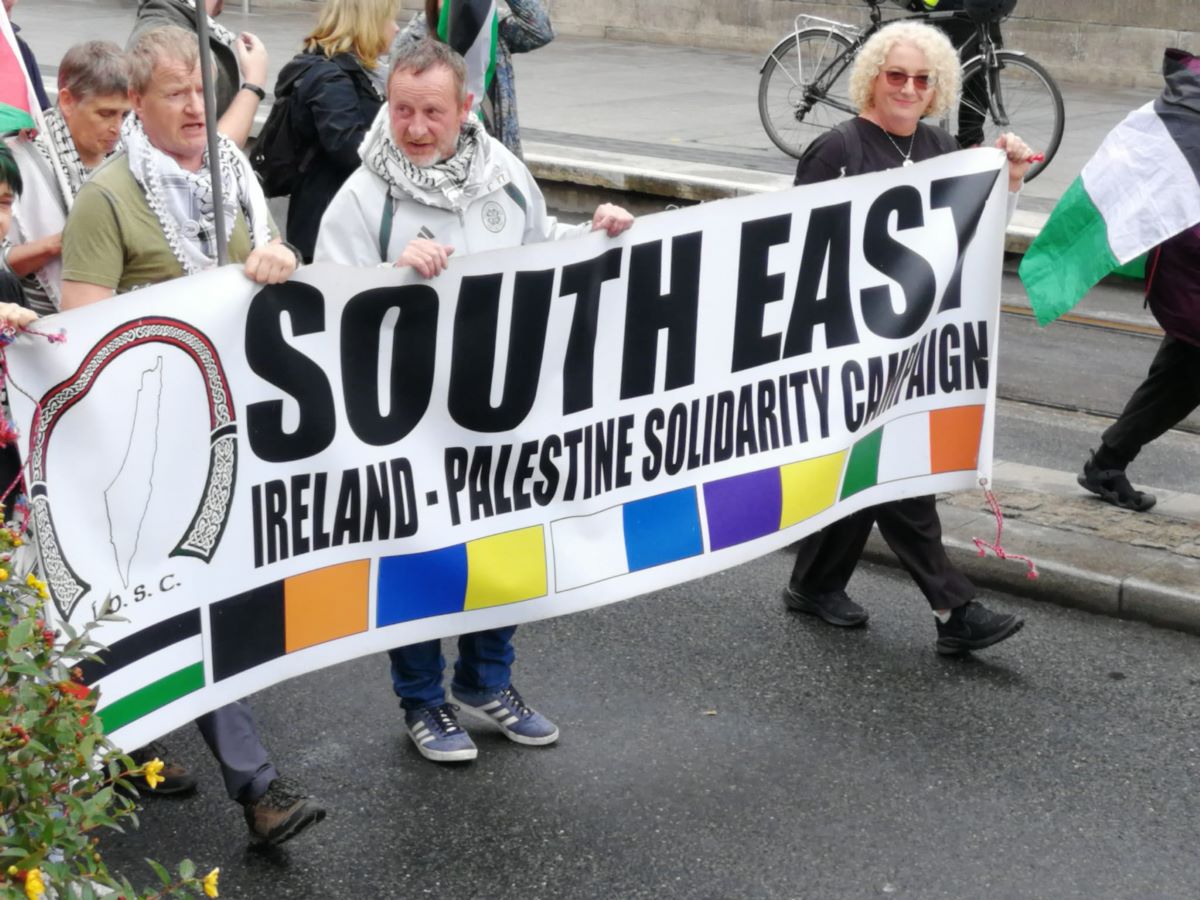
The march had been convened by the long-standing Ireland Palestine Solidarity Campaign which has branches across Ireland from Cork to Donegal, including in some parts of the British colony (where however the Loyalists are anti-Palestinian).1
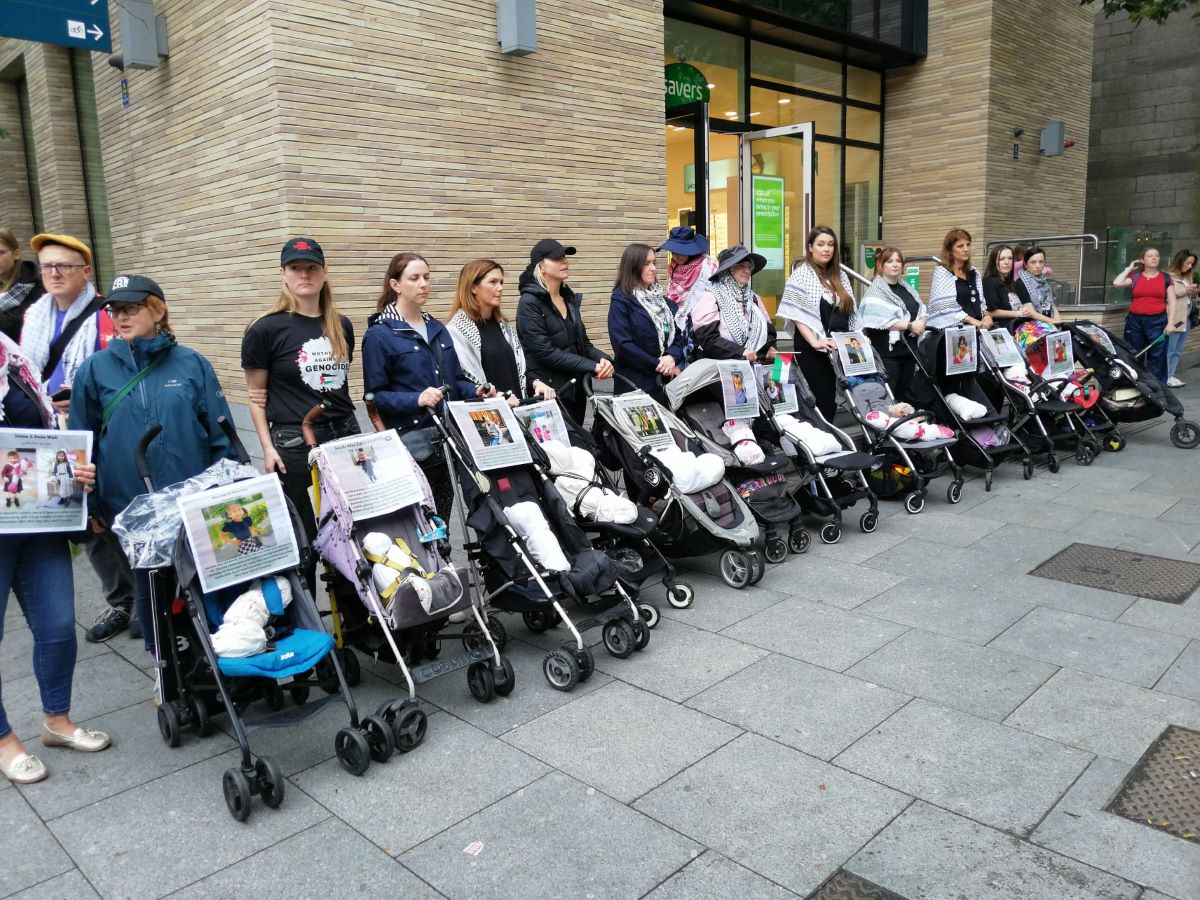
Mothers Against Genocide group in Dawson St. (around corner from Molesworth St.) evoking individual children murdered by ‘Israel’. (Photo: D.Breatnach)Dublin community group that holds Thursday evening vigils in four areas of North Dublin. (Photo: D.Breatnach)(Photo: D.Breatnach)
The assassinations of resistance leaders were still to come2 but it had been business as usual in Palestine with daily massacres of civilians by the ‘Israeli’ Occupation forces, ongoing starvation, destroyed health service, impending epidemics, prisoners released as ghosts of their former selves.
Also IOF raids and kidnappings3 in the West Bank, at times with Palestinian Authority4 collusion in arrests of activists, confiscation or destruction of Resistance weapons …
To all this the Palestinians in general have responded by helping one another trying to survive, digging people out of bombed rubble, documenting atrocities, burying their dead, trying to feed their children and elderly …
And their Resistance in all factions (and none) threw stones, fired bullets, launched anti-tank rockets, mortars, missiles and blew up bombs against Occupation armour and soldiers. And of course, contributed new names to the long list of martyred resistance fighters and commanders.
The ECJ,5 to howls of protest from the regime had pronounced its verdict that Israel was indeed, as has long been evident, guilty of practising apartheid against the Palestinians. However not one state ceased giving political or financial cover to the Occupation or supplying it with arms as a result.
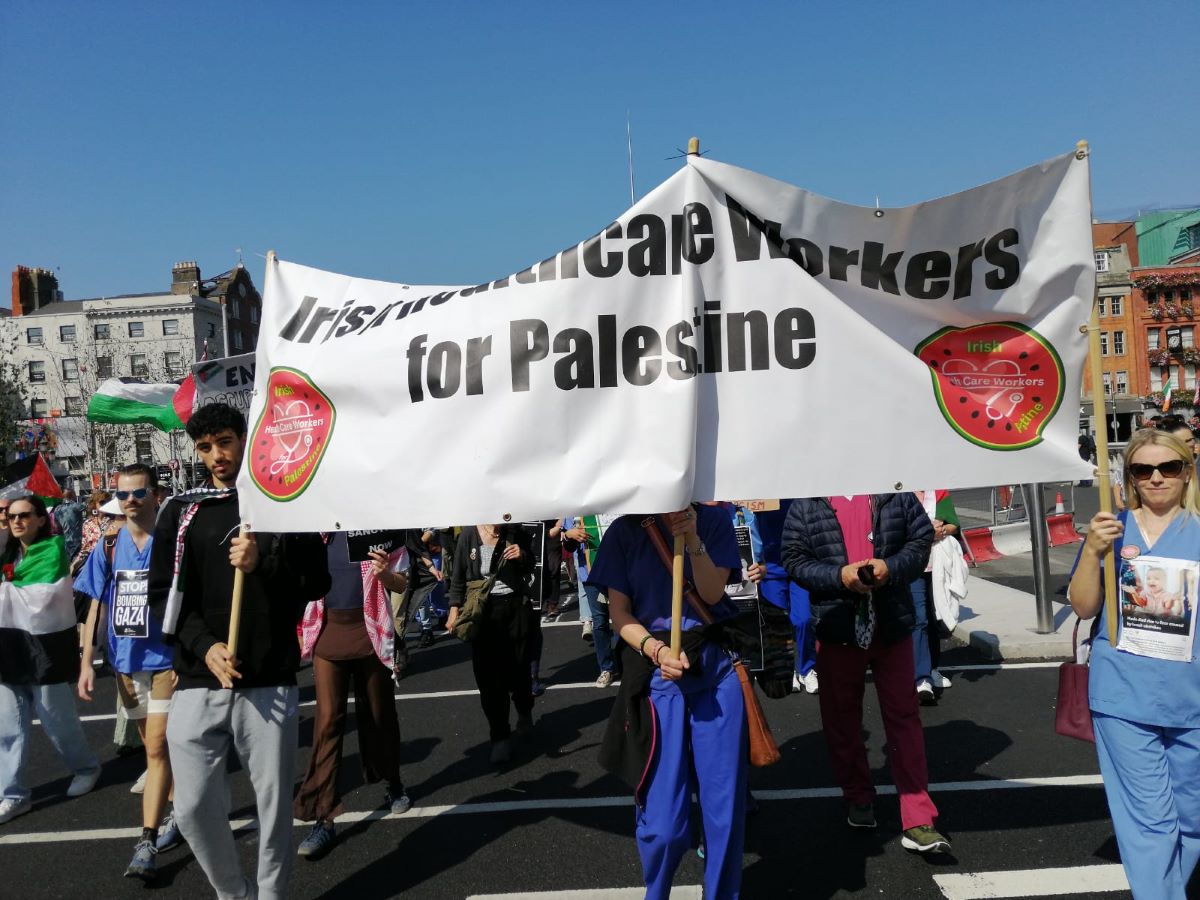
Irish Healthcare Workers for Palestine. (Photo: D.Breatnach) (Photo: D.Breatnach)(Photo: D.Breatnach)
IPSC Police?
Only a few Irish Tricolours were displayed on the march which is visually a political mistake, as I’ve observed earlier and the organisers should state that such are welcome. Not one Starry Plough flag, that of socialist Republicans, could be seen either, despite no doubt there being many such participating.
Irish language placards and banners have been getting rarer, despite a previous welcome upsurge upon which I’ve commented in the past. However there were some to be seen, including a number of Saoirse Don Phalaistín flags and the banner of a Newry group, from Co. Down, under British occupation.
As they filled Molesworth Street towards the IPSC stage and police barriers at the end, facing the Leinster House Irish Parliament building, some marchers already began to leave, having heard speeches before and perhaps heading for their transport back to their earlier points of departure.
The company that erects crowd barriers were ready to install them to cut off a section of Molesworth Street at the intersection of narrow lanes and the Gardaí wanted to cram the crowd in beyond the barriers. IPSC stewards began to usher marchers further into Molesworth street.
One approached a group of marchers telling them what the police wanted to which one of the group replied: “I don’t give a f..k what the police want!” and after the steward’s persistence, accused him of doing the job of the police.
The IPSC stewards have helped the police pack marchers into the stretch of Molesworth Street beyond the intersection (and incidentally leaving any demonstrating in Dawson Street cut off from the main group). (Photo: D.Breatnach)
Aside from the rough language, what were the IPSC stewards doing passing on police orders?
People in the group said that the IPSC stewards have done this before and that furthermore there was no important-through way being cleared,6 the exercise serving no real purpose other than getting the public used to being corralled and that at the least the police should do their own job.
(Photo: D.Breatnach)(Photo: D.Breatnach)
The main purpose of stewards is to keep the march moving and safely from traffic. The route has been agreed beforehand by the IPSC with the Gardaí which is not a legal requirement in Ireland. Even in that case the stewards should keep a strict separation in functions from the police.
The IPSC does an important job, publishing information and organising events, especially nationally but back in October delayed in even calling for the Zionist Ambassador’s expulsion. Some other groups also organise events and it appears that the IPSC supports some and not others.
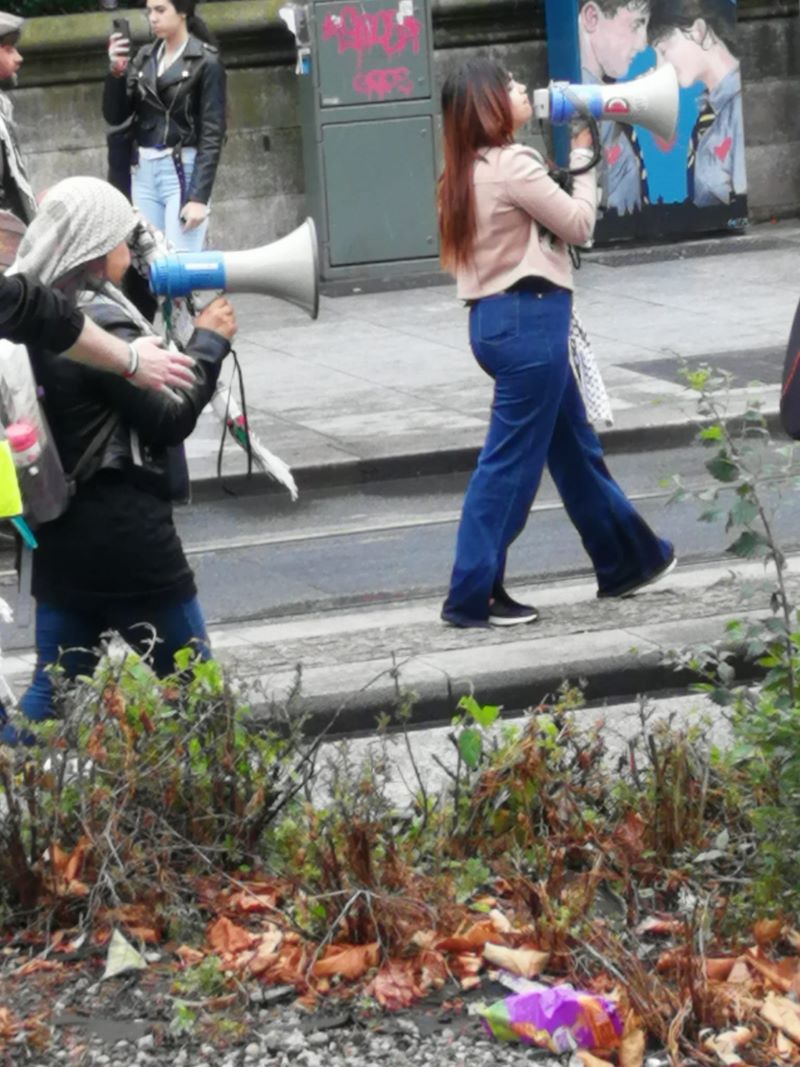
Young Palestinian women leading the slogans call-out. (Photo: D.Breatnach)(Photo: D.Breatnach)
Going forward it seems that the solidarity movement, including of course the IPSC, will need to take into account their meagre effect on the Irish Government, not to speak of upon the genocidal state itself and on its supporting states in the West, in particular the USA, Germany, UK …
Such recognition will call for escalation, for direct action, for different kinds of solidarity action … whether some organisations want to participate or not.
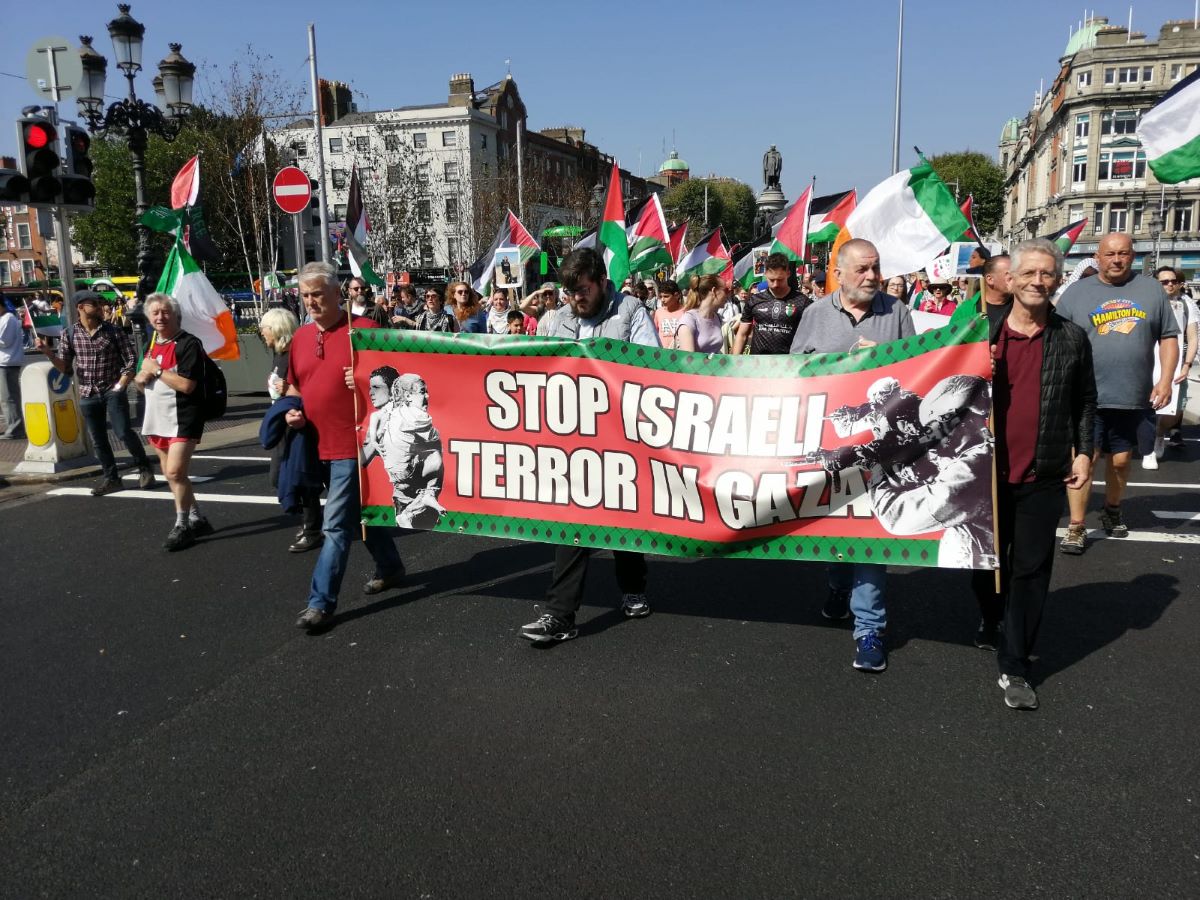
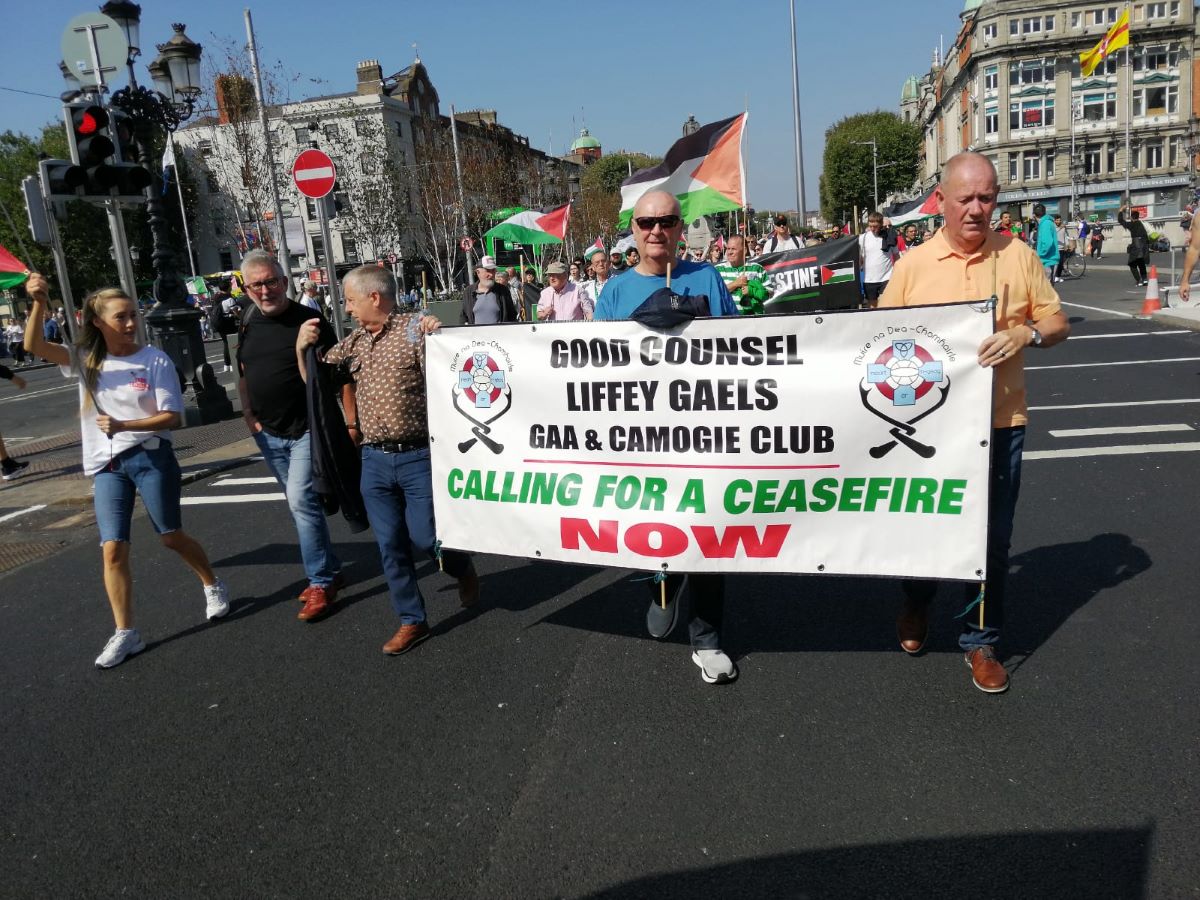
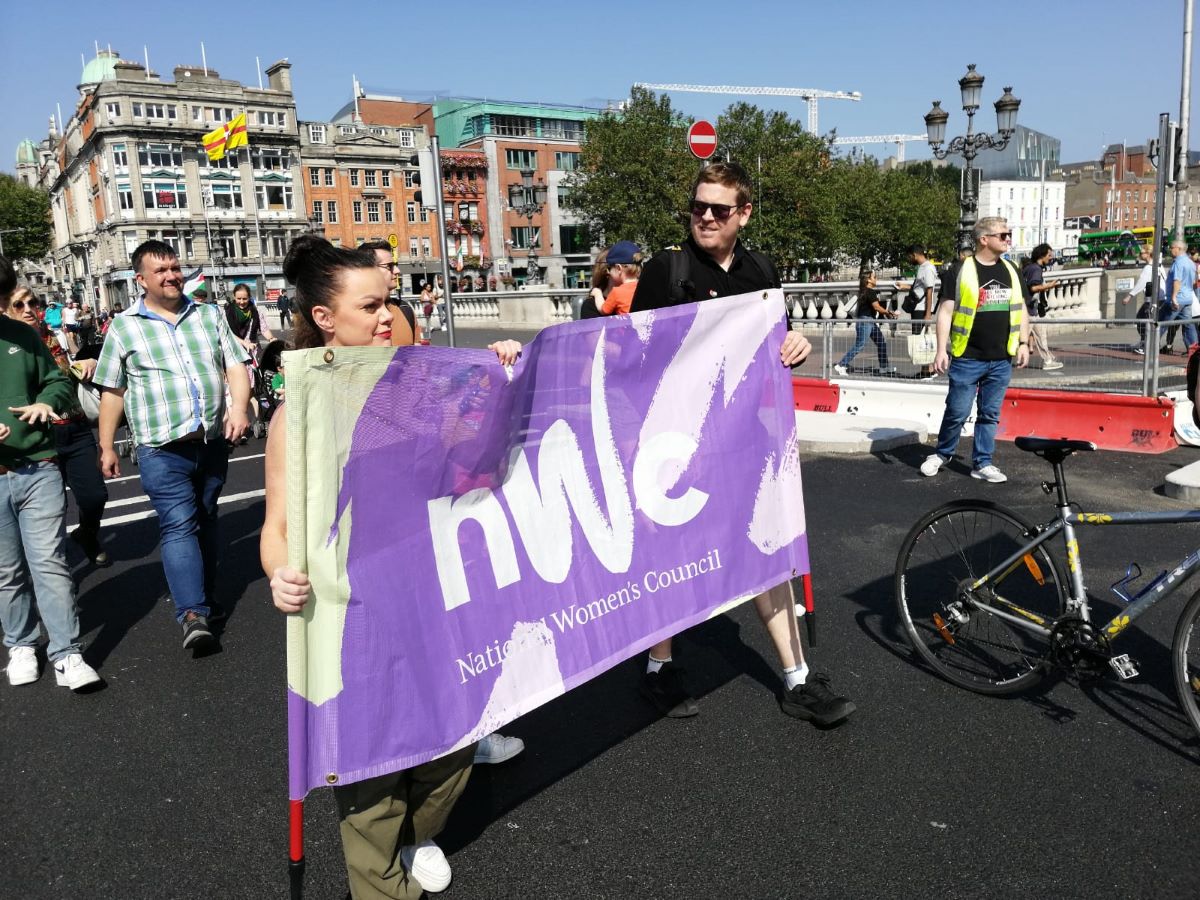
(Photo: D.Breatnach)(Photo: D.Breatnach)Some trade union banners on the march (though the unions do little to mobilise support, much less take action against ‘Israeli’ products etc.). (Photo: D.Breatnach)Front of the march turning into College Street. (Photo: D.Breatnach)
FOOTNOTES
1This could be because they see themselves as ‘British’ settlers, while the ‘Israelis’ are European settlers too but is more likely a knee-jerk reaction to the Palestine solidarity exhibited by Irish nationalists (something like “If they’re for them, we must be against them”.
2Assassinations of leaders of Hamas, Hezbolah and senior officers of Islamic Resistance Iraq.
3The IOF and the Zionist State may call them “arrests” or “detentions” but typically they are random or working off a list without warrants or due process. Former prisoners are re-arrested constantly; family of ‘wanted’ individuals are detained in order to pressure the ‘wanted’ to give themselves up. Typically the detained are served ‘administrative detention’ orders, jailing them for months without trial or evidence. Prisoners are underfed, overcrowded, beaten by guards, have dogs set upon them and medically neglected.
4Unelected, undemocratic, corrupt and zionist-colluding body financed by some Western powers and some colluding Arab states.
6Furthermore, with no side-streets available in that section beyond the intersection, the police could close that west end of the street should they wish to, ‘kettling’ all the demonstrators between two Garda barriers.
Around 30 people demonstrated outside Dublin’s Criminal Court on Thursday, many of them displaying Irish flags (Tricolour and Starry Plough) along with those of Palestine in solidarity with three activists before the court.
The activists were charged under Public Order legislation arising out of protesting a British war ship at Dublin docks in November last year, in solidarity with Palestine and against NATO’s support for the Israeli state’s slaughter in Gaza.
It was alleged that the activists (variously from Saoirse Don Phalaistín and Anti-Imperialist Action organisations) had entered a restricted part of the Dublin Docks and, holding a Palestine flag, had approached a British warship docked there and then occupied the gangway.
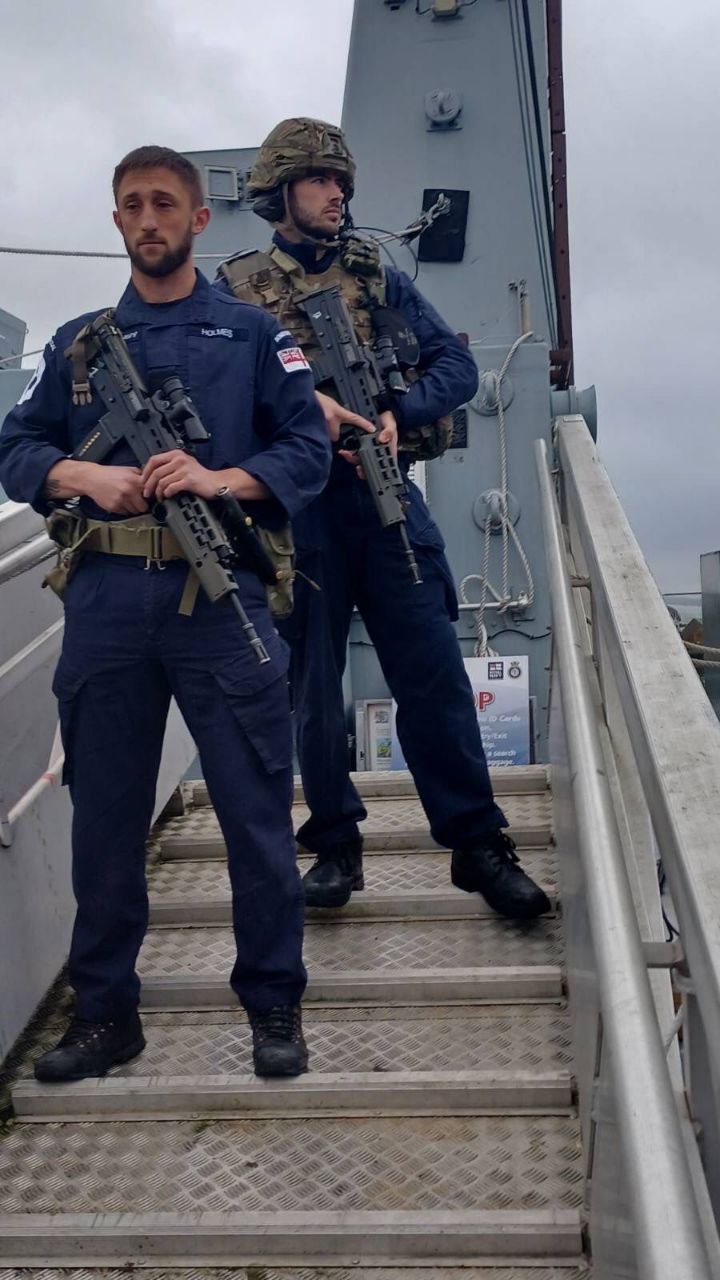
British military displaying firearms on Irish state soilin November last year. (Photo: Anti-Imperialist Action)
Gardaí had been called and the activists had refused their instruction to leave under the Public Order legislation and they had then been arrested. No act of violence, physical or verbal, took place on either side other than the refusal to leave and the arrests.
The activists appeared in the Parkgate Street building before Justice John Hughes and all three were defended by Damien Coffey of Sheehan Partners, a law firm which often handles political and human rights cases. Three Gardaí from Store Street acted in the role of the Prosecution.
The Garda in charge of the prosecution and his two colleagues gave evidence as to the arrests. Questioned by Coffey for the Defence, all confirmed that although the protesters had refused to leave, there had been no violence offered by them during their arrests.
Strangely, as shall become evident and relevant, one did not recall the British military presence on the gangway to be armed, whereas another did and confirmed that a photo of the armed men was of those who had been present.
One of the Garda offered his opinion that whereas the vessel was regarded in law as “British soil”, the gangplank was legally “Irish soil” and, if the protesters had actually set foot on the ship, they might have been charged with piracy. This piece of evidence also had unintended consequences.
One of the placards displayed by supporters outside the courthouse (Photo: Rebel Breeze)
According to this evidence, the British in a foreign military uniform had been present on Irish state soil and all replied to the defence lawyer that they were unaware of any Ministerial permission to do so — or that this could have constituted an offence under Section 317 of the Defence Act 1954.1
Furthermore, none were aware of any special permission granted to them to carry firearms on Irish state ground. The British military personnel themselves were not present as witnesses as their superiors had not replied to the Garda request to discuss giving evidence in the case.
Port security camera footage was shown as evidence by which protesters could be seen at the gates of a fenced-off section of the docks and some time later proceeding through a gate. A port security employee had been summoned by the Gardaí as a witness.
After he had been taken through his evidence (and failed to respond to what seemed an attempted prompt) by the Garda in charge the only relevance of his evidence was that a) the area was restricted and b) that he was worried for the safety of the protesters.
This (and the reason for the possible attempted prompt) was of importance when Coffey developed his defence summary on the legal grounds that Section 14 (1) of the Public Order Act required there to be an element of fear arising from the actions of those to be charged under the Act.
None of the evidence for the Prosecution had shown the presence of fear of anyone from the defendants and, furthermore, he submitted, any element of fear was much more likely to arise from the presence of two men holding firearms, to whit, the British military personnel.
The second part of the Defence summary dealt with right to protest, Coffey quoting a number of legal sources, also referencing the Irish Government’s recognition of a Palestinian state and statistics of people killed by the Israeli state against which the activists had been protesting.
Judge Hughes announced that a recess was due for lunch and that he wished to consult legal authority (case law etc) so they would recess and reconvene in an hours’ time.
A number of supporters who had taken time off from other commitments left at this point while a few arrived instead.
THE JUDGEMENT
After reconvening Judge Hughes began his long drawn out summing up and it gradually became clear that he intended to find the accused guilty. However people awaited with varying degrees of patience for the details of the sentence.
The Judge referred to the right to protest but also to the restrictions upon it (usually limiting its effectiveness) though he did not say that, nor that powers exist to abolish those rights when the State feels it necessary.
With regard to the ‘element of fear’ required for conviction under the Public Order Act Hughes quoted a judgement as a reference that seemed neither relevant nor reasonable, involving a woman experiencing fear of being broken into and even fear of children playing outside her home.
Despite repeating the standard claim of capitalist law that judges cannot adjudicate emotionally nor be swayed by what was occurring in Palestine, John Hughes revealed his own political bias when he bizarrely claimed that a British fleet had been welcomed into an Irish port in 1820.
He revealed his political naivety also when he expressed surprise that the British had not replied to the Garda communication regarding the incident.
On submission by Coffey regarding the lack of previous convictions and effect of criminal convictions on the lives of the three, Johnson, again drawing out the moment, gave them what amounts to a conditional discharge with a provisional forfeit of 500 euro.2
No doubt the desire not to create martyrs around whom solidarity campaigns might intensify played at least as much a part as any concern for the lives of the activists.
The defendants and their supporters left; outside the court they were embraced by a number of supporters before the gathering broke up, some attending to other solidarity activities elsewhere. The show of support was a good sign of solidarity against state repression.3
View of some of the people outside the courthouse on Thursday in solidarity with the three activists (Photo: Rebel Breeze)
SERIOUS ISSUES AMONG ELEMENTS OF COMEDY
The name of the British naval vessel being The Penzance and the mention of a possible piracy charge brings to mind of course the Gilbert & Sullivan opera The Pirates of Penzance (1879).
The focus of the Gardaí on arresting peaceful protesters in preference to unauthorised people in foreign military uniform carrying unlicensed firearms on Irish soil and also trying to suggest that not they but the protesters would give rise to fear is not without its comedic elements.
However overall the whole matter is extremely serious, with regard to the zionist genocide in Palestine, the active collusion of the UK/NATO, the active collusion of the Irish ruling class4despite its verbal positions – and the repression of its State on more active and directed solidarity actions.
End.
FOOTNOTES
1 317. — (1) No person shall, save with the consent in writing of a Minister of State, enter or land in the State while wearing any foreign uniform. (2) No person shall, save with the consent in writing of a Minister of State, go into any public place in the State while wearing any foreign uniform.
2 It will not appear as a criminal record but in the event of a subsequent conviction, the 500 euro can be levied as a fine in addition to any other punishment in court sentence.
3 Though the absence of a number of political organisations and trends was also marked.
4 “Dual-use”exports to the zionist state which can be adapted to military use; failure to press for any economic, academic or cultural sanctions against the zionist state; shelving of the Occupied Territories Bill; failure to impose diplomatic sanctions of any kind.





























 rebelbreeze