Chiquita, the multinationals and the bloodbath in Colombia

Gearóid Ó Loingsigh (16/06/2024)

(Reading time: 5 mins.)

It was an open secret that the US multinational, Chiquita, financed the paramilitaries. But the company always denied it, until one fine day, due to the insistence of the victims the company had to acknowledge its guilt and pay a fine of $25 million US.

On June 10th, this year, a tribunal in Florida ordered the company to pay $38 million to the families of 8 people who were murdered by the groups Chiquita financed.1

However, the victims in the same period for which Chiquita accepts it financed the paramilitaries and to have allowed them import weapons through their free zone port number more than eight victims, there are thousands.

But it is not just a matter of the number of victims but rather the number of victimisers. The judgement lays bare the discourse of the transitional justice system and that of all the governments, including the current one, about the nature of the conflict.

The peace agreement signed with the FARC, described the problem as one of some criminal guerrillas (and among their ranks there were) and some “rotten apples” in the armed forces (there weren’t any but rather it was a problem with the military institution itself).

The business people were designated as third parties and are not obliged to testify before the Special Jurisdiction for Peace (JEP). But the judgement in the US against Chiquita clearly shows that they are not “third parties” in the conflict but “first parties”.

Once upon a time the role of the multinationals in the conflict was the starting point for all of the left and the human rights groups too, but not anymore.

Before we look at the matter, we should bear in mind that among many of those who are now part of the government, those that signed or promoted the agreement with the FARC are various spokespersons that previously denounced many companies.

I had the honour of investigating the role of the British oil company BP and other companies in the case of Casanare, where the role of the company could be proven.

The company itself, partially acknowledged its bloody role in financing the 16th Brigade alleging that it was legal at that time.

Many organisations have denounced BP, and the voices raised against the company increase in number.2 But legally BP is as innocent as Chiquita once was. In Southern Bolívar we saw how mining companies fomented the war against communities.3

Carlos Castano, right, the leader of the right-wing paramilitary group United Self-Defense Forces of Colombia. (Photo cred: New York Post/ AP)

It wasn’t just in that region, but rather in the whole country and included national companies as well.4 The palm companies did their part and the cattle ranchers publicly accepted their role in fomenting paramilitaries,5 to name just a few sectors.

Other reports, as yet not proven to the same degree as the ones against Chiquita, cameout, but few doubt the reports against Coca Cola and Nestlé. Perhaps in a few years we can state it with the same legal certainty as we do now in relation to Chiquita.

And if we get there, it will be exclusively due to the struggle of the victims.

For the current government, the truth commission and many sectors of the Historic Pact (PH) the conflict is to be explained in terms of drug trafficking, minor disputes (never major ones) for land, corruption and the “culture of death in Colombia”.

But none of that is true. It is true that drug trafficking has, up to a point, played a role, and sometimes there are land disputes between neighbours that end badly and violence as a method of resolving problems is socially acceptable amongst many sectors of the country.

But none of this explains the conflict.

The Colombian conflict can be explained in terms of one between national capital, but above all international capital and the Colombian people and can be seen in the fight for land, the economic model, the war on unions, grassroots organisations etc.

Once upon a time it was not controversial on the left to say so, not even among the NGOs and even some politicians did so. Now, however, whoever states as much, dies politically.

Petro has given the excuse that he holds office but not power as a justification to explain the lack of operational capacity of his government and the lukewarm nature of his proposals. But we knew that, we always knew that, even when Petro on the campaign trail said he would “take power”.

People used to accept the idea that Colombian policies are not decided in the Nariño Palace (presidential palace) but rather in the White House and the cafés of Wall Street. The owners of the “cafés” decide more than do the Colombian people.

Those that serve the coffee are companies like Chiquita and it is the Colombians who wash the dishes.

President, are you the owner of one of these cafés, a waiter or a dishwasher? Tell us in detail. We would like to know who took the decision to allow Chiquita and the rest of the companies to kill left, right and centre.

We would like you to name those companies that kill peasants. Or, do you not as President have access to the military and police archives etc.?

On the election campaign, Petro said he was the Biden of Colombia.

But Biden and the Democrats have always received funds from multinationals, particularly from the agribusiness sector. So Petro should tell us whether he is still the Biden of Colombia and what he intends to do with Chiquita and other companies behind the Colombian conflict.

The peace process with the FARC and the rise of the PH as a party of government has left us a pernicious legacy, where we talk about the conflict in psychological terms, of evil, or individual responsibility (except when dealing with the insurgency).

And from the onset deny the role of the US in the conflict and the role of companies, particularly the multinationals. The business people are not on trial in the JEP, except those who voluntarily place themselves before the tribunal.

And that is only done by those who face a sure sentence in the ordinary justice system and see in the JEP the possibility of avoiding jail time. The Truth Commission excluded the business people.

In 2015, in the middle of his speech to the Colombian Oil Association, the then President Santos tried to reassure them and promised that he was not going to pursue them.

He gave them some advice, suggesting that if there was ever report made against them they could allege they were coerced.

Furthermore he stated, “Which businessman is guilty of war crimes or crimes against humanity? If there is even one, he might be put on trial, but I don’t see how, or where…”6

Well, for the moment we could reply that perhaps in Florida, but not in Bogotá and not due to the NGOs, state bodies and other personalities who sell us that image of the conflict in which companies are not the driving force behind the conflict.

End.

Comment by Rebel Breeze:
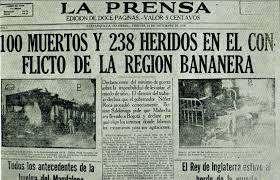
Chiquita is the current manifestation of the infamous United Fruit Company which organised a massacre against striking fruit workers in December 1928:
Leaders of the 1928 strike including two martyrs. (Photo sourced: Wikipedia)

NOTES:

1 The Guardian (11/06/2024) Chiquita ordered to pay $38 million to families of Colombian men killed by death squads. Luke Taylor. https://www.theguardian.com/world/article/2024/jun/11/chiquita-banana-deaths-lawsuit-colombia

2 Declassified UK (18/07/2023) La financiación de BP a los militares asesinos de Colombia. John McEvoy. https://www.declassifieduk.org/es/la-financiacion-de-bp-a-los-militares-asesinos-de-colombia/

3 Ó Loingsigh, G. (2003) La estrategia integral del paramilitarismo en el Magdalena Medio. España. https://www.academia.edu/96631813/LA_ESTRATEGIA_INTEGRAL_DEL_PARAMILITARISMO_EN_EL_MAGDALENA_MEDIO_DE_COLOMBIA

4 Ramírez, F. (2010) Gran minería en Colombia, ¿Para qué y para quién? Revista Semillas No. 42/43 https://semillas.org.co/es/revista/gran-miner

5 Ó Loingsigh, G. (2006) El Catatumbo: Un reto por la verdad. Cisca. Bogotá. P.153 https://www.academia.edu/16951015/Catatumbo_Un_Reto_Por_La_Verdad

6 Cited in Sinaltrainal et al (2016) Ambiguo y decepcionante acuerdo: itinerario para la impunidad de crímenes de Estado. P.24 https://rebelion.org/docs/208980.pdf

One Year of Petro

Gearóid Ó Loingsigh

(07/07/2023) (Reading time: 8 mins.)

The Petro government has reached the end of its first year in which it promised a lot, came through on some things and changed a lot of other things, particularly its position on certain issues.

Before taking a look at it, it should be pointed out that the Historic Pact (PH) is not the first left-wing government in Colombia. The country is still waiting for that. It is a remould of liberalism in the style of Ernesto Samper.

Even so, it is worth looking at its proposals and what it did in this year, as unlike Samper, it did give a lot of hope to the people.

It is generally accepted that Petro would not have been elected President if it were not for the big popular revolt that began on April 28th 2021, an uprising that cost the life of over 80 youths.

We don’t know the exact number of dead and disappeared and less still of the number of young women who were raped and sexually abused by the Police as part of the repression. Even the number of political prisoners is a matter of dispute.

Not due to the absence of the number of people detained but because the amongst Prosecutor’s Office, the press and sections of the PH there are those who seek to divest the detained youths of any political motivations.

They simply paint them as criminals and vandals, the last of these words having been covered in glory during those protests.1

The heroic ‘vandals’: Demonstrators clash with riot police during a protest against a tax reform bill launched by Colombian President Ivan Duque, in Bogota, on April 28, 2021. (Photo cred: Juan Barreto/ AFP). (Photo choice and caption by Rebel Breeze)

So, it comes as no surprise that Petro, like Boric in Chile, did not free the political prisoners from the revolt. He made a few lukewarm attempts to get a handful of them out, but a long way from all of them.

They are still in prison, despite his electoral victory being thanks to their struggle and actions that led them to prison.

It is perhaps the most symbolic transgression as it says sacrifice yourselves but don’t expect anything from me, not even when I owe you everything. Petro has defended himself by saying that it is not his decision to free or imprison anyone.

Recently he stated:

There are still many youths in prison and I get blamed, as if it were up to me to imprison or free them. State bodies and people inside them have decided that these youths should not be freed.

Not because they are terrorists, who would think protesting is terrorism? If not a dictator or Fascist. No, but because they want to punish the youths who rebel.2

Some may feel that he is right in a technical sense, i.e. that it is the Prosecution and the judges who imprison them. But that is to ignore reality.

He himself denigrated them when he referred to them as ‘vandals’ during the protests and since taking office, neither Petro nor the PH have been the visible heads of any initiative to free the prisoners. They washed their hands of the issue.

He didn’t even disband the specialised riot squad, the ESMAD. Unlike other proposals he didn’t even try to.

He changed its name and promised a couple of human rights courses for its members, as if the problem was their lack of attendance at a course or two given by some NGO and not a deep-rooted problem. The ESMAD is a unit that murdered many youths.

It is a body whose name is synonymous with violence, torture, sexual abuse and murder. A name change won’t wash away the blood.

the promise to put an end to the ESMD was just lip service during the presidential campaign. It wasn’t carried out and the government will fail to carry through on its commitment to the youths who brought the president to power, through the existence of a repressive violent force like this one.

The temptations to infiltrate the marches in order to justify confrontations with the kids will continue to be part of the landscape.3

Petro gives his voters a clenched fist on his inauguration as President in August last year but many remain in jail and the rest get little or nothing. (Photo sourced: Internet) (Photo choice and caption by Rebel Breeze)

In economic terms the government promised a lot during the campaign, but once in power, it quickly softened its proposals and in some other cases they didn’t get a majority of votes in Congress.

The lack of votes in Congress is not a simple one of not coming through, nor is it due to betrayals by the PH nor manoeuvres by other forces that Petro can’t control.

The PH is a coalition of sectors of the right with sectors of what passes for social democracy in Colombia. It was not inevitable, but rather Petro actively advocated that it be like that.

It is worth recalling that at first, he wasn’t going to choose Francia Márquez as his vice-president but rather a right winger like Roy Barreras.

However there are economic aspects that are under his control, but for the moment they remain as just proposals, rather than real policies that have gone through Congress. On the land question, Petro proposes monocultures and agribusiness.

This was clearly to be seen in the proposal to buy three million hectares from the cattle ranchers.

Petro’s vision of the countryside is one of it being at the service of big money and the promotion of cash crops, despite some references to the production of foodstuffs for internal consumption and the so-called bio-economy.

Something similar can be seen with his proposals for clean energy. He spoke a great deal about it during the electoral campaign and some of his proposals, or outlines as they stand, look good.

That Colombia no longer depend on oil and coal is not a bad idea and that it be replaced with alternative energy sources such as solar and wind power looks good, until we actually examine the details.

One of his first stumbles, in that sense, was with the Indigenous people, as La Guajira is a poor area that has suffered the consequences of coal mining.

He did not take them into account and they reminded him that what is proposed for their territory should have their support, though legally it is not quite the case, and that it should also benefit them.

He partially rectified the case, but the big question is, if he wants an energy transition why does he have to seek out French and other foreign capital to finance it. Does he want to hand over the wind and solar power as they are still doing with oil and coal?

It would seem so. According to Petro:

We need investments that help us carry this out: we would have a matrix of foreign investment centred on the construction of clean energies in South America, with a guaranteed market, if we have direct link to the United States and by sea with the rest of the world.4

If you substitute oil and coal for clean energy, you begin to see the problem: the resources of Colombia in the service of big money and the countries of the North.

If we are to have a real change and energy transition, we must end the idea of Northern energy consumption regardless of where it comes from as sustainable and that countries such as Colombia must supply energy for a planet-destroying consumption model.

Neither have there been great advances on the issue of peace. He did reactivate the dialogue with the ELN, but stumbled with something that is still an integral part of his policy, the so-called Total Peace.

In his proposal he compared the insurgent group, the ELN to the drug gangs and paramilitary groups such as the Clan de Golfo. It was not a mistake, Petro really does see the ELN as a criminal gang.

He made it clear in his speech to the military and he reaffirmed it when he named the blood thirsty Mafia boss and former Murderer-in-Chief of the paramilitaries, Salvatore Mancuso as a Peace Promoter.

With that he placed the ELN leadership on the same plane as the paramilitaries. And they have implicitly accepted it for the moment.

In Petro’s discourse Colombia is a violent country and there is no way to understand it and peace has to be made with everyone as they are all the same, the insurgency and the narcos. Not even Santos was that creative in delegitimising the guerrillas.

Mancuso took on his role and once again spoke of the land they had stolen, the disappeared etc. He has been telling us for two decades now that tomorrow he will reveal all, but tomorrow never comes.

When Uribe invited Mancuso to the Congress of the Republic, Petro had a different attitude.

His response was blunt and he described Uribe as a president that was captured by the paramilitaries and that Mancuso manipulated the Congress stating that “if under this flag of peace, dirtied by cocaine what is essentially being proposed is an alliance with genocidal drug traffickers and political leaders… then we are not contributing to any sort of peace.”5

And we end the year with a scandal. I have on many occasions compared Petro and the PH to Samper and the Liberal Party of the 90s. But not in my most fertile delirium could I imagine that Petro and his son would give us another Process 8000.

Samper managed to reinvent himself as a statesman and human rights defender, despite his government’s dreadful record, following the outcry over drug money in his election campaign. He has publicly supported Petro and the PH.

Now he can advise them on how to deny what is as plain as day. Illicit funds went into the PH’s campaign as has happened with all election campaigns.

Petro finds himself in the eye of the storm due to the manoeuvres of his son in asking for and receiving money. His ambassador in Caracas has boasted about obtaining 15,000 million pesos [3.3 million euros] that were not reported to the authorities.

Those on the “left” who gave Petro unconditional support defend him, saying that it all happened behind his back.

The only thing left to say about that is, a little bit of respect for Samper please! He established his copyright, authorship of that expression in relation to dirty money. They will have to come up with another one.

For the moment Petro says, I didn’t raise him, which is true. But his son is the beneficiary of a type of political nepotism. As was the case with Samper, the only doubt is whether Petro knew or not.

That a government which is supposedly progressive has found itself entangled in such a storm is revealing of a government in which politics is a family business.

Something similar happened to the FARC commander Iván Márquez with his nephew who turned out to be a DEA informant.

On the drugs issue it is clear that the discourse and reality do not match at any point. Petro went to the UN to announce a new drugs policy. He put forward various aims for his government and criticised the war on drugs.6

It seems like a bad joke that the said policy has not yet been published. What we have seen is that the fumigations continue, the Yanks smile on and occasionally there is talk of going after the big fish, without saying who they are.

We know that he is not talking about the banks, and less still of the European companies that supply the precursor chemicals. The big fish will turn out to be middle ranking thugs in the cities of Colombia, at best.

So, it has been a year that wasn’t that different to others. Yes, there were changes, some proposal or other that was half interesting, but even the right wing does that occasionally.

The vote of confidence cast in the ballot box is still waiting to see the promised changes. But we increasingly see a government without a clear aim and reinventing old policies as new ones, with the same results as before.

End.

FOOTNOTES

1 See Ó Loingsigh’s article Long Live the Vandals – R.B.

2 Infobae (06/08/2023) Petro se defendió por los casos de los presos del Paro Nacional: “Como si yo encarcelara o pudiera liberar”. Juan Camilo Rodríguez Parrado.
https://www.infobae.com/colombia/2023/08/03/petro-se-defendio-por-los-casos-de-los-presos-del-paro-nacional-como-si-yo-encarcelara-o-pudiera-liberar/

3 Pares (11/10/2023) Cambio de aviso: gobierno Petro echa para atrás desmonte del Esmad. Miguel Ángel Rubio Ospina. https://www.pares.com.co/post/cambio-de-aviso-gobierno-petro-echa-para-atrás-desmonte-del-esmad

4 Portafolio (18/01/2023) El plan que propone Petro para lograr inversión en energías limpias. https://www.portafolio.co/economia/gobierno/gustavo-petro-su-propuesta-para-lograr-inversion-en-energias-limpias-577102

5 See https://www.youtube.com/watch?v=Wg3av8Oeujk

6 See https://www.youtube.com/watch?v=J35_vqekWcc