LEBANON PRESIDENT CITES IRA AS EXAMPLE FOR DISARMING HEZBOLLAH

Diarmuid Breatnach

(Reading time: 6 mins.)

In an 11th January interview with state public television channel Télé Liban, Joseph Aoun, President of Lebanon, cited the disarming of the Provisional IRA with regard to the disarming of Hezbollah, which is being demanded by the USA and ‘Israel.’

Significant points from the interview were translated in summary and posted on The Cradle news updates channel on Telegram on the anniversary of Aoun’s election to the Presidency, for which he was constitutionally obliged to resign from his previous position of head of the armed forces.

In a post-colonial polity balanced between sovereignist and anti-imperialist forces on the one hand and pro-Western imperialist elements on the other, Aoun is widely regarded as the West’s man, a verdict justified by a constant thread in his Presidential statements and replies in this interview.

The whole issue of Hezbollah disarming arises mainly from the Zionist state and its main backer, US imperialism and has been much in the news for months.
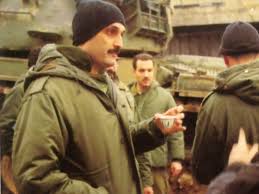
Samir Geaga, Lebanese politician of the Christian far-Right, back in his Christian Front days during the Lebanon Civil War. (Photo sourced: Internet)

In addition there is an internal Lebanese element with a background of right-wing Christian fascist militias,1 pro-Western imperialism and recruited as proxies by the ‘Israeli’ armed forces when they occupied Lebanon (1982-2000), before the rise of Hezbollah which led the liberation of the country.

Hezbollah’s last armed action was towards end of October 2025 after bombarding the Israeli occupation of northern Palestine in order to divert the Zionist armed forces from the accelerated genocide of Gaza, then in a defence of the IOF’s attack on Southern Lebanon.
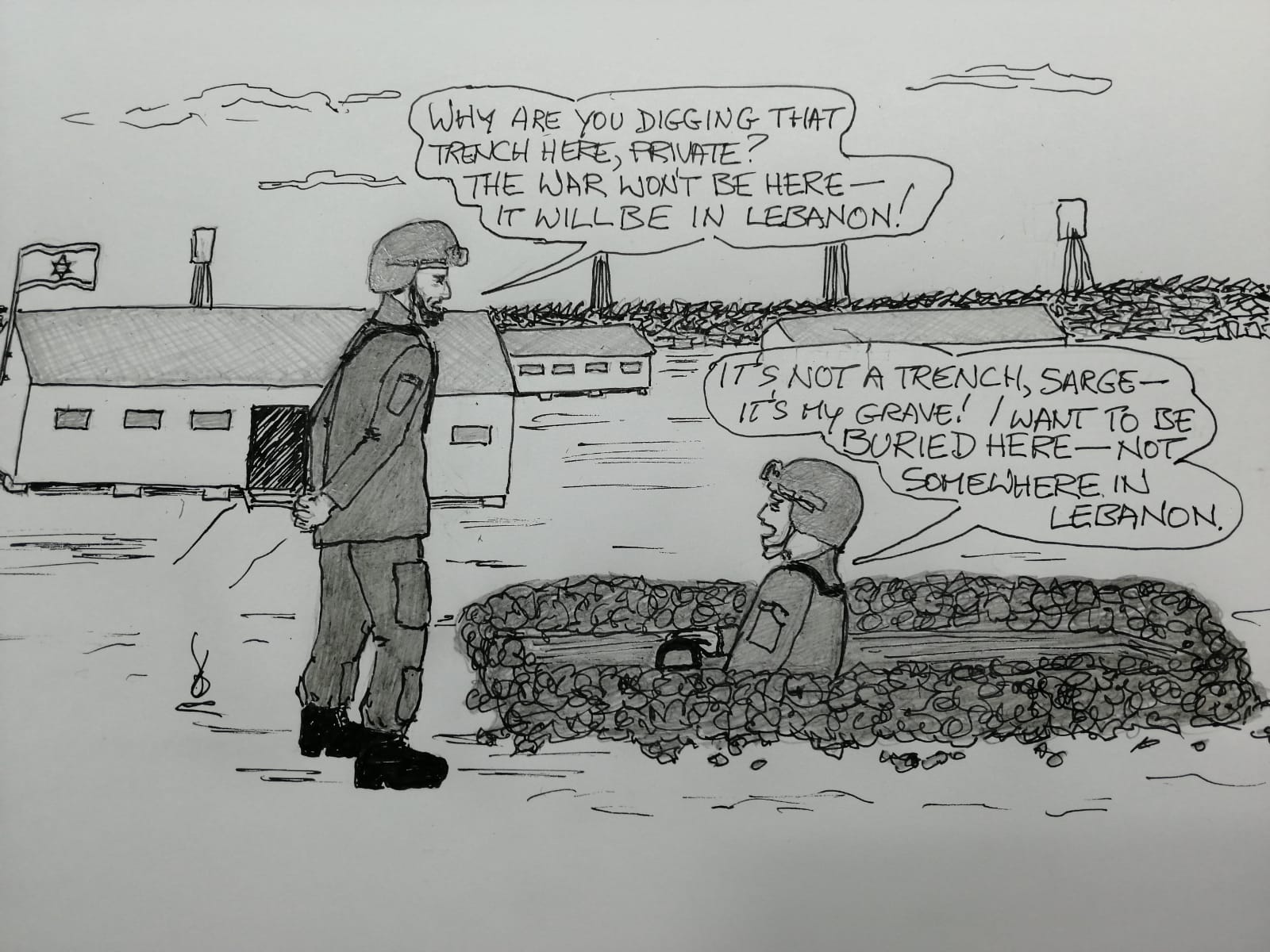
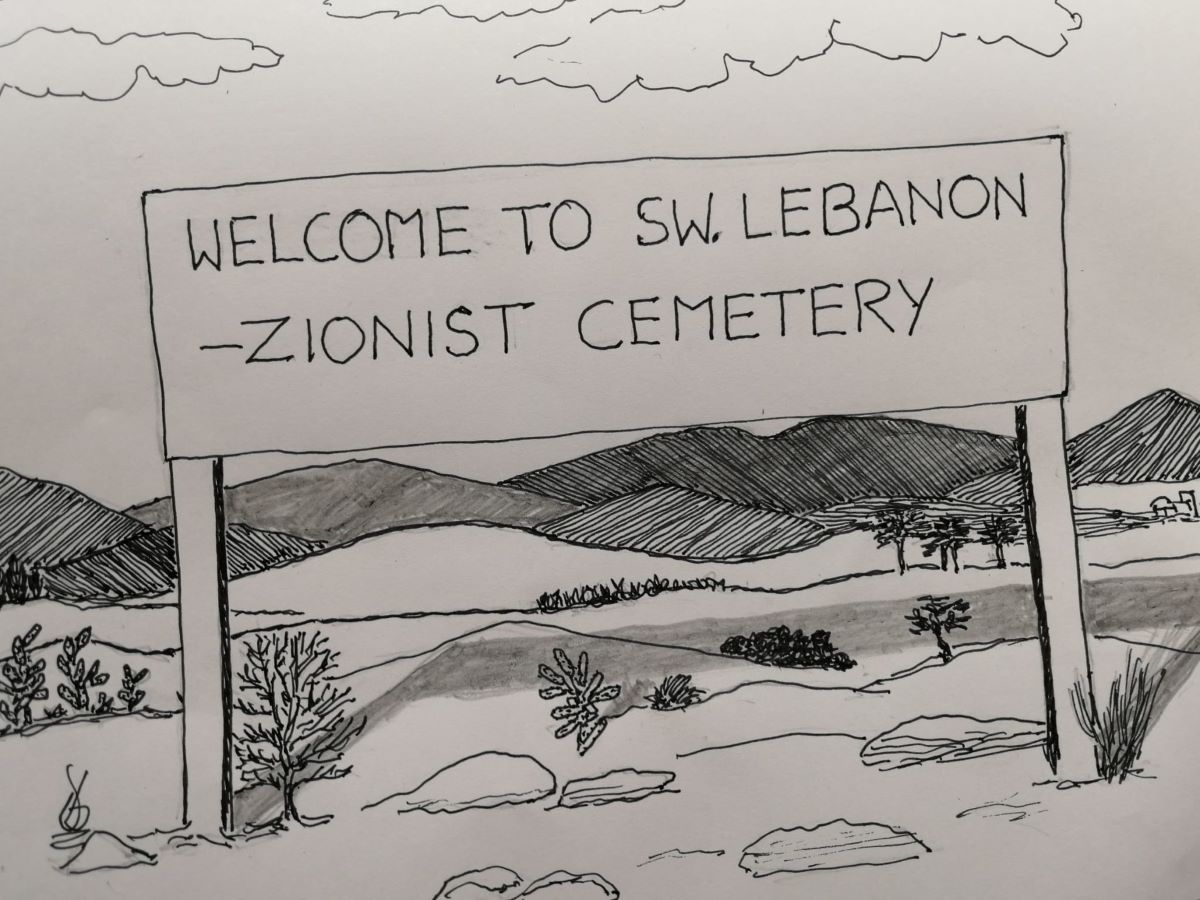
Cartoon comment on the constant defeat of Israeli invading forces by Hezbollah in 2024 and 2025. (Cartoon: D.Breatnach)

This was so effective that the Zionist state sued for a truce.

Meanwhile Hezbollah had been weakened by Israeli-programmed exploding pagers and mobile phone devices, along with the assassination of its widely-respected and charismatic leader, Hassan Nasrallah and agreed to the truce which it has scrupulously observed to the time of writing,

However, the same truce has at the time of writing been violated over 10,000 times by the Zionist armed forces2 in daily drone strike assassinations, bombings of homes and construction sites, troop invasions and checkpoints on Lebanese soil and even kidnappings of citizens.3

All without a word of condemnation from the truce’s guarantors, the USA and France, the former loud in its demands for Hezbollah disarmament along with threats by Trump and Netanyahu.
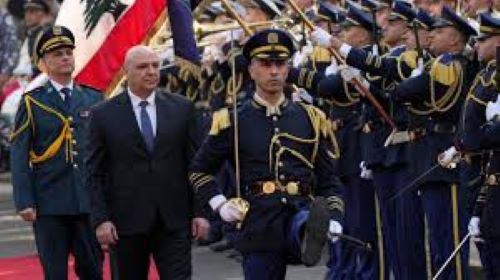
Joseph Aoun (centre, in civilian suit) upon his inauguration as President of Lebanon, reviewing troops of which had only recently been Commander in Chief. (Photo sourced: Internet)

SUMMARY AOUN’S STATEMENTS WITH COMMENTS

The Lebanese army has many missions and cannot focus solely on one task. Israeli occupation persists, and attacks continue. Halting attacks and Israeli withdrawal would greatly help accelerate progress.

Yes indeed and people may wonder why a) the Lebanese state forces are not in action repelling that very ‘Israeli’ occupation and attacks and b) why the disarmament of the Resistance is even being contemplated in the current circumstances.

  • Any assistance to the army facilitates operations. The decision has been made, and implementation speed depends on army leadership and available capabilities.”

It is not clear to which assistance Aoun is referring but otherwise he is admitting that the Lebanese Army is unable to disarm Hezbollah, a Resistance better-armed and more widely supported than the State Army and that serious attempts to do so would result in civil war.

• “The [resistance] weapons were initially deployed for a specific purpose when the army was absent. Now the army exists, and Lebanon’s armed forces are responsible for national security.

Clearly Lebanon’s armed forces are either unwilling or incapable of defending national security, since Aoun admits to the occupation and attacks by a foreign entity, which have been ongoing since the October 2025 ‘truce’.

  • The weapons no longer serve their role; their continued presence is a burden on their environment and Lebanon. This is not about Resolution 1701—the weapons’ mission is over.

To whom is the continued presence of weapons a burden? Are Lebanese people being attacked by those weapons? No, they are a burden only to the Zionist entity and its imperialist backers who wish to dominate West Asia – and of course to the domestic collaborators.

• “I want to tell others: it is time to be reasonable. Either you are truly part of the state or you are not. The state must take responsibility for protecting its citizens and land. The entire country bears this burden. Logic must prevail over force.”

This is clearly directed at Hezbollah and Amal, political forces represented in the Lebanese Parliament. If the state must take responsibility for protecting its citizens and land, then why not actually do so and demonstrate the alleged lack of necessity for the weapons of the Resistance?

What Aoun really means is that while there is an effective armed resistance, he will not be left in peace by the Zionist State or by US imperialism. And why not? Because they seek to dominate West Asia, which in itself proves the need for an effective armed Resistance.

• “Official positions are taken by official institutions. Lebanon will not be a platform threatening other states’ stability. During summer rocket attacks, the intelligence directorate apprehended the perpetrators quickly and warned Hamas officials they would be expelled if repeated. We will not allow Lebanon to be used for unwanted actions.”

The ‘Summer rocket attacks’ were not from Hezbollah but, if not from provocateurs, were an independent and unprofessional unit – this is well-known.

• “The appointment of Ambassador Simon Karam was made internally in Lebanon, not at the request of the US or any foreign party.”

Hmmm. Even if that were true, it cannot be denied that he is the choice of the USA.

• “Lebanon’s interest requires that decisions be made within the country. No one will fight or stand for us; all parties must cooperate with the state for Lebanon’s benefit.”

If the state wants cooperation for Lebanon’s benefit, surely it should first show itself deserving of that cooperation by standing up for its sovereignty against Zionist invasion, bombings and assassinations, along with Western imperialist threats and bullying?

• “Lebanon has three tools: diplomacy, economy, and military. We have tried war—it ended. Diplomatic paths offer a 50% chance of progress. Political negotiation, not war, resolves conflicts globally—Vietnam, Irish Republican Army, Gaza. Lebanon must pursue diplomatic solutions.

The war cannot be counted as ‘ended’ with over 10,000 Zionist violations of the ‘truce’, nor did the State ‘try war’, it was entirely Hezbollah resisting the attempted Zionist invasion although as is its wont, the Zionists did bomb civilian homes and infrastructure in Lebanon.

Political negotiation works when the state with which being negotiating either a) would rather not have war or b) is afraid to attack. The first case clearly does not apply to the Zionist State, nor will the second if the resistance is unarmed and all they have to worry about is Lebanon’s Army.

The examples Aoun quotes actually work against his theoretical trajectory: one proves the exact opposite and another two are not at all functioning in the interests of the people nor of secure peace.

The US was forced to negotiate with the Vietnamese liberation forces because of the strength of the latter’s resistance, after nearly 20 years of war.4 Even so, the US dragged out the negotiations until the liberation forces entered Saigon and US helicopters left in a hurry.

The Zionists continue to attack Gaza daily although they have levelled most of it. The Provisional IRA has not won Irish independence or territorial unity, the aims for which it declared it had been fighting and its political arm5 is now serving the administration of the colonial Occupation.

As has been pointed out many times in Rebel Breeze, the imperialists and their stooges learn from and copy one another’s tactics which was demonstrated very clearly in the trajectory of the imperialist pacification processes and how they contaminated a number of resistance movements.

There is never any reason for a national Resistance movement to surrender any of its weapons before the establishment of a strong independent state, well-armed and led by determined and uncorrupted people.

People very different from Youssef Rajj, Foreign Affairs Minister of Lebanon, who in interview with Sky News Arabia stated that as long as Hezbollah holds on to weapons, ‘Israel’ is entitled to attack Lebanon. Apart from its traitorous nature, the statement is not even formally correct.

Youssef Rajji, Foreign Affairs Minister of Lebanon (Photo sourced: Wikipedia)

Officially a state of war still exists between the Lebanese state and ‘Israel’ so of course the Resistance is entitled to hold weapons. More fundamentally, no Government Minister should justify another state attacking their country (as for example Machado does in relation to Venezuela).

National servility, collusion and treason are seen around the world but fortunately so too is resistance.

End.

Note: If you found this article of interest, why not register with Rebel Breeze for free, so that you will be notified by email of subsequent articles. You can de-register any time you wish.

FOOTNOTES

1Most of these were present in the ‘Lebanese Forces’ who carried out the massacres of the Sabra and Shatilla Palestinian camps of 1,300 and 3,500 civilians—mostly Palestinians and Lebanese Shias—in the city of Beirut during the Lebanese Civil War (1975-1990).

2https://www.aljazeera.com/features/2026/1/7/israels-continued-attacks-on-lebanon-could-derail-hezbollah-disarmament

3By October 2025 UN experts had recorded “At least 19 abductions of civilians from Lebanon by Israeli soldiers, which may amount to cases of enforced disappearances …” https://www.ohchr.org/en/press-releases/2025/10/un-experts-warn-against-continued-violations-ceasefire-lebanon-and-urge

4That was with the USA (also Australia). Before that the Vietnamese Resistance fought and defeated the French and Japanese.

5The Sinn Féin party, which is also the party with the second highest representation in the parliament of the Irish State and seeks to form a governing coalition with one of the established neo-colonial parties.

BOBBY SANDS – FREEDOM FIGHTER AND BEACON FOR THE DIASPORA

Diarmuid Breatnach

(Reading time: 6 mins.)

The anniversary on Sunday of the death on hunger strike of IRA Volunteer Bobby Sands was marked with a number of posts on social media. I would like to add an Irish migrant’s1 perspective and some analysis of his legacy.

The Irish diaspora was a powerful sector in solidarity for the Irish struggle not only because of their cultural background but also because of their numbers. Some British cities had an estimated diaspora population of 10% (Irish-born and 1st and 2nd generations).

Furthermore, the higher proportion of those in turn was of the working class, a section of society which, although they in no way had their hands on the standard levers of power, certainly had a strong potential of the kind the British ruling class had learned to fear.

Irish Republicans of course formed part of that sector and organised within it but on the other hand the IRA’s bombing campaign in Britain was of no help at all. The popular fear of being caught in an explosion greatly enabled the Government to tighten the screws under the guise of “security”.

Karl Marx, a strong supporter of Irish freedom had commented after the Clerkenwell prison bombing of 18672 that “One cannot expect the London proletarians to allow themselves to be blown up in honour of the Fenian emissaries” (i.e who they were trying to free from the jail).

In 1974 the Labour Government had repressive legislation ready and on 29 November, using hysteria arising from the Birmingham and Guildford pub-bombings they rushed through the Prevention of Terrorism Act (1974) which permitted the holding of suspects for two days without charge.

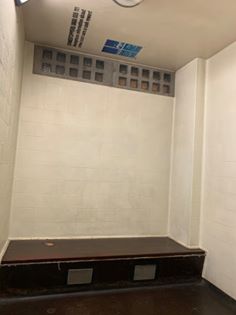
An underground cell in London’s Paddington Green police station – this is where Irish detainees under the Prevention of Terrorism Act might be kept and interrogated for seven days without visitors or access to solicitor. “The old cells were 12-foot square, contained no windows and were reportedly too hot in the summer and too cold in winter(Wikipedia).(Photo: Posted in 2020 on Internet by Green Anti-Capitalist Front who occupied the empty building intending to turn it into community centre.)

That could be extended for another five days – and often enough was — by application to the Home Secretary. Access to solicitor was usually denied and though not lawful, the fact of the detention itself was often denied to concerned people making enquiries of the police station.

The prospect of disappearing for seven days into police custody somewhere was naturally terrifying and a ‘suspect’ could also be deported without trial to Ireland – even to the British colony of the Six Counties, which amounted according to their law to “internal exile”.

Snapshot of London police harassment and intimidation of Irish solidarity activists in 1981. (Photo sourced: Internet)

The framing of a score of innocent Irish people3 in five different trials4 with very heavy sentences added to the intended terrorising of the Irish community in Britain, the “suspect community”5, many of whom believed the victims to be not only innocent but most not even politically active.6

Irish solidarity activity in Britain diminished greatly after 1974 as state repression impacted across the Irish community. But the hunger strikes and concerns to save the lives of the strikers in 1981 broke the hold of state terror as people took to the streets in their thousands once again.

They were unsuccessful but never returned to that state of immobilising fear that had settled over the community.

The Irish in Britain Representation Group got its initial start in 1981 which happened as follows: the bourgeois Federation of Irish Societies had its AGM in May 1981 and one of the members proposed that a motion of sympathy to the Sands family be recorded when he died.

IBRG and Irish Republican POW Support Committee banners on march Birmingham 1984 (Source: Mullarkey Archive)

The meeting’s Chairperson ruled the proposal out of order and ‘the Fed’ continued with their ordinary business. The then Editor of the Irish Post7, writing in his “Dolan” column, found this disturbing and suggested there might be a need for a new type of Irish community association.

A number of individuals wrote in and the ball got rolling, though it took until 1983 to set up the branch-based organisation with a constitution and democratic safeguards in operational rules. The IBRG soon had a number of branches in London and others in the North and Midlands.

For the next two decades the organisation campaigned for the release of the framed prisoners, against the Prevention of Terrorism Act, strip-searching, all racism but in particular the anti-Irish and anti-Traveller varieties, for Irish representation in education, services, Census category, etc.

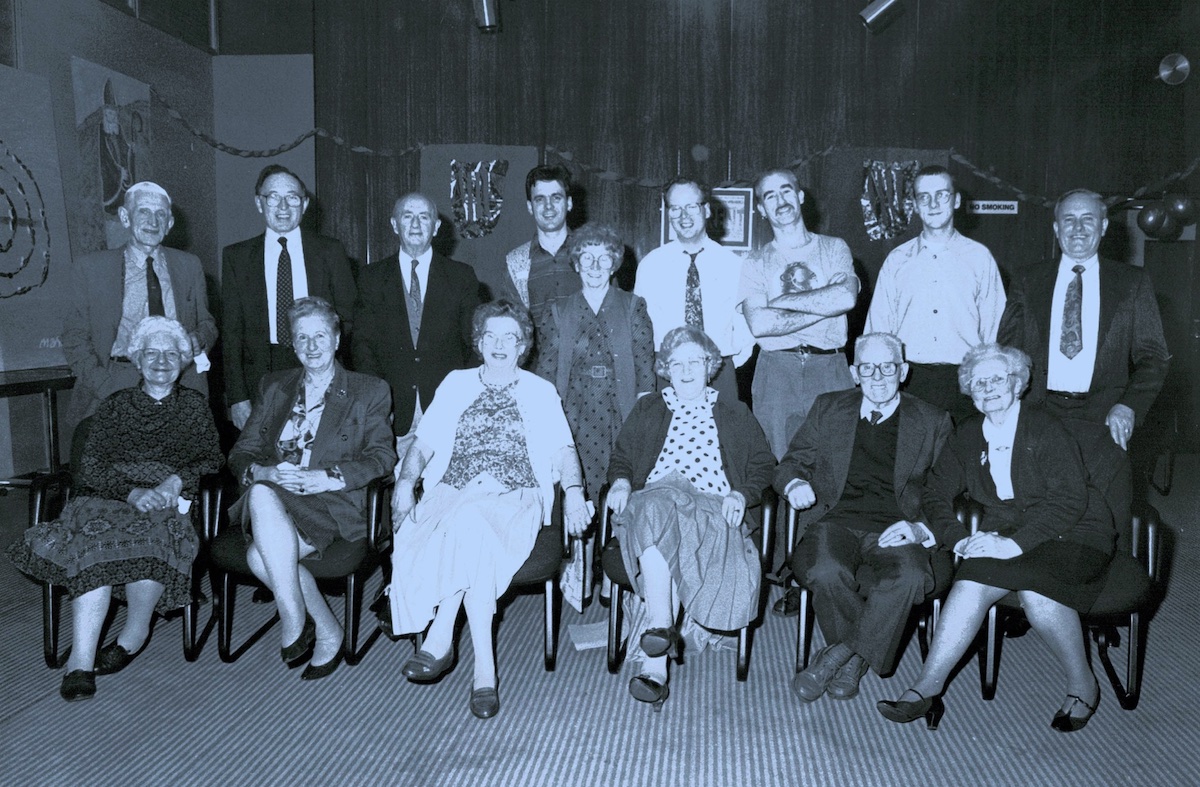
Lewisham Irish Centre Management Committee and Staff, possibly 1994. The Centre was campaigned for and won by the Lewisham Branch of the IRBG in conjunction with the Lewisham Irish Pensioners’ Association (which the IBRG had also founded).

The IBRG also called for British departure from Ireland and collaborated with other organisations in marches, demonstration, pickets, conferences, producing also a number of important report documents. The organisation’s officers were drawn from migrant Irish and those born in Britain.

THE LARK8 – a poem

Last night, from afar, I watched the Lark die

and inside me, began to cry,

and outside, a little too.

There’s nothing more that can now be done,

to save the life of this toilers’ son;

another martyr – Bobby, adieu.

Imperialism takes once more its toll,

another name joins the martyrs’ roll

and a knife of sadness runs us through.

But sorrow we must watch,

for it can still,

yes, it can kill

the song that Bobby listened to.

And if his death be not in vain,

let’s fuel our anger with the pain

and raise the fallen sword anew;

and this sword to us bequeathed:

let its blade be never sheathed

’till all our foes be ground to dust

and their machines naught but rust ….

Then will the servant be the master

and our widening horizons ever-vaster

and our debt

to Bobby

paid

as due.

(D.Breatnach, May 1981, London)

Bobby Sands Mural on gable end of a house in Belfast (Photo cred: Brooklyn Street Art)

REPRESENTATION OF BOBBY SANDS

Bobby Sands was a man of great courage whose leadership qualities were recognised by his fellow political prisoners when they elected him as their Officer Commanding in the H-Blocks. He was also an accomplished writer and poet.

When the British reneged on the agreement that ended the 1980 hunger strike and a new one was planned, Sands insisted on being first on the list, which also meant that in the event of resulting deaths, his would be the earliest.

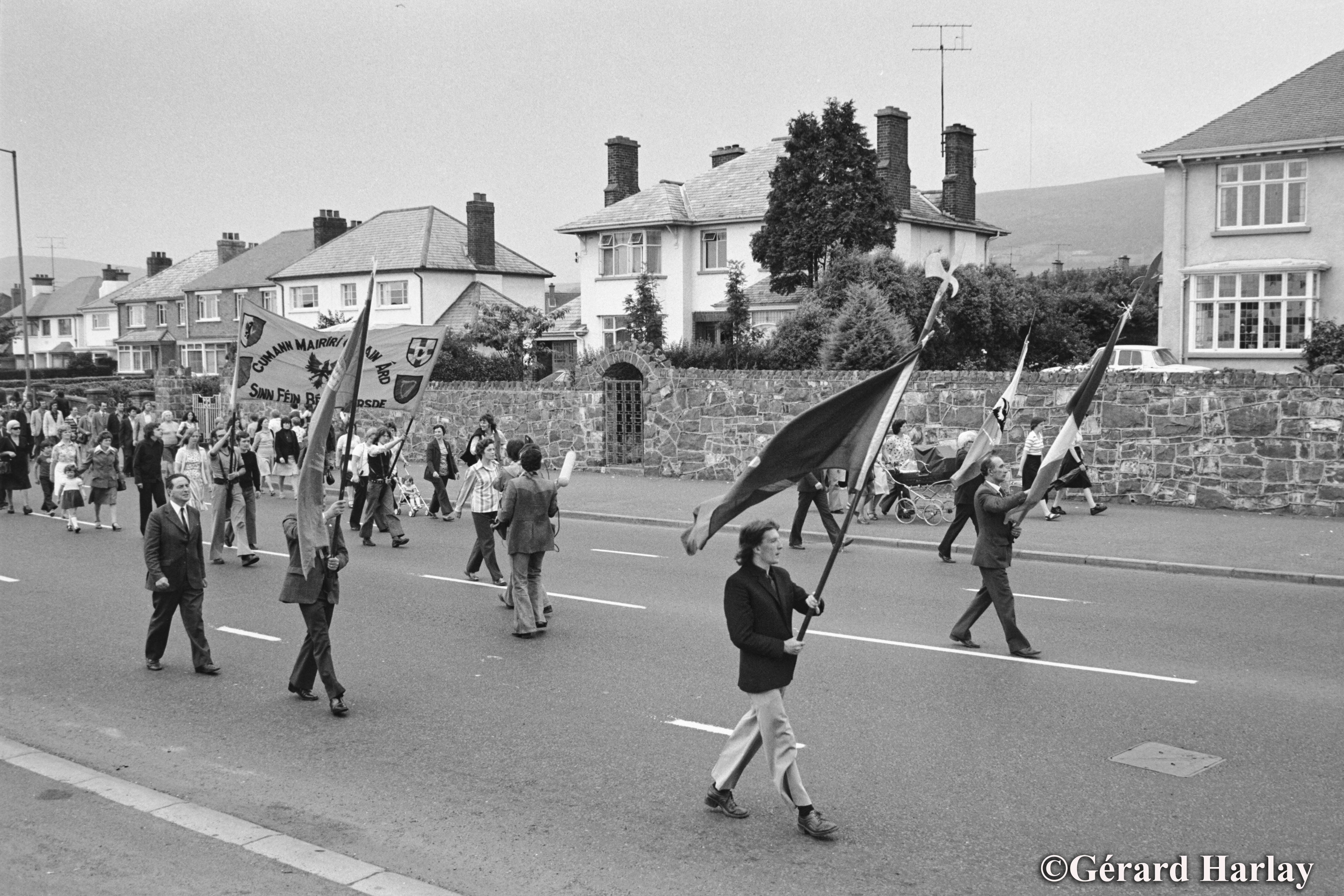
Bobby Sands (front left, colour party), Andersonstown Road,1976. (Photo: Gérard Harlay Archive)

Most people will agree easily with all the above evaluation of the man but from that point onwards, his representation is manipulated to suit different agendas, in particular those of pacifists, social democrats, liberals and a variety of opportunists.

Some of them love above all his quotation that “Our revenge shall be the laughter of our children”. They forget many other things he wrote and seek to turn him into an angel or saint of pacifism.

Since they embraced the pacification process, Sinn Féin try to represent Sands as an advocate for and proof of the effectiveness of participating in the parliamentary electoral system, based on his success in a 1981 Westminster by-election with 30,492 votes, 51.2% of the total of valid votes.

What both these groups fail to recognise is that Sands was an IRA volunteer and was sentenced for possession of handguns in 1972 and again in 1976. If he was an angel, it was of the Archangel type, fighting against what he considered evil.

He was proposed in the Fermanagh-South Tyrone by-election mainly in order to support the campaign of the prisoners against criminalisation and for the political status recognition that they had previously. Saving the lives of the hunger strikers was of course part of the plan too.

Nine protesting Republican prisoners contested the general election in the Irish State in June. Kieran Doherty and Paddy Agnew (who was not on hunger strike) were elected in Cavan-Monaghan and Louth respectively, and Joe McDonnell narrowly missed election in Sligo-Leitrim.

But that is a long way from proving that the electoral process is a viable way of dislodging the ruling class and their system and, in fact, history has proven the opposite.

Nobody knows what position Sands and the other nine would have taken on the electoral process had they lived. Possibly some would have gone along with the SF leadership on that and some others would now be reviled as “dissidents” (as are indeed some H-Block survivors).

All we can say for certain is that they were men of courage in that all of them had joined the armed struggle for Irish national liberation. They had even higher courage of a level hard to imagine, to risk and then experience slow physical disintegration and death by the day and by the hour.

Long after their erstwhile prominent enemies are forgotten, their names will shine in our history and Bobby Sands’s, the brightest of them all.

End.

FOOTNOTES

1At the time I was living and working in England.

2A bomb was planted against the prison wall to free a member of their group who was being held on remand awaiting trial at Clerkenwell Prison, London. The explosion damaged nearby houses, killed 12 civilians and wounded 120; no prisoners escaped and the attack was a failure. Michael Barrett was found guilty of the bombing despite his claim supported by witness testimony of having been in Glasgow during the bombing and was hanged on Tuesday 26 May 1868 outside Newgate Prison, the last man to be publicly hanged in England (the practice was ended from 29 May 1868 by the Capital Punishment Amendment Act 1868). https://en.wikipedia.org/wiki/Clerkenwell_explosion.

3Carole Richardson of the Guildford Four was not Irish but she was the girlfriend of one of three Irishmen.

4Birmingham Six, Guidford Four, Giuseppe Conlon, Maguire Seven and Judith Ward. They were not acquitted and released until decades later, by which time Giuseppe Conlon had died in jail.

5Suspect Community by Paddy Hillyard, Pluto Press (1993)

6Believing them innocent and not active worked even better to terrorise because if the likes of those could be framed and jailed, no-one was safe. But perhaps safest was to do absolutely nothing to draw the attention of the State.

7Brendán Mac Lua, co-founder of the Irish community newspaper in 1970 which is now a very different periodical.

8The lark is associated with Sands because he wrote a story about a man who had captured a skylark, a bird that unusually sings in flight. In the cage the bird would not sing so the man draped the cage with cloth and still the bird would not sing, nor would it do so when he refused it food and water until eventually, it died in the dark, silent to the last.

REFERENCES

Powers under the Prevention of Terrorism Act: https://cain.ulster.ac.uk/hmso/pta1974.htm

LEARNING FROM AND CORRECTING OUR MISTAKES

Diarmuid Breatnach

(Reading time: 6 mins.)

In all areas of endeavour and no less in revolutionary work it is essential to review our actions (and those of others) periodically in order that we may draw lessons to improve the success of future activity.

Irish history provides an abundance of material to revise.

The most recent period worthy of intensive review in my opinion is the three-decade war, mostly in the Six Counties but also having repercussions within the territory of the Irish State, in Britain and even further abroad.

An article in the July issue of An Phoblacht Abú1, monthly hard-copy newspaper of the Anti-Imperialist Action organisation, discusses the psychological and organisational problems arising from the way that three-decade struggle came to an end and its effects on the resistance movement.

That period in Ireland commenced with a struggle for democratic civil rights, not one of the demands of which were for more than was already well established in the rest of the ‘UK’. But it soon changed into a guerrilla war with huge numbers of political prisoners and jail struggles.

The movement experienced a number of splits and changes of leadership but for most of of the time it was led by the Provisional organisation’s leadership although changes took place inside its own leadership too.

Ruairí Ó Brádaigh, President Provisional Sinn Féin 1970-1983, speaking at GPO rally 1976. He led an unwinnable war. (Photo cred: Pat Langan/ Irish Times)
Some of the Provisional IRA leadership following the 1970s split: Martin McGuinness, Dáithí Ó Conaill, Sean Mac Stiofáin, IRA press conference 1972, Derry. (Photo cred: Larry Doherty)

The period ended with that leadership not only abandoning armed struggle but being coopted with its structures into joint management of the colonial occupation and preparing for joint management of the neo-colonial Irish state, a number of smaller splits in the movement a much disillusion.

The An Phoblacht Abú article concentrates on building or rebuilding trust in leadership through measures such as clear communication, discussion, organisational restructuring, collective solidarity, open discussion, transparent communication and education.

The article does not say this but in my opinion one of the basic educational needs is to acknowledge that in the circumstances, what happened was inevitable (and to consider how different circumstances might be constructed in future).

UNWINNABLE

It is essential in my view to acknowledge that the struggle, as it was waged, was bound to lose. Yes, unwinnable: an unassisted armed struggle against a world imperialist power fought primarily in one-fifth of our territory where the population is deeply divided – how could we think otherwise?

Clearly, the Provisional leadership did think otherwise. Assuming they were not insane or very stupid, on what could their belief have been based?

I can see only two rational possibilities:

1) They believed the British had no essential need to retain the 6-Co. Colony and would abandon it if put under enough pressure, or

2) that the Irish ruling class, through its government, would step in and join the struggle.

If they believed the first, their analysis was not historically-based. Since its invasion and occupation of Ireland in the mid-12th Century, the British ruling class has repeatedly gone to enormous efforts to suppress Irish self-determination.

When they had the opportunity to leave in 1921 they had cultivated a client bourgeoisie, then instigated a civil war and partitioned the land, leaving themselves a firm foothold in the country.

Their initial response to a call for simple civil rights in the late 1960s was violent suppression on the streets, abolition of habeas corpus and introduction of internment without trial – and army massacres.

If the previous lessons of history were not clear to the movement’s leadership, then those events up to 1972 should have made them crystal clear.

If the Republican leadership believed the Irish ruling class would step up, they failed to draw the lessons of history since at least 1921 and to understand the neo-colonial nature of the Gombeen class, amply illustrated in the preceding 50 years of the Irish State.

As embarked upon and fought, the war could not be won but a struggle was potentially winnable.

However, to have a chance of winning, the struggle would have to be over the whole 32 Counties. And to engage the maximum number of people, it would have to take up the social, cultural, economic and political deficits across the Irish state and across the colony.

The social rights of women and LBG2 people were widely-acknowledged deficit areas, yet the Republican movement did not seriously address them. Of course, doing so would have put the Movement in direct opposition to the Catholic Church hierarchy and its followers.

Why should that be a problem? Hadn’t the Hierarchy been pro-British occupation since the late 1800s3 and anti-Republican since the 1790s? Wasn’t it one of the cornerstones of the neo-colonial Irish State, its social prop and social control mechanism?

Yes but the problem was that some of the leadership themselves were in that ideological ambit and were in any case afraid to disaffect many of their followers. A natural fear, of course. Yet only in that way could the struggle go forward across the Irish state’s territory.

It was left to campaigners mostly outside the Republican Movement, including social democrats and liberals, to fight for the rights to contraception, divorce, equality for women, LGB rights. And later, to take on the huge institutional abuses of the Catholic Church in Ireland.

Those issues affected directly well over half the population of the Irish state and the the leadership lacked the interest or the courage4 to take part in their struggles, never mind lead them, which it left to mostly non-revolutionary leaderships.

There were many other issues that affected people in the 32 Counties which a revolutionary leadership could take up and, I would argue, should have taken up.

The latter includes emigration, rights of the Irish diaspora (particularly in Britain), foreign penetration of the Irish economy, foreign land ownership, housing shortage, industrial struggles, academic freedom, Irish language rights, Church control of education and the health service …

Some of those issues were taken up for a while by the movement in parts of the 26 Cos. prior to the split in the Republican Movement but were progressively dropped as the armed struggle in the 6 Cos. took off.

When years later the Provisional leadership got interested in social democratic reformism, they found they could hardly make any headway in the unions against the Labour Party and the remains of the Workers’ Party – because of the Provos’ earlier overwhelming neglect of that area of struggle.

SUMMARY

The struggle in the Six Counties could not be won precisely because it was primarily confined to that area and also one in which a powerful enemy had seduced a huge section of the population.

When the leadership acknowledged the unwinnability of the struggle as being waged, instead of changing their methods and aims of struggle to take in the whole 32 Cos, they decided on capitulation and getting the most possible out of it for themselves.

A change in the top leadership of Sinn Féin and the IRA: Gerry Adams and Martin McGuinness photographed in 1987. They recognised they could not win and set about managing abandoning it while getting something out of the system for the leadership. (Photo: PA)

The leadership of the Republican movement was unwilling to widen the struggle because they believed that it was unnecessary to do so and/ or they were unwilling to overcome their own ideological indoctrination and/or lacked the courage to confront prejudices among their following.

Some of the social struggles have now been won or hugely progressed but without the leadership of the Republican Movement, in fact by leaderships of mostly reformist trends.

Due to leaving the industrial struggle to social democrats, the trade union movement has degenerated hugely and is in a poor state to take on any substantial economic or rights struggle, to say nothing of a revolutionary one.

The surviving Republican movement seems unwilling to acknowledge those historical facts and its failure thus far in leadership. Admission of the facts is necessary in order to commence to repair the movement and to prepare for a struggle with a prospect of success.

End.

FOOTNOTES

1Page 9, entitled COMRADESHIP – GUARD AGAINST BETRAYAL; I intend to review the July issue of the newspaper separately some time soon.

2I have omitted the T from LGB because it is only comparatively recently that the transexual issue has gained wide acknowledgement, whereas the Gay, Lesbian and even Bi-Sexual issue were widely known about at the time under discussion.

3The Irish (settler) Parliament passed an act giving middle-class and higher Catholics the right to vote in 1793.

4Though no-one could fault their physical courage

“The Yank”: A Review

Gearóid Ó Loingsigh (republished from Socialist Democracy November 2022 with kind permission of the author)

(Reading time: 8 mins.)

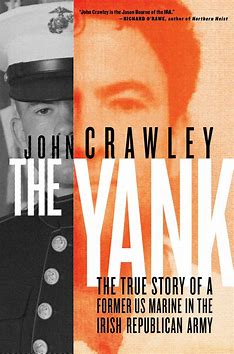
At first when I heard about this book, I thought it would be some spoof by a wannabe and wasn’t inclined to take it seriously.  That was a mistake.  The Yank is an entertaining and informative tale of the exploits of a Yank who joined the IRA. 

That in itself would be a story worth telling, except John Crawley’s life in the IRA was no ordinary story.  He comes across as a committed and dedicated Irish republican and even a veritable James Bond, though he might not like the comparison with the fictional agent of British imperialism and murder at her majesty’s request.

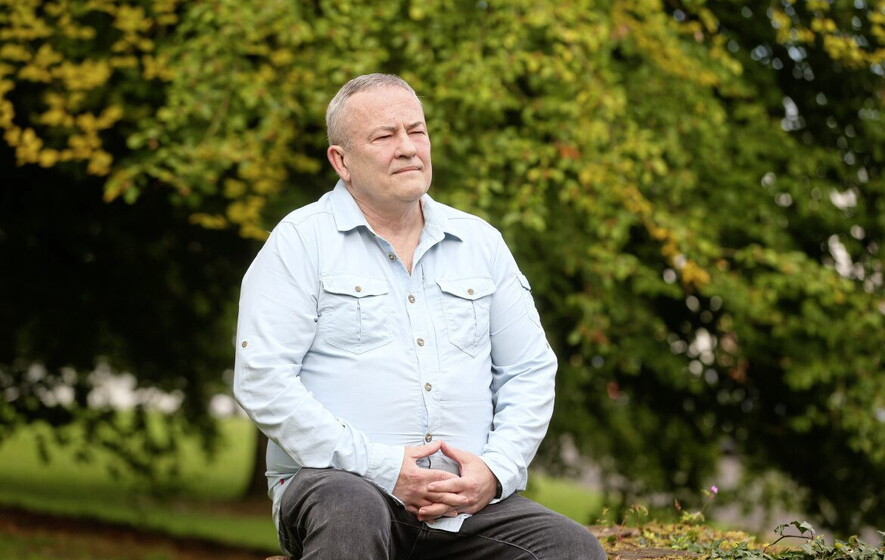
John Crawley, former US Marine and subsequently Provisional IRA Volunteer (Photo sourced: Irish News)

Crawley was a young man raised in the US, who when his family moved back to Ireland eventually decided to go back to the US and joined the Marines, with just one purpose in mind, to become a fighting and killing machine and return to Ireland to join the IRA. 

By fighting and killing machine, I don’t mean some mindless grunt as the Yankee military might put it.  He was determined and trained hard and excelled, to such a point that the US intelligence services wanted to recruit him and when he took the decision to come back to Ireland the US military were sorry to see him go. 

He was one of their best, something they recognised and tried to take advantage of.  Sadly, his undisputable abilities were not recognised by the IRA and Martin McGuinness in particular.  They had apparently little use for his rather unique skill set, which would be considered to be invaluable in any armed organisation, except in the IRA under Adams and McGuinness.

Crawley tells his autobiographical story in a very readable fashion; at times you feel you are having a fireside chat with a rather likeable man.  It is an easy read and worth it. 

The book has received some criticism from bourgeois critics who would rather that he just told his story of a Yank in the IRA, much like Mark Twain’s A Connecticut Yankee in King Arthur’s Court

But his tale is not one of fiction and the politics of Ireland are intimately bound up with his decision to join the IRA and remain in it, even after a lengthy prison sentence following his capture on the Marita Anne, when he and former Sinn Féin T.D. Martin Ferris tried to import arms to Ireland.

His politics are important to the story.  He is at times quite blunt and even clumsy in how he states them, sounding very much like Ruari Ó Bradaigh at times, though in the last chapter his explanation of why he rejected the Good Friday Agreement is much better, sincere and at times hits the nail on the head. 

He dedicated his life to an ideal and fought for it.  He had never suffered at the hands of the Brits, nor does he seem to be caught up some dewy-eyed nationalist dream but rather he made an ideological decision to commit to something and stuck with it.  This ideal was betrayed and part of how it was betrayed is shown in his story. 

The late Martin McGuinness, Commander Derry’s IRA, one of SF’s main leaders and Deputy First Minister or Her Majesty’s Irish colony. Crawley found much to make him uneasy in McGuinness’ military leadership which also gave rise to other doubts. (Photo sourced: Internet)

He doesn’t set out to besmirch McGuinness and I have to admit that I never took seriously any of the conspiracy tales around McGuinness and Adams, but there are many details in the book that call into question what McGuinness was about and with whom in later years and I am now more sympathetic to some of these stories.

Crawley had a military expertise that few if anyone else in the IRA had and yet McGuinness the head honcho in the IRA whose later reputation as a military man would help sway the IRA towards the GFA and disarmament did not value his expertise or indeed listen to him. 

He describes him as military illiterate, something I am inclined to agree with.  But McGuinness could not only not be questioned politically, but militarily.  He remarks at one point about IRA operations and weaponry that

Martin went silent. I could see he was seething, but he said no more about it. I shut my mouth. The last thing I wanted to do was alienate him. I wanted to help the IRA beat the Brits. I wasn’t there to criticise him personally, although I believe that’s how he interpreted it. My heart fell into my boots.

I had expected to be led by skilled professionals, men who were technically and tactically proficient. A true professional would value the correction and pass it on to the men on the ground but not this fellow. He took it as an insult.

Because of his status and prestige in the movement, I knew that if Martin McGuinness said the rocket didn’t explode then, as far as the IRA was concerned, it didn’t explode.

Nobody was going to listen to what I had to say about it. It didn’t matter to me personally whether or not I was believed, but the real damage was to volunteers’ confidence in the weapon.

He deals with the politics of betrayal in the GFA, and though he laments and rails against the lack of professionalism from the IRA leadership and the consequences of the illiteracy of McGuinness & Co.

Crawley doesn’t deal with the politics of a movement where McGuinness and others who were undoubtedly careerists from the beginning were able to hold sway. 

How could a movement get away with sending out men and women to fight, die and kill and not try to do their best for them?  This question goes beyond the individuals concerned, though they played a major role in it.  This question is not answered. 

But he gives us a lot of information, some of which should raise questions about the IRA leadership in the minds of the reader and indeed Crawley who also deals with the issue.

Crawley made many suggestions to the IRA and McGuinness in particular about things they could do.  They ranged from simple stuff that every sniper have their own rifle adjusted for them, to other things. 

His ideas were, and pardon the pun, shot down.  Most of them were basic common-sense things, others were based on his extensive and intense experience in the US military. 

Perhaps McGuinness and Adams watched the wrong documentaries and war films, but some of his suggestions were not a million miles from common sense, but yet the military expert of the IRA, McGuinness rejected them.  Why? we do not know, though he does hint at it later in the book.

The politics aside, his book is a fascinating look at the life of an IRA volunteer, one who has not bowed down to the political correctness of the SF leadership.  His description of his time in England would be riveting, except we obviously know the outcome.  It is nevertheless interesting. 

Crawley has a gift for writing, and he should not stop now.  In all conflicts Historic Memory, as it is termed is important and just another battlefield.  His is a voice that deserves to be heard and one which has to date been drowned out by Adams and McGuinness loyalists.  He should write more about his experiences.

There has been a slew of publications and memoirs by IRA volunteers, many of them by Adams loyalists.  This is not one of them.  Prior to this, our only insight on the inner workings and politics of individual volunteers was through the Boston College. 

At the time Sinn Féin described it as a “touts’ charter”, due to the criticism levelled, by those who gave their testimony, at Adams and co.  Martin McGuinness is dead and there have been too many publications, sanctioned by the IRA, or at least not meeting with its disapproval for Crawley’s book to be placed in that category. 

Instead, they have opted, unsuccessfully, to ignore it, hoping just like the IRA it will go away.  That hasn’t happened and the book is doing well and deserves to be read.

End.